Republic of the Philippines
Department of Education
Division of Rizal
District of Taytay II
SAN FRANCISCO ELEMENTARY SCHOOL
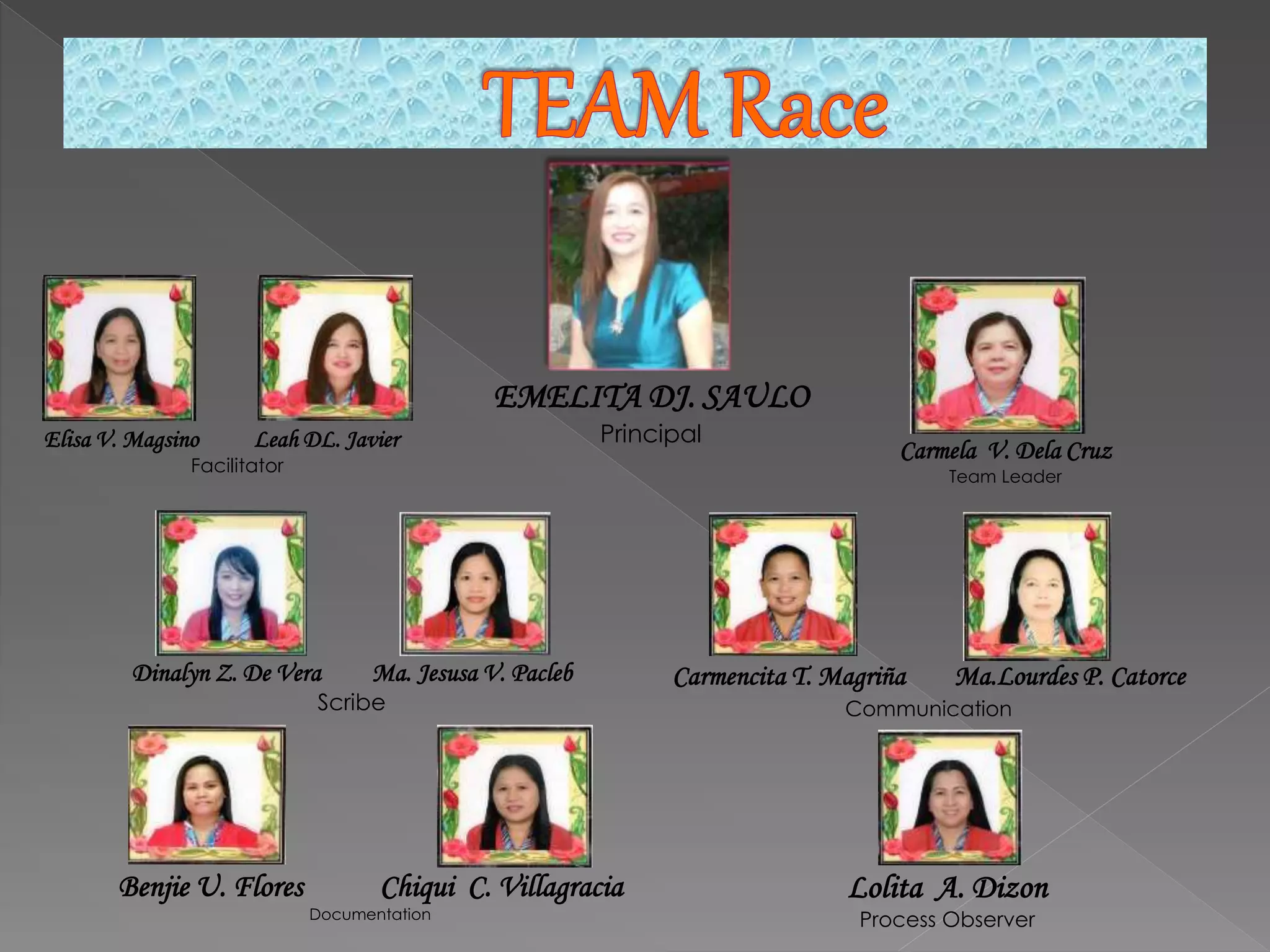
Elisa V. Magsino Leah DL. Javier
Facilitator
EMELITA DJ. SAULO
Principal
Dinalyn Z. De Vera Ma. Jesusa V. Pacleb
Scribe
Carmencita T. Magriña Ma.Lourdes P. Catorce
Communication
Benjie U. Flores Chiqui C. Villagracia
Documentation
Lolita A. Dizon
Process Observer
Carmela V. Dela Cruz
Team Leader
FUTURE STATE
BACKGROUND
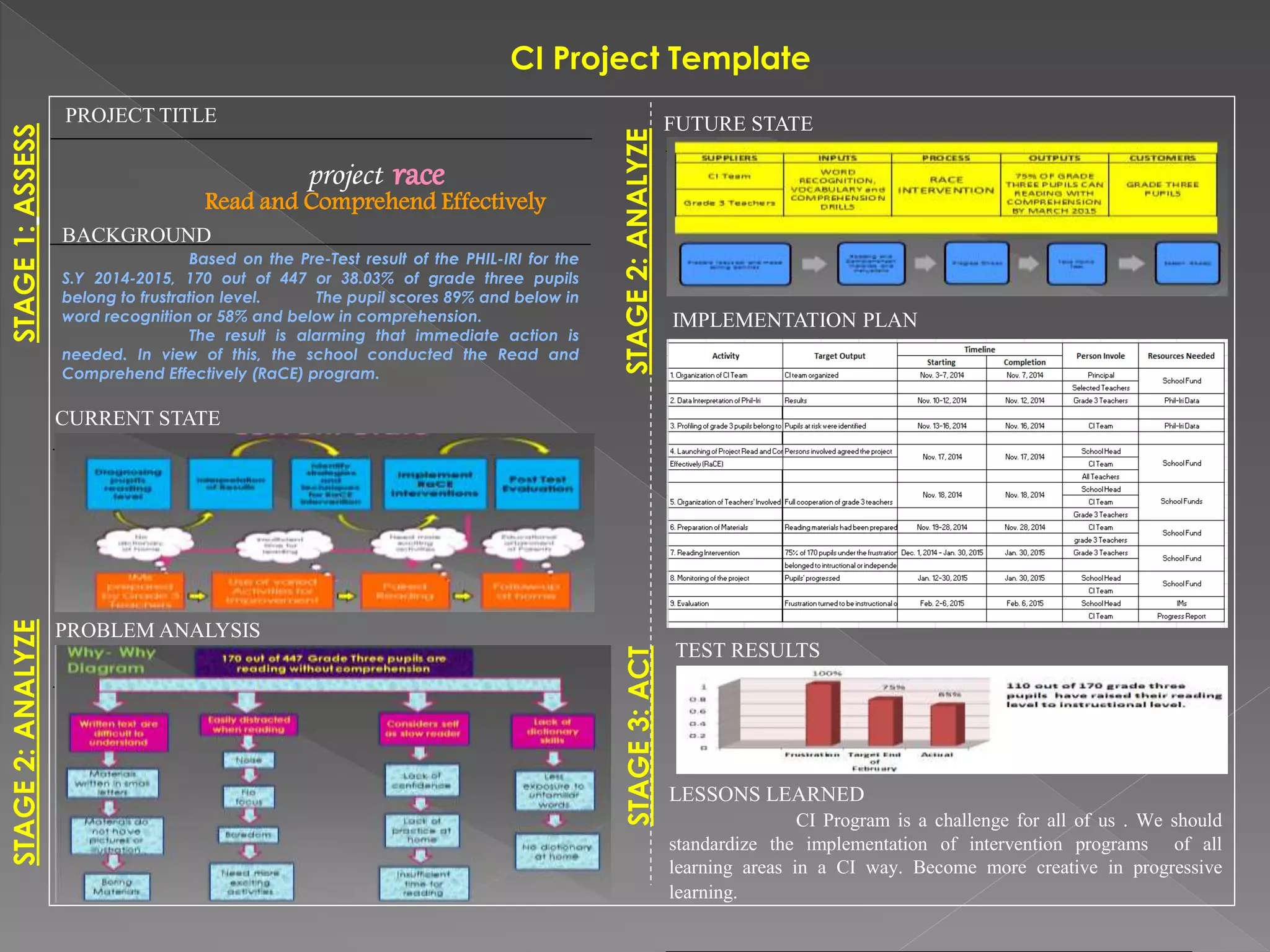
Based on the Pre-Test result of the PHIL-IRI for the
S.Y 2014-2015, 170 out of 447 or 38.03% of grade three pupils
belong to frustration level. The pupil scores 89% and below in
word recognition or 58% and below in comprehension.
The result is alarming that immediate action is
needed. In view of this, the school conducted the Read and
Comprehend Effectively (RaCE) program.
CURRENT STATE
PROBLEM ANALYSIS
IMPLEMENTATION PLAN
LESSONS LEARNED
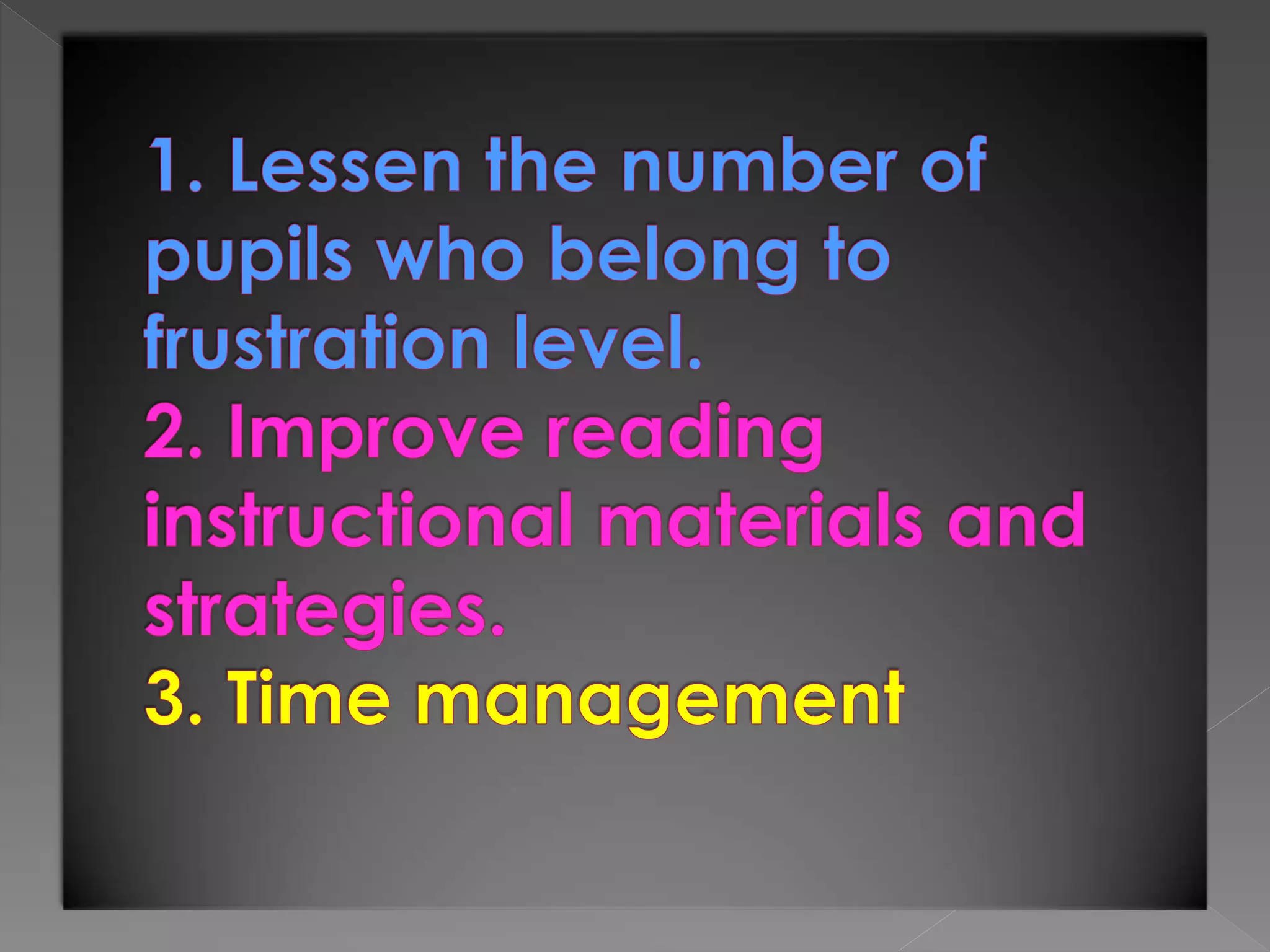
CI Program is a challenge for all of us . We should
standardize the implementation of intervention programs of all
learning areas in a CI way. Become more creative in progressive
learning.
TEST RESULTS
PROJECT TITLE
STAGE1:ASSESS
STAGE2:ANALYZESTAGE3:ACT
STAGE2:ANALYZE
CI Project Template
project race
Read and Comprehend Effectively
History
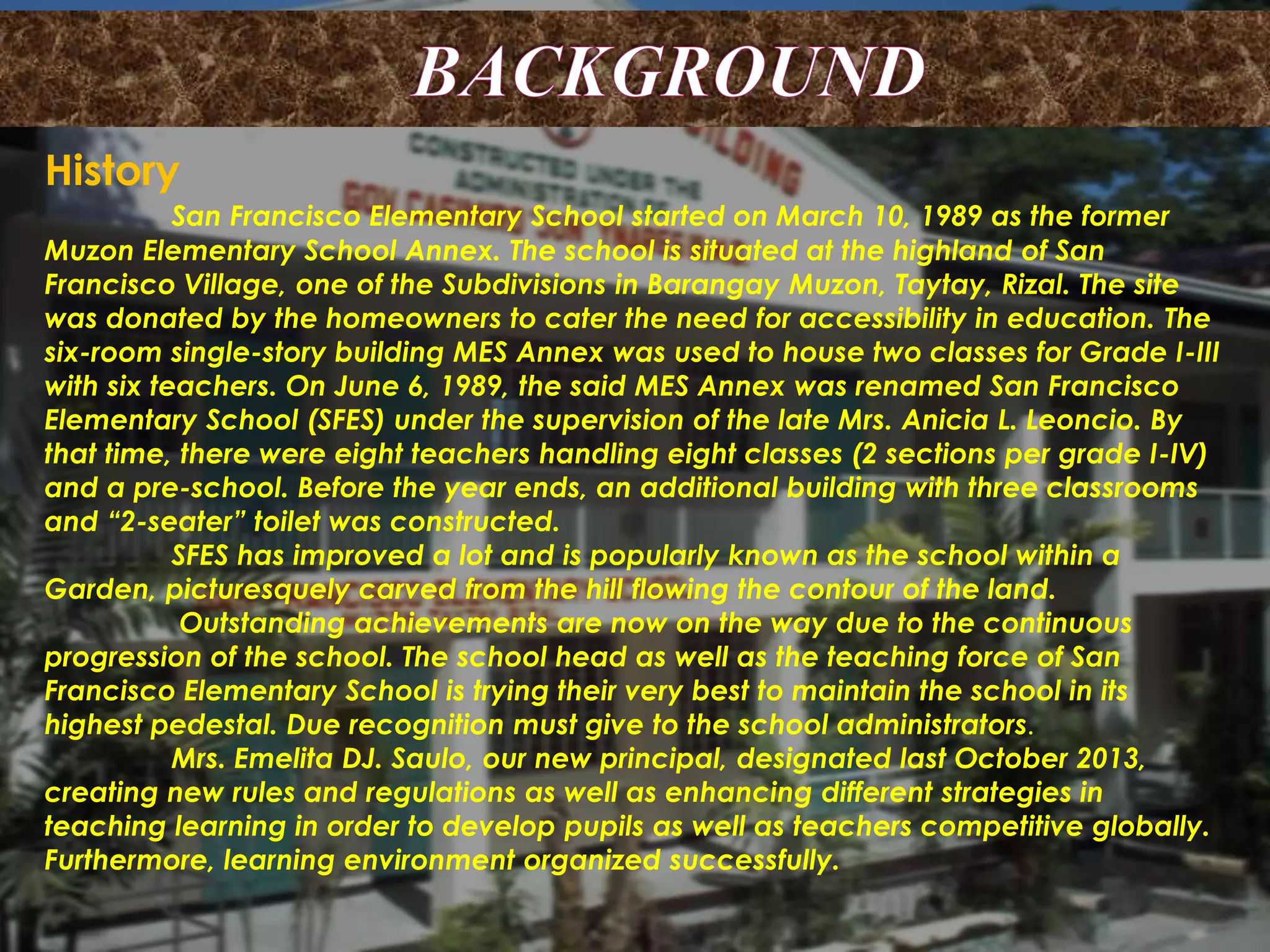
San Francisco Elementary School started on March 10, 1989 as the former
Muzon Elementary School Annex. The school is situated at the highland of San
Francisco Village, one of the Subdivisions in Barangay Muzon, Taytay, Rizal. The site
was donated by the homeowners to cater the need for accessibility in education. The
six-room single-story building MES Annex was used to house two classes for Grade I-III
with six teachers. On June 6, 1989, the said MES Annex was renamed San Francisco
Elementary School (SFES) under the supervision of the late Mrs. Anicia L. Leoncio. By
that time, there were eight teachers handling eight classes (2 sections per grade I-IV)
and a pre-school. Before the year ends, an additional building with three classrooms
and “2-seater” toilet was constructed.
SFES has improved a lot and is popularly known as the school within a
Garden, picturesquely carved from the hill flowing the contour of the land.
Outstanding achievements are now on the way due to the continuous
progression of the school. The school head as well as the teaching force of San
Francisco Elementary School is trying their very best to maintain the school in its
highest pedestal. Due recognition must give to the school administrators.
Mrs. Emelita DJ. Saulo, our new principal, designated last October 2013,
creating new rules and regulations as well as enhancing different strategies in
teaching learning in order to develop pupils as well as teachers competitive globally.
Furthermore, learning environment organized successfully.
Education aims to make every child a reader. Certain problems
and difficulties we encounter in reading really need an intervention
program wherein we can produce school children who are life-long
learners and readers through devoting time, commitment and
expertise.
There is only one way to control history and rein in the forces of
immoral and illiterate leadership and to mold the world into
something we can live in and that is to read books. If we relied on
our contemporary wisdom, we will find precious little time to see us
through our national and international crisis.
In short, we must read books, because reading a lot is one of
the powerful methods in increasing fluency, building vocabulary and
improving comprehension.
In addition to, this project utilizes strategies is a coordinated,
unified and holistic perspective using a comprehensive approach to
produce quality, proficient and independent reader. We can also
implement the different strategies that will provide opportunities for
children to develop the key life skill.
 Created and validated questionnaires
 Conducted survey thru questionnaires
 Gathered and tabulated the data
 Analyzed the gathered data
Questionnaire-Checklist
Part I. Respondents Personal Data
Name: __________________________________ Gr/Section: _________
Directions: Please supply the needed information by placing a check ( / ) mark
on the appropriate box.
Sex Female Male
Part II. Work Attitudes
Directions: Answer the following questions about your reading habits. Please
answer all questions truthfully. There are no rights or wrong answers.
Answering truthfully will help your teachers to help your teachers to become a
better reader. Please put a check ( / ) mark under the column heading which best
describes your feeling in every item following the given scale. Please do not
leave any item unanswered.
5 Always
4 Usually
3 Sometimes
2 Seldom
1 Never
Reading Habits 5 4 3 2 1
1. I give up when I find a story or written information difficult to
understand.
2. I use strategies to help me understand stories or written
information which I find difficult to understand.
3. I use dictionary when I can’t understand words.
4. I guess what will happen in the story before I read it.
5. I guess what will happen next to each event throughout the story
when I read.
6. I ask myself questions before I read the story.
7. I ask myself questions during onset reading of the story.
8. I ask myself questions after I read the story.
9. I relate the story to my own life when I read.
10. I can relate the story to something else e.g. TV programs,
movies watched when I read.
11. My parents often read books, newspapers or any reading
materials.
12. I consider myself a slow reader.
13. I spent a lot of time reading
14. I give up on reading assignments because they take too long,
15. I have trouble staying focused while I read.
16. I find myself thinking of other things as I read.
17. I am easily distracted with noise when I read at home or school.
18. I listen to music or watch TV when I am studying or reading.
19. I visualize or see pictures on my head while I am reading.
20. I express my difficulty in reading by saying “I hate reading”.
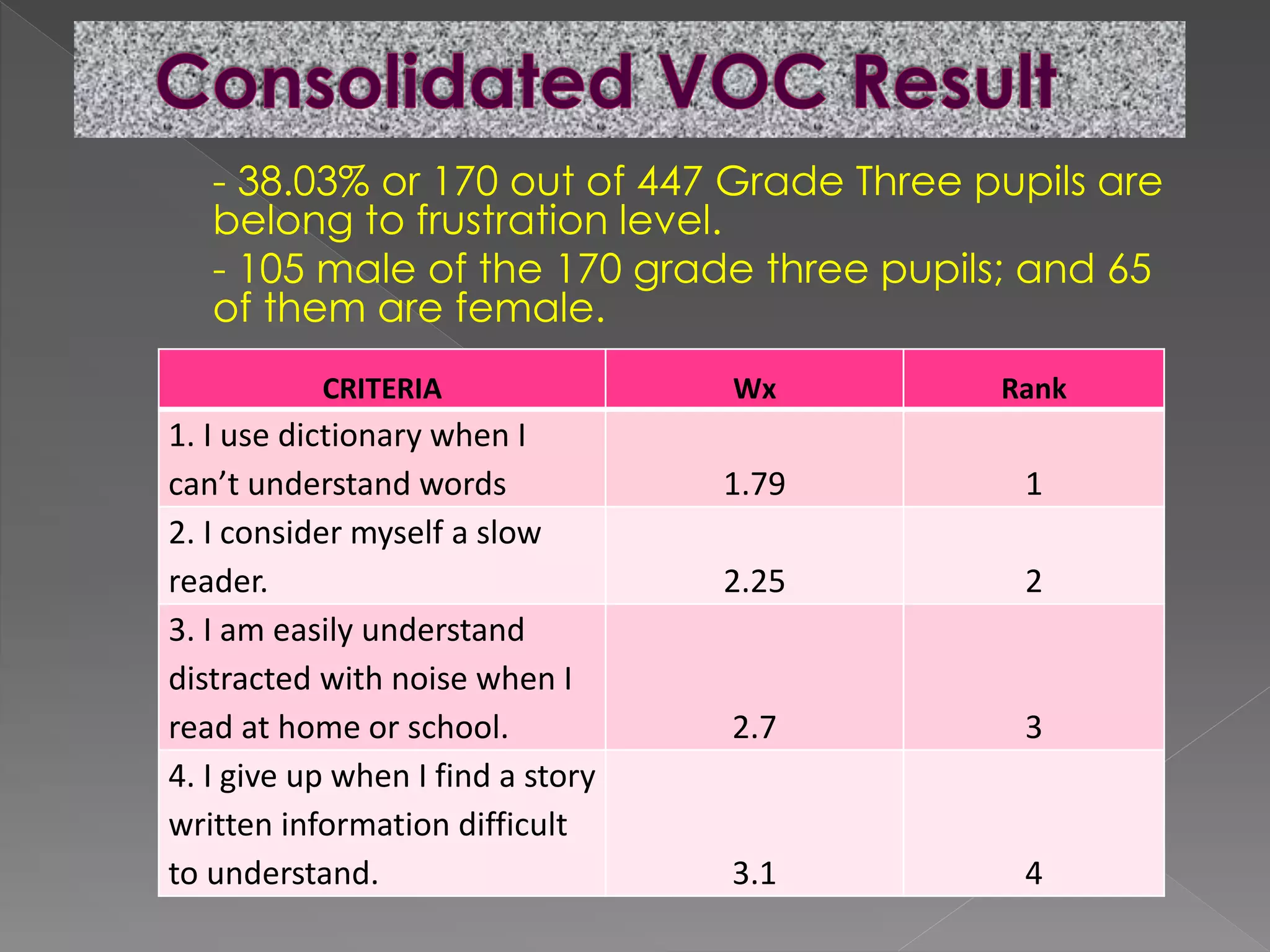
- 38.03% or 170 out of 447 Grade Three pupils are
belong to frustration level.
- 105 male of the 170 grade three pupils; and 65
of them are female.
CRITERIA Wx Rank
1. I use dictionary when I
can’t understand words 1.79 1
2. I consider myself a slow
reader. 2.25 2
3. I am easily understand
distracted with noise when I
read at home or school. 2.7 3
4. I give up when I find a story
written information difficult
to understand. 3.1 4
SUPPLIER INPUT PROCESS OUTPUT CUSTOMER
Principal
Phil- IRI
Materials
Conduct
Reading
Intervention
Phil- IRI
Results
Grade Three
Pupils
CI Team
San
Francisco
Elementary
School
Grade 3
Teacher
SIPOC
Diagnosing
pupils
reading
level
Interpretation
of Results
Implement
RaCE
Interventions
Identify
strategies
and
techniques
for RaCE
intervention
Post Test
Evaluation
IMs
prepared
by Grade 3
Teachers
Use of varied
Activities for
Improvement
Paired
Reading
Follow-up
at home
PROCESSSTEP
No
dictionary
at home
Insufficient
time for
reading
Need more
exciting
activities
Educational
attainment
of Parents
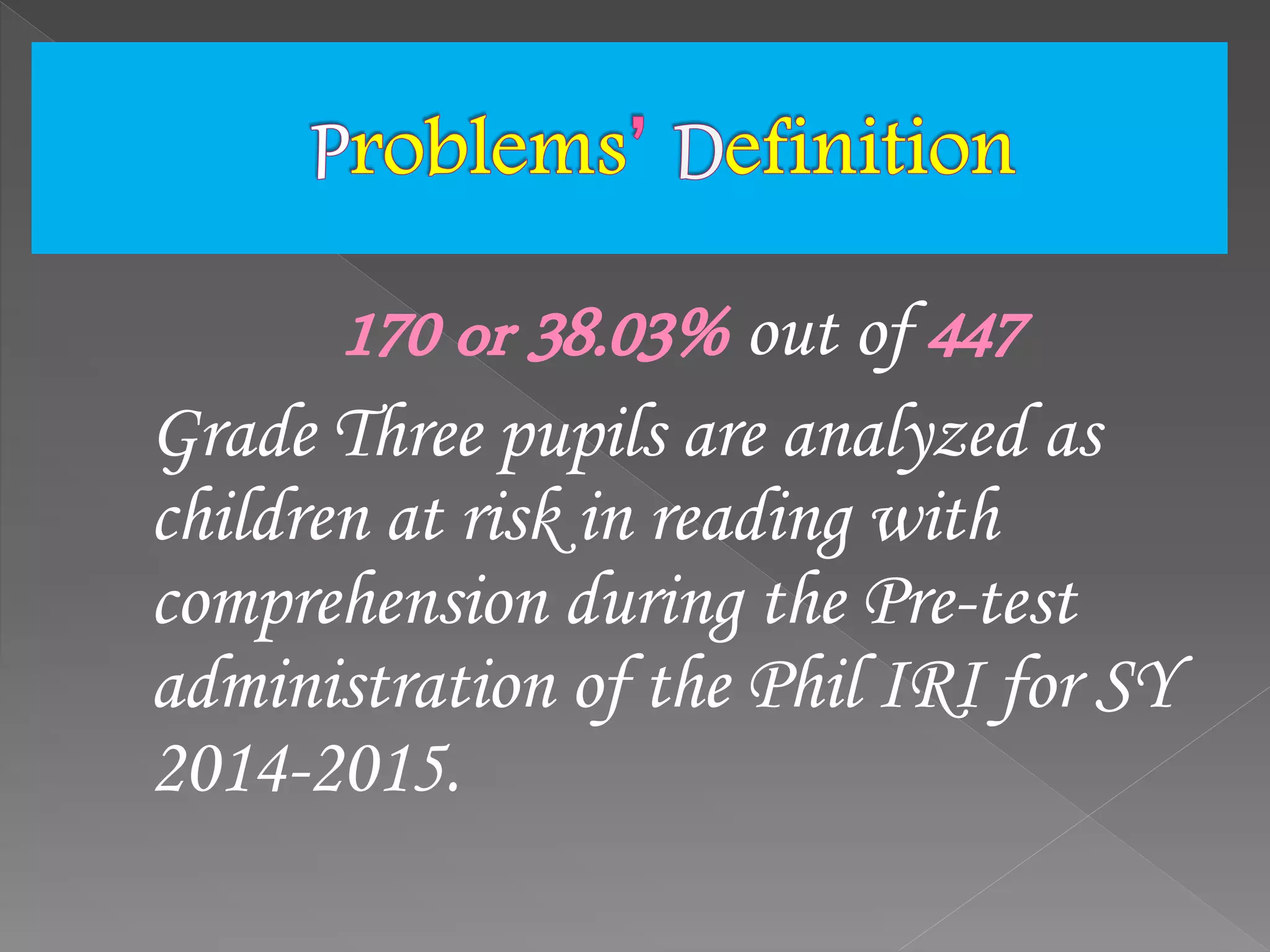
170 or 38.03% out of 447
Grade Three pupils are analyzed as
children at risk in reading with
comprehension during the Pre-test
administration of the Phil IRI for SY
2014-2015.
43.18
34.68
26.85
0.45
0
5
10
15
20
25
30
35
40
45
50
Frustration Instructional Independent Non Reader
Phil Iri Pre Test
Grade 3
13.67
35.76
50.57
0
Graphical Representation of Grade
three pupils in Frustration level
Frustration
Instructional
Independent
Non Reader
Lack of
dictionary
skills
170 out of 447 Grade Three pupils are
reading without comprehension
Materials
written in small
letters
Considers self
as slow reader
Written text are
difficult to
understand
Easily distracted
when reading
Less
exposure to
unfamiliar
words
Noise
Lack of
confidence
No dictionary
at home
No
focus
Boredom
Need more
exciting
activities
Materials do
not have
pictures or
illustration
Boring
Materials
Lack of
practice at
home
Insufficient
time for
reading
Why- Why
Diagram
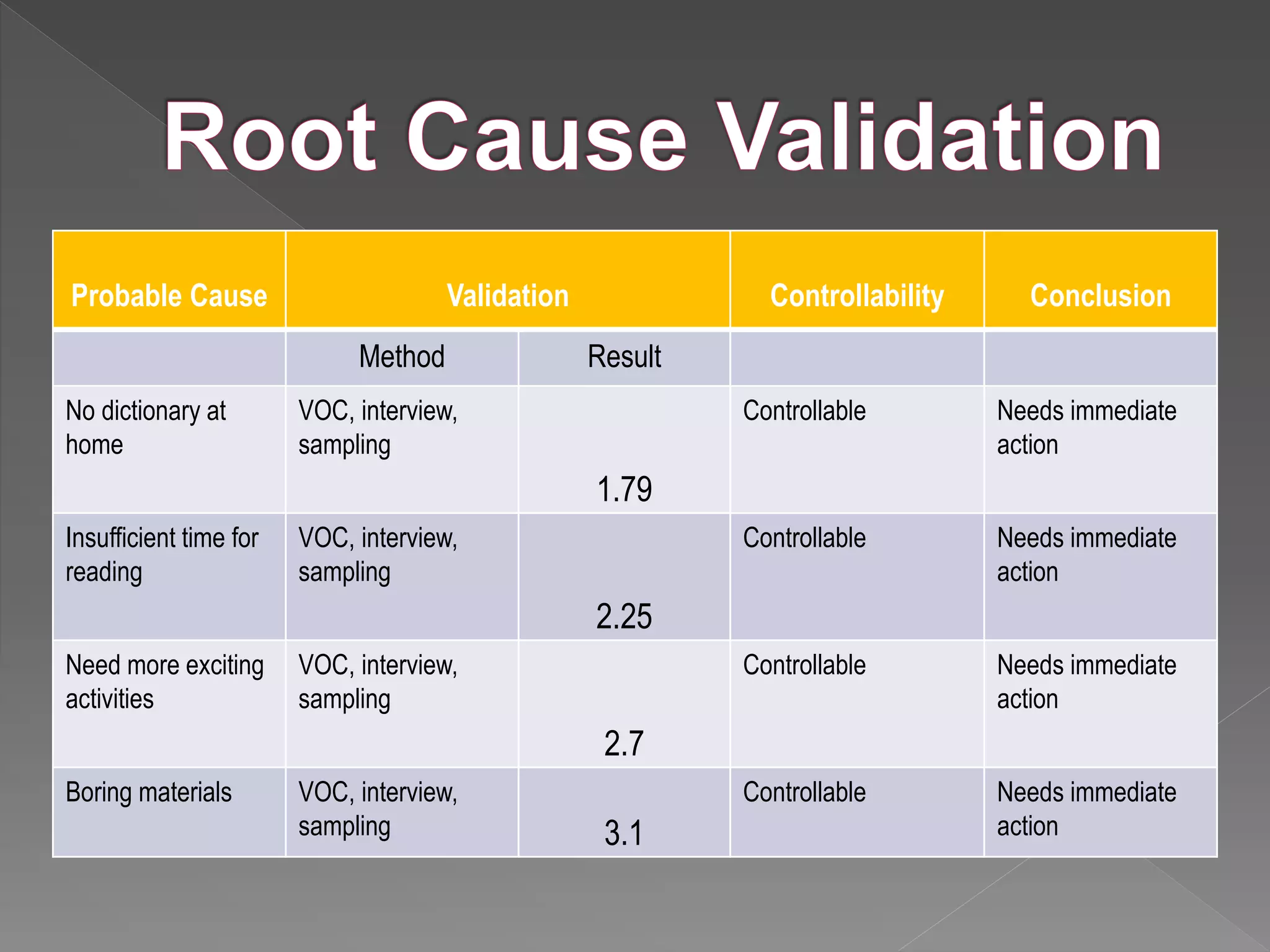
Probable Cause Validation Controllability Conclusion
Method Result
No dictionary at
home
VOC, interview,
sampling
1.79
Controllable Needs immediate
action
Insufficient time for
reading
VOC, interview,
sampling
2.25
Controllable Needs immediate
action
Need more exciting
activities
VOC, interview,
sampling
2.7
Controllable Needs immediate
action
Boring materials VOC, interview,
sampling 3.1
Controllable Needs immediate
action
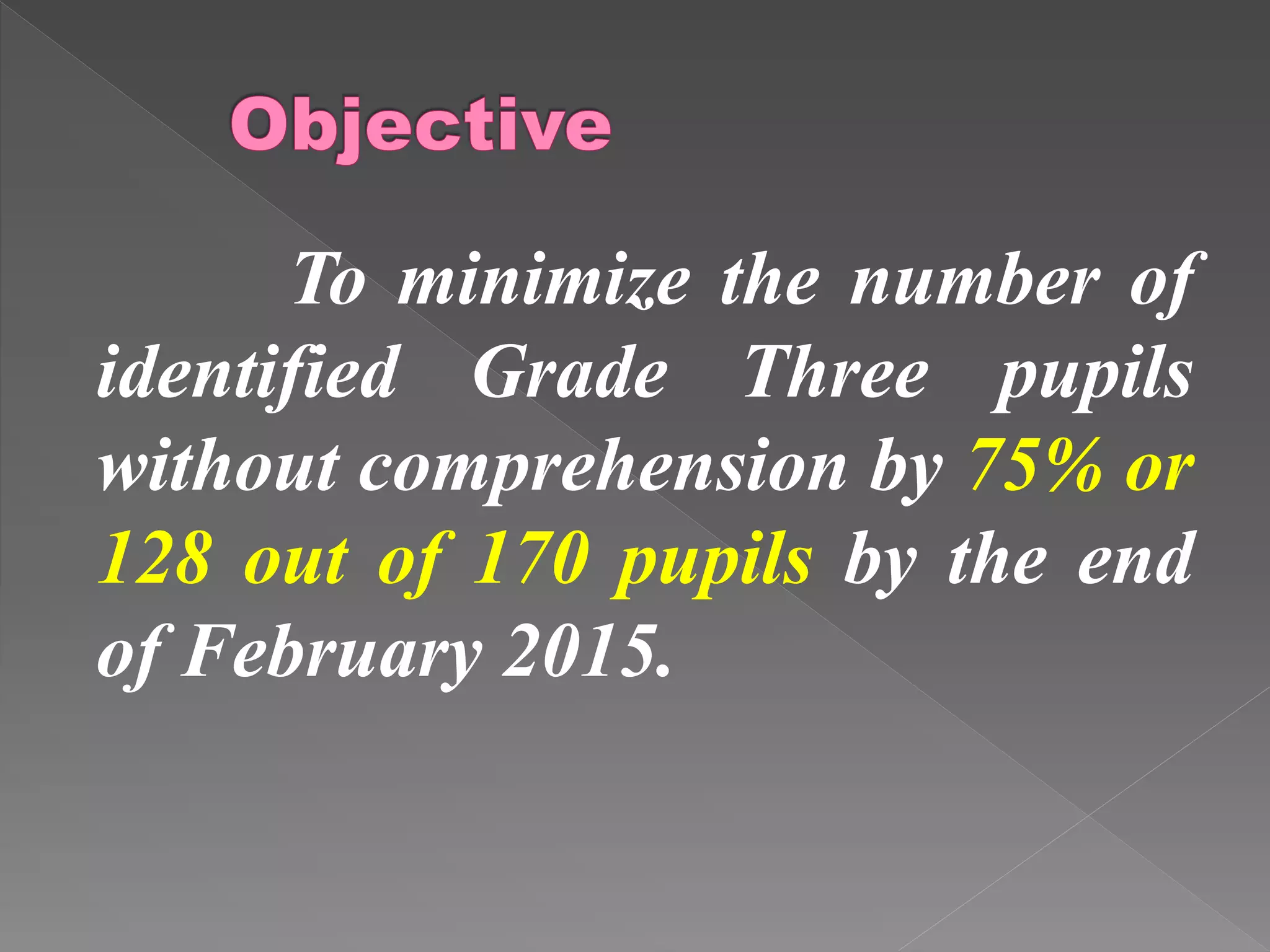
To minimize the number of
identified Grade Three pupils
without comprehension by 75% or
128 out of 170 pupils by the end
of February 2015.
Priority Root
Cause
Solution Recommended Improvement
No dictionary at
home
Unlocking words in
every lessons
Provide dictionary in every reading corner.
Insufficient time for
reading
Remedial in reading Make a schedule for reading session
Need more exciting
activities
More new hands on
activities
Search and create activities suited to the lesson.
Boring Materials IMs with colorful
pictures and written in
big letters
Prepare and reproduce big books and colorful
reading materials.
25
Process Steps
SUPPLIERS INPUTS PROCESS OUTPUTS CUSTOMERS
CI Team
WORD
RECOGNITION,
VOCABULARY and
COMPREHENSION
DRILLS
RACE
INTERVENTION
75% OF GRADE
THREE PUPILS CAN
READ WITH
COMPREHENSION
BY FEBRUARY 2015
GRADE THREE
PUPILS
Grade 3 Teachers
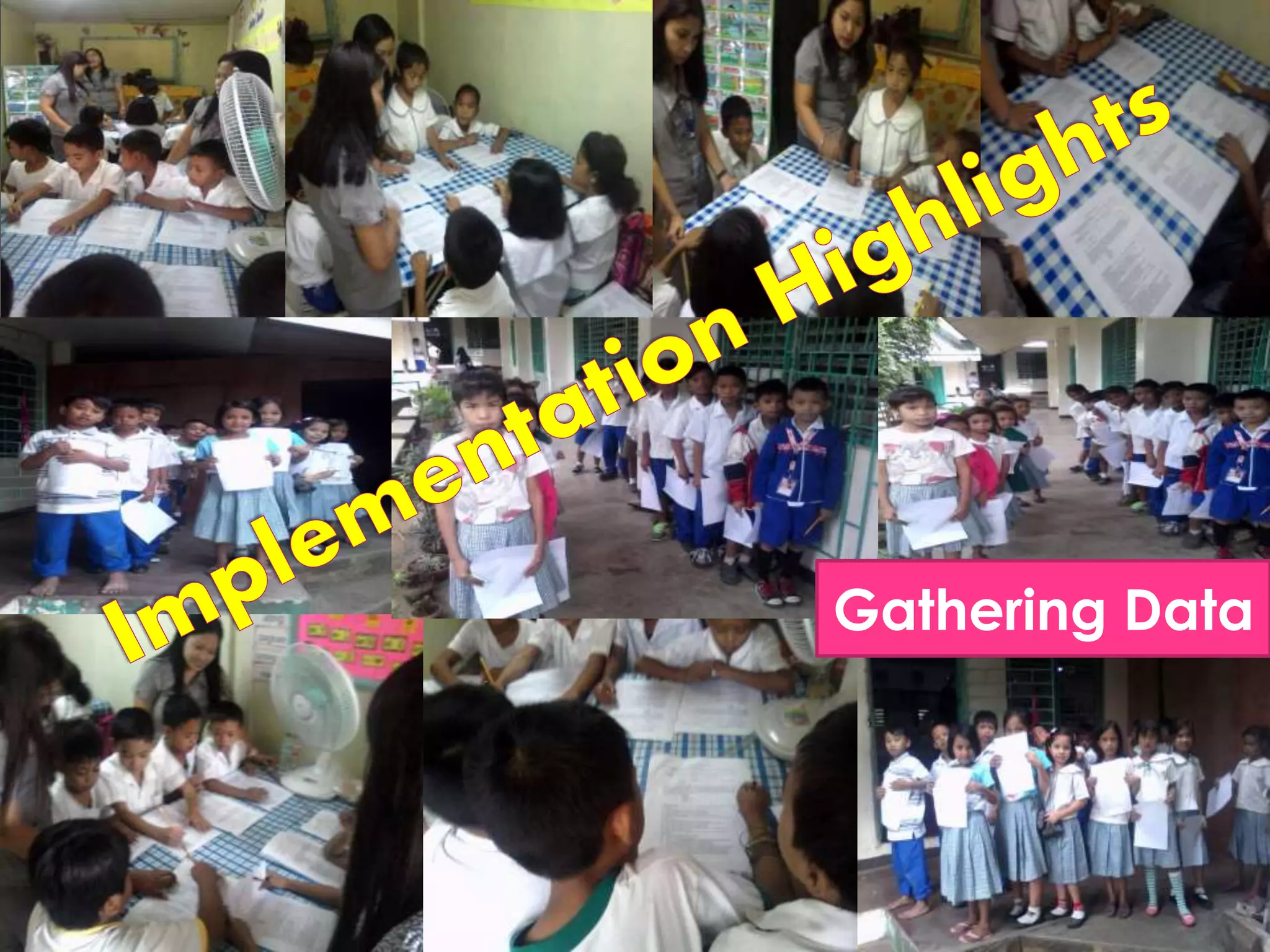
Implementation Highlights
Series of meetings with the CI
team   
Gathering Data
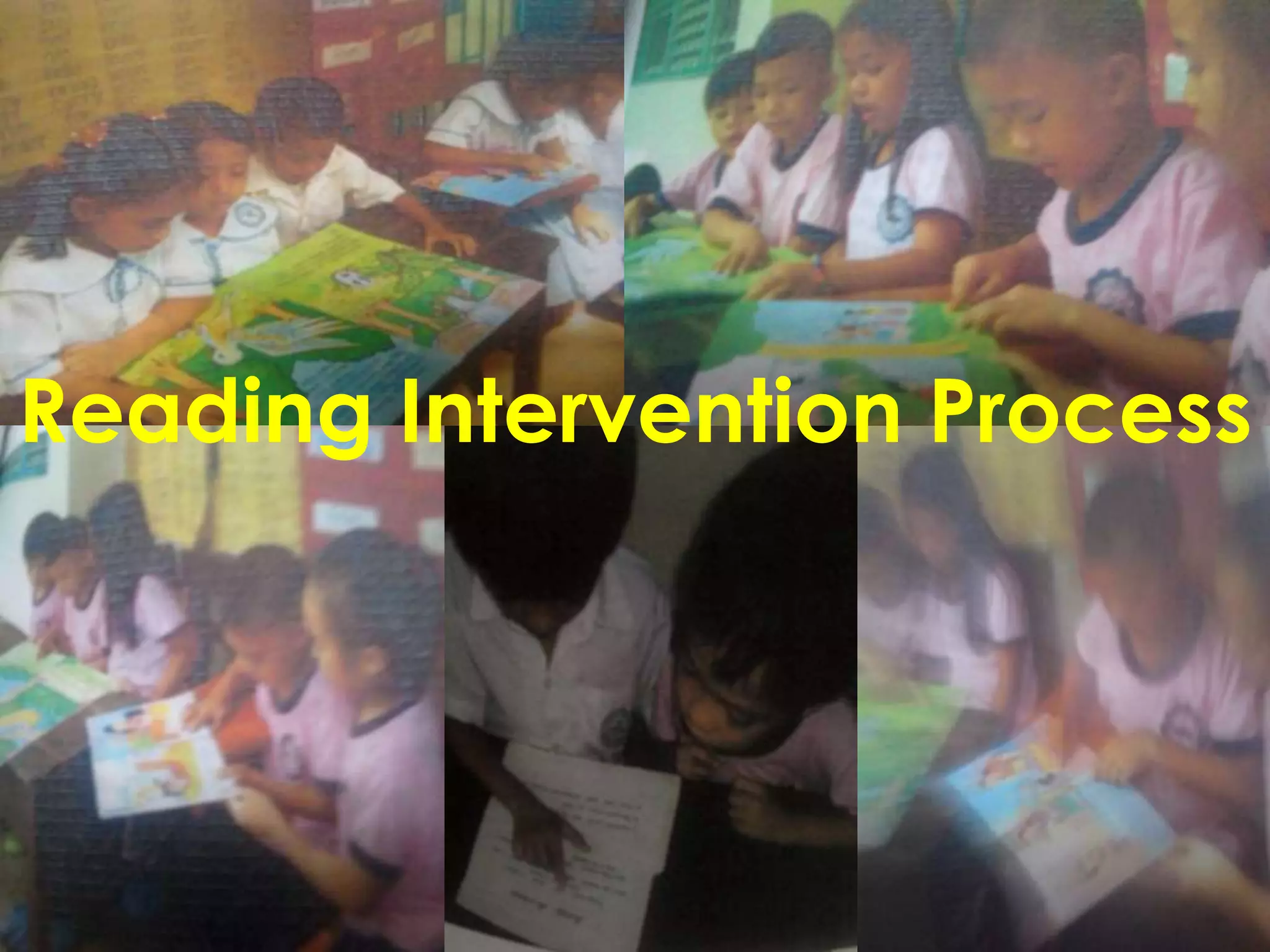
Reading Intervention Process
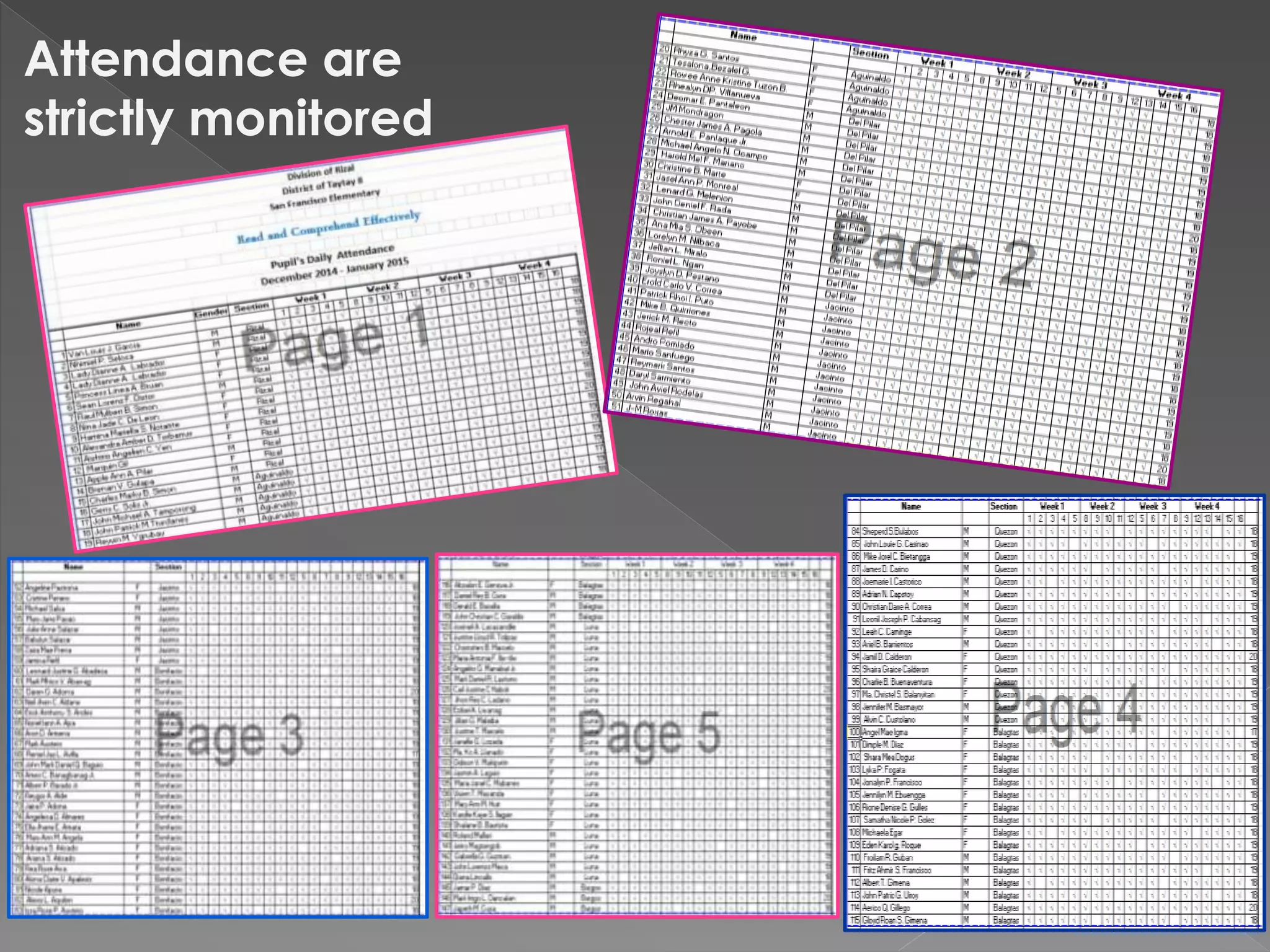
Attendance are
strictly monitored
CI (Continuous Improvement) is essentially a small step-by-step
incremental improvement strategy. It is based upon a belief that
continual improvement can be brought about by a never-ending
series of small changes. Even in the face of enormous innovative
improvement strategies, there will always be the need and
opportunity to supplement such strategies and initiatives with
continual small step changes.
1. Every teacher must motivate their pupils to develop reading habit
and love for reading.
2. Every pupil must be identified on their reading level.
3. A yearly school based training of teachers in reading.
4. To talk with parents to minimize absences in the class.
5. To award the reading teacher with exemplary performance.
0%
10%
20%
30%
40%
50%
60%
70%
80%
90%
100%
Frustration Target End of
February
Actual
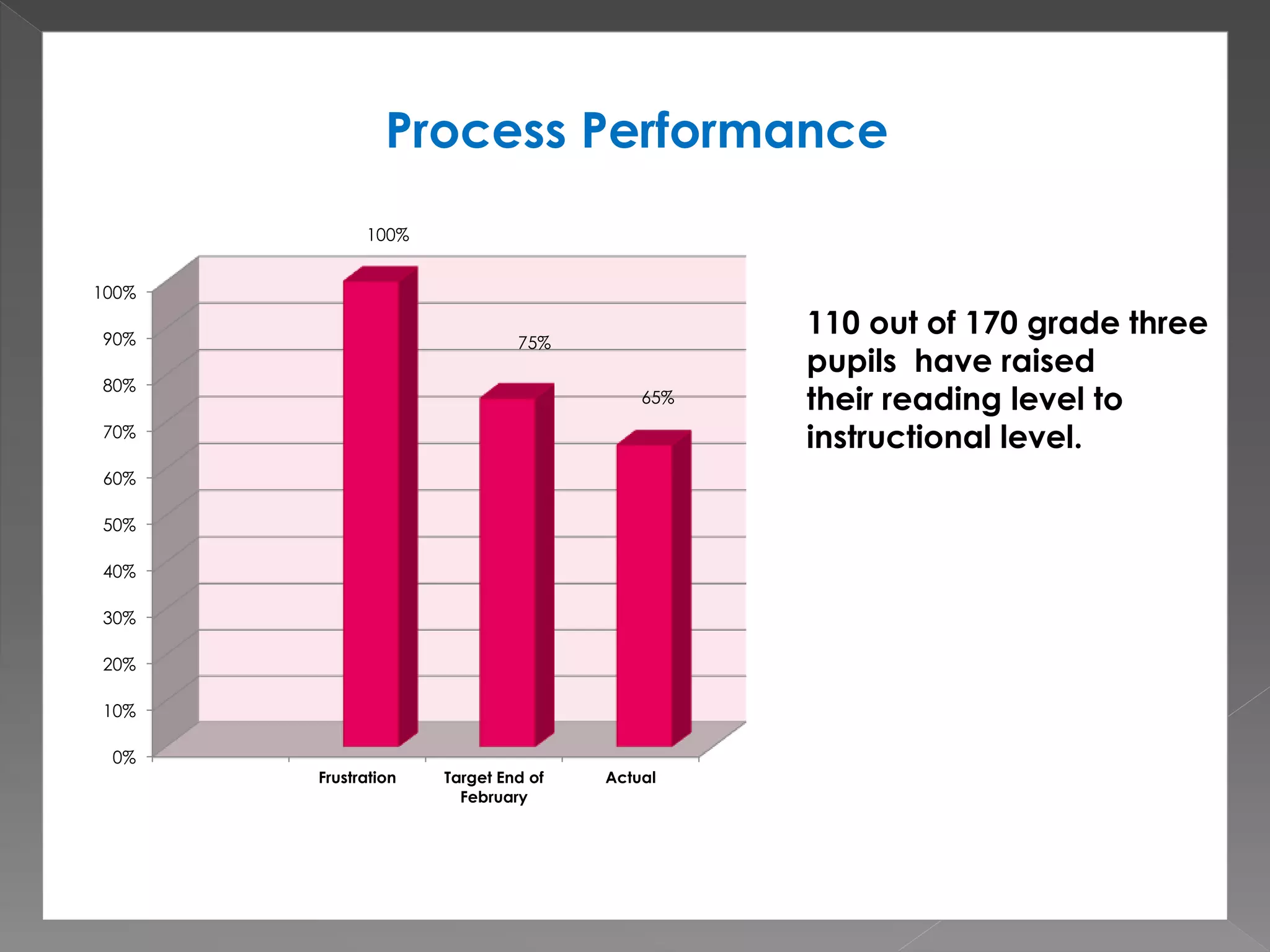
100%
75%
65%
Process Performance
110 out of 170 grade three
pupils have raised
their reading level to
instructional level.
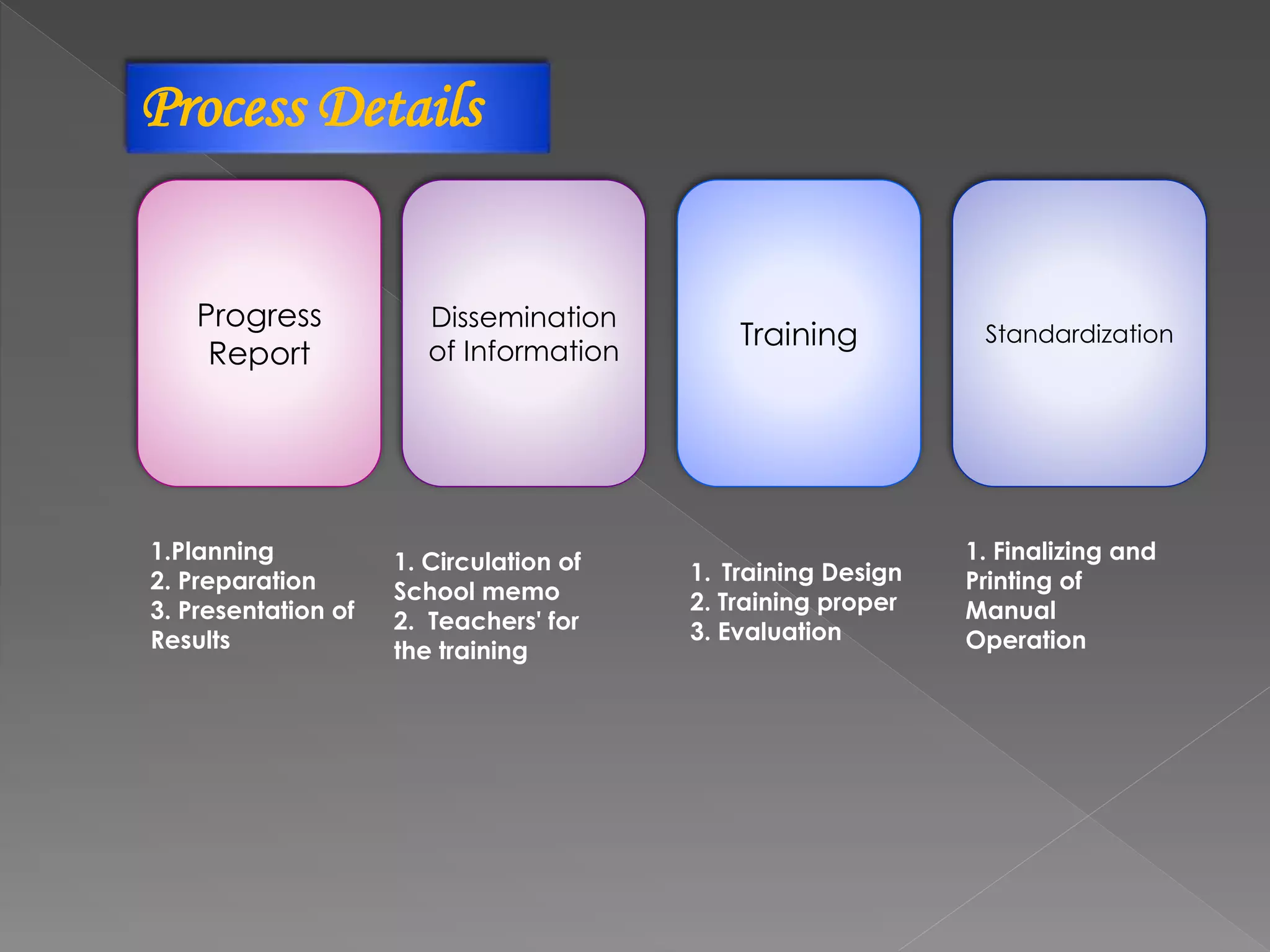
Progress
Report
Dissemination
of Information
Training Standardization
1.Planning
2. Preparation
3. Presentation of
Results
1. Circulation of
School memo
2. Teachers' for
the training
1. Training Design
2. Training proper
3. Evaluation
1. Finalizing and
Printing of
Manual
Operation
Process Details
Sustainability Plan
Team race (Read and Comprehea

Team race (Read and Comprehea

  • 1.
    Republic of thePhilippines Department of Education Division of Rizal District of Taytay II SAN FRANCISCO ELEMENTARY SCHOOL
  • 3.
    Elisa V. MagsinoLeah DL. Javier Facilitator EMELITA DJ. SAULO Principal Dinalyn Z. De Vera Ma. Jesusa V. Pacleb Scribe Carmencita T. Magriña Ma.Lourdes P. Catorce Communication Benjie U. Flores Chiqui C. Villagracia Documentation Lolita A. Dizon Process Observer Carmela V. Dela Cruz Team Leader
  • 4.
    FUTURE STATE BACKGROUND Based onthe Pre-Test result of the PHIL-IRI for the S.Y 2014-2015, 170 out of 447 or 38.03% of grade three pupils belong to frustration level. The pupil scores 89% and below in word recognition or 58% and below in comprehension. The result is alarming that immediate action is needed. In view of this, the school conducted the Read and Comprehend Effectively (RaCE) program. CURRENT STATE PROBLEM ANALYSIS IMPLEMENTATION PLAN LESSONS LEARNED CI Program is a challenge for all of us . We should standardize the implementation of intervention programs of all learning areas in a CI way. Become more creative in progressive learning. TEST RESULTS PROJECT TITLE STAGE1:ASSESS STAGE2:ANALYZESTAGE3:ACT STAGE2:ANALYZE CI Project Template project race Read and Comprehend Effectively
  • 6.
    History San Francisco ElementarySchool started on March 10, 1989 as the former Muzon Elementary School Annex. The school is situated at the highland of San Francisco Village, one of the Subdivisions in Barangay Muzon, Taytay, Rizal. The site was donated by the homeowners to cater the need for accessibility in education. The six-room single-story building MES Annex was used to house two classes for Grade I-III with six teachers. On June 6, 1989, the said MES Annex was renamed San Francisco Elementary School (SFES) under the supervision of the late Mrs. Anicia L. Leoncio. By that time, there were eight teachers handling eight classes (2 sections per grade I-IV) and a pre-school. Before the year ends, an additional building with three classrooms and “2-seater” toilet was constructed. SFES has improved a lot and is popularly known as the school within a Garden, picturesquely carved from the hill flowing the contour of the land. Outstanding achievements are now on the way due to the continuous progression of the school. The school head as well as the teaching force of San Francisco Elementary School is trying their very best to maintain the school in its highest pedestal. Due recognition must give to the school administrators. Mrs. Emelita DJ. Saulo, our new principal, designated last October 2013, creating new rules and regulations as well as enhancing different strategies in teaching learning in order to develop pupils as well as teachers competitive globally. Furthermore, learning environment organized successfully.
  • 7.
    Education aims tomake every child a reader. Certain problems and difficulties we encounter in reading really need an intervention program wherein we can produce school children who are life-long learners and readers through devoting time, commitment and expertise. There is only one way to control history and rein in the forces of immoral and illiterate leadership and to mold the world into something we can live in and that is to read books. If we relied on our contemporary wisdom, we will find precious little time to see us through our national and international crisis. In short, we must read books, because reading a lot is one of the powerful methods in increasing fluency, building vocabulary and improving comprehension. In addition to, this project utilizes strategies is a coordinated, unified and holistic perspective using a comprehensive approach to produce quality, proficient and independent reader. We can also implement the different strategies that will provide opportunities for children to develop the key life skill.
  • 9.
     Created andvalidated questionnaires  Conducted survey thru questionnaires  Gathered and tabulated the data  Analyzed the gathered data
  • 10.
    Questionnaire-Checklist Part I. RespondentsPersonal Data Name: __________________________________ Gr/Section: _________ Directions: Please supply the needed information by placing a check ( / ) mark on the appropriate box. Sex Female Male Part II. Work Attitudes Directions: Answer the following questions about your reading habits. Please answer all questions truthfully. There are no rights or wrong answers. Answering truthfully will help your teachers to help your teachers to become a better reader. Please put a check ( / ) mark under the column heading which best describes your feeling in every item following the given scale. Please do not leave any item unanswered. 5 Always 4 Usually 3 Sometimes 2 Seldom 1 Never Reading Habits 5 4 3 2 1 1. I give up when I find a story or written information difficult to understand. 2. I use strategies to help me understand stories or written information which I find difficult to understand. 3. I use dictionary when I can’t understand words. 4. I guess what will happen in the story before I read it. 5. I guess what will happen next to each event throughout the story when I read. 6. I ask myself questions before I read the story. 7. I ask myself questions during onset reading of the story. 8. I ask myself questions after I read the story. 9. I relate the story to my own life when I read. 10. I can relate the story to something else e.g. TV programs, movies watched when I read. 11. My parents often read books, newspapers or any reading materials. 12. I consider myself a slow reader. 13. I spent a lot of time reading 14. I give up on reading assignments because they take too long, 15. I have trouble staying focused while I read. 16. I find myself thinking of other things as I read. 17. I am easily distracted with noise when I read at home or school. 18. I listen to music or watch TV when I am studying or reading. 19. I visualize or see pictures on my head while I am reading. 20. I express my difficulty in reading by saying “I hate reading”.
  • 11.
    - 38.03% or170 out of 447 Grade Three pupils are belong to frustration level. - 105 male of the 170 grade three pupils; and 65 of them are female. CRITERIA Wx Rank 1. I use dictionary when I can’t understand words 1.79 1 2. I consider myself a slow reader. 2.25 2 3. I am easily understand distracted with noise when I read at home or school. 2.7 3 4. I give up when I find a story written information difficult to understand. 3.1 4
  • 13.
    SUPPLIER INPUT PROCESSOUTPUT CUSTOMER Principal Phil- IRI Materials Conduct Reading Intervention Phil- IRI Results Grade Three Pupils CI Team San Francisco Elementary School Grade 3 Teacher SIPOC
  • 14.
    Diagnosing pupils reading level Interpretation of Results Implement RaCE Interventions Identify strategies and techniques for RaCE intervention PostTest Evaluation IMs prepared by Grade 3 Teachers Use of varied Activities for Improvement Paired Reading Follow-up at home PROCESSSTEP No dictionary at home Insufficient time for reading Need more exciting activities Educational attainment of Parents
  • 16.
    170 or 38.03%out of 447 Grade Three pupils are analyzed as children at risk in reading with comprehension during the Pre-test administration of the Phil IRI for SY 2014-2015.
  • 17.
  • 18.
    13.67 35.76 50.57 0 Graphical Representation ofGrade three pupils in Frustration level Frustration Instructional Independent Non Reader
  • 19.
    Lack of dictionary skills 170 outof 447 Grade Three pupils are reading without comprehension Materials written in small letters Considers self as slow reader Written text are difficult to understand Easily distracted when reading Less exposure to unfamiliar words Noise Lack of confidence No dictionary at home No focus Boredom Need more exciting activities Materials do not have pictures or illustration Boring Materials Lack of practice at home Insufficient time for reading Why- Why Diagram
  • 21.
    Probable Cause ValidationControllability Conclusion Method Result No dictionary at home VOC, interview, sampling 1.79 Controllable Needs immediate action Insufficient time for reading VOC, interview, sampling 2.25 Controllable Needs immediate action Need more exciting activities VOC, interview, sampling 2.7 Controllable Needs immediate action Boring materials VOC, interview, sampling 3.1 Controllable Needs immediate action
  • 23.
    To minimize thenumber of identified Grade Three pupils without comprehension by 75% or 128 out of 170 pupils by the end of February 2015.
  • 24.
    Priority Root Cause Solution RecommendedImprovement No dictionary at home Unlocking words in every lessons Provide dictionary in every reading corner. Insufficient time for reading Remedial in reading Make a schedule for reading session Need more exciting activities More new hands on activities Search and create activities suited to the lesson. Boring Materials IMs with colorful pictures and written in big letters Prepare and reproduce big books and colorful reading materials.
  • 25.
    25 Process Steps SUPPLIERS INPUTSPROCESS OUTPUTS CUSTOMERS CI Team WORD RECOGNITION, VOCABULARY and COMPREHENSION DRILLS RACE INTERVENTION 75% OF GRADE THREE PUPILS CAN READ WITH COMPREHENSION BY FEBRUARY 2015 GRADE THREE PUPILS Grade 3 Teachers
  • 30.
    Implementation Highlights Series ofmeetings with the CI team   
  • 31.
  • 33.
  • 35.
  • 39.
    CI (Continuous Improvement)is essentially a small step-by-step incremental improvement strategy. It is based upon a belief that continual improvement can be brought about by a never-ending series of small changes. Even in the face of enormous innovative improvement strategies, there will always be the need and opportunity to supplement such strategies and initiatives with continual small step changes. 1. Every teacher must motivate their pupils to develop reading habit and love for reading. 2. Every pupil must be identified on their reading level. 3. A yearly school based training of teachers in reading. 4. To talk with parents to minimize absences in the class. 5. To award the reading teacher with exemplary performance.
  • 41.
    0% 10% 20% 30% 40% 50% 60% 70% 80% 90% 100% Frustration Target Endof February Actual 100% 75% 65% Process Performance 110 out of 170 grade three pupils have raised their reading level to instructional level.
  • 42.
    Progress Report Dissemination of Information Training Standardization 1.Planning 2.Preparation 3. Presentation of Results 1. Circulation of School memo 2. Teachers' for the training 1. Training Design 2. Training proper 3. Evaluation 1. Finalizing and Printing of Manual Operation Process Details
  • 43.

Editor's Notes

  • #22 Valid root causes may be prioritized via pareto analysis
  • #26 Highlight steps which have been improved Insert any additional steps Delete any steps which have been eliminated (typically non value-adding steps)