TEAM WORK AND
TEAM BUILDING
SUBMITTED BY:
Mohit Gupta
Work Teams
A work team generates positive synergy through coordinated effort. The individual
efforts result in a level of performance greater than the sum of those individual
inputs.
Effective teams have common characteristics:
โ€ขThey must have adequate resources, effective leadership, a climate of trust, and a
performance evaluation and reward system that reflects team contributions.
โ€ขThese teams have individuals with technical expertise as well as problem-solving,
decision-making, interpersonal skills and the right traits, especially
conscientiousness and openness.
โ€ขEffective teams have members who believe in the teamโ€™s capabilities and are
committed to a common plan and purpose.
โ€ขEffective teams also tend to be smallโ€”with fewer than 10 people, preferably
of diverse backgrounds.
๏ถProblem-Solving Teams
โ€ขGroups of 5 to 12 employees from the same department who meet for a few hours each
week to discuss ways of improving quality, efficiency, and the work environment.
โ€ขThese problem-solving teams rarely have the authority to unilaterally implement any of
their suggestions.
๏ถSelf-Managed Work Teams
โ€ขSelf-managed work teams are groups of employees (typically 10 to 15 in number) who
perform highly related or interdependent jobs and take on many of the responsibilities of
their former supervisors.
โ€ขThese tasks are planning and scheduling work, assigning tasks to members, making
operating decisions, taking action on problems, and working with suppliers and
customers.
โ€ขFully self-managed work teams even select their own members and evaluate each
otherโ€™s performance.
Types of Teams
๏ถCross-Functional Teams
โ€ขCross-functional teams are an effective means of allowing people from diverse areas within or
even between organizations to exchange information, develop new ideas, solve problems, and
coordinate complex projects.
โ€ขIt takes time to build trust and teamwork, especially among people from different backgrounds
with different experiences and perspectives.
๏ถVirtual Teams
โ€ขVirtual teams use computer technology to unite physically dispersed members and achieve a
common goal.
โ€ขThey collaborate onlineโ€”using communication links such as wide-area networks,
videoconferencing, or e-mailโ€”whether theyโ€™re a room away or continents apart.
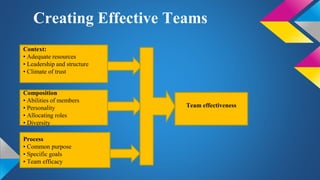
Creating Effective Teams
Context:
โ€ข Adequate resources
โ€ข Leadership and structure
โ€ข Climate of trust
Composition
โ€ข Abilities of members
โ€ข Personality
โ€ข Allocating roles
โ€ข Diversity
Process
โ€ข Common purpose
โ€ข Specific goals
โ€ข Team efficacy
Team effectiveness
Context
๏ถAdequate Resources
โ€ขTeams are part of a larger organization system, every work team relies on resources
outside the group to sustain it.
โ€ขA scarcity of resources directly reduces the ability of a team to perform its job
effectively and achieve its goals.
๏ถLeadership and Structure
โ€ขTeams canโ€™t function if they canโ€™t agree on who is to do what and ensure all members
share the workload.
โ€ขLeadership is especially important in multi team systems, in which different teams
coordinate their efforts to produce a desired outcome.
๏ถClimate of Trust
โ€ขMembers of effective teams trust each other.
โ€ขThey also exhibit trust in their leaders. Interpersonal trust among team members
facilitates cooperation, reduces the need to monitor each others.
โ€ขTrust is the foundation of leadership. It allows a team to accept and commit to its
leaderโ€™s goals and decisions..
Team Composition
๏ถAbilities of Members
โ€ขPart of a teamโ€™s performance depends on the knowledge, skills, and abilities of its
individual members.
โ€ขHigh-ability teamsโ€”composed of mostly intelligent membersโ€”do better than lower-
ability teams, especially when the workload is distributed evenly.
๏ถPersonality of Members
โ€ขTeams that rate higher on mean levels of openness to experience tend to perform better,
and the minimum level of team member agreeableness also matters.
โ€ขTeams did worse when they had one or more highly disagreeable members. Perhaps one
bad apple can spoil the whole bunch!
๏ถAllocation of Roles
โ€ขTeams have different needs, and members should be selected to ensure all the various
roles are filled.
โ€ขPut your most able, experienced, and conscientious workers in the most central roles in a
team.
Team Processes
๏ถCommon Plan and Purpose
โ€ขEffective teams begin by analyzing the teamโ€™s mission, developing goals to achieve
that mission, and creating strategies for achieving the goals.
โ€ขMembers of successful teams put a tremendous amount of time and effort into
discussing, shaping, and agreeing on a purpose that belongs to them both collectively
and individually.
๏ถSpecific Goals
โ€ขSuccessful teams translate their common purpose into specific, measurable, and
realistic performance goals. Specific goals facilitate clear communication .
๏ถTeam Efficacy
โ€ข Effective teams have confidence in themselves; they believe they can succeed.
โ€ขTeams that have been successful raise their beliefs about future success, which, in
turn, motivates them to work harder.
TEAM BUILDING
Team building is an ongoing process that helps a work group evolve into a cohesive
unit.
The team members not only share expectations for accomplishing group tasks, but trust
and support one another and respect one another's individual differences.
Your role as a team builder is to lead your team toward cohesiveness and productivity.
Guiding Principles
Team building can lead to:
โ€ขGood communications with participants as team members and individuals.
โ€ขIncreased department productivity and creativity.
โ€ขTeam members motivated to achieve goals
โ€ขA climate of cooperation and collaborative problem-solving.
โ€ขHigher levels of job satisfaction and commitment.
โ€ขHigher levels of trust and support.
โ€ขDiverse co-workers working well together.
โ€ขClear work objectives.
โ€ขBetter operating policies and procedures.
STEPS FOR BUILDING EFFECTIVE
TEAM
โ— The first rule of team building is an obvious one: to lead a team effectively, you
must first establish your leadership with each team member.
โ— Remember that the most effective team leaders build their relationships of trust
and loyalty, rather than fear or the power of their positions.
โ– Consider each employee's ideas as valuable: Remember that there is no such
thing as a stupid idea.
โ– Be aware of employees' unspoken feelings: Set an example to team members by
being open with employees and sensitive to their moods and feelings.
โ– Act as a harmonizing influence: Look for chances to mediate and resolve minor
disputes; point continually toward the team's higher goals.
โ– Be clear when communicating: Be careful to clarify directives.
๏ถ Encourage trust and cooperation among employees.
โ— Decreased productivity.
โ— Conflicts or hostility among staff members.
โ— Confusion about assignments, missed signals, and unclear relationships.
โ— Decisions misunderstood or not carried through properly.
โ— Apathy and lack of involvement.
โ— Complaints of discrimination or favoritism.
โ— Ineffective staff meetings, low participation, minimally effective decisions
โ— Negative reactions to the manager.
โ— Complaints about quality of service.
Symptoms that Signal a Need for Team
Building
THANK YOU

Team build And Team Work

  • 1.
    TEAM WORK AND TEAMBUILDING SUBMITTED BY: Mohit Gupta
  • 2.
    Work Teams A workteam generates positive synergy through coordinated effort. The individual efforts result in a level of performance greater than the sum of those individual inputs. Effective teams have common characteristics: โ€ขThey must have adequate resources, effective leadership, a climate of trust, and a performance evaluation and reward system that reflects team contributions. โ€ขThese teams have individuals with technical expertise as well as problem-solving, decision-making, interpersonal skills and the right traits, especially conscientiousness and openness. โ€ขEffective teams have members who believe in the teamโ€™s capabilities and are committed to a common plan and purpose. โ€ขEffective teams also tend to be smallโ€”with fewer than 10 people, preferably of diverse backgrounds.
  • 3.
    ๏ถProblem-Solving Teams โ€ขGroups of5 to 12 employees from the same department who meet for a few hours each week to discuss ways of improving quality, efficiency, and the work environment. โ€ขThese problem-solving teams rarely have the authority to unilaterally implement any of their suggestions. ๏ถSelf-Managed Work Teams โ€ขSelf-managed work teams are groups of employees (typically 10 to 15 in number) who perform highly related or interdependent jobs and take on many of the responsibilities of their former supervisors. โ€ขThese tasks are planning and scheduling work, assigning tasks to members, making operating decisions, taking action on problems, and working with suppliers and customers. โ€ขFully self-managed work teams even select their own members and evaluate each otherโ€™s performance. Types of Teams
  • 4.
    ๏ถCross-Functional Teams โ€ขCross-functional teamsare an effective means of allowing people from diverse areas within or even between organizations to exchange information, develop new ideas, solve problems, and coordinate complex projects. โ€ขIt takes time to build trust and teamwork, especially among people from different backgrounds with different experiences and perspectives. ๏ถVirtual Teams โ€ขVirtual teams use computer technology to unite physically dispersed members and achieve a common goal. โ€ขThey collaborate onlineโ€”using communication links such as wide-area networks, videoconferencing, or e-mailโ€”whether theyโ€™re a room away or continents apart.
  • 5.
    Creating Effective Teams Context: โ€ขAdequate resources โ€ข Leadership and structure โ€ข Climate of trust Composition โ€ข Abilities of members โ€ข Personality โ€ข Allocating roles โ€ข Diversity Process โ€ข Common purpose โ€ข Specific goals โ€ข Team efficacy Team effectiveness
  • 6.
    Context ๏ถAdequate Resources โ€ขTeams arepart of a larger organization system, every work team relies on resources outside the group to sustain it. โ€ขA scarcity of resources directly reduces the ability of a team to perform its job effectively and achieve its goals. ๏ถLeadership and Structure โ€ขTeams canโ€™t function if they canโ€™t agree on who is to do what and ensure all members share the workload. โ€ขLeadership is especially important in multi team systems, in which different teams coordinate their efforts to produce a desired outcome. ๏ถClimate of Trust โ€ขMembers of effective teams trust each other. โ€ขThey also exhibit trust in their leaders. Interpersonal trust among team members facilitates cooperation, reduces the need to monitor each others. โ€ขTrust is the foundation of leadership. It allows a team to accept and commit to its leaderโ€™s goals and decisions..
  • 7.
    Team Composition ๏ถAbilities ofMembers โ€ขPart of a teamโ€™s performance depends on the knowledge, skills, and abilities of its individual members. โ€ขHigh-ability teamsโ€”composed of mostly intelligent membersโ€”do better than lower- ability teams, especially when the workload is distributed evenly. ๏ถPersonality of Members โ€ขTeams that rate higher on mean levels of openness to experience tend to perform better, and the minimum level of team member agreeableness also matters. โ€ขTeams did worse when they had one or more highly disagreeable members. Perhaps one bad apple can spoil the whole bunch! ๏ถAllocation of Roles โ€ขTeams have different needs, and members should be selected to ensure all the various roles are filled. โ€ขPut your most able, experienced, and conscientious workers in the most central roles in a team.
  • 8.
    Team Processes ๏ถCommon Planand Purpose โ€ขEffective teams begin by analyzing the teamโ€™s mission, developing goals to achieve that mission, and creating strategies for achieving the goals. โ€ขMembers of successful teams put a tremendous amount of time and effort into discussing, shaping, and agreeing on a purpose that belongs to them both collectively and individually. ๏ถSpecific Goals โ€ขSuccessful teams translate their common purpose into specific, measurable, and realistic performance goals. Specific goals facilitate clear communication . ๏ถTeam Efficacy โ€ข Effective teams have confidence in themselves; they believe they can succeed. โ€ขTeams that have been successful raise their beliefs about future success, which, in turn, motivates them to work harder.
  • 9.
    TEAM BUILDING Team buildingis an ongoing process that helps a work group evolve into a cohesive unit. The team members not only share expectations for accomplishing group tasks, but trust and support one another and respect one another's individual differences. Your role as a team builder is to lead your team toward cohesiveness and productivity.
  • 10.
    Guiding Principles Team buildingcan lead to: โ€ขGood communications with participants as team members and individuals. โ€ขIncreased department productivity and creativity. โ€ขTeam members motivated to achieve goals โ€ขA climate of cooperation and collaborative problem-solving. โ€ขHigher levels of job satisfaction and commitment. โ€ขHigher levels of trust and support. โ€ขDiverse co-workers working well together. โ€ขClear work objectives. โ€ขBetter operating policies and procedures.
  • 11.
    STEPS FOR BUILDINGEFFECTIVE TEAM โ— The first rule of team building is an obvious one: to lead a team effectively, you must first establish your leadership with each team member. โ— Remember that the most effective team leaders build their relationships of trust and loyalty, rather than fear or the power of their positions. โ– Consider each employee's ideas as valuable: Remember that there is no such thing as a stupid idea. โ– Be aware of employees' unspoken feelings: Set an example to team members by being open with employees and sensitive to their moods and feelings. โ– Act as a harmonizing influence: Look for chances to mediate and resolve minor disputes; point continually toward the team's higher goals. โ– Be clear when communicating: Be careful to clarify directives. ๏ถ Encourage trust and cooperation among employees.
  • 12.
    โ— Decreased productivity. โ—Conflicts or hostility among staff members. โ— Confusion about assignments, missed signals, and unclear relationships. โ— Decisions misunderstood or not carried through properly. โ— Apathy and lack of involvement. โ— Complaints of discrimination or favoritism. โ— Ineffective staff meetings, low participation, minimally effective decisions โ— Negative reactions to the manager. โ— Complaints about quality of service. Symptoms that Signal a Need for Team Building
  • 13.