Montgomery Carpenter - Physical Therapist
Chris Mckenna - Social Worker
Joshua Mullen - General Education Teacher
MEETING THE NEEDS OF STUDENTS WITH
SPECIFIC LEARNING DISABILITIES,
EMOTIONAL/BEHAVIORAL DISABILITIES,
AND AUTISM:
RECOMMENDATIONS FOR ACADEMIC
AND SOCIAL EXCELLENCE AT SENN HIGH
SCHOOL
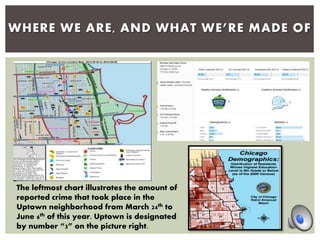
The leftmost chart illustrates the amount of
reported crime that took place in the
Uptown neighborhood from March 24th to
June 6th of this year. Uptown is designated
by number “3” on the picture right.
WHERE WE ARE, AND WHAT WE’RE MADE OF
The end goal for all of our recommendations is to ensure students with disabilities succeed
academically and socially. As a community, we need to make good on our compassioned
efforts and first recognize this is an issue were facing and then ameliorate the causal factors.
TAKING EXCELLENCE SERIOUSLY AT
SENN: ARE WE “ON TRACK?”
Why remaining on track matters and an analysis of
causal forces.
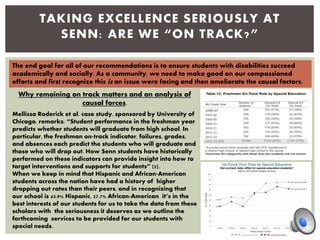
Mellissa Roderick et al. case study, sponsored by University of
Chicago, remarks: “Student performance in the freshman year
predicts whether students will graduate from high school. In
particular, the freshman on-track indicator, failures, grades,
and absences each predict the students who will graduate and
those who will drop out. How Senn students have historically
performed on these indicators can provide insight into how to
target interventions and supports for students” (2).
When we keep in mind that Hispanic and African-American
students across the nation have had a history of higher
dropping out rates than their peers, and in recognizing that
our school is 43.9% Hispanic, 27.7% African-American it’s in the
best interests of our students for us to take the data from these
scholars with the seriousness it deserves as we outline the
forthcoming services to be provided for our students with
special needs.
 Students with disabilities have the right to individualized
education. This pillar of IDEA is protected through the law’s
language of FAPE, or Free and Appropriate Public Education.
 A student with a disability ought to be assumed to be already
included in class alongside his peers in the general education
classroom unless there is evidence that, in spite of supports
and services, the student is not making educative strides. This
is the presumption that the least restrictive environment
 Procedural Due Process is the clause that holds schools and
parents accountable for carrying out the provisions delineated
in a students individualized education program (IEP); it also
operates as a rational that determines the appropriate phases
to resolve discrepancies between disagreeing parties.
INCORPORATION OF FEDERAL LAW:
SPECIAL EDUCATION TENANTS UNDER
IDEA (REV, 2004)
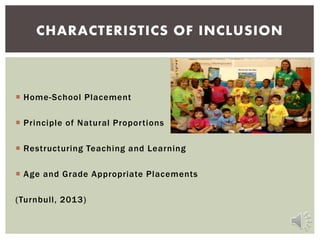
 Home-School Placement
 Principle of Natural Proportions
 Restructuring Teaching and Learning
 Age and Grade Appropriate Placements
(Turnbull, 2013)
CHARACTERISTICS OF INCLUSION
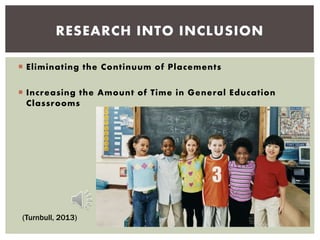
 Eliminating the Continuum of Placements
 Increasing the Amount of Time in General Education
Classrooms
RESEARCH INTO INCLUSION
(Turnbull, 2013)
Our team of multidisciplinary experts
has arrived at two general
recommendations:
GENERAL RECOMMENDATIONS
- The Effective Promotion of Student Self-Advocacy
- Wrap-Around Services
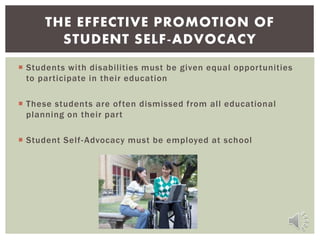
 Students with disabilities must be given equal opportunities
to participate in their education
 These students are often dismissed from all educational
planning on their part
 Student Self-Advocacy must be employed at school
THE EFFECTIVE PROMOTION OF
STUDENT SELF-ADVOCACY
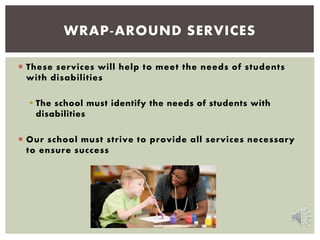
 These services will help to meet the needs of students
with disabilities
 The school must identify the needs of students with
disabilities
 Our school must strive to provide all services necessary
to ensure success
WRAP-AROUND SERVICES
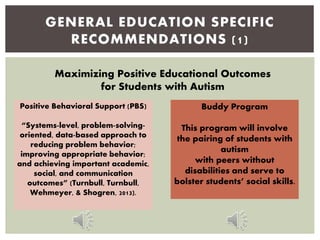
GENERAL EDUCATION SPECIFIC
RECOMMENDATIONS (1)
Maximizing Positive Educational Outcomes
for Students with Autism
Positive Behavioral Support (PBS)
“Systems-level, problem-solving-
oriented, data-based approach to
reducing problem behavior;
improving appropriate behavior;
and achieving important academic,
social, and communication
outcomes” (Turnbull, Turnbull,
Wehmeyer, & Shogren, 2013).
Buddy Program
This program will involve
the pairing of students with
autism
with peers without
disabilities and serve to
bolster students’ social skills.
GENERAL EDUCATION SPECIFIC
RECOMMENDATIONS (2)
Enhancing the Academic and Social
Experiences of Students with Specific Learning Disabilities
Curriculum Planning
Process that helps teachers
and IEP teams “identify
those points in the curriculum
at which students with
disabilities should receive
instruction that is based on
their unique learning needs”
(Turnbull, Turnbull,
Wehmeyer, & Shogren, 2013).
Partnership strategies
These serve to promote self-
efficacy among students with
specific learning disabilities.
Successful professional-
family/student partnerships
should include frequent
meetings of general education
teachers, special education
teachers, IEP teams, families,
and students.
GENERAL EDUCATION SPECIFIC
RECOMMENDATIONS (3)
Students with Emotional and Behavioral Disorders
Active involvement on the part of general
education teachers in
the process of determining appropriate
student IEPs and wrap-around services
The partnering of general education teachers
and the IEP teams of students with emotional
and behavioral disorders (EBD) can help to
ensure that the individual educational needs of
students with EBD are met.
Classwide Peer Tutoring
(CWPT)
“Evidence-based peer-
mediated practice that
supports students with EBD
to have positive peer
interactions” (Turnbull,
Turnbull, Wehmeyer, &
Shogren, 2013).
 Thinking about my role with all students as synonymous with the duties of an
ambassador, this is particularly significant when working with students on the autism
spectrum1.
 Students with autism need to have dependable advocates due to the fact that the
manner in which they process and communicate their experience is radically different
from a student without a disability. Thus, in order to acknowledge the correct type of
services a student may need, I am required to have a thorough knowledge of each
child’s particular proclivity for unique communication; ignoring these moments of
earnest communication as the “non -sense” of an autistic child does nothing in the way
of helping them progress socially or academically —that requires services to enhance
communication. Because of this need, I would recommend that I meet with the family
of the student with autism often to understand the development of language and plan
the scouting out of resources around those developments.
 Ron Suskind wrote an astute piece in the Times describing his son’s desire to
communicate despite his different mode of expressing such thought: “That desire to
connect has always been there as, the latest research indicates, it may be in all
autistic people; their neurological barriers don’t kill the desire, even if it’s deeply
submerged. And this is the way he [Owen] still is — autism isn’t a spell that has been
broken; it’s a way of being. That means the world will continue to be inhospitable to
him, walking about, as he does, uncertain, missing cues, his heart exposed. But he has
desperately wanted to connect, to feel his life, fully” ( Suskind 1).
SOCIALLY WORKING WITH STUDENTS
ON THE AUTISM SPECTRUM
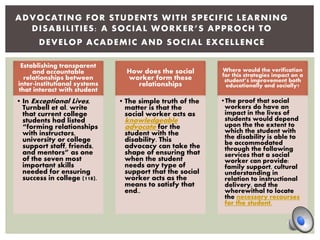
Establishing transparent
and accountable
relationships between
inter-institutional systems
that interact with student
• In Exceptional Lives,
Turnbell et al. write
that current college
students had listed
“forming relationships
with instructors,
university or college
support staff, friends,
and mentors” as one
of the seven most
important skills
needed for ensuring
success in college (118).
How does the social
worker form these
relationships
• The simple truth of the
matter is that the
social worker acts as
knowledgeable
advocate for the
student with the
disability. This
advocacy can take the
shape of ensuring that
when the student
needs any type of
support that the social
worker acts as the
means to satisfy that
end..
Where would the verification
for this strategies impact on a
student’s improvement both
educationally and socially?
•The proof that social
workers do have an
impact in the lives of
students would depend
upon the the extent to
which the student with
the disability is able to
be accommodated
through the following
services that a social
worker can provide:
family support, cultural
understanding in
relation to instructional
delivery, and the
wherewithal to locate
the necessary recourses
for the student.
ADVOCATING FOR STUDENTS WITH SPECIFIC LEARNING
DISABILITIES: A SOCIAL WORKER’S APPROCH TO
DEVELOP ACADEMIC AND SOCIAL EXCELLENCE
ADDRESSING STUDENTS WITH EBD AT
SENN: STRIKING A BALANCE
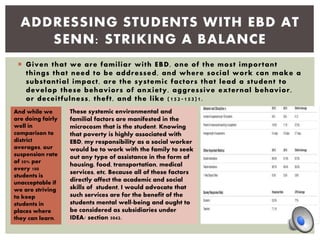
 Given that we are familiar with EBD, one of the most important
things that need to be addressed, and where social work can make a
substantial impact, are the systemic factors that lead a student to
develop these behaviors of anxiety, aggressive external behavior,
or deceitfulness, theft, and the like (152-153)1.
These systemic environmental and
familial factors are manifested in the
microcosm that is the student. Knowing
that poverty is highly associated with
EBD, my responsibility as a social worker
would be to work with the family to seek
out any type of assistance in the form of
housing, food, transportation, medical
services, etc. Because all of these factors
directly affect the academic and social
skills of student, I would advocate that
such services are for the benefit of the
students mental well-being and ought to
be considered as subsidiaries under
IDEA/ section 5042.
And while we
are doing fairly
well in
comparison to
district
averages, our
suspension rate
of 50% per
every 100
students is
unacceptable if
we are striving
to keep
students in
places where
they can learn.
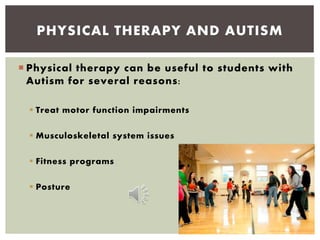
 Physical therapy can be useful to students with
Autism for several reasons:
 Treat motor function impairments
 Musculoskeletal system issues
 Fitness programs
 Posture
PHYSICAL THERAPY AND AUTISM
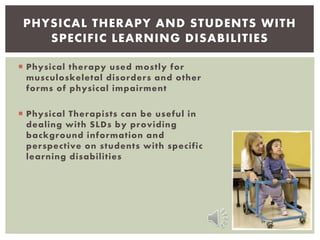
 Physical therapy used mostly for
musculoskeletal disorders and other
forms of physical impairment
 Physical Therapists can be useful in
dealing with SLDs by providing
background information and
perspective on students with specific
learning disabilities
PHYSICAL THERAPY AND STUDENTS WITH
SPECIFIC LEARNING DISABILITIES
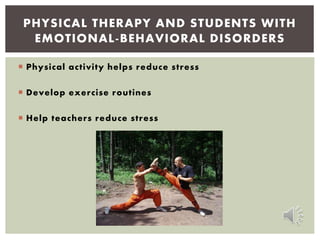
 Physical activity helps reduce stress
 Develop exercise routines
 Help teachers reduce stress
PHYSICAL THERAPY AND STUDENTS WITH
EMOTIONAL-BEHAVIORAL DISORDERS
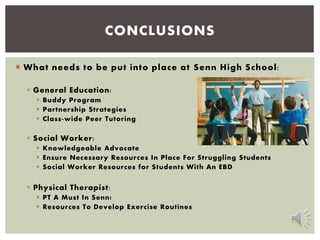
 What needs to be put into place at Senn High School:
 General Education:
 Buddy Program
 Partnership Strategies
 Class-wide Peer Tutoring
 Social Worker:
 Knowledgeable Advocate
 Ensure Necessary Resources In Place For Struggling Students
 Social Worker Resources for Students With An EBD
 Physical Therapist:
 PT A Must In Senn!
 Resources To Develop Exercise Routines
CONCLUSIONS
Image Credit s :
 http:// w w w . w i z ar d c r af t .n et / S en n/ i m ag e s/ s en nh s 1. g i f
 http:// st a t i c . d dm c dn . c om /g i f / f in an c i al - a i d - s tu d en t s- w i th - di s ab i l i t i es - 1. j p g
 http:// s pe c i a l e dpo s t . c om / w p - c on t ent /u p l o a ds / 2012/ 11/ h er_ ym c a 052809_ 69744c . j pg
 https:/ / w w w . r ea l g ap . c o .u k/ s i t e s/ d ef au l t /f i l e s/ i m ag e c ac h e/t r i p_ p i c s_ l i gh t bo x/ t r i p/ p i c s / g al l er y -
3-chin a -m a rt i al - a rt s . j pg
 http:// w w w . s l at e . co m / co nt en t/ d am/ s l at e/ ar t i c l es / bu s i n es s /t h e_ d i s m al _ s c i en c e/ 2012/ 01/ 1201
05_DS_go o d T ea ch er . j pg . CR OP . r e ct an g l e 3 - l a rg e . j pg
 http:// ww w. soc i al work er s. or g/ a r ch iv es/ a dvoc a c y/u p da tes/ 1997/ id ea . htm
Resour c es :
 Boyse , K. (2012, November 1). Univer s i t y of Michi g an Heal th Syst em . Learn i n g Disab i l i t i es : Your
Child: . Retri ev e d June 13, 2014, from http:// w w w . m ed . um i ch . e du/ yo u r ch i l d/ to p i c s / l d . ht m
 Meli s s a Roder i c k , Thomas Kell ey - Kempl e , Courtney M. Thompso n . "Getti ng On -Trac k: Under st a n di n g
Freshm an Perform an c e at Senn . " ccsr.u c h i c ag o . edu , 2013. Web. 10 June 2014
 Physi c al Activ i t y Redu c es Stres s | Anxi et y and Depr es s i on Assoc i at i on of Ameri c a , ADAA. ( n.d.) .
Physic al Activ ity Redu c es Stress | Anxiety and Depr ession Assoc iation of Americ a , ADAA. Retriev e d
June 13, 2014, from http:// w w w . a da a. o r g/ un d er s t an di n g - an x i et y/ r e l at e d - i l l n es s es / ot h er - r e l at e d -
condi t io n s / st r es s / ph y s i c a l - ac t i v i t y -r e du c es - st
 Turnbu l l , A. P. (2013) . Except i on a l Lives: Spec i a l Educat i o n in Today ' s Schoo l s (7 ed.) . Englewo o d
Cliff s , N.J.: Merri l l .
 Vann , M. (n.d. ) . How Physi c al Ther apy Hel ps Autist i c Childr en - Autism Center - Everyday Healt h .
Everyda yH ea l th . co m . Retri ev ed June 13, 2014, from http:// w w w . ev e r yd ayh e al t h . c om / aut i sm / ph ys i c al -
therapy . a s px
RESOURCES

Team 8

  • 1.
    Montgomery Carpenter -Physical Therapist Chris Mckenna - Social Worker Joshua Mullen - General Education Teacher MEETING THE NEEDS OF STUDENTS WITH SPECIFIC LEARNING DISABILITIES, EMOTIONAL/BEHAVIORAL DISABILITIES, AND AUTISM: RECOMMENDATIONS FOR ACADEMIC AND SOCIAL EXCELLENCE AT SENN HIGH SCHOOL
  • 2.
    The leftmost chartillustrates the amount of reported crime that took place in the Uptown neighborhood from March 24th to June 6th of this year. Uptown is designated by number “3” on the picture right. WHERE WE ARE, AND WHAT WE’RE MADE OF
  • 3.
    The end goalfor all of our recommendations is to ensure students with disabilities succeed academically and socially. As a community, we need to make good on our compassioned efforts and first recognize this is an issue were facing and then ameliorate the causal factors. TAKING EXCELLENCE SERIOUSLY AT SENN: ARE WE “ON TRACK?” Why remaining on track matters and an analysis of causal forces. Mellissa Roderick et al. case study, sponsored by University of Chicago, remarks: “Student performance in the freshman year predicts whether students will graduate from high school. In particular, the freshman on-track indicator, failures, grades, and absences each predict the students who will graduate and those who will drop out. How Senn students have historically performed on these indicators can provide insight into how to target interventions and supports for students” (2). When we keep in mind that Hispanic and African-American students across the nation have had a history of higher dropping out rates than their peers, and in recognizing that our school is 43.9% Hispanic, 27.7% African-American it’s in the best interests of our students for us to take the data from these scholars with the seriousness it deserves as we outline the forthcoming services to be provided for our students with special needs.
  • 4.
     Students withdisabilities have the right to individualized education. This pillar of IDEA is protected through the law’s language of FAPE, or Free and Appropriate Public Education.  A student with a disability ought to be assumed to be already included in class alongside his peers in the general education classroom unless there is evidence that, in spite of supports and services, the student is not making educative strides. This is the presumption that the least restrictive environment  Procedural Due Process is the clause that holds schools and parents accountable for carrying out the provisions delineated in a students individualized education program (IEP); it also operates as a rational that determines the appropriate phases to resolve discrepancies between disagreeing parties. INCORPORATION OF FEDERAL LAW: SPECIAL EDUCATION TENANTS UNDER IDEA (REV, 2004)
  • 5.
     Home-School Placement Principle of Natural Proportions  Restructuring Teaching and Learning  Age and Grade Appropriate Placements (Turnbull, 2013) CHARACTERISTICS OF INCLUSION
  • 6.
     Eliminating theContinuum of Placements  Increasing the Amount of Time in General Education Classrooms RESEARCH INTO INCLUSION (Turnbull, 2013)
  • 7.
    Our team ofmultidisciplinary experts has arrived at two general recommendations: GENERAL RECOMMENDATIONS - The Effective Promotion of Student Self-Advocacy - Wrap-Around Services
  • 8.
     Students withdisabilities must be given equal opportunities to participate in their education  These students are often dismissed from all educational planning on their part  Student Self-Advocacy must be employed at school THE EFFECTIVE PROMOTION OF STUDENT SELF-ADVOCACY
  • 9.
     These serviceswill help to meet the needs of students with disabilities  The school must identify the needs of students with disabilities  Our school must strive to provide all services necessary to ensure success WRAP-AROUND SERVICES
  • 10.
    GENERAL EDUCATION SPECIFIC RECOMMENDATIONS(1) Maximizing Positive Educational Outcomes for Students with Autism Positive Behavioral Support (PBS) “Systems-level, problem-solving- oriented, data-based approach to reducing problem behavior; improving appropriate behavior; and achieving important academic, social, and communication outcomes” (Turnbull, Turnbull, Wehmeyer, & Shogren, 2013). Buddy Program This program will involve the pairing of students with autism with peers without disabilities and serve to bolster students’ social skills.
  • 11.
    GENERAL EDUCATION SPECIFIC RECOMMENDATIONS(2) Enhancing the Academic and Social Experiences of Students with Specific Learning Disabilities Curriculum Planning Process that helps teachers and IEP teams “identify those points in the curriculum at which students with disabilities should receive instruction that is based on their unique learning needs” (Turnbull, Turnbull, Wehmeyer, & Shogren, 2013). Partnership strategies These serve to promote self- efficacy among students with specific learning disabilities. Successful professional- family/student partnerships should include frequent meetings of general education teachers, special education teachers, IEP teams, families, and students.
  • 12.
    GENERAL EDUCATION SPECIFIC RECOMMENDATIONS(3) Students with Emotional and Behavioral Disorders Active involvement on the part of general education teachers in the process of determining appropriate student IEPs and wrap-around services The partnering of general education teachers and the IEP teams of students with emotional and behavioral disorders (EBD) can help to ensure that the individual educational needs of students with EBD are met. Classwide Peer Tutoring (CWPT) “Evidence-based peer- mediated practice that supports students with EBD to have positive peer interactions” (Turnbull, Turnbull, Wehmeyer, & Shogren, 2013).
  • 13.
     Thinking aboutmy role with all students as synonymous with the duties of an ambassador, this is particularly significant when working with students on the autism spectrum1.  Students with autism need to have dependable advocates due to the fact that the manner in which they process and communicate their experience is radically different from a student without a disability. Thus, in order to acknowledge the correct type of services a student may need, I am required to have a thorough knowledge of each child’s particular proclivity for unique communication; ignoring these moments of earnest communication as the “non -sense” of an autistic child does nothing in the way of helping them progress socially or academically —that requires services to enhance communication. Because of this need, I would recommend that I meet with the family of the student with autism often to understand the development of language and plan the scouting out of resources around those developments.  Ron Suskind wrote an astute piece in the Times describing his son’s desire to communicate despite his different mode of expressing such thought: “That desire to connect has always been there as, the latest research indicates, it may be in all autistic people; their neurological barriers don’t kill the desire, even if it’s deeply submerged. And this is the way he [Owen] still is — autism isn’t a spell that has been broken; it’s a way of being. That means the world will continue to be inhospitable to him, walking about, as he does, uncertain, missing cues, his heart exposed. But he has desperately wanted to connect, to feel his life, fully” ( Suskind 1). SOCIALLY WORKING WITH STUDENTS ON THE AUTISM SPECTRUM
  • 14.
    Establishing transparent and accountable relationshipsbetween inter-institutional systems that interact with student • In Exceptional Lives, Turnbell et al. write that current college students had listed “forming relationships with instructors, university or college support staff, friends, and mentors” as one of the seven most important skills needed for ensuring success in college (118). How does the social worker form these relationships • The simple truth of the matter is that the social worker acts as knowledgeable advocate for the student with the disability. This advocacy can take the shape of ensuring that when the student needs any type of support that the social worker acts as the means to satisfy that end.. Where would the verification for this strategies impact on a student’s improvement both educationally and socially? •The proof that social workers do have an impact in the lives of students would depend upon the the extent to which the student with the disability is able to be accommodated through the following services that a social worker can provide: family support, cultural understanding in relation to instructional delivery, and the wherewithal to locate the necessary recourses for the student. ADVOCATING FOR STUDENTS WITH SPECIFIC LEARNING DISABILITIES: A SOCIAL WORKER’S APPROCH TO DEVELOP ACADEMIC AND SOCIAL EXCELLENCE
  • 15.
    ADDRESSING STUDENTS WITHEBD AT SENN: STRIKING A BALANCE  Given that we are familiar with EBD, one of the most important things that need to be addressed, and where social work can make a substantial impact, are the systemic factors that lead a student to develop these behaviors of anxiety, aggressive external behavior, or deceitfulness, theft, and the like (152-153)1. These systemic environmental and familial factors are manifested in the microcosm that is the student. Knowing that poverty is highly associated with EBD, my responsibility as a social worker would be to work with the family to seek out any type of assistance in the form of housing, food, transportation, medical services, etc. Because all of these factors directly affect the academic and social skills of student, I would advocate that such services are for the benefit of the students mental well-being and ought to be considered as subsidiaries under IDEA/ section 5042. And while we are doing fairly well in comparison to district averages, our suspension rate of 50% per every 100 students is unacceptable if we are striving to keep students in places where they can learn.
  • 16.
     Physical therapycan be useful to students with Autism for several reasons:  Treat motor function impairments  Musculoskeletal system issues  Fitness programs  Posture PHYSICAL THERAPY AND AUTISM
  • 17.
     Physical therapyused mostly for musculoskeletal disorders and other forms of physical impairment  Physical Therapists can be useful in dealing with SLDs by providing background information and perspective on students with specific learning disabilities PHYSICAL THERAPY AND STUDENTS WITH SPECIFIC LEARNING DISABILITIES
  • 18.
     Physical activityhelps reduce stress  Develop exercise routines  Help teachers reduce stress PHYSICAL THERAPY AND STUDENTS WITH EMOTIONAL-BEHAVIORAL DISORDERS
  • 19.
     What needsto be put into place at Senn High School:  General Education:  Buddy Program  Partnership Strategies  Class-wide Peer Tutoring  Social Worker:  Knowledgeable Advocate  Ensure Necessary Resources In Place For Struggling Students  Social Worker Resources for Students With An EBD  Physical Therapist:  PT A Must In Senn!  Resources To Develop Exercise Routines CONCLUSIONS
  • 20.
    Image Credit s:  http:// w w w . w i z ar d c r af t .n et / S en n/ i m ag e s/ s en nh s 1. g i f  http:// st a t i c . d dm c dn . c om /g i f / f in an c i al - a i d - s tu d en t s- w i th - di s ab i l i t i es - 1. j p g  http:// s pe c i a l e dpo s t . c om / w p - c on t ent /u p l o a ds / 2012/ 11/ h er_ ym c a 052809_ 69744c . j pg  https:/ / w w w . r ea l g ap . c o .u k/ s i t e s/ d ef au l t /f i l e s/ i m ag e c ac h e/t r i p_ p i c s_ l i gh t bo x/ t r i p/ p i c s / g al l er y - 3-chin a -m a rt i al - a rt s . j pg  http:// w w w . s l at e . co m / co nt en t/ d am/ s l at e/ ar t i c l es / bu s i n es s /t h e_ d i s m al _ s c i en c e/ 2012/ 01/ 1201 05_DS_go o d T ea ch er . j pg . CR OP . r e ct an g l e 3 - l a rg e . j pg  http:// ww w. soc i al work er s. or g/ a r ch iv es/ a dvoc a c y/u p da tes/ 1997/ id ea . htm Resour c es :  Boyse , K. (2012, November 1). Univer s i t y of Michi g an Heal th Syst em . Learn i n g Disab i l i t i es : Your Child: . Retri ev e d June 13, 2014, from http:// w w w . m ed . um i ch . e du/ yo u r ch i l d/ to p i c s / l d . ht m  Meli s s a Roder i c k , Thomas Kell ey - Kempl e , Courtney M. Thompso n . "Getti ng On -Trac k: Under st a n di n g Freshm an Perform an c e at Senn . " ccsr.u c h i c ag o . edu , 2013. Web. 10 June 2014  Physi c al Activ i t y Redu c es Stres s | Anxi et y and Depr es s i on Assoc i at i on of Ameri c a , ADAA. ( n.d.) . Physic al Activ ity Redu c es Stress | Anxiety and Depr ession Assoc iation of Americ a , ADAA. Retriev e d June 13, 2014, from http:// w w w . a da a. o r g/ un d er s t an di n g - an x i et y/ r e l at e d - i l l n es s es / ot h er - r e l at e d - condi t io n s / st r es s / ph y s i c a l - ac t i v i t y -r e du c es - st  Turnbu l l , A. P. (2013) . Except i on a l Lives: Spec i a l Educat i o n in Today ' s Schoo l s (7 ed.) . Englewo o d Cliff s , N.J.: Merri l l .  Vann , M. (n.d. ) . How Physi c al Ther apy Hel ps Autist i c Childr en - Autism Center - Everyday Healt h . Everyda yH ea l th . co m . Retri ev ed June 13, 2014, from http:// w w w . ev e r yd ayh e al t h . c om / aut i sm / ph ys i c al - therapy . a s px RESOURCES

Editor's Notes

  • #6 Turnbull, A. P. (2013). Exceptional Lives: Special Education in Today's Schools (7 ed.). Englewood Cliffs, N.J.: Merrill, (39-40).
  • #7 Turnbull, A. P. (2013). Exceptional Lives: Special Education in Today's Schools (7 ed.). Englewood Cliffs, N.J.: Merrill, (40).
  • #14 Frederick Streeck, executive director for the School Social Work Association of American, defines our duties as “Our niche as school social workers is to help with the home connection and the community connection as much as possible. Making home visits, giving parents an overview on how things are going, referring to agency services, that sort of thing, those are the places where school social workers can start, but then they’re also doing much more in-classroom as well.”
  • #16 1 Turnbull, Ann P. "Understanding Students with Emotional or Behavioral Disorders." Exceptional Lives: Special Education in Today's Schools. Englewood Cliffs, NJ: Merrill, 1995. N. pag. Print. 2 http://www.socialworkers.org/archives/advocacy/updates/1997/idea.htm
  • #17 Vann, M. (n.d.). How Physical Therapy Helps Autistic Children - Autism Center - Everyday Health. EverydayHealth.com. Retrieved June 13, 2014, from http://www.everydayhealth.com/autism/physical-therapy.aspx
  • #18 Boyse, K. (2012, November 1). University of Michigan Health System. Learning Disabilities: Your Child:. Retrieved June 13, 2014, from http://www.med.umich.edu/yourchild/topics/ld.htm
  • #19 Physical Activity Reduces Stress | Anxiety and Depression Association of America, ADAA. (n.d.). Physical Activity Reduces Stress | Anxiety and Depression Association of America, ADAA. Retrieved June 13, 2014, from http://www.adaa.org/understanding-anxiety/related-illnesses/other-related-conditions/stress/physical-activity-reduces-st