DEMONSTRATIONS IN TEACHING
“Good demonstration is good communication.”
LEARNING OBJECTIVES:
• To identify what does demonstration mean;
• To identify how should demonstration ;
• To state the importance of demonstration in the field
of teaching-learning process.
DEMONSTRATION
• It is showing how a thing is done emphasizing
salient merits, utility, and efficiency of a concept, a
method or a process or an attitude.
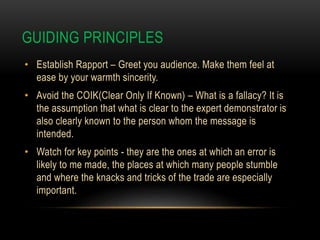
GUIDING PRINCIPLES
• Establish Rapport – Greet you audience. Make them feel at
ease by your warmth sincerity.
• Avoid the COIK(Clear Only If Known) – What is a fallacy? It is
the assumption that what is clear to the expert demonstrator is
also clearly known to the person whom the message is
intended.
• Watch for key points - they are the ones at which an error is
likely to me made, the places at which many people stumble
and where the knacks and tricks of the trade are especially
important.
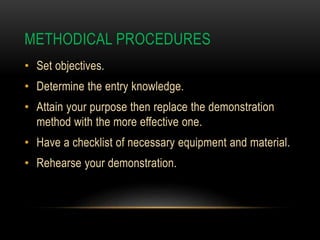
METHODICAL PROCEDURES
• Set objectives.
• Determine the entry knowledge.
• Attain your purpose then replace the demonstration
method with the more effective one.
• Have a checklist of necessary equipment and material.
• Rehearse your demonstration.
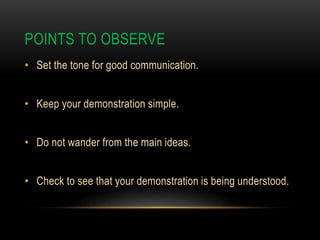
POINTS TO OBSERVE
• Set the tone for good communication.
• Keep your demonstration simple.
• Do not wander from the main ideas.
• Check to see that your demonstration is being understood.
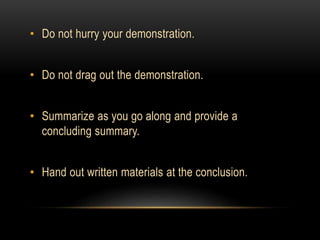
• Do not hurry your demonstration.
• Do not drag out the demonstration.
• Summarize as you go along and provide a
concluding summary.
• Hand out written materials at the conclusion.
SUMMING UP:
• A good demonstration is an audio-visual presentation. It
is not enough that teacher talks.
• To be effective, his/her demonstration must be
accompanied by some visuals.
• Determine first our goals, the materials we need, our
steps, and rehearse.
• Get and sustain the interest of our audience.
• Keep demonstration simple.
• Do not hurry nor drag out the demonstration.
• Check for understanding in the process of demonstration.
• Conclude with a summary.
• Hand out written materials at the end of demonstration.
ANY QUESTIONS?
THANK YOU AND GOD BLESS US!

Teaching with-demonstration

  • 1.
    DEMONSTRATIONS IN TEACHING “Gooddemonstration is good communication.”
  • 2.
    LEARNING OBJECTIVES: • Toidentify what does demonstration mean; • To identify how should demonstration ; • To state the importance of demonstration in the field of teaching-learning process.
  • 3.
    DEMONSTRATION • It isshowing how a thing is done emphasizing salient merits, utility, and efficiency of a concept, a method or a process or an attitude.
  • 4.
    GUIDING PRINCIPLES • EstablishRapport – Greet you audience. Make them feel at ease by your warmth sincerity. • Avoid the COIK(Clear Only If Known) – What is a fallacy? It is the assumption that what is clear to the expert demonstrator is also clearly known to the person whom the message is intended. • Watch for key points - they are the ones at which an error is likely to me made, the places at which many people stumble and where the knacks and tricks of the trade are especially important.
  • 5.
    METHODICAL PROCEDURES • Setobjectives. • Determine the entry knowledge. • Attain your purpose then replace the demonstration method with the more effective one. • Have a checklist of necessary equipment and material. • Rehearse your demonstration.
  • 6.
    POINTS TO OBSERVE •Set the tone for good communication. • Keep your demonstration simple. • Do not wander from the main ideas. • Check to see that your demonstration is being understood.
  • 7.
    • Do nothurry your demonstration. • Do not drag out the demonstration. • Summarize as you go along and provide a concluding summary. • Hand out written materials at the conclusion.
  • 8.
    SUMMING UP: • Agood demonstration is an audio-visual presentation. It is not enough that teacher talks. • To be effective, his/her demonstration must be accompanied by some visuals. • Determine first our goals, the materials we need, our steps, and rehearse.
  • 9.
    • Get andsustain the interest of our audience. • Keep demonstration simple. • Do not hurry nor drag out the demonstration. • Check for understanding in the process of demonstration. • Conclude with a summary. • Hand out written materials at the end of demonstration.
  • 10.
  • 11.
    THANK YOU ANDGOD BLESS US!