
StudentDevelopment Institute
Faculty of Arts, Humanities and Languages
Teaching GRAMMAR
Submitted to : Pann Rethea
Students Kum visal
Hong kimhorn
Pen chorpon
Sok monyneat
Batch II, Group 13 , Year IV, Semester I
Academic year 2017-2018
Contents
• Introduction Grammar
• Discovering Grammar
• Practicing Grammar
• Grammar Grammar
• Grammar Books
Introducing Grammar
• Grammar can be introduced in a number of ways, or
we can show students’ grammar evidence and ask
them to work to provide opportunities for students to
practice different grammar points. Many games from
the TV, Radio …etc. and they play everyday lives.
• The definition of Grammar according to the Glossary
of Grammatical Rhetorical Term:
“The systematic study and description of a
language”.
Introducing Grammar
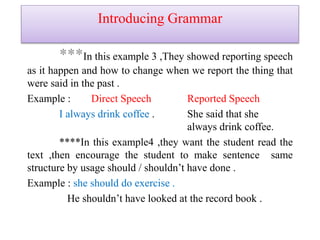
***In this example 3 ,They showed reporting speech
as it happen and how to change when we report the thing that
were said in the past .
Example : Direct Speech Reported Speech
I always drink coffee . She said that she
always drink coffee.
****In this example4 ,they want the student read the
text ,then encourage the student to make sentence same
structure by usage should / shouldn’t have done .
Example : she should do exercise .
He shouldn’t have looked at the record book .
Teaching Grammar
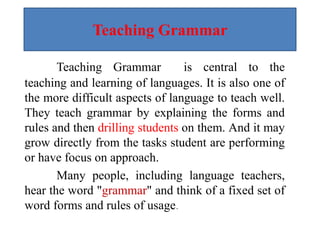
Teaching Grammar is central to the
teaching and learning of languages. It is also one of
the more difficult aspects of language to teach well.
They teach grammar by explaining the forms and
rules and then drilling students on them. And it may
grow directly from the tasks student are performing
or have focus on approach.
Many people, including language teachers,
hear the word "grammar" and think of a fixed set of
word forms and rules of usage.
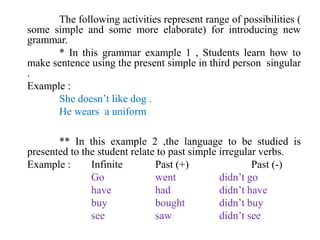
The following activities represent range of possibilities (
some simple and some more elaborate) for introducing new
grammar.
* In this grammar example 1 , Students learn how to
make sentence using the present simple in third person singular
.
Example :
She doesn’t like dog .
He wears a uniform
** In this example 2 ,the language to be studied is
presented to the student relate to past simple irregular verbs.
Example : Infinite Past (+) Past (-)
Go went didn’t go
have had didn’t have
buy bought didn’t buy
see saw didn’t see
Discovering Grammar
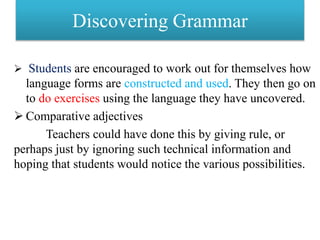
 Students are encouraged to work out for themselves how
language forms are constructed and used. They then go on
to do exercises using the language they have uncovered.
 Comparative adjectives
Teachers could have done this by giving rule, or
perhaps just by ignoring such technical information and
hoping that students would notice the various possibilities.
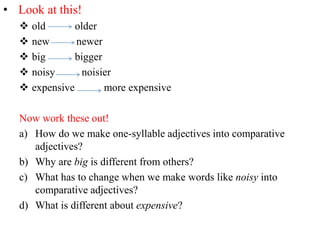
• Look at this!
 old older
 new newer
 big bigger
 noisy noisier
 expensive more expensive
Now work these out!
a) How do we make one-syllable adjectives into comparative
adjectives?
b) Why are big is different from others?
c) What has to change when we make words like noisy into
comparative adjectives?
d) What is different about expensive?
Analysis
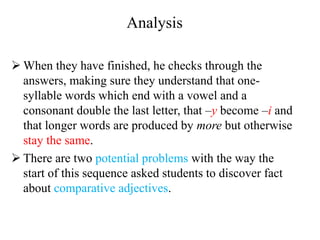
 When they have finished, he checks through the
answers, making sure they understand that one-
syllable words which end with a vowel and a
consonant double the last letter, that –y become –i and
that longer words are produced by more but otherwise
stay the same.
 There are two potential problems with the way the
start of this sequence asked students to discover fact
about comparative adjectives.
Analysis
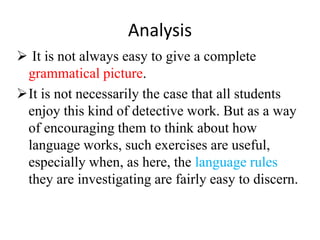
 It is not always easy to give a complete
grammatical picture.
It is not necessarily the case that all students
enjoy this kind of detective work. But as a way
of encouraging them to think about how
language works, such exercises are useful,
especially when, as here, the language rules
they are investigating are fairly easy to discern.
Practicing Grammar
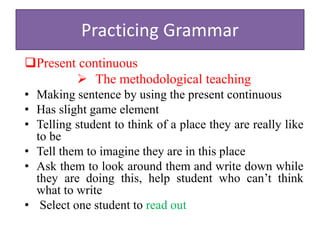
Present continuous
 The methodological teaching
• Making sentence by using the present continuous
• Has slight game element
• Telling student to think of a place they are really like
to be
• Tell them to imagine they are in this place
• Ask them to look around them and write down while
they are doing this, help student who can’t think
what to write
• Select one student to read out
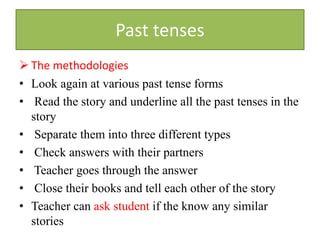
Past tenses
 The methodologies
• Look again at various past tense forms
• Read the story and underline all the past tenses in the
story
• Separate them into three different types
• Check answers with their partners
• Teacher goes through the answer
• Close their books and tell each other of the story
• Teacher can ask student if the know any similar
stories
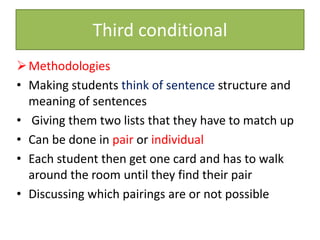
Third conditional
Methodologies
• Making students think of sentence structure and
meaning of sentences
• Giving them two lists that they have to match up
• Can be done in pair or individual
• Each student then get one card and has to walk
around the room until they find their pair
• Discussing which pairings are or not possible
Elementary
• Given to an ever-popular mini-survey activity
• Find the name of various people by going
around the class and asking question
• Ask the classmate
• Write down a name
Con-
• Making a chart asking students to find someone can
also get students to write the question themselves to
make it more interest
• Find out one interesting fact about each individual
student and put these facts into the chart
• There are mini-survey that we use for grammar
practice
Past perfect continuous
Methodologies
• Making sentences
• Required to use their imaginations or making
senses
• Add enjoyment by being designed as a team game
• Divides the class into small teams
• Reading sentence for which they have to find
appropriate response by using this tense
• The teams are given a short time to come up with
a good explanation for each sentence
• If they are correct or appropriate, the teacher
award a point
Grammar Game
The first Grammar Game is Asking the Right
Questions. There are many Grammar Games which
are used for learning all the levels. The following is
the game, which forces students to think extremely
carefully about the exact construction of the questions.
This game is provided two team, and there are cards
which are faced down. The member of a team pick up
the first card, and he or she ask the other team members .
Putting Sentences Back together again
• In this game, students can order many words to
make a sentence which this game is provided
the wrong order.
Ex. Like/ reading/ language./ I/ English/
Answer: ………………………………….
One Question Behind
• Focusing on simple idea that students should
answer the previous question, but they don’t
answer the question that is immediately being
asked.
Ex. 1. Where do you usually read the book?
2. What are you doing?
Answer: …………………………………..
Grammar Book
• Many shape and sizes of the grammar books
for the students at lower levels tend to be
quickly understandable explanations and
provide students with practicing.
• Many the basic grammatical points which we
can read many books, and the books contain
many strategies for learning.
A/An, Some, Any, No
• We use A and An with the singular countable
noun.
• Some: with plural coun-& uncoun- in
• Any: with plural coun and uncoun- in negative
• No: with singular and plural coun- and uncoun
Thanks

Teaching Methodology " Teaching Grammar"

  • 1.
    StudentDevelopment Institute Faculty ofArts, Humanities and Languages Teaching GRAMMAR Submitted to : Pann Rethea Students Kum visal Hong kimhorn Pen chorpon Sok monyneat Batch II, Group 13 , Year IV, Semester I Academic year 2017-2018
  • 2.
    Contents • Introduction Grammar •Discovering Grammar • Practicing Grammar • Grammar Grammar • Grammar Books
  • 3.
    Introducing Grammar • Grammarcan be introduced in a number of ways, or we can show students’ grammar evidence and ask them to work to provide opportunities for students to practice different grammar points. Many games from the TV, Radio …etc. and they play everyday lives. • The definition of Grammar according to the Glossary of Grammatical Rhetorical Term: “The systematic study and description of a language”.
  • 4.
    Introducing Grammar ***In thisexample 3 ,They showed reporting speech as it happen and how to change when we report the thing that were said in the past . Example : Direct Speech Reported Speech I always drink coffee . She said that she always drink coffee. ****In this example4 ,they want the student read the text ,then encourage the student to make sentence same structure by usage should / shouldn’t have done . Example : she should do exercise . He shouldn’t have looked at the record book .
  • 5.
    Teaching Grammar Teaching Grammaris central to the teaching and learning of languages. It is also one of the more difficult aspects of language to teach well. They teach grammar by explaining the forms and rules and then drilling students on them. And it may grow directly from the tasks student are performing or have focus on approach. Many people, including language teachers, hear the word "grammar" and think of a fixed set of word forms and rules of usage.
  • 6.
    The following activitiesrepresent range of possibilities ( some simple and some more elaborate) for introducing new grammar. * In this grammar example 1 , Students learn how to make sentence using the present simple in third person singular . Example : She doesn’t like dog . He wears a uniform ** In this example 2 ,the language to be studied is presented to the student relate to past simple irregular verbs. Example : Infinite Past (+) Past (-) Go went didn’t go have had didn’t have buy bought didn’t buy see saw didn’t see
  • 7.
    Discovering Grammar  Studentsare encouraged to work out for themselves how language forms are constructed and used. They then go on to do exercises using the language they have uncovered.  Comparative adjectives Teachers could have done this by giving rule, or perhaps just by ignoring such technical information and hoping that students would notice the various possibilities.
  • 8.
    • Look atthis!  old older  new newer  big bigger  noisy noisier  expensive more expensive Now work these out! a) How do we make one-syllable adjectives into comparative adjectives? b) Why are big is different from others? c) What has to change when we make words like noisy into comparative adjectives? d) What is different about expensive?
  • 9.
    Analysis  When theyhave finished, he checks through the answers, making sure they understand that one- syllable words which end with a vowel and a consonant double the last letter, that –y become –i and that longer words are produced by more but otherwise stay the same.  There are two potential problems with the way the start of this sequence asked students to discover fact about comparative adjectives.
  • 10.
    Analysis  It isnot always easy to give a complete grammatical picture. It is not necessarily the case that all students enjoy this kind of detective work. But as a way of encouraging them to think about how language works, such exercises are useful, especially when, as here, the language rules they are investigating are fairly easy to discern.
  • 11.
    Practicing Grammar Present continuous The methodological teaching • Making sentence by using the present continuous • Has slight game element • Telling student to think of a place they are really like to be • Tell them to imagine they are in this place • Ask them to look around them and write down while they are doing this, help student who can’t think what to write • Select one student to read out
  • 12.
    Past tenses  Themethodologies • Look again at various past tense forms • Read the story and underline all the past tenses in the story • Separate them into three different types • Check answers with their partners • Teacher goes through the answer • Close their books and tell each other of the story • Teacher can ask student if the know any similar stories
  • 13.
    Third conditional Methodologies • Makingstudents think of sentence structure and meaning of sentences • Giving them two lists that they have to match up • Can be done in pair or individual • Each student then get one card and has to walk around the room until they find their pair • Discussing which pairings are or not possible
  • 14.
    Elementary • Given toan ever-popular mini-survey activity • Find the name of various people by going around the class and asking question • Ask the classmate • Write down a name
  • 15.
    Con- • Making achart asking students to find someone can also get students to write the question themselves to make it more interest • Find out one interesting fact about each individual student and put these facts into the chart • There are mini-survey that we use for grammar practice
  • 16.
    Past perfect continuous Methodologies •Making sentences • Required to use their imaginations or making senses • Add enjoyment by being designed as a team game • Divides the class into small teams • Reading sentence for which they have to find appropriate response by using this tense • The teams are given a short time to come up with a good explanation for each sentence • If they are correct or appropriate, the teacher award a point
  • 17.
    Grammar Game The firstGrammar Game is Asking the Right Questions. There are many Grammar Games which are used for learning all the levels. The following is the game, which forces students to think extremely carefully about the exact construction of the questions. This game is provided two team, and there are cards which are faced down. The member of a team pick up the first card, and he or she ask the other team members .
  • 18.
    Putting Sentences Backtogether again • In this game, students can order many words to make a sentence which this game is provided the wrong order. Ex. Like/ reading/ language./ I/ English/ Answer: ………………………………….
  • 19.
    One Question Behind •Focusing on simple idea that students should answer the previous question, but they don’t answer the question that is immediately being asked. Ex. 1. Where do you usually read the book? 2. What are you doing? Answer: …………………………………..
  • 20.
    Grammar Book • Manyshape and sizes of the grammar books for the students at lower levels tend to be quickly understandable explanations and provide students with practicing. • Many the basic grammatical points which we can read many books, and the books contain many strategies for learning.
  • 21.
    A/An, Some, Any,No • We use A and An with the singular countable noun. • Some: with plural coun-& uncoun- in • Any: with plural coun and uncoun- in negative • No: with singular and plural coun- and uncoun
  • 22.