Going the Distance: Planning a Successful Lesson   A 2008-2009 AmeriCorps Production
The Four Language Skills Your lesson plan should incorporate activities using these 4 skills: Speaking Listening Reading Writing
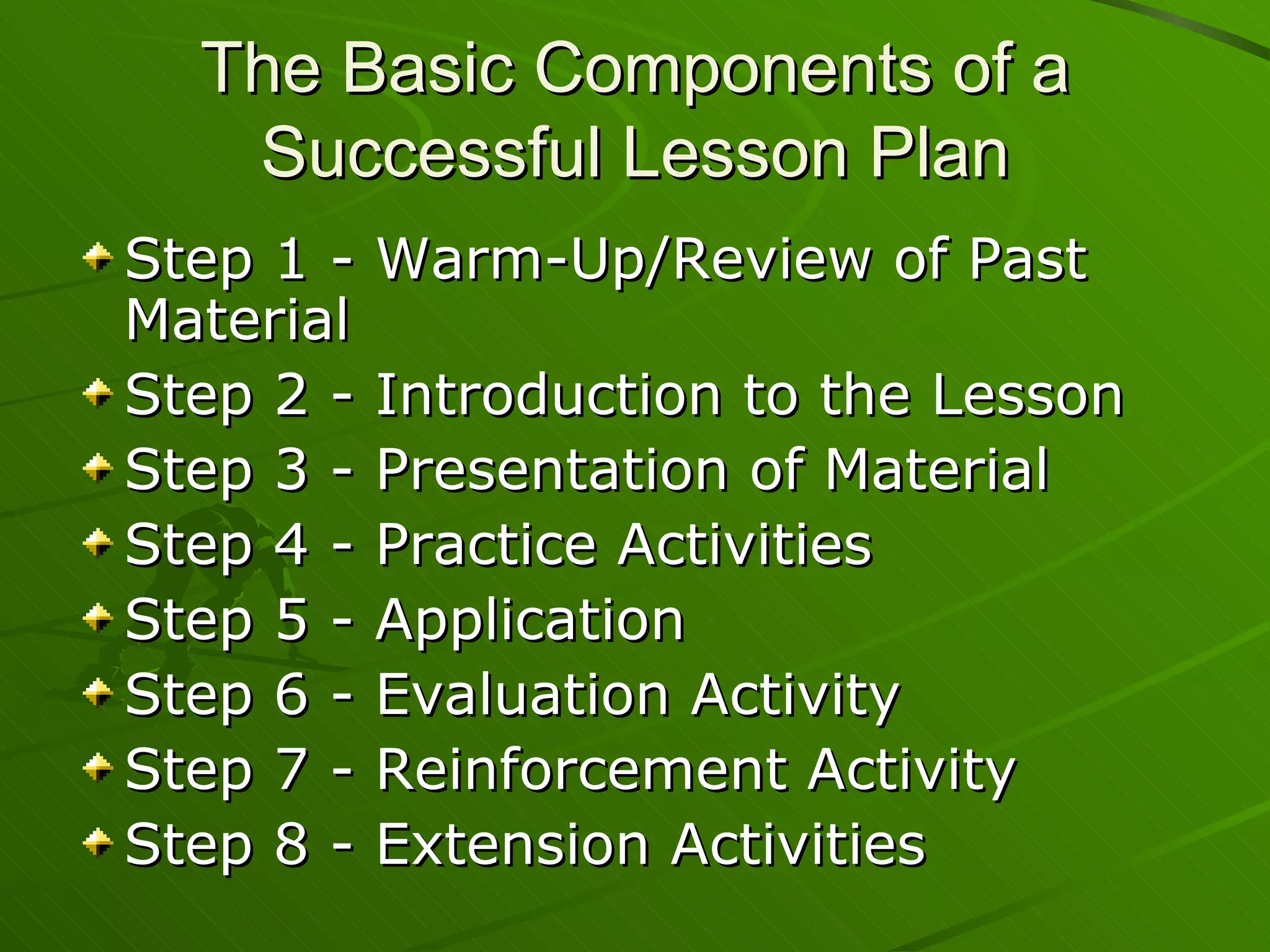
The Basic Components of a Successful Lesson Plan Step 1 - Warm-Up/Review of Past Material Step 2 - Introduction to the Lesson Step 3 - Presentation of Material Step 4 - Practice Activities Step 5 - Application Step 6 - Evaluation Activity Step 7 - Reinforcement Activity Step 8 - Extension Activities
Step 1 - The Warm-Up/Review It is essential to tie together the activities you are doing from class-to-class. Having a warm-up at the beginning of class is the best way to review the material you went over in the previous class. Also, many times you’ll find students might arrive late, so it is good to have an activity the other students can work on until you are ready to begin.
Warm-Up Activity Ideas! Journal Writing Answering questions written on the board Scrambled sentences Finishing homework Sample forms to practice filling out Magazine or newspaper articles to read (for more advanced levels) Crossword Puzzles Word Searches or Matching games with pertinent vocabulary Tongue Twisters
Step 2 – Introduction to the Lesson To make a smooth transition after the warm-up, relate the new topic to the material you just reviewed and also explain how it is relevant to the students’ lives.  Make sure you have an objective for your lesson and that you share your goal for the class with your students. Studies show that adult learners are more receptive to activities if they understand what they are expected to achieve during the class period.
Step 3 - Presentation of Materials When presenting new material to your class, it is important to center your lesson plan around a certain goal (i.e. by the end of class we will know 10 new vocabulary words). By having a clear and stated objective for the lesson, your presentation will be more focused for both you and your students.
Important Features of Step 3 - the Presentation: Establish a purpose for the lesson.  Why will your students need this in their day-to-day lives? Explain that to them. Provide information. Use both visual and verbal explanations.  Check for students’ level of understanding before moving on to the practice activities. Ask questions and elicit answers from individuals. Move around the room to listen to pronunciation.
ALL STAR POSTER ACTIVITY!
Step 4 - Practice Activities It’s important to have many activities planned to reinforce your presentation. Allowing the students to practice what they’ve learned can reinforce how the material is relevant in their everyday lives.
Important Features of Step 4 - Practice Activities: Make sure to use a variety of grouping strategies. Whole class, small groups, pairs, and individuals Special note on grouping strategies Monitor student practice (move around the room to assess students’ progress).  Provide materials to guide students.  Worksheets, visuals on the board, or refer them to pages in their books Provide for more than one learning style. Speaking Writing Listening  Doing
It is essential during the practice activities that you are constantly evaluating and giving feedback/encouragement to the students. An easy way to do this is to review the activity as a class after the students have finished.  Also, make sure to walk around the room and correct students as they practice. You will find students will also correct one another during the activities – it is important to make sure they are giving appropriate correction to each other.  Important Features of Step 4 - Practice Activities, Continued:
Step 5 - Application The application component allows students to participate in activities that apply the information they are learning in an everyday situation.
Important Features of Step 5 - Application: Provide students with opportunities to apply the material in real life situations. Have students role-play with partners, have group discussions, have conversation activities, etc. Facilitate purposeful communication. Allow students to provide responses based on their own experiences.
Step 6 – Evaluation Activity Although you will be evaluating students throughout your lesson and during all activities, it is good to have at least one activity that is entirely devoted to assessing individual understanding. Refer back to your stated objective to plan an evaluation activity.
Important Features of Step 6 – Evaluation Activity Assess achievements based on the lesson objectives. Using YES/NO cards is a simple and easy way to assess the students’ individual learning achievements.  Giving a short written test of knowledge for you to collect and review would give you more time to assess the success of the lesson. Consult the LCNV assessment sheets to track how many objectives your students have accomplished during the session. Those assessment sheets should be provided to you at the beginning of the session and they will be collected at the end of the session.
Step 7 – Reinforcement Activity After you have assessed the success of your lesson plan thus far, you can use the remainder of class to review and reinforce topics from the lesson that you feel your students have not grasped entirely. During the reinforcement activity it is helpful to use the entire class grouping strategy, so you can address the topic as a class.
Step 7 – Reinforcement Activity Your reinforcement activity should be designed to allow the students to self-assess their performance. It will also give the students a chance to reflect on everything they have learned during the class period.
Step 8 – Extension Activities At the end of class, it is crucial to assign activities for the students to continue to learn outside of the classroom.  Extension activities can be in the form of homework assignments or simply providing information about other programs where students can extend their learning.
Examples of Extension Activities: Assign homework from the student workbooks. Ask students to watch 15 minutes of television in English. Refer students to places in the community where they can practice skills learned.  For example, a library computer class in English Or, if your lesson was Food Vocabulary, suggest that the students go to a market and use only English to ask for assistance.
Lunch Break!
LESSON PLANNING ACTIVITY!
Other Things to Remember When Planning Your Lesson: Make sure the lesson integrates all four language skills. Activities should keep  all  students engaged. “Filler” activities are ready for spare moments. Always have extra games handy in case of emergencies or if the lesson goes faster than you planned!
It’s  YOUR  lesson plan! A lesson plan is simply a guide to structure your class. Make sure it makes sense to you! You must be comfortable with the format and flow of your lesson for it to be a success!
Fin. Contact information: Melissa Martin –  [email_address]  703-237-0866 ext. 104 Asmait Tewelde –  [email_address]  ext. 112 Adrienne Ward –  [email_address]  ext. 104 An AmeriCorps 2008-2009 Production. Directed by Melissa Martin, Asmait Tewelde, and Adrienne Ward Written by Melissa Martin, Asmait Tewelde, and Adrienne Ward Starring Melissa Martin Asmait Tewelde Adrienne Ward

Teacher Training: Lesson Planning Presentation Jan09

  • 1.
    Going the Distance:Planning a Successful Lesson A 2008-2009 AmeriCorps Production
  • 2.
    The Four LanguageSkills Your lesson plan should incorporate activities using these 4 skills: Speaking Listening Reading Writing
  • 3.
    The Basic Componentsof a Successful Lesson Plan Step 1 - Warm-Up/Review of Past Material Step 2 - Introduction to the Lesson Step 3 - Presentation of Material Step 4 - Practice Activities Step 5 - Application Step 6 - Evaluation Activity Step 7 - Reinforcement Activity Step 8 - Extension Activities
  • 4.
    Step 1 -The Warm-Up/Review It is essential to tie together the activities you are doing from class-to-class. Having a warm-up at the beginning of class is the best way to review the material you went over in the previous class. Also, many times you’ll find students might arrive late, so it is good to have an activity the other students can work on until you are ready to begin.
  • 5.
    Warm-Up Activity Ideas!Journal Writing Answering questions written on the board Scrambled sentences Finishing homework Sample forms to practice filling out Magazine or newspaper articles to read (for more advanced levels) Crossword Puzzles Word Searches or Matching games with pertinent vocabulary Tongue Twisters
  • 6.
    Step 2 –Introduction to the Lesson To make a smooth transition after the warm-up, relate the new topic to the material you just reviewed and also explain how it is relevant to the students’ lives. Make sure you have an objective for your lesson and that you share your goal for the class with your students. Studies show that adult learners are more receptive to activities if they understand what they are expected to achieve during the class period.
  • 7.
    Step 3 -Presentation of Materials When presenting new material to your class, it is important to center your lesson plan around a certain goal (i.e. by the end of class we will know 10 new vocabulary words). By having a clear and stated objective for the lesson, your presentation will be more focused for both you and your students.
  • 8.
    Important Features ofStep 3 - the Presentation: Establish a purpose for the lesson. Why will your students need this in their day-to-day lives? Explain that to them. Provide information. Use both visual and verbal explanations. Check for students’ level of understanding before moving on to the practice activities. Ask questions and elicit answers from individuals. Move around the room to listen to pronunciation.
  • 9.
    ALL STAR POSTERACTIVITY!
  • 10.
    Step 4 -Practice Activities It’s important to have many activities planned to reinforce your presentation. Allowing the students to practice what they’ve learned can reinforce how the material is relevant in their everyday lives.
  • 11.
    Important Features ofStep 4 - Practice Activities: Make sure to use a variety of grouping strategies. Whole class, small groups, pairs, and individuals Special note on grouping strategies Monitor student practice (move around the room to assess students’ progress). Provide materials to guide students. Worksheets, visuals on the board, or refer them to pages in their books Provide for more than one learning style. Speaking Writing Listening Doing
  • 12.
    It is essentialduring the practice activities that you are constantly evaluating and giving feedback/encouragement to the students. An easy way to do this is to review the activity as a class after the students have finished. Also, make sure to walk around the room and correct students as they practice. You will find students will also correct one another during the activities – it is important to make sure they are giving appropriate correction to each other. Important Features of Step 4 - Practice Activities, Continued:
  • 13.
    Step 5 -Application The application component allows students to participate in activities that apply the information they are learning in an everyday situation.
  • 14.
    Important Features ofStep 5 - Application: Provide students with opportunities to apply the material in real life situations. Have students role-play with partners, have group discussions, have conversation activities, etc. Facilitate purposeful communication. Allow students to provide responses based on their own experiences.
  • 15.
    Step 6 –Evaluation Activity Although you will be evaluating students throughout your lesson and during all activities, it is good to have at least one activity that is entirely devoted to assessing individual understanding. Refer back to your stated objective to plan an evaluation activity.
  • 16.
    Important Features ofStep 6 – Evaluation Activity Assess achievements based on the lesson objectives. Using YES/NO cards is a simple and easy way to assess the students’ individual learning achievements. Giving a short written test of knowledge for you to collect and review would give you more time to assess the success of the lesson. Consult the LCNV assessment sheets to track how many objectives your students have accomplished during the session. Those assessment sheets should be provided to you at the beginning of the session and they will be collected at the end of the session.
  • 17.
    Step 7 –Reinforcement Activity After you have assessed the success of your lesson plan thus far, you can use the remainder of class to review and reinforce topics from the lesson that you feel your students have not grasped entirely. During the reinforcement activity it is helpful to use the entire class grouping strategy, so you can address the topic as a class.
  • 18.
    Step 7 –Reinforcement Activity Your reinforcement activity should be designed to allow the students to self-assess their performance. It will also give the students a chance to reflect on everything they have learned during the class period.
  • 19.
    Step 8 –Extension Activities At the end of class, it is crucial to assign activities for the students to continue to learn outside of the classroom. Extension activities can be in the form of homework assignments or simply providing information about other programs where students can extend their learning.
  • 20.
    Examples of ExtensionActivities: Assign homework from the student workbooks. Ask students to watch 15 minutes of television in English. Refer students to places in the community where they can practice skills learned. For example, a library computer class in English Or, if your lesson was Food Vocabulary, suggest that the students go to a market and use only English to ask for assistance.
  • 21.
  • 22.
  • 23.
    Other Things toRemember When Planning Your Lesson: Make sure the lesson integrates all four language skills. Activities should keep all students engaged. “Filler” activities are ready for spare moments. Always have extra games handy in case of emergencies or if the lesson goes faster than you planned!
  • 24.
    It’s YOUR lesson plan! A lesson plan is simply a guide to structure your class. Make sure it makes sense to you! You must be comfortable with the format and flow of your lesson for it to be a success!
  • 25.
    Fin. Contact information:Melissa Martin – [email_address] 703-237-0866 ext. 104 Asmait Tewelde – [email_address] ext. 112 Adrienne Ward – [email_address] ext. 104 An AmeriCorps 2008-2009 Production. Directed by Melissa Martin, Asmait Tewelde, and Adrienne Ward Written by Melissa Martin, Asmait Tewelde, and Adrienne Ward Starring Melissa Martin Asmait Tewelde Adrienne Ward