Cu
[
urriculum
EE/EE
Under
Effectiv
m under C
Re
Bach
EE/Elec
the Fa
ve from t
Choice B
evised
helor o
Thir
ctrical
aculty o
the Acad
Based Cr
Syllab
of Eng
rd Yea
l, Elec
of Scie
demic Yea
redit & G
bus of
gineerin
ar
ctronic
ence &
ar 2018-
Grading
ng
cs & Po
Techno
-19 & onw
System
ower
ology
nwards ]
]
Dr. Babasaheb Ambedkar Marathwada University Aurangabad.
Tentative Teaching and Examination scheme of TE ( EEP / EE / EEE ) wef. 2018-19
Elective II
1. Special Purpose Electrical Machines
2. Digital Electronics
3. Communication Engineering
Semester -I Contact hr/week Examination Scheme
CODE Subject L T P Total CT TH TW P Total Duration of
Theory
Exam
EEP/301 Power System
Analysis
4 - 4 20 80 100 3 Hr
EEP/302 Microprocessor
and Interfacing
4 - 4 20 80 100 3 Hr
EEP/303 Electromagnetic
Fields
4 - 4 20 80 100 3 Hr
EEP/304 Control System
Engineering
4 - 4 20 80 100 3 Hr
EEP/305 Elective II 4 - 4 20 80 100 3 Hr
EEP/321 LAB 1
Power System
Analysis
- - 2 2 50 50
EEP/322 LAB II
Microprocessor
and Interfacing
- - 2 2 50 50
EEP/323 LAB III
Control System
Engineering
- - 2 2 50 50
EEP/324 LAB IV
Elective II
- - 2 2 50 50
BSH305 Communication
Skill –II
(*Term work
based on internal
online Exam)
2 - - 2 50* 50 2Hrs
TOTAL 20 - 10 30 100 400 150 100 750
Dr Babasaheb Ambedkar Marathwada University Aurangabad.
Tentative Teaching and Examination scheme of TE (EEP /EE /EEE) wef 2018-19
Elective III
1. Digital System Design
2. Industrial Management
3. Energy conservation and Audit
-----------
Semester -II Contact hr/week Examination Scheme
CODE Subject L T P Total CT TH TW P Total Duration of
Theory
Exam
EEP/351 Electrical
Machine Design
4 - 4 20 80 100 3 Hr
EEP/352 Testing and
Maintenance of
electrical
equipments
4 - 4 20 80 100 3 Hr
EEP/353 Power
Electronics – I
4 - 4 20 80 100 3 Hr
EEP/354 Microcontroller
and Applications
4 - 4 20 80 100 3 Hr
EEP/355 Elective III 4 - 4 20 80 100 3 Hr
EEP/371 LAB 1
Electrical
Machine Design
- - 2 2 25 25
EEP/372 LAB II
Testing and
Maintenance of
electrical
equipments
- - 2 2 50 50
EEP/373 LAB III
Power
Electronics – I
- - 2 2 50 50
EEP/374 LAB IV
Microcontroller
and Applications
- - 2 2 50 50
EEP/375 LAB V
Elective III
- - 2 2 50 50
EEP/376 Seminar 25 25
TOTAL 20 - 10 30 100 400 100 150 750
Te
TH
Pr
M
eaching Schem
HEORY: 4 Hrs/W
actical: 2 Hrs/W
arks
EE
e
Week
Week
P/301- PO
OWER SY
YSTEM A
ANALYSIS
S
Examination
Theory pape
Internal Asse
Practical : 50
n Scheme
er: 80 Marks
essment: 20
0 Marks
Teachin
Theory
Practica
EEP/3
ng Scheme
y: Hrs/Week
al: Hrs/Wee
302- MICR
ek
ROPROCESSOR &
& INTERF
Examina
Theory P
Internal
Practica
FACING
ation Scheme
Paper: Mar
l Assessment:
al : Marks
rks
Marks
E
Teach
Theor
Practi
EP/305- E
hing Scheme
ry: Hrs/Wee
ical: Hrs/We
Elective I
ek
eek
I- Specia
al Purpose
e Electric
Exa
Theory
Internal Asse
Pr
cal Machi
amination Sche
y Paper: Ma
ssment: M
actical : Ma
ines
eme
arks
arks
arks
Unit 1:Number System and logic Family: [6 Hrs.]
Binary number system, Signed binary numbers, Binary arithmetic, Decimal number system, Hexa
number system, Arithmetic operations using ’s complement, ’s complement, BCD code, Excess‐ co
Logic gates and switching functions, Basic gates: AND, OR, NOT, EX‐OR, EX‐NOR, NAND, NOR. Introd
family RTL, ECL, TTL, I L, PMOS, NMOS,CMOS, Characteristics of: TTL, CMOS. Representation of logic e
Unit­2: Combinational Logic Design : [8 Hrs.]
Boolean Algebra Rules, De Morgan’s theorem, Boolean algebra, Representation of logic functions usi
Simplification of Logic functions using Karnaugh Map, Don't care conditions, Design of combination
blocks: Half‐adder, Full‐adder, Half‐subtractor, bit comparator, Full subtractor, Binary to Gray and G
Unit­3: Data­Processing Circuits : [6 Hrs.]
Multiplexers, Demultiplexers, multiplexers/Demultiplexers Trees, BCD‐to‐Seven‐segment Decoders, E
Checkers, Comparator, Analog to digital conversion and its classifications, Digital to analog con
ADC and DAC Parallel Adder IC , Arithmetic logic Unit.
Unit­4: Sequential Logic Circuit [8 Hrs.]
Flip‐Flops: Memory cell, R‐S, J‐K, Race around condition, Master‐slave J‐K, D, T, excitation table, flip‐flo
Counter: Designing of asynchronous and synchronous counters, bit up/down, MOD‐ N cou
Registers:SISO, SIPO, PISO, PIFO Shift register.
Unit­5: Synchronous and Asynchronous Sequential Circuits [6 Hrs.]
Synchronous Sequential Circuits: General Model, Classification, Design, Use of Algorithmic State Ma
Sequential Circuits.
Asynchronous Sequential Circuits: Design of fundamental mode and pulse mode circuits State Machi
Circuits, Design of Combinational and Sequential circuits.
Unit­6: Semiconductor Memories and PLD [6 Hrs.]
Semiconductor Memory: Memory organization and operation, Expanding memory size, classification
RAM, ROM, EPROM, SRAM, DRAM, flash memory. Programmable Logic Devices: Introduction to Progr
Logic Arrays PLA , Programmable Array Logic PAL .
List of Practical’s.(any 8)
. To study and verify Logic Gates.
. To study and verify Combinational circuits.
. To study and verify Flip flops.
. To study and verify digital converter.
. To study and verify Multiplexer and Demultiplexers.
. To study and design MOD counter.
. To study and verify encoder and decoders.
. To study and verify Logic Families.
EEP/305- Elective II- DIGITAL ELECTRONICS
Teaching Scheme Examination Scheme
Theory: Hrs/Week Theory Paper: Marks
Practical: Hrs/Week Internal Assessment: Marks
Practical : Marks
. To study semiconductor memories.
. To study PLDs.
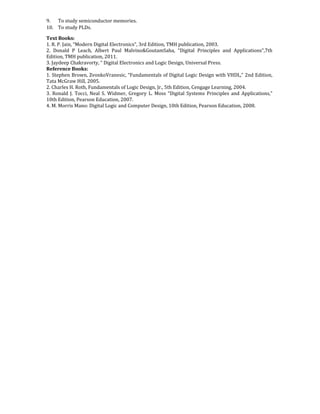
Text Books:
. R. P. Jain, Modern Digital Electronics , rd Edition, TMH publication, .
. Donald P Leach, Albert Paul Malvino&GoutamSaha, Digital Principles and Applications , th
Edition, TMH publication, .
. Jaydeep Chakravorty, Digital Electronics and Logic Design, Universal Press.
Reference Books:
. Stephen Brown, ZvonkoVranesic, Fundamentals of Digital Logic Design with VHDL, nd Edition,
Tata McGraw Hill, .
. Charles H. Roth, Fundamentals of Logic Design, Jr., th Edition, Cengage Learning, .
. Ronald J. Tocci, Neal S. Widmer, Gregory L. Moss Digital Systems Principles and Applications,
th Edition, Pearson Education, .
. M. Morris Mano: Digital Logic and Computer Design, th Edition, Pearson Education, .
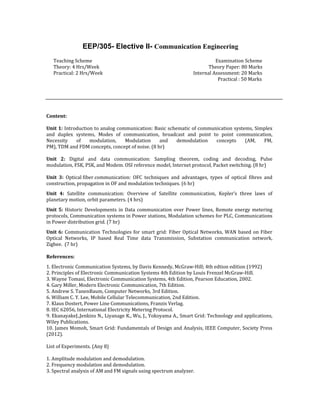
Content:
Unit 1: Introduction to analog communication: Basic schematic of communication systems, Simplex
and duplex systems, Modes of communication, broadcast and point to point communication,
Necessity of modulation, Modulation and demodulation concepts AM, FM,
PM , TDM and FDM concepts, concept of noise. hr
Unit 2: Digital and data communication: Sampling theorem, coding and decoding, Pulse
modulation, FSK, PSK, and Modem. OSI reference model, Internet protocol, Packet switching. hr
Unit 3: Optical fiber communication: OFC techniques and advantages, types of optical fibres and
construction, propagation in OF and modulation techniques. hr
Unit 4: Satellite communication: Overview of Satellite communication, Kepler’s three laws of
planetary motion, orbit parameters. hrs
Unit 5: Historic Developments in Data communication over Power lines, Remote energy metering
protocols, Communication systems in Power stations, Modulation schemes for PLC, Communications
in Power distribution grid. hr
Unit 6: Communication Technologies for smart grid: Fiber Optical Networks, WAN based on Fiber
Optical Networks, IP based Real Time data Transmission, Substation communication network,
Zigbee. hr
References:
. Electronic Communication Systems, by Davis Kennedy, McGraw‐Hill; th edtion edition
. Principles of Electronic Communication Systems th Edition by Louis Frenzel McGraw‐Hill.
. Wayne Tomasi, Electronic Communication Systems, th Edition, Pearson Education, .
. Gary Miller, Modern Electronic Communication, th Edition.
. Andrew S. TanenBaum, Computer Networks, rd Edition.
. William C. Y. Lee, Mobile Cellular Telecommunication, nd Edition.
. Klaus Dostert, Power Line Communications, Franzis Verlag.
. IEC , International Electricity Metering Protocol.
. EkanayakeJ.,Jenkins N., Liyanage K., Wu, J., Yokoyama A., Smart Grid: Technology and applications,
Wiley Publications.
. James Momoh, Smart Grid: Fundamentals of Design and Analysis, IEEE Computer, Society Press
.
List of Experiments. Any
. Amplitude modulation and demodulation.
. Frequency modulation and demodulation.
. Spectral analysis of AM and FM signals using spectrum analyzer.
EEP/305- Elective II- Communication Engineering
Teaching Scheme Examination Scheme
Theory: Hrs/Week Theory Paper: Marks
Practical: Hrs/Week Internal Assessment: Marks
Practical : Marks
. Pulse Code Modulation and demodulation.
. Sampling Theorem – Verification.
. Time division multiplexing Modulation and demodulation.
. Frequency & Phase shift keying.
. Study of Kepler’s laws of planetary motion.
. Study of modulation techniques in OFC.
. Study of substation communication network for smart grid.
. Study of Modulation schemes for PLC.
. Study of Remote energy metering protocols.
Prerequisite:
. Basic Knowledge of Soft Skills
. Good understanding of English
Objectives:
. To imbibe leadership skills
. To develop interpersonal Skills
. To introduce corporate etiquettes
. To imbibe team skills
CONTENTS
Unit 1: Understanding self and Goal Setting ( 5 Hours)
- Self‐Assessment: Understanding Self Core Competency SWOT/SWOC
- Long term and short‐term Goal Setting
- Execution Skills
Unit 2: Interpersonal Skills (6 Hours)
- Interpersonal Communication
- Conflict Management
- Problem Solving
- Decision Making
- Persuasion and Influence
EEP/ BSH305-Communication Skill-II
Teaching Scheme Examination Scheme
Theory : Hrs/Week Term Work : Marks
Unit 3: Group Dynamics and Team Building ( 4 Hours)
- Group Vs Team
- Team Building
- Team Work
- Developing Leadership Skills
Unit 4: Corporate Etiquette (5 Hours)
- Clothing Etiquette, Personal hygiene and grooming
- Time Management
- Influencing Skills Impression
- Balancing personal and professional Life
- Ethics, Values and Laws
Text Book:
. The Ace of Soft Skills Gopalaswamy Ramesh Pearson Publication
Reference Books:
. Execution; :Ram Charan
Publisher: Crown Business; edition June ,
Language: EnglishISBN‐ : ISBN‐ : ‐
. Laws of Teamwork : John C Maxwell
. Master of Business Etiquette: Cyrus Gonda
Author: Cyrus Gonda, Publisher EMBASSY BOOKS, , ISBN ,
. Goals :
Author: Brain Tracy ISBN: ‐ ‐ ‐ Published by Berrett‐Koehler Publishers, Inc
. Interpersonal Skills at work :
Author: John Hayes Second Edition: Routledge
. People Smart :
Author: Freda Hansburgby Berrett‐Koehler Publishers, Inc
Term Work Assessment (50 marks):
The term work shall consist of internal online examination of Marks, conducted at institute level.
The marks of the examination shall be forwarded to the University.
Teach
Theor
Practi
hing Scheme
ry: Hrs/Wee
cal: Hrs/We
EEP/351
k
eek
- Electric
cal Machi
ine Desig
E
The
Internal As
gn
Examination S
eory Paper:
ssessment:
Practical :
Scheme
Marks
Marks
Marks
EE
Teachin
THEOR
Practica
EP/352- T
ng Scheme
Y: Hrs/Wee
al: Hrs/Wee
TESTING
k
ek
AND MA
EQUIP
AINTENAN
PMENTS
NCE OF E
T
Internal
ELECTRIC
Examination
heory paper:
Assessment:
Practical :
CAL
n Scheme
Marks
Marks
Marks
Tea
The
Prac
ching Scheme
eory: Hrs/W
ctical: Hrs/W
EEP
e
Week
Week
P/353- Pow
wer Elect
tronics -
Intern
I
Examinat
Theory Pape
nal Assessmen
Practical
tion Scheme
er: Marks
nt: Marks
l : Marks
Teach
Theor
Practi
EE
hing Scheme
ry: Hrs/Wee
ical: Hrs/We
P/354- M
ek
eek
icrocontr
roller and
d Applica
T
Internal
ations
Examinatio
Theory Paper:
Assessment:
Practical :
n Scheme
Marks
Marks
Marks
Teachin
Theory
Practic
EEP/355
ng Scheme
y: Hrs/Week
cal: Hrs/Wee
-Elective
k
ek
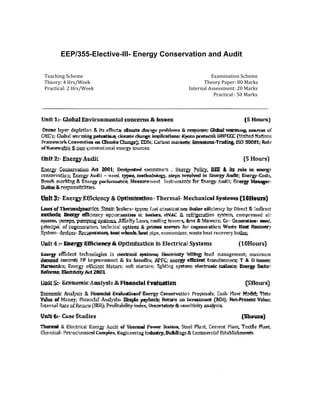
-III- Energ
gy Conse
ervation a
Th
Internal A
and Audi
Examination
heory Paper:
Assessment:
Practical :
t
n Scheme
Marks
Marks
Marks
UNIT 1: (08 hours)
Industrial Management: Principles and Importance of management, Functions of management,
Decision making process.
Operations Management: Production concept, production planning and control, manufacturing
systems: types and characteristics, plant layout types, need and characteristic, salary and wage
administration.
UNIT 2: (08 hours)
Human Resource Management: Concept, Objective and Functions of HRM, Principles of good HR
policy, Incentives: types and characteristics.
Financial Management: Types of Capital, Source of finance, Institutions building Industrial finance,
Taxation policies, Taxes: direct and indirect.
UNIT 3: (08 hours)
Marketing Management: Functions of Marketing, Market research, Sales Management, Sales
organization and its functions, sales forecasting, the selling and marketing concept.
Network Analysis: Network Techniques, Terms related to Network Planning, PERT, CPM, Applications
of Network Technique.
UNIT 4: (08 hours)
Material Management: Introduction to Material Management, Purchasing, Buying Technique,
Purchasing procedure, Inventory control, Inventory Management, Material requirement planning.
Total Quality Management: Definition, Quality obstacles, Benefits of TQM,ISO registration benefits, ISO
series standards, sector specific standards, ISO requirements, Introduction to ISO
series, Testing standards
UNIT 5: (08 hours)
Industrial Acts: Indian factory act, Indian Electricity act, The Workmen’s compensation act, Consumer
Protection act.
Engineering Economics: Meaning of economics, difference between value and price, law of demand and
supply, demand forecasting methods, Banks: functions and types, RBI, SEBI, modern concepts like SEZ,
PPP, BOT.
UNIT 6: (08 hours)
Management Information Systems: Introduction, Elements, Structure and Requirements of MIS,
Decision support system.
EEP/355-Elective-III- INDUSTRIAL MANAGEMENT
Teaching Scheme Examination Scheme
Theory: Hrs/Week Theory Paper: Marks
Practical: Hrs/Week Internal Assessment: Marks
Practical : Marks
Operations Research: LPP Graphical only , Transportation Problem, Assignment Problem, Inventory
Model EOQ, Stock levels .
REFERENCE BOOKS:
Industrial Engineering and Management: O.P. Khanna; Dhanpatrai and Company
Management Information Systems by G.B. Davis, M.H. Olson: McGrawhill; International Edition.
Total Quality Management by D.H. Besterfield, C.B. Michana& others; PHI Pvt. Ltd.
ISO quality systems: A. N. Singh; Dolphin Book N Delhi.
Business organization and management: M.C. Shukla; S. Chand.
Operations Research by S. D. Sharma.
TERMWORK:
Term‐work shall consist of minimum EIGHT experiments from above UNITS.
UNIT 1: MOS Devices (06 hours)
Introduction to MOST,I‐V characteristics of NMOS and PMOS, second order effects‐CLM, Body bias, short
channel effects‐VT roll off, DIBL, Mobility degradation, Transfer characteristics of CMOS inverter,
Detailed analysis of CMOS inverter with parasitic.
UNIT 2: CMOS Design (08 hours)
CMOS logic families‐static, dynamic including their timing analysis and power consumption, CPL, Pass
transistor logic, Transmission gate, circuits using CPL and pass transistor logic.
UNIT 3: Fabrication and Layout (06 hours)
Basic CMOS technology, self aligned CMOS process, N well, P well, Twin tub, Layout of CMOS inverter,
Design rules, Verification of layout
UNIT 4: Introduction to VHDL (06 hours)
Introduction, EDA Tool‐VHDL, Design flow, Introduction to VHDL, Elements of VHDL, Modelling styles‐
sequential, structural, and data flow modeling , sequential and concurrent statements
UNIT 5: Circuit Design Using FPGA &CPLD (06 hours)
Function, Procedures, Attributes, Test benches, synthesizable and no synthesizable statements, packages
and configurations. The state diagram, modeling in VHDL with examples such as counters, registers and
bidirectional bus. Introduction, study of architecture of CPLDs and FPGAs
UNIT 6: Testability (08 hours)
Need of design for testability, introduction to fault coverage, Testability, Design for testability,
controllability, absorbability, stuck at fault model, stuck open and stuck short faults, Boundary scan
check, JTAG technology, TAP controller, and TAP controller state diagram, scan path, Full and partial
scan.
TEXT BOOKS:
N. Weste and K. Eshranghian, Principles of CMOS VLSI Design, Addison Wesley.
J. Rabaey, Digital Integrated Circuits: A Design perspective, PHI
D. Perry, VHDL, nd edition, TMH, .
Kang S.M, CMOS Digital Integrated Circuits, TMH rd .
Bushnell Agrawal, Essentials of Electronic Testing for Digital memory and mixed signal VLSI circuits,
Kulwar academic publisher.
EEP/355-Elective-III- DIGITAL SYSTEM DESIGN
Teaching Scheme Examination Scheme
Theory: Hrs/Week Theory Paper: Marks
Practical: Hrs/Week Internal Assessment: Marks
Practical : Marks
REFERENCE BOOKS:
Boyee and Baker, CMOS, EEE Press.
Xilinx FPGA/CPLD data book.
VHDL Primer, Addison Weslay Longman, , J Bhaskar.
TERMWORK:
Term‐work shall consist of minimum EIGHT experiments from above UNITS.

TE-Electrical and Electronics Engineering syllabus.pdf

  • 2.
    Cu [ urriculum EE/EE Under Effectiv m under C Re Bach EE/Elec theFa ve from t Choice B evised helor o Thir ctrical aculty o the Acad Based Cr Syllab of Eng rd Yea l, Elec of Scie demic Yea redit & G bus of gineerin ar ctronic ence & ar 2018- Grading ng cs & Po Techno -19 & onw System ower ology nwards ] ]
  • 3.
    Dr. Babasaheb AmbedkarMarathwada University Aurangabad. Tentative Teaching and Examination scheme of TE ( EEP / EE / EEE ) wef. 2018-19 Elective II 1. Special Purpose Electrical Machines 2. Digital Electronics 3. Communication Engineering Semester -I Contact hr/week Examination Scheme CODE Subject L T P Total CT TH TW P Total Duration of Theory Exam EEP/301 Power System Analysis 4 - 4 20 80 100 3 Hr EEP/302 Microprocessor and Interfacing 4 - 4 20 80 100 3 Hr EEP/303 Electromagnetic Fields 4 - 4 20 80 100 3 Hr EEP/304 Control System Engineering 4 - 4 20 80 100 3 Hr EEP/305 Elective II 4 - 4 20 80 100 3 Hr EEP/321 LAB 1 Power System Analysis - - 2 2 50 50 EEP/322 LAB II Microprocessor and Interfacing - - 2 2 50 50 EEP/323 LAB III Control System Engineering - - 2 2 50 50 EEP/324 LAB IV Elective II - - 2 2 50 50 BSH305 Communication Skill –II (*Term work based on internal online Exam) 2 - - 2 50* 50 2Hrs TOTAL 20 - 10 30 100 400 150 100 750
  • 4.
    Dr Babasaheb AmbedkarMarathwada University Aurangabad. Tentative Teaching and Examination scheme of TE (EEP /EE /EEE) wef 2018-19 Elective III 1. Digital System Design 2. Industrial Management 3. Energy conservation and Audit ----------- Semester -II Contact hr/week Examination Scheme CODE Subject L T P Total CT TH TW P Total Duration of Theory Exam EEP/351 Electrical Machine Design 4 - 4 20 80 100 3 Hr EEP/352 Testing and Maintenance of electrical equipments 4 - 4 20 80 100 3 Hr EEP/353 Power Electronics – I 4 - 4 20 80 100 3 Hr EEP/354 Microcontroller and Applications 4 - 4 20 80 100 3 Hr EEP/355 Elective III 4 - 4 20 80 100 3 Hr EEP/371 LAB 1 Electrical Machine Design - - 2 2 25 25 EEP/372 LAB II Testing and Maintenance of electrical equipments - - 2 2 50 50 EEP/373 LAB III Power Electronics – I - - 2 2 50 50 EEP/374 LAB IV Microcontroller and Applications - - 2 2 50 50 EEP/375 LAB V Elective III - - 2 2 50 50 EEP/376 Seminar 25 25 TOTAL 20 - 10 30 100 400 100 150 750
  • 5.
    Te TH Pr M eaching Schem HEORY: 4Hrs/W actical: 2 Hrs/W arks EE e Week Week P/301- PO OWER SY YSTEM A ANALYSIS S Examination Theory pape Internal Asse Practical : 50 n Scheme er: 80 Marks essment: 20 0 Marks
  • 7.
    Teachin Theory Practica EEP/3 ng Scheme y: Hrs/Week al:Hrs/Wee 302- MICR ek ROPROCESSOR & & INTERF Examina Theory P Internal Practica FACING ation Scheme Paper: Mar l Assessment: al : Marks rks Marks
  • 13.
    E Teach Theor Practi EP/305- E hing Scheme ry:Hrs/Wee ical: Hrs/We Elective I ek eek I- Specia al Purpose e Electric Exa Theory Internal Asse Pr cal Machi amination Sche y Paper: Ma ssment: M actical : Ma ines eme arks arks arks
  • 16.
    Unit 1:Number Systemand logic Family: [6 Hrs.] Binary number system, Signed binary numbers, Binary arithmetic, Decimal number system, Hexa number system, Arithmetic operations using ’s complement, ’s complement, BCD code, Excess‐ co Logic gates and switching functions, Basic gates: AND, OR, NOT, EX‐OR, EX‐NOR, NAND, NOR. Introd family RTL, ECL, TTL, I L, PMOS, NMOS,CMOS, Characteristics of: TTL, CMOS. Representation of logic e Unit­2: Combinational Logic Design : [8 Hrs.] Boolean Algebra Rules, De Morgan’s theorem, Boolean algebra, Representation of logic functions usi Simplification of Logic functions using Karnaugh Map, Don't care conditions, Design of combination blocks: Half‐adder, Full‐adder, Half‐subtractor, bit comparator, Full subtractor, Binary to Gray and G Unit­3: Data­Processing Circuits : [6 Hrs.] Multiplexers, Demultiplexers, multiplexers/Demultiplexers Trees, BCD‐to‐Seven‐segment Decoders, E Checkers, Comparator, Analog to digital conversion and its classifications, Digital to analog con ADC and DAC Parallel Adder IC , Arithmetic logic Unit. Unit­4: Sequential Logic Circuit [8 Hrs.] Flip‐Flops: Memory cell, R‐S, J‐K, Race around condition, Master‐slave J‐K, D, T, excitation table, flip‐flo Counter: Designing of asynchronous and synchronous counters, bit up/down, MOD‐ N cou Registers:SISO, SIPO, PISO, PIFO Shift register. Unit­5: Synchronous and Asynchronous Sequential Circuits [6 Hrs.] Synchronous Sequential Circuits: General Model, Classification, Design, Use of Algorithmic State Ma Sequential Circuits. Asynchronous Sequential Circuits: Design of fundamental mode and pulse mode circuits State Machi Circuits, Design of Combinational and Sequential circuits. Unit­6: Semiconductor Memories and PLD [6 Hrs.] Semiconductor Memory: Memory organization and operation, Expanding memory size, classification RAM, ROM, EPROM, SRAM, DRAM, flash memory. Programmable Logic Devices: Introduction to Progr Logic Arrays PLA , Programmable Array Logic PAL . List of Practical’s.(any 8) . To study and verify Logic Gates. . To study and verify Combinational circuits. . To study and verify Flip flops. . To study and verify digital converter. . To study and verify Multiplexer and Demultiplexers. . To study and design MOD counter. . To study and verify encoder and decoders. . To study and verify Logic Families. EEP/305- Elective II- DIGITAL ELECTRONICS Teaching Scheme Examination Scheme Theory: Hrs/Week Theory Paper: Marks Practical: Hrs/Week Internal Assessment: Marks Practical : Marks
  • 17.
    . To studysemiconductor memories. . To study PLDs. Text Books: . R. P. Jain, Modern Digital Electronics , rd Edition, TMH publication, . . Donald P Leach, Albert Paul Malvino&GoutamSaha, Digital Principles and Applications , th Edition, TMH publication, . . Jaydeep Chakravorty, Digital Electronics and Logic Design, Universal Press. Reference Books: . Stephen Brown, ZvonkoVranesic, Fundamentals of Digital Logic Design with VHDL, nd Edition, Tata McGraw Hill, . . Charles H. Roth, Fundamentals of Logic Design, Jr., th Edition, Cengage Learning, . . Ronald J. Tocci, Neal S. Widmer, Gregory L. Moss Digital Systems Principles and Applications, th Edition, Pearson Education, . . M. Morris Mano: Digital Logic and Computer Design, th Edition, Pearson Education, .
  • 18.
    Content: Unit 1: Introductionto analog communication: Basic schematic of communication systems, Simplex and duplex systems, Modes of communication, broadcast and point to point communication, Necessity of modulation, Modulation and demodulation concepts AM, FM, PM , TDM and FDM concepts, concept of noise. hr Unit 2: Digital and data communication: Sampling theorem, coding and decoding, Pulse modulation, FSK, PSK, and Modem. OSI reference model, Internet protocol, Packet switching. hr Unit 3: Optical fiber communication: OFC techniques and advantages, types of optical fibres and construction, propagation in OF and modulation techniques. hr Unit 4: Satellite communication: Overview of Satellite communication, Kepler’s three laws of planetary motion, orbit parameters. hrs Unit 5: Historic Developments in Data communication over Power lines, Remote energy metering protocols, Communication systems in Power stations, Modulation schemes for PLC, Communications in Power distribution grid. hr Unit 6: Communication Technologies for smart grid: Fiber Optical Networks, WAN based on Fiber Optical Networks, IP based Real Time data Transmission, Substation communication network, Zigbee. hr References: . Electronic Communication Systems, by Davis Kennedy, McGraw‐Hill; th edtion edition . Principles of Electronic Communication Systems th Edition by Louis Frenzel McGraw‐Hill. . Wayne Tomasi, Electronic Communication Systems, th Edition, Pearson Education, . . Gary Miller, Modern Electronic Communication, th Edition. . Andrew S. TanenBaum, Computer Networks, rd Edition. . William C. Y. Lee, Mobile Cellular Telecommunication, nd Edition. . Klaus Dostert, Power Line Communications, Franzis Verlag. . IEC , International Electricity Metering Protocol. . EkanayakeJ.,Jenkins N., Liyanage K., Wu, J., Yokoyama A., Smart Grid: Technology and applications, Wiley Publications. . James Momoh, Smart Grid: Fundamentals of Design and Analysis, IEEE Computer, Society Press . List of Experiments. Any . Amplitude modulation and demodulation. . Frequency modulation and demodulation. . Spectral analysis of AM and FM signals using spectrum analyzer. EEP/305- Elective II- Communication Engineering Teaching Scheme Examination Scheme Theory: Hrs/Week Theory Paper: Marks Practical: Hrs/Week Internal Assessment: Marks Practical : Marks
  • 19.
    . Pulse CodeModulation and demodulation. . Sampling Theorem – Verification. . Time division multiplexing Modulation and demodulation. . Frequency & Phase shift keying. . Study of Kepler’s laws of planetary motion. . Study of modulation techniques in OFC. . Study of substation communication network for smart grid. . Study of Modulation schemes for PLC. . Study of Remote energy metering protocols. Prerequisite: . Basic Knowledge of Soft Skills . Good understanding of English Objectives: . To imbibe leadership skills . To develop interpersonal Skills . To introduce corporate etiquettes . To imbibe team skills CONTENTS Unit 1: Understanding self and Goal Setting ( 5 Hours) - Self‐Assessment: Understanding Self Core Competency SWOT/SWOC - Long term and short‐term Goal Setting - Execution Skills Unit 2: Interpersonal Skills (6 Hours) - Interpersonal Communication - Conflict Management - Problem Solving - Decision Making - Persuasion and Influence EEP/ BSH305-Communication Skill-II Teaching Scheme Examination Scheme Theory : Hrs/Week Term Work : Marks
  • 20.
    Unit 3: GroupDynamics and Team Building ( 4 Hours) - Group Vs Team - Team Building - Team Work - Developing Leadership Skills Unit 4: Corporate Etiquette (5 Hours) - Clothing Etiquette, Personal hygiene and grooming - Time Management - Influencing Skills Impression - Balancing personal and professional Life - Ethics, Values and Laws Text Book: . The Ace of Soft Skills Gopalaswamy Ramesh Pearson Publication Reference Books: . Execution; :Ram Charan Publisher: Crown Business; edition June , Language: EnglishISBN‐ : ISBN‐ : ‐ . Laws of Teamwork : John C Maxwell . Master of Business Etiquette: Cyrus Gonda Author: Cyrus Gonda, Publisher EMBASSY BOOKS, , ISBN , . Goals : Author: Brain Tracy ISBN: ‐ ‐ ‐ Published by Berrett‐Koehler Publishers, Inc . Interpersonal Skills at work : Author: John Hayes Second Edition: Routledge . People Smart : Author: Freda Hansburgby Berrett‐Koehler Publishers, Inc Term Work Assessment (50 marks): The term work shall consist of internal online examination of Marks, conducted at institute level. The marks of the examination shall be forwarded to the University.
  • 21.
    Teach Theor Practi hing Scheme ry: Hrs/Wee cal:Hrs/We EEP/351 k eek - Electric cal Machi ine Desig E The Internal As gn Examination S eory Paper: ssessment: Practical : Scheme Marks Marks Marks
  • 23.
    EE Teachin THEOR Practica EP/352- T ng Scheme Y:Hrs/Wee al: Hrs/Wee TESTING k ek AND MA EQUIP AINTENAN PMENTS NCE OF E T Internal ELECTRIC Examination heory paper: Assessment: Practical : CAL n Scheme Marks Marks Marks
  • 26.
    Tea The Prac ching Scheme eory: Hrs/W ctical:Hrs/W EEP e Week Week P/353- Pow wer Elect tronics - Intern I Examinat Theory Pape nal Assessmen Practical tion Scheme er: Marks nt: Marks l : Marks
  • 28.
    Teach Theor Practi EE hing Scheme ry: Hrs/Wee ical:Hrs/We P/354- M ek eek icrocontr roller and d Applica T Internal ations Examinatio Theory Paper: Assessment: Practical : n Scheme Marks Marks Marks
  • 30.
    Teachin Theory Practic EEP/355 ng Scheme y: Hrs/Week cal:Hrs/Wee -Elective k ek -III- Energ gy Conse ervation a Th Internal A and Audi Examination heory Paper: Assessment: Practical : t n Scheme Marks Marks Marks
  • 32.
    UNIT 1: (08hours) Industrial Management: Principles and Importance of management, Functions of management, Decision making process. Operations Management: Production concept, production planning and control, manufacturing systems: types and characteristics, plant layout types, need and characteristic, salary and wage administration. UNIT 2: (08 hours) Human Resource Management: Concept, Objective and Functions of HRM, Principles of good HR policy, Incentives: types and characteristics. Financial Management: Types of Capital, Source of finance, Institutions building Industrial finance, Taxation policies, Taxes: direct and indirect. UNIT 3: (08 hours) Marketing Management: Functions of Marketing, Market research, Sales Management, Sales organization and its functions, sales forecasting, the selling and marketing concept. Network Analysis: Network Techniques, Terms related to Network Planning, PERT, CPM, Applications of Network Technique. UNIT 4: (08 hours) Material Management: Introduction to Material Management, Purchasing, Buying Technique, Purchasing procedure, Inventory control, Inventory Management, Material requirement planning. Total Quality Management: Definition, Quality obstacles, Benefits of TQM,ISO registration benefits, ISO series standards, sector specific standards, ISO requirements, Introduction to ISO series, Testing standards UNIT 5: (08 hours) Industrial Acts: Indian factory act, Indian Electricity act, The Workmen’s compensation act, Consumer Protection act. Engineering Economics: Meaning of economics, difference between value and price, law of demand and supply, demand forecasting methods, Banks: functions and types, RBI, SEBI, modern concepts like SEZ, PPP, BOT. UNIT 6: (08 hours) Management Information Systems: Introduction, Elements, Structure and Requirements of MIS, Decision support system. EEP/355-Elective-III- INDUSTRIAL MANAGEMENT Teaching Scheme Examination Scheme Theory: Hrs/Week Theory Paper: Marks Practical: Hrs/Week Internal Assessment: Marks Practical : Marks
  • 33.
    Operations Research: LPPGraphical only , Transportation Problem, Assignment Problem, Inventory Model EOQ, Stock levels . REFERENCE BOOKS: Industrial Engineering and Management: O.P. Khanna; Dhanpatrai and Company Management Information Systems by G.B. Davis, M.H. Olson: McGrawhill; International Edition. Total Quality Management by D.H. Besterfield, C.B. Michana& others; PHI Pvt. Ltd. ISO quality systems: A. N. Singh; Dolphin Book N Delhi. Business organization and management: M.C. Shukla; S. Chand. Operations Research by S. D. Sharma. TERMWORK: Term‐work shall consist of minimum EIGHT experiments from above UNITS.
  • 34.
    UNIT 1: MOSDevices (06 hours) Introduction to MOST,I‐V characteristics of NMOS and PMOS, second order effects‐CLM, Body bias, short channel effects‐VT roll off, DIBL, Mobility degradation, Transfer characteristics of CMOS inverter, Detailed analysis of CMOS inverter with parasitic. UNIT 2: CMOS Design (08 hours) CMOS logic families‐static, dynamic including their timing analysis and power consumption, CPL, Pass transistor logic, Transmission gate, circuits using CPL and pass transistor logic. UNIT 3: Fabrication and Layout (06 hours) Basic CMOS technology, self aligned CMOS process, N well, P well, Twin tub, Layout of CMOS inverter, Design rules, Verification of layout UNIT 4: Introduction to VHDL (06 hours) Introduction, EDA Tool‐VHDL, Design flow, Introduction to VHDL, Elements of VHDL, Modelling styles‐ sequential, structural, and data flow modeling , sequential and concurrent statements UNIT 5: Circuit Design Using FPGA &CPLD (06 hours) Function, Procedures, Attributes, Test benches, synthesizable and no synthesizable statements, packages and configurations. The state diagram, modeling in VHDL with examples such as counters, registers and bidirectional bus. Introduction, study of architecture of CPLDs and FPGAs UNIT 6: Testability (08 hours) Need of design for testability, introduction to fault coverage, Testability, Design for testability, controllability, absorbability, stuck at fault model, stuck open and stuck short faults, Boundary scan check, JTAG technology, TAP controller, and TAP controller state diagram, scan path, Full and partial scan. TEXT BOOKS: N. Weste and K. Eshranghian, Principles of CMOS VLSI Design, Addison Wesley. J. Rabaey, Digital Integrated Circuits: A Design perspective, PHI D. Perry, VHDL, nd edition, TMH, . Kang S.M, CMOS Digital Integrated Circuits, TMH rd . Bushnell Agrawal, Essentials of Electronic Testing for Digital memory and mixed signal VLSI circuits, Kulwar academic publisher. EEP/355-Elective-III- DIGITAL SYSTEM DESIGN Teaching Scheme Examination Scheme Theory: Hrs/Week Theory Paper: Marks Practical: Hrs/Week Internal Assessment: Marks Practical : Marks
  • 35.
    REFERENCE BOOKS: Boyee andBaker, CMOS, EEE Press. Xilinx FPGA/CPLD data book. VHDL Primer, Addison Weslay Longman, , J Bhaskar. TERMWORK: Term‐work shall consist of minimum EIGHT experiments from above UNITS.