OBJECTIVES:
To get familiar with the networking devices and their
working
Network Hardware – Network Interface Card
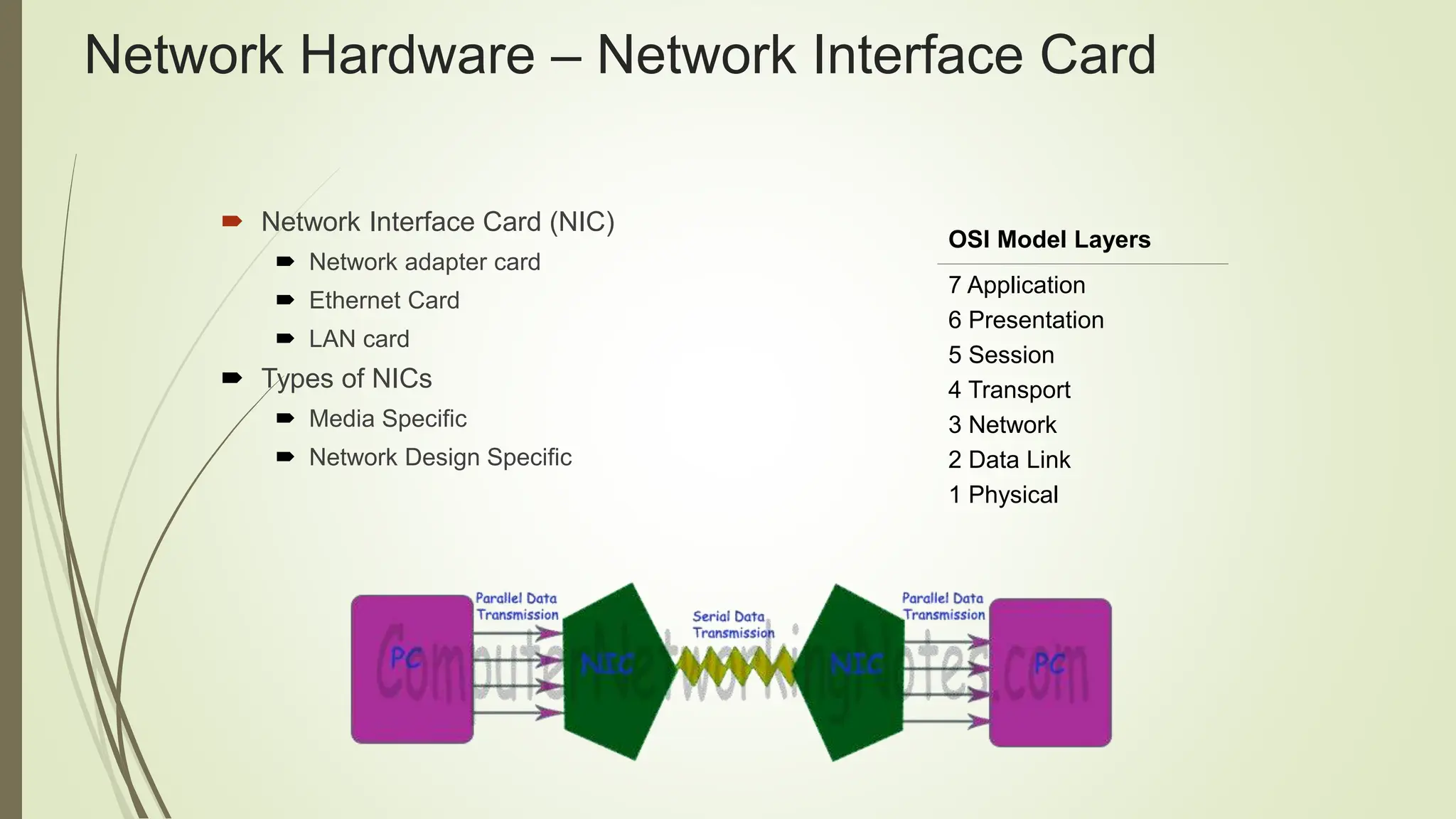
 Network Interface Card (NIC)
 Network adapter card
 Ethernet Card
 LAN card
 Types of NICs
 Media Specific
 Network Design Specific
OSI Model Layers
7 Application
6 Presentation
5 Session
4 Transport
3 Network
2 Data Link
1 Physical
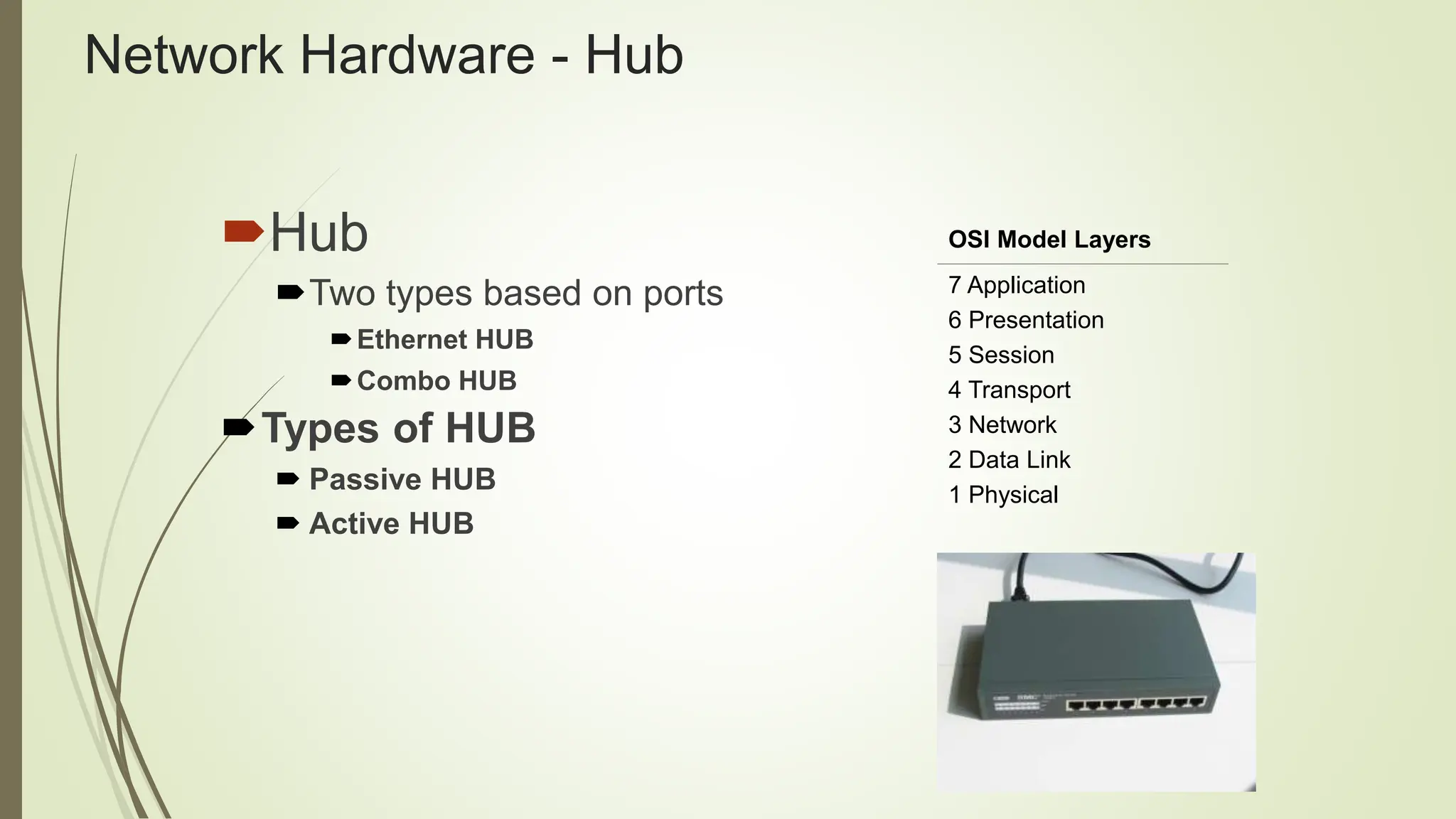
Network Hardware - Hub
Hub
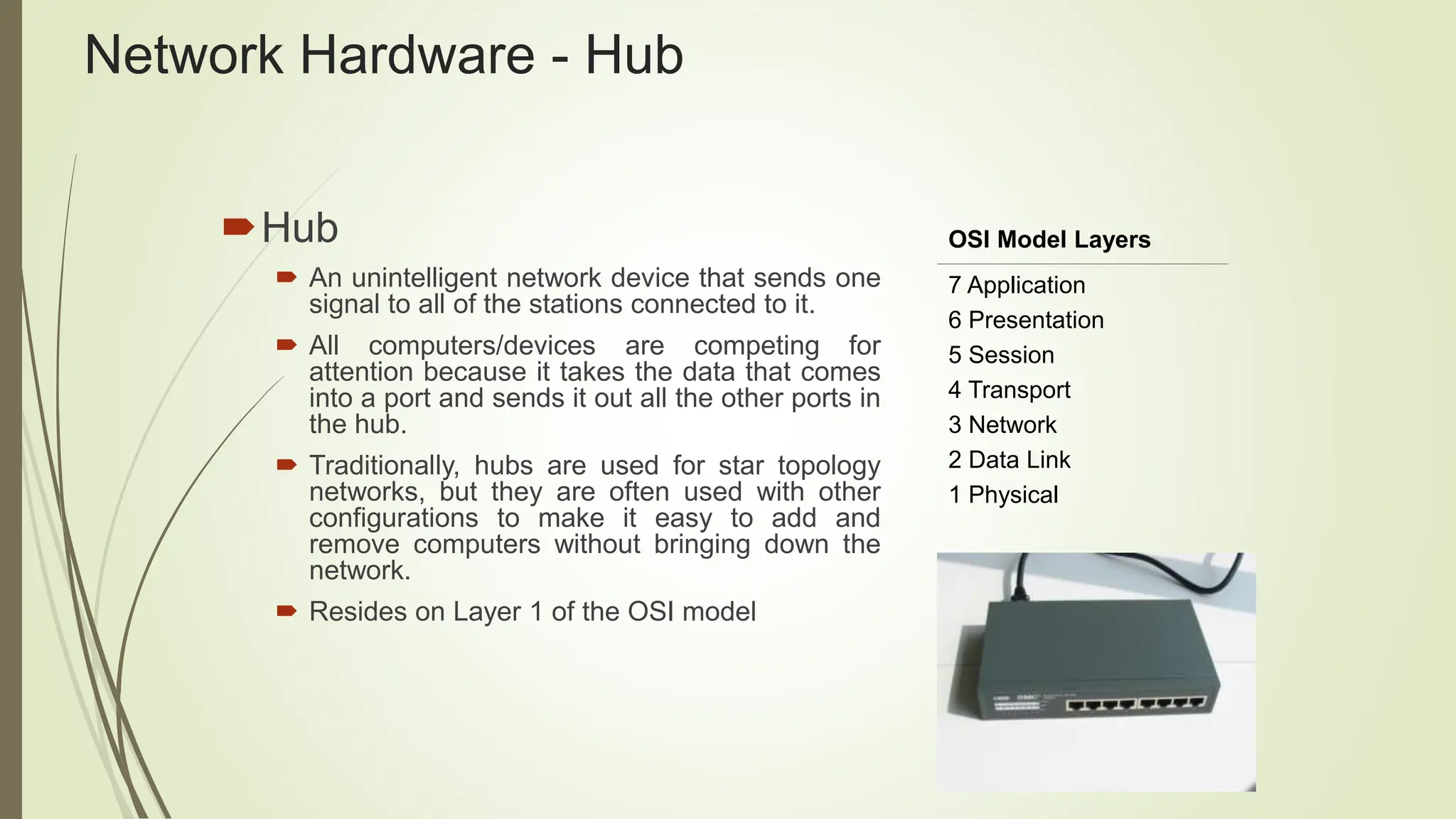
 An unintelligent network device that sends one
signal to all of the stations connected to it.
 All computers/devices are competing for
attention because it takes the data that comes
into a port and sends it out all the other ports in
the hub.
 Traditionally, hubs are used for star topology
networks, but they are often used with other
configurations to make it easy to add and
remove computers without bringing down the
network.
 Resides on Layer 1 of the OSI model
OSI Model Layers
7 Application
6 Presentation
5 Session
4 Transport
3 Network
2 Data Link
1 Physical
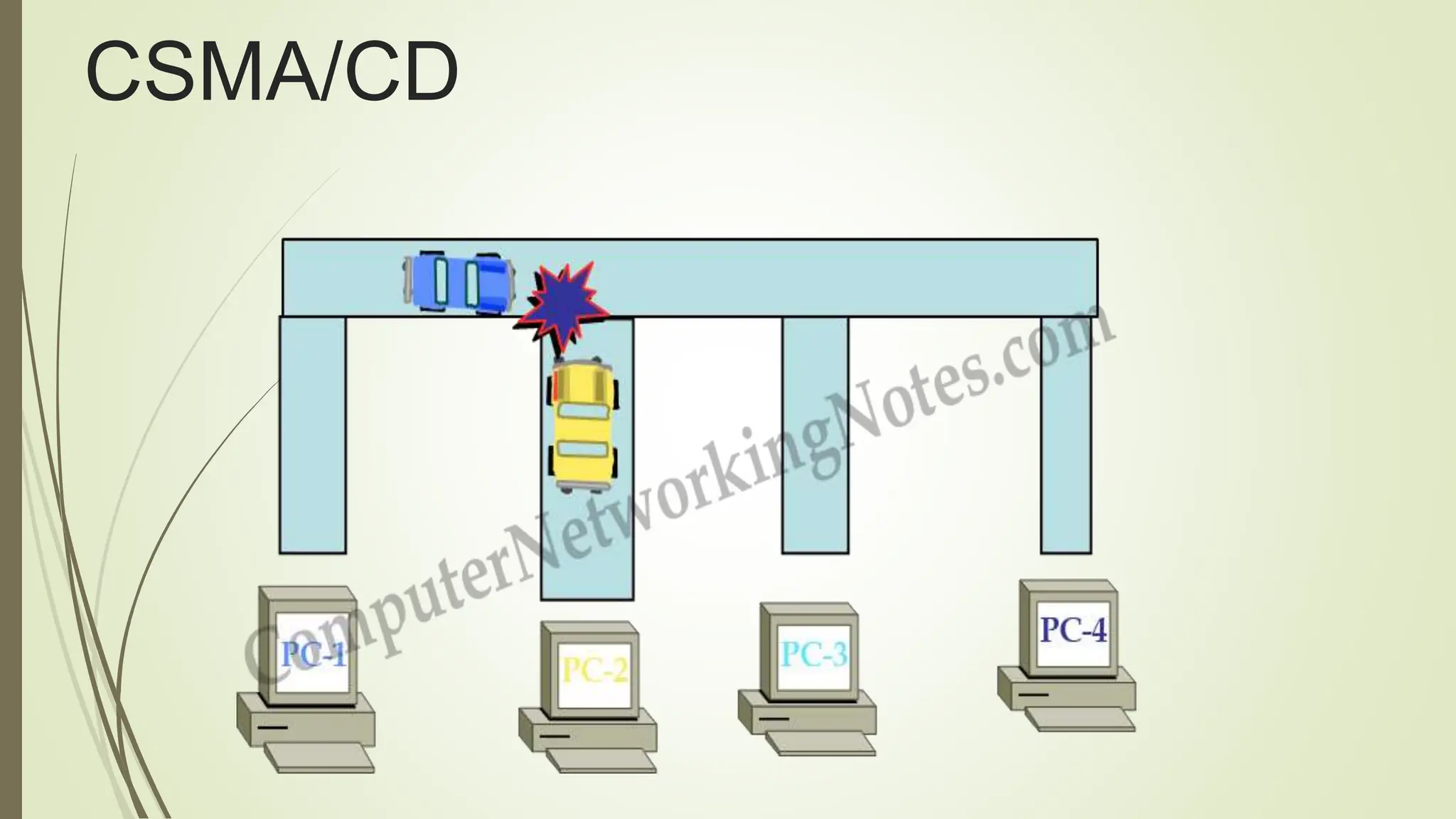
CSMA/CD
Network Hardware - Hub
Hub
Two types based on ports
Ethernet HUB
Combo HUB
Types of HUB
 Passive HUB
 Active HUB
OSI Model Layers
7 Application
6 Presentation
5 Session
4 Transport
3 Network
2 Data Link
1 Physical
Network Hardware
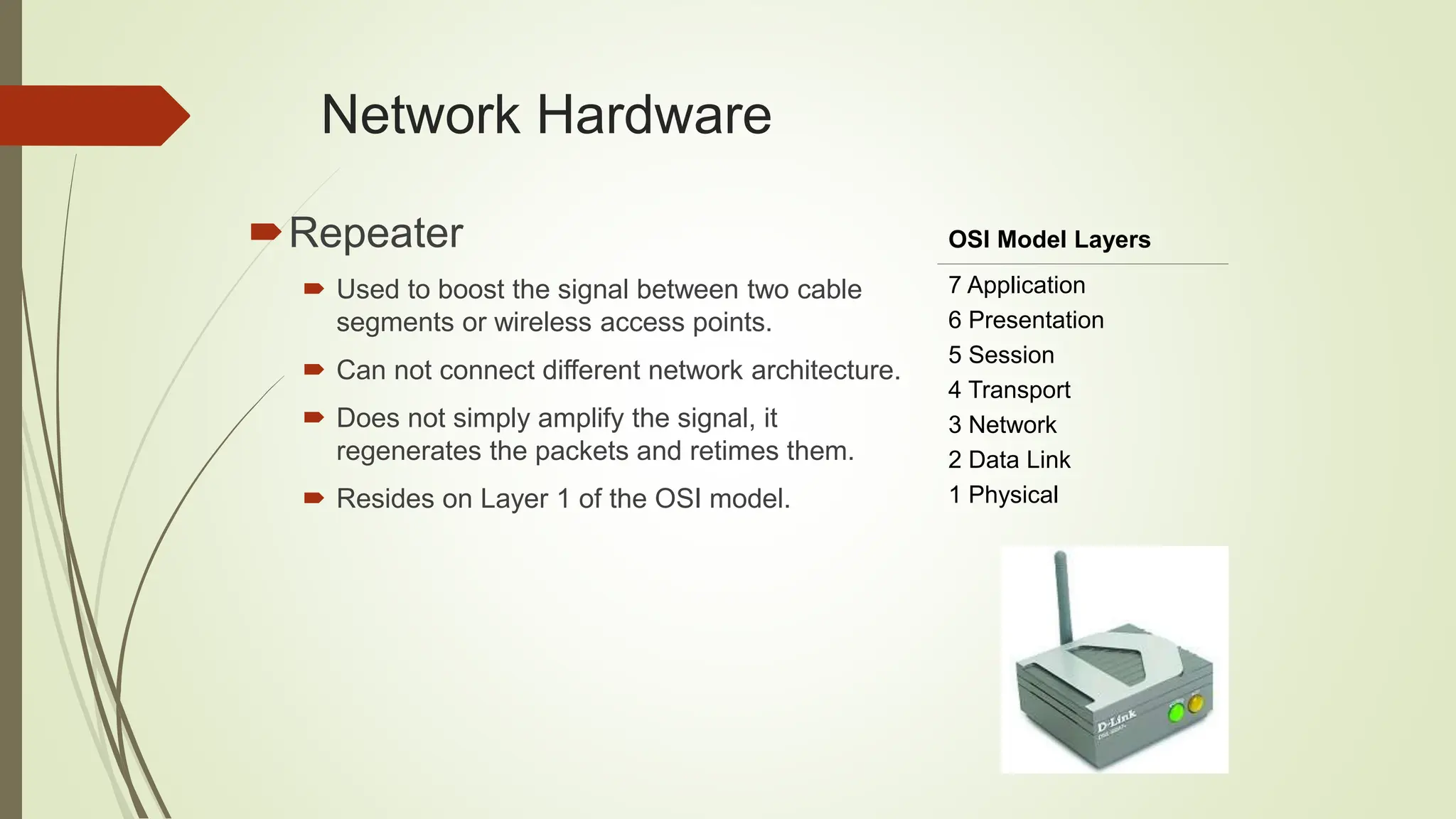
Repeater
 Used to boost the signal between two cable
segments or wireless access points.
 Can not connect different network architecture.
 Does not simply amplify the signal, it
regenerates the packets and retimes them.
 Resides on Layer 1 of the OSI model.
OSI Model Layers
7 Application
6 Presentation
5 Session
4 Transport
3 Network
2 Data Link
1 Physical
Network Hardware
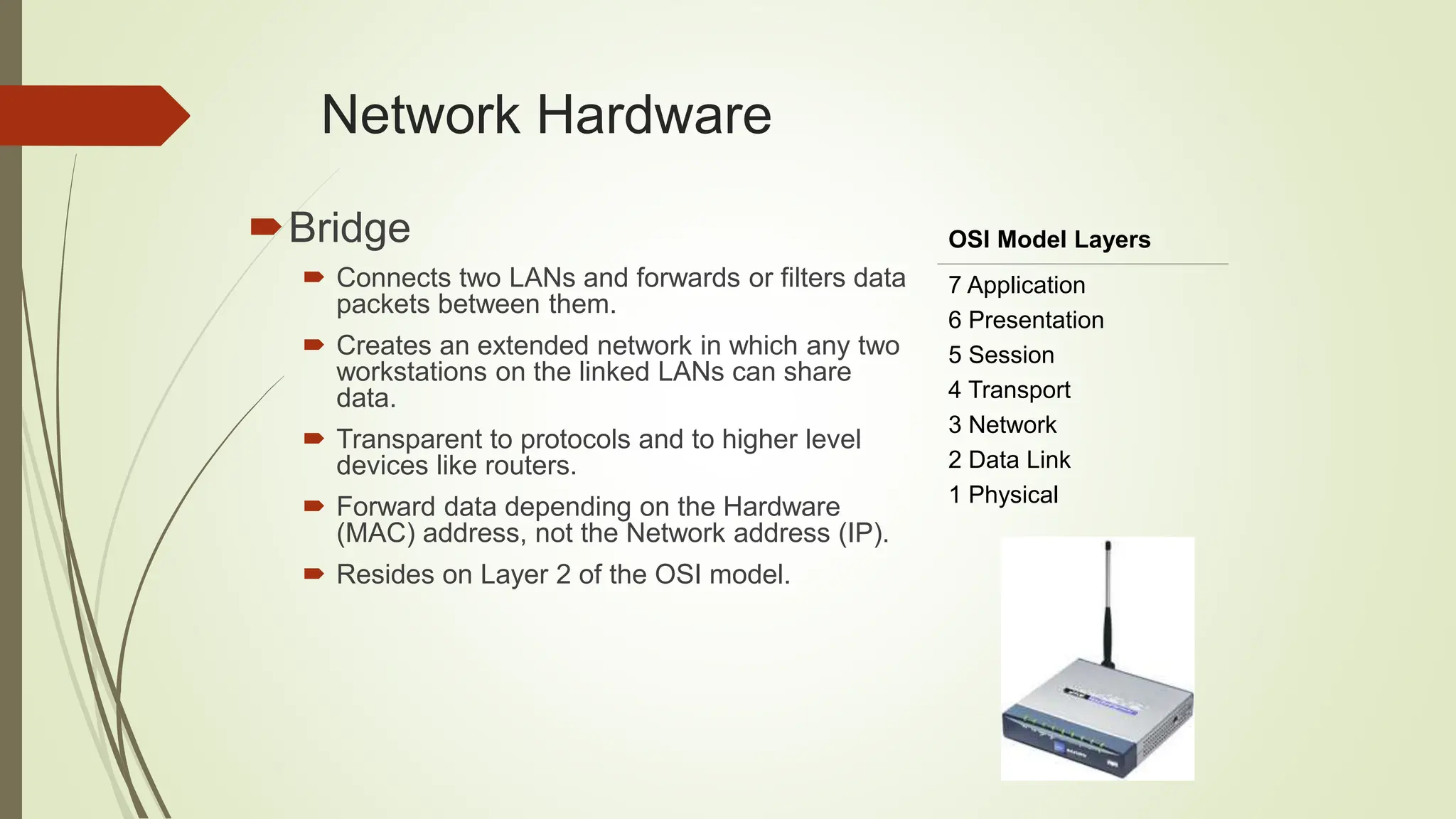
Bridge
 Connects two LANs and forwards or filters data
packets between them.
 Creates an extended network in which any two
workstations on the linked LANs can share
data.
 Transparent to protocols and to higher level
devices like routers.
 Forward data depending on the Hardware
(MAC) address, not the Network address (IP).
 Resides on Layer 2 of the OSI model.
OSI Model Layers
7 Application
6 Presentation
5 Session
4 Transport
3 Network
2 Data Link
1 Physical
Network Hardware
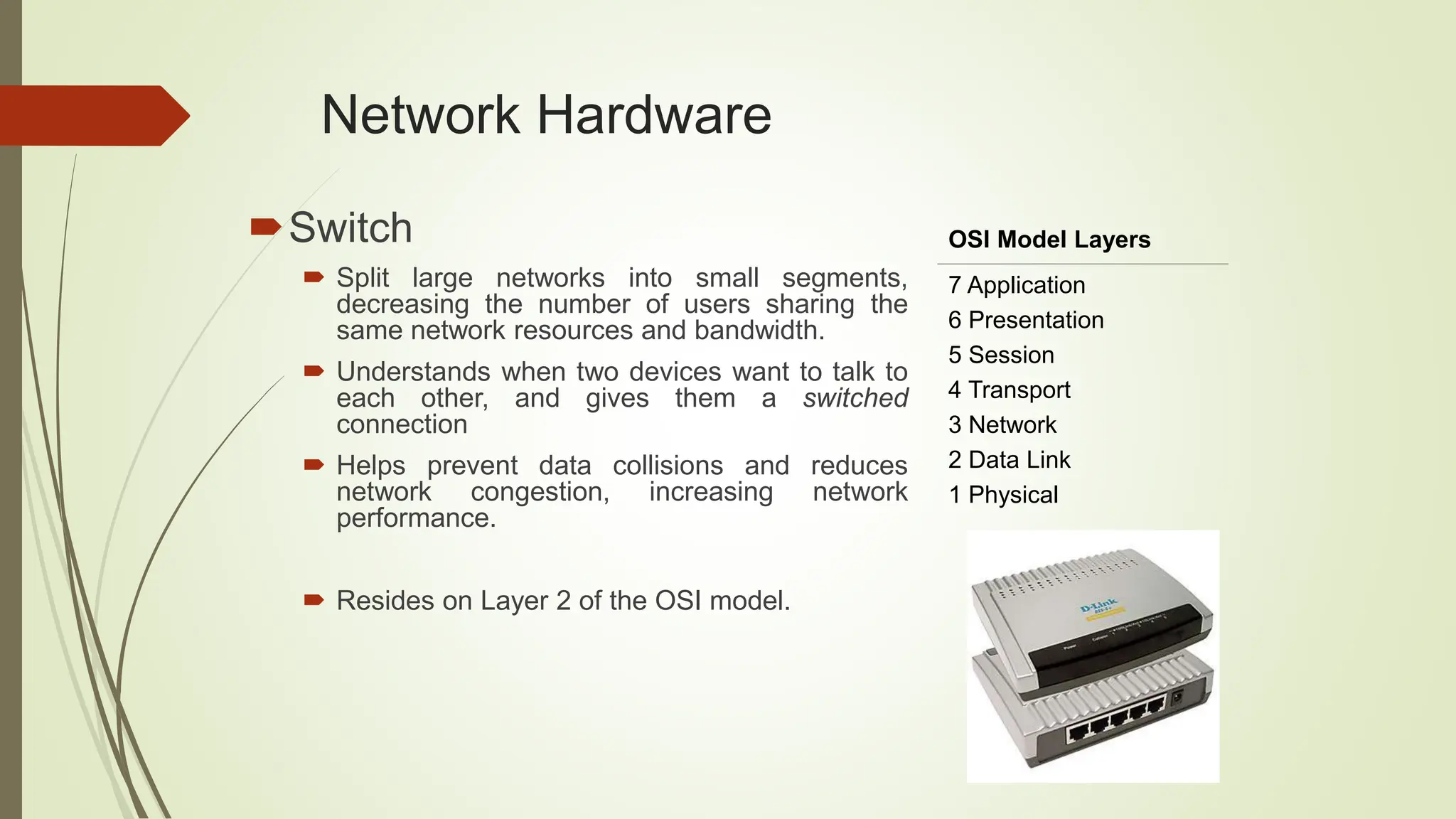
Switch
 Split large networks into small segments,
decreasing the number of users sharing the
same network resources and bandwidth.
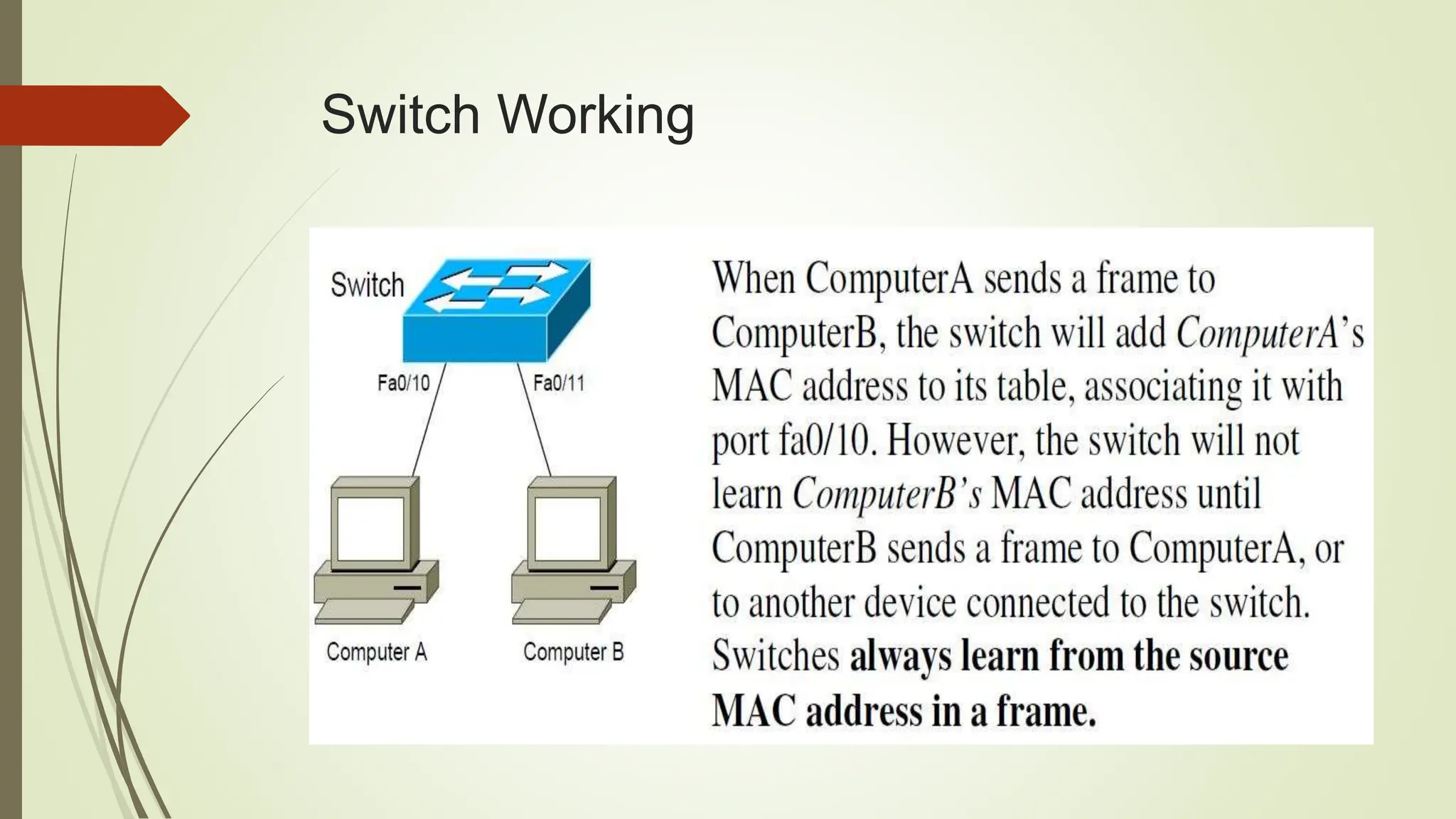
 Understands when two devices want to talk to
each other, and gives them a switched
connection
 Helps prevent data collisions and reduces
network congestion, increasing network
performance.
 Resides on Layer 2 of the OSI model.
OSI Model Layers
7 Application
6 Presentation
5 Session
4 Transport
3 Network
2 Data Link
1 Physical
Switch Working
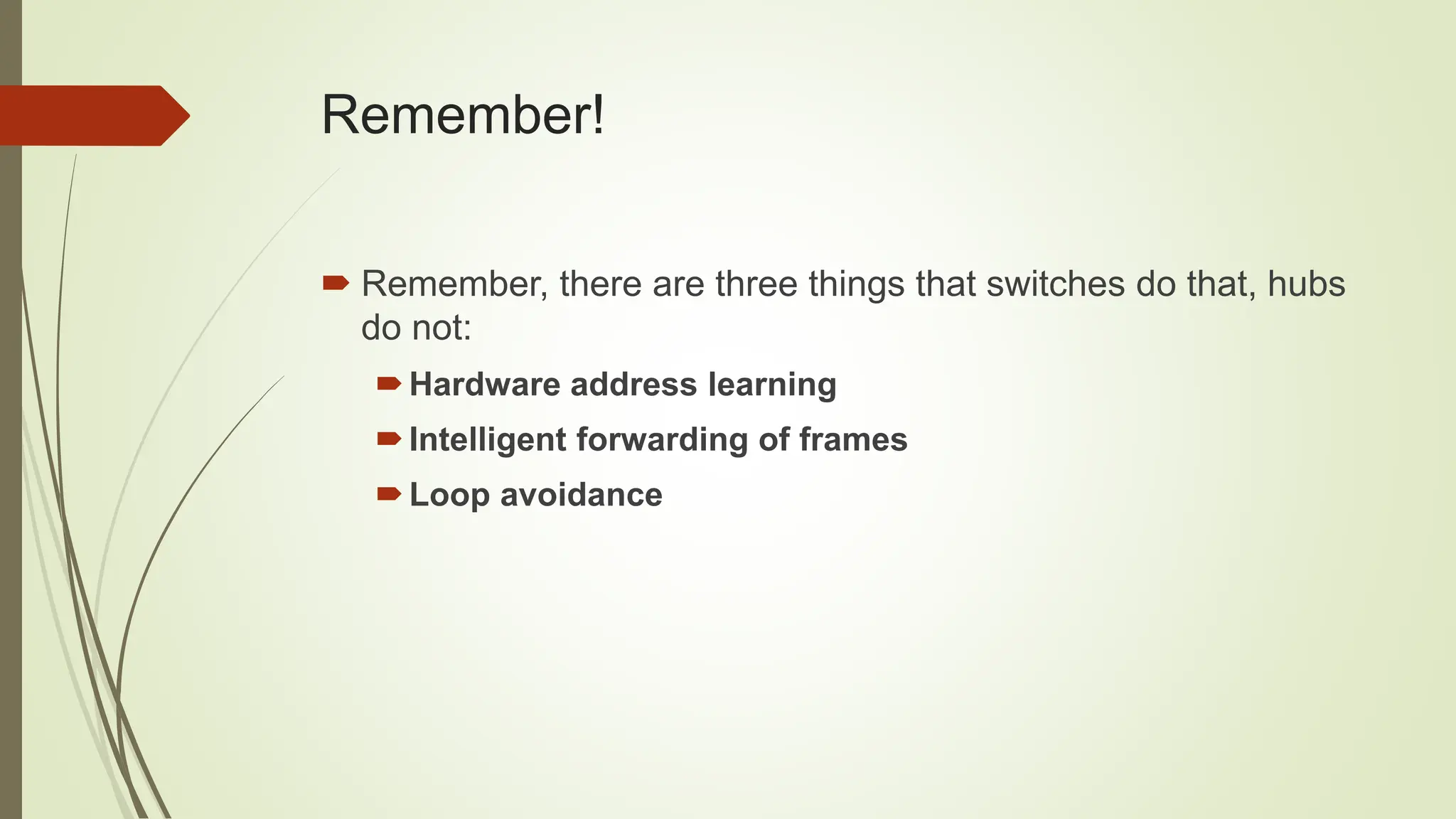
Remember!
 Remember, there are three things that switches do that, hubs
do not:
Hardware address learning
Intelligent forwarding of frames
Loop avoidance
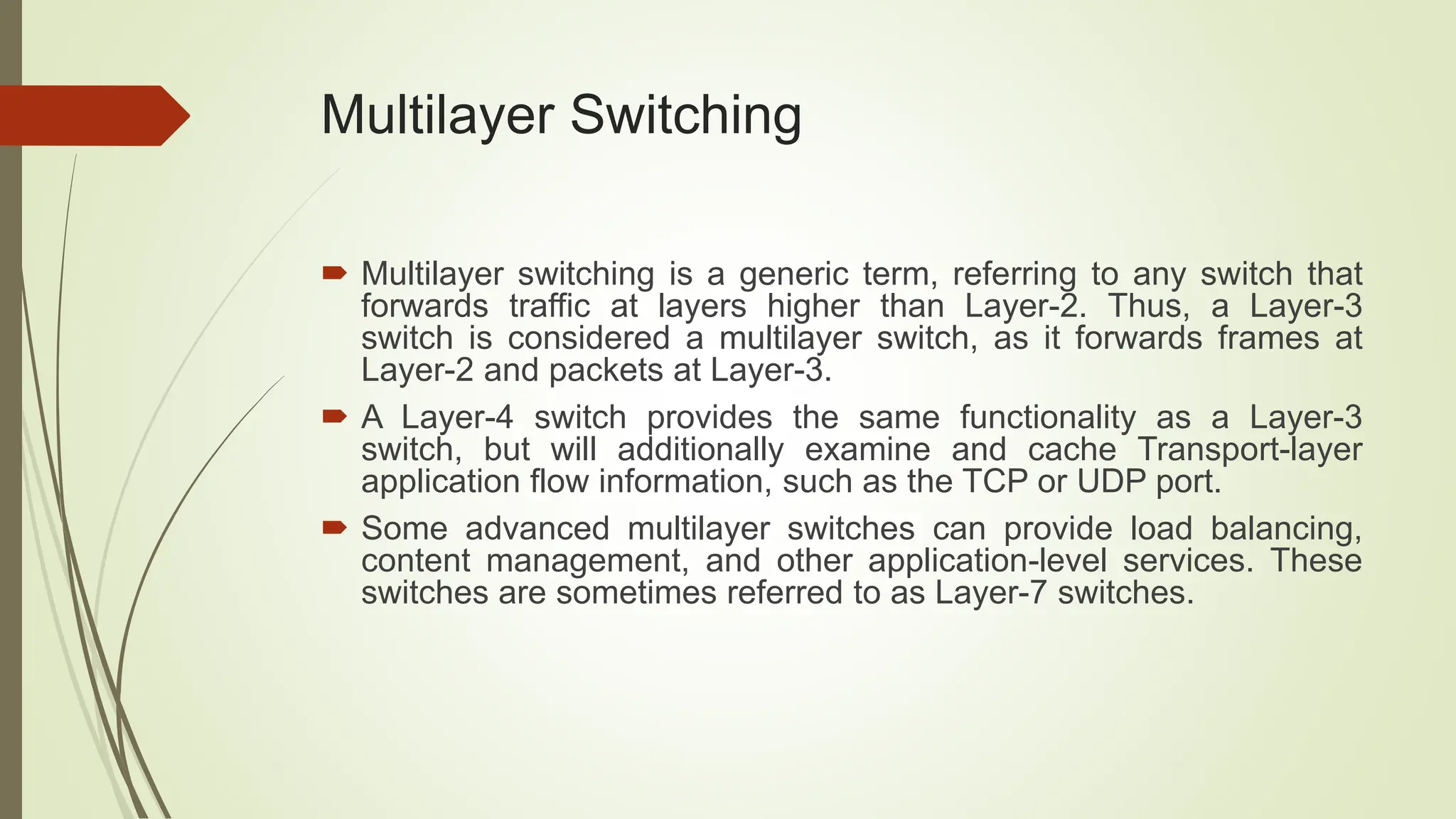
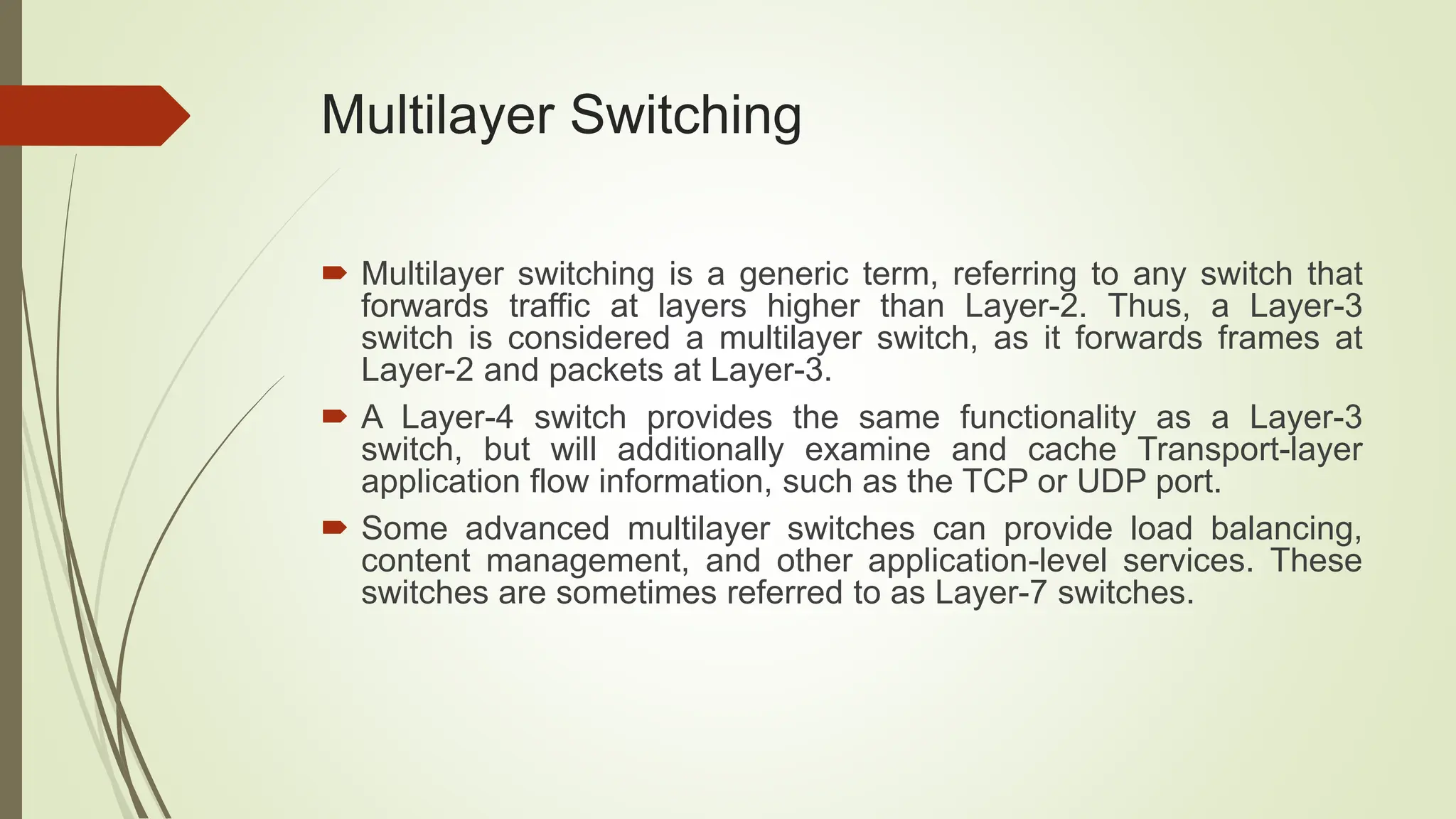
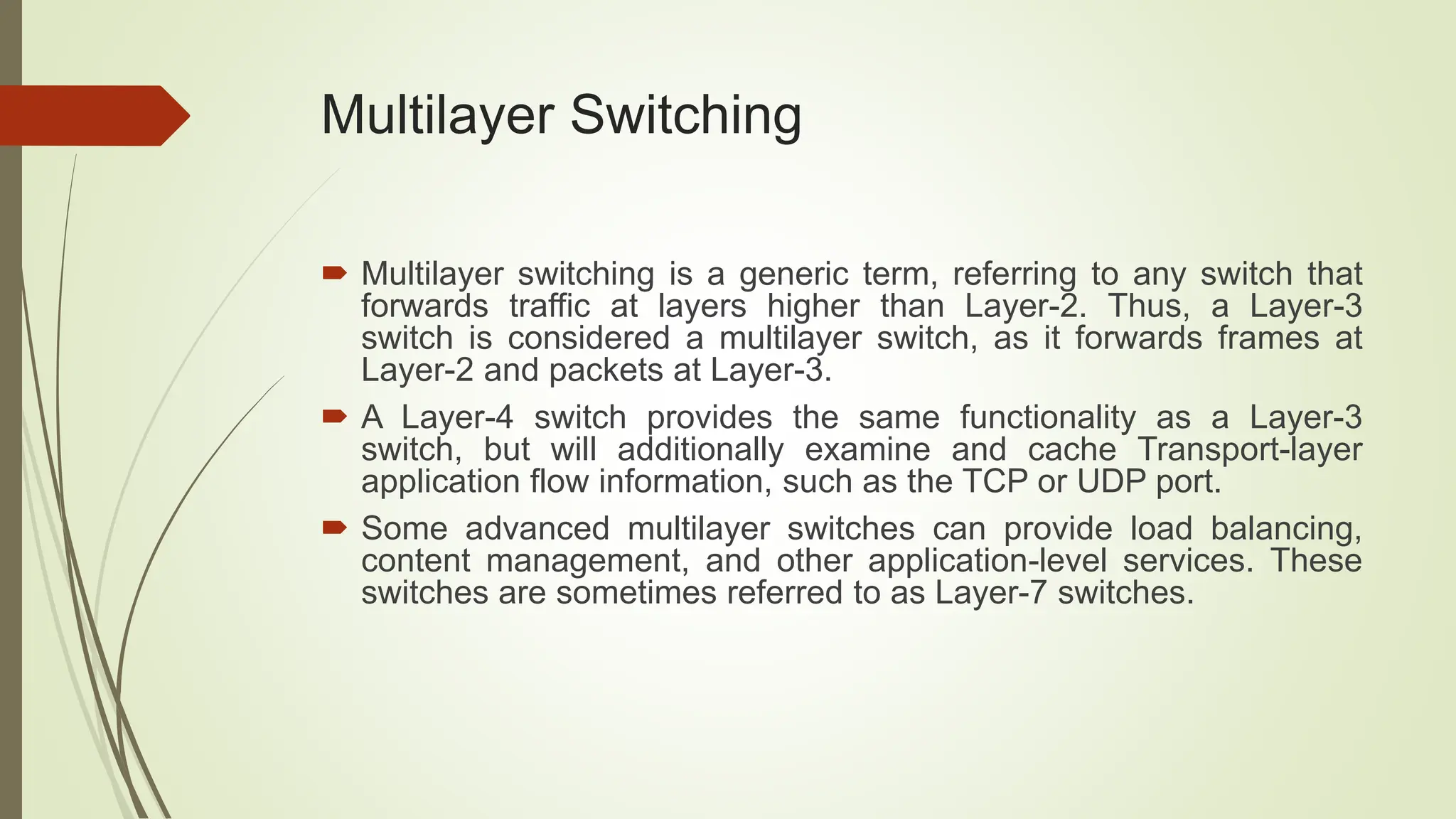
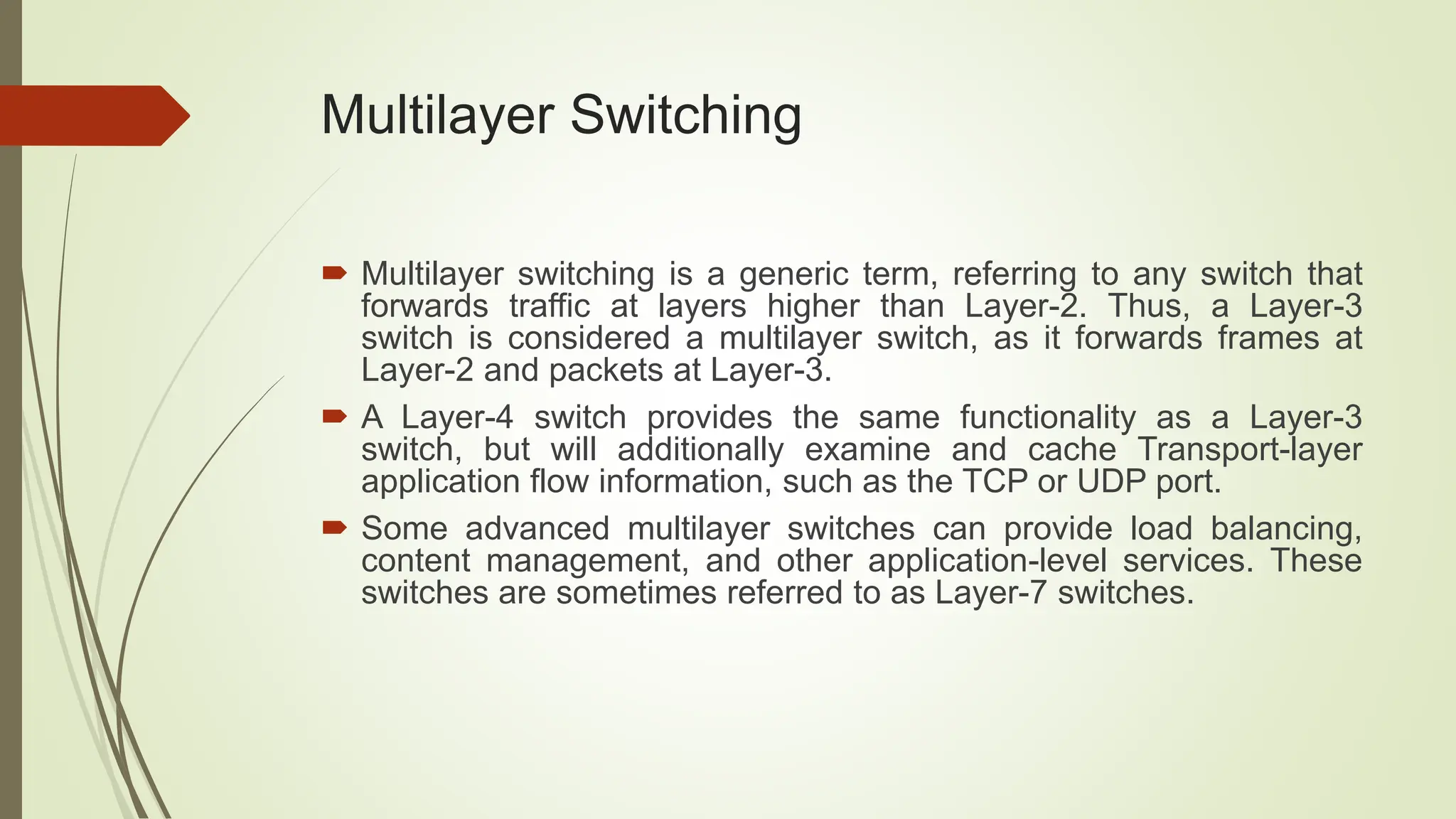
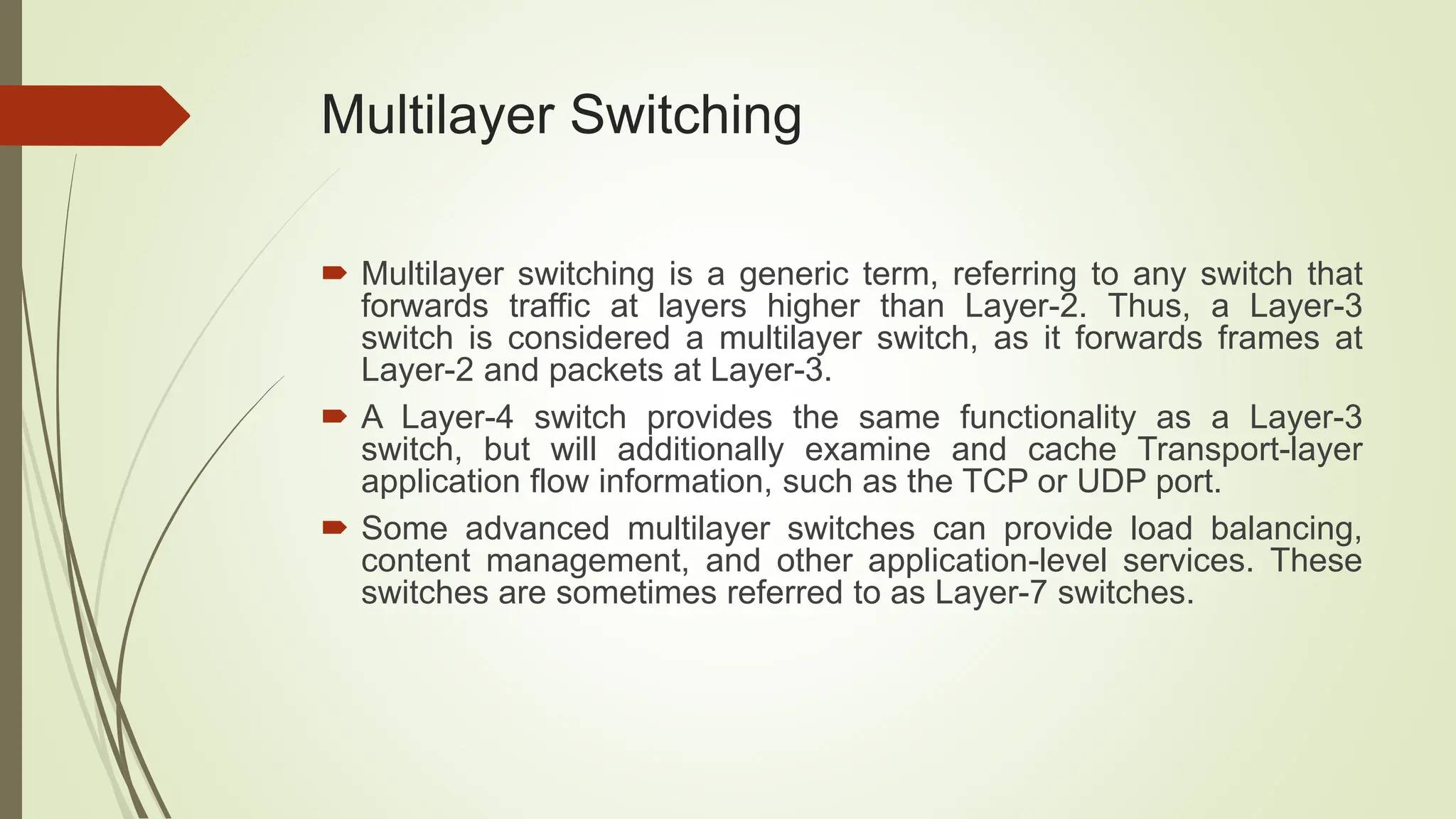
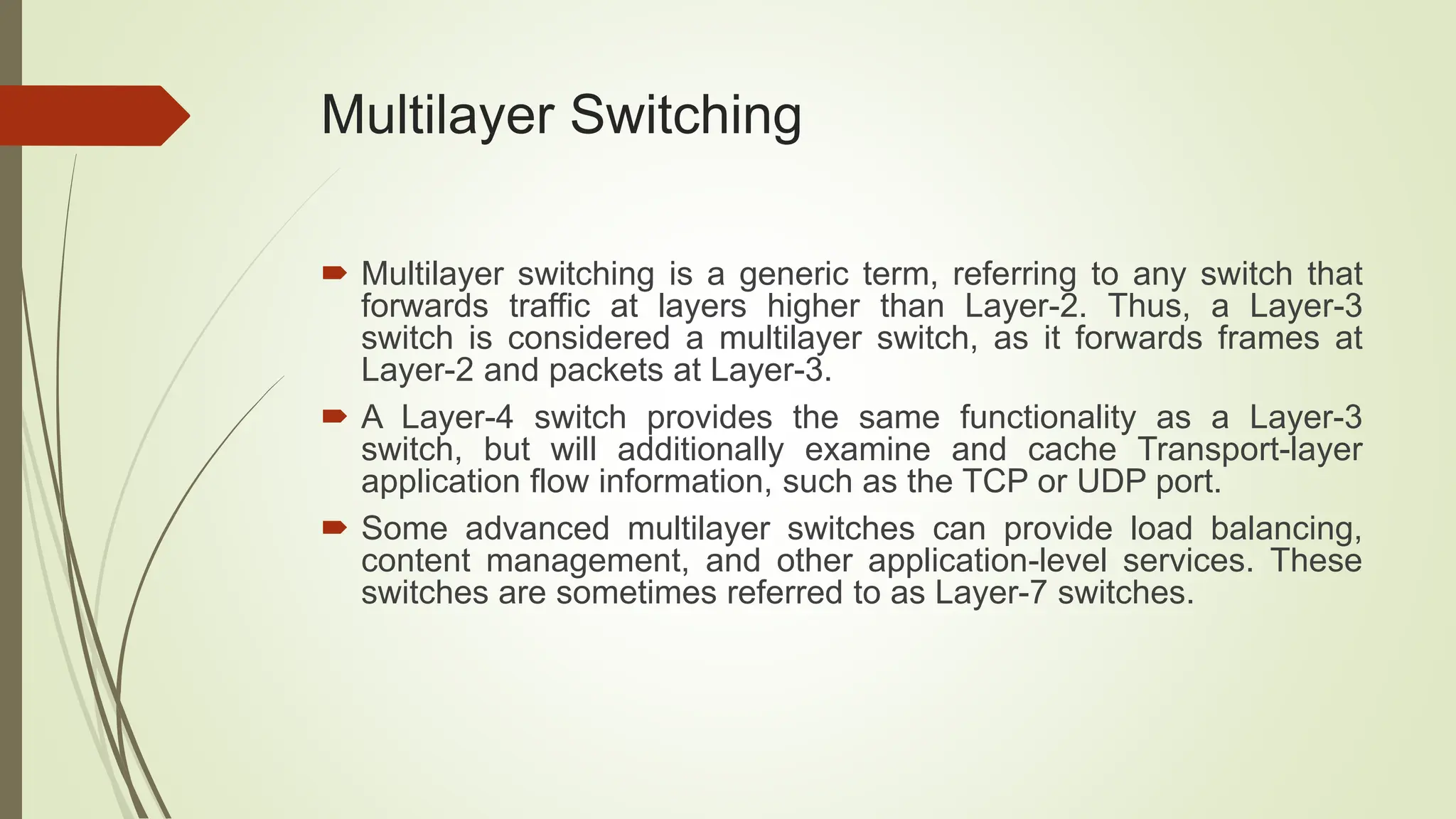
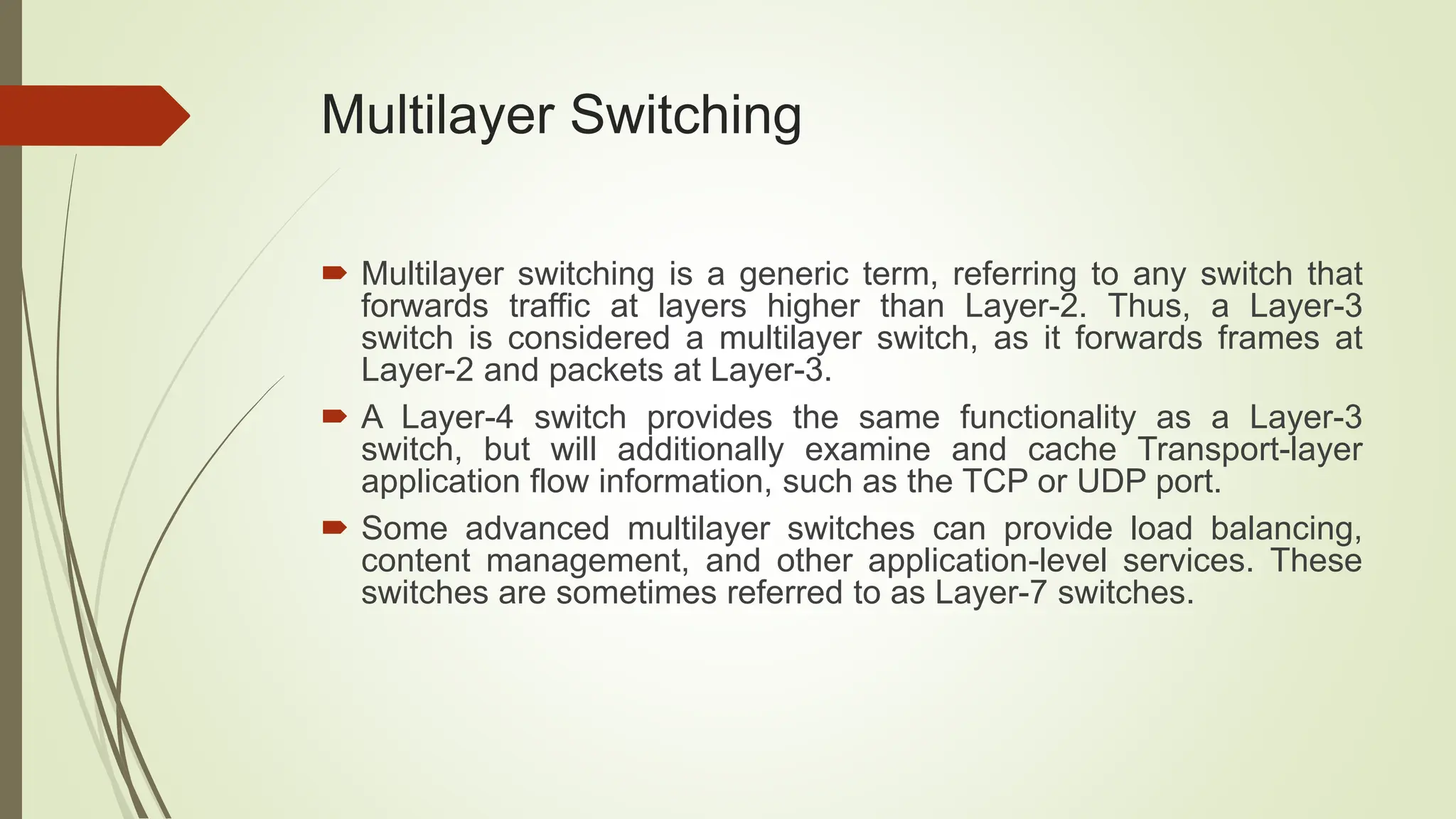
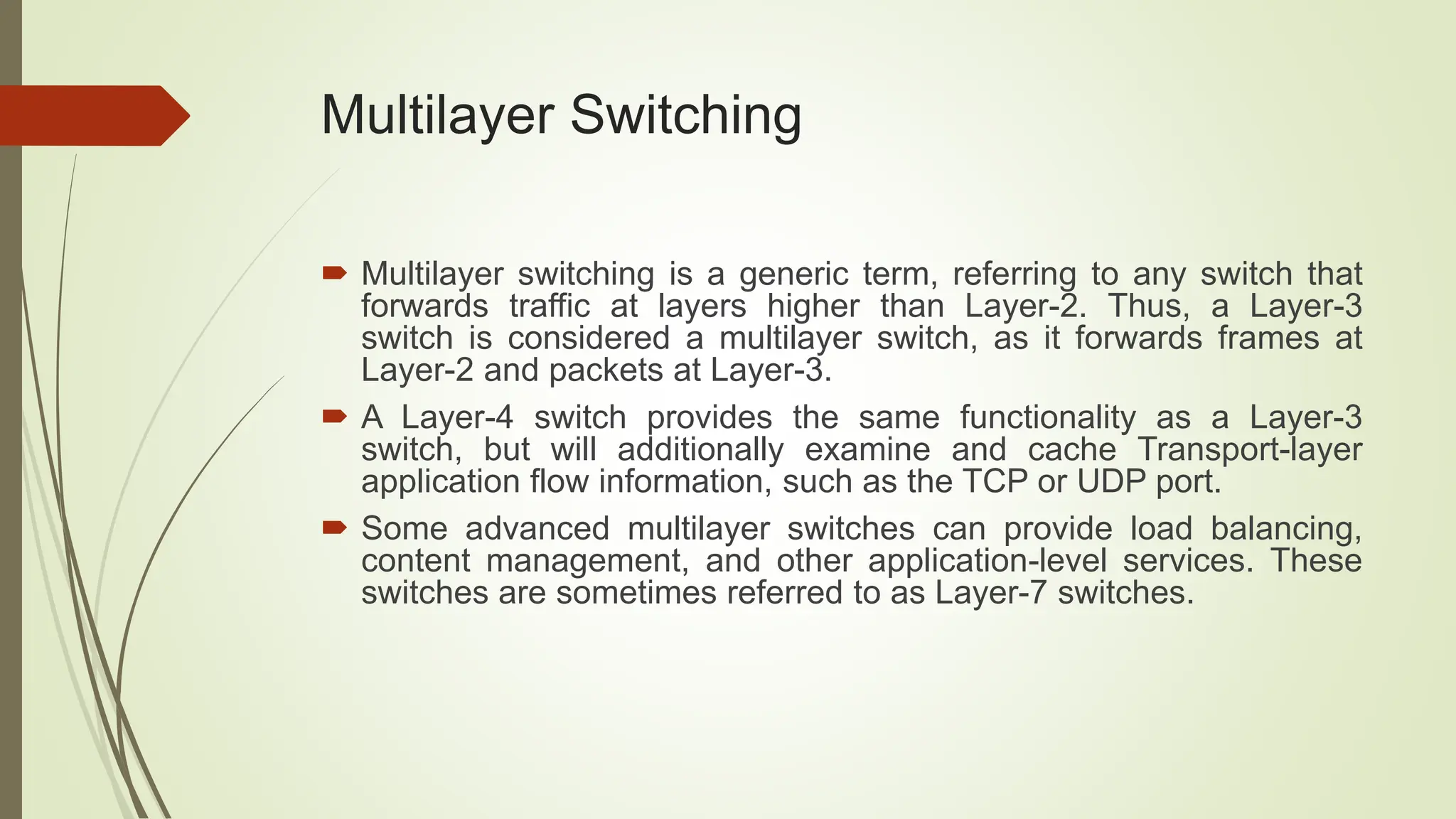
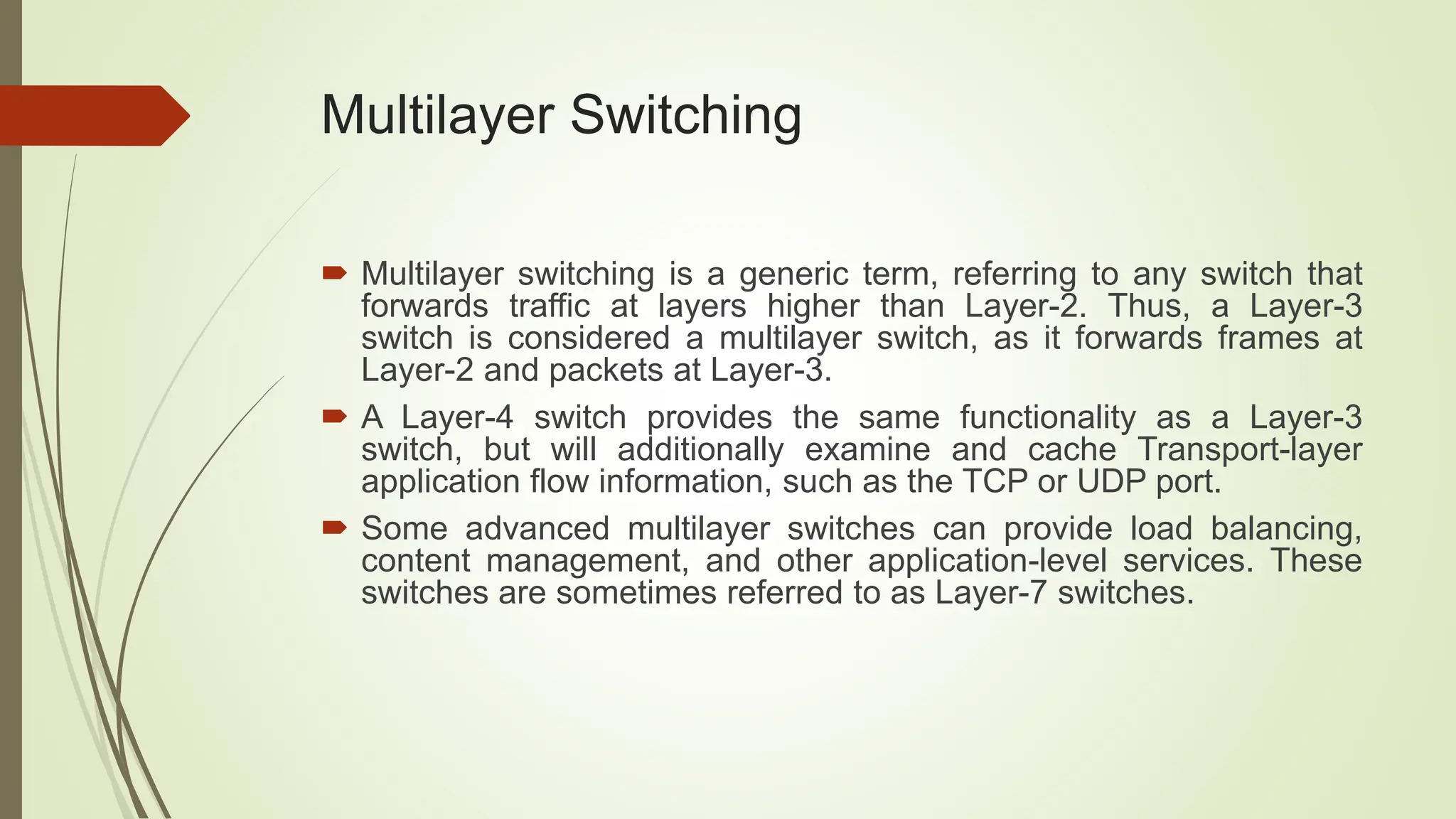
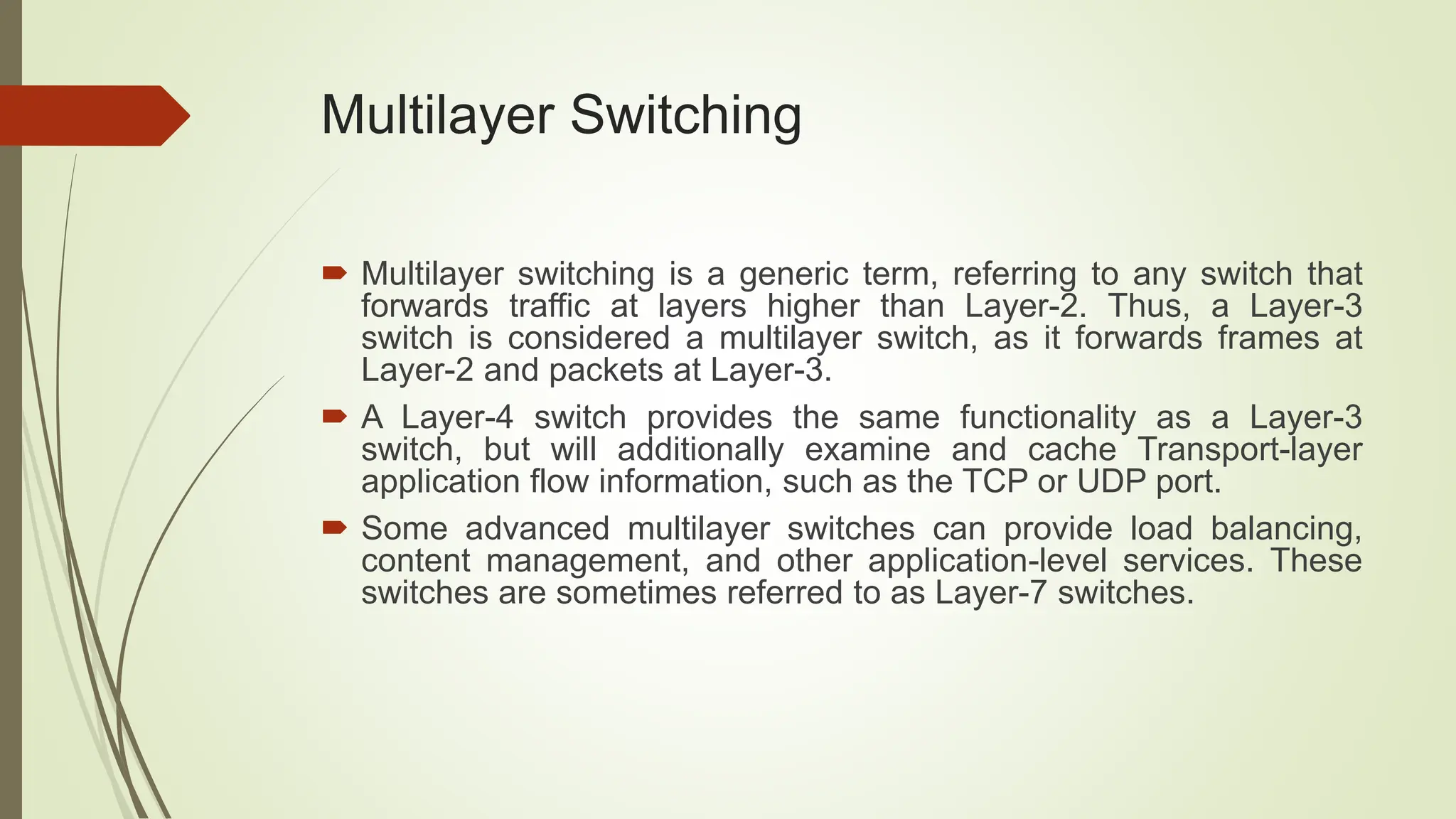
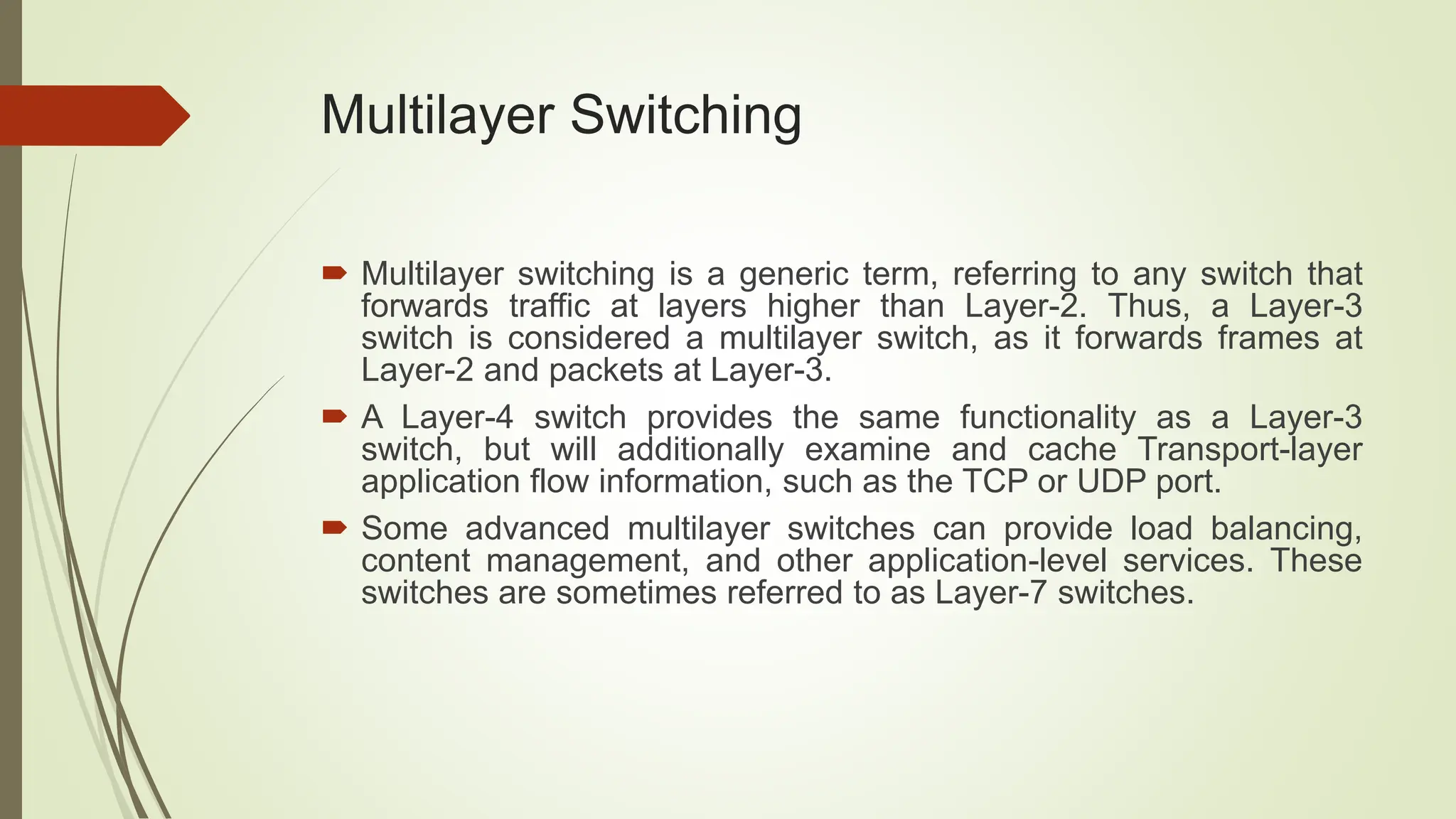
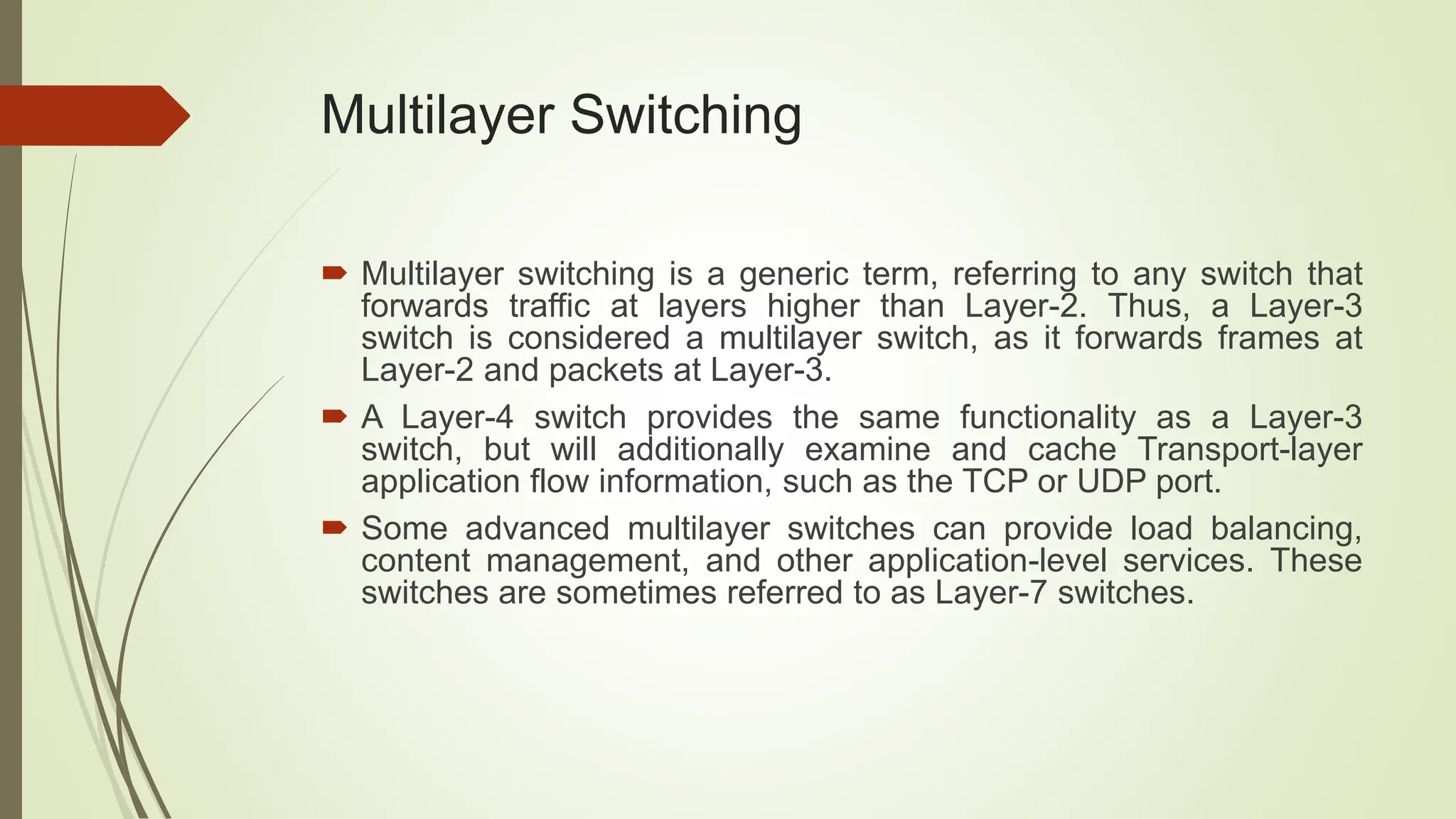
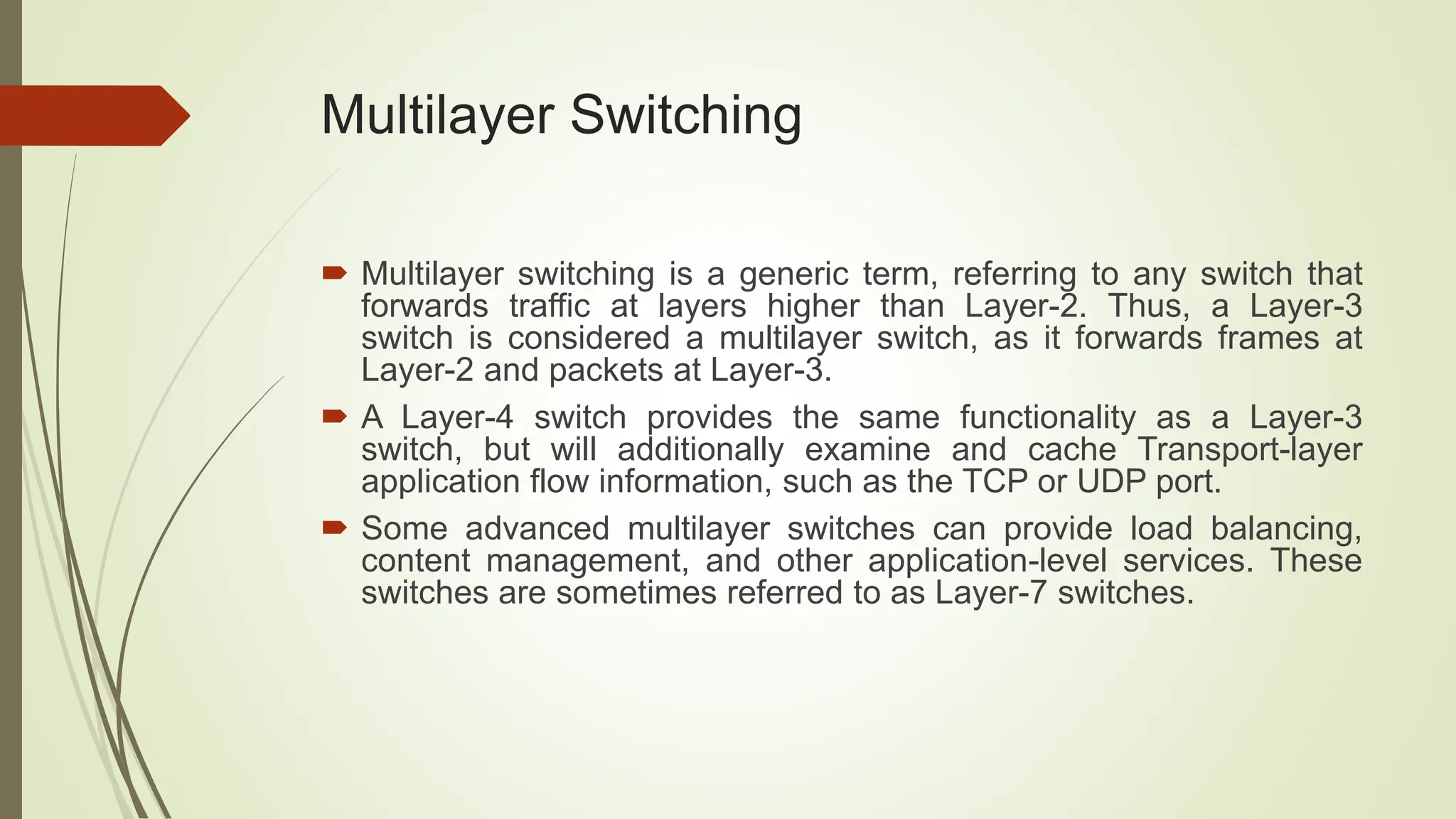
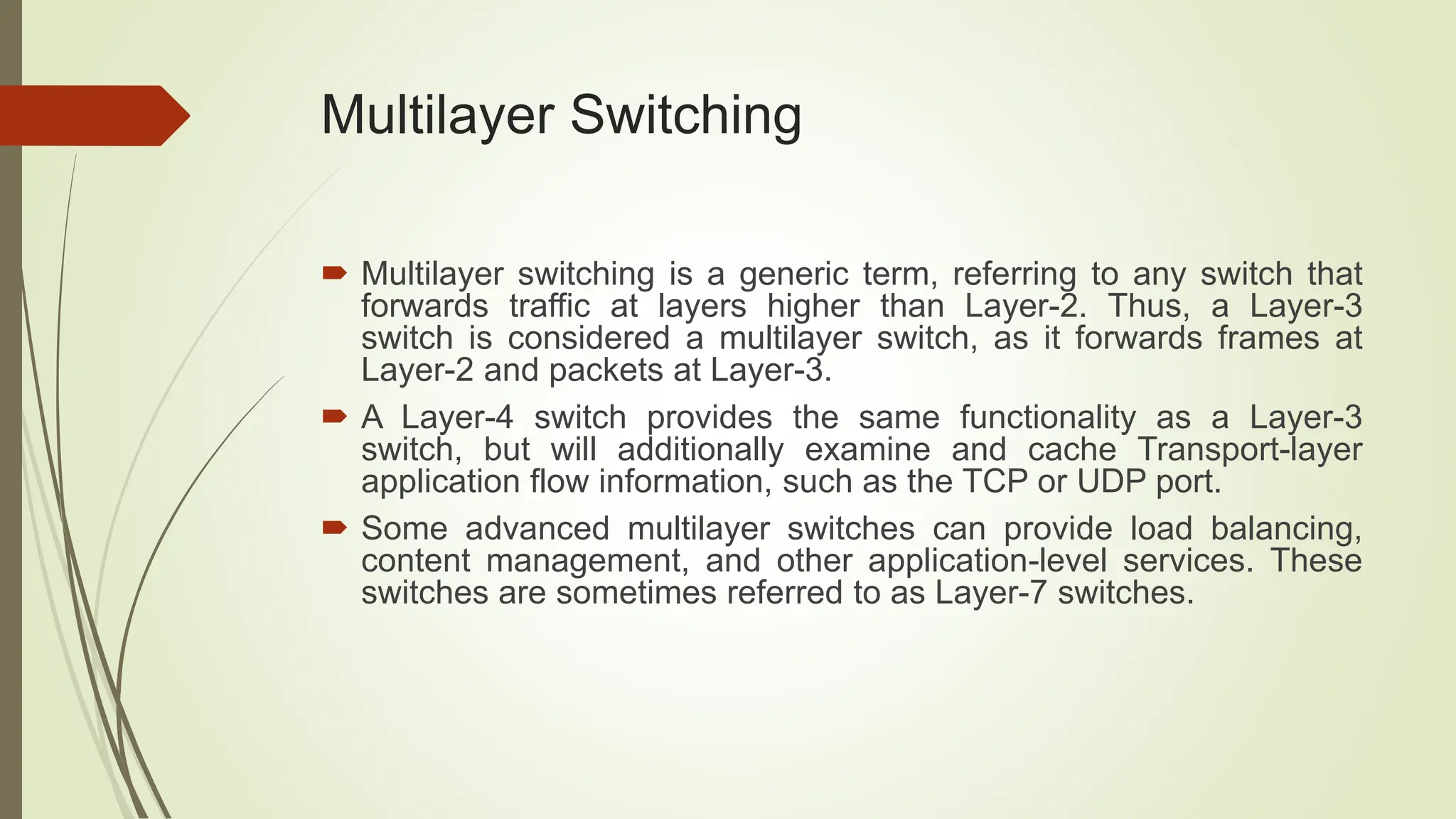
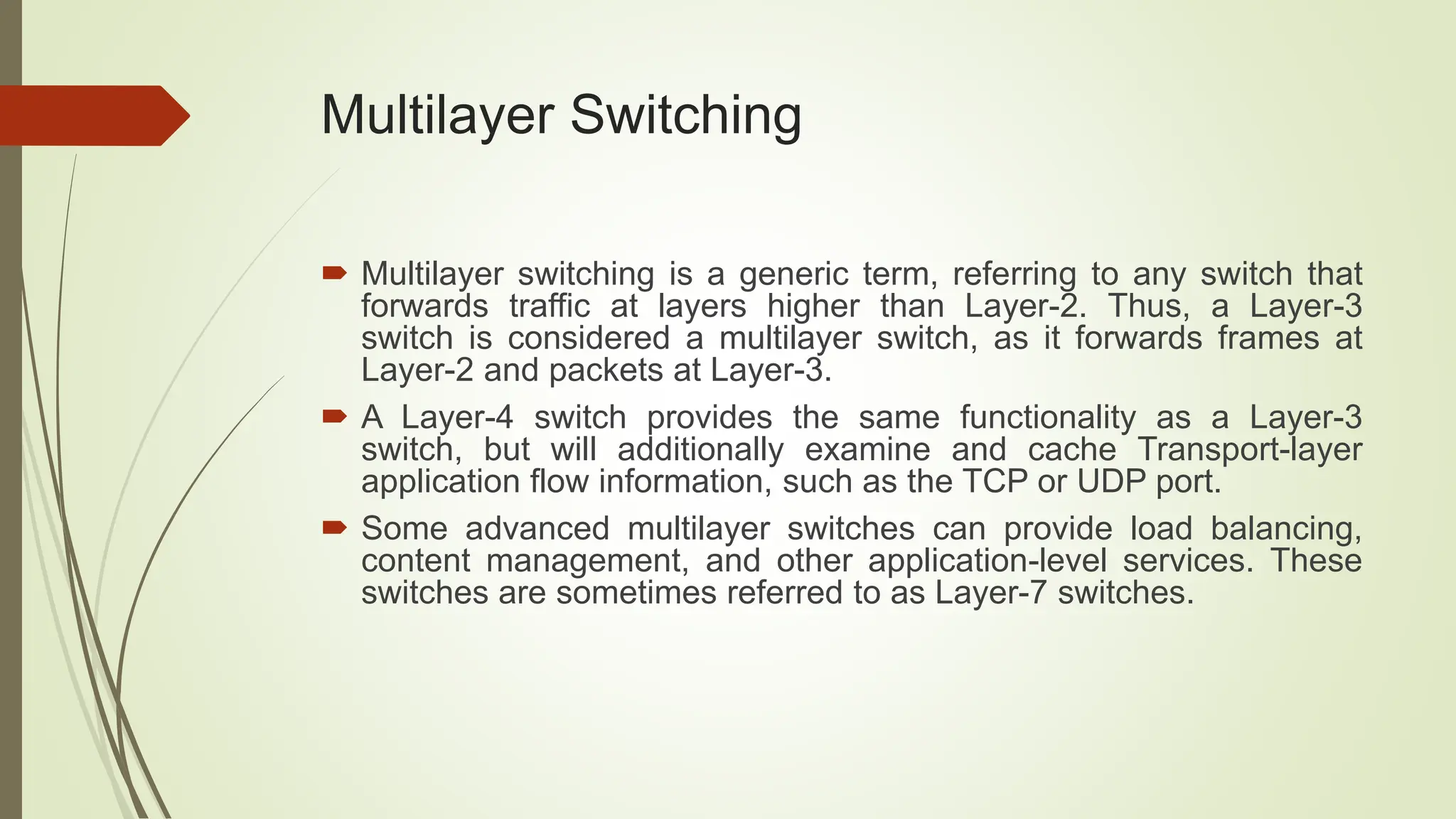
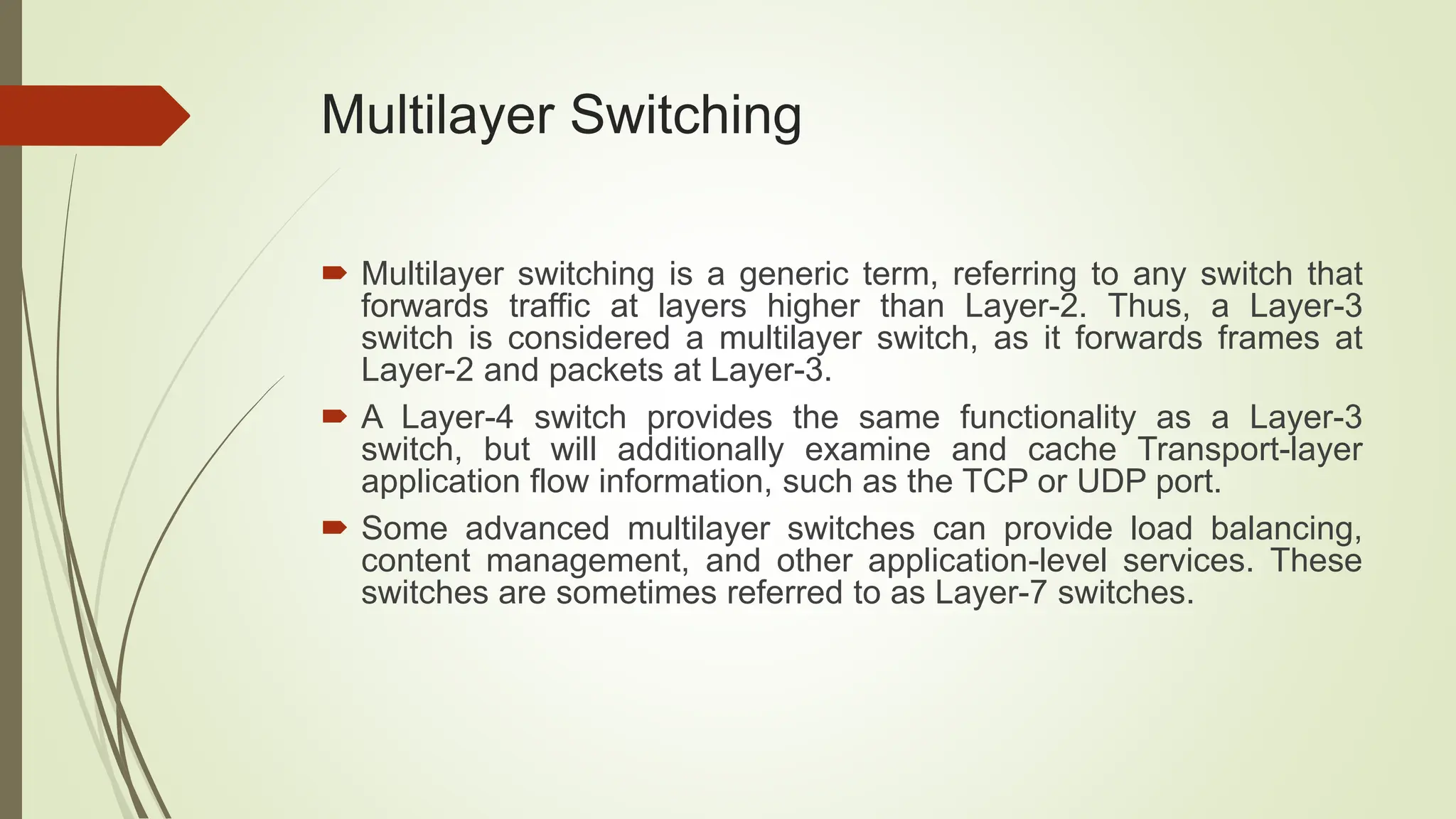
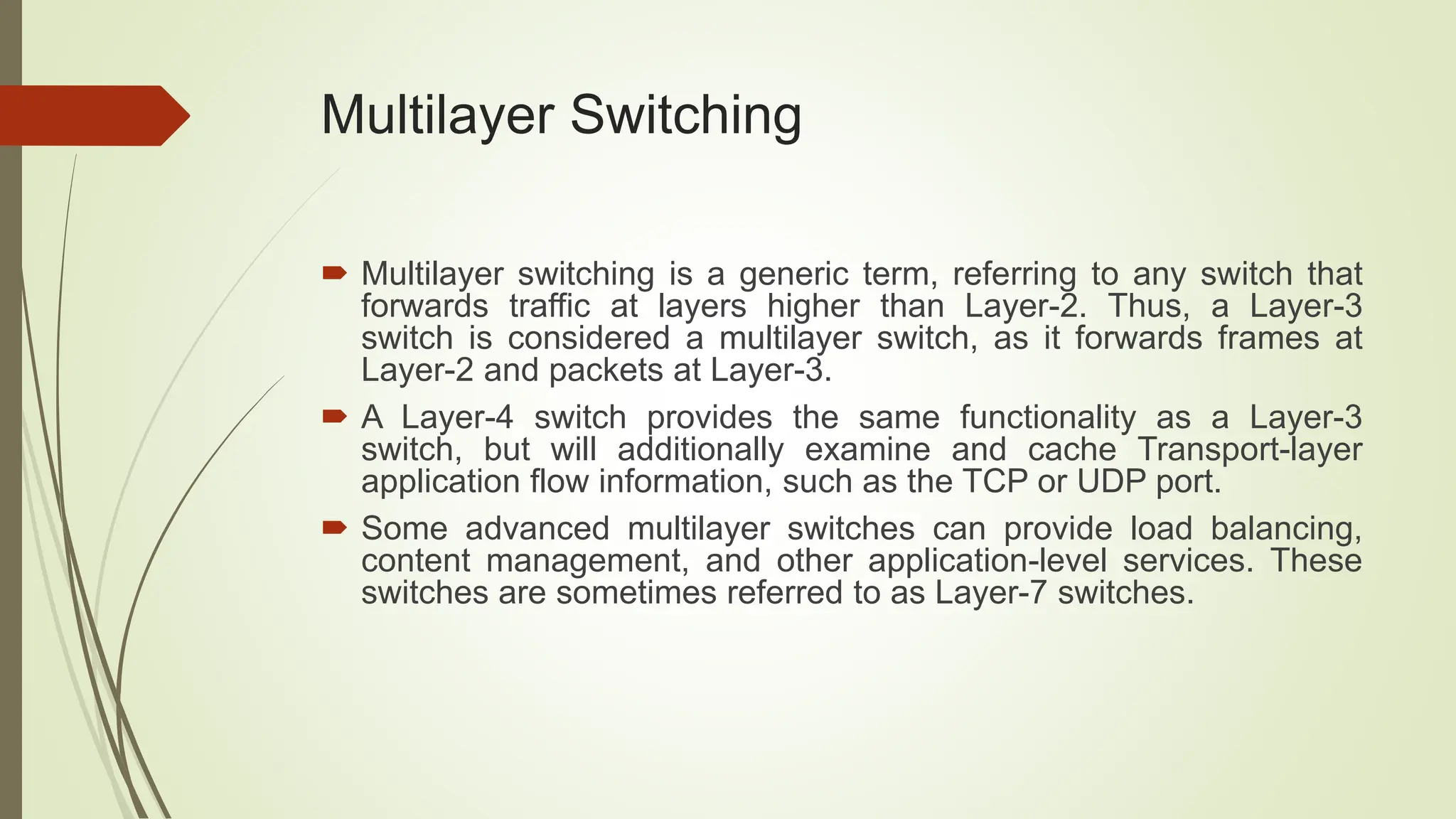
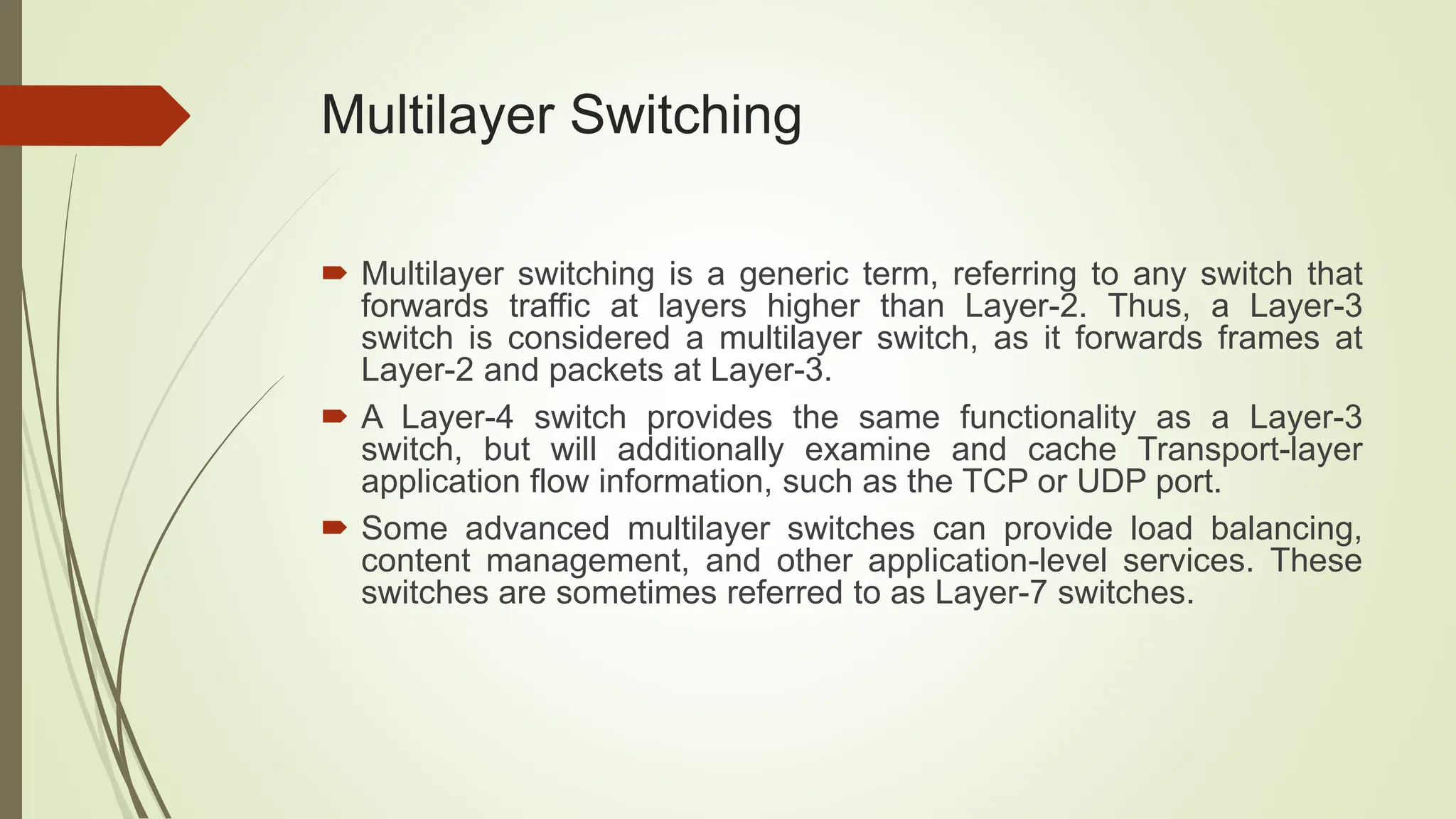
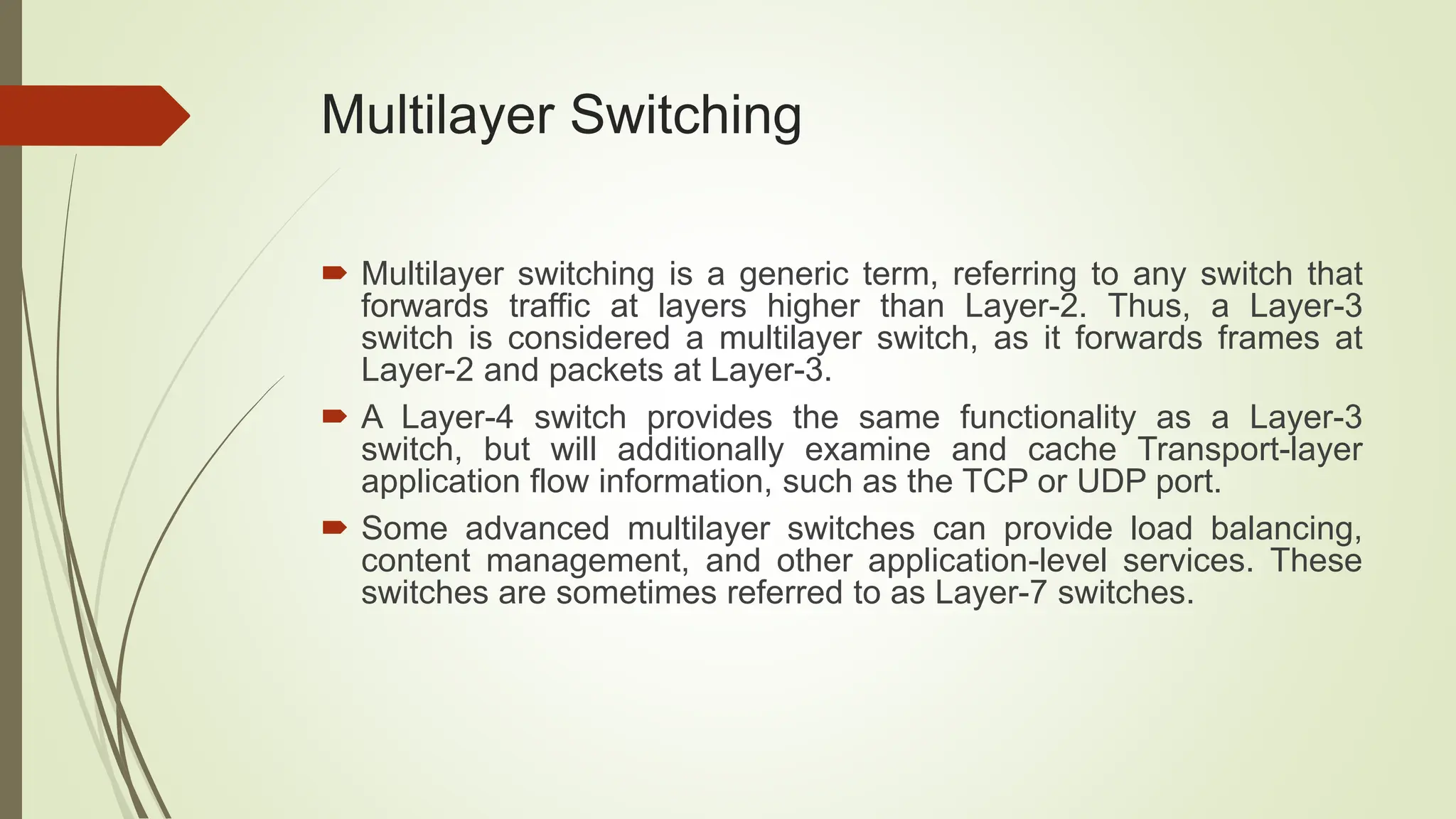
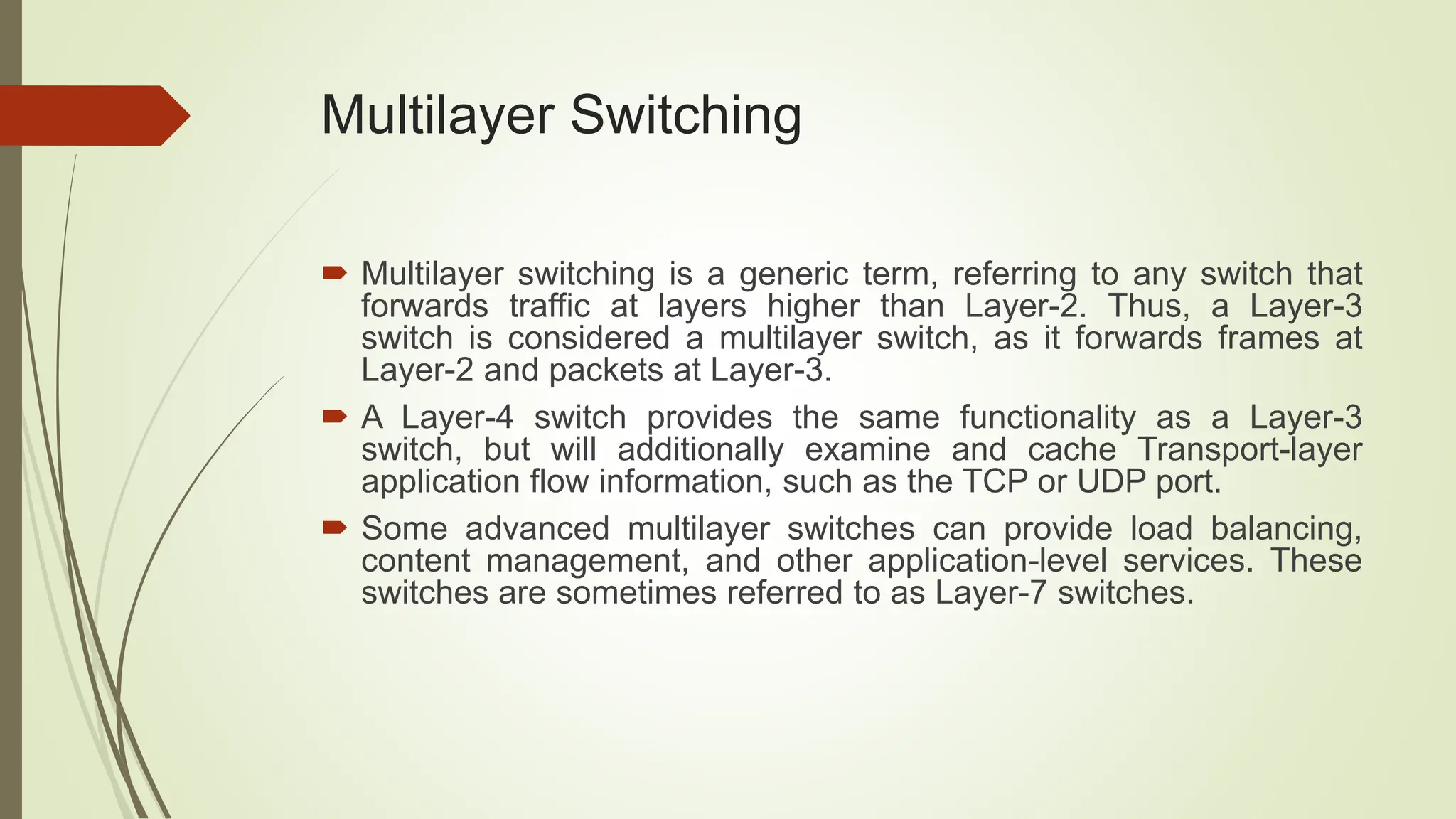
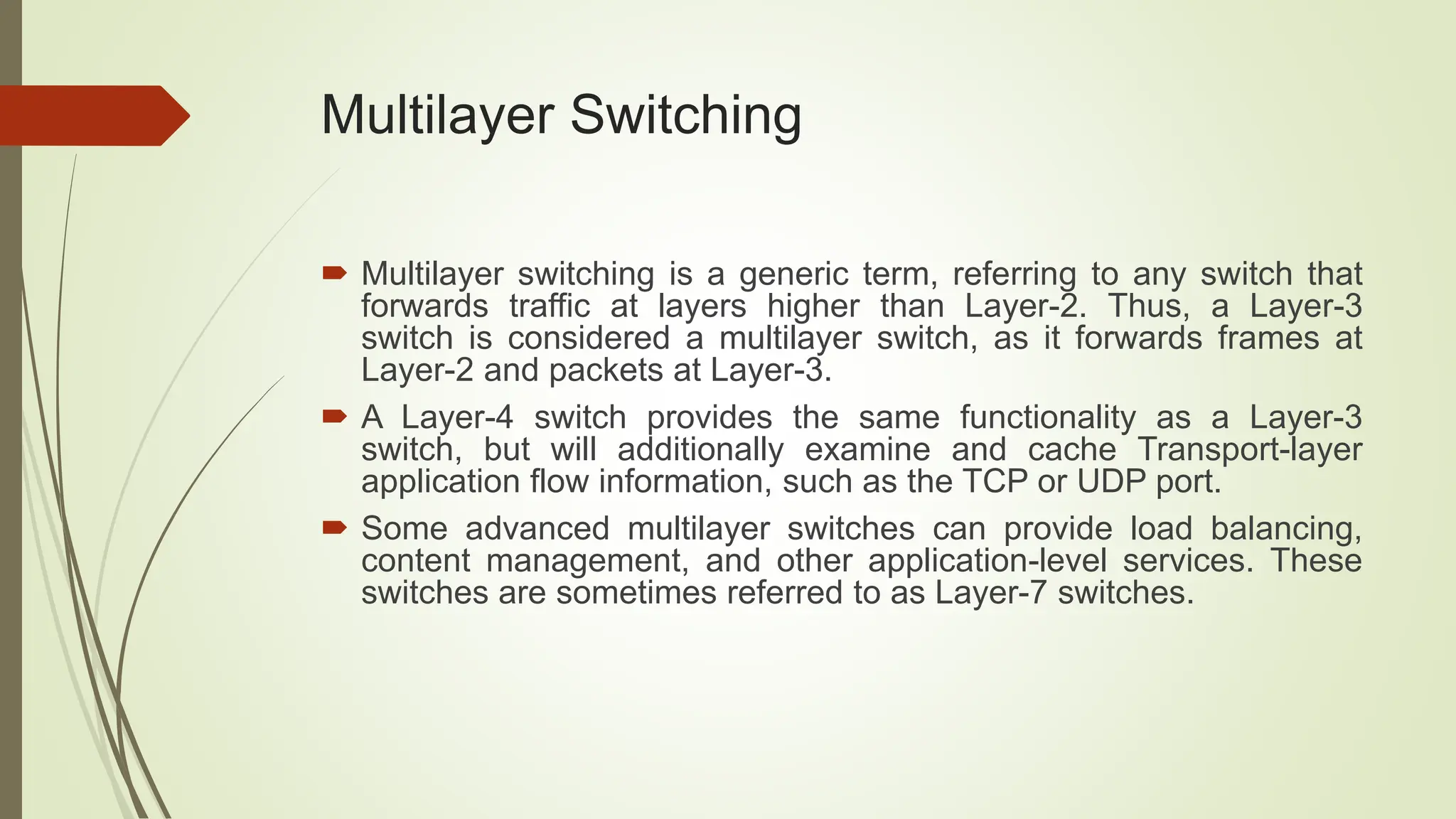
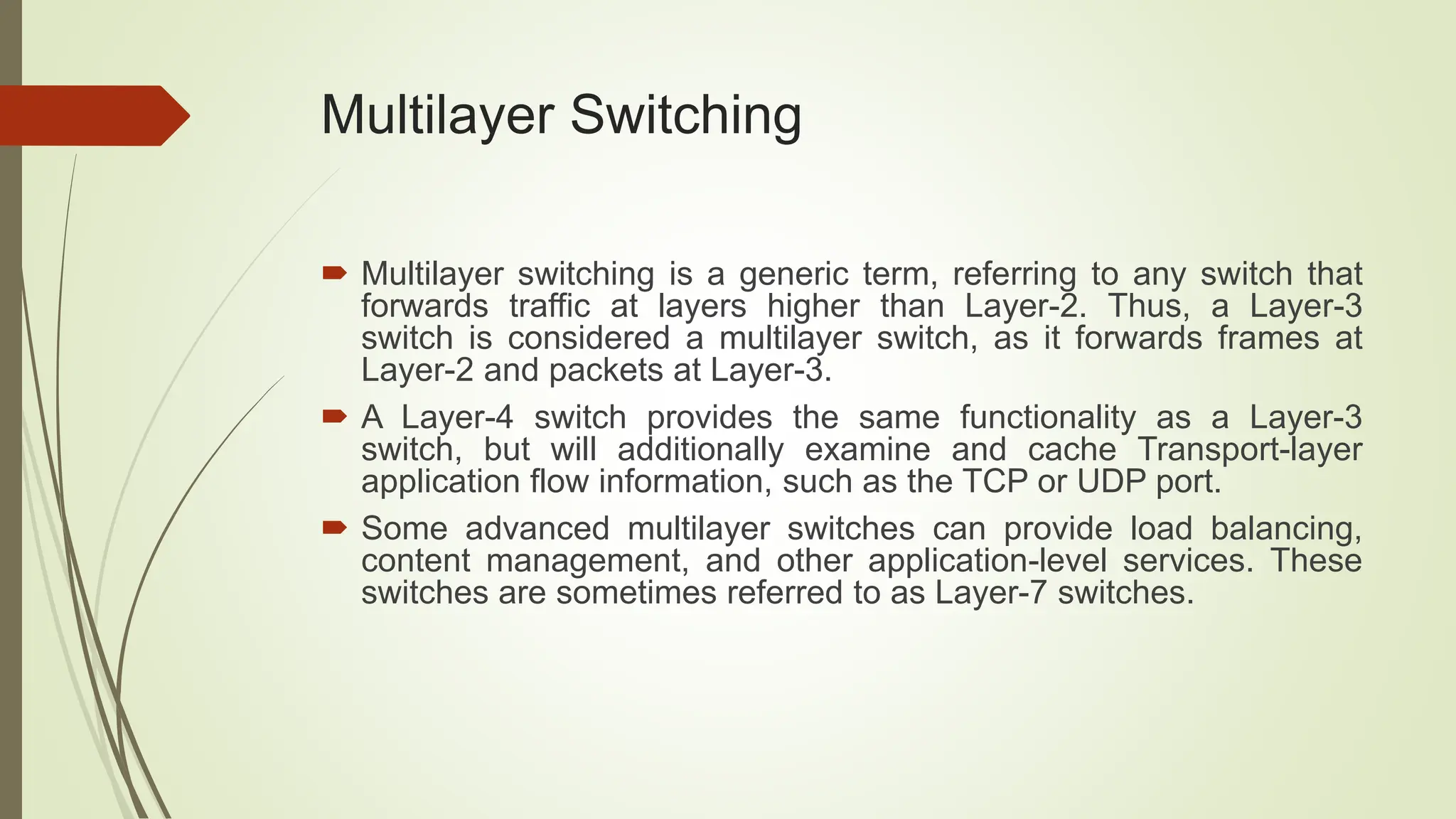
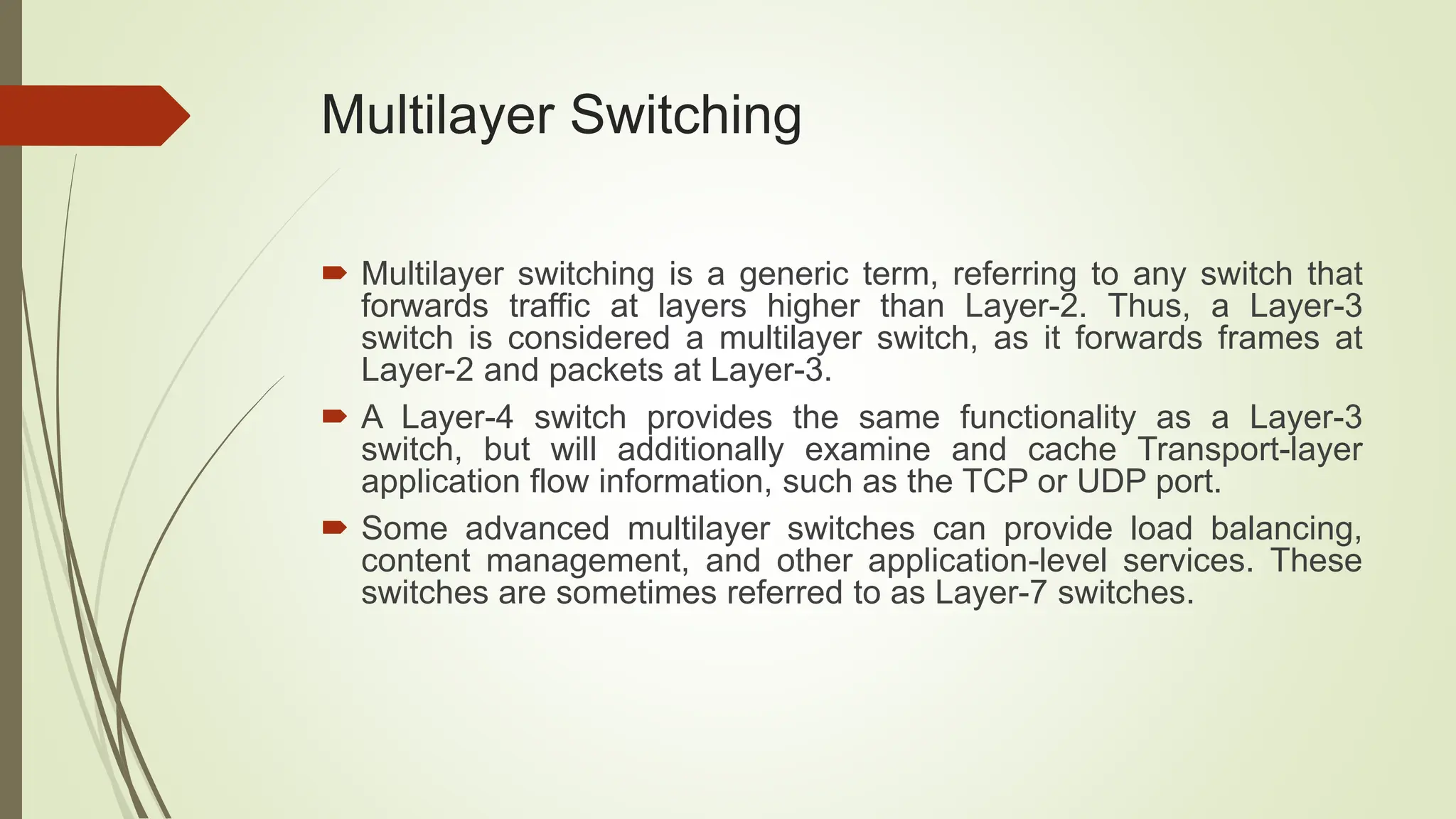
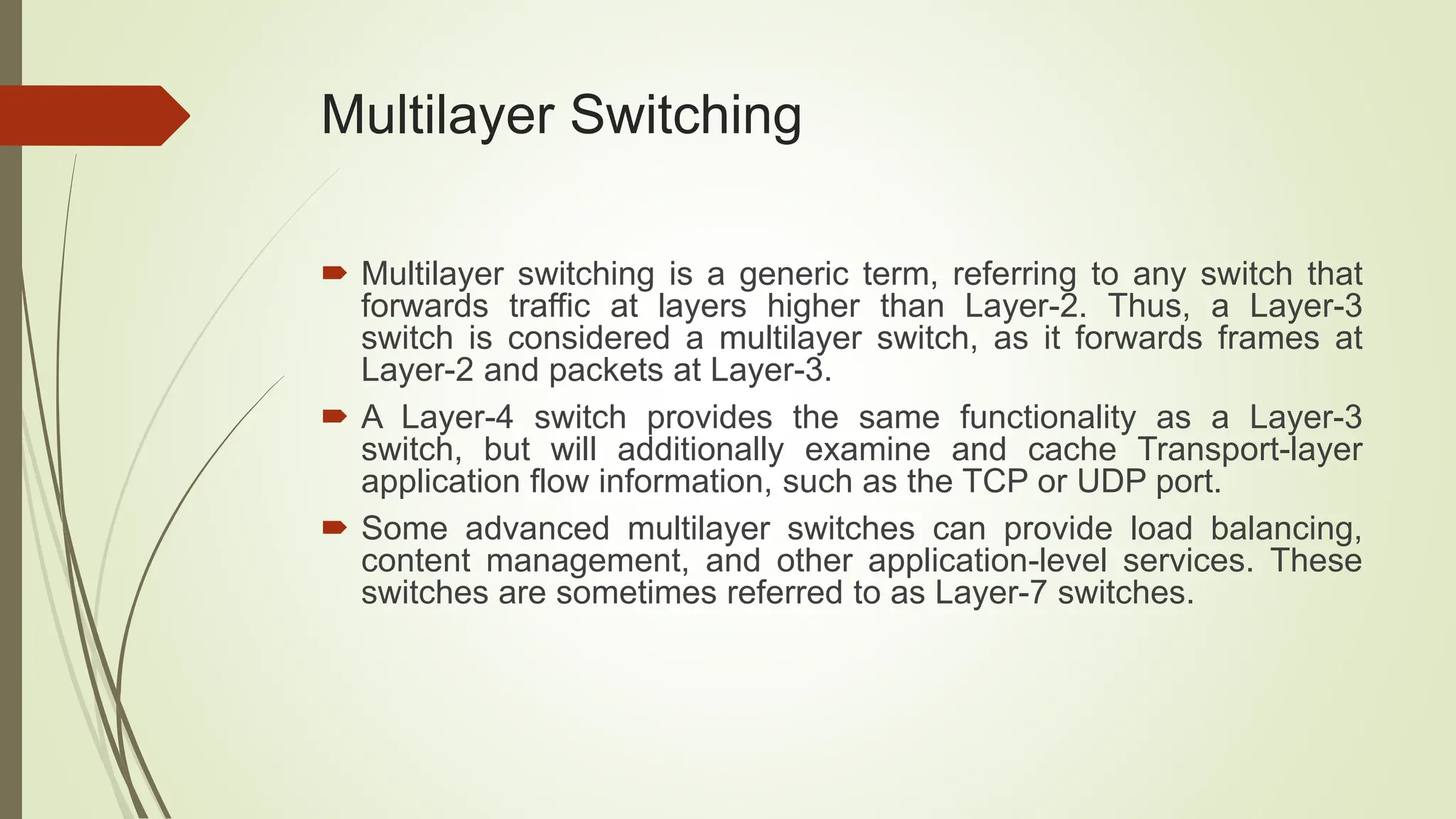
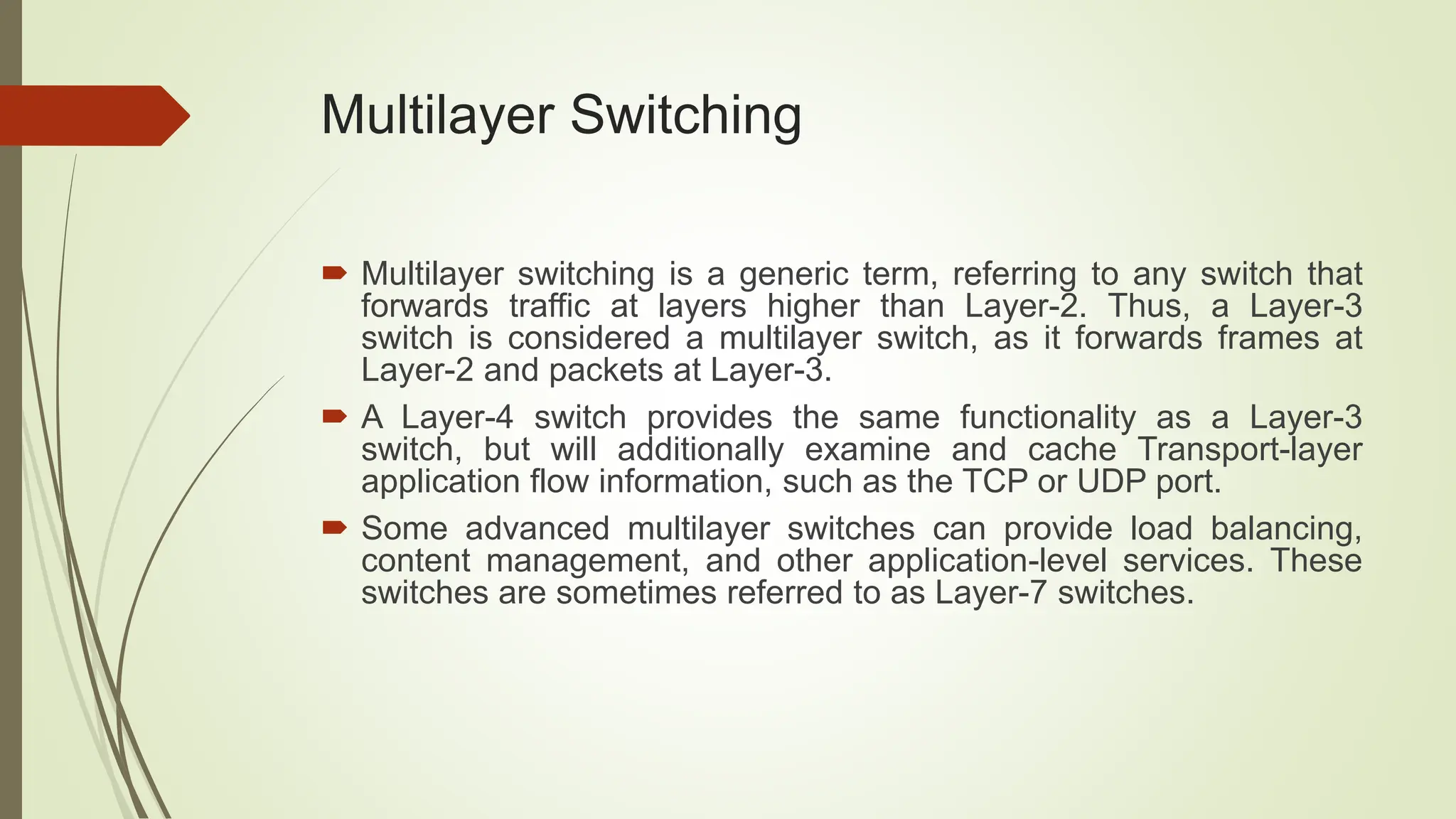
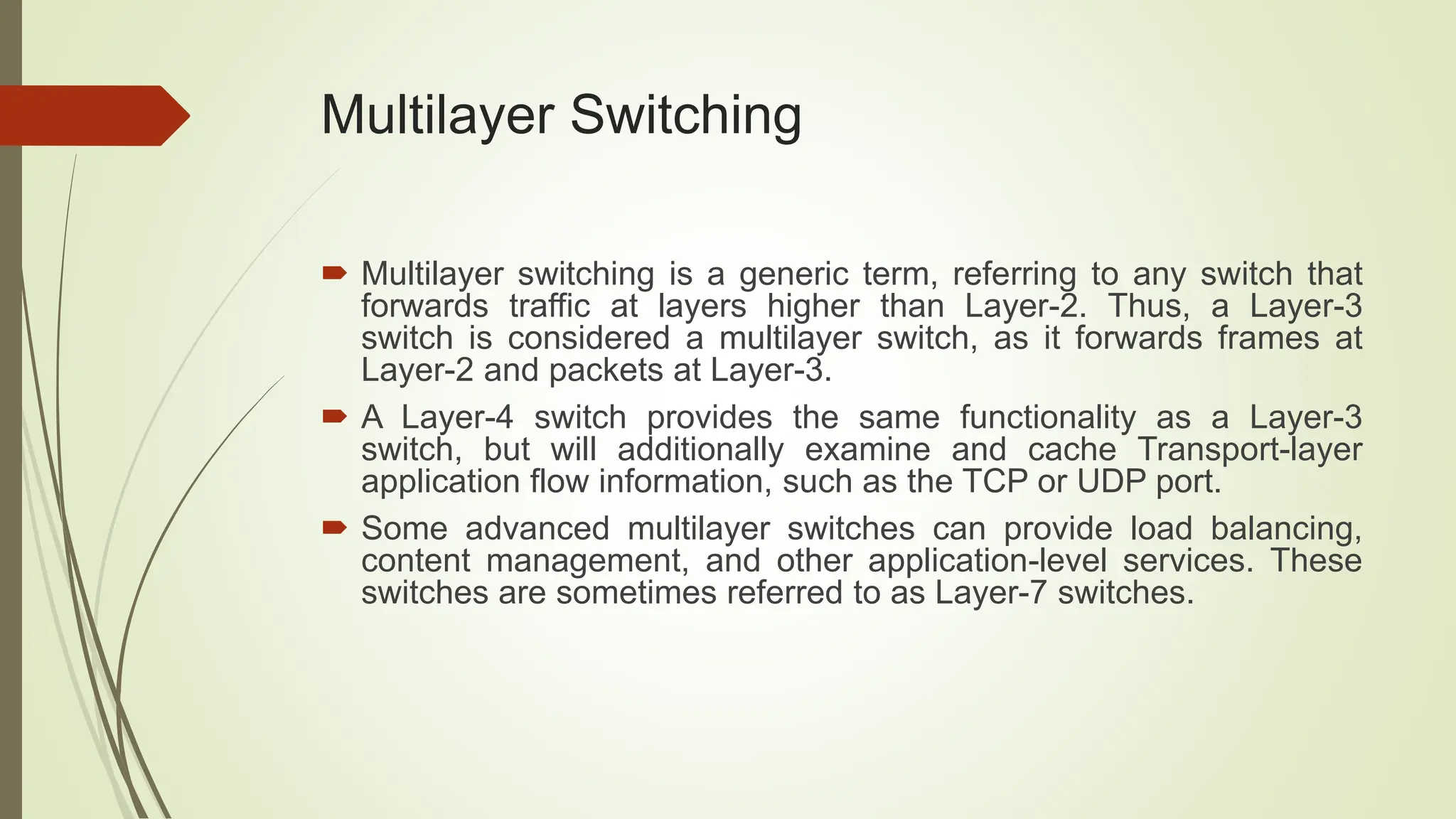
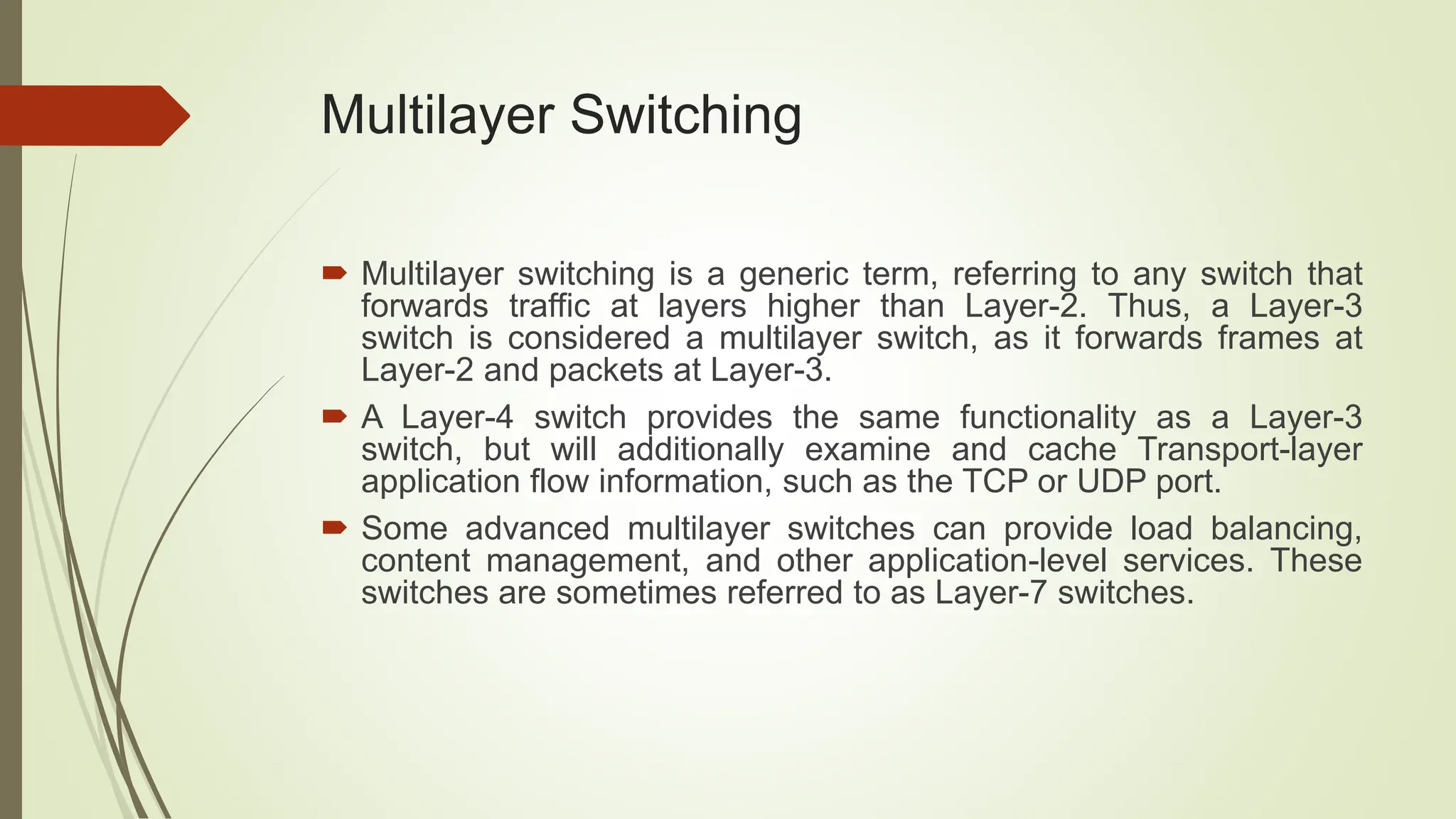
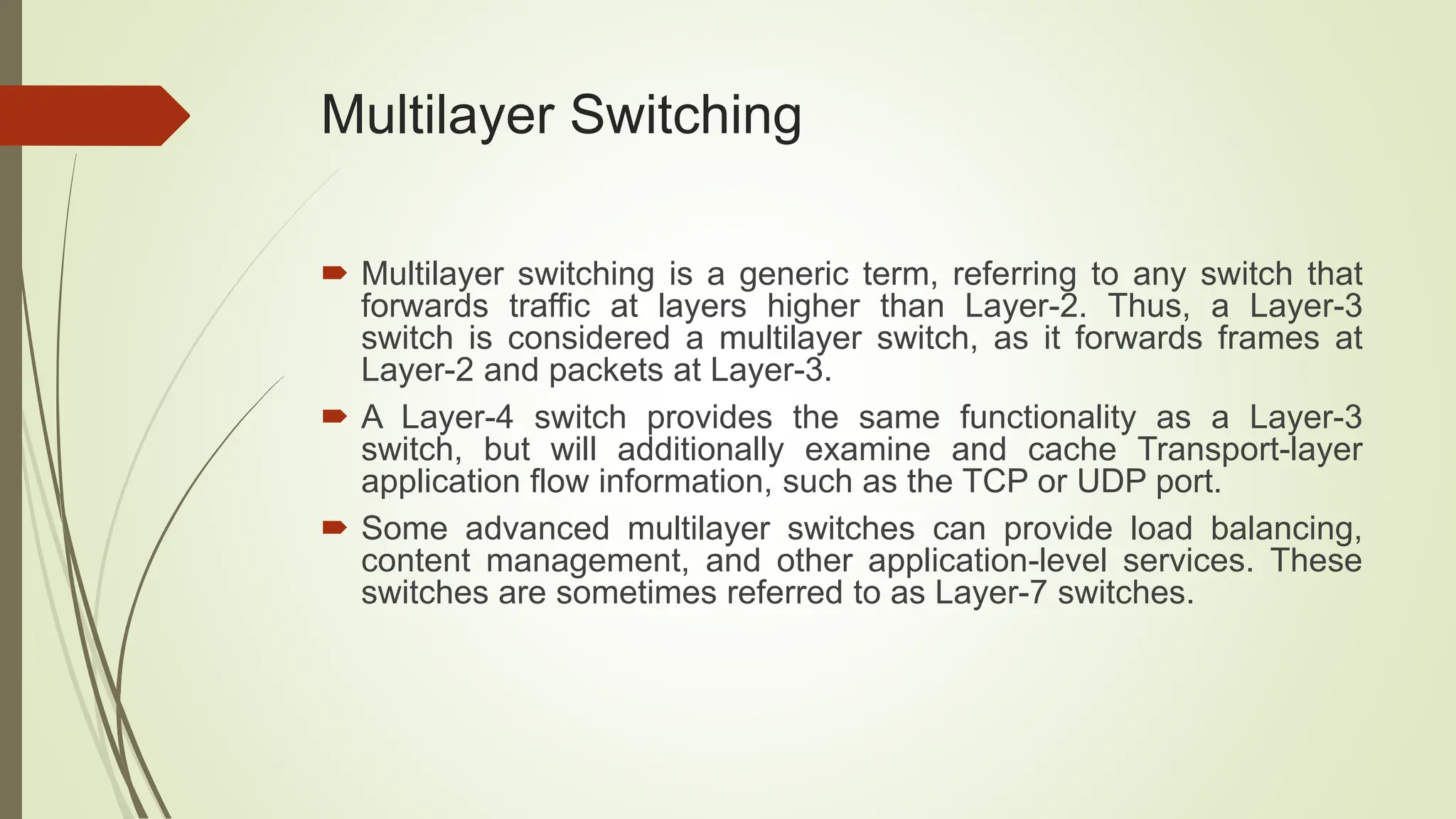
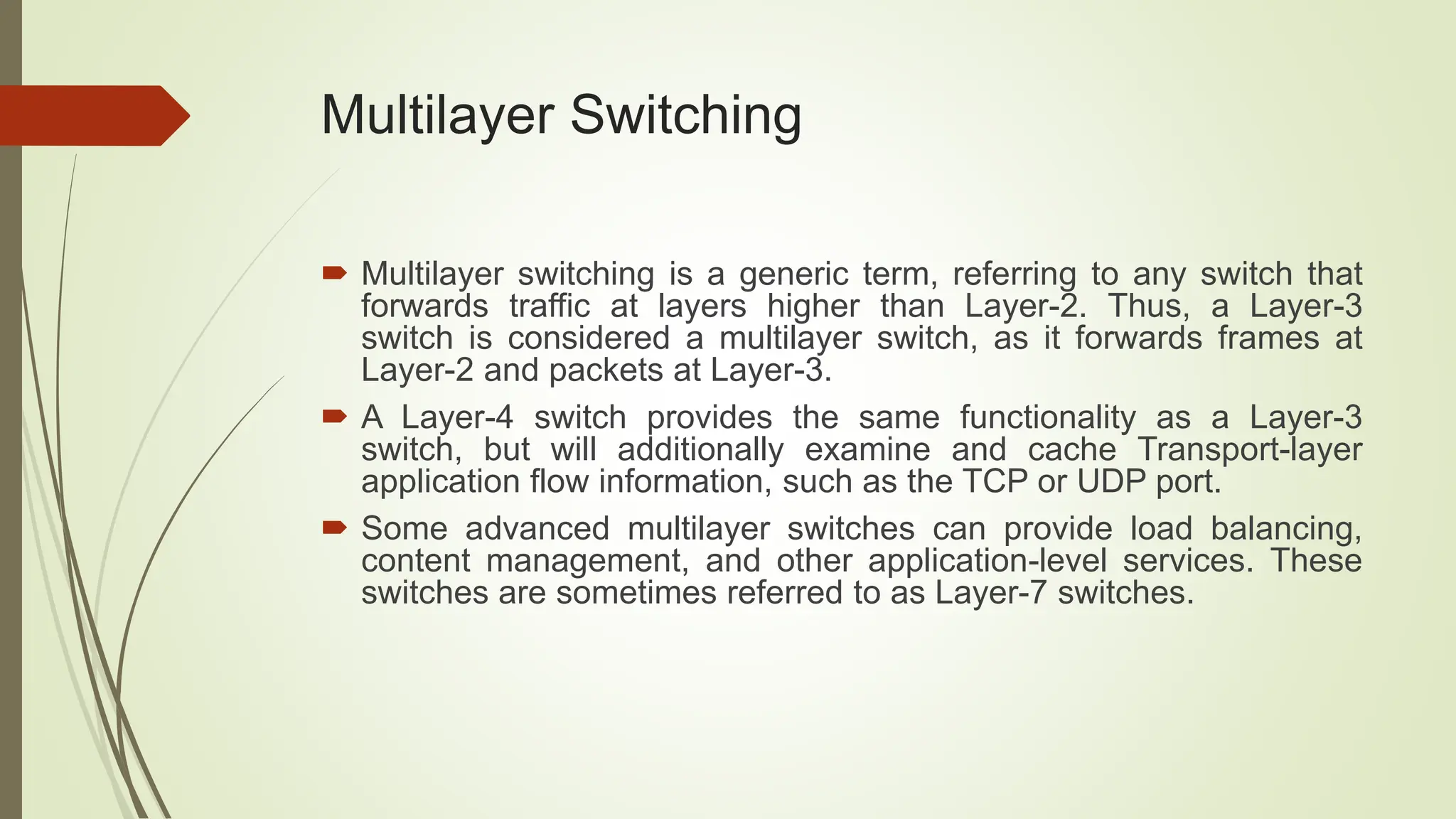
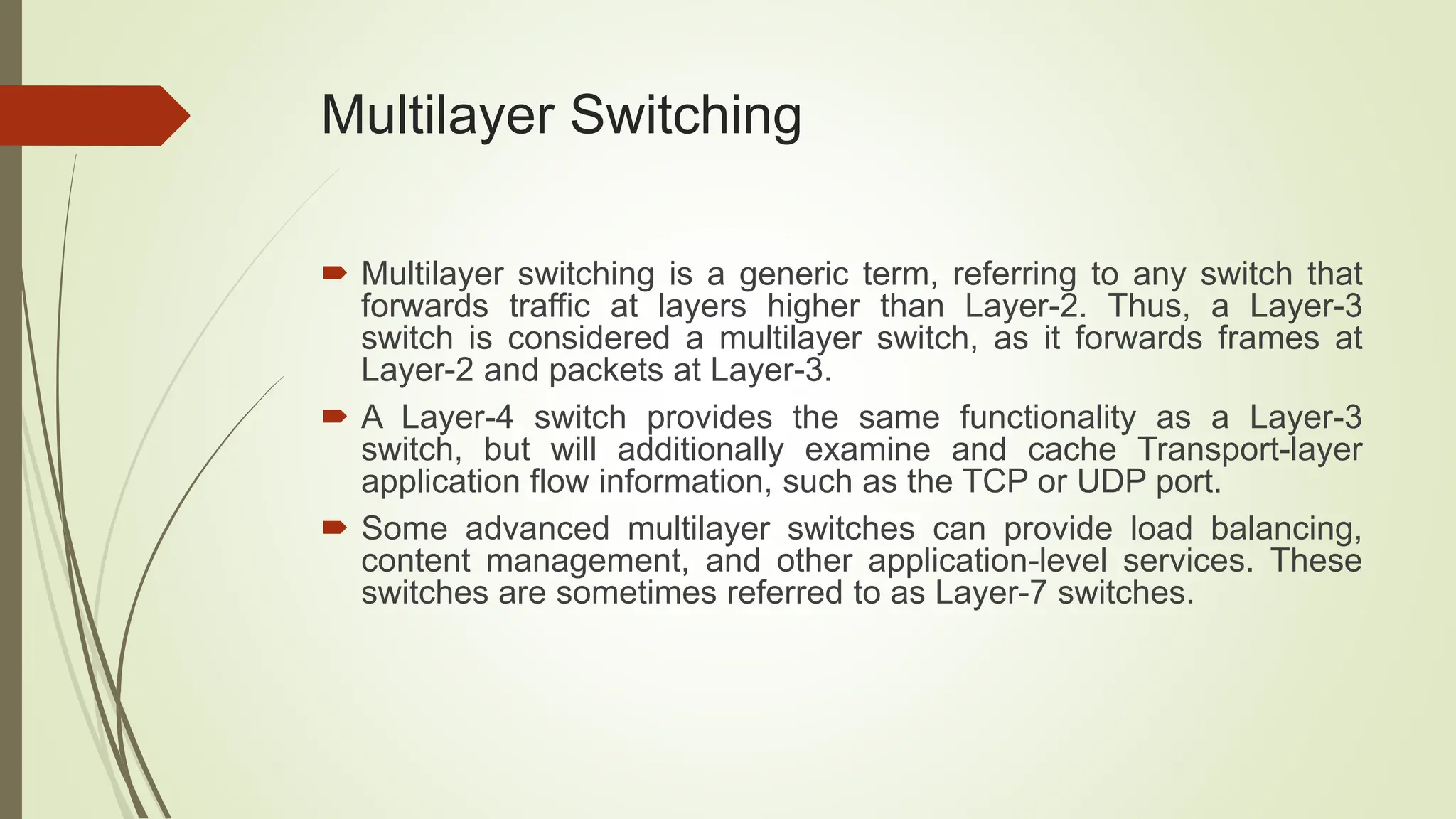
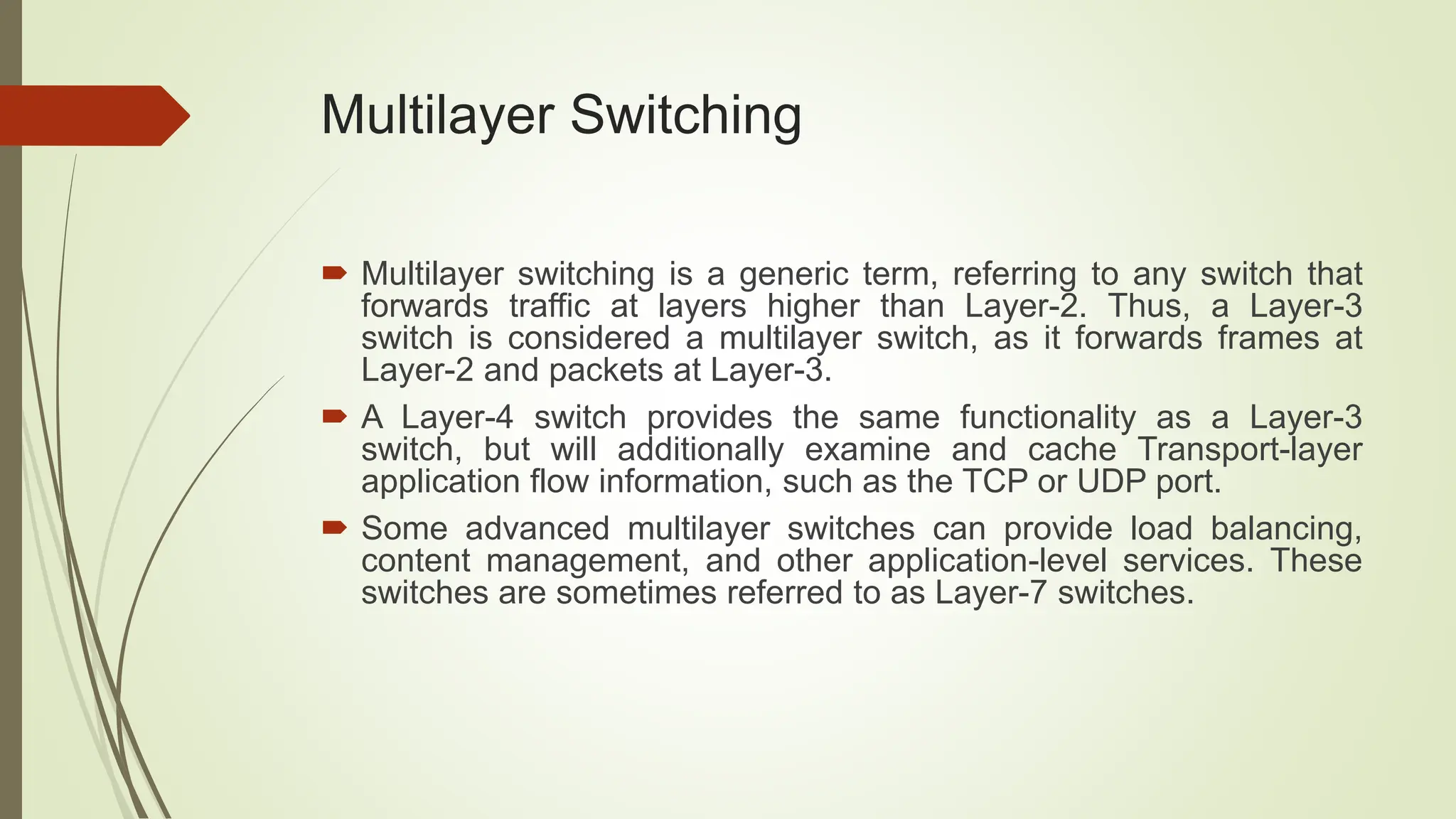
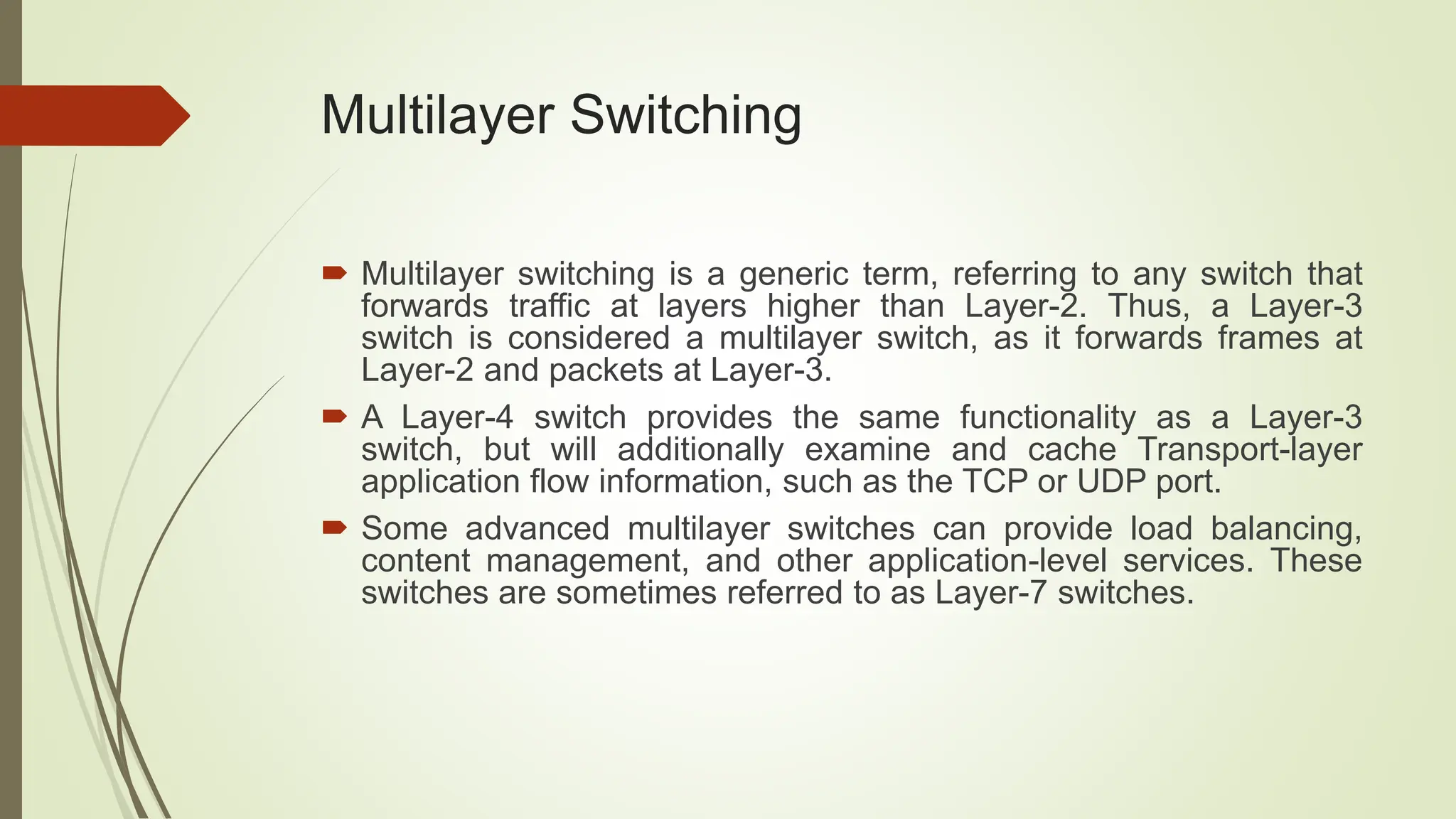
Multilayer Switching
 Multilayer switching is a generic term, referring to any switch that
forwards traffic at layers higher than Layer-2. Thus, a Layer-3
switch is considered a multilayer switch, as it forwards frames at
Layer-2 and packets at Layer-3.
 A Layer-4 switch provides the same functionality as a Layer-3
switch, but will additionally examine and cache Transport-layer
application flow information, such as the TCP or UDP port.
 Some advanced multilayer switches can provide load balancing,
content management, and other application-level services. These
switches are sometimes referred to as Layer-7 switches.
Multilayer Switching
 Multilayer switching is a generic term, referring to any switch that
forwards traffic at layers higher than Layer-2. Thus, a Layer-3
switch is considered a multilayer switch, as it forwards frames at
Layer-2 and packets at Layer-3.
 A Layer-4 switch provides the same functionality as a Layer-3
switch, but will additionally examine and cache Transport-layer
application flow information, such as the TCP or UDP port.
 Some advanced multilayer switches can provide load balancing,
content management, and other application-level services. These
switches are sometimes referred to as Layer-7 switches.
Multilayer Switching
 Multilayer switching is a generic term, referring to any switch that
forwards traffic at layers higher than Layer-2. Thus, a Layer-3
switch is considered a multilayer switch, as it forwards frames at
Layer-2 and packets at Layer-3.
 A Layer-4 switch provides the same functionality as a Layer-3
switch, but will additionally examine and cache Transport-layer
application flow information, such as the TCP or UDP port.
 Some advanced multilayer switches can provide load balancing,
content management, and other application-level services. These
switches are sometimes referred to as Layer-7 switches.
Multilayer Switching
 Multilayer switching is a generic term, referring to any switch that
forwards traffic at layers higher than Layer-2. Thus, a Layer-3
switch is considered a multilayer switch, as it forwards frames at
Layer-2 and packets at Layer-3.
 A Layer-4 switch provides the same functionality as a Layer-3
switch, but will additionally examine and cache Transport-layer
application flow information, such as the TCP or UDP port.
 Some advanced multilayer switches can provide load balancing,
content management, and other application-level services. These
switches are sometimes referred to as Layer-7 switches.
Multilayer Switching
 Multilayer switching is a generic term, referring to any switch that
forwards traffic at layers higher than Layer-2. Thus, a Layer-3
switch is considered a multilayer switch, as it forwards frames at
Layer-2 and packets at Layer-3.
 A Layer-4 switch provides the same functionality as a Layer-3
switch, but will additionally examine and cache Transport-layer
application flow information, such as the TCP or UDP port.
 Some advanced multilayer switches can provide load balancing,
content management, and other application-level services. These
switches are sometimes referred to as Layer-7 switches.
Multilayer Switching
 Multilayer switching is a generic term, referring to any switch that
forwards traffic at layers higher than Layer-2. Thus, a Layer-3
switch is considered a multilayer switch, as it forwards frames at
Layer-2 and packets at Layer-3.
 A Layer-4 switch provides the same functionality as a Layer-3
switch, but will additionally examine and cache Transport-layer
application flow information, such as the TCP or UDP port.
 Some advanced multilayer switches can provide load balancing,
content management, and other application-level services. These
switches are sometimes referred to as Layer-7 switches.
Multilayer Switching
 Multilayer switching is a generic term, referring to any switch that
forwards traffic at layers higher than Layer-2. Thus, a Layer-3
switch is considered a multilayer switch, as it forwards frames at
Layer-2 and packets at Layer-3.
 A Layer-4 switch provides the same functionality as a Layer-3
switch, but will additionally examine and cache Transport-layer
application flow information, such as the TCP or UDP port.
 Some advanced multilayer switches can provide load balancing,
content management, and other application-level services. These
switches are sometimes referred to as Layer-7 switches.
Multilayer Switching
 Multilayer switching is a generic term, referring to any switch that
forwards traffic at layers higher than Layer-2. Thus, a Layer-3
switch is considered a multilayer switch, as it forwards frames at
Layer-2 and packets at Layer-3.
 A Layer-4 switch provides the same functionality as a Layer-3
switch, but will additionally examine and cache Transport-layer
application flow information, such as the TCP or UDP port.
 Some advanced multilayer switches can provide load balancing,
content management, and other application-level services. These
switches are sometimes referred to as Layer-7 switches.
Multilayer Switching
 Multilayer switching is a generic term, referring to any switch that
forwards traffic at layers higher than Layer-2. Thus, a Layer-3
switch is considered a multilayer switch, as it forwards frames at
Layer-2 and packets at Layer-3.
 A Layer-4 switch provides the same functionality as a Layer-3
switch, but will additionally examine and cache Transport-layer
application flow information, such as the TCP or UDP port.
 Some advanced multilayer switches can provide load balancing,
content management, and other application-level services. These
switches are sometimes referred to as Layer-7 switches.
Multilayer Switching
 Multilayer switching is a generic term, referring to any switch that
forwards traffic at layers higher than Layer-2. Thus, a Layer-3
switch is considered a multilayer switch, as it forwards frames at
Layer-2 and packets at Layer-3.
 A Layer-4 switch provides the same functionality as a Layer-3
switch, but will additionally examine and cache Transport-layer
application flow information, such as the TCP or UDP port.
 Some advanced multilayer switches can provide load balancing,
content management, and other application-level services. These
switches are sometimes referred to as Layer-7 switches.
Multilayer Switching
 Multilayer switching is a generic term, referring to any switch that
forwards traffic at layers higher than Layer-2. Thus, a Layer-3
switch is considered a multilayer switch, as it forwards frames at
Layer-2 and packets at Layer-3.
 A Layer-4 switch provides the same functionality as a Layer-3
switch, but will additionally examine and cache Transport-layer
application flow information, such as the TCP or UDP port.
 Some advanced multilayer switches can provide load balancing,
content management, and other application-level services. These
switches are sometimes referred to as Layer-7 switches.
Multilayer Switching
 Multilayer switching is a generic term, referring to any switch that
forwards traffic at layers higher than Layer-2. Thus, a Layer-3
switch is considered a multilayer switch, as it forwards frames at
Layer-2 and packets at Layer-3.
 A Layer-4 switch provides the same functionality as a Layer-3
switch, but will additionally examine and cache Transport-layer
application flow information, such as the TCP or UDP port.
 Some advanced multilayer switches can provide load balancing,
content management, and other application-level services. These
switches are sometimes referred to as Layer-7 switches.
Multilayer Switching
 Multilayer switching is a generic term, referring to any switch that
forwards traffic at layers higher than Layer-2. Thus, a Layer-3
switch is considered a multilayer switch, as it forwards frames at
Layer-2 and packets at Layer-3.
 A Layer-4 switch provides the same functionality as a Layer-3
switch, but will additionally examine and cache Transport-layer
application flow information, such as the TCP or UDP port.
 Some advanced multilayer switches can provide load balancing,
content management, and other application-level services. These
switches are sometimes referred to as Layer-7 switches.
Multilayer Switching
 Multilayer switching is a generic term, referring to any switch that
forwards traffic at layers higher than Layer-2. Thus, a Layer-3
switch is considered a multilayer switch, as it forwards frames at
Layer-2 and packets at Layer-3.
 A Layer-4 switch provides the same functionality as a Layer-3
switch, but will additionally examine and cache Transport-layer
application flow information, such as the TCP or UDP port.
 Some advanced multilayer switches can provide load balancing,
content management, and other application-level services. These
switches are sometimes referred to as Layer-7 switches.
Multilayer Switching
 Multilayer switching is a generic term, referring to any switch that
forwards traffic at layers higher than Layer-2. Thus, a Layer-3
switch is considered a multilayer switch, as it forwards frames at
Layer-2 and packets at Layer-3.
 A Layer-4 switch provides the same functionality as a Layer-3
switch, but will additionally examine and cache Transport-layer
application flow information, such as the TCP or UDP port.
 Some advanced multilayer switches can provide load balancing,
content management, and other application-level services. These
switches are sometimes referred to as Layer-7 switches.
Multilayer Switching
 Multilayer switching is a generic term, referring to any switch that
forwards traffic at layers higher than Layer-2. Thus, a Layer-3
switch is considered a multilayer switch, as it forwards frames at
Layer-2 and packets at Layer-3.
 A Layer-4 switch provides the same functionality as a Layer-3
switch, but will additionally examine and cache Transport-layer
application flow information, such as the TCP or UDP port.
 Some advanced multilayer switches can provide load balancing,
content management, and other application-level services. These
switches are sometimes referred to as Layer-7 switches.
Multilayer Switching
 Multilayer switching is a generic term, referring to any switch that
forwards traffic at layers higher than Layer-2. Thus, a Layer-3
switch is considered a multilayer switch, as it forwards frames at
Layer-2 and packets at Layer-3.
 A Layer-4 switch provides the same functionality as a Layer-3
switch, but will additionally examine and cache Transport-layer
application flow information, such as the TCP or UDP port.
 Some advanced multilayer switches can provide load balancing,
content management, and other application-level services. These
switches are sometimes referred to as Layer-7 switches.
Multilayer Switching
 Multilayer switching is a generic term, referring to any switch that
forwards traffic at layers higher than Layer-2. Thus, a Layer-3
switch is considered a multilayer switch, as it forwards frames at
Layer-2 and packets at Layer-3.
 A Layer-4 switch provides the same functionality as a Layer-3
switch, but will additionally examine and cache Transport-layer
application flow information, such as the TCP or UDP port.
 Some advanced multilayer switches can provide load balancing,
content management, and other application-level services. These
switches are sometimes referred to as Layer-7 switches.
Multilayer Switching
 Multilayer switching is a generic term, referring to any switch that
forwards traffic at layers higher than Layer-2. Thus, a Layer-3
switch is considered a multilayer switch, as it forwards frames at
Layer-2 and packets at Layer-3.
 A Layer-4 switch provides the same functionality as a Layer-3
switch, but will additionally examine and cache Transport-layer
application flow information, such as the TCP or UDP port.
 Some advanced multilayer switches can provide load balancing,
content management, and other application-level services. These
switches are sometimes referred to as Layer-7 switches.
Multilayer Switching
 Multilayer switching is a generic term, referring to any switch that
forwards traffic at layers higher than Layer-2. Thus, a Layer-3
switch is considered a multilayer switch, as it forwards frames at
Layer-2 and packets at Layer-3.
 A Layer-4 switch provides the same functionality as a Layer-3
switch, but will additionally examine and cache Transport-layer
application flow information, such as the TCP or UDP port.
 Some advanced multilayer switches can provide load balancing,
content management, and other application-level services. These
switches are sometimes referred to as Layer-7 switches.
Multilayer Switching
 Multilayer switching is a generic term, referring to any switch that
forwards traffic at layers higher than Layer-2. Thus, a Layer-3
switch is considered a multilayer switch, as it forwards frames at
Layer-2 and packets at Layer-3.
 A Layer-4 switch provides the same functionality as a Layer-3
switch, but will additionally examine and cache Transport-layer
application flow information, such as the TCP or UDP port.
 Some advanced multilayer switches can provide load balancing,
content management, and other application-level services. These
switches are sometimes referred to as Layer-7 switches.
Multilayer Switching
 Multilayer switching is a generic term, referring to any switch that
forwards traffic at layers higher than Layer-2. Thus, a Layer-3
switch is considered a multilayer switch, as it forwards frames at
Layer-2 and packets at Layer-3.
 A Layer-4 switch provides the same functionality as a Layer-3
switch, but will additionally examine and cache Transport-layer
application flow information, such as the TCP or UDP port.
 Some advanced multilayer switches can provide load balancing,
content management, and other application-level services. These
switches are sometimes referred to as Layer-7 switches.
Multilayer Switching
 Multilayer switching is a generic term, referring to any switch that
forwards traffic at layers higher than Layer-2. Thus, a Layer-3
switch is considered a multilayer switch, as it forwards frames at
Layer-2 and packets at Layer-3.
 A Layer-4 switch provides the same functionality as a Layer-3
switch, but will additionally examine and cache Transport-layer
application flow information, such as the TCP or UDP port.
 Some advanced multilayer switches can provide load balancing,
content management, and other application-level services. These
switches are sometimes referred to as Layer-7 switches.
Multilayer Switching
 Multilayer switching is a generic term, referring to any switch that
forwards traffic at layers higher than Layer-2. Thus, a Layer-3
switch is considered a multilayer switch, as it forwards frames at
Layer-2 and packets at Layer-3.
 A Layer-4 switch provides the same functionality as a Layer-3
switch, but will additionally examine and cache Transport-layer
application flow information, such as the TCP or UDP port.
 Some advanced multilayer switches can provide load balancing,
content management, and other application-level services. These
switches are sometimes referred to as Layer-7 switches.
Multilayer Switching
 Multilayer switching is a generic term, referring to any switch that
forwards traffic at layers higher than Layer-2. Thus, a Layer-3
switch is considered a multilayer switch, as it forwards frames at
Layer-2 and packets at Layer-3.
 A Layer-4 switch provides the same functionality as a Layer-3
switch, but will additionally examine and cache Transport-layer
application flow information, such as the TCP or UDP port.
 Some advanced multilayer switches can provide load balancing,
content management, and other application-level services. These
switches are sometimes referred to as Layer-7 switches.
Multilayer Switching
 Multilayer switching is a generic term, referring to any switch that
forwards traffic at layers higher than Layer-2. Thus, a Layer-3
switch is considered a multilayer switch, as it forwards frames at
Layer-2 and packets at Layer-3.
 A Layer-4 switch provides the same functionality as a Layer-3
switch, but will additionally examine and cache Transport-layer
application flow information, such as the TCP or UDP port.
 Some advanced multilayer switches can provide load balancing,
content management, and other application-level services. These
switches are sometimes referred to as Layer-7 switches.
Multilayer Switching
 Multilayer switching is a generic term, referring to any switch that
forwards traffic at layers higher than Layer-2. Thus, a Layer-3
switch is considered a multilayer switch, as it forwards frames at
Layer-2 and packets at Layer-3.
 A Layer-4 switch provides the same functionality as a Layer-3
switch, but will additionally examine and cache Transport-layer
application flow information, such as the TCP or UDP port.
 Some advanced multilayer switches can provide load balancing,
content management, and other application-level services. These
switches are sometimes referred to as Layer-7 switches.
Multilayer Switching
 Multilayer switching is a generic term, referring to any switch that
forwards traffic at layers higher than Layer-2. Thus, a Layer-3
switch is considered a multilayer switch, as it forwards frames at
Layer-2 and packets at Layer-3.
 A Layer-4 switch provides the same functionality as a Layer-3
switch, but will additionally examine and cache Transport-layer
application flow information, such as the TCP or UDP port.
 Some advanced multilayer switches can provide load balancing,
content management, and other application-level services. These
switches are sometimes referred to as Layer-7 switches.
Multilayer Switching
 Multilayer switching is a generic term, referring to any switch that
forwards traffic at layers higher than Layer-2. Thus, a Layer-3
switch is considered a multilayer switch, as it forwards frames at
Layer-2 and packets at Layer-3.
 A Layer-4 switch provides the same functionality as a Layer-3
switch, but will additionally examine and cache Transport-layer
application flow information, such as the TCP or UDP port.
 Some advanced multilayer switches can provide load balancing,
content management, and other application-level services. These
switches are sometimes referred to as Layer-7 switches.
Multilayer Switching
 Multilayer switching is a generic term, referring to any switch that
forwards traffic at layers higher than Layer-2. Thus, a Layer-3
switch is considered a multilayer switch, as it forwards frames at
Layer-2 and packets at Layer-3.
 A Layer-4 switch provides the same functionality as a Layer-3
switch, but will additionally examine and cache Transport-layer
application flow information, such as the TCP or UDP port.
 Some advanced multilayer switches can provide load balancing,
content management, and other application-level services. These
switches are sometimes referred to as Layer-7 switches.
Multilayer Switching
 Multilayer switching is a generic term, referring to any switch that
forwards traffic at layers higher than Layer-2. Thus, a Layer-3
switch is considered a multilayer switch, as it forwards frames at
Layer-2 and packets at Layer-3.
 A Layer-4 switch provides the same functionality as a Layer-3
switch, but will additionally examine and cache Transport-layer
application flow information, such as the TCP or UDP port.
 Some advanced multilayer switches can provide load balancing,
content management, and other application-level services. These
switches are sometimes referred to as Layer-7 switches.
Multilayer Switching
 Multilayer switching is a generic term, referring to any switch that
forwards traffic at layers higher than Layer-2. Thus, a Layer-3
switch is considered a multilayer switch, as it forwards frames at
Layer-2 and packets at Layer-3.
 A Layer-4 switch provides the same functionality as a Layer-3
switch, but will additionally examine and cache Transport-layer
application flow information, such as the TCP or UDP port.
 Some advanced multilayer switches can provide load balancing,
content management, and other application-level services. These
switches are sometimes referred to as Layer-7 switches.
Multilayer Switching
 Multilayer switching is a generic term, referring to any switch that
forwards traffic at layers higher than Layer-2. Thus, a Layer-3
switch is considered a multilayer switch, as it forwards frames at
Layer-2 and packets at Layer-3.
 A Layer-4 switch provides the same functionality as a Layer-3
switch, but will additionally examine and cache Transport-layer
application flow information, such as the TCP or UDP port.
 Some advanced multilayer switches can provide load balancing,
content management, and other application-level services. These
switches are sometimes referred to as Layer-7 switches.
Multilayer Switching
 Multilayer switching is a generic term, referring to any switch that
forwards traffic at layers higher than Layer-2. Thus, a Layer-3
switch is considered a multilayer switch, as it forwards frames at
Layer-2 and packets at Layer-3.
 A Layer-4 switch provides the same functionality as a Layer-3
switch, but will additionally examine and cache Transport-layer
application flow information, such as the TCP or UDP port.
 Some advanced multilayer switches can provide load balancing,
content management, and other application-level services. These
switches are sometimes referred to as Layer-7 switches.
Multilayer Switching
 Multilayer switching is a generic term, referring to any switch that
forwards traffic at layers higher than Layer-2. Thus, a Layer-3
switch is considered a multilayer switch, as it forwards frames at
Layer-2 and packets at Layer-3.
 A Layer-4 switch provides the same functionality as a Layer-3
switch, but will additionally examine and cache Transport-layer
application flow information, such as the TCP or UDP port.
 Some advanced multilayer switches can provide load balancing,
content management, and other application-level services. These
switches are sometimes referred to as Layer-7 switches.
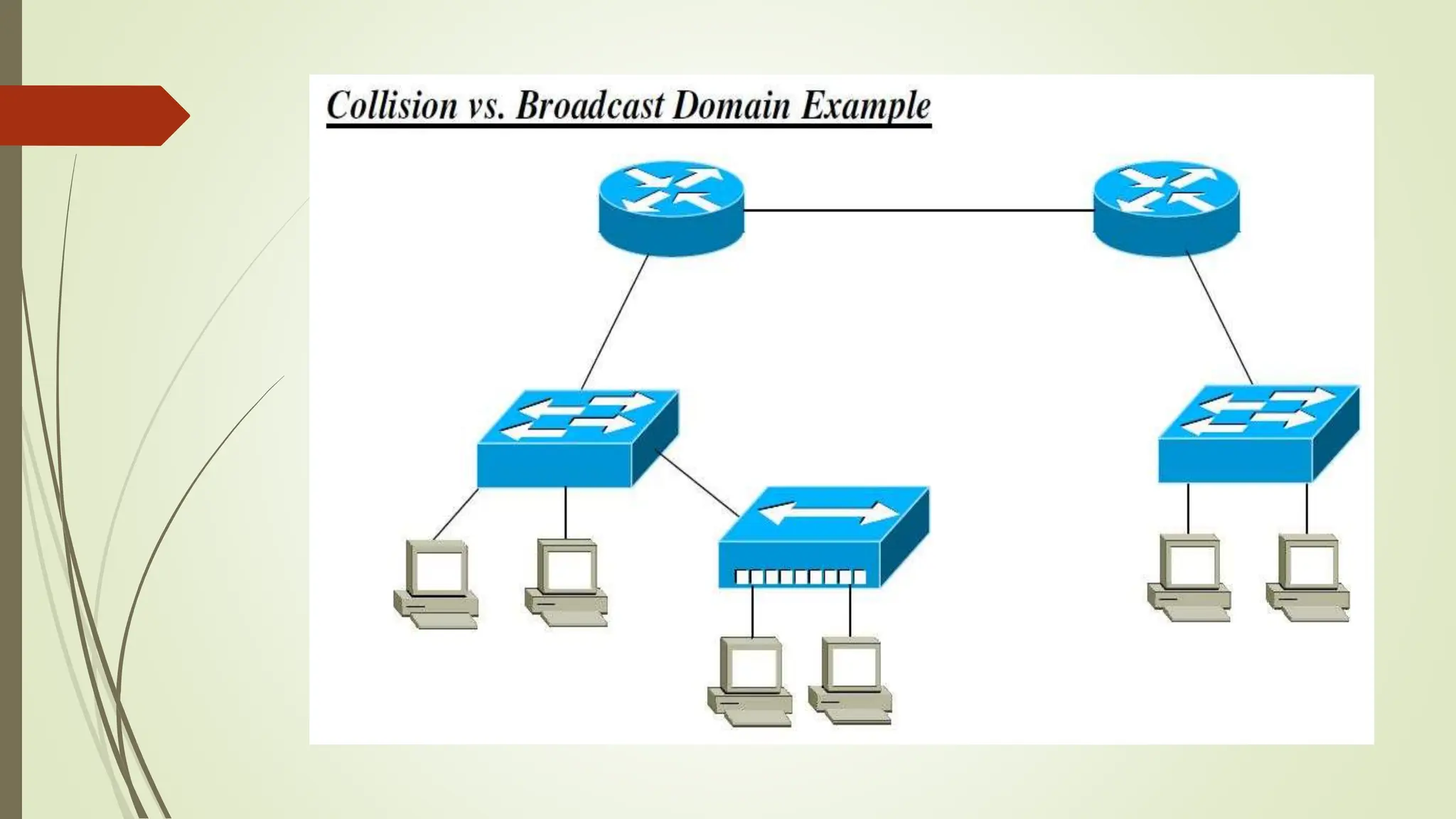
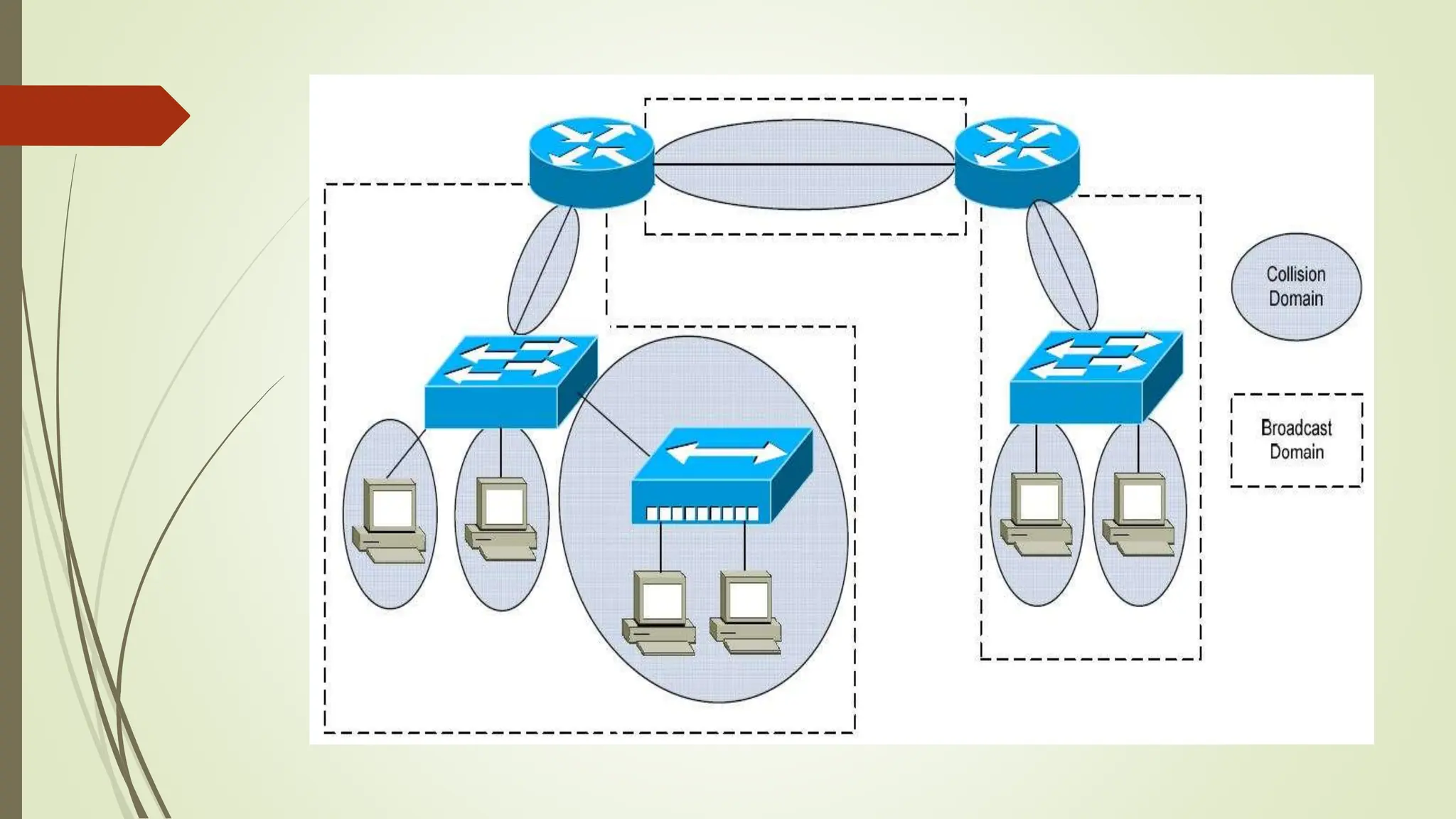
Remember That!
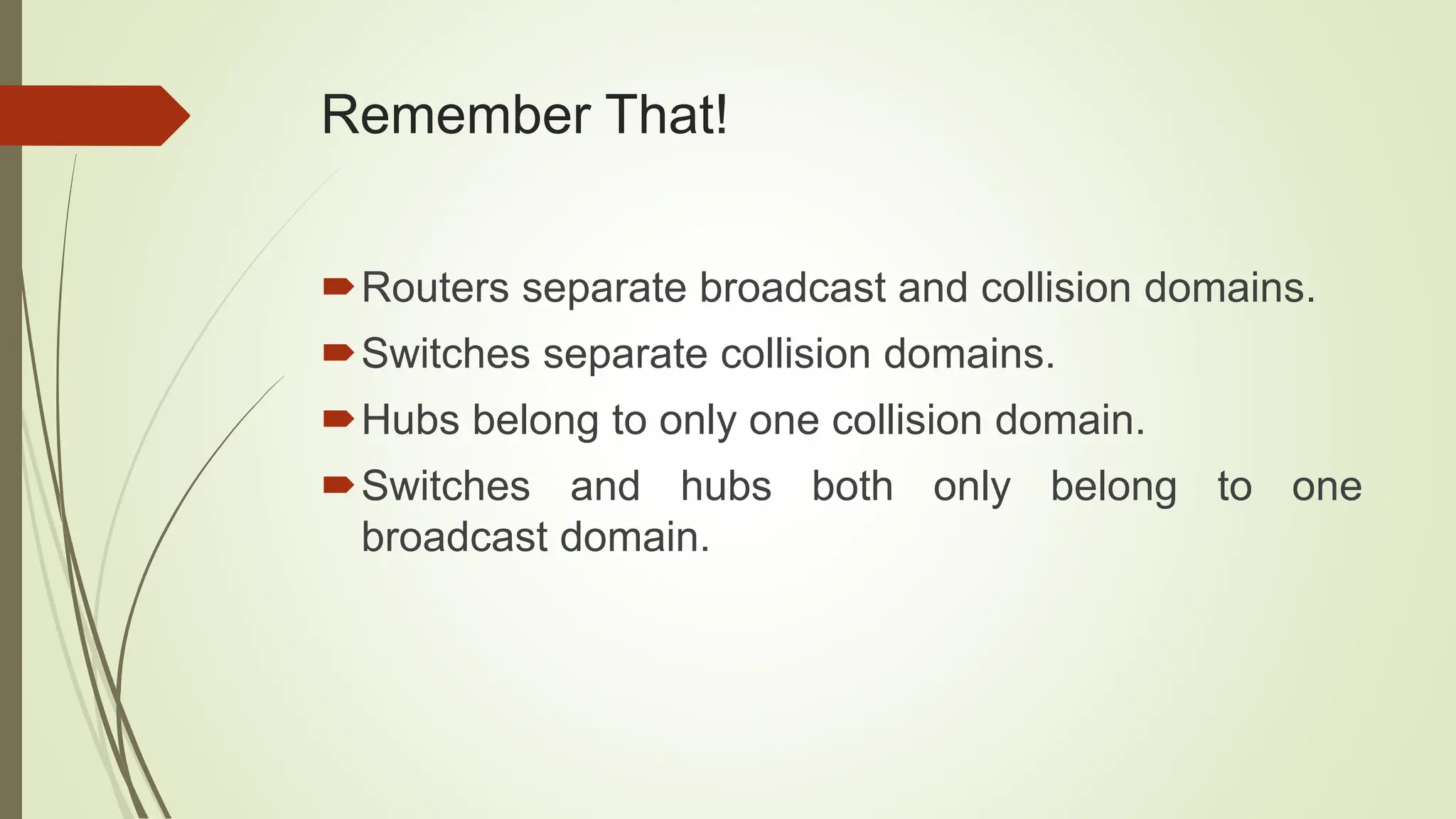
Routers separate broadcast and collision domains.
Switches separate collision domains.
Hubs belong to only one collision domain.
Switches and hubs both only belong to one
broadcast domain.
VLANs – A Layer-2 or Layer-3 Function?
 By default, a switch will forward both broadcasts and multicasts out every
port but the originating port.
 However, a switch can be logically segmented into multiple broadcast
domains, using Virtual LANs (or VLANs).
 Broadcasts from one VLAN will not be forwarded to another VLAN. The
logical separation provided by VLANs is not a Layer-3 function. VLAN tags
are inserted into the Layer-2 header.
 Remember, though VLANs provide separation for Layer-3 broadcast
domains, they are still a Layer-2 function.
Multilayer Switching
 Multilayer switching is a generic term, referring to any switch that
forwards traffic at layers higher than Layer-2. Thus, a Layer-3
switch is considered a multilayer switch, as it forwards frames at
Layer-2 and packets at Layer-3.
 A Layer-4 switch provides the same functionality as a Layer-3
switch, but will additionally examine and cache Transport-layer
application flow information, such as the TCP or UDP port.
 Some advanced multilayer switches can provide load balancing,
content management, and other application-level services. These
switches are sometimes referred to as Layer-7 switches.
Network Hardware
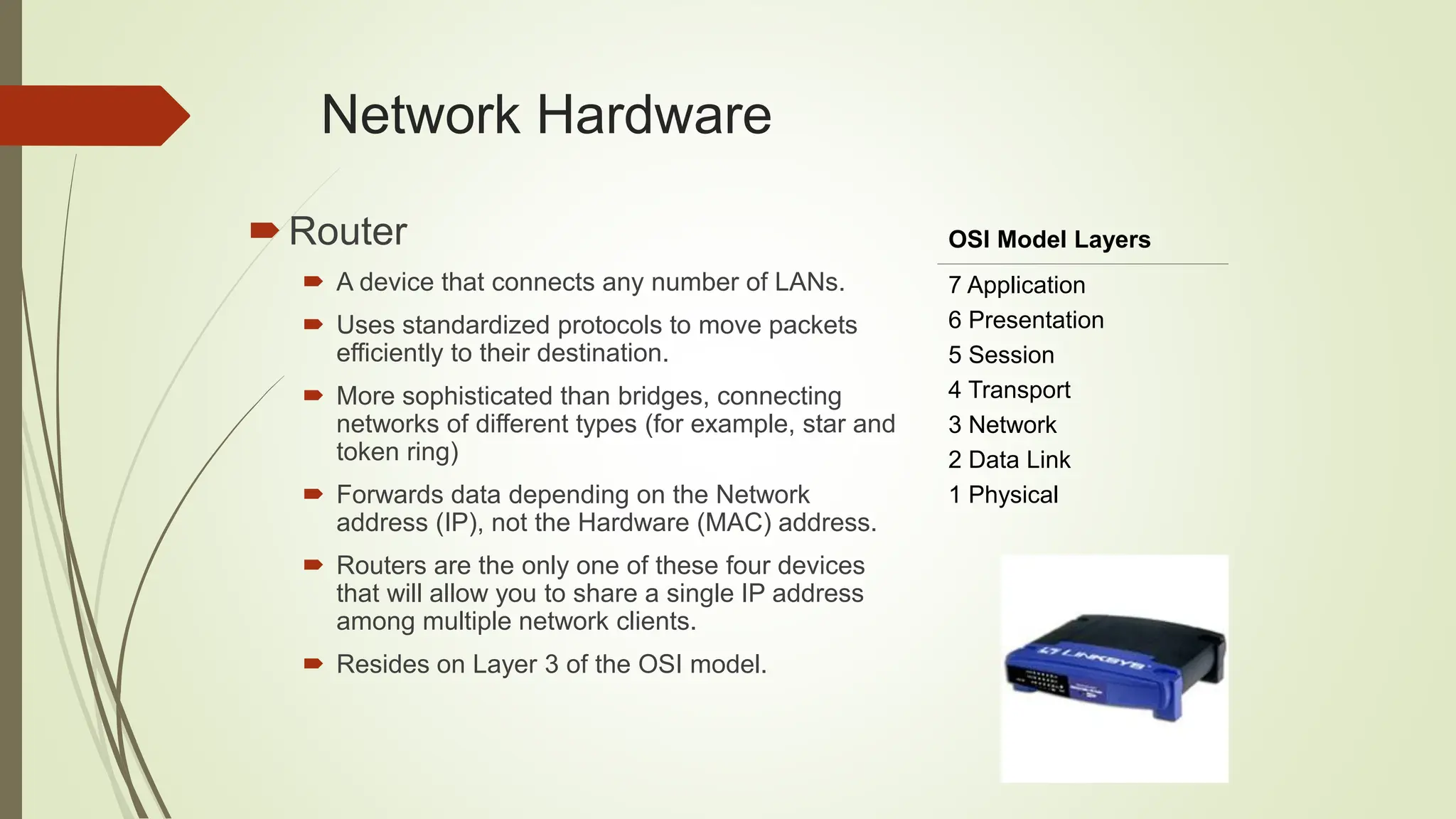
Router
 A device that connects any number of LANs.
 Uses standardized protocols to move packets
efficiently to their destination.
 More sophisticated than bridges, connecting
networks of different types (for example, star and
token ring)
 Forwards data depending on the Network
address (IP), not the Hardware (MAC) address.
 Routers are the only one of these four devices
that will allow you to share a single IP address
among multiple network clients.
 Resides on Layer 3 of the OSI model.
OSI Model Layers
7 Application
6 Presentation
5 Session
4 Transport
3 Network
2 Data Link
1 Physical
Assignment 3
1. Differentiate b/w HUB and REPEATER?
2. Differentiate b/w BRIDGE and SWITCH?
3. Differentiate b/w ROUTER and SWITCH?
THANKS

Tcp/ip Protocol presentation on Networking .pptx

  • 1.
    OBJECTIVES: To get familiarwith the networking devices and their working
  • 2.
    Network Hardware –Network Interface Card  Network Interface Card (NIC)  Network adapter card  Ethernet Card  LAN card  Types of NICs  Media Specific  Network Design Specific OSI Model Layers 7 Application 6 Presentation 5 Session 4 Transport 3 Network 2 Data Link 1 Physical
  • 3.
    Network Hardware -Hub Hub  An unintelligent network device that sends one signal to all of the stations connected to it.  All computers/devices are competing for attention because it takes the data that comes into a port and sends it out all the other ports in the hub.  Traditionally, hubs are used for star topology networks, but they are often used with other configurations to make it easy to add and remove computers without bringing down the network.  Resides on Layer 1 of the OSI model OSI Model Layers 7 Application 6 Presentation 5 Session 4 Transport 3 Network 2 Data Link 1 Physical
  • 4.
  • 5.
    Network Hardware -Hub Hub Two types based on ports Ethernet HUB Combo HUB Types of HUB  Passive HUB  Active HUB OSI Model Layers 7 Application 6 Presentation 5 Session 4 Transport 3 Network 2 Data Link 1 Physical
  • 6.
    Network Hardware Repeater  Usedto boost the signal between two cable segments or wireless access points.  Can not connect different network architecture.  Does not simply amplify the signal, it regenerates the packets and retimes them.  Resides on Layer 1 of the OSI model. OSI Model Layers 7 Application 6 Presentation 5 Session 4 Transport 3 Network 2 Data Link 1 Physical
  • 7.
    Network Hardware Bridge  Connectstwo LANs and forwards or filters data packets between them.  Creates an extended network in which any two workstations on the linked LANs can share data.  Transparent to protocols and to higher level devices like routers.  Forward data depending on the Hardware (MAC) address, not the Network address (IP).  Resides on Layer 2 of the OSI model. OSI Model Layers 7 Application 6 Presentation 5 Session 4 Transport 3 Network 2 Data Link 1 Physical
  • 8.
    Network Hardware Switch  Splitlarge networks into small segments, decreasing the number of users sharing the same network resources and bandwidth.  Understands when two devices want to talk to each other, and gives them a switched connection  Helps prevent data collisions and reduces network congestion, increasing network performance.  Resides on Layer 2 of the OSI model. OSI Model Layers 7 Application 6 Presentation 5 Session 4 Transport 3 Network 2 Data Link 1 Physical
  • 9.
  • 10.
    Remember!  Remember, thereare three things that switches do that, hubs do not: Hardware address learning Intelligent forwarding of frames Loop avoidance
  • 11.
    Multilayer Switching  Multilayerswitching is a generic term, referring to any switch that forwards traffic at layers higher than Layer-2. Thus, a Layer-3 switch is considered a multilayer switch, as it forwards frames at Layer-2 and packets at Layer-3.  A Layer-4 switch provides the same functionality as a Layer-3 switch, but will additionally examine and cache Transport-layer application flow information, such as the TCP or UDP port.  Some advanced multilayer switches can provide load balancing, content management, and other application-level services. These switches are sometimes referred to as Layer-7 switches.
  • 12.
    Multilayer Switching  Multilayerswitching is a generic term, referring to any switch that forwards traffic at layers higher than Layer-2. Thus, a Layer-3 switch is considered a multilayer switch, as it forwards frames at Layer-2 and packets at Layer-3.  A Layer-4 switch provides the same functionality as a Layer-3 switch, but will additionally examine and cache Transport-layer application flow information, such as the TCP or UDP port.  Some advanced multilayer switches can provide load balancing, content management, and other application-level services. These switches are sometimes referred to as Layer-7 switches.
  • 13.
    Multilayer Switching  Multilayerswitching is a generic term, referring to any switch that forwards traffic at layers higher than Layer-2. Thus, a Layer-3 switch is considered a multilayer switch, as it forwards frames at Layer-2 and packets at Layer-3.  A Layer-4 switch provides the same functionality as a Layer-3 switch, but will additionally examine and cache Transport-layer application flow information, such as the TCP or UDP port.  Some advanced multilayer switches can provide load balancing, content management, and other application-level services. These switches are sometimes referred to as Layer-7 switches.
  • 14.
    Multilayer Switching  Multilayerswitching is a generic term, referring to any switch that forwards traffic at layers higher than Layer-2. Thus, a Layer-3 switch is considered a multilayer switch, as it forwards frames at Layer-2 and packets at Layer-3.  A Layer-4 switch provides the same functionality as a Layer-3 switch, but will additionally examine and cache Transport-layer application flow information, such as the TCP or UDP port.  Some advanced multilayer switches can provide load balancing, content management, and other application-level services. These switches are sometimes referred to as Layer-7 switches.
  • 15.
    Multilayer Switching  Multilayerswitching is a generic term, referring to any switch that forwards traffic at layers higher than Layer-2. Thus, a Layer-3 switch is considered a multilayer switch, as it forwards frames at Layer-2 and packets at Layer-3.  A Layer-4 switch provides the same functionality as a Layer-3 switch, but will additionally examine and cache Transport-layer application flow information, such as the TCP or UDP port.  Some advanced multilayer switches can provide load balancing, content management, and other application-level services. These switches are sometimes referred to as Layer-7 switches.
  • 16.
    Multilayer Switching  Multilayerswitching is a generic term, referring to any switch that forwards traffic at layers higher than Layer-2. Thus, a Layer-3 switch is considered a multilayer switch, as it forwards frames at Layer-2 and packets at Layer-3.  A Layer-4 switch provides the same functionality as a Layer-3 switch, but will additionally examine and cache Transport-layer application flow information, such as the TCP or UDP port.  Some advanced multilayer switches can provide load balancing, content management, and other application-level services. These switches are sometimes referred to as Layer-7 switches.
  • 17.
    Multilayer Switching  Multilayerswitching is a generic term, referring to any switch that forwards traffic at layers higher than Layer-2. Thus, a Layer-3 switch is considered a multilayer switch, as it forwards frames at Layer-2 and packets at Layer-3.  A Layer-4 switch provides the same functionality as a Layer-3 switch, but will additionally examine and cache Transport-layer application flow information, such as the TCP or UDP port.  Some advanced multilayer switches can provide load balancing, content management, and other application-level services. These switches are sometimes referred to as Layer-7 switches.
  • 18.
    Multilayer Switching  Multilayerswitching is a generic term, referring to any switch that forwards traffic at layers higher than Layer-2. Thus, a Layer-3 switch is considered a multilayer switch, as it forwards frames at Layer-2 and packets at Layer-3.  A Layer-4 switch provides the same functionality as a Layer-3 switch, but will additionally examine and cache Transport-layer application flow information, such as the TCP or UDP port.  Some advanced multilayer switches can provide load balancing, content management, and other application-level services. These switches are sometimes referred to as Layer-7 switches.
  • 19.
    Multilayer Switching  Multilayerswitching is a generic term, referring to any switch that forwards traffic at layers higher than Layer-2. Thus, a Layer-3 switch is considered a multilayer switch, as it forwards frames at Layer-2 and packets at Layer-3.  A Layer-4 switch provides the same functionality as a Layer-3 switch, but will additionally examine and cache Transport-layer application flow information, such as the TCP or UDP port.  Some advanced multilayer switches can provide load balancing, content management, and other application-level services. These switches are sometimes referred to as Layer-7 switches.
  • 20.
    Multilayer Switching  Multilayerswitching is a generic term, referring to any switch that forwards traffic at layers higher than Layer-2. Thus, a Layer-3 switch is considered a multilayer switch, as it forwards frames at Layer-2 and packets at Layer-3.  A Layer-4 switch provides the same functionality as a Layer-3 switch, but will additionally examine and cache Transport-layer application flow information, such as the TCP or UDP port.  Some advanced multilayer switches can provide load balancing, content management, and other application-level services. These switches are sometimes referred to as Layer-7 switches.
  • 21.
    Multilayer Switching  Multilayerswitching is a generic term, referring to any switch that forwards traffic at layers higher than Layer-2. Thus, a Layer-3 switch is considered a multilayer switch, as it forwards frames at Layer-2 and packets at Layer-3.  A Layer-4 switch provides the same functionality as a Layer-3 switch, but will additionally examine and cache Transport-layer application flow information, such as the TCP or UDP port.  Some advanced multilayer switches can provide load balancing, content management, and other application-level services. These switches are sometimes referred to as Layer-7 switches.
  • 22.
    Multilayer Switching  Multilayerswitching is a generic term, referring to any switch that forwards traffic at layers higher than Layer-2. Thus, a Layer-3 switch is considered a multilayer switch, as it forwards frames at Layer-2 and packets at Layer-3.  A Layer-4 switch provides the same functionality as a Layer-3 switch, but will additionally examine and cache Transport-layer application flow information, such as the TCP or UDP port.  Some advanced multilayer switches can provide load balancing, content management, and other application-level services. These switches are sometimes referred to as Layer-7 switches.
  • 23.
    Multilayer Switching  Multilayerswitching is a generic term, referring to any switch that forwards traffic at layers higher than Layer-2. Thus, a Layer-3 switch is considered a multilayer switch, as it forwards frames at Layer-2 and packets at Layer-3.  A Layer-4 switch provides the same functionality as a Layer-3 switch, but will additionally examine and cache Transport-layer application flow information, such as the TCP or UDP port.  Some advanced multilayer switches can provide load balancing, content management, and other application-level services. These switches are sometimes referred to as Layer-7 switches.
  • 24.
    Multilayer Switching  Multilayerswitching is a generic term, referring to any switch that forwards traffic at layers higher than Layer-2. Thus, a Layer-3 switch is considered a multilayer switch, as it forwards frames at Layer-2 and packets at Layer-3.  A Layer-4 switch provides the same functionality as a Layer-3 switch, but will additionally examine and cache Transport-layer application flow information, such as the TCP or UDP port.  Some advanced multilayer switches can provide load balancing, content management, and other application-level services. These switches are sometimes referred to as Layer-7 switches.
  • 25.
    Multilayer Switching  Multilayerswitching is a generic term, referring to any switch that forwards traffic at layers higher than Layer-2. Thus, a Layer-3 switch is considered a multilayer switch, as it forwards frames at Layer-2 and packets at Layer-3.  A Layer-4 switch provides the same functionality as a Layer-3 switch, but will additionally examine and cache Transport-layer application flow information, such as the TCP or UDP port.  Some advanced multilayer switches can provide load balancing, content management, and other application-level services. These switches are sometimes referred to as Layer-7 switches.
  • 26.
    Multilayer Switching  Multilayerswitching is a generic term, referring to any switch that forwards traffic at layers higher than Layer-2. Thus, a Layer-3 switch is considered a multilayer switch, as it forwards frames at Layer-2 and packets at Layer-3.  A Layer-4 switch provides the same functionality as a Layer-3 switch, but will additionally examine and cache Transport-layer application flow information, such as the TCP or UDP port.  Some advanced multilayer switches can provide load balancing, content management, and other application-level services. These switches are sometimes referred to as Layer-7 switches.
  • 27.
    Multilayer Switching  Multilayerswitching is a generic term, referring to any switch that forwards traffic at layers higher than Layer-2. Thus, a Layer-3 switch is considered a multilayer switch, as it forwards frames at Layer-2 and packets at Layer-3.  A Layer-4 switch provides the same functionality as a Layer-3 switch, but will additionally examine and cache Transport-layer application flow information, such as the TCP or UDP port.  Some advanced multilayer switches can provide load balancing, content management, and other application-level services. These switches are sometimes referred to as Layer-7 switches.
  • 28.
    Multilayer Switching  Multilayerswitching is a generic term, referring to any switch that forwards traffic at layers higher than Layer-2. Thus, a Layer-3 switch is considered a multilayer switch, as it forwards frames at Layer-2 and packets at Layer-3.  A Layer-4 switch provides the same functionality as a Layer-3 switch, but will additionally examine and cache Transport-layer application flow information, such as the TCP or UDP port.  Some advanced multilayer switches can provide load balancing, content management, and other application-level services. These switches are sometimes referred to as Layer-7 switches.
  • 29.
    Multilayer Switching  Multilayerswitching is a generic term, referring to any switch that forwards traffic at layers higher than Layer-2. Thus, a Layer-3 switch is considered a multilayer switch, as it forwards frames at Layer-2 and packets at Layer-3.  A Layer-4 switch provides the same functionality as a Layer-3 switch, but will additionally examine and cache Transport-layer application flow information, such as the TCP or UDP port.  Some advanced multilayer switches can provide load balancing, content management, and other application-level services. These switches are sometimes referred to as Layer-7 switches.
  • 30.
    Multilayer Switching  Multilayerswitching is a generic term, referring to any switch that forwards traffic at layers higher than Layer-2. Thus, a Layer-3 switch is considered a multilayer switch, as it forwards frames at Layer-2 and packets at Layer-3.  A Layer-4 switch provides the same functionality as a Layer-3 switch, but will additionally examine and cache Transport-layer application flow information, such as the TCP or UDP port.  Some advanced multilayer switches can provide load balancing, content management, and other application-level services. These switches are sometimes referred to as Layer-7 switches.
  • 31.
    Multilayer Switching  Multilayerswitching is a generic term, referring to any switch that forwards traffic at layers higher than Layer-2. Thus, a Layer-3 switch is considered a multilayer switch, as it forwards frames at Layer-2 and packets at Layer-3.  A Layer-4 switch provides the same functionality as a Layer-3 switch, but will additionally examine and cache Transport-layer application flow information, such as the TCP or UDP port.  Some advanced multilayer switches can provide load balancing, content management, and other application-level services. These switches are sometimes referred to as Layer-7 switches.
  • 32.
    Multilayer Switching  Multilayerswitching is a generic term, referring to any switch that forwards traffic at layers higher than Layer-2. Thus, a Layer-3 switch is considered a multilayer switch, as it forwards frames at Layer-2 and packets at Layer-3.  A Layer-4 switch provides the same functionality as a Layer-3 switch, but will additionally examine and cache Transport-layer application flow information, such as the TCP or UDP port.  Some advanced multilayer switches can provide load balancing, content management, and other application-level services. These switches are sometimes referred to as Layer-7 switches.
  • 33.
    Multilayer Switching  Multilayerswitching is a generic term, referring to any switch that forwards traffic at layers higher than Layer-2. Thus, a Layer-3 switch is considered a multilayer switch, as it forwards frames at Layer-2 and packets at Layer-3.  A Layer-4 switch provides the same functionality as a Layer-3 switch, but will additionally examine and cache Transport-layer application flow information, such as the TCP or UDP port.  Some advanced multilayer switches can provide load balancing, content management, and other application-level services. These switches are sometimes referred to as Layer-7 switches.
  • 34.
    Multilayer Switching  Multilayerswitching is a generic term, referring to any switch that forwards traffic at layers higher than Layer-2. Thus, a Layer-3 switch is considered a multilayer switch, as it forwards frames at Layer-2 and packets at Layer-3.  A Layer-4 switch provides the same functionality as a Layer-3 switch, but will additionally examine and cache Transport-layer application flow information, such as the TCP or UDP port.  Some advanced multilayer switches can provide load balancing, content management, and other application-level services. These switches are sometimes referred to as Layer-7 switches.
  • 35.
    Multilayer Switching  Multilayerswitching is a generic term, referring to any switch that forwards traffic at layers higher than Layer-2. Thus, a Layer-3 switch is considered a multilayer switch, as it forwards frames at Layer-2 and packets at Layer-3.  A Layer-4 switch provides the same functionality as a Layer-3 switch, but will additionally examine and cache Transport-layer application flow information, such as the TCP or UDP port.  Some advanced multilayer switches can provide load balancing, content management, and other application-level services. These switches are sometimes referred to as Layer-7 switches.
  • 36.
    Multilayer Switching  Multilayerswitching is a generic term, referring to any switch that forwards traffic at layers higher than Layer-2. Thus, a Layer-3 switch is considered a multilayer switch, as it forwards frames at Layer-2 and packets at Layer-3.  A Layer-4 switch provides the same functionality as a Layer-3 switch, but will additionally examine and cache Transport-layer application flow information, such as the TCP or UDP port.  Some advanced multilayer switches can provide load balancing, content management, and other application-level services. These switches are sometimes referred to as Layer-7 switches.
  • 37.
    Multilayer Switching  Multilayerswitching is a generic term, referring to any switch that forwards traffic at layers higher than Layer-2. Thus, a Layer-3 switch is considered a multilayer switch, as it forwards frames at Layer-2 and packets at Layer-3.  A Layer-4 switch provides the same functionality as a Layer-3 switch, but will additionally examine and cache Transport-layer application flow information, such as the TCP or UDP port.  Some advanced multilayer switches can provide load balancing, content management, and other application-level services. These switches are sometimes referred to as Layer-7 switches.
  • 38.
    Multilayer Switching  Multilayerswitching is a generic term, referring to any switch that forwards traffic at layers higher than Layer-2. Thus, a Layer-3 switch is considered a multilayer switch, as it forwards frames at Layer-2 and packets at Layer-3.  A Layer-4 switch provides the same functionality as a Layer-3 switch, but will additionally examine and cache Transport-layer application flow information, such as the TCP or UDP port.  Some advanced multilayer switches can provide load balancing, content management, and other application-level services. These switches are sometimes referred to as Layer-7 switches.
  • 39.
    Multilayer Switching  Multilayerswitching is a generic term, referring to any switch that forwards traffic at layers higher than Layer-2. Thus, a Layer-3 switch is considered a multilayer switch, as it forwards frames at Layer-2 and packets at Layer-3.  A Layer-4 switch provides the same functionality as a Layer-3 switch, but will additionally examine and cache Transport-layer application flow information, such as the TCP or UDP port.  Some advanced multilayer switches can provide load balancing, content management, and other application-level services. These switches are sometimes referred to as Layer-7 switches.
  • 40.
    Multilayer Switching  Multilayerswitching is a generic term, referring to any switch that forwards traffic at layers higher than Layer-2. Thus, a Layer-3 switch is considered a multilayer switch, as it forwards frames at Layer-2 and packets at Layer-3.  A Layer-4 switch provides the same functionality as a Layer-3 switch, but will additionally examine and cache Transport-layer application flow information, such as the TCP or UDP port.  Some advanced multilayer switches can provide load balancing, content management, and other application-level services. These switches are sometimes referred to as Layer-7 switches.
  • 41.
    Multilayer Switching  Multilayerswitching is a generic term, referring to any switch that forwards traffic at layers higher than Layer-2. Thus, a Layer-3 switch is considered a multilayer switch, as it forwards frames at Layer-2 and packets at Layer-3.  A Layer-4 switch provides the same functionality as a Layer-3 switch, but will additionally examine and cache Transport-layer application flow information, such as the TCP or UDP port.  Some advanced multilayer switches can provide load balancing, content management, and other application-level services. These switches are sometimes referred to as Layer-7 switches.
  • 42.
    Multilayer Switching  Multilayerswitching is a generic term, referring to any switch that forwards traffic at layers higher than Layer-2. Thus, a Layer-3 switch is considered a multilayer switch, as it forwards frames at Layer-2 and packets at Layer-3.  A Layer-4 switch provides the same functionality as a Layer-3 switch, but will additionally examine and cache Transport-layer application flow information, such as the TCP or UDP port.  Some advanced multilayer switches can provide load balancing, content management, and other application-level services. These switches are sometimes referred to as Layer-7 switches.
  • 43.
    Multilayer Switching  Multilayerswitching is a generic term, referring to any switch that forwards traffic at layers higher than Layer-2. Thus, a Layer-3 switch is considered a multilayer switch, as it forwards frames at Layer-2 and packets at Layer-3.  A Layer-4 switch provides the same functionality as a Layer-3 switch, but will additionally examine and cache Transport-layer application flow information, such as the TCP or UDP port.  Some advanced multilayer switches can provide load balancing, content management, and other application-level services. These switches are sometimes referred to as Layer-7 switches.
  • 44.
    Multilayer Switching  Multilayerswitching is a generic term, referring to any switch that forwards traffic at layers higher than Layer-2. Thus, a Layer-3 switch is considered a multilayer switch, as it forwards frames at Layer-2 and packets at Layer-3.  A Layer-4 switch provides the same functionality as a Layer-3 switch, but will additionally examine and cache Transport-layer application flow information, such as the TCP or UDP port.  Some advanced multilayer switches can provide load balancing, content management, and other application-level services. These switches are sometimes referred to as Layer-7 switches.
  • 45.
    Multilayer Switching  Multilayerswitching is a generic term, referring to any switch that forwards traffic at layers higher than Layer-2. Thus, a Layer-3 switch is considered a multilayer switch, as it forwards frames at Layer-2 and packets at Layer-3.  A Layer-4 switch provides the same functionality as a Layer-3 switch, but will additionally examine and cache Transport-layer application flow information, such as the TCP or UDP port.  Some advanced multilayer switches can provide load balancing, content management, and other application-level services. These switches are sometimes referred to as Layer-7 switches.
  • 50.
    Remember That! Routers separatebroadcast and collision domains. Switches separate collision domains. Hubs belong to only one collision domain. Switches and hubs both only belong to one broadcast domain.
  • 51.
    VLANs – ALayer-2 or Layer-3 Function?  By default, a switch will forward both broadcasts and multicasts out every port but the originating port.  However, a switch can be logically segmented into multiple broadcast domains, using Virtual LANs (or VLANs).  Broadcasts from one VLAN will not be forwarded to another VLAN. The logical separation provided by VLANs is not a Layer-3 function. VLAN tags are inserted into the Layer-2 header.  Remember, though VLANs provide separation for Layer-3 broadcast domains, they are still a Layer-2 function.
  • 52.
    Multilayer Switching  Multilayerswitching is a generic term, referring to any switch that forwards traffic at layers higher than Layer-2. Thus, a Layer-3 switch is considered a multilayer switch, as it forwards frames at Layer-2 and packets at Layer-3.  A Layer-4 switch provides the same functionality as a Layer-3 switch, but will additionally examine and cache Transport-layer application flow information, such as the TCP or UDP port.  Some advanced multilayer switches can provide load balancing, content management, and other application-level services. These switches are sometimes referred to as Layer-7 switches.
  • 53.
    Network Hardware Router  Adevice that connects any number of LANs.  Uses standardized protocols to move packets efficiently to their destination.  More sophisticated than bridges, connecting networks of different types (for example, star and token ring)  Forwards data depending on the Network address (IP), not the Hardware (MAC) address.  Routers are the only one of these four devices that will allow you to share a single IP address among multiple network clients.  Resides on Layer 3 of the OSI model. OSI Model Layers 7 Application 6 Presentation 5 Session 4 Transport 3 Network 2 Data Link 1 Physical
  • 54.
    Assignment 3 1. Differentiateb/w HUB and REPEATER? 2. Differentiate b/w BRIDGE and SWITCH? 3. Differentiate b/w ROUTER and SWITCH?
  • 55.