Team Based Learning

         TBL
    Ali Mohammad Hossein Zadeh – 1101600641
 Faculty of Creative Multimedia, Cyberjaya, Malaysia
                   January 2012
Topics
• What is TBL?
• TBL Elements:
   1. Permanent and instructor-assigned groups
      • Classroom Design
   2. Readiness assurance process
      • IF-AT
   3. Application Activities
   4. Student Peer Evaluations
• Why use TBL?
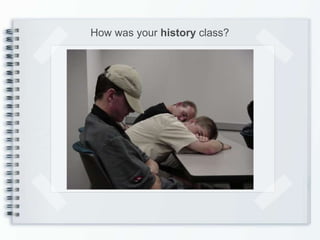
How was your history class?
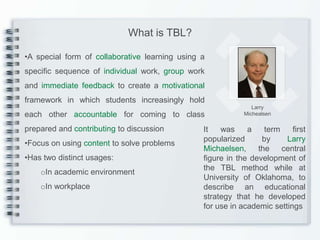
What is TBL?

•A special form of collaborative learning using a
specific sequence of individual work, group work
and immediate feedback to create a motivational
framework in which students increasingly hold
                                                               Larry
each other accountable for coming to class                  Michealsen

prepared and contributing to discussion         It   was     a    term    first
                                                popularized      by     Larry
•Focus on using content to solve problems
                                                Michaelsen,     the    central
•Has two distinct usages:                       figure in the development of
                                                the TBL method while at
    oIn academic environment
                                                University of Oklahoma, to
    oIn workplace                               describe an educational
                                                strategy that he developed
                                                for use in academic settings
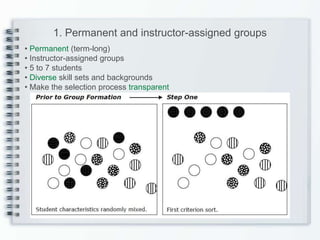
1. Permanent and instructor-assigned groups
• Permanent (term-long)
• Instructor-assigned groups
• 5 to 7 students
• Diverse skill sets and backgrounds
• Make the selection process transparent
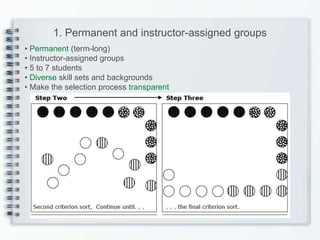
1. Permanent and instructor-assigned groups
• Permanent (term-long)
• Instructor-assigned groups
• 5 to 7 students
• Diverse skill sets and backgrounds
• Make the selection process transparent
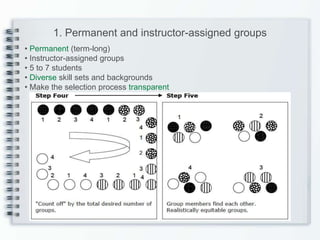
1. Permanent and instructor-assigned groups
• Permanent (term-long)
• Instructor-assigned groups
• 5 to 7 students
• Diverse skill sets and backgrounds
• Make the selection process transparent
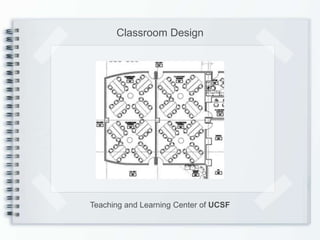
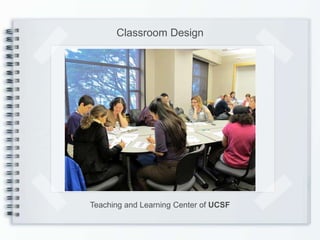
Classroom Design


Teaching and Learning Center of UCSF
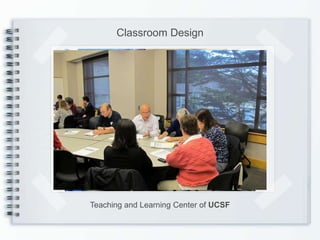
Classroom Design


Teaching and Learning Center of UCSF
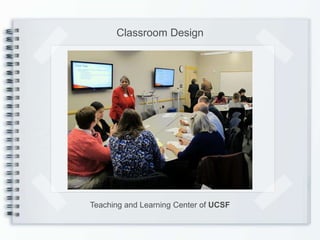
Classroom Design


Teaching and Learning Center of UCSF
Classroom Design


Teaching and Learning Center of UCSF
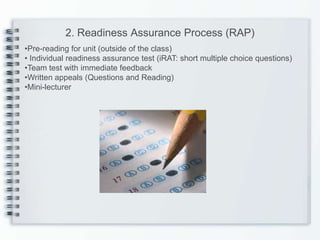
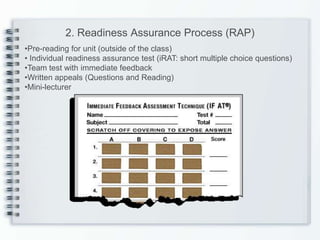
2. Readiness Assurance Process (RAP)
•Pre-reading for unit (outside of the class)
• Individual readiness assurance test (iRAT: short multiple choice questions)
•Team test with immediate feedback
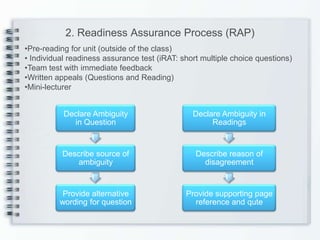
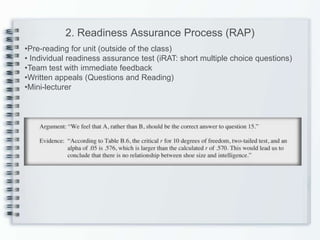
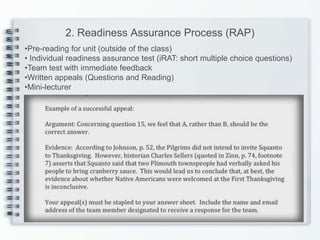
•Written appeals (Questions and Reading)
•Mini-lecturer
2. Readiness Assurance Process (RAP)
•Pre-reading for unit (outside of the class)
• Individual readiness assurance test (iRAT: short multiple choice questions)
•Team test with immediate feedback
•Written appeals (Questions and Reading)
•Mini-lecturer
2. Readiness Assurance Process (RAP)
•Pre-reading for unit (outside of the class)
• Individual readiness assurance test (iRAT: short multiple choice questions)
•Team test with immediate feedback
•Written appeals (Questions and Reading)
•Mini-lecturer


           Declare Ambiguity                    Declare Ambiguity in
             in Question                             Readings


          Describe source of                     Describe reason of
              ambiguity                            disagreement


           Provide alternative                Provide supporting page
          wording for question                  reference and qute
2. Readiness Assurance Process (RAP)
•Pre-reading for unit (outside of the class)
• Individual readiness assurance test (iRAT: short multiple choice questions)
•Team test with immediate feedback
•Written appeals (Questions and Reading)
•Mini-lecturer
2. Readiness Assurance Process (RAP)
•Pre-reading for unit (outside of the class)
• Individual readiness assurance test (iRAT: short multiple choice questions)
•Team test with immediate feedback
•Written appeals (Questions and Reading)
•Mini-lecturer
IF-AT
On the way to a restaurant for dinner:
Were there not differences in knowledge
between those students who guessed and
those who were able to narrow their choices?
We also remembered how frustrating it was to          Mike Epstein

take a test and never see precisely where we
 were right or wrong!
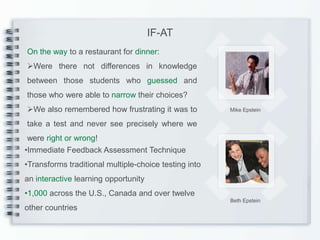
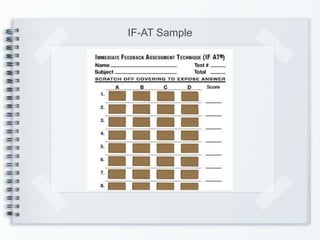
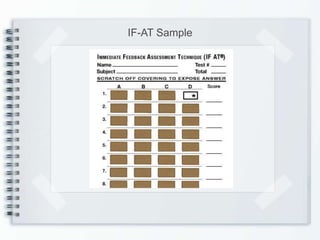
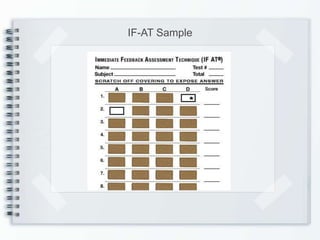
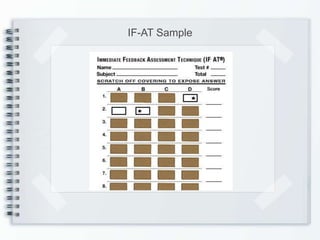
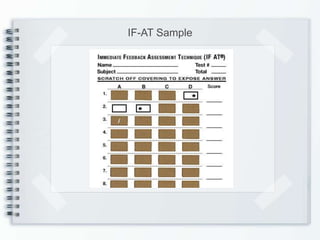
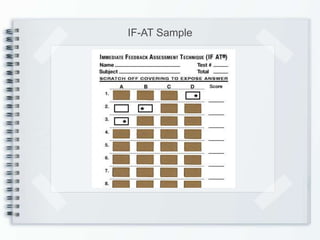
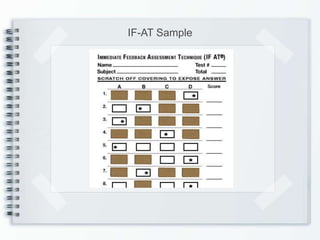
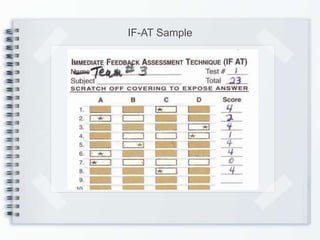
•Immediate Feedback Assessment Technique
•Transforms traditional multiple-choice testing into
an interactive learning opportunity
•1,000 across the U.S., Canada and over twelve
                                                       Beth Epstein
other countries
IF-AT Sample
IF-AT Sample
IF-AT Sample
IF-AT Sample
IF-AT Sample
IF-AT Sample
IF-AT Sample
IF-AT Sample
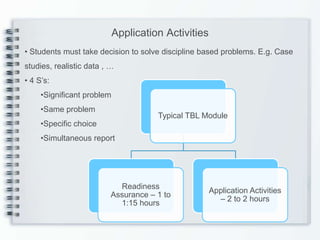
Application Activities
• Students must take decision to solve discipline based problems. E.g. Case
studies, realistic data , …
• 4 S’s:
     •Significant problem
     •Same problem
                                      Typical TBL Module
     •Specific choice
     •Simultaneous report


                            Readiness
                                                     Application Activities
                          Assurance – 1 to
                                                       – 2 to 2 hours
                            1:15 hours
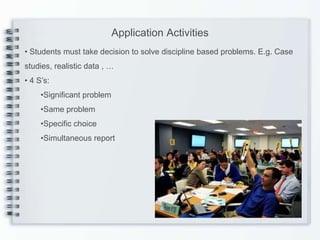
Application Activities
• Students must take decision to solve discipline based problems. E.g. Case
studies, realistic data , …
• 4 S’s:
     •Significant problem
     •Same problem
     •Specific choice
     •Simultaneous report
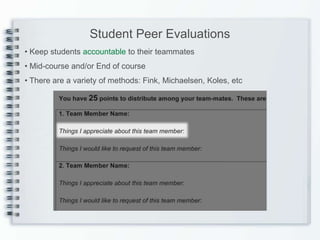
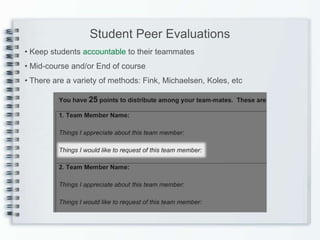
Student Peer Evaluations
• Keep students accountable to their teammates
• Mid-course and/or End of course
• There are a variety of methods: Fink, Michaelsen, Koles, etc
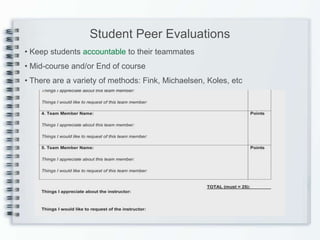
Student Peer Evaluations
• Keep students accountable to their teammates
• Mid-course and/or End of course
• There are a variety of methods: Fink, Michaelsen, Koles, etc
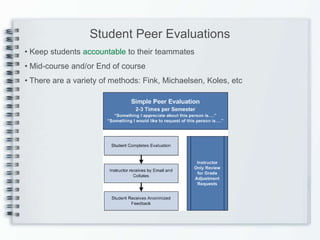
Student Peer Evaluations
• Keep students accountable to their teammates
• Mid-course and/or End of course
• There are a variety of methods: Fink, Michaelsen, Koles, etc
Student Peer Evaluations
• Keep students accountable to their teammates
• Mid-course and/or End of course
• There are a variety of methods: Fink, Michaelsen, Koles, etc
Why use TBL?
•Every team scored better than its own best member
•Lowest team is 5 points higher than the highest individual in the
entire class
•It promotes student engagement
•More time is spent critically thinking and less time covering course
content
•Once the students from a team, they can do really great things.


    Based on data gathered by Dr. Larry Michaelsen over of a series of
              semesters (8 classes, 335 students, 3.5 years)
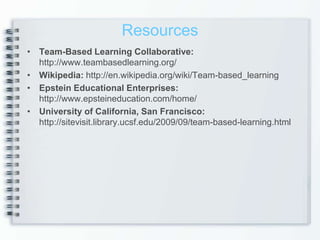
Resources
• Team-Based Learning Collaborative:
  http://www.teambasedlearning.org/
• Wikipedia: http://en.wikipedia.org/wiki/Team-based_learning
• Epstein Educational Enterprises:
  http://www.epsteineducation.com/home/
• University of California, San Francisco:
  http://sitevisit.library.ucsf.edu/2009/09/team-based-learning.html
Thank you for your attention. Questions?
Спасибо
Thank You   ありがとう

                     Dank
            Grazie
                Terima kasih
고마워       谢谢

Gracias

Team based Learning

  • 1.
    Team Based Learning TBL Ali Mohammad Hossein Zadeh – 1101600641 Faculty of Creative Multimedia, Cyberjaya, Malaysia January 2012
  • 2.
    Topics • What isTBL? • TBL Elements: 1. Permanent and instructor-assigned groups • Classroom Design 2. Readiness assurance process • IF-AT 3. Application Activities 4. Student Peer Evaluations • Why use TBL?
  • 3.
    How was yourhistory class?
  • 4.
    What is TBL? •Aspecial form of collaborative learning using a specific sequence of individual work, group work and immediate feedback to create a motivational framework in which students increasingly hold Larry each other accountable for coming to class Michealsen prepared and contributing to discussion It was a term first popularized by Larry •Focus on using content to solve problems Michaelsen, the central •Has two distinct usages: figure in the development of the TBL method while at oIn academic environment University of Oklahoma, to oIn workplace describe an educational strategy that he developed for use in academic settings
  • 5.
    1. Permanent andinstructor-assigned groups • Permanent (term-long) • Instructor-assigned groups • 5 to 7 students • Diverse skill sets and backgrounds • Make the selection process transparent
  • 6.
    1. Permanent andinstructor-assigned groups • Permanent (term-long) • Instructor-assigned groups • 5 to 7 students • Diverse skill sets and backgrounds • Make the selection process transparent
  • 7.
    1. Permanent andinstructor-assigned groups • Permanent (term-long) • Instructor-assigned groups • 5 to 7 students • Diverse skill sets and backgrounds • Make the selection process transparent
  • 8.
    Classroom Design Teaching andLearning Center of UCSF
  • 9.
    Classroom Design Teaching andLearning Center of UCSF
  • 10.
    Classroom Design Teaching andLearning Center of UCSF
  • 11.
    Classroom Design Teaching andLearning Center of UCSF
  • 12.
    2. Readiness AssuranceProcess (RAP) •Pre-reading for unit (outside of the class) • Individual readiness assurance test (iRAT: short multiple choice questions) •Team test with immediate feedback •Written appeals (Questions and Reading) •Mini-lecturer
  • 13.
    2. Readiness AssuranceProcess (RAP) •Pre-reading for unit (outside of the class) • Individual readiness assurance test (iRAT: short multiple choice questions) •Team test with immediate feedback •Written appeals (Questions and Reading) •Mini-lecturer
  • 14.
    2. Readiness AssuranceProcess (RAP) •Pre-reading for unit (outside of the class) • Individual readiness assurance test (iRAT: short multiple choice questions) •Team test with immediate feedback •Written appeals (Questions and Reading) •Mini-lecturer Declare Ambiguity Declare Ambiguity in in Question Readings Describe source of Describe reason of ambiguity disagreement Provide alternative Provide supporting page wording for question reference and qute
  • 15.
    2. Readiness AssuranceProcess (RAP) •Pre-reading for unit (outside of the class) • Individual readiness assurance test (iRAT: short multiple choice questions) •Team test with immediate feedback •Written appeals (Questions and Reading) •Mini-lecturer
  • 16.
    2. Readiness AssuranceProcess (RAP) •Pre-reading for unit (outside of the class) • Individual readiness assurance test (iRAT: short multiple choice questions) •Team test with immediate feedback •Written appeals (Questions and Reading) •Mini-lecturer
  • 17.
    IF-AT On the wayto a restaurant for dinner: Were there not differences in knowledge between those students who guessed and those who were able to narrow their choices? We also remembered how frustrating it was to Mike Epstein take a test and never see precisely where we were right or wrong! •Immediate Feedback Assessment Technique •Transforms traditional multiple-choice testing into an interactive learning opportunity •1,000 across the U.S., Canada and over twelve Beth Epstein other countries
  • 18.
  • 19.
  • 20.
  • 21.
  • 22.
  • 23.
  • 24.
  • 25.
  • 26.
    Application Activities • Studentsmust take decision to solve discipline based problems. E.g. Case studies, realistic data , … • 4 S’s: •Significant problem •Same problem Typical TBL Module •Specific choice •Simultaneous report Readiness Application Activities Assurance – 1 to – 2 to 2 hours 1:15 hours
  • 27.
    Application Activities • Studentsmust take decision to solve discipline based problems. E.g. Case studies, realistic data , … • 4 S’s: •Significant problem •Same problem •Specific choice •Simultaneous report
  • 28.
    Student Peer Evaluations •Keep students accountable to their teammates • Mid-course and/or End of course • There are a variety of methods: Fink, Michaelsen, Koles, etc
  • 29.
    Student Peer Evaluations •Keep students accountable to their teammates • Mid-course and/or End of course • There are a variety of methods: Fink, Michaelsen, Koles, etc
  • 30.
    Student Peer Evaluations •Keep students accountable to their teammates • Mid-course and/or End of course • There are a variety of methods: Fink, Michaelsen, Koles, etc
  • 31.
    Student Peer Evaluations •Keep students accountable to their teammates • Mid-course and/or End of course • There are a variety of methods: Fink, Michaelsen, Koles, etc
  • 32.
    Why use TBL? •Everyteam scored better than its own best member •Lowest team is 5 points higher than the highest individual in the entire class •It promotes student engagement •More time is spent critically thinking and less time covering course content •Once the students from a team, they can do really great things. Based on data gathered by Dr. Larry Michaelsen over of a series of semesters (8 classes, 335 students, 3.5 years)
  • 33.
    Resources • Team-Based LearningCollaborative: http://www.teambasedlearning.org/ • Wikipedia: http://en.wikipedia.org/wiki/Team-based_learning • Epstein Educational Enterprises: http://www.epsteineducation.com/home/ • University of California, San Francisco: http://sitevisit.library.ucsf.edu/2009/09/team-based-learning.html
  • 34.
    Thank you foryour attention. Questions?
  • 35.
    Спасибо Thank You ありがとう Dank Grazie Terima kasih 고마워 谢谢 Gracias