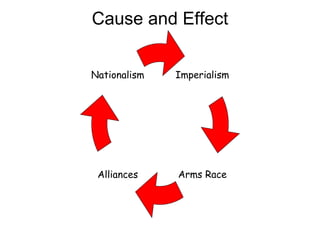
Cause and Effect Imperialism Arms Race Alliances Nationalism
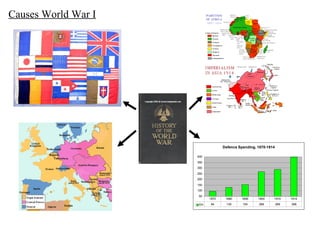
Causes World War I
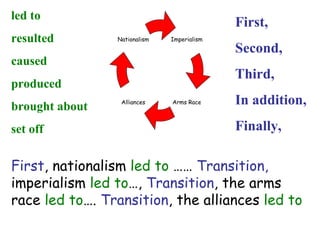
First , nationalism  led to  ……  Transition,  imperialism  led to …,  Transition , the arms race  led to ….  Transition , the alliances  led to led to resulted caused produced brought about set off First, Second, Third, In addition, Finally,  Imperialism Arms Race Alliances Nationalism
 
 
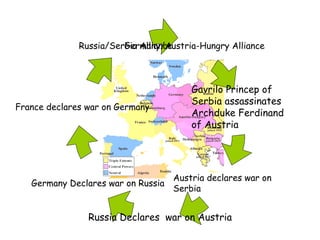
Germany/Austria-Hungry Alliance Austria declares war on Serbia Russia/Serbia Alliance Gavrilo Princep of  Serbia assassinates Archduke Ferdinand of Austria Russia Declares  war on Austria Germany Declares war on Russia France declares war on Germany
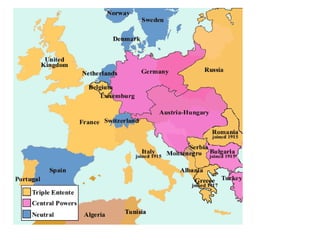
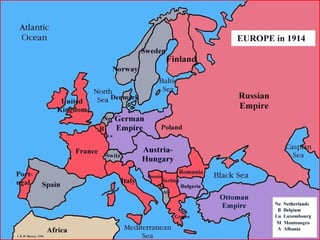
OVERVIEW 65 million combatants from 30 countries representing every continent 29 million become casualties Naval battles around the world and land battles in Europe, Africa, and Asia Triple Alliance = Germany, Austria, Italy +Turkey + Bulgaria - Italy = Central Powers Entente Cordiale = Britain, France + Russia + Italy + (later) US = Allied Powers Revolutionary technology, but evolutionary tactics
 
ROAD TO WAR Germany, Italy, Russia, Austro-Hungary all fairly recently “unified” with significant internal unrest Germany seeks new markets/prestige of colonies Massive arms race Multiple and extensive alliances
U.S. Motives Wilson  - pro-Neutral but also pro-Britain Submarines  – British navy blockades German ports, u-boats only way to fight back -Lusitania – part cruise ship, part munitions transport Economic ties  – America was in a recession – JP Morgan and bankers loan vast money -Military orders from France and Britain huge Psychological and ethnic ties  – align with British (democratic) – Germany embodies autocrat Germany’s unscrupulous war efforts  – makes Germans look like opportunists -Zimmermann Note -Attack on neutral Belgium Russian Issue-  Autocracy pre-1917 then Communist in 1917.  US can not join the other democracies of the world
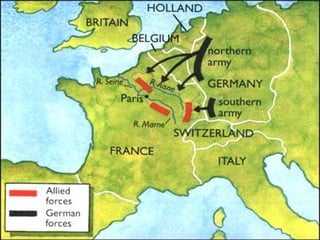
Schlieffen Plan Germans want to finish off French before Russia is ready to fight Germans believe French will immediately try to retake Alsace-Lorraine Original plan called for economy of force on the left while heavily weighting the right flank Von Moltke revised and distributed forces more evenly across the front Plan failed when Germans were held up by Belgians, then stopped by French and British at the Battle of the Marne Russians also mobilized more quickly than expected
1914 June 28, 1914 Archduke Franz Ferdinand, heir to the throne of the Austro-Hungarian Empire, is assassinated in Sarajevo July 28 Austria-Hungary declares war on Russia August 1 Germany declares war on Russia August 3 Germany declares war on France August 4 Great Britain declares war on Germany
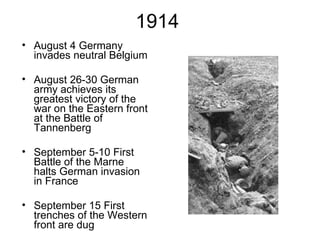
1914  August 4 Germany invades neutral Belgium August 26-30 German army achieves its greatest victory of the war on the Eastern front at the Battle of Tannenberg September 5-10 First Battle of the Marne halts German invasion in France September 15 First trenches of the Western front are dug
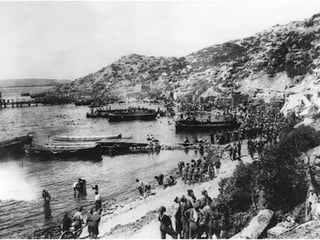
1915 January 19, 1915 First German Zeppelin air raid on England February 4 Germany declares a submarine blockade of Great Britain. Any boat approaching England is considered a legitimate target April 22-May 5 Second Battle of Ypres marks first use of chemical weapons April 25 Allies begin assault on Gallipoli peninsula in Turkey
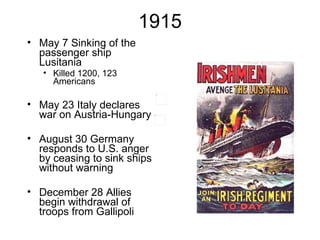
1915 May 7 Sinking of the passenger ship Lusitania Killed 1200, 123 Americans May 23 Italy declares war on Austria-Hungary August 30 Germany responds to U.S. anger by ceasing to sink ships without warning December 28 Allies begin withdrawal of troops from Gallipoli
 
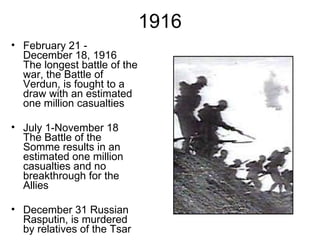
1916 February 21 - December 18, 1916  The longest battle of the war, the Battle of Verdun, is fought to a draw with an estimated one million casualties  July 1-November 18 The Battle of the Somme results in an estimated one million casualties and no breakthrough for the Allies December 31 Russian  Rasputin, is murdered by relatives of the Tsar
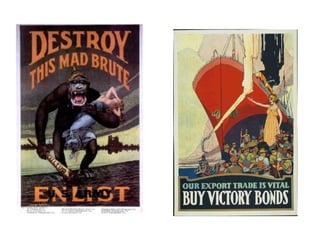
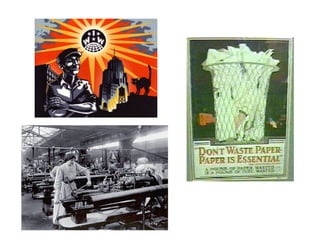
Homefront Fighting the war Draft-work or fight Government agencies created Women roles changed Propaganda Propaganda-enforced loyalty Committee of Public Information, George Creel Restrictions on immigration (xenophobia) Espionage Act 1917 Censorship of radical writings Sedition Act1918 Anti-socialist and anti union
Homefront Financing the war Liberty Bonds War Industries Board-Bernard  Baruck Raw materials, production quotas, fixed prices Conserve grain passage of 18 th  amendment War Trade Board Investigated war profiteers National Board Labor Board Forced labor disputes threatening war production Labor Policies Board-Felix  Frankfurter Set wages and working conditions Government instituted collective bargaining
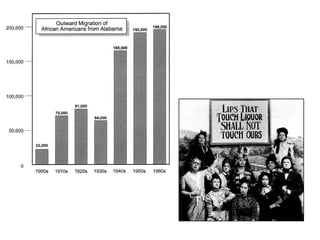
Homefront Roles Changed Women Took jobs reserved for men (400,00) Leads to 19 th  Amendment Blacks and Hispanics Took jobs from the stemmed tide of immigration  500,00 Blacks moved north-”The Great Migration” Children Boy Scouts/Girl Scouts Physical Education becomes part of HS curriculum


1917 February 1, 1917 Germany again declares unrestricted submarine warfare April 6 The United States declares war on Germany July 6 T.E. Lawrence and the Arabs capture Aquaba July 16-November 10 Third Battles of Ypres, known as Passchendaele, results in minor gains, but still no breakthrough
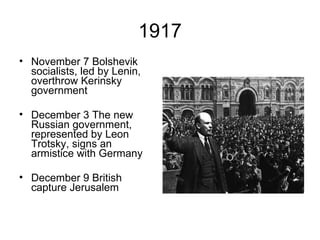
1917 November 7 Bolshevik socialists, led by Lenin, overthrow Kerinsky government December 3 The new Russian government, represented by Leon Trotsky, signs an armistice with Germany December 9 British capture Jerusalem
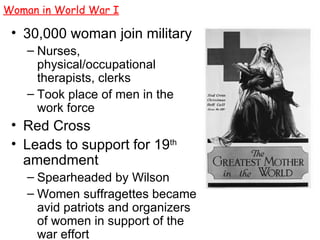
Woman in World War I 30,000 woman join military Nurses, physical/occupational therapists, clerks Took place of men in the work force Red Cross Leads to support for 19 th  amendment Spearheaded by Wilson Women suffragettes became avid patriots and organizers of women in support of the war effort
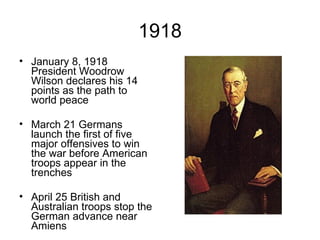
1918 January 8, 1918 President Woodrow Wilson declares his 14 points as the path to world peace March 21 Germans launch the first of five major offensives to win the war before American troops appear in the trenches April 25 British and Australian troops stop the German advance near Amiens                                               
1918 May 23 German shells land on Paris August 8 Allied counteroffensives on the Somme push the German army back September 29 Allied troops break through the German fortifications at the Hindenberg line November 11 At eleven o'clock on the eleventh day of the eleventh month of 1918, the war ends as Germany and Allies sign an Armistice
 
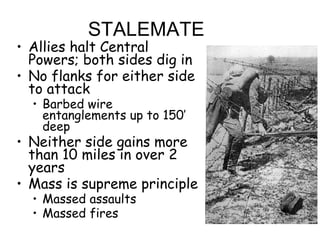
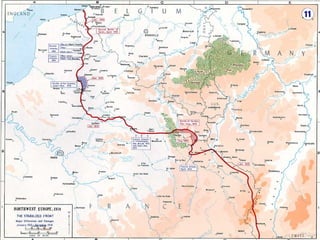
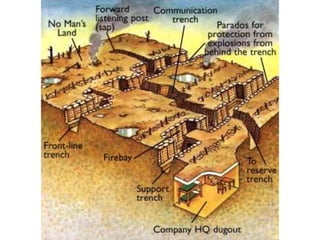
STALEMATE Allies halt Central Powers; both sides dig in No flanks for either side to attack Barbed wire entanglements up to 150’ deep Neither side gains more than 10 miles in over 2 years Mass is supreme principle Massed assaults Massed fires
 
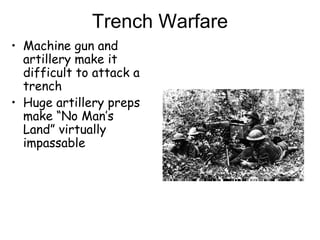
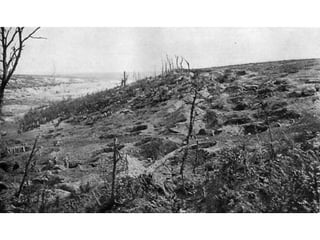
Trench Warfare Machine gun and artillery make it difficult to attack a trench Huge artillery preps make “No Man’s Land” virtually impassable
 
Trench Warfare Evolves Three group (squad) infiltration: Squad one finds and fixes enemy Squad two finds and exploits weak spots Squad three supports two and exploits breaches Strong points reduced later from rear/flanks Combined arms:  grenades, machine guns, flame throwers in infantry squads fires smoke, gas, to keep defenders’ heads down
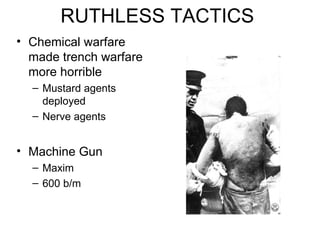
RUTHLESS TACTICS Chemical warfare made trench warfare more horrible Mustard agents deployed Nerve agents Machine Gun Maxim 600 b/m
 
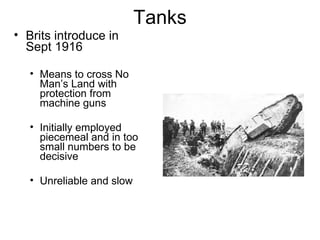
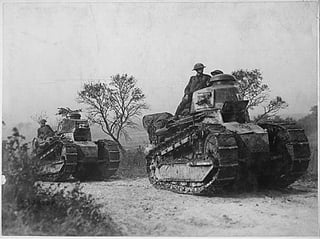
Tanks Brits introduce in Sept 1916 Means to cross No Man’s Land with protection from machine guns Initially employed piecemeal and in too small numbers to be decisive Unreliable and slow
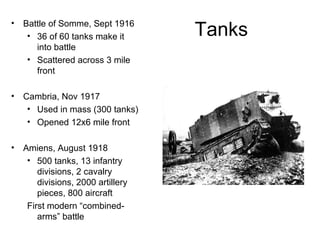
Tanks Battle of Somme, Sept 1916 36 of 60 tanks make it into battle Scattered across 3 mile front Cambria, Nov 1917 Used in mass (300 tanks) Opened 12x6 mile front Amiens, August 1918 500 tanks, 13 infantry divisions, 2 cavalry divisions, 2000 artillery pieces, 800 aircraft First modern “combined-arms” battle
 
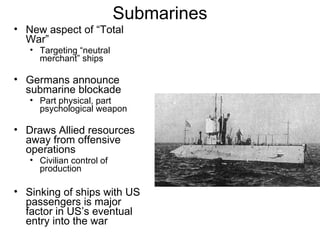
Submarines New aspect of “Total War” Targeting “neutral merchant” ships Germans announce submarine blockade Part physical, part psychological weapon Draws Allied resources away from offensive operations Civilian control of production Sinking of ships with US passengers is major factor in US’s eventual entry into the war
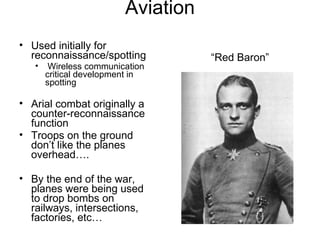
Aviation “Red Baron” Used initially for reconnaissance/spotting Wireless communication critical development in spotting  Arial combat originally a counter-reconnaissance function Troops on the ground don’t like the planes overhead…. By the end of the war, planes were being used to drop bombs on railways, intersections, factories, etc…
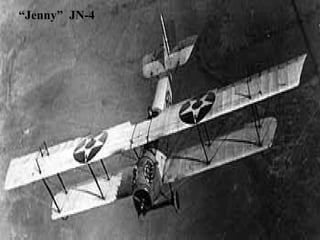
“ Jenny”  JN-4
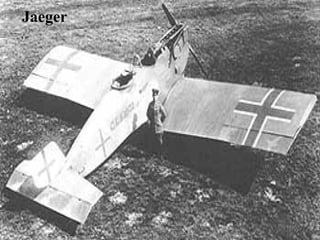
Jaeger
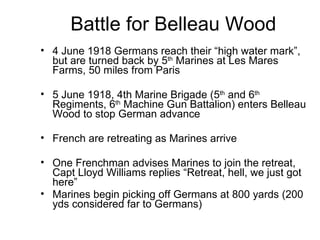
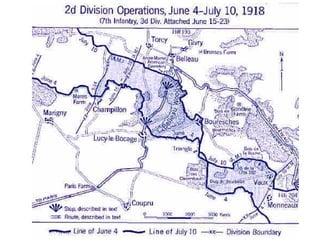
Battle for Belleau Wood 4 June 1918 Germans reach their “high water mark”, but are turned back by 5 th  Marines at Les Mares Farms, 50 miles from Paris 5 June 1918, 4th Marine Brigade (5 th  and 6 th  Regiments, 6 th  Machine Gun Battalion) enters Belleau Wood to stop German advance French are retreating as Marines arrive One Frenchman advises Marines to join the retreat, Capt Lloyd Williams replies “Retreat, hell, we just got here” Marines begin picking off Germans at 800 yards (200 yds considered far to Germans)
 
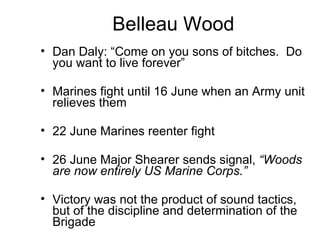
Belleau Wood Dan Daly: “Come on you sons of bitches.  Do you want to live forever” Marines fight until 16 June when an Army unit relieves them 22 June Marines reenter fight 26 June Major Shearer sends signal,  “Woods are now entirely US Marine Corps.”   Victory was not the product of sound tactics, but of the discipline and determination of the Brigade
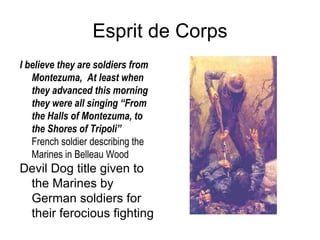
Esprit de Corps I believe they are soldiers from Montezuma,  At least when they advanced this morning they were all singing “From the Halls of Montezuma, to the Shores of Tripoli” French soldier describing the Marines in Belleau Wood Devil Dog title given to the Marines by German soldiers for their ferocious fighting
Armistice-November 11, 1918 truce (agreement to end fighting) -For Germany- withdrawal of Russians  =  new hope for successful end to war.  Germany resumes unrestricted submarine warfare -For Allies-American troops pouring into war fronts and Allied forces began advancement towards Germany; Battle of Belleau Wood -September 1918-General Ludendorff informed leaders that war was lost and demanded that government ask for peace; Allies unwilling to make peace;  November 1918- sailors in Kiel, Germany mutiny and within days councils of workers and soldiers forming (Socialist Party), taking over civilian and military offices;  Social Democrats under Friedrich Ebert announce creation of democratic republic--Kaiser in exile.    German government signs armistice two days later
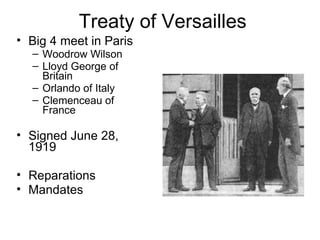
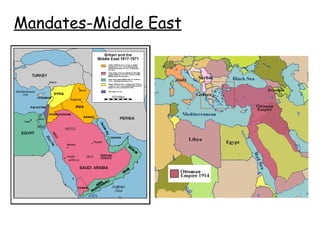
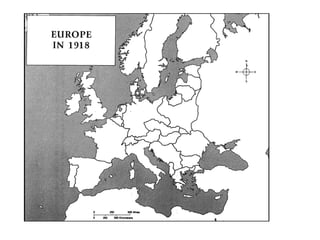
Treaty of Versailles Big 4 meet in Paris Woodrow Wilson Lloyd George of Britain Orlando of Italy Clemenceau of France Signed June 28, 1919 Reparations Mandates
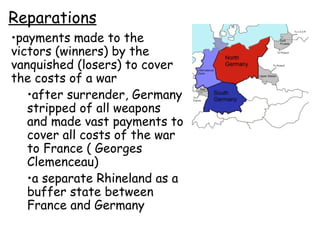
Reparations payments made to the victors (winners) by the vanquished (losers) to cover the costs of a war after surrender, Germany stripped of all weapons and made vast payments to cover all costs of the war to France ( Georges Clemenceau) a separate Rhineland as a buffer state between France and Germany
14 Points Versailles Treaty
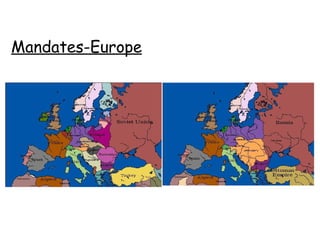
Mandates-Europe
Mandates-Middle East
 

Task 8.5 World War I

  • 1.
    Cause and EffectImperialism Arms Race Alliances Nationalism
  • 2.
  • 3.
    First , nationalism led to …… Transition, imperialism led to …, Transition , the arms race led to …. Transition , the alliances led to led to resulted caused produced brought about set off First, Second, Third, In addition, Finally, Imperialism Arms Race Alliances Nationalism
  • 4.
  • 5.
  • 6.
    Germany/Austria-Hungry Alliance Austriadeclares war on Serbia Russia/Serbia Alliance Gavrilo Princep of Serbia assassinates Archduke Ferdinand of Austria Russia Declares war on Austria Germany Declares war on Russia France declares war on Germany
  • 7.
    OVERVIEW 65 millioncombatants from 30 countries representing every continent 29 million become casualties Naval battles around the world and land battles in Europe, Africa, and Asia Triple Alliance = Germany, Austria, Italy +Turkey + Bulgaria - Italy = Central Powers Entente Cordiale = Britain, France + Russia + Italy + (later) US = Allied Powers Revolutionary technology, but evolutionary tactics
  • 8.
  • 9.
    ROAD TO WARGermany, Italy, Russia, Austro-Hungary all fairly recently “unified” with significant internal unrest Germany seeks new markets/prestige of colonies Massive arms race Multiple and extensive alliances
  • 10.
    U.S. Motives Wilson - pro-Neutral but also pro-Britain Submarines – British navy blockades German ports, u-boats only way to fight back -Lusitania – part cruise ship, part munitions transport Economic ties – America was in a recession – JP Morgan and bankers loan vast money -Military orders from France and Britain huge Psychological and ethnic ties – align with British (democratic) – Germany embodies autocrat Germany’s unscrupulous war efforts – makes Germans look like opportunists -Zimmermann Note -Attack on neutral Belgium Russian Issue- Autocracy pre-1917 then Communist in 1917. US can not join the other democracies of the world
  • 11.
    Schlieffen Plan Germanswant to finish off French before Russia is ready to fight Germans believe French will immediately try to retake Alsace-Lorraine Original plan called for economy of force on the left while heavily weighting the right flank Von Moltke revised and distributed forces more evenly across the front Plan failed when Germans were held up by Belgians, then stopped by French and British at the Battle of the Marne Russians also mobilized more quickly than expected
  • 12.
    1914 June 28,1914 Archduke Franz Ferdinand, heir to the throne of the Austro-Hungarian Empire, is assassinated in Sarajevo July 28 Austria-Hungary declares war on Russia August 1 Germany declares war on Russia August 3 Germany declares war on France August 4 Great Britain declares war on Germany
  • 13.
    1914 August4 Germany invades neutral Belgium August 26-30 German army achieves its greatest victory of the war on the Eastern front at the Battle of Tannenberg September 5-10 First Battle of the Marne halts German invasion in France September 15 First trenches of the Western front are dug
  • 14.
    1915 January 19,1915 First German Zeppelin air raid on England February 4 Germany declares a submarine blockade of Great Britain. Any boat approaching England is considered a legitimate target April 22-May 5 Second Battle of Ypres marks first use of chemical weapons April 25 Allies begin assault on Gallipoli peninsula in Turkey
  • 15.
    1915 May 7Sinking of the passenger ship Lusitania Killed 1200, 123 Americans May 23 Italy declares war on Austria-Hungary August 30 Germany responds to U.S. anger by ceasing to sink ships without warning December 28 Allies begin withdrawal of troops from Gallipoli
  • 16.
  • 17.
    1916 February 21- December 18, 1916 The longest battle of the war, the Battle of Verdun, is fought to a draw with an estimated one million casualties July 1-November 18 The Battle of the Somme results in an estimated one million casualties and no breakthrough for the Allies December 31 Russian Rasputin, is murdered by relatives of the Tsar
  • 18.
    Homefront Fighting thewar Draft-work or fight Government agencies created Women roles changed Propaganda Propaganda-enforced loyalty Committee of Public Information, George Creel Restrictions on immigration (xenophobia) Espionage Act 1917 Censorship of radical writings Sedition Act1918 Anti-socialist and anti union
  • 19.
    Homefront Financing thewar Liberty Bonds War Industries Board-Bernard Baruck Raw materials, production quotas, fixed prices Conserve grain passage of 18 th amendment War Trade Board Investigated war profiteers National Board Labor Board Forced labor disputes threatening war production Labor Policies Board-Felix Frankfurter Set wages and working conditions Government instituted collective bargaining
  • 20.
    Homefront Roles ChangedWomen Took jobs reserved for men (400,00) Leads to 19 th Amendment Blacks and Hispanics Took jobs from the stemmed tide of immigration 500,00 Blacks moved north-”The Great Migration” Children Boy Scouts/Girl Scouts Physical Education becomes part of HS curriculum
  • 21.
  • 22.
  • 23.
  • 24.
    1917 February 1,1917 Germany again declares unrestricted submarine warfare April 6 The United States declares war on Germany July 6 T.E. Lawrence and the Arabs capture Aquaba July 16-November 10 Third Battles of Ypres, known as Passchendaele, results in minor gains, but still no breakthrough
  • 25.
    1917 November 7Bolshevik socialists, led by Lenin, overthrow Kerinsky government December 3 The new Russian government, represented by Leon Trotsky, signs an armistice with Germany December 9 British capture Jerusalem
  • 26.
    Woman in WorldWar I 30,000 woman join military Nurses, physical/occupational therapists, clerks Took place of men in the work force Red Cross Leads to support for 19 th amendment Spearheaded by Wilson Women suffragettes became avid patriots and organizers of women in support of the war effort
  • 27.
    1918 January 8,1918 President Woodrow Wilson declares his 14 points as the path to world peace March 21 Germans launch the first of five major offensives to win the war before American troops appear in the trenches April 25 British and Australian troops stop the German advance near Amiens                                               
  • 28.
    1918 May 23German shells land on Paris August 8 Allied counteroffensives on the Somme push the German army back September 29 Allied troops break through the German fortifications at the Hindenberg line November 11 At eleven o'clock on the eleventh day of the eleventh month of 1918, the war ends as Germany and Allies sign an Armistice
  • 29.
  • 30.
    STALEMATE Allies haltCentral Powers; both sides dig in No flanks for either side to attack Barbed wire entanglements up to 150’ deep Neither side gains more than 10 miles in over 2 years Mass is supreme principle Massed assaults Massed fires
  • 31.
  • 32.
    Trench Warfare Machinegun and artillery make it difficult to attack a trench Huge artillery preps make “No Man’s Land” virtually impassable
  • 33.
  • 34.
    Trench Warfare EvolvesThree group (squad) infiltration: Squad one finds and fixes enemy Squad two finds and exploits weak spots Squad three supports two and exploits breaches Strong points reduced later from rear/flanks Combined arms: grenades, machine guns, flame throwers in infantry squads fires smoke, gas, to keep defenders’ heads down
  • 35.
    RUTHLESS TACTICS Chemicalwarfare made trench warfare more horrible Mustard agents deployed Nerve agents Machine Gun Maxim 600 b/m
  • 36.
  • 37.
    Tanks Brits introducein Sept 1916 Means to cross No Man’s Land with protection from machine guns Initially employed piecemeal and in too small numbers to be decisive Unreliable and slow
  • 38.
    Tanks Battle ofSomme, Sept 1916 36 of 60 tanks make it into battle Scattered across 3 mile front Cambria, Nov 1917 Used in mass (300 tanks) Opened 12x6 mile front Amiens, August 1918 500 tanks, 13 infantry divisions, 2 cavalry divisions, 2000 artillery pieces, 800 aircraft First modern “combined-arms” battle
  • 39.
  • 40.
    Submarines New aspectof “Total War” Targeting “neutral merchant” ships Germans announce submarine blockade Part physical, part psychological weapon Draws Allied resources away from offensive operations Civilian control of production Sinking of ships with US passengers is major factor in US’s eventual entry into the war
  • 41.
    Aviation “Red Baron”Used initially for reconnaissance/spotting Wireless communication critical development in spotting Arial combat originally a counter-reconnaissance function Troops on the ground don’t like the planes overhead…. By the end of the war, planes were being used to drop bombs on railways, intersections, factories, etc…
  • 42.
  • 43.
  • 44.
    Battle for BelleauWood 4 June 1918 Germans reach their “high water mark”, but are turned back by 5 th Marines at Les Mares Farms, 50 miles from Paris 5 June 1918, 4th Marine Brigade (5 th and 6 th Regiments, 6 th Machine Gun Battalion) enters Belleau Wood to stop German advance French are retreating as Marines arrive One Frenchman advises Marines to join the retreat, Capt Lloyd Williams replies “Retreat, hell, we just got here” Marines begin picking off Germans at 800 yards (200 yds considered far to Germans)
  • 45.
  • 46.
    Belleau Wood DanDaly: “Come on you sons of bitches. Do you want to live forever” Marines fight until 16 June when an Army unit relieves them 22 June Marines reenter fight 26 June Major Shearer sends signal, “Woods are now entirely US Marine Corps.” Victory was not the product of sound tactics, but of the discipline and determination of the Brigade
  • 47.
    Esprit de CorpsI believe they are soldiers from Montezuma, At least when they advanced this morning they were all singing “From the Halls of Montezuma, to the Shores of Tripoli” French soldier describing the Marines in Belleau Wood Devil Dog title given to the Marines by German soldiers for their ferocious fighting
  • 48.
    Armistice-November 11, 1918truce (agreement to end fighting) -For Germany- withdrawal of Russians = new hope for successful end to war. Germany resumes unrestricted submarine warfare -For Allies-American troops pouring into war fronts and Allied forces began advancement towards Germany; Battle of Belleau Wood -September 1918-General Ludendorff informed leaders that war was lost and demanded that government ask for peace; Allies unwilling to make peace; November 1918- sailors in Kiel, Germany mutiny and within days councils of workers and soldiers forming (Socialist Party), taking over civilian and military offices; Social Democrats under Friedrich Ebert announce creation of democratic republic--Kaiser in exile.  German government signs armistice two days later
  • 49.
    Treaty of VersaillesBig 4 meet in Paris Woodrow Wilson Lloyd George of Britain Orlando of Italy Clemenceau of France Signed June 28, 1919 Reparations Mandates
  • 50.
    Reparations payments madeto the victors (winners) by the vanquished (losers) to cover the costs of a war after surrender, Germany stripped of all weapons and made vast payments to cover all costs of the war to France ( Georges Clemenceau) a separate Rhineland as a buffer state between France and Germany
  • 51.
  • 52.
  • 53.
  • 54.