LMCP 1532:PEMBANGUNAN BANDAR MAPAN
TUGASAN 4:AMALAN TERBAIK
Nama:Yee Xin Ni
Matrix no:A161031
Prof. Dato’ IR.DR Riza Atiq Abdullah Bin O.K. Rahmat
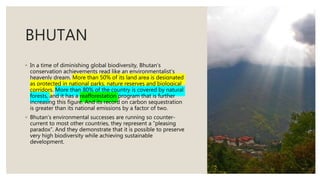
BHUTAN
◦ In a time of diminishing global biodiversity, Bhutan’s
conservation achievements read like an environmentalist’s
heavenly dream. More than 50% of its land area is designated
as protected in national parks, nature reserves and biological
corridors. More than 80% of the country is covered by natural
forests, and it has a reafforestation program that is further
increasing this figure. And its record on carbon sequestration
is greater than its national emissions by a factor of two.
◦ Bhutan’s environmental successes are running so counter-
current to most other countries, they represent a “pleasing
paradox”. And they demonstrate that it is possible to preserve
very high biodiversity while achieving sustainable
development.
Bhutan’s counter intuitive development goals
For Bhutan, environmental sustainability is both the primary objective and the starting point for national
development.
Within its 2008 national constitution, the government pledged to protect, conserve and improve its pristine
environment and safeguard the biodiversity of the country.
The flip side is that all Bhutanese are formally held responsible under the constitution to protect the
environment.
The country is transcending the classical tension between economic development and environmental
conservation by developing sectors that require continuing environmental protection to be sustainable.
This has included a “run-of-the-river” hydroelectricity development which requires the preservation of
watersheds in natural forest. Their national needs for electricity are met while generating foreign exchange
with India, which has expanding energy needs.
Bhutan has also developed a “low impact-high value” approach to tourism, guarding against some of the
negative, culturally destructive aspects of mass tourism.
Controlled pricing and limiting the numbers of tourists and their access to certain areas is also minimising
unwanted impacts.
They have built an eco-tourism industry around protected areas. This ensures the conservation of
biodiversity and landscapes that particularly attract the eco-tourist. It also generates income for
communities living with problematic wildlife.
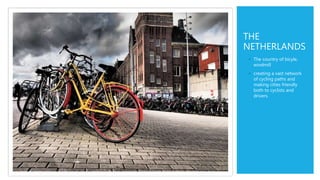
THE
NETHERLANDS
◦ The country of bicyle,
windmill
◦ creating a vast network
of cycling paths and
making cities friendly
both to cyclists and
drivers.
AMALAN TERBAIK
◦ Langkah yang dilakukan untuk keuntungan sejagat.
◦ Penambahbaikan daripada contoh kawasan sekeliling.
◦ Amalan terbaik dapat dilihat dari aspek seperti ekonomi,social,alam sekitar dan sebagainya.
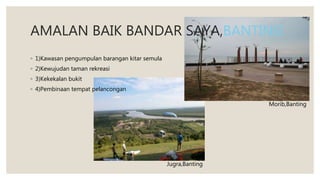
AMALAN BAIK BANDAR SAYA,BANTING
◦ 1)Kawasan pengumpulan barangan kitar semula
◦ 2)Kewujudan taman rekreasi
◦ 3)Kekekalan bukit
◦ 4)Pembinaan tempat pelancongan
Morib,Banting
Jugra,Banting
SUMBER
◦ https://www.google.com/search?q=morib+banting&espv=2&source=lnms&tbm=isch&sa=X&v
ed=0ahUKEwjJroLCq9bSAhVEso8KHdaICQoQ_AUIBygC&biw=1242&bih=535
◦ https://www.google.com/search?q=bhutan&oq=bhutan&aqs=chrome.0.69i59l2j0l4.1157j0j9&s
ourceid=chrome&ie=UTF-8
SEKIAN TERIMA KASIH

Task 4

  • 1.
    LMCP 1532:PEMBANGUNAN BANDARMAPAN TUGASAN 4:AMALAN TERBAIK Nama:Yee Xin Ni Matrix no:A161031 Prof. Dato’ IR.DR Riza Atiq Abdullah Bin O.K. Rahmat
  • 2.
    BHUTAN ◦ In atime of diminishing global biodiversity, Bhutan’s conservation achievements read like an environmentalist’s heavenly dream. More than 50% of its land area is designated as protected in national parks, nature reserves and biological corridors. More than 80% of the country is covered by natural forests, and it has a reafforestation program that is further increasing this figure. And its record on carbon sequestration is greater than its national emissions by a factor of two. ◦ Bhutan’s environmental successes are running so counter- current to most other countries, they represent a “pleasing paradox”. And they demonstrate that it is possible to preserve very high biodiversity while achieving sustainable development.
  • 3.
    Bhutan’s counter intuitivedevelopment goals For Bhutan, environmental sustainability is both the primary objective and the starting point for national development. Within its 2008 national constitution, the government pledged to protect, conserve and improve its pristine environment and safeguard the biodiversity of the country. The flip side is that all Bhutanese are formally held responsible under the constitution to protect the environment. The country is transcending the classical tension between economic development and environmental conservation by developing sectors that require continuing environmental protection to be sustainable. This has included a “run-of-the-river” hydroelectricity development which requires the preservation of watersheds in natural forest. Their national needs for electricity are met while generating foreign exchange with India, which has expanding energy needs. Bhutan has also developed a “low impact-high value” approach to tourism, guarding against some of the negative, culturally destructive aspects of mass tourism. Controlled pricing and limiting the numbers of tourists and their access to certain areas is also minimising unwanted impacts. They have built an eco-tourism industry around protected areas. This ensures the conservation of biodiversity and landscapes that particularly attract the eco-tourist. It also generates income for communities living with problematic wildlife.
  • 4.
    THE NETHERLANDS ◦ The countryof bicyle, windmill ◦ creating a vast network of cycling paths and making cities friendly both to cyclists and drivers.
  • 5.
    AMALAN TERBAIK ◦ Langkahyang dilakukan untuk keuntungan sejagat. ◦ Penambahbaikan daripada contoh kawasan sekeliling. ◦ Amalan terbaik dapat dilihat dari aspek seperti ekonomi,social,alam sekitar dan sebagainya.
  • 6.
    AMALAN BAIK BANDARSAYA,BANTING ◦ 1)Kawasan pengumpulan barangan kitar semula ◦ 2)Kewujudan taman rekreasi ◦ 3)Kekekalan bukit ◦ 4)Pembinaan tempat pelancongan Morib,Banting Jugra,Banting
  • 7.
  • 8.