1
Hello my name is Petar Angelov. I work as technical support
specialist at Sofica Group.
I apply to the program because this is a good opportunity to share my
personal Ideas and contribute to the company. Sofica Group has
given me job and the work environment, which I enjoy every day, so I
can go to work with positive attitude. I feel like it is my duty, to help
the company to the best of my abilities, if there is a possibility.
S e l f I n t r o d u c t i o n
Try not to become a man of success.
Rather become a man of value.
Albert Einstein
2
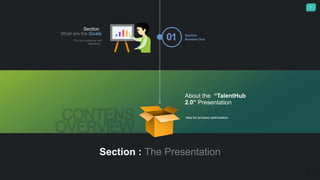
Section : The Presentation
About the “TalentHub
2.0” Presentation
Idea for process optimization.
01
Section :
What are the Goals
The main purpouse and
objectives..
Section
Number One
3
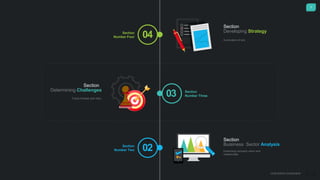
CONTENTS OVERVIEW
03
Section :
Determining Challenges
Future threads and risks.
Section
Number Three
02
Section :
Buisiness Sector Analysis
Examining company vision and
market state.
Section
Number Two
04
Section :
Developing StrategySection
Number Four
Summation of lore
4
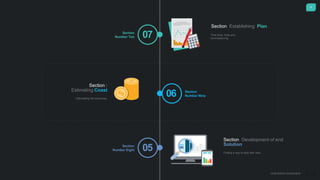
CONTENTS OVERVIEW
06
Section :
Estimating Coast
Callculating the resources.
Section
Number Nine
05
Section :Development of end
Solution
Finding a way to deal with risks.
Section
Number Eight
07
Section :Establishing Plan
Time lines, trials and
commissioning
Section
Number Ten
5
REVIEW OF PRESENTATION
By Petar Angelov
T a l e n t H U B 2 . 0
WHAT ARE
THE GOALS
01 Section
Number One
7
WHAT ARE THE GOALS
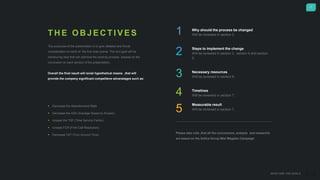
T H E O B J E C T I V E S
The purpouse of the presentation is to give detailed and thural
consideration on each of the five main points. The end goal will be
introducing idea that will optimise the working process ,bassed on the
conclusion on each section of the presentation..
Overall the final result will revial hypothetical means ,that will
provide the company significant competiteve advanatages such as:
 Decrease the Abandonment Rate
 Decrease the ASA (Average Speed to Answer).
 Icrease the TSF (Time Service Factor).
 Icrease FCR (First-Call Resolution).
 Decrease TAT (Turn-Around Time).
Why should the process be changed
Will be reviewed in section 2.
Steps to implement the change
Will be reviewed in section 3, section 4 and section
5,
Necessary resources
Will be reviewed in section 6.
Timelines
Will be reviewed in section 7.
Measurable result
Will be reviewed in section 7.
Please take note ,that all the conclusions, analysis and researchs
are based on the Sofica Group Mtel Megalan Campaign
1
2
3
4
5
ANALYSIS OF
BUSINESS
SECTOR
02 Section
Number One
9
20%
15.5
%
39%
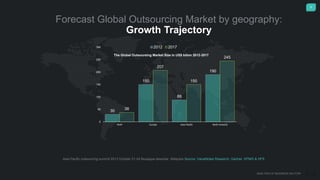
Forecast Global Outsourcing Market by geography:
Growth Trajectory
The Global Outsoursing Market Size in US$ bilion 2012-2017
Asia Pacific outsourcing summit 2013 October 21-24 Nusajaya-Iskandar, Malaysia Source: ValueNotes Research, Gartner, KPMG & HFS
30
150
88
190
38
207
150
245
0
50
100
150
200
250
300
RoW Europe Asia-Pacific North America
2012 2017
ANALYSIS OF BUSINESS SECTOR
10
Infrastructure
Management
ITO by
service area
61%
17%
14%
8%
BPO by
service area
1
Application
Development
IT Professional
Services
Other IT Services
2
3
4
1
2
3
4
CRM
Human Resource
Finance & Accounting
Industry Specific /
Others
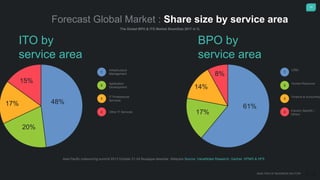
Forecast Global Market : Share size by service area
The Global BPO & ITO Market ShareSize 2017 in %
ANALYSIS OF BUSINESS SECTOR
48%
20%
17%
15%
Asia Pacific outsourcing summit 2013 October 21-24 Nusajaya-Iskandar, Malaysia Source: ValueNotes Research, Gartner, KPMG & HFS
11
ANALYSIS OF BUSINESS SECTOR
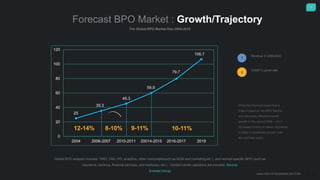
Forecast BPO Market : Growth/Trajectory
The Global BPO Market Size 2004-2019
25
35.3
45.3
59.9
79.7
106.7
0
20
40
60
80
100
120
2004 2006-2007 2010-2011 20014-2015 2016-2017 2019
Revenue in US$ bilion
1
2
3
CAGR % growt rate
Global BPO analysis includes HRO, F&A, PO, analytics, other horizontals(such as SCM and marketing etc.), and vertical-specific BPO (such as
insurance, banking, financial services, and healtcare, etc.). Contact center operators are exluded. Source:
Everest Group
12-14% 8-10% 9-11% 10-11%
12
ANALYSIS OF BUSINESS SECTOR
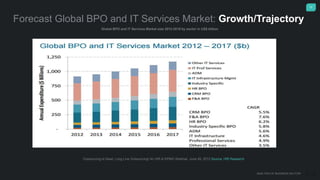
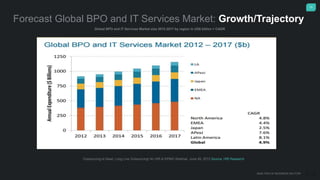
Forecast Global BPO and IT Services Market: Growth/Trajectory
Global BPO and IT Services Market size 2012-2019 by sector in US$ billion
Outsourcing is Dead, Long Live Outsourcing! An HfS & KPMG Webinar, June 26, 2013 Source: HfS Research
13
3
ANALYSIS OF BUSINESS SECTOR
Outsourcing is Dead, Long Live Outsourcing! An HfS & KPMG Webinar, June 26, 2013 Source: HfS Research
Forecast Global BPO and IT Services Market: Growth/Trajectory
Global BPO and IT Services Market size 2012-2017 by region in US$ billion + CAGR
14
ANALYSIS OF BUSINESS SECTOR
Global Business Process Outsourcing M&A update Autumn 2014 Source: HfS Research, 2013; KellyOCG – 6 Key Trends in Outsourcing
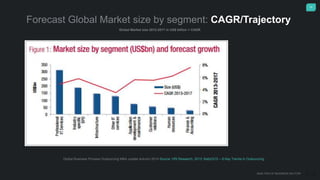
Forecast Global Market size by segment: CAGR/Trajectory
Global Market size 2012-2017 in US$ billion + CAGR
15
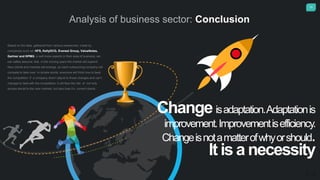
Analysis of business sector: Conclusion
Based on the data, gathered from various researches ,made by
companies such as: HFS, KellyOCG, Everest Group, ValueNotes,
Gartner and KPMG a well know experts in their area of business, we
can safely assume, that in the coming years the market will expand.
New clients and markets will emerge ,so each outsourcing company will
compete to take over. In simple words, everyone will think how to beat
the competition. If a company dosn‘t adjust to those changes and can‘t
manage to deal with the competition, it will face the risk of not only
access denial to the new markets, but also lose it‘s current clients.
Changeisadaptation.Adaptationis
improvement.Improvementisefficiency.
Changeisnotamatterofwhyorshould.
It is a necessity
DETERMINING
CHALLENGES
03 Section
Number One
17
DETERMINING CHALLENGES
Market Dynamics
IT Outsourcing to China Increases Despite Drawbacks
Market Insights™ | Everest Group link to Article by Stephanie Overby Dec 6, 2011 7:00 AM PT Source: www.cio.com
Never mind China's higher IT outsourcing costs than competing countries, poor English skills and lack of
scale. A new report predicts that China's multi-billion dollar offshore outsourcing market will grow 25 percent
over the next three years as international IT leaders tap the country for domestic and regional support..
When it comes to information technology and business process outsourcing, China has been on a tear.
Global services exports from China nearly tripled, from $1.2 billion in 2007 to $3.5 billion in 2010, with IT
services accounting for 65 percent of the total, according to a report released this month by outsourcing
consultancy and analyst firm Everest Group. That, says Everest's analysts, officially makes China a mature
market for offshore IT outsourcing. And the growth is expected to continue: Everest predicts that China will
rake in nearly $10 billion by 2015 and remain a viable option for IT leaders seeking to cut labor costs for the
next 13 years. According to Everest's offshore locations survey conducted earlier this year, China now ranks
third in attractiveness to IT buyers behind India and the Philippines..
But China has a markedly different value proposition for IT leaders than its two biggest rivals. While an
American CIO might go to India or the Philippines to support U.S. operations at lower costs, the reasons for
engaging a service provider in China are more complex. "Except for modest risk diversification beyond India
and the Philippines," China does not offer a clear advantage, the Everest report states. Rather, CIOs
leverage outsourcers in China to serve their regional businesses in Japan, Hong Kong or Korea, or to
support their growing Chinese operations designed tap into the domestic market. The choice to outsource to
China is not one made in isolation, says H. Karthik, vice president of global sourcing for Everest. "The China
decision needs to be viewed in context of the global strategy," he says. Consider the drawbacks to
outsourcing to China: The country can be 30 to 45 percent more expensive than India or the Philippines for
IT and business process services. Quality English skills, even in large cities like Shaghai and Beijing, are
lacking. And the typical size for a global delivery center is 400 to 600 full-time employees; only a few global
companies set up operations of 1,000 workers or more. The upside is that China produced 5.8 million
graduates in 2010—more than half of them in engineering and management disciplines, according to
Everest. The country's market growth has been propelled by strong government initiatives and incentives
and the investment of multi-national IT service providers like U.S.-based Accenture and IBM and India's
Wipro and Tata Consultancy Services. In the last year, more than 15 delivery centers were established or
expanded, according to Everest. And U.S. companies, including Chevron, Marriott and Bank of America
have set up captive service centers in China. While expensive relative to offshore rivals, operating costs in
China's biggest metropolitan areas are still 60 to 70 percent cheaper than major U.S. cities, such as Dallas,
Texas, says Everest. And the country now has more than 20 cities offering IT and business process
services, with customer interest growing in often lower-cost, tier-two cities such as Dalian, Guangzhou and
Chengdu. The Everest report offers an updated snapshot of China's strengths in the IT service market: in
the next slide
18
DETERMINING CHALLENGES
Market Dynamics
IT Outsourcing to China Increases Despite Drawbacks
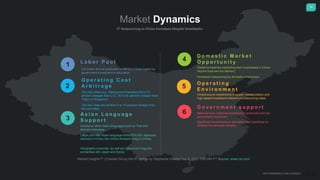
L a b o r P o o l
5.8 million annual graduates in 2010 in China, fueled by
government investment in education.
O p e r a t i n g C o s t
A r b i t r a g e
Tier-one cities (e.g., Beijing and Shanghai) 60 to 70
percent cheaper than U.S., 50 to 60 percent cheaper than
Tokyo or Singapore.
Tier-two cities are another 5 to 10 percent cheaper than
tier-one cities.
A s i a n L a n g u a g e
S u p p o r t
Geographic proximity, as well as cultural and linguistic
similarities with Japan and Korea.
Large pool with Asian language skills (870,000 Japanese
learners in China; two million Koreans living in China).
Access to other Asian languages such as Thai and
Bahasa Indonesia.
D o m e s t i c M a r k e t
O p p o r t u n i t y
Global companies expanding their businesses in China
require local service delivery.
Increased outsourcing by domestic enterprises.
O p e r a t i n g
E n v i r o n m e n t
Infrastructure investments in power, transportation and
high-speed broadband network in outsourcing cities.
G o v e r n m e n t s u p p o r t
Significant investments in education and incentives to
develop the services industry.
National level initiatives bolstered by provincial and city
government incentives.
1
2
3
4
5
6
Market Insights™ | Everest Group link to Article by Stephanie Overby Dec 6, 2011 7:00 AM PT Source: www.cio.com
19
DETERMINING CHALLENGES
Market Dynamics
Source: http://www.thehindubusinessline.com/
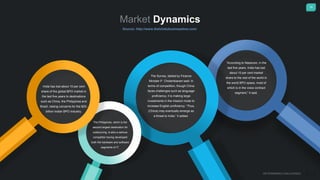
India has lost about 10 per cent
share of the global BPO market in
the last five years to destinations
such as China, the Philippines and
Brazil, raising concerns for the $20-
billion Indian BPO industry.
“According to Nasscom, in the
last five years, India has lost
about 10 per cent market
share to the rest of the world in
the world BPO space, most of
which is in the voice contract
segment,” it said.
The Survey, tabled by Finance
Minister P. Chidambaram said: In
terms of competition, though China
faces challenges such as language
proficiency, it is making large
investments in the mission mode to
increase English proficiency. “Thus,
(China) may eventually emerge as
a threat to India,” it added.
The Philippines, which is the
second largest destination for
outsourcing, is also a serious
competitor having developed
both the hardware and software
segments of IT.
20
DETERMINING CHALLENGES
Market Dynamics
IT Outsourcing to China Increases Despite Drawbacks
Source: 2014 Tholons Top 100 Outsourcing Destinations: Regional Overview
Moving to the South American region, Uruguay‟s software and IT chamber Cuti (Cámara Uruguaya de
Tecnologías de la Información), expects the continued growth of its local IT industry – aiming for US$1
billion in annual IT exports by 2020. Benefits such as 100% tax exemption for up to 25 years as well as free
trade zones with exemptions from most operating-derived taxes support this positive outlook. The country
currently estimates 16,000 people to be working directly in the IT industry. Uruguay‟s domestic IT revenues
were estimated at US$484 million in 2011, up 24% from 2010. Meanwhile, the BPO sector generated
revenue of US$150 million in 2012 – expected to exceed US$350 million by 2020.4 Two particular nations in
the region remain saddled with pressing and persistent internal concerns, namely the key regional services
outsourcing markets of Brazil and Argentina. Brazil continues to face domestic labor issues which have
brought about volatility and restless labor unions, which have been persistent in demanding an increase on
national wages. Labor force 4 Global Delivery Report, Uruguay Bullish on IT Prospects, 2013 7 of 15 ©
2014 Tholons unrest has been increasing and has the propensity to erode Brazil‟s macroeconomic gains of
recent years. Likewise, Argentina continues to mire in economic turmoil that has hindered its domestic
economy. The Argentine government and third party analysts continue to report contrasting figures on rising
inflation rates. These conflicting rates introduce an element of uncertainty for services providers especially
in terms of cost projections and business environment stability, both extremely vital facets when establishing
and managing delivery centers. According to Tholons Analyst, Darnel Diaz, “Lingering economic issues and
civil unrest must be addressed by government if Argentina is to reinvigorate its services outsourcing
industry. Long term viability of the industry will continue to be challenged for as long as these debilitating
domestic conditions persist.” For this year, the Tholons Top 100 rankings reveal the fast emerging and
developed markets in the Americas region including cities from Guatemala, Peru, Colombia, Uruguay, and
Costa Rica. Costa Rica is expected to continue leading the region, particular for higher value services (ITO,
KPO), and despite the ongoing macro-economic concerns facing the country such as inflation and the
continuing appreciation of the Colon against the US dollar. There is also be tangible and realistic
opportunities for the processing of outsourced services in more stable locations such as Colombia, Uruguay,
Peru, Nicaragua, and Guatemala. According to Tholons President for Latin America, Mario Tucci, “While
Latin America shows 23 cities this year, many of these locations often have smaller talent pools compared
to other larger regions. Thus, the near-term goal for Latin America should be to focus on smaller, more
concentrated specialized offerings, working in conjunction with other vendors on a global model. On the
service provider side, it‟s an opportune time for companies looking for new locations in Latin America, in
particular, those looking to establish for in-house delivery centers. We expect increased interest in Latin
America from these service providers, especially those providers from North America and India who are
looking at expanding their global delivery platform models, as well as locators looking to relocate existing
operations from the other, unstable deliver locations in the region. To capitalize on this opportunity,
governments and supporting institutional bodies should ensure that supportive industry policies, fiscal
incentives, and legislation – geared specifically to developing local IT-BPO sectors – are clearly established.
The implementation of this enabling environment, should then result in faster adoption and growth of
services outsourcing in the region, and will likewise, take better advantage of the Latin America‟s maturing
capabilities, especially now that the region has over 10 years of global service delivery experience.”
21
2014 Tholons Top 100 Outsourcing Destinations: Regional Overview
Rank 2014 Movement form 2013 Country City Rank 2014 Movement form 2013 Country City
2 +1 Philippines Manila (NCR)
1 0 India Bangalore
4 0 India Delhi
6 0 India Hyderabad
8 0 Philippines Cebu City
12 0 China Beijing
15 -1 China Shenzhen
18 +1 Malaysia Kuala Lampur
22 +1 Vietnam Honoi
25 +1 India Kolkata
33 +1 China Chengdu
38 +1 India Jaipur
55 -1 India Buhbaneswar
62 +5 China Xi‘an
68 -2 India Thiruvananthapuram
75 +1 Taiwan Taipei
83 +3 South Korea Seoul
85 -2 Thailand Bangkok
31 -2 India Coimbatore
67 +6 Malaysia Penang
3 -1 India Mumbai
5 0 India Chennai
7 0 India Pune
11 0 China Shanghai
14 +1 China Delian (Dairen)
17 -1 Vietnam Ho Chi Minh City
19 +1 Sri Lanka Colombo
23 +2 India Chandigarh
30 +1 Singapore Singapore
37 -2 China Guangzhou (Canton)
45 +1 China Tianjin
58 +3 Indonesia Jakarta
63 +6 India Ahmedabad
69 +1 Philippines Davao City
82 +2 Phillipines Santa Rosa, Laguna
84 +3 Australia Perth
93 +1 Philippines Baclod City
99 0 Philippines Baguio City
13 0 Costa Ricka San Jose
20 -2 Brazil Sao Paulo
24 -3 Chilie Santiago
27 0 Brazil Curitiba
28 -4 Argentina Buenos Aries
36 +1 Uruguay Montevideo
39 -1 Brazil Rio De Janeiro
48 +1 Columbia Bogota
49 -6 Brazil Brasillia
51 +2 Colombia Medellin
57 +6 Peru Lima
71 -12 Perto Rico San Juan
73 -2 Argentina Cordoba
77 +3 Colombia Bucaramanga
80 -2 Brazil Recifa
86 -1 Chilie Valparaíso
87 +8 Nicaragua Managua
88 +3 Brazil Campinas
92 +4 Guatemala Guatemala City
94 -4 Paraguay Asunción
98 0 Colombia Cali
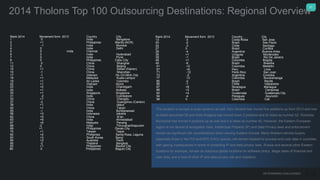
The situation in europe is quite dynamic as well. Kyiv Ukraine has moved five positions up from 2013 and now
its listed asnumber 50 and Sofia Bulgaria has moved down 2 postions and its listed as number 52. Romania
Bucharest has moved 4 postions up as well and it is listed as number 40. However, the Eastern European
region is not devoid of ecosystem risks. Intellectual Property (IP) and Data Privacy laws and enforcement
remain as significant risk considerations when viewing Eastern Europe. Many Western service buyers,
especially those in the ITO and KPO (FAO) spaces, will remain hesitant to process end-user data in countries
with glaring inadequacies in terms of protecting IP and data privacy laws. Russia and several other Eastern
locations for example, remain as notorious global locations for software piracy, illegal sales of financial and
user data, and a host of other IP and data privacy risk and violations.
DETERMINING CHALLENGES
22
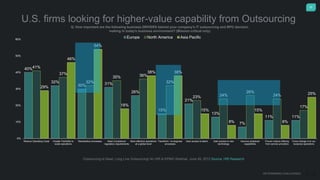
U.S. firms looking for higher-value capability from Outsourcing
Q. How important are the following business DRIVERS behind your company's IT outsourcing and BPO decision
making in today's business environment? (Mission-critical only)
Outsourcing is Dead, Long Live Outsourcing! An HfS & KPMG Webinar, June 26, 2013 Source: HfS Research
40%
32%
30% 31%
26%
15%
21%
13%
7%
11% 11%
41%
37%
32%
35% 36%
32%
23% 24%
26%
24%
17%
29%
46%
54%
18%
38% 38%
15%
8%
15%
8%
25%
0%
10%
20%
30%
40%
50%
60%
Reduce Operating Coast Greater Felxibility to
scale operations
Standardize processes Meet Compliance
regulatory requirements
More effective operations
at a global level
Transform / re-engineer
processes
Gain access to talent Gain access to new
technology
Improve analytical
capabilities
Proven mature offering
from service providers
Force change in to our
buissnes operations
Europe North America Asia Pacific
DETERMINING CHALLENGES
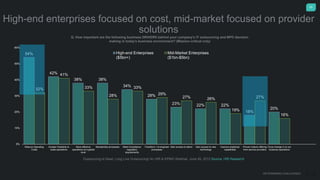
23
High-end enterprises focused on cost, mid-market focused on provider
solutions
Q. How important are the following business DRIVERS behind your company's IT outsourcing and BPO decision
making in today's business environment? (Mission-critical only)
Outsourcing is Dead, Long Live Outsourcing! An HfS & KPMG Webinar, June 26, 2013 Source: HfS Research
54%
42%
38% 38%
34%
28%
23% 22% 22%
18%
20%
32%
41%
33%
28%
33%
29%
27% 26%
19%
27%
16%
0%
10%
20%
30%
40%
50%
60%
Reduce Operating
Costs
Greater Felxibility to
scale operations
More effective
operations at a global
level
Standardize processes Meet Compliance
regulatory
requirements
Transform / re-engineer
processes
Gain access to talent Gain access to new
technology
Improve analytical
capabilities
Proven mature offering
from service providers
Force change in to our
buissnes operations
High-end Enterprises
($5bn+)
Mid-Market Enterprises
($1bn-$5bn)
DETERMINING CHALLENGES
24
DETERMINING CHALLENGES
25
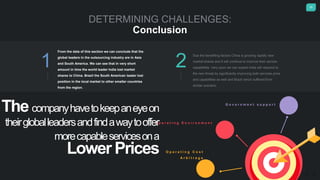
DETERMINING CHALLENGES:
Conclusion
From the data of this section we can conclude that the
global leaders in the outsourcing industry are in Asia
and South America. We can see that in very short
amount in time the world leader India lost market
shares to China. Brazil the South American leader lost
position in the local market to other smaller countries
from the region.
Due the benefiting factors China is growing rapidly new
market shares and it will continue to improve their service
capabilities. Very soon we can expect India will respond to
the new threat by significantly improving both services price
and capabilities as well and Brazil which suffered from
similar scenario.
1 2
G o v e r n m e n t s u p p o r t
O p e r a t i n g E n v i r o n m e n t
O p e r a t i n g C o s t
A r b i t r a g e
The companyhavetokeepaneyeon
theirgloballeadersandfindawaytooffer
morecapableservicesona
Lower Prices
DEVELOPING
STRATEGY
04 Section
Number One
27
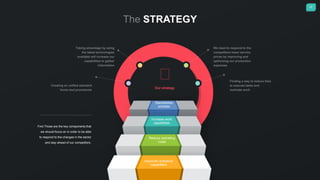
The STRATEGY
Reduce operating
coast
Increase work
capabilities
Standardize
process
Improven analytical
capabilities
Our strategy
Creating an unified standard
forms and procedures
Taking advantage by using
the latest technologies
available will increase our
capabilities to gather
information
Finding a way to reduce time
to execute tasks and
motivate work
We need to respond to the
competitors lower service
prices by improving and
optimising our production
expenses
Find Those are the key components that
we should focus on in order to be able
to respond to the changes in the sector
and stay ahead of our competitors.

TalentHub 2.0 Sample

  • 1.
    1 Hello my nameis Petar Angelov. I work as technical support specialist at Sofica Group. I apply to the program because this is a good opportunity to share my personal Ideas and contribute to the company. Sofica Group has given me job and the work environment, which I enjoy every day, so I can go to work with positive attitude. I feel like it is my duty, to help the company to the best of my abilities, if there is a possibility. S e l f I n t r o d u c t i o n Try not to become a man of success. Rather become a man of value. Albert Einstein
  • 2.
    2 Section : ThePresentation About the “TalentHub 2.0” Presentation Idea for process optimization. 01 Section : What are the Goals The main purpouse and objectives.. Section Number One
  • 3.
    3 CONTENTS OVERVIEW 03 Section : DeterminingChallenges Future threads and risks. Section Number Three 02 Section : Buisiness Sector Analysis Examining company vision and market state. Section Number Two 04 Section : Developing StrategySection Number Four Summation of lore
  • 4.
    4 CONTENTS OVERVIEW 06 Section : EstimatingCoast Callculating the resources. Section Number Nine 05 Section :Development of end Solution Finding a way to deal with risks. Section Number Eight 07 Section :Establishing Plan Time lines, trials and commissioning Section Number Ten
  • 5.
    5 REVIEW OF PRESENTATION ByPetar Angelov T a l e n t H U B 2 . 0
  • 6.
    WHAT ARE THE GOALS 01Section Number One
  • 7.
    7 WHAT ARE THEGOALS T H E O B J E C T I V E S The purpouse of the presentation is to give detailed and thural consideration on each of the five main points. The end goal will be introducing idea that will optimise the working process ,bassed on the conclusion on each section of the presentation.. Overall the final result will revial hypothetical means ,that will provide the company significant competiteve advanatages such as:  Decrease the Abandonment Rate  Decrease the ASA (Average Speed to Answer).  Icrease the TSF (Time Service Factor).  Icrease FCR (First-Call Resolution).  Decrease TAT (Turn-Around Time). Why should the process be changed Will be reviewed in section 2. Steps to implement the change Will be reviewed in section 3, section 4 and section 5, Necessary resources Will be reviewed in section 6. Timelines Will be reviewed in section 7. Measurable result Will be reviewed in section 7. Please take note ,that all the conclusions, analysis and researchs are based on the Sofica Group Mtel Megalan Campaign 1 2 3 4 5
  • 8.
  • 9.
    9 20% 15.5 % 39% Forecast Global OutsourcingMarket by geography: Growth Trajectory The Global Outsoursing Market Size in US$ bilion 2012-2017 Asia Pacific outsourcing summit 2013 October 21-24 Nusajaya-Iskandar, Malaysia Source: ValueNotes Research, Gartner, KPMG & HFS 30 150 88 190 38 207 150 245 0 50 100 150 200 250 300 RoW Europe Asia-Pacific North America 2012 2017 ANALYSIS OF BUSINESS SECTOR
  • 10.
    10 Infrastructure Management ITO by service area 61% 17% 14% 8% BPOby service area 1 Application Development IT Professional Services Other IT Services 2 3 4 1 2 3 4 CRM Human Resource Finance & Accounting Industry Specific / Others Forecast Global Market : Share size by service area The Global BPO & ITO Market ShareSize 2017 in % ANALYSIS OF BUSINESS SECTOR 48% 20% 17% 15% Asia Pacific outsourcing summit 2013 October 21-24 Nusajaya-Iskandar, Malaysia Source: ValueNotes Research, Gartner, KPMG & HFS
  • 11.
    11 ANALYSIS OF BUSINESSSECTOR Forecast BPO Market : Growth/Trajectory The Global BPO Market Size 2004-2019 25 35.3 45.3 59.9 79.7 106.7 0 20 40 60 80 100 120 2004 2006-2007 2010-2011 20014-2015 2016-2017 2019 Revenue in US$ bilion 1 2 3 CAGR % growt rate Global BPO analysis includes HRO, F&A, PO, analytics, other horizontals(such as SCM and marketing etc.), and vertical-specific BPO (such as insurance, banking, financial services, and healtcare, etc.). Contact center operators are exluded. Source: Everest Group 12-14% 8-10% 9-11% 10-11%
  • 12.
    12 ANALYSIS OF BUSINESSSECTOR Forecast Global BPO and IT Services Market: Growth/Trajectory Global BPO and IT Services Market size 2012-2019 by sector in US$ billion Outsourcing is Dead, Long Live Outsourcing! An HfS & KPMG Webinar, June 26, 2013 Source: HfS Research
  • 13.
    13 3 ANALYSIS OF BUSINESSSECTOR Outsourcing is Dead, Long Live Outsourcing! An HfS & KPMG Webinar, June 26, 2013 Source: HfS Research Forecast Global BPO and IT Services Market: Growth/Trajectory Global BPO and IT Services Market size 2012-2017 by region in US$ billion + CAGR
  • 14.
    14 ANALYSIS OF BUSINESSSECTOR Global Business Process Outsourcing M&A update Autumn 2014 Source: HfS Research, 2013; KellyOCG – 6 Key Trends in Outsourcing Forecast Global Market size by segment: CAGR/Trajectory Global Market size 2012-2017 in US$ billion + CAGR
  • 15.
    15 Analysis of businesssector: Conclusion Based on the data, gathered from various researches ,made by companies such as: HFS, KellyOCG, Everest Group, ValueNotes, Gartner and KPMG a well know experts in their area of business, we can safely assume, that in the coming years the market will expand. New clients and markets will emerge ,so each outsourcing company will compete to take over. In simple words, everyone will think how to beat the competition. If a company dosn‘t adjust to those changes and can‘t manage to deal with the competition, it will face the risk of not only access denial to the new markets, but also lose it‘s current clients. Changeisadaptation.Adaptationis improvement.Improvementisefficiency. Changeisnotamatterofwhyorshould. It is a necessity
  • 16.
  • 17.
    17 DETERMINING CHALLENGES Market Dynamics ITOutsourcing to China Increases Despite Drawbacks Market Insights™ | Everest Group link to Article by Stephanie Overby Dec 6, 2011 7:00 AM PT Source: www.cio.com Never mind China's higher IT outsourcing costs than competing countries, poor English skills and lack of scale. A new report predicts that China's multi-billion dollar offshore outsourcing market will grow 25 percent over the next three years as international IT leaders tap the country for domestic and regional support.. When it comes to information technology and business process outsourcing, China has been on a tear. Global services exports from China nearly tripled, from $1.2 billion in 2007 to $3.5 billion in 2010, with IT services accounting for 65 percent of the total, according to a report released this month by outsourcing consultancy and analyst firm Everest Group. That, says Everest's analysts, officially makes China a mature market for offshore IT outsourcing. And the growth is expected to continue: Everest predicts that China will rake in nearly $10 billion by 2015 and remain a viable option for IT leaders seeking to cut labor costs for the next 13 years. According to Everest's offshore locations survey conducted earlier this year, China now ranks third in attractiveness to IT buyers behind India and the Philippines.. But China has a markedly different value proposition for IT leaders than its two biggest rivals. While an American CIO might go to India or the Philippines to support U.S. operations at lower costs, the reasons for engaging a service provider in China are more complex. "Except for modest risk diversification beyond India and the Philippines," China does not offer a clear advantage, the Everest report states. Rather, CIOs leverage outsourcers in China to serve their regional businesses in Japan, Hong Kong or Korea, or to support their growing Chinese operations designed tap into the domestic market. The choice to outsource to China is not one made in isolation, says H. Karthik, vice president of global sourcing for Everest. "The China decision needs to be viewed in context of the global strategy," he says. Consider the drawbacks to outsourcing to China: The country can be 30 to 45 percent more expensive than India or the Philippines for IT and business process services. Quality English skills, even in large cities like Shaghai and Beijing, are lacking. And the typical size for a global delivery center is 400 to 600 full-time employees; only a few global companies set up operations of 1,000 workers or more. The upside is that China produced 5.8 million graduates in 2010—more than half of them in engineering and management disciplines, according to Everest. The country's market growth has been propelled by strong government initiatives and incentives and the investment of multi-national IT service providers like U.S.-based Accenture and IBM and India's Wipro and Tata Consultancy Services. In the last year, more than 15 delivery centers were established or expanded, according to Everest. And U.S. companies, including Chevron, Marriott and Bank of America have set up captive service centers in China. While expensive relative to offshore rivals, operating costs in China's biggest metropolitan areas are still 60 to 70 percent cheaper than major U.S. cities, such as Dallas, Texas, says Everest. And the country now has more than 20 cities offering IT and business process services, with customer interest growing in often lower-cost, tier-two cities such as Dalian, Guangzhou and Chengdu. The Everest report offers an updated snapshot of China's strengths in the IT service market: in the next slide
  • 18.
    18 DETERMINING CHALLENGES Market Dynamics ITOutsourcing to China Increases Despite Drawbacks L a b o r P o o l 5.8 million annual graduates in 2010 in China, fueled by government investment in education. O p e r a t i n g C o s t A r b i t r a g e Tier-one cities (e.g., Beijing and Shanghai) 60 to 70 percent cheaper than U.S., 50 to 60 percent cheaper than Tokyo or Singapore. Tier-two cities are another 5 to 10 percent cheaper than tier-one cities. A s i a n L a n g u a g e S u p p o r t Geographic proximity, as well as cultural and linguistic similarities with Japan and Korea. Large pool with Asian language skills (870,000 Japanese learners in China; two million Koreans living in China). Access to other Asian languages such as Thai and Bahasa Indonesia. D o m e s t i c M a r k e t O p p o r t u n i t y Global companies expanding their businesses in China require local service delivery. Increased outsourcing by domestic enterprises. O p e r a t i n g E n v i r o n m e n t Infrastructure investments in power, transportation and high-speed broadband network in outsourcing cities. G o v e r n m e n t s u p p o r t Significant investments in education and incentives to develop the services industry. National level initiatives bolstered by provincial and city government incentives. 1 2 3 4 5 6 Market Insights™ | Everest Group link to Article by Stephanie Overby Dec 6, 2011 7:00 AM PT Source: www.cio.com
  • 19.
    19 DETERMINING CHALLENGES Market Dynamics Source:http://www.thehindubusinessline.com/ India has lost about 10 per cent share of the global BPO market in the last five years to destinations such as China, the Philippines and Brazil, raising concerns for the $20- billion Indian BPO industry. “According to Nasscom, in the last five years, India has lost about 10 per cent market share to the rest of the world in the world BPO space, most of which is in the voice contract segment,” it said. The Survey, tabled by Finance Minister P. Chidambaram said: In terms of competition, though China faces challenges such as language proficiency, it is making large investments in the mission mode to increase English proficiency. “Thus, (China) may eventually emerge as a threat to India,” it added. The Philippines, which is the second largest destination for outsourcing, is also a serious competitor having developed both the hardware and software segments of IT.
  • 20.
    20 DETERMINING CHALLENGES Market Dynamics ITOutsourcing to China Increases Despite Drawbacks Source: 2014 Tholons Top 100 Outsourcing Destinations: Regional Overview Moving to the South American region, Uruguay‟s software and IT chamber Cuti (Cámara Uruguaya de Tecnologías de la Información), expects the continued growth of its local IT industry – aiming for US$1 billion in annual IT exports by 2020. Benefits such as 100% tax exemption for up to 25 years as well as free trade zones with exemptions from most operating-derived taxes support this positive outlook. The country currently estimates 16,000 people to be working directly in the IT industry. Uruguay‟s domestic IT revenues were estimated at US$484 million in 2011, up 24% from 2010. Meanwhile, the BPO sector generated revenue of US$150 million in 2012 – expected to exceed US$350 million by 2020.4 Two particular nations in the region remain saddled with pressing and persistent internal concerns, namely the key regional services outsourcing markets of Brazil and Argentina. Brazil continues to face domestic labor issues which have brought about volatility and restless labor unions, which have been persistent in demanding an increase on national wages. Labor force 4 Global Delivery Report, Uruguay Bullish on IT Prospects, 2013 7 of 15 © 2014 Tholons unrest has been increasing and has the propensity to erode Brazil‟s macroeconomic gains of recent years. Likewise, Argentina continues to mire in economic turmoil that has hindered its domestic economy. The Argentine government and third party analysts continue to report contrasting figures on rising inflation rates. These conflicting rates introduce an element of uncertainty for services providers especially in terms of cost projections and business environment stability, both extremely vital facets when establishing and managing delivery centers. According to Tholons Analyst, Darnel Diaz, “Lingering economic issues and civil unrest must be addressed by government if Argentina is to reinvigorate its services outsourcing industry. Long term viability of the industry will continue to be challenged for as long as these debilitating domestic conditions persist.” For this year, the Tholons Top 100 rankings reveal the fast emerging and developed markets in the Americas region including cities from Guatemala, Peru, Colombia, Uruguay, and Costa Rica. Costa Rica is expected to continue leading the region, particular for higher value services (ITO, KPO), and despite the ongoing macro-economic concerns facing the country such as inflation and the continuing appreciation of the Colon against the US dollar. There is also be tangible and realistic opportunities for the processing of outsourced services in more stable locations such as Colombia, Uruguay, Peru, Nicaragua, and Guatemala. According to Tholons President for Latin America, Mario Tucci, “While Latin America shows 23 cities this year, many of these locations often have smaller talent pools compared to other larger regions. Thus, the near-term goal for Latin America should be to focus on smaller, more concentrated specialized offerings, working in conjunction with other vendors on a global model. On the service provider side, it‟s an opportune time for companies looking for new locations in Latin America, in particular, those looking to establish for in-house delivery centers. We expect increased interest in Latin America from these service providers, especially those providers from North America and India who are looking at expanding their global delivery platform models, as well as locators looking to relocate existing operations from the other, unstable deliver locations in the region. To capitalize on this opportunity, governments and supporting institutional bodies should ensure that supportive industry policies, fiscal incentives, and legislation – geared specifically to developing local IT-BPO sectors – are clearly established. The implementation of this enabling environment, should then result in faster adoption and growth of services outsourcing in the region, and will likewise, take better advantage of the Latin America‟s maturing capabilities, especially now that the region has over 10 years of global service delivery experience.”
  • 21.
    21 2014 Tholons Top100 Outsourcing Destinations: Regional Overview Rank 2014 Movement form 2013 Country City Rank 2014 Movement form 2013 Country City 2 +1 Philippines Manila (NCR) 1 0 India Bangalore 4 0 India Delhi 6 0 India Hyderabad 8 0 Philippines Cebu City 12 0 China Beijing 15 -1 China Shenzhen 18 +1 Malaysia Kuala Lampur 22 +1 Vietnam Honoi 25 +1 India Kolkata 33 +1 China Chengdu 38 +1 India Jaipur 55 -1 India Buhbaneswar 62 +5 China Xi‘an 68 -2 India Thiruvananthapuram 75 +1 Taiwan Taipei 83 +3 South Korea Seoul 85 -2 Thailand Bangkok 31 -2 India Coimbatore 67 +6 Malaysia Penang 3 -1 India Mumbai 5 0 India Chennai 7 0 India Pune 11 0 China Shanghai 14 +1 China Delian (Dairen) 17 -1 Vietnam Ho Chi Minh City 19 +1 Sri Lanka Colombo 23 +2 India Chandigarh 30 +1 Singapore Singapore 37 -2 China Guangzhou (Canton) 45 +1 China Tianjin 58 +3 Indonesia Jakarta 63 +6 India Ahmedabad 69 +1 Philippines Davao City 82 +2 Phillipines Santa Rosa, Laguna 84 +3 Australia Perth 93 +1 Philippines Baclod City 99 0 Philippines Baguio City 13 0 Costa Ricka San Jose 20 -2 Brazil Sao Paulo 24 -3 Chilie Santiago 27 0 Brazil Curitiba 28 -4 Argentina Buenos Aries 36 +1 Uruguay Montevideo 39 -1 Brazil Rio De Janeiro 48 +1 Columbia Bogota 49 -6 Brazil Brasillia 51 +2 Colombia Medellin 57 +6 Peru Lima 71 -12 Perto Rico San Juan 73 -2 Argentina Cordoba 77 +3 Colombia Bucaramanga 80 -2 Brazil Recifa 86 -1 Chilie Valparaíso 87 +8 Nicaragua Managua 88 +3 Brazil Campinas 92 +4 Guatemala Guatemala City 94 -4 Paraguay Asunción 98 0 Colombia Cali The situation in europe is quite dynamic as well. Kyiv Ukraine has moved five positions up from 2013 and now its listed asnumber 50 and Sofia Bulgaria has moved down 2 postions and its listed as number 52. Romania Bucharest has moved 4 postions up as well and it is listed as number 40. However, the Eastern European region is not devoid of ecosystem risks. Intellectual Property (IP) and Data Privacy laws and enforcement remain as significant risk considerations when viewing Eastern Europe. Many Western service buyers, especially those in the ITO and KPO (FAO) spaces, will remain hesitant to process end-user data in countries with glaring inadequacies in terms of protecting IP and data privacy laws. Russia and several other Eastern locations for example, remain as notorious global locations for software piracy, illegal sales of financial and user data, and a host of other IP and data privacy risk and violations. DETERMINING CHALLENGES
  • 22.
    22 U.S. firms lookingfor higher-value capability from Outsourcing Q. How important are the following business DRIVERS behind your company's IT outsourcing and BPO decision making in today's business environment? (Mission-critical only) Outsourcing is Dead, Long Live Outsourcing! An HfS & KPMG Webinar, June 26, 2013 Source: HfS Research 40% 32% 30% 31% 26% 15% 21% 13% 7% 11% 11% 41% 37% 32% 35% 36% 32% 23% 24% 26% 24% 17% 29% 46% 54% 18% 38% 38% 15% 8% 15% 8% 25% 0% 10% 20% 30% 40% 50% 60% Reduce Operating Coast Greater Felxibility to scale operations Standardize processes Meet Compliance regulatory requirements More effective operations at a global level Transform / re-engineer processes Gain access to talent Gain access to new technology Improve analytical capabilities Proven mature offering from service providers Force change in to our buissnes operations Europe North America Asia Pacific DETERMINING CHALLENGES
  • 23.
    23 High-end enterprises focusedon cost, mid-market focused on provider solutions Q. How important are the following business DRIVERS behind your company's IT outsourcing and BPO decision making in today's business environment? (Mission-critical only) Outsourcing is Dead, Long Live Outsourcing! An HfS & KPMG Webinar, June 26, 2013 Source: HfS Research 54% 42% 38% 38% 34% 28% 23% 22% 22% 18% 20% 32% 41% 33% 28% 33% 29% 27% 26% 19% 27% 16% 0% 10% 20% 30% 40% 50% 60% Reduce Operating Costs Greater Felxibility to scale operations More effective operations at a global level Standardize processes Meet Compliance regulatory requirements Transform / re-engineer processes Gain access to talent Gain access to new technology Improve analytical capabilities Proven mature offering from service providers Force change in to our buissnes operations High-end Enterprises ($5bn+) Mid-Market Enterprises ($1bn-$5bn) DETERMINING CHALLENGES
  • 24.
  • 25.
    25 DETERMINING CHALLENGES: Conclusion From thedata of this section we can conclude that the global leaders in the outsourcing industry are in Asia and South America. We can see that in very short amount in time the world leader India lost market shares to China. Brazil the South American leader lost position in the local market to other smaller countries from the region. Due the benefiting factors China is growing rapidly new market shares and it will continue to improve their service capabilities. Very soon we can expect India will respond to the new threat by significantly improving both services price and capabilities as well and Brazil which suffered from similar scenario. 1 2 G o v e r n m e n t s u p p o r t O p e r a t i n g E n v i r o n m e n t O p e r a t i n g C o s t A r b i t r a g e The companyhavetokeepaneyeon theirgloballeadersandfindawaytooffer morecapableservicesona Lower Prices
  • 26.
  • 27.
    27 The STRATEGY Reduce operating coast Increasework capabilities Standardize process Improven analytical capabilities Our strategy Creating an unified standard forms and procedures Taking advantage by using the latest technologies available will increase our capabilities to gather information Finding a way to reduce time to execute tasks and motivate work We need to respond to the competitors lower service prices by improving and optimising our production expenses Find Those are the key components that we should focus on in order to be able to respond to the changes in the sector and stay ahead of our competitors.