Larry Galehouse, PE, PSLarry Galehouse, PE, PSLarry Galehouse, PE, PSLarry Galehouse, PE, PS
Director, National Center for Pavement PreservationDirector, National Center for Pavement PreservationDirector, National Center for Pavement PreservationDirector, National Center for Pavement Preservation
Larry Galehouse, PE, PSLarry Galehouse, PE, PSLarry Galehouse, PE, PSLarry Galehouse, PE, PS
Director, National Center for Pavement PreservationDirector, National Center for Pavement PreservationDirector, National Center for Pavement PreservationDirector, National Center for Pavement Preservation
April 23, 2013April 23, 2013
Signed into Law July 6, 2012P.L. 112-141
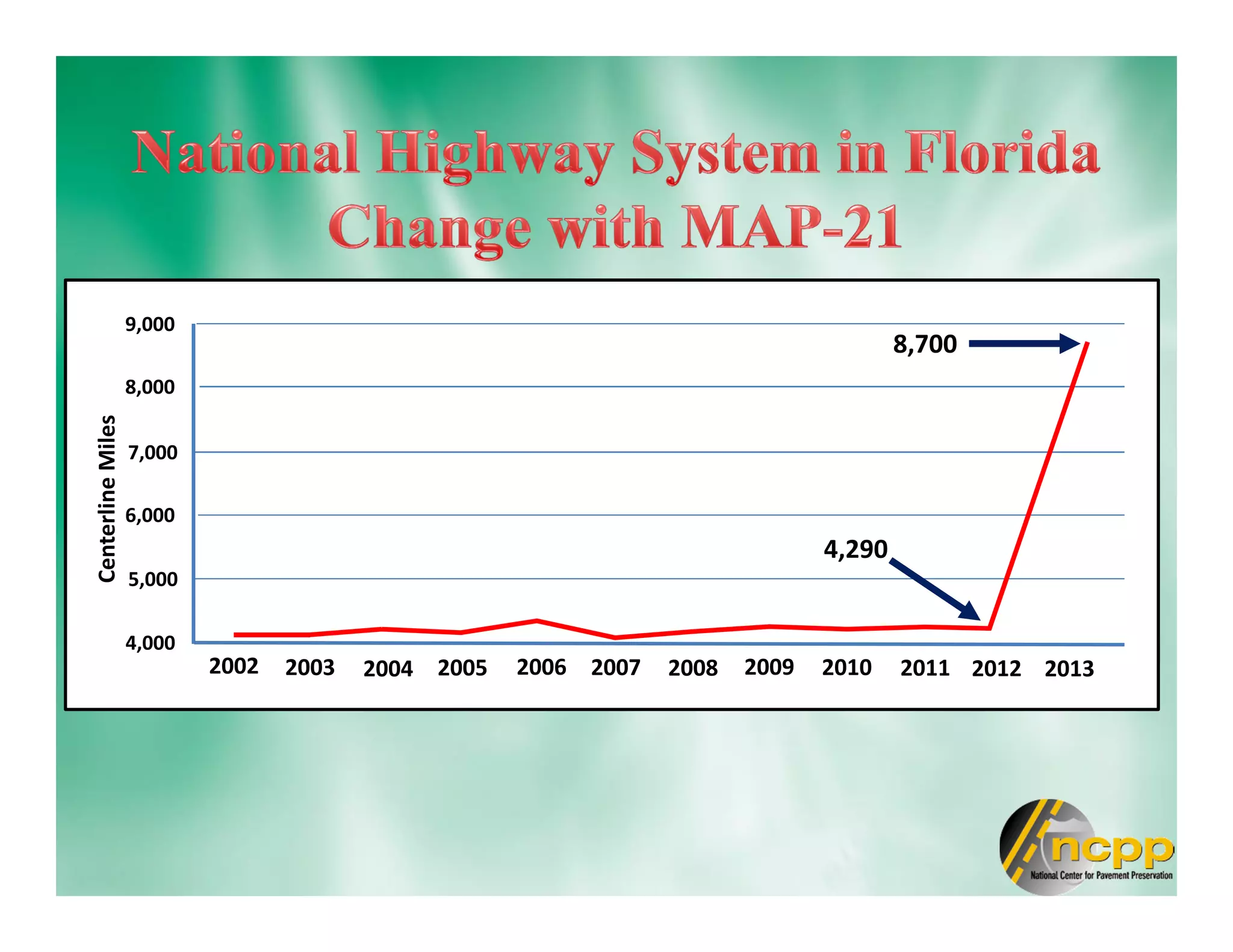
9,000
8,000
7,000
6,000
5,000
4,000
2002 2003 2004 20062005 2007 20092008 2010 201320122011
CenterlineMiles
8,700
4,290
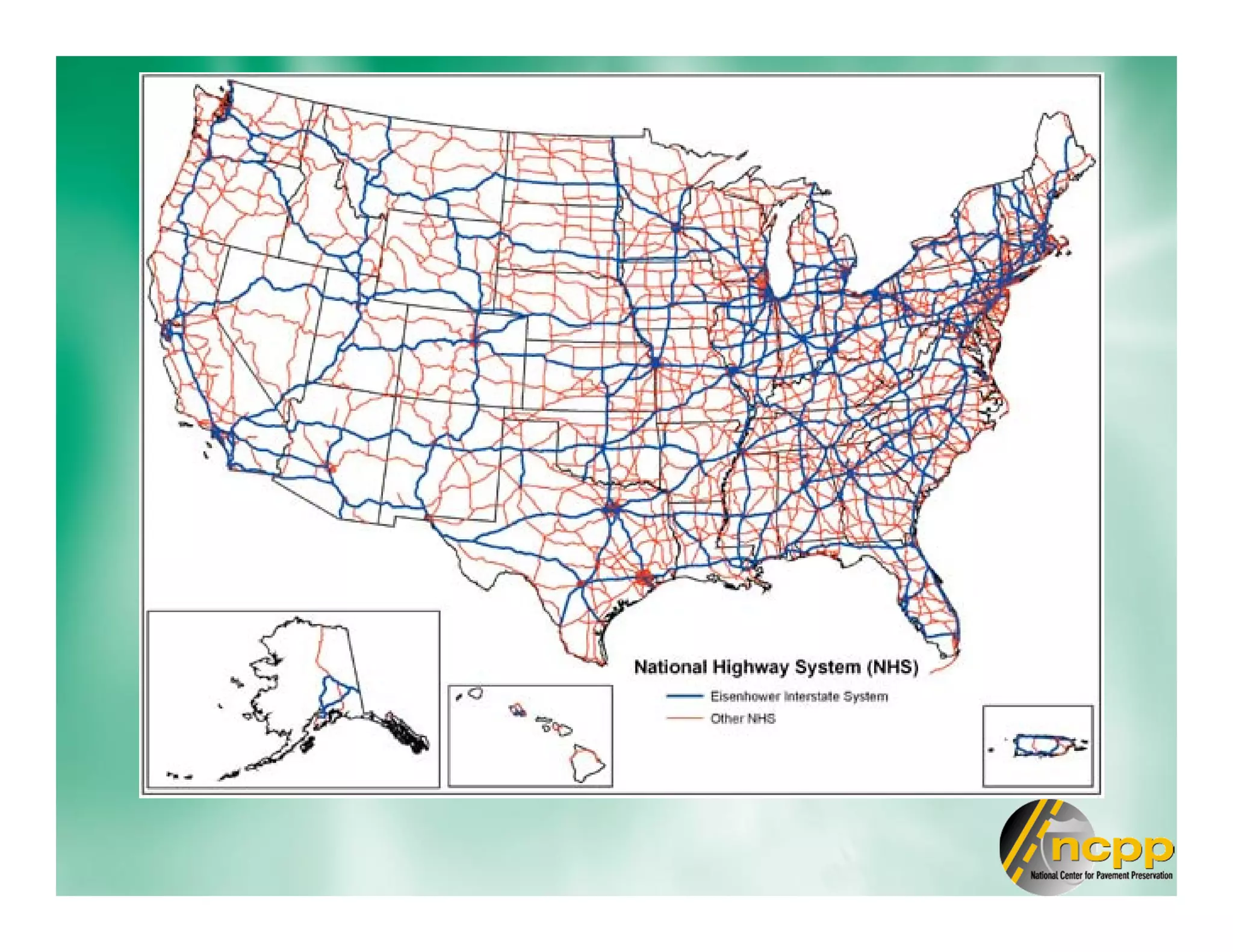
• Includes urban and rural principal arterials, and
main thoroughfares that carry heavy volumes of
traffic,
• Most on the state highway system and some are on
local roads.
• Many of these local roads function as main streets
for communities and serve commercial areas and
central business districts.
• New designated NHS roadways must use AASHTO
Green Book standards to meet design expectations
required as part of the NHS classification.
• Design exceptions are remain an available
mechanism in certain situations.
• Federal law gives the state DOT authority for
selecting projects on the NHS in consultation with
local officials. This potentially gives the state DOT
a larger role in selecting projects on local roads,
though this will likely not require a burdensome
process.
SEC. 1103. DEFINITIONS.
(a) Definitions- Section 101(a) of title 23, United States Code, is amended—
‘‘(2) ASSET MANAGEMENT.—The term ‘asset management’
means a strategic and systematic process of operating,
maintaining, and improving physical assets, with a focus
on both engineering and economic analysis based upon
quality information, to identify a structured sequence of
maintenance, preservation, repair, rehabilitation, and
replacement actions that will achieve and sustain a desired
state of good repair over the lifecycle of the assets at
minimum practicable cost.’’;
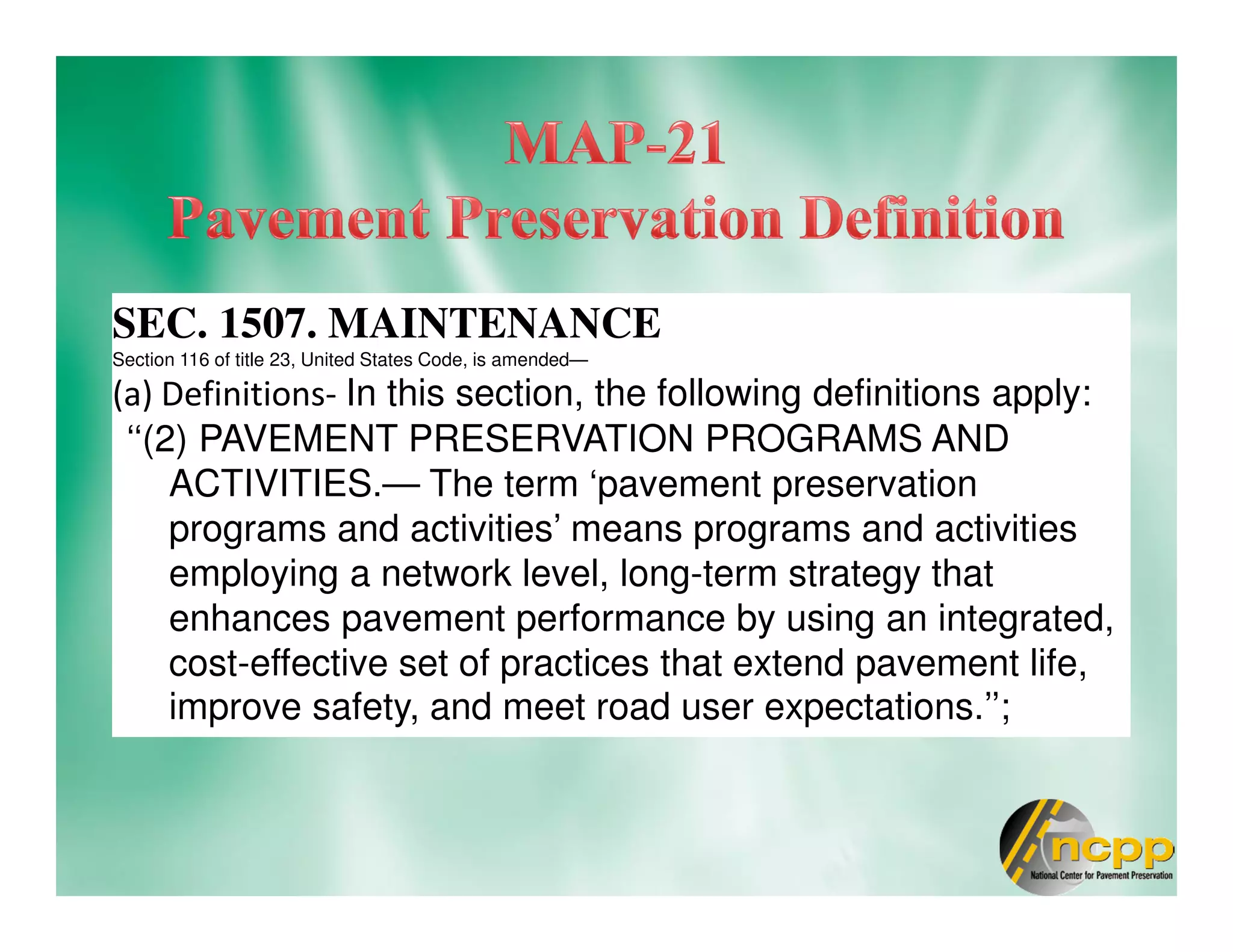
SEC. 1507. MAINTENANCE
Section 116 of title 23, United States Code, is amended—
(a) Definitions- In this section, the following definitions apply:
‘‘(2) PAVEMENT PRESERVATION PROGRAMS AND
ACTIVITIES.— The term ‘pavement preservation
programs and activities’ means programs and activities
employing a network level, long-term strategy that
enhances pavement performance by using an integrated,
cost-effective set of practices that extend pavement life,
improve safety, and meet road user expectations.’’;
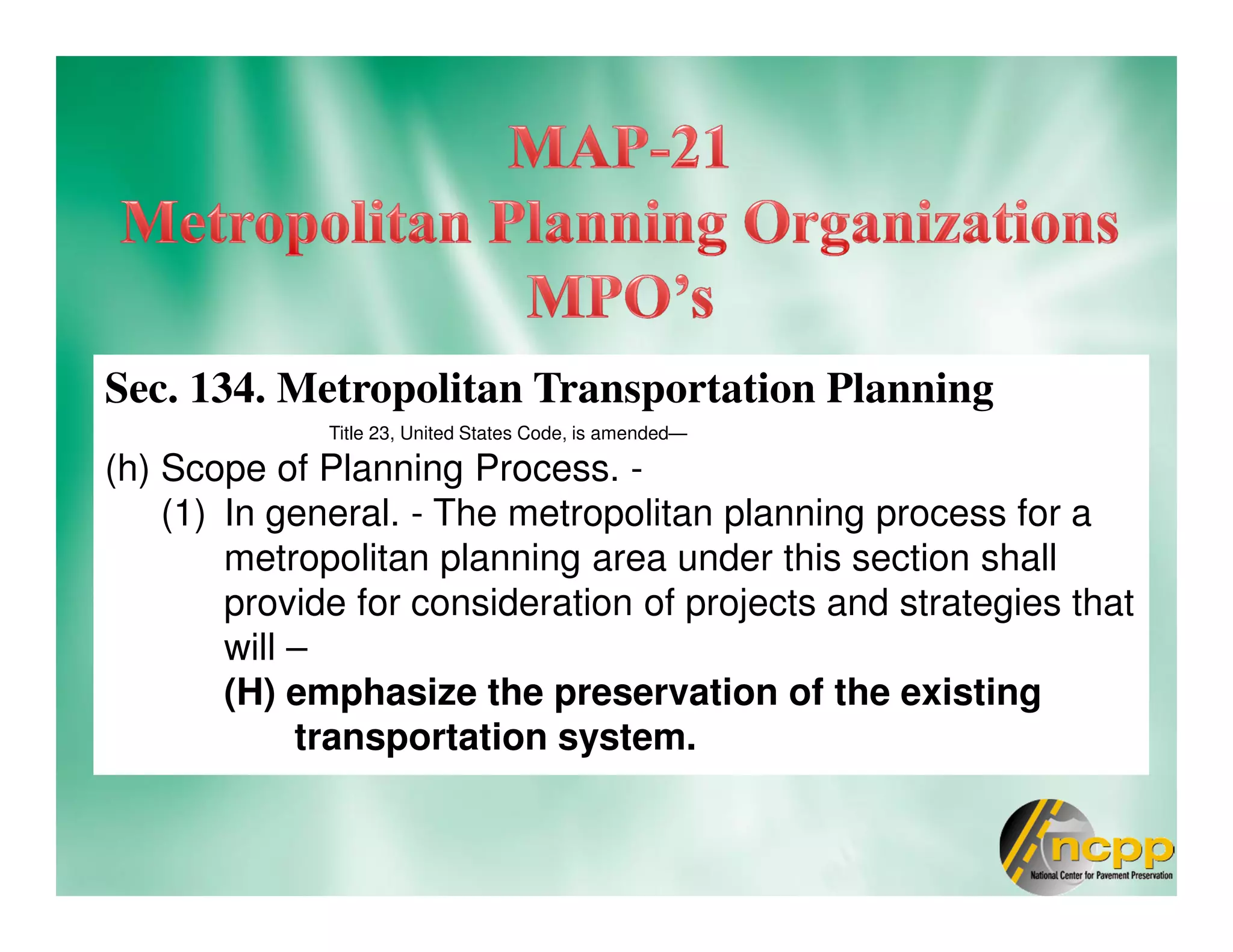
Sec. 134. Metropolitan Transportation Planning
Title 23, United States Code, is amended—
(h) Scope of Planning Process. -
(1) In general. - The metropolitan planning process for a
metropolitan planning area under this section shall
provide for consideration of projects and strategies that
will –
(H) emphasize the preservation of the existing
transportation system.
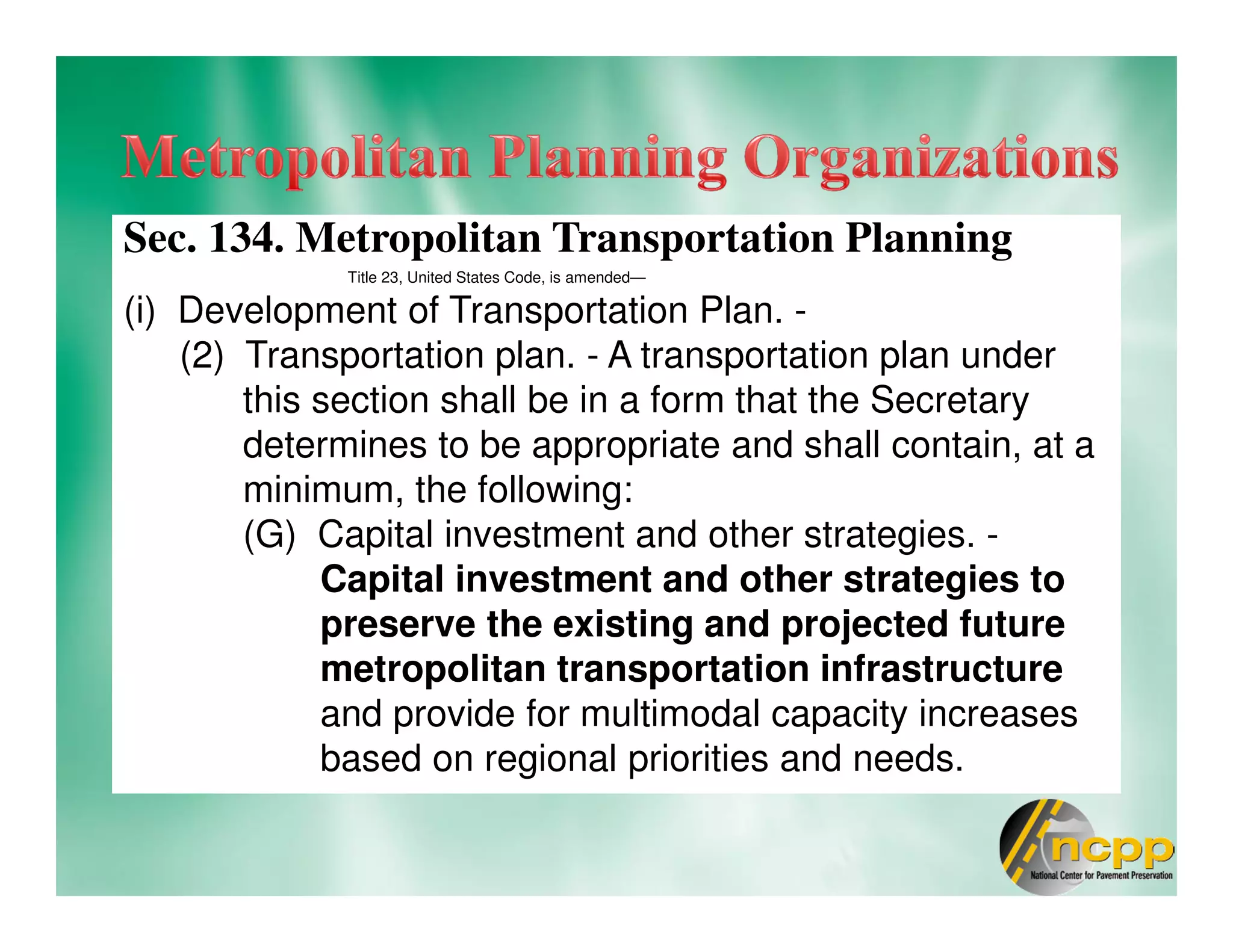
Sec. 134. Metropolitan Transportation Planning
Title 23, United States Code, is amended—
(i) Development of Transportation Plan. -
(2) Transportation plan. - A transportation plan under
this section shall be in a form that the Secretary
determines to be appropriate and shall contain, at a
minimum, the following:
(G) Capital investment and other strategies. -
Capital investment and other strategies to
preserve the existing and projected future
metropolitan transportation infrastructure
and provide for multimodal capacity increases
based on regional priorities and needs.
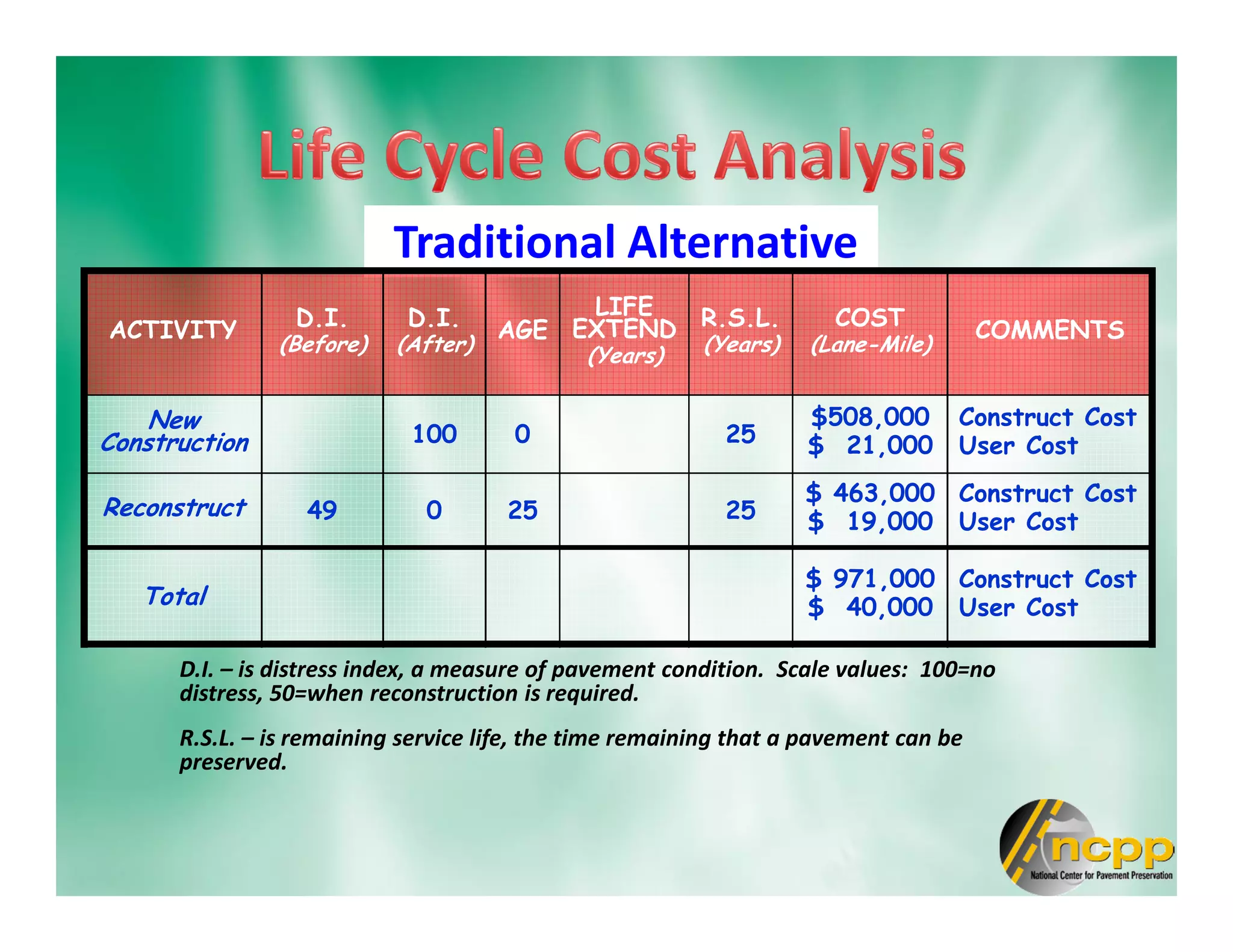
Traditional Alternative
D.I. – is distress index, a measure of pavement condition. Scale values: 100=no
distress, 50=when reconstruction is required.
R.S.L. – is remaining service life, the time remaining that a pavement can be
preserved.
ACTIVITY D.I.
(Before)
D.I.
(After)
AGE
LIFE
EXTEND
(Years)
R.S.L.
(Years)
COST
(Lane-Mile)
COMMENTS
New
Construction 100 0 25
$508,000
$ 21,000
Construct Cost
User Cost
Reconstruct 49 0 25 25
$ 463,000
$ 19,000
Construct Cost
User Cost
Total
$ 971,000
$ 40,000
Construct Cost
User Cost
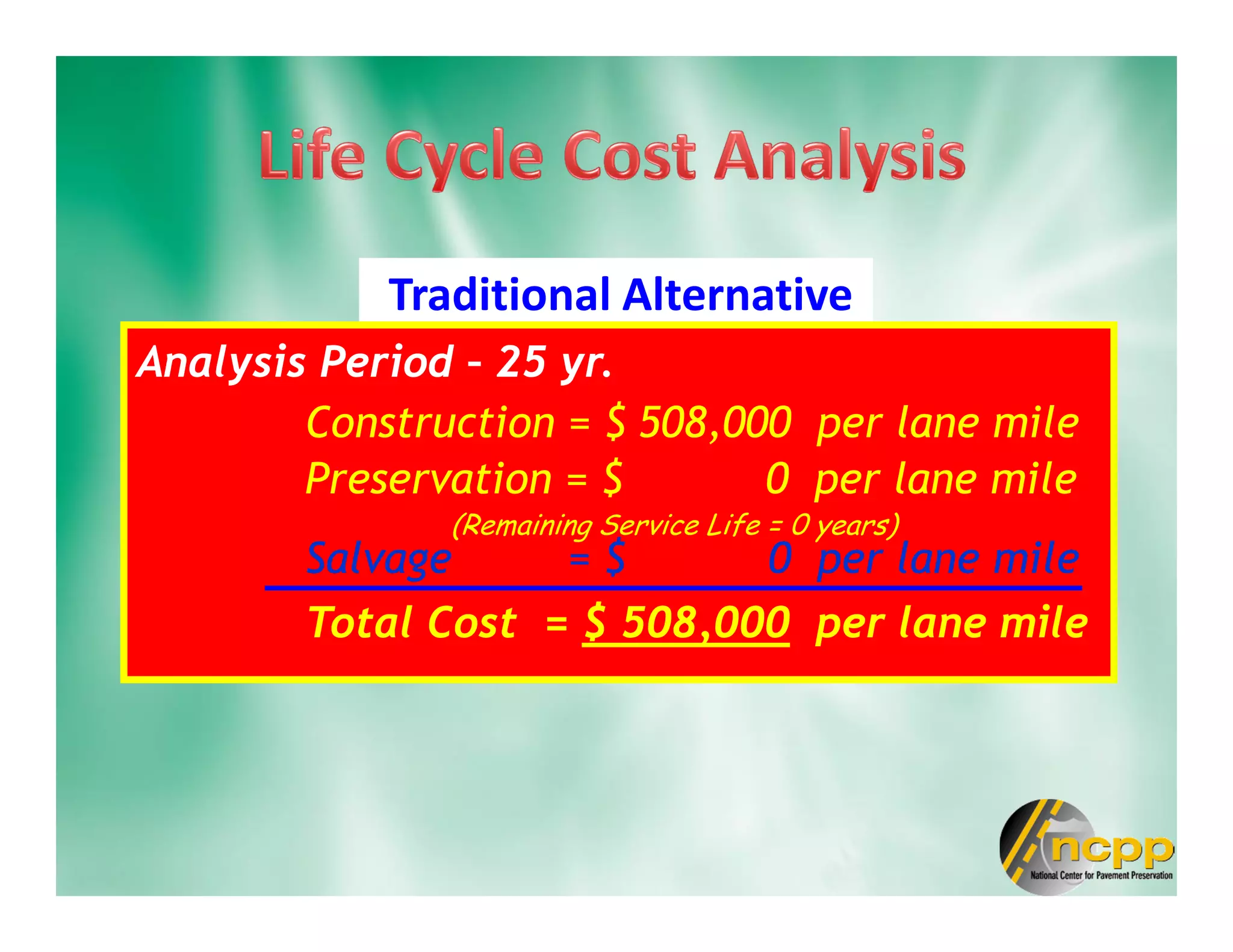
Traditional Alternative
Analysis Period – 25 yr.
Construction = $ 508,000 per lane mile
Preservation = $ 0 per lane mile
Salvage = $ 0 per lane mile
Total Cost = $ 508,000 per lane mile
Analysis Period – 25 yr.
Construction = $ 508,000 per lane mile
Preservation = $ 0 per lane mile
Salvage = $ 0 per lane mile
Total Cost = $ 508,000 per lane mile
(Remaining Service Life = 0 years)
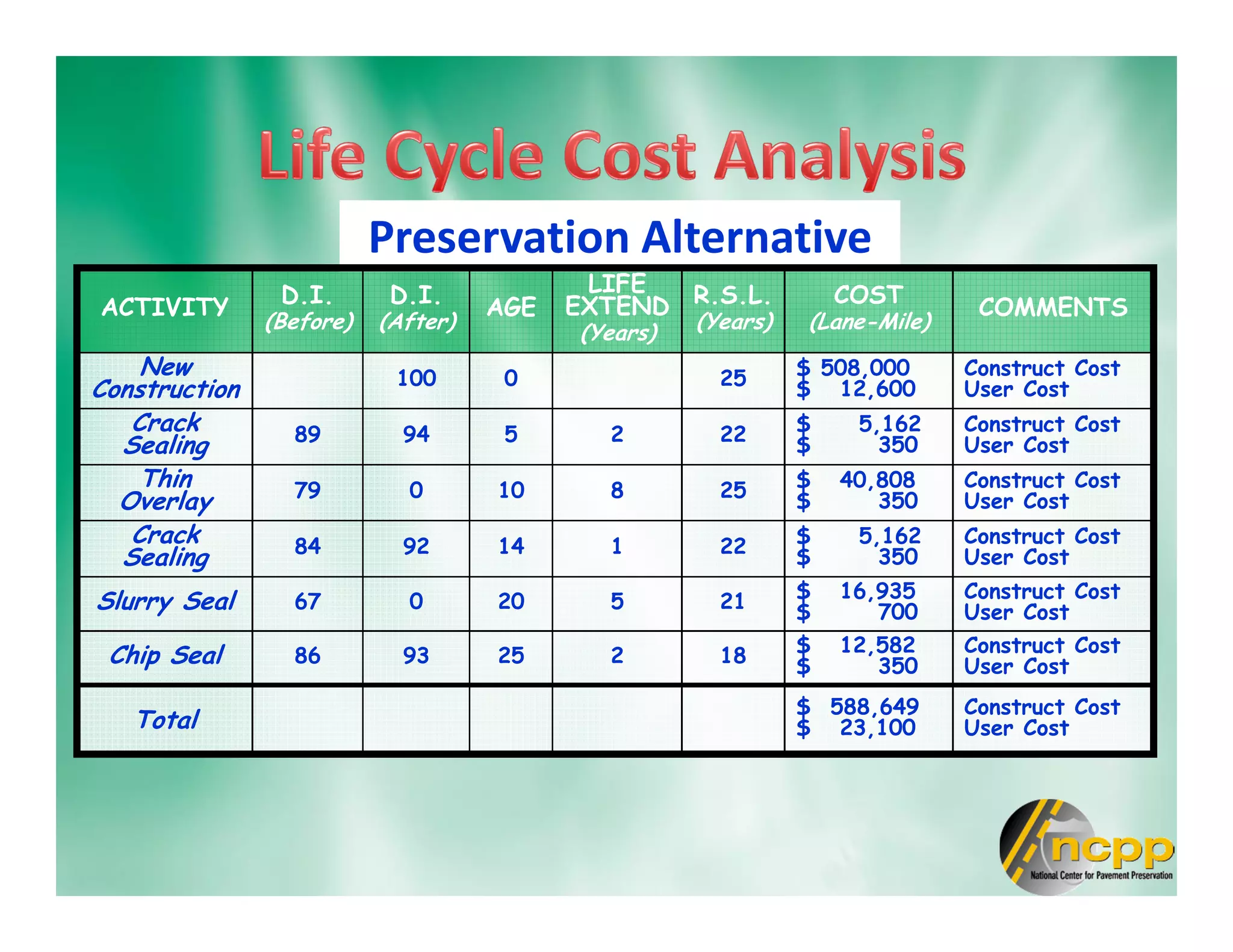
Preservation Alternative
ACTIVITY D.I.
(Before)
D.I.
(After)
AGE
LIFE
EXTEND
(Years)
R.S.L.
(Years)
COST
(Lane-Mile)
COMMENTS
New
Construction 100 0 25 $ 508,000
$ 12,600
Construct Cost
User Cost
Crack
Sealing 89 94 5 2 22 $ 5,162
$ 350
Construct Cost
User Cost
Thin
Overlay 79 0 10 8 25 $ 40,808
$ 350
Construct Cost
User Cost
Crack
Sealing 84 92 14 1 22 $ 5,162
$ 350
Construct Cost
User Cost
Slurry Seal 67 0 20 5 21 $ 16,935
$ 700
Construct Cost
User Cost
Chip Seal 86 93 25 2 18 $ 12,582
$ 350
Construct Cost
User Cost
Total
$ 588,649
$ 23,100
Construct Cost
User Cost
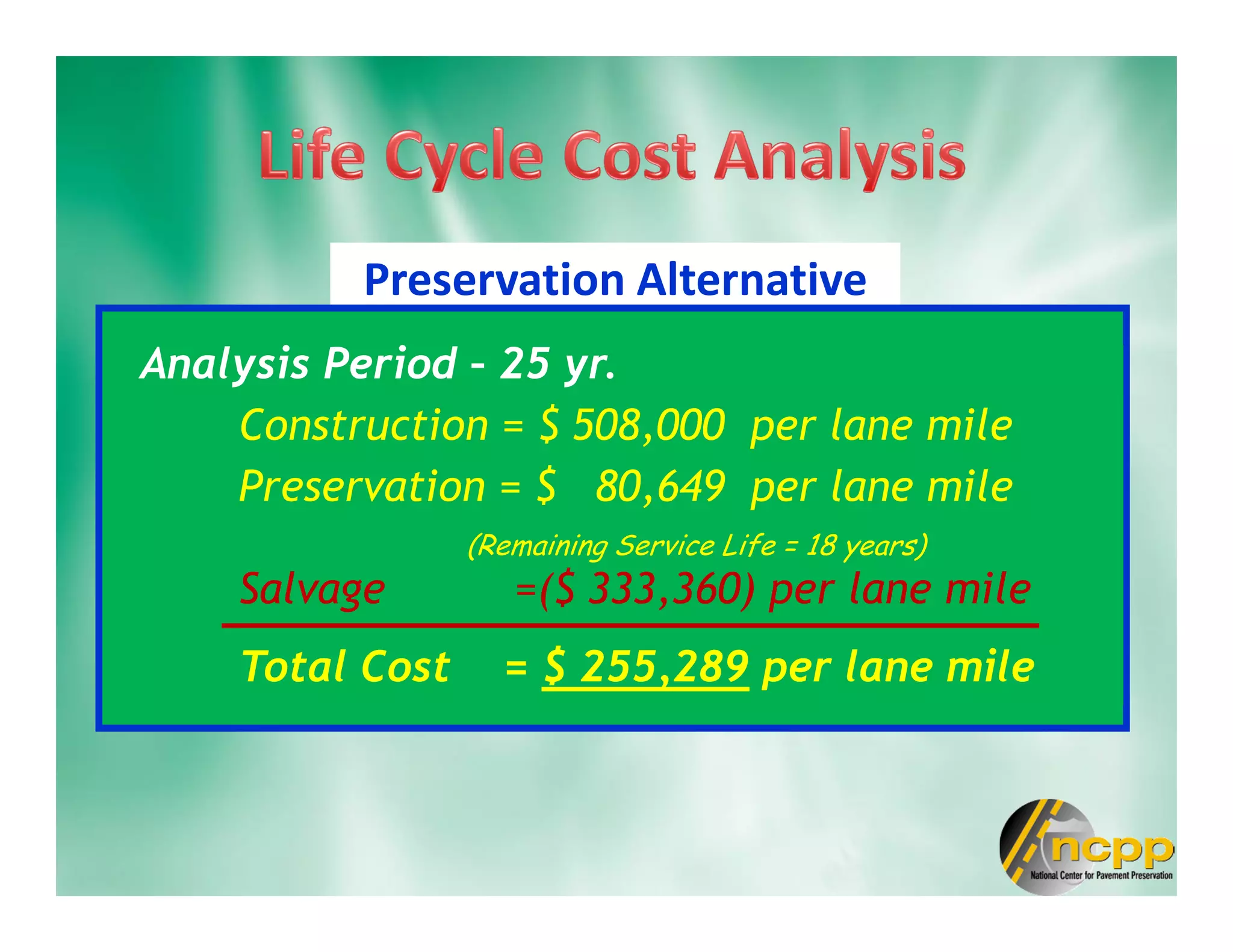
Preservation Alternative
Analysis Period – 25 yr.
Construction = $ 508,000 per lane mile
Preservation = $ 80,649 per lane mile
Salvage =($ 333,360) per lane mile
Total Cost = $ 255,289 per lane mile
Analysis Period – 25 yr.
Construction = $ 508,000 per lane mile
Preservation = $ 80,649 per lane mile
Salvage =($ 333,360) per lane mile
Total Cost = $ 255,289 per lane mile
(Remaining Service Life = 18 years)
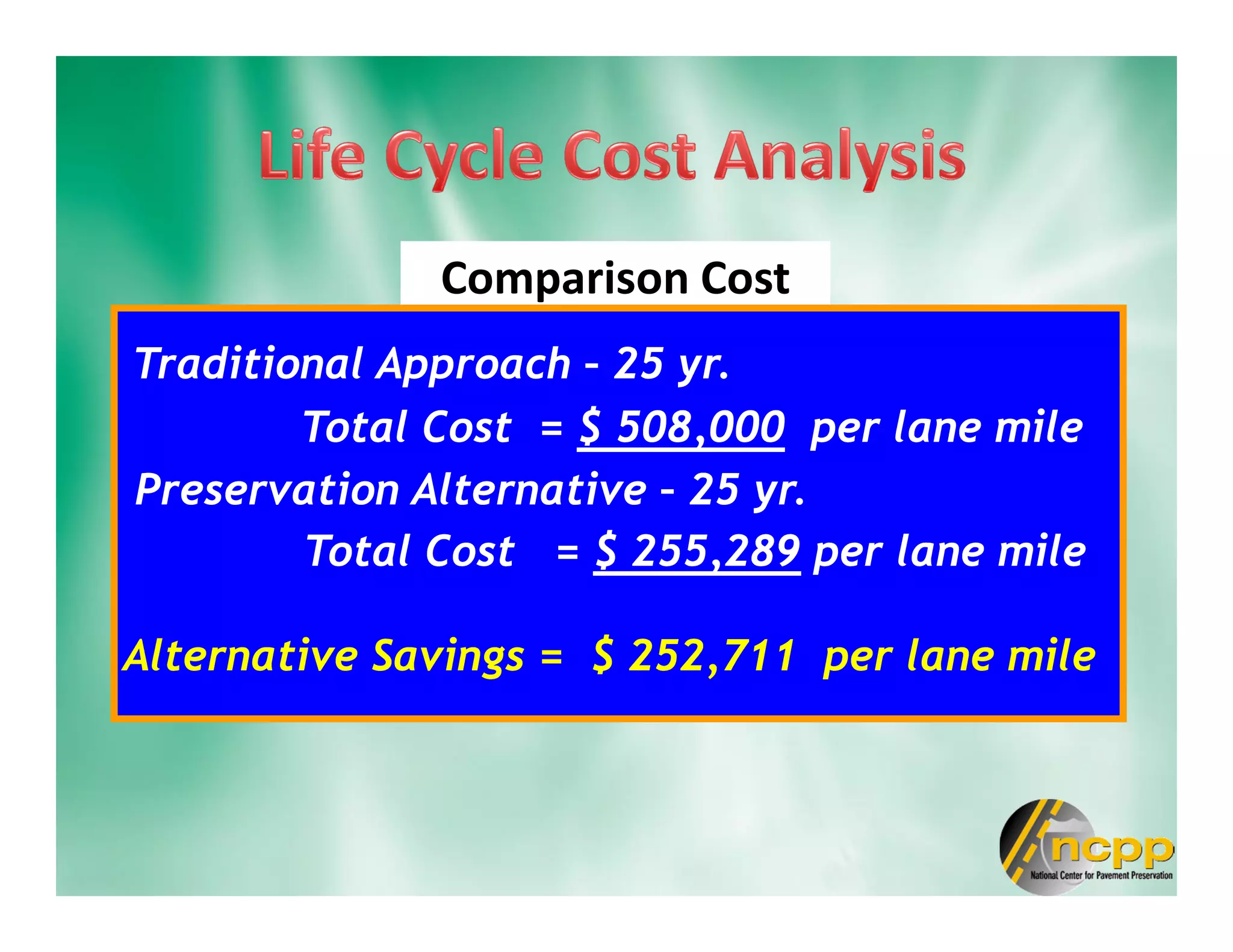
Comparison Cost
Preservation Alternative – 25 yr.
Total Cost = $ 255,289 per lane mile
Preservation Alternative – 25 yr.
Total Cost = $ 255,289 per lane mile
Traditional Approach – 25 yr.
Total Cost = $ 508,000 per lane mile
Traditional Approach – 25 yr.
Total Cost = $ 508,000 per lane mile
Alternative Savings = $ 252,711 per lane mileAlternative Savings = $ 252,711 per lane mile
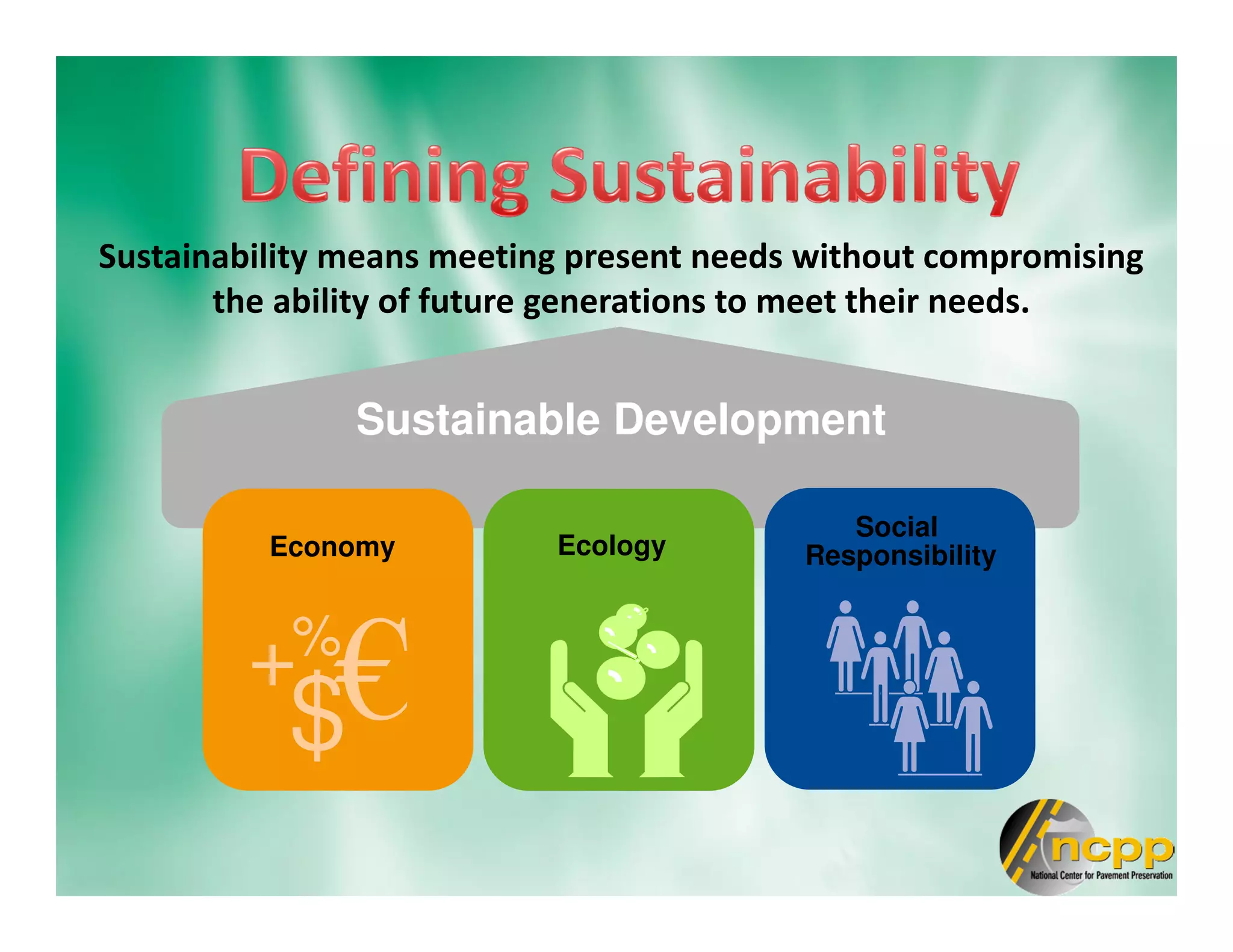
Social
ResponsibilityEcologyEconomy
Sustainable Development
€$
%
+
Sustainability means meeting present needs without compromising
the ability of future generations to meet their needs.
Economy
Ecology
Social
Responsibility
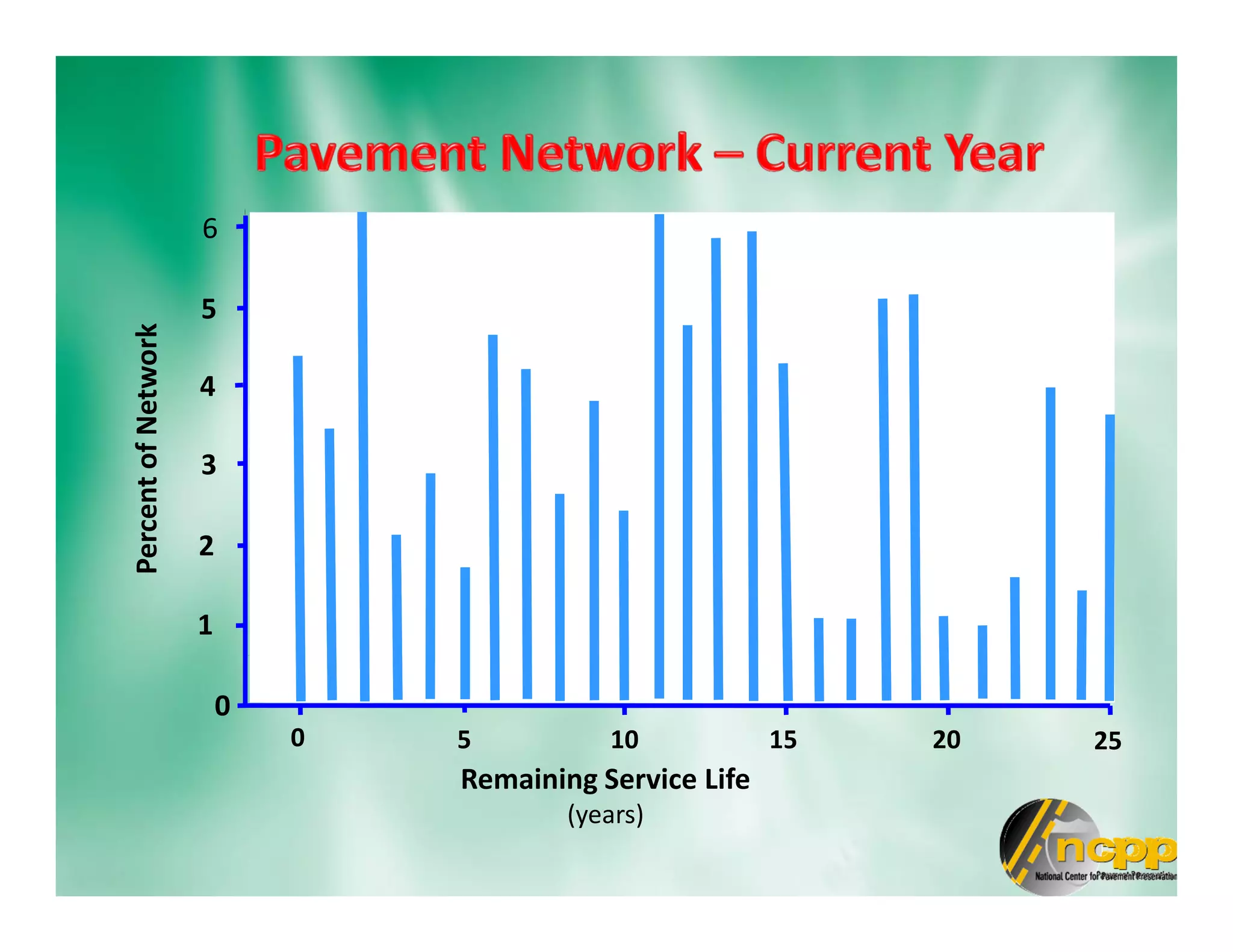
0
1
2
3
4
5
0 5 10 15 20 25
Remaining Service Life
(years)
PercentofNetwork
6
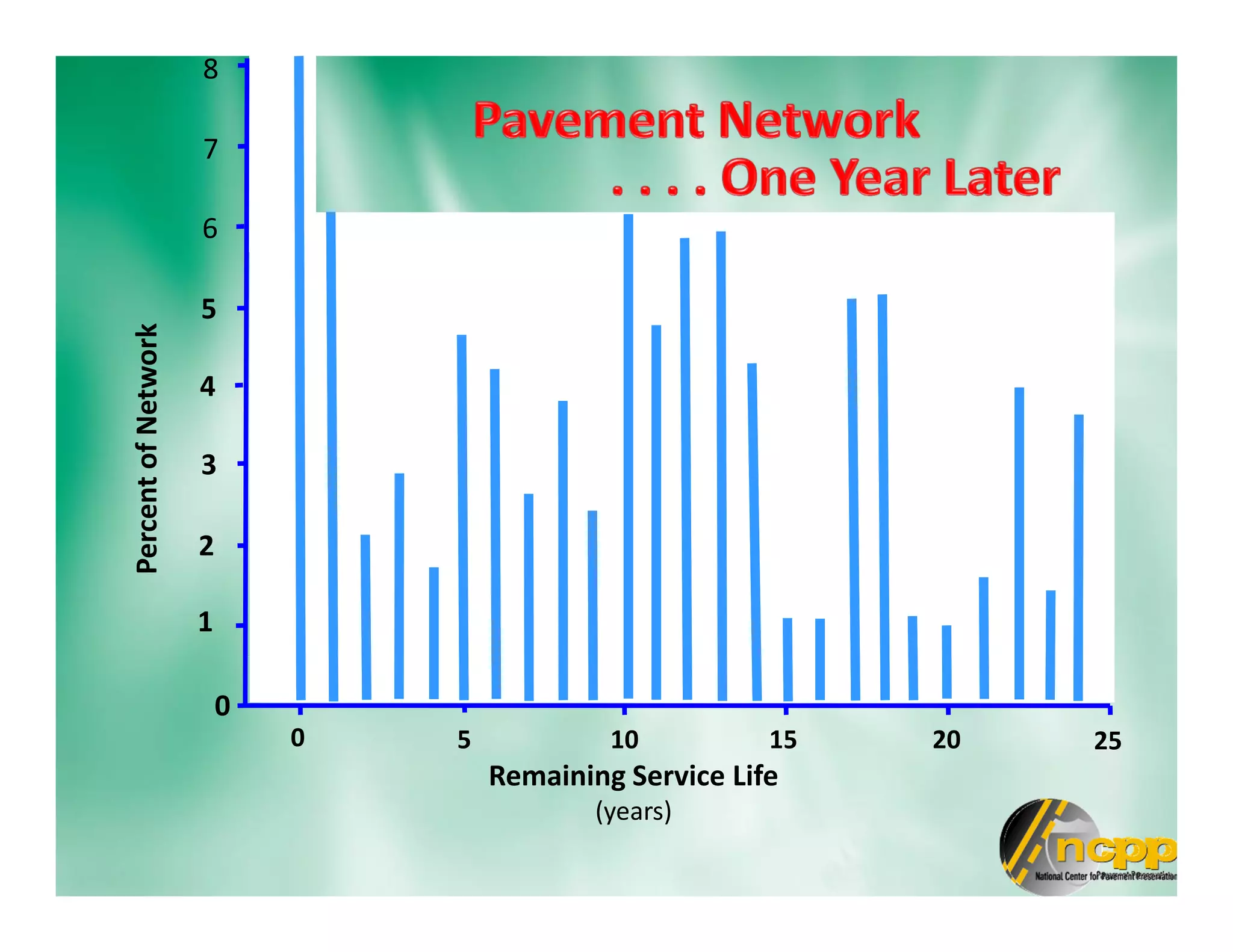
0
1
2
3
4
5
0 5 10 15 20 25
Remaining Service Life
(years)
6
7
8
PercentofNetwork
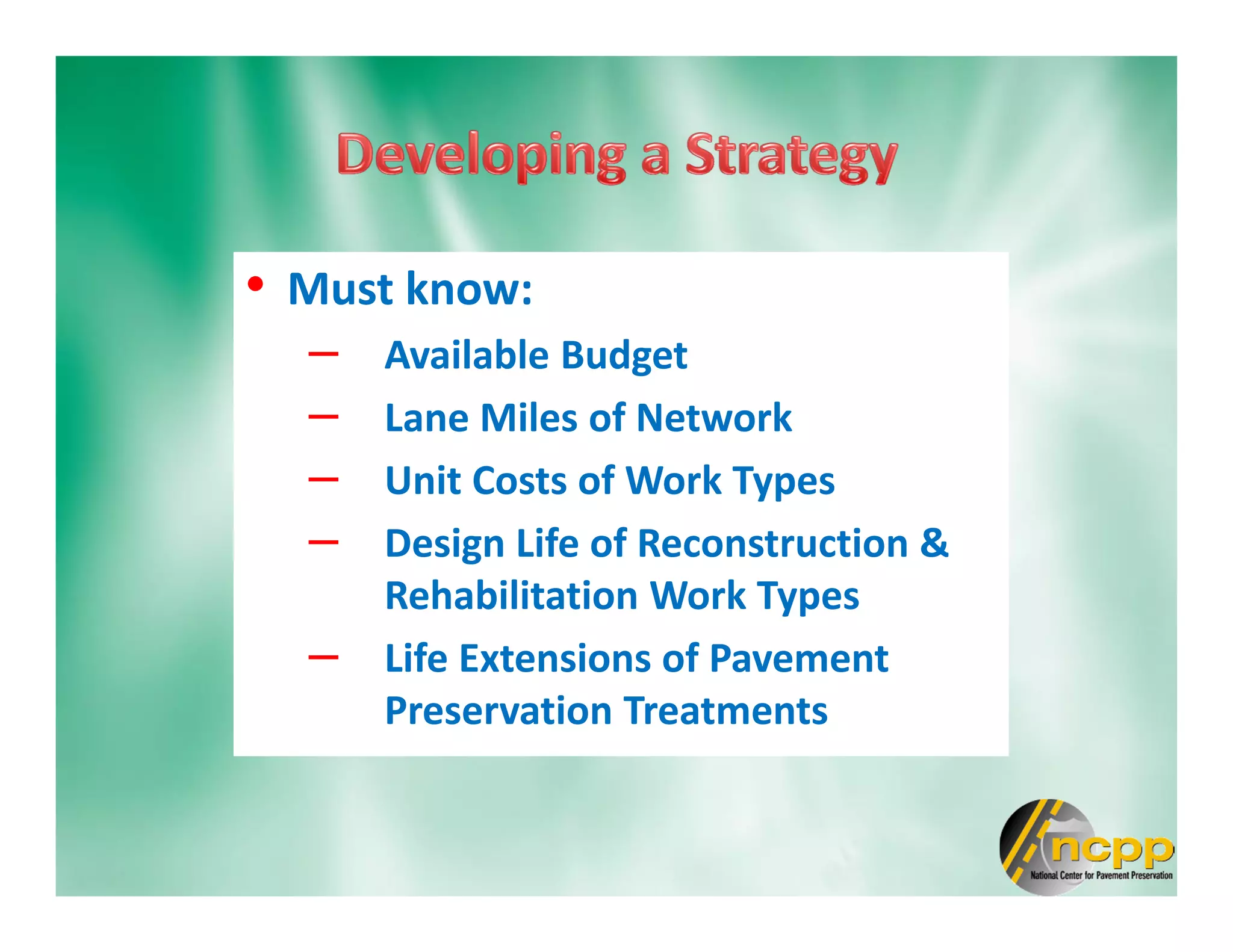
• Must know:
– Available Budget
– Lane Miles of Network
– Unit Costs of Work Types
– Design Life of Reconstruction &
Rehabilitation Work Types
– Life Extensions of Pavement
Preservation Treatments
• Inventory
• Traffic volume and load
• Pavement condition
• Drainage
• Maintenance
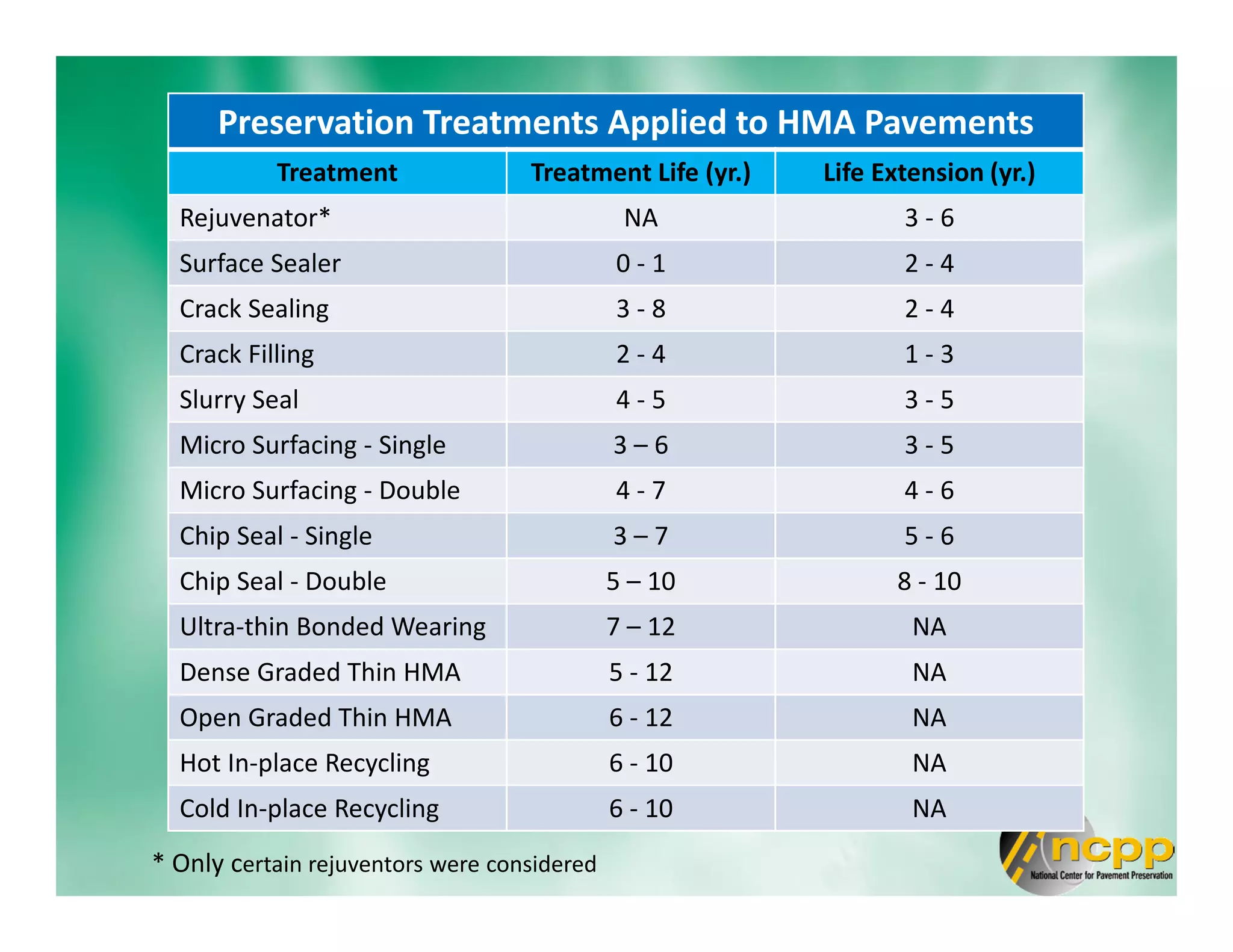
Preservation Treatments Applied to HMA Pavements
Treatment Treatment Life (yr.) Life Extension (yr.)
Rejuvenator* NA 3 - 6
Surface Sealer 0 - 1 2 - 4
Crack Sealing 3 - 8 2 - 4
Crack Filling 2 - 4 1 - 3
Slurry Seal 4 - 5 3 - 5
Micro Surfacing - Single 3 – 6 3 - 5
Micro Surfacing - Double 4 - 7 4 - 6
Chip Seal - Single 3 – 7 5 - 6
Chip Seal - Double 5 – 10 8 - 10
Ultra-thin Bonded Wearing 7 – 12 NA
Dense Graded Thin HMA 5 - 12 NA
Open Graded Thin HMA 6 - 12 NA
Hot In-place Recycling 6 - 10 NA
Cold In-place Recycling 6 - 10 NA
* Only certain rejuventors were considered
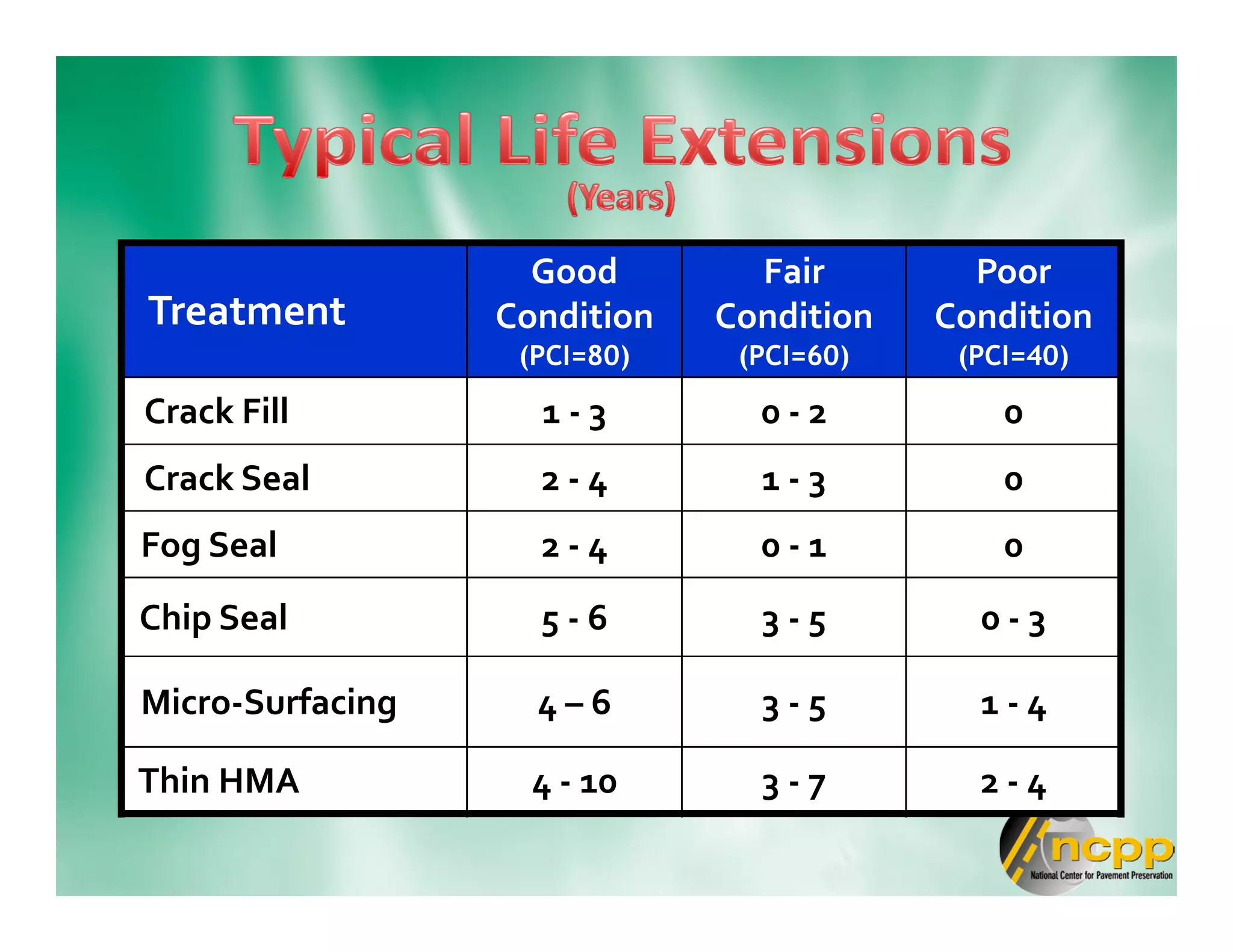
Treatment
Good
Condition
(PCI=80)
Fair
Condition
(PCI=60)
Poor
Condition
(PCI=40)
Crack Fill 1 - 3 0 - 2 0
Crack Seal 2 - 4 1 - 3 0
Fog Seal 2 - 4 0 - 1 0
Chip Seal 5 - 6 3 - 5 0 - 3
Micro-Surfacing 4 – 6 3 - 5 1 - 4
Thin HMA 4 - 10 3 - 7 2 - 4
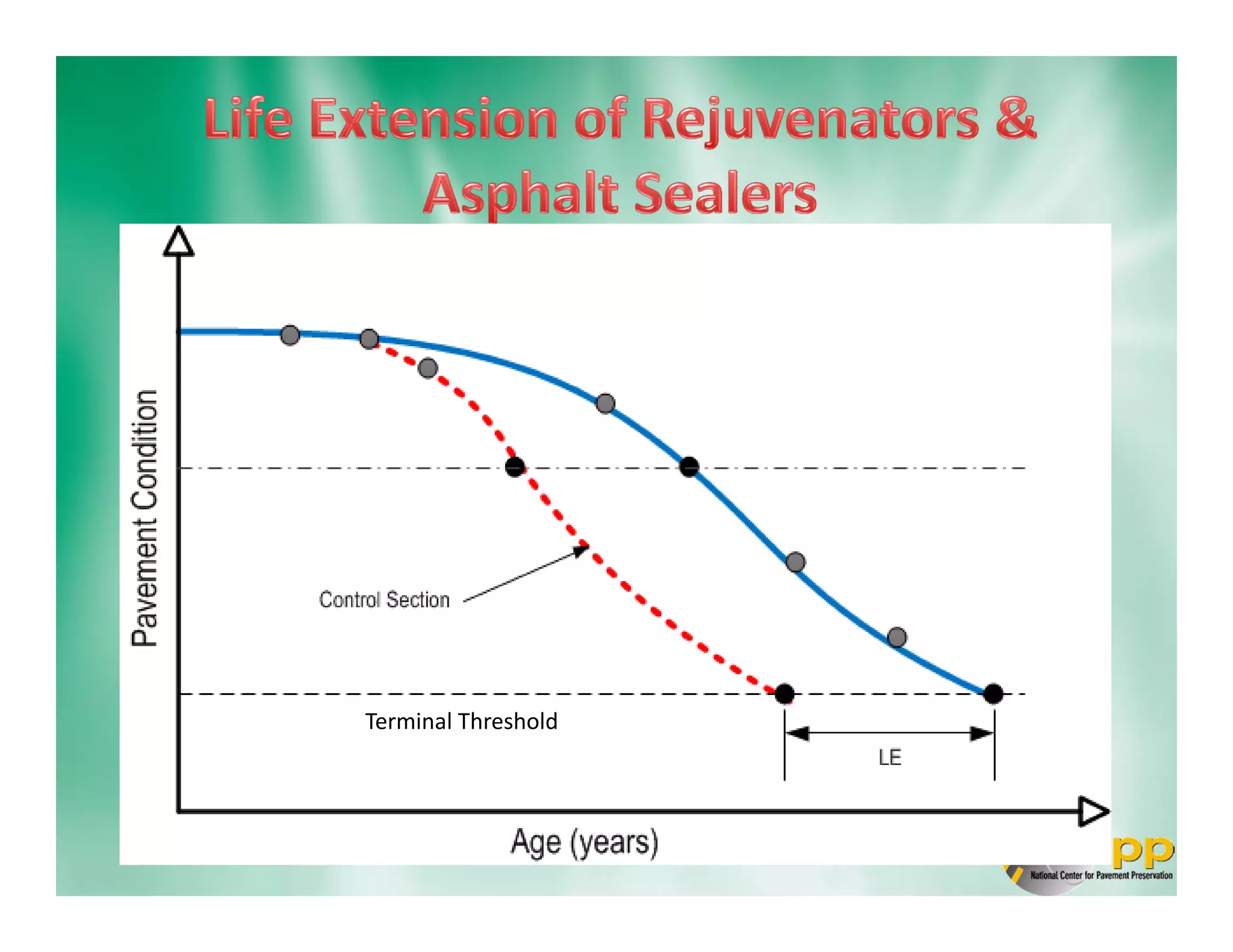
Terminal Threshold
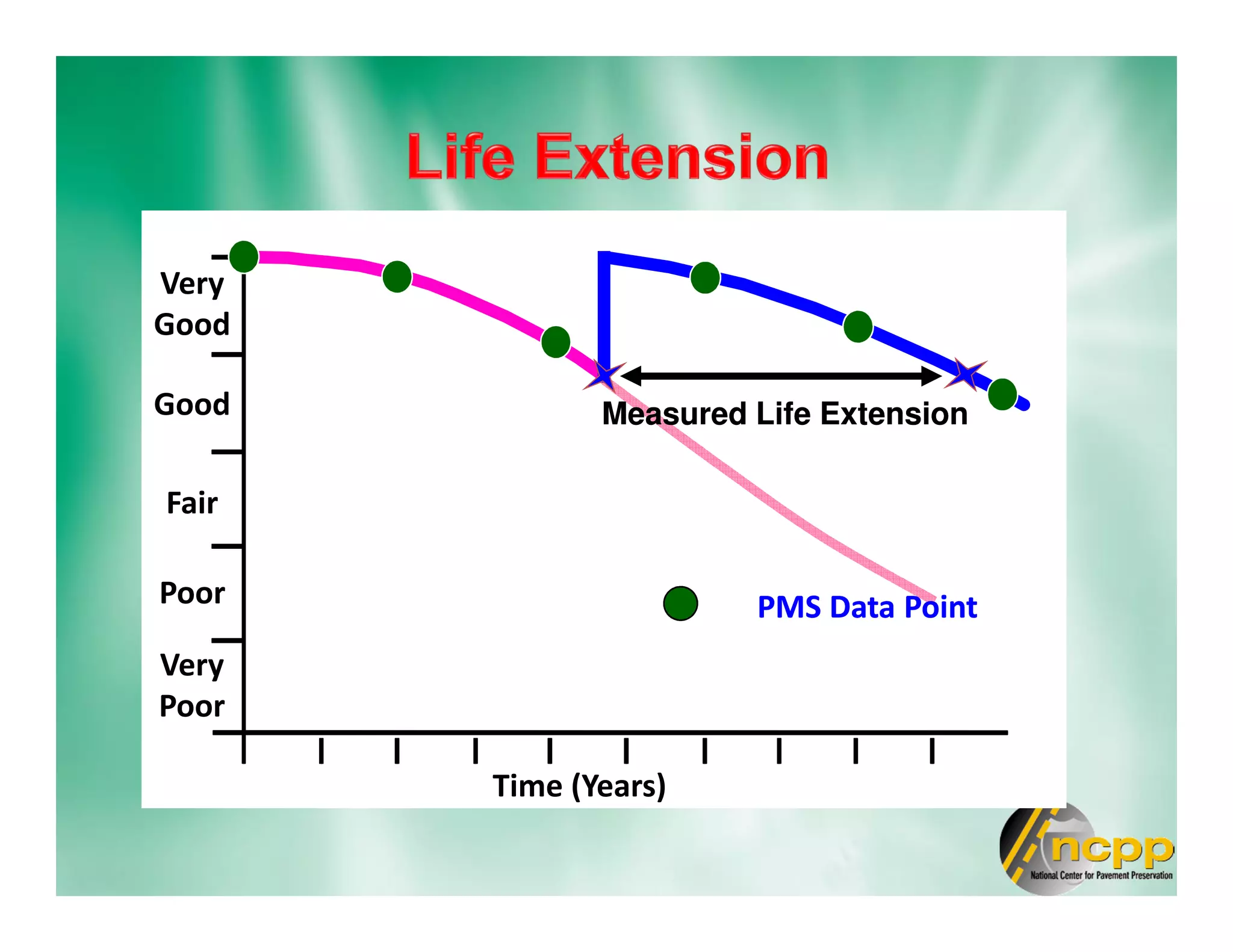
PMS Data Point
Very
Good
Good
Fair
Poor
Very
Poor
Time (Years)
PMS Data PointPMS Data Point
Measured Life ExtensionMeasured Life Extension
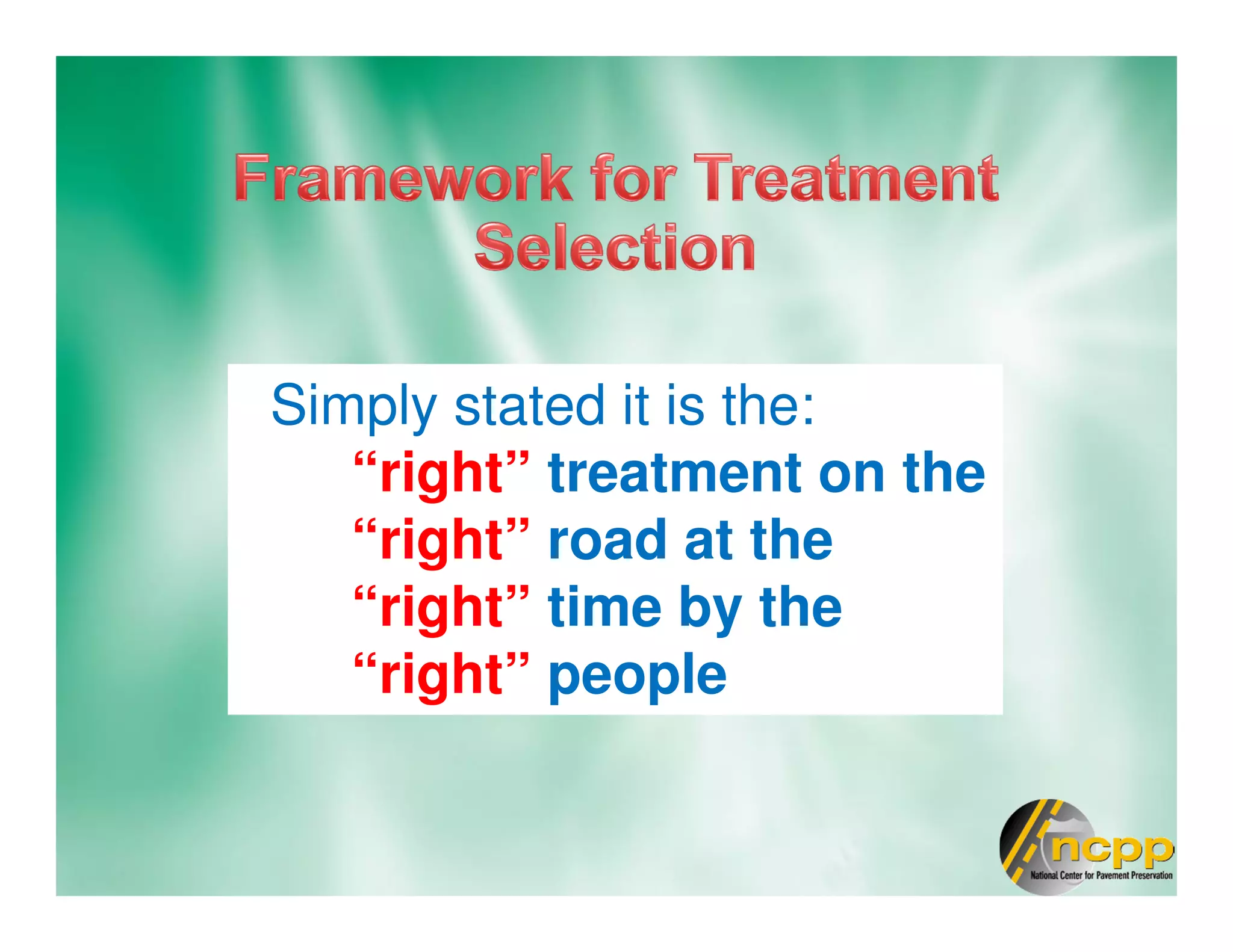
Simply stated it is the:
“right” treatment on the
“right” road at the
“right” time by the
“right” people
• Other potential criteria
– Availability of qualified contractors
– Availability of materials
– Time (of year) of construction
– Pavement noise
– Facility downtime
– Surface friction
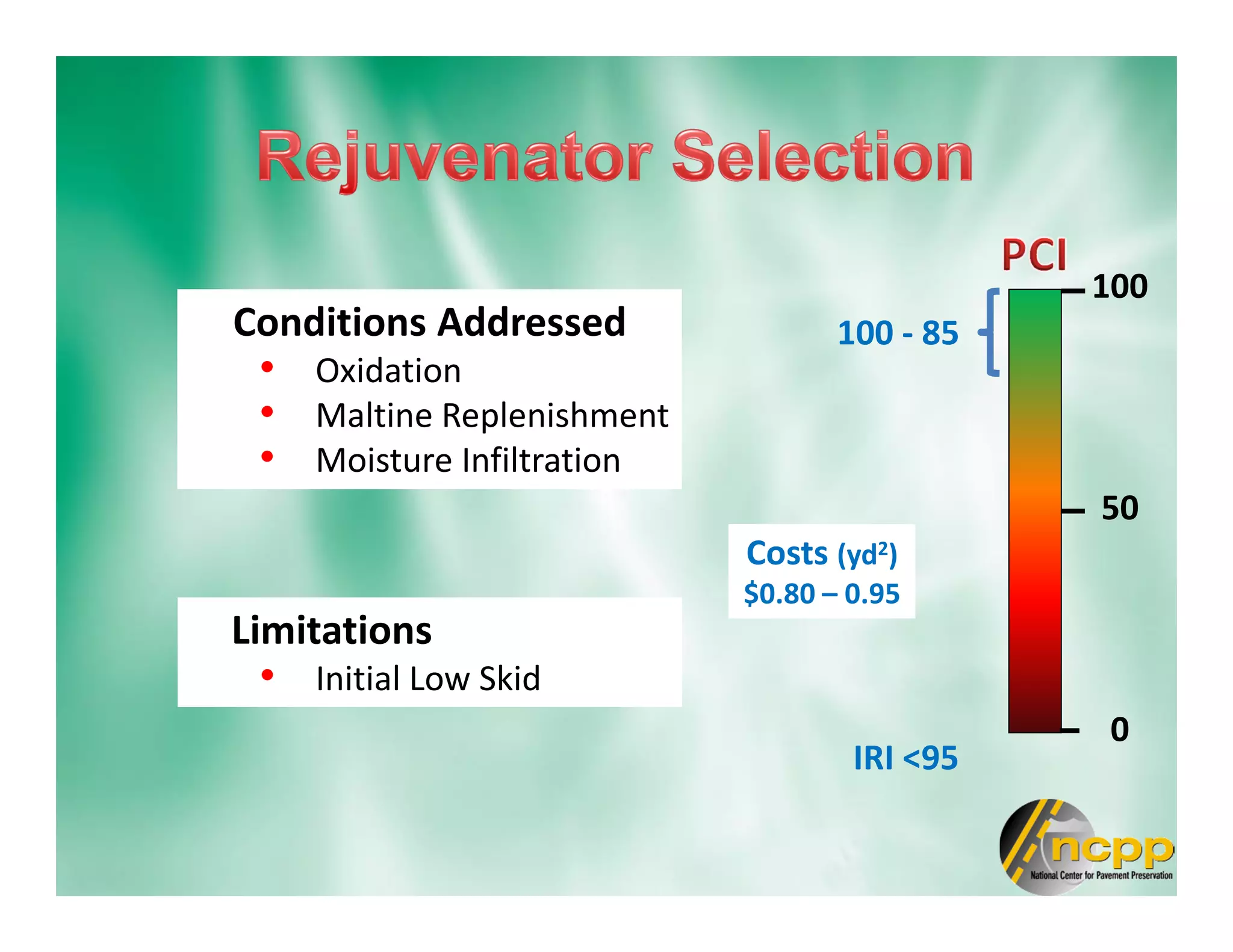
Conditions Addressed
• Oxidation
• Maltine Replenishment
• Moisture Infiltration
100
0
50
100 - 85
IRI <95
Limitations
• Initial Low Skid
Costs (yd2)
$0.80 – 0.95
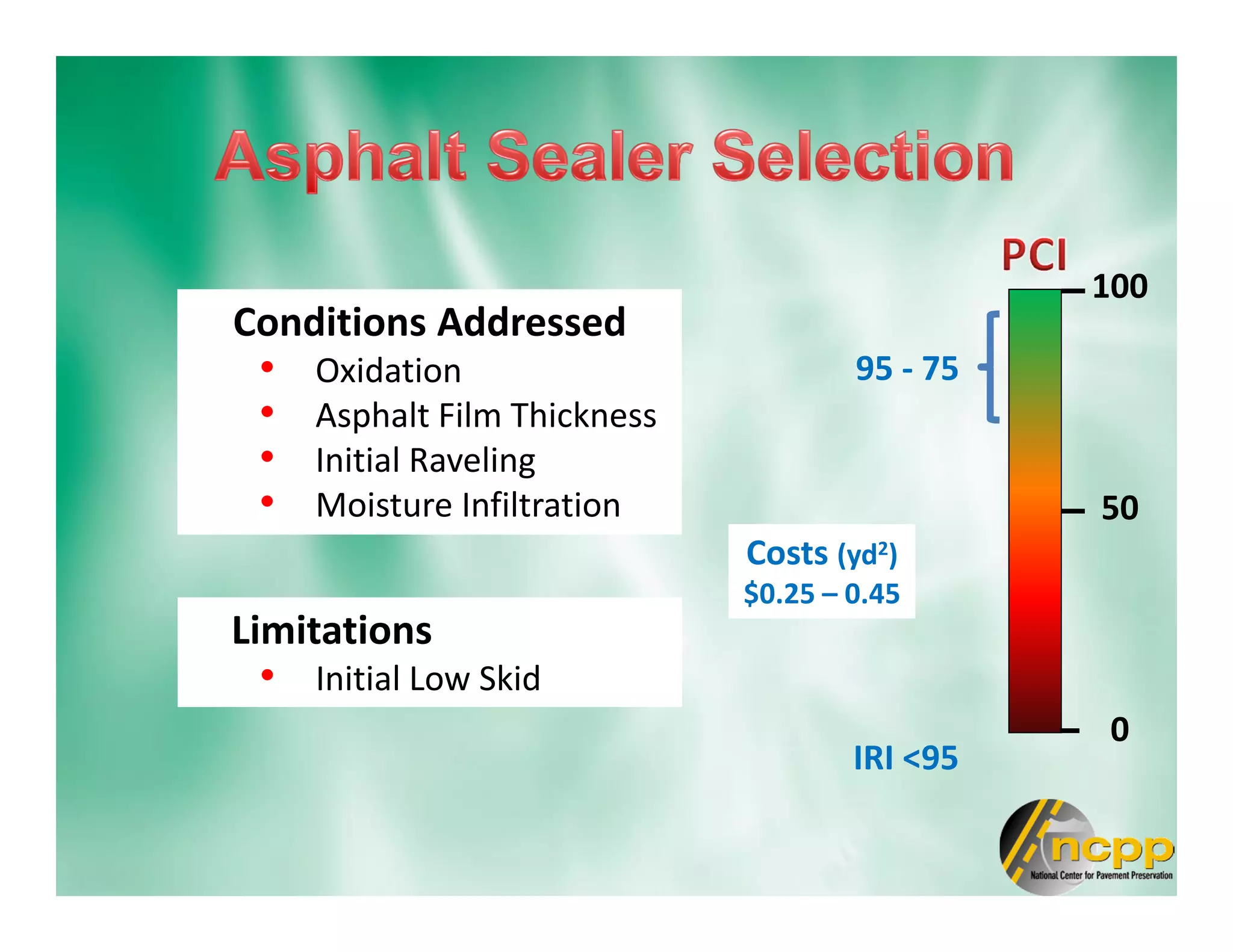
Conditions Addressed
• Oxidation
• Asphalt Film Thickness
• Initial Raveling
• Moisture Infiltration
100
0
50
95 - 75
IRI <95
Limitations
• Initial Low Skid
Costs (yd2)
$0.25 – 0.45
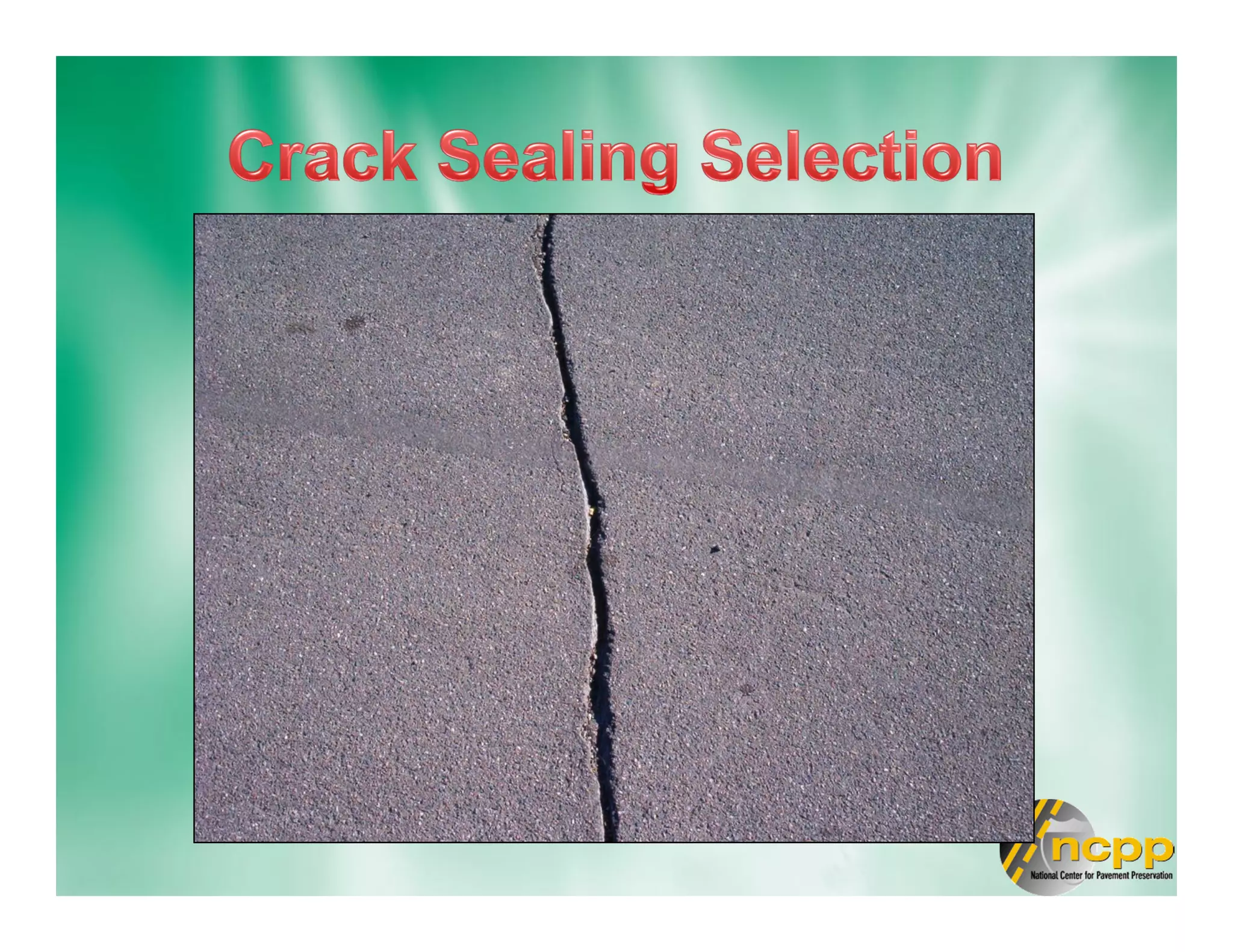
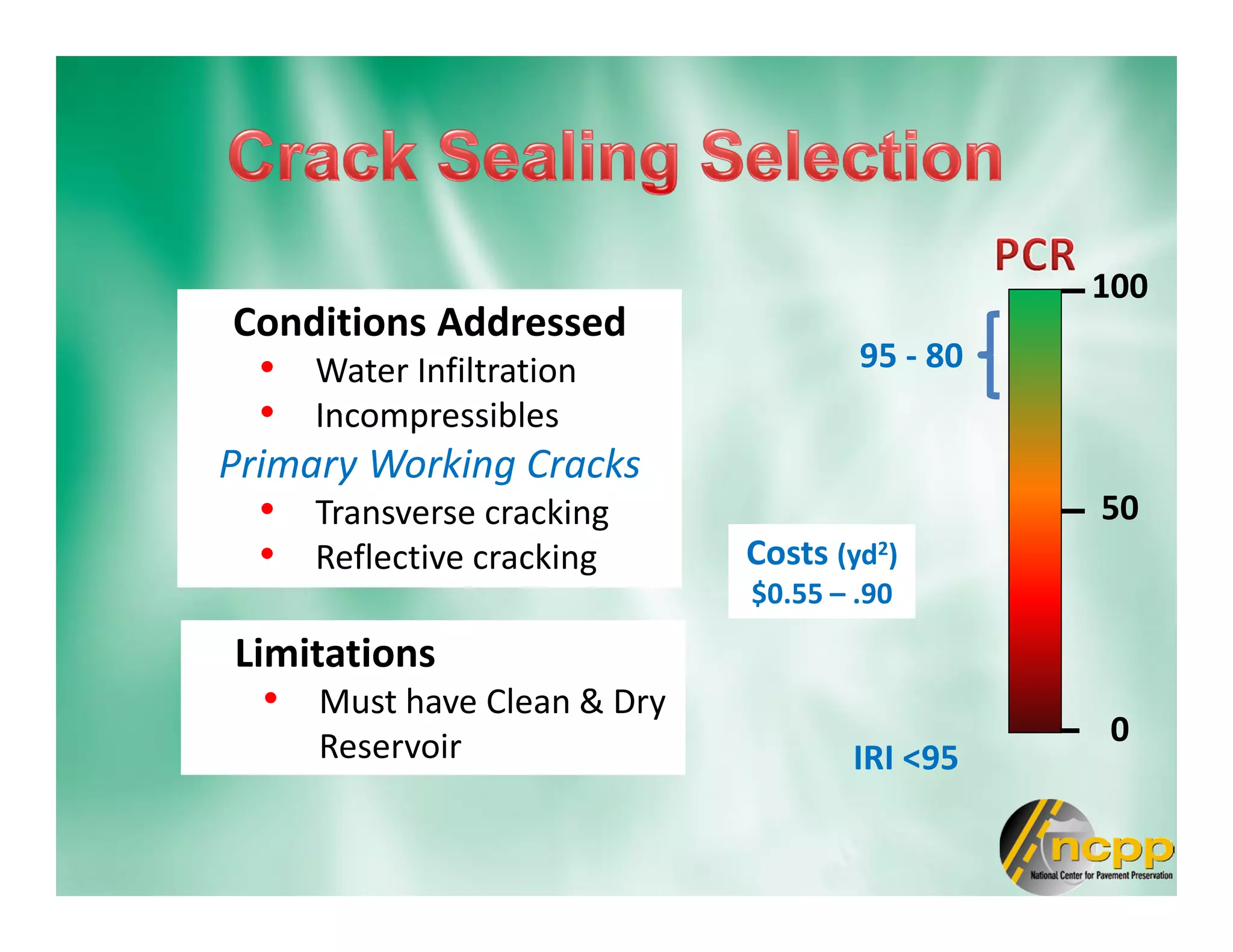
Conditions Addressed
• Water Infiltration
• Incompressibles
Primary Working Cracks
• Transverse cracking
• Reflective cracking
100
0
50
95 - 80
IRI <95
Limitations
• Must have Clean & Dry
Reservoir
Costs (yd2)
$0.55 – .90
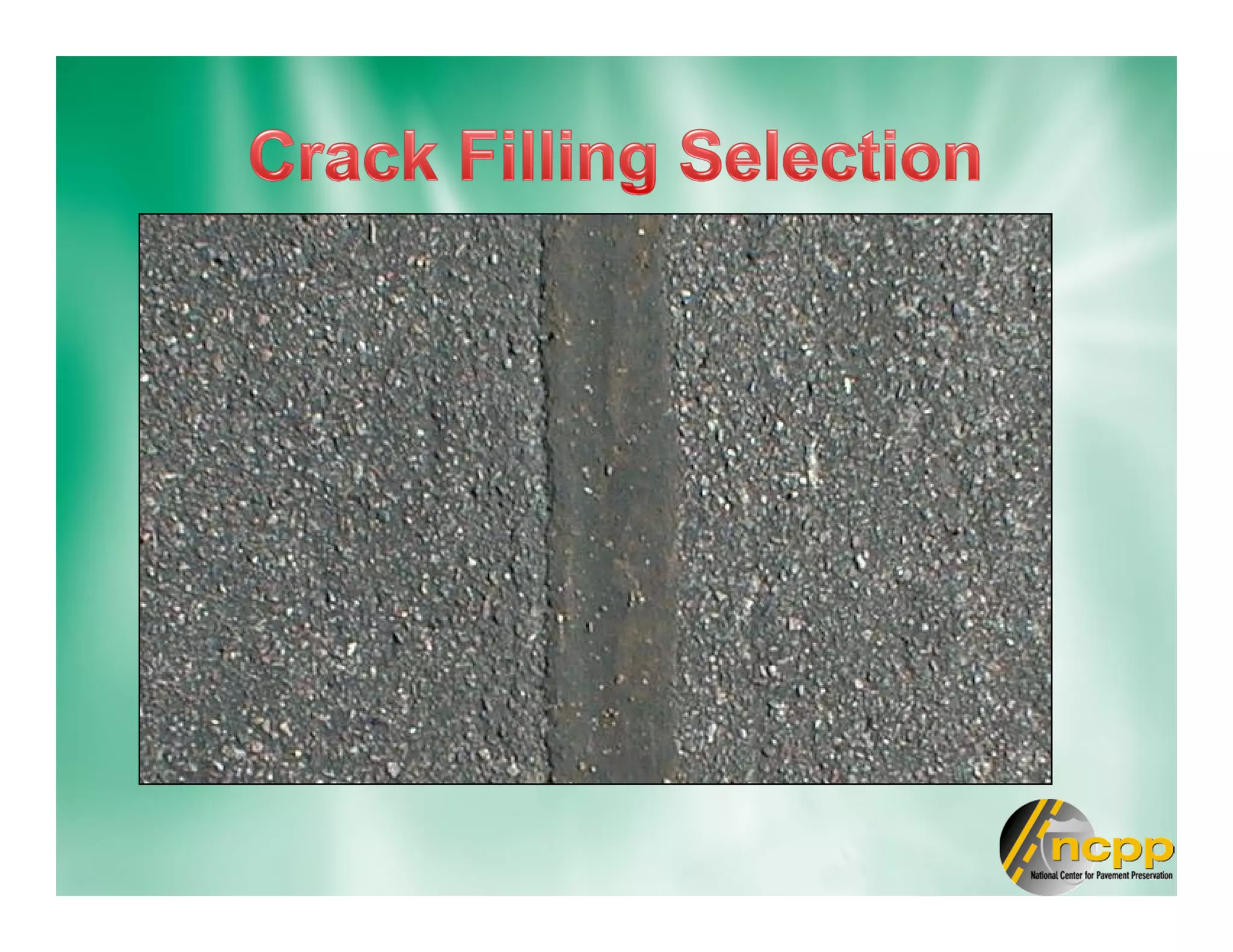
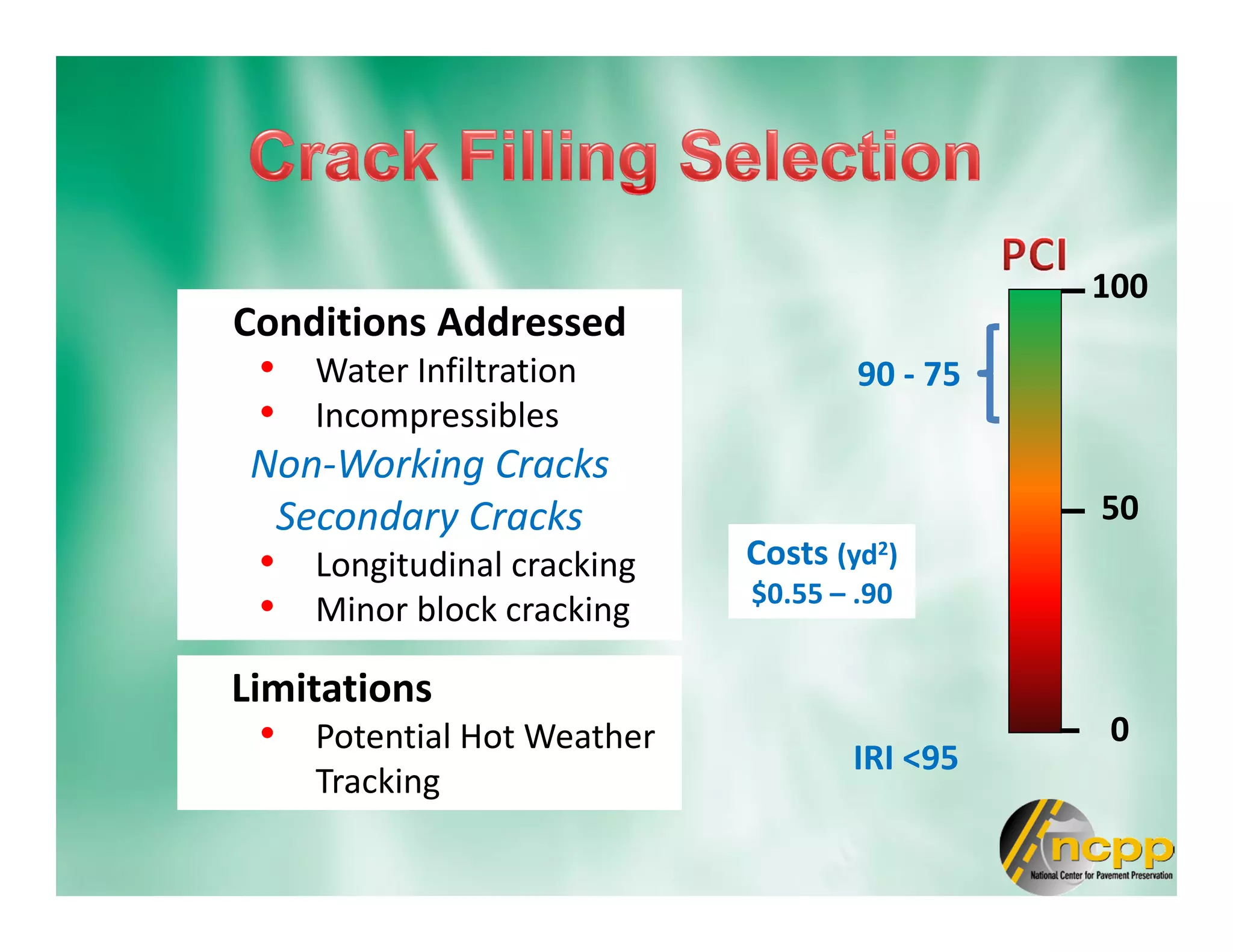
Conditions Addressed
• Water Infiltration
• Incompressibles
Non-Working Cracks
Secondary Cracks
• Longitudinal cracking
• Minor block cracking
100
0
50
90 - 75
IRI <95
Limitations
• Potential Hot Weather
Tracking
Costs (yd2)
$0.55 – .90
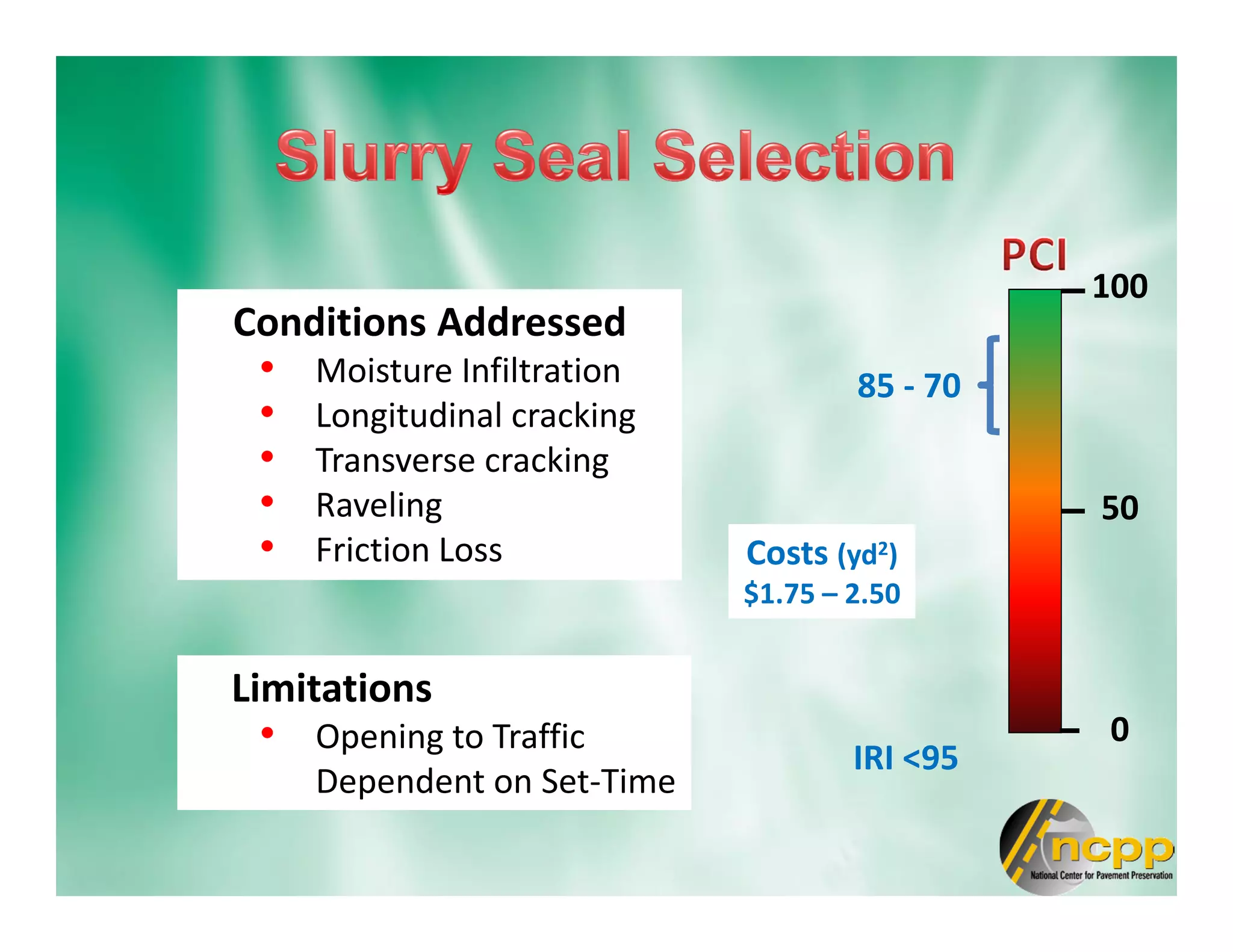
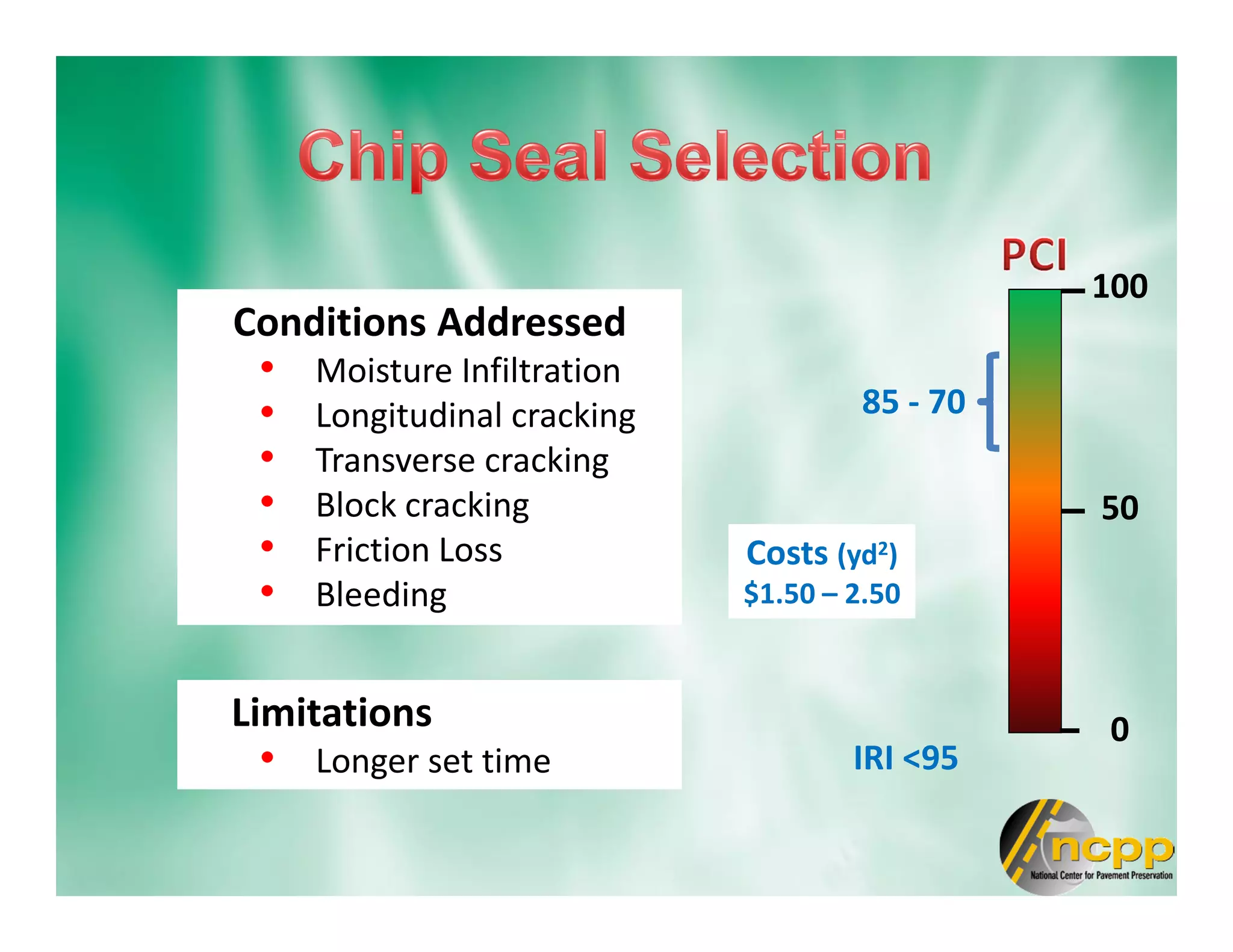
Conditions Addressed
• Moisture Infiltration
• Longitudinal cracking
• Transverse cracking
• Raveling
• Friction Loss
100
0
50
85 - 70
IRI <95
Limitations
• Opening to Traffic
Dependent on Set-Time
Costs (yd2)
$1.75 – 2.50
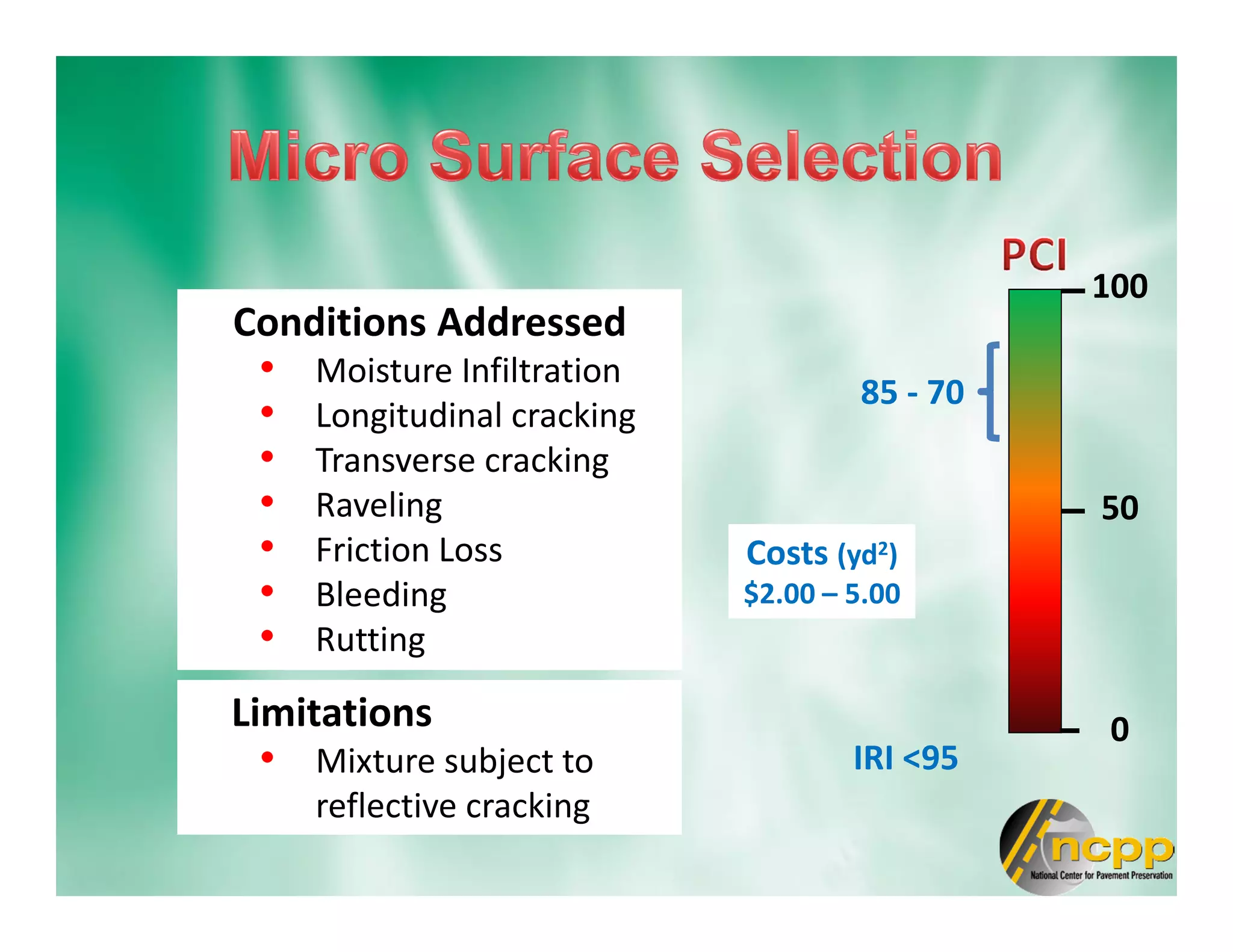
Conditions Addressed
• Moisture Infiltration
• Longitudinal cracking
• Transverse cracking
• Raveling
• Friction Loss
• Bleeding
• Rutting
100
0
50
85 - 70
IRI <95
Limitations
• Mixture subject to
reflective cracking
Costs (yd2)
$2.00 – 5.00
Conditions Addressed
• Moisture Infiltration
• Longitudinal cracking
• Transverse cracking
• Block cracking
• Friction Loss
• Bleeding
100
0
50
85 - 70
IRI <95
Limitations
• Longer set time
Costs (yd2)
$1.50 – 2.50
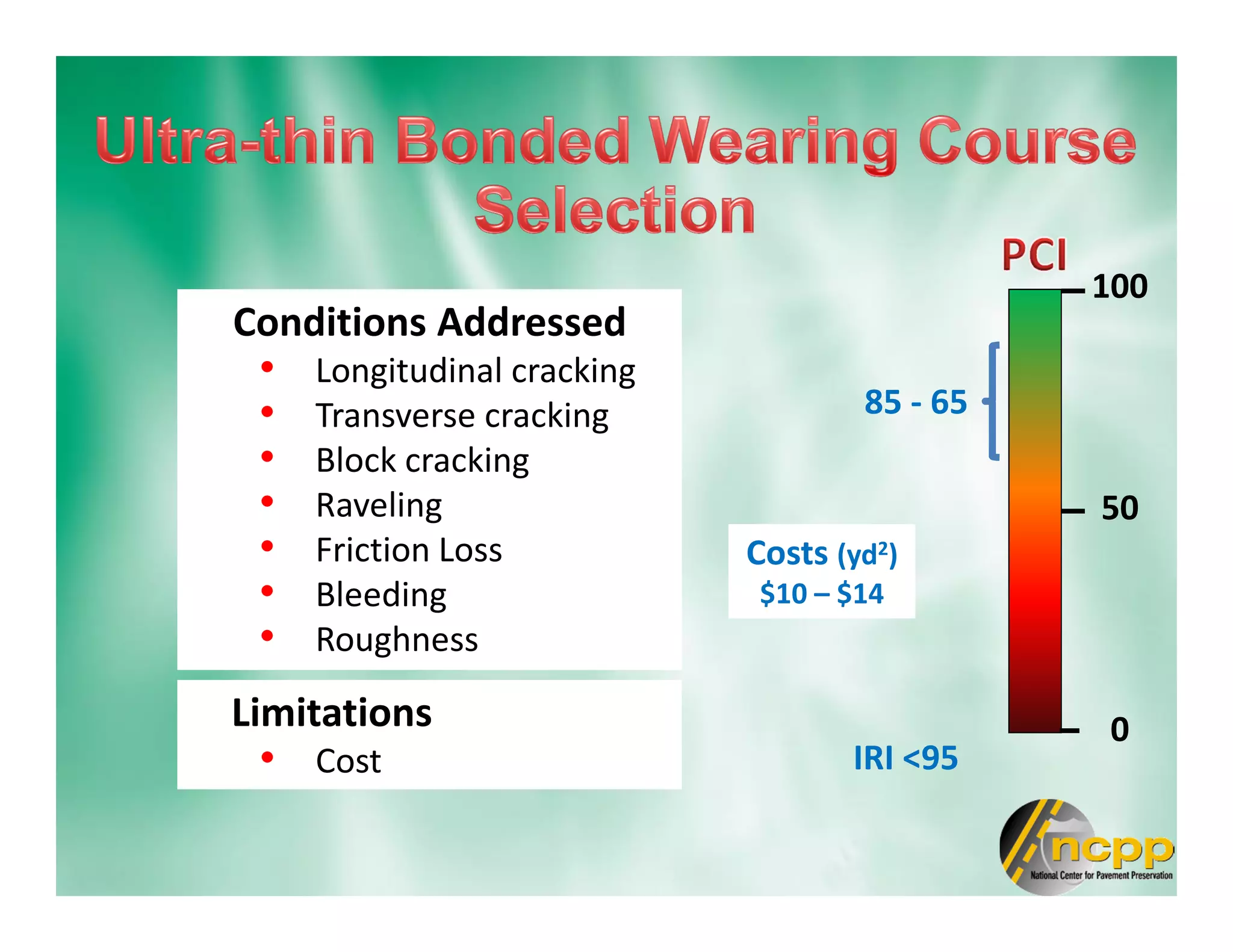
Conditions Addressed
• Longitudinal cracking
• Transverse cracking
• Block cracking
• Raveling
• Friction Loss
• Bleeding
• Roughness
100
0
50
85 - 65
IRI <95
Costs (yd2)
$10 – $14
Limitations
• Cost
Conditions Addressed
• Longitudinal cracking
• Transverse cracking
• Block cracking
• Raveling
• Friction Loss
• Bleeding
• Ride
• Splash/Spray (OGFC)
100
0
50
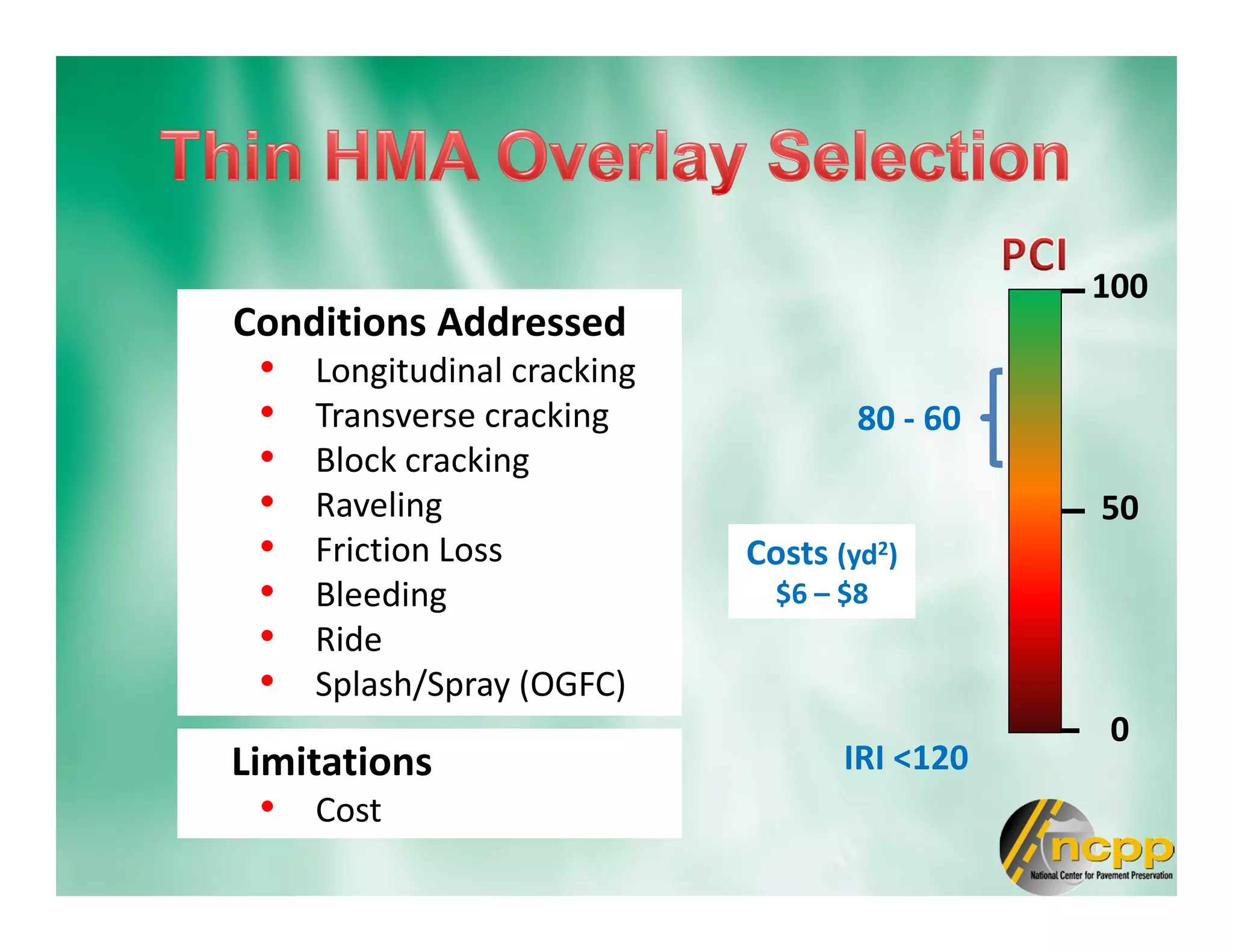
80 - 60
IRI <120
Costs (yd2)
$6 – $8
Limitations
• Cost
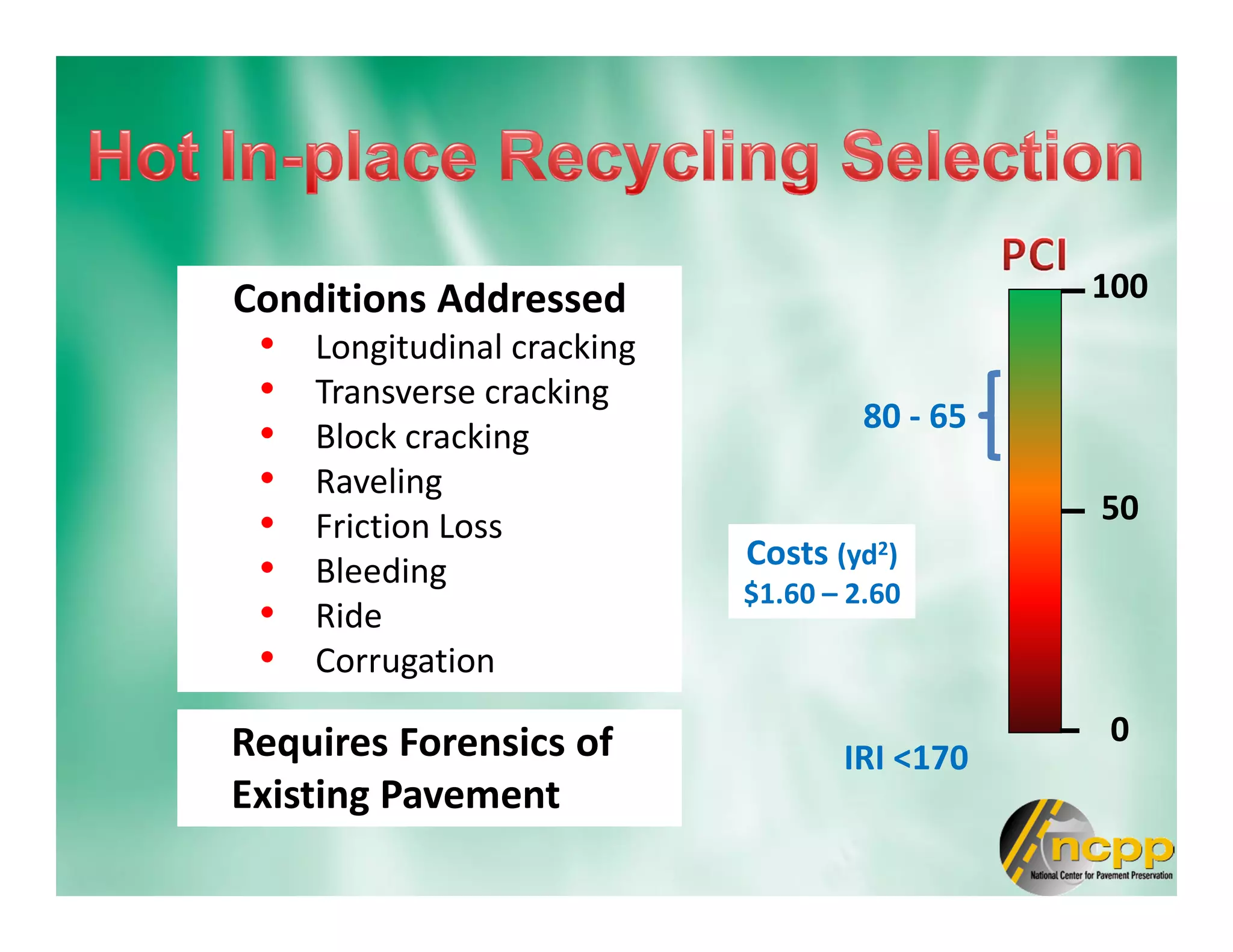
Conditions Addressed
• Longitudinal cracking
• Transverse cracking
• Block cracking
• Raveling
• Friction Loss
• Bleeding
• Ride
• Corrugation
100
0
50
80 - 65
IRI <170
Costs (yd2)
$1.60 – 2.60
Requires Forensics of
Existing Pavement
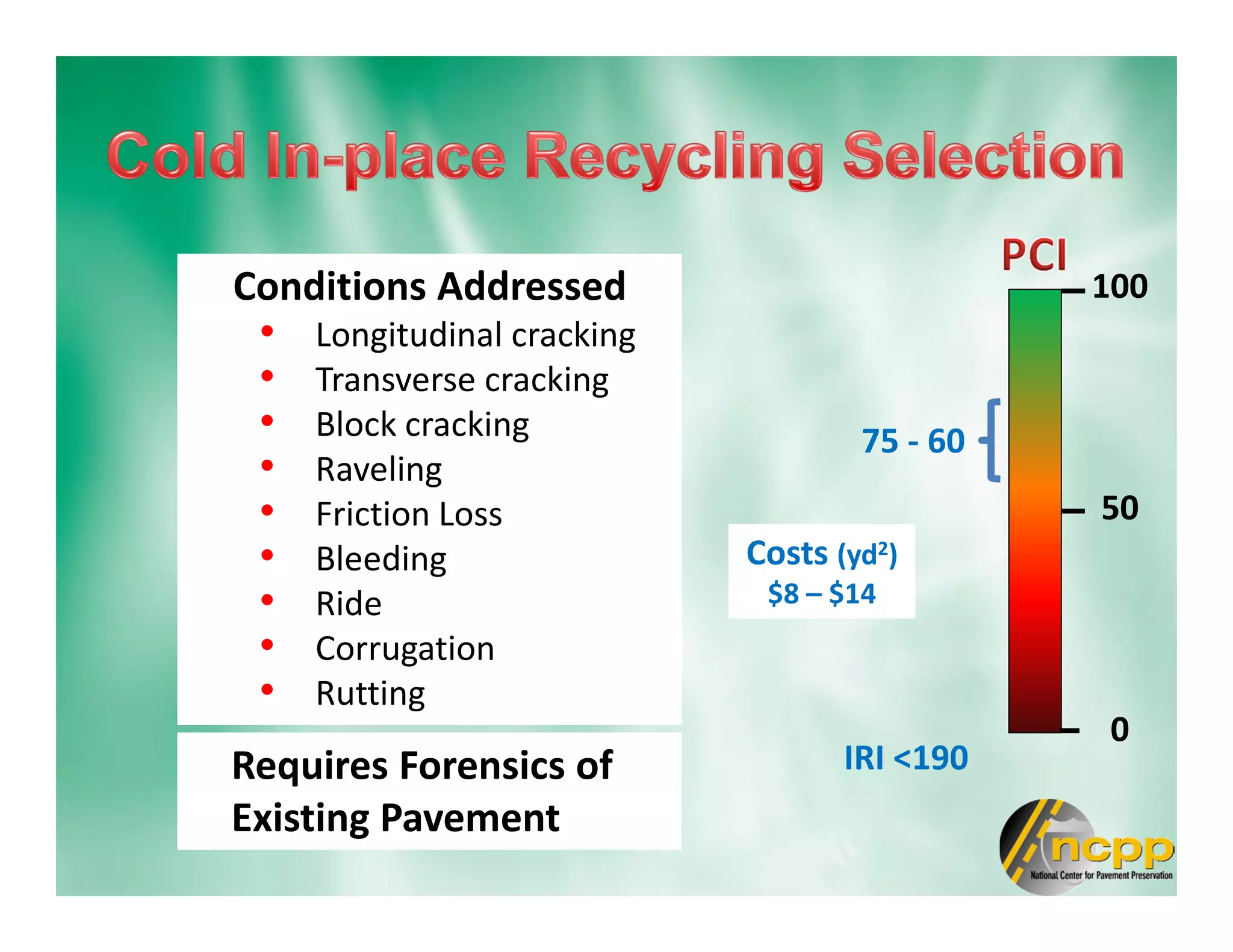
Conditions Addressed
• Longitudinal cracking
• Transverse cracking
• Block cracking
• Raveling
• Friction Loss
• Bleeding
• Ride
• Corrugation
• Rutting
100
0
50
75 - 60
IRI <190
Costs (yd2)
$8 – $14
Requires Forensics of
Existing Pavement
Please visit us on the web at www.pavementpreservation.org
Larry Galehouse, P.E., P.S.
Director
National Center for Pavement Preservation
2857 Jolly Road
Okemos, Michigan 48864
(517) 432-8220 • Fax: (517) 432-8223
email: galehou3@egr.msu.edu
www.pavementpreservation.org
www.tsp2.org

T16 addressing pavement assest management-galehouse

  • 1.
    Larry Galehouse, PE,PSLarry Galehouse, PE, PSLarry Galehouse, PE, PSLarry Galehouse, PE, PS Director, National Center for Pavement PreservationDirector, National Center for Pavement PreservationDirector, National Center for Pavement PreservationDirector, National Center for Pavement Preservation Larry Galehouse, PE, PSLarry Galehouse, PE, PSLarry Galehouse, PE, PSLarry Galehouse, PE, PS Director, National Center for Pavement PreservationDirector, National Center for Pavement PreservationDirector, National Center for Pavement PreservationDirector, National Center for Pavement Preservation April 23, 2013April 23, 2013
  • 5.
    Signed into LawJuly 6, 2012P.L. 112-141
  • 8.
    9,000 8,000 7,000 6,000 5,000 4,000 2002 2003 200420062005 2007 20092008 2010 201320122011 CenterlineMiles 8,700 4,290
  • 9.
    • Includes urbanand rural principal arterials, and main thoroughfares that carry heavy volumes of traffic, • Most on the state highway system and some are on local roads. • Many of these local roads function as main streets for communities and serve commercial areas and central business districts.
  • 10.
    • New designatedNHS roadways must use AASHTO Green Book standards to meet design expectations required as part of the NHS classification. • Design exceptions are remain an available mechanism in certain situations.
  • 11.
    • Federal lawgives the state DOT authority for selecting projects on the NHS in consultation with local officials. This potentially gives the state DOT a larger role in selecting projects on local roads, though this will likely not require a burdensome process.
  • 12.
    SEC. 1103. DEFINITIONS. (a)Definitions- Section 101(a) of title 23, United States Code, is amended— ‘‘(2) ASSET MANAGEMENT.—The term ‘asset management’ means a strategic and systematic process of operating, maintaining, and improving physical assets, with a focus on both engineering and economic analysis based upon quality information, to identify a structured sequence of maintenance, preservation, repair, rehabilitation, and replacement actions that will achieve and sustain a desired state of good repair over the lifecycle of the assets at minimum practicable cost.’’;
  • 13.
    SEC. 1507. MAINTENANCE Section116 of title 23, United States Code, is amended— (a) Definitions- In this section, the following definitions apply: ‘‘(2) PAVEMENT PRESERVATION PROGRAMS AND ACTIVITIES.— The term ‘pavement preservation programs and activities’ means programs and activities employing a network level, long-term strategy that enhances pavement performance by using an integrated, cost-effective set of practices that extend pavement life, improve safety, and meet road user expectations.’’;
  • 14.
    Sec. 134. MetropolitanTransportation Planning Title 23, United States Code, is amended— (h) Scope of Planning Process. - (1) In general. - The metropolitan planning process for a metropolitan planning area under this section shall provide for consideration of projects and strategies that will – (H) emphasize the preservation of the existing transportation system.
  • 15.
    Sec. 134. MetropolitanTransportation Planning Title 23, United States Code, is amended— (i) Development of Transportation Plan. - (2) Transportation plan. - A transportation plan under this section shall be in a form that the Secretary determines to be appropriate and shall contain, at a minimum, the following: (G) Capital investment and other strategies. - Capital investment and other strategies to preserve the existing and projected future metropolitan transportation infrastructure and provide for multimodal capacity increases based on regional priorities and needs.
  • 17.
    Traditional Alternative D.I. –is distress index, a measure of pavement condition. Scale values: 100=no distress, 50=when reconstruction is required. R.S.L. – is remaining service life, the time remaining that a pavement can be preserved. ACTIVITY D.I. (Before) D.I. (After) AGE LIFE EXTEND (Years) R.S.L. (Years) COST (Lane-Mile) COMMENTS New Construction 100 0 25 $508,000 $ 21,000 Construct Cost User Cost Reconstruct 49 0 25 25 $ 463,000 $ 19,000 Construct Cost User Cost Total $ 971,000 $ 40,000 Construct Cost User Cost
  • 18.
    Traditional Alternative Analysis Period– 25 yr. Construction = $ 508,000 per lane mile Preservation = $ 0 per lane mile Salvage = $ 0 per lane mile Total Cost = $ 508,000 per lane mile Analysis Period – 25 yr. Construction = $ 508,000 per lane mile Preservation = $ 0 per lane mile Salvage = $ 0 per lane mile Total Cost = $ 508,000 per lane mile (Remaining Service Life = 0 years)
  • 19.
    Preservation Alternative ACTIVITY D.I. (Before) D.I. (After) AGE LIFE EXTEND (Years) R.S.L. (Years) COST (Lane-Mile) COMMENTS New Construction100 0 25 $ 508,000 $ 12,600 Construct Cost User Cost Crack Sealing 89 94 5 2 22 $ 5,162 $ 350 Construct Cost User Cost Thin Overlay 79 0 10 8 25 $ 40,808 $ 350 Construct Cost User Cost Crack Sealing 84 92 14 1 22 $ 5,162 $ 350 Construct Cost User Cost Slurry Seal 67 0 20 5 21 $ 16,935 $ 700 Construct Cost User Cost Chip Seal 86 93 25 2 18 $ 12,582 $ 350 Construct Cost User Cost Total $ 588,649 $ 23,100 Construct Cost User Cost
  • 20.
    Preservation Alternative Analysis Period– 25 yr. Construction = $ 508,000 per lane mile Preservation = $ 80,649 per lane mile Salvage =($ 333,360) per lane mile Total Cost = $ 255,289 per lane mile Analysis Period – 25 yr. Construction = $ 508,000 per lane mile Preservation = $ 80,649 per lane mile Salvage =($ 333,360) per lane mile Total Cost = $ 255,289 per lane mile (Remaining Service Life = 18 years)
  • 21.
    Comparison Cost Preservation Alternative– 25 yr. Total Cost = $ 255,289 per lane mile Preservation Alternative – 25 yr. Total Cost = $ 255,289 per lane mile Traditional Approach – 25 yr. Total Cost = $ 508,000 per lane mile Traditional Approach – 25 yr. Total Cost = $ 508,000 per lane mile Alternative Savings = $ 252,711 per lane mileAlternative Savings = $ 252,711 per lane mile
  • 22.
    Social ResponsibilityEcologyEconomy Sustainable Development €$ % + Sustainability meansmeeting present needs without compromising the ability of future generations to meet their needs.
  • 23.
  • 24.
  • 25.
  • 31.
    0 1 2 3 4 5 0 5 1015 20 25 Remaining Service Life (years) PercentofNetwork 6
  • 32.
    0 1 2 3 4 5 0 5 1015 20 25 Remaining Service Life (years) 6 7 8 PercentofNetwork
  • 33.
    • Must know: –Available Budget – Lane Miles of Network – Unit Costs of Work Types – Design Life of Reconstruction & Rehabilitation Work Types – Life Extensions of Pavement Preservation Treatments
  • 34.
    • Inventory • Trafficvolume and load • Pavement condition • Drainage • Maintenance
  • 35.
    Preservation Treatments Appliedto HMA Pavements Treatment Treatment Life (yr.) Life Extension (yr.) Rejuvenator* NA 3 - 6 Surface Sealer 0 - 1 2 - 4 Crack Sealing 3 - 8 2 - 4 Crack Filling 2 - 4 1 - 3 Slurry Seal 4 - 5 3 - 5 Micro Surfacing - Single 3 – 6 3 - 5 Micro Surfacing - Double 4 - 7 4 - 6 Chip Seal - Single 3 – 7 5 - 6 Chip Seal - Double 5 – 10 8 - 10 Ultra-thin Bonded Wearing 7 – 12 NA Dense Graded Thin HMA 5 - 12 NA Open Graded Thin HMA 6 - 12 NA Hot In-place Recycling 6 - 10 NA Cold In-place Recycling 6 - 10 NA * Only certain rejuventors were considered
  • 36.
    Treatment Good Condition (PCI=80) Fair Condition (PCI=60) Poor Condition (PCI=40) Crack Fill 1- 3 0 - 2 0 Crack Seal 2 - 4 1 - 3 0 Fog Seal 2 - 4 0 - 1 0 Chip Seal 5 - 6 3 - 5 0 - 3 Micro-Surfacing 4 – 6 3 - 5 1 - 4 Thin HMA 4 - 10 3 - 7 2 - 4
  • 37.
  • 38.
    PMS Data Point Very Good Good Fair Poor Very Poor Time(Years) PMS Data PointPMS Data Point Measured Life ExtensionMeasured Life Extension
  • 39.
    Simply stated itis the: “right” treatment on the “right” road at the “right” time by the “right” people
  • 40.
    • Other potentialcriteria – Availability of qualified contractors – Availability of materials – Time (of year) of construction – Pavement noise – Facility downtime – Surface friction
  • 42.
    Conditions Addressed • Oxidation •Maltine Replenishment • Moisture Infiltration 100 0 50 100 - 85 IRI <95 Limitations • Initial Low Skid Costs (yd2) $0.80 – 0.95
  • 44.
    Conditions Addressed • Oxidation •Asphalt Film Thickness • Initial Raveling • Moisture Infiltration 100 0 50 95 - 75 IRI <95 Limitations • Initial Low Skid Costs (yd2) $0.25 – 0.45
  • 46.
    Conditions Addressed • WaterInfiltration • Incompressibles Primary Working Cracks • Transverse cracking • Reflective cracking 100 0 50 95 - 80 IRI <95 Limitations • Must have Clean & Dry Reservoir Costs (yd2) $0.55 – .90
  • 48.
    Conditions Addressed • WaterInfiltration • Incompressibles Non-Working Cracks Secondary Cracks • Longitudinal cracking • Minor block cracking 100 0 50 90 - 75 IRI <95 Limitations • Potential Hot Weather Tracking Costs (yd2) $0.55 – .90
  • 50.
    Conditions Addressed • MoistureInfiltration • Longitudinal cracking • Transverse cracking • Raveling • Friction Loss 100 0 50 85 - 70 IRI <95 Limitations • Opening to Traffic Dependent on Set-Time Costs (yd2) $1.75 – 2.50
  • 52.
    Conditions Addressed • MoistureInfiltration • Longitudinal cracking • Transverse cracking • Raveling • Friction Loss • Bleeding • Rutting 100 0 50 85 - 70 IRI <95 Limitations • Mixture subject to reflective cracking Costs (yd2) $2.00 – 5.00
  • 54.
    Conditions Addressed • MoistureInfiltration • Longitudinal cracking • Transverse cracking • Block cracking • Friction Loss • Bleeding 100 0 50 85 - 70 IRI <95 Limitations • Longer set time Costs (yd2) $1.50 – 2.50
  • 56.
    Conditions Addressed • Longitudinalcracking • Transverse cracking • Block cracking • Raveling • Friction Loss • Bleeding • Roughness 100 0 50 85 - 65 IRI <95 Costs (yd2) $10 – $14 Limitations • Cost
  • 58.
    Conditions Addressed • Longitudinalcracking • Transverse cracking • Block cracking • Raveling • Friction Loss • Bleeding • Ride • Splash/Spray (OGFC) 100 0 50 80 - 60 IRI <120 Costs (yd2) $6 – $8 Limitations • Cost
  • 60.
    Conditions Addressed • Longitudinalcracking • Transverse cracking • Block cracking • Raveling • Friction Loss • Bleeding • Ride • Corrugation 100 0 50 80 - 65 IRI <170 Costs (yd2) $1.60 – 2.60 Requires Forensics of Existing Pavement
  • 62.
    Conditions Addressed • Longitudinalcracking • Transverse cracking • Block cracking • Raveling • Friction Loss • Bleeding • Ride • Corrugation • Rutting 100 0 50 75 - 60 IRI <190 Costs (yd2) $8 – $14 Requires Forensics of Existing Pavement
  • 63.
    Please visit uson the web at www.pavementpreservation.org Larry Galehouse, P.E., P.S. Director National Center for Pavement Preservation 2857 Jolly Road Okemos, Michigan 48864 (517) 432-8220 • Fax: (517) 432-8223 email: galehou3@egr.msu.edu www.pavementpreservation.org www.tsp2.org