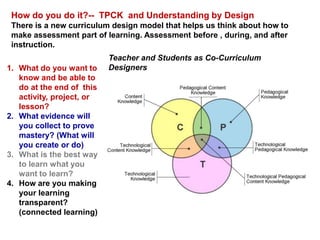
How do you do it?-- TPCK and Understanding by Design
There is a new curriculum design model that helps us think about how to
make assessment part of learning. Assessment before , during, and after
instruction.
Teacher and Students as Co-Curriculum
Designers1. What do you want to
know and be able to
do at the end of this
activity, project, or
lesson?
2. What evidence will
you collect to prove
mastery? (What will
you create or do)
3. What is the best way
to learn what you
want to learn?
4. How are you making
your learning
transparent?
(connected learning)
Why TPACK?
• Learning how to use technology is much
different than knowing what to do with it for
instructional purposes
• Redesigning instruction requires an
understanding of how knowledge about
content, pedagogy, and technology overlap to
inform your choices for curriculum and
instruction
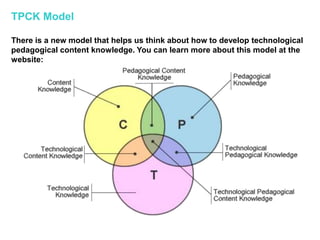
TPCK Model
There is a new model that helps us think about how to develop technological
pedagogical content knowledge. You can learn more about this model at the
website:
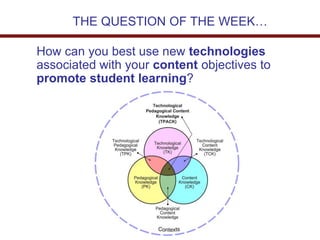
7 Pieces of the TPACK Pie
• Content [CK]: subject matter to be learned
• Technology [TK]: foundational and new technologies
• Pedagogy [PK]: purpose, values & methods used to teach
and evaluate learning
• PCK: What pedagogical strategies make concepts
difficult or easy to learn?
• TCK: How is content represented and transformed by the
application of technology?
• TPK: What pedagogical strategies enable you to get the
most out of existing technologies for teaching &
evaluating learning?
• TPCK:Understanding the relationship between elements -
- “a change in any one factor has to be „compensated‟ by
changes in the other two”
THE QUESTION OF THE WEEK…
How can you best use new technologies
associated with your content objectives to
promote student learning?
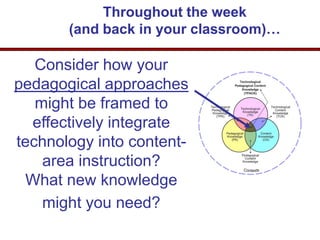
Consider how your
pedagogical approaches
might be framed to
effectively integrate
technology into content-
area instruction?
What new knowledge
might you need?
Throughout the week
(and back in your classroom)…
• Content focus: What content does this lesson focus on?
• Pedagogical focus: What pedagogical practices are
employed in this lesson?
• Technology used: What technologies are used?
• PCK: Do these pedagogical practices make concepts
clearer and/or foster deeper learning?
• TCK: Does the use of technology help represent the
content in diverse ways or maximize opportunities to
transform the content in ways that make sense to the
learner?
• TPK: Do the pedagogical practices maximize the use of
existing technologies for teaching and evaluating
learning?
• TPCK:How might things need to change if one aspect of
the lesson were to be different or not available?
TPACK Guidelines
TPACK in Practice
Step 1- Best Practice
Researchers at Mid-continent Research for Education and Learning (McREL) have
identified nine instructional strategies that are most likely to improve student achievement
across all content areas and across all grade levels. These strategies are explained in the
book Classroom Instruction That Works by Robert Marzano, Debra Pickering, and Jane
Pollock.
1. Identifying similarities and differences
2. Summarizing and note taking
3. Reinforcing effort and providing recognition
4. Homework and practice
5. Nonlinguistic representations
6. Cooperative learning
7. Setting objectives and providing feedback
8. Generating and testing hypotheses
9. Cues, questions, and advance organizers
What are specific strategies you use in your classroom
for a particular discipline?
Step 2- What Tool Fits?
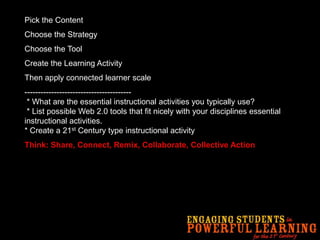
Pick the Content
Choose the Strategy
Choose the Tool
Create the Learning Activity
Then apply connected learner scale
----------------------------------------
* What are the essential instructional activities you typically use?
* List possible Web 2.0 tools that fit nicely with your disciplines essential
instructional activities.
* Create a 21st Century type instructional activity
Think: Share, Connect, Remix, Collaborate, Collective Action

T pack 2013

  • 2.
    How do youdo it?-- TPCK and Understanding by Design There is a new curriculum design model that helps us think about how to make assessment part of learning. Assessment before , during, and after instruction. Teacher and Students as Co-Curriculum Designers1. What do you want to know and be able to do at the end of this activity, project, or lesson? 2. What evidence will you collect to prove mastery? (What will you create or do) 3. What is the best way to learn what you want to learn? 4. How are you making your learning transparent? (connected learning)
  • 3.
    Why TPACK? • Learninghow to use technology is much different than knowing what to do with it for instructional purposes • Redesigning instruction requires an understanding of how knowledge about content, pedagogy, and technology overlap to inform your choices for curriculum and instruction
  • 4.
    TPCK Model There isa new model that helps us think about how to develop technological pedagogical content knowledge. You can learn more about this model at the website:
  • 5.
    7 Pieces ofthe TPACK Pie • Content [CK]: subject matter to be learned • Technology [TK]: foundational and new technologies • Pedagogy [PK]: purpose, values & methods used to teach and evaluate learning • PCK: What pedagogical strategies make concepts difficult or easy to learn? • TCK: How is content represented and transformed by the application of technology? • TPK: What pedagogical strategies enable you to get the most out of existing technologies for teaching & evaluating learning? • TPCK:Understanding the relationship between elements - - “a change in any one factor has to be „compensated‟ by changes in the other two”
  • 6.
    THE QUESTION OFTHE WEEK… How can you best use new technologies associated with your content objectives to promote student learning?
  • 7.
    Consider how your pedagogicalapproaches might be framed to effectively integrate technology into content- area instruction? What new knowledge might you need? Throughout the week (and back in your classroom)…
  • 8.
    • Content focus:What content does this lesson focus on? • Pedagogical focus: What pedagogical practices are employed in this lesson? • Technology used: What technologies are used? • PCK: Do these pedagogical practices make concepts clearer and/or foster deeper learning? • TCK: Does the use of technology help represent the content in diverse ways or maximize opportunities to transform the content in ways that make sense to the learner? • TPK: Do the pedagogical practices maximize the use of existing technologies for teaching and evaluating learning? • TPCK:How might things need to change if one aspect of the lesson were to be different or not available? TPACK Guidelines
  • 9.
    TPACK in Practice Step1- Best Practice Researchers at Mid-continent Research for Education and Learning (McREL) have identified nine instructional strategies that are most likely to improve student achievement across all content areas and across all grade levels. These strategies are explained in the book Classroom Instruction That Works by Robert Marzano, Debra Pickering, and Jane Pollock. 1. Identifying similarities and differences 2. Summarizing and note taking 3. Reinforcing effort and providing recognition 4. Homework and practice 5. Nonlinguistic representations 6. Cooperative learning 7. Setting objectives and providing feedback 8. Generating and testing hypotheses 9. Cues, questions, and advance organizers
  • 10.
    What are specificstrategies you use in your classroom for a particular discipline?
  • 11.
    Step 2- WhatTool Fits?
  • 13.
    Pick the Content Choosethe Strategy Choose the Tool Create the Learning Activity Then apply connected learner scale ---------------------------------------- * What are the essential instructional activities you typically use? * List possible Web 2.0 tools that fit nicely with your disciplines essential instructional activities. * Create a 21st Century type instructional activity Think: Share, Connect, Remix, Collaborate, Collective Action