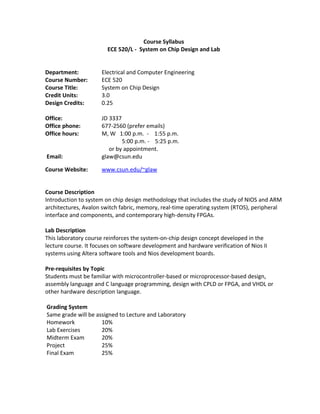
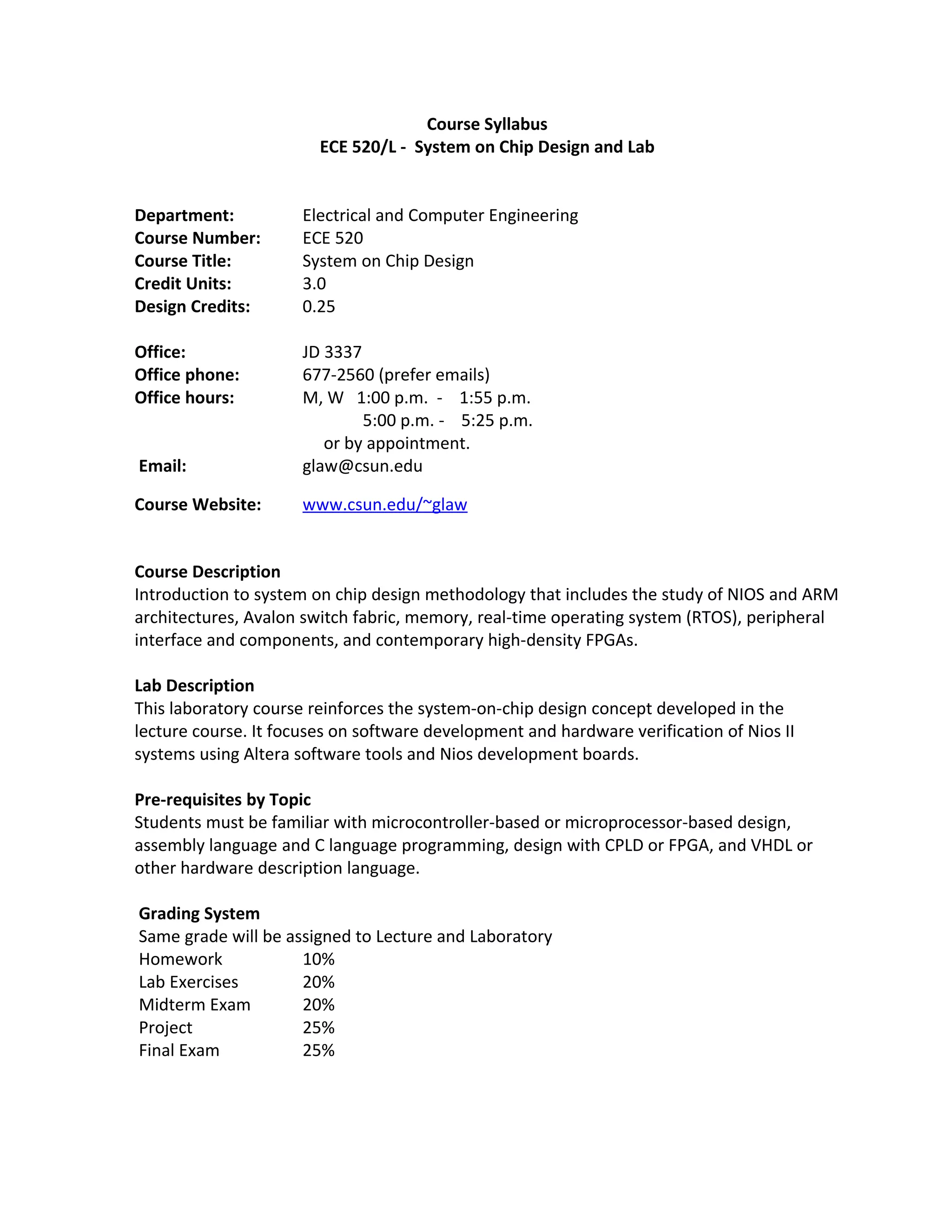
Course Syllabus
ECE 520/L - System on Chip Design and Lab
Department: Electrical and Computer Engineering
Course Number: ECE 520
Course Title: System on Chip Design
Credit Units: 3.0
Design Credits: 0.25
Office: JD 3337
Office phone: 677-2560 (prefer emails)
Office hours: M, W 1:00 p.m. - 1:55 p.m.
5:00 p.m. - 5:25 p.m.
or by appointment.
Email: glaw@csun.edu
Course Website: www.csun.edu/~glaw
Course Description
Introduction to system on chip design methodology that includes the study of NIOS and ARM
architectures, Avalon switch fabric, memory, real-time operating system (RTOS), peripheral
interface and components, and contemporary high-density FPGAs.
Lab Description
This laboratory course reinforces the system-on-chip design concept developed in the
lecture course. It focuses on software development and hardware verification of Nios II
systems using Altera software tools and Nios development boards.
Pre-requisites by Topic
Students must be familiar with microcontroller-based or microprocessor-based design,
assembly language and C language programming, design with CPLD or FPGA, and VHDL or
other hardware description language.
Grading System
Same grade will be assigned to Lecture and Laboratory
Homework 10%
Lab Exercises 20%
Midterm Exam 20%
Project 25%
Final Exam 25%
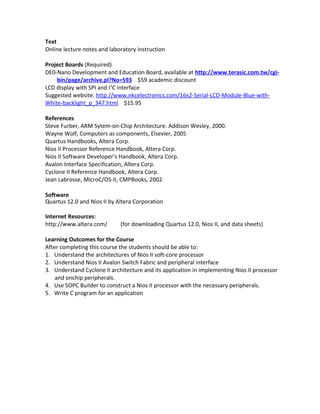
Text
Online lecture notes and laboratory instruction
Project Boards (Required)
DE0-Nano Development and Education Board, available at http://www.terasic.com.tw/cgi-
bin/page/archive.pl?No=593 $59 academic discount
LCD display with SPI and I2
C interface
Suggested website: http://www.nkcelectronics.com/16x2-Serial-LCD-Module-Blue-with-
White-backlight_p_347.html $15.95
References
Steve Furber, ARM Sytem-on-Chip Architecture. Addison Wesley, 2000.
Wayne Wolf, Computers as components, Elsevier, 2005
Quartus Handbooks, Altera Corp.
Nios II Processor Reference Handbook, Altera Corp.
Nios II Software Developer’s Handbook, Altera Corp.
Avalon Interface Specification, Altera Corp.
Cyclone II Reference Handbook, Altera Corp.
Jean Labrosse, MicroC/OS-II, CMPBooks, 2002
Software
Quartus 12.0 and Nios II by Altera Corporation
Internet Resources:
http://www.altera.com/ (for downloading Quartus 12.0, Nios II, and data sheets)
Learning Outcomes for the Course
After completing this course the students should be able to:
1. Understand the architectures of Nios II soft-core processor
2. Understand Nios II Avalon Switch Fabric and peripheral interface
3. Understand Cyclone II architecture and its application in implementing Nios II processor
and onchip peripherals.
4. Use SOPC Builder to construct a Nios II processor with the necessary peripherals.
5. Write C program for an application
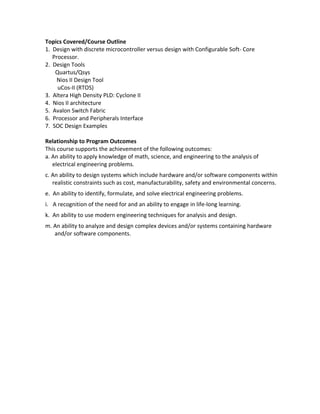
Topics Covered/Course Outline
1. Design with discrete microcontroller versus design with Configurable Soft- Core
Processor.
2. Design Tools
Quartus/Qsys
Nios II Design Tool
uCos-II (RTOS)
3. Altera High Density PLD: Cyclone II
4. Nios II architecture
5. Avalon Switch Fabric
6. Processor and Peripherals Interface
7. SOC Design Examples
Relationship to Program Outcomes
This course supports the achievement of the following outcomes:
a. An ability to apply knowledge of math, science, and engineering to the analysis of
electrical engineering problems.
c. An ability to design systems which include hardware and/or software components within
realistic constraints such as cost, manufacturability, safety and environmental concerns.
e. An ability to identify, formulate, and solve electrical engineering problems.
i. A recognition of the need for and an ability to engage in life-long learning.
k. An ability to use modern engineering techniques for analysis and design.
m. An ability to analyze and design complex devices and/or systems containing hardware
and/or software components.

Syllabus

  • 1.
    Course Syllabus ECE 520/L- System on Chip Design and Lab Department: Electrical and Computer Engineering Course Number: ECE 520 Course Title: System on Chip Design Credit Units: 3.0 Design Credits: 0.25 Office: JD 3337 Office phone: 677-2560 (prefer emails) Office hours: M, W 1:00 p.m. - 1:55 p.m. 5:00 p.m. - 5:25 p.m. or by appointment. Email: glaw@csun.edu Course Website: www.csun.edu/~glaw Course Description Introduction to system on chip design methodology that includes the study of NIOS and ARM architectures, Avalon switch fabric, memory, real-time operating system (RTOS), peripheral interface and components, and contemporary high-density FPGAs. Lab Description This laboratory course reinforces the system-on-chip design concept developed in the lecture course. It focuses on software development and hardware verification of Nios II systems using Altera software tools and Nios development boards. Pre-requisites by Topic Students must be familiar with microcontroller-based or microprocessor-based design, assembly language and C language programming, design with CPLD or FPGA, and VHDL or other hardware description language. Grading System Same grade will be assigned to Lecture and Laboratory Homework 10% Lab Exercises 20% Midterm Exam 20% Project 25% Final Exam 25%
  • 2.
    Text Online lecture notesand laboratory instruction Project Boards (Required) DE0-Nano Development and Education Board, available at http://www.terasic.com.tw/cgi- bin/page/archive.pl?No=593 $59 academic discount LCD display with SPI and I2 C interface Suggested website: http://www.nkcelectronics.com/16x2-Serial-LCD-Module-Blue-with- White-backlight_p_347.html $15.95 References Steve Furber, ARM Sytem-on-Chip Architecture. Addison Wesley, 2000. Wayne Wolf, Computers as components, Elsevier, 2005 Quartus Handbooks, Altera Corp. Nios II Processor Reference Handbook, Altera Corp. Nios II Software Developer’s Handbook, Altera Corp. Avalon Interface Specification, Altera Corp. Cyclone II Reference Handbook, Altera Corp. Jean Labrosse, MicroC/OS-II, CMPBooks, 2002 Software Quartus 12.0 and Nios II by Altera Corporation Internet Resources: http://www.altera.com/ (for downloading Quartus 12.0, Nios II, and data sheets) Learning Outcomes for the Course After completing this course the students should be able to: 1. Understand the architectures of Nios II soft-core processor 2. Understand Nios II Avalon Switch Fabric and peripheral interface 3. Understand Cyclone II architecture and its application in implementing Nios II processor and onchip peripherals. 4. Use SOPC Builder to construct a Nios II processor with the necessary peripherals. 5. Write C program for an application
  • 3.
    Topics Covered/Course Outline 1.Design with discrete microcontroller versus design with Configurable Soft- Core Processor. 2. Design Tools Quartus/Qsys Nios II Design Tool uCos-II (RTOS) 3. Altera High Density PLD: Cyclone II 4. Nios II architecture 5. Avalon Switch Fabric 6. Processor and Peripherals Interface 7. SOC Design Examples Relationship to Program Outcomes This course supports the achievement of the following outcomes: a. An ability to apply knowledge of math, science, and engineering to the analysis of electrical engineering problems. c. An ability to design systems which include hardware and/or software components within realistic constraints such as cost, manufacturability, safety and environmental concerns. e. An ability to identify, formulate, and solve electrical engineering problems. i. A recognition of the need for and an ability to engage in life-long learning. k. An ability to use modern engineering techniques for analysis and design. m. An ability to analyze and design complex devices and/or systems containing hardware and/or software components.