Email : sales@xbyte.io
Phone no : 1(832) 251 731
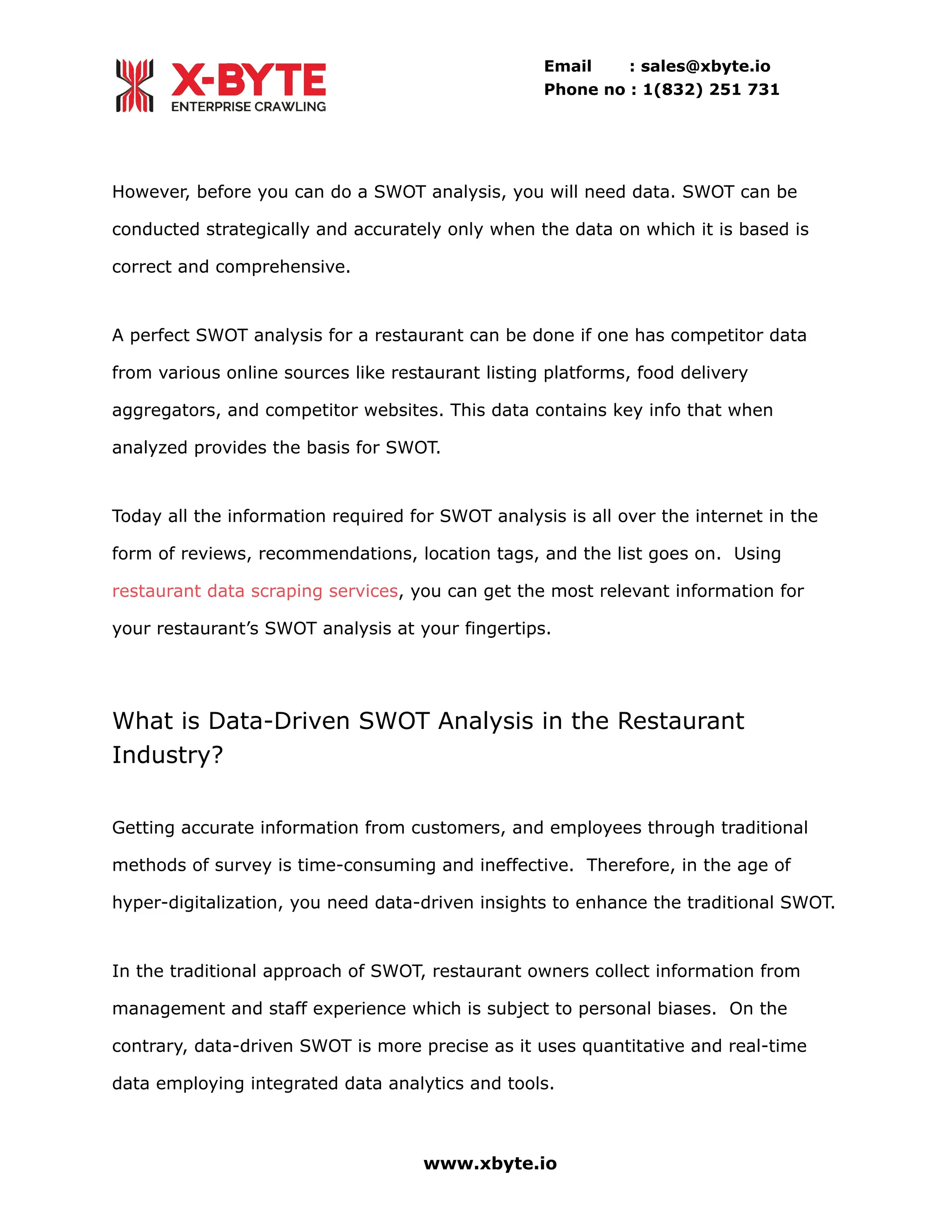
SWOT Analysis for Restaurants: A
Strategic Guide
Restaurant businesses are hyper-competitive. Those who want to beat the
competition and gain a distinct identity in this industry need to first understand
their strengths and weaknesses. This is where the SWOT analysis process can help
businesses identify their strengths, weaknesses, threats, and opportunities. If you
are a restaurant business, then SWOT analysis will provide a bird’ s-eye view of
your business, highlighting the areas where you thrive, room for improvement,
risks that need to be mitigated, and opportunities that can open new avenues for
your business.
Whether you are considering revamping your existing business or starting a new
one, this strategic planning activity is a must during the initial and ongoing phases
of your business.
www.xbyte.io
Email : sales@xbyte.io
Phone no : 1(832) 251 731
However, before you can do a SWOT analysis, you will need data. SWOT can be
conducted strategically and accurately only when the data on which it is based is
correct and comprehensive.
A perfect SWOT analysis for a restaurant can be done if one has competitor data
from various online sources like restaurant listing platforms, food delivery
aggregators, and competitor websites. This data contains key info that when
analyzed provides the basis for SWOT.
Today all the information required for SWOT analysis is all over the internet in the
form of reviews, recommendations, location tags, and the list goes on. Using
restaurant data scraping services, you can get the most relevant information for
your restaurant’s SWOT analysis at your fingertips.
What is Data-Driven SWOT Analysis in the Restaurant
Industry?
Getting accurate information from customers, and employees through traditional
methods of survey is time-consuming and ineffective. Therefore, in the age of
hyper-digitalization, you need data-driven insights to enhance the traditional SWOT.
In the traditional approach of SWOT, restaurant owners collect information from
management and staff experience which is subject to personal biases. On the
contrary, data-driven SWOT is more precise as it uses quantitative and real-time
data employing integrated data analytics and tools.
www.xbyte.io
Email : sales@xbyte.io
Phone no : 1(832) 251 731
The data-driven SWOT offers granular and fact-based insights to reveal insights
from different sources like the web, social media, industry players, etc.
Another advantage of data-driven SWOT is that it is not static like traditional SWOT,
reflecting aspects from a specific point in time. For instance, instead of analyzing a
competitor’s pricing strategy at a particular time, you can track their pricing
strategies monthly or quarterly to tailor your pricing and stay competitive.
Moreover, restaurants can use predictive analytics capabilities incorporated in
data-driven SWOT to forecast potential threats and upcoming opportunities.
It’s needless to say, data scraping for restaurants can transform their SWOT
analysis into an objective, strategic, and dynamic tool for the fast-paced sector like
restaurants. Given the dynamism in customer preferences and cut-throat
competition in the restaurant business, data-backed SWOT is vital. For that, data
scraping provides an immense size of data from diverse sources, enabling
restaurant businesses to stay responsive to market forces. With it, restaurants can
assess in which direction their competition is moving. They can forecast the
emerging customer preferences in food, dine-outs, and location from various data
streams. Thus, data scraping empowers restaurant enterprises to be proactive and
outperform their competitors.
www.xbyte.io
Email : sales@xbyte.io
Phone no : 1(832) 251 731
SWOT Analysis for Restaurants will benefit:
1. Restaurants (Dine-in Only)
2. Restaurant chain
3. Cloud-kitchens
4. Restaurants (Take Away Only)
5. Restaurants (Both Dine-in and Takeaway)
6. Restaurant aggregators
7. Restaurants partnered with Food delivery businesses
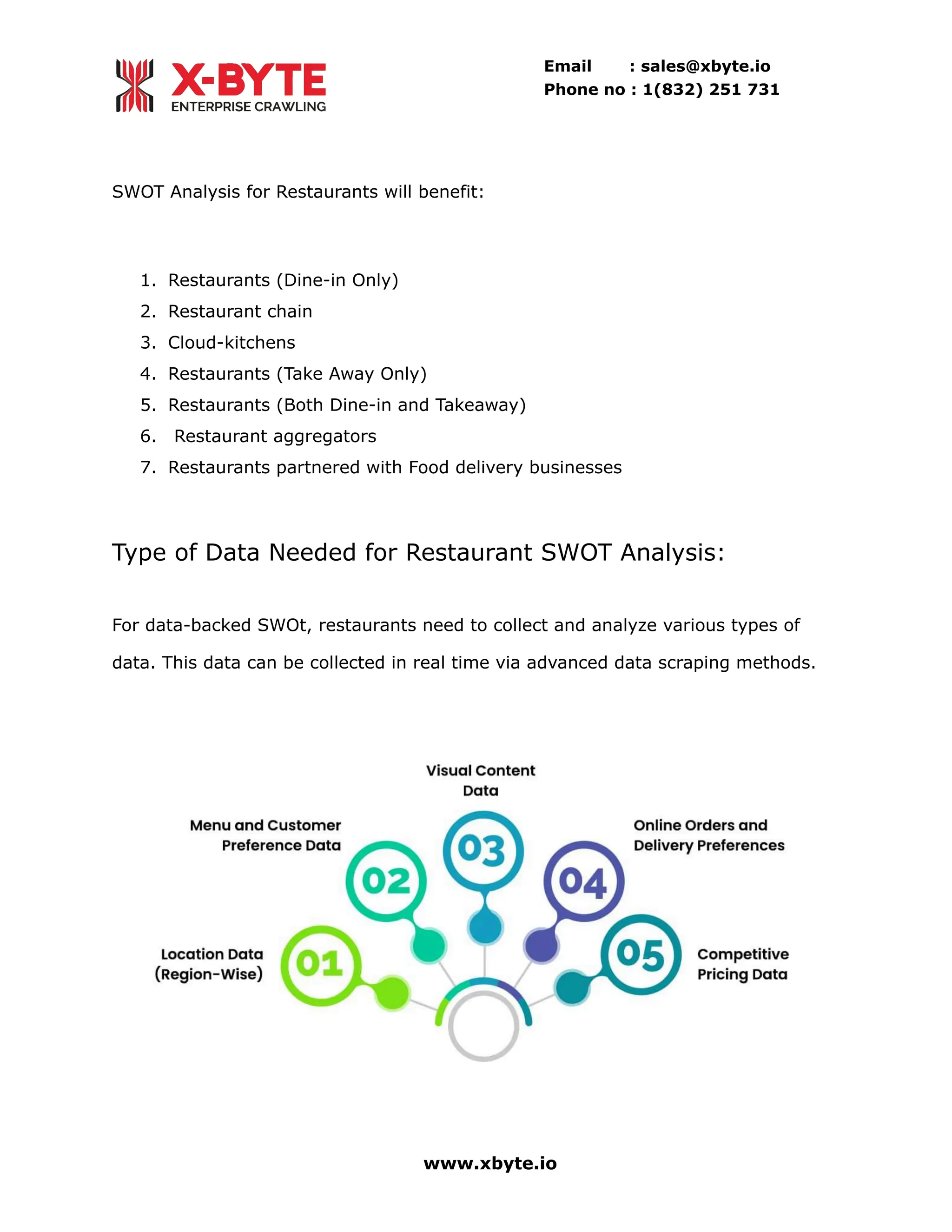
Type of Data Needed for Restaurant SWOT Analysis:
For data-backed SWOt, restaurants need to collect and analyze various types of
data. This data can be collected in real time via advanced data scraping methods.
www.xbyte.io
Email : sales@xbyte.io
Phone no : 1(832) 251 731
Below is the list of data that you will need for restaurant SWOT analysis:
#1 Location Data (Region-Wise)
Restaurant data scraping provides ample region-specific location information that
you may use to make targeted decisions and respond to market conditions. Using
scraped location data, you can identify weaknesses, such as if your offerings do not
match the regional demographic’s preferences or if there is any underserved region
in which you have expansion opportunities. Overall, scraped location data makes it
easy to assess where your business stands in the market by locating competitors’
locations, gaps in local dining options, and customer footfall potential.
Types of data scraped for location-related queries are:
● Regional competitor presence
● Popular menu items in specific regions
● Foot Traffic Patterns
● Proximity to Points of Interest
● Real Estate Trends in the Location
● Transportation Accessibility
● Local Economic Indicators
● Zoning Regulations & parking data
● Customer Demographics based on income, age, and lifestyle.
www.xbyte.io
Email : sales@xbyte.io
Phone no : 1(832) 251 731
#2 Menu and Customer Preference Data
Scraping food data such as best-selling dishes and frequently ordered items enables
restaurants to identify strengths that they can highlight in their promotions. You
can know which of the dishes or service options are getting lower ratings, revealing
the gaps in the restaurant’s offerings and areas that need more attention.
Advanced data analytics let you monitor what competitor’s trending offerings are
that can threaten your restaurant’s market share. Moreover, by scraping reviews
and hashtags, you can identify the emerging trends in food habits and lifestyle. You
can use these trends to identify opportunities to adapt to the customers’
preferences.
Types of data to understand trending menu and customer preferences:
● Most ordered dishes
● Menu Items
● Customer Ratings
● Competitors’ unique menu offerings
● Dietary trends include gluten-free, vegan, sugar-free, etc.
#3 Visual Content Data
For any restaurant business, visual content like food videos, appealing images of
dishes, ambiance, and packaging are key aspects. Thanks to data scraping, it goes
beyond extracting texts and provides information like food items, menus, and
ambiance from the images. You can even get insights about customers’ sentiments
www.xbyte.io
Email : sales@xbyte.io
Phone no : 1(832) 251 731
based on visual cues. It helps you identify gaps in visual elements of branding and
tailor your offerings to meet emerging trends and customer preferences.
The following data can be extracted in data scraping:
● Visual content of food presentation
● Decor Images
● Visuals used on packaging
● , Images of marketing materials
#4 Online Orders and Delivery Preferences
If you want to optimize the existing capacity of your restaurant business with online
delivery, data crawling will give you feasibility checks with real-time information.
By analyzing various data points related to food orders, you can align your services
to identify threats, weaknesses, and opportunities. For instance, you can get
real-time insights into packaging reviews highlighting differentiated delivery
services and popular dishes to tap new opportunities for boosting revenues.
Data fields you can furnish using data crawling services are:
● Business Hours of Competitors
● Popular Dishes for Delivery
● Preferred Delivery Methods
● Delivery Routes
● Zones of Service
www.xbyte.io
Email : sales@xbyte.io
Phone no : 1(832) 251 731
● Regional Order Patterns
● Repeat Orders
● Delivery Charges
#5 Competitive Pricing Data
When dealing in a highly competitive industry like the restaurant and food business,
an effective pricing strategy is crucial. Therefore, competitive pricing data scraping
is critical for gaining knowledge about the pricing strengths and weaknesses of the
business. You can get pricing insights such as food menu pricing of the
competitors, discount data, and promotional offers in the market. Responding to
these market trends and pricing from key industry players, you can develop a
dynamic pricing model through real-time pricing adjustments.
The following outputs are gained from competitive pricing scraping for the
restaurant business:
● Menu Item Prices
● Pricing by regions
● Discounts and Promotions
● Dynamic Pricing Trends (Ex. Pricing during peak hours and holiday seasons)
● Loyalty Programs and Rewards
● Price Comparisons by Order Channel (website, in-app, third-party delivery
platforms)
● Competitors Combo or Bundle Pricing
● Special Occasion Pricing
www.xbyte.io
Email : sales@xbyte.io
Phone no : 1(832) 251 731
Key Sources of Data for Restaurant SWOT Analysis
If you are seeking more informed SWOT analysis, data scraping can be very
beneficial. It provides insights into strengths, weaknesses, opportunities, and
threats for the business. Here are some of the data sources that are scraped for
detailed and in-depth information:
1. Review Sites like Yelp, TripAdvisor
Among the top five businesses reviewed on Yelp is the restaurant business.
According to an online survey by Review Trackers, 45% of customers go to Yelp for
reviews before visiting a business. Hence, such review sites are excellent sources
for analyzing direct feedback and identifying strengths and weaknesses. Combining
ratings also makes it easier to see patterns in customer satisfaction. One can easily
make out what people think about the business and what areas it needs to put
more effort into.
2. Social Media Platforms like Instagram, Facebook, X)
Instagram has become the favorite platform among GenZ customers. Scraping
images and location tags, provide extensive data about the trending preferences
and customer sentiments. Posts related to gluten-free, sugar-free snacks reveal a
lot about customer values. You can get a 360-degree view of emerging trends and
anticipate potential threats due to changing preferences.
www.xbyte.io
Email : sales@xbyte.io
Phone no : 1(832) 251 731
3. Online Food Ordering and Delivery Platforms
In the age of busy lifestyles, online food ordering platforms are the go-to option for
busy working people, it is also a great source of vital information about the food
industry. What kind of foods are ordered the most in specific regions, peak hours
for food orders, pricing and discount data, and customer demographics are some of
the information you can get for your restaurant business.
4. Search Engine Scraping like Google Trends
Since people go to Google for every query, it is obvious that Google Trends data will
reflect what people look for when searching for restaurants. For instance, relevant
terms like “vegan” can show the interests of the customers in a specific region.
Such information is useful to guide menu adjustments. Most importantly patterns
like an increase or decrease in searches can promptly highlight the threats or
opportunities to innovate.
5. Competitor Websites and Menus
Exploring competitors’ websites for pricing, menu, and promotion will help you
weigh your strategies and offerings against theirs. This data scraping will point out
the weak points in your pricing, for example. For instance, the scraping
competition’s website can reveal that your restaurant’s menu prices are
unreasonably higher and without any differentiator. Hence, it can reveal the flawed
pricing strategy as your business’ weakness that you can work on.
www.xbyte.io
Email : sales@xbyte.io
Phone no : 1(832) 251 731
6. Local Business Directories
When looking for contact information, such as addresses, phone numbers, and
emails, local business directories are a great resource. This information can help
your restaurant business to form alliances with regional vendors. Not to mention,
you can get in touch with local corporate customers for delivery or catering and
interact with patrons for marketing campaigns. A thorough profile that might be
helpful for market research and competition analysis is also provided by directories,
which frequently include customer evaluations, operating hours, and service
information.
Real-World Example: Data-Driven SWOT Analysis for a
Hypothetical Restaurant
To help you understand better how you can optimize the SWOT Analysis tool using
data scraping, we have prepared a practical example. It illustrates how specific
data sources and insights gained through data scraping directly support each
component of SWOT analysis offering you a complete picture for strategic actions.
www.xbyte.io
Email : sales@xbyte.io
Phone no : 1(832) 251 731
SWOT Points Data to be Collected Source of Data
Strengths Prime Location ● High foot traffic
near the beach
● Mentions of the
views and
location as
attractive
● Geo-location
data and foot
traffic statistics
from
location-based
platforms
● Customer review
sites for
mentions of
“view” and
“beach.”
Weaknesses Slow service during peak
hours
● Negative reviews
citing wait times
or slow service
● High foot traffic
on weekends and
holidays
● Negative reviews
mentioning “slow
service” or “wait
times” from Yelp,
TripAdvisor, and
Google
● Scraping social
media comments
for recent
mentions of wait
times
● Seasonal foot
traffic patterns
(Google Trends
data)
Opportunities High tourist footfall during
holiday seasons
● Tourist
demographics
and Seasonal
peak visit times
● Local tourism
events data
● Google Trends or
competitor
reviews for data
on holiday
seasons
impacting dining
preferences
Threats Increasing competition
with nearby casual dining
restaurants
● Competitor
analysis of
nearby
restaurants,
menu pricing,
promotions, and
popular dishes
● Competitor
website menu
scraping to
compare
offerings and
pricing
● Customer review
sites to
understand
competitor
strengths
● Social media to
track
promotional
campaigns of
competitors
www.xbyte.io
Email : sales@xbyte.io
Phone no : 1(832) 251 731
A Quick Snapshot
This strategic guide to data-driven SWOT using data scraping for Restaurant
business is sure to empower you to make the right choices. Here’s a gist of the
article and what you can do with data scraping to fuel your SWOT framework:
Capitalize on Strengths
➢ Monitor reputation by scraping reviews from sites like Yelp, Trip Advisor
➢ Enhance customer experiences with fast delivery, etc., by analyzing the
comments on social media platforms
➢ Bring differentiator by analyzing competitors’ websites for service and menu
Mitigate Weaknesses
➢ Identify service gaps by analyzing social media mentions and scraped reviews.
➢ Tailor menu to meet trends by scraping competitors’ websites
➢ Adapt dynamic pricing with real-time pricing data of competitors
Counteract Threats
➢ Access websites to analyze competitors’ promotional materials, pricing
➢ Scrap social media and review sites to monitor consumer behavior
Uncover Opportunities
➢ Track trending dietary preferences using trend analysis
➢ Identify successful partnerships by scraping delivery app data
➢ Use location data scraping to identify the most profitable location, demographics
www.xbyte.io
Email : sales@xbyte.io
Phone no : 1(832) 251 731
If you want to grow your restaurant business, data scraping is a cutting-edge tool
that can shed light on each component of SWOT analysis with in-depth data
extraction. It provides access to the huge amount of data available on social media
platforms, review sites, competitor’s menus, and websites.
As the leading restaurant data scraping service provider, X-Byte understands the
challenges of restaurateurs and the tools that can empower them to gain a
competitive edge in the market.
Looking to level up your business strategically with restaurant data scraping
services? Contact our team today!
Unleash Your Restaurant's Full
Potential!
Discover Restaurant Data Insights!
www.xbyte.io

SWOT Analysis for Restaurants: A Strategic Guide

  • 1.
    Email : sales@xbyte.io Phoneno : 1(832) 251 731 SWOT Analysis for Restaurants: A Strategic Guide Restaurant businesses are hyper-competitive. Those who want to beat the competition and gain a distinct identity in this industry need to first understand their strengths and weaknesses. This is where the SWOT analysis process can help businesses identify their strengths, weaknesses, threats, and opportunities. If you are a restaurant business, then SWOT analysis will provide a bird’ s-eye view of your business, highlighting the areas where you thrive, room for improvement, risks that need to be mitigated, and opportunities that can open new avenues for your business. Whether you are considering revamping your existing business or starting a new one, this strategic planning activity is a must during the initial and ongoing phases of your business. www.xbyte.io
  • 2.
    Email : sales@xbyte.io Phoneno : 1(832) 251 731 However, before you can do a SWOT analysis, you will need data. SWOT can be conducted strategically and accurately only when the data on which it is based is correct and comprehensive. A perfect SWOT analysis for a restaurant can be done if one has competitor data from various online sources like restaurant listing platforms, food delivery aggregators, and competitor websites. This data contains key info that when analyzed provides the basis for SWOT. Today all the information required for SWOT analysis is all over the internet in the form of reviews, recommendations, location tags, and the list goes on. Using restaurant data scraping services, you can get the most relevant information for your restaurant’s SWOT analysis at your fingertips. What is Data-Driven SWOT Analysis in the Restaurant Industry? Getting accurate information from customers, and employees through traditional methods of survey is time-consuming and ineffective. Therefore, in the age of hyper-digitalization, you need data-driven insights to enhance the traditional SWOT. In the traditional approach of SWOT, restaurant owners collect information from management and staff experience which is subject to personal biases. On the contrary, data-driven SWOT is more precise as it uses quantitative and real-time data employing integrated data analytics and tools. www.xbyte.io
  • 3.
    Email : sales@xbyte.io Phoneno : 1(832) 251 731 The data-driven SWOT offers granular and fact-based insights to reveal insights from different sources like the web, social media, industry players, etc. Another advantage of data-driven SWOT is that it is not static like traditional SWOT, reflecting aspects from a specific point in time. For instance, instead of analyzing a competitor’s pricing strategy at a particular time, you can track their pricing strategies monthly or quarterly to tailor your pricing and stay competitive. Moreover, restaurants can use predictive analytics capabilities incorporated in data-driven SWOT to forecast potential threats and upcoming opportunities. It’s needless to say, data scraping for restaurants can transform their SWOT analysis into an objective, strategic, and dynamic tool for the fast-paced sector like restaurants. Given the dynamism in customer preferences and cut-throat competition in the restaurant business, data-backed SWOT is vital. For that, data scraping provides an immense size of data from diverse sources, enabling restaurant businesses to stay responsive to market forces. With it, restaurants can assess in which direction their competition is moving. They can forecast the emerging customer preferences in food, dine-outs, and location from various data streams. Thus, data scraping empowers restaurant enterprises to be proactive and outperform their competitors. www.xbyte.io
  • 4.
    Email : sales@xbyte.io Phoneno : 1(832) 251 731 SWOT Analysis for Restaurants will benefit: 1. Restaurants (Dine-in Only) 2. Restaurant chain 3. Cloud-kitchens 4. Restaurants (Take Away Only) 5. Restaurants (Both Dine-in and Takeaway) 6. Restaurant aggregators 7. Restaurants partnered with Food delivery businesses Type of Data Needed for Restaurant SWOT Analysis: For data-backed SWOt, restaurants need to collect and analyze various types of data. This data can be collected in real time via advanced data scraping methods. www.xbyte.io
  • 5.
    Email : sales@xbyte.io Phoneno : 1(832) 251 731 Below is the list of data that you will need for restaurant SWOT analysis: #1 Location Data (Region-Wise) Restaurant data scraping provides ample region-specific location information that you may use to make targeted decisions and respond to market conditions. Using scraped location data, you can identify weaknesses, such as if your offerings do not match the regional demographic’s preferences or if there is any underserved region in which you have expansion opportunities. Overall, scraped location data makes it easy to assess where your business stands in the market by locating competitors’ locations, gaps in local dining options, and customer footfall potential. Types of data scraped for location-related queries are: ● Regional competitor presence ● Popular menu items in specific regions ● Foot Traffic Patterns ● Proximity to Points of Interest ● Real Estate Trends in the Location ● Transportation Accessibility ● Local Economic Indicators ● Zoning Regulations & parking data ● Customer Demographics based on income, age, and lifestyle. www.xbyte.io
  • 6.
    Email : sales@xbyte.io Phoneno : 1(832) 251 731 #2 Menu and Customer Preference Data Scraping food data such as best-selling dishes and frequently ordered items enables restaurants to identify strengths that they can highlight in their promotions. You can know which of the dishes or service options are getting lower ratings, revealing the gaps in the restaurant’s offerings and areas that need more attention. Advanced data analytics let you monitor what competitor’s trending offerings are that can threaten your restaurant’s market share. Moreover, by scraping reviews and hashtags, you can identify the emerging trends in food habits and lifestyle. You can use these trends to identify opportunities to adapt to the customers’ preferences. Types of data to understand trending menu and customer preferences: ● Most ordered dishes ● Menu Items ● Customer Ratings ● Competitors’ unique menu offerings ● Dietary trends include gluten-free, vegan, sugar-free, etc. #3 Visual Content Data For any restaurant business, visual content like food videos, appealing images of dishes, ambiance, and packaging are key aspects. Thanks to data scraping, it goes beyond extracting texts and provides information like food items, menus, and ambiance from the images. You can even get insights about customers’ sentiments www.xbyte.io
  • 7.
    Email : sales@xbyte.io Phoneno : 1(832) 251 731 based on visual cues. It helps you identify gaps in visual elements of branding and tailor your offerings to meet emerging trends and customer preferences. The following data can be extracted in data scraping: ● Visual content of food presentation ● Decor Images ● Visuals used on packaging ● , Images of marketing materials #4 Online Orders and Delivery Preferences If you want to optimize the existing capacity of your restaurant business with online delivery, data crawling will give you feasibility checks with real-time information. By analyzing various data points related to food orders, you can align your services to identify threats, weaknesses, and opportunities. For instance, you can get real-time insights into packaging reviews highlighting differentiated delivery services and popular dishes to tap new opportunities for boosting revenues. Data fields you can furnish using data crawling services are: ● Business Hours of Competitors ● Popular Dishes for Delivery ● Preferred Delivery Methods ● Delivery Routes ● Zones of Service www.xbyte.io
  • 8.
    Email : sales@xbyte.io Phoneno : 1(832) 251 731 ● Regional Order Patterns ● Repeat Orders ● Delivery Charges #5 Competitive Pricing Data When dealing in a highly competitive industry like the restaurant and food business, an effective pricing strategy is crucial. Therefore, competitive pricing data scraping is critical for gaining knowledge about the pricing strengths and weaknesses of the business. You can get pricing insights such as food menu pricing of the competitors, discount data, and promotional offers in the market. Responding to these market trends and pricing from key industry players, you can develop a dynamic pricing model through real-time pricing adjustments. The following outputs are gained from competitive pricing scraping for the restaurant business: ● Menu Item Prices ● Pricing by regions ● Discounts and Promotions ● Dynamic Pricing Trends (Ex. Pricing during peak hours and holiday seasons) ● Loyalty Programs and Rewards ● Price Comparisons by Order Channel (website, in-app, third-party delivery platforms) ● Competitors Combo or Bundle Pricing ● Special Occasion Pricing www.xbyte.io
  • 9.
    Email : sales@xbyte.io Phoneno : 1(832) 251 731 Key Sources of Data for Restaurant SWOT Analysis If you are seeking more informed SWOT analysis, data scraping can be very beneficial. It provides insights into strengths, weaknesses, opportunities, and threats for the business. Here are some of the data sources that are scraped for detailed and in-depth information: 1. Review Sites like Yelp, TripAdvisor Among the top five businesses reviewed on Yelp is the restaurant business. According to an online survey by Review Trackers, 45% of customers go to Yelp for reviews before visiting a business. Hence, such review sites are excellent sources for analyzing direct feedback and identifying strengths and weaknesses. Combining ratings also makes it easier to see patterns in customer satisfaction. One can easily make out what people think about the business and what areas it needs to put more effort into. 2. Social Media Platforms like Instagram, Facebook, X) Instagram has become the favorite platform among GenZ customers. Scraping images and location tags, provide extensive data about the trending preferences and customer sentiments. Posts related to gluten-free, sugar-free snacks reveal a lot about customer values. You can get a 360-degree view of emerging trends and anticipate potential threats due to changing preferences. www.xbyte.io
  • 10.
    Email : sales@xbyte.io Phoneno : 1(832) 251 731 3. Online Food Ordering and Delivery Platforms In the age of busy lifestyles, online food ordering platforms are the go-to option for busy working people, it is also a great source of vital information about the food industry. What kind of foods are ordered the most in specific regions, peak hours for food orders, pricing and discount data, and customer demographics are some of the information you can get for your restaurant business. 4. Search Engine Scraping like Google Trends Since people go to Google for every query, it is obvious that Google Trends data will reflect what people look for when searching for restaurants. For instance, relevant terms like “vegan” can show the interests of the customers in a specific region. Such information is useful to guide menu adjustments. Most importantly patterns like an increase or decrease in searches can promptly highlight the threats or opportunities to innovate. 5. Competitor Websites and Menus Exploring competitors’ websites for pricing, menu, and promotion will help you weigh your strategies and offerings against theirs. This data scraping will point out the weak points in your pricing, for example. For instance, the scraping competition’s website can reveal that your restaurant’s menu prices are unreasonably higher and without any differentiator. Hence, it can reveal the flawed pricing strategy as your business’ weakness that you can work on. www.xbyte.io
  • 11.
    Email : sales@xbyte.io Phoneno : 1(832) 251 731 6. Local Business Directories When looking for contact information, such as addresses, phone numbers, and emails, local business directories are a great resource. This information can help your restaurant business to form alliances with regional vendors. Not to mention, you can get in touch with local corporate customers for delivery or catering and interact with patrons for marketing campaigns. A thorough profile that might be helpful for market research and competition analysis is also provided by directories, which frequently include customer evaluations, operating hours, and service information. Real-World Example: Data-Driven SWOT Analysis for a Hypothetical Restaurant To help you understand better how you can optimize the SWOT Analysis tool using data scraping, we have prepared a practical example. It illustrates how specific data sources and insights gained through data scraping directly support each component of SWOT analysis offering you a complete picture for strategic actions. www.xbyte.io
  • 12.
    Email : sales@xbyte.io Phoneno : 1(832) 251 731 SWOT Points Data to be Collected Source of Data Strengths Prime Location ● High foot traffic near the beach ● Mentions of the views and location as attractive ● Geo-location data and foot traffic statistics from location-based platforms ● Customer review sites for mentions of “view” and “beach.” Weaknesses Slow service during peak hours ● Negative reviews citing wait times or slow service ● High foot traffic on weekends and holidays ● Negative reviews mentioning “slow service” or “wait times” from Yelp, TripAdvisor, and Google ● Scraping social media comments for recent mentions of wait times ● Seasonal foot traffic patterns (Google Trends data) Opportunities High tourist footfall during holiday seasons ● Tourist demographics and Seasonal peak visit times ● Local tourism events data ● Google Trends or competitor reviews for data on holiday seasons impacting dining preferences Threats Increasing competition with nearby casual dining restaurants ● Competitor analysis of nearby restaurants, menu pricing, promotions, and popular dishes ● Competitor website menu scraping to compare offerings and pricing ● Customer review sites to understand competitor strengths ● Social media to track promotional campaigns of competitors www.xbyte.io
  • 13.
    Email : sales@xbyte.io Phoneno : 1(832) 251 731 A Quick Snapshot This strategic guide to data-driven SWOT using data scraping for Restaurant business is sure to empower you to make the right choices. Here’s a gist of the article and what you can do with data scraping to fuel your SWOT framework: Capitalize on Strengths ➢ Monitor reputation by scraping reviews from sites like Yelp, Trip Advisor ➢ Enhance customer experiences with fast delivery, etc., by analyzing the comments on social media platforms ➢ Bring differentiator by analyzing competitors’ websites for service and menu Mitigate Weaknesses ➢ Identify service gaps by analyzing social media mentions and scraped reviews. ➢ Tailor menu to meet trends by scraping competitors’ websites ➢ Adapt dynamic pricing with real-time pricing data of competitors Counteract Threats ➢ Access websites to analyze competitors’ promotional materials, pricing ➢ Scrap social media and review sites to monitor consumer behavior Uncover Opportunities ➢ Track trending dietary preferences using trend analysis ➢ Identify successful partnerships by scraping delivery app data ➢ Use location data scraping to identify the most profitable location, demographics www.xbyte.io
  • 14.
    Email : sales@xbyte.io Phoneno : 1(832) 251 731 If you want to grow your restaurant business, data scraping is a cutting-edge tool that can shed light on each component of SWOT analysis with in-depth data extraction. It provides access to the huge amount of data available on social media platforms, review sites, competitor’s menus, and websites. As the leading restaurant data scraping service provider, X-Byte understands the challenges of restaurateurs and the tools that can empower them to gain a competitive edge in the market. Looking to level up your business strategically with restaurant data scraping services? Contact our team today! Unleash Your Restaurant's Full Potential! Discover Restaurant Data Insights! www.xbyte.io