




1Presentation OnSwitchingPresented by :-Ashish Kushwah7th semesterRoll No.0928ec081007
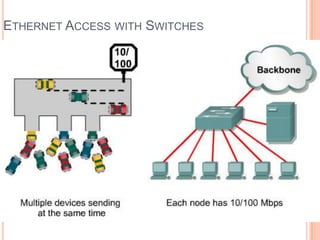
Layer 2 SwitchingSwitching breaks up large collision domains into smaller ones
Collision domain is a network segment with two or more devices sharing the same bandwidth.
A hub network is a typical example of this type of technology
Each port on a switch is actually its own collision domain, you can make a much better Ethernet LAN network just by replacing your hubs with switches2
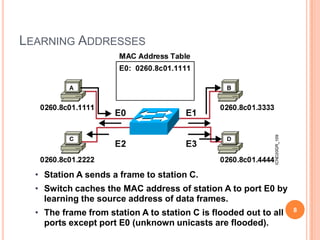
How Switches and BridgesLearn Addresses3Bridges and switches learn in the following ways: 	Reading the source MAC address of each 	received frame or datagram
	Recording the port on which the MAC address 	was received. In this way, the bridge or switch learns which addresses belong to the devices connected to each port.
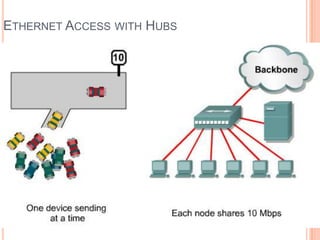
Ethernet Access with Hubs4
Ethernet Access with Switches5
Switch FeaturesThere are three conditions in which a switch will flood a frame out on all ports except to the port on which the frame came in, as follows:
Unknown unicast address
Broadcast frame
Multicast frame6
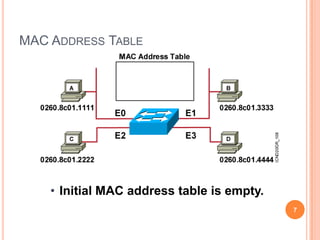
MAC Address Table7Initial MAC address table is empty.Learning Addresses8Station A sends a frame to station C.
Switch caches the MAC address of station A to port E0 by learning the source address of data frames.
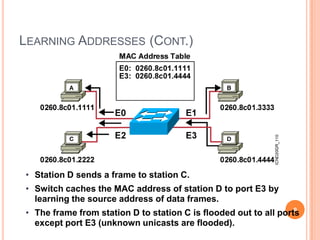
The frame from station A to station C is flooded out to all ports except port E0 (unknown unicasts are flooded).Learning Addresses (Cont.)9Station D sends a frame to station C.
Switch caches the MAC address of station D to port E3 by learning the source address of data frames.
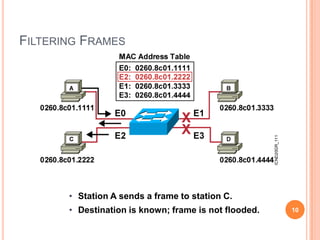
The frame from station D to station C is flooded out to all ports except port E3 (unknown unicasts are flooded).Filtering Frames10Station A sends a frame to station C.
Destination is known; frame is not flooded.11Spanning Tree Protocol
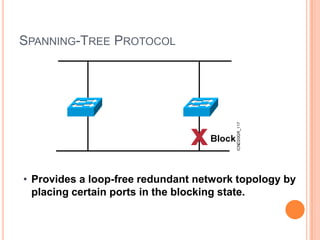
Spanning-Tree Protocol12Provides a loop-free redundant network topology by placing certain ports in the blocking state.Spanning Tree Protocol13Spanning Tree Protocol resides in Data link Layer
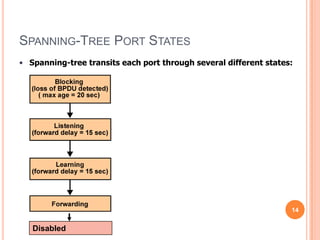
Ethernet bridges and switches can implement the IEEE 802.1D Spanning-Tree Protocol and use the spanning-tree algorithm to construct a loop free network.   Spanning-Tree Port States14Spanning-tree transits each port through several different states:Disabled
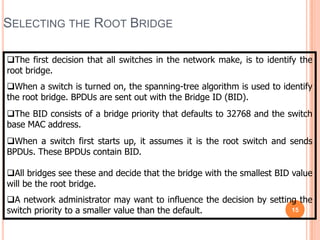
Selecting the Root Bridge15The first decision that all switches in the network make, is to identify the root bridge.
When a switch is turned on, the spanning-tree algorithm is used to identify the root bridge. BPDUs are sent out with the Bridge ID (BID).
The BID consists of a bridge priority that defaults to 32768 and the switch base MAC address.
When a switch first starts up, it assumes it is the root switch and sends BPDUs. These BPDUs contain BID.

Switching seminar ppt