A final requirement for programming


                         http://eglobiotraining.com
We first define the word “programming”, it is a
computer language programmers use to develop
applications, scripts, or other set of instructions for a
computer to execute.

       programming is instructing a computer to do
something for you with the help of a programming
language. The role of a programming language can be
described in two ways:
‱ Technical: It is a means for instructing a Computer to
  perform Tasks
‱ Conceptual: It is a framework within which we organize
  our ideas about things and processes.
                         http://eglobiotraining.com
As an individual, I have learned that programming is a
very broad because it composes many scripts, applications and
can be used to run a program that has been part of the
programming language.
        A programming language should both provide means to
describe primitive data and procedures and means to combine
and abstract those into more complex ones.
        The distinction between data and procedures is not that
clear cut. In many programming languages, procedures can be
passed as data (to be applied to ``real'' data) and sometimes
processed like ``ordinary'' data. Conversely ``ordinary'' data can
be turned into procedures by an evaluation mechanism.
                          http://eglobiotraining.com
At first, programming is confusing because you have
so much to understand about codes that will enable to run
a program. Programming has applications and program
development, the best example for this is the Internet
bowser


        Programming is a creative process done by
programmers to instruct a computer on how to do a task.
Fundamentally programs manipulate numbers and text.
These are the building blocks of all programs.
Programming languages let you use them in different
ways, e.g adding numbers, etc
 or storing data on disk for
later retrieval.       http://eglobiotraining.com
You have to consider languages to run or write your
own program, most demanded language in programming is
the DEV C++ (a full-featured Integrated Development
Environment (IDE)).

      C++ is one of the most used programming
languages in the world. Also known as "C with Classes".

New to programming or thinking about it? It might surprise
you to know that there are many programmers who
program just for fun and it can lead to a job.

                       http://eglobiotraining.com
Switch case statements are a substitute for long
if statements that compare a variable to several
"integral" values ("integral" values are simply values that
can be expressed as an integer, such as the value of a
char).


                      http://eglobiotraining.com
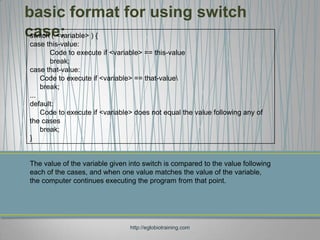
basic format for using switch
case:
 switch ( <variable> ) {
case this-value:
       Code to execute if <variable> == this-value
       break;
case that-value:
    Code to execute if <variable> == that-value
    break;
...
default:
    Code to execute if <variable> does not equal the value following any of
the cases
    break;
}


The value of the variable given into switch is compared to the value following
each of the cases, and when one value matches the value of the variable,
the computer continues executing the program from that point.


                                http://eglobiotraining.com
The condition of a switch statement is a
value. The case says that if it has the value of
whatever is after that case then do whatever
follows the colon. The break is used to break out
of the case statements. An important thing to
note about the switch statement is that the case
values may only be constant integral
expressions.

                  http://eglobiotraining.com
“Break” is a keyword that breaks out of the
code block, usually surrounded by braces, which
it is in. In this case, break prevents the program
from falling through and executing the code in all
the other case statements.


                  http://eglobiotraining.com
The default case is optional, but it is wise to
include it as it handles any unexpected cases.
Switch statements serves as a simple way to
write long if statements when the requirements
are met. Often it can be used to process input
from a user.


                   http://eglobiotraining.com
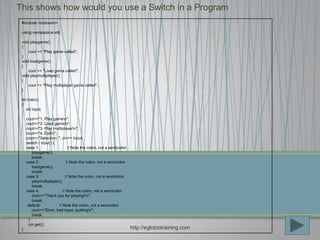
This shows how would you use a Switch in a Program
 #include <iostream>

 using namespace std;

 void playgame()
 {
     cout << "Play game called";
 }
 void loadgame()
 }
     cout << "Load game called";
 void playmultiplayer()
 {
     cout << "Play multiplayer game called";
 }

 int main()
 {
    int input;

     cout<<"1. Play gamen";
     cout<<"2. Load gamen";
     cout<<"3. Play multiplayern";
     cout<<"4. Exitn";
     cout<<"Selection: "; cin>> input;
     switch ( input ) {
     case 1:                    // Note the colon, not a semicolon
         playgame();
         break;
     case 2:                   // Note the colon, not a semicolon
         loadgame();
         break;
     case 3:                  // Note the colon, not a semicolon
         playmultiplayer();
         break;
     case 4:                // Note the colon, not a semicolon
         cout<<"Thank you for playing!n";
         break;
      default:           // Note the colon, not a semicolon
         cout<<"Error, bad input, quittingn";
         break;
       }
       cin.get();
 }                                                                   http://eglobiotraining.com
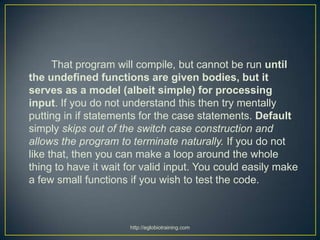
That program will compile, but cannot be run until
the undefined functions are given bodies, but it
serves as a model (albeit simple) for processing
input. If you do not understand this then try mentally
putting in if statements for the case statements. Default
simply skips out of the switch case construction and
allows the program to terminate naturally. If you do not
like that, then you can make a loop around the whole
thing to have it wait for valid input. You could easily make
a few small functions if you wish to test the code.


                      http://eglobiotraining.com
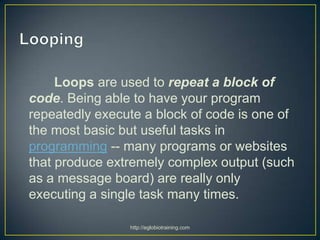
Loops are used to repeat a block of
code. Being able to have your program
repeatedly execute a block of code is one of
the most basic but useful tasks in
programming -- many programs or websites
that produce extremely complex output (such
as a message board) are really only
executing a single task many times.

                http://eglobiotraining.com
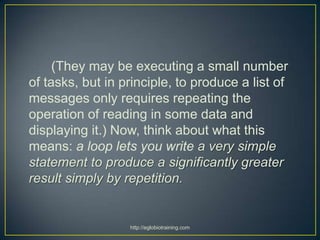
(They may be executing a small number
of tasks, but in principle, to produce a list of
messages only requires repeating the
operation of reading in some data and
displaying it.) Now, think about what this
means: a loop lets you write a very simple
statement to produce a significantly greater
result simply by repetition.


                  http://eglobiotraining.com
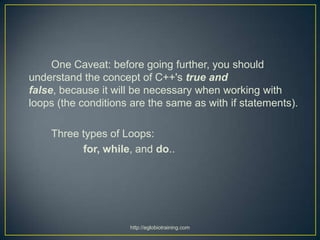
One Caveat: before going further, you should
understand the concept of C++'s true and
false, because it will be necessary when working with
loops (the conditions are the same as with if statements).

    Three types of Loops:
          for, while, and do..


                     http://eglobiotraining.com
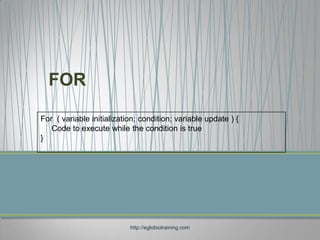
FOR

For ( variable initialization; condition; variable update ) {
   Code to execute while the condition is true
}


                           http://eglobiotraining.com
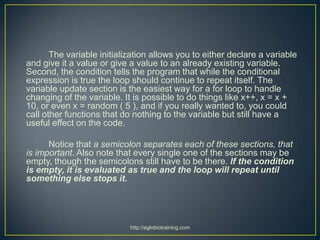
The variable initialization allows you to either declare a variable
and give it a value or give a value to an already existing variable.
Second, the condition tells the program that while the conditional
expression is true the loop should continue to repeat itself. The
variable update section is the easiest way for a for loop to handle
changing of the variable. It is possible to do things like x++, x = x +
10, or even x = random ( 5 ), and if you really wanted to, you could
call other functions that do nothing to the variable but still have a
useful effect on the code.

      Notice that a semicolon separates each of these sections, that
is important. Also note that every single one of the sections may be
empty, though the semicolons still have to be there. If the condition
is empty, it is evaluated as true and the loop will repeat until
something else stops it.


                            http://eglobiotraining.com
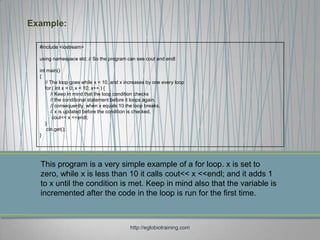
Example:

  #include <iostream>

  using namespace std; // So the program can see cout and endl

  int main()
  {
     // The loop goes while x < 10, and x increases by one every loop
     for ( int x = 0; x < 10; x++ ) {
        // Keep in mind that the loop condition checks
        // the conditional statement before it loops again.
        // consequently, when x equals 10 the loop breaks.
        // x is updated before the condition is checked.
         cout<< x <<endl;
     }
      cin.get();
  }


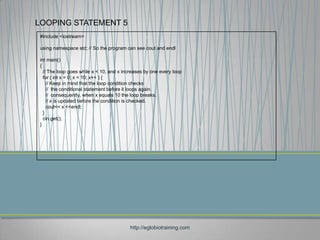
  This program is a very simple example of a for loop. x is set to
  zero, while x is less than 10 it calls cout<< x <<endl; and it adds 1
  to x until the condition is met. Keep in mind also that the variable is
  incremented after the code in the loop is run for the first time.


                                            http://eglobiotraining.com
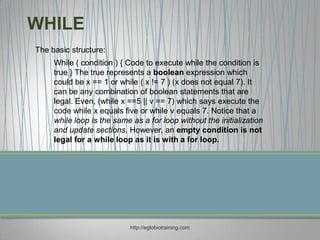
WHILE
The basic structure:
     While ( condition ) { Code to execute while the condition is
     true } The true represents a boolean expression which
     could be x == 1 or while ( x != 7 ) (x does not equal 7). It
     can be any combination of boolean statements that are
     legal. Even, (while x ==5 || v == 7) which says execute the
     code while x equals five or while v equals 7. Notice that a
     while loop is the same as a for loop without the initialization
     and update sections. However, an empty condition is not
     legal for a while loop as it is with a for loop.


                            http://eglobiotraining.com
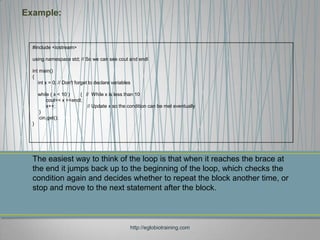
Example:


  #include <iostream>

  using namespace std; // So we can see cout and endl

  int main()
  {
     int x = 0; // Don't forget to declare variables

      while ( x < 10 )   { // While x is less than 10
          cout<< x <<endl;
          x++;              // Update x so the condition can be met eventually
      }
      cin.get();
  }


  The easiest way to think of the loop is that when it reaches the brace at
  the end it jumps back up to the beginning of the loop, which checks the
  condition again and decides whether to repeat the block another time, or
  stop and move to the next statement after the block.


                                                   http://eglobiotraining.com
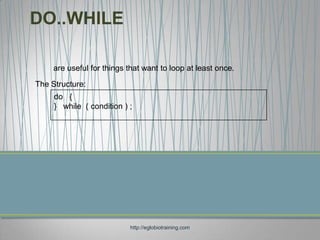
DO..WHILE

     are useful for things that want to loop at least once.

The Structure:
     do {
     } while ( condition ) ;


                           http://eglobiotraining.com
Notice that the condition is tested at the end of the
block instead of the beginning, so the block will be
executed at least once. If the condition is true, we jump
back to the beginning of the block and execute it again. A
do..while loop is basically a reversed while loop. A
while loop says "Loop while the condition is true, and
execute this block of code", a do..while loop says
"Execute this block of code, and loop while the
condition is true".


                     http://eglobiotraining.com
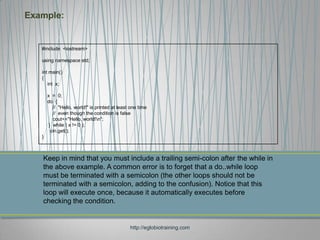
Example:


   #include <iostream>

   using namespace std;

   int main()
   {
      int x;

       x = 0;
       do {
          // "Hello, world!" is printed at least one time
          // even though the condition is false
          cout<<"Hello, world!n";
        } while ( x != 0 );
         cin.get();
   }


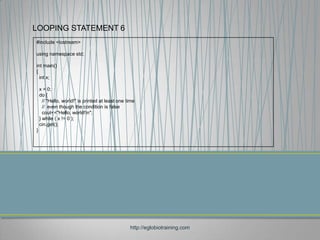
   Keep in mind that you must include a trailing semi-colon after the while in
   the above example. A common error is to forget that a do..while loop
   must be terminated with a semicolon (the other loops should not be
   terminated with a semicolon, adding to the confusion). Notice that this
   loop will execute once, because it automatically executes before
   checking the condition.


                                                http://eglobiotraining.com
http://eglobiotraining.com
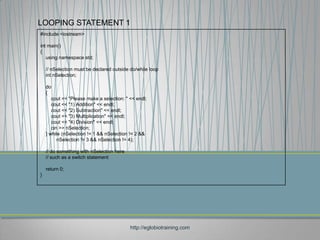
LOOPING STATEMENT 1
#include <iostream>

int main()
{
   using namespace std;

    // nSelection must be declared outside do/while loop
    int nSelection;

    do
    {
       cout << "Please make a selection: " << endl;
       cout << "1) Addition" << endl;
       cout << "2) Subtraction" << endl;
       cout << "3) Multiplication" << endl;
       cout << "4) Division" << endl;
       cin >> nSelection;
    } while (nSelection != 1 && nSelection != 2 &&
          nSelection != 3 && nSelection != 4);

    // do something with nSelection here
    // such as a switch statement

    return 0;
}


                                           http://eglobiotraining.com
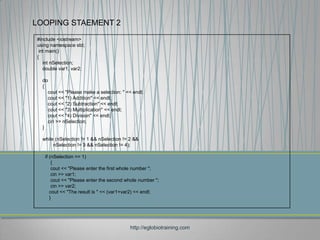
LOOPING STAEMENT 2
#include <iostream>
using namespace std;
 int main()
{
   int nSelection;
   double var1, var2;

  do
  {
    cout << "Please make a selection: " << endl;
    cout << "1) Addition" << endl;
    cout << "2) Subtraction" << endl;
    cout << "3) Multiplication" << endl;
    cout << "4) Division" << endl;
    cin >> nSelection;
  }

  while (nSelection != 1 && nSelection != 2 &&
       nSelection != 3 && nSelection != 4);

   if (nSelection == 1)
       {
       cout << "Please enter the first whole number ";
       cin >> var1;
       cout << "Please enter the second whole number ";
       cin >> var2;
      cout << "The result is " << (var1+var2) << endl;
      }


                                          http://eglobiotraining.com
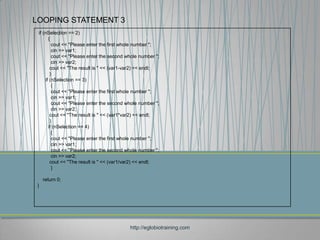
LOOPING STATEMENT 3
 if (nSelection == 2)
       {
         cout << "Please enter the first whole number ";
         cin >> var1;
         cout << "Please enter the second whole number ";
         cin >> var2;
        cout << "The result is " << (var1-var2) << endl;
        }
     if (nSelection == 3)
         {
         cout << "Please enter the first whole number ";
         cin >> var1;
         cout << "Please enter the second whole number ";
         cin >> var2;
        cout << "The result is " << (var1*var2) << endl;
        }
       if (nSelection == 4)
         {
         cout << "Please enter the first whole number ";
         cin >> var1;
         cout << "Please enter the second whole number ";
         cin >> var2;
        cout << "The result is " << (var1/var2) << endl;
         }

     return 0;
 }


                                           http://eglobiotraining.com
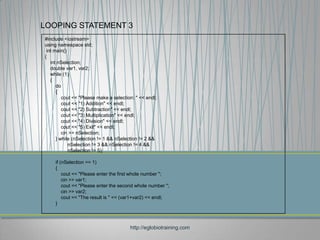
LOOPING STATEMENT 3
#include <iostream>
using namespace std;
 int main()
{
   int nSelection;
   double var1, var2;
   while (1)
   {
      do
      {
         cout << "Please make a selection: " << endl;
         cout << "1) Addition" << endl;
         cout << "2) Subtraction" << endl;
         cout << "3) Multiplication" << endl;
         cout << "4) Division" << endl;
         cout << "5) Exit" << endl;
         cin >> nSelection;
      } while (nSelection != 1 && nSelection != 2 &&
            nSelection != 3 && nSelection != 4 &&
            nSelection != 5);

     if (nSelection == 1)
     {
         cout << "Please enter the first whole number ";
         cin >> var1;
         cout << "Please enter the second whole number ";
         cin >> var2;
         cout << "The result is " << (var1+var2) << endl;
     }


                                        http://eglobiotraining.com
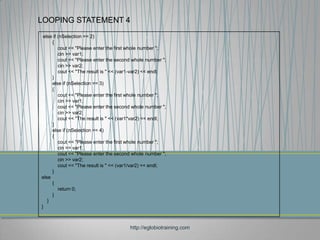
LOOPING STATEMENT 4
 else if (nSelection == 2)
     {
         cout << "Please enter the first whole number ";
         cin >> var1;
         cout << "Please enter the second whole number ";
         cin >> var2;
         cout << "The result is " << (var1-var2) << endl;
     }
     else if (nSelection == 3)
     {
         cout << "Please enter the first whole number ";
         cin >> var1;
         cout << "Please enter the second whole number ";
         cin >> var2;
         cout << "The result is " << (var1*var2) << endl;
     }
     else if (nSelection == 4)
     {
         cout << "Please enter the first whole number ";
         cin >> var1;
         cout << "Please enter the second whole number ";
         cin >> var2;
         cout << "The result is " << (var1/var2) << endl;
     }
else
     {
         return 0;
     }
   }
}


                                        http://eglobiotraining.com
LOOPING STATEMENT 5
#include <iostream>

using namespace std; // So the program can see cout and endl

int main()
{
  // The loop goes while x < 10, and x increases by one every loop
  for ( int x = 0; x < 10; x++ ) {
    // Keep in mind that the loop condition checks
    // the conditional statement before it loops again.
    // consequently, when x equals 10 the loop breaks.
    // x is updated before the condition is checked.
    cout<< x <<endl;
  }
  cin.get();
}


                                          http://eglobiotraining.com
LOOPING STATEMENT 6
#include <iostream>

using namespace std;

int main()
{
  int x;

    x = 0;
    do {
      // "Hello, world!" is printed at least one time
      // even though the condition is false
      cout<<"Hello, world!n";
    } while ( x != 0 );
    cin.get();
}


                                                  http://eglobiotraining.com
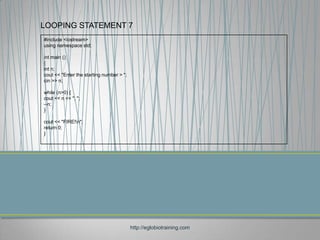
LOOPING STATEMENT 7
#include <iostream>
using namespace std;

int main ()
{
int n;
cout << "Enter the starting number > ";
cin >> n;

while (n>0) {
cout << n << ", ";
--n;
}

cout << "FIRE!n";
return 0;
}


                                          http://eglobiotraining.com
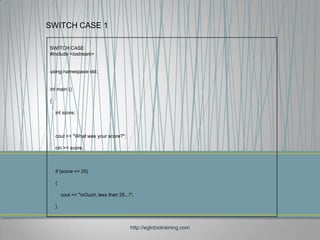
SWITCH CASE 1

SWITCH CASE
#include <iostream>


using namespace std;


int main ()

{

    int score;


    cout << "What was your score?";

    cin >> score;


    if (score <= 25)

    {

        cout << "nOuch, less than 25...!";

    }


                                         http://eglobiotraining.com
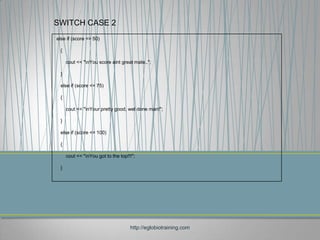
SWITCH CASE 2
else if (score <= 50)

 {

     cout << "nYou score aint great mate..";

 }

 else if (score <= 75)

 {

     cout << "nYour pretty good, wel done man!";

 }

 else if (score <= 100)

 {

     cout << "nYou got to the top!!!";

 }


                                    http://eglobiotraining.com
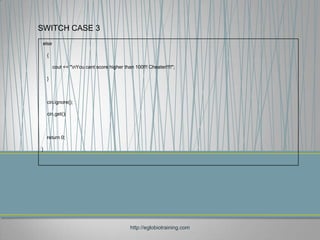
SWITCH CASE 3
 else

    {

        cout << "nYou cant score higher than 100!!! Cheater!!!!";

    }


    cin.ignore();

    cin.get();


    return 0;

}


                                            http://eglobiotraining.com
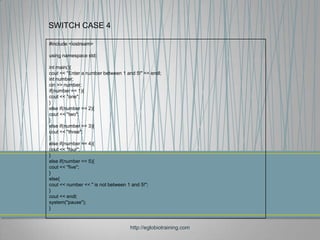
SWITCH CASE 4

#include <iostream>

using namespace std;

int main(){
cout << "Enter a number between 1 and 5!" << endl;
int number;
cin >> number;
if(number == 1){
cout << "one";
}
else if(number == 2){
cout << "two";
}
else if(number == 3){
cout << "three";
}
else if(number == 4){
cout << "four";
}
else if(number == 5){
cout << "five";
}
else{
cout << number << " is not between 1 and 5!";
}
cout << endl;
system("pause");
}


                                    http://eglobiotraining.com
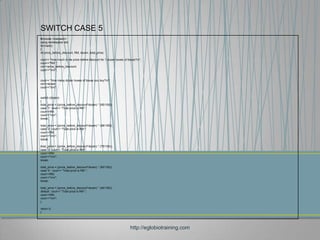
SWITCH CASE 5
#include <iostream>
using namespace std;
int main()
{
int price_before_discount, RM, dozen, total_price;

cout<< "How much is the price before discount for 1 dozen boxes of tissue?n";
cout<<"RM ";
cin>>price_before_discount;
cout<<"nn";


cout<< "How many dozen boxes of tissue you buy?n";
cin>>dozen;
cout<<"nn";


switch (dozen)
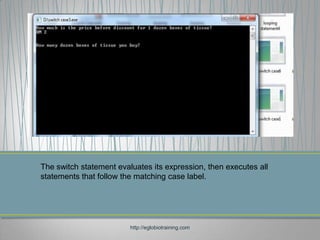
{
total_price = ((price_before_discount*dozen) * (95/100));
case '1': cout<< "Total price is RM ";
cout<<RM;
cout<<"nn";
break;

total_price = ((price_before_discount*dozen) * (88/100));
case '2': cout<< "Total price is RM ";
cout<<RM;
cout<<"nn";
break;

total_price = ((price_before_discount*dozen) * (75/100));
case '3': cout<< "Total price is RM ";
cout<<RM;
cout<<"nn";
break;

total_price = ((price_before_discount*dozen) * (60/100));
case '4' : cout<< "Total price is RM ";
cout<<RM;
cout<<"nn";
break;

total_price = ((price_before_discount*dozen) * (40/100));
default : cout<< "Total price is RM ";
cout<<RM;
cout<<"nn";
}

return 0;
}


                                                                     http://eglobiotraining.com
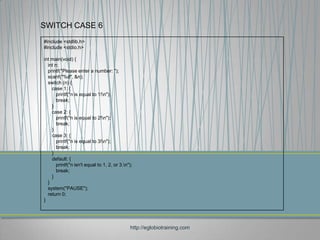
SWITCH CASE 6
#include <stdlib.h>
#include <stdio.h>

int main(void) {
  int n;
  printf("Please enter a number: ");
  scanf("%d", &n);
  switch (n) {
    case 1: {
       printf("n is equal to 1!n");
       break;
    }
    case 2: {
       printf("n is equal to 2!n");
       break;
    }
    case 3: {
       printf("n is equal to 3!n");
       break;
    }
    default: {
       printf("n isn't equal to 1, 2, or 3.n");
       break;
    }
  }
  system("PAUSE");
  return 0;
}


                                              http://eglobiotraining.com
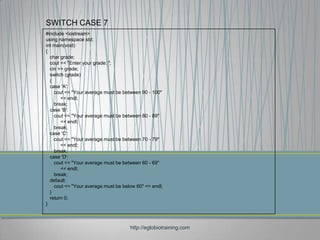
SWITCH CASE 7
#include <iostream>
using namespace std;
int main(void)
{
  char grade;
  cout << "Enter your grade: ";
  cin >> grade;
  switch (grade)
  {
  case 'A':
    cout << "Your average must be between 90 - 100"
       << endl;
    break;
  case 'B':
    cout << "Your average must be between 80 - 89"
       << endl;
    break;
  case 'C':
    cout << "Your average must be between 70 - 79"
       << endl;
    break;
  case 'D':
    cout << "Your average must be between 60 - 69"
       << endl;
    break;
  default:
    cout << "Your average must be below 60" << endl;
  }
  return 0;
}


                                     http://eglobiotraining.com
http://eglobiotraining.com
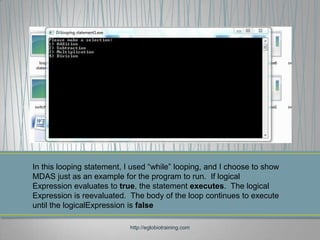
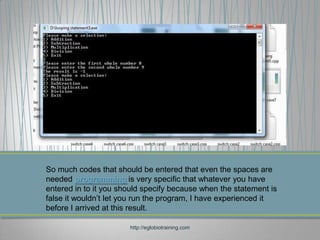
In this looping statement, I used “while” looping, and I choose to show
MDAS just as an example for the program to run. If logical
Expression evaluates to true, the statement executes. The logical
Expression is reevaluated. The body of the loop continues to execute
until the logicalExpression is false

                            http://eglobiotraining.com
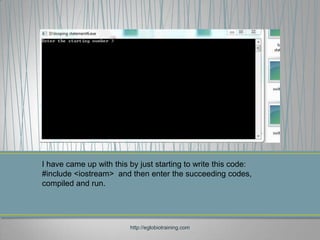
I have came up with this by just starting to write this code:
#include <iostream> and then enter the succeeding codes,
compiled and run.


                         http://eglobiotraining.com
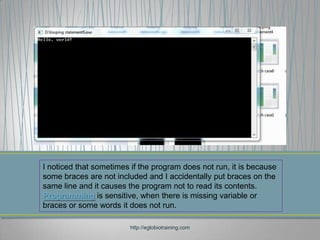
I noticed that sometimes if the program does not run, it is because
some braces are not included and I accidentally put braces on the
same line and it causes the program not to read its contents.
Programming is sensitive, when there is missing variable or
braces or some words it does not run.

                         http://eglobiotraining.com
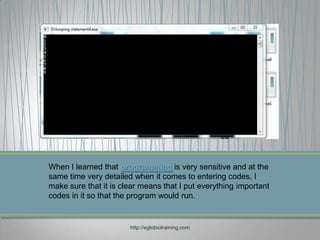
When I learned that programming is very sensitive and at the
same time very detailed when it comes to entering codes, I
make sure that it is clear means that I put everything important
codes in it so that the program would run.


                       http://eglobiotraining.com
So much codes that should be entered that even the spaces are
needed programming is very specific that whatever you have
entered in to it you should specify because when the statement is
false it wouldn’t let you run the program, I have experienced it
before I arrived at this result.

                       http://eglobiotraining.com
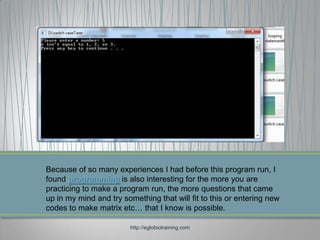
Because of so many experiences I had before this program run, I
found programming is also interesting for the more you are
practicing to make a program run, the more questions that came
up in my mind and try something that will fit to this or entering new
codes to make matrix etc
 that I know is possible.

                        http://eglobiotraining.com
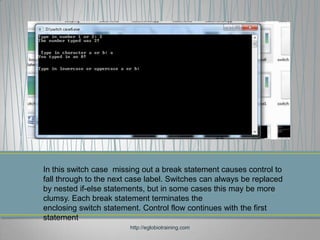
In this switch case missing out a break statement causes control to
fall through to the next case label. Switches can always be replaced
by nested if-else statements, but in some cases this may be more
clumsy. Each break statement terminates the
enclosing switch statement. Control flow continues with the first
statement
                        http://eglobiotraining.com
Unlike if-then and if-then-else statements, the switch statement can
have a number of possible execution paths, A switch works with
the byte, short, char, and int primitive data types.


                           http://eglobiotraining.com
The switch statement evaluates its expression, then executes all
statements that follow the matching case label.


                         http://eglobiotraining.com
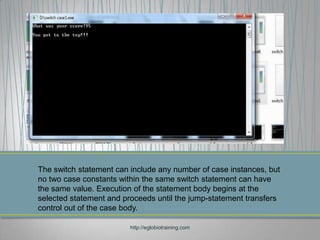
The switch statement can include any number of case instances, but
no two case constants within the same switch statement can have
the same value. Execution of the statement body begins at the
selected statement and proceeds until the jump-statement transfers
control out of the case body.

                         http://eglobiotraining.com
Submitted by:
Tarun, April G.
 BM10203


                  http://eglobiotraining.com

Switch case and looping new

  • 1.
    A final requirementfor programming http://eglobiotraining.com
  • 2.
    We first definethe word “programming”, it is a computer language programmers use to develop applications, scripts, or other set of instructions for a computer to execute. programming is instructing a computer to do something for you with the help of a programming language. The role of a programming language can be described in two ways: ‱ Technical: It is a means for instructing a Computer to perform Tasks ‱ Conceptual: It is a framework within which we organize our ideas about things and processes. http://eglobiotraining.com
  • 3.
    As an individual,I have learned that programming is a very broad because it composes many scripts, applications and can be used to run a program that has been part of the programming language. A programming language should both provide means to describe primitive data and procedures and means to combine and abstract those into more complex ones. The distinction between data and procedures is not that clear cut. In many programming languages, procedures can be passed as data (to be applied to ``real'' data) and sometimes processed like ``ordinary'' data. Conversely ``ordinary'' data can be turned into procedures by an evaluation mechanism. http://eglobiotraining.com
  • 4.
    At first, programmingis confusing because you have so much to understand about codes that will enable to run a program. Programming has applications and program development, the best example for this is the Internet bowser
 Programming is a creative process done by programmers to instruct a computer on how to do a task. Fundamentally programs manipulate numbers and text. These are the building blocks of all programs. Programming languages let you use them in different ways, e.g adding numbers, etc
 or storing data on disk for later retrieval. http://eglobiotraining.com
  • 5.
    You have toconsider languages to run or write your own program, most demanded language in programming is the DEV C++ (a full-featured Integrated Development Environment (IDE)). C++ is one of the most used programming languages in the world. Also known as "C with Classes". New to programming or thinking about it? It might surprise you to know that there are many programmers who program just for fun and it can lead to a job. http://eglobiotraining.com
  • 6.
    Switch case statementsare a substitute for long if statements that compare a variable to several "integral" values ("integral" values are simply values that can be expressed as an integer, such as the value of a char). http://eglobiotraining.com
  • 7.
    basic format forusing switch case: switch ( <variable> ) { case this-value: Code to execute if <variable> == this-value break; case that-value: Code to execute if <variable> == that-value break; ... default: Code to execute if <variable> does not equal the value following any of the cases break; } The value of the variable given into switch is compared to the value following each of the cases, and when one value matches the value of the variable, the computer continues executing the program from that point. http://eglobiotraining.com
  • 8.
    The condition ofa switch statement is a value. The case says that if it has the value of whatever is after that case then do whatever follows the colon. The break is used to break out of the case statements. An important thing to note about the switch statement is that the case values may only be constant integral expressions. http://eglobiotraining.com
  • 9.
    “Break” is akeyword that breaks out of the code block, usually surrounded by braces, which it is in. In this case, break prevents the program from falling through and executing the code in all the other case statements. http://eglobiotraining.com
  • 10.
    The default caseis optional, but it is wise to include it as it handles any unexpected cases. Switch statements serves as a simple way to write long if statements when the requirements are met. Often it can be used to process input from a user. http://eglobiotraining.com
  • 11.
    This shows howwould you use a Switch in a Program #include <iostream> using namespace std; void playgame() { cout << "Play game called"; } void loadgame() } cout << "Load game called"; void playmultiplayer() { cout << "Play multiplayer game called"; } int main() { int input; cout<<"1. Play gamen"; cout<<"2. Load gamen"; cout<<"3. Play multiplayern"; cout<<"4. Exitn"; cout<<"Selection: "; cin>> input; switch ( input ) { case 1: // Note the colon, not a semicolon playgame(); break; case 2: // Note the colon, not a semicolon loadgame(); break; case 3: // Note the colon, not a semicolon playmultiplayer(); break; case 4: // Note the colon, not a semicolon cout<<"Thank you for playing!n"; break; default: // Note the colon, not a semicolon cout<<"Error, bad input, quittingn"; break; } cin.get(); } http://eglobiotraining.com
  • 12.
    That program willcompile, but cannot be run until the undefined functions are given bodies, but it serves as a model (albeit simple) for processing input. If you do not understand this then try mentally putting in if statements for the case statements. Default simply skips out of the switch case construction and allows the program to terminate naturally. If you do not like that, then you can make a loop around the whole thing to have it wait for valid input. You could easily make a few small functions if you wish to test the code. http://eglobiotraining.com
  • 13.
    Loops are usedto repeat a block of code. Being able to have your program repeatedly execute a block of code is one of the most basic but useful tasks in programming -- many programs or websites that produce extremely complex output (such as a message board) are really only executing a single task many times. http://eglobiotraining.com
  • 14.
    (They may beexecuting a small number of tasks, but in principle, to produce a list of messages only requires repeating the operation of reading in some data and displaying it.) Now, think about what this means: a loop lets you write a very simple statement to produce a significantly greater result simply by repetition. http://eglobiotraining.com
  • 15.
    One Caveat: beforegoing further, you should understand the concept of C++'s true and false, because it will be necessary when working with loops (the conditions are the same as with if statements). Three types of Loops: for, while, and do.. http://eglobiotraining.com
  • 16.
    FOR For ( variableinitialization; condition; variable update ) { Code to execute while the condition is true } http://eglobiotraining.com
  • 17.
    The variable initializationallows you to either declare a variable and give it a value or give a value to an already existing variable. Second, the condition tells the program that while the conditional expression is true the loop should continue to repeat itself. The variable update section is the easiest way for a for loop to handle changing of the variable. It is possible to do things like x++, x = x + 10, or even x = random ( 5 ), and if you really wanted to, you could call other functions that do nothing to the variable but still have a useful effect on the code. Notice that a semicolon separates each of these sections, that is important. Also note that every single one of the sections may be empty, though the semicolons still have to be there. If the condition is empty, it is evaluated as true and the loop will repeat until something else stops it. http://eglobiotraining.com
  • 18.
    Example: #include<iostream> using namespace std; // So the program can see cout and endl int main() { // The loop goes while x < 10, and x increases by one every loop for ( int x = 0; x < 10; x++ ) { // Keep in mind that the loop condition checks // the conditional statement before it loops again. // consequently, when x equals 10 the loop breaks. // x is updated before the condition is checked. cout<< x <<endl; } cin.get(); } This program is a very simple example of a for loop. x is set to zero, while x is less than 10 it calls cout<< x <<endl; and it adds 1 to x until the condition is met. Keep in mind also that the variable is incremented after the code in the loop is run for the first time. http://eglobiotraining.com
  • 19.
    WHILE The basic structure: While ( condition ) { Code to execute while the condition is true } The true represents a boolean expression which could be x == 1 or while ( x != 7 ) (x does not equal 7). It can be any combination of boolean statements that are legal. Even, (while x ==5 || v == 7) which says execute the code while x equals five or while v equals 7. Notice that a while loop is the same as a for loop without the initialization and update sections. However, an empty condition is not legal for a while loop as it is with a for loop. http://eglobiotraining.com
  • 20.
    Example: #include<iostream> using namespace std; // So we can see cout and endl int main() { int x = 0; // Don't forget to declare variables while ( x < 10 ) { // While x is less than 10 cout<< x <<endl; x++; // Update x so the condition can be met eventually } cin.get(); } The easiest way to think of the loop is that when it reaches the brace at the end it jumps back up to the beginning of the loop, which checks the condition again and decides whether to repeat the block another time, or stop and move to the next statement after the block. http://eglobiotraining.com
  • 21.
    DO..WHILE are useful for things that want to loop at least once. The Structure: do { } while ( condition ) ; http://eglobiotraining.com
  • 22.
    Notice that thecondition is tested at the end of the block instead of the beginning, so the block will be executed at least once. If the condition is true, we jump back to the beginning of the block and execute it again. A do..while loop is basically a reversed while loop. A while loop says "Loop while the condition is true, and execute this block of code", a do..while loop says "Execute this block of code, and loop while the condition is true". http://eglobiotraining.com
  • 23.
    Example: #include <iostream> using namespace std; int main() { int x; x = 0; do { // "Hello, world!" is printed at least one time // even though the condition is false cout<<"Hello, world!n"; } while ( x != 0 ); cin.get(); } Keep in mind that you must include a trailing semi-colon after the while in the above example. A common error is to forget that a do..while loop must be terminated with a semicolon (the other loops should not be terminated with a semicolon, adding to the confusion). Notice that this loop will execute once, because it automatically executes before checking the condition. http://eglobiotraining.com
  • 24.
  • 25.
    LOOPING STATEMENT 1 #include<iostream> int main() { using namespace std; // nSelection must be declared outside do/while loop int nSelection; do { cout << "Please make a selection: " << endl; cout << "1) Addition" << endl; cout << "2) Subtraction" << endl; cout << "3) Multiplication" << endl; cout << "4) Division" << endl; cin >> nSelection; } while (nSelection != 1 && nSelection != 2 && nSelection != 3 && nSelection != 4); // do something with nSelection here // such as a switch statement return 0; } http://eglobiotraining.com
  • 26.
    LOOPING STAEMENT 2 #include<iostream> using namespace std; int main() { int nSelection; double var1, var2; do { cout << "Please make a selection: " << endl; cout << "1) Addition" << endl; cout << "2) Subtraction" << endl; cout << "3) Multiplication" << endl; cout << "4) Division" << endl; cin >> nSelection; } while (nSelection != 1 && nSelection != 2 && nSelection != 3 && nSelection != 4); if (nSelection == 1) { cout << "Please enter the first whole number "; cin >> var1; cout << "Please enter the second whole number "; cin >> var2; cout << "The result is " << (var1+var2) << endl; } http://eglobiotraining.com
  • 27.
    LOOPING STATEMENT 3 if (nSelection == 2) { cout << "Please enter the first whole number "; cin >> var1; cout << "Please enter the second whole number "; cin >> var2; cout << "The result is " << (var1-var2) << endl; } if (nSelection == 3) { cout << "Please enter the first whole number "; cin >> var1; cout << "Please enter the second whole number "; cin >> var2; cout << "The result is " << (var1*var2) << endl; } if (nSelection == 4) { cout << "Please enter the first whole number "; cin >> var1; cout << "Please enter the second whole number "; cin >> var2; cout << "The result is " << (var1/var2) << endl; } return 0; } http://eglobiotraining.com
  • 28.
    LOOPING STATEMENT 3 #include<iostream> using namespace std; int main() { int nSelection; double var1, var2; while (1) { do { cout << "Please make a selection: " << endl; cout << "1) Addition" << endl; cout << "2) Subtraction" << endl; cout << "3) Multiplication" << endl; cout << "4) Division" << endl; cout << "5) Exit" << endl; cin >> nSelection; } while (nSelection != 1 && nSelection != 2 && nSelection != 3 && nSelection != 4 && nSelection != 5); if (nSelection == 1) { cout << "Please enter the first whole number "; cin >> var1; cout << "Please enter the second whole number "; cin >> var2; cout << "The result is " << (var1+var2) << endl; } http://eglobiotraining.com
  • 29.
    LOOPING STATEMENT 4 else if (nSelection == 2) { cout << "Please enter the first whole number "; cin >> var1; cout << "Please enter the second whole number "; cin >> var2; cout << "The result is " << (var1-var2) << endl; } else if (nSelection == 3) { cout << "Please enter the first whole number "; cin >> var1; cout << "Please enter the second whole number "; cin >> var2; cout << "The result is " << (var1*var2) << endl; } else if (nSelection == 4) { cout << "Please enter the first whole number "; cin >> var1; cout << "Please enter the second whole number "; cin >> var2; cout << "The result is " << (var1/var2) << endl; } else { return 0; } } } http://eglobiotraining.com
  • 30.
    LOOPING STATEMENT 5 #include<iostream> using namespace std; // So the program can see cout and endl int main() { // The loop goes while x < 10, and x increases by one every loop for ( int x = 0; x < 10; x++ ) { // Keep in mind that the loop condition checks // the conditional statement before it loops again. // consequently, when x equals 10 the loop breaks. // x is updated before the condition is checked. cout<< x <<endl; } cin.get(); } http://eglobiotraining.com
  • 31.
    LOOPING STATEMENT 6 #include<iostream> using namespace std; int main() { int x; x = 0; do { // "Hello, world!" is printed at least one time // even though the condition is false cout<<"Hello, world!n"; } while ( x != 0 ); cin.get(); } http://eglobiotraining.com
  • 32.
    LOOPING STATEMENT 7 #include<iostream> using namespace std; int main () { int n; cout << "Enter the starting number > "; cin >> n; while (n>0) { cout << n << ", "; --n; } cout << "FIRE!n"; return 0; } http://eglobiotraining.com
  • 33.
    SWITCH CASE 1 SWITCHCASE #include <iostream> using namespace std; int main () { int score; cout << "What was your score?"; cin >> score; if (score <= 25) { cout << "nOuch, less than 25...!"; } http://eglobiotraining.com
  • 34.
    SWITCH CASE 2 elseif (score <= 50) { cout << "nYou score aint great mate.."; } else if (score <= 75) { cout << "nYour pretty good, wel done man!"; } else if (score <= 100) { cout << "nYou got to the top!!!"; } http://eglobiotraining.com
  • 35.
    SWITCH CASE 3 else { cout << "nYou cant score higher than 100!!! Cheater!!!!"; } cin.ignore(); cin.get(); return 0; } http://eglobiotraining.com
  • 36.
    SWITCH CASE 4 #include<iostream> using namespace std; int main(){ cout << "Enter a number between 1 and 5!" << endl; int number; cin >> number; if(number == 1){ cout << "one"; } else if(number == 2){ cout << "two"; } else if(number == 3){ cout << "three"; } else if(number == 4){ cout << "four"; } else if(number == 5){ cout << "five"; } else{ cout << number << " is not between 1 and 5!"; } cout << endl; system("pause"); } http://eglobiotraining.com
  • 37.
    SWITCH CASE 5 #include<iostream> using namespace std; int main() { int price_before_discount, RM, dozen, total_price; cout<< "How much is the price before discount for 1 dozen boxes of tissue?n"; cout<<"RM "; cin>>price_before_discount; cout<<"nn"; cout<< "How many dozen boxes of tissue you buy?n"; cin>>dozen; cout<<"nn"; switch (dozen) { total_price = ((price_before_discount*dozen) * (95/100)); case '1': cout<< "Total price is RM "; cout<<RM; cout<<"nn"; break; total_price = ((price_before_discount*dozen) * (88/100)); case '2': cout<< "Total price is RM "; cout<<RM; cout<<"nn"; break; total_price = ((price_before_discount*dozen) * (75/100)); case '3': cout<< "Total price is RM "; cout<<RM; cout<<"nn"; break; total_price = ((price_before_discount*dozen) * (60/100)); case '4' : cout<< "Total price is RM "; cout<<RM; cout<<"nn"; break; total_price = ((price_before_discount*dozen) * (40/100)); default : cout<< "Total price is RM "; cout<<RM; cout<<"nn"; } return 0; } http://eglobiotraining.com
  • 38.
    SWITCH CASE 6 #include<stdlib.h> #include <stdio.h> int main(void) { int n; printf("Please enter a number: "); scanf("%d", &n); switch (n) { case 1: { printf("n is equal to 1!n"); break; } case 2: { printf("n is equal to 2!n"); break; } case 3: { printf("n is equal to 3!n"); break; } default: { printf("n isn't equal to 1, 2, or 3.n"); break; } } system("PAUSE"); return 0; } http://eglobiotraining.com
  • 39.
    SWITCH CASE 7 #include<iostream> using namespace std; int main(void) { char grade; cout << "Enter your grade: "; cin >> grade; switch (grade) { case 'A': cout << "Your average must be between 90 - 100" << endl; break; case 'B': cout << "Your average must be between 80 - 89" << endl; break; case 'C': cout << "Your average must be between 70 - 79" << endl; break; case 'D': cout << "Your average must be between 60 - 69" << endl; break; default: cout << "Your average must be below 60" << endl; } return 0; } http://eglobiotraining.com
  • 40.
  • 41.
    In this loopingstatement, I used “while” looping, and I choose to show MDAS just as an example for the program to run. If logical Expression evaluates to true, the statement executes. The logical Expression is reevaluated. The body of the loop continues to execute until the logicalExpression is false http://eglobiotraining.com
  • 42.
    I have cameup with this by just starting to write this code: #include <iostream> and then enter the succeeding codes, compiled and run. http://eglobiotraining.com
  • 43.
    I noticed thatsometimes if the program does not run, it is because some braces are not included and I accidentally put braces on the same line and it causes the program not to read its contents. Programming is sensitive, when there is missing variable or braces or some words it does not run. http://eglobiotraining.com
  • 44.
    When I learnedthat programming is very sensitive and at the same time very detailed when it comes to entering codes, I make sure that it is clear means that I put everything important codes in it so that the program would run. http://eglobiotraining.com
  • 45.
    So much codesthat should be entered that even the spaces are needed programming is very specific that whatever you have entered in to it you should specify because when the statement is false it wouldn’t let you run the program, I have experienced it before I arrived at this result. http://eglobiotraining.com
  • 46.
    Because of somany experiences I had before this program run, I found programming is also interesting for the more you are practicing to make a program run, the more questions that came up in my mind and try something that will fit to this or entering new codes to make matrix etc
 that I know is possible. http://eglobiotraining.com
  • 47.
    In this switchcase missing out a break statement causes control to fall through to the next case label. Switches can always be replaced by nested if-else statements, but in some cases this may be more clumsy. Each break statement terminates the enclosing switch statement. Control flow continues with the first statement http://eglobiotraining.com
  • 48.
    Unlike if-then andif-then-else statements, the switch statement can have a number of possible execution paths, A switch works with the byte, short, char, and int primitive data types. http://eglobiotraining.com
  • 49.
    The switch statementevaluates its expression, then executes all statements that follow the matching case label. http://eglobiotraining.com
  • 50.
    The switch statementcan include any number of case instances, but no two case constants within the same switch statement can have the same value. Execution of the statement body begins at the selected statement and proceeds until the jump-statement transfers control out of the case body. http://eglobiotraining.com
  • 51.
    Submitted by: Tarun, AprilG. BM10203 http://eglobiotraining.com