SUSE® KVM Overview
Patrick Quairoli
Global Alliance Director
pjq@suse.com
2
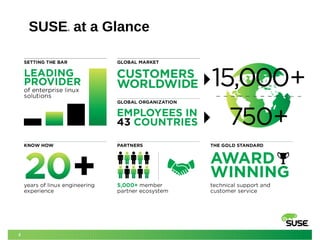
SUSE® at a Glance
3
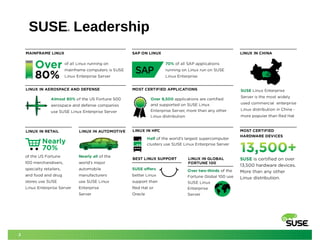
SUSE® Leadership
4
Open Source Community Leadership
kernel.org
OPEN
VIRTUALIZATION
ALLIANCE
KVM Overview
6
What is KVM?
• A progressive and open source hypervisor driven by
the KVM community, Open Virtualization Alliance and
companies like Intel, IBM, SUSE, and Red Hat.
• KVM is an acronym for Kernel-based Virtual Machine
• Fully Integrated into the Linux Kernel.
‒ Takes full advantages of the Reliability, Availability and
Security of Linux
• Supports advanced hardware assisted virtualization
technologies in Intel VT-X and AMD-V X86
• Supports Linux and Windows Guests.
7
How KVM operates
• QEMU provides machine and device emulation
• Para-virtual drivers used to improve IO performance
• Virtual machines are just another process
‒ # qemu-kvm...
• Virtual machines (processes) can be controlled with
nice, cgroups, numactl, etc.
• Implemented as kernel modules
‒ kvm.ko: provides virtualization infrastructure
‒ kvm_amd.ko and kvm_intel.ko: hardware platform specific
modules
8
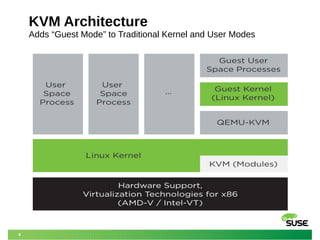
KVM Architecture
Adds “Guest Mode” to Traditional Kernel and User Modes
9
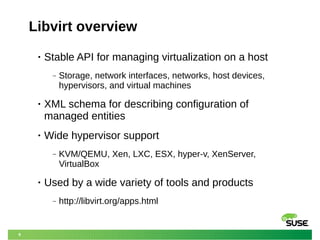
Libvirt overview
• Stable API for managing virtualization on a host
‒ Storage, network interfaces, networks, host devices,
hypervisors, and virtual machines
• XML schema for describing configuration of
managed entities
• Wide hypervisor support
‒ KVM/QEMU, Xen, LXC, ESX, hyper-v, XenServer,
VirtualBox
• Used by a wide variety of tools and products
‒ http://libvirt.org/apps.html
10
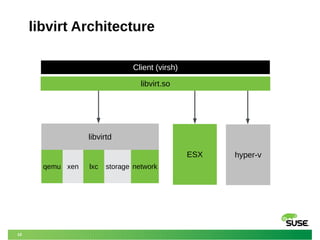
libvirt Architecture
libvirtd
hyper-vESX
Client (virsh)
libvirt.so
qemu xen lxc storage network
Enabling KVM with SUSE Solutions
12
SUSE Virtualization Advantages
Virtualization Host: SUSE® has the most experience and success in
the virtualization host (hypervisor) market. Supporting both KVM and
XEN hypervisors.
Virtual Machine Guest: SUSE® Linux Enterprise Server is the “Perfect
Guest” on VMware, Microsoft, Citrix and SUSE KVM and XEN
hypervisor implementations.
Virtualization Management: SUSE offers robust management solutions
to simplify the management of physical and virtual machines—across
hypervisors.
Virtual Application Stacks: SUSE Studio is a web application for
building and testing software applications in a web browser. It supports
the creation of physical, virtual or cloud-based applications.
Roadmap for the Cloud: Based on Open Stack, SUSE Cloud is an
automated cloud computing platform that helps IT organizations
rapidly deploy and easily manage Infrastructure-as-a-Service private
clouds.
13
KVMKVM
SLESSLES
SUSE
Studio
SUSE
Studio
SUSE
Manager
SUSE
Manager
SUSE
Cloud
SUSE
Cloud
SLE
HAE
SLE
HAE
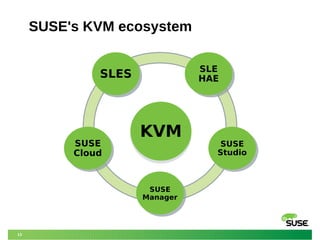
SUSE's KVM ecosystem
14
SUSE Linux Enterprise 11 SP2
Includes 3.0 Linux kernel
‒ Support for next
generation Intel, AMD
and IBM hardware
‒ Improved scheduler,
memory management
and networking
performance
‒ Geo-site clustering
‒ Application compatibility
15
Virtualization with SUSE
• Open source hypervisors fully supported in the platform
‒ KVM updated to version 0.15
‒ I/O improvements, storage and network device hotplugging
‒ Power saving capabilities
‒ Microsoft Windows support
• Perfect Guest strategy, tuned to run great as a guest on all
major hypervisors, including:
‒ VMware ESX
‒ Microsoft Hyper-V
‒ Citrix XenServer
‒ SUSE Linux Enterprise with Xen and KVM
• Unique cost efficiency – unlimited number of virtual machines
per physical server with one subscription
16
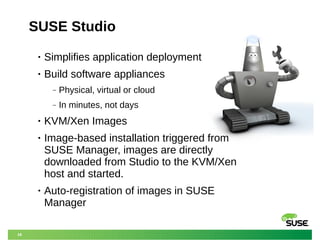
SUSE Studio
• Simplifies application deployment
• Build software appliances
‒ Physical, virtual or cloud
‒ In minutes, not days
• KVM/Xen Images
• Image-based installation triggered from
SUSE Manager, images are directly
downloaded from Studio to the KVM/Xen
host and started.
• Auto-registration of images in SUSE
Manager
17
SUSE® Manager
• Manage both SUSE Linux Enterprise
and Red Hat Enterprise Linux servers
with a single centralized solution
• Automated and cost-effective software
management, system
provisioning/configuration and
monitoring capabilities
• Manage Linux server deployments
across physical, virtual and cloud
environments
• Natively interfaces with KVM and Xen to
start, stop, and redeploy VMs
SUSE Manager
18
SUSE Cloud
• Multi-Hypervisor support (KVM and Xen)
• Integrated into existing SUSE product
lifecycle processes
• Reduces VM sprawl
• Architected for unlimited growth
• Avoid lock-in at the cloud infrastructure layer
SUSE Cloud is an open source software solution based on the
OpenStack project that provides the fundamental capabilities for
enterprises to deploy an Infrastructure-as-a-Service Private Cloud
19
SUSE High Availability Extension
• Most modern and complete open source solution
for implementing high available Linux clusters
• A suite of robust open source technologies that is:
‒ Affordable
‒ Integrated
‒ Virtualization agnostic
• Used with SUSE Linux Enterprise Server, it helps to:
‒ Maintain business continuity
‒ Protect data integrity
‒ Reduce unplanned downtime for your mission-critical
Linux workloads
SUSE Resources
21
SUSE Resources
• Product Pages
‒ http://www.suse.com/products/server/
‒ https://www.suse.com/products/#Virtualization
‒ https://www.suse.com/products/susestudio/
‒ https://www.suse.com/products/suse-manager/
‒ https://www.suse.com/products/suse-cloud/
‒ https://www.suse.com/products/highavailability/
• Documentation
‒ http://suse.com/documentation
‒ https://www.suse.com/documentation/sles11/book_kvm/data/book_kvm.html
• Virtualization Support
‒ http://www.novell.com/docrep/2009/09/SUSE_Linux_Enterprise_Server_Virtualiza
tion_Technology_Support_en.pdf
• Release Notes
‒ http://www.suse.com/releasenotes/x86_64/SUSE-SLES/11-SP2/
Corporate Headquarters
Maxfeldstrasse 5
90409 Nuremberg
Germany
+49 911 740 53 0 (Worldwide)
www.suse.com
Join us on:
www.opensuse.org
23
Unpublished Work of SUSE. All Rights Reserved.
This work is an unpublished work and contains confidential, proprietary and trade secret information of SUSE.
Access to this work is restricted to SUSE employees who have a need to know to perform tasks within the scope of
their assignments. No part of this work may be practiced, performed, copied, distributed, revised, modified, translated,
abridged, condensed, expanded, collected, or adapted without the prior written consent of SUSE.
Any use or exploitation of this work without authorization could subject the perpetrator to criminal and civil liability.
General Disclaimer
This document is not to be construed as a promise by any participating company to develop, deliver, or market a
product. It is not a commitment to deliver any material, code, or functionality, and should not be relied upon in making
purchasing decisions. SUSE makes no representations or warranties with respect to the contents of this document,
and specifically disclaims any express or implied warranties of merchantability or fitness for any particular purpose. The
development, release, and timing of features or functionality described for SUSE products remains at the sole
discretion of SUSE. Further, SUSE reserves the right to revise this document and to make changes to its content, at
any time, without obligation to notify any person or entity of such revisions or changes. All SUSE marks referenced in
this presentation are trademarks or registered trademarks of Novell, Inc. in the United States and other countries. All
third-party trademarks are the property of their respective owners.

SUSE KVM Ecosystem

  • 1.
    SUSE® KVM Overview PatrickQuairoli Global Alliance Director pjq@suse.com
  • 2.
  • 3.
  • 4.
    4 Open Source CommunityLeadership kernel.org OPEN VIRTUALIZATION ALLIANCE
  • 5.
  • 6.
    6 What is KVM? •A progressive and open source hypervisor driven by the KVM community, Open Virtualization Alliance and companies like Intel, IBM, SUSE, and Red Hat. • KVM is an acronym for Kernel-based Virtual Machine • Fully Integrated into the Linux Kernel. ‒ Takes full advantages of the Reliability, Availability and Security of Linux • Supports advanced hardware assisted virtualization technologies in Intel VT-X and AMD-V X86 • Supports Linux and Windows Guests.
  • 7.
    7 How KVM operates •QEMU provides machine and device emulation • Para-virtual drivers used to improve IO performance • Virtual machines are just another process ‒ # qemu-kvm... • Virtual machines (processes) can be controlled with nice, cgroups, numactl, etc. • Implemented as kernel modules ‒ kvm.ko: provides virtualization infrastructure ‒ kvm_amd.ko and kvm_intel.ko: hardware platform specific modules
  • 8.
    8 KVM Architecture Adds “GuestMode” to Traditional Kernel and User Modes
  • 9.
    9 Libvirt overview • StableAPI for managing virtualization on a host ‒ Storage, network interfaces, networks, host devices, hypervisors, and virtual machines • XML schema for describing configuration of managed entities • Wide hypervisor support ‒ KVM/QEMU, Xen, LXC, ESX, hyper-v, XenServer, VirtualBox • Used by a wide variety of tools and products ‒ http://libvirt.org/apps.html
  • 10.
  • 11.
    Enabling KVM withSUSE Solutions
  • 12.
    12 SUSE Virtualization Advantages VirtualizationHost: SUSE® has the most experience and success in the virtualization host (hypervisor) market. Supporting both KVM and XEN hypervisors. Virtual Machine Guest: SUSE® Linux Enterprise Server is the “Perfect Guest” on VMware, Microsoft, Citrix and SUSE KVM and XEN hypervisor implementations. Virtualization Management: SUSE offers robust management solutions to simplify the management of physical and virtual machines—across hypervisors. Virtual Application Stacks: SUSE Studio is a web application for building and testing software applications in a web browser. It supports the creation of physical, virtual or cloud-based applications. Roadmap for the Cloud: Based on Open Stack, SUSE Cloud is an automated cloud computing platform that helps IT organizations rapidly deploy and easily manage Infrastructure-as-a-Service private clouds.
  • 13.
  • 14.
    14 SUSE Linux Enterprise11 SP2 Includes 3.0 Linux kernel ‒ Support for next generation Intel, AMD and IBM hardware ‒ Improved scheduler, memory management and networking performance ‒ Geo-site clustering ‒ Application compatibility
  • 15.
    15 Virtualization with SUSE •Open source hypervisors fully supported in the platform ‒ KVM updated to version 0.15 ‒ I/O improvements, storage and network device hotplugging ‒ Power saving capabilities ‒ Microsoft Windows support • Perfect Guest strategy, tuned to run great as a guest on all major hypervisors, including: ‒ VMware ESX ‒ Microsoft Hyper-V ‒ Citrix XenServer ‒ SUSE Linux Enterprise with Xen and KVM • Unique cost efficiency – unlimited number of virtual machines per physical server with one subscription
  • 16.
    16 SUSE Studio • Simplifiesapplication deployment • Build software appliances ‒ Physical, virtual or cloud ‒ In minutes, not days • KVM/Xen Images • Image-based installation triggered from SUSE Manager, images are directly downloaded from Studio to the KVM/Xen host and started. • Auto-registration of images in SUSE Manager
  • 17.
    17 SUSE® Manager • Manageboth SUSE Linux Enterprise and Red Hat Enterprise Linux servers with a single centralized solution • Automated and cost-effective software management, system provisioning/configuration and monitoring capabilities • Manage Linux server deployments across physical, virtual and cloud environments • Natively interfaces with KVM and Xen to start, stop, and redeploy VMs SUSE Manager
  • 18.
    18 SUSE Cloud • Multi-Hypervisorsupport (KVM and Xen) • Integrated into existing SUSE product lifecycle processes • Reduces VM sprawl • Architected for unlimited growth • Avoid lock-in at the cloud infrastructure layer SUSE Cloud is an open source software solution based on the OpenStack project that provides the fundamental capabilities for enterprises to deploy an Infrastructure-as-a-Service Private Cloud
  • 19.
    19 SUSE High AvailabilityExtension • Most modern and complete open source solution for implementing high available Linux clusters • A suite of robust open source technologies that is: ‒ Affordable ‒ Integrated ‒ Virtualization agnostic • Used with SUSE Linux Enterprise Server, it helps to: ‒ Maintain business continuity ‒ Protect data integrity ‒ Reduce unplanned downtime for your mission-critical Linux workloads
  • 20.
  • 21.
    21 SUSE Resources • ProductPages ‒ http://www.suse.com/products/server/ ‒ https://www.suse.com/products/#Virtualization ‒ https://www.suse.com/products/susestudio/ ‒ https://www.suse.com/products/suse-manager/ ‒ https://www.suse.com/products/suse-cloud/ ‒ https://www.suse.com/products/highavailability/ • Documentation ‒ http://suse.com/documentation ‒ https://www.suse.com/documentation/sles11/book_kvm/data/book_kvm.html • Virtualization Support ‒ http://www.novell.com/docrep/2009/09/SUSE_Linux_Enterprise_Server_Virtualiza tion_Technology_Support_en.pdf • Release Notes ‒ http://www.suse.com/releasenotes/x86_64/SUSE-SLES/11-SP2/
  • 23.
    Corporate Headquarters Maxfeldstrasse 5 90409Nuremberg Germany +49 911 740 53 0 (Worldwide) www.suse.com Join us on: www.opensuse.org 23
  • 24.
    Unpublished Work ofSUSE. All Rights Reserved. This work is an unpublished work and contains confidential, proprietary and trade secret information of SUSE. Access to this work is restricted to SUSE employees who have a need to know to perform tasks within the scope of their assignments. No part of this work may be practiced, performed, copied, distributed, revised, modified, translated, abridged, condensed, expanded, collected, or adapted without the prior written consent of SUSE. Any use or exploitation of this work without authorization could subject the perpetrator to criminal and civil liability. General Disclaimer This document is not to be construed as a promise by any participating company to develop, deliver, or market a product. It is not a commitment to deliver any material, code, or functionality, and should not be relied upon in making purchasing decisions. SUSE makes no representations or warranties with respect to the contents of this document, and specifically disclaims any express or implied warranties of merchantability or fitness for any particular purpose. The development, release, and timing of features or functionality described for SUSE products remains at the sole discretion of SUSE. Further, SUSE reserves the right to revise this document and to make changes to its content, at any time, without obligation to notify any person or entity of such revisions or changes. All SUSE marks referenced in this presentation are trademarks or registered trademarks of Novell, Inc. in the United States and other countries. All third-party trademarks are the property of their respective owners.