PURCHASING & SUPPLY CHAIN MANAGEMENT, 4ePURCHASING & SUPPLY CHAIN MANAGEMENT, 4e
CENGAGE LEARNINGCENGAGE LEARNING
Monczka – Handfield – Giunipero – PattersonMonczka – Handfield – Giunipero – Patterson
Presentation onPresentation on
Supplier Evaluation and SelectionSupplier Evaluation and Selection
By Pradeep OwalekarBy Pradeep Owalekar
Based on the cited BookBased on the cited Book
Coverage of Topic
 Supplier evaluation and selectionSupplier evaluation and selection
processprocess
 Key supplier evaluation criteriaKey supplier evaluation criteria
 Developing a supplier evaluation andDeveloping a supplier evaluation and
selection surveyselection survey
 Critical supplier selection issuesCritical supplier selection issues
 Reducing supplier evaluation andReducing supplier evaluation and
selection cycle timeselection cycle time
22
Evaluation and Selection Process
 No “one best way”No “one best way”
 Overall objective is to reduce sourcingOverall objective is to reduce sourcing
risk and maximize value to the buyerrisk and maximize value to the buyer
 Need to select suppliers for the long-Need to select suppliers for the long-
termterm
33
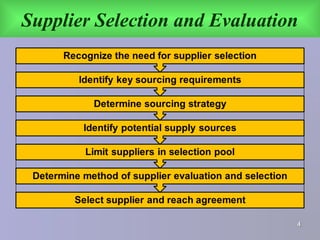
Supplier Selection and Evaluation
44
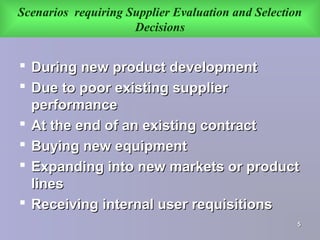
Scenarios requiring Supplier Evaluation and Selection
Decisions
 During new product developmentDuring new product development
 Due to poor existing supplierDue to poor existing supplier
performanceperformance
 At the end of an existing contractAt the end of an existing contract
 Buying new equipmentBuying new equipment
 Expanding into new markets or productExpanding into new markets or product
lineslines
 Receiving internal user requisitionsReceiving internal user requisitions
55
Scenarios requiring Supplier Evaluation and Selection
Decisions
 Performing market testsPerforming market tests
 Facing countertrade requirementsFacing countertrade requirements
 During outsourcing analysisDuring outsourcing analysis
 Consolidating volumesConsolidating volumes
 Conducting a reverse auctionConducting a reverse auction
 When current suppliers have insufficientWhen current suppliers have insufficient
capacitycapacity
 Reducing supply base sizeReducing supply base size
Pradeep B. OwalekarPradeep B. Owalekar
66
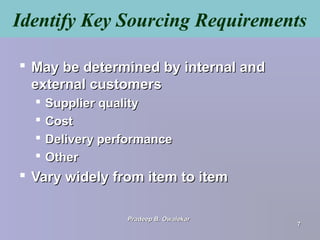
Identify Key Sourcing Requirements
 May be determined by internal andMay be determined by internal and
external customersexternal customers
 Supplier qualitySupplier quality
 CostCost
 Delivery performanceDelivery performance
 OtherOther
 Vary widely from item to itemVary widely from item to item
Pradeep B. OwalekarPradeep B. Owalekar
77
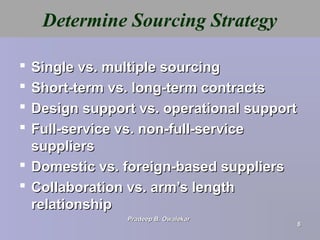
Determine Sourcing Strategy
 Single vs. multiple sourcingSingle vs. multiple sourcing
 Short-term vs. long-term contractsShort-term vs. long-term contracts
 Design support vs. operational supportDesign support vs. operational support
 Full-service vs. non-full-serviceFull-service vs. non-full-service
supplierssuppliers
 Domestic vs. foreign-based suppliersDomestic vs. foreign-based suppliers
 Collaboration vs. arm’s lengthCollaboration vs. arm’s length
relationshiprelationship
Pradeep B. OwalekarPradeep B. Owalekar
88
Identify Potential Sources
 How well existing suppliers can satisfyHow well existing suppliers can satisfy
cost, quality, and/or other performancecost, quality, and/or other performance
objectivesobjectives
 Strategic importance of purchaseStrategic importance of purchase
requirementrequirement
 Technical complexity of purchaseTechnical complexity of purchase
requirementrequirement
Pradeep B. OwalekarPradeep B. Owalekar
99
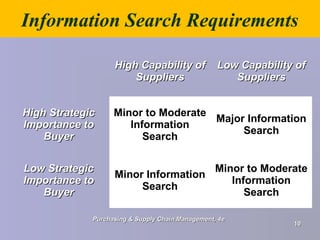
Information Search Requirements
Purchasing & Supply Chain Management, 4ePurchasing & Supply Chain Management, 4e
1010
High Capability ofHigh Capability of
SuppliersSuppliers
Low Capability ofLow Capability of
SuppliersSuppliers
High StrategicHigh Strategic
Importance toImportance to
BuyerBuyer
Minor to Moderate
Information
Search
Major Information
Search
Low StrategicLow Strategic
Importance toImportance to
BuyerBuyer
Minor Information
Search
Minor to Moderate
Information
Search
Sources of Information
 Current suppliersCurrent suppliers
 Preferred suppliersPreferred suppliers
 SalesSales
representativesrepresentatives
 InformationInformation
databasesdatabases
 ExperienceExperience
 Trade journalsTrade journals
 Trade directoriesTrade directories
 Trade showsTrade shows
 Second-party orSecond-party or
indirect informationindirect information
 Internal sourcesInternal sources
 Internet searchesInternet searches
Pradeep B. OwalekarPradeep B. Owalekar
1111
Sourcing Alternatives
 Manufacturer vs. distributorManufacturer vs. distributor
 Vendor-managed inventoryVendor-managed inventory
 Integrated supplyIntegrated supply
 Local, national, or international suppliersLocal, national, or international suppliers
 Large vs. small suppliersLarge vs. small suppliers
 CapabilityCapability
 Multiple vs. single sourcingMultiple vs. single sourcing
Purchasing & Supply Chain Management, 4ePurchasing & Supply Chain Management, 4e
1212
Method of Evaluation and Selection
 Evaluation from supplier-providedEvaluation from supplier-provided
informationinformation
 Supplier visitsSupplier visits
 Use of preferred suppliersUse of preferred suppliers
 External or third-party informationExternal or third-party information
Pradeep B. OwalekarPradeep B. Owalekar
1313
Key Suppliers Evaluation Criteria
 Price, quality, and deliveryPrice, quality, and delivery
 Management capabilityManagement capability
 Employees capabilitiesEmployees capabilities
 Cost structureCost structure
 Total quality performance, systems,Total quality performance, systems,
and philosophyand philosophy
 Process and technological capabilityProcess and technological capability
Pradeep B. OwalekarPradeep B. Owalekar
1414
Key Suppliers Evaluation Criteria
 Environmental regulation complianceEnvironmental regulation compliance
 Financial stabilityFinancial stability
 Production scheduling and controlProduction scheduling and control
systemssystems
 E-commerce capabilityE-commerce capability
 Supplier’s sourcing strategies, policies,Supplier’s sourcing strategies, policies,
and techniquesand techniques
 Longer-term relationship potentialLonger-term relationship potential
Purchasing & Supply Chain Management, 4ePurchasing & Supply Chain Management, 4e
1515
Management Capabilities
 Does management practice long-rangeDoes management practice long-range
planning?planning?
 Has management committed to totalHas management committed to total
quality management and continuousquality management and continuous
improvement?improvement?
 How high is management turnover?How high is management turnover?
 What are the professional andWhat are the professional and
educational backgrounds of keyeducational backgrounds of key
managers?managers?
Pradeep B. OwalekarPradeep B. Owalekar
1616
Management Capabilities
 What is the organization’s vision?What is the organization’s vision?
 Is the company customer focused?Is the company customer focused?
 What is the history of labor-What is the history of labor-
management relations?management relations?
 Is the organization making necessaryIs the organization making necessary
capital investments?capital investments?
Pradeep B. OwalekarPradeep B. Owalekar
1717
Management Capabilities
 Is the organization prepared to faceIs the organization prepared to face
future competitive challenges?future competitive challenges?
 Does management fully understand theDoes management fully understand the
importance of strategic sourcing?importance of strategic sourcing?
Pradeep B. OwalekarPradeep B. Owalekar
1818
Employee Capabilities
 Degree of commitment to quality andDegree of commitment to quality and
continuous improvementcontinuous improvement
 Overall skills and abilitiesOverall skills and abilities
 Employee-management relationsEmployee-management relations
 Worker flexibilityWorker flexibility
 Workforce turnoverWorkforce turnover
 Willingness to contribute to improvedWillingness to contribute to improved
operationsoperations
Pradeep B. OwalekarPradeep B. Owalekar
1919
Total Cost Structure
 Direct labor costsDirect labor costs
 Indirect labor costsIndirect labor costs
 Material costsMaterial costs
 Manufacturing or process operatingManufacturing or process operating
costscosts
 General overhead costsGeneral overhead costs
Pradeep B. OwalekarPradeep B. Owalekar
2020
Challenges of Total Cost Analysis
 Supplier may not understand its trueSupplier may not understand its true
costscosts
 Unsophisticated cost accounting systemUnsophisticated cost accounting system
 Cost data is considered proprietaryCost data is considered proprietary
 Buyer’s knowledge may undermineBuyer’s knowledge may undermine
supplier’s pricing strategysupplier’s pricing strategy
 Supplier is concerned about potentialSupplier is concerned about potential
misuse of its cost datamisuse of its cost data
Pradeep B. OwalekarPradeep B. Owalekar
2121
Total Quality Performance
 Management commitmentManagement commitment
 Use of SPC techniquesUse of SPC techniques
 Level of defectsLevel of defects
 Safety, training, and maintenanceSafety, training, and maintenance
 Use of ISO 9000 criteriaUse of ISO 9000 criteria
Purchasing & Supply Chain Management, 4ePurchasing & Supply Chain Management, 4e
2222
Process and Technological Capability
 Level of technology, design capability,Level of technology, design capability,
methods used, and equipmentmethods used, and equipment
 Current vs. future capabilitiesCurrent vs. future capabilities
 Resources committed to R&DResources committed to R&D
Pradeep B. OwalekarPradeep B. Owalekar
2323
Environmental Compliance
 Disclosure of environmental infractionsDisclosure of environmental infractions
 Hazardous and toxic waste generationHazardous and toxic waste generation
and managementand management
 Recycling managementRecycling management
 ISO 14000 certificationISO 14000 certification
 Control of ozone-depleting substancesControl of ozone-depleting substances
Pradeep B. OwalekarPradeep B. Owalekar
2424
Financial Stability
 Often used as a screening process inOften used as a screening process in
the initial selection phasethe initial selection phase
 Risks of a financially weak supplierRisks of a financially weak supplier
 Supplier will go out of businessSupplier will go out of business
 Insufficient resources to invest inInsufficient resources to invest in
improved plant and equipmentimproved plant and equipment
 Supplier may become too dependent onSupplier may become too dependent on
buyerbuyer
 May be an indicator of other problemsMay be an indicator of other problems
Pradeep B. OwalekarPradeep B. Owalekar
2525
Production Scheduling and Control
 Does the supplier use MRP?Does the supplier use MRP?
 Does the supplier track material andDoes the supplier track material and
production cycle times?production cycle times?
 Can the supplier support the buyer’sCan the supplier support the buyer’s
JIT initiatives?JIT initiatives?
 What are the supplier’s real lead times?What are the supplier’s real lead times?
 What is the supplier’s on-time deliveryWhat is the supplier’s on-time delivery
performance?performance?
Pradeep B. OwalekarPradeep B. Owalekar
2626
E-Commerce Capability
 Web-based B2B vs. EDI systemsWeb-based B2B vs. EDI systems
 Does the supplier have CAD capability?Does the supplier have CAD capability?
 Does the supplier use bar coding?Does the supplier use bar coding?
 Does the supplier use RFID?Does the supplier use RFID?
 Can the supplier provide ASNs?Can the supplier provide ASNs?
 Can the supplier accept EFT transfers?Can the supplier accept EFT transfers?
 Does the supplier utilize e-mail?Does the supplier utilize e-mail?
Pradeep B. OwalekarPradeep B. Owalekar
2727
Supplier’s Supply Base Strategies
 Tier 1 vs. Tier 2 vs. Tier 3 suppliersTier 1 vs. Tier 2 vs. Tier 3 suppliers
 Sharing of informationSharing of information
 Level of supplier developmentLevel of supplier development
activities in the supplier’s own supplyactivities in the supplier’s own supply
basebase
Pradeep B. OwalekarPradeep B. Owalekar
2828
Potential for Long-Term Relationships
 Is the supplier willing to participate?Is the supplier willing to participate?
 Can the supplier commit necessaryCan the supplier commit necessary
resources?resources?
 When in the design phase can theWhen in the design phase can the
supplier participate?supplier participate?
 How is the supplier unique?How is the supplier unique?
 Can the supplier participate in jointCan the supplier participate in joint
problem solving and improvement?problem solving and improvement?
Pradeep B. OwalekarPradeep B. Owalekar
2929
Potential for Long-Term Relationships
 Will there be free and open informationWill there be free and open information
sharing?sharing?
 Will the supplier engage in futureWill the supplier engage in future
planning?planning?
 Can the supplier maintain the buyer’sCan the supplier maintain the buyer’s
need for confidentiality?need for confidentiality?
 What is the general level of comfortWhat is the general level of comfort
between the parties?between the parties?
Pradeep B. OwalekarPradeep B. Owalekar
3030
Potential for Long-Term Relationships
 How well does the supplier understandHow well does the supplier understand
the buyer’s industry and business?the buyer’s industry and business?
 Will the supplier share cost data?Will the supplier share cost data?
 Is the supplier willing to share innovationIs the supplier willing to share innovation
data early?data early?
 Can the supplier commit to dedicatedCan the supplier commit to dedicated
capacity?capacity?
 What is the supplier’s commitment level?What is the supplier’s commitment level?
Pradeep B. OwalekarPradeep B. Owalekar
3131
Evaluation and Selection Surveys
 Identify supplier evaluation categoriesIdentify supplier evaluation categories
 Assign a weight to each categoryAssign a weight to each category
 Identify and weight subcategoriesIdentify and weight subcategories
 Define a scoring system for categoriesDefine a scoring system for categories
and subcategoriesand subcategories
 Evaluate supplier directlyEvaluate supplier directly
 Review results and make decisionReview results and make decision
Pradeep B. OwalekarPradeep B. Owalekar
3232
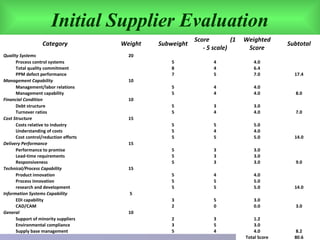
Initial Supplier Evaluation
Category Weight Subweight
Score (1
- 5 scale)
Weighted
Score
Subtotal
Quality Systems 20        
  Process control systems   5 4 4.0  
  Total quality commitment   8 4 6.4  
  PPM defect performance   7 5 7.0 17.4
Management Capability 10        
  Management/labor relations   5 4 4.0  
  Management capability   5 4 4.0 8.0
Financial Condition 10        
  Debt structure   5 3 3.0  
  Turnover ratios   5 4 4.0 7.0
Cost Structure 15        
  Costs relative to industry   5 5 5.0  
  Understanding of costs   5 4 4.0  
  Cost control/reduction efforts   5 5 5.0 14.0
Delivery Performance 15        
  Performance to promise   5 3 3.0  
  Lead-time requirements   5 3 3.0  
  Responsiveness   5 3 3.0 9.0
Technical/Process Capability 15        
  Product innovation   5 4 4.0  
  Process innovation   5 5 5.0  
  research and development   5 5 5.0 14.0
Information Systems Capability 5        
  EDI capability   3 5 3.0  
  CAD/CAM   2 0 0.0 3.0
General 10        
  Support of minority suppliers   2 3 1.2  
  Environmental compliance   3 5 3.0  
  Supply base management   5 4 4.0 8.2
Total Score 80.6
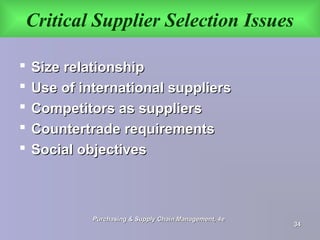
Critical Supplier Selection Issues
 Size relationshipSize relationship
 Use of international suppliersUse of international suppliers
 Competitors as suppliersCompetitors as suppliers
 Countertrade requirementsCountertrade requirements
 Social objectivesSocial objectives
Purchasing & Supply Chain Management, 4ePurchasing & Supply Chain Management, 4e
3434
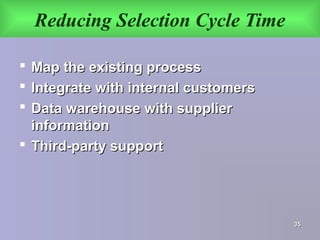
Reducing Selection Cycle Time
 Map the existing processMap the existing process
 Integrate with internal customersIntegrate with internal customers
 Data warehouse with supplierData warehouse with supplier
informationinformation
 Third-party supportThird-party support
3535
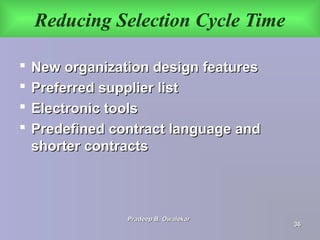
Reducing Selection Cycle Time
 New organization design featuresNew organization design features
 Preferred supplier listPreferred supplier list
 Electronic toolsElectronic tools
 Predefined contract language andPredefined contract language and
shorter contractsshorter contracts
Pradeep B. OwalekarPradeep B. Owalekar
3636
A Good Supplier Does the Following:
 Builds quality into the product, aimingBuilds quality into the product, aiming
for zero defectsfor zero defects
 Makes delivery performance a priorityMakes delivery performance a priority
 Demonstrates responsiveness to aDemonstrates responsiveness to a
buyer’s needsbuyer’s needs
 Works with the buyer to reduce leadWorks with the buyer to reduce lead
timestimes
Pradeep B. OwalekarPradeep B. Owalekar
3737
A Good Supplier Does the Following:
 Provides the buyer with capability andProvides the buyer with capability and
workload informationworkload information
 Creates the futureCreates the future
 Reinvests part of its profits into R&DReinvests part of its profits into R&D
with a long-term viewwith a long-term view
 Meets stringent financial stabilityMeets stringent financial stability
criteria when evaluating newcriteria when evaluating new
customerscustomers
3838

Supplier evaluation & selection

  • 1.
    PURCHASING & SUPPLYCHAIN MANAGEMENT, 4ePURCHASING & SUPPLY CHAIN MANAGEMENT, 4e CENGAGE LEARNINGCENGAGE LEARNING Monczka – Handfield – Giunipero – PattersonMonczka – Handfield – Giunipero – Patterson Presentation onPresentation on Supplier Evaluation and SelectionSupplier Evaluation and Selection By Pradeep OwalekarBy Pradeep Owalekar Based on the cited BookBased on the cited Book
  • 2.
    Coverage of Topic Supplier evaluation and selectionSupplier evaluation and selection processprocess  Key supplier evaluation criteriaKey supplier evaluation criteria  Developing a supplier evaluation andDeveloping a supplier evaluation and selection surveyselection survey  Critical supplier selection issuesCritical supplier selection issues  Reducing supplier evaluation andReducing supplier evaluation and selection cycle timeselection cycle time 22
  • 3.
    Evaluation and SelectionProcess  No “one best way”No “one best way”  Overall objective is to reduce sourcingOverall objective is to reduce sourcing risk and maximize value to the buyerrisk and maximize value to the buyer  Need to select suppliers for the long-Need to select suppliers for the long- termterm 33
  • 4.
  • 5.
    Scenarios requiring SupplierEvaluation and Selection Decisions  During new product developmentDuring new product development  Due to poor existing supplierDue to poor existing supplier performanceperformance  At the end of an existing contractAt the end of an existing contract  Buying new equipmentBuying new equipment  Expanding into new markets or productExpanding into new markets or product lineslines  Receiving internal user requisitionsReceiving internal user requisitions 55
  • 6.
    Scenarios requiring SupplierEvaluation and Selection Decisions  Performing market testsPerforming market tests  Facing countertrade requirementsFacing countertrade requirements  During outsourcing analysisDuring outsourcing analysis  Consolidating volumesConsolidating volumes  Conducting a reverse auctionConducting a reverse auction  When current suppliers have insufficientWhen current suppliers have insufficient capacitycapacity  Reducing supply base sizeReducing supply base size Pradeep B. OwalekarPradeep B. Owalekar 66
  • 7.
    Identify Key SourcingRequirements  May be determined by internal andMay be determined by internal and external customersexternal customers  Supplier qualitySupplier quality  CostCost  Delivery performanceDelivery performance  OtherOther  Vary widely from item to itemVary widely from item to item Pradeep B. OwalekarPradeep B. Owalekar 77
  • 8.
    Determine Sourcing Strategy Single vs. multiple sourcingSingle vs. multiple sourcing  Short-term vs. long-term contractsShort-term vs. long-term contracts  Design support vs. operational supportDesign support vs. operational support  Full-service vs. non-full-serviceFull-service vs. non-full-service supplierssuppliers  Domestic vs. foreign-based suppliersDomestic vs. foreign-based suppliers  Collaboration vs. arm’s lengthCollaboration vs. arm’s length relationshiprelationship Pradeep B. OwalekarPradeep B. Owalekar 88
  • 9.
    Identify Potential Sources How well existing suppliers can satisfyHow well existing suppliers can satisfy cost, quality, and/or other performancecost, quality, and/or other performance objectivesobjectives  Strategic importance of purchaseStrategic importance of purchase requirementrequirement  Technical complexity of purchaseTechnical complexity of purchase requirementrequirement Pradeep B. OwalekarPradeep B. Owalekar 99
  • 10.
    Information Search Requirements Purchasing& Supply Chain Management, 4ePurchasing & Supply Chain Management, 4e 1010 High Capability ofHigh Capability of SuppliersSuppliers Low Capability ofLow Capability of SuppliersSuppliers High StrategicHigh Strategic Importance toImportance to BuyerBuyer Minor to Moderate Information Search Major Information Search Low StrategicLow Strategic Importance toImportance to BuyerBuyer Minor Information Search Minor to Moderate Information Search
  • 11.
    Sources of Information Current suppliersCurrent suppliers  Preferred suppliersPreferred suppliers  SalesSales representativesrepresentatives  InformationInformation databasesdatabases  ExperienceExperience  Trade journalsTrade journals  Trade directoriesTrade directories  Trade showsTrade shows  Second-party orSecond-party or indirect informationindirect information  Internal sourcesInternal sources  Internet searchesInternet searches Pradeep B. OwalekarPradeep B. Owalekar 1111
  • 12.
    Sourcing Alternatives  Manufacturervs. distributorManufacturer vs. distributor  Vendor-managed inventoryVendor-managed inventory  Integrated supplyIntegrated supply  Local, national, or international suppliersLocal, national, or international suppliers  Large vs. small suppliersLarge vs. small suppliers  CapabilityCapability  Multiple vs. single sourcingMultiple vs. single sourcing Purchasing & Supply Chain Management, 4ePurchasing & Supply Chain Management, 4e 1212
  • 13.
    Method of Evaluationand Selection  Evaluation from supplier-providedEvaluation from supplier-provided informationinformation  Supplier visitsSupplier visits  Use of preferred suppliersUse of preferred suppliers  External or third-party informationExternal or third-party information Pradeep B. OwalekarPradeep B. Owalekar 1313
  • 14.
    Key Suppliers EvaluationCriteria  Price, quality, and deliveryPrice, quality, and delivery  Management capabilityManagement capability  Employees capabilitiesEmployees capabilities  Cost structureCost structure  Total quality performance, systems,Total quality performance, systems, and philosophyand philosophy  Process and technological capabilityProcess and technological capability Pradeep B. OwalekarPradeep B. Owalekar 1414
  • 15.
    Key Suppliers EvaluationCriteria  Environmental regulation complianceEnvironmental regulation compliance  Financial stabilityFinancial stability  Production scheduling and controlProduction scheduling and control systemssystems  E-commerce capabilityE-commerce capability  Supplier’s sourcing strategies, policies,Supplier’s sourcing strategies, policies, and techniquesand techniques  Longer-term relationship potentialLonger-term relationship potential Purchasing & Supply Chain Management, 4ePurchasing & Supply Chain Management, 4e 1515
  • 16.
    Management Capabilities  Doesmanagement practice long-rangeDoes management practice long-range planning?planning?  Has management committed to totalHas management committed to total quality management and continuousquality management and continuous improvement?improvement?  How high is management turnover?How high is management turnover?  What are the professional andWhat are the professional and educational backgrounds of keyeducational backgrounds of key managers?managers? Pradeep B. OwalekarPradeep B. Owalekar 1616
  • 17.
    Management Capabilities  Whatis the organization’s vision?What is the organization’s vision?  Is the company customer focused?Is the company customer focused?  What is the history of labor-What is the history of labor- management relations?management relations?  Is the organization making necessaryIs the organization making necessary capital investments?capital investments? Pradeep B. OwalekarPradeep B. Owalekar 1717
  • 18.
    Management Capabilities  Isthe organization prepared to faceIs the organization prepared to face future competitive challenges?future competitive challenges?  Does management fully understand theDoes management fully understand the importance of strategic sourcing?importance of strategic sourcing? Pradeep B. OwalekarPradeep B. Owalekar 1818
  • 19.
    Employee Capabilities  Degreeof commitment to quality andDegree of commitment to quality and continuous improvementcontinuous improvement  Overall skills and abilitiesOverall skills and abilities  Employee-management relationsEmployee-management relations  Worker flexibilityWorker flexibility  Workforce turnoverWorkforce turnover  Willingness to contribute to improvedWillingness to contribute to improved operationsoperations Pradeep B. OwalekarPradeep B. Owalekar 1919
  • 20.
    Total Cost Structure Direct labor costsDirect labor costs  Indirect labor costsIndirect labor costs  Material costsMaterial costs  Manufacturing or process operatingManufacturing or process operating costscosts  General overhead costsGeneral overhead costs Pradeep B. OwalekarPradeep B. Owalekar 2020
  • 21.
    Challenges of TotalCost Analysis  Supplier may not understand its trueSupplier may not understand its true costscosts  Unsophisticated cost accounting systemUnsophisticated cost accounting system  Cost data is considered proprietaryCost data is considered proprietary  Buyer’s knowledge may undermineBuyer’s knowledge may undermine supplier’s pricing strategysupplier’s pricing strategy  Supplier is concerned about potentialSupplier is concerned about potential misuse of its cost datamisuse of its cost data Pradeep B. OwalekarPradeep B. Owalekar 2121
  • 22.
    Total Quality Performance Management commitmentManagement commitment  Use of SPC techniquesUse of SPC techniques  Level of defectsLevel of defects  Safety, training, and maintenanceSafety, training, and maintenance  Use of ISO 9000 criteriaUse of ISO 9000 criteria Purchasing & Supply Chain Management, 4ePurchasing & Supply Chain Management, 4e 2222
  • 23.
    Process and TechnologicalCapability  Level of technology, design capability,Level of technology, design capability, methods used, and equipmentmethods used, and equipment  Current vs. future capabilitiesCurrent vs. future capabilities  Resources committed to R&DResources committed to R&D Pradeep B. OwalekarPradeep B. Owalekar 2323
  • 24.
    Environmental Compliance  Disclosureof environmental infractionsDisclosure of environmental infractions  Hazardous and toxic waste generationHazardous and toxic waste generation and managementand management  Recycling managementRecycling management  ISO 14000 certificationISO 14000 certification  Control of ozone-depleting substancesControl of ozone-depleting substances Pradeep B. OwalekarPradeep B. Owalekar 2424
  • 25.
    Financial Stability  Oftenused as a screening process inOften used as a screening process in the initial selection phasethe initial selection phase  Risks of a financially weak supplierRisks of a financially weak supplier  Supplier will go out of businessSupplier will go out of business  Insufficient resources to invest inInsufficient resources to invest in improved plant and equipmentimproved plant and equipment  Supplier may become too dependent onSupplier may become too dependent on buyerbuyer  May be an indicator of other problemsMay be an indicator of other problems Pradeep B. OwalekarPradeep B. Owalekar 2525
  • 26.
    Production Scheduling andControl  Does the supplier use MRP?Does the supplier use MRP?  Does the supplier track material andDoes the supplier track material and production cycle times?production cycle times?  Can the supplier support the buyer’sCan the supplier support the buyer’s JIT initiatives?JIT initiatives?  What are the supplier’s real lead times?What are the supplier’s real lead times?  What is the supplier’s on-time deliveryWhat is the supplier’s on-time delivery performance?performance? Pradeep B. OwalekarPradeep B. Owalekar 2626
  • 27.
    E-Commerce Capability  Web-basedB2B vs. EDI systemsWeb-based B2B vs. EDI systems  Does the supplier have CAD capability?Does the supplier have CAD capability?  Does the supplier use bar coding?Does the supplier use bar coding?  Does the supplier use RFID?Does the supplier use RFID?  Can the supplier provide ASNs?Can the supplier provide ASNs?  Can the supplier accept EFT transfers?Can the supplier accept EFT transfers?  Does the supplier utilize e-mail?Does the supplier utilize e-mail? Pradeep B. OwalekarPradeep B. Owalekar 2727
  • 28.
    Supplier’s Supply BaseStrategies  Tier 1 vs. Tier 2 vs. Tier 3 suppliersTier 1 vs. Tier 2 vs. Tier 3 suppliers  Sharing of informationSharing of information  Level of supplier developmentLevel of supplier development activities in the supplier’s own supplyactivities in the supplier’s own supply basebase Pradeep B. OwalekarPradeep B. Owalekar 2828
  • 29.
    Potential for Long-TermRelationships  Is the supplier willing to participate?Is the supplier willing to participate?  Can the supplier commit necessaryCan the supplier commit necessary resources?resources?  When in the design phase can theWhen in the design phase can the supplier participate?supplier participate?  How is the supplier unique?How is the supplier unique?  Can the supplier participate in jointCan the supplier participate in joint problem solving and improvement?problem solving and improvement? Pradeep B. OwalekarPradeep B. Owalekar 2929
  • 30.
    Potential for Long-TermRelationships  Will there be free and open informationWill there be free and open information sharing?sharing?  Will the supplier engage in futureWill the supplier engage in future planning?planning?  Can the supplier maintain the buyer’sCan the supplier maintain the buyer’s need for confidentiality?need for confidentiality?  What is the general level of comfortWhat is the general level of comfort between the parties?between the parties? Pradeep B. OwalekarPradeep B. Owalekar 3030
  • 31.
    Potential for Long-TermRelationships  How well does the supplier understandHow well does the supplier understand the buyer’s industry and business?the buyer’s industry and business?  Will the supplier share cost data?Will the supplier share cost data?  Is the supplier willing to share innovationIs the supplier willing to share innovation data early?data early?  Can the supplier commit to dedicatedCan the supplier commit to dedicated capacity?capacity?  What is the supplier’s commitment level?What is the supplier’s commitment level? Pradeep B. OwalekarPradeep B. Owalekar 3131
  • 32.
    Evaluation and SelectionSurveys  Identify supplier evaluation categoriesIdentify supplier evaluation categories  Assign a weight to each categoryAssign a weight to each category  Identify and weight subcategoriesIdentify and weight subcategories  Define a scoring system for categoriesDefine a scoring system for categories and subcategoriesand subcategories  Evaluate supplier directlyEvaluate supplier directly  Review results and make decisionReview results and make decision Pradeep B. OwalekarPradeep B. Owalekar 3232
  • 33.
    Initial Supplier Evaluation CategoryWeight Subweight Score (1 - 5 scale) Weighted Score Subtotal Quality Systems 20           Process control systems   5 4 4.0     Total quality commitment   8 4 6.4     PPM defect performance   7 5 7.0 17.4 Management Capability 10           Management/labor relations   5 4 4.0     Management capability   5 4 4.0 8.0 Financial Condition 10           Debt structure   5 3 3.0     Turnover ratios   5 4 4.0 7.0 Cost Structure 15           Costs relative to industry   5 5 5.0     Understanding of costs   5 4 4.0     Cost control/reduction efforts   5 5 5.0 14.0 Delivery Performance 15           Performance to promise   5 3 3.0     Lead-time requirements   5 3 3.0     Responsiveness   5 3 3.0 9.0 Technical/Process Capability 15           Product innovation   5 4 4.0     Process innovation   5 5 5.0     research and development   5 5 5.0 14.0 Information Systems Capability 5           EDI capability   3 5 3.0     CAD/CAM   2 0 0.0 3.0 General 10           Support of minority suppliers   2 3 1.2     Environmental compliance   3 5 3.0     Supply base management   5 4 4.0 8.2 Total Score 80.6
  • 34.
    Critical Supplier SelectionIssues  Size relationshipSize relationship  Use of international suppliersUse of international suppliers  Competitors as suppliersCompetitors as suppliers  Countertrade requirementsCountertrade requirements  Social objectivesSocial objectives Purchasing & Supply Chain Management, 4ePurchasing & Supply Chain Management, 4e 3434
  • 35.
    Reducing Selection CycleTime  Map the existing processMap the existing process  Integrate with internal customersIntegrate with internal customers  Data warehouse with supplierData warehouse with supplier informationinformation  Third-party supportThird-party support 3535
  • 36.
    Reducing Selection CycleTime  New organization design featuresNew organization design features  Preferred supplier listPreferred supplier list  Electronic toolsElectronic tools  Predefined contract language andPredefined contract language and shorter contractsshorter contracts Pradeep B. OwalekarPradeep B. Owalekar 3636
  • 37.
    A Good SupplierDoes the Following:  Builds quality into the product, aimingBuilds quality into the product, aiming for zero defectsfor zero defects  Makes delivery performance a priorityMakes delivery performance a priority  Demonstrates responsiveness to aDemonstrates responsiveness to a buyer’s needsbuyer’s needs  Works with the buyer to reduce leadWorks with the buyer to reduce lead timestimes Pradeep B. OwalekarPradeep B. Owalekar 3737
  • 38.
    A Good SupplierDoes the Following:  Provides the buyer with capability andProvides the buyer with capability and workload informationworkload information  Creates the futureCreates the future  Reinvests part of its profits into R&DReinvests part of its profits into R&D with a long-term viewwith a long-term view  Meets stringent financial stabilityMeets stringent financial stability criteria when evaluating newcriteria when evaluating new customerscustomers 3838