Supervised Learning of Sparsity-
Promoting Regularizers for Denoising
Michael McCann and Saiprasad Ravishankar
Michigan State University
July 7, 2020 - SIAM Conference on Imaging Science (IS20)
2
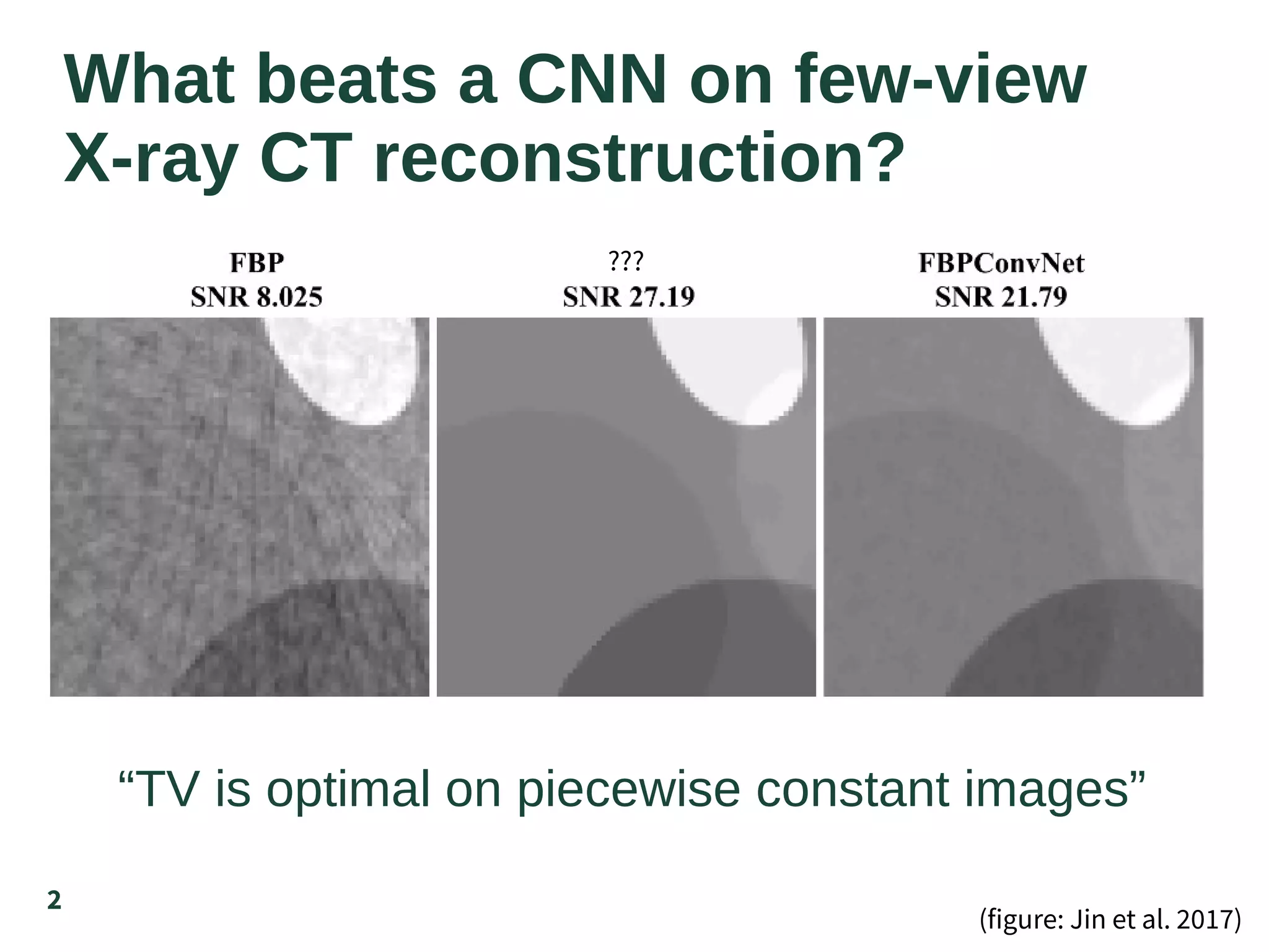
What beats a CNN on few-view
X-ray CT reconstruction?
(figure: Jin et al. 2017)
???
“TV is optimal on piecewise constant images”
3
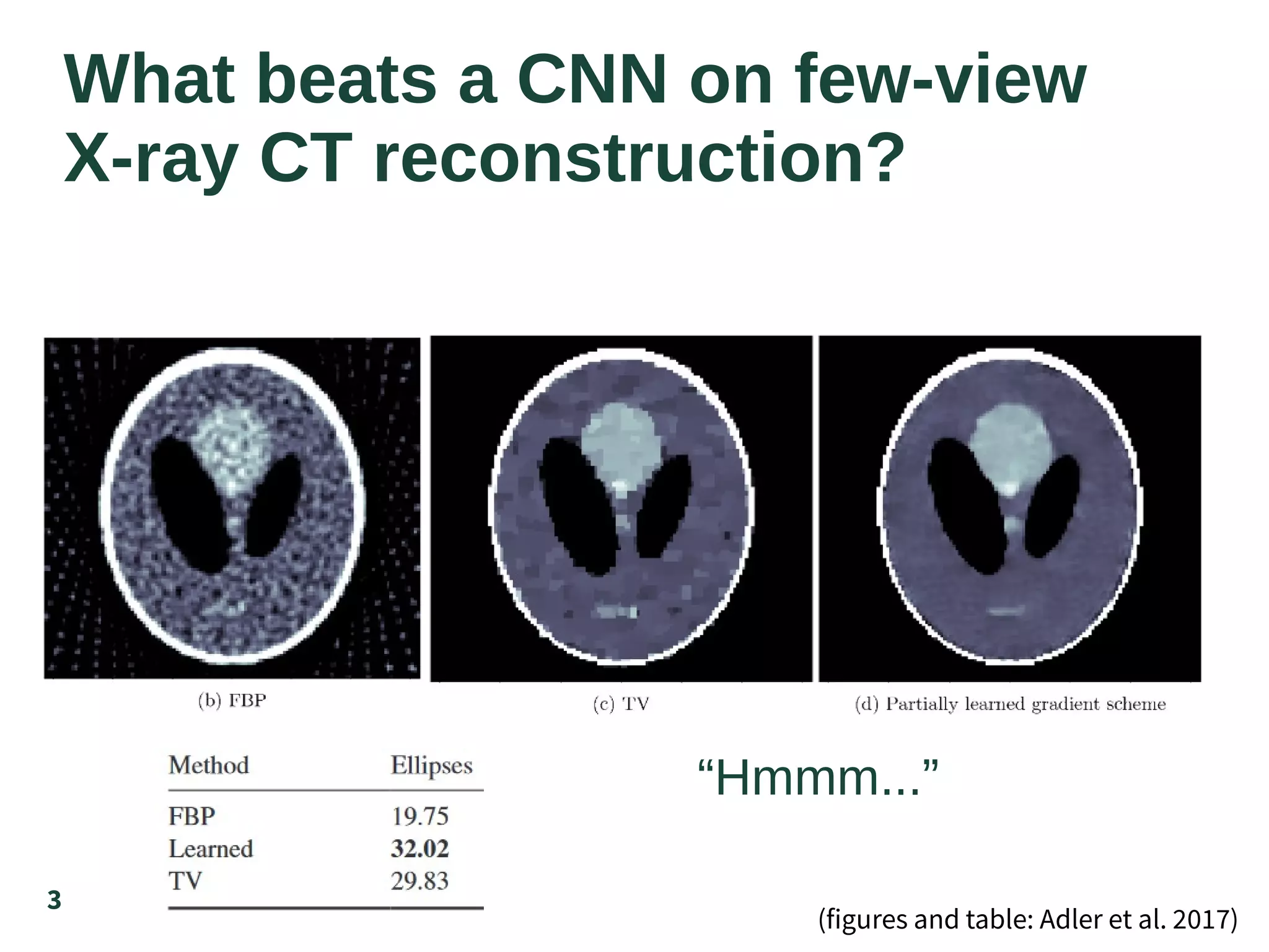
What beats a CNN on few-view
X-ray CT reconstruction?
(figures and table: Adler et al. 2017)
“Hmmm...”
4
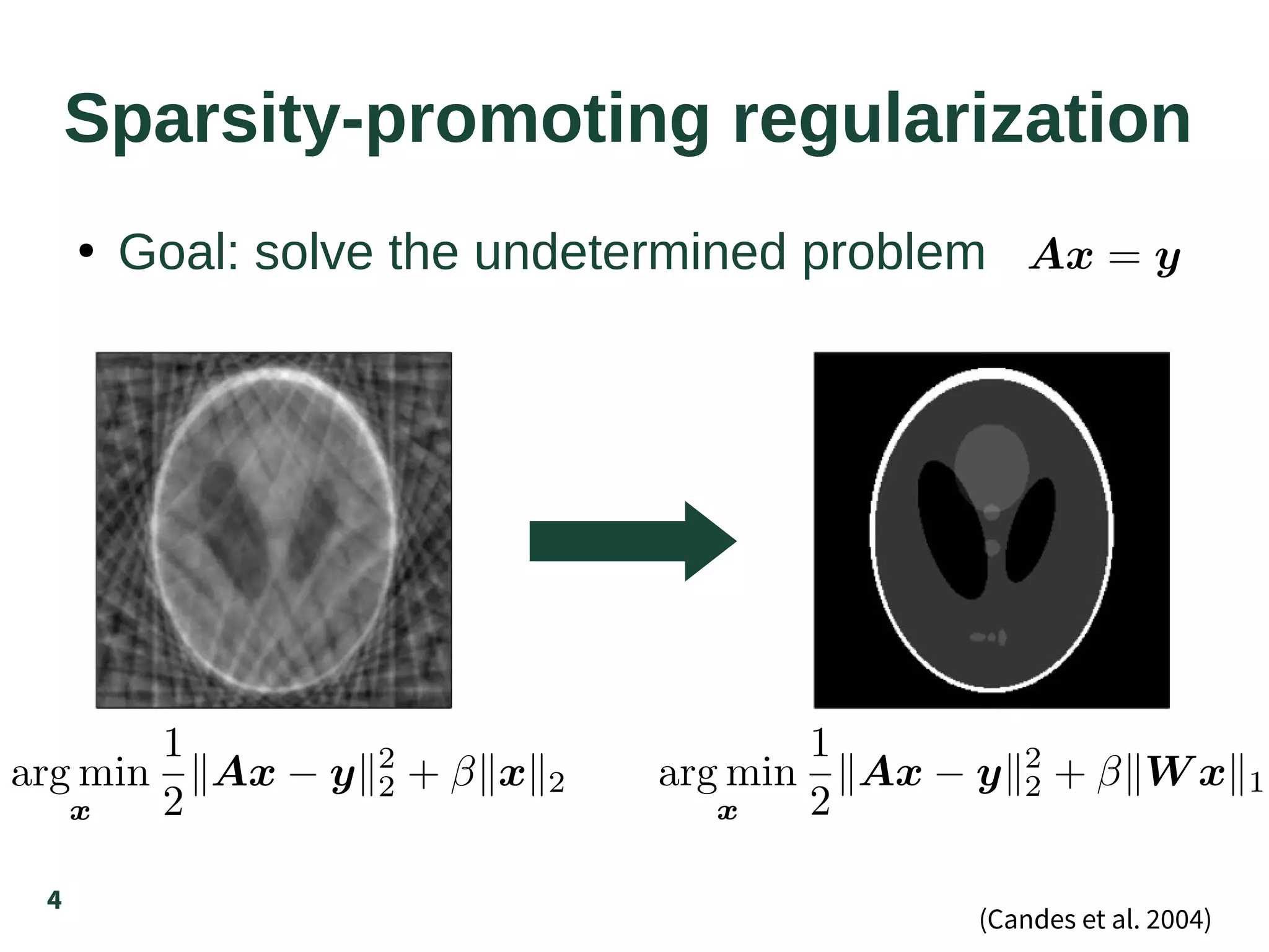
Sparsity-promoting regularization
(Candes et al. 2004)
●
Goal: solve the undetermined problem
5
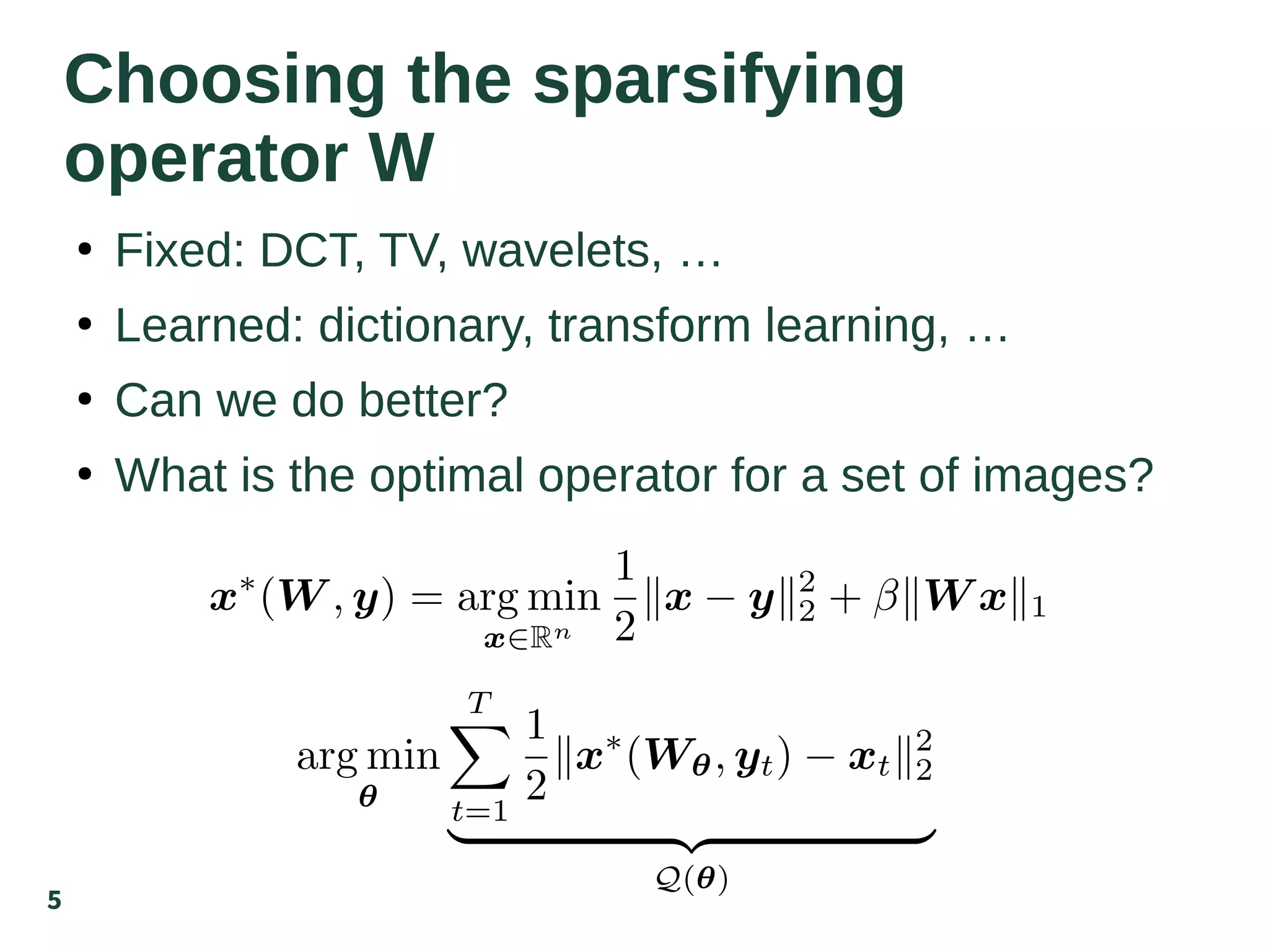
Choosing the sparsifying
operator W
●
Fixed: DCT, TV, wavelets, …
●
Learned: dictionary, transform learning, …
●
Can we do better?
●
What is the optimal operator for a set of images?
6
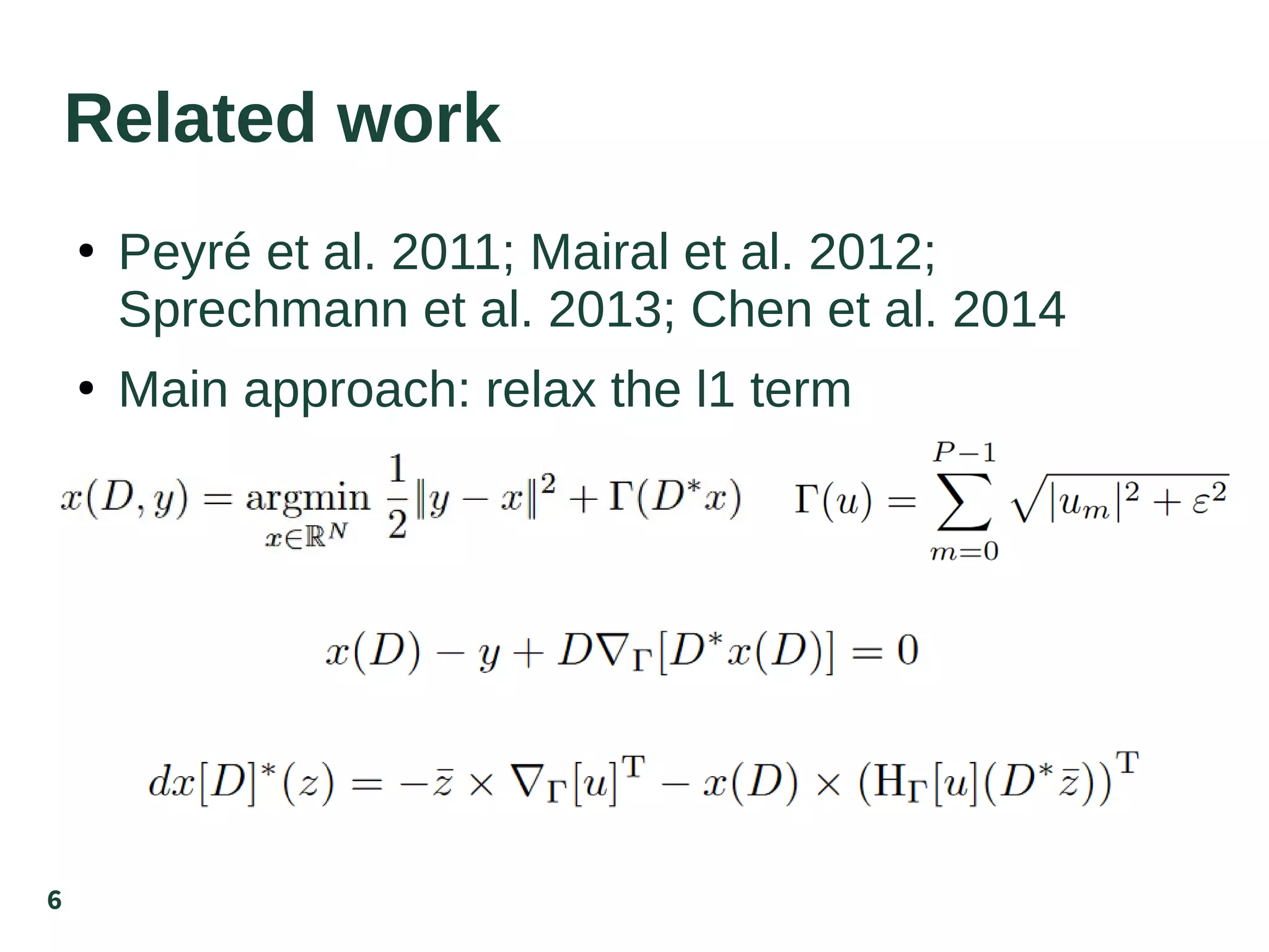
Related work
●
Peyré et al. 2011; Mairal et al. 2012;
Sprechmann et al. 2013; Chen et al. 2014
●
Main approach: relax the l1 term
7
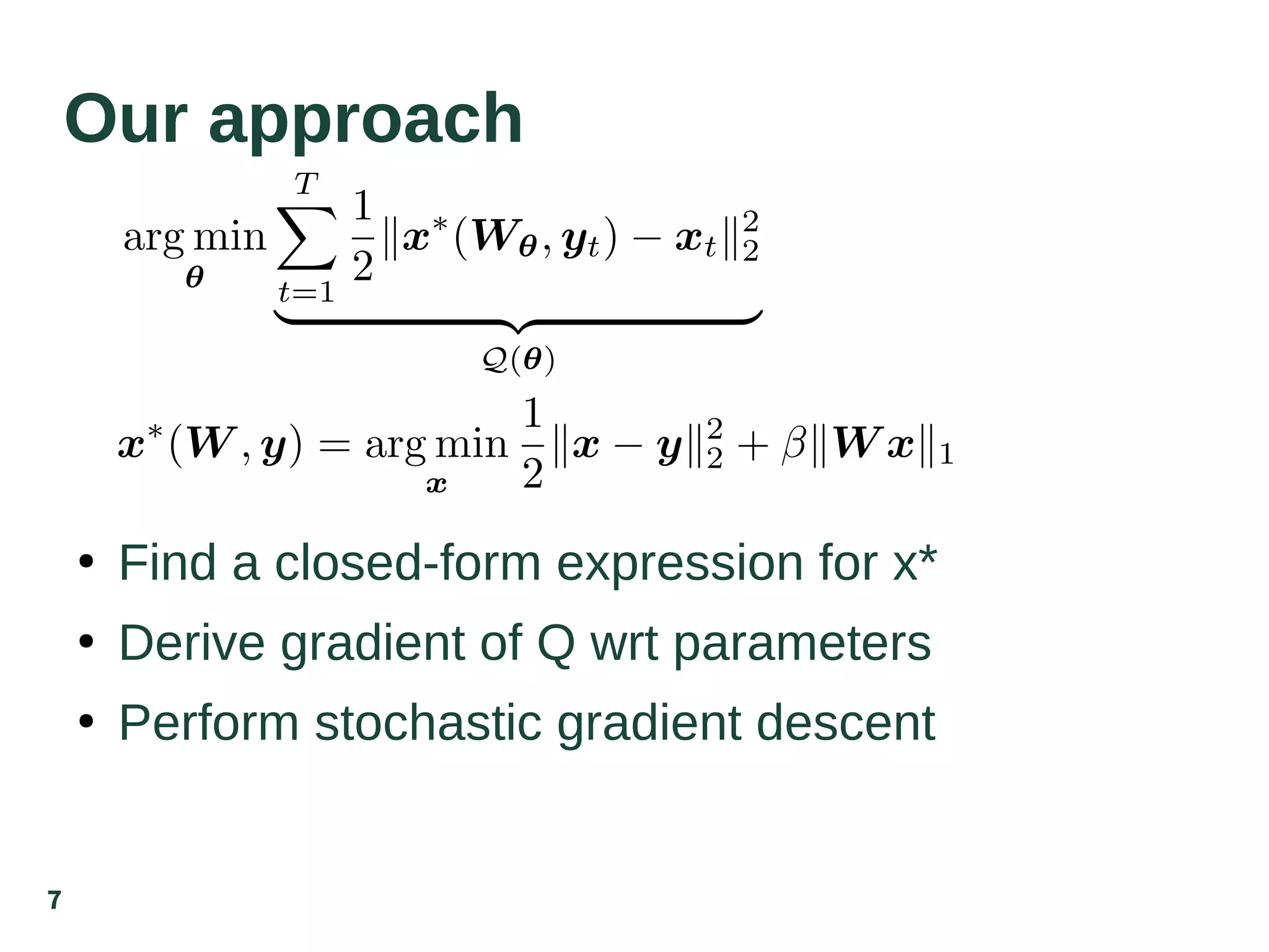
Our approach
●
Find a closed-form expression for x*
●
Derive gradient of Q wrt parameters
●
Perform stochastic gradient descent
8
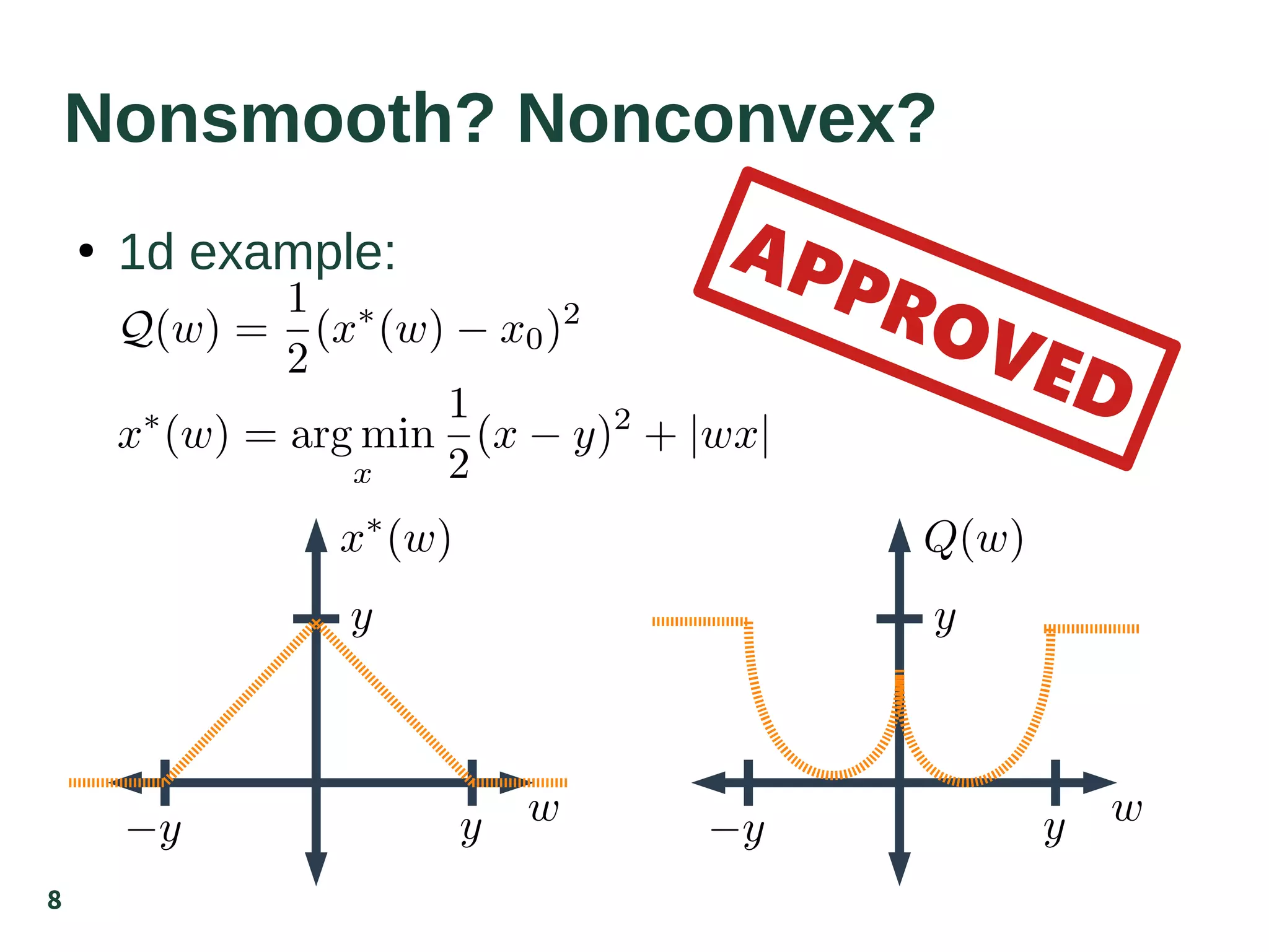
Nonsmooth? Nonconvex?
●
1d example: APPROVED
9
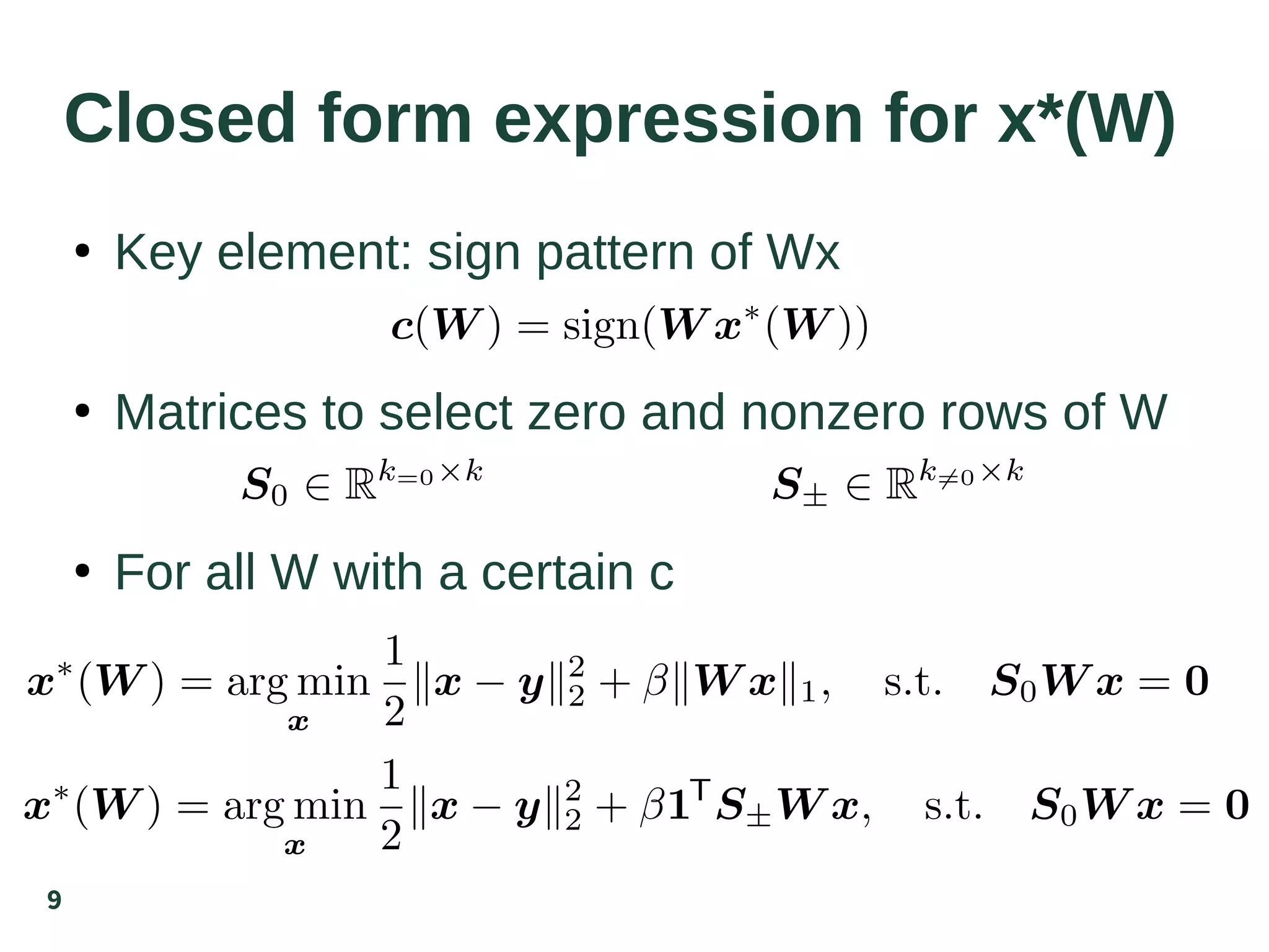
Closed form expression for x*(W)
●
Key element: sign pattern of Wx
●
Matrices to select zero and nonzero rows of W
●
For all W with a certain c
10
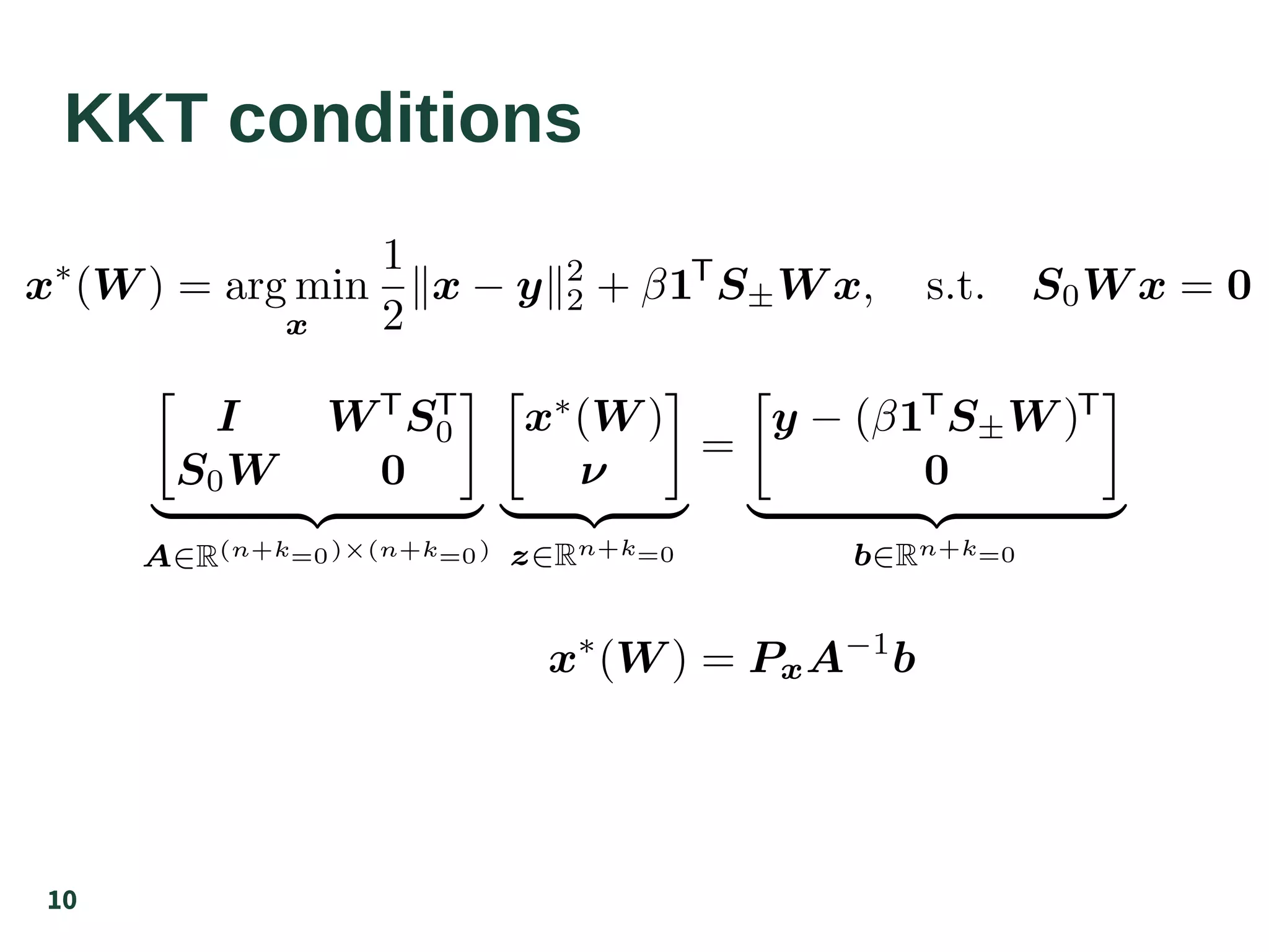
KKT conditions
11
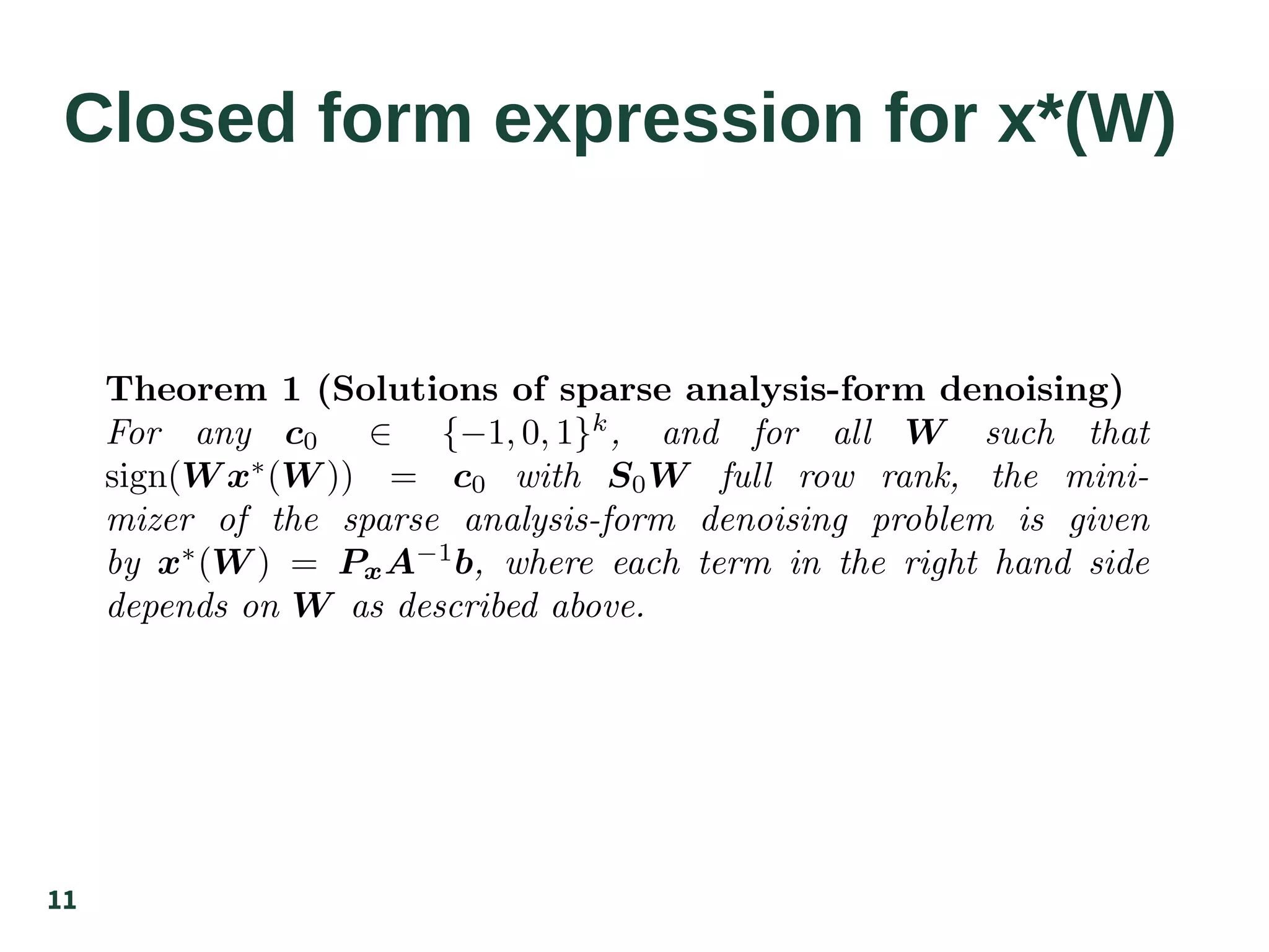
Closed form expression for x*(W)
12
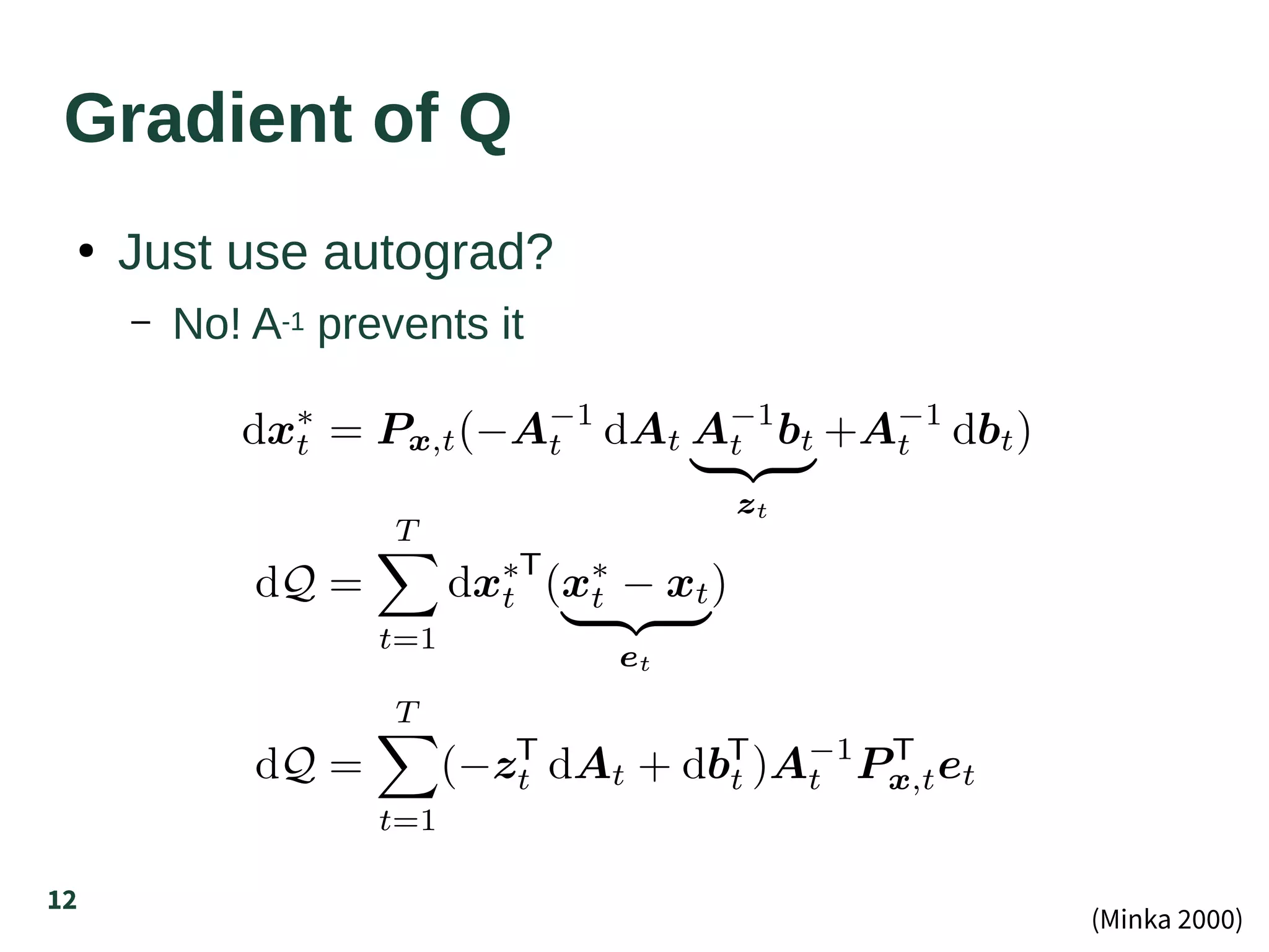
Gradient of Q
●
Just use autograd?
– No! A-1 prevents it
(Minka 2000)
13
Gradient calculation algorithm
●
Solve the reconstruction problem with current
W (we use ADMM)
●
Find the sign pattern of x* and form A and b
– How to handle inexactness of Wx*?
●
Solve the KKT system to find z
●
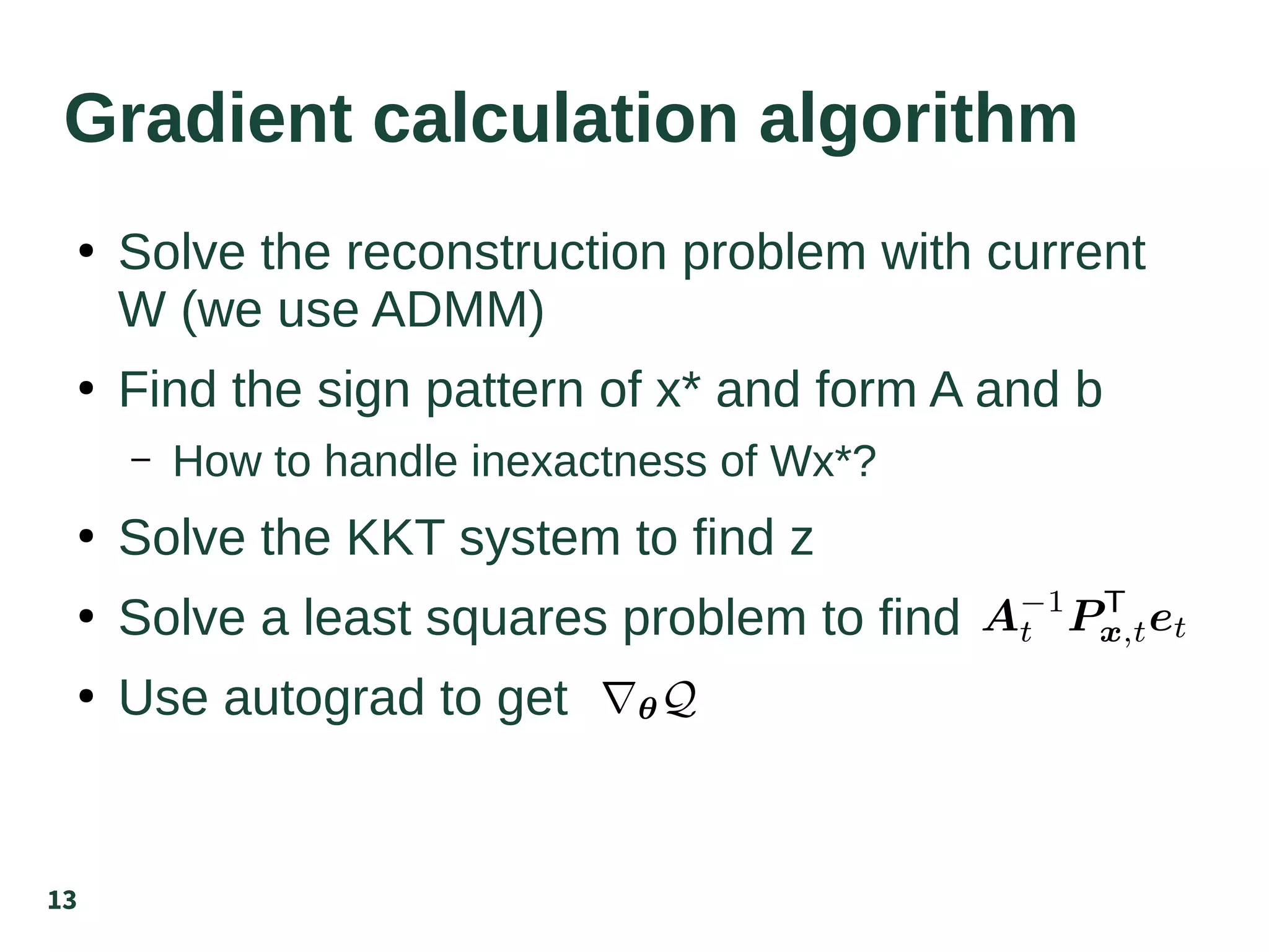
Solve a least squares problem to find
●
Use autograd to get
14
Denoising experiment
●
Images are 64x64, range is [0,1]
●
Additive IID Gaussian noise, stdev=0.1
●
10 training, 10 testing
15
Methods compared
●
BM3D, TV, DCT
– Regularization strength tuned on training
●
Unsupervised learned operator
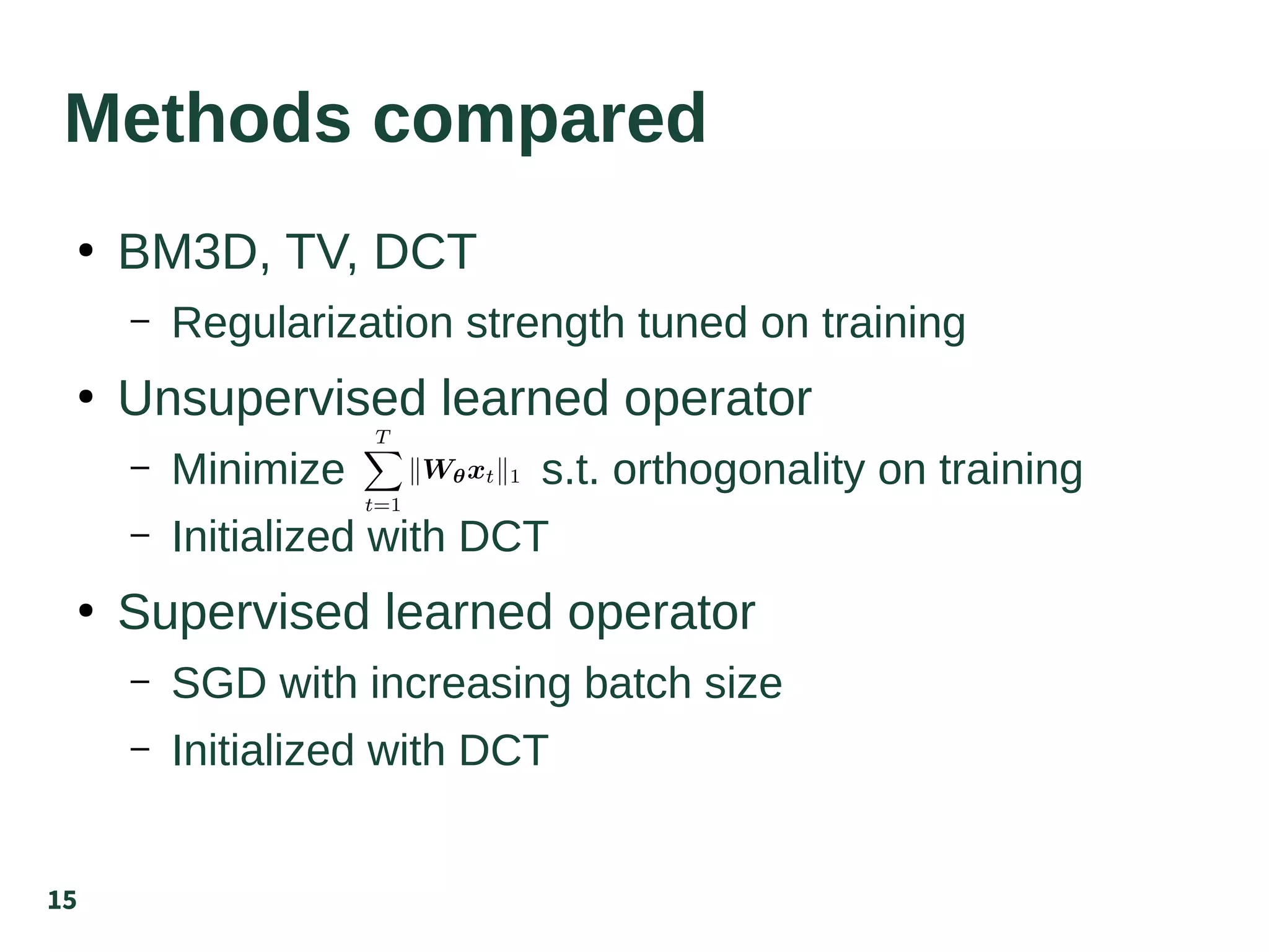
– Minimize s.t. orthogonality on training
– Initialized with DCT
●
Supervised learned operator
– SGD with increasing batch size
– Initialized with DCT
16
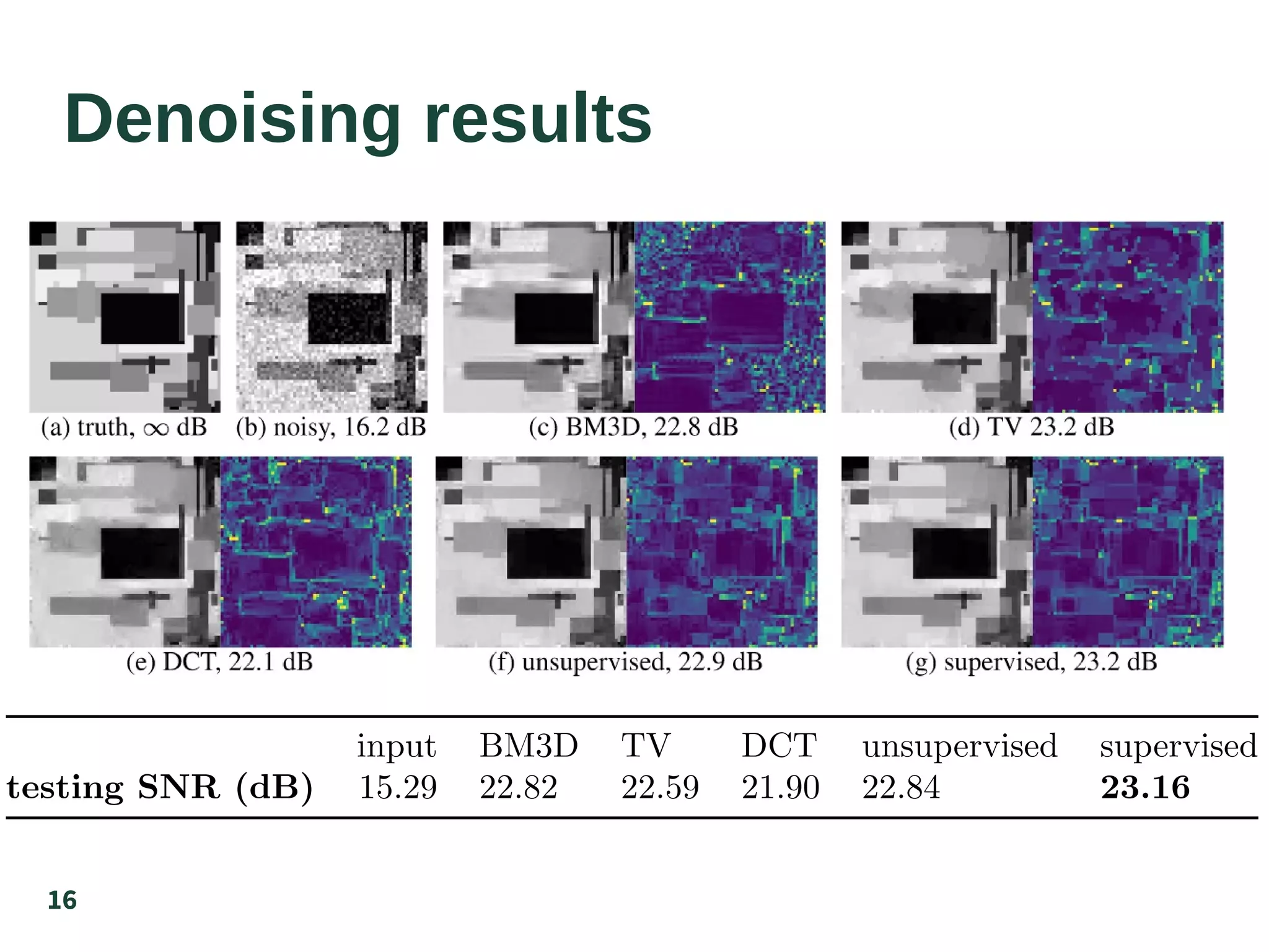
Denoising results
17
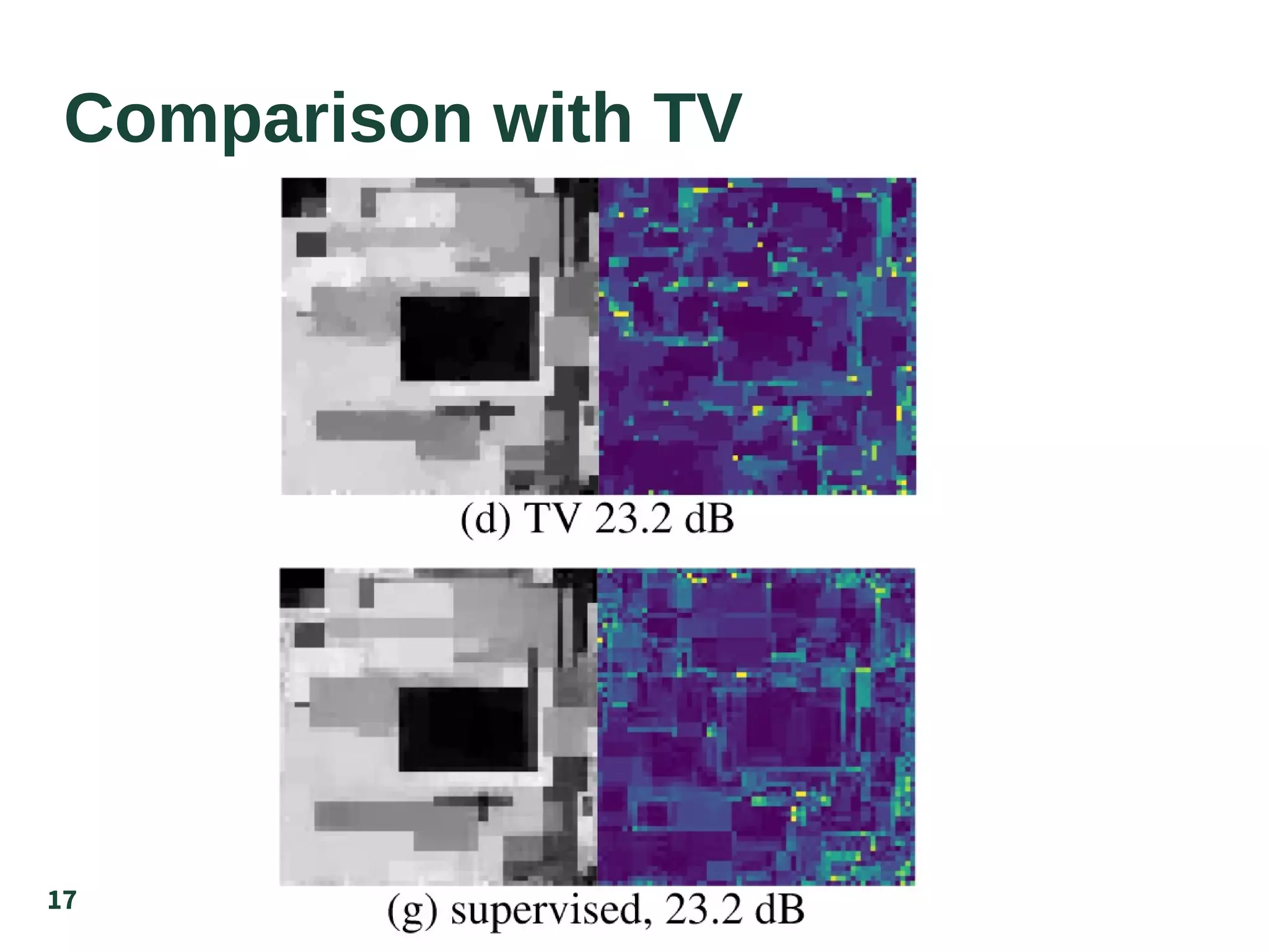
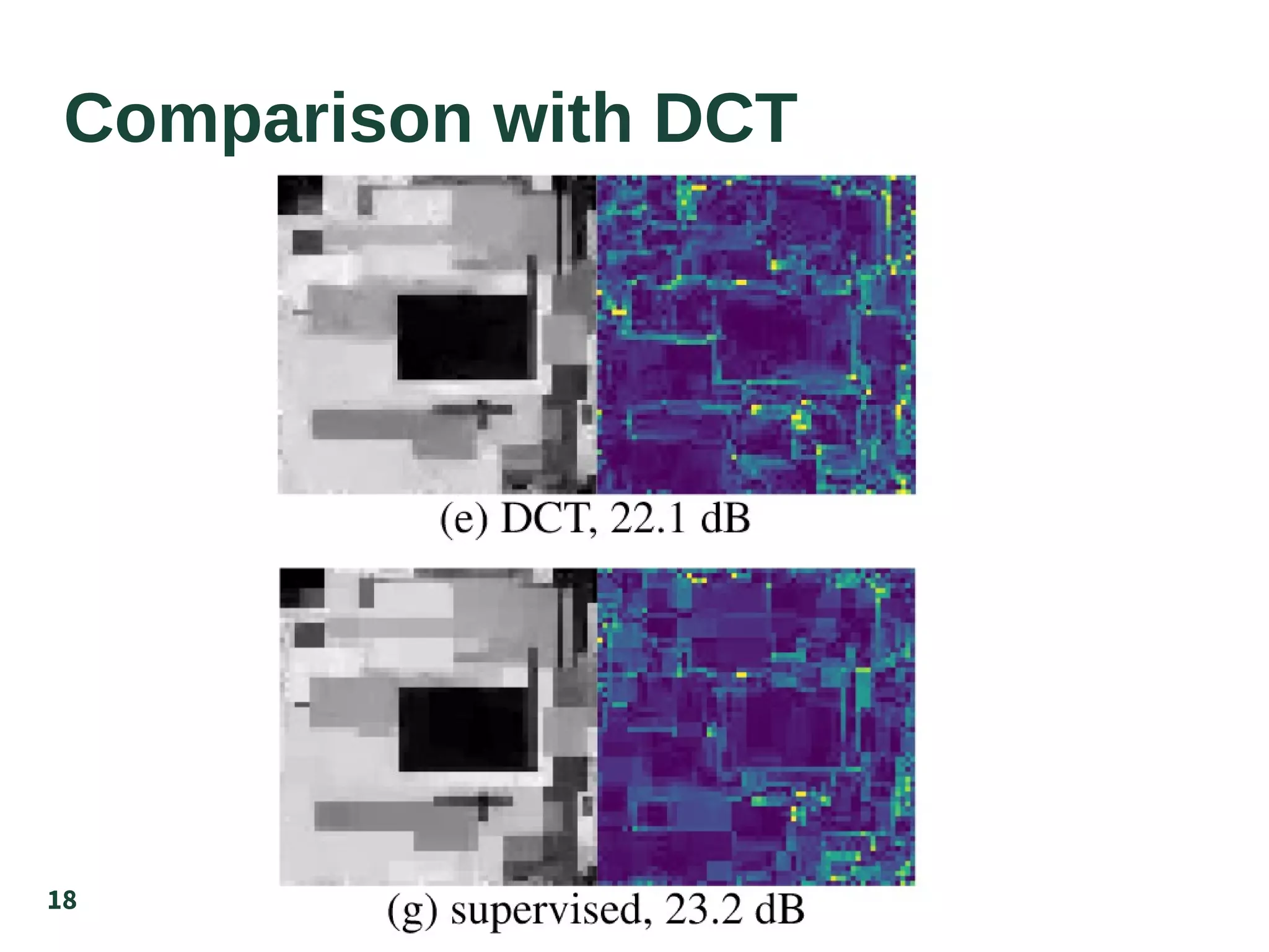
Comparison with TV
18
Comparison with DCT
19
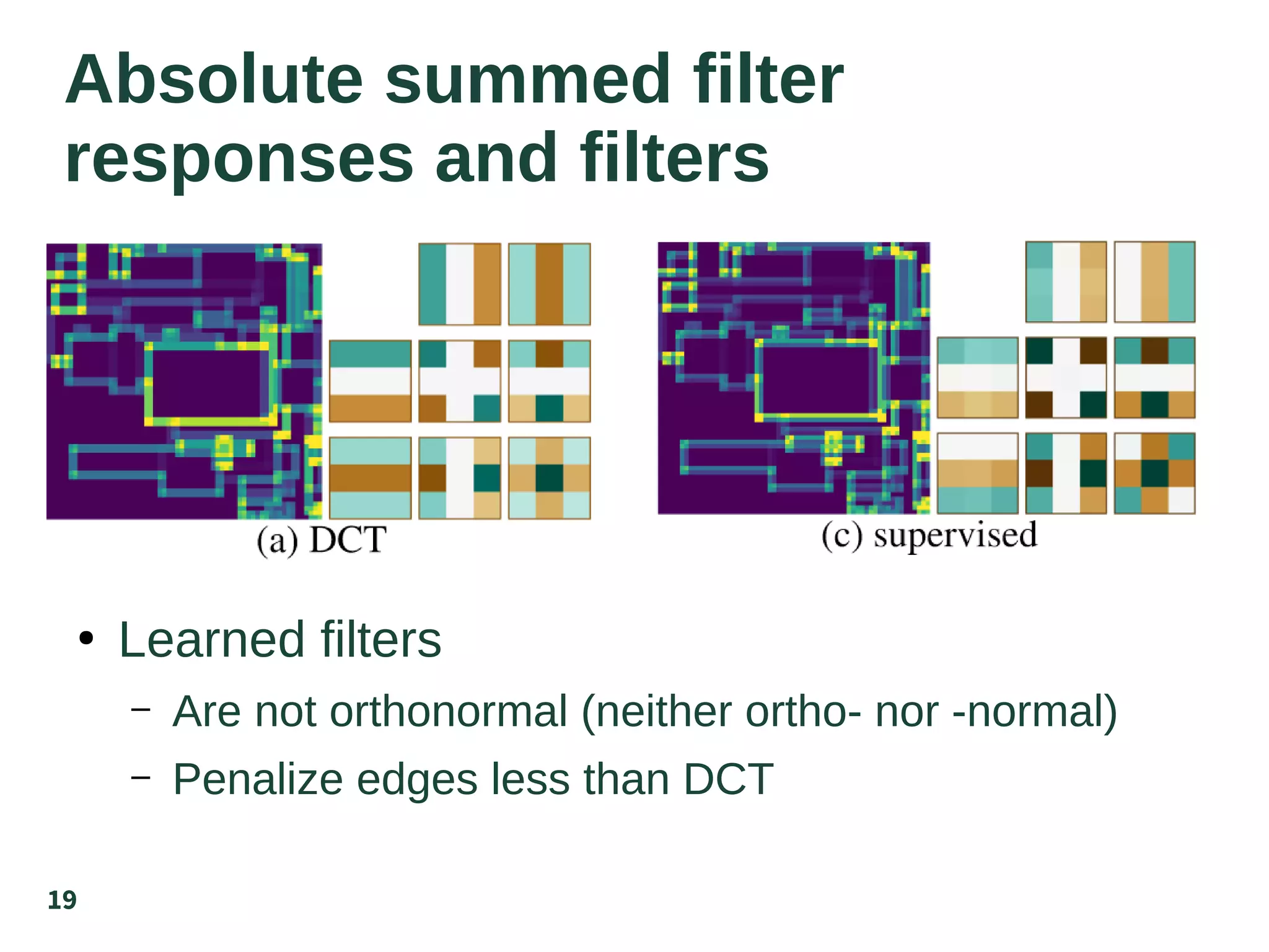
Absolute summed filter
responses and filters
●
Learned filters
– Are not orthonormal (neither ortho- nor -normal)
– Penalize edges less than DCT
20
Future work
●
Make a full comparison with CNN-based
denoising
– Maybe we don’t need deep architectures!
●
Extend to general linear inverse problems
●
Extend to nonunique x*
●
Extend to multilayer regularizers
21
Thanks for your attention!
●
Preprint: https://arxiv.org/abs/2006.05521
●
Slides: https://bit.ly/38uOCoO
– (those are not zeros)
●
Questions: mccann13@msu.edu
22
References
●
K. H. Jin, M. T. McCann, E. Froustey, and M. Unser, “Deep Convolutional Neural Network
for Inverse Problems in Imaging,” IEEE Transactions on Image Processing, vol. 26, no. 9,
pp. 4509–4522, Sep. 2017.
●
J. Adler and O. Öktem, “Solving ill-posed inverse problems using iterative deep neural
networks,” Inverse Problems, vol. 33, no. 12, p. 124007, Nov. 2017.
●
E. J. Candes, J. Romberg, and T. Tao, “Robust uncertainty principles: exact signal
reconstruction from highly incomplete frequency information,” IEEE Transactions on
Information Theory, vol. 52, no. 2, pp. 489–509, Feb. 2006.
●
G. Peyré and J. M. Fadili, “Learning analysis sparsity priors,” in Sampling Theory
and Applications, Singapore, Singapore, May 2011, p. 4.
●
J. Mairal, F. Bach, and J. Ponce, “Task-driven dictionary learning,”IEEE Transactions on
Pattern Analysis and Machine Intelligence, vol. 34, no. 4, pp. 791–804, Apr. 2012.
●
P. Sprechmann, R. Litman, T. Ben Yakar, A. M. Bronstein, and G. Sapiro, “Supervised
sparse analysis and synthesis operators,” inAdvances in Neural Information Processing
Systems 26, 2013, pp. 908–916.
●
Y. Chen, T. Pock, and H. Bischof, “Learning`1-based analysis and synthesis sparsity priors
using bi-level optimization,”arXiv:1401.4105 [cs.CV], Jan. 2014.
●
Y. Chen, R. Ranftl, and T. Pock, “Insights into analysis operator learning: From patch-
based sparse models to higher order MRFs,”IEEE Transactions on Image Processing, vol.
23, no. 3, pp. 1060–1072, Mar. 2014.
●
T. P. Minka, “Old and new matrix algebra useful for statistics,” MIT Media Lab, 2000.

Supervised Learning of Sparsity-Promoting Regularizers for Denoising

  • 1.
    Supervised Learning ofSparsity- Promoting Regularizers for Denoising Michael McCann and Saiprasad Ravishankar Michigan State University July 7, 2020 - SIAM Conference on Imaging Science (IS20)
  • 2.
    2 What beats aCNN on few-view X-ray CT reconstruction? (figure: Jin et al. 2017) ??? “TV is optimal on piecewise constant images”
  • 3.
    3 What beats aCNN on few-view X-ray CT reconstruction? (figures and table: Adler et al. 2017) “Hmmm...”
  • 4.
    4 Sparsity-promoting regularization (Candes etal. 2004) ● Goal: solve the undetermined problem
  • 5.
    5 Choosing the sparsifying operatorW ● Fixed: DCT, TV, wavelets, … ● Learned: dictionary, transform learning, … ● Can we do better? ● What is the optimal operator for a set of images?
  • 6.
    6 Related work ● Peyré etal. 2011; Mairal et al. 2012; Sprechmann et al. 2013; Chen et al. 2014 ● Main approach: relax the l1 term
  • 7.
    7 Our approach ● Find aclosed-form expression for x* ● Derive gradient of Q wrt parameters ● Perform stochastic gradient descent
  • 8.
  • 9.
    9 Closed form expressionfor x*(W) ● Key element: sign pattern of Wx ● Matrices to select zero and nonzero rows of W ● For all W with a certain c
  • 10.
  • 11.
  • 12.
    12 Gradient of Q ● Justuse autograd? – No! A-1 prevents it (Minka 2000)
  • 13.
    13 Gradient calculation algorithm ● Solvethe reconstruction problem with current W (we use ADMM) ● Find the sign pattern of x* and form A and b – How to handle inexactness of Wx*? ● Solve the KKT system to find z ● Solve a least squares problem to find ● Use autograd to get
  • 14.
    14 Denoising experiment ● Images are64x64, range is [0,1] ● Additive IID Gaussian noise, stdev=0.1 ● 10 training, 10 testing
  • 15.
    15 Methods compared ● BM3D, TV,DCT – Regularization strength tuned on training ● Unsupervised learned operator – Minimize s.t. orthogonality on training – Initialized with DCT ● Supervised learned operator – SGD with increasing batch size – Initialized with DCT
  • 16.
  • 17.
  • 18.
  • 19.
    19 Absolute summed filter responsesand filters ● Learned filters – Are not orthonormal (neither ortho- nor -normal) – Penalize edges less than DCT
  • 20.
    20 Future work ● Make afull comparison with CNN-based denoising – Maybe we don’t need deep architectures! ● Extend to general linear inverse problems ● Extend to nonunique x* ● Extend to multilayer regularizers
  • 21.
    21 Thanks for yourattention! ● Preprint: https://arxiv.org/abs/2006.05521 ● Slides: https://bit.ly/38uOCoO – (those are not zeros) ● Questions: mccann13@msu.edu
  • 22.
    22 References ● K. H. Jin,M. T. McCann, E. Froustey, and M. Unser, “Deep Convolutional Neural Network for Inverse Problems in Imaging,” IEEE Transactions on Image Processing, vol. 26, no. 9, pp. 4509–4522, Sep. 2017. ● J. Adler and O. Öktem, “Solving ill-posed inverse problems using iterative deep neural networks,” Inverse Problems, vol. 33, no. 12, p. 124007, Nov. 2017. ● E. J. Candes, J. Romberg, and T. Tao, “Robust uncertainty principles: exact signal reconstruction from highly incomplete frequency information,” IEEE Transactions on Information Theory, vol. 52, no. 2, pp. 489–509, Feb. 2006. ● G. Peyré and J. M. Fadili, “Learning analysis sparsity priors,” in Sampling Theory and Applications, Singapore, Singapore, May 2011, p. 4. ● J. Mairal, F. Bach, and J. Ponce, “Task-driven dictionary learning,”IEEE Transactions on Pattern Analysis and Machine Intelligence, vol. 34, no. 4, pp. 791–804, Apr. 2012. ● P. Sprechmann, R. Litman, T. Ben Yakar, A. M. Bronstein, and G. Sapiro, “Supervised sparse analysis and synthesis operators,” inAdvances in Neural Information Processing Systems 26, 2013, pp. 908–916. ● Y. Chen, T. Pock, and H. Bischof, “Learning`1-based analysis and synthesis sparsity priors using bi-level optimization,”arXiv:1401.4105 [cs.CV], Jan. 2014. ● Y. Chen, R. Ranftl, and T. Pock, “Insights into analysis operator learning: From patch- based sparse models to higher order MRFs,”IEEE Transactions on Image Processing, vol. 23, no. 3, pp. 1060–1072, Mar. 2014. ● T. P. Minka, “Old and new matrix algebra useful for statistics,” MIT Media Lab, 2000.