Summary of C++17
features
Is this release good, great, amazing or meh?
Bartłomiej Filipek
http://www.bfilipek.com/
Blog version, annotated
Last update: 25th Nov 2017
About me
www.bfilipek.com
10y+ experience
Currently @Xara.com
Text related features
Somehow addicted to Cpp :D
The plan
C++17 timeline
What we get
Fixes and deprecation
Language clarification
Templates
Attributes
Simplification
Filesystem
Parallel STL
Utils
Summary
Timeline
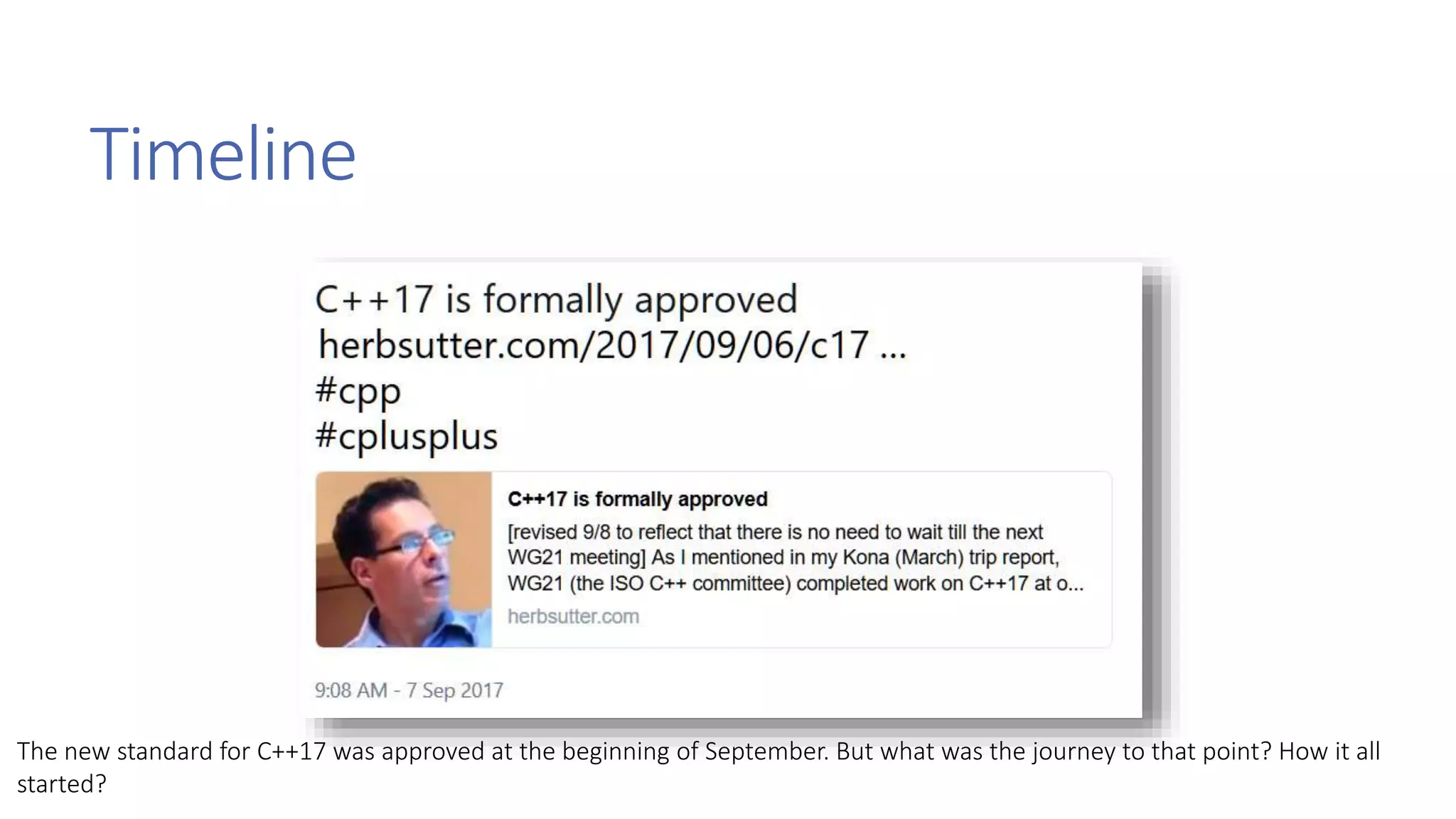
The new standard for C++17 was approved at the beginning of September. But what was the journey to that point? How it all
started?
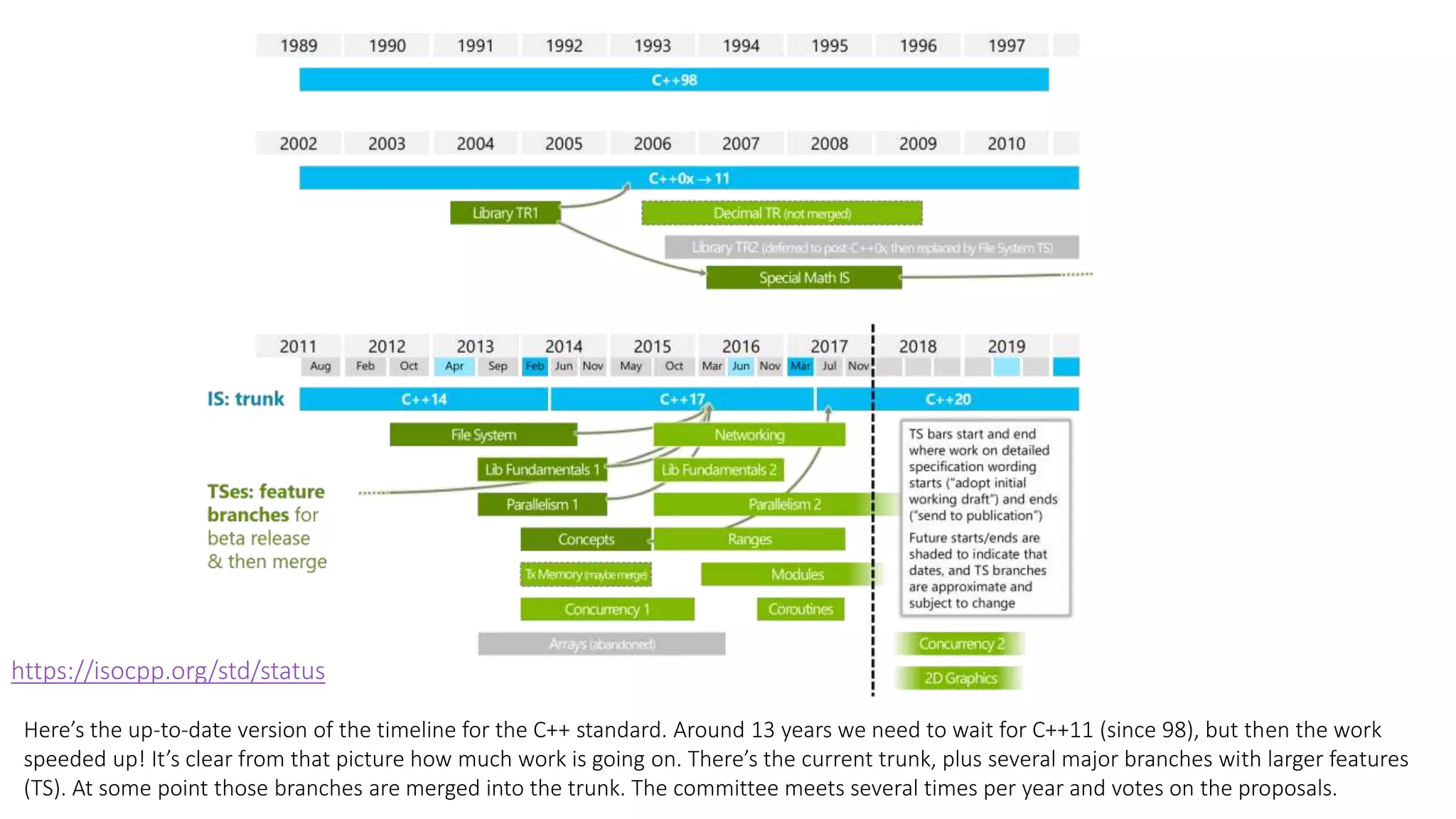
https://isocpp.org/std/status
Here’s the up-to-date version of the timeline for the C++ standard. Around 13 years we need to wait for C++11 (since 98), but then the work
speeded up! It’s clear from that picture how much work is going on. There’s the current trunk, plus several major branches with larger features
(TS). At some point those branches are merged into the trunk. The committee meets several times per year and votes on the proposals.
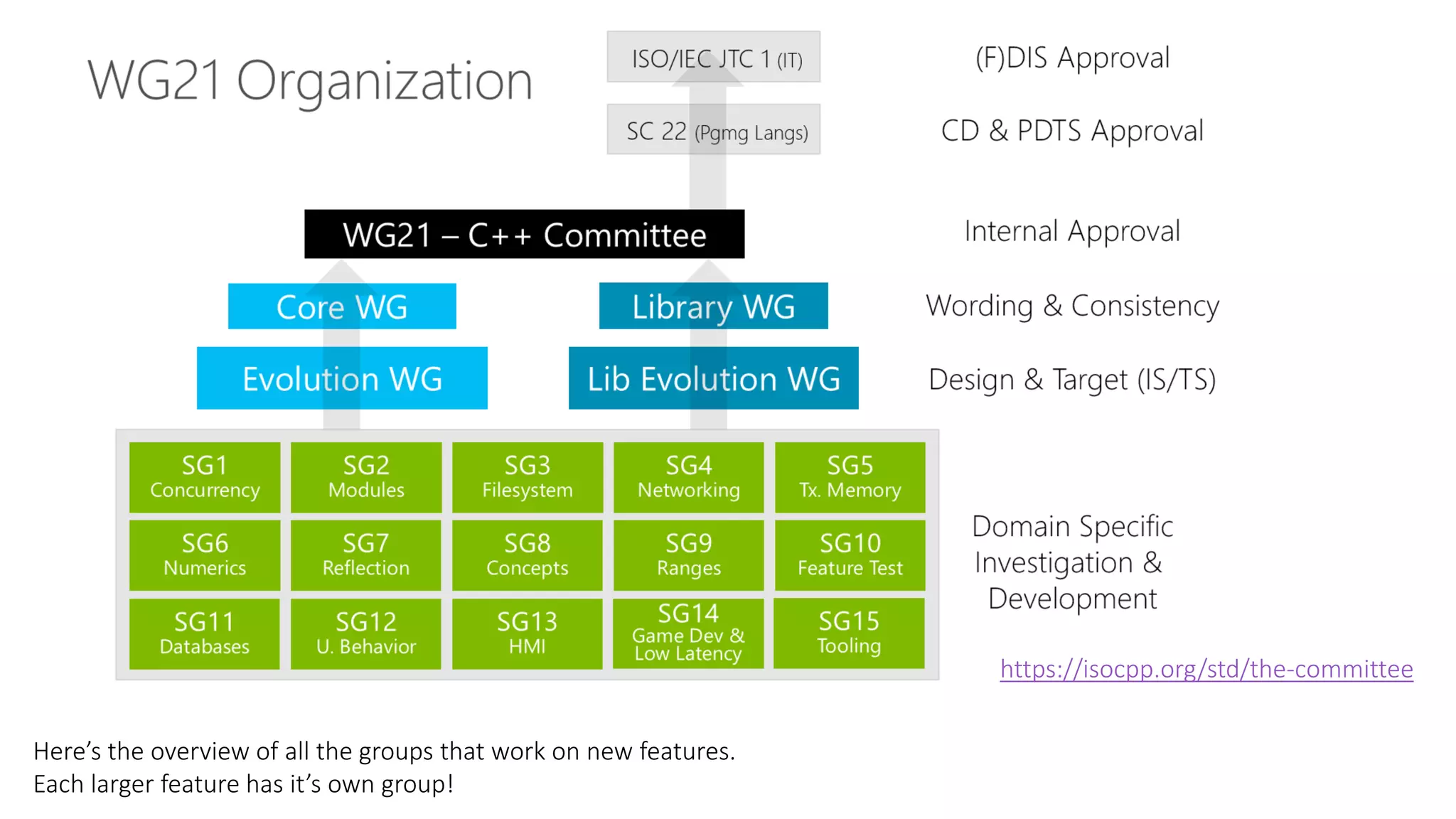
https://isocpp.org/std/the-committee
Here’s the overview of all the groups that work on new features.
Each larger feature has it’s own group!
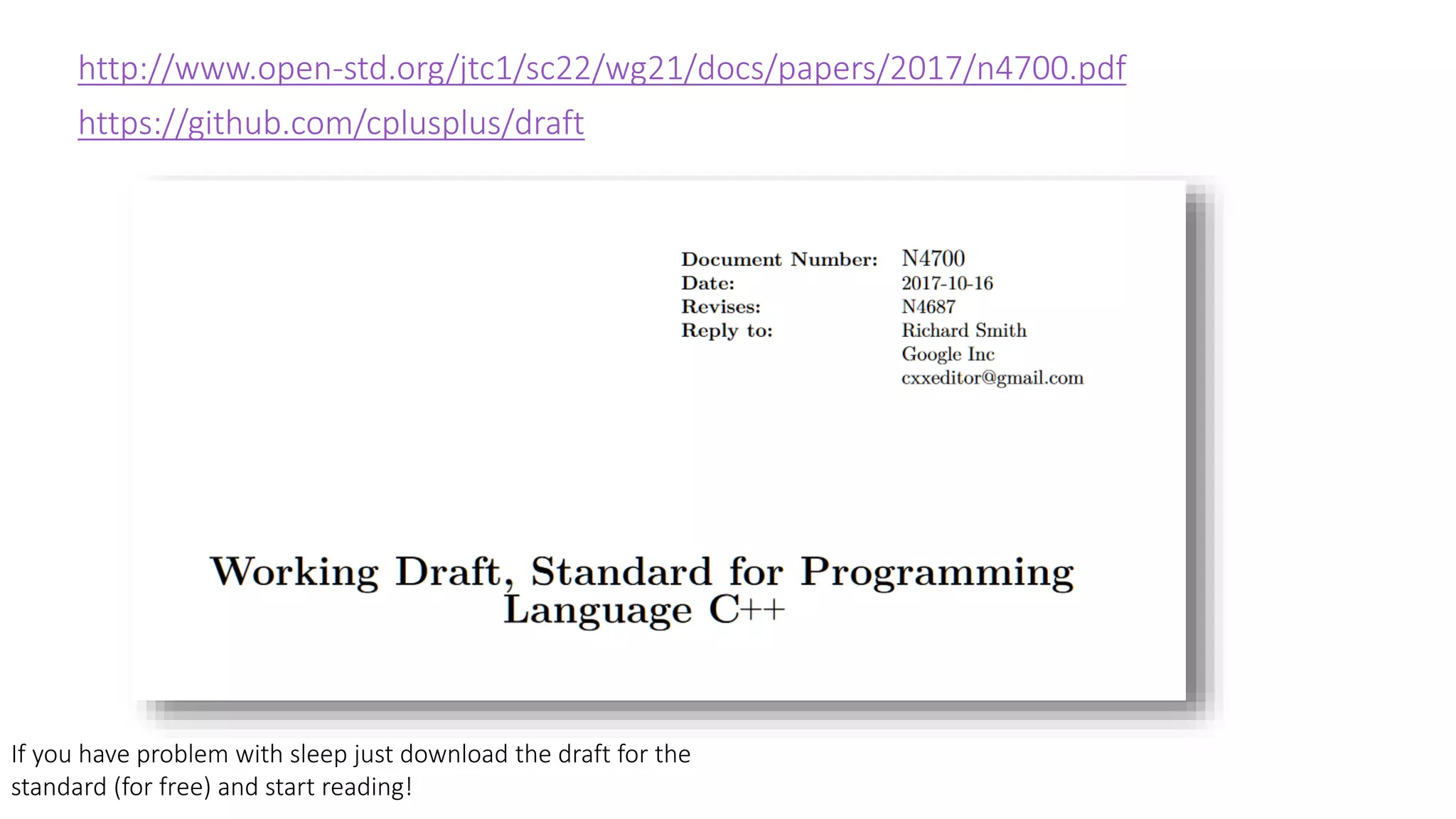
http://www.open-std.org/jtc1/sc22/wg21/docs/papers/2017/n4700.pdf
https://github.com/cplusplus/draft
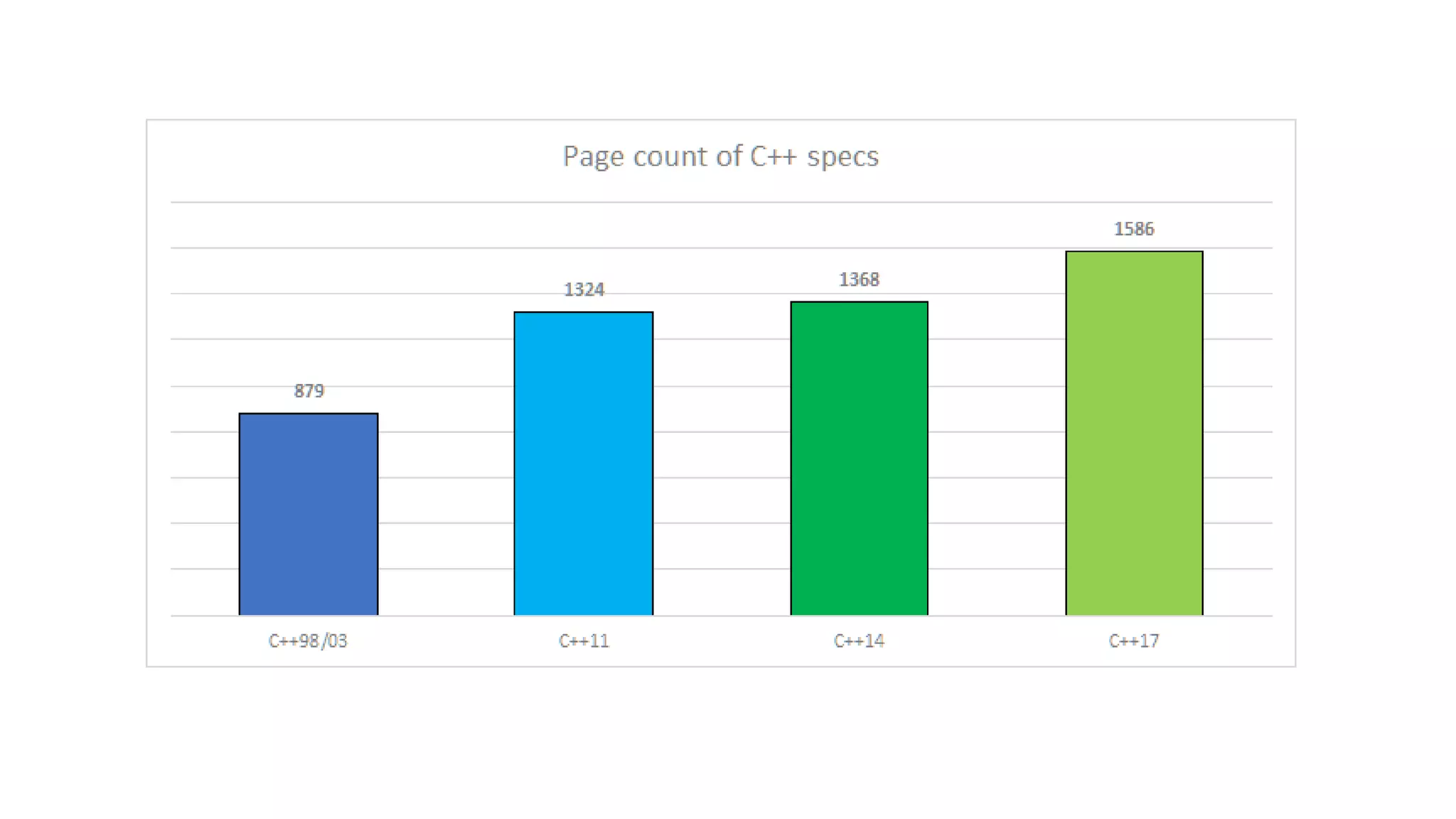
If you have problem with sleep just download the draft for the
standard (for free) and start reading!
Ship every 3 years
As I see here’s the major changed that happened in the
standardization process: C++11 was so late (we expected it to be
before 2010!), but the committee waited until all the features
were ready. Now we focus on the deadline. If a feature is not
ready, then it’s simply moved to the next standard.
Merged: The Library Fundamentals 1 TS (most parts)
Removal of some deprecated types and functions, including std::auto_ptr, std::random_shuffle, and old function adaptors
Merged: The Parallelism TS, a.k.a. “Parallel STL.”,
Merged: File System TS,
Merged: The Mathematical Special Functions IS,
Improving std::pair and std::tuple
std::shared_mutex (untimed)
Variant, Optional, Any
Splicing Maps and Sets
New auto rules for direct-list-initialization
static_assert with no message
typename in a template template parameter
Removing trigraphs
Nested namespace definition
Attributes for namespaces and enumerators
u8 character literals
Allow constant evaluation for all non-type template arguments
Fold Expressions
Unary fold expressions and empty parameter packs
Remove Deprecated Use of the register Keyword
Remove Deprecated operator++(bool)
Removing Deprecated Exception Specifications from C++17
Make exception specifications part of the type system
Aggregate initialization of classes with base classes
Lambda capture of *this
Using attribute namespaces without repetition
Dynamic memory allocation for over-aligned data
__has_include in preprocessor conditionals
Template argument deduction for class templates
Non-type template parameters with auto type
Guaranteed copy elision
New specification for inheriting constructors (DR1941 et al)
Direct-list-initialization of enumerations
Stricter expression evaluation order
constexpr lambda expressions
Different begin and end types in range-based for
[[fallthrough]] attribute
[[nodiscard]] attribute
[[maybe_unused]] attribute
Ignore unknown attributes
Pack expansions in using-declarations
Structured Binding Declarations
Hexadecimal floating-point literals
init-statements for if and switch
Inline variables
DR: Matching of template template-arguments excludes compatible templates
std::uncaught_exceptions()
constexpr if-statements
1. Fixes and deprecation
2. Language clarification
3. Templates
4. Attributes
5. Simplification
6. Filesystem
7. Parallel STL
8. Utils
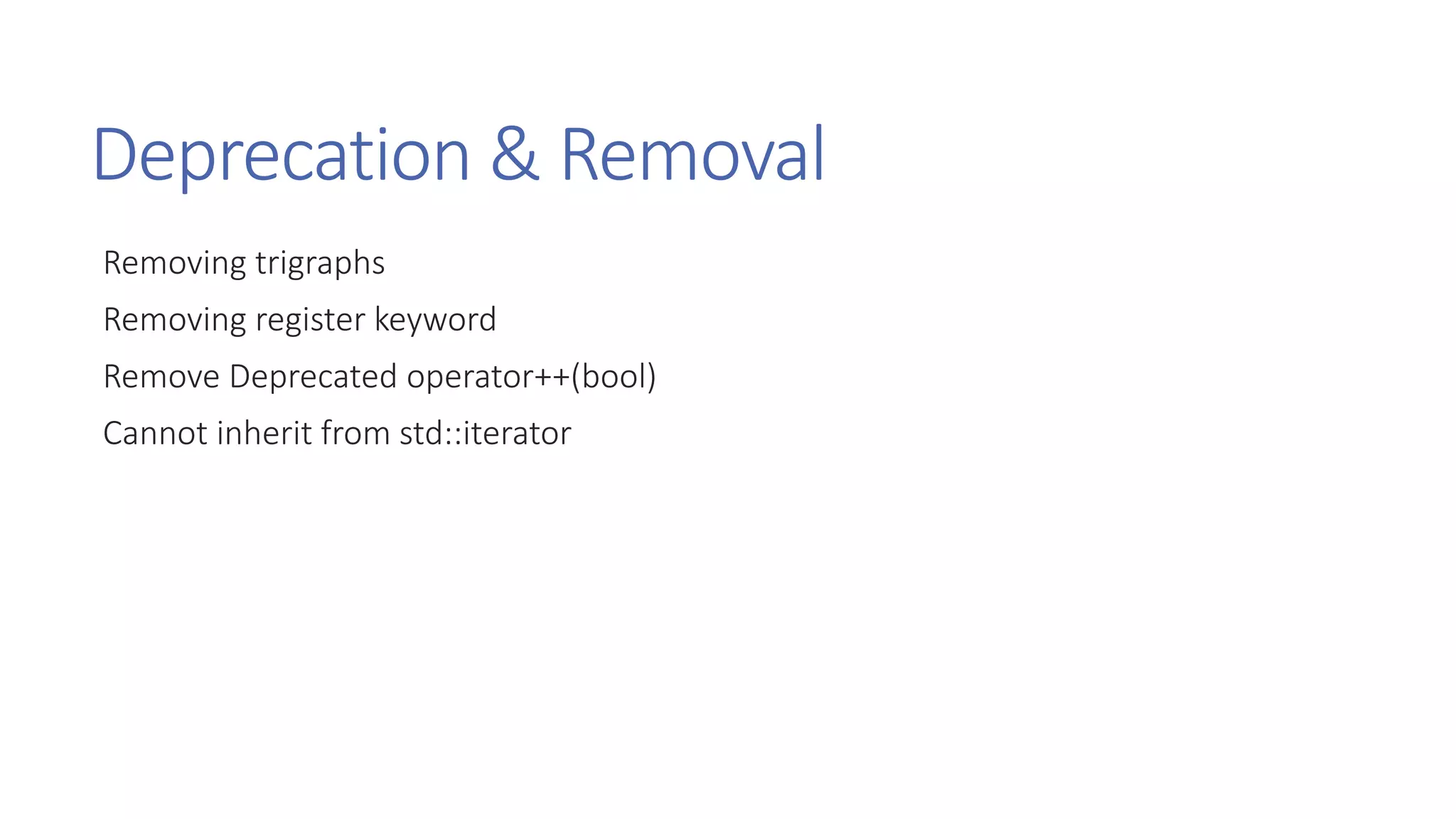
Deprecation & Removal
Removing trigraphs
Removing register keyword
Remove Deprecated operator++(bool)
Cannot inherit from std::iterator
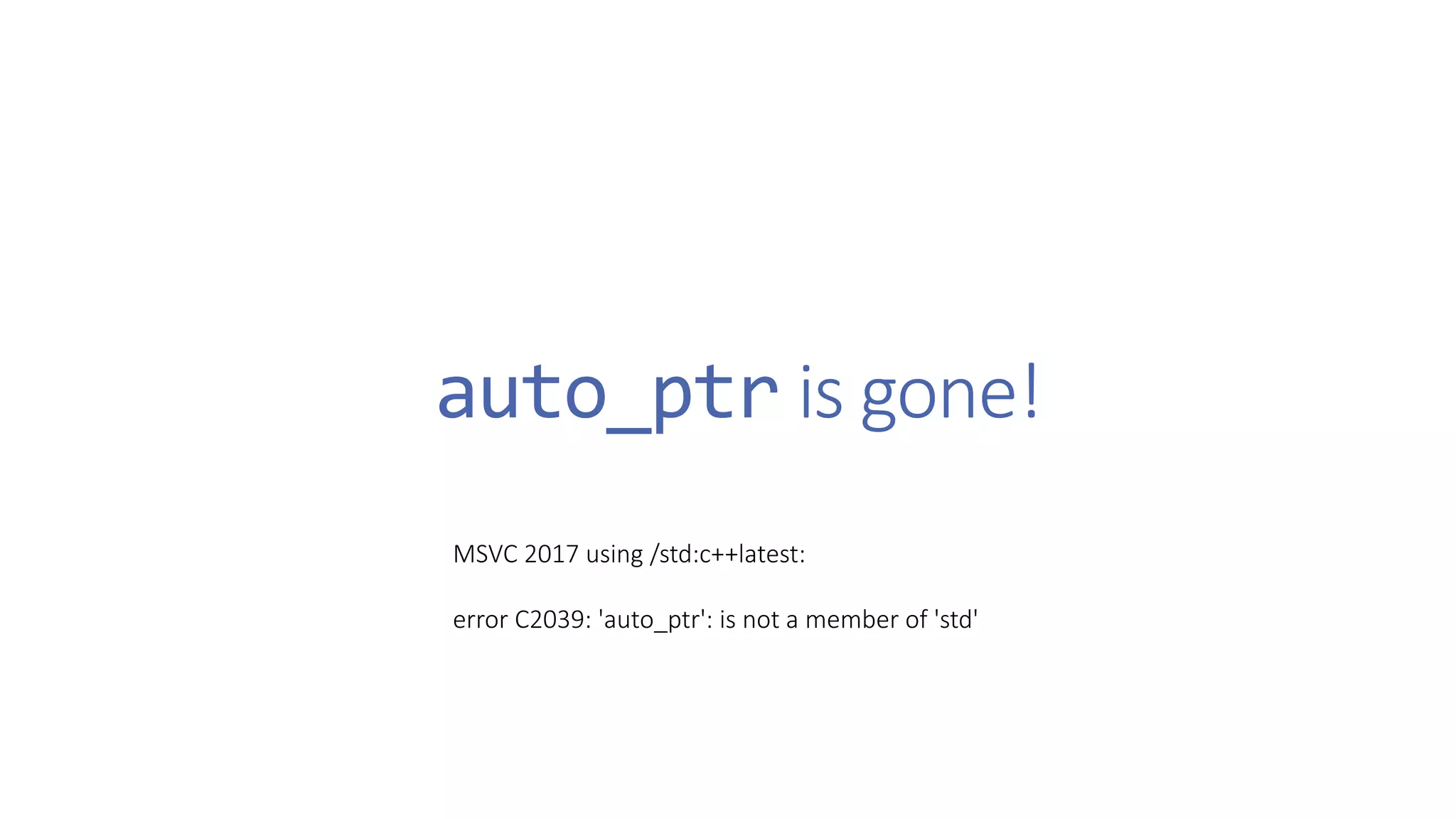
auto_ptr is gone!
MSVC 2017 using /std:c++latest:
error C2039: 'auto_ptr': is not a member of 'std'
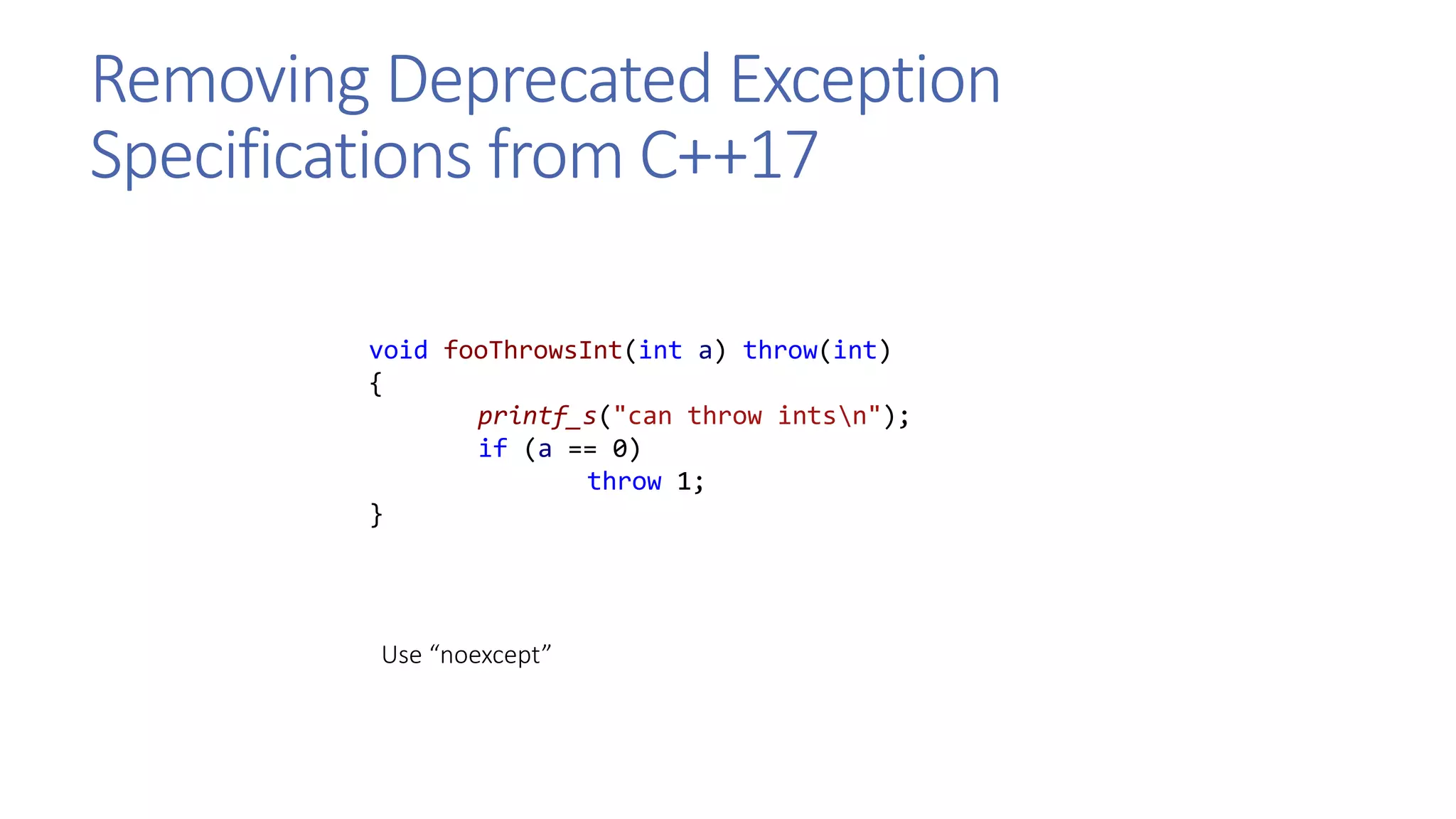
Removing Deprecated Exception
Specifications from C++17
void fooThrowsInt(int a) throw(int)
{
printf_s("can throw intsn");
if (a == 0)
throw 1;
}
Use “noexcept”
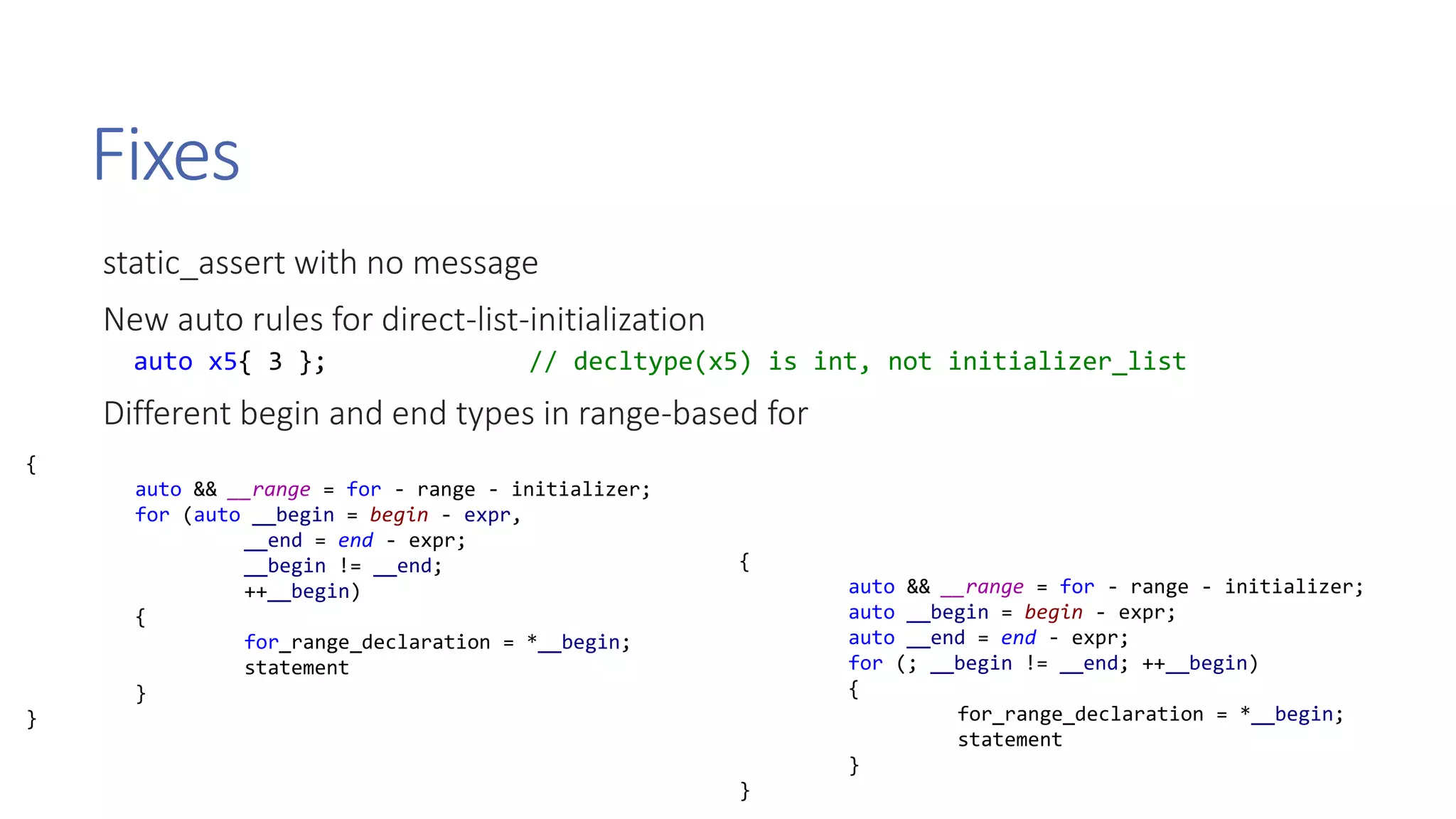
Fixes
static_assert with no message
New auto rules for direct-list-initialization
auto x5{ 3 }; // decltype(x5) is int, not initializer_list
Different begin and end types in range-based for
{
auto && __range = for - range - initializer;
for (auto __begin = begin - expr,
__end = end - expr;
__begin != __end;
++__begin)
{
for_range_declaration = *__begin;
statement
}
}
{
auto && __range = for - range - initializer;
auto __begin = begin - expr;
auto __end = end - expr;
for (; __begin != __end; ++__begin)
{
for_range_declaration = *__begin;
statement
}
}
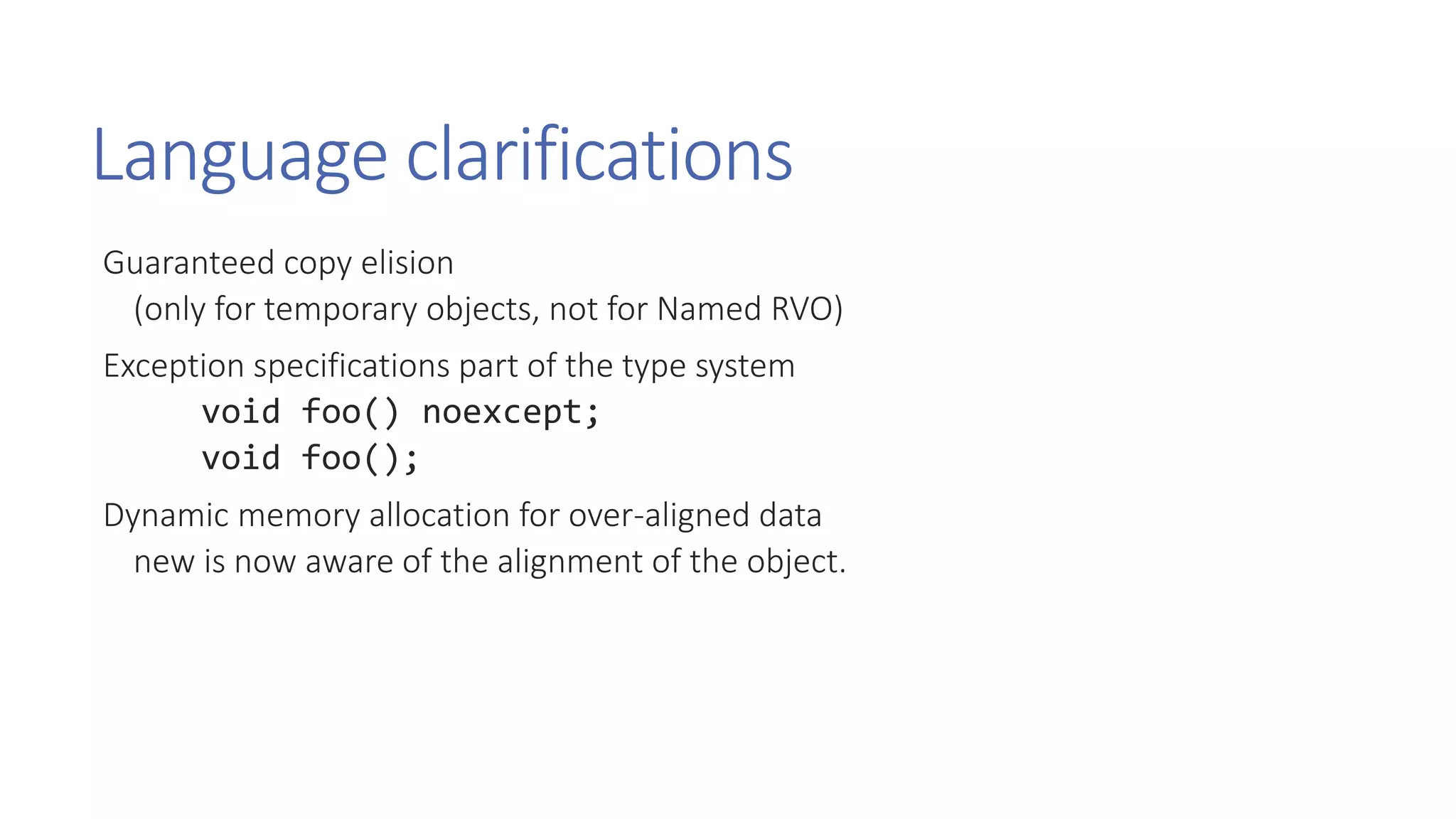
Language clarifications
Guaranteed copy elision
(only for temporary objects, not for Named RVO)
Exception specifications part of the type system
void foo() noexcept;
void foo();
Dynamic memory allocation for over-aligned data
new is now aware of the alignment of the object.
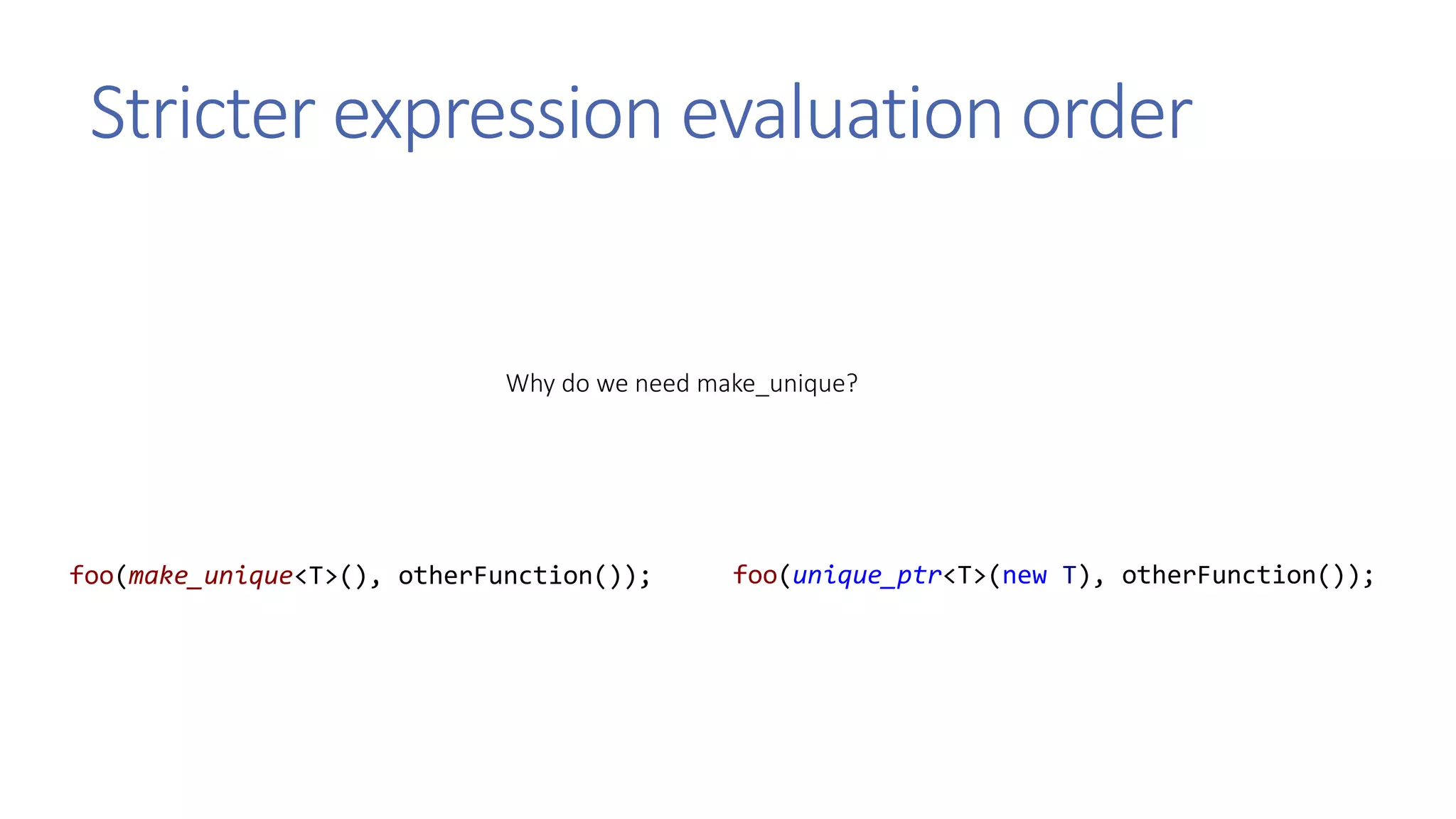
Stricter expression evaluation order
Why do we need make_unique?
foo(make_unique<T>(), otherFunction()); foo(unique_ptr<T>(new T), otherFunction());
Templates
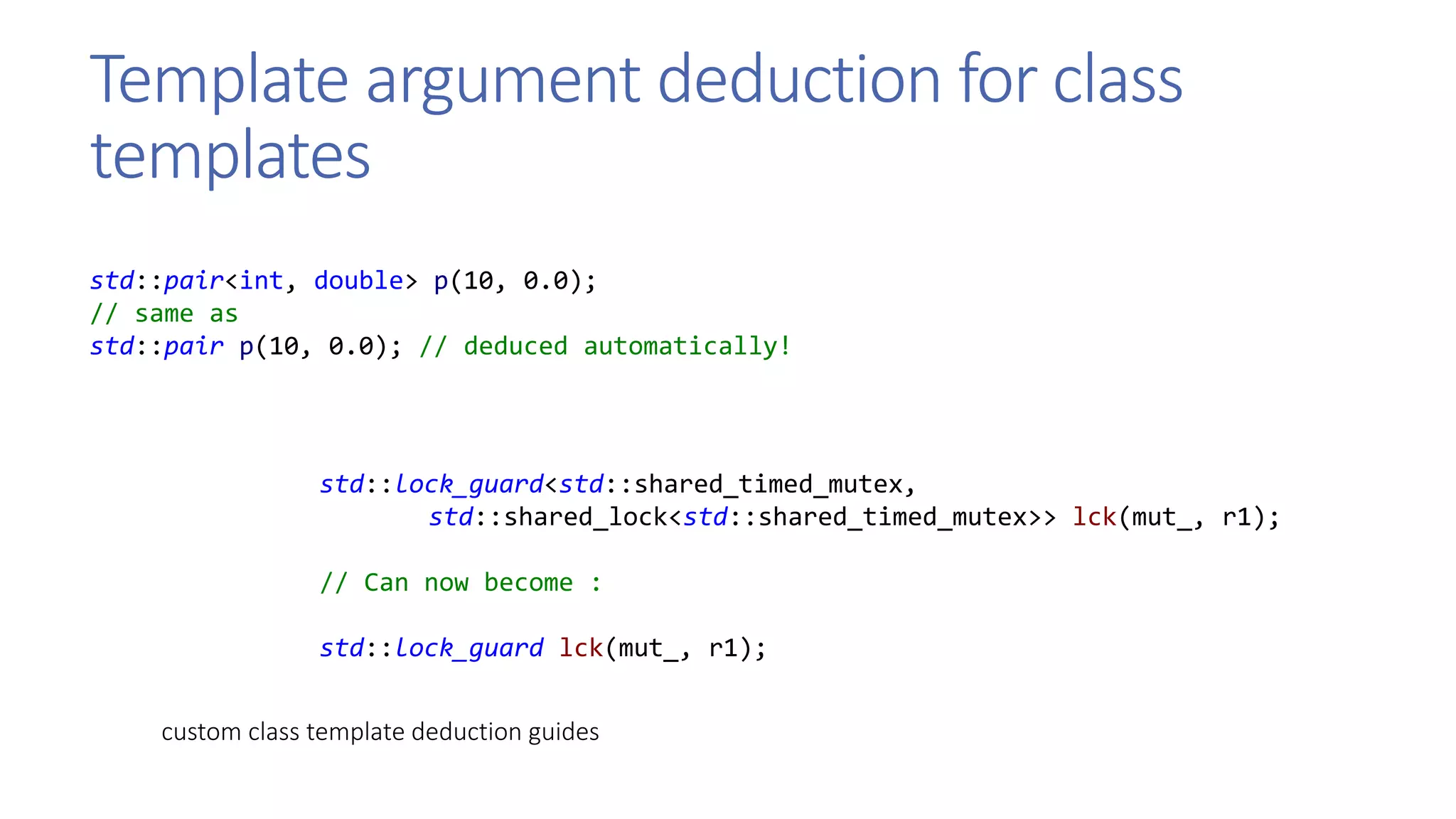
Template argument deduction for class
templates
std::pair<int, double> p(10, 0.0);
// same as
std::pair p(10, 0.0); // deduced automatically!
std::lock_guard<std::shared_timed_mutex,
std::shared_lock<std::shared_timed_mutex>> lck(mut_, r1);
// Can now become :
std::lock_guard lck(mut_, r1);
custom class template deduction guides
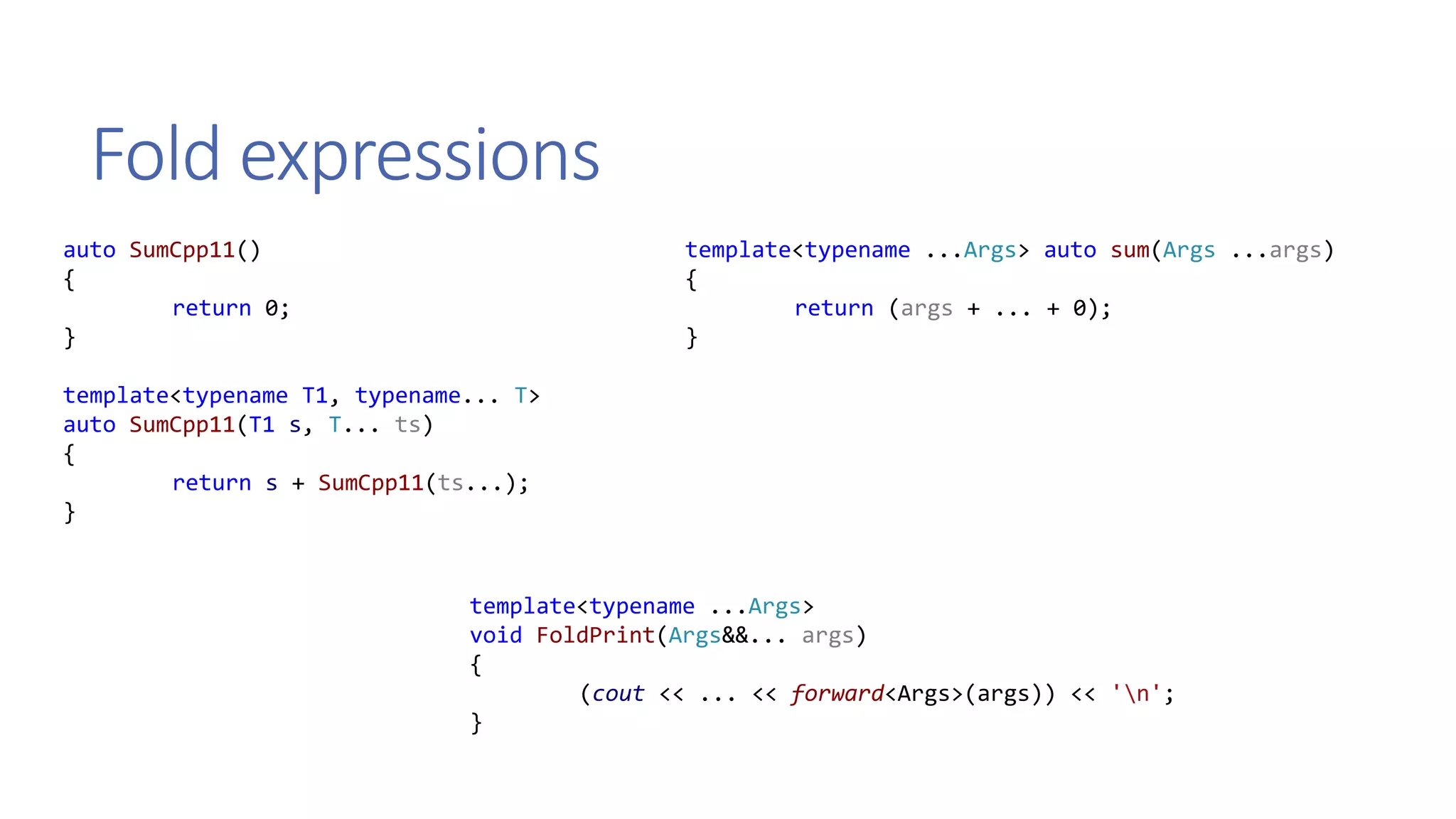
Fold expressions
auto SumCpp11()
{
return 0;
}
template<typename T1, typename... T>
auto SumCpp11(T1 s, T... ts)
{
return s + SumCpp11(ts...);
}
template<typename ...Args> auto sum(Args ...args)
{
return (args + ... + 0);
}
template<typename ...Args>
void FoldPrint(Args&&... args)
{
(cout << ... << forward<Args>(args)) << 'n';
}
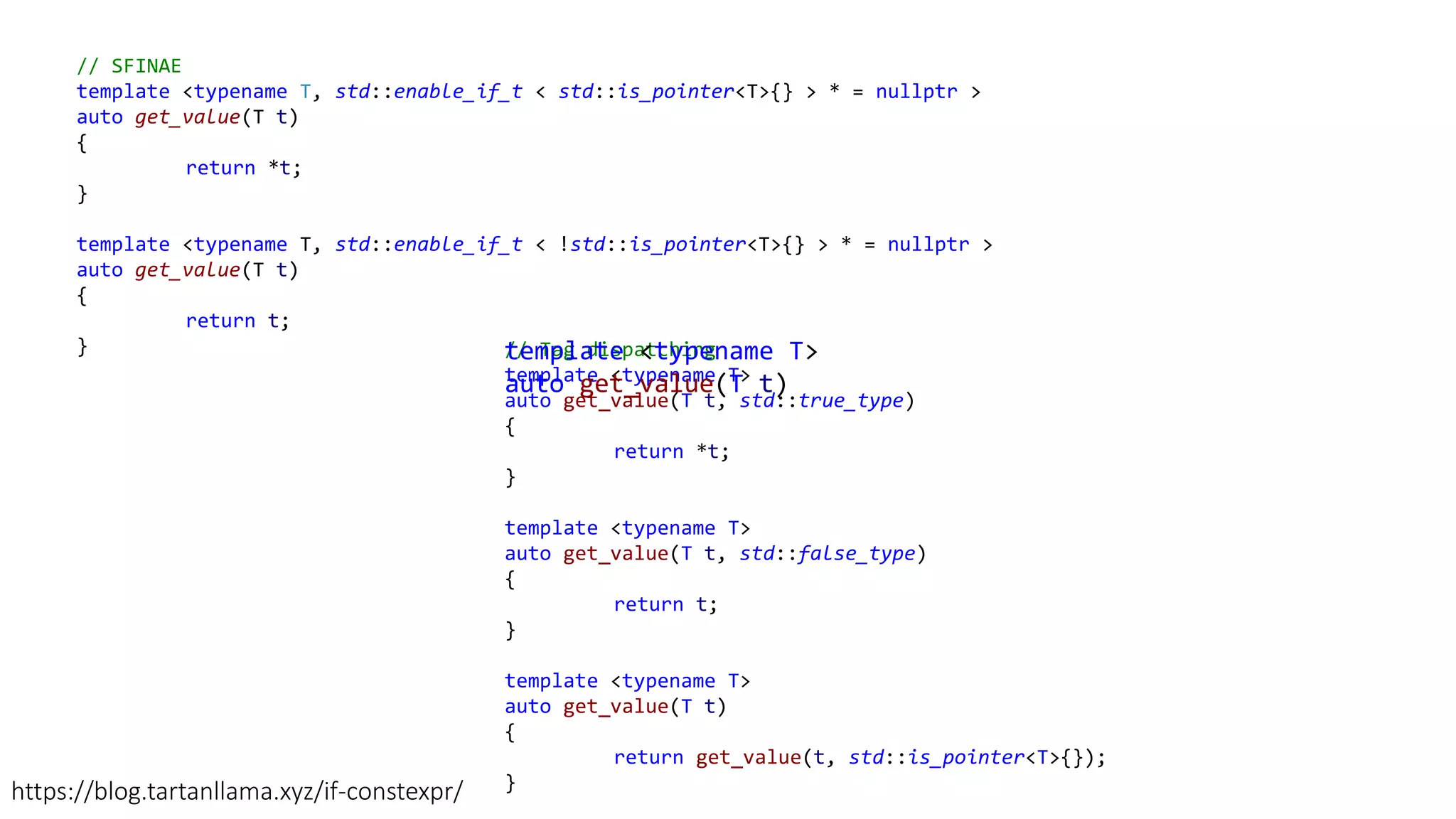
// SFINAE
template <typename T, std::enable_if_t < std::is_pointer<T>{} > * = nullptr >
auto get_value(T t)
{
return *t;
}
template <typename T, std::enable_if_t < !std::is_pointer<T>{} > * = nullptr >
auto get_value(T t)
{
return t;
} // Tag dispatching
template <typename T>
auto get_value(T t, std::true_type)
{
return *t;
}
template <typename T>
auto get_value(T t, std::false_type)
{
return t;
}
template <typename T>
auto get_value(T t)
{
return get_value(t, std::is_pointer<T>{});
}https://blog.tartanllama.xyz/if-constexpr/
template <typename T>
auto get_value(T t)
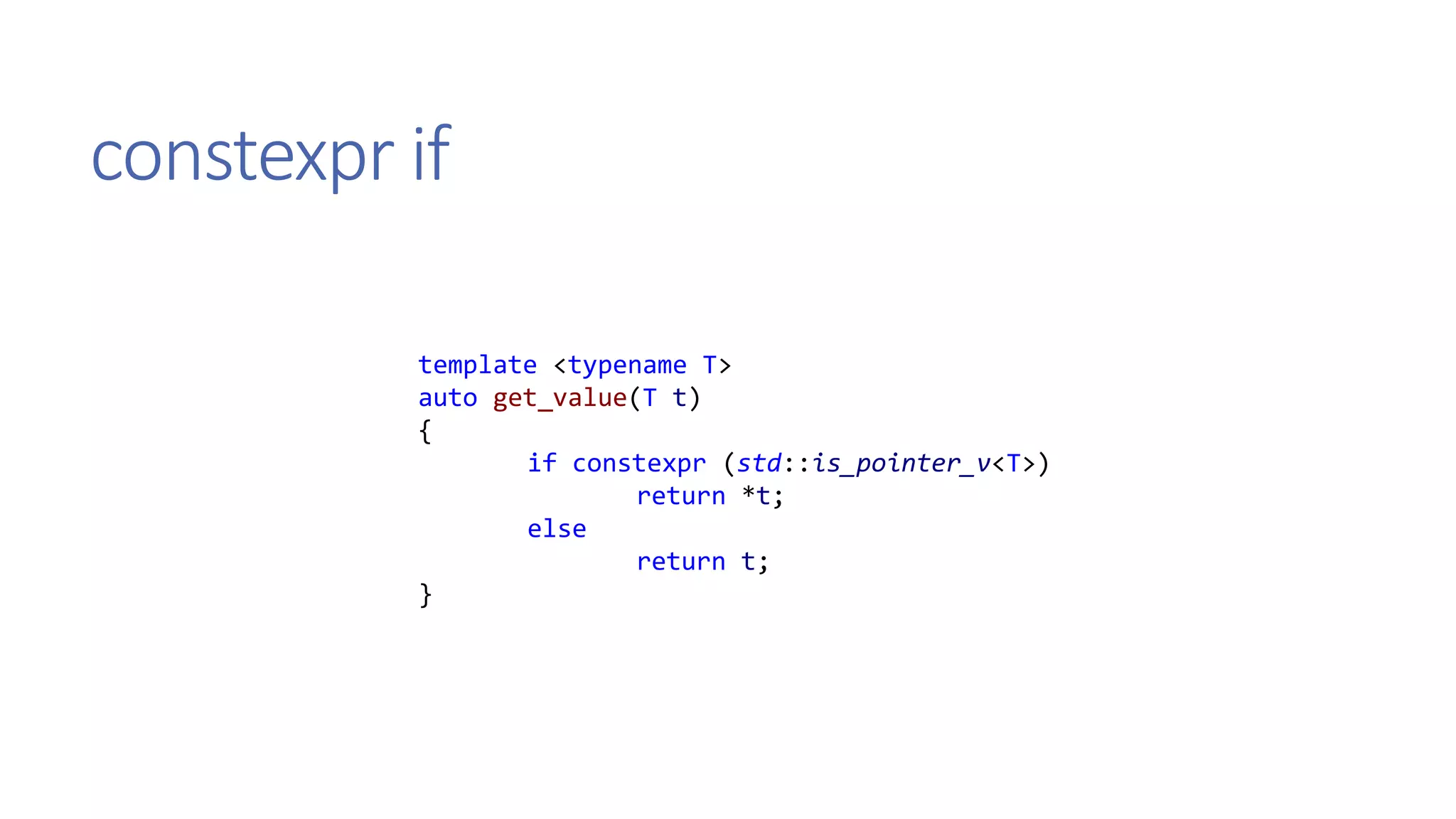
constexpr if
template <typename T>
auto get_value(T t)
{
if constexpr (std::is_pointer_v<T>)
return *t;
else
return t;
}
Attributes
[[fallthrough]]
[[nodiscard]]
[[maybe_unused]]
@cppreference.com
Attributes available in C++17
[[noreturn]]
[[carries_dependency]]
[[deprecated]]
[[deprecated("msg")]]
[[fallthrough]]
[[nodiscard]]
[[maybe_unused]]
enum class[[nodiscard]] ErrorCode{
OK,
Fatal,
System,
FileIssue
};
ErrorCode Compute() { ... }
...
Compute(); // warning!
How will it simplify the code?
Inline variables
Great for header-only libs!
constexpr if
Structured Binding Declarations
// works with arrays:
double myArray[3] = { 1.0, 2.0, 3.0 };
auto[a, b, c] = myArray;
auto[a, b] = myPair; // binds myPair.first/second (must implement get<N>)
// non static, public members
struct S { int x1; double y1; };
S f();
const auto[x, y] = f();
std::map myMap;
for (const auto &[key, val] : myMap)
{
}
Init-statement for if/switch
{
auto val = GetValue();
if (condition(val))
// on success
else
// on false...
}
if (auto val = GetValue(); condition(val))
// on success
else
// on false...
if (const auto it = myString.find("Hello"); it != std::string::npos)
std::cout << it << " Hellon";
if (const auto it = myString.find("World"); it != std::string::npos)
std::cout << it << " Worldn";
Structured bindings & init in if
statements
// better together: structured bindings + if initializer
if (auto[iter, succeeded] = mymap.insert(value); succeeded) {
use(iter); // ok
// ...
} // iter and succeeded are destroyed here
Filesystem
namespace fs = std::experimental::filesystem;
void DisplayDirTree(const fs::path& pathToShow, int level)
{
if (fs::exists(pathToShow) && fs::is_directory(pathToShow))
{
auto lead = std::string(level * 3, ' ');
for (const auto& entry : fs::directory_iterator(pathToShow))
{
auto filename = entry.path().filename();
if (fs::is_directory(entry.status()))
{
cout << lead << "[+] " << filename << "n";
DisplayDirTree(entry, level + 1);
cout << "n";
}
else if (fs::is_regular_file(entry.status()))
DisplayFileInfo(entry, lead, filename);
else
cout << lead << " [?]" << filename << "n";
}
}
}
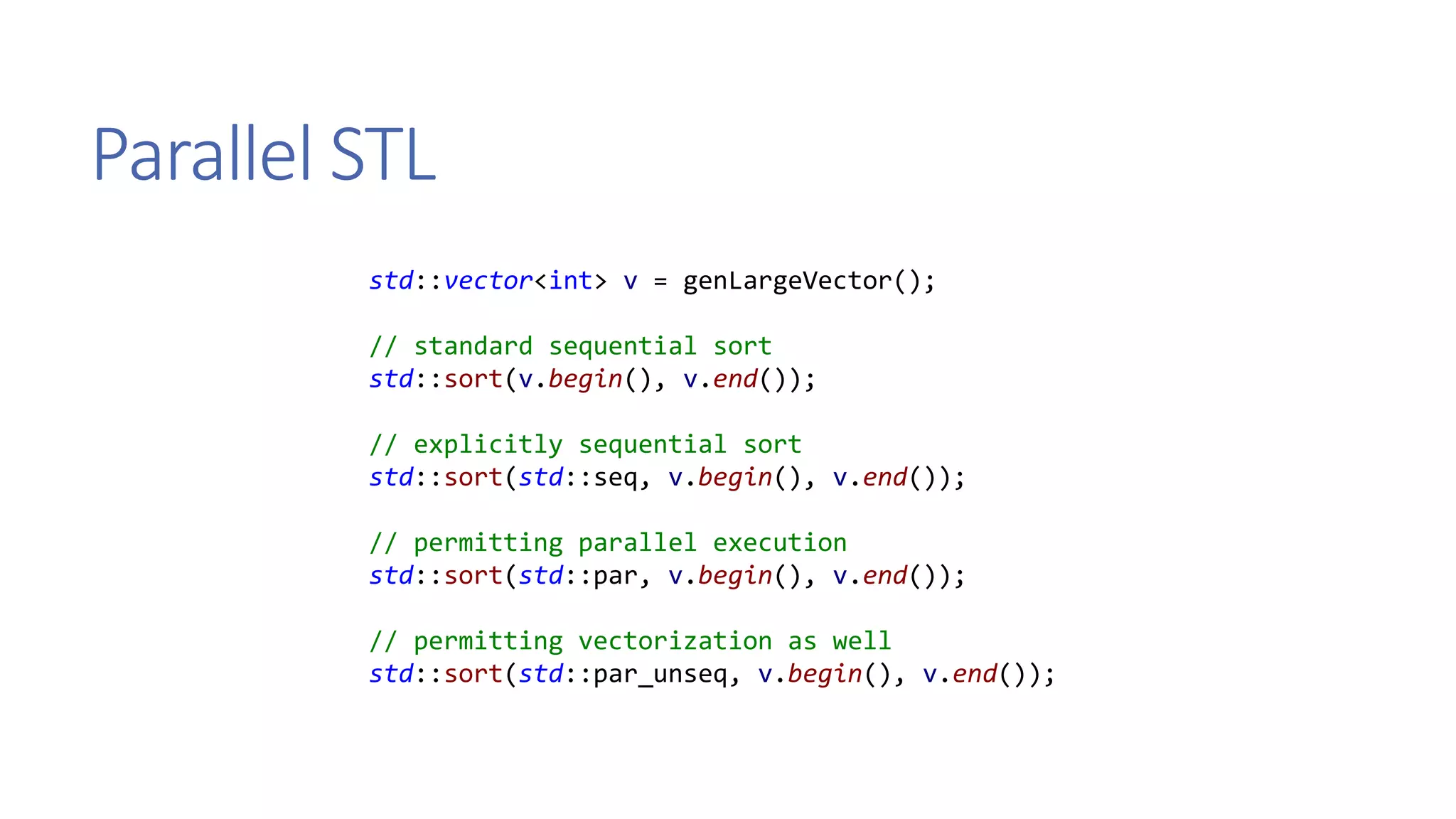
Parallel STL
std::vector<int> v = genLargeVector();
// standard sequential sort
std::sort(v.begin(), v.end());
// explicitly sequential sort
std::sort(std::seq, v.begin(), v.end());
// permitting parallel execution
std::sort(std::par, v.begin(), v.end());
// permitting vectorization as well
std::sort(std::par_unseq, v.begin(), v.end());
Utils
std::any
std::variant
std::optional
string_view
Searchers
http://www.bfilipek.com/2017/09/cpp17-details-utils.html
auto a = std::any(12);
a = std::string("hello world");
a = 10.0f;
cout << std::any_cast<float>(a);
std::variant<int, float, std::string> abc;
// get<>
// get_if<>
// visit()
std::optional<std::string> ostr = GetUserResponse();
default_searcher
boyer_moore_searcher
boyer_moore_horspool_searcher
Compiler support
GCC 7.0 is feature complete
Clang 5.0
MSVC 2017.4 has most of the features
The separate part is the standard library for each compiler. They might be delayed,
especially regarding parallel versions of the algorithms.
Summary
Is C++17 great? Amazing? Or just meh… ?
I think it’s a very decent version of the standard! Maybe people
would like to see more, but it was not possible due to the
deadline. Without this we would have to wait a year or two to
have all the “desired” features to be accepted.
Bonus – seemyfreePDFwithdescriptionofalloftheC++17 features!
http://www.bfilipek.com/2017/09/c17-in-detail-summary-bonus.html
https://isocpp.org/

Summary of C++17 features

  • 1.
    Summary of C++17 features Isthis release good, great, amazing or meh? Bartłomiej Filipek http://www.bfilipek.com/ Blog version, annotated Last update: 25th Nov 2017
  • 2.
    About me www.bfilipek.com 10y+ experience Currently@Xara.com Text related features Somehow addicted to Cpp :D
  • 3.
    The plan C++17 timeline Whatwe get Fixes and deprecation Language clarification Templates Attributes Simplification Filesystem Parallel STL Utils Summary
  • 4.
    Timeline The new standardfor C++17 was approved at the beginning of September. But what was the journey to that point? How it all started?
  • 5.
    https://isocpp.org/std/status Here’s the up-to-dateversion of the timeline for the C++ standard. Around 13 years we need to wait for C++11 (since 98), but then the work speeded up! It’s clear from that picture how much work is going on. There’s the current trunk, plus several major branches with larger features (TS). At some point those branches are merged into the trunk. The committee meets several times per year and votes on the proposals.
  • 6.
    https://isocpp.org/std/the-committee Here’s the overviewof all the groups that work on new features. Each larger feature has it’s own group!
  • 7.
    http://www.open-std.org/jtc1/sc22/wg21/docs/papers/2017/n4700.pdf https://github.com/cplusplus/draft If you haveproblem with sleep just download the draft for the standard (for free) and start reading!
  • 9.
    Ship every 3years As I see here’s the major changed that happened in the standardization process: C++11 was so late (we expected it to be before 2010!), but the committee waited until all the features were ready. Now we focus on the deadline. If a feature is not ready, then it’s simply moved to the next standard.
  • 10.
    Merged: The LibraryFundamentals 1 TS (most parts) Removal of some deprecated types and functions, including std::auto_ptr, std::random_shuffle, and old function adaptors Merged: The Parallelism TS, a.k.a. “Parallel STL.”, Merged: File System TS, Merged: The Mathematical Special Functions IS, Improving std::pair and std::tuple std::shared_mutex (untimed) Variant, Optional, Any Splicing Maps and Sets New auto rules for direct-list-initialization static_assert with no message typename in a template template parameter Removing trigraphs Nested namespace definition Attributes for namespaces and enumerators u8 character literals Allow constant evaluation for all non-type template arguments Fold Expressions Unary fold expressions and empty parameter packs Remove Deprecated Use of the register Keyword Remove Deprecated operator++(bool) Removing Deprecated Exception Specifications from C++17 Make exception specifications part of the type system Aggregate initialization of classes with base classes Lambda capture of *this Using attribute namespaces without repetition Dynamic memory allocation for over-aligned data __has_include in preprocessor conditionals Template argument deduction for class templates Non-type template parameters with auto type Guaranteed copy elision New specification for inheriting constructors (DR1941 et al) Direct-list-initialization of enumerations Stricter expression evaluation order constexpr lambda expressions Different begin and end types in range-based for [[fallthrough]] attribute [[nodiscard]] attribute [[maybe_unused]] attribute Ignore unknown attributes Pack expansions in using-declarations Structured Binding Declarations Hexadecimal floating-point literals init-statements for if and switch Inline variables DR: Matching of template template-arguments excludes compatible templates std::uncaught_exceptions() constexpr if-statements 1. Fixes and deprecation 2. Language clarification 3. Templates 4. Attributes 5. Simplification 6. Filesystem 7. Parallel STL 8. Utils
  • 11.
    Deprecation & Removal Removingtrigraphs Removing register keyword Remove Deprecated operator++(bool) Cannot inherit from std::iterator
  • 12.
    auto_ptr is gone! MSVC2017 using /std:c++latest: error C2039: 'auto_ptr': is not a member of 'std'
  • 13.
    Removing Deprecated Exception Specificationsfrom C++17 void fooThrowsInt(int a) throw(int) { printf_s("can throw intsn"); if (a == 0) throw 1; } Use “noexcept”
  • 14.
    Fixes static_assert with nomessage New auto rules for direct-list-initialization auto x5{ 3 }; // decltype(x5) is int, not initializer_list Different begin and end types in range-based for { auto && __range = for - range - initializer; for (auto __begin = begin - expr, __end = end - expr; __begin != __end; ++__begin) { for_range_declaration = *__begin; statement } } { auto && __range = for - range - initializer; auto __begin = begin - expr; auto __end = end - expr; for (; __begin != __end; ++__begin) { for_range_declaration = *__begin; statement } }
  • 15.
    Language clarifications Guaranteed copyelision (only for temporary objects, not for Named RVO) Exception specifications part of the type system void foo() noexcept; void foo(); Dynamic memory allocation for over-aligned data new is now aware of the alignment of the object.
  • 16.
    Stricter expression evaluationorder Why do we need make_unique? foo(make_unique<T>(), otherFunction()); foo(unique_ptr<T>(new T), otherFunction());
  • 17.
  • 18.
    Template argument deductionfor class templates std::pair<int, double> p(10, 0.0); // same as std::pair p(10, 0.0); // deduced automatically! std::lock_guard<std::shared_timed_mutex, std::shared_lock<std::shared_timed_mutex>> lck(mut_, r1); // Can now become : std::lock_guard lck(mut_, r1); custom class template deduction guides
  • 19.
    Fold expressions auto SumCpp11() { return0; } template<typename T1, typename... T> auto SumCpp11(T1 s, T... ts) { return s + SumCpp11(ts...); } template<typename ...Args> auto sum(Args ...args) { return (args + ... + 0); } template<typename ...Args> void FoldPrint(Args&&... args) { (cout << ... << forward<Args>(args)) << 'n'; }
  • 20.
    // SFINAE template <typenameT, std::enable_if_t < std::is_pointer<T>{} > * = nullptr > auto get_value(T t) { return *t; } template <typename T, std::enable_if_t < !std::is_pointer<T>{} > * = nullptr > auto get_value(T t) { return t; } // Tag dispatching template <typename T> auto get_value(T t, std::true_type) { return *t; } template <typename T> auto get_value(T t, std::false_type) { return t; } template <typename T> auto get_value(T t) { return get_value(t, std::is_pointer<T>{}); }https://blog.tartanllama.xyz/if-constexpr/ template <typename T> auto get_value(T t)
  • 21.
    constexpr if template <typenameT> auto get_value(T t) { if constexpr (std::is_pointer_v<T>) return *t; else return t; }
  • 22.
    Attributes [[fallthrough]] [[nodiscard]] [[maybe_unused]] @cppreference.com Attributes available inC++17 [[noreturn]] [[carries_dependency]] [[deprecated]] [[deprecated("msg")]] [[fallthrough]] [[nodiscard]] [[maybe_unused]] enum class[[nodiscard]] ErrorCode{ OK, Fatal, System, FileIssue }; ErrorCode Compute() { ... } ... Compute(); // warning!
  • 23.
    How will itsimplify the code? Inline variables Great for header-only libs! constexpr if
  • 24.
    Structured Binding Declarations //works with arrays: double myArray[3] = { 1.0, 2.0, 3.0 }; auto[a, b, c] = myArray; auto[a, b] = myPair; // binds myPair.first/second (must implement get<N>) // non static, public members struct S { int x1; double y1; }; S f(); const auto[x, y] = f(); std::map myMap; for (const auto &[key, val] : myMap) { }
  • 25.
    Init-statement for if/switch { autoval = GetValue(); if (condition(val)) // on success else // on false... } if (auto val = GetValue(); condition(val)) // on success else // on false... if (const auto it = myString.find("Hello"); it != std::string::npos) std::cout << it << " Hellon"; if (const auto it = myString.find("World"); it != std::string::npos) std::cout << it << " Worldn";
  • 26.
    Structured bindings &init in if statements // better together: structured bindings + if initializer if (auto[iter, succeeded] = mymap.insert(value); succeeded) { use(iter); // ok // ... } // iter and succeeded are destroyed here
  • 27.
    Filesystem namespace fs =std::experimental::filesystem; void DisplayDirTree(const fs::path& pathToShow, int level) { if (fs::exists(pathToShow) && fs::is_directory(pathToShow)) { auto lead = std::string(level * 3, ' '); for (const auto& entry : fs::directory_iterator(pathToShow)) { auto filename = entry.path().filename(); if (fs::is_directory(entry.status())) { cout << lead << "[+] " << filename << "n"; DisplayDirTree(entry, level + 1); cout << "n"; } else if (fs::is_regular_file(entry.status())) DisplayFileInfo(entry, lead, filename); else cout << lead << " [?]" << filename << "n"; } } }
  • 28.
    Parallel STL std::vector<int> v= genLargeVector(); // standard sequential sort std::sort(v.begin(), v.end()); // explicitly sequential sort std::sort(std::seq, v.begin(), v.end()); // permitting parallel execution std::sort(std::par, v.begin(), v.end()); // permitting vectorization as well std::sort(std::par_unseq, v.begin(), v.end());
  • 29.
    Utils std::any std::variant std::optional string_view Searchers http://www.bfilipek.com/2017/09/cpp17-details-utils.html auto a =std::any(12); a = std::string("hello world"); a = 10.0f; cout << std::any_cast<float>(a); std::variant<int, float, std::string> abc; // get<> // get_if<> // visit() std::optional<std::string> ostr = GetUserResponse(); default_searcher boyer_moore_searcher boyer_moore_horspool_searcher
  • 30.
    Compiler support GCC 7.0is feature complete Clang 5.0 MSVC 2017.4 has most of the features The separate part is the standard library for each compiler. They might be delayed, especially regarding parallel versions of the algorithms.
  • 31.
    Summary Is C++17 great?Amazing? Or just meh… ? I think it’s a very decent version of the standard! Maybe people would like to see more, but it was not possible due to the deadline. Without this we would have to wait a year or two to have all the “desired” features to be accepted.
  • 32.
    Bonus – seemyfreePDFwithdescriptionofalloftheC++17features! http://www.bfilipek.com/2017/09/c17-in-detail-summary-bonus.html
  • 33.

Editor's Notes

  • #5 The new standard for C++17 was approved at the beginning of September. But what was the journey to that point? How it all started?
  • #6 Here’s the up-to-date version of the timeline for the C++ standard. Around 13 years we need to wait for C++11 (since 98), but then the work speeded up! It’s clear from that picture how much work is going on. There’s the current trunk, plus several major branches with larger features (TS). At some point those branches are merged into the trunk. The committee meets several times per year and votes on the proposals.
  • #7 Here’s the overview of all the groups that work on new features. Each larger feature has it’s own group!
  • #8 If you have problem with sleep just download the draft for the standard (for free) and start reading!
  • #10 As I see here’s the major changed that happened in the standardization process: C++11 was so late (we expected it to be before 2010!), but the committee waited until all the features were ready. Now we focus on the deadline. If a feature is not ready, then it’s simply moved to the next standard.
  • #14 he above code is deprecated since C++11. The only practical exception declaration is throw() that mean - this code won’t throw anything. But since C++11 it’s advised to use noexcept.
  • #17 In the above code we know that new T is quaranteed to happen before unique_ptr construction, but that's all. For example, new T might happen first, then otherFunction(), and then unique_ptr constructor. When otherFunction throws, then new T generates a leak (as the unique pointer is not yet created). When you use make_unique, then it’s not possible to leak, even when the order of execution is random. More of such problems in GotW #56: Exception-Safe Function Calls
  • #32 I think it’s a very decent version of the standard! Maybe people would like to see more, but it was not possible due to the deadline. Without this we would have to wait a year or two to have all the “desired” features to be accepted.