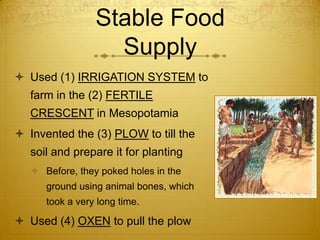
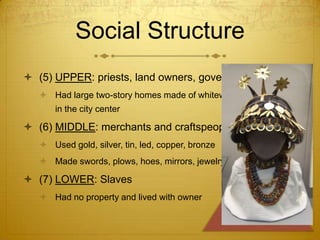
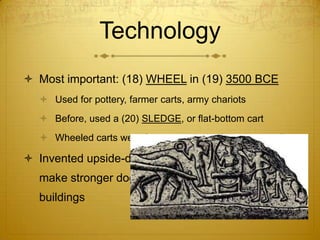
The Sumer civilization developed advanced agricultural techniques like irrigation systems and the plow, which allowed them to farm productively in Mesopotamia's fertile floodplains. They had a stratified social structure led by priests, landowners, and government officials who lived in large homes. Merchants, craftspeople, and slaves comprised the middle and lower classes. City-states were governed by kings chosen by the gods to enforce laws and collect taxes, and scribes recorded these laws. Religion influenced all aspects of life and Sumerians built large ziggurats to house their gods. They also made technological advancements such as the wheel, arch, and a written language called cuneiform recorded on clay tablets.




![Ancient Egypt [PDF]](https://cdn.slidesharecdn.com/ss_thumbnails/ancientegyptpowerpointfull-150914165252-lva1-app6891-thumbnail.jpg?width=640&height=640&fit=bounds)


