Successful
     Bilingual Programmes

Why going bilingual can work
              for your school
      University of Westminster
           17th November 2012
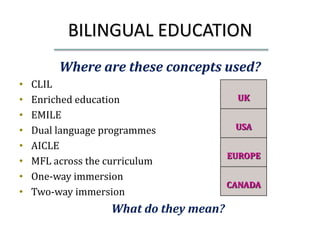
BILINGUAL EDUCATION
         Where are these concepts used?
•   CLIL
•   Enriched education                    UK
•   EMILE
•   Dual language programmes              USA

•   AICLE
                                         EUROPE
•   MFL across the curriculum
•   One-way immersion
                                         CANADA
•   Two-way immersion
                    What do they mean?
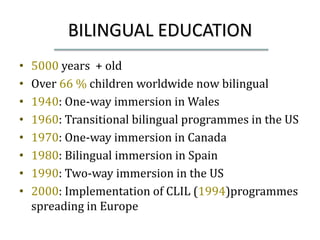
BILINGUAL EDUCATION
•   5000 years + old
•   Over 66 % children worldwide now bilingual
•   1940: One-way immersion in Wales
•   1960: Transitional bilingual programmes in the US
•   1970: One-way immersion in Canada
•   1980: Bilingual immersion in Spain
•   1990: Two-way immersion in the US
•   2000: Implementation of CLIL (1994)programmes
    spreading in Europe
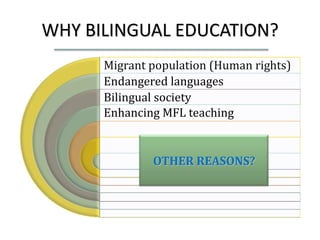
WHY BILINGUAL EDUCATION?
      Migrant population (Human rights)
      Endangered languages
      Bilingual society
      Enhancing MFL teaching


              OTHER REASONS?
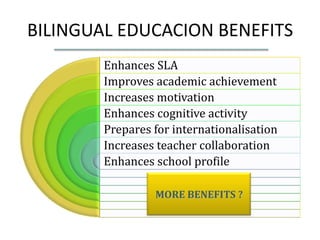
BILINGUAL EDUCACION BENEFITS
        Enhances SLA
        Improves academic achievement
        Increases motivation
        Enhances cognitive activity
        Prepares for internationalisation
        Increases teacher collaboration
        Enhances school profile

                 MORE BENEFITS ?
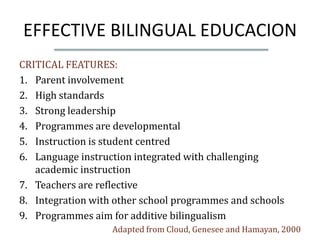
EFFECTIVE BILINGUAL EDUCACION
CRITICAL FEATURES:
1. Parent involvement
2. High standards
3. Strong leadership
4. Programmes are developmental
5. Instruction is student centred
6. Language instruction integrated with challenging
   academic instruction
7. Teachers are reflective
8. Integration with other school programmes and schools
9. Programmes aim for additive bilingualism
                   Adapted from Cloud, Genesee and Hamayan, 2000
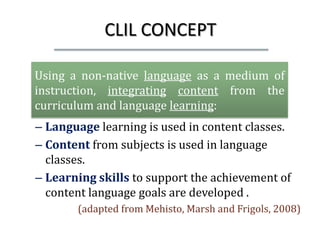
CLIL CONCEPT

Using a non-native language as a medium of
instruction, integrating content from the
curriculum and language learning:
– Language learning is used in content classes.
– Content from subjects is used in language
  classes.
– Learning skills to support the achievement of
  content language goals are developed .
       (adapted from Mehisto, Marsh and Frigols, 2008)
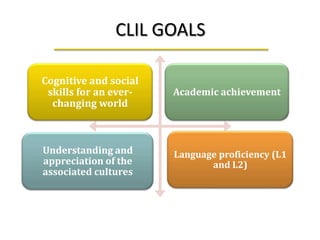
CLIL GOALS

Cognitive and social
 skills for an ever-   Academic achievement
  changing world


Understanding and      Language proficiency (L1
appreciation of the           and L2)
associated cultures
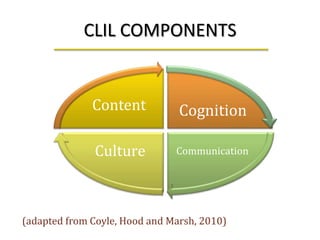
CLIL COMPONENTS


              Content           Cognition

              Culture          Communication


(adapted from Coyle, Hood and Marsh, 2010)
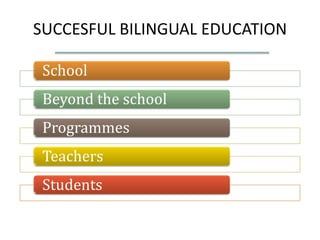
SUCCESFUL BILINGUAL EDUCATION

 School
 Beyond the school
 Programmes
 Teachers
 Students
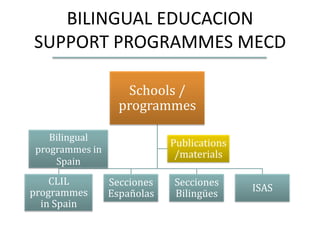
BILINGUAL EDUCACION
SUPPORT PROGRAMMES MECD

                   Schools /
                  programmes

   Bilingual
                            Publications
programmes in                /materials
    Spain
    CLIL        Secciones   Secciones
programmes                                 ISAS
                Españolas   Bilingües
  in Spain
BILINGUAL EDUCACION
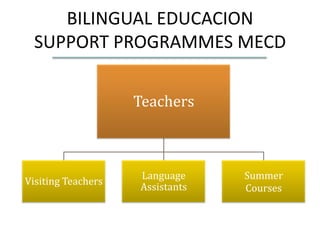
  SUPPORT PROGRAMMES MECD

                    Teachers


                    Language     Summer
Visiting Teachers
                    Assistants   Courses
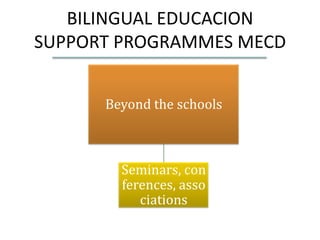
BILINGUAL EDUCACION
SUPPORT PROGRAMMES MECD


      Beyond the schools


        Seminars, con
        ferences, asso
           ciations
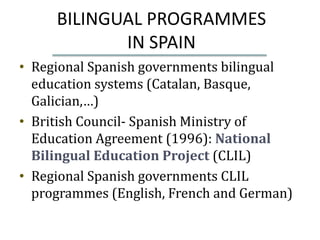
BILINGUAL PROGRAMMES
            IN SPAIN
• Regional Spanish governments bilingual
  education systems (Catalan, Basque,
  Galician,…)
• British Council- Spanish Ministry of
  Education Agreement (1996): National
  Bilingual Education Project (CLIL)
• Regional Spanish governments CLIL
  programmes (English, French and German)
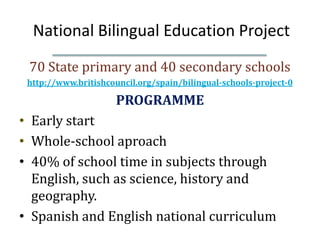
National Bilingual Education Project
 70 State primary and 40 secondary schools
 http://www.britishcouncil.org/spain/bilingual-schools-project-0

                      PROGRAMME
• Early start
• Whole-school aproach
• 40% of school time in subjects through
  English, such as science, history and
  geography.
• Spanish and English national curriculum
National Bilingual Education Project
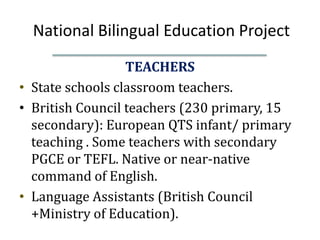
                  TEACHERS
• State schools classroom teachers.
• British Council teachers (230 primary, 15
  secondary): European QTS infant/ primary
  teaching . Some teachers with secondary
  PGCE or TEFL. Native or near-native
  command of English.
• Language Assistants (British Council
  +Ministry of Education).
National Bilingual Education Project
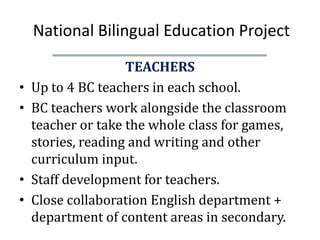
                    TEACHERS
•   Up to 4 BC teachers in each school.
•   BC teachers work alongside the classroom
    teacher or take the whole class for games,
    stories, reading and writing and other
    curriculum input.
•   Staff development for teachers.
•   Close collaboration English department +
    department of content areas in secondary.
National Bilingual Education Project
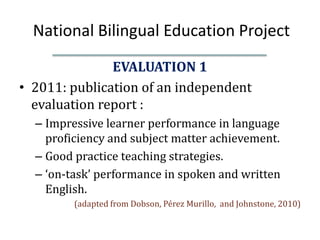
               EVALUATION 1
• 2011: publication of an independent
  evaluation report :
  – Impressive learner performance in language
    proficiency and subject matter achievement.
  – Good practice teaching strategies.
  – ‘on-task’ performance in spoken and written
    English.
         (adapted from Dobson, Pérez Murillo, and Johnstone, 2010)
National Bilingual Education Project
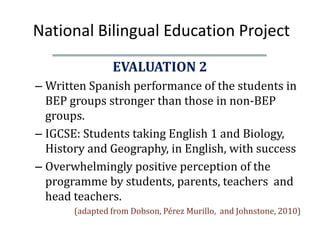
                EVALUATION 2
– Written Spanish performance of the students in
  BEP groups stronger than those in non-BEP
  groups.
– IGCSE: Students taking English 1 and Biology,
  History and Geography, in English, with success
– Overwhelmingly positive perception of the
  programme by students, parents, teachers and
  head teachers.
       (adapted from Dobson, Pérez Murillo, and Johnstone, 2010)
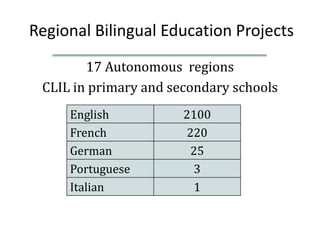
Regional Bilingual Education Projects
        17 Autonomous regions
 CLIL in primary and secondary schools
     English           2100
     French            220
     German             25
     Portuguese         3
     Italian            1
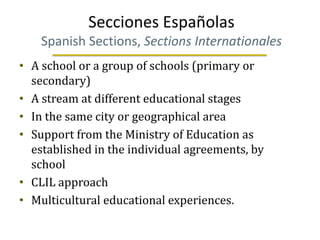
Secciones Españolas
    Spanish Sections, Sections Internationales
• A school or a group of schools (primary or
  secondary)
• A stream at different educational stages
• In the same city or geographical area
• Support from the Ministry of Education as
  established in the individual agreements, by
  school
• CLIL approach
• Multicultural educational experiences.
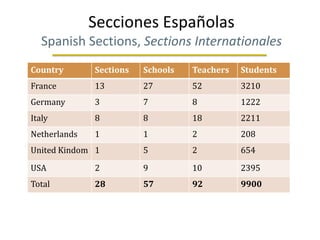
Secciones Españolas
   Spanish Sections, Sections Internationales
Country       Sections   Schools   Teachers   Students
France        13         27        52         3210
Germany       3          7         8          1222
Italy         8          8         18         2211
Netherlands   1          1         2          208
United Kindom 1          5         2          654
USA           2          9         10         2395
Total         28         57        92         9900
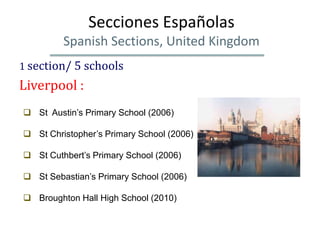
Secciones Españolas
         Spanish Sections, United Kingdom
1 section/ 5 schools
Liverpool :
 St Austin’s Primary School (2006)

 St Christopher’s Primary School (2006)

 St Cuthbert’s Primary School (2006)

 St Sebastian’s Primary School (2006)

 Broughton Hall High School (2010)
Secciones Españolas
           Spanish Sections, United Kingdom
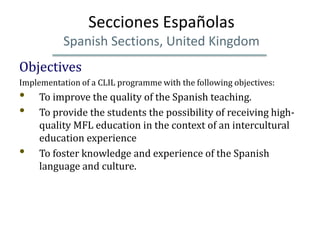
Objectives
Implementation of a CLIL programme with the following objectives:
•    To improve the quality of the Spanish teaching.
•    To provide the students the possibility of receiving high-
     quality MFL education in the context of an intercultural
     education experience
•    To foster knowledge and experience of the Spanish
     language and culture.
Secciones Españolas
         Spanish Sections, United Kingdom
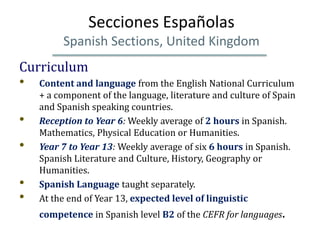
Curriculum
• Content and language from the English National Curriculum
    + a component of the language, literature and culture of Spain
    and Spanish speaking countries.
•   Reception to Year 6: Weekly average of 2 hours in Spanish.
    Mathematics, Physical Education or Humanities.
•   Year 7 to Year 13: Weekly average of six 6 hours in Spanish.
    Spanish Literature and Culture, History, Geography or
    Humanities.
•   Spanish Language taught separately.
•   At the end of Year 13, expected level of linguistic
    competence in Spanish level B2 of the CEFR for languages.
Secciones Españolas
           Spanish Sections, United Kingdom
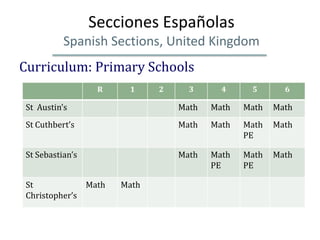
Curriculum: Primary Schools
                   R    1     2     3      4     5       6

 St Austin’s                      Math   Math   Math   Math
 St Cuthbert’s                    Math   Math   Math   Math
                                                PE

 St Sebastian’s                   Math   Math   Math   Math
                                         PE     PE

 St            Math    Math
 Christopher’s
Secciones Españolas
        Spanish Sections, United Kingdom
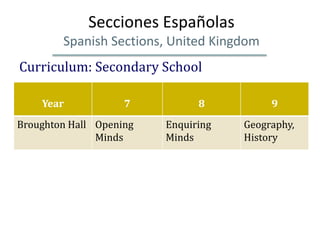
Curriculum: Secondary School

    Year            7          8           9
Broughton Hall Opening   Enquiring   Geography,
               Minds     Minds       History
Secciones Españolas
         Spanish Sections, United Kingdom
Teachers
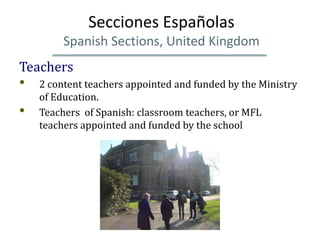
•   2 content teachers appointed and funded by the Ministry
    of Education.
•   Teachers of Spanish: classroom teachers, or MFL
    teachers appointed and funded by the school
Secciones Españolas
        Spanish Sections, United Kingdom
Students
•   Primary: Whole school programme
•   Secondary: Stream, 7 and 8 year, high achieving
    students.
•   Knowledge of Spanish, not an admission
    requirement, except for advanced levels of the
    Spanish Section.
•   The achievement of the Spanish Section’s
    objectives a requirement for continued
    participation in the programme.
Secciones Bilingües
               Bilingual Sections
• Beginning 1988
• Whole school or stream in a school (primary
  or secondary)
• Support from the Ministry of Education as
  established in the individual agreements, by
  country
• CLIL approach
• Multicultural educational experiences
• Double certification/ Final examination
Secciones Bilingües
Bilingual Sections in Central and Eastern Europe

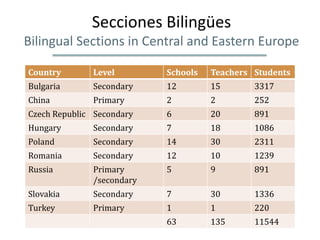
Country       Level        Schools   Teachers Students
Bulgaria      Secondary    12        15       3317
China         Primary      2         2        252
Czech Republic Secondary   6         20       891
Hungary       Secondary    7         18       1086
Poland        Secondary    14        30       2311
Romania       Secondary    12        10       1239
Russia        Primary      5         9        891
              /secondary
Slovakia      Secondary    7         30       1336
Turkey        Primary      1         1        220
                           63        135      11544
Secciones Bilingües
                 Bilingual Sections
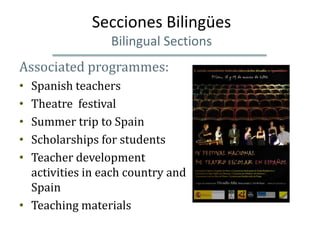
Associated programmes:
• Spanish teachers
• Theatre festival
• Summer trip to Spain
• Scholarships for students
• Teacher development
  activities in each country and
  Spain
• Teaching materials
Secciones Bilingües
           Bilingual Sections: Curriculum
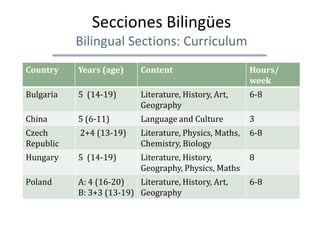
Country    Years (age)     Content                       Hours/
                                                         week
Bulgaria   5 (14-19)       Literature, History, Art,     6-8
                           Geography
China      5 (6-11)        Language and Culture          3
Czech      2+4 (13-19)     Literature, Physics, Maths,   6-8
Republic                   Chemistry, Biology
Hungary    5 (14-19)       Literature, History,          8
                           Geography, Physics, Maths
Poland     A: 4 (16-20)   Literature, History, Art,      6-8
           B: 3+3 (13-19) Geography
Secciones Bilingües
           Bilingual Sections: Curriculum

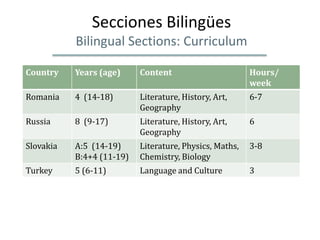
Country    Years (age)     Content                       Hours/
                                                         week
Romania    4 (14-18)       Literature, History, Art,     6-7
                           Geography
Russia     8 (9-17)        Literature, History, Art,     6
                           Geography
Slovakia   A:5 (14-19)     Literature, Physics, Maths,   3-8
           B:4+4 (11-19)   Chemistry, Biology
Turkey     5 (6-11)        Language and Culture          3
ISAs
       International Spanish Academies
• Beginning 2000
• Whole school or stream in a school (primary
  or secondary)
• Support from the Ministry of Education as
  established in the individual agreements
  with each school
• Bilingual immersion approach, existing
  programmes
• Multicultural educational experiences
ISAs
   International Spanish Academies
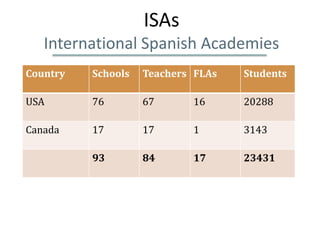
Country   Schools   Teachers FLAs   Students

USA       76        67      16      20288

Canada    17        17      1       3143

          93        84      17      23431
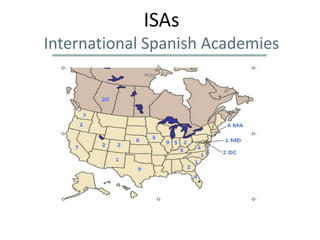
ISAs
International Spanish Academies
ISAs
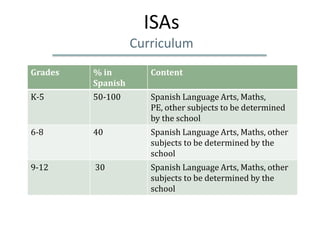
                   Curriculum
Grades   % in         Content
         Spanish
K-5      50-100       Spanish Language Arts, Maths,
                      PE, other subjects to be determined
                      by the school
6-8      40           Spanish Language Arts, Maths, other
                      subjects to be determined by the
                      school
9-12     30           Spanish Language Arts, Maths, other
                      subjects to be determined by the
                      school
ISAs
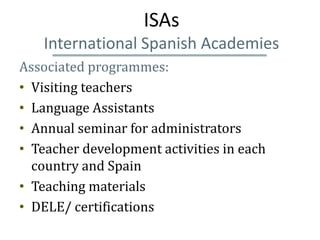
   International Spanish Academies
Associated programmes:
• Visiting teachers
• Language Assistants
• Annual seminar for administrators
• Teacher development activities in each
  country and Spain
• Teaching materials
• DELE/ certifications
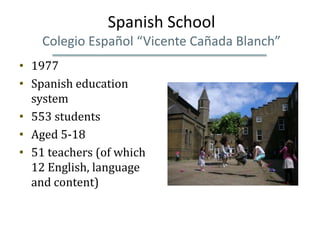
Spanish School
    Colegio Español “Vicente Cañada Blanch”
• 1977
• Spanish education
  system
• 553 students
• Aged 5-18
• 51 teachers (of which
  12 English, language
  and content)
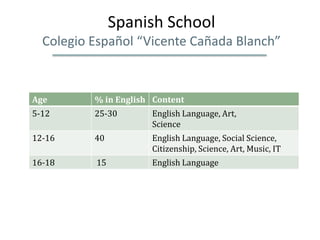
Spanish School
  Colegio Español “Vicente Cañada Blanch”


Age       % in English Content
5-12      25-30       English Language, Art,
                      Science
12-16     40          English Language, Social Science,
                      Citizenship, Science, Art, Music, IT
16-18     15          English Language
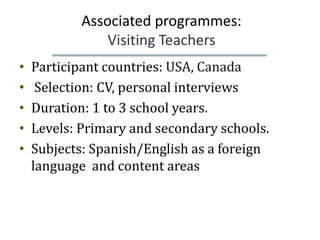
Associated programmes:
                Visiting Teachers
•   Participant countries: USA, Canada
•    Selection: CV, personal interviews
•   Duration: 1 to 3 school years.
•   Levels: Primary and secondary schools.
•   Subjects: Spanish/English as a foreign
    language and content areas
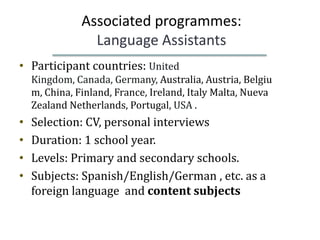
Associated programmes:
                 Language Assistants
• Participant countries: United
    Kingdom, Canada, Germany, Australia, Austria, Belgiu
    m, China, Finland, France, Ireland, Italy Malta, Nueva
    Zealand Netherlands, Portugal, USA .
•   Selection: CV, personal interviews
•   Duration: 1 school year.
•   Levels: Primary and secondary schools.
•   Subjects: Spanish/English/German , etc. as a
    foreign language and content subjects
Associated programmes:
                Materials, publications
• Resources to teach CLIL in Spanish
http://www.educacion.gob.es/reinounido/publicaciones-
   materiales/material-didactico.html

• Science, etc. (Secciones Bilingües)
http://www.educacion.gob.es/exterior/sk/es/publicaciones-y-
   materiales/recursos-didacticos.shtml

• In French
EMILE
http://www.emilangues.education.fr/formation/certification-
   complementaire/les-enjeux
Associated programmes:
  Associations, Organizations , Institutions
• Languages Company
http://www.languagescompany.com/images/stories/do
   cs/news/clil_national_statement_and_guidelines.pdf
• European Commission
http://ec.europa.eu/languages/language-
   teaching/content-and-language-integrated-
   learning_en.htm
• CLIL compendium:
http://www.clilcompendium.com/clilexpertise.htm
Associated programmes:
  Associations, Organizations, Institutions
• ALL
http://clil4teachers.pbworks.com/w/page
  /8427859/FrontPage
• La Cosecha, Dual Language Education of
  New Mexico
http://dlenm.org/
• NABE
http://www.nabe.org/
UTAH DUAL LANGUAGE

• http://www.youtube.com/watch?v=hTG
  0YFU8vWA
GRACIAS | MERCI | THANK YOU
                                 l
       natalio.ormeno@mecd.es


    Why going bilingual can work
                  for your school
          University of Westminster
               17th November 2012

Successful Bilingual Programmes

  • 1.
    Successful Bilingual Programmes Why going bilingual can work for your school University of Westminster 17th November 2012
  • 2.
    BILINGUAL EDUCATION Where are these concepts used? • CLIL • Enriched education UK • EMILE • Dual language programmes USA • AICLE EUROPE • MFL across the curriculum • One-way immersion CANADA • Two-way immersion What do they mean?
  • 3.
    BILINGUAL EDUCATION • 5000 years + old • Over 66 % children worldwide now bilingual • 1940: One-way immersion in Wales • 1960: Transitional bilingual programmes in the US • 1970: One-way immersion in Canada • 1980: Bilingual immersion in Spain • 1990: Two-way immersion in the US • 2000: Implementation of CLIL (1994)programmes spreading in Europe
  • 4.
    WHY BILINGUAL EDUCATION? Migrant population (Human rights) Endangered languages Bilingual society Enhancing MFL teaching OTHER REASONS?
  • 5.
    BILINGUAL EDUCACION BENEFITS Enhances SLA Improves academic achievement Increases motivation Enhances cognitive activity Prepares for internationalisation Increases teacher collaboration Enhances school profile MORE BENEFITS ?
  • 6.
    EFFECTIVE BILINGUAL EDUCACION CRITICALFEATURES: 1. Parent involvement 2. High standards 3. Strong leadership 4. Programmes are developmental 5. Instruction is student centred 6. Language instruction integrated with challenging academic instruction 7. Teachers are reflective 8. Integration with other school programmes and schools 9. Programmes aim for additive bilingualism Adapted from Cloud, Genesee and Hamayan, 2000
  • 7.
    CLIL CONCEPT Using anon-native language as a medium of instruction, integrating content from the curriculum and language learning: – Language learning is used in content classes. – Content from subjects is used in language classes. – Learning skills to support the achievement of content language goals are developed . (adapted from Mehisto, Marsh and Frigols, 2008)
  • 8.
    CLIL GOALS Cognitive andsocial skills for an ever- Academic achievement changing world Understanding and Language proficiency (L1 appreciation of the and L2) associated cultures
  • 9.
    CLIL COMPONENTS Content Cognition Culture Communication (adapted from Coyle, Hood and Marsh, 2010)
  • 10.
    SUCCESFUL BILINGUAL EDUCATION School Beyond the school Programmes Teachers Students
  • 11.
    BILINGUAL EDUCACION SUPPORT PROGRAMMESMECD Schools / programmes Bilingual Publications programmes in /materials Spain CLIL Secciones Secciones programmes ISAS Españolas Bilingües in Spain
  • 12.
    BILINGUAL EDUCACION SUPPORT PROGRAMMES MECD Teachers Language Summer Visiting Teachers Assistants Courses
  • 13.
    BILINGUAL EDUCACION SUPPORT PROGRAMMESMECD Beyond the schools Seminars, con ferences, asso ciations
  • 14.
    BILINGUAL PROGRAMMES IN SPAIN • Regional Spanish governments bilingual education systems (Catalan, Basque, Galician,…) • British Council- Spanish Ministry of Education Agreement (1996): National Bilingual Education Project (CLIL) • Regional Spanish governments CLIL programmes (English, French and German)
  • 15.
    National Bilingual EducationProject 70 State primary and 40 secondary schools http://www.britishcouncil.org/spain/bilingual-schools-project-0 PROGRAMME • Early start • Whole-school aproach • 40% of school time in subjects through English, such as science, history and geography. • Spanish and English national curriculum
  • 16.
    National Bilingual EducationProject TEACHERS • State schools classroom teachers. • British Council teachers (230 primary, 15 secondary): European QTS infant/ primary teaching . Some teachers with secondary PGCE or TEFL. Native or near-native command of English. • Language Assistants (British Council +Ministry of Education).
  • 17.
    National Bilingual EducationProject TEACHERS • Up to 4 BC teachers in each school. • BC teachers work alongside the classroom teacher or take the whole class for games, stories, reading and writing and other curriculum input. • Staff development for teachers. • Close collaboration English department + department of content areas in secondary.
  • 18.
    National Bilingual EducationProject EVALUATION 1 • 2011: publication of an independent evaluation report : – Impressive learner performance in language proficiency and subject matter achievement. – Good practice teaching strategies. – ‘on-task’ performance in spoken and written English. (adapted from Dobson, Pérez Murillo, and Johnstone, 2010)
  • 19.
    National Bilingual EducationProject EVALUATION 2 – Written Spanish performance of the students in BEP groups stronger than those in non-BEP groups. – IGCSE: Students taking English 1 and Biology, History and Geography, in English, with success – Overwhelmingly positive perception of the programme by students, parents, teachers and head teachers. (adapted from Dobson, Pérez Murillo, and Johnstone, 2010)
  • 20.
    Regional Bilingual EducationProjects 17 Autonomous regions CLIL in primary and secondary schools English 2100 French 220 German 25 Portuguese 3 Italian 1
  • 21.
    Secciones Españolas Spanish Sections, Sections Internationales • A school or a group of schools (primary or secondary) • A stream at different educational stages • In the same city or geographical area • Support from the Ministry of Education as established in the individual agreements, by school • CLIL approach • Multicultural educational experiences.
  • 22.
    Secciones Españolas Spanish Sections, Sections Internationales Country Sections Schools Teachers Students France 13 27 52 3210 Germany 3 7 8 1222 Italy 8 8 18 2211 Netherlands 1 1 2 208 United Kindom 1 5 2 654 USA 2 9 10 2395 Total 28 57 92 9900
  • 23.
    Secciones Españolas Spanish Sections, United Kingdom 1 section/ 5 schools Liverpool :  St Austin’s Primary School (2006)  St Christopher’s Primary School (2006)  St Cuthbert’s Primary School (2006)  St Sebastian’s Primary School (2006)  Broughton Hall High School (2010)
  • 24.
    Secciones Españolas Spanish Sections, United Kingdom Objectives Implementation of a CLIL programme with the following objectives: • To improve the quality of the Spanish teaching. • To provide the students the possibility of receiving high- quality MFL education in the context of an intercultural education experience • To foster knowledge and experience of the Spanish language and culture.
  • 25.
    Secciones Españolas Spanish Sections, United Kingdom Curriculum • Content and language from the English National Curriculum + a component of the language, literature and culture of Spain and Spanish speaking countries. • Reception to Year 6: Weekly average of 2 hours in Spanish. Mathematics, Physical Education or Humanities. • Year 7 to Year 13: Weekly average of six 6 hours in Spanish. Spanish Literature and Culture, History, Geography or Humanities. • Spanish Language taught separately. • At the end of Year 13, expected level of linguistic competence in Spanish level B2 of the CEFR for languages.
  • 26.
    Secciones Españolas Spanish Sections, United Kingdom Curriculum: Primary Schools R 1 2 3 4 5 6 St Austin’s Math Math Math Math St Cuthbert’s Math Math Math Math PE St Sebastian’s Math Math Math Math PE PE St Math Math Christopher’s
  • 27.
    Secciones Españolas Spanish Sections, United Kingdom Curriculum: Secondary School Year 7 8 9 Broughton Hall Opening Enquiring Geography, Minds Minds History
  • 28.
    Secciones Españolas Spanish Sections, United Kingdom Teachers • 2 content teachers appointed and funded by the Ministry of Education. • Teachers of Spanish: classroom teachers, or MFL teachers appointed and funded by the school
  • 29.
    Secciones Españolas Spanish Sections, United Kingdom Students • Primary: Whole school programme • Secondary: Stream, 7 and 8 year, high achieving students. • Knowledge of Spanish, not an admission requirement, except for advanced levels of the Spanish Section. • The achievement of the Spanish Section’s objectives a requirement for continued participation in the programme.
  • 30.
    Secciones Bilingües Bilingual Sections • Beginning 1988 • Whole school or stream in a school (primary or secondary) • Support from the Ministry of Education as established in the individual agreements, by country • CLIL approach • Multicultural educational experiences • Double certification/ Final examination
  • 31.
    Secciones Bilingües Bilingual Sectionsin Central and Eastern Europe Country Level Schools Teachers Students Bulgaria Secondary 12 15 3317 China Primary 2 2 252 Czech Republic Secondary 6 20 891 Hungary Secondary 7 18 1086 Poland Secondary 14 30 2311 Romania Secondary 12 10 1239 Russia Primary 5 9 891 /secondary Slovakia Secondary 7 30 1336 Turkey Primary 1 1 220 63 135 11544
  • 32.
    Secciones Bilingües Bilingual Sections Associated programmes: • Spanish teachers • Theatre festival • Summer trip to Spain • Scholarships for students • Teacher development activities in each country and Spain • Teaching materials
  • 33.
    Secciones Bilingües Bilingual Sections: Curriculum Country Years (age) Content Hours/ week Bulgaria 5 (14-19) Literature, History, Art, 6-8 Geography China 5 (6-11) Language and Culture 3 Czech 2+4 (13-19) Literature, Physics, Maths, 6-8 Republic Chemistry, Biology Hungary 5 (14-19) Literature, History, 8 Geography, Physics, Maths Poland A: 4 (16-20) Literature, History, Art, 6-8 B: 3+3 (13-19) Geography
  • 34.
    Secciones Bilingües Bilingual Sections: Curriculum Country Years (age) Content Hours/ week Romania 4 (14-18) Literature, History, Art, 6-7 Geography Russia 8 (9-17) Literature, History, Art, 6 Geography Slovakia A:5 (14-19) Literature, Physics, Maths, 3-8 B:4+4 (11-19) Chemistry, Biology Turkey 5 (6-11) Language and Culture 3
  • 35.
    ISAs International Spanish Academies • Beginning 2000 • Whole school or stream in a school (primary or secondary) • Support from the Ministry of Education as established in the individual agreements with each school • Bilingual immersion approach, existing programmes • Multicultural educational experiences
  • 36.
    ISAs International Spanish Academies Country Schools Teachers FLAs Students USA 76 67 16 20288 Canada 17 17 1 3143 93 84 17 23431
  • 37.
  • 38.
    ISAs Curriculum Grades % in Content Spanish K-5 50-100 Spanish Language Arts, Maths, PE, other subjects to be determined by the school 6-8 40 Spanish Language Arts, Maths, other subjects to be determined by the school 9-12 30 Spanish Language Arts, Maths, other subjects to be determined by the school
  • 39.
    ISAs International Spanish Academies Associated programmes: • Visiting teachers • Language Assistants • Annual seminar for administrators • Teacher development activities in each country and Spain • Teaching materials • DELE/ certifications
  • 40.
    Spanish School Colegio Español “Vicente Cañada Blanch” • 1977 • Spanish education system • 553 students • Aged 5-18 • 51 teachers (of which 12 English, language and content)
  • 41.
    Spanish School Colegio Español “Vicente Cañada Blanch” Age % in English Content 5-12 25-30 English Language, Art, Science 12-16 40 English Language, Social Science, Citizenship, Science, Art, Music, IT 16-18 15 English Language
  • 42.
    Associated programmes: Visiting Teachers • Participant countries: USA, Canada • Selection: CV, personal interviews • Duration: 1 to 3 school years. • Levels: Primary and secondary schools. • Subjects: Spanish/English as a foreign language and content areas
  • 43.
    Associated programmes: Language Assistants • Participant countries: United Kingdom, Canada, Germany, Australia, Austria, Belgiu m, China, Finland, France, Ireland, Italy Malta, Nueva Zealand Netherlands, Portugal, USA . • Selection: CV, personal interviews • Duration: 1 school year. • Levels: Primary and secondary schools. • Subjects: Spanish/English/German , etc. as a foreign language and content subjects
  • 44.
    Associated programmes: Materials, publications • Resources to teach CLIL in Spanish http://www.educacion.gob.es/reinounido/publicaciones- materiales/material-didactico.html • Science, etc. (Secciones Bilingües) http://www.educacion.gob.es/exterior/sk/es/publicaciones-y- materiales/recursos-didacticos.shtml • In French EMILE http://www.emilangues.education.fr/formation/certification- complementaire/les-enjeux
  • 45.
    Associated programmes: Associations, Organizations , Institutions • Languages Company http://www.languagescompany.com/images/stories/do cs/news/clil_national_statement_and_guidelines.pdf • European Commission http://ec.europa.eu/languages/language- teaching/content-and-language-integrated- learning_en.htm • CLIL compendium: http://www.clilcompendium.com/clilexpertise.htm
  • 46.
    Associated programmes: Associations, Organizations, Institutions • ALL http://clil4teachers.pbworks.com/w/page /8427859/FrontPage • La Cosecha, Dual Language Education of New Mexico http://dlenm.org/ • NABE http://www.nabe.org/
  • 47.
    UTAH DUAL LANGUAGE •http://www.youtube.com/watch?v=hTG 0YFU8vWA
  • 48.
    GRACIAS | MERCI| THANK YOU l natalio.ormeno@mecd.es Why going bilingual can work for your school University of Westminster 17th November 2012

Editor's Notes

  • #2 Esto es lo que tengo que hacer
  • #49 Esto es lo que tengo que hacer