COVID-19 Vaccine
Development & Types
• Vaccines can prevent infectious diseases.
Examples : measles, polio, hepatitis B,
influenza and many others.
• ‘Herd’ or ‘indirect’ or ‘population’
immunity.
Why we use vaccines
2
• Vaccines safely deliver an immunogen
which is a specific type of antigen that
elicits an immune response, to train the
immune system to recognize the
pathogen when it is encountered
naturally.
How vaccines work
3
• Vaccines sometimes require more than
one dose to:
build complete immunity
give a ‘booster’ dose when immunity wears
off
immunize people against viruses causing
disease that may be different from season
to season, for example, the yearly flu
vaccine
How vaccines are delivered
ABOUT
VACCINES
4
Immunogens used to develop viralvaccines
IMMUNOGEN HOW IT WORKS EXAMPLE of vaccines
Attenuated live virus Live virus but doesn’t
cause disease
Measles, rubella, mumps,
yellow fever, smallpox
(vaccinia)
Whole inactivated virus Inactivated dead virus Influenza, rabies hepatitis
A
Protein subunit A protein derived from
a pathogen
Influenza
Recombinant Host cell is used to
express an antigen
Hepatitis B
Peptides Synthetic produced
fragment of an antigen
COVID-19 vaccines in
development
Replicating or non-
replicating viral vector
Viral pathogen expressed
on a safe virus that
doesn’t cause disease
Ebola
Nucleic acid DNA or RNA coding for a
viral protein
COVID-19 vaccines in
development 1
0
Virus Vaccines
11
• Virus is selected,
modified
(weakened) or
completely
inactivated so that
it will not cause
disease
Inactivated dead virus
Vaccines from whole
virus
Attenuated live virus
Attenuated live or inactivated dead
virus
Source: https://www.nature.com/articles/d41586-020-
01221-y
Protein-based vaccines
1
2
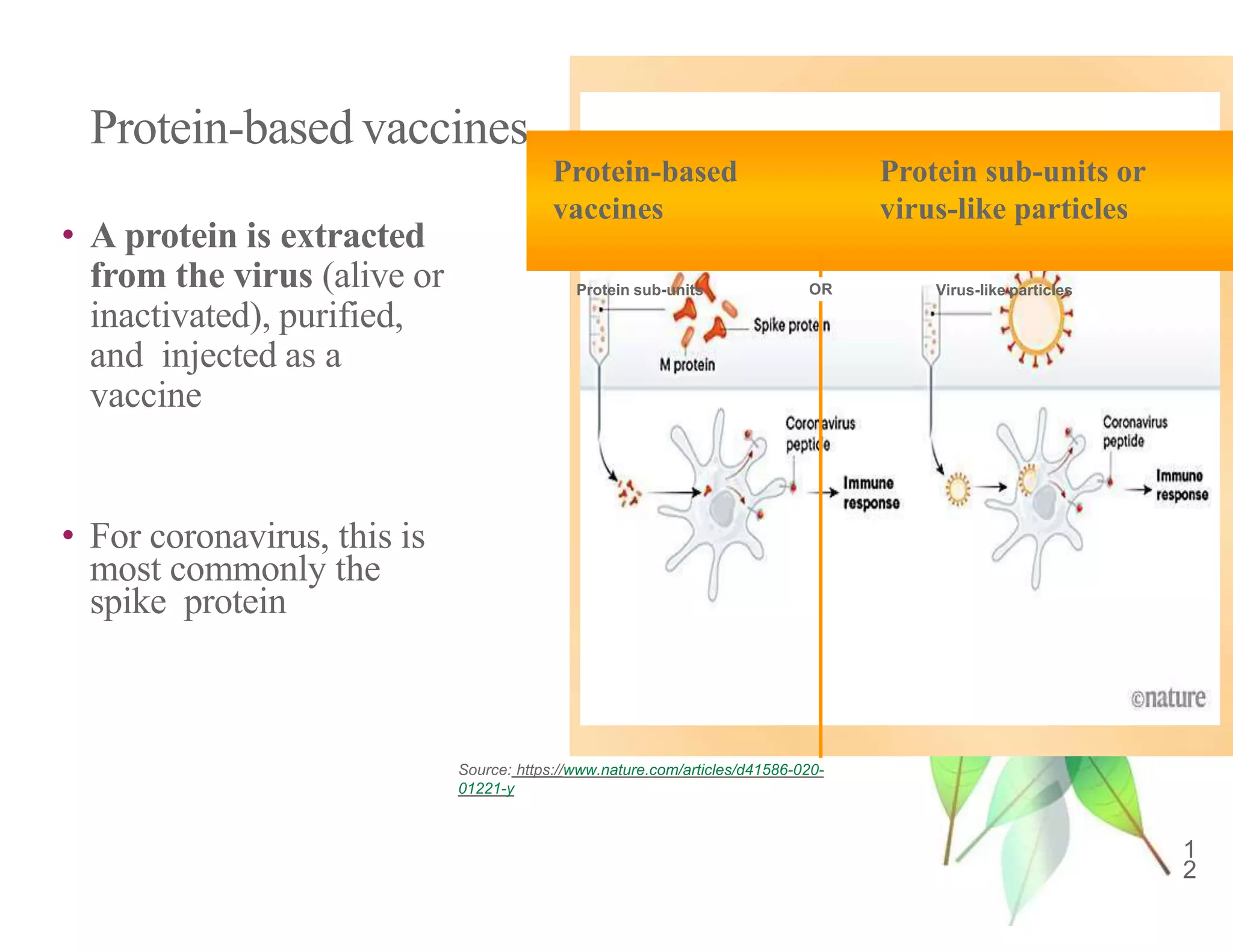
• A protein is extracted
from the virus (alive or
inactivated), purified,
and injected as a
vaccine
• For coronavirus, this is
most commonly the
spike protein
Virus-like particles
Protein sub-units
Protein-based
vaccines
Protein sub-units or
virus-like particles
OR
Source: https://www.nature.com/articles/d41586-020-
01221-y
Viral vector vaccines
• The gene for a
pathogen protein
is inserted into a
different virus that
can infect
someone without
causing disease
• The safe virus
serves as a
‘platform’ or
‘vector’ to deliver
the protein that
triggers an
immune response
1
3
Non-replicating viral vector
Viral vector
vaccines
Replicating vector
Replicating vector or non-replicating viral
vector
Source: https://www.nature.com/articles/d41586-020-
01221-y
Nucleic acid vaccines
14
• Instead of a virus, a protein
antigen, or a virus expressing
the protein, nucleic acid
coding for the antigen is
injected
• DNA plasmid: enters
nucleus, translated to
mRNA for expression of
protein
• Or mRNA can be injected.
More direct (no translation
required) but less stable than
DNA
• This is new technology – no
other vaccines for human use
have used this
Nucleic acid
vaccines
DNA vaccine
DNA vaccine or RNA
vaccine
RNA vaccine
VACCINE DEVELOPMENT — Mechanism of action for types
of vaccines
• Pre-clinical studies
Vaccine is tested in animal studies for efficacy and safety, including challenge studies
• Phase I clinical trial
Small groups of healthy adult volunteers receive the vaccine to test for safety
• Phase II clinical trial
Vaccine is given to people who have characteristics (such as age and physical health) similar to
those for whom the new vaccine is intended
• Phase III clinical trial
Vaccine is given to thousands of people and tested for efficacy and safety
• Phase IV post marketing surveillance
Ongoing studies after the vaccine is approved and licensed, to monitor adverse events and to study
long- term effects of the vaccine in the population
• Human challenge studies
Studies in which a vaccine is given followed by the pathogen against which the vaccine is
designed to protect. Such trials are uncommon in people as they present considerable ethical
challenges
Steps in Vaccine
Development
15
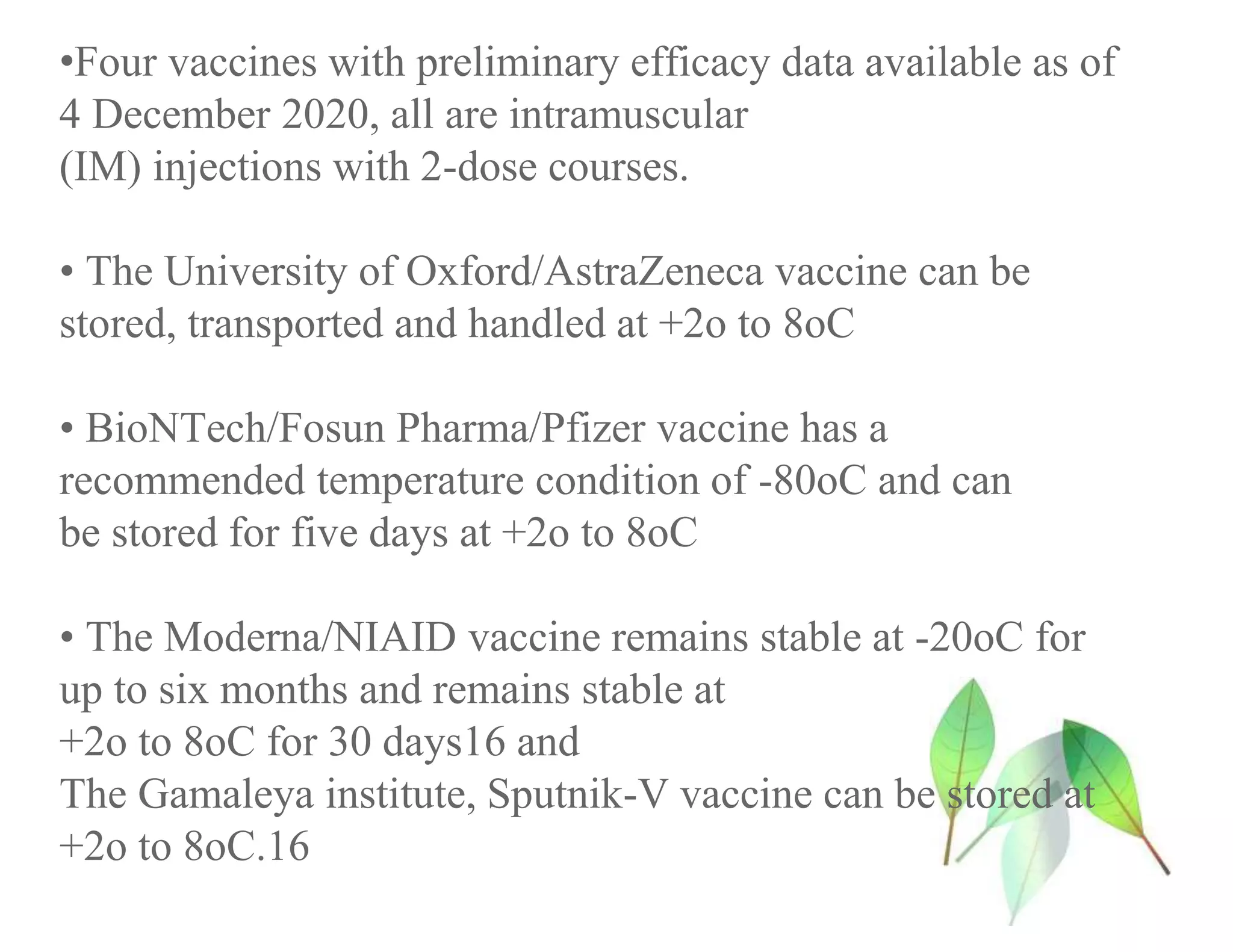
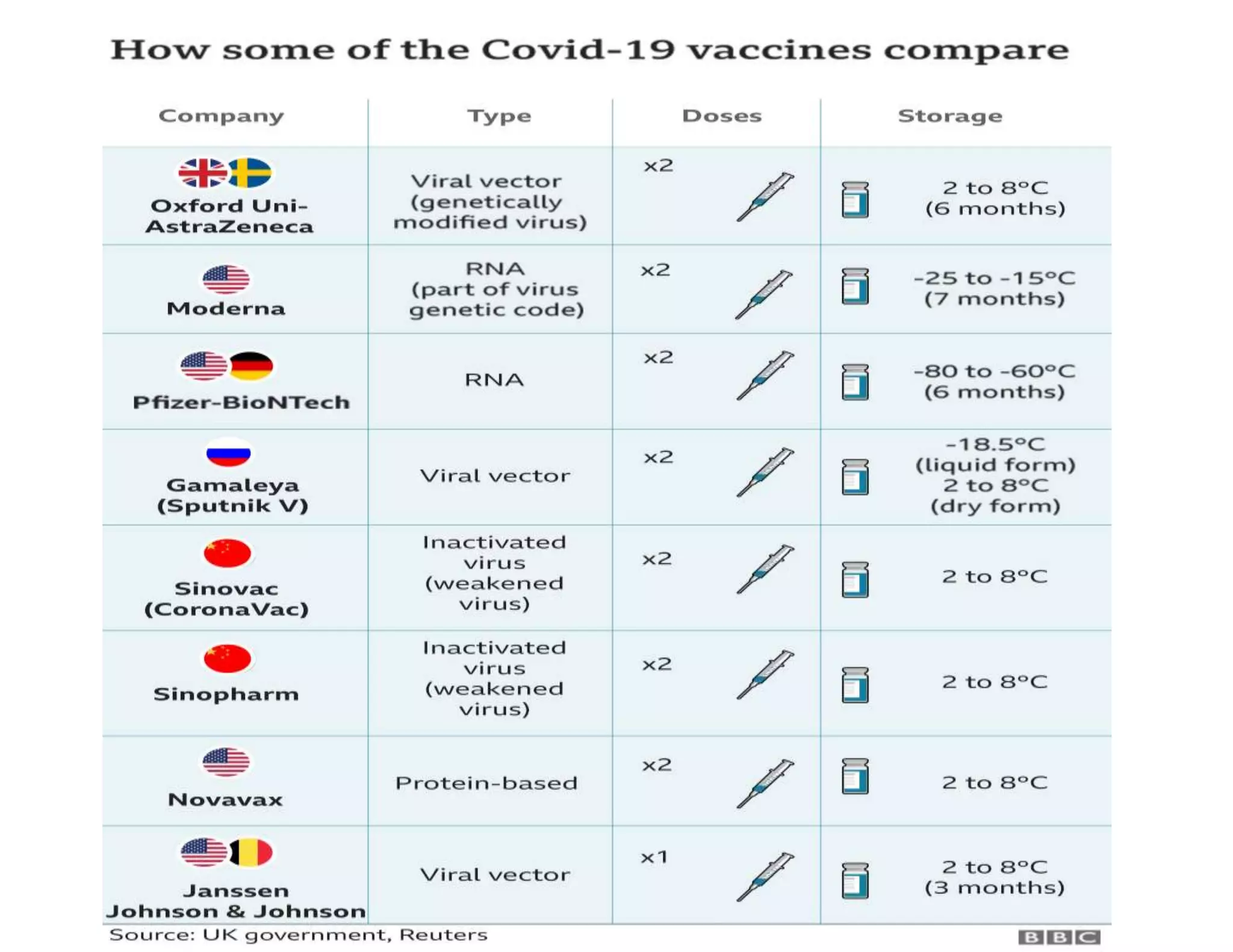
•Four vaccines with preliminary efficacy data available as of
4 December 2020, all are intramuscular
(IM) injections with 2-dose courses.
• The University of Oxford/AstraZeneca vaccine can be
stored, transported and handled at +2o to 8oC
• BioNTech/Fosun Pharma/Pfizer vaccine has a
recommended temperature condition of -80oC and can
be stored for five days at +2o to 8oC
• The Moderna/NIAID vaccine remains stable at -20oC for
up to six months and remains stable at
+2o to 8oC for 30 days16 and
The Gamaleya institute, Sputnik-V vaccine can be stored at
+2o to 8oC.16
Why there are so many COVID-19 vaccines in
development
16
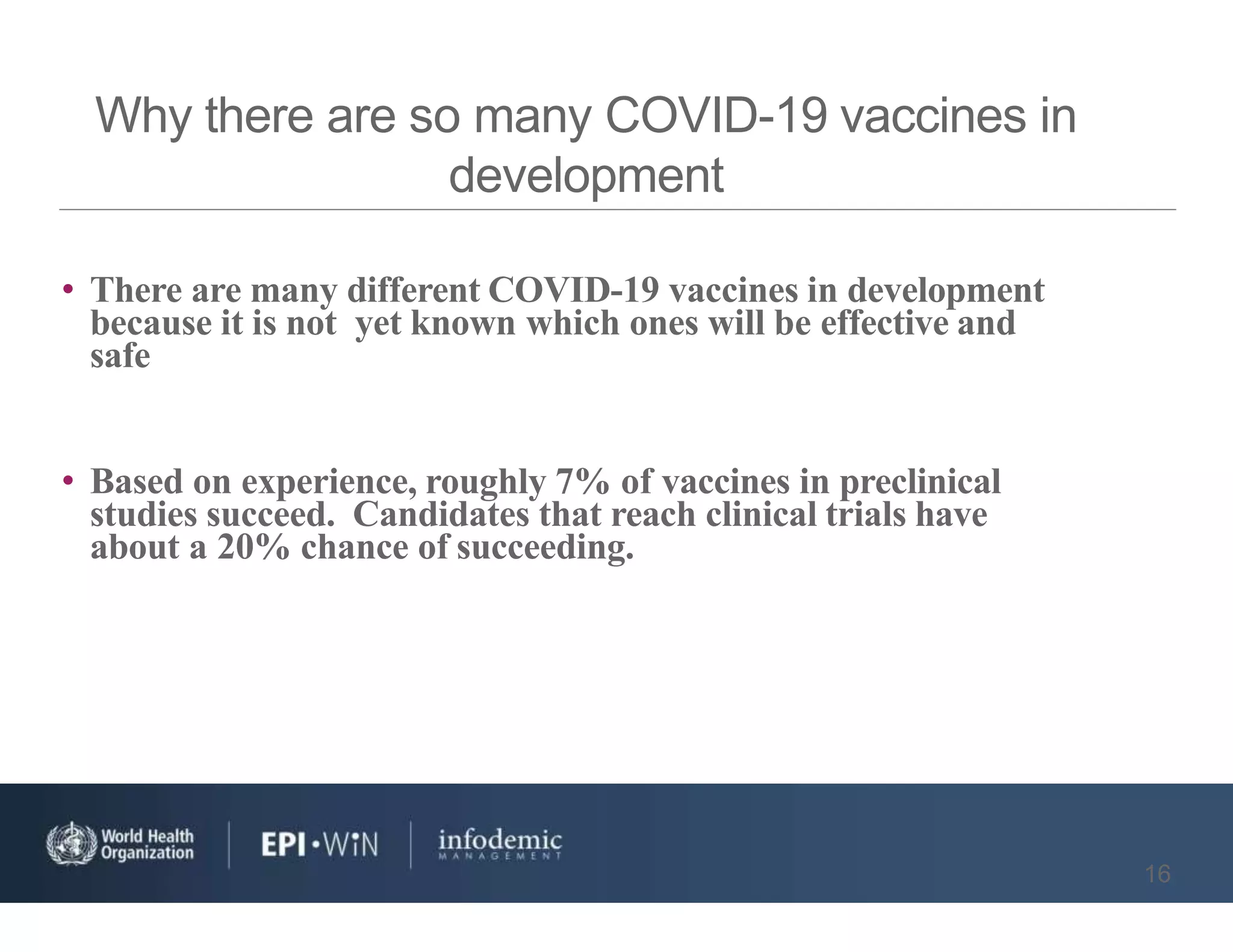
• There are many different COVID-19 vaccines in development
because it is not yet known which ones will be effective and
safe
• Based on experience, roughly 7% of vaccines in preclinical
studies succeed. Candidates that reach clinical trials have
about a 20% chance of succeeding.
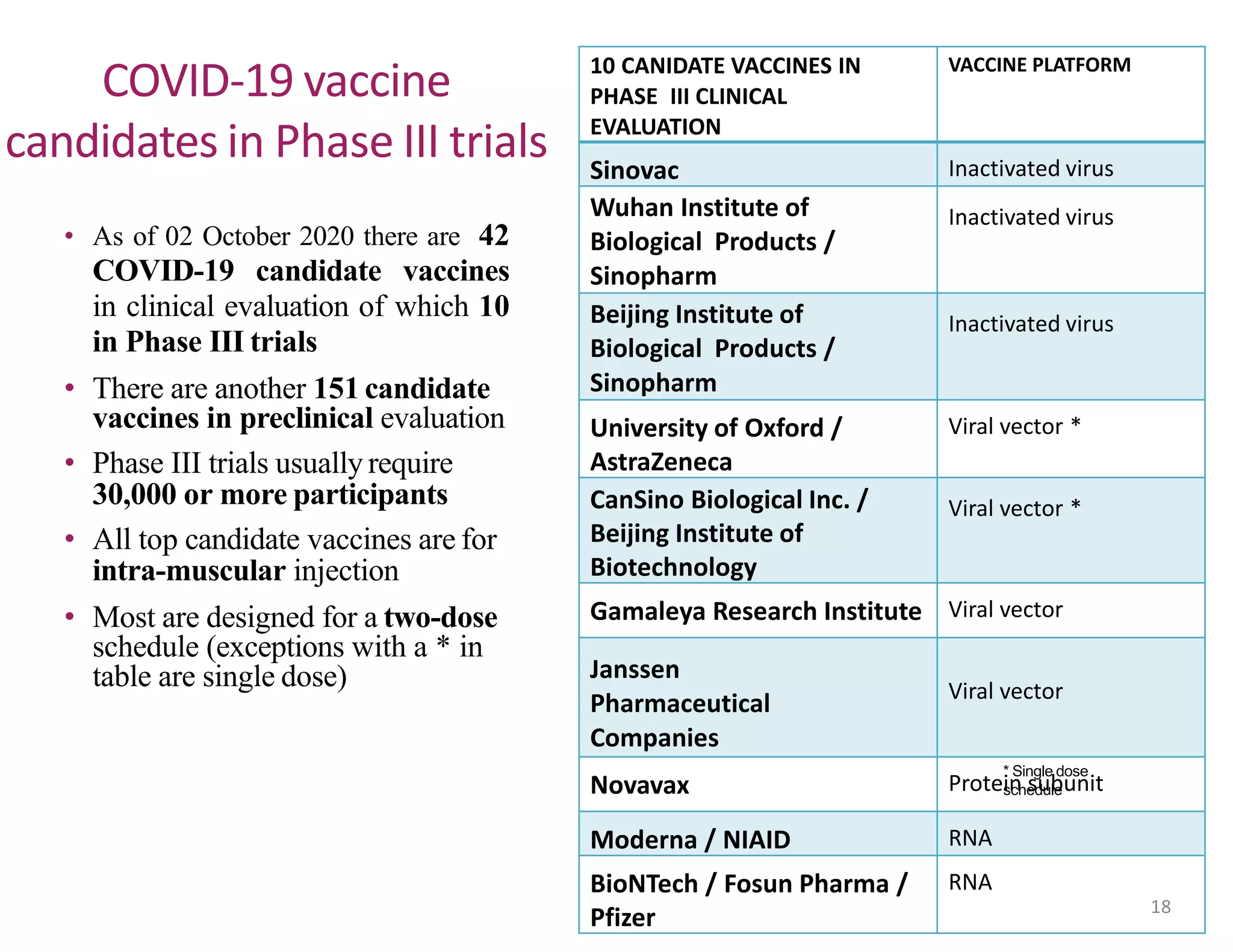
• As of 02 October 2020 there are 42
COVID-19 candidate vaccines
in clinical evaluation of which 10
in Phase III trials
• There are another 151 candidate
vaccines in preclinical evaluation
• Phase III trials usually require
30,000 or more participants
• All top candidate vaccines are for
intra-muscular injection
• Most are designed for a two-dose
schedule (exceptions with a * in
table are single dose)
COVID-19 vaccine
candidates in Phase III trials
18
10 CANIDATE VACCINES IN
PHASE III CLINICAL
EVALUATION
VACCINE PLATFORM
Sinovac Inactivated virus
Wuhan Institute of
Biological Products /
Sinopharm
Inactivated virus
Beijing Institute of
Biological Products /
Sinopharm
Inactivated virus
University of Oxford /
AstraZeneca
Viral vector *
CanSino Biological Inc. /
Beijing Institute of
Biotechnology
Viral vector *
Gamaleya Research Institute Viral vector
Janssen
Pharmaceutical
Companies
Viral vector
Novavax Protein subunit
Moderna / NIAID RNA
BioNTech / Fosun Pharma /
Pfizer
RNA
* Single dose
schedule
• Companies like Moderna, Pfizer, and
Inovio Pharmaceuticals have been
perfecting cutting-edge vaccines
composed of genetic material (RNA and
DNA vaccines) that the cells can take up
and use to produce antigenic proteins,
more specifically the spike proteins found
on the membrane of the virus
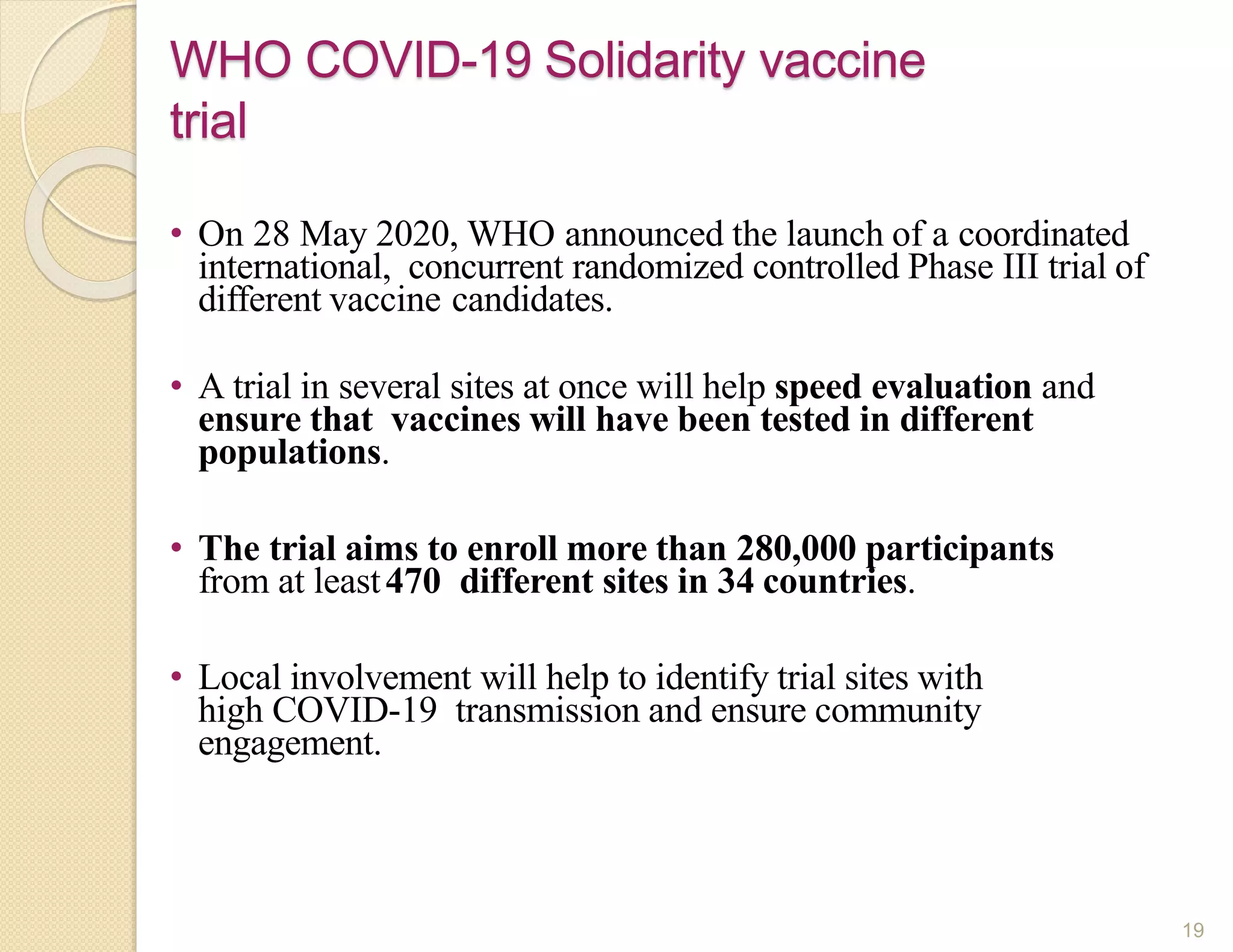
• On 28 May 2020, WHO announced the launch of a coordinated
international, concurrent randomized controlled Phase III trial of
different vaccine candidates.
• A trial in several sites at once will help speed evaluation and
ensure that vaccines will have been tested in different
populations.
• The trial aims to enroll more than 280,000 participants
from at least470 different sites in 34 countries.
• Local involvement will help to identify trial sites with
high COVID-19 transmission and ensure community
engagement.
WHO COVID-19 Solidarity vaccine
trial
19
CONTINUED.......................

subtopic of COVID- 19 VACCINE DEVELOPMENT AND TYPES

  • 1.
  • 2.
    • Vaccines canprevent infectious diseases. Examples : measles, polio, hepatitis B, influenza and many others. • ‘Herd’ or ‘indirect’ or ‘population’ immunity. Why we use vaccines 2
  • 3.
    • Vaccines safelydeliver an immunogen which is a specific type of antigen that elicits an immune response, to train the immune system to recognize the pathogen when it is encountered naturally. How vaccines work 3
  • 4.
    • Vaccines sometimesrequire more than one dose to: build complete immunity give a ‘booster’ dose when immunity wears off immunize people against viruses causing disease that may be different from season to season, for example, the yearly flu vaccine How vaccines are delivered ABOUT VACCINES 4
  • 5.
    Immunogens used todevelop viralvaccines IMMUNOGEN HOW IT WORKS EXAMPLE of vaccines Attenuated live virus Live virus but doesn’t cause disease Measles, rubella, mumps, yellow fever, smallpox (vaccinia) Whole inactivated virus Inactivated dead virus Influenza, rabies hepatitis A Protein subunit A protein derived from a pathogen Influenza Recombinant Host cell is used to express an antigen Hepatitis B Peptides Synthetic produced fragment of an antigen COVID-19 vaccines in development Replicating or non- replicating viral vector Viral pathogen expressed on a safe virus that doesn’t cause disease Ebola Nucleic acid DNA or RNA coding for a viral protein COVID-19 vaccines in development 1 0
  • 6.
    Virus Vaccines 11 • Virusis selected, modified (weakened) or completely inactivated so that it will not cause disease Inactivated dead virus Vaccines from whole virus Attenuated live virus Attenuated live or inactivated dead virus Source: https://www.nature.com/articles/d41586-020- 01221-y
  • 7.
    Protein-based vaccines 1 2 • Aprotein is extracted from the virus (alive or inactivated), purified, and injected as a vaccine • For coronavirus, this is most commonly the spike protein Virus-like particles Protein sub-units Protein-based vaccines Protein sub-units or virus-like particles OR Source: https://www.nature.com/articles/d41586-020- 01221-y
  • 8.
    Viral vector vaccines •The gene for a pathogen protein is inserted into a different virus that can infect someone without causing disease • The safe virus serves as a ‘platform’ or ‘vector’ to deliver the protein that triggers an immune response 1 3 Non-replicating viral vector Viral vector vaccines Replicating vector Replicating vector or non-replicating viral vector Source: https://www.nature.com/articles/d41586-020- 01221-y
  • 9.
    Nucleic acid vaccines 14 •Instead of a virus, a protein antigen, or a virus expressing the protein, nucleic acid coding for the antigen is injected • DNA plasmid: enters nucleus, translated to mRNA for expression of protein • Or mRNA can be injected. More direct (no translation required) but less stable than DNA • This is new technology – no other vaccines for human use have used this Nucleic acid vaccines DNA vaccine DNA vaccine or RNA vaccine RNA vaccine VACCINE DEVELOPMENT — Mechanism of action for types of vaccines
  • 10.
    • Pre-clinical studies Vaccineis tested in animal studies for efficacy and safety, including challenge studies • Phase I clinical trial Small groups of healthy adult volunteers receive the vaccine to test for safety • Phase II clinical trial Vaccine is given to people who have characteristics (such as age and physical health) similar to those for whom the new vaccine is intended • Phase III clinical trial Vaccine is given to thousands of people and tested for efficacy and safety • Phase IV post marketing surveillance Ongoing studies after the vaccine is approved and licensed, to monitor adverse events and to study long- term effects of the vaccine in the population • Human challenge studies Studies in which a vaccine is given followed by the pathogen against which the vaccine is designed to protect. Such trials are uncommon in people as they present considerable ethical challenges Steps in Vaccine Development 15
  • 11.
    •Four vaccines withpreliminary efficacy data available as of 4 December 2020, all are intramuscular (IM) injections with 2-dose courses. • The University of Oxford/AstraZeneca vaccine can be stored, transported and handled at +2o to 8oC • BioNTech/Fosun Pharma/Pfizer vaccine has a recommended temperature condition of -80oC and can be stored for five days at +2o to 8oC • The Moderna/NIAID vaccine remains stable at -20oC for up to six months and remains stable at +2o to 8oC for 30 days16 and The Gamaleya institute, Sputnik-V vaccine can be stored at +2o to 8oC.16
  • 12.
    Why there areso many COVID-19 vaccines in development 16 • There are many different COVID-19 vaccines in development because it is not yet known which ones will be effective and safe • Based on experience, roughly 7% of vaccines in preclinical studies succeed. Candidates that reach clinical trials have about a 20% chance of succeeding.
  • 14.
    • As of02 October 2020 there are 42 COVID-19 candidate vaccines in clinical evaluation of which 10 in Phase III trials • There are another 151 candidate vaccines in preclinical evaluation • Phase III trials usually require 30,000 or more participants • All top candidate vaccines are for intra-muscular injection • Most are designed for a two-dose schedule (exceptions with a * in table are single dose) COVID-19 vaccine candidates in Phase III trials 18 10 CANIDATE VACCINES IN PHASE III CLINICAL EVALUATION VACCINE PLATFORM Sinovac Inactivated virus Wuhan Institute of Biological Products / Sinopharm Inactivated virus Beijing Institute of Biological Products / Sinopharm Inactivated virus University of Oxford / AstraZeneca Viral vector * CanSino Biological Inc. / Beijing Institute of Biotechnology Viral vector * Gamaleya Research Institute Viral vector Janssen Pharmaceutical Companies Viral vector Novavax Protein subunit Moderna / NIAID RNA BioNTech / Fosun Pharma / Pfizer RNA * Single dose schedule
  • 16.
    • Companies likeModerna, Pfizer, and Inovio Pharmaceuticals have been perfecting cutting-edge vaccines composed of genetic material (RNA and DNA vaccines) that the cells can take up and use to produce antigenic proteins, more specifically the spike proteins found on the membrane of the virus
  • 17.
    • On 28May 2020, WHO announced the launch of a coordinated international, concurrent randomized controlled Phase III trial of different vaccine candidates. • A trial in several sites at once will help speed evaluation and ensure that vaccines will have been tested in different populations. • The trial aims to enroll more than 280,000 participants from at least470 different sites in 34 countries. • Local involvement will help to identify trial sites with high COVID-19 transmission and ensure community engagement. WHO COVID-19 Solidarity vaccine trial 19
  • 18.