Study Skills
Student Success Center
Gannon University
Study Plan
• Write down assignments
• Set times to study
• Take breaks
Environment
• Where’s the best place to study?
• Get the best conditions you can
• Have the proper lighting
• Organize information
Study Methods
• High energy – study more difficult
material or least interesting
• No procrastinating – get to work
• If concentration lost take a break
• Master the vocabulary of the subject
Study Methods
• Know your learning style
• Key information – highlight or rewrite
• Note cards
• Mind mapping
• Talk out loud
• Quizzing yourself
Learning style
• Visual – use of sight
– Charts, graphs, rewrite notes, pictures
– Visualize concepts and ideas
– Pictures spelling words
– Test yourself by looking at main ideas
and write the details or answers
Learning style
• Auditory – use of hearing
– Sit in the front of class
– Discussion groups – hear ideas and concepts
– Repeats information out loud
– Look at main ideas and repeat back
information
– Easily distracted by noise
Learning style
• Tactile – use of touch
– Rewrite notes
– Use note cards – organize main ideas
– Study with pen/pencil in hand
– Draw pictures/diagrams
– Organization can be a challenge
• Kinesthetic – use of body
– Walking around helps in memorizing
Why take notes?
• You will be an active listener
• History class discussions
• Written information on what to study
• Visual Aid
• Helps one study
Note-taking Strategies
• Attend class – come prepared
• Date notes
• Include everything in notes
– Charts, diagrams, etc…
• Use as much paper as needed
• Rewrite notes
• Keep things simple
• Write own notes out of book
• REVIEW
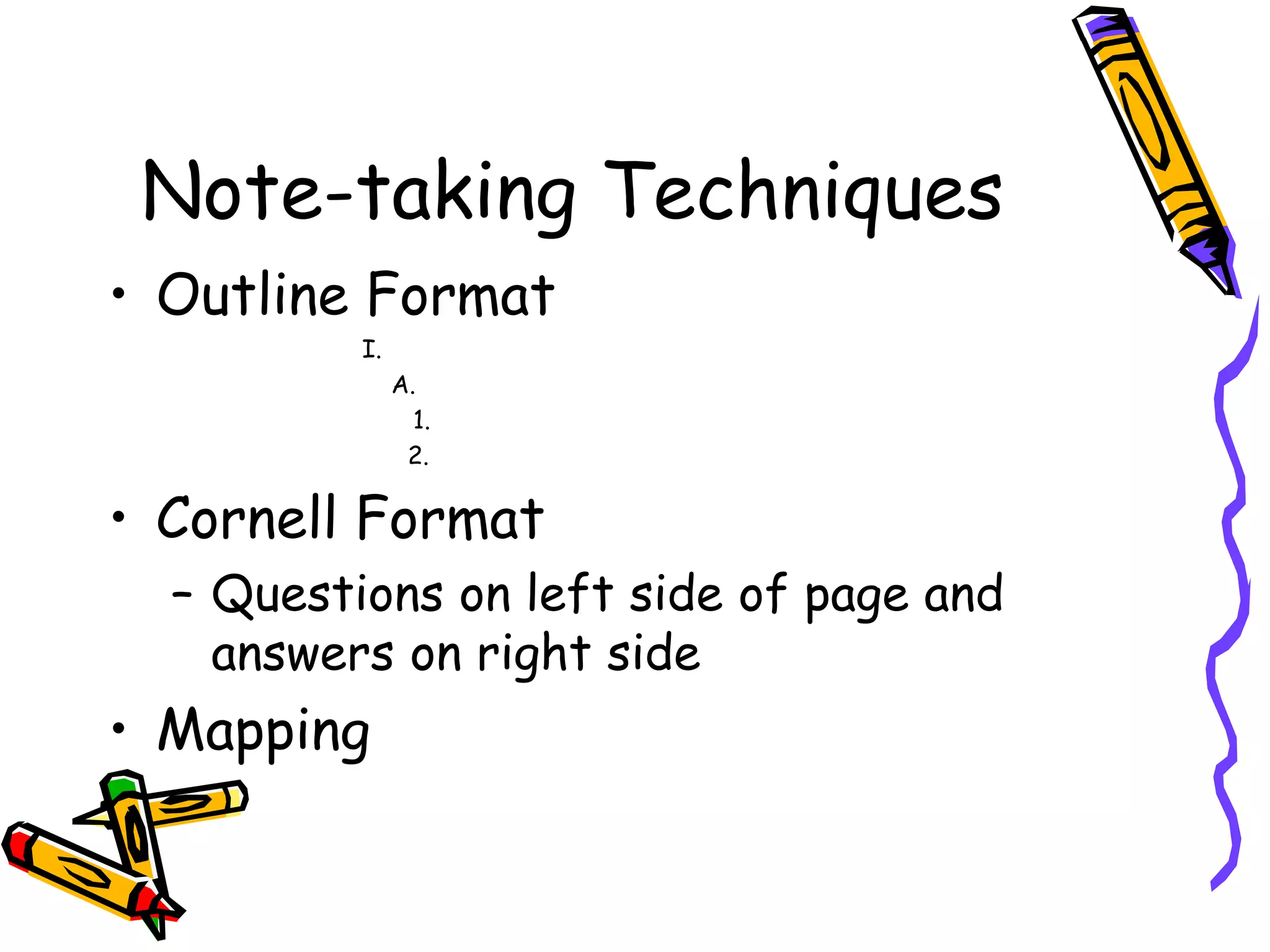
Note-taking Techniques
• Outline Format
I.
A.
1.
2.
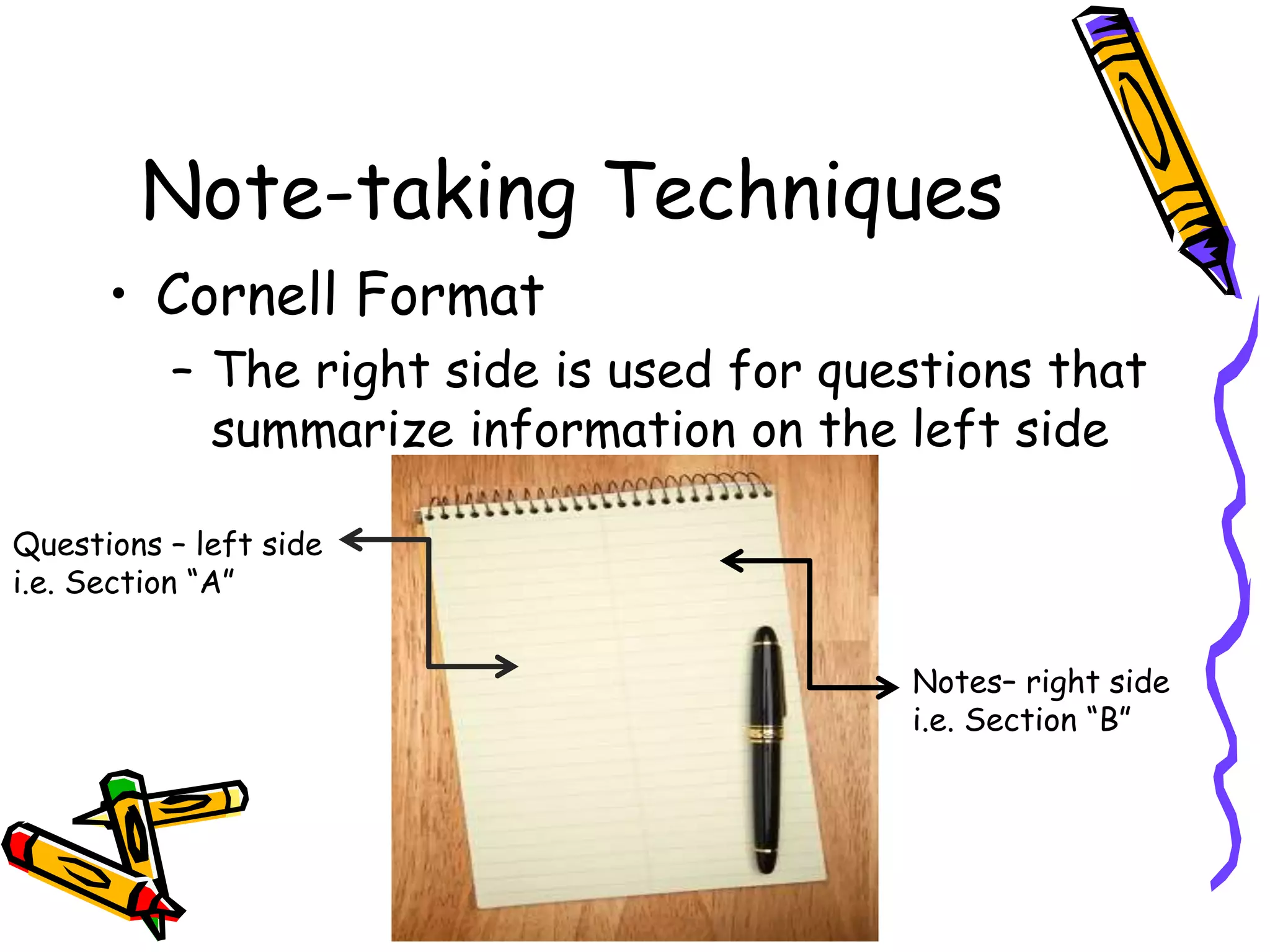
• Cornell Format
– Questions on left side of page and
answers on right side
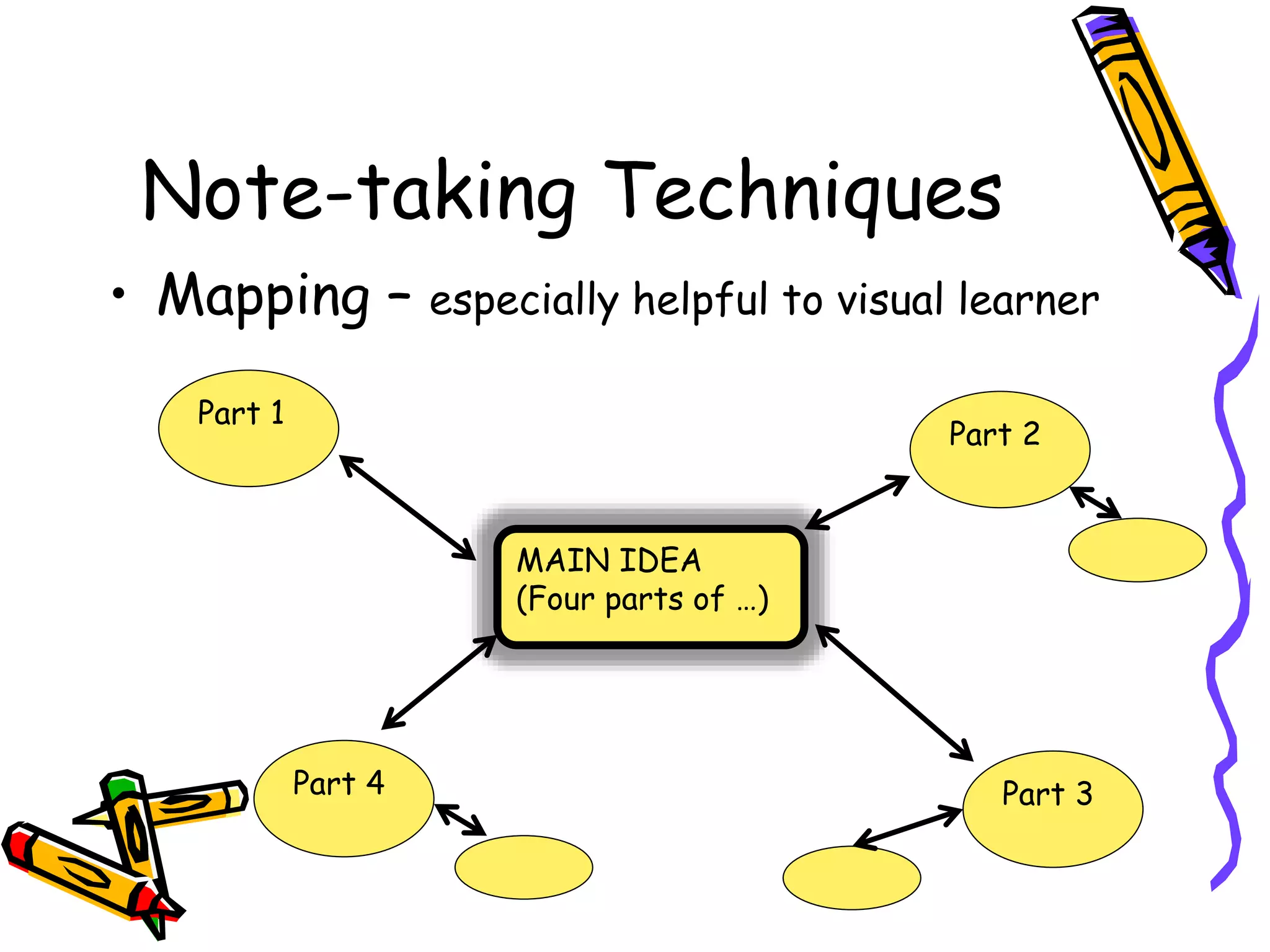
• Mapping
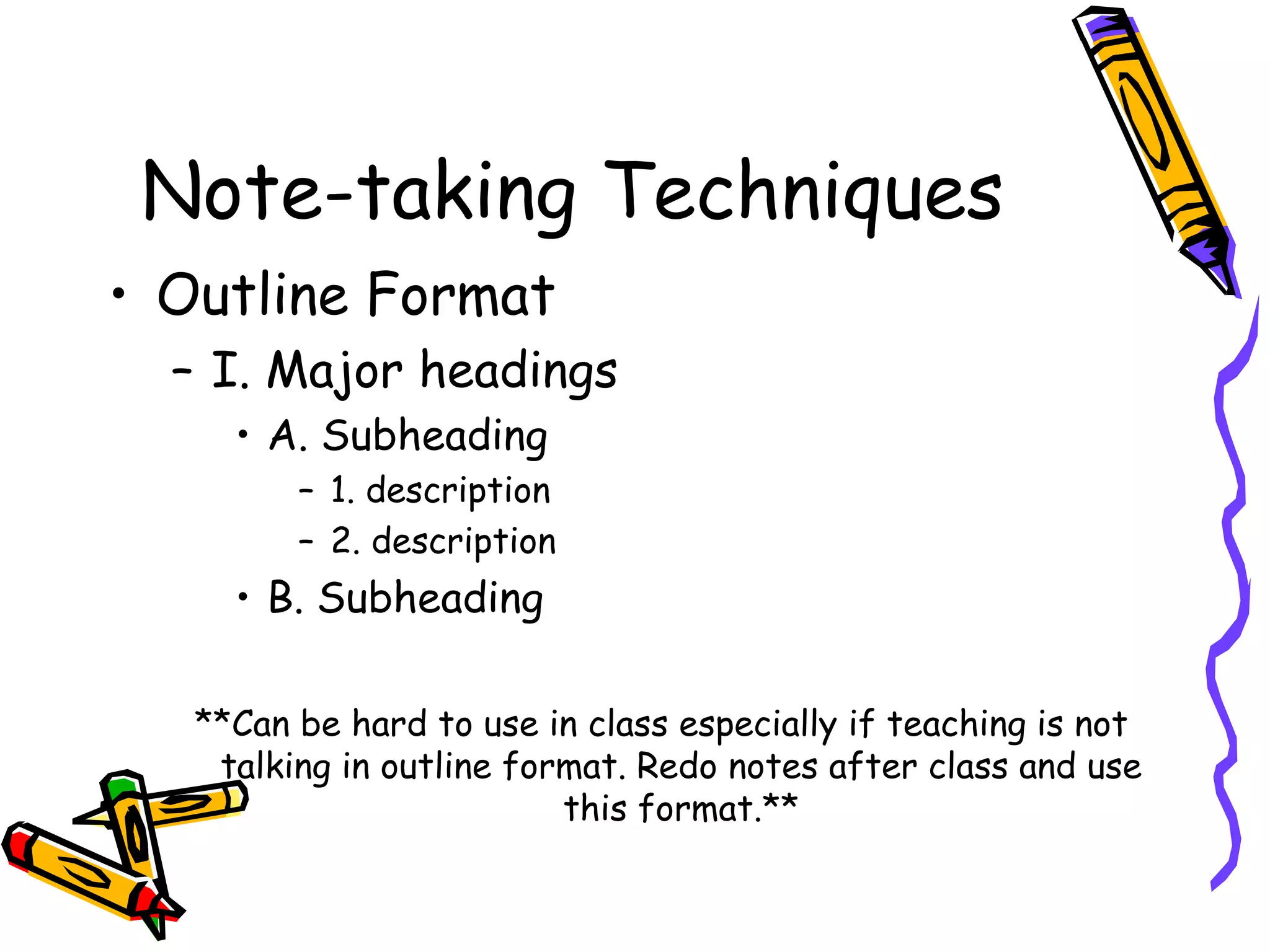
Note-taking Techniques
• Outline Format
– I. Major headings
• A. Subheading
– 1. description
– 2. description
• B. Subheading
**Can be hard to use in class especially if teaching is not
talking in outline format. Redo notes after class and use
this format.**
Note-taking Techniques
• Cornell Format
– The right side is used for questions that
summarize information on the left side
Questions – left side
i.e. Section “A”
Notes– right side
i.e. Section “B”
Note-taking Techniques
• Mapping – especially helpful to visual learner
MAIN IDEA
(Four parts of …)
Part 1
Part 2
Part 3Part 4
Resources
• Study Skills Assessment
– http://www.studygs.net/attmot4.htm
15

Study skills

  • 1.
    Study Skills Student SuccessCenter Gannon University
  • 2.
    Study Plan • Writedown assignments • Set times to study • Take breaks
  • 3.
    Environment • Where’s thebest place to study? • Get the best conditions you can • Have the proper lighting • Organize information
  • 4.
    Study Methods • Highenergy – study more difficult material or least interesting • No procrastinating – get to work • If concentration lost take a break • Master the vocabulary of the subject
  • 5.
    Study Methods • Knowyour learning style • Key information – highlight or rewrite • Note cards • Mind mapping • Talk out loud • Quizzing yourself
  • 6.
    Learning style • Visual– use of sight – Charts, graphs, rewrite notes, pictures – Visualize concepts and ideas – Pictures spelling words – Test yourself by looking at main ideas and write the details or answers
  • 7.
    Learning style • Auditory– use of hearing – Sit in the front of class – Discussion groups – hear ideas and concepts – Repeats information out loud – Look at main ideas and repeat back information – Easily distracted by noise
  • 8.
    Learning style • Tactile– use of touch – Rewrite notes – Use note cards – organize main ideas – Study with pen/pencil in hand – Draw pictures/diagrams – Organization can be a challenge • Kinesthetic – use of body – Walking around helps in memorizing
  • 9.
    Why take notes? •You will be an active listener • History class discussions • Written information on what to study • Visual Aid • Helps one study
  • 10.
    Note-taking Strategies • Attendclass – come prepared • Date notes • Include everything in notes – Charts, diagrams, etc… • Use as much paper as needed • Rewrite notes • Keep things simple • Write own notes out of book • REVIEW
  • 11.
    Note-taking Techniques • OutlineFormat I. A. 1. 2. • Cornell Format – Questions on left side of page and answers on right side • Mapping
  • 12.
    Note-taking Techniques • OutlineFormat – I. Major headings • A. Subheading – 1. description – 2. description • B. Subheading **Can be hard to use in class especially if teaching is not talking in outline format. Redo notes after class and use this format.**
  • 13.
    Note-taking Techniques • CornellFormat – The right side is used for questions that summarize information on the left side Questions – left side i.e. Section “A” Notes– right side i.e. Section “B”
  • 14.
    Note-taking Techniques • Mapping– especially helpful to visual learner MAIN IDEA (Four parts of …) Part 1 Part 2 Part 3Part 4
  • 15.
    Resources • Study SkillsAssessment – http://www.studygs.net/attmot4.htm 15