Structural Equation Modelling
(SEM)
An Introduction (Part 2)
SEM: Basic Concepts
• Measured Variable or Indicator Variable
• Latent Variable
• Measurement Model
• Structural Model
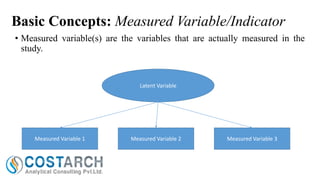
Basic Concepts: Measured Variable/Indicator
• Measured variable(s) are the variables that are actually measured in the
study.

Latent Variable

Measured Variable 1

Measured Variable 2

Measured Variable 3
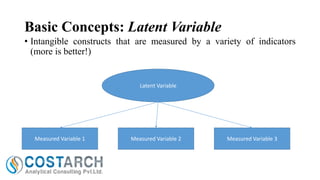
Basic Concepts: Latent Variable
• Intangible constructs that are measured by a variety of indicators
(more is better!)

Latent Variable

Measured Variable 1

Measured Variable 2

Measured Variable 3
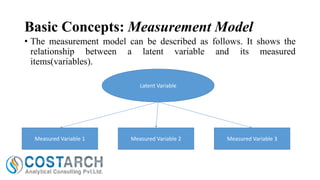
Basic Concepts: Measurement Model
• The measurement model can be described as follows. It shows the
relationship between a latent variable and its measured
items(variables).
Latent Variable

Measured Variable 1

Measured Variable 2

Measured Variable 3
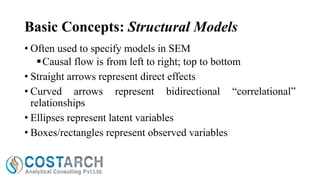
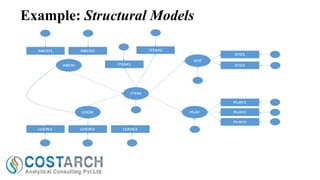
Basic Concepts: Structural Models
• Often used to specify models in SEM
 Causal flow is from left to right; top to bottom
• Straight arrows represent direct effects
• Curved arrows represent bidirectional “correlational”
relationships
• Ellipses represent latent variables
• Boxes/rectangles represent observed variables
Example: Structural Models
Variants of Structural Equation Modelling
• Confirmatory Factor Analysis (CFA)
• Path Analysis with observed variables
• Path analysis with latent variables
Confirmatory Factor Analysis
“Measurement Model”
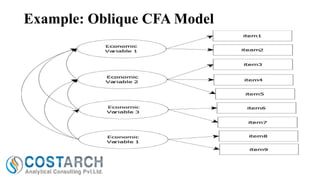
• Tests model that specifies relationships between variables (items) and
factors
 And relationships among factors

• Confirmatory
 Because model is specified a priori
Example: Oblique CFA Model
Confirmatory vs. Exploratory Factor
Analysis
• In CFA the model is specified a priori
 Based on theory
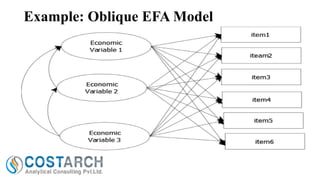
• EFA is not a member of the SEM family
 Includes a class of procedures involving centroids, principal components, and
principal axis factor analysis
 Does not require a priori hypothesis about relationships within your model
 Inductive vs. deductive approach
 More restrictions on the relationships between indicators and latent factors
Example: Oblique EFA Model
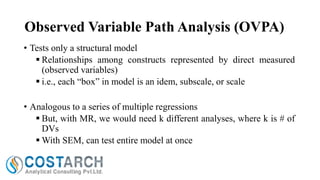
Observed Variable Path Analysis (OVPA)
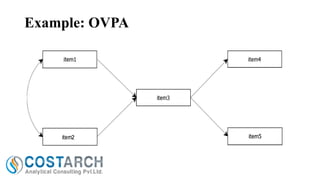
• Tests only a structural model
 Relationships among constructs represented by direct measured
(observed variables)
 i.e., each “box” in model is an idem, subscale, or scale
• Analogous to a series of multiple regressions
 But, with MR, we would need k different analyses, where k is # of
DVs
 With SEM, can test entire model at once
Example: OVPA
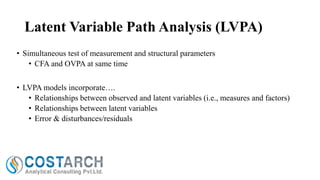
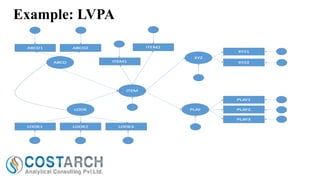
Latent Variable Path Analysis (LVPA)
• Simultaneous test of measurement and structural parameters
• CFA and OVPA at same time
• LVPA models incorporate….
• Relationships between observed and latent variables (i.e., measures and factors)
• Relationships between latent variables
• Error & disturbances/residuals
Example: LVPA
Data Considerations
Sample Size
• SEM is a large-sample technique
• The required Sample size needed depends on….
Complexity of model
 Ratios of sample size to estimated parameters ranging from
5:1 to 20:1 (Bentler & Chou, 1987; Kline, 2005)
Data Quality
 Larger samples for non-normal data
Looking for Online SEM
Training?
Contact us: info@costarch.com

Visit: http://tinyurl.com/costarch-sem
www.costarch.com

Structural Equation Modelling (SEM) Part 2

  • 1.
  • 2.
    SEM: Basic Concepts •Measured Variable or Indicator Variable • Latent Variable • Measurement Model • Structural Model
  • 3.
    Basic Concepts: MeasuredVariable/Indicator • Measured variable(s) are the variables that are actually measured in the study. Latent Variable Measured Variable 1 Measured Variable 2 Measured Variable 3
  • 4.
    Basic Concepts: LatentVariable • Intangible constructs that are measured by a variety of indicators (more is better!) Latent Variable Measured Variable 1 Measured Variable 2 Measured Variable 3
  • 5.
    Basic Concepts: MeasurementModel • The measurement model can be described as follows. It shows the relationship between a latent variable and its measured items(variables). Latent Variable Measured Variable 1 Measured Variable 2 Measured Variable 3
  • 6.
    Basic Concepts: StructuralModels • Often used to specify models in SEM  Causal flow is from left to right; top to bottom • Straight arrows represent direct effects • Curved arrows represent bidirectional “correlational” relationships • Ellipses represent latent variables • Boxes/rectangles represent observed variables
  • 7.
  • 8.
    Variants of StructuralEquation Modelling • Confirmatory Factor Analysis (CFA) • Path Analysis with observed variables • Path analysis with latent variables
  • 9.
    Confirmatory Factor Analysis “MeasurementModel” • Tests model that specifies relationships between variables (items) and factors  And relationships among factors • Confirmatory  Because model is specified a priori
  • 10.
  • 11.
    Confirmatory vs. ExploratoryFactor Analysis • In CFA the model is specified a priori  Based on theory • EFA is not a member of the SEM family  Includes a class of procedures involving centroids, principal components, and principal axis factor analysis  Does not require a priori hypothesis about relationships within your model  Inductive vs. deductive approach  More restrictions on the relationships between indicators and latent factors
  • 12.
  • 13.
    Observed Variable PathAnalysis (OVPA) • Tests only a structural model  Relationships among constructs represented by direct measured (observed variables)  i.e., each “box” in model is an idem, subscale, or scale • Analogous to a series of multiple regressions  But, with MR, we would need k different analyses, where k is # of DVs  With SEM, can test entire model at once
  • 14.
  • 15.
    Latent Variable PathAnalysis (LVPA) • Simultaneous test of measurement and structural parameters • CFA and OVPA at same time • LVPA models incorporate…. • Relationships between observed and latent variables (i.e., measures and factors) • Relationships between latent variables • Error & disturbances/residuals
  • 16.
  • 17.
    Data Considerations Sample Size •SEM is a large-sample technique • The required Sample size needed depends on…. Complexity of model  Ratios of sample size to estimated parameters ranging from 5:1 to 20:1 (Bentler & Chou, 1987; Kline, 2005) Data Quality  Larger samples for non-normal data
  • 18.
    Looking for OnlineSEM Training? Contact us: info@costarch.com Visit: http://tinyurl.com/costarch-sem www.costarch.com