STRONG AND WEAK TIES: THE
CHANGE OF ONLINE RELATIONSHIP
FROM BLOGS TO SOCIAL NETWORKS


                   Elisabetta Locatelli
                     PhD Graduate
             Università Cattolica di Milano
        OssCom | Osservatorio sulla Comunicazione


     ESA Conference “Culture and the making of worlds”
                Università Bocconi – Milan
                   8th September 2010
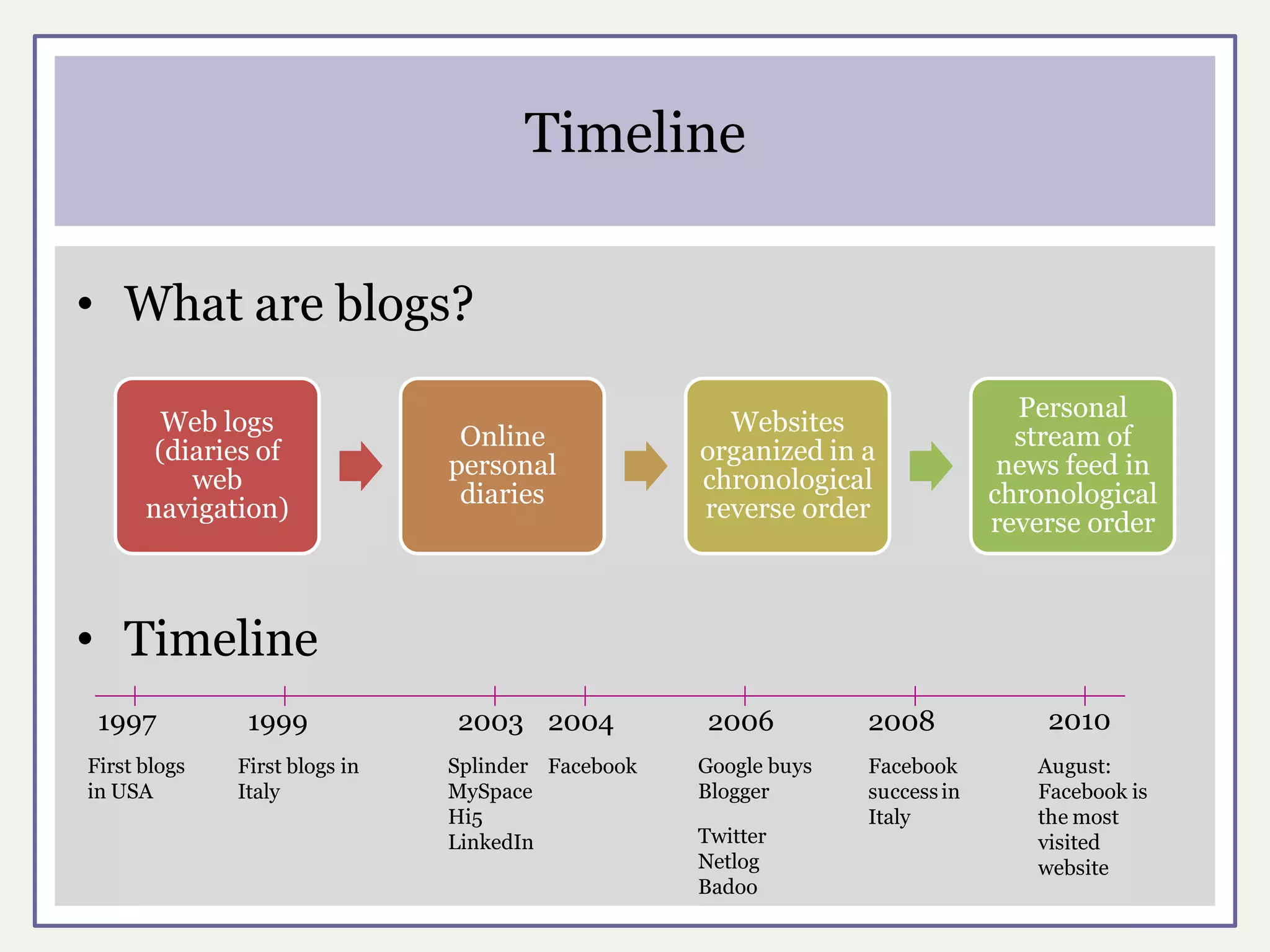
Timeline

• What are blogs?
                                                                                Personal
        Web logs                                     Websites
                                Online                                          stream of
       (diaries of                                 organized in a
                               personal                                        news feed in
          web                                      chronological
                                diaries                                       chronological
      navigation)                                  reverse order
                                                                              reverse order


• Timeline
 1997          1999            2003 2004           2006          2008             2010
First blogs   First blogs in   Splinder Facebook   Google buys   Facebook        August:
in USA        Italy            MySpace             Blogger       success in      Facebook is
                               Hi5                               Italy           the most
                               LinkedIn            Twitter                       visited
                                                   Netlog                        website
                                                   Badoo
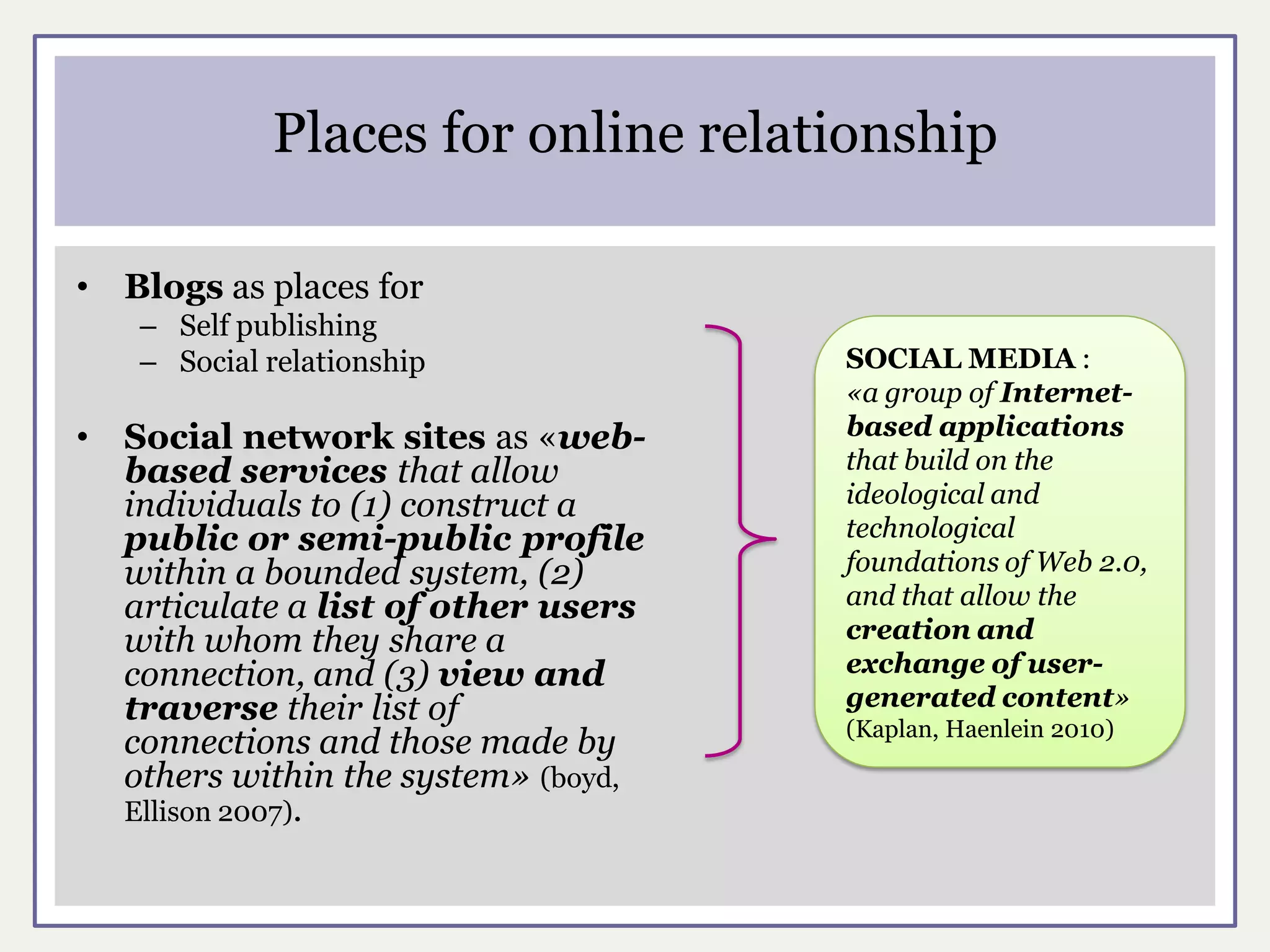
Places for online relationship

•   Blogs as places for
    – Self publishing
    – Social relationship              SOCIAL MEDIA :
                                       «a group of Internet-
•   Social network sites as «web-      based applications
    based services that allow          that build on the
    individuals to (1) construct a     ideological and
    public or semi-public profile      technological
    within a bounded system, (2)       foundations of Web 2.0,
    articulate a list of other users   and that allow the
    with whom they share a             creation and
    connection, and (3) view and       exchange of user-
    traverse their list of             generated content»
                                       (Kaplan, Haenlein 2010)
    connections and those made by
    others within the system» (boyd,
    Ellison 2007).
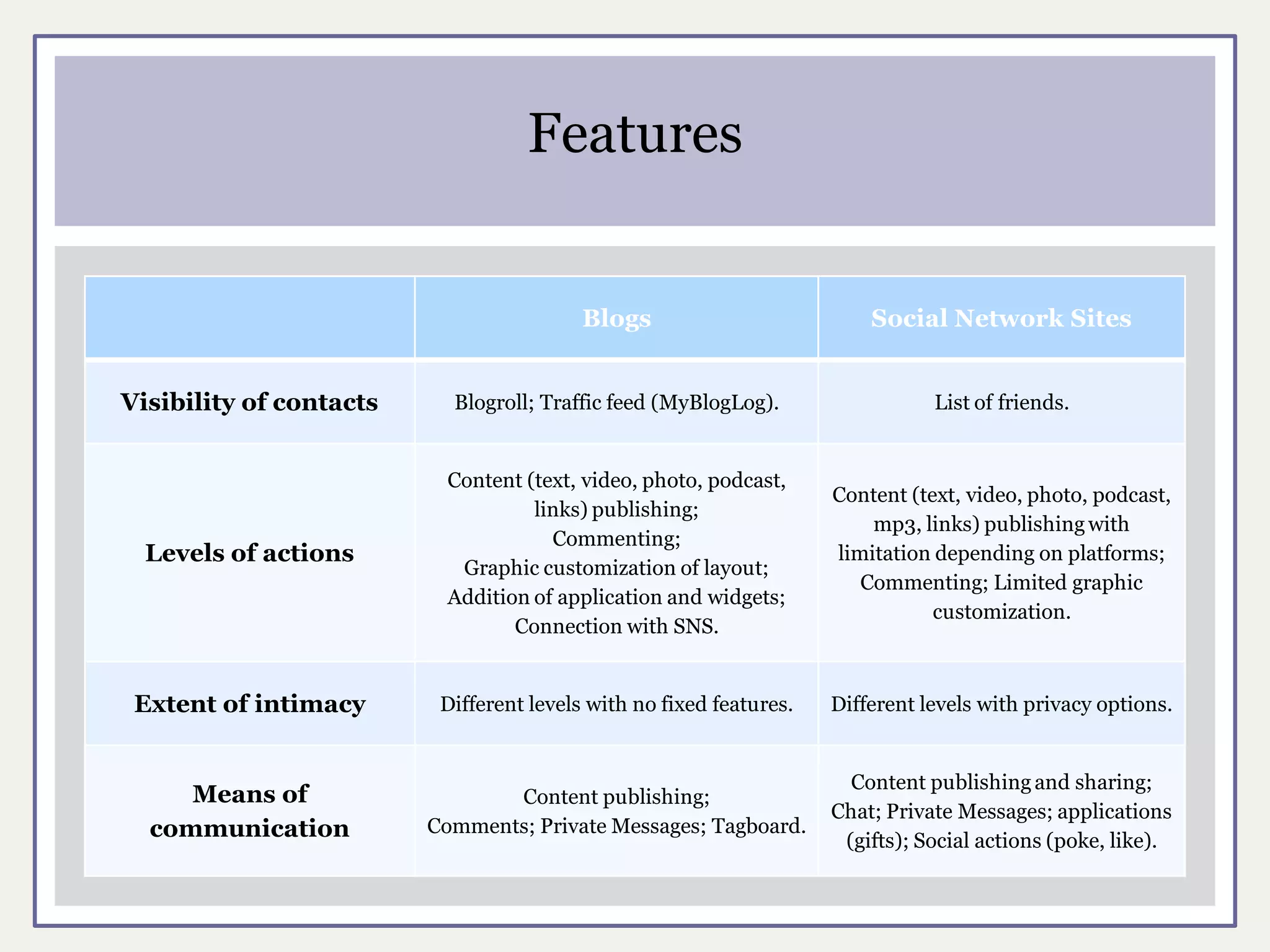
Features


                                          Blogs                          Social Network Sites


Visibility of contacts     Blogroll; Traffic feed (MyBlogLog).                  List of friends.


                          Content (text, video, photo, podcast,
                                                                     Content (text, video, photo, podcast,
                                   links) publishing;
                                                                         mp3, links) publishing with
                                     Commenting;
  Levels of actions                                                  limitation depending on platforms;
                           Graphic customization of layout;
                                                                        Commenting; Limited graphic
                          Addition of application and widgets;
                                                                                customization.
                                 Connection with SNS.


 Extent of intimacy       Different levels with no fixed features.   Different levels with privacy options.


                                                                       Content publishing and sharing;
     Means of                   Content publishing;
                                                                     Chat; Private Messages; applications
  communication          Comments; Private Messages; Tagboard.
                                                                      (gifts); Social actions (poke, like).
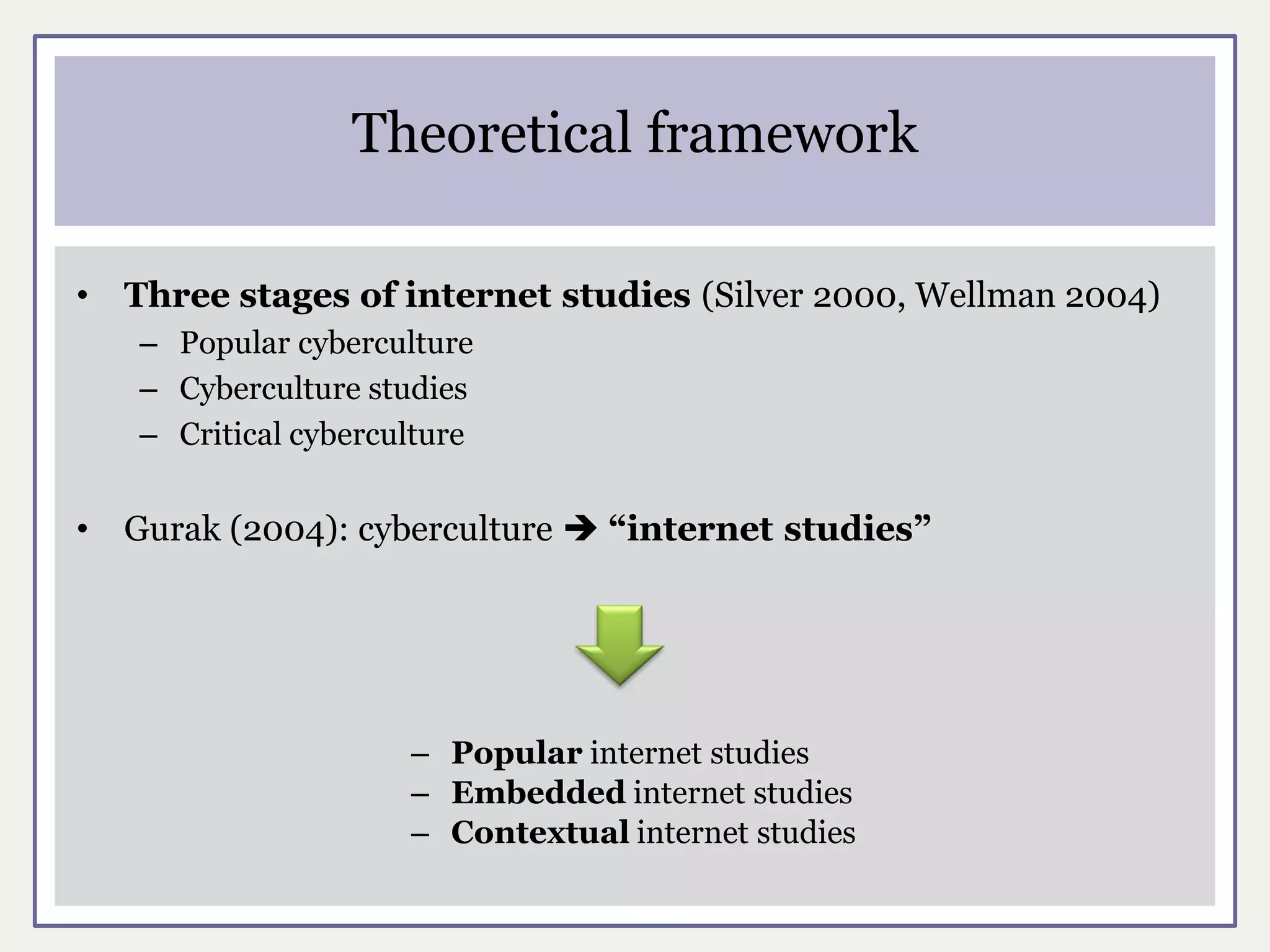
Theoretical framework

•   Three stages of internet studies (Silver 2000, Wellman 2004)
    – Popular cyberculture
    – Cyberculture studies
    – Critical cyberculture


•   Gurak (2004): cyberculture  “internet studies”


                      – Popular internet studies
                      – Embedded internet studies
                      – Contextual internet studies
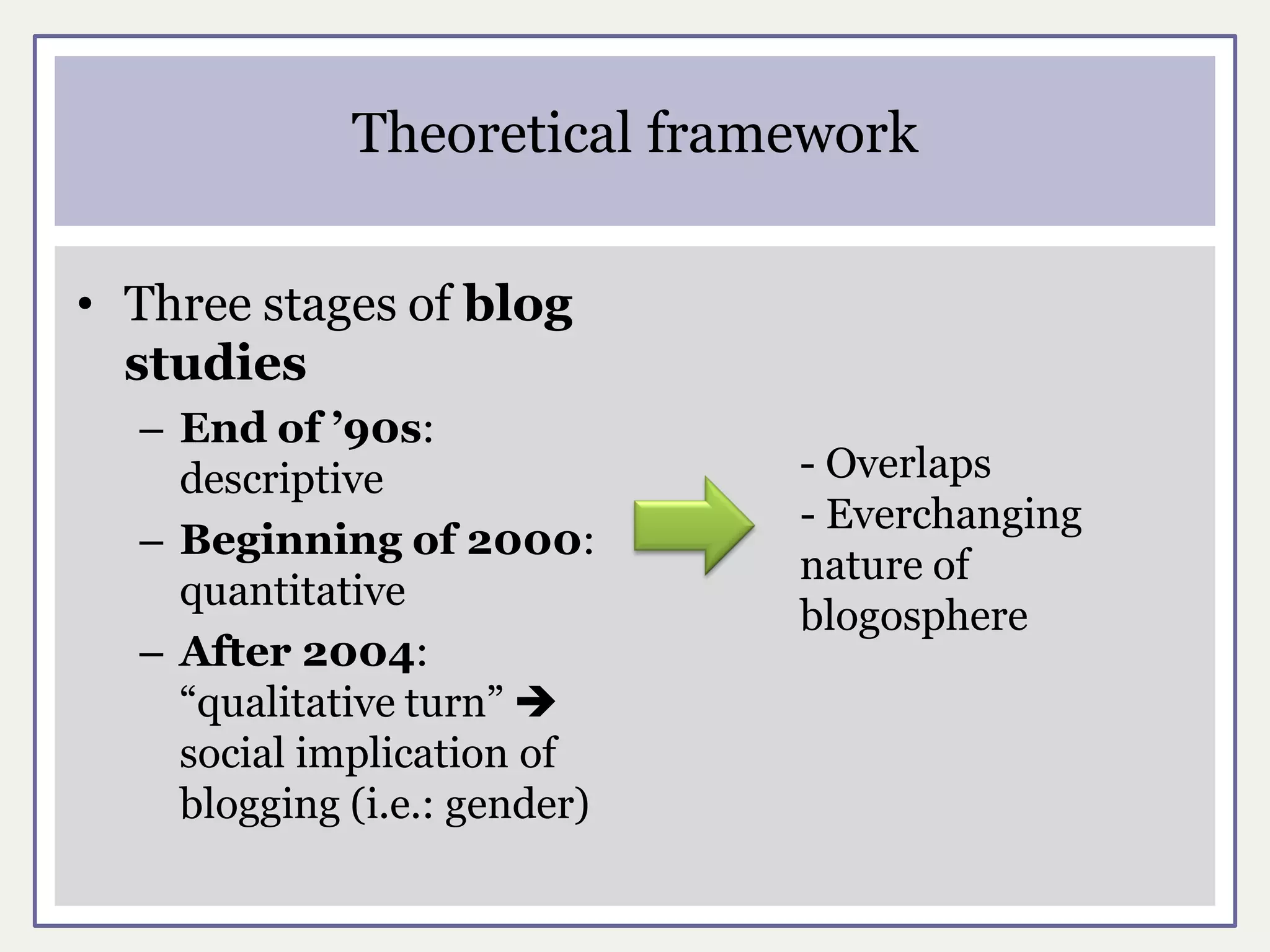
Theoretical framework

• Three stages of blog
  studies
  – End of ’90s:
    descriptive               - Overlaps
                              - Everchanging
  – Beginning of 2000:
                              nature of
    quantitative
                              blogosphere
  – After 2004:
    “qualitative turn” 
    social implication of
    blogging (i.e.: gender)
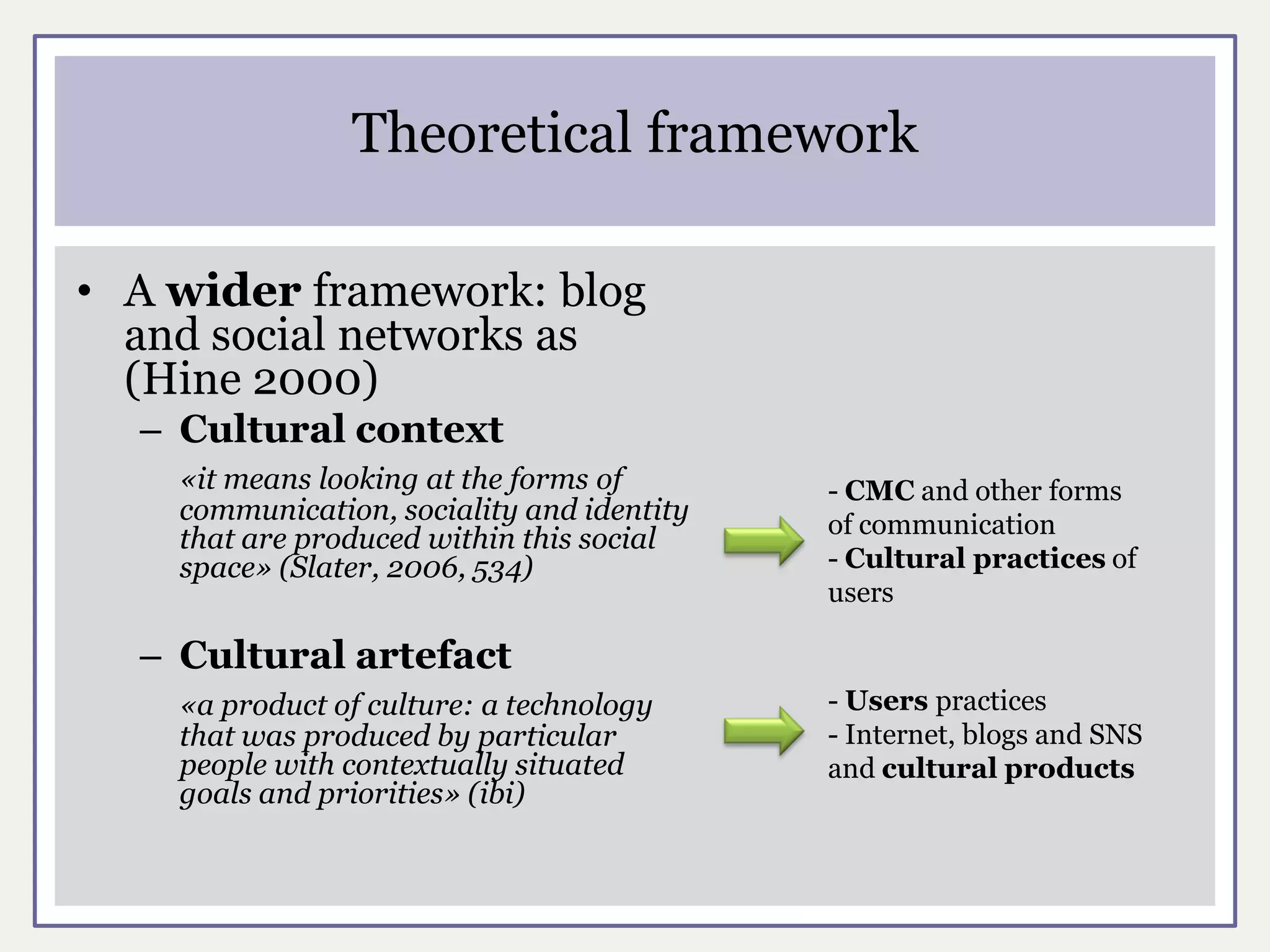
Theoretical framework

• A wider framework: blog
  and social networks as
  (Hine 2000)
  – Cultural context
    «it means looking at the forms of       - CMC and other forms
    communication, sociality and identity   of communication
    that are produced within this social
    space» (Slater, 2006, 534)              - Cultural practices of
                                            users

  – Cultural artefact
    «a product of culture: a technology     - Users practices
    that was produced by particular         - Internet, blogs and SNS
    people with contextually situated       and cultural products
    goals and priorities» (ibi)
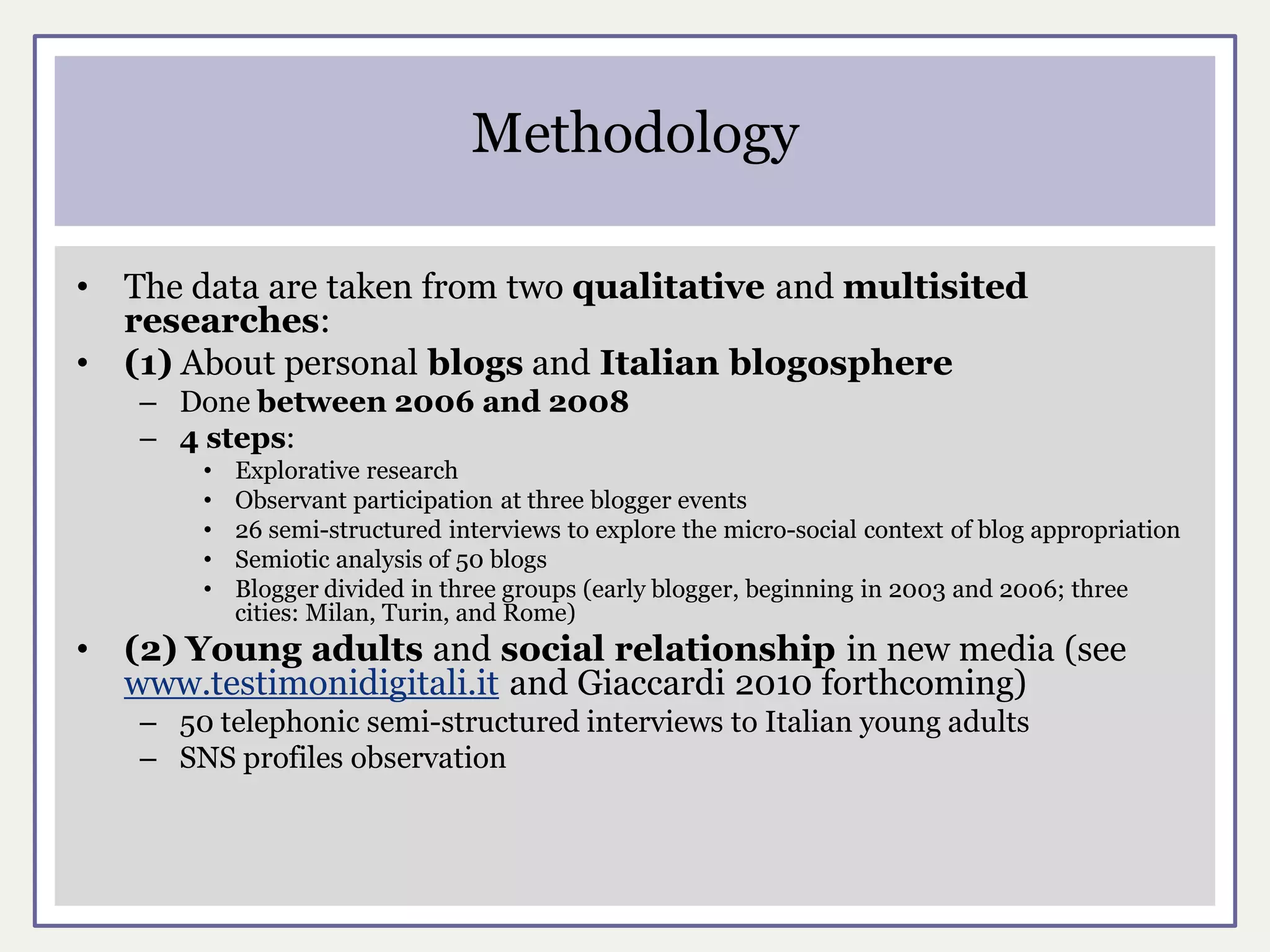
Methodology

•   The data are taken from two qualitative and multisited
    researches:
•   (1) About personal blogs and Italian blogosphere
    – Done between 2006 and 2008
    – 4 steps:
        •   Explorative research
        •   Observant participation at three blogger events
        •   26 semi-structured interviews to explore the micro-social context of blog appropriation
        •   Semiotic analysis of 50 blogs
        •   Blogger divided in three groups (early blogger, beginning in 2003 and 2006; three
            cities: Milan, Turin, and Rome)
•   (2) Young adults and social relationship in new media (see
    www.testimonidigitali.it and Giaccardi 2010 forthcoming)
    – 50 telephonic semi-structured interviews to Italian young adults
    – SNS profiles observation
Results

•   Social relationships in the
    blogosphere
                                                  “After I met her and other bloggers a small group of
     – Early bloggers                             people formed” (m,2001,text-photo)
         • Few people
         • Virtual community: Clear boundaries;
           Common memory; Common language
     – 2003                                                        Content is a key
         •   Comments                                              point for building
         •   Public space  Circle of readers
         •   Blogstars                                             social relations
         •   Link = trust
     – 2006
                                                          «Frequent readers then came, especially ones
         • More confidence                                who leave a comment and after it you go to read
         • Social tools                                   their blog. You knew a lot of people […] and you
                                                          set up a network of relations» (m,2003,text).
         • Two splitting phenomena
              – Desire to protect privacy                  «At a certain time I realized that if a blog has no
              – Desire to have more and more readers       comment it doesn’t work, so I tried to put into
         • Offline aggregation in bigger events (e.g.      posts questions, feedbacks»
                                                           (M,2006,text+photo, 42).
           BarCamps, BlogFest)
Results

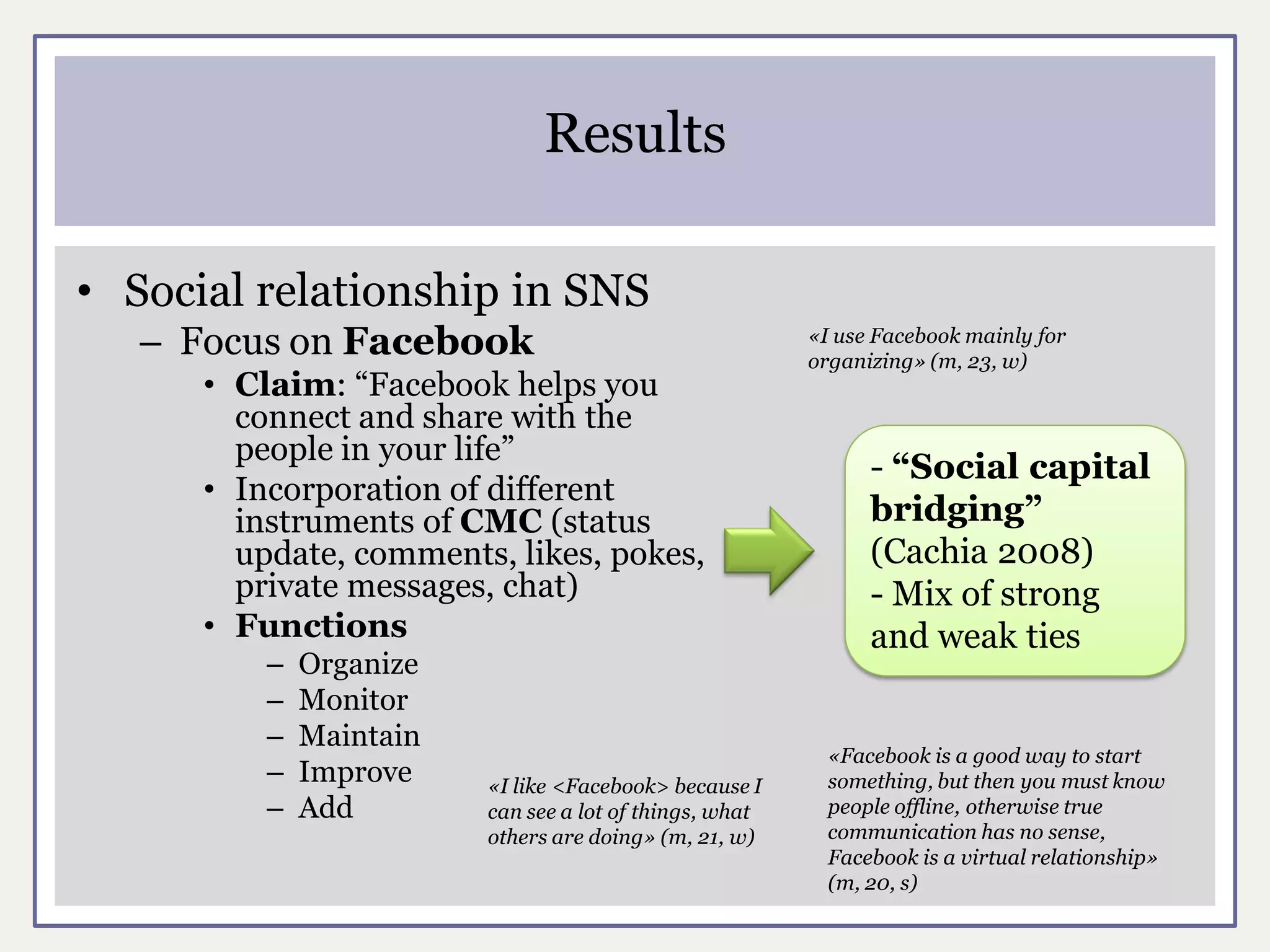
• Social relationship in SNS
   – Focus on Facebook                                   «I use Facebook mainly for
                                                         organizing» (m, 23, w)
      • Claim: “Facebook helps you
        connect and share with the
        people in your life”
                                                               - “Social capital
      • Incorporation of different
        instruments of CMC (status                             bridging”
        update, comments, likes, pokes,                        (Cachia 2008)
        private messages, chat)                                - Mix of strong
      • Functions                                              and weak ties
          –   Organize
          –   Monitor
          –   Maintain
                                                           «Facebook is a good way to start
          –   Improve    «I like <Facebook> because I      something, but then you must know
          –   Add        can see a lot of things, what     people offline, otherwise true
                         others are doing» (m, 21, w)      communication has no sense,
                                                           Facebook is a virtual relationship»
                                                           (m, 20, s)
Conclusion

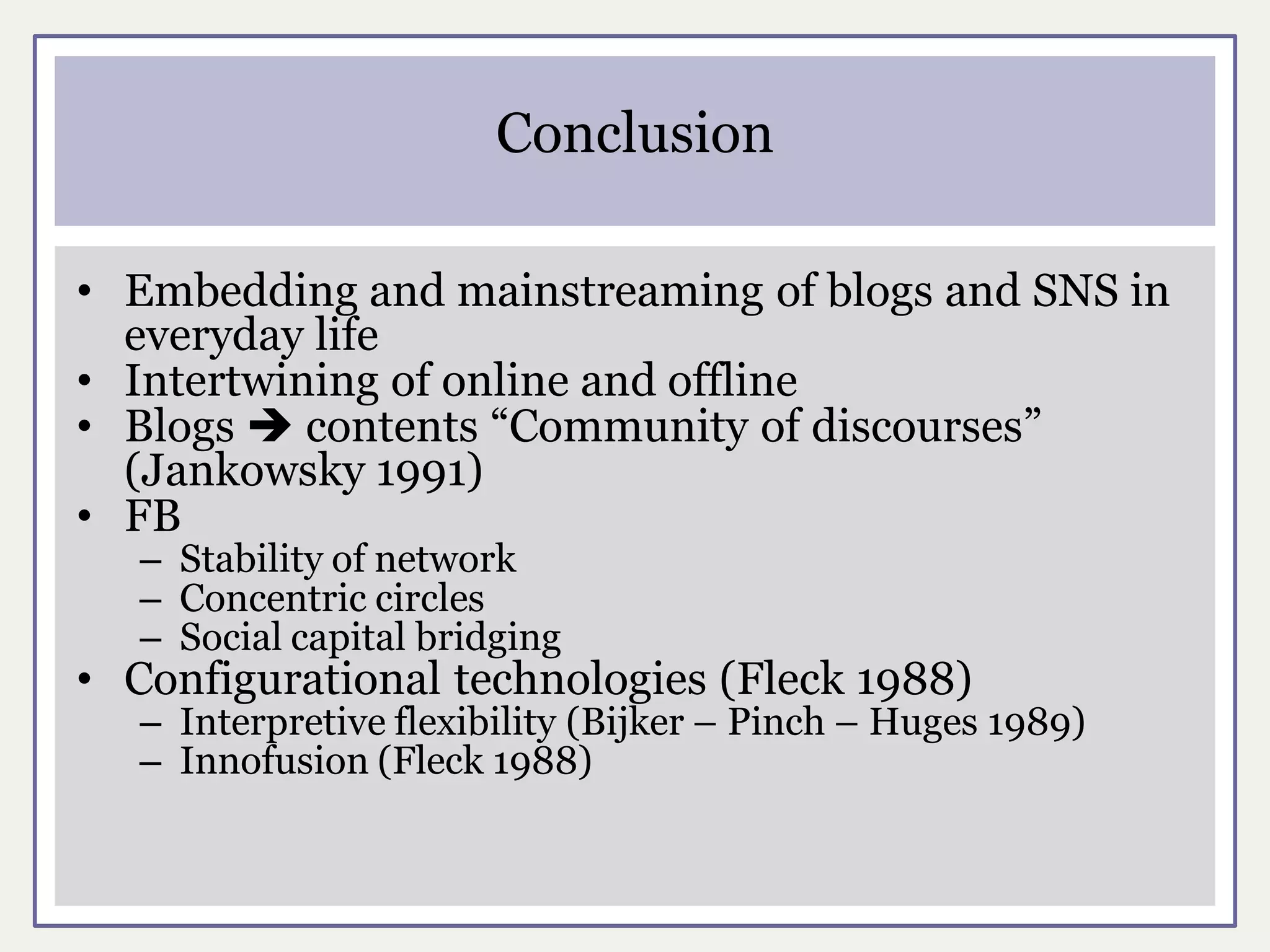
• Embedding and mainstreaming of blogs and SNS in
  everyday life
• Intertwining of online and offline
• Blogs  contents “Community of discourses”
  (Jankowsky 1991)
• FB
   – Stability of network
   – Concentric circles
   – Social capital bridging
• Configurational technologies (Fleck 1988)
   – Interpretive flexibility (Bijker – Pinch – Huges 1989)
   – Innofusion (Fleck 1988)
Going further

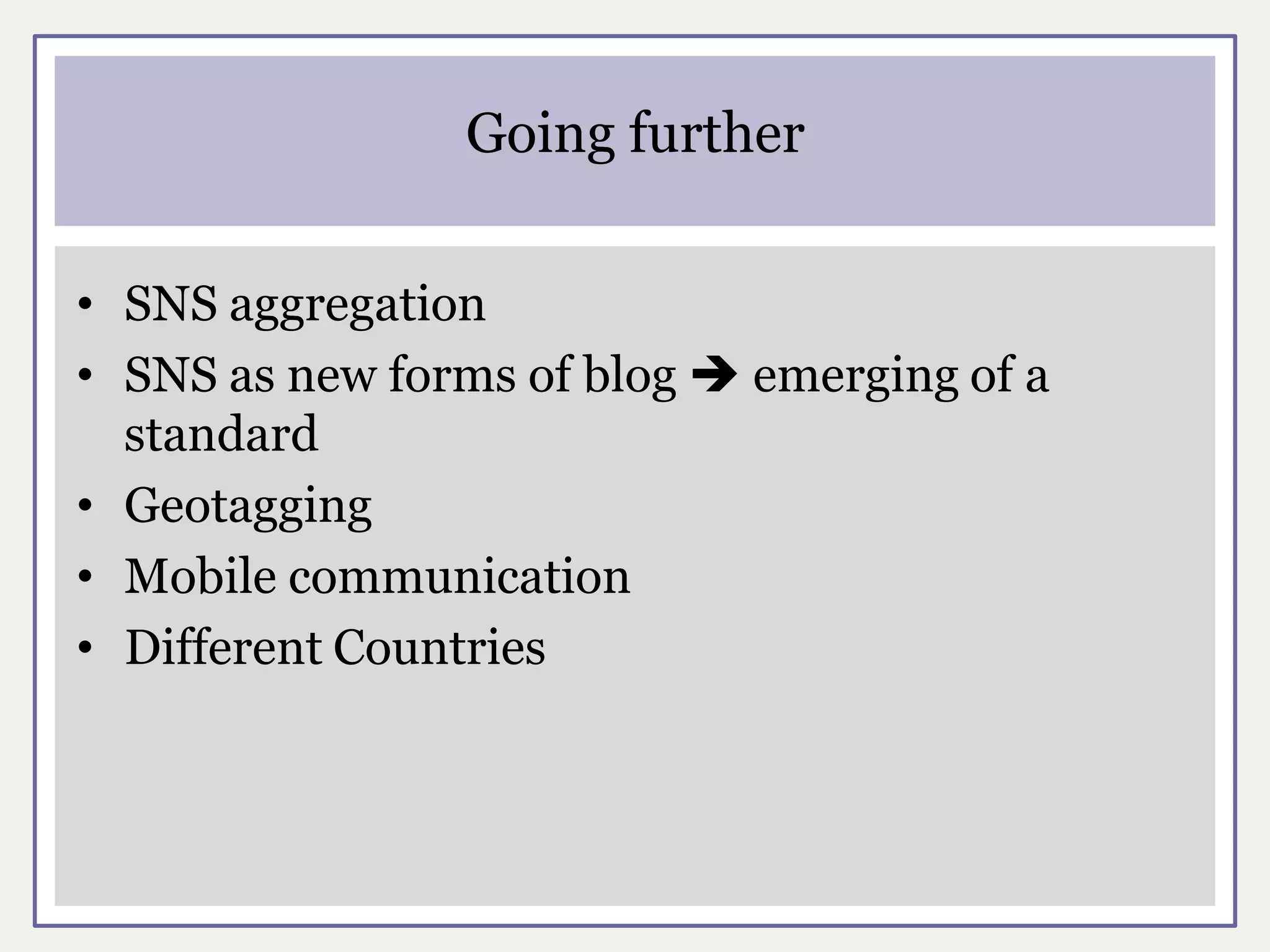
• SNS aggregation
• SNS as new forms of blog  emerging of a
  standard
• Geotagging
• Mobile communication
• Different Countries
Thanks for your attention

   elisabetta.locatelli@unicatt.it
  http://theblogup.blogspot.com
  http://twitter.com/donnabetta
Bibliography

•   Bijker, W. E., Pinch, T., Hughes, T. P. (1989), The Social Construction of Technological
    Systems, Cambridge Mass. – London: MIT Press.
•   Blood, R. (2002) The Weblog Handbook: Practical Advice on Creating and Maintaining
    your Blog, New York: Perseus Books Group.
•   Blood, R. (ed.) (2002) , We’ve Got Blog: how weblogs are changing our culture, New York:
    Perseus Books Group.
•   boyd, d., Ellison, N. B. (2007). Social network sites: Definition, history, and scholarship. In
    Journal of Computer-Mediated Communication, 13(1), article 11.
    http://jcmc.indiana.edu/vol13/issue1/boyd.ellison.html
•   Cachia, R. (2008), Social Computing: Study on the Use and Impact of Online Social
    Networking. IPTS Exploratory Research on the Socio-Economic Impact of Social
    Computing, Jankowsky, N. W. (1991) Qualitative Research Community Media. In Jensen,
    K. B. – Jankowski, N. W. (ed.), A handbook of Qualitative Methodologies for Mass
    Communication Research (pp. 163 -174), London and New York: Routledge.
•   Fleck, J. (1988), Innfusion or Diffusation? The Nature of Technological Development in
    Robotics, «Edinburgh PICT working paper» N.4.
•   Gauntlett, D. - Horsley, D. (eds.) (2004), Web Studies, second edition, London: Arnold.
Bibliography

•   Gurak, L. J. (2004), Internet Studies in the Twenty-first Century. In
    Gauntlett, D., Horsley, R. (eds.), Web studies, second edition (pp. 24-33),
    London: Arnold.
•   Hine, C., (2000), Virtual Ethnography, London et al.: SAGE.
•   Kaplan A. M., Haenlein M. (2010), Users of the world, unite! The challenges
    and opportunities of social media, Business Horizons, Vol. 53, Issue 1.
•   Silver, D. (2000), Looking Backwards, Looking Forwards: Cyberculture
    Studies 1990-2000. In Gauntlett, D. (ed.), Web Studies. Rewiring Media
    Studies for the Digital Age (pp. 19 – 30), London: Arnold.
•   Slater, D. (2006), Social Relationship and Identity Online and Offline. In
    Lievrouw, L. A., Livingstone, Handbook of New Media: Social Shaping and
    Social Consequences of ICTs. Updated Student Editino (pp. 35 – 54),
    London et al.: Sage.
•   Wellman, B. (2004), The Three Ages of Internet Studies: Ten, Five and Zero
    Years Ago. In New Media & Society, vol 6(1).
•   Wellman, B., Hogan, B. (2004), The Immanent Internet. In McKay, J. (ed.)
    Netting Citizens: Exploring Citizenship in a Digital Age (pp. 54-80),
    Edinburgh: St. Andrew Press.

Strong and weak ties: the change of online relationship from blogs to social networks

  • 1.
    STRONG AND WEAKTIES: THE CHANGE OF ONLINE RELATIONSHIP FROM BLOGS TO SOCIAL NETWORKS Elisabetta Locatelli PhD Graduate Università Cattolica di Milano OssCom | Osservatorio sulla Comunicazione ESA Conference “Culture and the making of worlds” Università Bocconi – Milan 8th September 2010
  • 2.
    Timeline • What areblogs? Personal Web logs Websites Online stream of (diaries of organized in a personal news feed in web chronological diaries chronological navigation) reverse order reverse order • Timeline 1997 1999 2003 2004 2006 2008 2010 First blogs First blogs in Splinder Facebook Google buys Facebook August: in USA Italy MySpace Blogger success in Facebook is Hi5 Italy the most LinkedIn Twitter visited Netlog website Badoo
  • 3.
    Places for onlinerelationship • Blogs as places for – Self publishing – Social relationship SOCIAL MEDIA : «a group of Internet- • Social network sites as «web- based applications based services that allow that build on the individuals to (1) construct a ideological and public or semi-public profile technological within a bounded system, (2) foundations of Web 2.0, articulate a list of other users and that allow the with whom they share a creation and connection, and (3) view and exchange of user- traverse their list of generated content» (Kaplan, Haenlein 2010) connections and those made by others within the system» (boyd, Ellison 2007).
  • 4.
    Features Blogs Social Network Sites Visibility of contacts Blogroll; Traffic feed (MyBlogLog). List of friends. Content (text, video, photo, podcast, Content (text, video, photo, podcast, links) publishing; mp3, links) publishing with Commenting; Levels of actions limitation depending on platforms; Graphic customization of layout; Commenting; Limited graphic Addition of application and widgets; customization. Connection with SNS. Extent of intimacy Different levels with no fixed features. Different levels with privacy options. Content publishing and sharing; Means of Content publishing; Chat; Private Messages; applications communication Comments; Private Messages; Tagboard. (gifts); Social actions (poke, like).
  • 5.
    Theoretical framework • Three stages of internet studies (Silver 2000, Wellman 2004) – Popular cyberculture – Cyberculture studies – Critical cyberculture • Gurak (2004): cyberculture  “internet studies” – Popular internet studies – Embedded internet studies – Contextual internet studies
  • 6.
    Theoretical framework • Threestages of blog studies – End of ’90s: descriptive - Overlaps - Everchanging – Beginning of 2000: nature of quantitative blogosphere – After 2004: “qualitative turn”  social implication of blogging (i.e.: gender)
  • 7.
    Theoretical framework • Awider framework: blog and social networks as (Hine 2000) – Cultural context «it means looking at the forms of - CMC and other forms communication, sociality and identity of communication that are produced within this social space» (Slater, 2006, 534) - Cultural practices of users – Cultural artefact «a product of culture: a technology - Users practices that was produced by particular - Internet, blogs and SNS people with contextually situated and cultural products goals and priorities» (ibi)
  • 8.
    Methodology • The data are taken from two qualitative and multisited researches: • (1) About personal blogs and Italian blogosphere – Done between 2006 and 2008 – 4 steps: • Explorative research • Observant participation at three blogger events • 26 semi-structured interviews to explore the micro-social context of blog appropriation • Semiotic analysis of 50 blogs • Blogger divided in three groups (early blogger, beginning in 2003 and 2006; three cities: Milan, Turin, and Rome) • (2) Young adults and social relationship in new media (see www.testimonidigitali.it and Giaccardi 2010 forthcoming) – 50 telephonic semi-structured interviews to Italian young adults – SNS profiles observation
  • 9.
    Results • Social relationships in the blogosphere “After I met her and other bloggers a small group of – Early bloggers people formed” (m,2001,text-photo) • Few people • Virtual community: Clear boundaries; Common memory; Common language – 2003 Content is a key • Comments point for building • Public space  Circle of readers • Blogstars social relations • Link = trust – 2006 «Frequent readers then came, especially ones • More confidence who leave a comment and after it you go to read • Social tools their blog. You knew a lot of people […] and you set up a network of relations» (m,2003,text). • Two splitting phenomena – Desire to protect privacy «At a certain time I realized that if a blog has no – Desire to have more and more readers comment it doesn’t work, so I tried to put into • Offline aggregation in bigger events (e.g. posts questions, feedbacks» (M,2006,text+photo, 42). BarCamps, BlogFest)
  • 10.
    Results • Social relationshipin SNS – Focus on Facebook «I use Facebook mainly for organizing» (m, 23, w) • Claim: “Facebook helps you connect and share with the people in your life” - “Social capital • Incorporation of different instruments of CMC (status bridging” update, comments, likes, pokes, (Cachia 2008) private messages, chat) - Mix of strong • Functions and weak ties – Organize – Monitor – Maintain «Facebook is a good way to start – Improve «I like <Facebook> because I something, but then you must know – Add can see a lot of things, what people offline, otherwise true others are doing» (m, 21, w) communication has no sense, Facebook is a virtual relationship» (m, 20, s)
  • 11.
    Conclusion • Embedding andmainstreaming of blogs and SNS in everyday life • Intertwining of online and offline • Blogs  contents “Community of discourses” (Jankowsky 1991) • FB – Stability of network – Concentric circles – Social capital bridging • Configurational technologies (Fleck 1988) – Interpretive flexibility (Bijker – Pinch – Huges 1989) – Innofusion (Fleck 1988)
  • 12.
    Going further • SNSaggregation • SNS as new forms of blog  emerging of a standard • Geotagging • Mobile communication • Different Countries
  • 13.
    Thanks for yourattention elisabetta.locatelli@unicatt.it http://theblogup.blogspot.com http://twitter.com/donnabetta
  • 14.
    Bibliography • Bijker, W. E., Pinch, T., Hughes, T. P. (1989), The Social Construction of Technological Systems, Cambridge Mass. – London: MIT Press. • Blood, R. (2002) The Weblog Handbook: Practical Advice on Creating and Maintaining your Blog, New York: Perseus Books Group. • Blood, R. (ed.) (2002) , We’ve Got Blog: how weblogs are changing our culture, New York: Perseus Books Group. • boyd, d., Ellison, N. B. (2007). Social network sites: Definition, history, and scholarship. In Journal of Computer-Mediated Communication, 13(1), article 11. http://jcmc.indiana.edu/vol13/issue1/boyd.ellison.html • Cachia, R. (2008), Social Computing: Study on the Use and Impact of Online Social Networking. IPTS Exploratory Research on the Socio-Economic Impact of Social Computing, Jankowsky, N. W. (1991) Qualitative Research Community Media. In Jensen, K. B. – Jankowski, N. W. (ed.), A handbook of Qualitative Methodologies for Mass Communication Research (pp. 163 -174), London and New York: Routledge. • Fleck, J. (1988), Innfusion or Diffusation? The Nature of Technological Development in Robotics, «Edinburgh PICT working paper» N.4. • Gauntlett, D. - Horsley, D. (eds.) (2004), Web Studies, second edition, London: Arnold.
  • 15.
    Bibliography • Gurak, L. J. (2004), Internet Studies in the Twenty-first Century. In Gauntlett, D., Horsley, R. (eds.), Web studies, second edition (pp. 24-33), London: Arnold. • Hine, C., (2000), Virtual Ethnography, London et al.: SAGE. • Kaplan A. M., Haenlein M. (2010), Users of the world, unite! The challenges and opportunities of social media, Business Horizons, Vol. 53, Issue 1. • Silver, D. (2000), Looking Backwards, Looking Forwards: Cyberculture Studies 1990-2000. In Gauntlett, D. (ed.), Web Studies. Rewiring Media Studies for the Digital Age (pp. 19 – 30), London: Arnold. • Slater, D. (2006), Social Relationship and Identity Online and Offline. In Lievrouw, L. A., Livingstone, Handbook of New Media: Social Shaping and Social Consequences of ICTs. Updated Student Editino (pp. 35 – 54), London et al.: Sage. • Wellman, B. (2004), The Three Ages of Internet Studies: Ten, Five and Zero Years Ago. In New Media & Society, vol 6(1). • Wellman, B., Hogan, B. (2004), The Immanent Internet. In McKay, J. (ed.) Netting Citizens: Exploring Citizenship in a Digital Age (pp. 54-80), Edinburgh: St. Andrew Press.