1. Understand whyevery company needs a sound strategy
to compete successfully, manage the conduct of its
business, and strengthen its prospects for long-term
success.
2. Develop an awareness of the four most dependable
strategic approaches for setting a company apart from
rivals and winning a sustainable competitive advantage.
3. Understand that a company’s strategy tends to evolve
over time because of changing circumstances and
ongoing management efforts to improve the company’s
strategy.
4. Learn the three tests of a winning strategy.
Learning Objectives
4.
WHAT DO WEMEAN BY STRATEGY ?
• What is our present situation?
– Business environment and industry
conditions
– Firm’s financial and competitive capabilities
• Where do we want to go from here?
– Creating a vision for the firm’s future direction
• How are we going to get there?
– Crafting an action plan that will get us there
5.
WHAT IS STRATEGYABOUT?
• Strategy is all about How:
– How to outcompete rivals.
– How to respond to economic and market
conditions and growth opportunities.
– How to manage functional pieces of the
business.
– How to improve the firm’s financial and
market performance.
6.
WHY DO STRATEGY?
• A firm does strategy:
– To improve its financial performance.
– To strengthen its competitive position.
– To gain a sustainable competitive.
advantage over its market rivals.
• A creative, distinctive strategy:
– Can yield above-average profits.
– Makes competition difficult for rivals.
7.
STRATEGY AND COMPETITORS
♦Strategy is about competing differently
from rivals—
● Doing what they don’t do or doing it better!
● Doing what they can’t do!
● Doing that which sets the firm apart and
attracts customers.
● Doing what we should or should not do to
produce a competitive edge.
8.
STRATEGIC APPROACHES
• Buildinga competitive advantage by:
1. Striving to become the industry’s low-cost
provider (efficiency).
2. Outcompeting rivals on differentiating
features (effectiveness).
3. Focusing on better serving a niche market’s
needs (efficiency andor effectiveness).
4. Offering the lowest (best) prices for
differentiated goods (best-cost provider).
9.
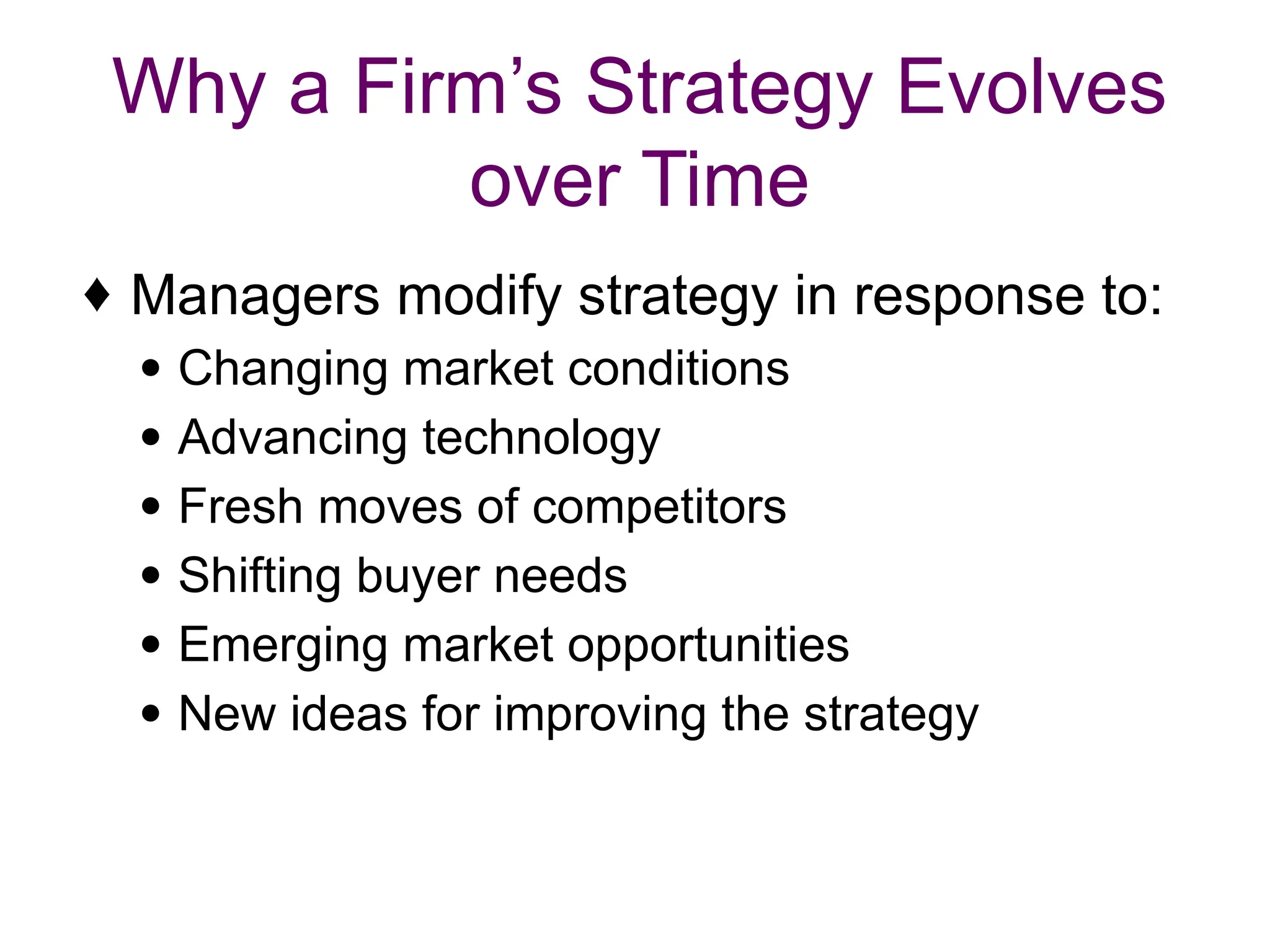
Why a Firm’sStrategy Evolves
over Time
♦ Managers modify strategy in response to:
● Changing market conditions
● Advancing technology
● Fresh moves of competitors
● Shifting buyer needs
● Emerging market opportunities
● New ideas for improving the strategy
10.
The Evolving Natureof a Firm’s Strategy
• Realized (current) strategy is a blend of:
– Proactive (deliberate) strategy elements that
include both continued and new initiatives.
– Reactive (emergent) strategy elements that
are required due to unanticipated competitive
developments and fresh market conditions.
11.
1.2 A Company’sStrategy Is a Blend of Proactive Initiatives
and Reactive Adjustments
12.
OUR IS STRATEGYA WINNER?
Winning
Strategy
The Strategic
Fit Test
The Competitive
Advantage Test
The Performance
Test
13.
WHAT MAKES ASTRATEGY
A WINNER?
• A winning strategy must pass three tests:
– The Fit Test
• Does it exhibit dynamic fit with the external and
internal aspects of the firm’s overall situation?
– The Competitive Advantage Test
• Can it help the firm achieve a significant and
sustainable competitive advantage?
– The Performance Test
• Can it produce good performance as measured
by the firm’s profitability, financial and
competitive strengths, and market standing?
14.
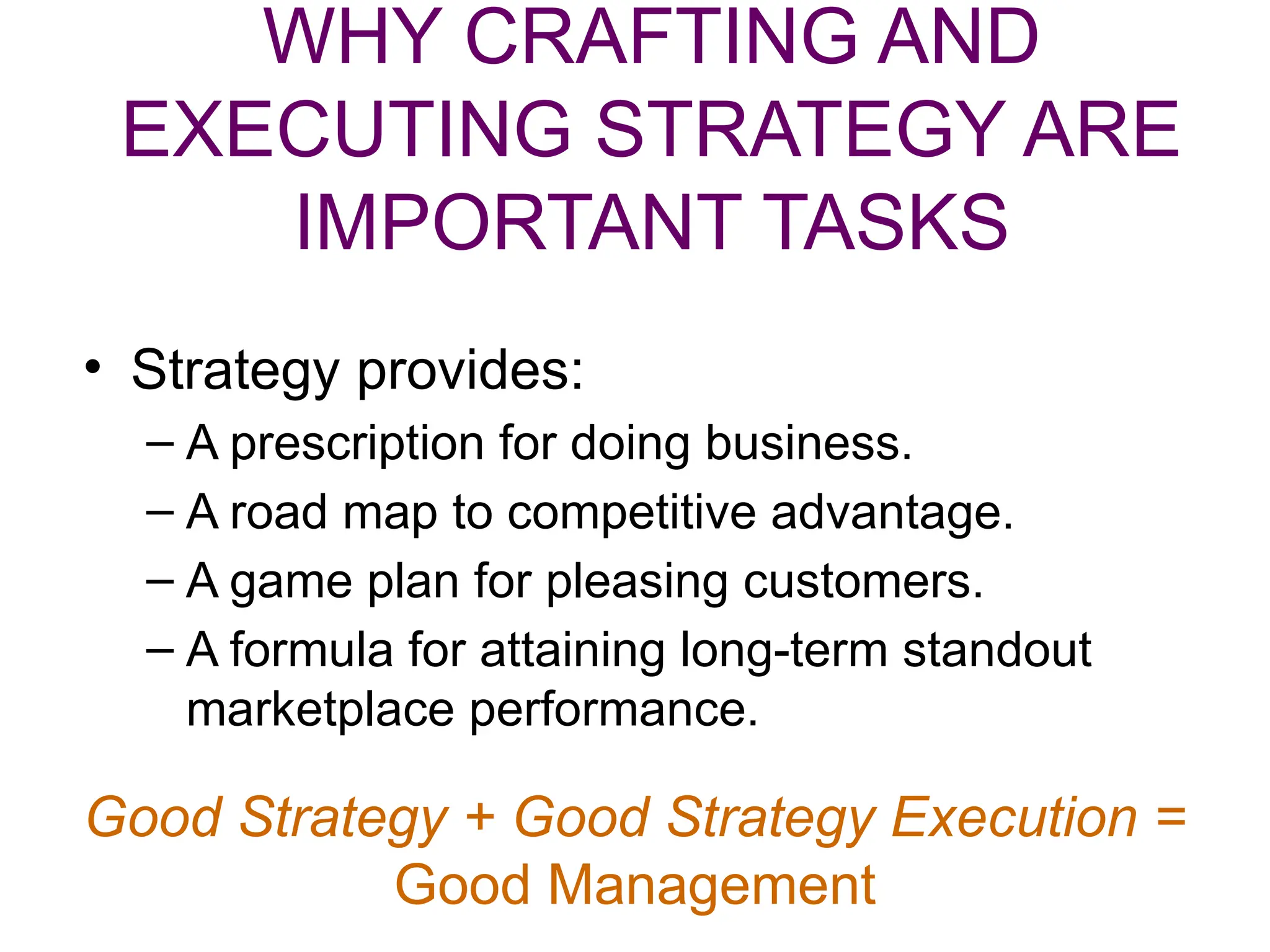
WHY CRAFTING AND
EXECUTINGSTRATEGY ARE
IMPORTANT TASKS
• Strategy provides:
– A prescription for doing business.
– A road map to competitive advantage.
– A game plan for pleasing customers.
– A formula for attaining long-term standout
marketplace performance.
Good Strategy + Good Strategy Execution =
Good Management
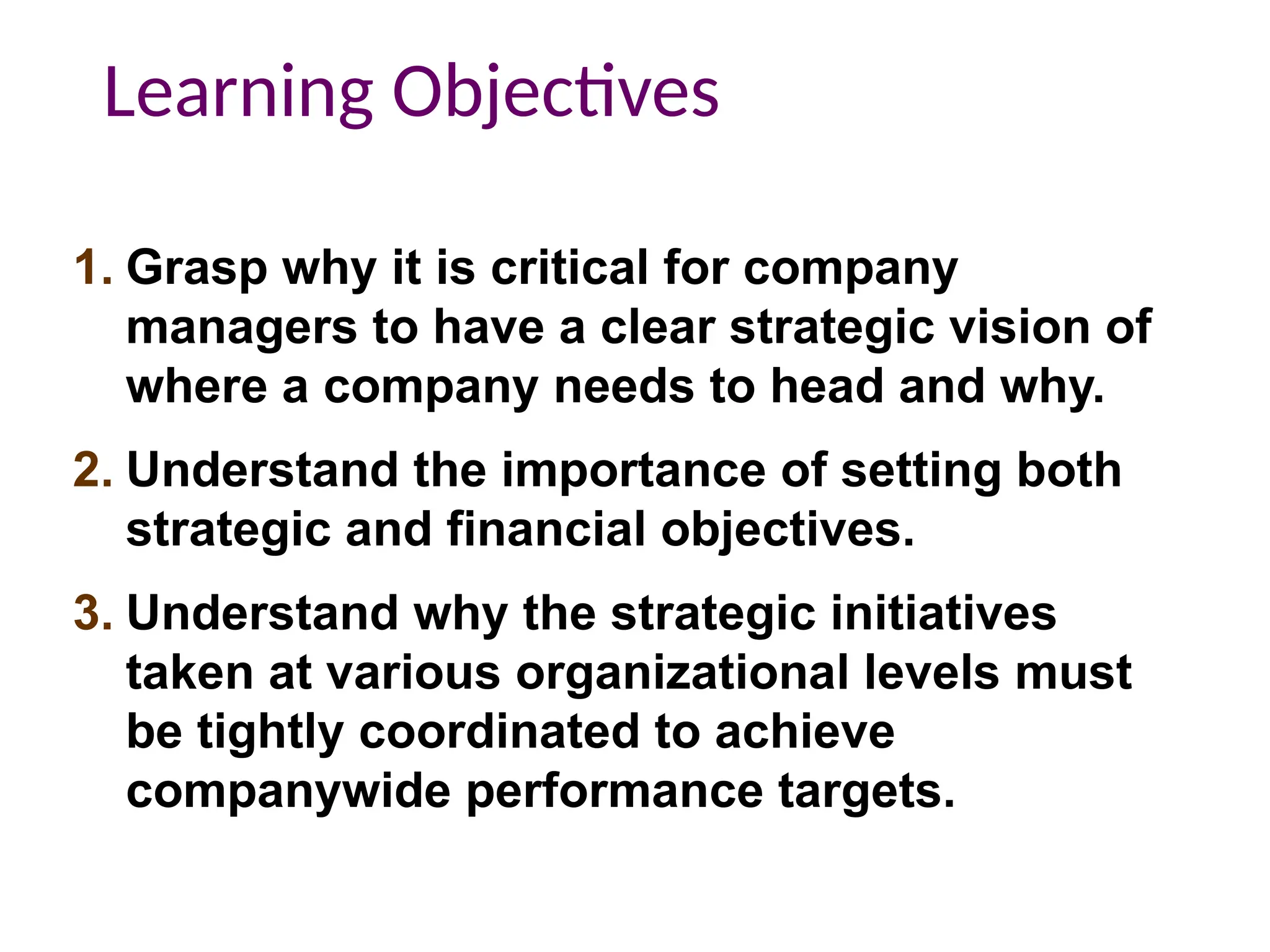
1. Grasp whyit is critical for company
managers to have a clear strategic vision of
where a company needs to head and why.
2. Understand the importance of setting both
strategic and financial objectives.
3. Understand why the strategic initiatives
taken at various organizational levels must
be tightly coordinated to achieve
companywide performance targets.
Learning Objectives
17.
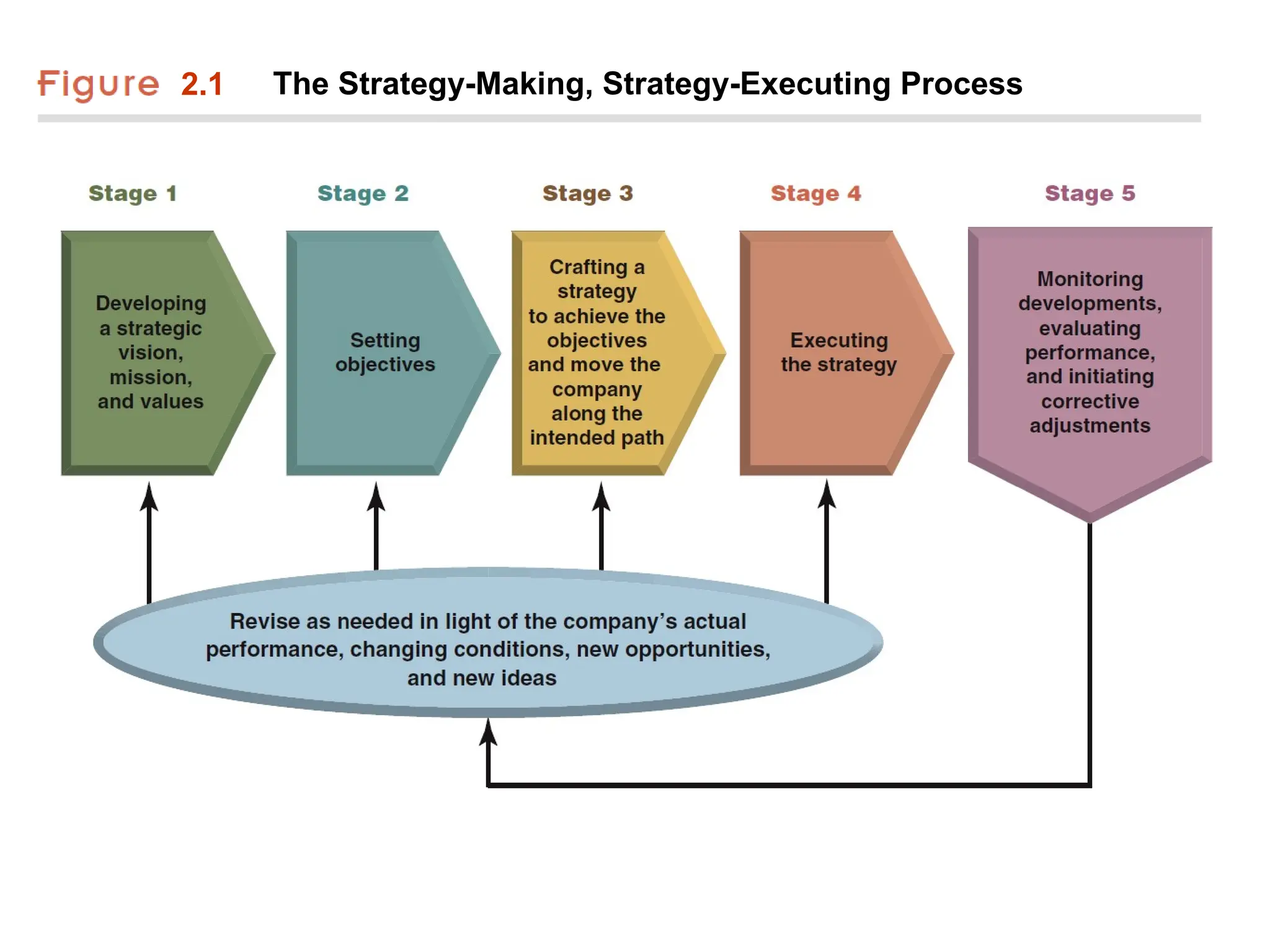
WHAT DOES THESTRATEGY-
MAKING, STRATEGY-EXECUTING
PROCESS ENTAIL?
1. Developing a strategic vision, a mission, and a set of
values.
2. Setting objectives for measuring performance and
progress.
3. Crafting a strategy to achieve those objectives.
4. Executing the chosen strategy efficiently and effectively.
5. Monitoring strategic developments, evaluating execution,
and making adjustments in the vision and mission,
objectives, strategy, or execution as necessary.
STAGE 1: DEVELOPINGA STRATEGIC
VISION, A MISSION, AND A SET OF
CORE VALUES
• Developing a Strategic Vision:
– Delineates management’s future aspirations
for the business to its stakeholders.
– Provides direction—“where we are going.”
– Sets out the compelling rationale (strategic
soundness) for the firm’s direction.
– Uses distinctive and specific language to set
the firm apart from its rivals.
20.
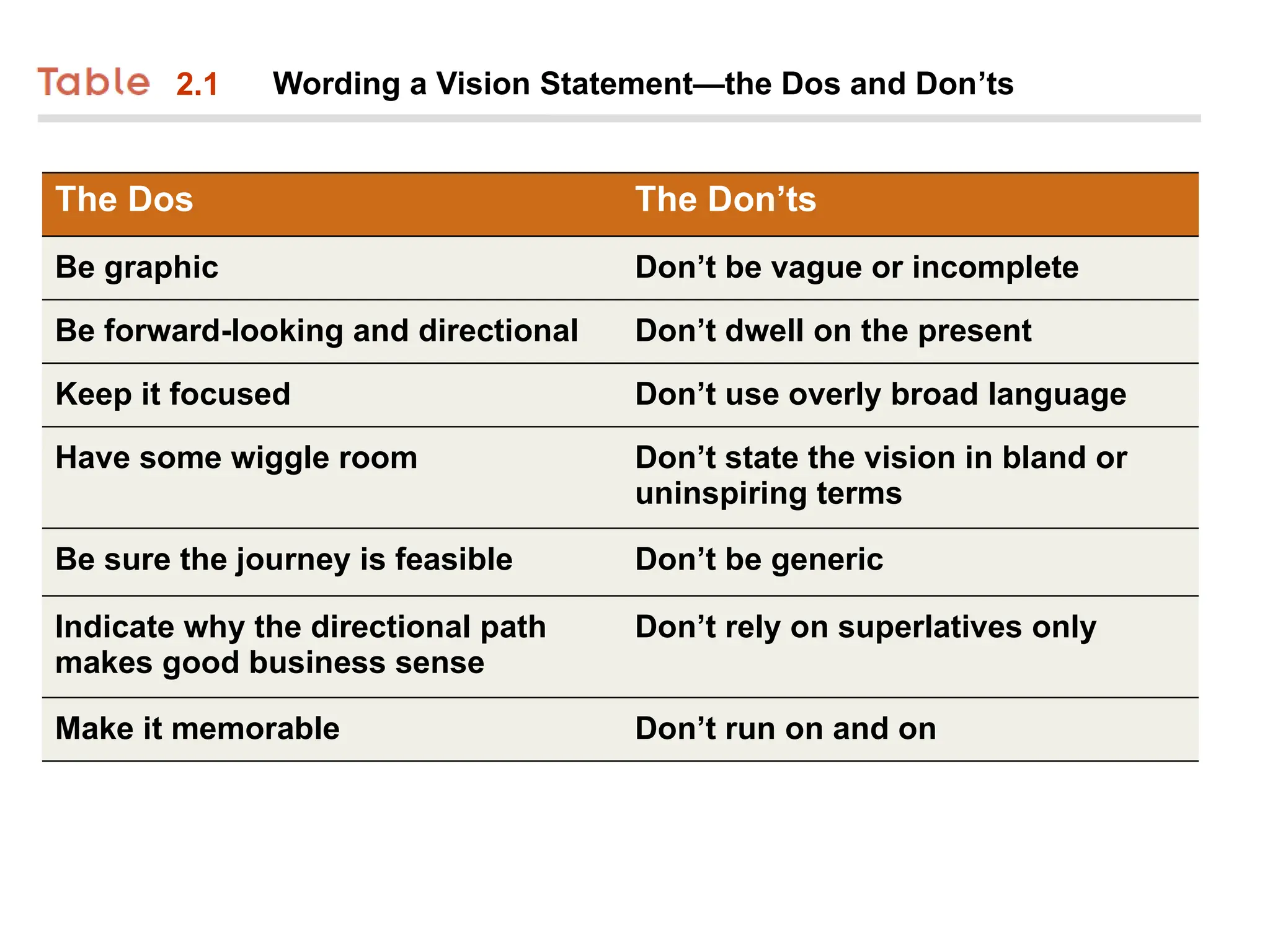
2.1 Wording aVision Statement—the Dos and Don’ts
The Dos The Don’ts
Be graphic Don’t be vague or incomplete
Be forward-looking and directional Don’t dwell on the present
Keep it focused Don’t use overly broad language
Have some wiggle room Don’t state the vision in bland or
uninspiring terms
Be sure the journey is feasible Don’t be generic
Indicate why the directional path
makes good business sense
Don’t rely on superlatives only
Make it memorable Don’t run on and on
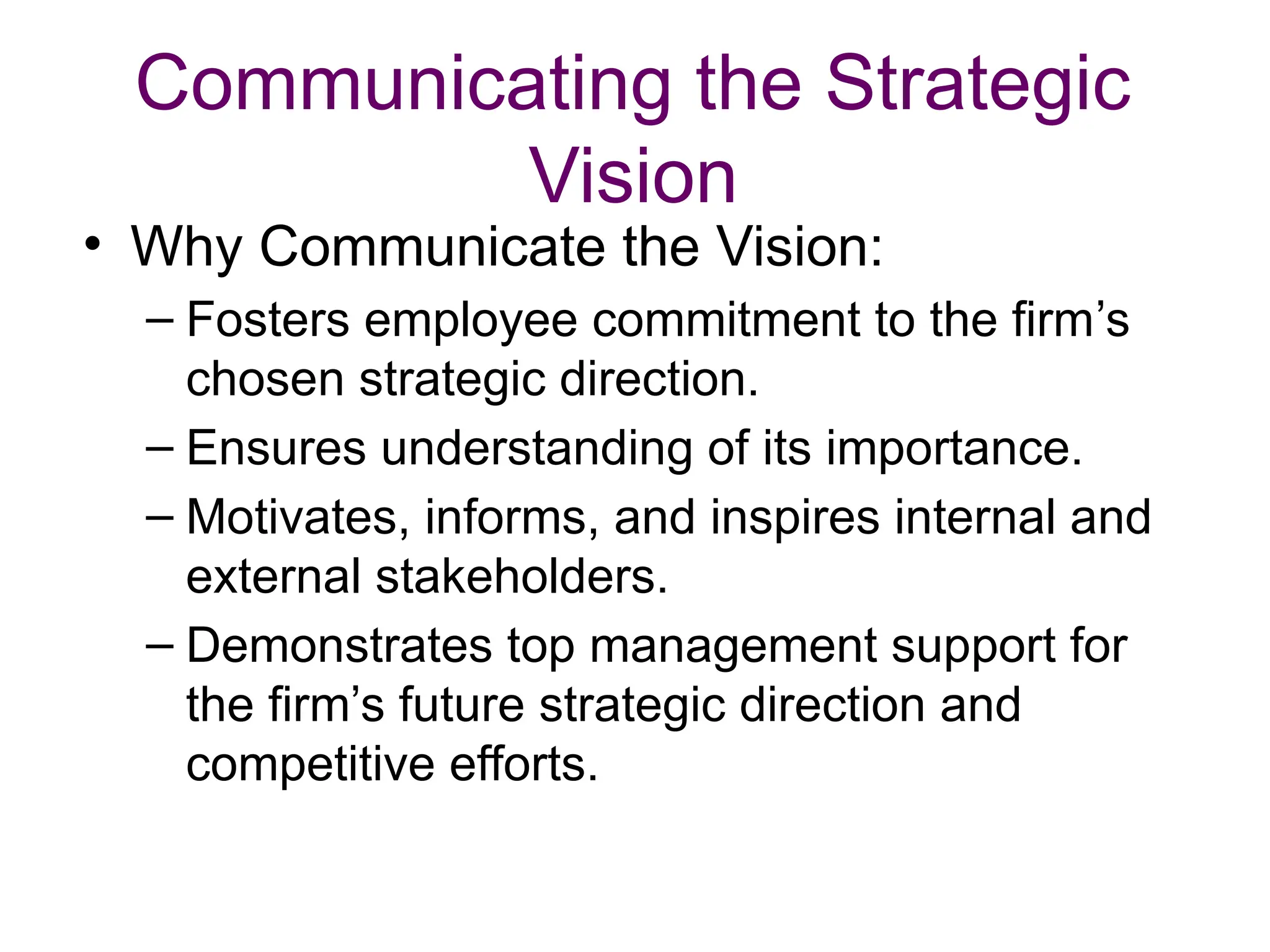
21.
Communicating the Strategic
Vision
•Why Communicate the Vision:
– Fosters employee commitment to the firm’s
chosen strategic direction.
– Ensures understanding of its importance.
– Motivates, informs, and inspires internal and
external stakeholders.
– Demonstrates top management support for
the firm’s future strategic direction and
competitive efforts.
22.
STAGE 2: SETTINGOBJECTIVES
• The Purposes of Setting Objectives:
– To convert the vision and mission into specific,
measurable, timely performance targets.
– To focus efforts and align actions throughout
the organization.
– To serve as yardsticks for tracking a firm’s
performance and progress.
– To provide motivation and inspire employees
to greater levels of effort.
23.
THE TWO ESSENTIALKINDS OF
OBJECTIVES TO SET
• Financial
Objectives
–Communicate top
management’s targets
for financial
performance.
–Are focused internally
on the firm’s
operations and
activities.
• Strategic
Objectives
–Are related to a
firm’s marketing
standing and
competitive vitality.
–Are focused
externally on
competition vis-à-
vis the firm’s rivals.
24.
EMPLOYING A BALANCED
SCORECARD
•A balanced scorecard measures a firm’s
optimal performance by:
• Placing a balanced emphasis on achieving
both financial and strategic objectives.
• Avoiding tracking only financial performance and
overlooking the importance of measuring whether
a firm is strengthening its competitiveness and
market position.
The surest path to sustained future profitability year after year is to relentlessly
pursue strategic outcomes that strengthen a firm’s business position and give
it a growing competitive advantage over rivals!
25.
STAGE 3: CRAFTINGA STRATEGY
• Strategy Making:
– Addresses a series of strategic how’s.
– Requires choosing among strategic alternatives.
– Promotes actions to do things differently from
competitors rather than running with the herd.
– Is a collaborative team effort that involves
managers in various positions at all
organizational levels.
26.
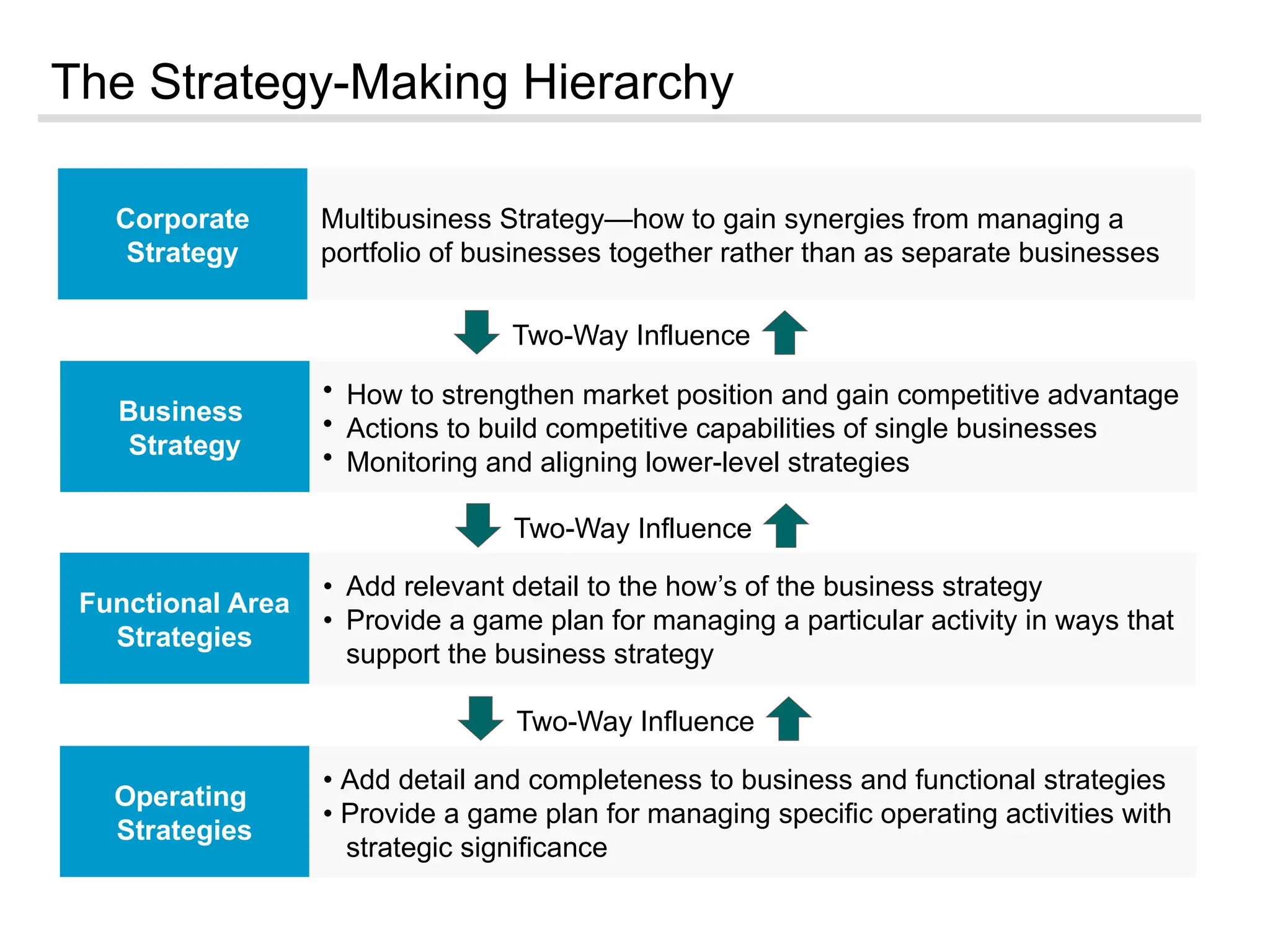
The Strategy-Making Hierarchy
Corporate
Strategy
MultibusinessStrategy—how to gain synergies from managing a
portfolio of businesses together rather than as separate businesses
Business
Strategy
• How to strengthen market position and gain competitive advantage
• Actions to build competitive capabilities of single businesses
• Monitoring and aligning lower-level strategies
Functional Area
Strategies
• Add relevant detail to the how’s of the business strategy
• Provide a game plan for managing a particular activity in ways that
support the business strategy
Operating
Strategies
• Add detail and completeness to business and functional strategies
• Provide a game plan for managing specific operating activities with
strategic significance
Two-Way Influence
Two-Way Influence
Two-Way Influence
27.
STAGE 4: EXECUTINGTHE
STRATEGY
• Converting strategic plans into actions
requires:
– Directing organizational action.
– Motivating people.
– Building and strengthening the firm’s
competencies and competitive capabilities.
– Creating and nurturing a strategy-supportive
work climate.
– Meeting or beating performance targets.
28.
STAGE 5: EVALUATING
PERFORMANCE
ANDINITIATING CORRECTIVE
ADJUSTMENTS
• Evaluating Performance:
– Deciding whether the enterprise is passing
the three tests of a winning strategy—good fit,
competitive advantage, strong performance.
• Initiating Corrective Adjustments:
– Deciding whether to continue or change the
firm’s vision and mission, objectives, strategy,
and/or strategy execution methods.
– Based on organizational learning.













![str_mgnt_1comp_mode[2].ppt and its components](https://cdn.slidesharecdn.com/ss_thumbnails/strmgnt1compmode2-240630151143-2120a020-thumbnail.jpg?width=640&height=640&fit=bounds)


