Strategic Management in Action 6th Edition Coulter Solutions Manual
1.
Strategic Management inAction 6th Edition
Coulter Solutions Manual download
https://testbankfan.com/product/strategic-management-in-
action-6th-edition-coulter-solutions-manual/
Visit testbankfan.com today to download the complete set of
test bank or solution manual
2.
Here are somerecommended products for you. Click the link to
download, or explore more at testbankfan.com
Strategic Management in Action 6th Edition Coulter Test
Bank
https://testbankfan.com/product/strategic-management-in-action-6th-
edition-coulter-test-bank/
Business in Action 6th Edition Bovee Solutions Manual
https://testbankfan.com/product/business-in-action-6th-edition-bovee-
solutions-manual/
Strategic Management 6th Edition Hubbard Solutions Manual
https://testbankfan.com/product/strategic-management-6th-edition-
hubbard-solutions-manual/
College Accounting A Career Approach 12th Edition Scott
Test Bank
https://testbankfan.com/product/college-accounting-a-career-
approach-12th-edition-scott-test-bank/
3.
Understanding Pathophysiology 6thEdition Huether Test
Bank
https://testbankfan.com/product/understanding-pathophysiology-6th-
edition-huether-test-bank/
Goulds Pathophysiology for the Health Professions 5th
Edition VanMeter Test Bank
https://testbankfan.com/product/goulds-pathophysiology-for-the-health-
professions-5th-edition-vanmeter-test-bank/
How Children Develop 5th Edition Siegler Test Bank
https://testbankfan.com/product/how-children-develop-5th-edition-
siegler-test-bank/
Microeconomics 2nd Edition Acemoglu Solutions Manual
https://testbankfan.com/product/microeconomics-2nd-edition-acemoglu-
solutions-manual/
Physics Principles With Applications 7th Edition Giancoli
Test Bank
https://testbankfan.com/product/physics-principles-with-
applications-7th-edition-giancoli-test-bank/
4.
Environmental Science fora Changing World Canadian 1st
Edition Branfireun Test Bank
https://testbankfan.com/product/environmental-science-for-a-changing-
world-canadian-1st-edition-branfireun-test-bank/
5.
CHAPTER 5 FUNCTIONALAND COMPETITIVE
STRATEGIES
LEARNING OUTCOMES
Use this Learning Outline as you read and study the chapter:
5.1 Describe the functional strategies an organization needs and explain how those strategies are
implemented and evaluated.
5.2 Explain competitive advantage and what it implies.
5.3 Describe the different competitive strategies.
5.4 Discuss how competitive strategies are implemented and evaluated.
TEXT OUTLINE
Active Learning Hint
Hand out an “empty” chapter outline or one with key information missing for the students to use in note
taking. This outline will help the students to organize the information, while keeping the students
actively listening for the information needed to complete the outline.
Strategic Management in Action Case #1: Driving for Success
You may wish to open with a Question and Answer exercise.
• The Toyota vignette illustrates the interrelationships of an organization's functional strategies and
their contributions to the company’s success. Additionally, you may want to review what a learning
organization is and link Toyota's two main principles with their status as a learning organization.
• Questions to connect previous discussion with this chapter:
• What is Toyota’s competitive advantage?
• What is Toyota’s core competency that provides the basis for their competitive advantage?
• What advantages does the Toyota five-day custom car manufacturing system provide for the
marketing department?
• How can this manufacturing pace be sustained? Can't other manufacturers imitate the Toyota
system?
Teaching Notes: _______________________________________________________________________
_____________________________________________________________________________________
_____________________________________________________________________________________
_____________________________________________________________________________________
_____________________________________________________________________________________
LEARNING OUTCOME 5.1 DESCRIBE THE FUNCTIONAL STRATEGIES AN
ORGANIZATION NEEDS, AND EXPLAIN HOW THOSE
STRATEGIES ARE IMPLEMENTED AND EVALUATED
FUNCTIONAL STRATEGIES AND STRATEGIC MANAGEMENT PROCESS
A. Strategic Management in Action: Process (Figure 5.1)
1. Top-level decision makers (i.e., CEO and top management team) develop the overall goal
of what the organization hopes to achieve (i.e., its vision, mission and strategic objectives)
and establish the overall corporate strategies.
2. Functional strategies are developed taking into account the organization’s vision,
mission(s), overall corporate and competitive strategies.
6.
3. When theorganization is first founded, corporate strategies are addressed immediately
where the overall strategic goal(s) and directions are formulated by the CEO and top
management team and then functional strategies are addressed.
4. The vast majority of strategic situations are ones where the organization is not new. In these
situations; functional strategies are looked at first in the process of deciding the most
appropriate strategies—that is, the ones that will lead to a sustainable competitive
advantage.
B. What Happens after the SWOT Analysis?
1. Decision makers have information about the positive and negative aspects of both the
external and internal environments (i.e., Internal [Strengths and Weaknesses] and External
[Opportunities and Threats]).
2. If the organization’s strengths in the various functional units can be exploited as
competitive advantages, particularly in light of any relevant external opportunities, the
organization may well be on its way to achieving high levels of performance.
3. If negative trends are found in any of the organization’s external areas or weaknesses,
changes in functional strategies might be needed to counteract these.
4. Serious functional weaknesses that might be preventing a competitive advantage from being
developed may need to be corrected or minimized.
Active Learning Hint
Conduct a SWOT analysis for Domino’s Pizza and address the issues presented in the Strategic
Management in Action highlight. Divide the class into groups of 4-5 students to work on the SWOT,
and then ask several of the groups to report their findings. Another method would be to divide the class
into 4 groups (or multiples of four). One group identifies the strengths, another group the weaknesses,
etc. Ask each group to report their findings to the class.
Strategic Management in Action: Super Bowl and Pizza
1. Discuss whether to try to meet peak demand – does it lead to loyalty? Is it a weakness if a company
cannot meet demand on that particular day. If you cannot supply your customers you open the door
to rival suppliers and you may lose some to other pizza-makers if you turn them away.
2. A SWOT analysis may reveal if production or delivery capacity are inadequate for the peak demand
or if there may be excess capacity.
C. What Functional Strategies Does an Organization Need?
Functional (or operational) strategies are the short-term, goal-directed decisions and actions
of the organization’s various functional units (Figure 5.2).
All organizations perform three basic functions as they create and deliver goods and services:
1) Product Strategies (design, production-operations, marketing)
2) People Strategies (human resources)
3) Support Process Strategies (information and financial-accounting systems)
1. Functional Strategies – The Product
a). Product design strategies typically involve an organization’s R&D function
b). Once products are ready to be produced, production-operations strategies ensue
c). Next, marketing strategies are implemented
2. Functional Strategies – The People
a). High-performance Work Practices are human resource policies and practices that
lead to both high individual and high organizational performance.
b). Table 5.1 lists some of the high-performance work practices that have been identified.
7.
These types ofHR strategies can:
(1) Improve knowledge, skills and abilities of organization’s current and
potential employees
(2) Increase employees’ motivation
(3) Reduce loafing on the job
(4) Help retain quality employees
(5) Encourage nonperformers to leave the organization
c). Strategic choices include:
i. Getting people into the organization (HR planning, recruiting and staffing)
ii. Making sure they have the knowledge and skills to do their jobs
iii. Helping them do their jobs better (orientation and training)
iv. Assessing how well they do those jobs and making needed corrections
(performance appraisal and disciplinary actions)
v. Motivating high levels of effort and compensating them fairly and
appropriately (compensation and benefits)
vi. Other HR Issues (employee relations, job design, diversity efforts,
workplace safety and health, workplace misbehavior)
vii. An organization’s HR policies reflect its commitment to and treatment of its
employees. Must closely align with those other strategies to assure that the
right numbers of appropriately skilled people are in the right place at the
right time and that the organization’s workforce is being used effectively
and efficiently.
3. Functional Strategies – The Support Process
a). Organizations have two main support processes – information systems and
financial-accounting systems
b). Information affects how effectively and efficiently organizational members can do
their work
c). Two strategic decisions most associated with the organization’s information system
are the choice of system technology and the choice of types of information
systems needed
d). Financial-accounting systems provide strategic decision makers with information
about the organization’s financial transactions, accounts, and standing
e). Strategic choices include:
i. Collecting and using financial and accounting data
ii. Evaluating financial performance
iii. Doing financial forecasting and budgeting
iv. Determining the optimum financing mix
v. Effectively and efficiently managing the financial-accounting functional
area
Strategic Management In Action: Loading the Airplane
• In light of all the delays and flight cancellations the airlines industry experienced in Summer 2007,
have the students discuss some ideas on how the airlines might adopt some production-operations
strategies that might make each airplane’s turnaround at the gate faster.
For Your Information—To Layoff or Not to Layoff
• Student responses may vary based on the students’ life and work experiences and the state of the
United States and global economy.
8.
The Grey Zone– Corporate Blogs
Corporate blogs are popular and legal but not necessarily in the best interests of the company. Should
organizations promote things that are popular but may be harmful or at least may not be beneficial to the
company?
When an employee raises a concern, what are the risks to the organization of responding? Or not
responding? How might stakeholders see it?
What about government regulators or juries? Will they be more sympathetic if you ignore the concerns
of your stakeholders and it turns out that your company’s actions were harmful? What could happen
then?
Do you have to respond to every stakeholder concern?
Strategic Management in Action: Caesars Entertainment
Great service leads to more spending by gamblers. Ask your students if they think that this would hold
true to other businesses outside of the gambling environment? Does great service lead to more spending
in hotels, resorts, restaurants, retail stores, or bars?
Learning Review: Learning Outcome 5.1
• How does the work done in the functional areas support the creation of a competitive
advantage? If the organization’s strengths in the various functional units can be exploited as
competitive advantages, particularly in light of any relevant external opportunities, the
organization may well be on its way to achieving high levels of performance.
• What happens after the SWOT analysis is completed? After completing the SWOT analysis,
decision makers have information about the positive and negative aspects of both the external
and internal environments. The SWOT analysis points to the strategic issues organizational
decision makers need to address in their pursuit of sustainable competitive advantage and high
levels of performance.
• What are the three functional concerns of organizations? The three functional concerns for
organizations are the product, the people, and the support processes.
• What strategies are important to each of those functional concerns? For product, the strategies
are design, production-operations, and marketing. For people, it is HR strategies. And for
support process, it’s strategies related to information systems and financial-accounting systems.
9.
LEARNING OUTCOME 5.2EXPLAIN WHAT COMPETITIVE ADVANTAGE IS AND
WHAT IT IMPLIES
A. Competitive Advantage
1. Is a key concept of strategic management (getting it and keeping it is what managing
strategically is all about)
2. Sets an organization apart (its competitive edge)
3. Is what an organization’s competitive strategies are designed to exploit
4. Implies that there are other competitors also attempting to develop competitive advantage
and attract customers
5. An organization does something that others can’t do or does it better than others do
(distinctive capability)
6. An organization has something that other competitors don’t (unique resource)
7. Can be eroded easily (and often quickly) by competitors’ actions
B. Understanding the Competitive Environment
1. Competition is everywhere. Most industries and organizations have experienced at some
point.
2. What is Competition?
a) Competition is when organizations battle or vie for some desired object or outcome—
typically customers, market share, survey ranking, or needed resources.
Strategic Management in Action
• Describe situations, outside business and athletics, where competition is taking place.
Answers will vary based on the students and their business and life experiences.
3. Who are Competitors?
Competitors can be described according to:
a) Industry Perspective
(1) Identifies competitors as organizations that are making and selling the same or very
similar good or service.
(2) Describes industries according to the number of sellers and the degree of
differentiation (i.e., similarities or differences of the products or services).
(a) The number of sellers and the level of product-service differentiation will affect
how intensely competitive the industry is.
(b) The most intense competition is “pure competition” where there are many
sellers and no differentiation exists among the sellers.
b) Market Perspective
(1) Competitors are organizations that satisfy the same customer need.
(2) Intensity of competition depends on:
(a) How well the customer’s need is understood or defined
(b) How well different organizations are able to meet that need
c) Strategic Groups Perspective
(1) Recall “current rivalry” in Porter’s Five Forces Model from Chapter 3.
(2) Strategic group is a group of firms competing in an industry that have similar
strategies, resources and customers.
(3) A single industry could have a few or several strategic groups depending on what
strategic factors are important to customers.
(a) Two strategic factors, important to customers, used in grouping competitors are
price and quality.
(b) Important strategic factors, or strategic dimensions, used to determine an
organization’s competitors are different for every industry and can be different
even for different industry segments.
(c) Table 5.2 lists some dimensions that might be used to distinguish strategic
10.
groups.
(4) The mostrelevant competitors are those in an organization’s own strategic group.
(5) Level of intensity of competition from this perspective depends on:
(a) How effectively each competitor has developed its competitive advantage
(b) The competitive strategies used by each competitor in the strategic group
(6) Controversy exists over whether or not specific, identifiable strategic groups even
exist.
(a) These questions generally concern:
(1) The factors that are used to define a strategic group
(2) How those factors are chosen and used to separate specific and identifiable
groups
Strategic Management in Action—Hot Sauce
• Ask students how many are familiar with these two brands of hot sauce.
• Ask the students why they choose one sauce over another.
• Ask the students if an ad campaign changes their mind about a product or brand.
• Ask the students what actions a hot sauce manufacturer might take to protect its competitive position.
C. The Role of Resources and Distinctive Capabilities in Gaining Competitive Advantage
Every organization has resources and capabilities to do whatever it’s in business to do.
1. Not every organization is able to:
a) Effectively exploit the resources or capabilities it has
b) Obtain the resources or capabilities it needs but doesn’t have
c) Classic case of “the haves” and “the have-nots” or “the can do’s” and “the can’t do’s”
2. Some organizations “put it all together” and develop distinctive organizational capabilities
that provide a sustainable competitive advantage, others don’t.
3. Organizations will develop strategies to:
a) Exploit their current resources and capabilities
b) Vie for needed-but-not-owned resources and capabilities to pursue and attain desired
outcomes (customers, market share, resources)
c) While other organizations (few to many) are doing exactly the same thing
4. Competitive advantage, by its very nature, implies trying to gain the edge on others.
5. As organizations fight for a sustainable competitive advantage, the stage for competition—
intense, moderate, or mild—is set.
Strategic Management—The Global Perspective: Sukhoi Holding Company
• Ask students to research other aircraft manufacturers.
• How is the Sukhoi Holding Company going to develop a competitive advantage over other aircraft
manufacturers?
D. From Competitive Advantage to Competitive Strategies
Competitive strategy is the way organizations set themselves apart to compete to create a
sustainable competitive advantage
1. The choice of competitive strategy
a) Depends on how an organization or business unit is going to compete in its particular
industry or market
b) Is based on the competitive advantage(s) that the organization has been able to develop
2. Refining and sharpening its sustainable competitive advantage (in unique resources or
distinctive capabilities) provides the basis for an organization’s competitive strategy.
Teaching Notes: _______________________________________________________________________
11.
_____________________________________________________________________________________
_____________________________________________________________________________________
Learning Review: LearningOutcome 5.2
• Is competition an issue for all organizations? Discuss.
• Competition is a given for all organizations, regardless of size, type, or geographic location. Even
not-for-profit organizations compete for resources and customers.
• What is competitive advantage?
• Competitive advantage is what sets an organization apart—its competitive edge.
• Compare and contrast the three approaches to defining competitors.
• The industry perspective identifies competitors as organizations that are making the same
product or providing the same service.
▪ The marketing perspective says competitors are organizations that satisfy the same customer
need.
▪ The strategic groups perspective identifies a group of firms competing in an industry that have
similar strategies, resources and customers.
• What role do resources and distinctive capabilities play in gaining competitive advantage?
• Organizations will develop strategies to exploit their current resources and capabilities or to vie
for needed-but-not-owned resources and capabilities to pursue and attain desired outcomes such
as customers, market share and resources. They do this while other organizations (few to many)
are doing exactly the same thing. Competitive advantage, by its very nature, implies trying to gain
the edge on others. As organizations strive for a sustainable competitive advantage, the stage for
competition—intense, moderate, or mild—is set.
• Define competitive strategy. What’s the connection between competitive advantage and competitive
strategy?
• Competitive strategy is the way organizations set themselves apart to create a sustainable
competitive advantage.
• The choice of a competitive strategy is based on the competitive advantage(s) that the
organization has been able to develop.
LEARNING OUTCOME 5.3
DESCRIBE THE DIFFERENT COMPETITIVE STRATEGIES
Although it may seem there are numerous ways an organization competes, the number of
competitive strategies is actually few of possible types of competitive strategies, there are actually a
limited number of ways to describe how an organization competes.
A. Traditional Approaches to Defining Competitive Strategy
1. Miles and Snow’s Adaptive Strategies (1978) (Table 5.3):
a) Based on the strategies organizations use to adapt to their uncertain competitive
environments.
b) Generally been supportive of the appropriateness of these strategies for describing how
organizations are competing.
c) Prospector Strategy
(1) Strategy in which an organization continually innovates by finding and exploiting
new product and market opportunities.
(2) Prospector’s competitive strength is ability to:
(a) Survey a wide range of rapidly changing environmental conditions, trends and
situations to create new products and services to fit this dynamic environment.
(3) Prospector’s competitive strategy is to continually innovate, develop and test new
products and services (i.e., find new directions to pursue).
(4) Constant search for innovation creates uncertainties for prospector’s competitors
who never know what’s going to happen next or what to expect.
(5) If prospector can develop new products or services that the market desires and is
12.
willing to payfor, it has a competitive advantage.
(6) Examples: Fox Broadcasting Network and MTV known for innovative television
network programming and willingness to pursue new directions based on its ability
to assess environmental trends.
b) Defender Strategy
(1) Strategy used by organizations to protect current market share by emphasizing
existing products and producing only a limited product line.
(2) Defenders have well-established businesses that they’re seeking to defend.
(3) Defender has success with this strategy as long as the primary technology and
narrow product line remain competitive.
(4) Over time, defenders can carve out and maintain niches within their industries that
competitors find difficult to penetrate.
(5) Example: Lincoln Electric of Cleveland, OH; Anheuser-Busch; IBM
c) Analyzer Strategy – strategy of analysis and imitation.
Analyzers
(1) Watch for and copy the successful ideas of prospectors
(2) Compete by following the direction that prospectors pioneer
(3) Thoroughly analyze new business ideas before jumping in
(4) Systematically assess and evaluate whether the move is appropriate for them
(5) Examples: Unilever’s Suave shampoo and skin care products, COSMI Corporation
(education, entertainment and business software)
Strategic Management—The Global Perspective: Pague Menos
• Ask students what they think about the Brazilian retailer copying Wal-Mart’s strategies?
• How successful can Pague Menos be by taking the low cost approach?
• What are the drawbacks to using a low cost strategy? Is it sustainable?
• What is to keep another emerging competitor from copying Pague Menos? What if the new
competitor undercuts Pague Menos’ prices?
d) Reactor Strategy – the lack of a coherent strategic plan or apparent means of
competing.
(1) Reactors:
(a) Simply react to environmental changes and make adjustments only when finally
forced to do so by environmental pressures
(b) Oftentimes unable to respond quickly to perceived environmental changes
because:
(1) They lack the needed resource or capabilities OR
(2) They’re not able to exploit their current resources and capabilities
(2) This is not a recommended competitive strategy for developing a competitive
advantage.
(3) Thought of as a “default” strategy, almost a nonstrategy position.
(4) Without significant strategic changes, a reactor will always be in a weak
competitive position.
(5) Examples: Sears; Sizzler International, Inc.; Digital Equipment Corporation
For Your Information – The Copycat Economy
• Ask the students to evaluate Clorox’s decision to market ReadyMop and determine what strategy is
being used. Was it an offensive or a defensive move on Clorox’s part?
• Ask the students if they can think of any other examples of “copycatting?” In the soft drink business
every new flavor is virtually matched immediately by a competing flavor from a rival. Diet Pepsi and
13.
Diet Coke havespawned cherry, lemon, lime, and vanilla flavored varieties, as well as C2, a low
carb Coke and Pepsi One a very low calorie add-on to the Diet Pepsi line. The key seems to be to not
allow any competitor an advantage for any length of time. Fast-food makers have done the same
thing with gourmet salads. Wendy’s started the war with a very successful introduction of gourmet
salads and McDonald’s followed with several varieties within months. Automobile financing and
rebates are another example where there is little difference between competitors.
• How did Procter and Gamble respond to Clorox? Rather than cede any advantage to Clorox, P&G
cut its price (and its profit margin) to not be out positioned by a “fast-follower.” Possible responses
range from increased advertising to win customer attention to price cuts that then limit the ability of
new entrants to garner profits…perhaps discouraging their entry before it occurs.
Teaching Notes: _______________________________________________________________________
_____________________________________________________________________________________
_____________________________________________________________________________________
_____________________________________________________________________________________
2. Porter’s Generic Competitive Strategies (1980)
a) Porter’s approach is based on an organization’s competitive advantage.
b) Competitive advantage can come from only one of two sources:
(1) Having the lowest costs in the industry
(2) Possessing significant and desirable differences from competitors
c) Another important strategic factor is the scope of the product-market in which the
organization wishes to compete—that is, broad (i.e., all or most market segments) or
narrow (i.e., only one segment or a few segments).
d) The mix of these factors provides the basis for Porter’s approach.
e) The term generic simply refers to the fact that these strategies can be pursued by any
type or size organization in any type or size industry.
(1) Cost leadership Strategy (or low-cost strategy) is one in which an organization
strives to have the lowest costs in its industry and produces products for a broad
customer base.
(a) Cost leader
(1) Chooses to compete on the basis of having the lowest costs.
(2) The main goal is to have the lowest (total unit) costs in the industry
(emphasis on costs, not prices).
(a) With the lowest costs in its industry, the cost leader:
(1) Can potentially charge the lowest prices and
(2) Still earn significant profits, even during a price war
(b) Successful pursuit of the cost leadership strategy
(1) Everything the cost leader does—every strategic decision made, every
strategic action taken—is aimed at keeping costs as low as possible.
(2) Efficiency in all areas of operations is the main objective, and all resources,
distinctive capabilities, and functional strategies are directed at that.
(3) The cost leader isn’t going to have deep and wide product lines as
providing these product or service variations is expensive.
(4) ,The cost leader has chosen to compete on the basis of low costs, not on
being different than competitors.
(5) The cost leader will market products aimed at the “average” customer.
(6) Little or no product frills or differences will be available. No fancy artwork or
plush office furniture at corporate headquarters and no corporate jets.
(7) Cost leader won’t have an elaborate high-tech, multimedia interactive Web site
unless it’s an extremely cost effective and efficient way to reach masses of
potential customers.
(8) Examples: Payless Shoe Source, Collective Brands, Nucor Corporation and
Wal-Mart. Ask the students to identify common characteristics between these
14.
organizations
1. Other characteristicsof cost leaders include:
a. Strict attention to production controls
b. Rigorous use of budgets
c. Little product differentiation—just enough to satisfy what the mass
market might demand
d. Limited market segmentation—products or services aimed at the
mass market
e. Emphasis on productivity improvements
f. Resources, distinctive capabilities and core competencies found in
production-operations and materials management
2. Drawbacks of the cost leadership strategy:
a. The main danger is that competitors might find ways of lowering
costs even further; taking away the cost leader’s cost advantage.
b. Competitors might be able to easily imitate what the cost leader is
doing and erode the cost advantage.
c. Cost leader, in its all-out pursuit of lowering costs, might lose sight
of changing customer tastes and needs.
(2) Differentiation Strategy
a) Organization competes by providing unique (different) products with features that:
i. Customers value,
ii. Perceive as different, and
iii. Are willing to pay a premium price for
b) The main goal of the differentiator is to provide products or services that are truly
unique and different in the eyes of customers.
c) Doing this, the differentiator can charge a premium price because customers perceive
that the product or service is different and that it uniquely meets their needs.
d) This premium price provides the profit incentive to compete on the basis of
differentiation.
For Your Information—Selling Luxury
• Have your students visit some of the Web sites mentioned as they consider these questions. Perhaps
several of your students have already used some of the services such as Lexus and General Electric’s
Profile washer and dryer. Encourage the students to share these “experiences” with the class.
• Are there other examples of luxury marketers trying new approaches to selling their products?
Student responses will vary on this question. Encourage students to identify as many luxury
marketers as possible.
● What do you think of these pitches?
Student responses to this question may vary based on their life and professional experiences.
• Is the differentiation strategy one that’s appropriate only in good economic times?
Student responses may vary, but should include differentiation will work in conditions where a
company’s products or services provides customers value, is perceived as different and customers
are willing to pay a premium price.
e) A successful differentiator:
i. All its capabilities, resources and functional strategies are aimed at
isolating and understanding specific market segments and developing
product features valued by customers in those various segments.
ii. Has broad and wide product lines—that is, many different models,
features, price ranges and so forth.
iii. Has countless variations of market segments and product features so
that the customer perceives the product or service as different and
unique and worth the extra price.
iv. Because the differentiation strategy can be expensive, the differentiator
15.
also needs tocontrol costs to protect profits, but not to the extent that it
loses its source of differentiation.
f) Examples: Gap, Old Navy, Pottery Barn
g) Other characteristics of differentiators include:
i. Differentiating themselves along as many dimensions as possible and
segmenting the market into many niches.
ii. Establish brand loyalty, where customers consistently and repeatedly
seek out, purchase and use a particular brand. Brand loyalty can be a
very powerful competitive weapon for the differentiator.
iii. The differentiator’s distinctive capabilities tend to be in marketing and
research and development.
h) Drawbacks of the differentiation strategy
i. Must remain unique in customers’ eyes, which may be difficult
depending on competitors’ abilities to imitate and copy successful
differentiation features.
ii. Customers might become more price sensitive, and product differences
might become less important.
(3) Focus strategy is when an organization pursues either a cost or differentiation
advantage but in a limited (narrow) customer group or segment.
a) A focuser:
i. Concentrates on serving a limited (narrow) customer group or segment
known as a market niche:
a. Geographical niche can be defined in terms of region or
locality.
b. Type of customer niche focuses on a specific group of
customers.
c. Product line niche would focus on a specific and specialized
product line.
2. Pursues either a cost or differentiation advantage
a. Cost focuser competes
i. By having lower costs than the overall industry cost
leader in specific and narrow niches
ii. Also successful if an organization can produce
complex or custom-built products that don’t lend
themselves easily to cost efficiencies by the industry’s
overall cost leaders
b. Differentiation focuser can use whatever forms of
differentiation the broad differentiator might use, such as:
i. Product features
ii. Product innovations
iii. Product quality
iv. Customer responsiveness
v. Specializes in one or a few segments instead of all
market segments.
c. Advantages of the focus strategy:
i. The focuser knows its market niche well and can build
strong brand loyalty by responding to changing
customers’ needs
ii. The focuser who can provide products or services that
the broad competitors can’t or won’t, will have the
niche all to itself.
Strategic Management—The Global Perspective: Abraaj Capital
• Do you think a cost focus or differentiation focus strategy might be more appropriate?
16.
▪ A differentiationfocus strategy might be more appropriate as Abraaj Capital might focus on
product features, product innovation, product quality, or customer responsiveness to outcompete
its rivals (i.e., Goldman Sachs, Citigroup) in the Middle East and Southeast Asia markets.
d. Drawbacks of the focus strategy
i. The focuser often operates on a small scale making it
difficult to lower costs significantly. However, with
technological advancements such as flexible
manufacturing systems, this drawback is not as critical
as it once was. As information and computer
technology become more affordable, focusers have
discovered that economies (cost efficiencies) don’t
necessarily have to come from large-scale production
runs.
ii. The niche customers might change their tastes or
needs. Because it is often difficult for a focuser to
change niches easily and quickly, this could be a
serious problem. In addition, any technological
changes that might impact the niche can have a similar
effect.
iii. The threat of the broad differentiator taking notice of
the focuser’s market niche, especially if the focuser is
enjoying a significant level of success, and moving in
to offer products and services to those customers.
(4) Stuck in the Middle
a) Happens when an organization isn’t successfully pursuing either a low-cost
or a differentiation competitive advantage
b) Occurs when an organization’s:
1. Costs are too high to compete with the low-cost leader.
2. Products and services aren’t differentiated enough to compete with the
differentiator.
c) This is not a preferred or profitable strategic direction.
d) Becoming “unstuck” means making consistent strategic decisions about what
competitive advantage to pursue and then doing so by aligning resources,
distinctive capabilities and core competencies.
Teaching Notes: _______________________________________________________________________
_____________________________________________________________________________________
_____________________________________________________________________________________
3. Contemporary Views on Competitive Strategy
Some of the newer perspectives provide an expanded, and perhaps more realistic, description of
what competitive strategies organizations are using.
a. Integrated Low-Cost Differentiation Strategy
i. Competitive advantage by simultaneously achieving low costs and high levels of
differentiation.
ii. Technological advancements that make this hybrid competitive strategy possible are:
a) Flexible manufacturing systems
b) Just-in-time inventory systems
c) Integrated manufacturing systems
b. Just because these technological advancements are available and accessible doesn’t
mean that every organization that uses them will be able to successfully implement an
integrated low-cost differentiation strategy.
and surrounded bya glittering cortege composed of his ministers,
grand almoner, grand marshal of the palace, chamberlains, and
heralds at arms.
Political offences were never left unpunished by Christophe, and
towards delinquents of this kind he never manifested his vengeance
by open violence or a display of personal indignation. Those who
had excited his mistrust were upon some occasions even favored
with a personal visit from the monarch, who studiously concealed his
vengeful purposes under a show of kindness, and the utmost
graciousness of manner. But the arrival of his vengeance was not
retarded by this display of civility. The agents of Christophe generally
made their appearance by night, and the suspected offender was
secretly hurried off to the fate which awaited him. But though
Christophe’s anger for offences not of a political character was
violent, it was seldom bloody.
Amidst a torrent of philippics against such persons, his customary
expression, “O! diable,” was a signal to those in attendance to fall
upon the offender and scourge him with canes; and when the
punishment had been made sufficient, the justice of the monarch
was satisfied, and the culprit was restored again to his favor.
Sometimes, however, his indignation in these cases was aroused to
the ferocity of a savage not to be appeased but by the blood of his
victim.
We must now turn to the affairs of the republic. Pétion had long
been despondent for the permanence of the republic, and this
feeling had by degrees grown into a settled despair, when he
discovered that his long administration had not succeeded in giving
order and civilization to the idle and barbarous hordes composing
the dangerous population of his government. While the more
despotic sway of Christophe maintained the prosperity of his
kingdom, Pétion found that the people of the republic was becoming
every day a more ungovernable rabble, indolent, dissolute, and
wretched. While the coffers of Christophe were overflowing with
millions of treasures wrung by the hard exactions of his tyranny from
19.
the blacks whotoiled upon the soil, the finances of the republic were
already in irretrievable confusion, as the productions of that territory
were hardly sufficient for the sustenance of its population.
Amidst these perplexities and embarrassments, Pétion fell sick in the
month of March, 1818, and after a malady which continued but eight
days, he perished of a mind diseased, declaring to his attendants
that he was weary of life.
The announcement that Pétion was no more threw all the foreign
merchants of the republic into consternation. They expected that an
event like this would be the harbinger of another revolution to
overturn all that had been achieved, or of a long and destructive
anarchy, which would completely annihilate the little authority there
yet remained in the republic. Merchandise to the amount of millions
had been sold to the credit of the country, in the doubtful hope that
its government would be durable. Both treasures and blood were at
stake, but the terror of the moment was soon appeased. At the
tidings of Pétion’s illness, the Senate had assembled itself in session,
and this body conferred power upon the expiring president to
nominate his successor; and Pétion, when he foresaw that his death
was inevitable, designated for this purpose General Boyer, then
commanding the arrondissement of Port au Prince.
The funeral ceremonies of the deceased president took place upon
the first of April, and were performed with the most august
solemnity. All the great officers of the army were ordered to their
posts, and required to maintain a ceaseless vigilance for the
preservation of tranquillity. An embargo was laid until the Sunday
following upon all vessels in the harbor of Port au Prince, and several
detachments of troops were ordered to march towards different
points of the frontier. The observance of every precaution which the
most anxious solicitude could suggest for the maintenance of
internal peace, and the prevention of invasion from abroad, was
evidence that Pétion had bequeathed his power to a successor
worthy of his choice.
20.
There was awide difference between Pétion and Christophe; the
former was a republican at heart, the latter, a tyrant by nature.
Assuming no pretensions to personal or official dignity, and totally
rejecting all the ceremonial of a court, it was Pétion’s ambition to
maintain the exterior of a plain republican magistrate. Clad in the
white linen undress of the country, and with a Madras handkerchief
tied about his head, he mixed freely and promiscuously with his
fellow-citizens, or seated himself in the piazza of the government
house, accessible to all.
Pétion was subtle, cautious, and designing. He aspired to be the
Washington, as Christophe was deemed the Bonaparte, of Hayti. By
insinuating the doctrines of equality and republicanism, Pétion
succeeded in governing, with but ten thousand mulattoes, a
population of more than two hundred thousand blacks.
The administration of Pétion was mild, and he did all that he could
for the elevation of the people whom he ruled. He was the patron of
education and the arts; and scientific men, for years after his death,
spoke his name with reverence. He was highly respected by the
representatives of foreign powers, and strangers visiting his republic
always mentioned his name in connection with the best cultivated
and the most gentlemanly of the people of Hayti. The people of the
republic, without distinction of color or sect, regarded Pétion’s death
as a great national calamity; and this feeling extended even into
Christophe’s dominion, where the republican president had many
warm friends amongst the blacks as well as the mulattoes. Pétion
was only forty-eight years of age at his death. He was a man of
medium size, handsome, as were nearly all of the men of mixed
blood, who took part in the Haytian war. His manners were of the
Parisian school, and his early military training gave him a carriage of
person that added dignity to his general appearance.
21.
CHAPTER XX.
BOYER THESUCCESSOR OF PÉTION IN HAYTI.
Boyer, the new president, was peaceably acknowledged by the
people of the republic as their lawful chief, and no other general of
the army manifested any disposition to establish an adverse claim to
the vacant dignity.
Boyer, finding himself tranquilly seated in power, and placed beyond
any danger from the hostile enterprises of the rival dynasty, devoted
himself to the encouragement of agriculture and commerce within
his territory. He made a tour of inspection through all the different
districts, and in each of them the due observance of the laws was
enjoined, and the citizens were urged to abandon their idle habits,
and for the good of the State, if not for the promotion of their
individual interests, to employ themselves in the development of the
great resources of the country.
Within a few months after his elevation to power, the new president
formed the resolution to disperse the hordes of banditti that infested
Grande Anse, and kept the whole South in perpetual alarm.
Conscious of the importance there existed of depriving his great
competitor of a lodgment within the very heart of the republic, such
as to expose its very capital to the danger of an attack both in front
and rear, Boyer determined to fit out a sufficient force to sweep the
mountains of La Hotte, and if possible, to capture Gomar within the
very fastnesses which had been for so many years his natural
citadel.
Christophe, on the other hand, determined, if possible, to preserve
this important point from which he could so easily gain an entrance
to the territory of the republic, made a diversion in favor of the
Maroons in this movement against them, by assuming a hostile
22.
attitude upon thenorthern frontier of the republic. A formidable
detachment of the royal army was already entering the neutral
territory of Boucausin, and threatening another attack upon Port au
Prince, when Boyer found it necessary to defer his intended
expedition against Gomar, and recall all his forces to repel the
danger which was threatening in an opposite quarter. This was the
single result which Christophe designed to accomplish by his
movement on Port au Prince; and when this had been effected, his
army returned to its quarters in the North.
But Boyer was not to be turned aside from his resolution of rescuing
the best districts of his territory from continual spoliation, and when
the panic had subsided which had been inspired by the threatened
invasion of Christophe, he put his troops in motion in the autumn of
1819, for a campaign against the Maroons of Grande Anse. The
troops of the republic met, and defeated the brigands.
Having accomplished the objects of his visit, and left peace and
tranquillity where those conditions had so long been unknown, Boyer
commenced his return to his capital, gratified that his attainment of
power had been effected so peaceably, and that the hopes of his
administration were already based more solidly than ever upon the
wishes of the people.
Boyer had now attained complete success in his design to shut the
boundaries of his states against the machinations of Christophe; and
until a more favorable moment he contented himself to maintain a
policy strictly defensive against an opponent so warlike. The latter,
on his side, enraged at the defeat and overthrow of his allies of
Grande Anse, began to threaten another invasion of Boyer’s territory,
and many months glided away in the daily expectation of the
commencement of hostilities between the two governments. In this
interval the growing tyranny of Christophe forced a flood of
emigration from his realms into the territories of the republic, and
the very household troops of the monarch began to desert in large
numbers from the service of a sovereign whose cruelty decimated
their ranks at the instigation of his caprice. Bold, crafty, and
23.
suspicious, Christophe withone breath congratulated his subjects
upon the glorious possession which they held of personal liberty and
national independence, and with another he doomed them to
scourgings, imprisonment, and death.
So unlimited and habitual was his severity, that it was said of him
that he would put a man to death with as little hesitation as a
sportsman would bring down an article of game. His dungeons were
filled with thousands of victims of all colors, and new detachments of
prisoners were daily arriving to swell the number. The innocent were
confounded with the guilty; for under the promptings of his hatred
or jealousy, the despot would not stop to make nice discriminations.
24.
CHAPTER XXI.
INSURRECTION, ANDDEATH OF CHRISTOPHE.
Christophe, who now might be denominated the Caligula of the
blacks, was every day adding to the discontent and terror of his
subjects. His soldiers were treated with extreme severity for every
real or fancied fault, and they sought for nothing so earnestly as for
an occasion to abandon his service, and gain an asylum within the
territories of his rival; or to attempt, what they scarcely dared to
meditate, the dethronement of a tyrant who caused them to pass
their lives in wretchedness. Christophe possessed a knowledge of
this disaffection entertained towards him, and instead of seeking to
assure and perpetuate the allegiance of his army, to the bayonets of
which he was indebted for his power, his vengeance became every
day more watchful and more terrible, until his conduct exceeded in
cruelty even that which had already spread hatred and misery
throughout the nation. Christophe determined to rule through the
inspirement of fear alone, and he practised no arts of conciliation to
preserve to his interests those even who were necessary to the
maintenance of his power.
His despotism was thus carried beyond the limits of endurance. So
far from seeking to attach his great officers to his own person, by
lavishing upon them the favors of his government, his suspicions had
become alarmed at the growing wealth of his nobles, in
consequence of the immense incomes drawn by them from the
estates placed under their control, within the districts of which they
were the titulary lords. To prevent this inordinate increase of wealth
among a class of persons who, it was thought, might one day
employ it against the throne and dignity of the sovereign, an
institution was formed, called the Royal Chamber of Accounts,
which, by a sort of star-chamber process, appraised the estates of
25.
the nobility, anddisburdened them of so much of their wealth as the
king deemed a matter of superfluity to them. Several of the black
nobles had already been subjected to the jurisdiction of this royal
court; and, actuated by secret indignation for this arbitrary spoliation
of their property, they sought only for an opportunity to drive
Christophe from his power, in the hope to share the same authority
among themselves.
In the month of August, 1820, Christophe, while attending mass,
was attacked with paralysis, and was immediately carried to his
palace at Sans Souci, where he remained an invalid for many
months, to the great satisfaction of his subjects.
This event, so favorable to the treacherous designs of the
discontented chiefs of his government, furnished an occasion for the
formation of a dangerous conspiracy, at the head of which were Paul
Romaine, Prince of Limbe, and General Richard, the governor of the
royal capital. The conspirators designed to put Christophe to death,
and after the performance of a deed so acceptable to the nation, to
form a northern republic, similar in its structure to that which existed
in the South, at the head of which was to be placed General
Romaine, with the title of president.
But before this scheme could be carried out, a division of the royal
army, stationed at St. Marks, and consisting of a force of six
thousand men, exasperated at the cruelties practiced upon them,
seized upon this occasion to revolt. The commanding general was
beheaded, and a deputation of the mutineers was dispatched to
carry the head of the murdered officer to the president of the
republic at Port au Prince.
The intelligence of this revolt was carried quickly to Christophe’s
capital, and it produced an explosion of popular feeling that
betokened the speedy downfall of the black monarchy. The troops of
the capital immediately put themselves under arms, and assumed a
threatening attitude. On the evening of the 6th of October, the
26.
inhabitants of thecapital were startled at the noise of drums beating
to arms.
The streets were soon filled with soldiers, obeying or resisting the
authority of their officers, as the latter happened to favor or hate the
power of the king. The governor of the capital, who did not wish for
such a dénouement to his plans, undertook measures to subdue the
mutinous spirit of the troops; but though he sought for support on
every side, he found no readiness, either on the part of the army or
of the people, to assist him in his attempt. The tumult increased
every moment, and spread by degrees to every part of the town,
until the whole population became united in the rebellion. The army
took the lead, and the whole body of the inhabitants followed the
example of the soldiers. It was decided by acclamation to march
upon Sans Souci, and seize upon Christophe within his own palace,
but this movement was deferred until the following day.
Meantime, Christophe had been informed of these proceedings, so
ominous to the preservation of his power, if not of his life. He had
not yet recovered from his malady, but his unconquerable energy of
soul had not been paralyzed by disease, for he leaped immediately
from his bed, demanding that his arms should be brought to him,
and that his horse should be ordered to the door. But if his bold
spirit did not quail before the calamities which were impending over
him, his bodily frame proved unequal to the activity of his mind, and
he was compelled to rest satisfied with sending forward his guards
to subdue the rebellious troops of the capital, while he remained
within his palace to await his destiny.
Meantime, General Richard, the governor of the capital, had put
himself at the head of the insurgents, the number of whom
amounted to ten or twelve thousand, and the column took up its
march directly for Sans Souci. On Sunday, the 8th of October, the
insurgents encountered on their way the detachment of body guards
which the monarch had dispatched against them.
27.
The two forcesquickly arranged themselves in order of battle, and a
brisk fire commenced between them. It continued, however, but a
few minutes. The cry of the insurgents was, “Liberté, liberté,” and
the utterance of this magical word soon became contagious in the
ranks of the royal guards. The latter had even less predilection for
their monarch than the other corps of the army, for their situation
and rank bringing them in nearer contact with the royal person, they
were frequently exposed to the terrific explosions of the royal
vengeance.
Thus the watchword of the mutineers was answered with redoubled
enthusiasm by the household troops, and they passed over in a body
to join the forces of the insurgents. The whole military power of the
kingdom was now united in a vast column of mutineers, burning for
vengeance upon Christophe, and pressing onward to the palace of
Sans Souci.
The king was soon informed that his guards had declared against
him, and that the forces of the insurgents were already in the
immediate vicinity of his palace. At this astounding intelligence he
exclaimed in despair, “Then all is over with me!” and seizing a pistol,
shot himself through the heart.
Thus perished a man who had succeeded in maintaining his
authority over the blacks for a longer time than any of the chiefs of
the revolution. This he accomplished through the single agency of
the extraordinary energy of his character. The unshrinking boldness
and decision of his measures made terror the safeguard of his
throne, until his excessive cruelty drove his subjects to a point at
which fear is changed into desperation. His policy at first was that of
Toussaint, but he carried it to an access of rigor which made his
government a despotism. Like his great predecessor, he possessed
such intimate knowledge of the African character, as enabled him to
succeed completely in controlling those placed under his sway, and,
in spite of the national propensities, to make his plans effectual for
developing the resources of the country. While the territory was still
a neglected waste, and its population poor, the lands of Christophe
28.
were in acondition of high productiveness, and the monarch died,
leaving millions in the royal treasury.
But the salutary restraints imposed upon his disorderly subjects at
the commencement of his reign, had been augmented by degrees to
correspond to the demands of an evergrowing jealousy, until they
had become changed to a rigorous severity of discipline, or
vengeance, such as has been practised in few countries upon the
globe. The dungeons of the Citadel Henry were almost as fatal to
human life as the Black Hole at Calcutta, and it has been asserted,
that amidst the pestiferous exhalations and suffocative atmosphere
of these abodes of misery, the prisoners were almost sure to perish
after a short confinement. With less truth it has been alleged, that
fifty thousand persons lost their lives in these living tombs, while
thirty thousand others perished of fatigue, hunger, and hardship of
those who had been condemned for offences of a lighter nature, to
labors upon the public works of the kingdom, all of which were
performed under the lash and bayonet of the soldiery.[41]
These estimates are probably beyond the truth, though the number
is incredible of those who perished under the severe exactions of
Christophe’s tyranny, by hardship, imprisonment, military execution,
or the infliction of sudden death, executed amidst a burst of
ferocious vengeance in the despot. Christophe failed of giving
perpetuity to his government through the mere abuse of his power.
The king was fifty-three years of age at his death, having reigned
nine years. With a mind little capable of continuous thought,
Christophe possessed a strong and obstinate will. When once he had
gained an elevated position, he manifested great energy of
character. Anxious to augment by commerce the material strength of
his dominions, and to develop its moral power by education, he
imposed on the emancipated people a labor not unlike that of the
days of their servitude. Many hundreds of lives were sacrificed in
erecting the palace of Sans Souci, and grading its grounds. The
schools put in operation in his time, surpassed anything of the kind
ever introduced in that part of the Island before or since.
CHAPTER XXII.
UNION OFHAYTI AND SANTO DOMINGO.
The death of Christophe was hailed with enthusiasm and applause,
in his own part of the Island, as well as in the republic; and on the
15th of October, 1821, General Paul Romaine put himself at the head
of affairs, and proclaimed a republic. A deputation was at once
dispatched to President Boyer, with an offer to unite the two
governments under him, as their head. This was accepted, and in a
short time the union took place.
From the time of the evacuation of the Island by the French under
Rochambeau, Santo Domingo, the Spanish part of the Island, had
become a place of refuge for the white colonist, and the persecuted
mulattoes; and during the administration of Dessalines and
Christophe, Santo Domingo was comparatively quiet, except an
occasional visit from the partisans of some of the Haytian chiefs.
Santo Domingo was a mulatto government, and it hailed with joy the
union under Boyer, and a scheme was set on foot to carry the
Spanish part of the Island over to Boyer. Many of their best men
thought it would be better for the whole Island to be governed by
one legislature, and that its capital should be at Port au Prince.
The authorities of Santo Domingo were clearly of this opinion, for
when the new project was laid before them, they yielded a ready
assent, and a deputation immediately set forward in the month of
December, 1821, to convey the wishes of the Spanish blacks to the
mulatto chief of the French part of the Island. Boyer was formally
solicited to grant his consent that the Spanish part of the Island
should be annexed to the republic. This was a demand so gratifying
to Boyer’s personal ambition that any reluctance on his part to
comply with it was clearly impossible. Thus the Spanish deputies
31.
were received withthe utmost graciousness, and dismissed with
every favor that gratified hope could bestow.
But a year had elapsed since the rebellion in the North had
transferred the realms of Christophe as a precious godsend to the
peaceable possession of Boyer, and the army of the republic was
now ordered to put itself in readiness for a victorious and bloodless
march to Santo Domingo. Boyer placed himself at its head, and a
rapid advance was made into the heart of the Spanish territory. Not
the least resistance was encountered, and the inhabitants of each of
the towns in succession hastened emulously to testify their
adherence to the cause of the republic, until the invading column
marched at last in a sort of triumph into the city of Santo Domingo.
The principal authorities, and the people generally, made a formal
transfer of their allegiance to their new rulers, and were permitted to
remain in the enjoyment of their former privileges. The chief
command of the lately acquired territory was placed by Boyer in the
hands of General Borgella, and the president returned to Port au
Prince, gratified by the extraordinary success with which fortune had
crowned his administration; which he commenced by governing a
distant province in the southwestern part of the Island, and by a
succession of unlooked-for incidents, he had been placed at the
head of the whole country, without a competitor to annoy him, or
any malcontents to disturb the internal repose of his government.
The death of Christophe, and the elevation of Boyer to the
government of all St. Domingo, were events which had in the
meantime created a strong sensation in the ranks of the old
colonists residing in France, as well as at the office of the minister
for the colonies. Boyer’s attachment to France was presumed to be
stronger than that of his predecessor, Pétion, and under such
circumstances, new hope was derived from the event of his
exaltation to power. It was now thought that an occurrence so
propitious to the claims of France upon her ancient colony would
lead to a satisfactory adjustment of the difficulty which had been
interposed against the success of former negotiation. The French
32.
cabinet immediately formedthe resolution to sound the new chief of
Hayti as to his sentiments in regard to an arrangement between the
two governments. The difficulties in the way of an easy conquest of
the country, and the tone of firmness which had been held both by
Christophe and Pétion to all former demands made upon them by
the agents of France, had by degrees depressed the hopes of the
colonists, and diminished the expectations of the French government
in relation to the claims upon St. Domingo. The restoration of the
Island to its former condition of colonial dependence, and the
establishment of the ancient planters in the possession of their
estates and negroes, were no longer regarded as events within the
bounds of possibility, and the demands of France upon the
government of Hayti were now lowered to the mere claim of an
indemnity to the colonists for the losses which had reduced them to
beggary.
At length, a secret agent of the minister of marine held an audience
with Boyer, and informed him that the French government having in
former years made repeated attempts to accomplish an arrangement
between the two countries, all of which had been fruitless, it was
desired that Boyer himself would renew the negotiations in his turn.
In consequence of this information, Boyer appointed General Boyé
as his plenipotentiary, who was furnished with instructions
authorizing him to commence negotiations with the appointed agent
of France, either in that or some neutral country, for the purpose of
terminating the differences existing between their respective
governments. M. Esmangart and the Haytian envoy agreed to hold
their conferences at Brussels, but the hopes of the two contracting
nations were in this instance also destined to be frustrated. The
parties could not agree as to the nature of the indemnity to be
made.
At length, in 1825, after the recognition of the independence of
Hayti by others, the French, under Charles X., sold to its inhabitants
the rights which they had won by their swords for the sum of one
hundred and fifty millions of francs, to be paid as an indemnity to
33.
the colonists. Thiswas the basis of a treaty of peace and fraternal
feeling between France and Hayti, that resulted in great good to the
latter. In 1843, a party opposed to president Boyer made its
appearance, which formed itself into a conspiracy to overthrow the
government. Seeing that he could not make head against it, Boyer,
in disgust, took leave of the people in a dignified manner, and retired
to the island of Jamaica, where, a few years since, he died.
Jean Pierre Boyer was born at Port au Prince, on the second of
February, 1776, received a European education at Paris, fought
under Rigaud and Toussaint L’Ouverture; and in consequence of the
success which the black leader obtained, quitted the Island. Boyer
returned to Hayti in Le Clerc’s expedition; he, however, separated
from the French general-in-chief, and joined in the foremost in the
great battle for the freedom of his race. He was a brave man, a good
soldier, and proved himself a statesman of no ordinary ability. When
he came into power, the mountains were filled with Maroons, headed
by their celebrated chief, Gomar; Rigaud and Pétion had tried in vain
to rid the country of these brigands.
Boyer, however, soon broke up their strongholds, dispersed them,
and finally destroyed or brought them all under subjection. By his
good judgment, management, and humanity, he succeeded in
uniting the whole island under one government, and gained the
possession of what Christophe had exhausted himself with efforts to
obtain, and what Pétion had sighed for, without daring to cherish a
single hope that its attainment could be accomplished. Few men
who took part in the St. Domingo drama, did more good, or lived a
more blameless life, than Boyer.
34.
CHAPTER XXIII.
SOULOUQUE ASEMPEROR OF HAYTI.
General Riche, a griffe, or dark mulatto, was selected to fill the place
left vacant by the flight of Boyer; and his ability, together with the
universal confidence reposed in him by all classes, seemed to
shadow forth a prosperous era for the republic. He had, however,
done little more than enter upon his arduous duties, when he was
carried off by a sudden malady, universally regretted by the entire
population.
The Senate, whose duty it was to elect the president, gave a
majority of their votes for Faustin Soulouque, on the first of March,
1847, and he was inaugurated into the position the same day.
Soulouque was a tall, good-natured, full-blooded negro, who, from
the year 1804, when he was house-servant for General Lamarre, had
passed through all the events of his country without leaving any
trace of himself, whether good or bad. With no education, no ability,
save that he was a great eater, he was the last man in the republic
that would have been thought of for any office, except the one he
filled.
True, in 1810, while his master, General Lamarre, was defending the
Mole against Christophe, the former was killed, and Soulouque was
charged to carry the general’s heart to Pétion, who made the servant
a lieutenant in his mounted guard; and on Pétion’s death, he
bequeathed him to Boyer, as a piece of furniture belonging to the
presidential palace. Boyer made Soulouque first servant, under the
title of “captain,” to his housekeeper. Here he grew fat, and was
forgotten till 1843, when the revolution brought him into note. After
serving a short time as president, his vanity induced Soulouque to
aspire to be emperor, and that title was conferred upon him in the
35.
year 1849. Inthis silly step he took for his model Napoleon
Bonaparte, according to whose court and camp Soulouque formed
his own.
But the people of Hayti soon saw the sad mistake in the election of
such a man to power, and his change of base aroused a secret
feeling against the empire, which resulted in its overthrow, in 1859.
36.
CHAPTER XXIV.
GEFFRARD ASPRESIDENT OF HAYTI.
Fabre Geffrard was born at Cayes September 19, 1806. His father
was General Nicholas Geffrard, one of the founders of Haytian
independence. He became a soldier at the early age of fifteen, and
after serving in the ranks, passed rapidly through several grades of
promotion, until he obtained a captaincy. In 1843, when General
Herard took up arms against President Boyer, he choose Geffrard for
his lieutenant, who, by his skill and bravery, contributed largely to
the success of the revolutionary army. As a reward for his valuable
services, he received from the new government the brevet rank of
general of brigade, and was commandant of Jacmel, and in 1845 he
was named general of division. In 1849 he was appointed by
Soulouque to take command of his Haytian army sent against the
Dominicans, and in 1856 it fell to his lot, by the display of rare
military talents, to repair in some measure the disasters attending
the invasion of St. Domingo by the Haytian army, led by the emperor
himself. Shortly after, Soulouque, moved thereto, doubtless, by
jealousy of Geffrard’s well-earned fame, disgraced him; but the
emperor paid dearly for this, for in December, 1858, Geffrard
declared against him, and in January, 1859, Soulouque was
overthrown, with his mock empire, and Geffrard proclaimed
President of the Republic, which was restored.
He at once set himself vigorously to work to remedy the numerous
evils which had grown up under the administration of his ignorant,
narrow-minded, and cruel predecessor, and became exceedingly
popular. He established numerous schools in all parts of the
Republic, and gave every encouragement to agricultural and
industrial enterprise generally. In 1861, he concluded a concordat
with the Pope, creating Hayti an Archbishopric. Humane in his
37.
disposition, enlightened andliberal in his views, and a steady friend
of progress, his rule, at one time, promised to be a long and
prosperous one.
Geffrard was in color a griffe, and was fifty-two years of age when
called to the presidency of Hayti. He was of middle height, slim in
figure, of a pleasing countenance, sparkling eye, gray hair, limbs
supple by bodily exercise, a splendid horseman, and liberal to the
arts, even to extravagance. Possessing a polished education, he was
gentlemanly in his conversation and manners. Soon after assuming
the presidency, he resolved to encourage immigration, and issued an
address to the colored Americans, which in point of sympathy and
patriotic feeling for his race, has never been surpassed by any man
living or dead.
It may be set down as a truism, that slavery, proscription, and
oppression are poor schools in which to train independent, self-
respecting freemen. Individuals so trained are apt to have all their
aspirations, aims, ends, and objects in life on a level with the low,
grovelling, and servile plane of a slavish and dependent mind; or if
by chance that mind has grown restless under its fetters, and sighs
for enfranchisement and liberty, it is apt to rush to the other extreme
in its desires, and is led to covet those positions for which it has no
proper qualifications whatever. The bent of the slavery-disciplined
mind is either too low or too high. It cannot remain in equilibrium. It
either cringes with all the dastard servility of the slave, or assumes
the lordly airs of a cruel and imperious despot.
These things, therefore, being true of the victims of abject servitude,
we have herein the key to the failure of the colored emigration to
Hayti.
At the invitation of President Geffrard, in 1861, some of the colored
citizens of the United States did accept the invitation and went out;
but it would have been better for them and for Hayti had they
remained at home. The majority of the emigrants ventured on the
voyage to Hayti, because a free passage was given them by
38.
Geffrard; and theoffer of the Haytian government to supply the
emigrants with provisions until they could raise a crop, was a bait
which these idlers could not withstand.
Men who had been failures in their own country, could scarcely be
expected to meet with success by merely a trip across the sea.
What Hayti needed were men with stout hearts and hard hands,
fitted for an agricultural life, determined upon developing the
resources of the country. Men of the above type are to be found in
our land, but they can easily make a living here, and have no cause
to emigrate.
The liberal offer of the Haytian president to Americans and other
blacks to come to the Island, and his general progressive efforts to
elevate his people, were not appreciated by the Haytians, and the
spirit of revolution which had so long governed the Island, soon
began to manifest itself.
The several rebellions against the authority of President Geffrard, of
Hayti, at length culminated in his overthrow and expulsion from the
Island, and the elevation of his old enemy, Salnave, to the
presidency. The rebellion, which was headed by Salnave, was begun
in 1865. The rebels seized and held the town of Cape Haytian for
several months, and were only finally driven out on its bombardment
by the English man-of-war, Bull Dog, commanded by Captain Wake.
Salnave was forced to leave Hayti and take refuge in St. Domingo.
Captain Wake was called by the British government, and cashiered
for his attack on Cape Haytian.
In his exile Salnave continued his efforts to revolutionize the country,
and found many adherents, but few opportunities for an uprising. An
attempt was made by his friends at Port au Prince on February 1,
1867; but Geffrard had been forewarned, and this attempt failed,
and the ringleaders were captured and shot. The revolutionists did
not despair, however, and on the night of February 22d a more
successful effort was made; Geffrard was driven to seek safety in
39.
flight, and abdicatingthe presidency, went into exile in Jamaica. A
Provisional Government was appointed, and Salnave, whom the
people hailed as the “Garibaldi of Hayti,” and the “Deliverer of the
People,” was appointed President on April 26, 1867. He however
insisted that he would not accept the presidency except at the hands
of the people. An election was therefore ordered and held. There
were no rival candidates in the field, the other most distinguished
participants in the revolution, Generals Nissage and Chevallier,
conceding the presidential chair to Salnave with great good-will. He
was unanimously elected, and on Sunday, May 12, was sworn into
office.
40.
CHAPTER XXV.
SALNAVE ASPRESIDENT OF HAYTI.
President Salnave was a native of Cape Haytian, and was forty-one
years of age when elevated to power. He was the son of French and
Negro parents. He entered the army of Hayti in early youth, and was
a major under Geffrard when the empire was overthrown. While
holding the same commission under the Republic, Salnave projected
the rebellion of 1865, and seized Cape Haytian, from which he was
driven, as we have described. He was said to be a man of unusual
intelligence, of progressive and liberal ideas, great energy of
character, and brilliant results were expected from his administration.
However, obtaining supreme power by force, so common in Hayti,
any one could see that Salnave’s government would be of short
duration. The same influences as some of the men who aided him in
driving out Geffrard, soon began secretly to work against the new
president, and on the 18th of December, 1869, Salnave found
himself shut up in his capital, and surrounded on all sides by his
most bitter enemies. At last, on the 8th of January, 1870, the
Haytian president sought safety in flight, but was captured by
President Cabral, of Dominica, into whose government Salnave had
taken refuge.
Delivered up to his own government by the Dominican president,
Salnave was tried for high treason, condemned and shot. In
personal appearance the defeated chief was a fine representative of
the race. He was brown in complexion, hair black, soft, and wavy,
education good, for the West Indies. Salnave was high-tempered,
heedless, and even cruel. He was succeeded in the government of
Hayti by General Nissage Saget, who seems to have the confidence
of the people, and whom, it is hoped, he will have the power to
unite.
42.
CHAPTER XXVI.
JAMAICA.
Jamaica, thechief of the British West India Islands, was discovered
by Columbus on his second voyage, in May, 1494, and was taken
from Spain by the English in May, 1655, during the reign of Oliver
Cromwell. It thus became an appendage to the British crown, after it
had been in the possession of Spain for one hundred and forty-six
years. The number of slaves on the Island at this time was about
fifteen hundred.
Morgan, a notorious pirate and buccaneer, was knighted and made
governor of the Island in 1670. Lord Vaughan succeeded Morgan,
and under his administration the African Company was formed, and
the slave-trade legalized; Africans were imported in large numbers,
and the development of the natural resources of Jamaica greatly
increased the wealth of the planters.
The number of slaves annually imported into the Island amounted to
sixteen thousand,[42] so that within thirty years the slave population
had increased from ninety-nine thousand to upwards of two hundred
thousand, whilst the total numerical strength of the whites did not
exceed sixteen thousand.
From this time down to the year 1832, it presented a succession of
wars, usurpations, crimes, misery, and vice; nor in this desert of
human wretchedness is there one green spot on which the mind of a
philanthropist would love to dwell; all is one revolting scene of
infamy, bloodshed, and unmitigated woe; of insecure peace and
open disturbance; of the abuse of power, and of the reaction of
misery against oppression. In 1832 an insurrection of the slaves
occurred, by which the lives of seven hundred slaves were sacrificed,
43.
and an expense,including property destroyed, of one hundred and
sixty-two thousand pounds sterling.
The total importation of slaves from the conquest of the Island by
the English to 1805, amounted to eight hundred and fifty thousand,
and this added to forty thousand brought by the Spaniards, made an
aggregate of eight hundred and ninety thousand, exclusive of all
births, in three hundred years. The influence which the system of
slavery spread over the community in Jamaica and the rest of the
British West Indies, was not less demoralizing than in Hayti and the
other islands.
Crimes which in European countries would have been considered
and treated as a wanton insult to society at large, did not exclude
the parties from the pale of respectable society, or generally operate
to their disadvantage among the female portion of the community.
The reckless destroyers of female innocence and happiness united in
the dance, mingled in public entertainments, and were admitted at
the social board, and were on terms of intimacy with the younger
branches of families.[43]
The intermediate colors between the whites[44] and pure blacks,
were denominated as follows: A Sambo is the offspring of a mulatto
woman by a black man; a mulatto is the child of a black woman and
white man; a quadroon is the offspring of a mulatto by a white man,
and a mestee is that of a quadroon woman by a white man. The
offspring of a female mestee by a white man being above the third
in lineal descent from the Negro ancestor, was white, in the
estimation of the law, and enjoyed all the privileges and immunities
of Her Majesty’s white subjects; but all the rest, whether mulattoes,
quadroons, or mestees, were considered by the law as mulattoes or
persons of color.
Although the people of Jamaica represented to the home
government that the slaves were satisfied and happy, and would not
accept their freedom were it offered them, a revolt of the blacks
44.
took place in1832. More than fifty thousand were engaged in this
effort to obtain the long-wished-for boon.
The man with whom the insurrection originated,—Samuel Sharp,—
was a slave, and a member of the Baptist Church in Montego Bay.
He was born in slavery, but he had never felt anything of the
bitterness of slavery. He was born in a family that treated him
indulgently; he was a pet, and was brought up as the playmate of
the juvenile members of the family, and had opportunities of
learning to read and for mental cultivation, to which very few of his
fellow-slaves had access; and Sharp, above all this, was possessed
of a mind worthy of any man, and of oratorical powers of no
common order.
Sharp determined to free himself and his fellow-slaves. I do not
know whether he was himself deceived, or whether he knowingly
deceived his fellow-conspirators; but he persuaded a large number
of them to believe that the British government had made them free,
and that their owners were keeping them in slavery, in opposition to
the wishes of the authorities in England. It so happened, that, just
at that time, the planters themselves were pursuing a course which
favored Sharp’s proceedings directly. They were holding meetings
through the length and breadth of the Island, protesting against the
interference of the home government with their property, passing
very inflammatory resolutions, and threatening that they would
transfer their allegiance to the United States, in order that they
might perpetuate their interest in their slaves.
The insurrection was suppressed, and about two thousand of the
slaves were put to death. This effort of the bondmen to free
themselves, gave a new impetus to the agitation of the abolition
movement, which had already begun under the auspices of Buxton,
Allen, Brougham, and George Thompson, the successors of
Clarkson, Wilberforce, Sharp, and Macaulay; and the work went
bravely on. Elizabeth Heyrick, feeling that the emancipation of the
slave could never be effected by gradual means, raised the cry of
“Immediate emancipation.” She wrote: “Immediate emancipation is
45.
the object tobe aimed at; it is more wise and rational, more politic
and safe, as well as more just and humane, than gradual
emancipation. The interests, moral and political, temporal and
eternal, of all parties concerned, will be best promoted by immediate
emancipation.”
The doctrine of immediate emancipation was taken up by the friends
of the Negro everywhere, and Brougham, in Parliament, said:—
“Tell me not of rights; talk not of the property of the planter in his
slaves. I deny the right; I acknowledge not the property. The
principles, the feelings, of our common nature, rise in rebellion
against it. Be the appeal made to the understanding or to the heart,
the sentence is the same that rejects it. In vain you tell me of laws
that sanction such a claim.”
John Philpot Curran followed, in one of the finest speeches ever
made in behalf of the rights of man. Said he,—
“I speak in the spirit of the British Law, which makes liberty
commensurate with, and inseparable from, the British soil; which
proclaims, even to the stranger and the sojourner, the moment he
sets his foot upon British earth, that the ground on which he treads
is holy, and consecrated by the genius of Universal Emancipation. No
matter in what language his doom may have been pronounced; no
matter what complexion, incompatible with freedom, an Indian or an
African sun may have burnt upon him; no matter in what disastrous
battle his liberty may have been cloven down; no matter with what
solemnities he may have been devoted upon the altar of slavery; the
first moment he touches the sacred soil of Britain, the altar and the
god sink together in the dust; his soul walks abroad in her own
majesty; his body swells beyond the measure of his chains, that
burst from around him, and he stands redeemed, regenerated, and
disenthralled, by the irresistible genius of universal emancipation.”
The name and labors of Granville Sharp have been overshadowed by
those of other men, who reaped in the full, bright sunshine of
46.
success the harvestof popular admiration for the results of a
philanthropic policy, of which Granville Sharp was the seed-sower.
Zachary, Macaulay, Clarkson, Wilberforce, and Buxton are regarded
as the leaders of the great movement that emancipated the slaves of
Great Britain. Burke and Wilkes are remembered as the enlightened
advocates of the Independence of America; and these great names
throw a shadow over the Clerk in the Ordnance, who, with high-
souled integrity, resigned his place, and gave up a calling that was
his only profession and livelihood, rather than serve a government
that waged a fratricidal war, and who, in defiance of the opinions of
the Solicitor and Attorney-General, and of the Lord Chief-Justice,
opposed by all the lawyers, and forsaken even by his own
professional advisers, undertook to search the indices of a law
library, to wade through an immense mass of dry and repulsive
literature, and to make extracts from all the most important Acts of
Parliament as he went along; until, at the very time that slaves were
being sold by auction in Liverpool and London, and when he could
not find a single lawyer who agreed with his opinion, he boldly
exclaimed, “God be thanked! there is nothing in any English law or
statute that can justify the enslaving of others.”
Granville Sharp, in his boyhood a linen-draper’s apprentice, and
afterwards a clerk in the Ordnance Department of England, one day,
in the surgery of his brother, saw a negro named Jonathan Strong,
lame, unable to work, almost blind, very ill, and turned adrift in the
streets of London, by his master, a lawyer in Barbadoes. The
assistance of Granville Sharp, and of his brother William, the
surgeon, restored Jonathan Strong to health, and obtained for him a
situation. Two years afterwards, the Barbadoes lawyer recognized
his slave, strong, healthy, and valuable, serving as a footman behind
a lady’s carriage, and he arrested the negro, and put him in prison,
until there should be an opportunity to ship him for the West Indies.
Mr. Sharp appealed to the Lord Mayor, who, although he decided
that he was incompetent to deal with the legal question of the
47.
black’s freedom, releasedStrong, because there was no offence
charged against him.
And then—it was in 1767—now more than a hundred years ago—
then began the protracted movement in England in favor of the
slave. The master of Jonathan Strong immediately commenced an
action against Granville Sharp, to recover possession of his negro, of
whom he said he had been robbed: and Sharp drew up the result of
his study of the question, in a plain, clear, and manly statement,
which, after having been circulated some time in manuscript, was
printed in 1769, and was headed, “On the injustice of tolerating
slavery in England.”
It produced such an effect on the opinion of the public, that the
lawyer abandoned his proceedings. Other cases soon tested the
earnest philanthropy of the slaves’ friend. The wife of one Styles was
seized and sent to Barbadoes. Sharp compelled the aggressor to
bring the woman back. In 1776, Thomas Lewis was kidnapped and
shipped for Jamaica. Sharp found him chained to the mainmast of a
ship at Spithead, and by a writ of habeas corpus brought him before
Lord Mansfield, the very judge whose opinion had been most
strongly expressed in opposition to that entertained by Granville
Sharp on the subject of slavery.
Lord Mansfield discharged the negro, because no evidence was
adduced to show that he was ever nominally the property of the
man who claimed him; but the great question of liberty or slavery
remained as undecided as before. At this time the slave-trade was
carried on openly in the streets of London, Bristol, and Liverpool.
Negro slavery was enforced by merchants, supported by lawyers,
and upheld by judges; and that a clerk in a public office, without
personal influence, and armed, only with integrity and moral
courage, should, under such circumstances, assert, and, in the end,
should prove, that the slave who sets his foot on British ground
becomes at that instant free, is one of the most striking incidents in
modern history.
48.
An opportunity forbringing the conflicting opinions to an issue soon
occurred. A negro named James Somerset had been taken to
England and left there by his master, who afterwards wished to send
him back to Jamaica. Sharp found counsel to defend the negro, and
Lord Mansfield intimated that the case was one of such general
concern, that he should take the opinions of all the judges upon it.
The case was adjourned and readjourned, and was carried over from
term to term; but at length Lord Mansfield declared the court to be
clearly of opinion that “the claim of slavery never can be supported
in England; that the power claimed never was in use in England nor
acknowledged by law; and that, therefore, the man James Somerset,
must be discharged.” By this judgment, the slave-trade in England
was effectually abolished.
History affords no nobler picture than that of Granville Sharp.
Standing alone, opposed to the opinions of the ablest lawyers, and
the most rooted prejudices and customs of the times; fighting
unassisted the most memorable battle for the constitution of his
country, and for the liberties of British subjects, and by his single
exertions gaining a most memorable victory.
On the 1st of August, 1838, eight hundred thousand African
bondmen were made fully and unconditionally free; an act of
legislation the most magnanimous and sublime in the annals of
British history. Although the enemies of emancipation had predicted
that murder and pillage would follow such an act, the conduct of the
freed people was everything that the most ardent friends of the
Negro could wish.
On the evening of the day preceding that which witnessed the actual
bestowment of the inestimable boon on the apprentices of Jamaica,
the towns and missionary stations throughout the Island were
crowded with people especially interested in the event, and who,
filling the different places of worship, remained in some instances
performing different acts of devotion until the day of liberty dawned,
when they saluted it with the most joyous acclamations. Others,
before and after similar services, dispersed themselves in different
49.
Welcome to ourwebsite – the perfect destination for book lovers and
knowledge seekers. We believe that every book holds a new world,
offering opportunities for learning, discovery, and personal growth.
That’s why we are dedicated to bringing you a diverse collection of
books, ranging from classic literature and specialized publications to
self-development guides and children's books.
More than just a book-buying platform, we strive to be a bridge
connecting you with timeless cultural and intellectual values. With an
elegant, user-friendly interface and a smart search system, you can
quickly find the books that best suit your interests. Additionally,
our special promotions and home delivery services help you save time
and fully enjoy the joy of reading.
Join us on a journey of knowledge exploration, passion nurturing, and
personal growth every day!
testbankfan.com




![3. When the organization is first founded, corporate strategies are addressed immediately
where the overall strategic goal(s) and directions are formulated by the CEO and top
management team and then functional strategies are addressed.
4. The vast majority of strategic situations are ones where the organization is not new. In these
situations; functional strategies are looked at first in the process of deciding the most
appropriate strategies—that is, the ones that will lead to a sustainable competitive
advantage.
B. What Happens after the SWOT Analysis?
1. Decision makers have information about the positive and negative aspects of both the
external and internal environments (i.e., Internal [Strengths and Weaknesses] and External
[Opportunities and Threats]).
2. If the organization’s strengths in the various functional units can be exploited as
competitive advantages, particularly in light of any relevant external opportunities, the
organization may well be on its way to achieving high levels of performance.
3. If negative trends are found in any of the organization’s external areas or weaknesses,
changes in functional strategies might be needed to counteract these.
4. Serious functional weaknesses that might be preventing a competitive advantage from being
developed may need to be corrected or minimized.
Active Learning Hint
Conduct a SWOT analysis for Domino’s Pizza and address the issues presented in the Strategic
Management in Action highlight. Divide the class into groups of 4-5 students to work on the SWOT,
and then ask several of the groups to report their findings. Another method would be to divide the class
into 4 groups (or multiples of four). One group identifies the strengths, another group the weaknesses,
etc. Ask each group to report their findings to the class.
Strategic Management in Action: Super Bowl and Pizza
1. Discuss whether to try to meet peak demand – does it lead to loyalty? Is it a weakness if a company
cannot meet demand on that particular day. If you cannot supply your customers you open the door
to rival suppliers and you may lose some to other pizza-makers if you turn them away.
2. A SWOT analysis may reveal if production or delivery capacity are inadequate for the peak demand
or if there may be excess capacity.
C. What Functional Strategies Does an Organization Need?
Functional (or operational) strategies are the short-term, goal-directed decisions and actions
of the organization’s various functional units (Figure 5.2).
All organizations perform three basic functions as they create and deliver goods and services:
1) Product Strategies (design, production-operations, marketing)
2) People Strategies (human resources)
3) Support Process Strategies (information and financial-accounting systems)
1. Functional Strategies – The Product
a). Product design strategies typically involve an organization’s R&D function
b). Once products are ready to be produced, production-operations strategies ensue
c). Next, marketing strategies are implemented
2. Functional Strategies – The People
a). High-performance Work Practices are human resource policies and practices that
lead to both high individual and high organizational performance.
b). Table 5.1 lists some of the high-performance work practices that have been identified.](https://image.slidesharecdn.com/6296-250710200946-fd3a5d4b/75/Strategic-Management-in-Action-6th-Edition-Coulter-Solutions-Manual-6-2048.jpg)
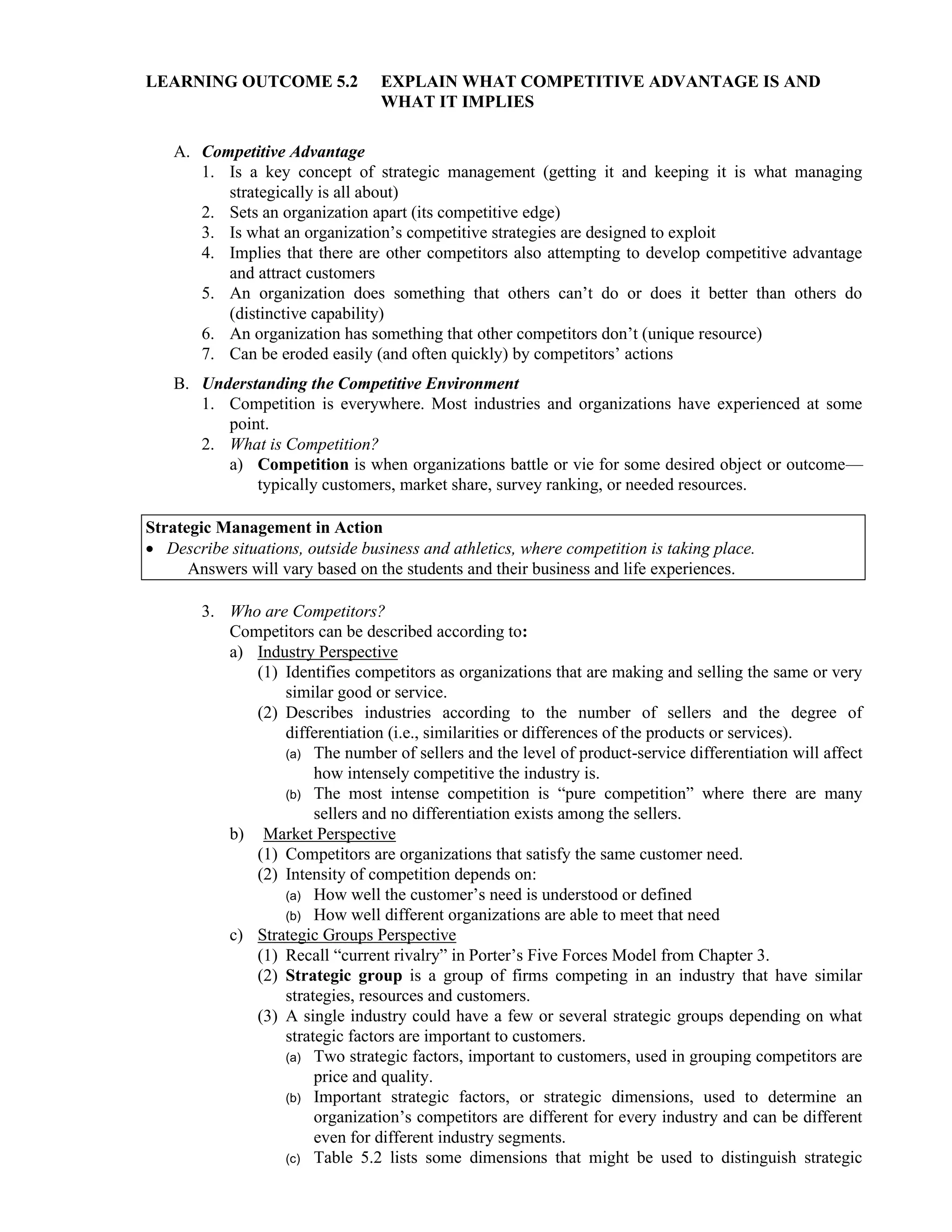
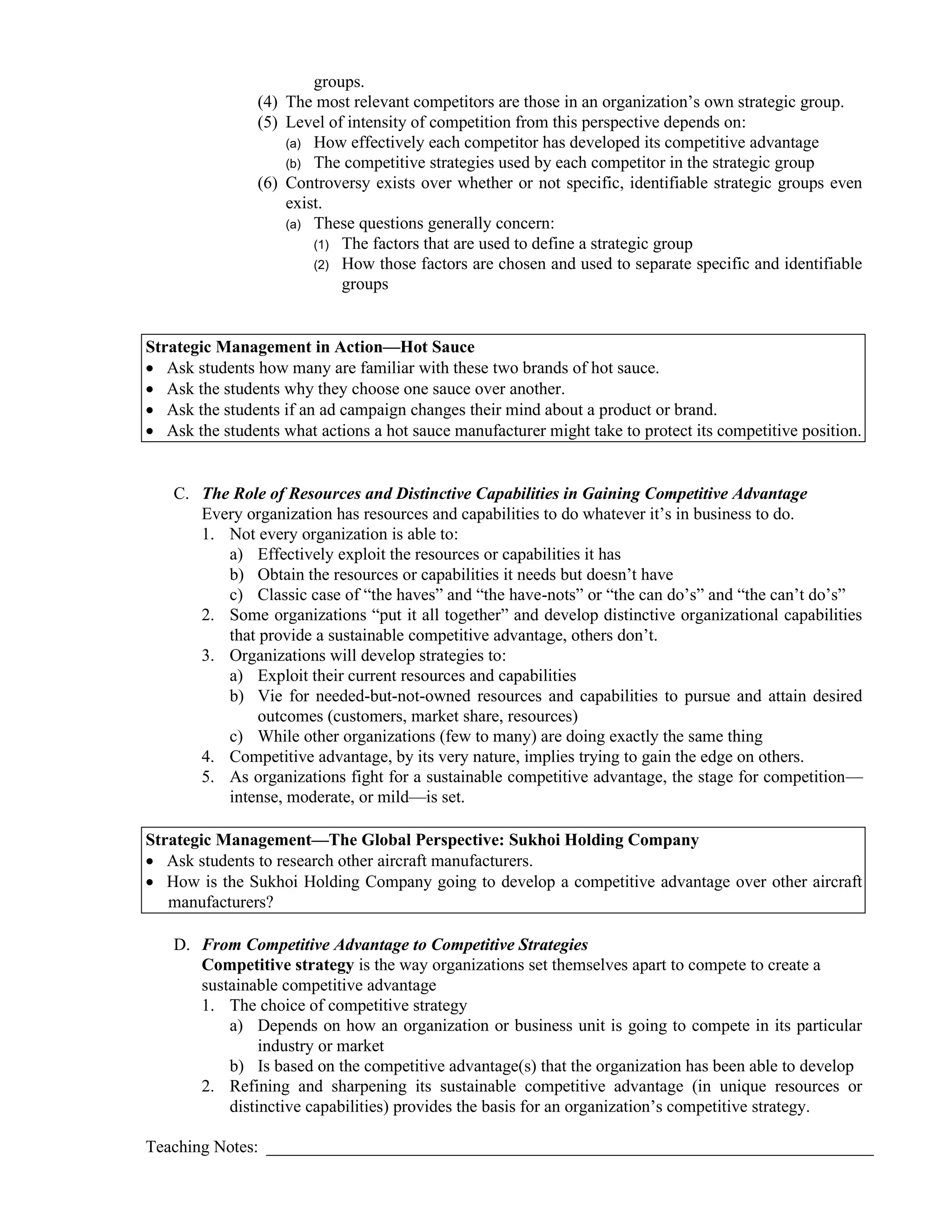
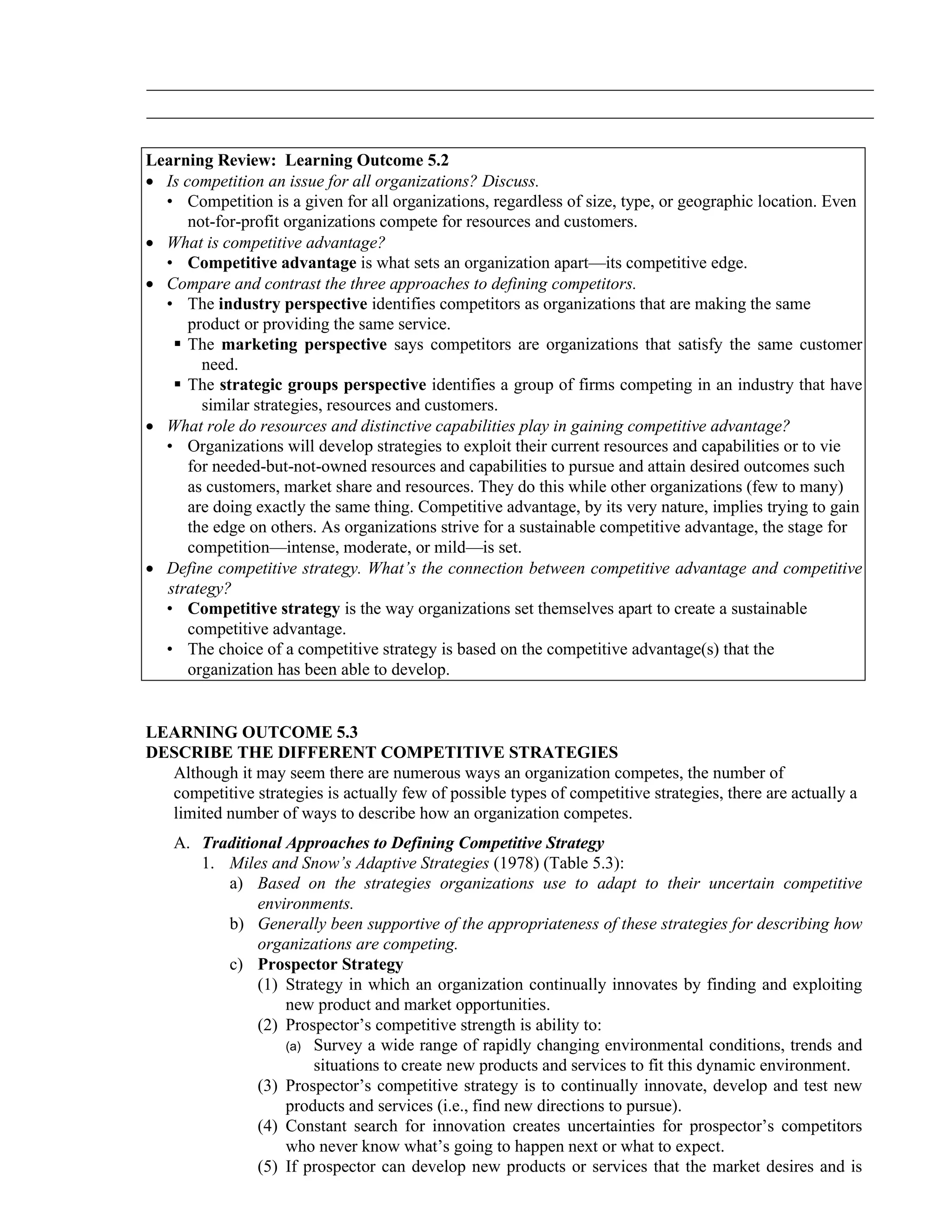
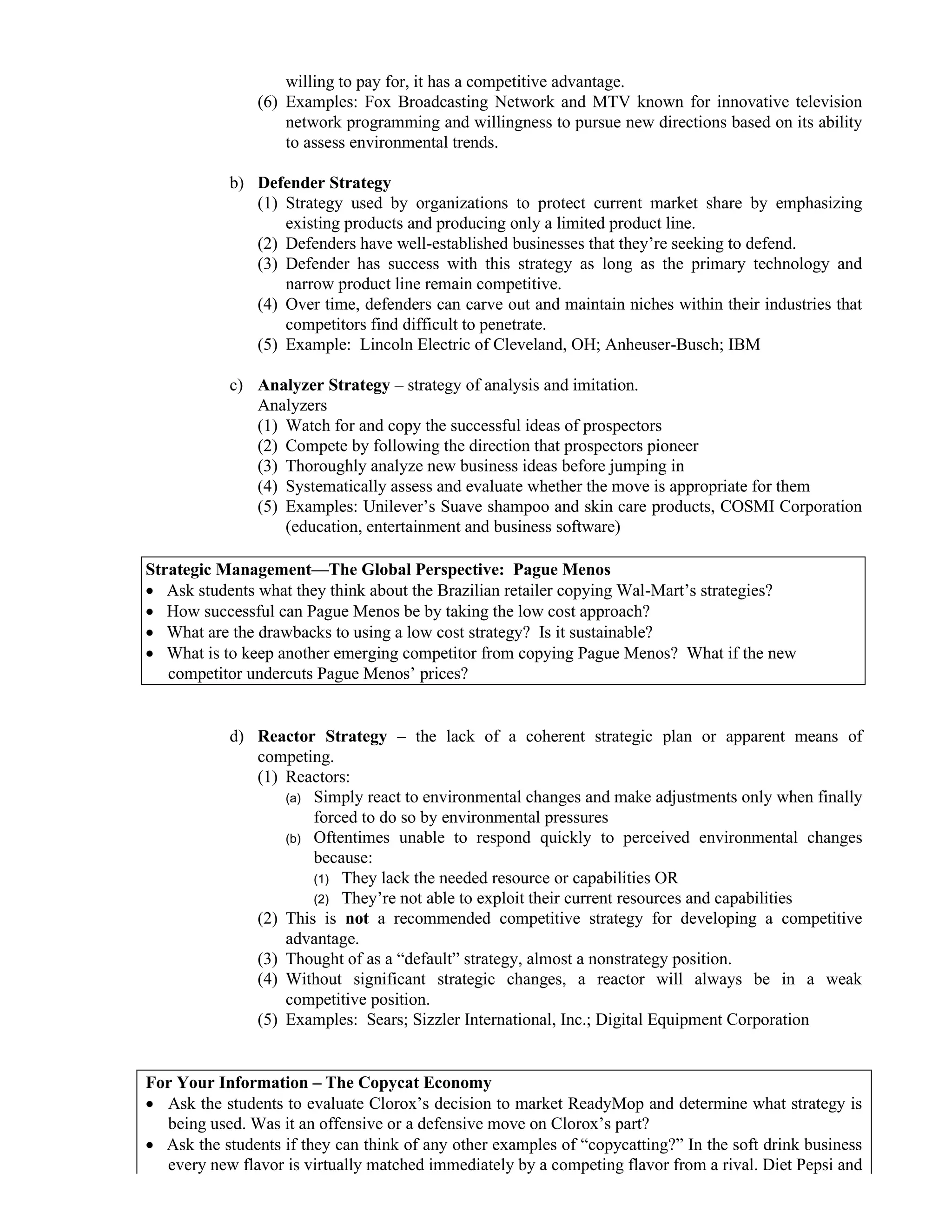

![were in a condition of high productiveness, and the monarch died,
leaving millions in the royal treasury.
But the salutary restraints imposed upon his disorderly subjects at
the commencement of his reign, had been augmented by degrees to
correspond to the demands of an evergrowing jealousy, until they
had become changed to a rigorous severity of discipline, or
vengeance, such as has been practised in few countries upon the
globe. The dungeons of the Citadel Henry were almost as fatal to
human life as the Black Hole at Calcutta, and it has been asserted,
that amidst the pestiferous exhalations and suffocative atmosphere
of these abodes of misery, the prisoners were almost sure to perish
after a short confinement. With less truth it has been alleged, that
fifty thousand persons lost their lives in these living tombs, while
thirty thousand others perished of fatigue, hunger, and hardship of
those who had been condemned for offences of a lighter nature, to
labors upon the public works of the kingdom, all of which were
performed under the lash and bayonet of the soldiery.[41]
These estimates are probably beyond the truth, though the number
is incredible of those who perished under the severe exactions of
Christophe’s tyranny, by hardship, imprisonment, military execution,
or the infliction of sudden death, executed amidst a burst of
ferocious vengeance in the despot. Christophe failed of giving
perpetuity to his government through the mere abuse of his power.
The king was fifty-three years of age at his death, having reigned
nine years. With a mind little capable of continuous thought,
Christophe possessed a strong and obstinate will. When once he had
gained an elevated position, he manifested great energy of
character. Anxious to augment by commerce the material strength of
his dominions, and to develop its moral power by education, he
imposed on the emancipated people a labor not unlike that of the
days of their servitude. Many hundreds of lives were sacrificed in
erecting the palace of Sans Souci, and grading its grounds. The
schools put in operation in his time, surpassed anything of the kind
ever introduced in that part of the Island before or since.](https://image.slidesharecdn.com/6296-250710200946-fd3a5d4b/75/Strategic-Management-in-Action-6th-Edition-Coulter-Solutions-Manual-28-2048.jpg)
![FOOTNOTE:
[41] Malo.](https://image.slidesharecdn.com/6296-250710200946-fd3a5d4b/75/Strategic-Management-in-Action-6th-Edition-Coulter-Solutions-Manual-29-2048.jpg)


![CHAPTER XXVI.
JAMAICA.
Jamaica, the chief of the British West India Islands, was discovered
by Columbus on his second voyage, in May, 1494, and was taken
from Spain by the English in May, 1655, during the reign of Oliver
Cromwell. It thus became an appendage to the British crown, after it
had been in the possession of Spain for one hundred and forty-six
years. The number of slaves on the Island at this time was about
fifteen hundred.
Morgan, a notorious pirate and buccaneer, was knighted and made
governor of the Island in 1670. Lord Vaughan succeeded Morgan,
and under his administration the African Company was formed, and
the slave-trade legalized; Africans were imported in large numbers,
and the development of the natural resources of Jamaica greatly
increased the wealth of the planters.
The number of slaves annually imported into the Island amounted to
sixteen thousand,[42] so that within thirty years the slave population
had increased from ninety-nine thousand to upwards of two hundred
thousand, whilst the total numerical strength of the whites did not
exceed sixteen thousand.
From this time down to the year 1832, it presented a succession of
wars, usurpations, crimes, misery, and vice; nor in this desert of
human wretchedness is there one green spot on which the mind of a
philanthropist would love to dwell; all is one revolting scene of
infamy, bloodshed, and unmitigated woe; of insecure peace and
open disturbance; of the abuse of power, and of the reaction of
misery against oppression. In 1832 an insurrection of the slaves
occurred, by which the lives of seven hundred slaves were sacrificed,](https://image.slidesharecdn.com/6296-250710200946-fd3a5d4b/75/Strategic-Management-in-Action-6th-Edition-Coulter-Solutions-Manual-42-2048.jpg)
![and an expense, including property destroyed, of one hundred and
sixty-two thousand pounds sterling.
The total importation of slaves from the conquest of the Island by
the English to 1805, amounted to eight hundred and fifty thousand,
and this added to forty thousand brought by the Spaniards, made an
aggregate of eight hundred and ninety thousand, exclusive of all
births, in three hundred years. The influence which the system of
slavery spread over the community in Jamaica and the rest of the
British West Indies, was not less demoralizing than in Hayti and the
other islands.
Crimes which in European countries would have been considered
and treated as a wanton insult to society at large, did not exclude
the parties from the pale of respectable society, or generally operate
to their disadvantage among the female portion of the community.
The reckless destroyers of female innocence and happiness united in
the dance, mingled in public entertainments, and were admitted at
the social board, and were on terms of intimacy with the younger
branches of families.[43]
The intermediate colors between the whites[44] and pure blacks,
were denominated as follows: A Sambo is the offspring of a mulatto
woman by a black man; a mulatto is the child of a black woman and
white man; a quadroon is the offspring of a mulatto by a white man,
and a mestee is that of a quadroon woman by a white man. The
offspring of a female mestee by a white man being above the third
in lineal descent from the Negro ancestor, was white, in the
estimation of the law, and enjoyed all the privileges and immunities
of Her Majesty’s white subjects; but all the rest, whether mulattoes,
quadroons, or mestees, were considered by the law as mulattoes or
persons of color.
Although the people of Jamaica represented to the home
government that the slaves were satisfied and happy, and would not
accept their freedom were it offered them, a revolt of the blacks](https://image.slidesharecdn.com/6296-250710200946-fd3a5d4b/75/Strategic-Management-in-Action-6th-Edition-Coulter-Solutions-Manual-43-2048.jpg)