1STRATEGIC MANAGEMENTEvaluation and Control
2Evaluation and Control Evaluation & Control:Process that ensures that the company is achieving what it set out to accomplish.  Compares performance with desired results.1) corporate2) divisional & functional
3Evaluation and Control
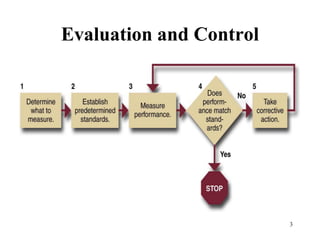
Hero Honda exampleWhat to measure: most important elements of process which account for the highest expense or problemsStandards of performance (KPIs): measures of expected performance results relating to strategic objectives. Acceptable tolerance indicated (KPIs)Measure performance at predetermined times4
Compare performance to asses deviations if anyCorrective action.Deviation by chanceIncorrect way of executionIncorrect  processbest person for corrective action5
6Evaluation & Control Information   Performance data and activity reports   Information on incorrect way of doing   should be available to operations managers for immediate  correction.   Information regarding incorrect process should reach top management to develop new one
7Evaluation and Control (corporate)Measuring Performance:Performance  end result of activityMeasures depend on organizational unitAppropriate Measures:ROI ( post mortem)Steering Controls (real time control, enabling corrective action) EX:  Statistical Process Control(SPC) in quality
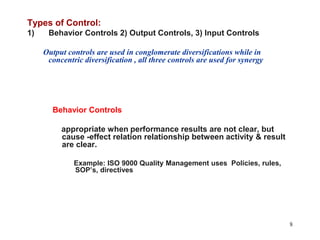
8Types of Control:Behavior Controls 2) Output Controls, 3) Input ControlsOutput controls are used in conglomerate diversifications while in concentric diversification , all three controls are used for synergyBehavior Controls    appropriate when performance results are not clear, but  cause -effect relation relationship between activity & result are clear.    Example: ISO 9000 Quality Management uses  Policies, rules, SOP’s, directives
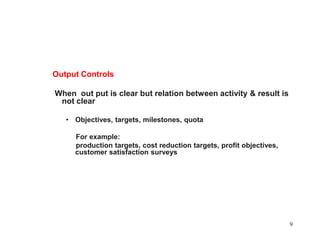
Output Controls When  out put is clear but relation between activity & result is not clearObjectives, targets, milestones, quota     For example:     production targets, cost reduction targets, profit objectives, customer satisfaction surveys9
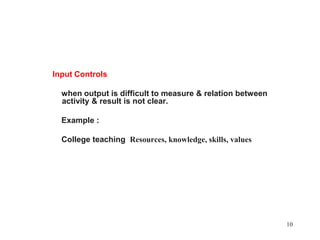
Input Controls    when output is difficult to measure & relation between activity & result is not clear.    Example :    College teaching  Resources, knowledge, skills, values10
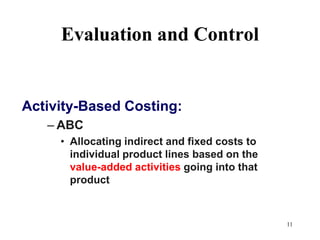
11Evaluation and Control Activity-Based Costing:ABCAllocating indirect and fixed costs to individual product lines based on the value-added activities going into that product
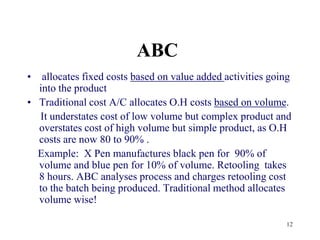
12ABC allocates fixed costs based on value added activities going into the productTraditional cost A/C allocates O.H costs based on volume.      It understates cost of low volume but complex product and overstates cost of high volume but simple product, as O.H costs are now 80 to 90% .    Example:  X Pen manufactures black pen for  90% of volume and blue pen for 10% of volume. Retooling  takes 8 hours. ABC analyses process and charges retooling cost to the batch being produced. Traditional method allocates volume wise!
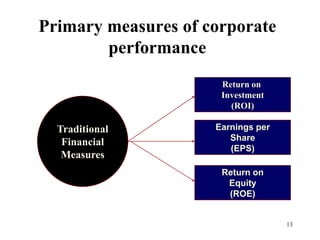
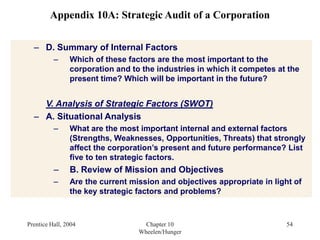
13Primary measures of corporate performanceReturn on Investment(ROI)Traditional Financial MeasuresEarnings perShare(EPS)Return onEquity(ROE)
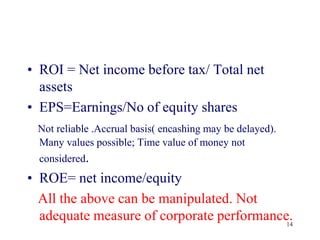
ROI = Net income before tax/ Total net assetsEPS=Earnings/No of equity sharesNot reliable .Accrual basis( encashing may be delayed). Many values possible; Time value of money not considered.ROE= net income/equity All the above can be manipulated. Not adequate measure of corporate performance.14
15Stake holder measures Top management must fix one or two measures addressing concerns of each stake holder group.
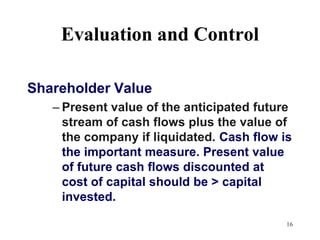
16Evaluation and Control Shareholder ValuePresent value of the anticipated future stream of cash flows plus the value of the company if liquidated.	Cash flow is the important measure. Present value of future cash flows discounted at cost of capital should be > capital invested.
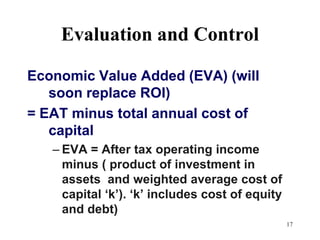
17Evaluation and Control Economic Value Added (EVA) (will soon replace ROI)= EAT minus total annual cost of capitalEVA = After tax operating income minus ( product of investment in assets  and weighted average cost of capital ‘k’). ‘k’ includes cost of equity and debt)
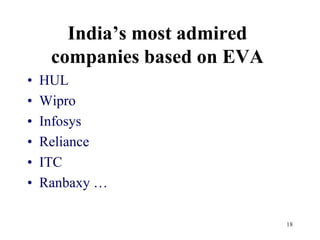
India’s most admired companies based on EVAHULWiproInfosysRelianceITCRanbaxy …18
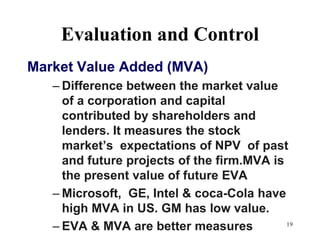
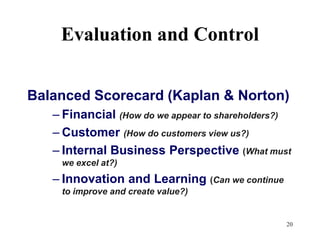
19Evaluation and Control Market Value Added (MVA)Difference between the market value of a corporation and capital contributed by shareholders and lenders. It measures the stock market’s  expectations of NPV  of past and future projects of the firm.MVA is  the present value of future EVA Microsoft,  GE, Intel & coca-Cola have high MVA in US. GM has low value.  EVA & MVA are better measures
20Evaluation and Control Balanced Scorecard (Kaplan & Norton)Financial (How do we appear to shareholders?)Customer (How do customers view us?)Internal Business Perspective (What must we excel at?)Innovation and Learning (Can we continue to improve and create value?)
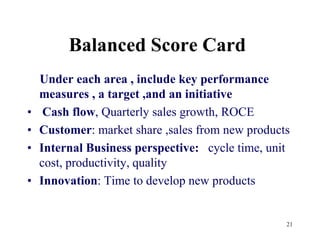
21Balanced Score Card    Under each area , include key performance  measures , a target ,and an initiativeCash flow, Quarterly sales growth, ROCECustomer: market share ,sales from new productsInternal Business perspective:   cycle time, unit cost, productivity, qualityInnovation: Time to develop new products
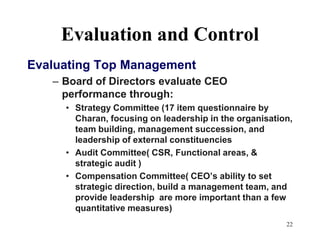
22Evaluation and Control Evaluating Top ManagementBoard of Directors evaluate CEO performance through:Strategy Committee (17 item questionnaire by Charan, focusing on leadership in the organisation, team building, management succession, and leadership of external constituenciesAudit Committee( CSR, Functional areas, & strategic audit ) Compensation Committee( CEO’s ability to set strategic direction, build a management team, and provide leadership  are more important than a few  quantitative measures)
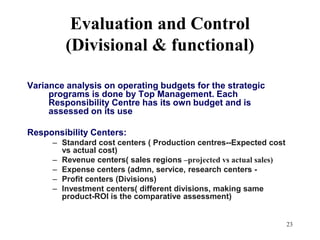
23Evaluation and Control (Divisional & functional) Variance analysis on operating budgets for the strategic programs is done by Top Management. Each Responsibility Centre has its own budget and is assessed on its useResponsibility Centers:Standard cost centers ( Production centres--Expected cost vs actual cost)Revenue centers( sales regions –projected vs actual sales)Expense centers (admn, service, research centers - Profit centers (Divisions)Investment centers( different divisions, making same product-ROI is the comparative assessment)
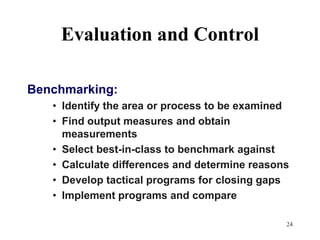
24Evaluation and Control Benchmarking:Identify the area or process to be examined
Find output measures and obtain measurements
Select best-in-class to benchmark against
Calculate differences and determine reasons
Develop tactical programs for closing gaps
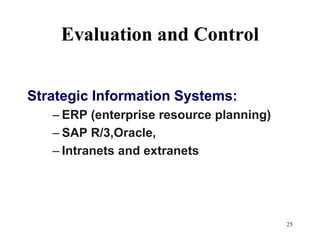
Implement programs and compare	25Evaluation and Control Strategic Information Systems:ERP (enterprise resource planning)SAP R/3,Oracle,Intranets and extranets
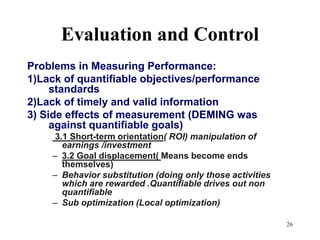
26Evaluation and Control Problems in Measuring Performance:1)Lack of quantifiable objectives/performance standards2)Lack of timely and valid information3) Side effects of measurement (DEMING was against quantifiable goals) 3.1 Short-term orientation( ROI) manipulation of earnings /investment3.2 Goal displacement( Means become ends themselves)Behavior substitution (doing only those activities which are rewarded .Quantifiable drives out non quantifiableSub optimization (Local optimization)
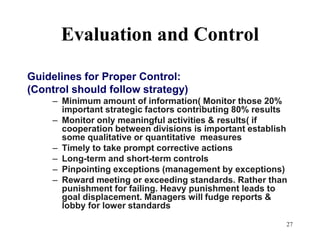
27Evaluation and Control Guidelines for Proper Control:(Control should follow strategy)Minimum amount of information( Monitor those 20% important strategic factors contributing 80% resultsMonitor only meaningful activities & results( if cooperation between divisions is important establish some qualitative or quantitative  measuresTimely to take prompt corrective actionsLong-term and short-term controlsPinpointing exceptions (management by exceptions)Reward meeting or exceeding standards. Rather than punishment for failing. Heavy punishment leads to goal displacement. Managers will fudge reports & lobby for lower standards
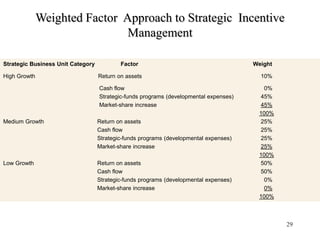
28Evaluation and Control Strategic Incentive Management:Weighted-factor method (SBU Managers)……. see next slideLong-term evaluation method ( Top corporate level managers) --Growth in EPS over 5 year periodStrategic-funds method (Expenses for current operations & developmental expenses are accounted separately, emphasizing S/T & L/T approaches
29Weighted Factor  Approach to Strategic  Incentive ManagementStrategic Business Unit Category                Factor                                                    	                WeightHigh Growth                                       Return on assets				 10%		Cash flow			                    	   0%       		Strategic-funds programs (developmental expenses)	 45%		Market-share increase				 45%100%Medium Growth	Return on assets				 25%	Cash flow					 25%	Strategic-funds programs (developmental expenses)	 25%	Market-share increase				 25%100%Low Growth	Return on assets				 50%	Cash flow					 50%	Strategic-funds programs (developmental expenses)	   0%	Market-share increase				   0%100%
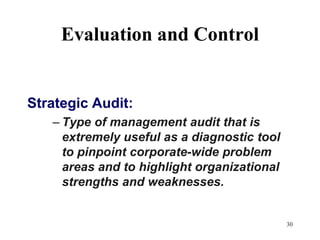
30Evaluation and Control Strategic Audit:Type of management audit that is extremely useful as a diagnostic tool to pinpoint corporate-wide problem areas and to highlight organizational strengths and weaknesses.
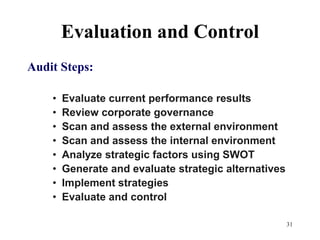
31Evaluation and ControlAudit Steps:Evaluate current performance results
Review corporate governance
Scan and assess the external environment
Scan and assess the internal environment
Analyze strategic factors using SWOT
Generate and evaluate strategic alternatives
Implement strategies
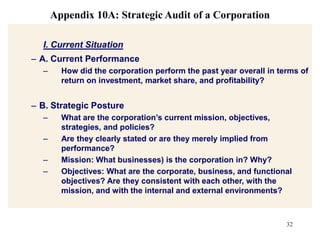
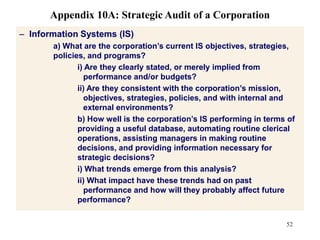
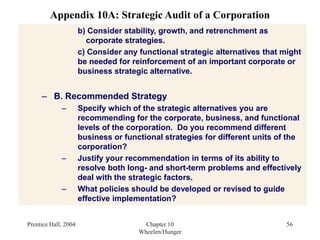
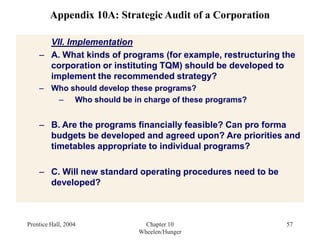
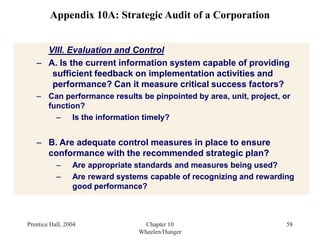
Evaluate and control32Appendix 10A: Strategic Audit of a CorporationI. Current SituationA. Current Performance
How did the corporation perform the past year overall in terms of return on investment, market share, and profitability?
B. Strategic Posture
What are the corporation’s current mission, objectives, strategies, and policies?
Are they clearly stated or are they merely implied from performance?
Mission: What businesses) is the corporation in? Why?
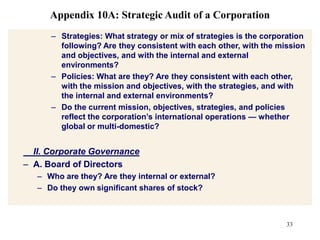
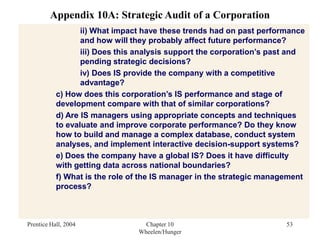
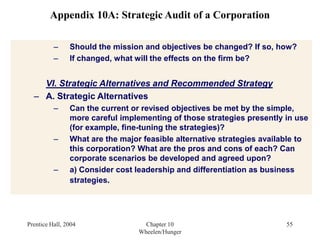
Objectives: What are the corporate, business, and functional objectives? Are they consistent with each other, with the mission, and with the internal and external environments?33Appendix 10A: Strategic Audit of a CorporationStrategies: What strategy or mix of strategies is the corporation following? Are they consistent with each other, with the mission and objectives, and with the internal and external environments?
Policies: What are they? Are they consistent with each other, with the mission and objectives, with the strategies, and with the internal and external environments?
Do the current mission, objectives, strategies, and policies reflect the corporation’s international operations — whether global or multi-domestic?	II. Corporate GovernanceA. Board of Directors
Who are they? Are they internal or external?
Do they own significant shares of stock?Prentice Hall, 2004	Chapter 10Wheelen/Hunger 34Appendix 10A: Strategic Audit of a CorporationIs the stock privately held or publicly traded? Are there different classes of stock with different voting rights?
What do they contribute to the corporation in terms of knowledge, skills, background, and connections? If the corporation has international operations, do board members have international experience?
How long have they served on the board?
What is their level of involvement in strategic management? Do they merely rubber-stamp top management’s proposals or do they actively participate and suggest future directions?35Appendix 10A: Strategic Audit of a CorporationB. Top Management
What person or group constitutes top management?
What are top management’s chief characteristics in terms of knowledge, skills, background, and style? If the corporation has international operations, does top management have international experience? Are executives from acquired companies considered part of the top management team?
Has top management been responsible for the corporation’s performance over the past few years? How many managers have been in their current position for less than 3 years? Were they internal promotions or external hires?

STRATEGIC MANAGEMENT Evaluation & Control Edited

  • 1.
  • 2.
    2Evaluation and ControlEvaluation & Control:Process that ensures that the company is achieving what it set out to accomplish. Compares performance with desired results.1) corporate2) divisional & functional
  • 3.
  • 4.
    Hero Honda exampleWhatto measure: most important elements of process which account for the highest expense or problemsStandards of performance (KPIs): measures of expected performance results relating to strategic objectives. Acceptable tolerance indicated (KPIs)Measure performance at predetermined times4
  • 5.
    Compare performance toasses deviations if anyCorrective action.Deviation by chanceIncorrect way of executionIncorrect processbest person for corrective action5
  • 6.
    6Evaluation & ControlInformation Performance data and activity reports Information on incorrect way of doing should be available to operations managers for immediate correction. Information regarding incorrect process should reach top management to develop new one
  • 7.
    7Evaluation and Control(corporate)Measuring Performance:Performance end result of activityMeasures depend on organizational unitAppropriate Measures:ROI ( post mortem)Steering Controls (real time control, enabling corrective action) EX: Statistical Process Control(SPC) in quality
  • 8.
    8Types of Control:BehaviorControls 2) Output Controls, 3) Input ControlsOutput controls are used in conglomerate diversifications while in concentric diversification , all three controls are used for synergyBehavior Controls appropriate when performance results are not clear, but cause -effect relation relationship between activity & result are clear. Example: ISO 9000 Quality Management uses Policies, rules, SOP’s, directives
  • 9.
    Output Controls When out put is clear but relation between activity & result is not clearObjectives, targets, milestones, quota For example: production targets, cost reduction targets, profit objectives, customer satisfaction surveys9
  • 10.
    Input Controls when output is difficult to measure & relation between activity & result is not clear. Example : College teaching Resources, knowledge, skills, values10
  • 11.
    11Evaluation and ControlActivity-Based Costing:ABCAllocating indirect and fixed costs to individual product lines based on the value-added activities going into that product
  • 12.
    12ABC allocates fixedcosts based on value added activities going into the productTraditional cost A/C allocates O.H costs based on volume. It understates cost of low volume but complex product and overstates cost of high volume but simple product, as O.H costs are now 80 to 90% . Example: X Pen manufactures black pen for 90% of volume and blue pen for 10% of volume. Retooling takes 8 hours. ABC analyses process and charges retooling cost to the batch being produced. Traditional method allocates volume wise!
  • 13.
    13Primary measures ofcorporate performanceReturn on Investment(ROI)Traditional Financial MeasuresEarnings perShare(EPS)Return onEquity(ROE)
  • 14.
    ROI = Netincome before tax/ Total net assetsEPS=Earnings/No of equity sharesNot reliable .Accrual basis( encashing may be delayed). Many values possible; Time value of money not considered.ROE= net income/equity All the above can be manipulated. Not adequate measure of corporate performance.14
  • 15.
    15Stake holder measuresTop management must fix one or two measures addressing concerns of each stake holder group.
  • 16.
    16Evaluation and ControlShareholder ValuePresent value of the anticipated future stream of cash flows plus the value of the company if liquidated. Cash flow is the important measure. Present value of future cash flows discounted at cost of capital should be > capital invested.
  • 17.
    17Evaluation and ControlEconomic Value Added (EVA) (will soon replace ROI)= EAT minus total annual cost of capitalEVA = After tax operating income minus ( product of investment in assets and weighted average cost of capital ‘k’). ‘k’ includes cost of equity and debt)
  • 18.
    India’s most admiredcompanies based on EVAHULWiproInfosysRelianceITCRanbaxy …18
  • 19.
    19Evaluation and ControlMarket Value Added (MVA)Difference between the market value of a corporation and capital contributed by shareholders and lenders. It measures the stock market’s expectations of NPV of past and future projects of the firm.MVA is the present value of future EVA Microsoft, GE, Intel & coca-Cola have high MVA in US. GM has low value. EVA & MVA are better measures
  • 20.
    20Evaluation and ControlBalanced Scorecard (Kaplan & Norton)Financial (How do we appear to shareholders?)Customer (How do customers view us?)Internal Business Perspective (What must we excel at?)Innovation and Learning (Can we continue to improve and create value?)
  • 21.
    21Balanced Score Card Under each area , include key performance measures , a target ,and an initiativeCash flow, Quarterly sales growth, ROCECustomer: market share ,sales from new productsInternal Business perspective: cycle time, unit cost, productivity, qualityInnovation: Time to develop new products
  • 22.
    22Evaluation and ControlEvaluating Top ManagementBoard of Directors evaluate CEO performance through:Strategy Committee (17 item questionnaire by Charan, focusing on leadership in the organisation, team building, management succession, and leadership of external constituenciesAudit Committee( CSR, Functional areas, & strategic audit ) Compensation Committee( CEO’s ability to set strategic direction, build a management team, and provide leadership are more important than a few quantitative measures)
  • 23.
    23Evaluation and Control(Divisional & functional) Variance analysis on operating budgets for the strategic programs is done by Top Management. Each Responsibility Centre has its own budget and is assessed on its useResponsibility Centers:Standard cost centers ( Production centres--Expected cost vs actual cost)Revenue centers( sales regions –projected vs actual sales)Expense centers (admn, service, research centers - Profit centers (Divisions)Investment centers( different divisions, making same product-ROI is the comparative assessment)
  • 24.
    24Evaluation and ControlBenchmarking:Identify the area or process to be examined
  • 25.
    Find output measuresand obtain measurements
  • 26.
    Select best-in-class tobenchmark against
  • 27.
    Calculate differences anddetermine reasons
  • 28.
  • 29.
    Implement programs andcompare 25Evaluation and Control Strategic Information Systems:ERP (enterprise resource planning)SAP R/3,Oracle,Intranets and extranets
  • 30.
    26Evaluation and ControlProblems in Measuring Performance:1)Lack of quantifiable objectives/performance standards2)Lack of timely and valid information3) Side effects of measurement (DEMING was against quantifiable goals) 3.1 Short-term orientation( ROI) manipulation of earnings /investment3.2 Goal displacement( Means become ends themselves)Behavior substitution (doing only those activities which are rewarded .Quantifiable drives out non quantifiableSub optimization (Local optimization)
  • 31.
    27Evaluation and ControlGuidelines for Proper Control:(Control should follow strategy)Minimum amount of information( Monitor those 20% important strategic factors contributing 80% resultsMonitor only meaningful activities & results( if cooperation between divisions is important establish some qualitative or quantitative measuresTimely to take prompt corrective actionsLong-term and short-term controlsPinpointing exceptions (management by exceptions)Reward meeting or exceeding standards. Rather than punishment for failing. Heavy punishment leads to goal displacement. Managers will fudge reports & lobby for lower standards
  • 32.
    28Evaluation and ControlStrategic Incentive Management:Weighted-factor method (SBU Managers)……. see next slideLong-term evaluation method ( Top corporate level managers) --Growth in EPS over 5 year periodStrategic-funds method (Expenses for current operations & developmental expenses are accounted separately, emphasizing S/T & L/T approaches
  • 33.
    29Weighted Factor Approach to Strategic Incentive ManagementStrategic Business Unit Category Factor WeightHigh Growth Return on assets 10% Cash flow 0% Strategic-funds programs (developmental expenses) 45% Market-share increase 45%100%Medium Growth Return on assets 25% Cash flow 25% Strategic-funds programs (developmental expenses) 25% Market-share increase 25%100%Low Growth Return on assets 50% Cash flow 50% Strategic-funds programs (developmental expenses) 0% Market-share increase 0%100%
  • 34.
    30Evaluation and ControlStrategic Audit:Type of management audit that is extremely useful as a diagnostic tool to pinpoint corporate-wide problem areas and to highlight organizational strengths and weaknesses.
  • 35.
    31Evaluation and ControlAuditSteps:Evaluate current performance results
  • 36.
  • 37.
    Scan and assessthe external environment
  • 38.
    Scan and assessthe internal environment
  • 39.
  • 40.
    Generate and evaluatestrategic alternatives
  • 41.
  • 42.
    Evaluate and control32Appendix10A: Strategic Audit of a CorporationI. Current SituationA. Current Performance
  • 43.
    How did thecorporation perform the past year overall in terms of return on investment, market share, and profitability?
  • 44.
  • 45.
    What are thecorporation’s current mission, objectives, strategies, and policies?
  • 46.
    Are they clearlystated or are they merely implied from performance?
  • 47.
    Mission: What businesses) isthe corporation in? Why?
  • 48.
    Objectives: What are thecorporate, business, and functional objectives? Are they consistent with each other, with the mission, and with the internal and external environments?33Appendix 10A: Strategic Audit of a CorporationStrategies: What strategy or mix of strategies is the corporation following? Are they consistent with each other, with the mission and objectives, and with the internal and external environments?
  • 49.
    Policies: What are they?Are they consistent with each other, with the mission and objectives, with the strategies, and with the internal and external environments?
  • 50.
    Do the currentmission, objectives, strategies, and policies reflect the corporation’s international operations — whether global or multi-domestic? II. Corporate GovernanceA. Board of Directors
  • 51.
    Who are they?Are they internal or external?
  • 52.
    Do they ownsignificant shares of stock?Prentice Hall, 2004 Chapter 10Wheelen/Hunger 34Appendix 10A: Strategic Audit of a CorporationIs the stock privately held or publicly traded? Are there different classes of stock with different voting rights?
  • 53.
    What do theycontribute to the corporation in terms of knowledge, skills, background, and connections? If the corporation has international operations, do board members have international experience?
  • 54.
    How long havethey served on the board?
  • 55.
    What is theirlevel of involvement in strategic management? Do they merely rubber-stamp top management’s proposals or do they actively participate and suggest future directions?35Appendix 10A: Strategic Audit of a CorporationB. Top Management
  • 56.
    What person orgroup constitutes top management?
  • 57.
    What are topmanagement’s chief characteristics in terms of knowledge, skills, background, and style? If the corporation has international operations, does top management have international experience? Are executives from acquired companies considered part of the top management team?
  • 58.
    Has top managementbeen responsible for the corporation’s performance over the past few years? How many managers have been in their current position for less than 3 years? Were they internal promotions or external hires?