1E-Professional development
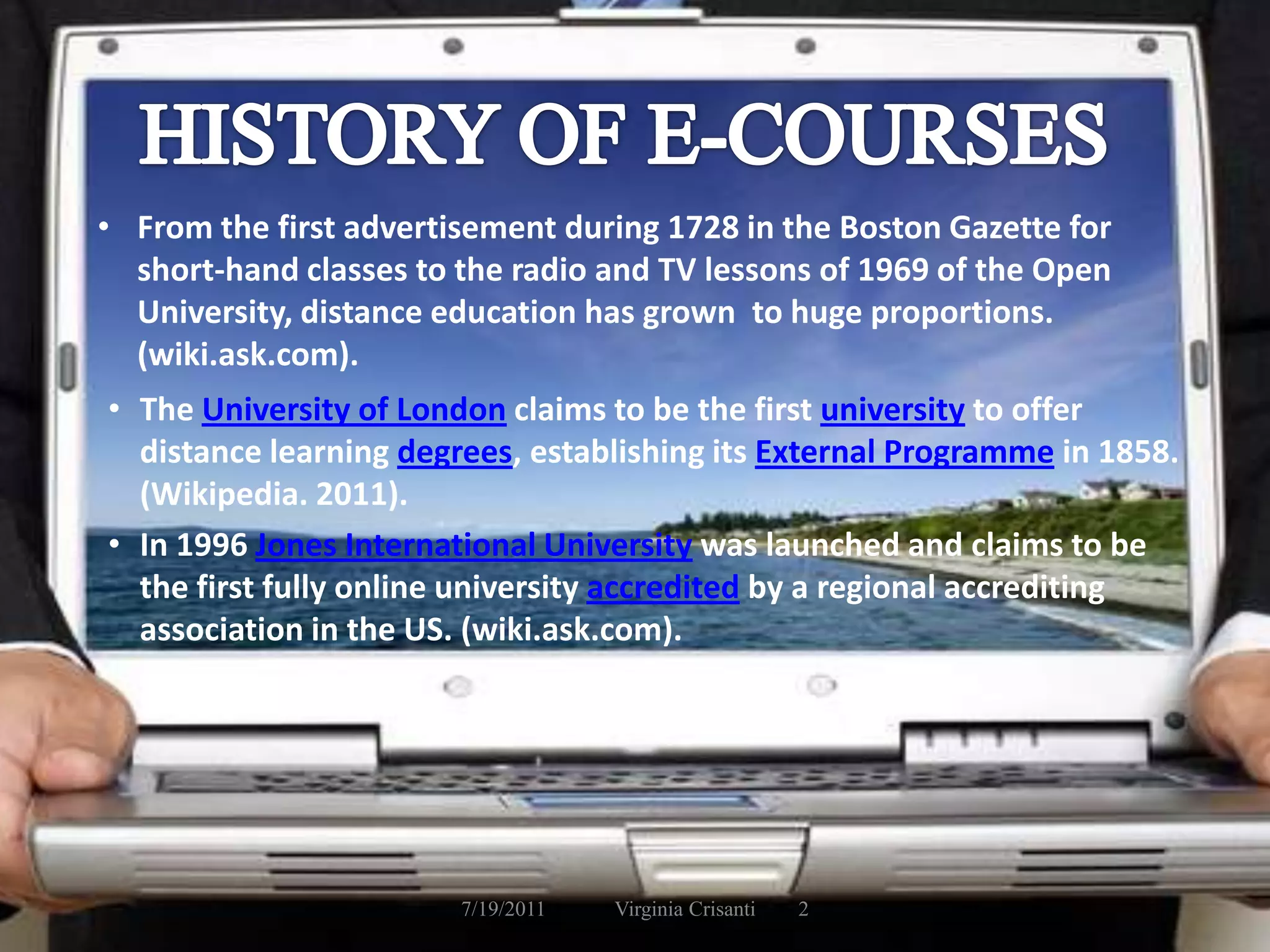
2HISTORY OF E-COURSESFrom the first advertisement during 1728 in the Boston Gazette for short-hand classes to the radio and TV lessons of 1969 of the Open University, distance education has grown  to huge proportions. (wiki.ask.com).The University of London claims to be the first university to offer distance learning degrees, establishing its External Programme in 1858. (Wikipedia. 2011).In 1996 Jones International University was launched and claims to be the first fully online university accredited by a regional accrediting association in the US. (wiki.ask.com).7/19/2011             Virginia Crisanti2
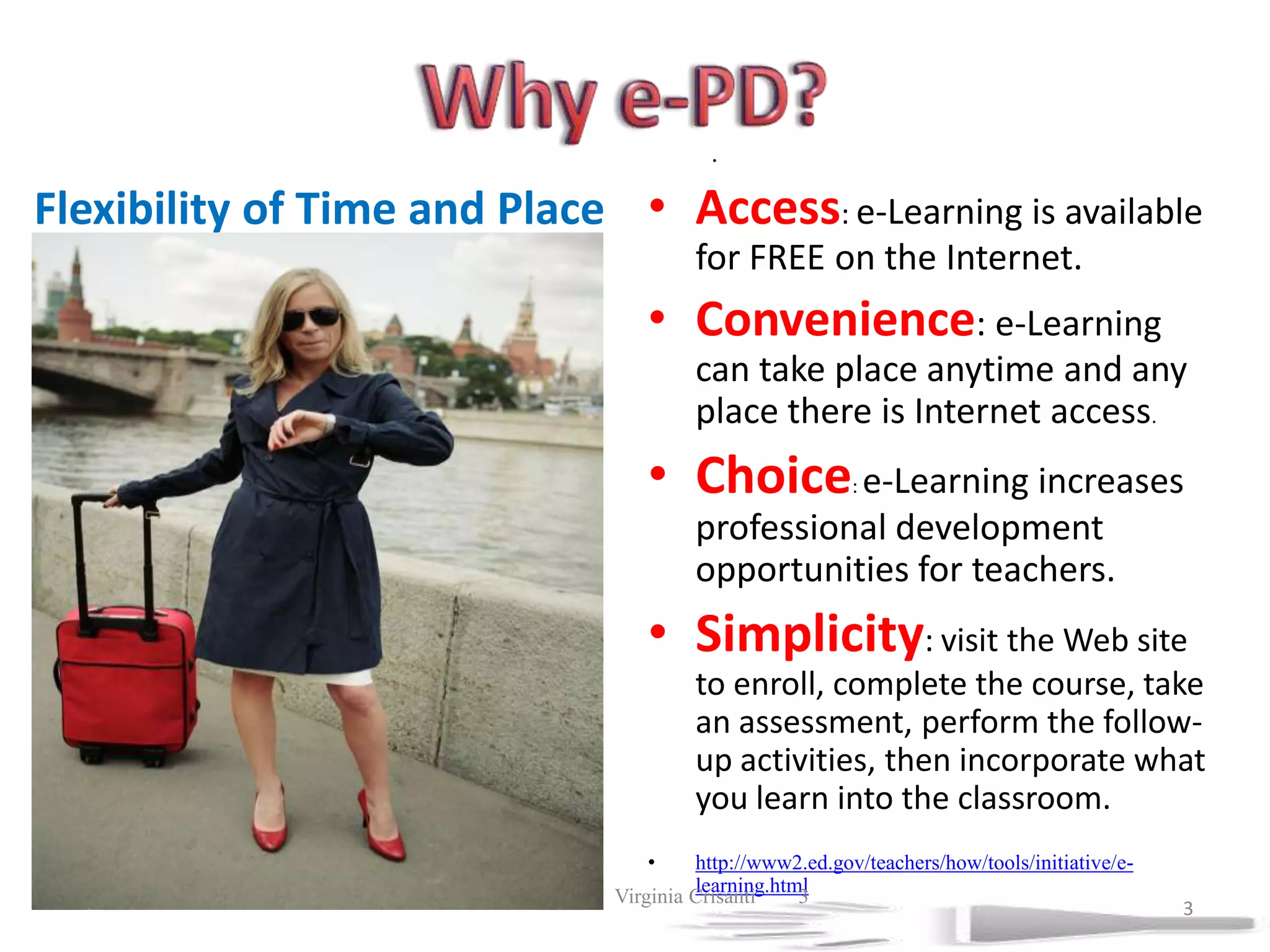
Why e-PD?.Access: e-Learning is available for FREE on the Internet. Convenience: e-Learning can take place anytime and any place there is Internet access. Choice: e-Learning increases professional development opportunities for teachers. Simplicity: visit the Web site to enroll, complete the course, take an assessment, perform the follow-up activities, then incorporate what you learn into the classroom. http://www2.ed.gov/teachers/how/tools/initiative/e-learning.htmlFlexibility of Time and Place7/19/2011             Virginia Crisanti33
7/19/2011             Virginia Crisanti44 INNOVATION  SUCCESS       EVALUATIONDEVELOPMENT         GROWTHSOLUTION      PROGRESS            MARKETINGStudent/Enrollment Trends The current higher education infrastructure cannot accommodate the growingWhat problem or need existed that gave rise to your innovation?
5RESEARCHWhat were their findings?This study provides a body of evidence that teachers’ participation in a coordinated series of OPD courses have effects that translate into improvements in targeted student outcomes.What seems to be lacking is a system for helping educators to continually learn about new educational resources and more effectively keep track of and inform each other about the best practices for technology supported learning.Using online communities for professional development at a distance can help reduce isolation in the classroom (Schlager, Fusco & Schank, 2002)
E-PDRESEARCHWhat research organization or people developed a solution to this problem or need?e-Learning for Educators (efe) Project. inTASC@bc.edu.)7/19/2011             Virginia Crisanti        66
E-PD Who were the “lead thinkers” for this innovation?How did they convince a manufacturer to produce it?7
DEVELOPMENTWhat problems did your innovation encounter in the development process?“It depends on the individual,” she says. “Just like online learning isn’t for all students, it’s not for all teachers either.”  (Davis. 2009).CPD activities should:be spread over timebe collaborativeuse active learningbe delivered to groups of teachersinclude periods of practice, coaching, and follow-up promote reflective practiceencourage experimentation, andrespond to teachers’ needs.[7][8][9]^ see: Snow-Renner and Lauer, ‘Professional Development Analysis (synthesis of 54 studies), McREL, 2005 ^ see Garet, Porter, Desmoine, Birman, Kwang, What makes professional development effective? American Education Research Journal 38(4) 915-946. 2001 ^ see General Teaching Council for England ,‘Teachers’ Professional Learning’, London, 2005.8
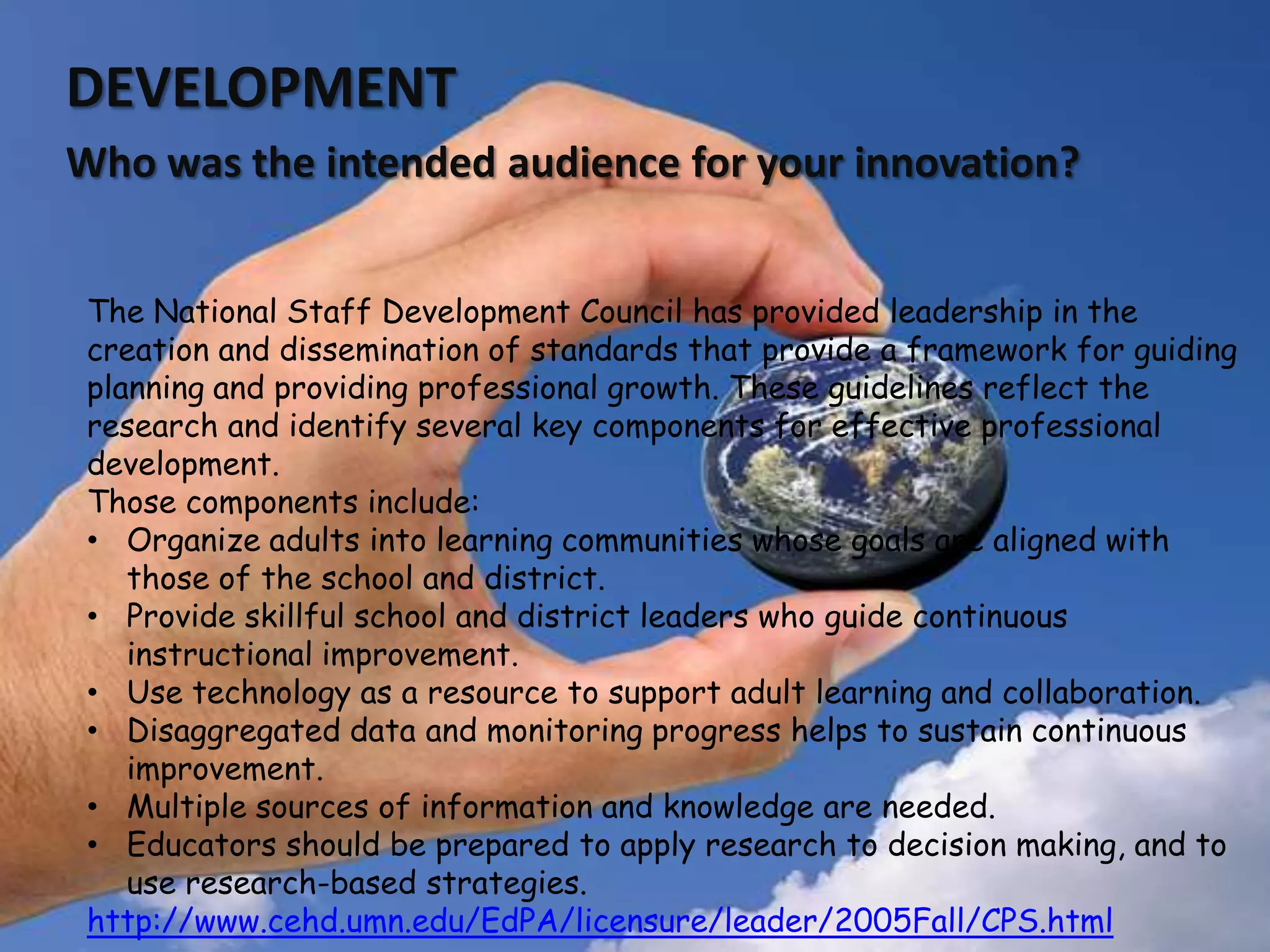
9DEVELOPMENTWho was the intended audience for your innovation? The National Staff Development Council has provided leadership in the creation and dissemination of standards that provide a framework for guiding planning and providing professional growth. These guidelines reflect the research and identify several key components for effective professional development. Those components include:Organize adults into learning communities whose goals are aligned with those of the school and district.
Provide skillful school and district leaders who guide continuous instructional improvement.
Use technology as a resource to support adult learning and collaboration.
Disaggregated data and monitoring progress helps to sustain continuous improvement.
Multiple sources of information and knowledge are needed.
Educators should be prepared to apply research to decision making, and to use research-based strategies.http://www.cehd.umn.edu/EdPA/licensure/leader/2005Fall/CPS.html
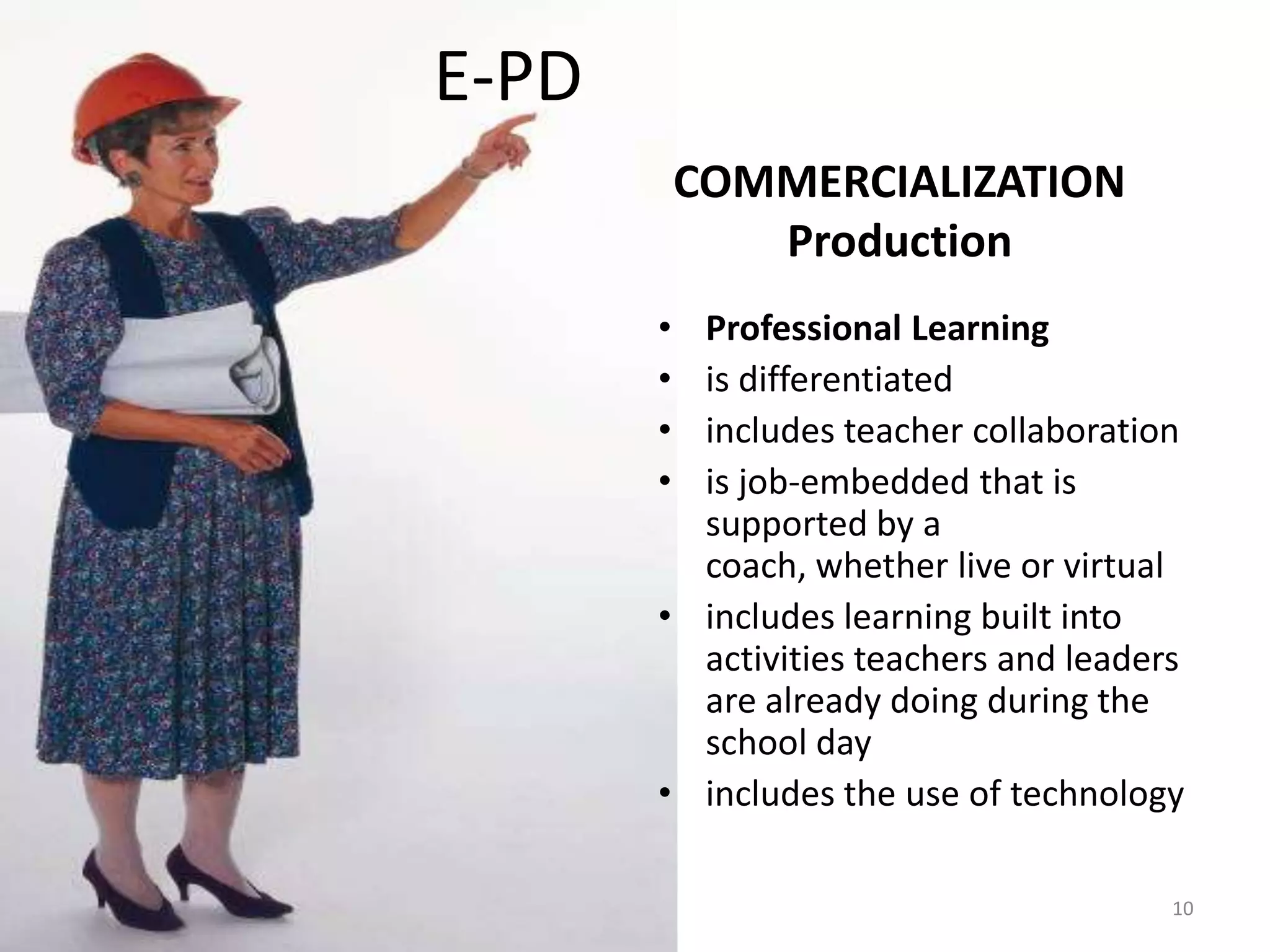
E-PD COMMERCIALIZATIONProduction10Professional Learningis differentiatedincludes teacher collaborationis job-embedded that is supported by a coach, whether live or virtualincludes learning built into activities teachers and leaders are already doing during the school dayincludes the use of technology
11COMMERCIALIZATIONManufacturing
COMMERCIALIZATIONMarketing12E-PDCOMMERCIALIZATIONPackaging
E-PDRESOURCESCOMMERCIALIZATIONDistribution of your innovation. Ravitz, J. & Hoadley. C. Supporting change and scholarship through review of online resources in professional development settings. Schlager British Journal of Educational Technology March, 2005.M., Fusco, J. & Schank, P. (2002). Evolution of an online education community of practice. In K. Renninger and W. Shumar (Eds.), Building virtual communities: Learning and change in cyberspace. New York, NY: Cambridge University Press, 129-158.Davis. M.R. (2009) Online professional development weighed as cost-saving tactic.  IT Management. Retrieved fromKezar. S. (2011). 21st Century Teaching and Learning Online Best Practices: Professional Development (PD) Support for Individuals, Schools, and Districts - Sylva Kezar, ASCD . Notes from TCEA 2011 Session. Retrieved fromO’Dwyer, L.M., Masters, J.,Dash, S., De Kramer, R.M.,Humez, A., & Russel, M.,  (2010). e-Learning for Educators Effects of On-Line Professional Development on Teachers and their Students:  Executive Summary         of Four Randomized Trials.  Retrieved from http://www.bc.edu/research/intasc/PDF/EFE_Findings2010_ExecutiveSummary.pdfBecause traditional face-to-face professional development gathers people in one place at one time, it can’t reach as many educators. (Davis. 2009).As part of its popular Teacher-to-Teacher Initiative, the U.S. Department of Education launched the groundbreaking e-Learning professional development Web site.Teachers receive free training focused on content knowledge and instructional skills. Thirty-two digital workshops are currently available on a wide variety of topics, including elementary-level reading, vocabulary, reading in content areas, algebra, turning data into information, and differentiated instruction. The Department's Web site has a searchable database of over 1,500 free teaching resources and lesson plans. To date, the e-Learning site has logged more than 300,000 visitshttp://www2.ed.gov/teachers/how/tools/initiative/e-learning.html13
Diffusion of E-PDAnticipated Innovators & Early AdoptorsThose who need:FlexibilityAccessibilityJust-in-time learning Self-paced learning14Persuasive StrategiesConvenience of time, location, and selection.
Time, handicapped, options.
Need based, current, timely.
Allows multiple levels:  accelerated vs. extra time.Change agent must meet the need of the learner and show them the advantage relative to their need.

Storyboard e pd edit 8

  • 1.
  • 2.
    2HISTORY OF E-COURSESFromthe first advertisement during 1728 in the Boston Gazette for short-hand classes to the radio and TV lessons of 1969 of the Open University, distance education has grown to huge proportions. (wiki.ask.com).The University of London claims to be the first university to offer distance learning degrees, establishing its External Programme in 1858. (Wikipedia. 2011).In 1996 Jones International University was launched and claims to be the first fully online university accredited by a regional accrediting association in the US. (wiki.ask.com).7/19/2011 Virginia Crisanti2
  • 3.
    Why e-PD?.Access: e-Learningis available for FREE on the Internet. Convenience: e-Learning can take place anytime and any place there is Internet access. Choice: e-Learning increases professional development opportunities for teachers. Simplicity: visit the Web site to enroll, complete the course, take an assessment, perform the follow-up activities, then incorporate what you learn into the classroom. http://www2.ed.gov/teachers/how/tools/initiative/e-learning.htmlFlexibility of Time and Place7/19/2011 Virginia Crisanti33
  • 4.
    7/19/2011 Virginia Crisanti44 INNOVATION SUCCESS EVALUATIONDEVELOPMENT GROWTHSOLUTION PROGRESS MARKETINGStudent/Enrollment Trends The current higher education infrastructure cannot accommodate the growingWhat problem or need existed that gave rise to your innovation?
  • 5.
    5RESEARCHWhat were theirfindings?This study provides a body of evidence that teachers’ participation in a coordinated series of OPD courses have effects that translate into improvements in targeted student outcomes.What seems to be lacking is a system for helping educators to continually learn about new educational resources and more effectively keep track of and inform each other about the best practices for technology supported learning.Using online communities for professional development at a distance can help reduce isolation in the classroom (Schlager, Fusco & Schank, 2002)
  • 6.
    E-PDRESEARCHWhat research organizationor people developed a solution to this problem or need?e-Learning for Educators (efe) Project. inTASC@bc.edu.)7/19/2011 Virginia Crisanti 66
  • 7.
    E-PD Who werethe “lead thinkers” for this innovation?How did they convince a manufacturer to produce it?7
  • 8.
    DEVELOPMENTWhat problems didyour innovation encounter in the development process?“It depends on the individual,” she says. “Just like online learning isn’t for all students, it’s not for all teachers either.” (Davis. 2009).CPD activities should:be spread over timebe collaborativeuse active learningbe delivered to groups of teachersinclude periods of practice, coaching, and follow-up promote reflective practiceencourage experimentation, andrespond to teachers’ needs.[7][8][9]^ see: Snow-Renner and Lauer, ‘Professional Development Analysis (synthesis of 54 studies), McREL, 2005 ^ see Garet, Porter, Desmoine, Birman, Kwang, What makes professional development effective? American Education Research Journal 38(4) 915-946. 2001 ^ see General Teaching Council for England ,‘Teachers’ Professional Learning’, London, 2005.8
  • 9.
    9DEVELOPMENTWho was theintended audience for your innovation? The National Staff Development Council has provided leadership in the creation and dissemination of standards that provide a framework for guiding planning and providing professional growth. These guidelines reflect the research and identify several key components for effective professional development. Those components include:Organize adults into learning communities whose goals are aligned with those of the school and district.
  • 10.
    Provide skillful schooland district leaders who guide continuous instructional improvement.
  • 11.
    Use technology asa resource to support adult learning and collaboration.
  • 12.
    Disaggregated data andmonitoring progress helps to sustain continuous improvement.
  • 13.
    Multiple sources ofinformation and knowledge are needed.
  • 14.
    Educators should beprepared to apply research to decision making, and to use research-based strategies.http://www.cehd.umn.edu/EdPA/licensure/leader/2005Fall/CPS.html
  • 15.
    E-PD COMMERCIALIZATIONProduction10Professional Learningis differentiatedincludesteacher collaborationis job-embedded that is supported by a coach, whether live or virtualincludes learning built into activities teachers and leaders are already doing during the school dayincludes the use of technology
  • 16.
  • 17.
  • 18.
    E-PDRESOURCESCOMMERCIALIZATIONDistribution of yourinnovation. Ravitz, J. & Hoadley. C. Supporting change and scholarship through review of online resources in professional development settings. Schlager British Journal of Educational Technology March, 2005.M., Fusco, J. & Schank, P. (2002). Evolution of an online education community of practice. In K. Renninger and W. Shumar (Eds.), Building virtual communities: Learning and change in cyberspace. New York, NY: Cambridge University Press, 129-158.Davis. M.R. (2009) Online professional development weighed as cost-saving tactic. IT Management. Retrieved fromKezar. S. (2011). 21st Century Teaching and Learning Online Best Practices: Professional Development (PD) Support for Individuals, Schools, and Districts - Sylva Kezar, ASCD . Notes from TCEA 2011 Session. Retrieved fromO’Dwyer, L.M., Masters, J.,Dash, S., De Kramer, R.M.,Humez, A., & Russel, M., (2010). e-Learning for Educators Effects of On-Line Professional Development on Teachers and their Students: Executive Summary of Four Randomized Trials. Retrieved from http://www.bc.edu/research/intasc/PDF/EFE_Findings2010_ExecutiveSummary.pdfBecause traditional face-to-face professional development gathers people in one place at one time, it can’t reach as many educators. (Davis. 2009).As part of its popular Teacher-to-Teacher Initiative, the U.S. Department of Education launched the groundbreaking e-Learning professional development Web site.Teachers receive free training focused on content knowledge and instructional skills. Thirty-two digital workshops are currently available on a wide variety of topics, including elementary-level reading, vocabulary, reading in content areas, algebra, turning data into information, and differentiated instruction. The Department's Web site has a searchable database of over 1,500 free teaching resources and lesson plans. To date, the e-Learning site has logged more than 300,000 visitshttp://www2.ed.gov/teachers/how/tools/initiative/e-learning.html13
  • 19.
    Diffusion of E-PDAnticipatedInnovators & Early AdoptorsThose who need:FlexibilityAccessibilityJust-in-time learning Self-paced learning14Persuasive StrategiesConvenience of time, location, and selection.
  • 20.
  • 21.
  • 22.
    Allows multiple levels: accelerated vs. extra time.Change agent must meet the need of the learner and show them the advantage relative to their need.
  • 23.
    Anticipated laggardsAre thosewho:Persuasive StrategiesCommunication strategies that target the laggards.Use internet to reach them.Show positive results and rewards.Motivate slowly and in a safe environment.Offer significant support.15Live in the PastAre suspicious of changeAre resistant to changeMaintain the status quo.Have limited resources/opportunities.Are cautious.
  • 24.
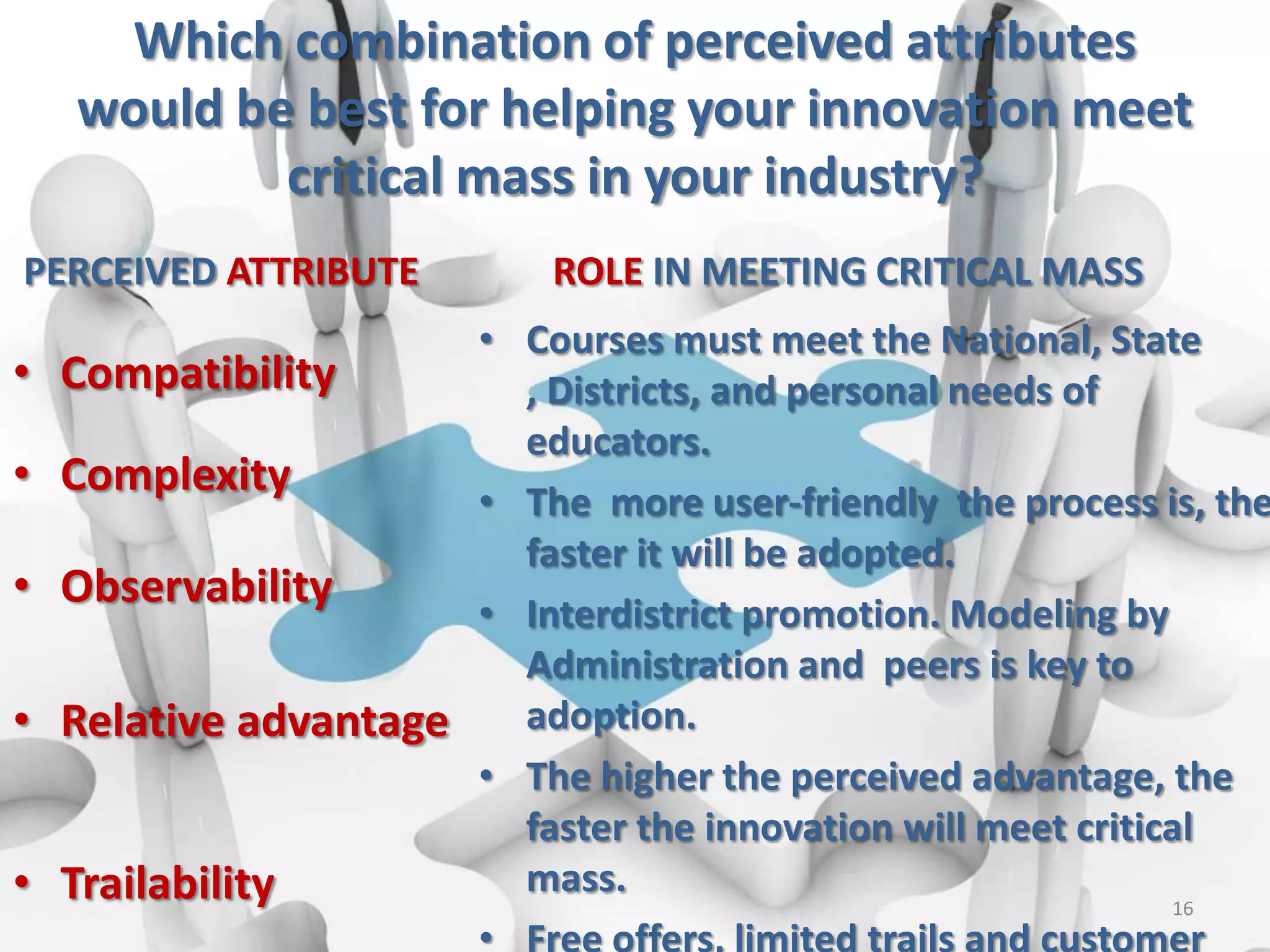
    Which combination ofperceived attributes would be best for helping your innovation meet critical mass in your industry?PERCEIVED ATTRIBUTEROLE IN MEETING CRITICAL MASSCourses must meet the National, State , Districts, and personal needs of educators.The more user-friendly the process is, the faster it will be adopted.Interdistrict promotion. Modeling by Administration and peers is key to adoption.The higher the perceived advantage, the faster the innovation will meet critical mass.Free offers, limited trails and customer support would increase usage.16CompatibilityComplexityObservabilityRelative advantageTrailability
  • 25.
    Adoption of E-PDCentralizedapproachContinued use of My Learning Plan.comIdentify pre-approved online PD.Direct teachers to select goal courses.***Establish means to obtain approval for individual courses necessary to meet educational goals.17
  • 26.
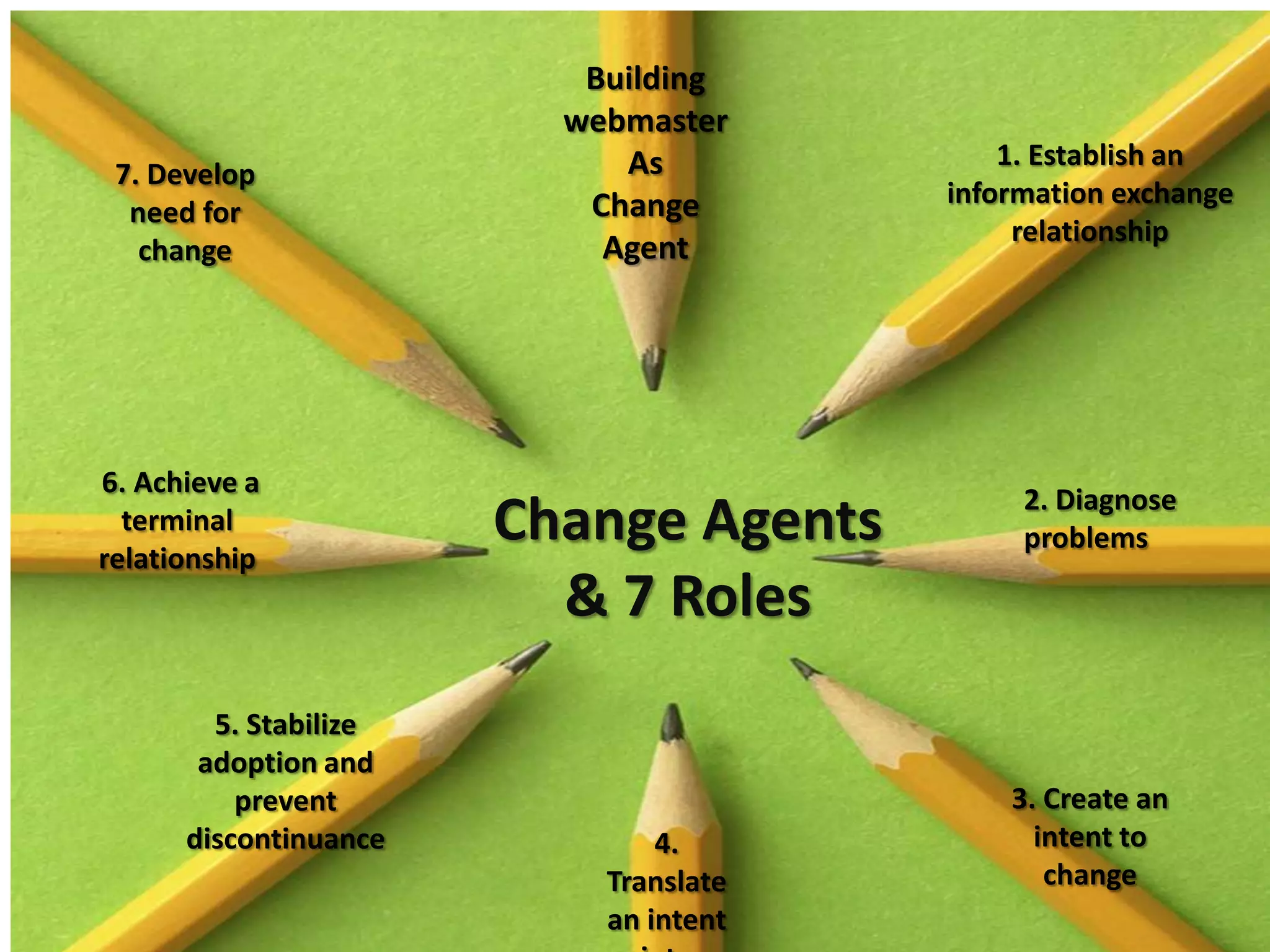
    18Building webmasterAs ChangeAgent1. Establish an information exchange relationship7. Develop need for change 6. Achieve a terminal relationshipChange Agents & 7 Roles2. Diagnoseproblems5. Stabilize adoption and prevent discontinuance3. Create an intent to change4. Translate an intent into action
  • 27.
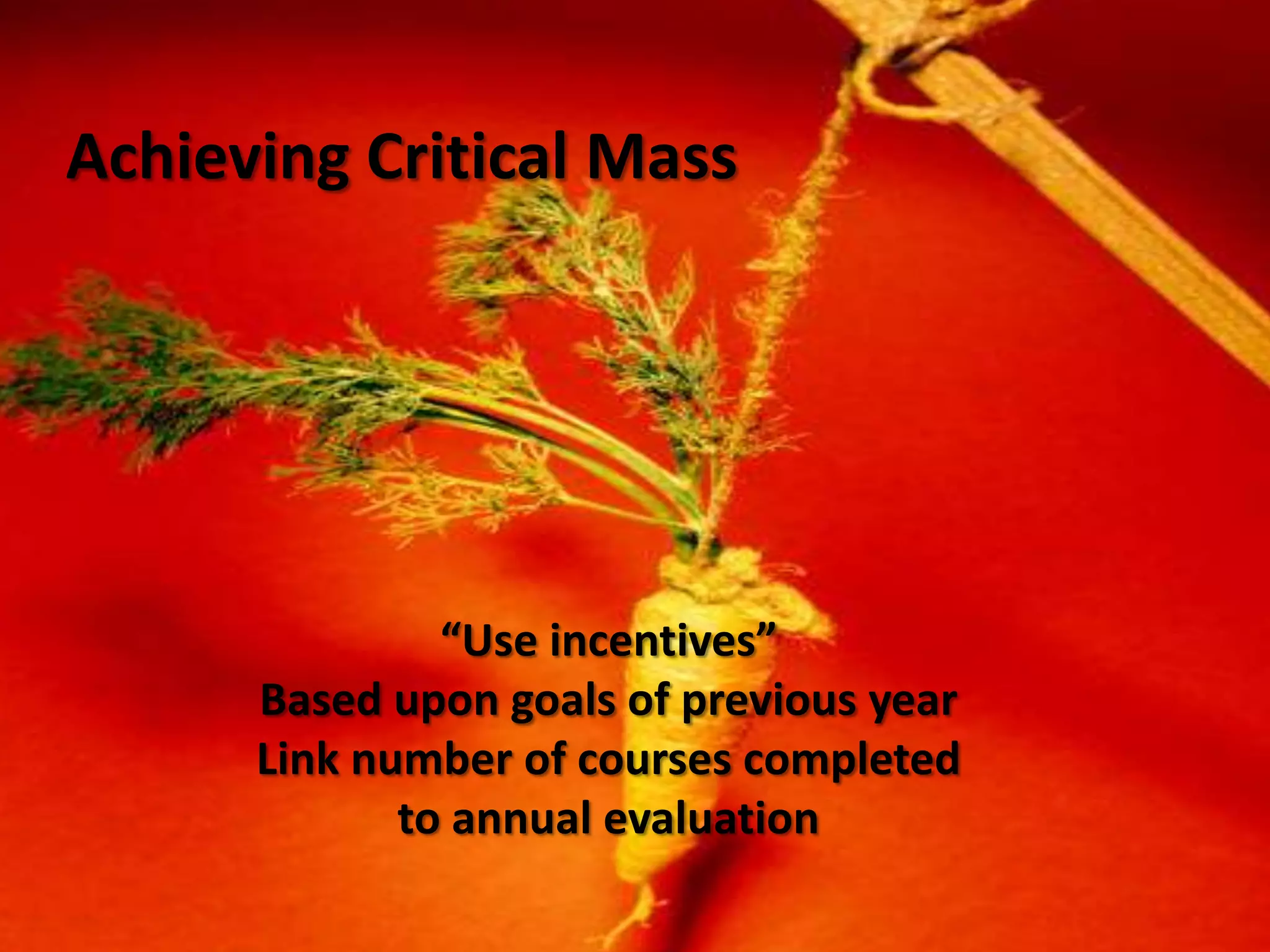
    19Achieving Critical MassHasthe innovation you are proposing to the Board already met critical mass in society? If it has not met critical mass, which of the four strategies for achieving critical mass do you recommend to the Board for your innovation? “Use incentives” Based upon goals of previous yearLink number of courses completed to annual evaluation
  • 28.
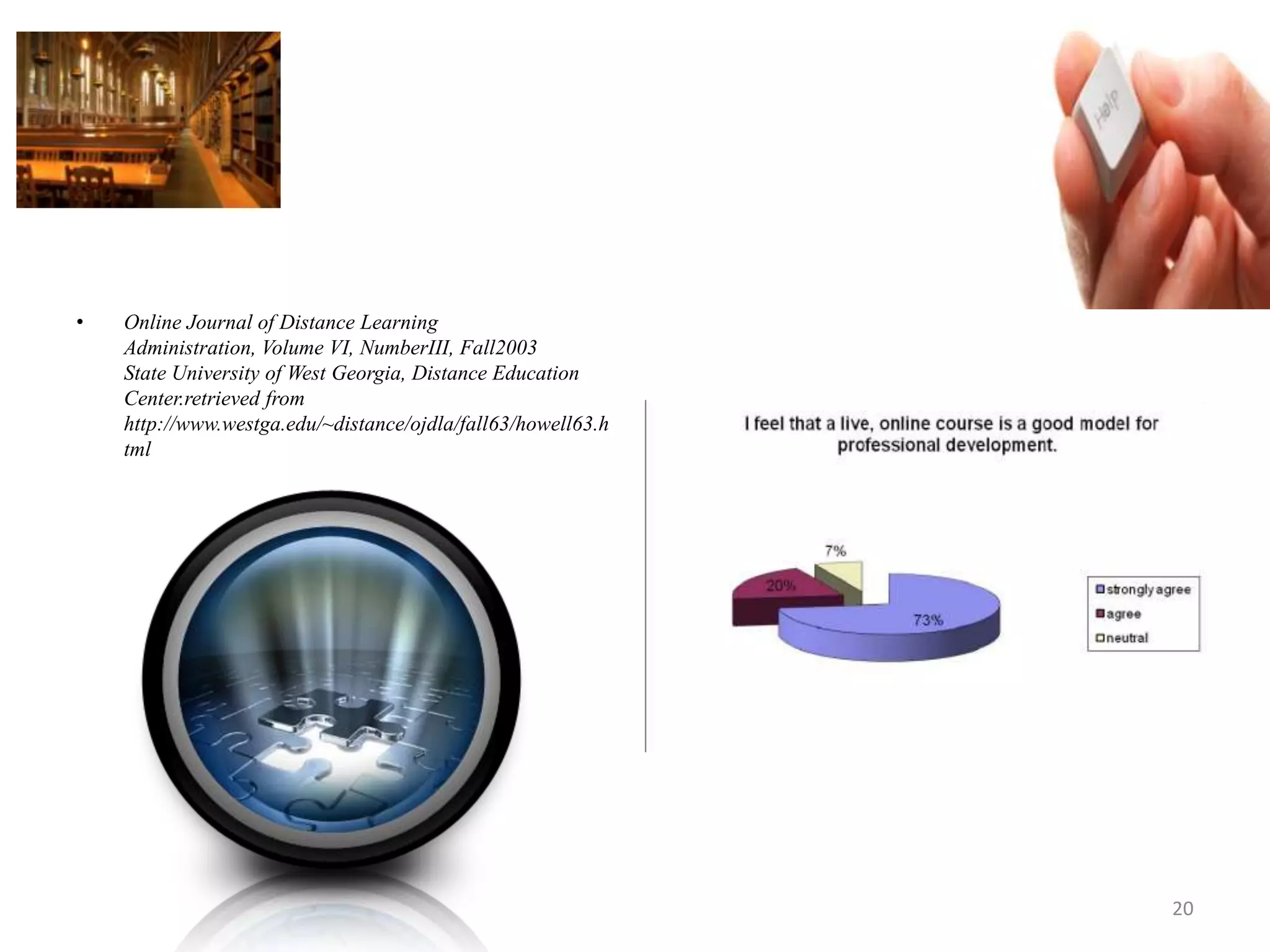
    Online Journal ofDistance Learning Administration, Volume VI, NumberIII, Fall2003State University of West Georgia, Distance Education Center.retrieved from http://www.westga.edu/~distance/ojdla/fall63/howell63.html20
  • 29.
    Computers & EducationVolume51, Issue 2, September 2008, Pages 955-967 http://www.newman.ac.uk/Students_Websites/~m.m.friel/index.htmE-learning: emerging uses, empirical results and future directionsElizabeth T. Welsh, Connie R. Wanberg, Kenneth G. Brown, Marcia J. SimmeringArticle first published online: 14 NOV 2003DOI: 10.1046/j.1360-3736.2003.00184.x21
  • 30.
    "We want toprovide teachers with strategies that are proven to work. And teachers want to hear from other teachers who are getting real results in the classroom. That's why professional development through e-Learning is such an important part of the No Child Left Behind Act."— U.S. Secretary of Education Margaret Spellingshttp://books.google.com/books?hl=en&lr=&id=yOpH1aOuopcC&oi=fnd&pg=PR6&dq=research+and+development+about+E-learning+technology&ots=jvB2_Zj_Ln&sig=8tkx5RymbTYOzrODAkn_qlDRSUs#v=onepage&q=research%20and%20development%20about%20E-learning%20technology&f=false22