By April & Sadie
STORE DESIGN
Chapter 17
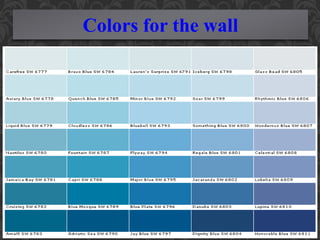
Colors for the wall
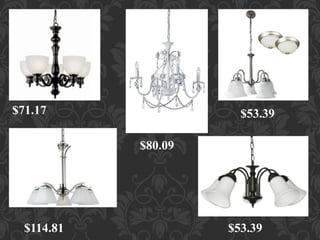
$71.17
$80.09
$53.39
$114.81 $53.39
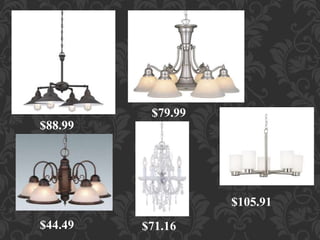
$88.99
$79.99
$44.49
$105.91
$71.16
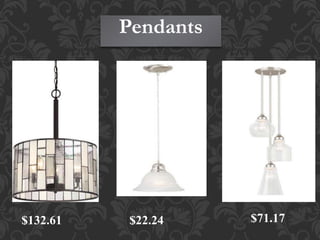
$132.61 $71.17$22.24
Pendants
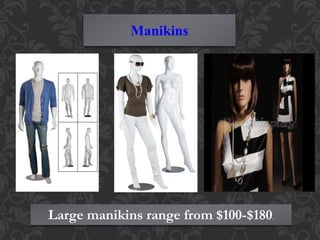
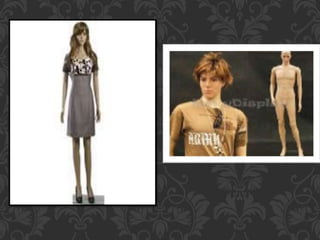
Manikins
Large manikins range from $100-$180.
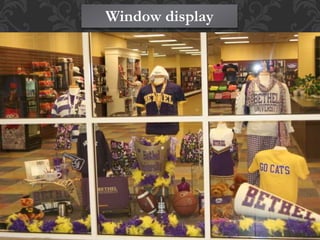
Window display
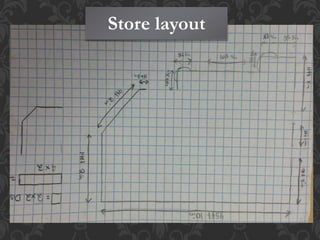
Store layout
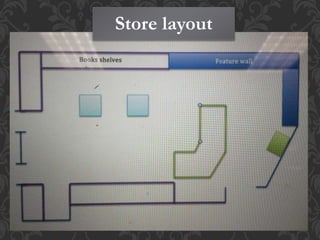
Store layout
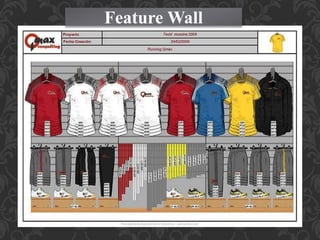
Feature Wall
ADA
Americans with Disabilities Act
It protects people with disabilities from discrimination
and employment, transportation, public
accommodations, and telecommunications, and
activities of state and local governments.
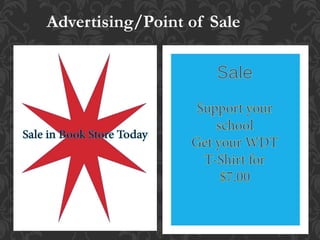
Advertising/Point of Sale
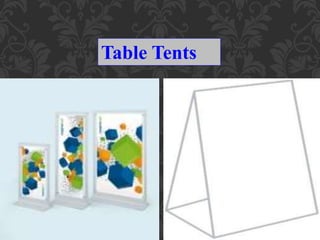
Table Tents
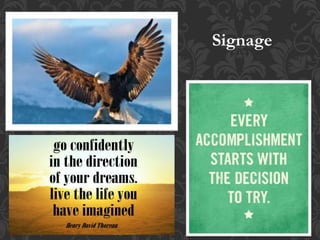
Signage
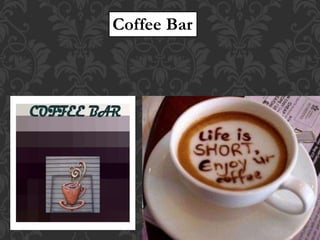
Coffee Bar
Music
Music can either add or distract from a
retailers total atmospheric package.
Take survey see what stations, or music
selection students listen to.
93.1,95.9, 98.7, 101.1, 97.5 and etc.
Any Questions
or
suggestions?.
Signage and
Graphics
Signage and graphics help customers locate
specific products and departments, provide
product information, and suggest items or special
purchases.
Call-to-action signage: places in strategic locations in the store can
convey how, where, and why
 Category signage: used within a particular department or sector or
sector of the store to identify types of products offered
 Promotional signage: describes special offers and found within the
store or displayed in windows
 Point-of-sale signage: are placed near the merchandise they refer to
so that customers know its price and other detailed info
Digital signage
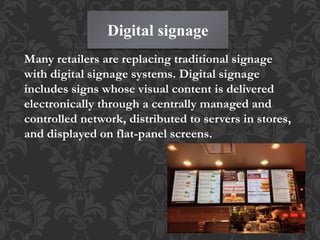
Many retailers are replacing traditional signage
with digital signage systems. Digital signage
includes signs whose visual content is delivered
electronically through a centrally managed and
controlled network, distributed to servers in stores,
and displayed on flat-panel screens.
Feature Areas
Are areas within a store that are designed to
get customers attention
 Windows: draw customers into the store and
provide a visual message about the type of
merchandise
 Entrances: first impression caused by the entry
area affects the customers image of the store
 Freestanding Displays: are fixtures that are
located on aisles and designed primarily to attract
customers attention and bring them in
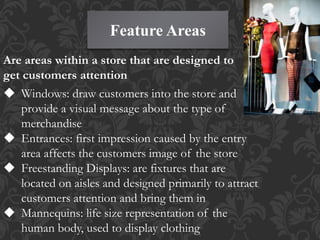
 Mannequins: life size representation of the
human body, used to display clothing
 End Caps: are displays located at the end of an aisle in
stores using a grid layout
 Promotional Aisle or Area: is space used to display
merchandise that is being promoted
 Walls: because retail floor space is often limited, many
retailers increase their ability to store extra stock, display
merchandise, and creatively present a message by utilizing
wall space
 Dressing Rooms: are critical spaces, where customers often
decide whether to purchase an item
 Cash Wraps: also known as piont of purchase counters, are
places in the store where customers can poruchase
merchandise.
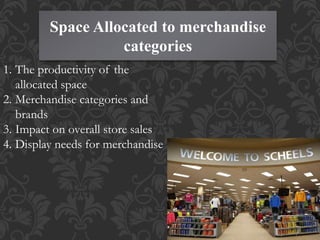
Space Allocated to merchandise
categories
1. The productivity of the
allocated space
2. Merchandise categories and
brands
3. Impact on overall store sales
4. Display needs for merchandise
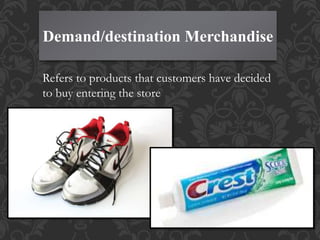
Demand/destination Merchandise
Refers to products that customers have decided
to buy entering the store
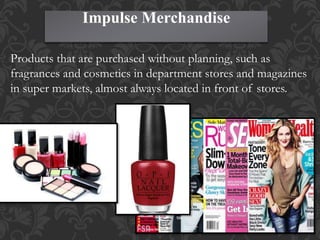
Impulse Merchandise
Products that are purchased without planning, such as
fragrances and cosmetics in department stores and magazines
in super markets, almost always located in front of stores.
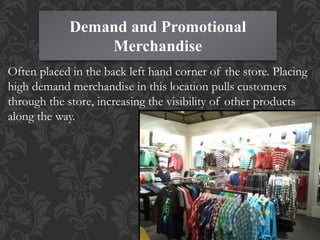
Demand and Promotional
Merchandise
Often placed in the back left hand corner of the store. Placing
high demand merchandise in this location pulls customers
through the store, increasing the visibility of other products
along the way.
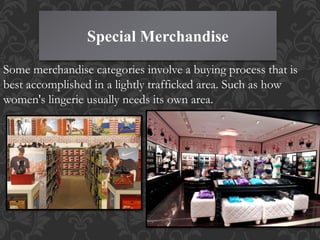
Special Merchandise
Some merchandise categories involve a buying process that is
best accomplished in a lightly trafficked area. Such as how
women's lingerie usually needs its own area.
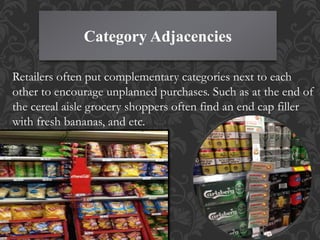
Category Adjacencies
Retailers often put complementary categories next to each
other to encourage unplanned purchases. Such as at the end of
the cereal aisle grocery shoppers often find an end cap filler
with fresh bananas, and etc.
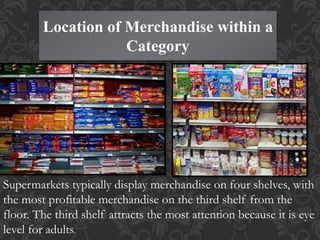
Location of Merchandise within a
Category
Supermarkets typically display merchandise on four shelves, with
the most profitable merchandise on the third shelf from the
floor. The third shelf attracts the most attention because it is eye
level for adults.
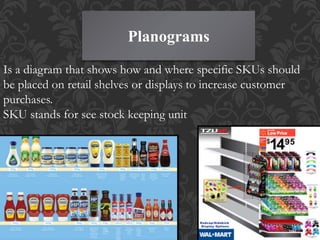
Planograms
Is a diagram that shows how and where specific SKUs should
be placed on retail shelves or displays to increase customer
purchases.
SKU stands for see stock keeping unit
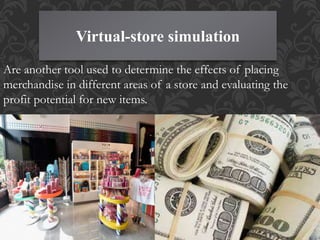
Virtual-store simulation
Are another tool used to determine the effects of placing
merchandise in different areas of a store and evaluating the
profit potential for new items.
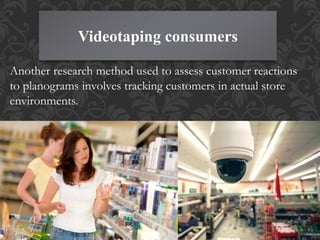
Videotaping consumers
Another research method used to assess customer reactions
to planograms involves tracking customers in actual store
environments.
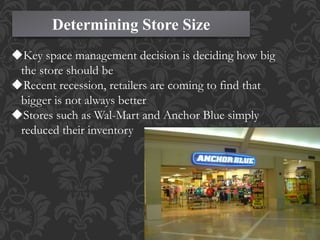
Determining Store Size
Key space management decision is deciding how big
the store should be
Recent recession, retailers are coming to find that
bigger is not always better
Stores such as Wal-Mart and Anchor Blue simply
reduced their inventory
Visual Merchandise
Is the presentation of a store and its merchandise in ways
that will attract the attention of potential customers.
Fixtures
Straight rack- consist of long pipe balanced between
supports in the floor or attached to the wall.
Rounder- is round fixture that sits on a pedestal.
Four way fixture- has two crossbars that sit
perpendicularly on a pedestal.
Gondola- is an island type of self-service counter
with tiers of shelves, bins, or pegs.
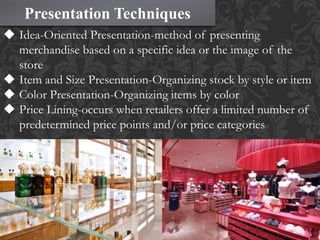
Presentation Techniques
 Idea-Oriented Presentation-method of presenting
merchandise based on a specific idea or the image of the
store
 Item and Size Presentation-Organizing stock by style or item
 Color Presentation-Organizing items by color
 Price Lining-occurs when retailers offer a limited number of
predetermined price points and/or price categories
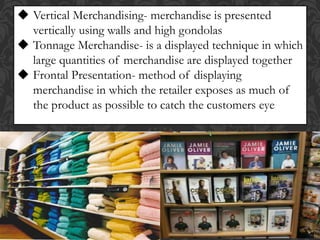
 Vertical Merchandising- merchandise is presented
vertically using walls and high gondolas
 Tonnage Merchandise- is a displayed technique in which
large quantities of merchandise are displayed together
 Frontal Presentation- method of displaying
merchandise in which the retailer exposes as much of
the product as possible to catch the customers eye
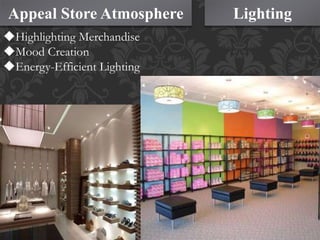
Lighting
Highlighting Merchandise
Mood Creation
Energy-Efficient Lighting
Appeal Store Atmosphere
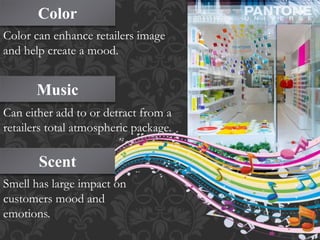
Color
Music
Scent
Color can enhance retailers image
and help create a mood.
Can either add to or detract from a
retailers total atmospheric package.
Smell has large impact on
customers mood and
emotions.
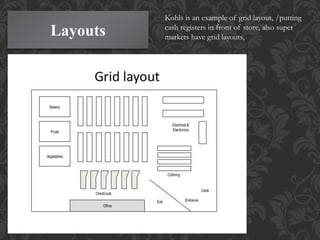
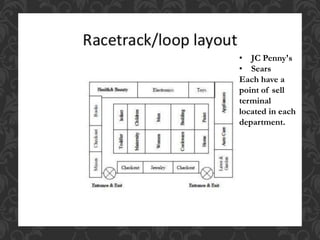
Layouts
Kohls is an example of grid layout, /putting
cash registers in front of store, also super
markets have grid layouts,
• JC Penny's
• Sears
Each have a
point of sell
terminal
located in each
department.
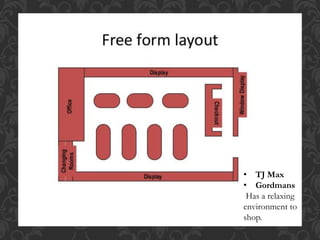
• TJ Max
• Gordmans
Has a relaxing
environment to
shop.
Store Design Objectives
1.Implement the retailer’s strategy
2.Build loyalty by providing a
rewarding shopping experience
3.Increase sales on a visit
4.Control costs
5.Meet legal requirements
Retailers Strategy
The design must be consistent with
and reinforce the retailer’s strategy
by meeting the needs of the target
market and building a sustainable
competitive advantage.
Building Loyalty
When customers have rewarding
experiences when patronizing
retailers store and/ or website, they
are motivated to visit repeatedly and
develop loyalty towards the retailer.
 Safeway
Sam's club
Buckle (rewards card)
Increase sales on a visit
Store design has a substantial effect on
which products customers buy, how long
they stay in the store, and how much they
spend during the visit.
Control cost
Store designs can also affect labor costs and
inventory shrinkage. Some stores are organized
into isolated departments, which provides an
intimate, comfortable shopping experience that
result in more sales.
Meet Legal requirements
All stores design and redesign decisions must
comply with the 1990 Americans with
Disabilities Act and its 2008 amendments. This
law protects people with disabilities from
discrimination in employment, transportation,
public accommodations, telecommunications,
activities of state and local governments.

Store presentation

  • 1.
    By April &Sadie STORE DESIGN Chapter 17
  • 2.
  • 3.
  • 4.
  • 5.
  • 6.
  • 8.
  • 9.
  • 10.
  • 11.
  • 12.
    ADA Americans with DisabilitiesAct It protects people with disabilities from discrimination and employment, transportation, public accommodations, and telecommunications, and activities of state and local governments.
  • 13.
  • 14.
  • 15.
  • 17.
  • 18.
    Music Music can eitheradd or distract from a retailers total atmospheric package. Take survey see what stations, or music selection students listen to. 93.1,95.9, 98.7, 101.1, 97.5 and etc.
  • 19.
  • 21.
    Signage and Graphics Signage andgraphics help customers locate specific products and departments, provide product information, and suggest items or special purchases. Call-to-action signage: places in strategic locations in the store can convey how, where, and why  Category signage: used within a particular department or sector or sector of the store to identify types of products offered  Promotional signage: describes special offers and found within the store or displayed in windows  Point-of-sale signage: are placed near the merchandise they refer to so that customers know its price and other detailed info
  • 22.
    Digital signage Many retailersare replacing traditional signage with digital signage systems. Digital signage includes signs whose visual content is delivered electronically through a centrally managed and controlled network, distributed to servers in stores, and displayed on flat-panel screens.
  • 23.
    Feature Areas Are areaswithin a store that are designed to get customers attention  Windows: draw customers into the store and provide a visual message about the type of merchandise  Entrances: first impression caused by the entry area affects the customers image of the store  Freestanding Displays: are fixtures that are located on aisles and designed primarily to attract customers attention and bring them in  Mannequins: life size representation of the human body, used to display clothing
  • 24.
     End Caps:are displays located at the end of an aisle in stores using a grid layout  Promotional Aisle or Area: is space used to display merchandise that is being promoted  Walls: because retail floor space is often limited, many retailers increase their ability to store extra stock, display merchandise, and creatively present a message by utilizing wall space  Dressing Rooms: are critical spaces, where customers often decide whether to purchase an item  Cash Wraps: also known as piont of purchase counters, are places in the store where customers can poruchase merchandise.
  • 25.
    Space Allocated tomerchandise categories 1. The productivity of the allocated space 2. Merchandise categories and brands 3. Impact on overall store sales 4. Display needs for merchandise
  • 26.
    Demand/destination Merchandise Refers toproducts that customers have decided to buy entering the store
  • 27.
    Impulse Merchandise Products thatare purchased without planning, such as fragrances and cosmetics in department stores and magazines in super markets, almost always located in front of stores.
  • 28.
    Demand and Promotional Merchandise Oftenplaced in the back left hand corner of the store. Placing high demand merchandise in this location pulls customers through the store, increasing the visibility of other products along the way.
  • 29.
    Special Merchandise Some merchandisecategories involve a buying process that is best accomplished in a lightly trafficked area. Such as how women's lingerie usually needs its own area.
  • 30.
    Category Adjacencies Retailers oftenput complementary categories next to each other to encourage unplanned purchases. Such as at the end of the cereal aisle grocery shoppers often find an end cap filler with fresh bananas, and etc.
  • 31.
    Location of Merchandisewithin a Category Supermarkets typically display merchandise on four shelves, with the most profitable merchandise on the third shelf from the floor. The third shelf attracts the most attention because it is eye level for adults.
  • 32.
    Planograms Is a diagramthat shows how and where specific SKUs should be placed on retail shelves or displays to increase customer purchases. SKU stands for see stock keeping unit
  • 33.
    Virtual-store simulation Are anothertool used to determine the effects of placing merchandise in different areas of a store and evaluating the profit potential for new items.
  • 34.
    Videotaping consumers Another researchmethod used to assess customer reactions to planograms involves tracking customers in actual store environments.
  • 35.
    Determining Store Size Keyspace management decision is deciding how big the store should be Recent recession, retailers are coming to find that bigger is not always better Stores such as Wal-Mart and Anchor Blue simply reduced their inventory
  • 36.
    Visual Merchandise Is thepresentation of a store and its merchandise in ways that will attract the attention of potential customers. Fixtures Straight rack- consist of long pipe balanced between supports in the floor or attached to the wall. Rounder- is round fixture that sits on a pedestal. Four way fixture- has two crossbars that sit perpendicularly on a pedestal. Gondola- is an island type of self-service counter with tiers of shelves, bins, or pegs.
  • 37.
    Presentation Techniques  Idea-OrientedPresentation-method of presenting merchandise based on a specific idea or the image of the store  Item and Size Presentation-Organizing stock by style or item  Color Presentation-Organizing items by color  Price Lining-occurs when retailers offer a limited number of predetermined price points and/or price categories
  • 38.
     Vertical Merchandising-merchandise is presented vertically using walls and high gondolas  Tonnage Merchandise- is a displayed technique in which large quantities of merchandise are displayed together  Frontal Presentation- method of displaying merchandise in which the retailer exposes as much of the product as possible to catch the customers eye
  • 39.
  • 40.
    Color Music Scent Color can enhanceretailers image and help create a mood. Can either add to or detract from a retailers total atmospheric package. Smell has large impact on customers mood and emotions.
  • 41.
    Layouts Kohls is anexample of grid layout, /putting cash registers in front of store, also super markets have grid layouts,
  • 42.
    • JC Penny's •Sears Each have a point of sell terminal located in each department.
  • 43.
    • TJ Max •Gordmans Has a relaxing environment to shop.
  • 44.
    Store Design Objectives 1.Implementthe retailer’s strategy 2.Build loyalty by providing a rewarding shopping experience 3.Increase sales on a visit 4.Control costs 5.Meet legal requirements
  • 45.
    Retailers Strategy The designmust be consistent with and reinforce the retailer’s strategy by meeting the needs of the target market and building a sustainable competitive advantage.
  • 46.
    Building Loyalty When customershave rewarding experiences when patronizing retailers store and/ or website, they are motivated to visit repeatedly and develop loyalty towards the retailer.  Safeway Sam's club Buckle (rewards card)
  • 47.
    Increase sales ona visit Store design has a substantial effect on which products customers buy, how long they stay in the store, and how much they spend during the visit.
  • 48.
    Control cost Store designscan also affect labor costs and inventory shrinkage. Some stores are organized into isolated departments, which provides an intimate, comfortable shopping experience that result in more sales.
  • 49.
    Meet Legal requirements Allstores design and redesign decisions must comply with the 1990 Americans with Disabilities Act and its 2008 amendments. This law protects people with disabilities from discrimination in employment, transportation, public accommodations, telecommunications, activities of state and local governments.

Editor's Notes