STORAGE CLASSES
By
SATHISHKUMAR G
(sathishsak111@gmail.com)
A storage class defines the scope
(visibility) and life time of variables and/or
functions within a C++ Program. There are
following storage classes which can be
used in a C++ Program
•auto
•register
•static
•extern
STORAGE CLASSES
auto - Storage Class
auto is the default storage class for all local
variables.
{
int Count;
auto int Month;
}
The example above defines two variables
with the same storage class. auto can only
be used within functions, i.e. local
variables.
register - Storage Class
register is used to define local variables that should be
stored in a register instead of RAM. This means that the
variable has a maximum size equal to the register size
(usually one word) and cant have the unary '&' operator
applied to it (as it does not have a memory location).
{
register int Miles;
}
Register should only be used for variables that require quick
access - such as counters. It should also be noted that
defining 'register' does not mean that the variable will be
stored in a register. It means that it MIGHT be stored in a
register - depending on hardware and implimentation
restrictions.
static - Storage Class
As we have seen, external variables have global scope
across the entire program (provided extern declarations are
used is files other than where the variable is defined), and a
lifetime over the the entire program run. The storage class,
static, similarly provides a lifetime over the entire program,
however; it provides a way to limit the scope of such
variables, Static storage class is declared with the keyword
static as the class specifier when the variable is defined.
These variables are automatically initialized to zero upon
memory allocation just as external variables are. Static
storage class can be specified for automatic as well as
external variables.
static - Storage Class
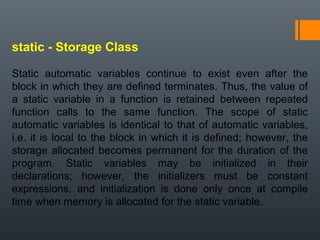
Static automatic variables continue to exist even after the
block in which they are defined terminates. Thus, the value of
a static variable in a function is retained between repeated
function calls to the same function. The scope of static
automatic variables is identical to that of automatic variables,
i.e. it is local to the block in which it is defined; however, the
storage allocated becomes permanent for the duration of the
program. Static variables may be initialized in their
declarations; however, the initializers must be constant
expressions, and initialization is done only once at compile
time when memory is allocated for the static variable.
extern - Storage Class
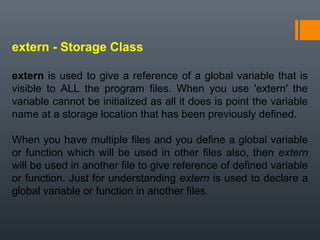
extern is used to give a reference of a global variable that is
visible to ALL the program files. When you use 'extern' the
variable cannot be initialized as all it does is point the variable
name at a storage location that has been previously defined.
When you have multiple files and you define a global variable
or function which will be used in other files also, then extern
will be used in another file to give reference of defined variable
or function. Just for understanding extern is used to declare a
global variable or function in another files.
THANK YOU

STORAGE CLASSES

  • 1.
  • 2.
    A storage classdefines the scope (visibility) and life time of variables and/or functions within a C++ Program. There are following storage classes which can be used in a C++ Program •auto •register •static •extern STORAGE CLASSES
  • 3.
    auto - StorageClass auto is the default storage class for all local variables. { int Count; auto int Month; } The example above defines two variables with the same storage class. auto can only be used within functions, i.e. local variables.
  • 4.
    register - StorageClass register is used to define local variables that should be stored in a register instead of RAM. This means that the variable has a maximum size equal to the register size (usually one word) and cant have the unary '&' operator applied to it (as it does not have a memory location). { register int Miles; } Register should only be used for variables that require quick access - such as counters. It should also be noted that defining 'register' does not mean that the variable will be stored in a register. It means that it MIGHT be stored in a register - depending on hardware and implimentation restrictions.
  • 5.
    static - StorageClass As we have seen, external variables have global scope across the entire program (provided extern declarations are used is files other than where the variable is defined), and a lifetime over the the entire program run. The storage class, static, similarly provides a lifetime over the entire program, however; it provides a way to limit the scope of such variables, Static storage class is declared with the keyword static as the class specifier when the variable is defined. These variables are automatically initialized to zero upon memory allocation just as external variables are. Static storage class can be specified for automatic as well as external variables.
  • 6.
    static - StorageClass Static automatic variables continue to exist even after the block in which they are defined terminates. Thus, the value of a static variable in a function is retained between repeated function calls to the same function. The scope of static automatic variables is identical to that of automatic variables, i.e. it is local to the block in which it is defined; however, the storage allocated becomes permanent for the duration of the program. Static variables may be initialized in their declarations; however, the initializers must be constant expressions, and initialization is done only once at compile time when memory is allocated for the static variable.
  • 7.
    extern - StorageClass extern is used to give a reference of a global variable that is visible to ALL the program files. When you use 'extern' the variable cannot be initialized as all it does is point the variable name at a storage location that has been previously defined. When you have multiple files and you define a global variable or function which will be used in other files also, then extern will be used in another file to give reference of defined variable or function. Just for understanding extern is used to declare a global variable or function in another files.
  • 8.