
American Risk UnderwritersAmerican Risk Underwriters
Presented ByPresented By
Jon Dailey ofJon Dailey of
American Risk UnderwritersAmerican Risk Underwriters
DateDate
HistoryHistory
• Labor Management Relations Act of 1947:
o Development of tax exempt trusts used as a
conduit for Insurance premiums and direct
benefit payments
• Employee Retirement Income Security Act of 1974:
(ERISA)
o Removed barriers for employers to fund
their own employee benefit plans
Learning ObjectivesLearning Objectives
• Compare and Contrast Fully Funded and Self-
Funded Insurance Plans
Learning ObjectivesLearning Objectives
• Compare and Contrast Fully Funded and Self-
Funded Insurance Plans
• Learn Terminology and Definitions of Self-Funded
Plan
Learning ObjectivesLearning Objectives
• Compare and Contrast Fully Funded and Self-
Funded Insurance Plans
• Learn Terminology and Definitions of Self-Funded
Plan
• Understand the Components of a Self-Funded Plan
Learning ObjectivesLearning Objectives
• Compare and Contrast Fully Funded and Self-
Funded Insurance Plans
• Learn Terminology and Definitions of Self-Funded
Plan
• Understand the Components of a Self-Funded Plan
• Understand the Underwriting Components of
Specific and Aggregate Coverage
Learning ObjectivesLearning Objectives
• Compare and Contrast Fully Funded and Self-
Funded Insurance Plans
• Learn Terminology and Definitions of Self-Funded
Plan
• Understand the Components of a Self-Funded Plan
• Understand the Underwriting Components of
Specific and Aggregate Coverage
• Understand the TPA’s Key Administration Role
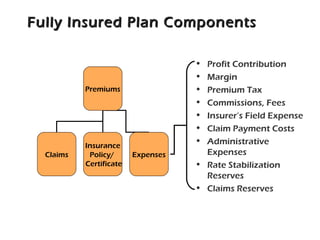
Fully Insured Plan ComponentsFully Insured Plan Components
• Profit Contribution
• Margin
• Premium Tax
• Commissions, Fees
• Insurer’s Field Expense
• Claim Payment Costs
• Administrative
Expenses
• Rate Stabilization
Reserves
• Claims Reserves
Premiums
Claims
Insurance
Policy/
Certificate
Expenses
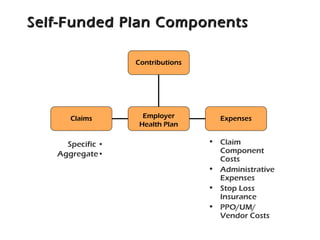
Self-Funded Plan ComponentsSelf-Funded Plan Components
Specific •
Aggregate•
• Claim
Component
Costs
• Administrative
Expenses
• Stop Loss
Insurance
• PPO/UM/
Vendor Costs
Contributions
Claims Employer
Health Plan
Expenses
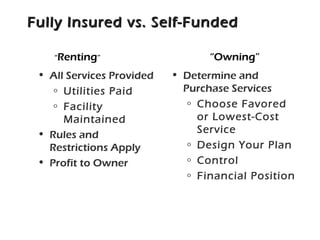
Fully Insured vs. Self-FundedFully Insured vs. Self-Funded
• All Services Provided
o Utilities Paid
o Facility
Maintained
• Rules and
Restrictions Apply
• Profit to Owner
• Determine and
Purchase Services
o Choose Favored
or Lowest-Cost
Service
o Design Your Plan
o Control
o Financial Position
“Renting” “Owning”
Advantages of Fully InsuredAdvantages of Fully Insured
• Carrier processes and pays claims as well as provides all of
the benefit management services
• Carrier is responsible for establishing claim reserves
• Employer group pays deductible rates each month during
contract period
• Carrier absorbs excess loss
• Individual claims exceeding pooling point are paid by carrier
• Upon termination, carrier has responsibility for run-out claims
Disadvantages of Fully InsuredDisadvantages of Fully Insured
• No refunds to policy holder
• Must include State and Federal mandates
• Carrier identifies/keeps Reserves; employer
pays
• Highly regulated by DOI’s
• It’s not Stop-Loss
Self-Funded Economic BenefitsSelf-Funded Economic Benefits
• Premium Taxes
• Cash Flow
• Mandated Benefits / Regulation
• Self -Administration
• Profits
Premium TaxPremium Tax
• Savings Between 1.5% to 3.5%
Cash FlowCash Flow
• “Pay as You Go” or Trust Fund
• Checking Account or Reserve Fund
• Monthly Aggregate Advance
• Fiduciary Responsibility
Mandated BenefitsMandated Benefits
• Legislated Benefits or Design Choice
• Additional 5%-7%
AdministrationAdministration
• Fully Insured Costs 15% - 20%
o Management
o Marketing
o Advertising
o Legal
o Logistical
• Self-Funded Costs 3% - 5%
ProfitsProfits
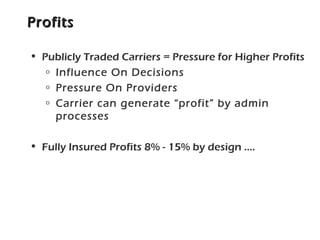
• Publicly Traded Carriers = Pressure for Higher Profits
o Influence On Decisions
o Pressure On Providers
o Carrier can generate “profit” by admin
processes
• Fully Insured Profits 8% - 15% by design ….
Self- Funded Economic AdvantageSelf- Funded Economic Advantage
SummarySummary
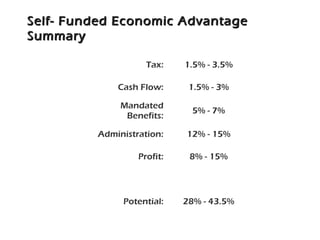
Tax: 1.5% - 3.5%
Cash Flow: 1.5% - 3%
Mandated
Benefits:
5% - 7%
Administration: 12% - 15%
Profit: 8% - 15%
Potential: 28% - 43.5%
Advantages of Self - FundingAdvantages of Self - Funding
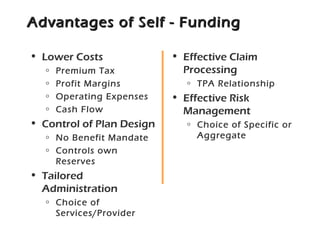
• Lower Costs
o Premium Tax
o Profit Margins
o Operating Expenses
o Cash Flow
• Control of Plan Design
o No Benefit Mandate
o Controls own
Reserves
• Tailored
Administration
o Choice of
Services/Provider
• Effective Claim
Processing
o TPA Relationship
• Effective Risk
Management
o Choice of Specific or
Aggregate
Disadvantages of Self - FundingDisadvantages of Self - Funding
• Employer Becomes Insurer
• Risk Assumption
• Provision of Services
• Asset Exposure
The Product – Specific andThe Product – Specific and
AggregateAggregate
• Specific Stop Loss
o Form of Excess Insurance Coverage that
provides protection for the Employer
against a high claim on any one Individual.
o Reimbursement generally after Specific
deductible is satisfied.
o Specific Advance
The Product – Specific andThe Product – Specific and
AggregateAggregate
• Aggregate Stop Loss
o Provides a ceiling on the dollar amount of
eligible expenses that an employer would
pay in total during a contract period.
o Reimbursement generally at the end of the
policy period.
o Monthly Option Available
Policy PeriodsPolicy Periods
• Fully Insured
o Incurred During the Policy Period (Effectively 12/24)
• Self – Funded – Variations in Effective Date
o 12/12 – Incurred and Paid During Policy Period
o 15/12 – Losses Incurred Three Months Prior To
Inception but Paid During Policy Period
o 12/15 – Losses Incurred During Policy Period and
Paid Up To Three Months After Policy
Period
o 24/12 – Losses Incurred During Twenty-Four Month
Period and Paid During Twelve Month
Period
o Other Variations Include:12/24, 18/12, 12/18
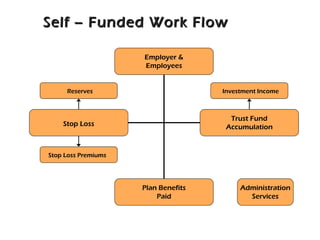
Self – Funded Work FlowSelf – Funded Work Flow
Administration
Services
Employer &
Employees
Plan Benefits
Paid
Stop Loss
Trust Fund
Accumulation
Reserves
Stop Loss Premiums
Investment Income
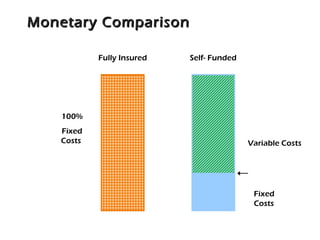
Monetary ComparisonMonetary Comparison
Fully Insured Self- Funded
100%
Fixed
Costs Variable Costs
Fixed
Costs
Stop-Loss UnderwritingStop-Loss Underwriting
• Data Required
o Current Census
• DOB, Sex, Dependents
o Current Disabled or COBRA Participants
o Current SPD/Summary
o Current and Estimated Participants by Percentage
o Other Carrier
o Current Funding Method
o Current TPA and PPO
o Commission Requested
o Paid Claims – 24 months
o Large Claims (At 50% of requested Spec. level) – 24
months
o Current/Corresponding Specific Level
Stop-Loss UnderwritingStop-Loss Underwriting
• Coverage Requested
o Specific Deductible Level
o Claim Accumulation (12/12, 12/15, etc.)
o Current Specific Rates
o Aggregate Coverage and Claim
Accumulation
o Current Factors
o Annual Maximum Requested
o Benefits to be Covered
•Specific: Medical, RX
•Aggregate: Medical, Dental, Vision, etc.
Stop-Loss UnderwritingStop-Loss Underwriting
• Request for Proposal (RFP)
o Proposed Effective Date
o Employer Name
o Address, City, State, Zip
o Other Locations
o Nature of Business
o SIC Code(s)
o Due Date
TerminologyTerminology
• Risk
o Possibility of loss; Subject to insurance
• Premium Components
o Cost of Healthcare
o Reserves: Funds set aside to pay claims
o Retention: Expenses or administrative costs
• Aggregate Factor
o The dollar figure that is multiplied by the number of covered
persons each month during the contract period to calculate the
AAD. It includes expected claims plus margins
• Aggregate Stop Loss
o The form of excess risk coverage that privides for the employer
againast the accumulation of claims exceeding a stated level.
This is protection against abnormal frequency of claims in total
rather than abnormal severity of a single claim.
• Annual Aggregate Deductible
o This number represents the overall limit of claim liability for the
group (employer). Beyond this point the Stop Loss policy
indemnifies the group at the end of the contract period.
TerminologyTerminology
• Actively-At-Work
o A contract provision that provides that the covearge will only be
available for employees actively at work on a full time basis on
the effective date of coverage.
• Paid Claims
o A payment made for health services (covered benefit) rendered
• Catastrophic Claim
o A claim so large that it materially effects the group experience
o Pooling in fully insured or specific excess in self-funded
• Incurred Claim
o Provider services rendered but not yet submitted for payment
• Run-in Claims
o Claims from a prior plan or carrier
• Run-out Claims
o Claims incurred prior to but reported/paid after contract
termination
TerminologyTerminology
• IBNR/ RBNP
o Incurred but not reported claims; reported but not yet paid
• Experience
o A comparison of total dollar amount paid premium versus paid
and incurred claims
• Experience Rating
o Use of an employers loss experience to determine rate level
• Lag
o Period of time between incurred and paid claim
o Reserves established to recognize lag
• Plan Fiduciary
o Responsible for administration and management of employee
benefit plans
o Generally the employer who buys services from TPA in turn
• TPA
o Provides host of administrative services
o Fiduciary
TerminologyTerminology
• MGU
o Managing General Underwriter
o Provides underwriting, rating and claims services on behalf of a
Carrier
• Trend
o Measurement of change over time in the cost of health care using
industry information and medical inflation
o Adjusts the cost of claims paid in the past to present value
• Expense
o TPA Administration fees
o Stop-loss premiums
o Broker commissions
• Medical Inflation
o Annualized factor on the cost of providing healthcare and Rx
services
• HIPAA
o Health Insurance Portability and Accountability Act
o National administrative provisions and security/privacy of health
data
• Conversion
o Carrier provides the conversion of medical coverage to an
individual basis for employees terminating from the plan
Test Your KnowledgeTest Your Knowledge
• What is Stop Loss coverage?
• Who is insured?
• What coverage is available?
• How is Stop Loss written?
• What is the role of the employer’s plan document?
• How is Loss defined?
• When are claims paid?
• What happens when someone leaves the plan?
DiscussionDiscussion
• SIIA
o Model Self-Funded Plan
• A Current Prospect

Stop Loss Presentation

  • 1.
    American Risk UnderwritersAmericanRisk Underwriters Presented ByPresented By Jon Dailey ofJon Dailey of American Risk UnderwritersAmerican Risk Underwriters DateDate
  • 2.
    HistoryHistory • Labor ManagementRelations Act of 1947: o Development of tax exempt trusts used as a conduit for Insurance premiums and direct benefit payments • Employee Retirement Income Security Act of 1974: (ERISA) o Removed barriers for employers to fund their own employee benefit plans
  • 3.
    Learning ObjectivesLearning Objectives •Compare and Contrast Fully Funded and Self- Funded Insurance Plans
  • 4.
    Learning ObjectivesLearning Objectives •Compare and Contrast Fully Funded and Self- Funded Insurance Plans • Learn Terminology and Definitions of Self-Funded Plan
  • 5.
    Learning ObjectivesLearning Objectives •Compare and Contrast Fully Funded and Self- Funded Insurance Plans • Learn Terminology and Definitions of Self-Funded Plan • Understand the Components of a Self-Funded Plan
  • 6.
    Learning ObjectivesLearning Objectives •Compare and Contrast Fully Funded and Self- Funded Insurance Plans • Learn Terminology and Definitions of Self-Funded Plan • Understand the Components of a Self-Funded Plan • Understand the Underwriting Components of Specific and Aggregate Coverage
  • 7.
    Learning ObjectivesLearning Objectives •Compare and Contrast Fully Funded and Self- Funded Insurance Plans • Learn Terminology and Definitions of Self-Funded Plan • Understand the Components of a Self-Funded Plan • Understand the Underwriting Components of Specific and Aggregate Coverage • Understand the TPA’s Key Administration Role
  • 8.
    Fully Insured PlanComponentsFully Insured Plan Components • Profit Contribution • Margin • Premium Tax • Commissions, Fees • Insurer’s Field Expense • Claim Payment Costs • Administrative Expenses • Rate Stabilization Reserves • Claims Reserves Premiums Claims Insurance Policy/ Certificate Expenses
  • 9.
    Self-Funded Plan ComponentsSelf-FundedPlan Components Specific • Aggregate• • Claim Component Costs • Administrative Expenses • Stop Loss Insurance • PPO/UM/ Vendor Costs Contributions Claims Employer Health Plan Expenses
  • 10.
    Fully Insured vs.Self-FundedFully Insured vs. Self-Funded • All Services Provided o Utilities Paid o Facility Maintained • Rules and Restrictions Apply • Profit to Owner • Determine and Purchase Services o Choose Favored or Lowest-Cost Service o Design Your Plan o Control o Financial Position “Renting” “Owning”
  • 11.
    Advantages of FullyInsuredAdvantages of Fully Insured • Carrier processes and pays claims as well as provides all of the benefit management services • Carrier is responsible for establishing claim reserves • Employer group pays deductible rates each month during contract period • Carrier absorbs excess loss • Individual claims exceeding pooling point are paid by carrier • Upon termination, carrier has responsibility for run-out claims
  • 12.
    Disadvantages of FullyInsuredDisadvantages of Fully Insured • No refunds to policy holder • Must include State and Federal mandates • Carrier identifies/keeps Reserves; employer pays • Highly regulated by DOI’s • It’s not Stop-Loss
  • 13.
    Self-Funded Economic BenefitsSelf-FundedEconomic Benefits • Premium Taxes • Cash Flow • Mandated Benefits / Regulation • Self -Administration • Profits
  • 14.
    Premium TaxPremium Tax •Savings Between 1.5% to 3.5%
  • 15.
    Cash FlowCash Flow •“Pay as You Go” or Trust Fund • Checking Account or Reserve Fund • Monthly Aggregate Advance • Fiduciary Responsibility
  • 16.
    Mandated BenefitsMandated Benefits •Legislated Benefits or Design Choice • Additional 5%-7%
  • 17.
    AdministrationAdministration • Fully InsuredCosts 15% - 20% o Management o Marketing o Advertising o Legal o Logistical • Self-Funded Costs 3% - 5%
  • 18.
    ProfitsProfits • Publicly TradedCarriers = Pressure for Higher Profits o Influence On Decisions o Pressure On Providers o Carrier can generate “profit” by admin processes • Fully Insured Profits 8% - 15% by design ….
  • 19.
    Self- Funded EconomicAdvantageSelf- Funded Economic Advantage SummarySummary Tax: 1.5% - 3.5% Cash Flow: 1.5% - 3% Mandated Benefits: 5% - 7% Administration: 12% - 15% Profit: 8% - 15% Potential: 28% - 43.5%
  • 20.
    Advantages of Self- FundingAdvantages of Self - Funding • Lower Costs o Premium Tax o Profit Margins o Operating Expenses o Cash Flow • Control of Plan Design o No Benefit Mandate o Controls own Reserves • Tailored Administration o Choice of Services/Provider • Effective Claim Processing o TPA Relationship • Effective Risk Management o Choice of Specific or Aggregate
  • 21.
    Disadvantages of Self- FundingDisadvantages of Self - Funding • Employer Becomes Insurer • Risk Assumption • Provision of Services • Asset Exposure
  • 22.
    The Product –Specific andThe Product – Specific and AggregateAggregate • Specific Stop Loss o Form of Excess Insurance Coverage that provides protection for the Employer against a high claim on any one Individual. o Reimbursement generally after Specific deductible is satisfied. o Specific Advance
  • 23.
    The Product –Specific andThe Product – Specific and AggregateAggregate • Aggregate Stop Loss o Provides a ceiling on the dollar amount of eligible expenses that an employer would pay in total during a contract period. o Reimbursement generally at the end of the policy period. o Monthly Option Available
  • 24.
    Policy PeriodsPolicy Periods •Fully Insured o Incurred During the Policy Period (Effectively 12/24) • Self – Funded – Variations in Effective Date o 12/12 – Incurred and Paid During Policy Period o 15/12 – Losses Incurred Three Months Prior To Inception but Paid During Policy Period o 12/15 – Losses Incurred During Policy Period and Paid Up To Three Months After Policy Period o 24/12 – Losses Incurred During Twenty-Four Month Period and Paid During Twelve Month Period o Other Variations Include:12/24, 18/12, 12/18
  • 25.
    Self – FundedWork FlowSelf – Funded Work Flow Administration Services Employer & Employees Plan Benefits Paid Stop Loss Trust Fund Accumulation Reserves Stop Loss Premiums Investment Income
  • 26.
    Monetary ComparisonMonetary Comparison FullyInsured Self- Funded 100% Fixed Costs Variable Costs Fixed Costs
  • 27.
    Stop-Loss UnderwritingStop-Loss Underwriting •Data Required o Current Census • DOB, Sex, Dependents o Current Disabled or COBRA Participants o Current SPD/Summary o Current and Estimated Participants by Percentage o Other Carrier o Current Funding Method o Current TPA and PPO o Commission Requested o Paid Claims – 24 months o Large Claims (At 50% of requested Spec. level) – 24 months o Current/Corresponding Specific Level
  • 28.
    Stop-Loss UnderwritingStop-Loss Underwriting •Coverage Requested o Specific Deductible Level o Claim Accumulation (12/12, 12/15, etc.) o Current Specific Rates o Aggregate Coverage and Claim Accumulation o Current Factors o Annual Maximum Requested o Benefits to be Covered •Specific: Medical, RX •Aggregate: Medical, Dental, Vision, etc.
  • 29.
    Stop-Loss UnderwritingStop-Loss Underwriting •Request for Proposal (RFP) o Proposed Effective Date o Employer Name o Address, City, State, Zip o Other Locations o Nature of Business o SIC Code(s) o Due Date
  • 30.
    TerminologyTerminology • Risk o Possibilityof loss; Subject to insurance • Premium Components o Cost of Healthcare o Reserves: Funds set aside to pay claims o Retention: Expenses or administrative costs • Aggregate Factor o The dollar figure that is multiplied by the number of covered persons each month during the contract period to calculate the AAD. It includes expected claims plus margins • Aggregate Stop Loss o The form of excess risk coverage that privides for the employer againast the accumulation of claims exceeding a stated level. This is protection against abnormal frequency of claims in total rather than abnormal severity of a single claim. • Annual Aggregate Deductible o This number represents the overall limit of claim liability for the group (employer). Beyond this point the Stop Loss policy indemnifies the group at the end of the contract period.
  • 31.
    TerminologyTerminology • Actively-At-Work o Acontract provision that provides that the covearge will only be available for employees actively at work on a full time basis on the effective date of coverage. • Paid Claims o A payment made for health services (covered benefit) rendered • Catastrophic Claim o A claim so large that it materially effects the group experience o Pooling in fully insured or specific excess in self-funded • Incurred Claim o Provider services rendered but not yet submitted for payment • Run-in Claims o Claims from a prior plan or carrier • Run-out Claims o Claims incurred prior to but reported/paid after contract termination
  • 32.
    TerminologyTerminology • IBNR/ RBNP oIncurred but not reported claims; reported but not yet paid • Experience o A comparison of total dollar amount paid premium versus paid and incurred claims • Experience Rating o Use of an employers loss experience to determine rate level • Lag o Period of time between incurred and paid claim o Reserves established to recognize lag • Plan Fiduciary o Responsible for administration and management of employee benefit plans o Generally the employer who buys services from TPA in turn • TPA o Provides host of administrative services o Fiduciary
  • 33.
    TerminologyTerminology • MGU o ManagingGeneral Underwriter o Provides underwriting, rating and claims services on behalf of a Carrier • Trend o Measurement of change over time in the cost of health care using industry information and medical inflation o Adjusts the cost of claims paid in the past to present value • Expense o TPA Administration fees o Stop-loss premiums o Broker commissions • Medical Inflation o Annualized factor on the cost of providing healthcare and Rx services • HIPAA o Health Insurance Portability and Accountability Act o National administrative provisions and security/privacy of health data • Conversion o Carrier provides the conversion of medical coverage to an individual basis for employees terminating from the plan
  • 34.
    Test Your KnowledgeTestYour Knowledge • What is Stop Loss coverage? • Who is insured? • What coverage is available? • How is Stop Loss written? • What is the role of the employer’s plan document? • How is Loss defined? • When are claims paid? • What happens when someone leaves the plan?
  • 35.
    DiscussionDiscussion • SIIA o ModelSelf-Funded Plan • A Current Prospect