STOMATA
Mrs. R. H. Mishal
Incharge HOD, D. Pharm
Sir Dr. M. S. Gosavi College of Pharmaceutical Education
& Research, Nashik.
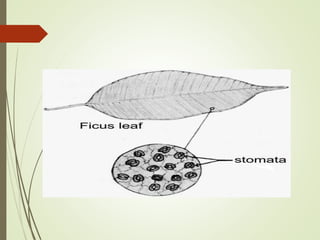
A stoma is a minute epidermal opening with following
characteristics:
• A central cell
• Two kidney shaped similar cells containing
chloroplasts known as Guard cells and varying
number of subsidiary (epidermal) cells covering the
guard cells.
A stoma is made up of a pair of identical guard cells,
forming a pore in centre through which gaseous
exchange takes place.
STOMATA
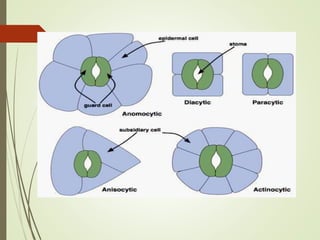
There are 4 basic types of stomata among the
dicotyledons.
These types are distinguished on the basis of arrangements
of the subsidiary cells surrounding the stomata
The four types are:
• Anomocytic type, Ranunculaceae
• Anisocytic type, Curciferae
• Paracytic type, Rubiceae
• Diacytic type, Caryophyllaceae
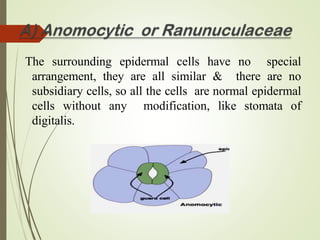
The surrounding epidermal cells have no special
arrangement, they are all similar & there are no
subsidiary cells, so all the cells are normal epidermal
cells without any modification, like stomata of
digitalis.
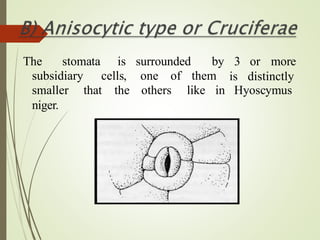
The stomata is surrounded
subsidiary cells, one of them
by 3 or more
is distinctly
Hyoscymus
smaller that the others like in
niger.
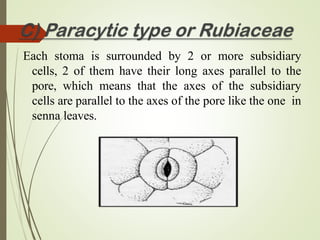
Each stoma is surrounded by 2 or more subsidiary
cells, 2 of them have their long axes parallel to the
pore, which means that the axes of the subsidiary
cells are parallel to the axes of the pore like the one in
senna leaves.
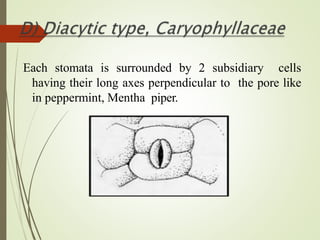
Each stomata is surrounded by 2 subsidiary cells
having their long axes perpendicular to the pore like
in peppermint, Mentha piper.
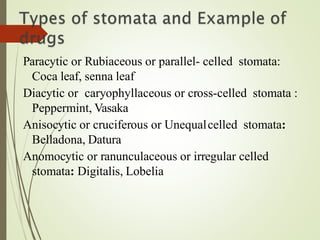
Paracytic or Rubiaceous or parallel- celled stomata:
Coca leaf, senna leaf
Diacytic or caryophyllaceous or cross-celled stomata :
Peppermint, Vasaka
Anisocytic or cruciferous or Unequalcelled stomata:
Belladona, Datura
Anomocytic or ranunculaceous or irregular celled
stomata: Digitalis, Lobelia
Thank You

Stomata Types.pptx

  • 1.
    STOMATA Mrs. R. H.Mishal Incharge HOD, D. Pharm Sir Dr. M. S. Gosavi College of Pharmaceutical Education & Research, Nashik.
  • 2.
    A stoma isa minute epidermal opening with following characteristics: • A central cell • Two kidney shaped similar cells containing chloroplasts known as Guard cells and varying number of subsidiary (epidermal) cells covering the guard cells. A stoma is made up of a pair of identical guard cells, forming a pore in centre through which gaseous exchange takes place. STOMATA
  • 4.
    There are 4basic types of stomata among the dicotyledons. These types are distinguished on the basis of arrangements of the subsidiary cells surrounding the stomata The four types are: • Anomocytic type, Ranunculaceae • Anisocytic type, Curciferae • Paracytic type, Rubiceae • Diacytic type, Caryophyllaceae
  • 5.
    The surrounding epidermalcells have no special arrangement, they are all similar & there are no subsidiary cells, so all the cells are normal epidermal cells without any modification, like stomata of digitalis.
  • 6.
    The stomata issurrounded subsidiary cells, one of them by 3 or more is distinctly Hyoscymus smaller that the others like in niger.
  • 7.
    Each stoma issurrounded by 2 or more subsidiary cells, 2 of them have their long axes parallel to the pore, which means that the axes of the subsidiary cells are parallel to the axes of the pore like the one in senna leaves.
  • 8.
    Each stomata issurrounded by 2 subsidiary cells having their long axes perpendicular to the pore like in peppermint, Mentha piper.
  • 10.
    Paracytic or Rubiaceousor parallel- celled stomata: Coca leaf, senna leaf Diacytic or caryophyllaceous or cross-celled stomata : Peppermint, Vasaka Anisocytic or cruciferous or Unequalcelled stomata: Belladona, Datura Anomocytic or ranunculaceous or irregular celled stomata: Digitalis, Lobelia
  • 11.