Assessing societal impact:
what have we learned
from the UK REF?
Steven Hill
Head of Research Policy
ORCID/CASRAI Conference
18 May 2015
@stevenhill
• Impact in the Research Excellence Framework
• What have we learned?
Summary
• Impact in the Research Excellence Framework
• What have we learned?
Summary
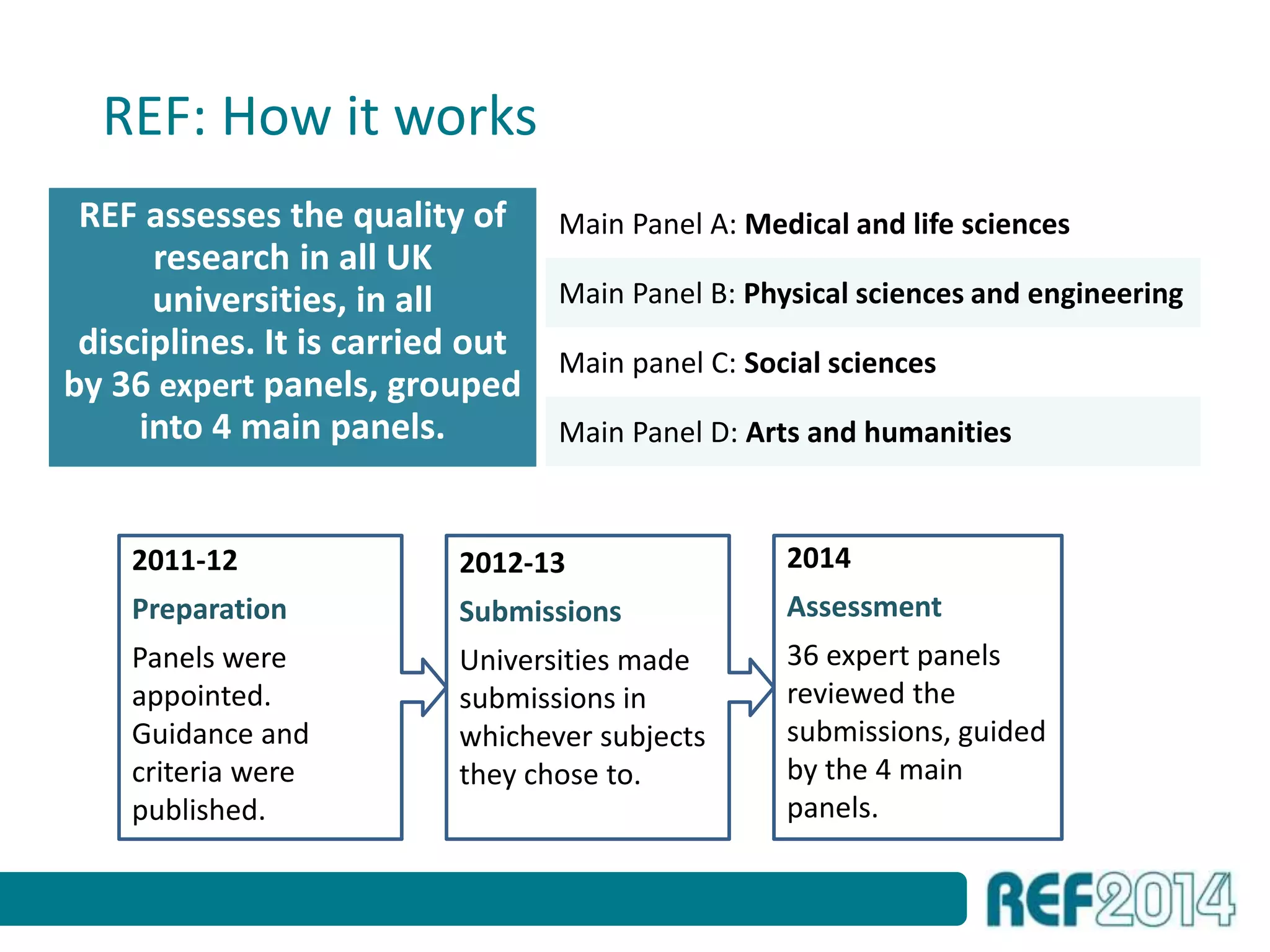
REF: How it works
REF assesses the quality of
research in all UK
universities, in all
disciplines. It is carried out
by 36 expert panels, grouped
into 4 main panels.
2011-12
Preparation
Panels were
appointed.
Guidance and
criteria were
published.
2012-13
Submissions
Universities made
submissions in
whichever subjects
they chose to.
2014
Assessment
36 expert panels
reviewed the
submissions, guided
by the 4 main
panels.
Main Panel A: Medical and life sciences
Main Panel B: Physical sciences and engineering
Main panel C: Social sciences
Main Panel D: Arts and humanities
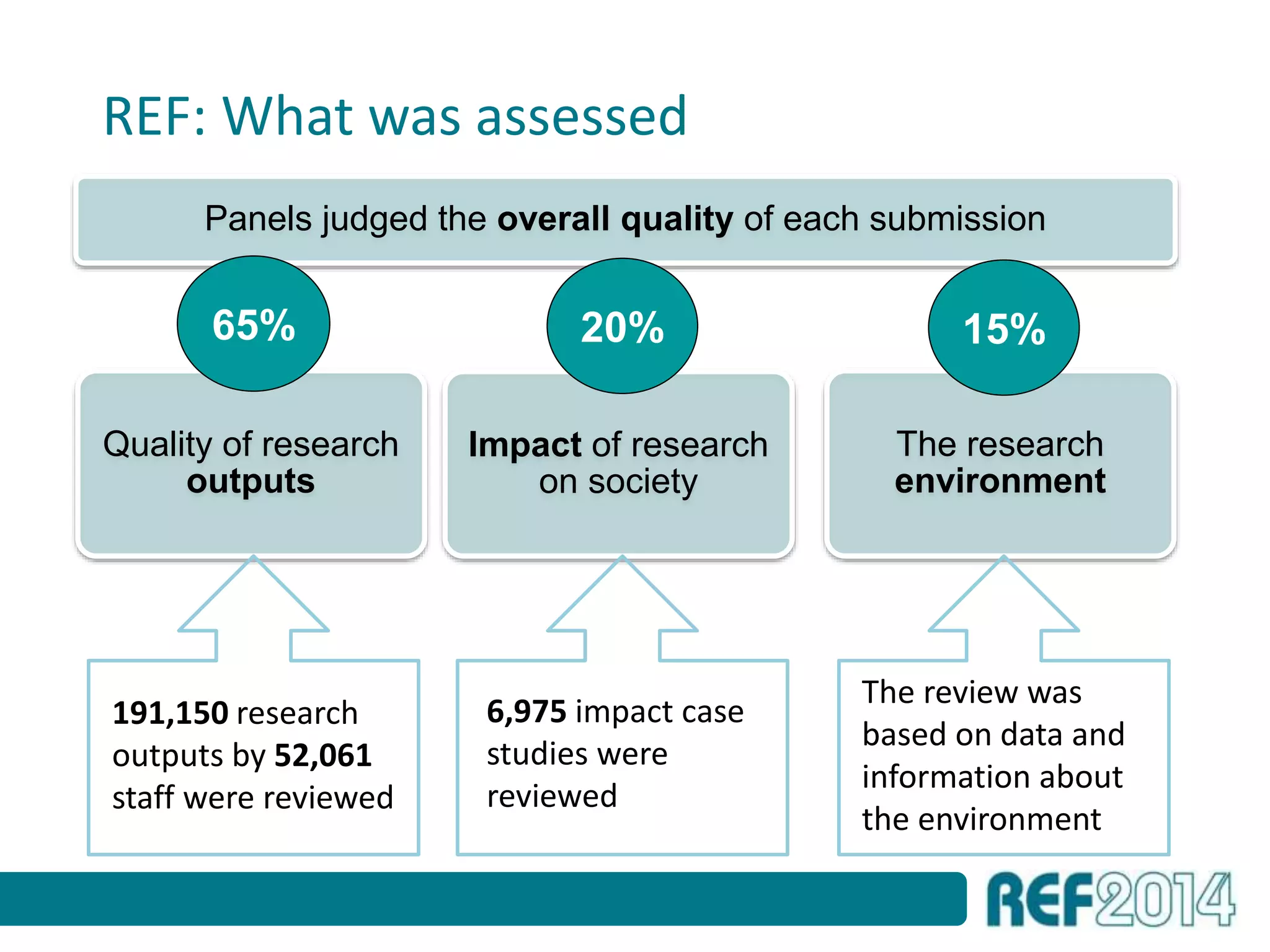
REF: What was assessed
Panels judged the overall quality of each submission
Quality of research
outputs
Impact of research
on society
The research
environment
65% 20% 15%
191,150 research
outputs by 52,061
staff were reviewed
6,975 impact case
studies were
reviewed
The review was
based on data and
information about
the environment
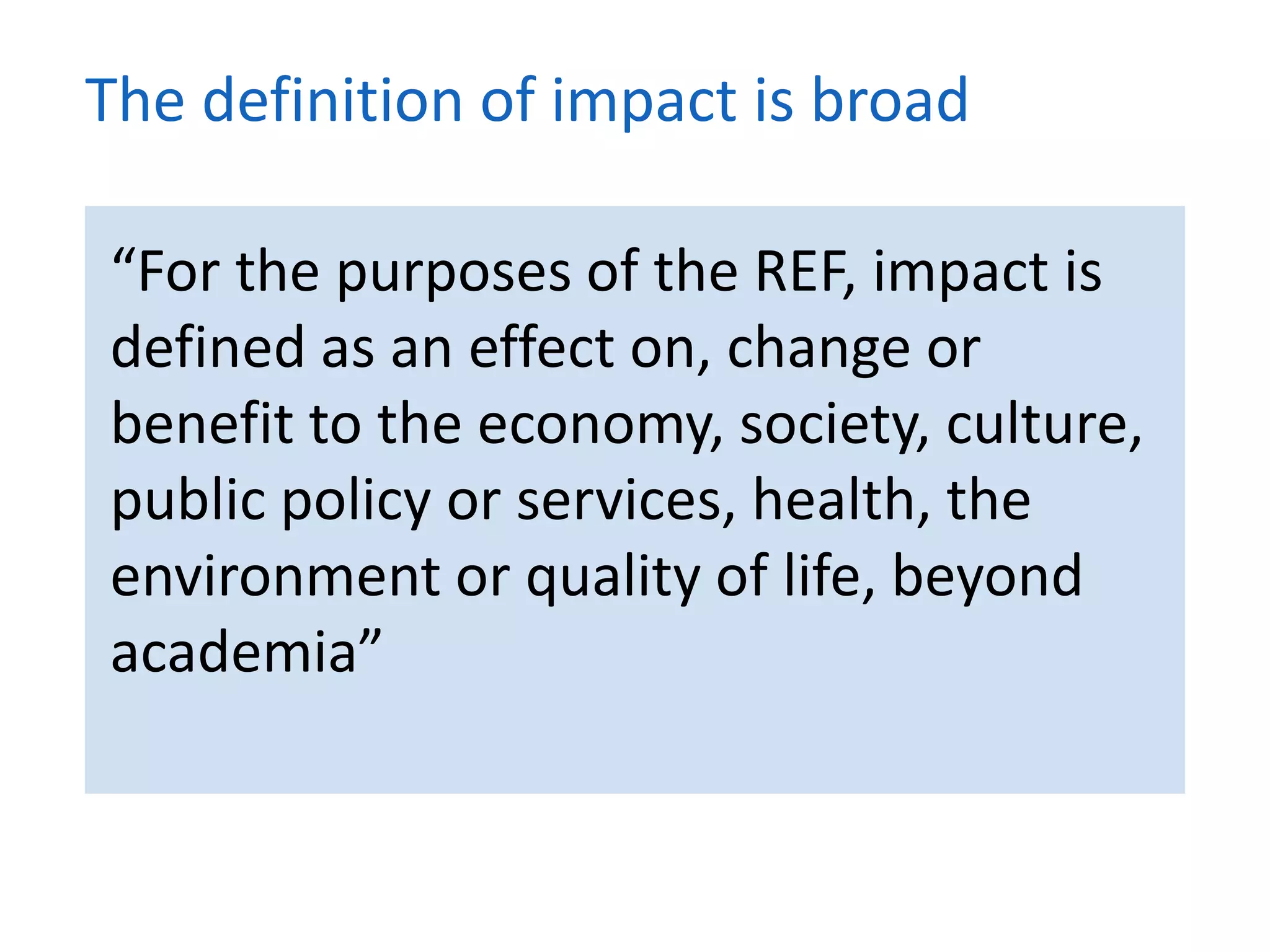
“For the purposes of the REF, impact is
defined as an effect on, change or
benefit to the economy, society, culture,
public policy or services, health, the
environment or quality of life, beyond
academia”
The definition of impact is broad
• Impact in the Research Excellence Framework
• What have we learned?
Summary
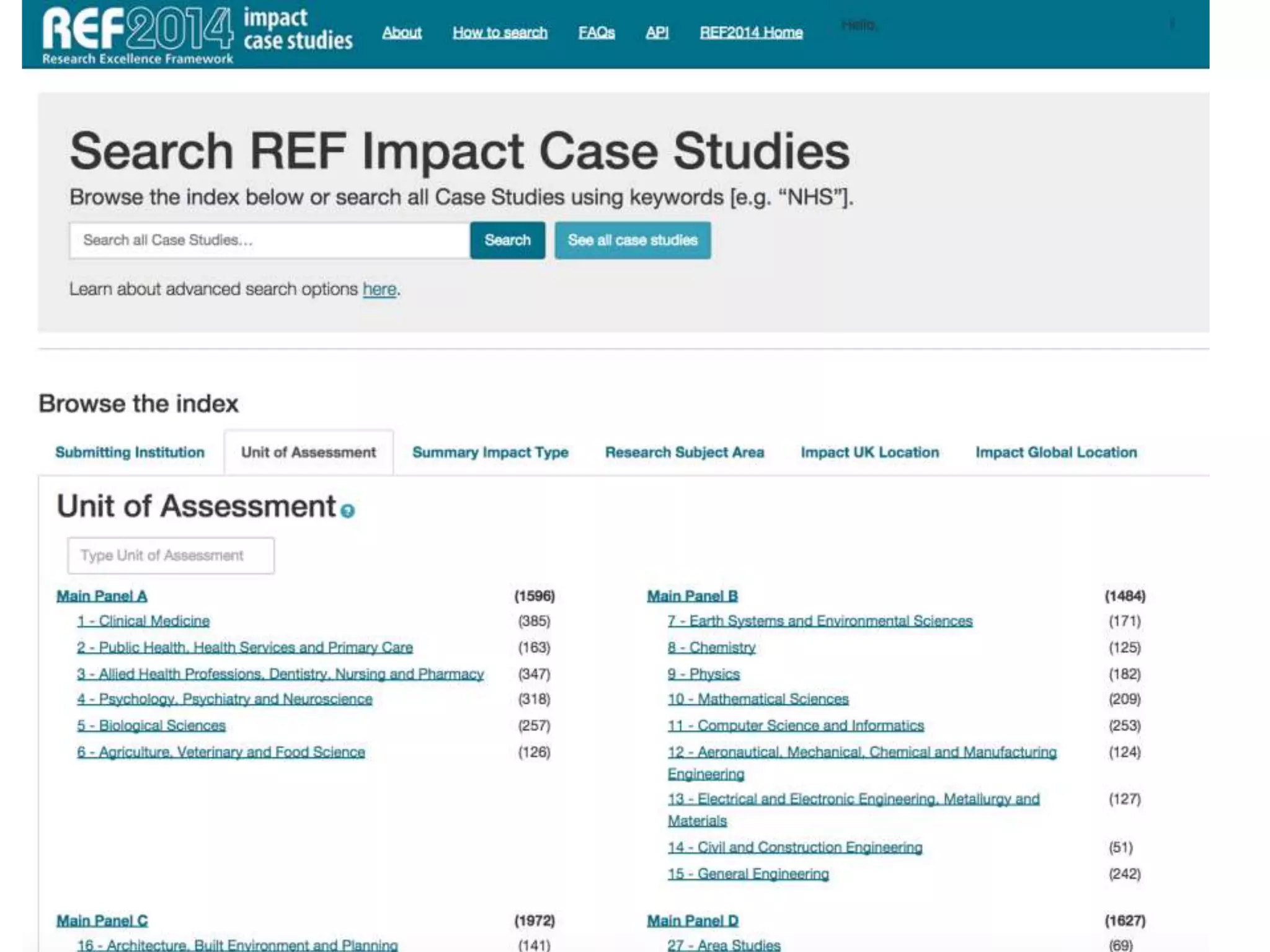
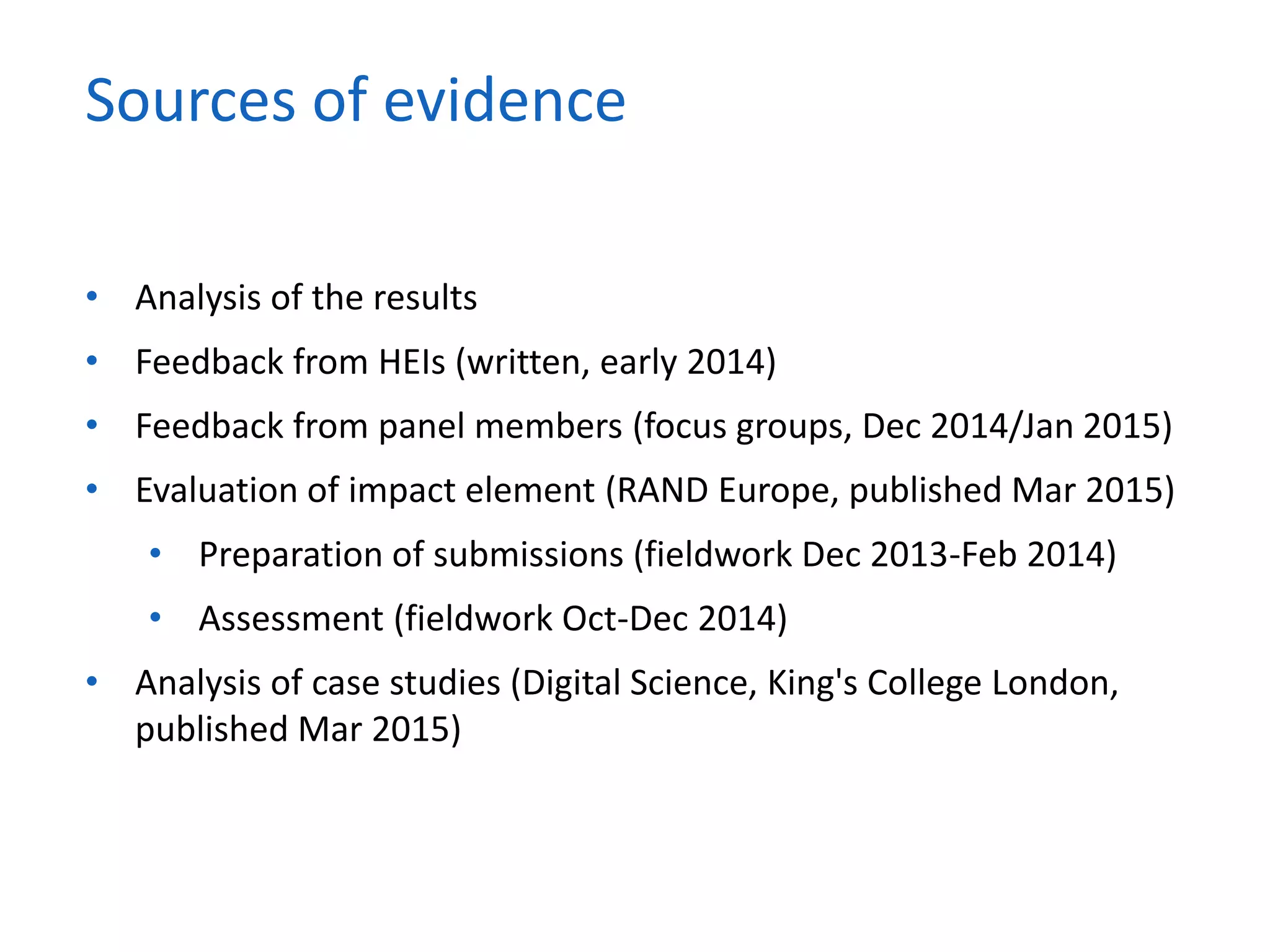
• Analysis of the results
• Feedback from HEIs (written, early 2014)
• Feedback from panel members (focus groups, Dec 2014/Jan 2015)
• Evaluation of impact element (RAND Europe, published Mar 2015)
• Preparation of submissions (fieldwork Dec 2013-Feb 2014)
• Assessment (fieldwork Oct-Dec 2014)
• Analysis of case studies (Digital Science, King's College London,
published Mar 2015)
Sources of evidence
• Preparing for impact has provided benefits and strategic insight to
Universities
What have we learned?
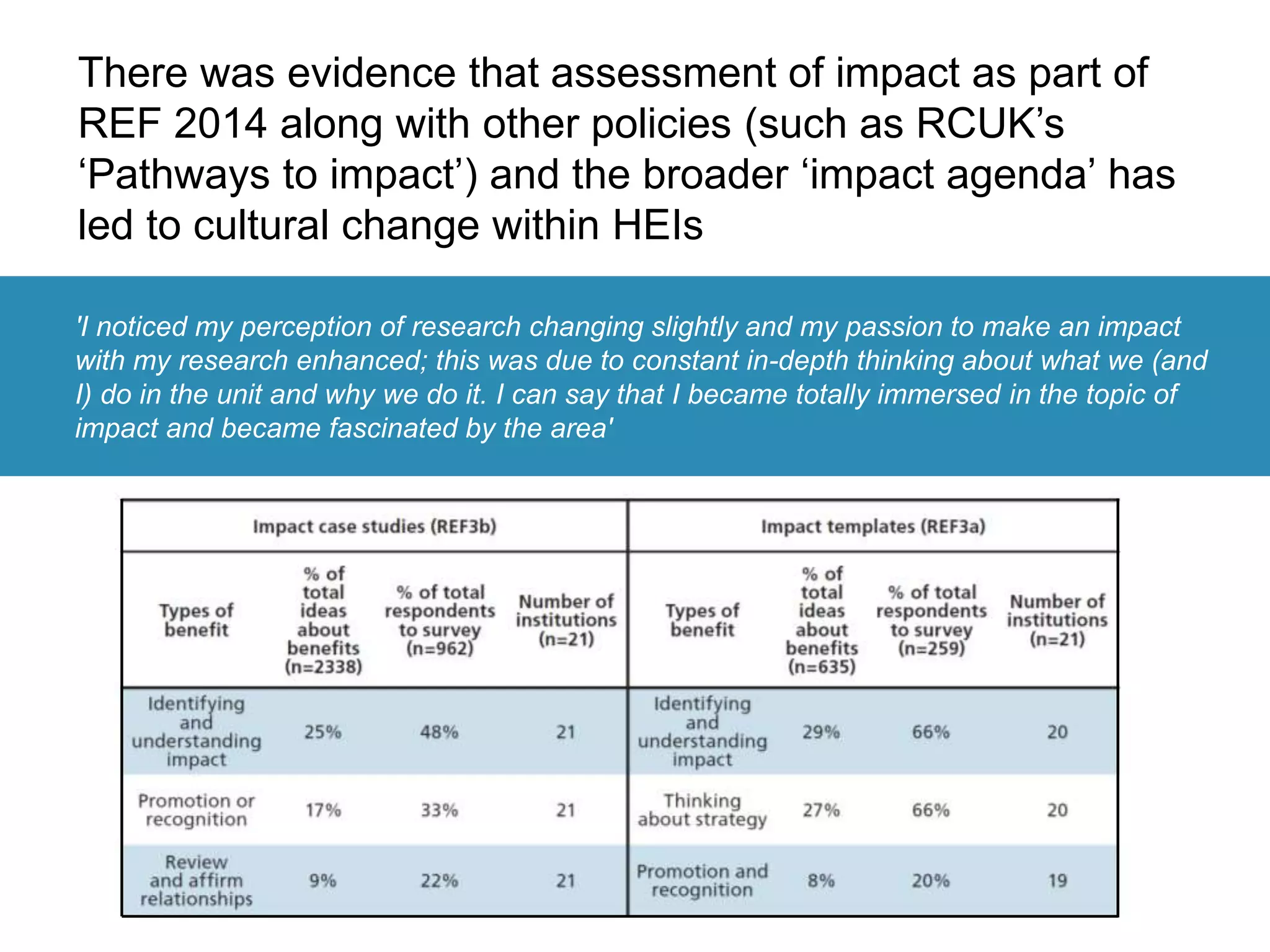
There was evidence that assessment of impact as part of
REF 2014 along with other policies (such as RCUK’s
‘Pathways to impact’) and the broader ‘impact agenda’ has
led to cultural change within HEIs
'I noticed my perception of research changing slightly and my passion to make an impact
with my research enhanced; this was due to constant in-depth thinking about what we (and
I) do in the unit and why we do it. I can say that I became totally immersed in the topic of
impact and became fascinated by the area'
“It is fair to say that over the period of preparation, the status and
visibility of research activity; its relevance to the everyday work of
staff and students; and its visibility to the [institution’s] large
communities of members of the public and other academic and
business collaborators, has been considerably invigorated and
enhanced.”
“The most positive aspect of preparing for REF 2014 was to illuminate
the vast array of research impact which [the university] may not
otherwise have realised it had.”
“In short, we know more about ourselves as a consequence of
making a REF submission.”
Feedback from participating HEIs
As a result of the impact agenda and changing culture,
HEIs are changing their practice
‘REF3A is informing the [impact] strategies that are currently being written’
Setting out an
impact strategy
Implementing systems to
store evidence of impact
Fixed-term posts
becoming permanent
Capturing evidence of
impact on an ongoing basis
Inclusion of impact as a
criterion for promotion
Building a plan for
impact into projects
• Preparing for impact has provided benefits and strategic insight to
Universities
• The assessment of impact worked well, but there are areas for
improvement
What have we learned?
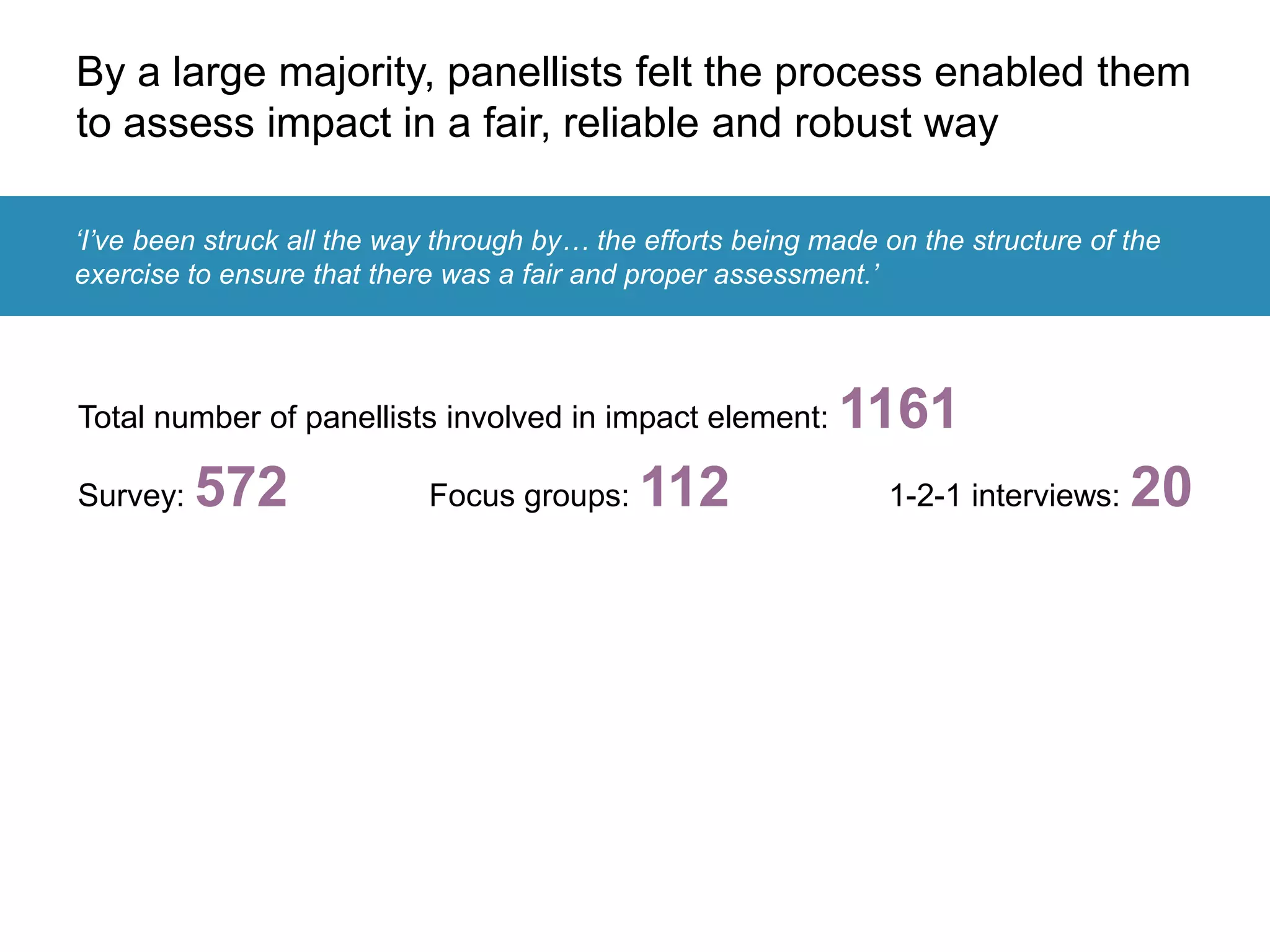
By a large majority, panellists felt the process enabled them
to assess impact in a fair, reliable and robust way
‘I’ve been struck all the way through by… the efforts being made on the structure of the
exercise to ensure that there was a fair and proper assessment.’
Total number of panellists involved in impact element: 1161
Survey: 572 Focus groups: 112 1-2-1 interviews: 20
Areas for further thought and improvement
• Panellists felt they were able to differentiate between
submissions in a more detail than the scoring process allowed
them to express
• There was variation in the way the process was conducted
• There were particular challenges in assessing the impact
templates
• Lack of requirement to evidence meant quality of writing had a
large effect
• Options for the future:
– Combine with environment template
– Use of metrics and factual information
– Remove it
‘There is much to commend [it] although there are improvements to be made and
much to be learned.’
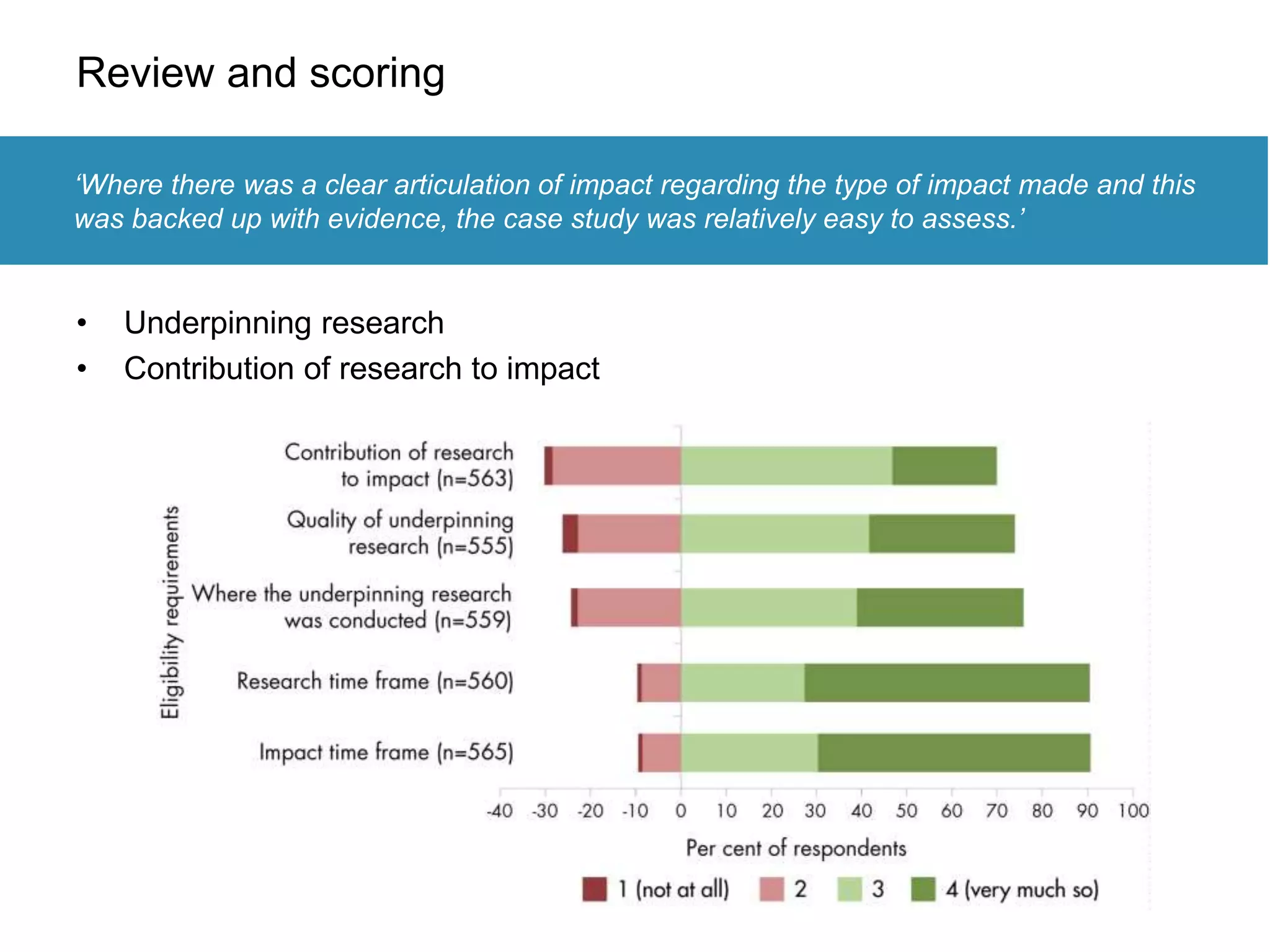
Review and scoring
• Underpinning research
• Contribution of research to impact
‘Where there was a clear articulation of impact regarding the type of impact made and this
was backed up with evidence, the case study was relatively easy to assess.’
• Preparing for impact has provided benefits and strategic insight to
Universities
• The assessment of impact worked well, but there are areas for
improvement
• Considerable and diverse impacts were submitted for assessment
What have we learned?
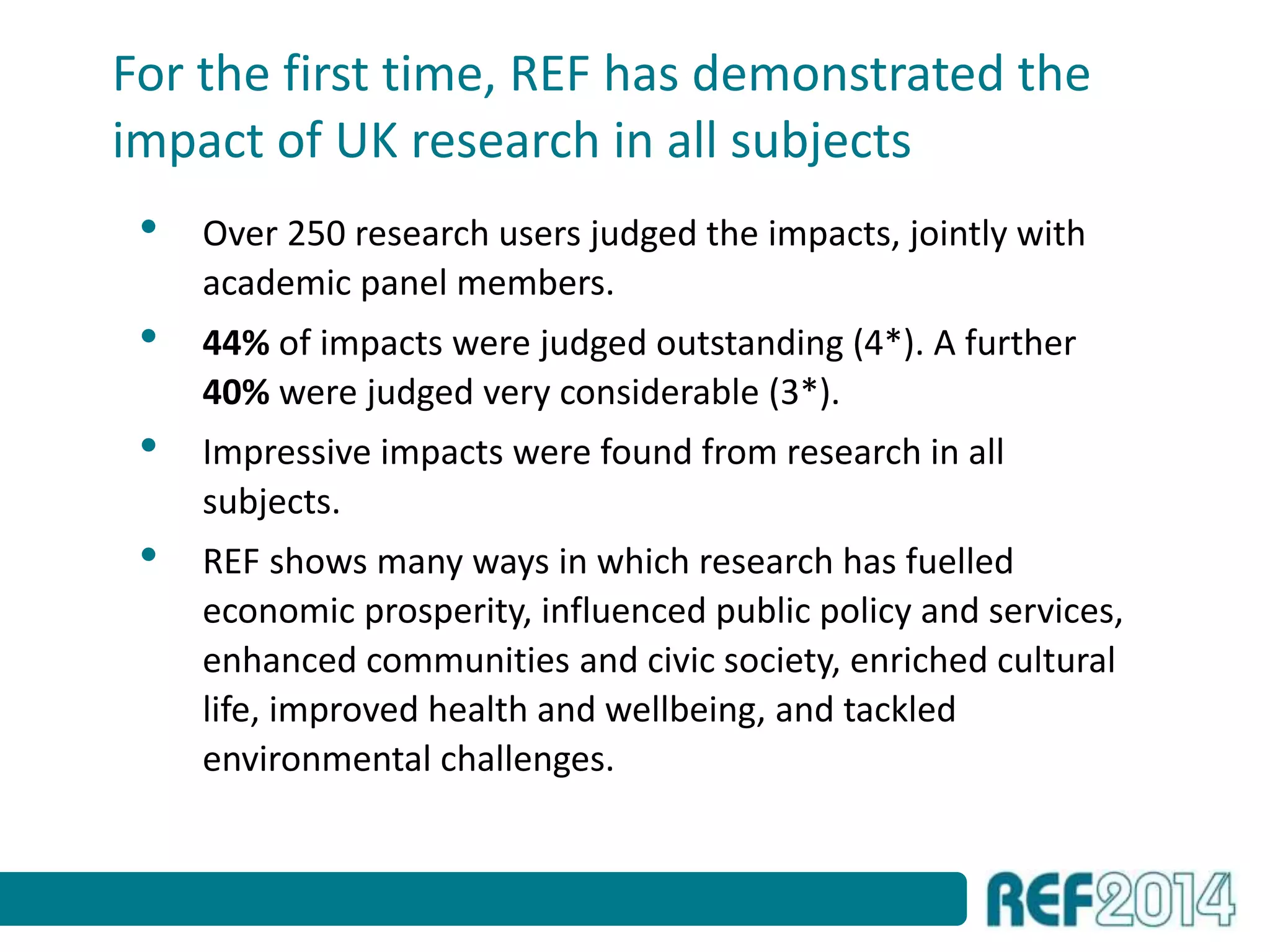
For the first time, REF has demonstrated the
impact of UK research in all subjects
• Over 250 research users judged the impacts, jointly with
academic panel members.
• 44% of impacts were judged outstanding (4*). A further
40% were judged very considerable (3*).
• Impressive impacts were found from research in all
subjects.
• REF shows many ways in which research has fuelled
economic prosperity, influenced public policy and services,
enhanced communities and civic society, enriched cultural
life, improved health and wellbeing, and tackled
environmental challenges.
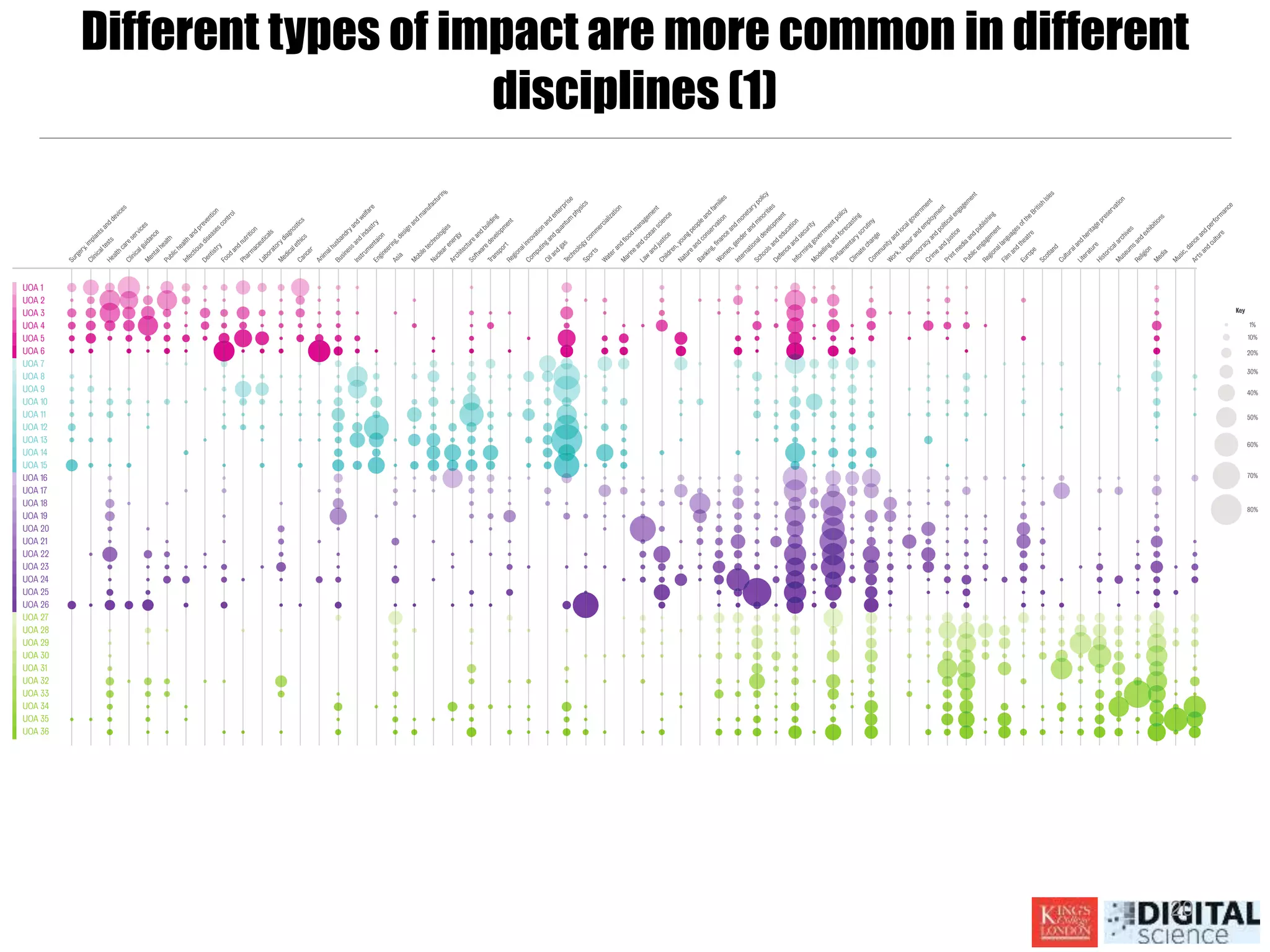
Different types of impact are more common in different
disciplines (1)
20
• Preparing for impact has provided benefits and strategic insight to
Universities
• The assessment of impact worked well, but there are areas for
improvement
• Considerable and diverse impacts were submitted for assessment
• Impact derives from the integration of disciplinary knowledge
What have we learned?
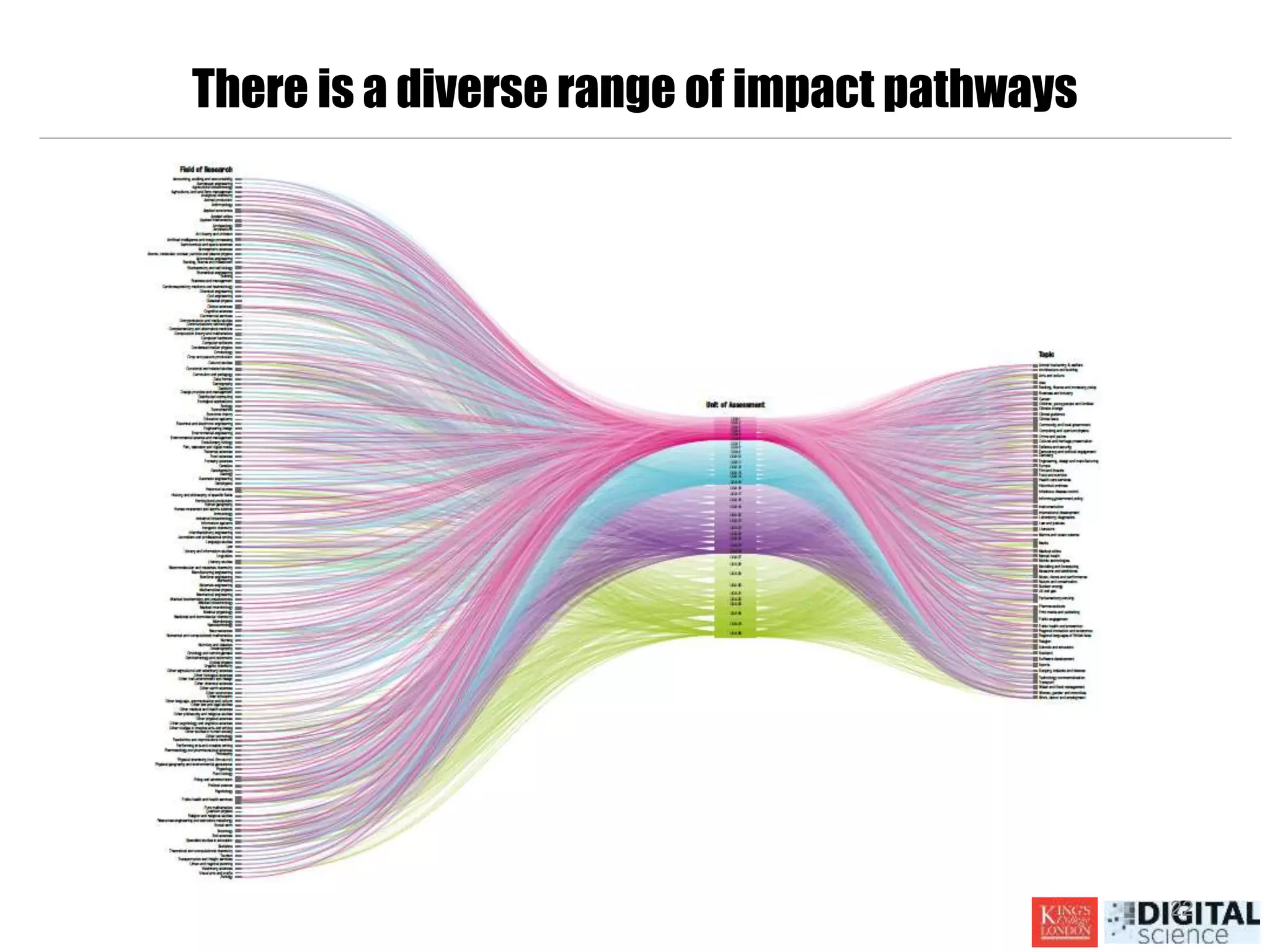
There is a diverse range of impact pathways
22
• Preparing for impact has provided benefits and strategic insight to
Universities
• The assessment of impact worked well, but there are areas for
improvement
• Considerable and diverse impacts were submitted for assessment
• Impact derives from the integration of disciplinary knowledge
• Impact derives from research of high academic quality
What have we learned?
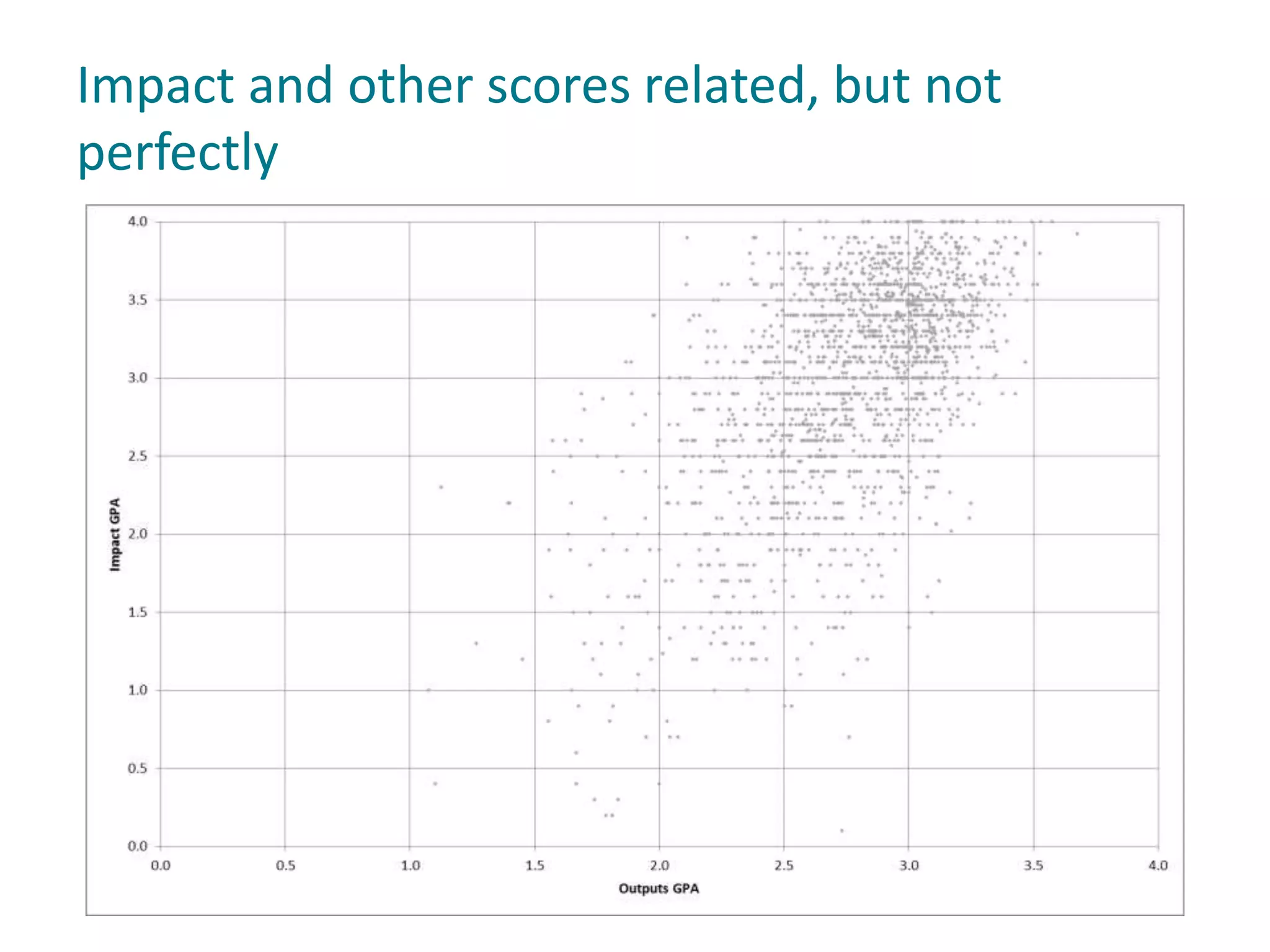
Impact and other scores related, but not
perfectly
• Preparing for impact has provided benefits and strategic insight to
Universities
• The assessment of impact worked well, but there are areas for
improvement
• Considerable and diverse impacts were submitted for assessment
• Impact derives from the integration of disciplinary knowledge
• Impact derives from research of high academic quality
• The systematic collection of impact data has generated an
important national asset, and provided new insight into the
relationship between research and impact
What have we learned?
26
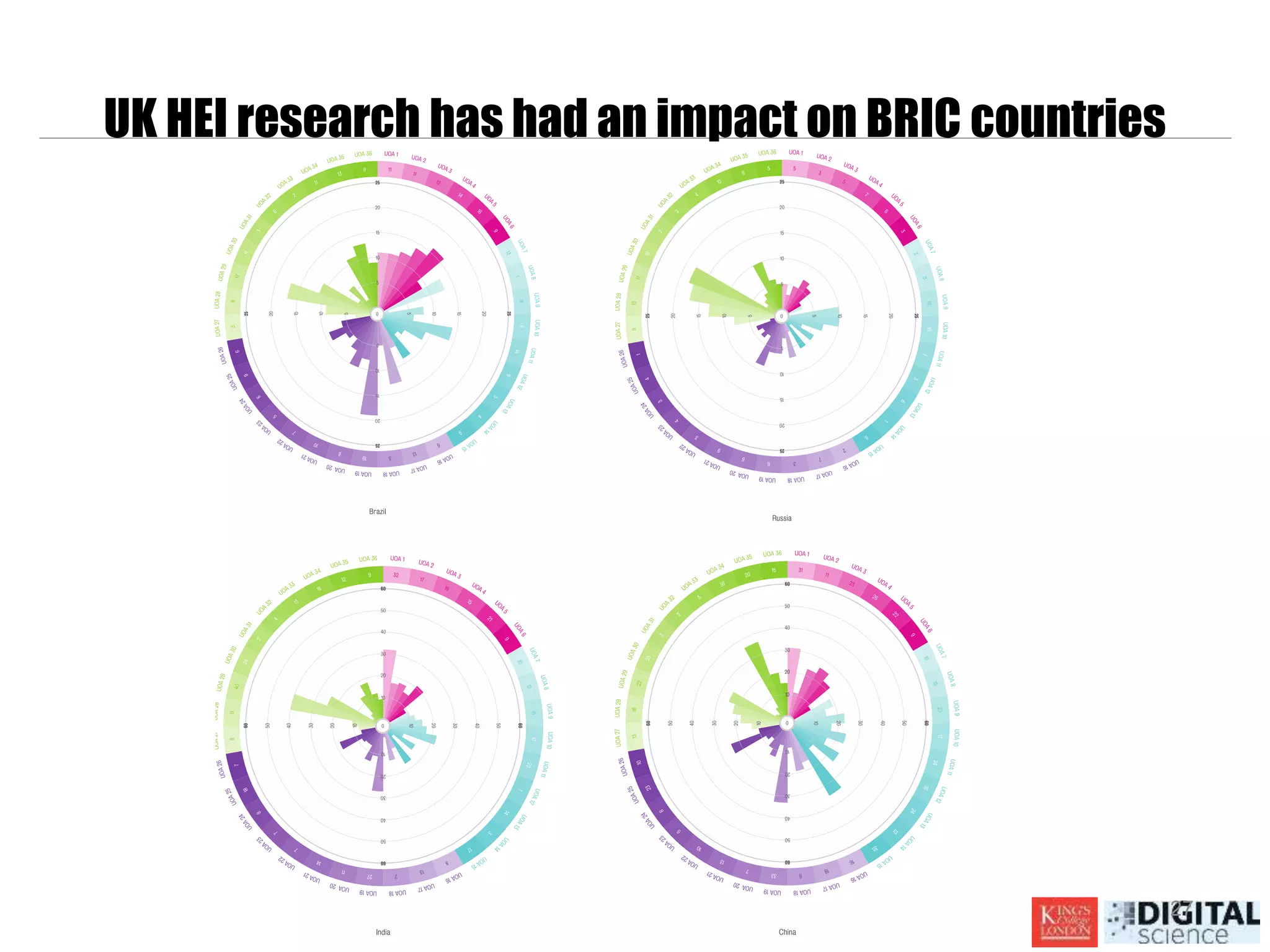
UK HEI research has had an impact on BRIC countries
27
• Preparing for impact has provided benefits and strategic insight to
Universities
• The assessment of impact worked well, but there are areas for
improvement
• Considerable and diverse impacts were submitted for assessment
• Impact derives from the integration of disciplinary knowledge
• Impact derives from research of high academic quality
• The systematic collection of impact data has generated an
important national asset, and provided new insight into the
relationship between research and impact
What have we learned?
Thank you for listening
s.hill@hefce.ac.uk
@stevenhill

Assessing societal impact: what have we learned from the UK REF?

  • 1.
    Assessing societal impact: whathave we learned from the UK REF? Steven Hill Head of Research Policy ORCID/CASRAI Conference 18 May 2015 @stevenhill
  • 2.
    • Impact inthe Research Excellence Framework • What have we learned? Summary
  • 3.
    • Impact inthe Research Excellence Framework • What have we learned? Summary
  • 4.
    REF: How itworks REF assesses the quality of research in all UK universities, in all disciplines. It is carried out by 36 expert panels, grouped into 4 main panels. 2011-12 Preparation Panels were appointed. Guidance and criteria were published. 2012-13 Submissions Universities made submissions in whichever subjects they chose to. 2014 Assessment 36 expert panels reviewed the submissions, guided by the 4 main panels. Main Panel A: Medical and life sciences Main Panel B: Physical sciences and engineering Main panel C: Social sciences Main Panel D: Arts and humanities
  • 5.
    REF: What wasassessed Panels judged the overall quality of each submission Quality of research outputs Impact of research on society The research environment 65% 20% 15% 191,150 research outputs by 52,061 staff were reviewed 6,975 impact case studies were reviewed The review was based on data and information about the environment
  • 6.
    “For the purposesof the REF, impact is defined as an effect on, change or benefit to the economy, society, culture, public policy or services, health, the environment or quality of life, beyond academia” The definition of impact is broad
  • 7.
    • Impact inthe Research Excellence Framework • What have we learned? Summary
  • 8.
    • Analysis ofthe results • Feedback from HEIs (written, early 2014) • Feedback from panel members (focus groups, Dec 2014/Jan 2015) • Evaluation of impact element (RAND Europe, published Mar 2015) • Preparation of submissions (fieldwork Dec 2013-Feb 2014) • Assessment (fieldwork Oct-Dec 2014) • Analysis of case studies (Digital Science, King's College London, published Mar 2015) Sources of evidence
  • 9.
    • Preparing forimpact has provided benefits and strategic insight to Universities What have we learned?
  • 10.
    There was evidencethat assessment of impact as part of REF 2014 along with other policies (such as RCUK’s ‘Pathways to impact’) and the broader ‘impact agenda’ has led to cultural change within HEIs 'I noticed my perception of research changing slightly and my passion to make an impact with my research enhanced; this was due to constant in-depth thinking about what we (and I) do in the unit and why we do it. I can say that I became totally immersed in the topic of impact and became fascinated by the area'
  • 11.
    “It is fairto say that over the period of preparation, the status and visibility of research activity; its relevance to the everyday work of staff and students; and its visibility to the [institution’s] large communities of members of the public and other academic and business collaborators, has been considerably invigorated and enhanced.” “The most positive aspect of preparing for REF 2014 was to illuminate the vast array of research impact which [the university] may not otherwise have realised it had.” “In short, we know more about ourselves as a consequence of making a REF submission.” Feedback from participating HEIs
  • 12.
    As a resultof the impact agenda and changing culture, HEIs are changing their practice ‘REF3A is informing the [impact] strategies that are currently being written’ Setting out an impact strategy Implementing systems to store evidence of impact Fixed-term posts becoming permanent Capturing evidence of impact on an ongoing basis Inclusion of impact as a criterion for promotion Building a plan for impact into projects
  • 13.
    • Preparing forimpact has provided benefits and strategic insight to Universities • The assessment of impact worked well, but there are areas for improvement What have we learned?
  • 14.
    By a largemajority, panellists felt the process enabled them to assess impact in a fair, reliable and robust way ‘I’ve been struck all the way through by… the efforts being made on the structure of the exercise to ensure that there was a fair and proper assessment.’ Total number of panellists involved in impact element: 1161 Survey: 572 Focus groups: 112 1-2-1 interviews: 20
  • 15.
    Areas for furtherthought and improvement • Panellists felt they were able to differentiate between submissions in a more detail than the scoring process allowed them to express • There was variation in the way the process was conducted • There were particular challenges in assessing the impact templates • Lack of requirement to evidence meant quality of writing had a large effect • Options for the future: – Combine with environment template – Use of metrics and factual information – Remove it ‘There is much to commend [it] although there are improvements to be made and much to be learned.’
  • 16.
    Review and scoring •Underpinning research • Contribution of research to impact ‘Where there was a clear articulation of impact regarding the type of impact made and this was backed up with evidence, the case study was relatively easy to assess.’
  • 17.
    • Preparing forimpact has provided benefits and strategic insight to Universities • The assessment of impact worked well, but there are areas for improvement • Considerable and diverse impacts were submitted for assessment What have we learned?
  • 18.
    For the firsttime, REF has demonstrated the impact of UK research in all subjects • Over 250 research users judged the impacts, jointly with academic panel members. • 44% of impacts were judged outstanding (4*). A further 40% were judged very considerable (3*). • Impressive impacts were found from research in all subjects. • REF shows many ways in which research has fuelled economic prosperity, influenced public policy and services, enhanced communities and civic society, enriched cultural life, improved health and wellbeing, and tackled environmental challenges.
  • 20.
    Different types ofimpact are more common in different disciplines (1) 20
  • 21.
    • Preparing forimpact has provided benefits and strategic insight to Universities • The assessment of impact worked well, but there are areas for improvement • Considerable and diverse impacts were submitted for assessment • Impact derives from the integration of disciplinary knowledge What have we learned?
  • 22.
    There is adiverse range of impact pathways 22
  • 23.
    • Preparing forimpact has provided benefits and strategic insight to Universities • The assessment of impact worked well, but there are areas for improvement • Considerable and diverse impacts were submitted for assessment • Impact derives from the integration of disciplinary knowledge • Impact derives from research of high academic quality What have we learned?
  • 24.
    Impact and otherscores related, but not perfectly
  • 25.
    • Preparing forimpact has provided benefits and strategic insight to Universities • The assessment of impact worked well, but there are areas for improvement • Considerable and diverse impacts were submitted for assessment • Impact derives from the integration of disciplinary knowledge • Impact derives from research of high academic quality • The systematic collection of impact data has generated an important national asset, and provided new insight into the relationship between research and impact What have we learned?
  • 26.
  • 27.
    UK HEI researchhas had an impact on BRIC countries 27
  • 28.
    • Preparing forimpact has provided benefits and strategic insight to Universities • The assessment of impact worked well, but there are areas for improvement • Considerable and diverse impacts were submitted for assessment • Impact derives from the integration of disciplinary knowledge • Impact derives from research of high academic quality • The systematic collection of impact data has generated an important national asset, and provided new insight into the relationship between research and impact What have we learned?
  • 29.
    Thank you forlistening s.hill@hefce.ac.uk @stevenhill