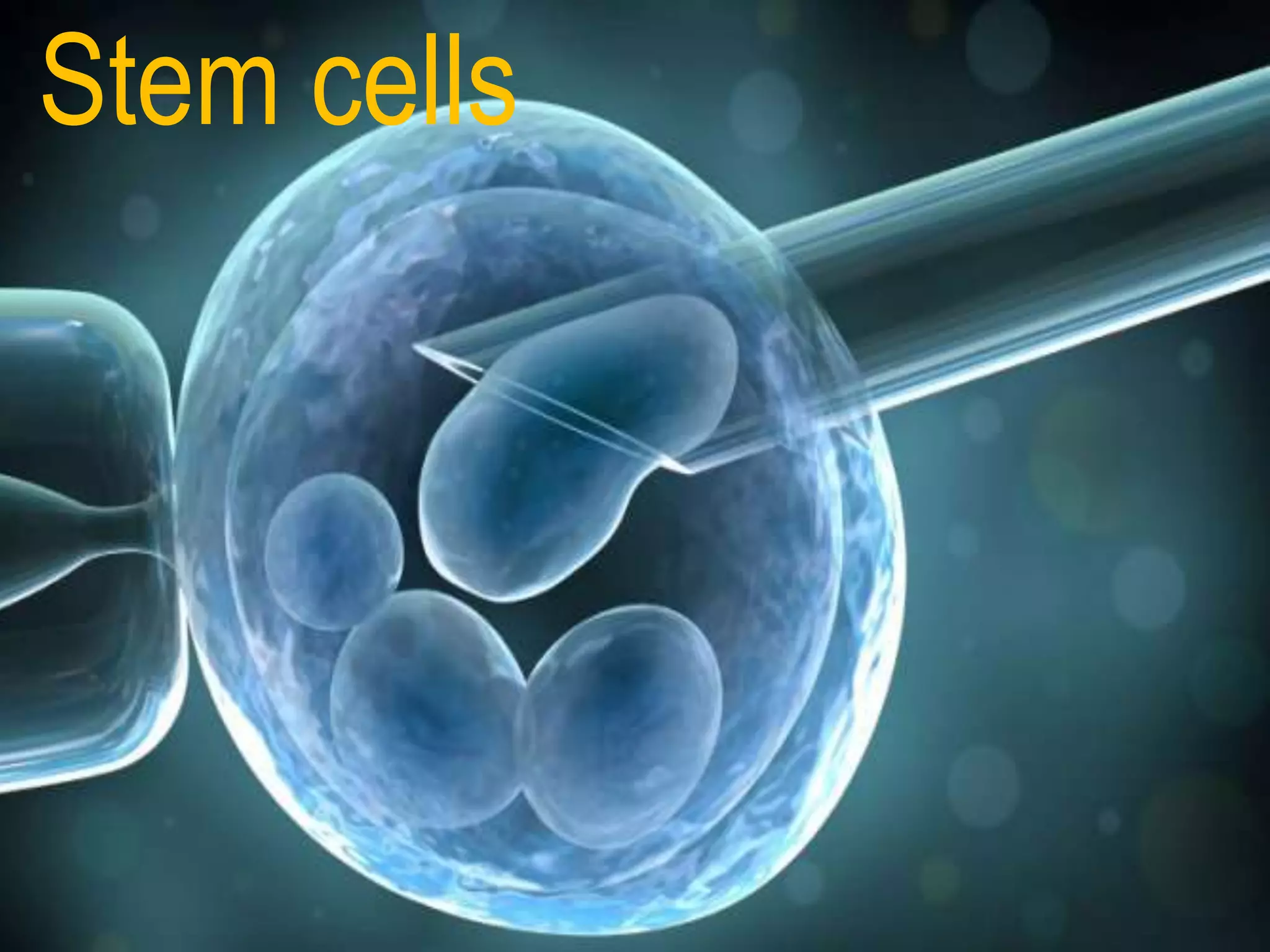

Stem cells
Outline of Presentation
 What are stem cells?
 How do cells know what to become?
 Types of stem cells.
 Uses of stem cells.
 Disadvantages of stem cells.
 Future direction of stem cells.
• the body is made up of about 200 different kinds of specialized
cells such as muscle cells, nerve cells, fat cells and skin cells.
• what is the foundation for these and all other cells in body?
• Stem cells.
• Stem cells are undifferentiated biological cells that can divide
and differentiate to produce the specialized cells and can
preserve themselves by producing other stem cells.
• this process of specialization is called differentiation.
• once the differentiation pathway of a stem cell has been
decided, it can no longer become another type of cell on its own.
How do cells know what to become?
• Although stem cell have the genome to differentiate to any
tissue, they differentiate in one type they decide to be
…HOW?
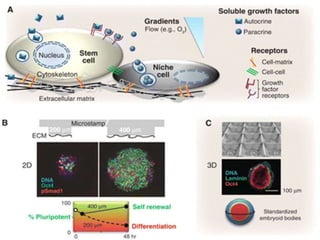
• The stem cells are like other cells they communicate with
neighboring cells but they can also expresses certain
(stemness) genes that make it able to proliferate,
differentiate, or remain quiet when exposed to certain signals
from the environment.
• Signals from the environment are chemicals, extracellular
proteins/hormones/factors.
• neighboring cells, the physical environment converge on the
cell, typically activating a signaling cascade that leads to
gene expression. These specific proteins change the
phenotype into that of a more specialized cell.
Types of stem cells
 Embryonic stem cells(ES cells).
 Adult stem cells.
 Induced pluripotent stem cells(IPS).
:Embryonic stem cells
 Donated excess IVF embryos.
 they are pluripotent stem cells derived from the
inner cell mass of a blastocyst, an early-stage pre-
implantation embryo human.
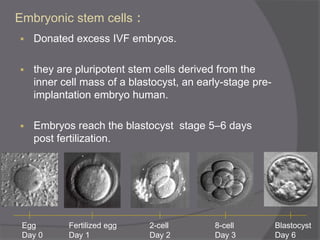
 Embryos reach the blastocyst stage 5–6 days
post fertilization.
Egg
Day 0
Fertilized egg
Day 1
2-cell
Day 2
8-cell
Day 3
Blastocyst
Day 6
continued
 can be grown indefinitely in the laboratory in an
unspecialized state, so can become any cell in the body.
 But with all these advantages the embryonic stem
consider a big ethical issue, due to killing one who
deserve life for another whatever who already has had
its life.
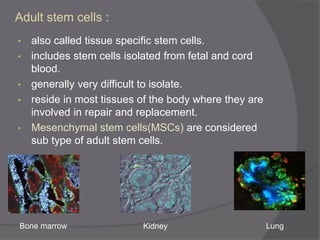
Adult stem cells :
• also called tissue specific stem cells.
• includes stem cells isolated from fetal and cord
blood.
• generally very difficult to isolate.
• reside in most tissues of the body where they are
involved in repair and replacement.
• Mesenchymal stem cells(MSCs) are considered
sub type of adult stem cells.
Bone marrow Kidney Lung
Induced pluripotent stem cells :
 Due to ethical issue of ES cells, New attempts
appear to exceed this issue.
 In 2007, they succeed to produce pluripotent stem
cells from adult cells. having the same abilities as
ES cells.
 So these days stem cells are created entirely in
labs by cellular reprogramming.
 By this step we remove the ethical barrier against
stem cells research.
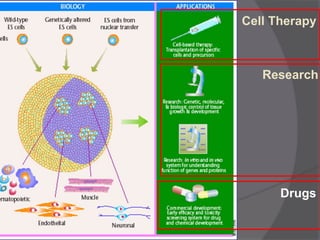
:Uses of stem cells
examples of stem cell in :
 research,
 therapies,
 and in technologies.
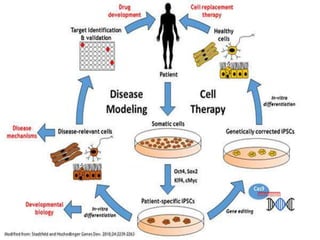
Cell Therapy
Research
Drugs
Example of stem cells in research :
 Due to research in stem cells, scientists able to
create IPS from adult cells exceeding the ethical
barrier of ES cells.
 Now research able scientists to use stem cells in
several fields such as :
1) To study normal human development.
2) In drug discovery.
3) For cell replacement.
4) For endogenous, or self repair.
Example of stem cells in therapies :
In fact, three types of stem cells are actually used :
1) Adult stem cells.
2) MSCs.
3) IPS.
except ES cells(which still used in japan).
:Adult stem cells
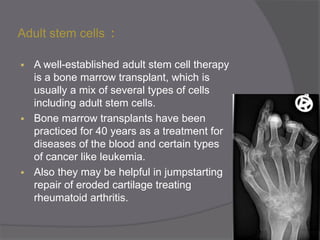
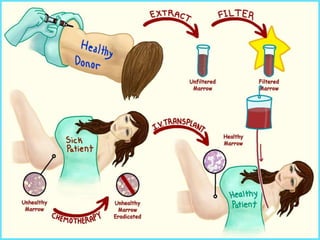
 A well-established adult stem cell therapy
is a bone marrow transplant, which is
usually a mix of several types of cells
including adult stem cells.
 Bone marrow transplants have been
practiced for 40 years as a treatment for
diseases of the blood and certain types
of cancer like leukemia.
 Also they may be helpful in jumpstarting
repair of eroded cartilage treating
rheumatoid arthritis.
Mesenchymal stem cells:
Beside their capacity for differentiation and
regeneration, they also have :
 Drug delivery method.
Which is the ability of systemically delivered cells to
home to sites of injury and repair.
Because of :
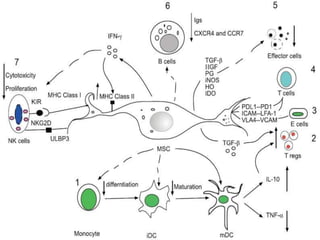
1) The ability for multipotent differentiation,
2) The paracrine/ autocrine action of stem cell
secretome including its immunomodulatory and
anti-inflammatory effects and ability to initiate or
assist in tissue regeneration.
continued
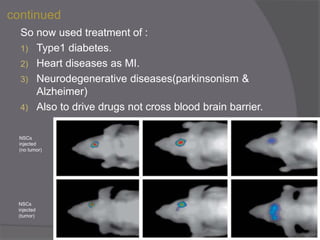
So now used treatment of :
1) Type1 diabetes.
2) Heart diseases as MI.
3) Neurodegenerative diseases(parkinsonism &
Alzheimer)
4) Also to drive drugs not cross blood brain barrier.
NSCs
injected
(no tumor)
NSCs
injected
(tumor)
:Induced pluripotent stem cells
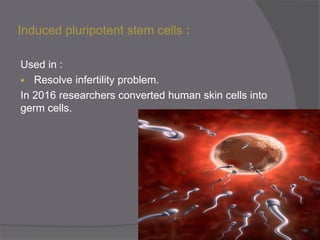
Used in :
 Resolve infertility problem.
In 2016 researchers converted human skin cells into
germ cells.
continued
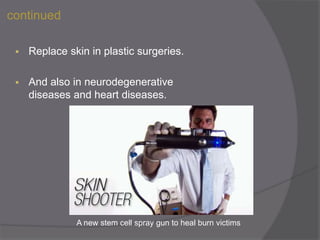
 Replace skin in plastic surgeries.
 And also in neurodegenerative
diseases and heart diseases.
A new stem cell spray gun to heal burn victims
Disadvantages of stem cells
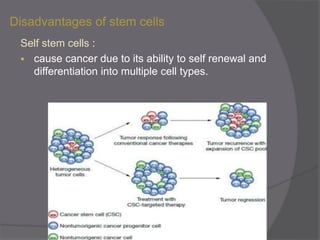
Self stem cells :
 cause cancer due to its ability to self renewal and
differentiation into multiple cell types.
continued
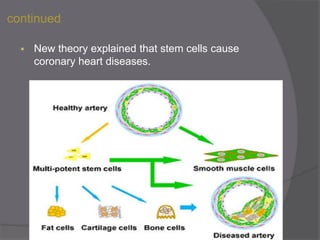
 New theory explained that stem cells cause
coronary heart diseases.
Non self (therapeutic) stem cells :
 ES cells are taken from blastocyst which is a human life
and to destroy it is immoral and unacceptable.
 Expensive.
 May rejected as non self cells.
 Tumorigenic.
 Adult stem cells are pre-specialized, for instance, blood
stem cells make only blood, and brain stem cells make
only brain cells.
future directions of stem cells :
• Although the huge progress achieved in stem cell
research, Stem cell field is still in its infancy.
• There is still much left to understand about stem
cells.
Thank you

Stem cells

  • 1.
  • 3.
    Outline of Presentation What are stem cells?  How do cells know what to become?  Types of stem cells.  Uses of stem cells.  Disadvantages of stem cells.  Future direction of stem cells.
  • 4.
    • the bodyis made up of about 200 different kinds of specialized cells such as muscle cells, nerve cells, fat cells and skin cells. • what is the foundation for these and all other cells in body? • Stem cells. • Stem cells are undifferentiated biological cells that can divide and differentiate to produce the specialized cells and can preserve themselves by producing other stem cells. • this process of specialization is called differentiation. • once the differentiation pathway of a stem cell has been decided, it can no longer become another type of cell on its own.
  • 5.
    How do cellsknow what to become? • Although stem cell have the genome to differentiate to any tissue, they differentiate in one type they decide to be …HOW? • The stem cells are like other cells they communicate with neighboring cells but they can also expresses certain (stemness) genes that make it able to proliferate, differentiate, or remain quiet when exposed to certain signals from the environment. • Signals from the environment are chemicals, extracellular proteins/hormones/factors. • neighboring cells, the physical environment converge on the cell, typically activating a signaling cascade that leads to gene expression. These specific proteins change the phenotype into that of a more specialized cell.
  • 7.
    Types of stemcells  Embryonic stem cells(ES cells).  Adult stem cells.  Induced pluripotent stem cells(IPS).
  • 8.
    :Embryonic stem cells Donated excess IVF embryos.  they are pluripotent stem cells derived from the inner cell mass of a blastocyst, an early-stage pre- implantation embryo human.  Embryos reach the blastocyst stage 5–6 days post fertilization. Egg Day 0 Fertilized egg Day 1 2-cell Day 2 8-cell Day 3 Blastocyst Day 6
  • 9.
    continued  can begrown indefinitely in the laboratory in an unspecialized state, so can become any cell in the body.  But with all these advantages the embryonic stem consider a big ethical issue, due to killing one who deserve life for another whatever who already has had its life.
  • 10.
    Adult stem cells: • also called tissue specific stem cells. • includes stem cells isolated from fetal and cord blood. • generally very difficult to isolate. • reside in most tissues of the body where they are involved in repair and replacement. • Mesenchymal stem cells(MSCs) are considered sub type of adult stem cells. Bone marrow Kidney Lung
  • 11.
    Induced pluripotent stemcells :  Due to ethical issue of ES cells, New attempts appear to exceed this issue.  In 2007, they succeed to produce pluripotent stem cells from adult cells. having the same abilities as ES cells.  So these days stem cells are created entirely in labs by cellular reprogramming.  By this step we remove the ethical barrier against stem cells research.
  • 13.
    :Uses of stemcells examples of stem cell in :  research,  therapies,  and in technologies.
  • 14.
  • 15.
    Example of stemcells in research :  Due to research in stem cells, scientists able to create IPS from adult cells exceeding the ethical barrier of ES cells.  Now research able scientists to use stem cells in several fields such as : 1) To study normal human development. 2) In drug discovery. 3) For cell replacement. 4) For endogenous, or self repair.
  • 16.
    Example of stemcells in therapies : In fact, three types of stem cells are actually used : 1) Adult stem cells. 2) MSCs. 3) IPS. except ES cells(which still used in japan).
  • 17.
    :Adult stem cells A well-established adult stem cell therapy is a bone marrow transplant, which is usually a mix of several types of cells including adult stem cells.  Bone marrow transplants have been practiced for 40 years as a treatment for diseases of the blood and certain types of cancer like leukemia.  Also they may be helpful in jumpstarting repair of eroded cartilage treating rheumatoid arthritis.
  • 19.
    Mesenchymal stem cells: Besidetheir capacity for differentiation and regeneration, they also have :  Drug delivery method. Which is the ability of systemically delivered cells to home to sites of injury and repair. Because of : 1) The ability for multipotent differentiation, 2) The paracrine/ autocrine action of stem cell secretome including its immunomodulatory and anti-inflammatory effects and ability to initiate or assist in tissue regeneration.
  • 21.
    continued So now usedtreatment of : 1) Type1 diabetes. 2) Heart diseases as MI. 3) Neurodegenerative diseases(parkinsonism & Alzheimer) 4) Also to drive drugs not cross blood brain barrier. NSCs injected (no tumor) NSCs injected (tumor)
  • 22.
    :Induced pluripotent stemcells Used in :  Resolve infertility problem. In 2016 researchers converted human skin cells into germ cells.
  • 23.
    continued  Replace skinin plastic surgeries.  And also in neurodegenerative diseases and heart diseases. A new stem cell spray gun to heal burn victims
  • 24.
    Disadvantages of stemcells Self stem cells :  cause cancer due to its ability to self renewal and differentiation into multiple cell types.
  • 25.
    continued  New theoryexplained that stem cells cause coronary heart diseases.
  • 26.
    Non self (therapeutic)stem cells :  ES cells are taken from blastocyst which is a human life and to destroy it is immoral and unacceptable.  Expensive.  May rejected as non self cells.  Tumorigenic.  Adult stem cells are pre-specialized, for instance, blood stem cells make only blood, and brain stem cells make only brain cells.
  • 27.
    future directions ofstem cells : • Although the huge progress achieved in stem cell research, Stem cell field is still in its infancy. • There is still much left to understand about stem cells.
  • 29.