Discrete Distributions
• What is a random variable?
• Distinguish between discrete random variables
and continuous random variables.
• Know how to determine the mean and variance
of a discrete distribution.
• Identify the type of statistical experiments that
can be described by the binomial distribution,
and know how to calculate probabilities based on
the binomial distribution.
Discrete vs. Continuous Distributions
• Random Variable - a variable which contains the
outcomes of a chance experiment
• Discrete Random Variable – A random variable
that only takes on distinct values
ex: Number of heads on 10 flips, Number of defective
items in a random sample of 100, Number of times
you check your watch during class, etc.

• Continuous Random Variable – A random variable
that takes on infinite values by increasing
precision. For each two values, there always
exists a valid value in between them.
ex: Time until a bulb goes out, height, etc.
Describing a Distribution
• A distribution can be described by
constructing a graph of the distribution
• Measures of central tendency and variability
can be applied to distributions
Describing a Discrete Distribution
• Mean of discrete distribution – is the long run
average
– If the process is repeated long enough, the average of
the outcomes will approach the long run average
(mean)
– Mean of a discrete distribution

µ = ∑ (Xi * P(Xi))
where µ is the long run average,
Xi = the ith outcome of random variable X, and
P(Xi) = probability of X = Xi
Describing a Discrete Distribution
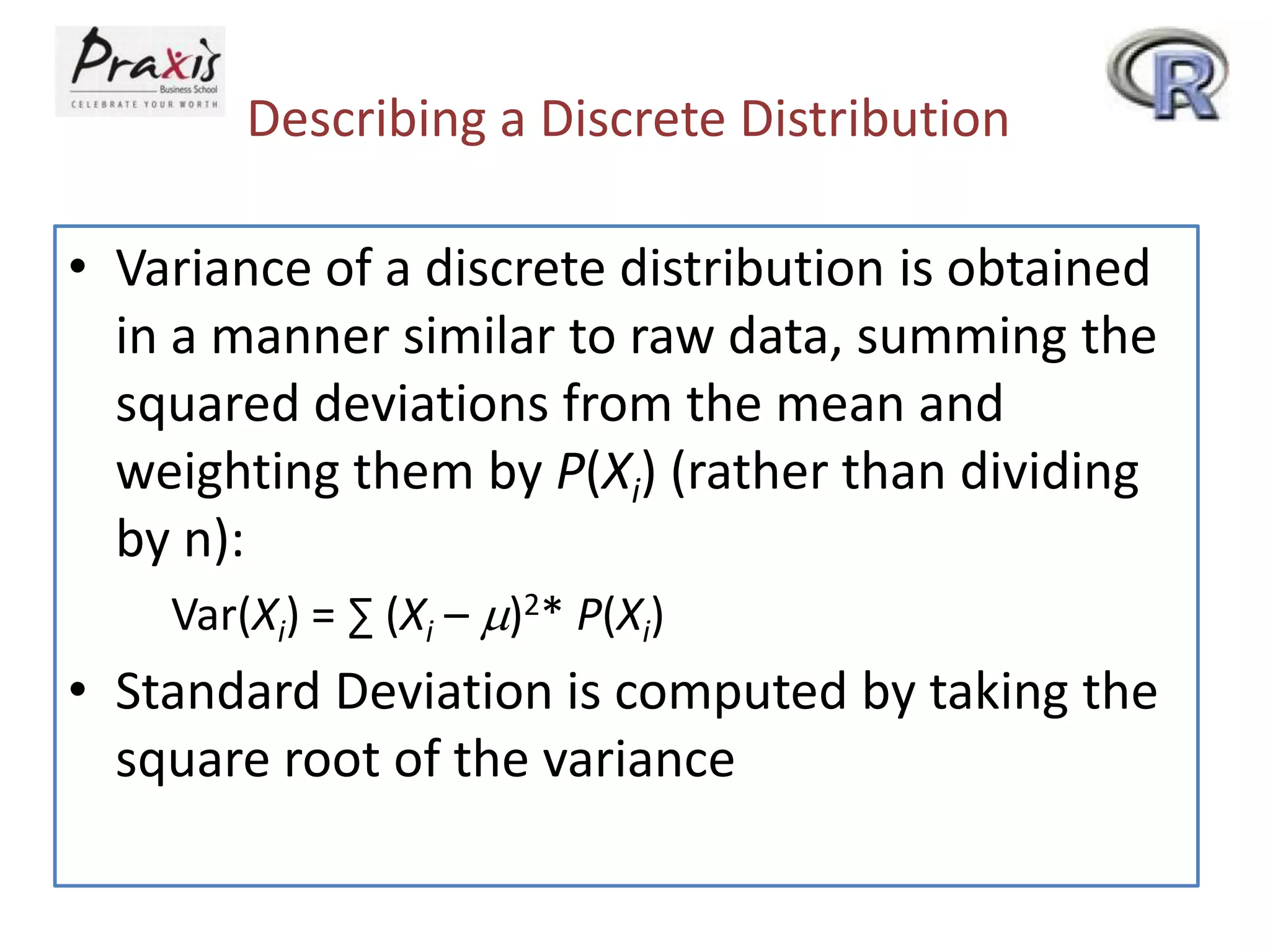
• Variance of a discrete distribution is obtained
in a manner similar to raw data, summing the
squared deviations from the mean and
weighting them by P(Xi) (rather than dividing
by n):
Var(Xi) = ∑ (Xi – m)2* P(Xi)

• Standard Deviation is computed by taking the
square root of the variance
Discrete Distribution -- Example
• An executive is considering out-of-town business travel
for a given Friday. At least one crisis could occur on the
day that the executive is gone. The distribution on the
following slide contains the number of crises that could
occur during the day the executive is gone and the
probability that each number will occur. For example,
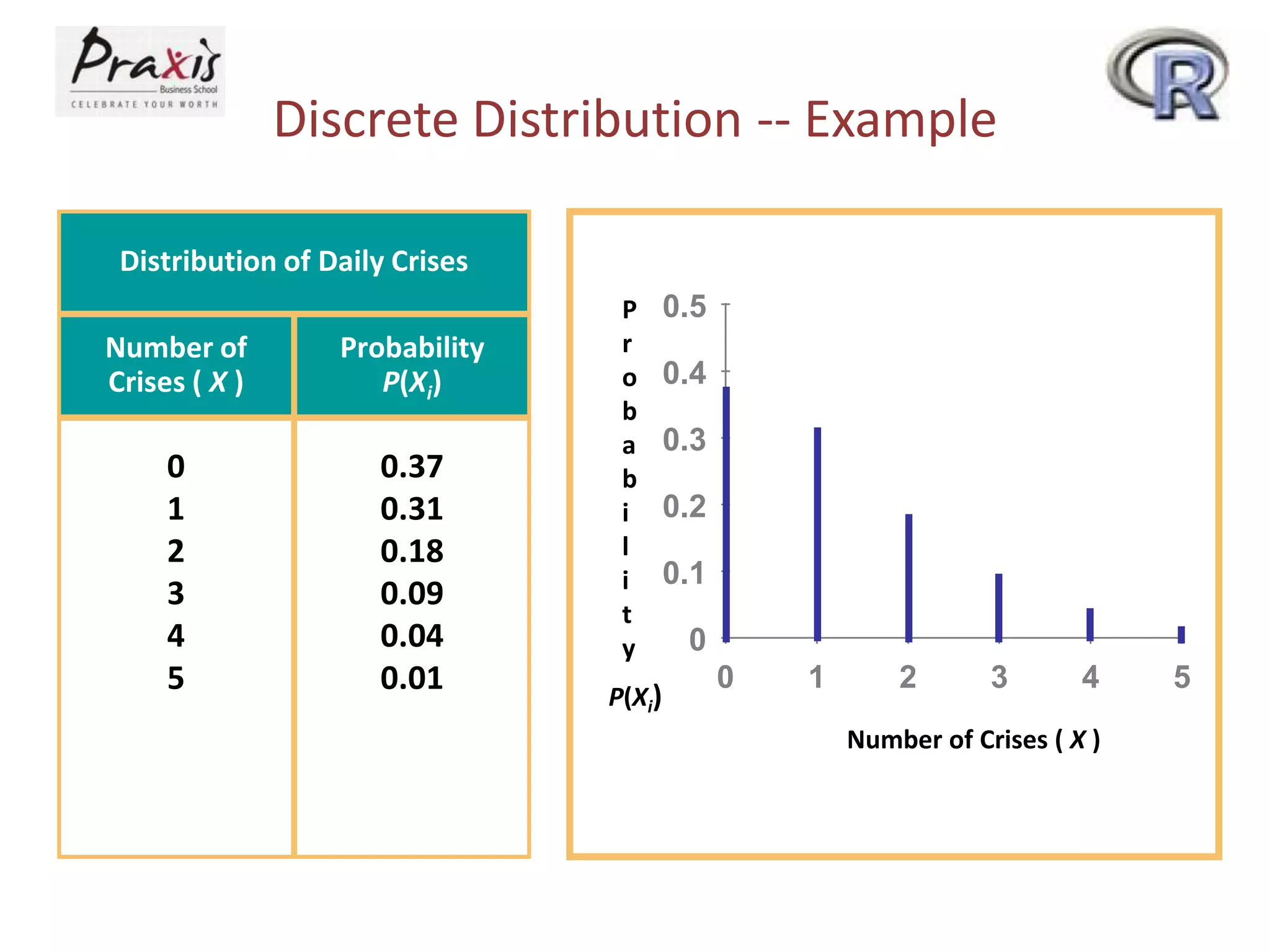
there is a 0.37 probability that no crisis will occur, a 0.31
probability of one crisis, and so on.
Discrete Distribution -- Example
Distribution of Daily Crises

Number of
Crises ( X )

0
1
2
3
4
5

Probability
P(Xi)

0.37
0.31
0.18
0.09
0.04
0.01

P
r
o
b
a
b
i
l
i
t
y
P(Xi)

0.5
0.4
0.3
0.2
0.1
0
0

1

2

3

4

Number of Crises ( X )

5
Requirements for a Discrete
Probability Function -- Examples
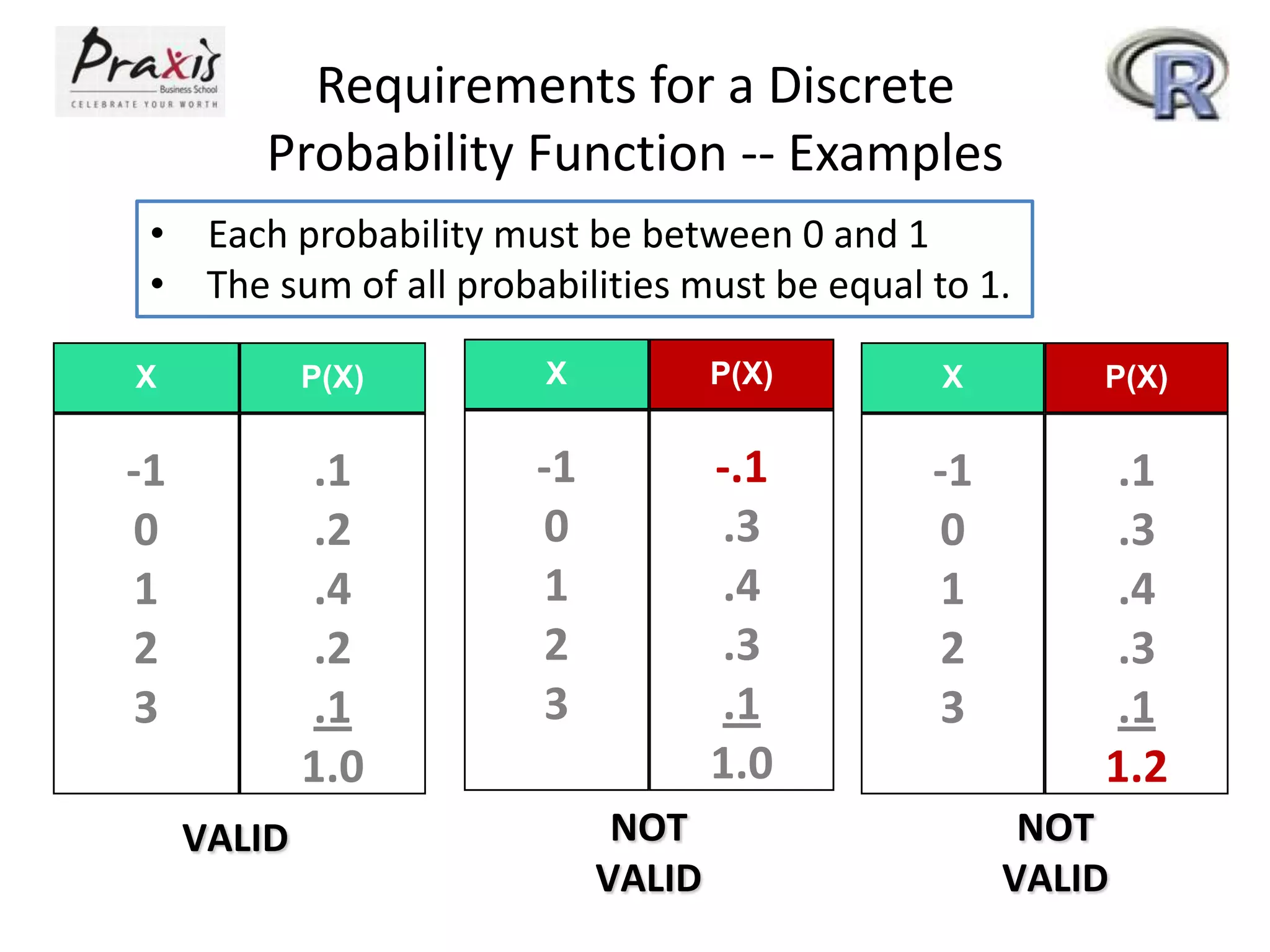
• Each probability must be between 0 and 1
• The sum of all probabilities must be equal to 1.
X

P(X)

X

P(X)

X

P(X)

-1
0
1
2
3

.1
.2
.4
.2
.1
1.0

-1
0
1
2
3

-.1
.3
.4
.3
.1
1.0

-1
0
1
2
3

.1
.3
.4
.3
.1
1.2

VALID

NOT
VALID

NOT
VALID
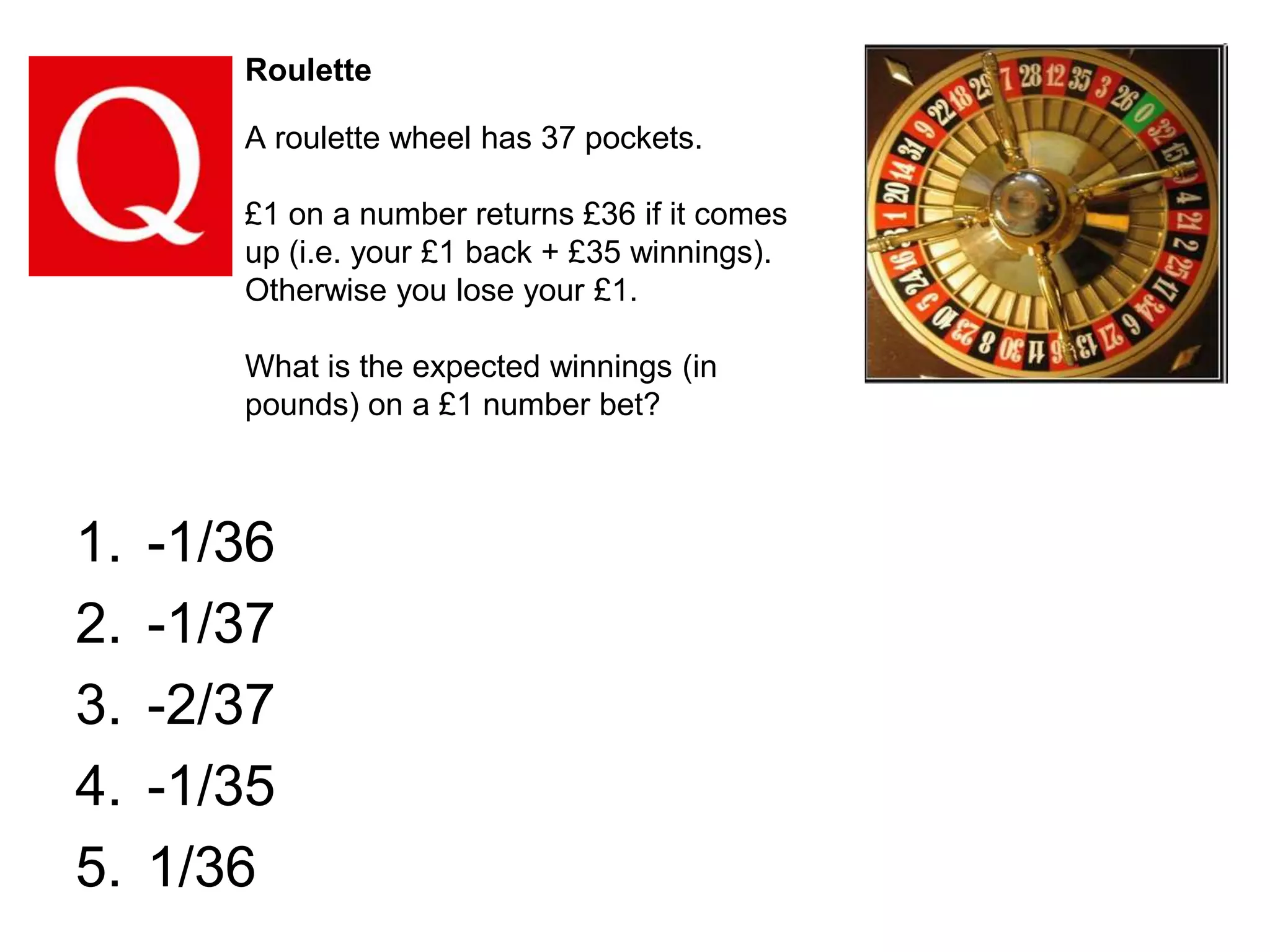
Roulette

A roulette wheel has 37 pockets.
£1 on a number returns £36 if it comes
up (i.e. your £1 back + £35 winnings).
Otherwise you lose your £1.
What is the expected winnings (in
pounds) on a £1 number bet?

1.
2.
3.
4.
5.

-1/36
-1/37
-2/37
-1/35
1/36
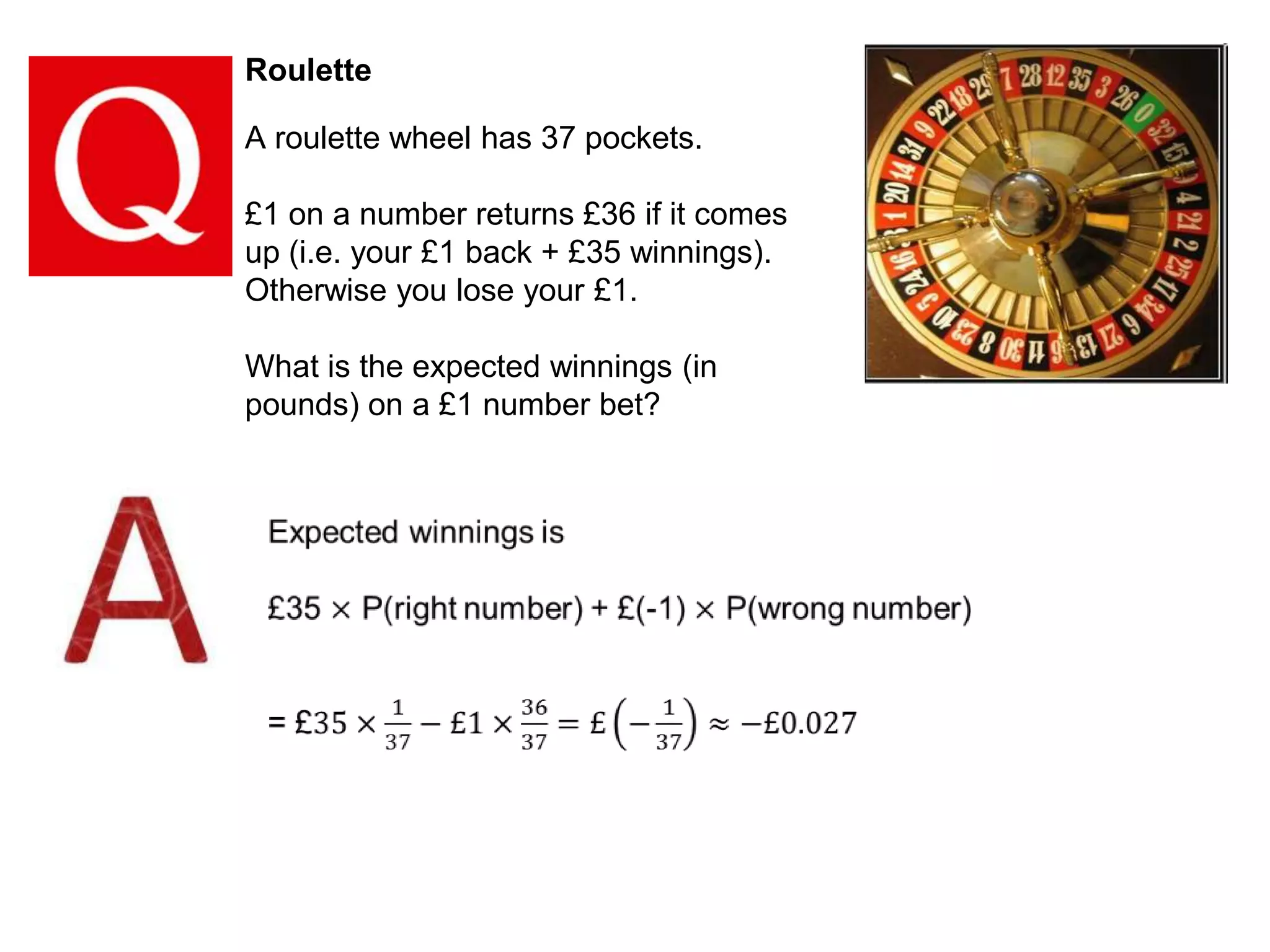
Roulette

A roulette wheel has 37 pockets.
£1 on a number returns £36 if it comes
up (i.e. your £1 back + £35 winnings).
Otherwise you lose your £1.
What is the expected winnings (in
pounds) on a £1 number bet?
Binomial Distribution
• The binomial distribution is a discrete distribution where X, the
random variable, represents the number of “successes” and
the following four conditions are met:





There are n trials
The n trials are independent of each other
The outcome is dichotomous – only two outcomes are possible
The probability of “success” is constant across trials

• Example, 10 coin flips, X = # of heads

• X = the number of “successes” and we say X follows a Binomial
distribution with n trials and P(success in each trial) = p
• If the data follow a binomial distribution, then we can
summarize P(Xi) for all values of Xi = 1, …, n through the
binomial probability distribution formula
• n = Sample size
Situations where
a Binomial distribution might occur
1) Quality control: select n items at random; X =
number found to be satisfactory.
2) Survey of n people about products A and B; X =
number preferring A.
3) Telecommunications: n messages; X = number
with an invalid address.
4) Number of items with some property above a
threshold; e.g. X = number with height > A
Binomial distribution
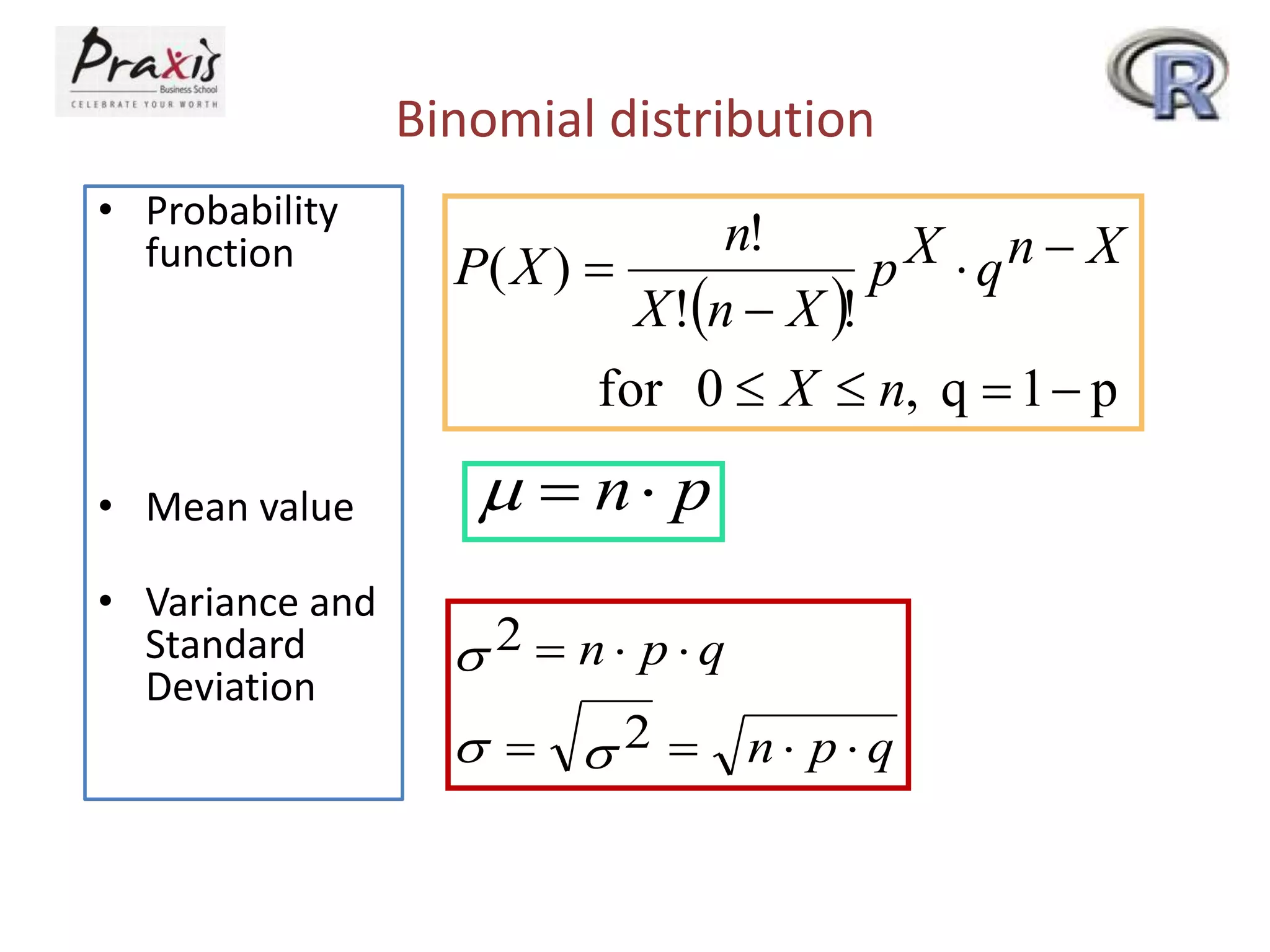
• Probability
function

• Mean value
• Variance and
Standard
Deviation

n!
P( X ) 
p X  qn  X
X !n  X !
for 0  X  n, q  1  p

m  n p
 2  n pq
   2  n pq
Binomial Distribution:
Demonstration Problem 5.3
According to the U.S. Census Bureau,
approximately 6% of all workers in Jackson,
Mississippi, are unemployed. In conducting
a random telephone survey in Jackson,
what is the probability of getting two or
fewer unemployed workers in a sample of
20?
Binomial Distribution:
Demonstration Problem 5.3
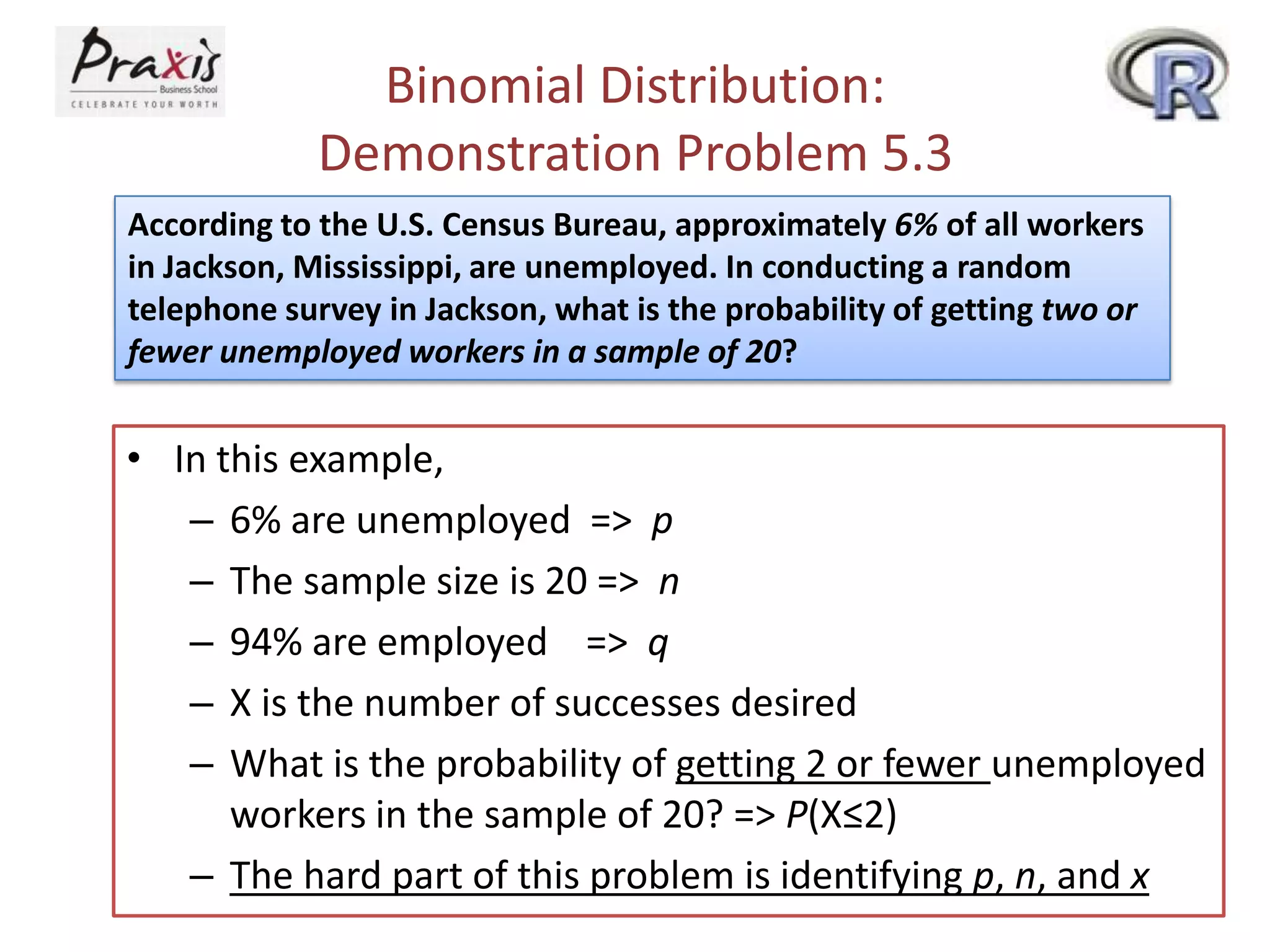
According to the U.S. Census Bureau, approximately 6% of all workers
in Jackson, Mississippi, are unemployed. In conducting a random
telephone survey in Jackson, what is the probability of getting two or
fewer unemployed workers in a sample of 20?

• In this example,
– 6% are unemployed => p
– The sample size is 20 => n
– 94% are employed => q
– X is the number of successes desired
– What is the probability of getting 2 or fewer unemployed
workers in the sample of 20? => P(X≤2)
– The hard part of this problem is identifying p, n, and x
Binomial Distribution Table:
Demonstration Problem 5.3
According to the U.S. Census Bureau, approximately 6% of all workers in Jackson,
Mississippi, are unemployed. In conducting a random telephone survey in Jackson, what
is the probability of getting two or fewer unemployed workers in a sample of 20?
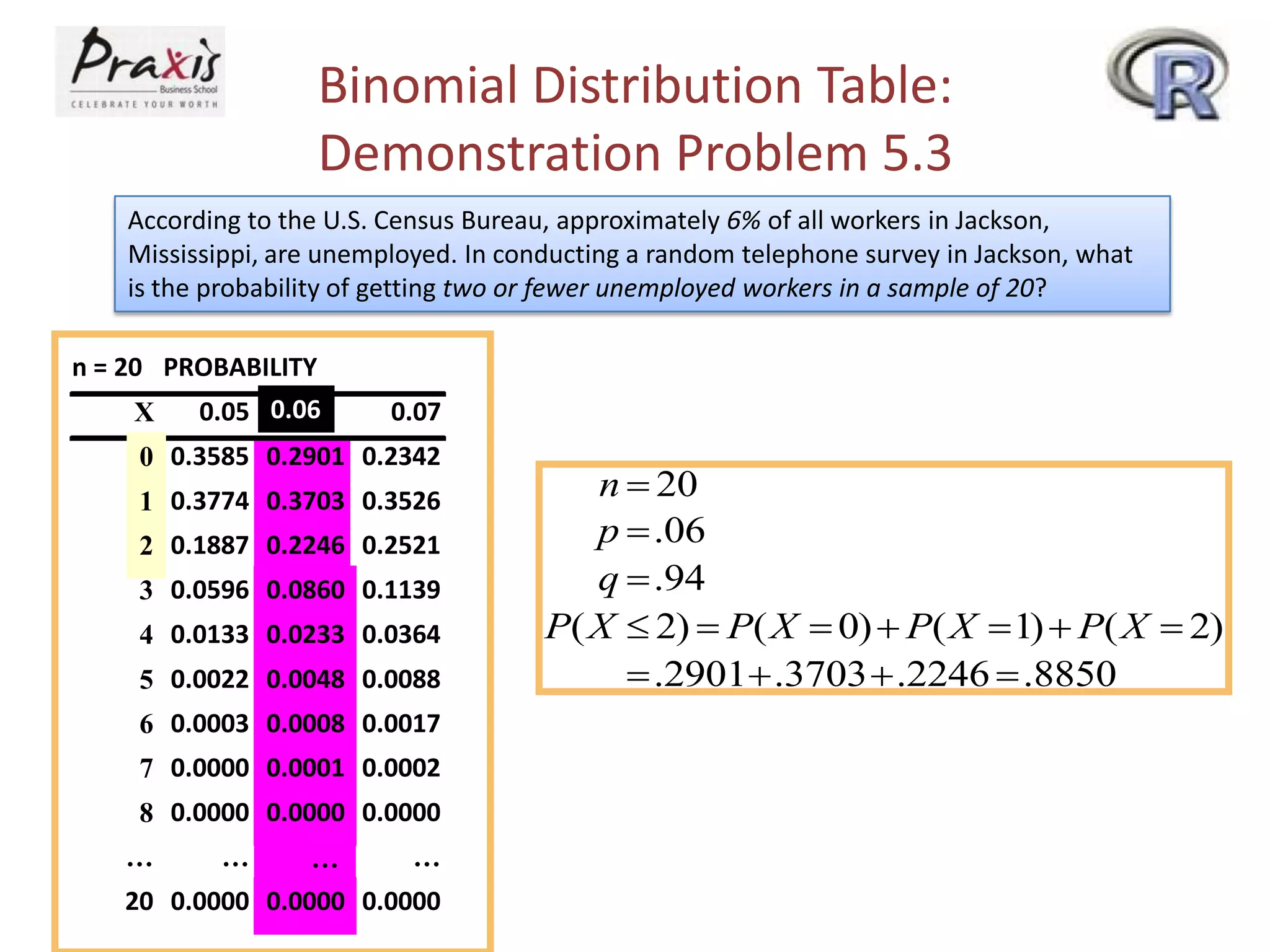
n = 20 PROBABILITY
X

0.05 0.06

0.07

0 0.3585 0.2901 0.2342
1 0.3774 0.3703 0.3526
2 0.1887 0.2246 0.2521
3 0.0596 0.0860 0.1139
4 0.0133 0.0233 0.0364
5 0.0022 0.0048 0.0088
6 0.0003 0.0008 0.0017
7 0.0000 0.0001 0.0002
8 0.0000 0.0000 0.0000
…

…

…

…

20 0.0000 0.0000 0.0000

n  20
p  .06
q  .94
P( X  2)  P( X  0)  P( X  1)  P( X  2)
 .2901 .3703  .2246  .8850
Poisson Distribution

• The Poisson distribution focuses only on the
number of discrete occurrences over some
interval or continuum
 Poisson does not have a given number of
trials (n) as a binomial experiment does
 Occurrences are independent of other
occurrences
 Occurrences occur over an interval
Poisson Distribution
• If Poisson distribution is studied over a long
period of time, a long run average can be
determined
 The average is denoted by lambda (λ)
 Each Poisson distribution contains a lambda
value from which the probabilities are
determined
 A Poisson distribution can be described by λ
alone
Poisson Distribution :
Probability Function P(x)
 X e   for X  0,1,2,3,...
P( X ) 
X!

where :

  longrun average
e  2.718282... (the base of natural logarithms)
Mean

Variance





Standard
Deviation


Continuous Random Variables
• A continuous random variable is a random variable which can
take values measured on a continuous scale e.g. weights,
strengths, times or lengths.
• Probabilities of outcomes occurring between particular two
points are determined by calculating the area under the
Probability density function curve between these points.
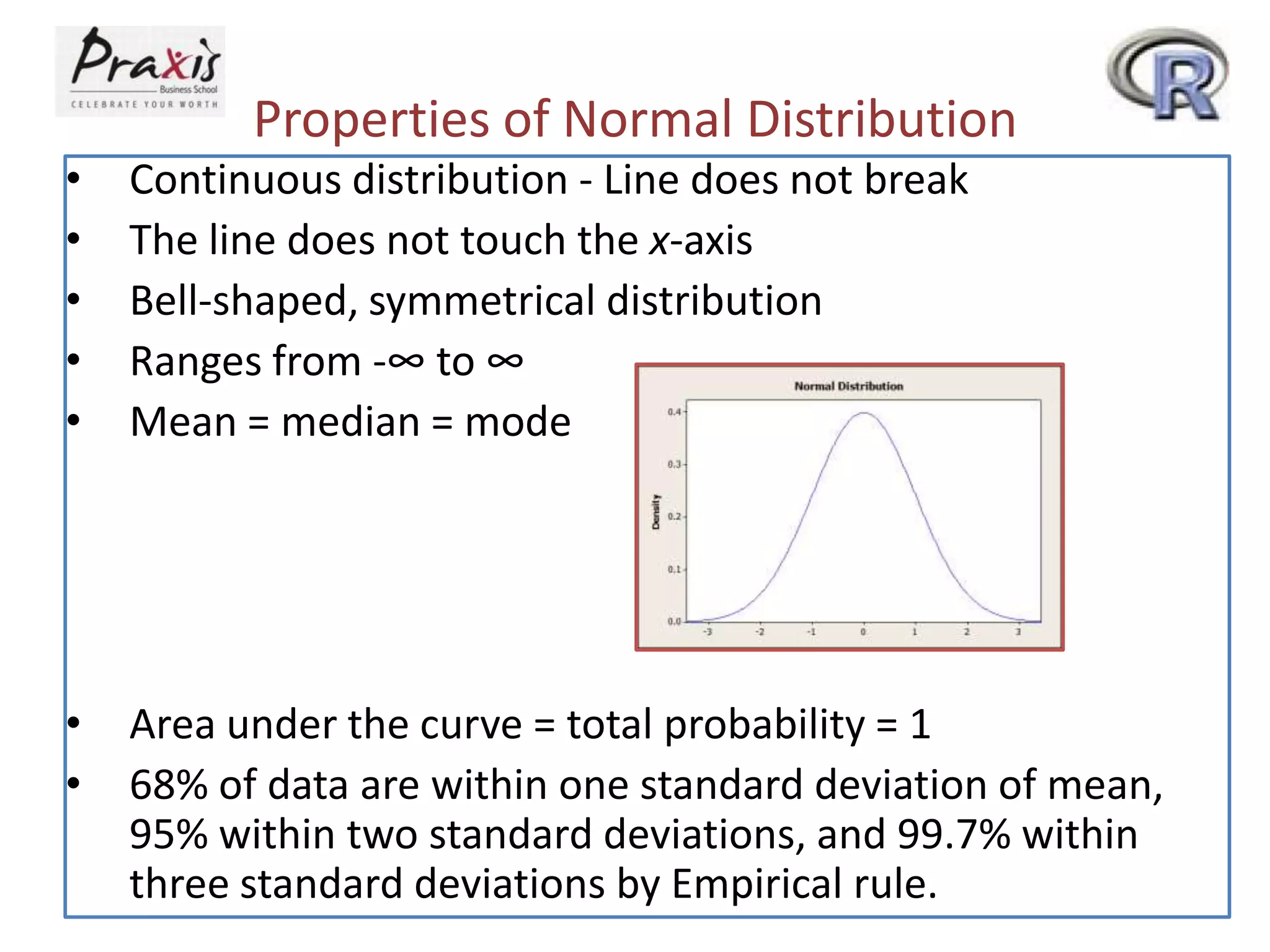
Properties of Normal Distribution
•
•
•
•
•

Continuous distribution - Line does not break
The line does not touch the x-axis
Bell-shaped, symmetrical distribution
Ranges from -∞ to ∞
Mean = median = mode

•
•

Area under the curve = total probability = 1
68% of data are within one standard deviation of mean,
95% within two standard deviations, and 99.7% within
three standard deviations by Empirical rule.
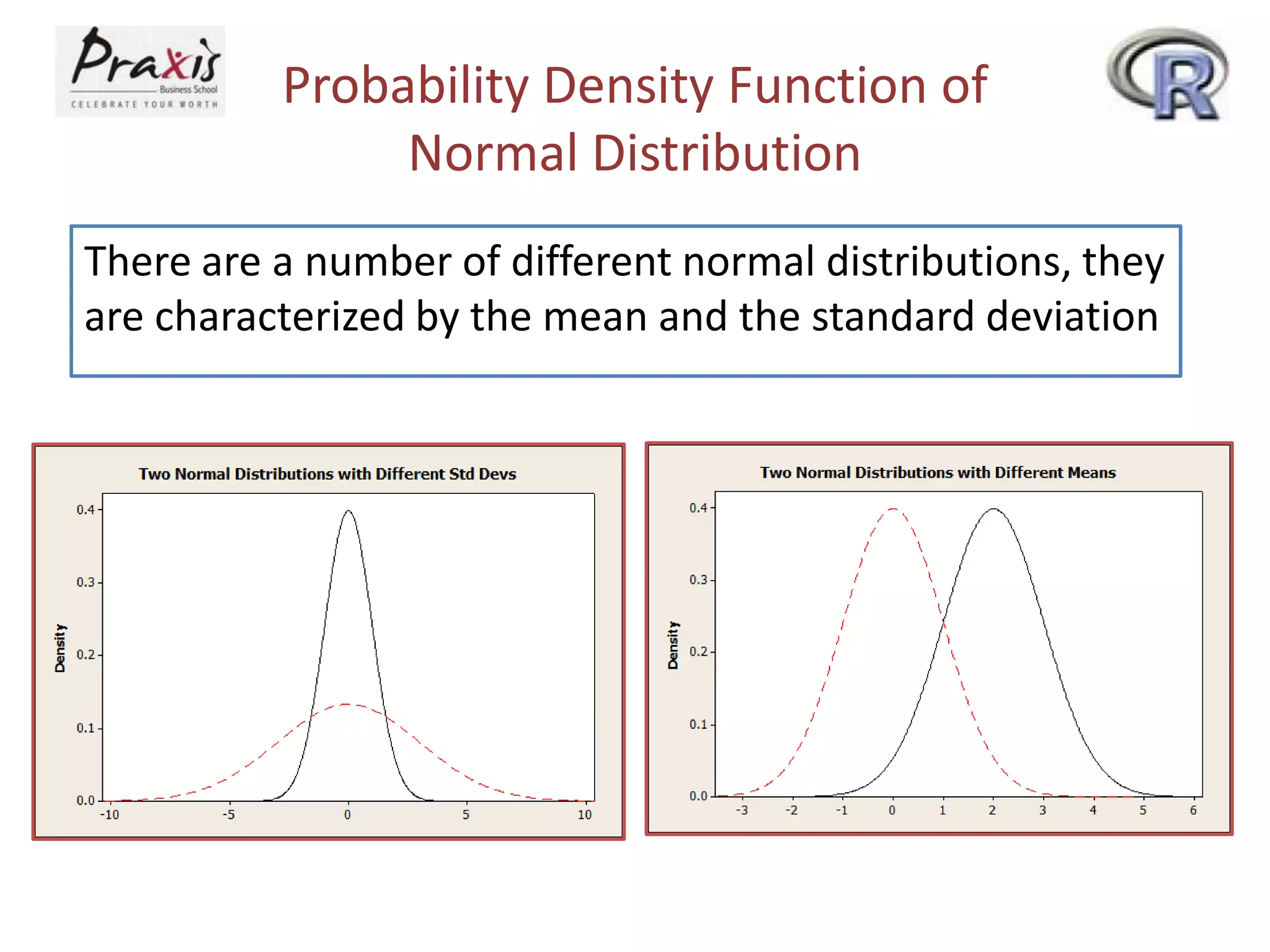
Probability Density Function of
Normal Distribution
There are a number of different normal distributions, they
are characterized by the mean and the standard deviation
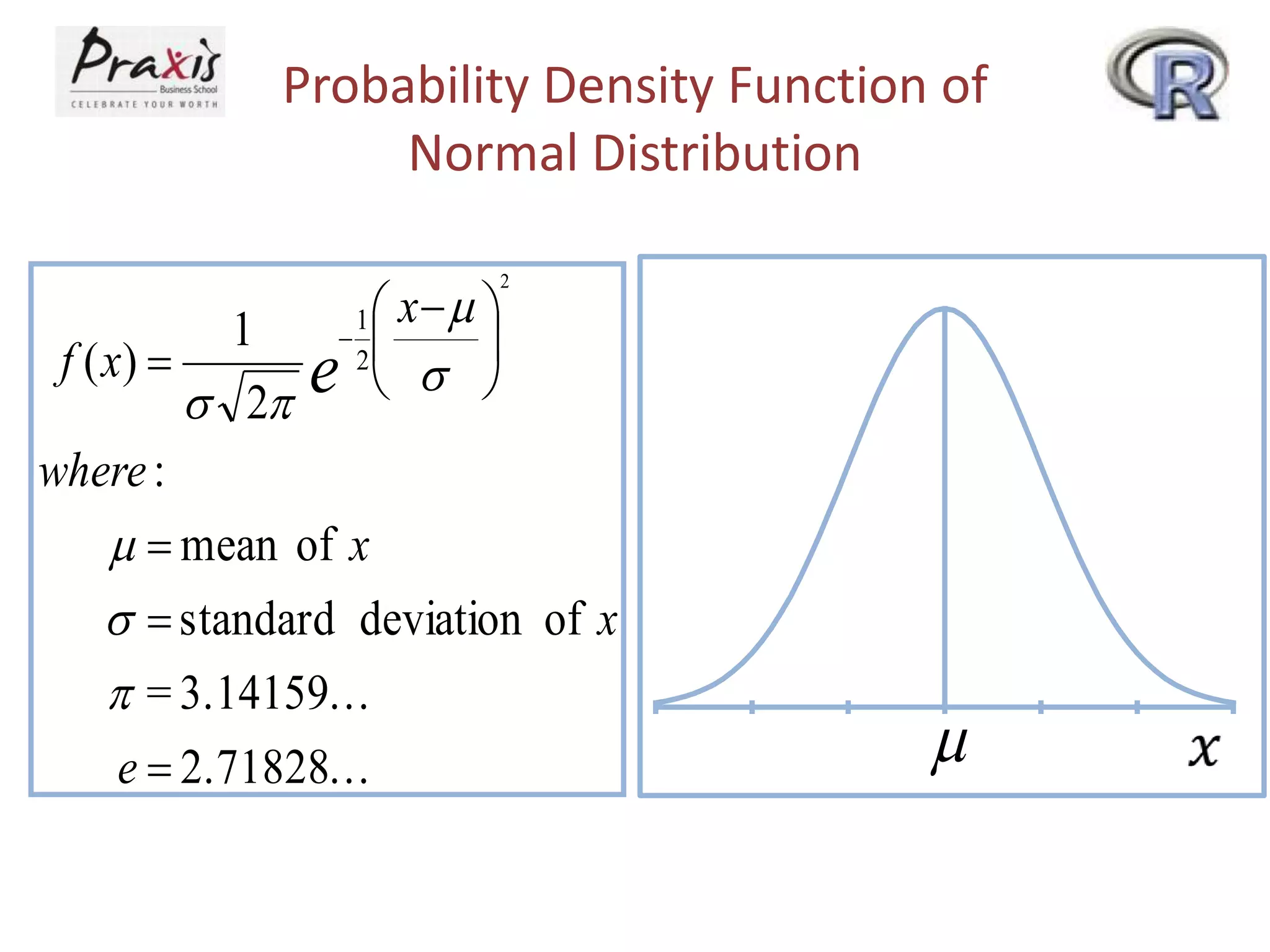
Probability Density Function of
Normal Distribution
1 x m 
1
 

2
f ( x) 
e   
 2
where :
m  mean of x
  standard deviation of x
 = 3.14159. . .
e  2.71828. . .
2

m
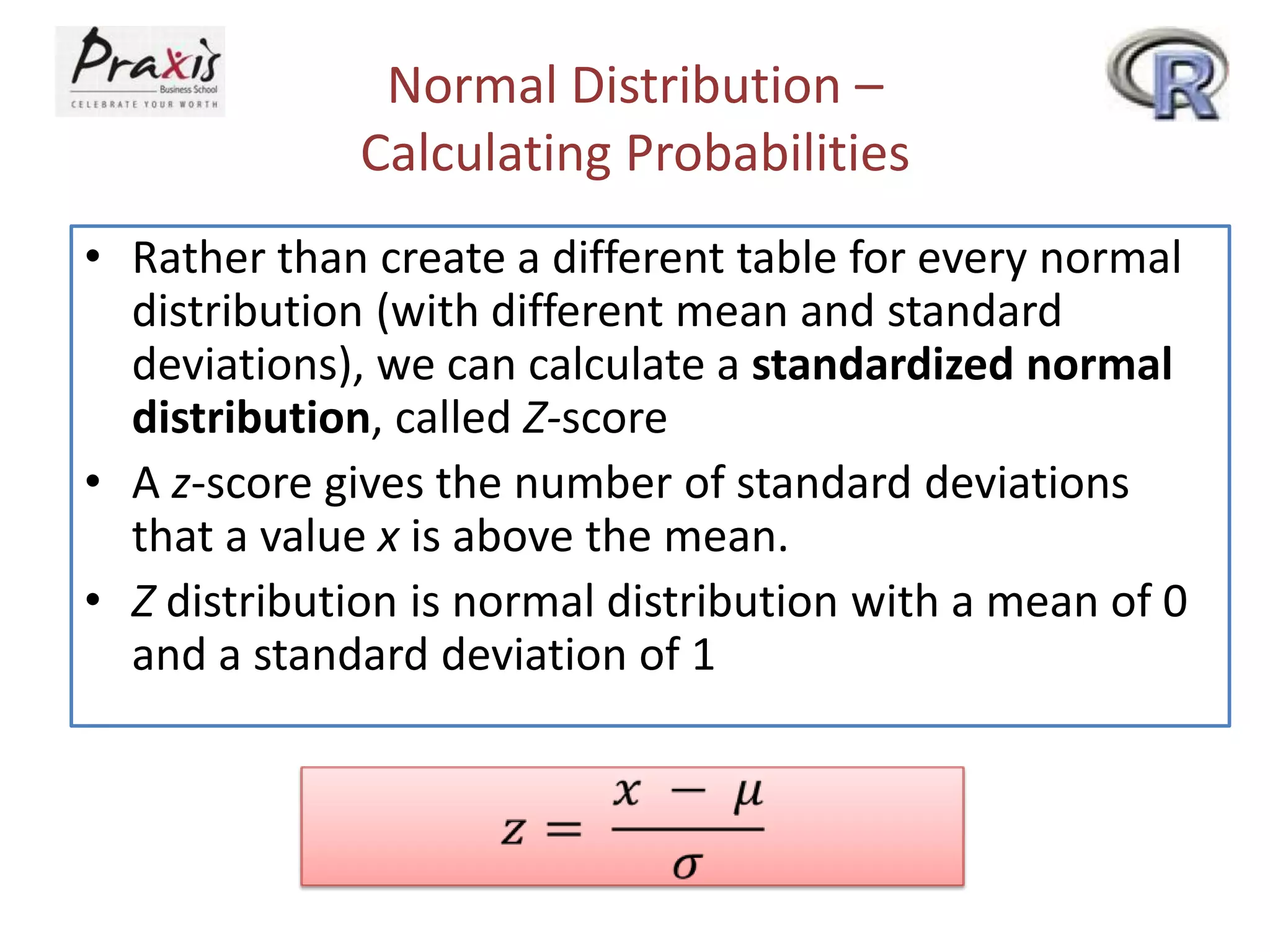
Normal Distribution –
Calculating Probabilities
• Rather than create a different table for every normal
distribution (with different mean and standard
deviations), we can calculate a standardized normal
distribution, called Z-score
• A z-score gives the number of standard deviations
that a value x is above the mean.
• Z distribution is normal distribution with a mean of 0
and a standard deviation of 1
Standardized Normal Distribution –
Calculating Probabilities
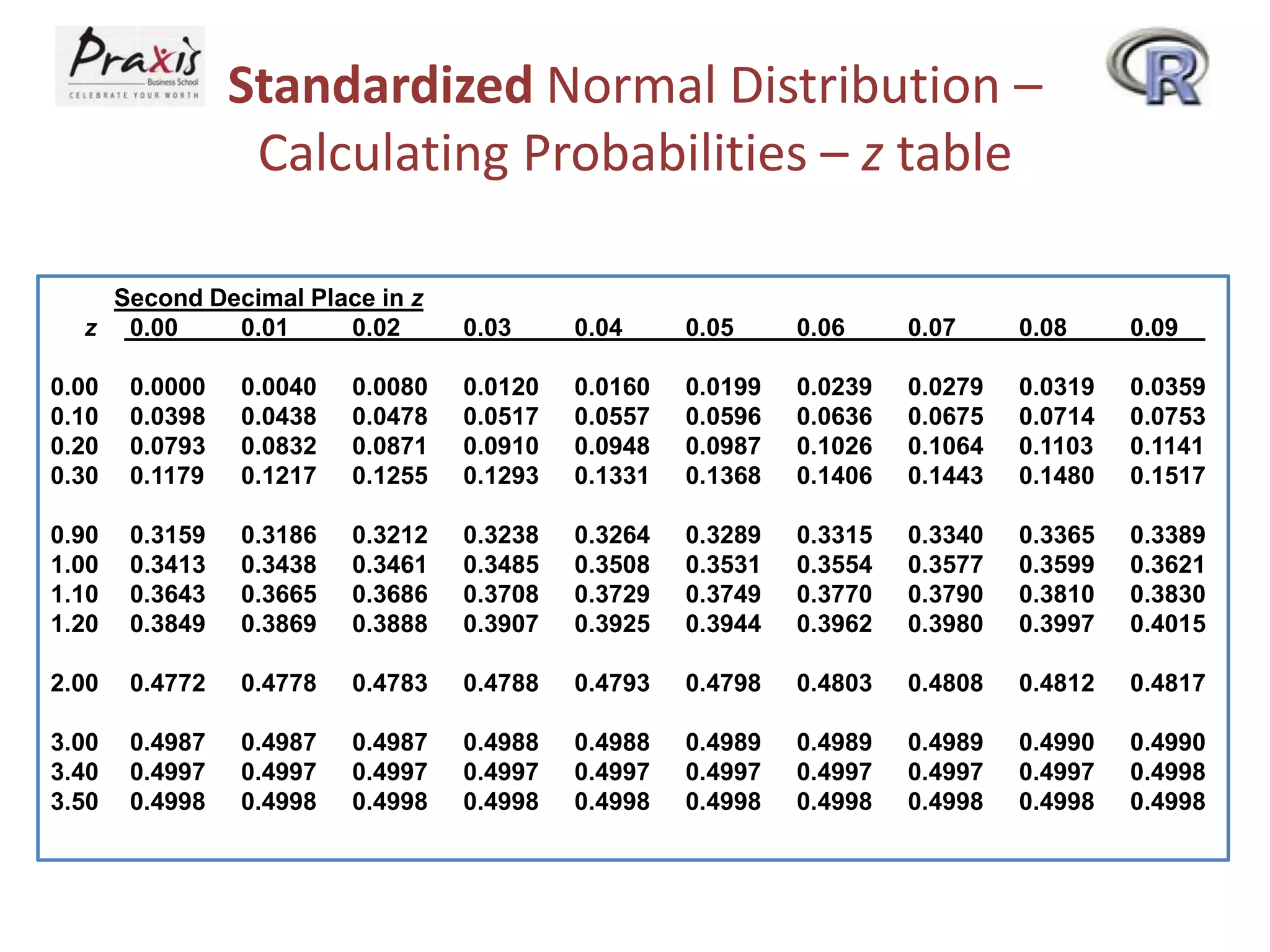
• Z distribution probability values are given in table A5
of your book or can be calculated using software
• Table A5 gives the total area under the Z curve
between 0 and any point on the positive Z axis
• Since the curve is symmetric, the area under the
curve between Z and 0 is the same whether the Z
curve is positive or negative
Standardized Normal Distribution –
Calculating Probabilities – z table
Second Decimal Place in z
z 0.00
0.01
0.02

0.03

0.04

0.05

0.06

0.07

0.08

0.09

0.00
0.10
0.20
0.30

0.0000
0.0398
0.0793
0.1179

0.0040
0.0438
0.0832
0.1217

0.0080
0.0478
0.0871
0.1255

0.0120
0.0517
0.0910
0.1293

0.0160
0.0557
0.0948
0.1331

0.0199
0.0596
0.0987
0.1368

0.0239
0.0636
0.1026
0.1406

0.0279
0.0675
0.1064
0.1443

0.0319
0.0714
0.1103
0.1480

0.0359
0.0753
0.1141
0.1517

0.90
1.00
1.10
1.20

0.3159
0.3413
0.3643
0.3849

0.3186
0.3438
0.3665
0.3869

0.3212
0.3461
0.3686
0.3888

0.3238
0.3485
0.3708
0.3907

0.3264
0.3508
0.3729
0.3925

0.3289
0.3531
0.3749
0.3944

0.3315
0.3554
0.3770
0.3962

0.3340
0.3577
0.3790
0.3980

0.3365
0.3599
0.3810
0.3997

0.3389
0.3621
0.3830
0.4015

2.00

0.4772

0.4778

0.4783

0.4788

0.4793

0.4798

0.4803

0.4808

0.4812

0.4817

3.00
3.40
3.50

0.4987
0.4997
0.4998

0.4987
0.4997
0.4998

0.4987
0.4997
0.4998

0.4988
0.4997
0.4998

0.4988
0.4997
0.4998

0.4989
0.4997
0.4998

0.4989
0.4997
0.4998

0.4989
0.4997
0.4998

0.4990
0.4997
0.4998

0.4990
0.4998
0.4998
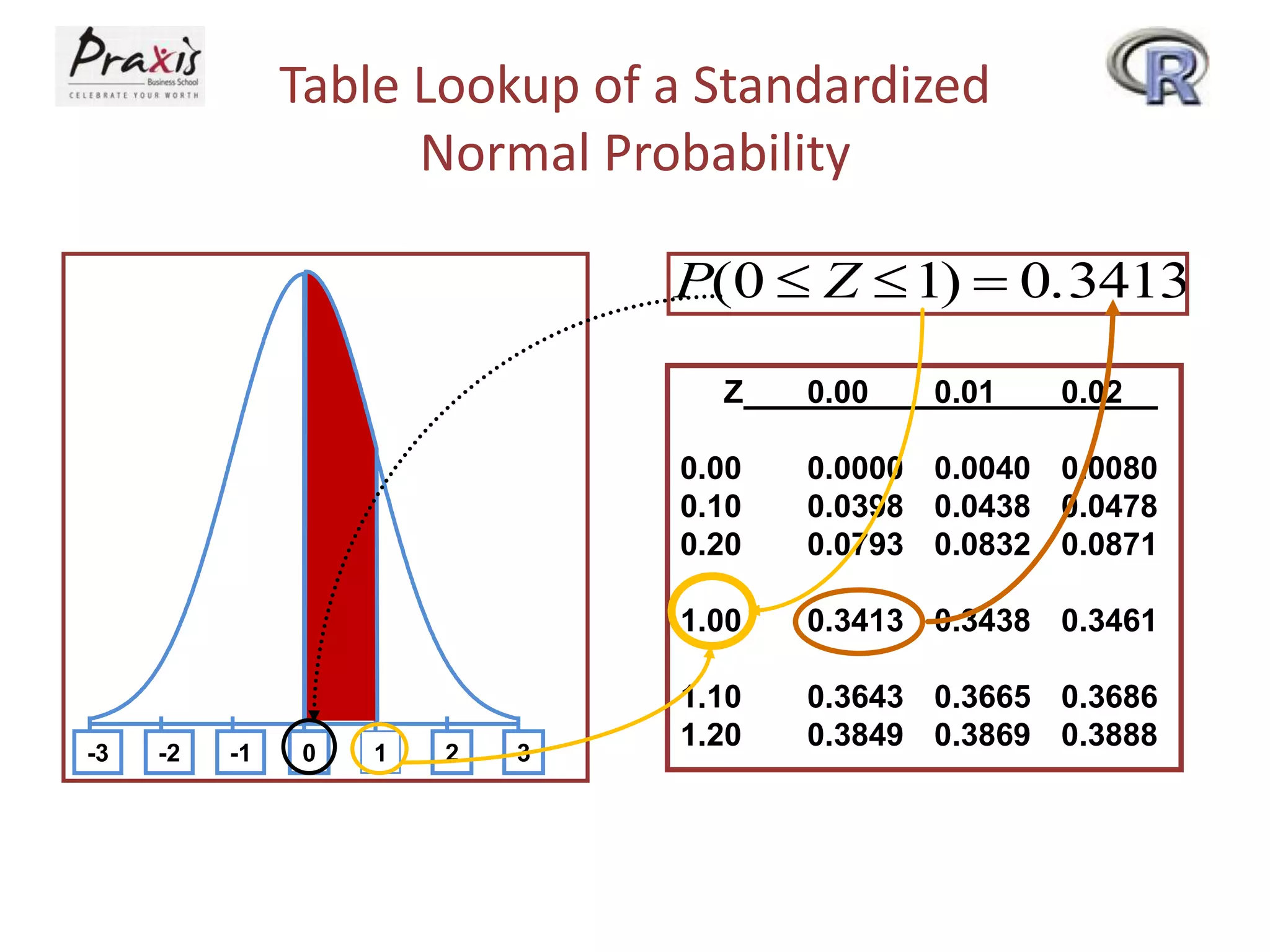
Table Lookup of a Standardized
Normal Probability
P(0  Z  1)  0. 3413
Z

0.00

0.01

0.02

0.00
0.10
0.20
1.00

-3

-2

-1

0

1

2

3

0.0000 0.0040 0.0080
0.0398 0.0438 0.0478
0.0793 0.0832 0.0871
0.3413 0.3438 0.3461

1.10
1.20

0.3643 0.3665 0.3686
0.3849 0.3869 0.3888
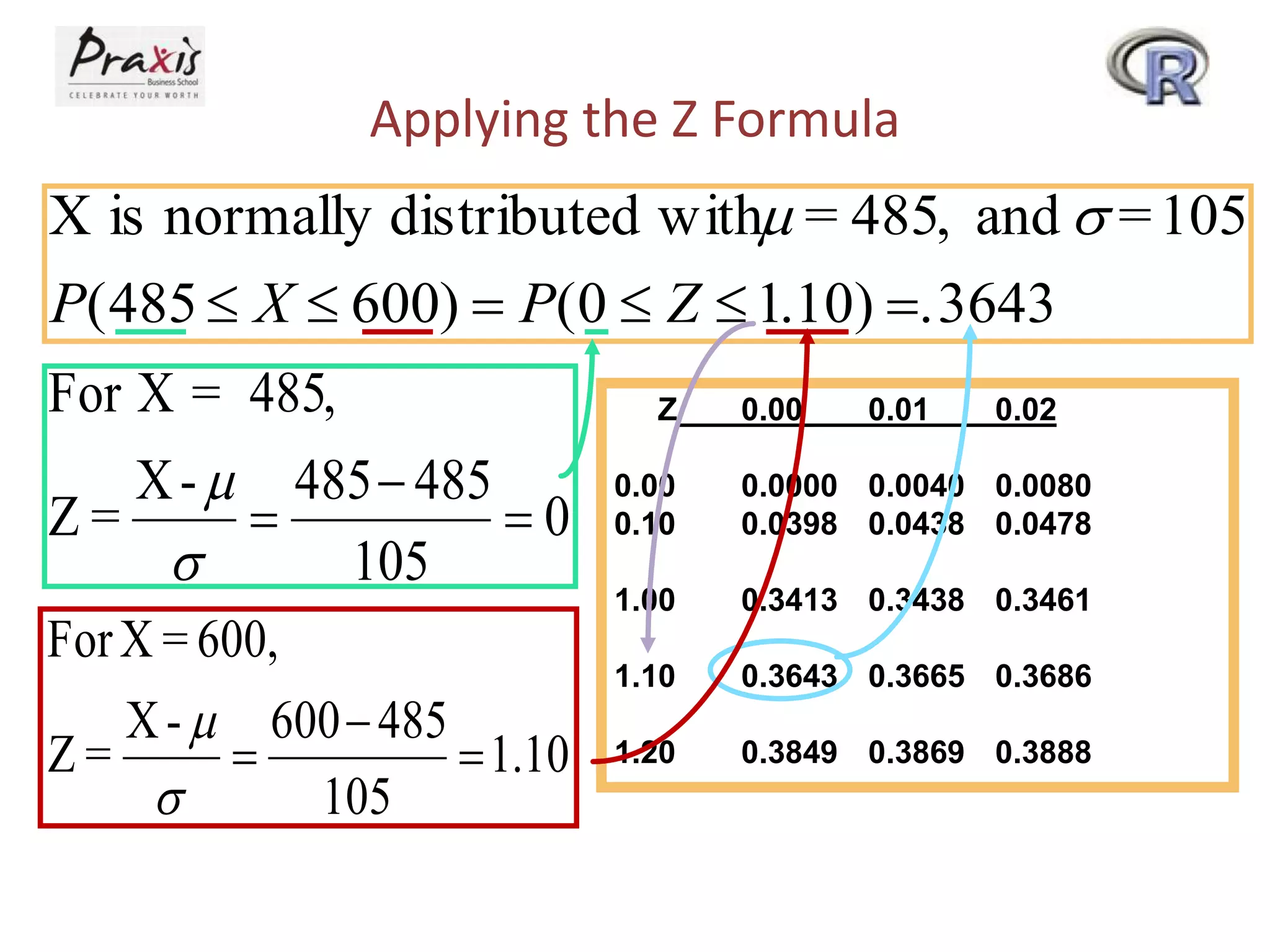
Applying the Z Formula

X is normally distributed withm = 485, and  = 105
P( 485  X  600)  P( 0  Z  1.10) . 3643
For X = 485,
X - m 485  485
Z=

0

105
For X = 600,
X - m 600  485
Z=

 1.10

105

Z

0.00

0.01

0.02

0.00
0.10

0.0000 0.0040 0.0080
0.0398 0.0438 0.0478

1.00

0.3413 0.3438 0.3461

1.10

0.3643 0.3665 0.3686

1.20

0.3849 0.3869 0.3888
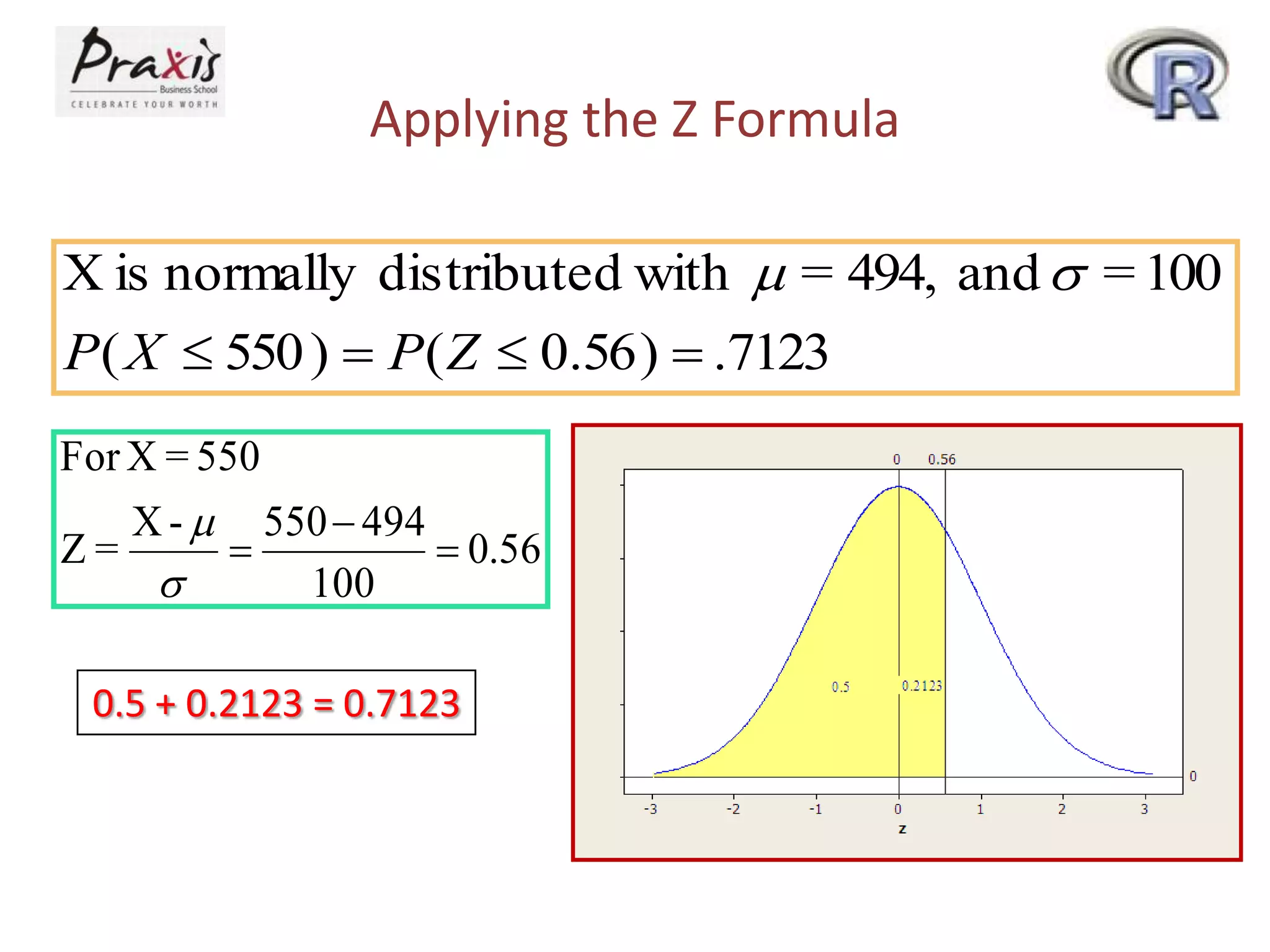
Applying the Z Formula
X is normally distributed with m = 494, and  = 100
P( X  550 )  P( Z  0.56 )  .7123
For X = 550
X - m 550  494
Z=

 0.56

100
0.5 + 0.2123 = 0.7123
Applying the Z Formula
X is normally distributed with m = 494, and  = 100
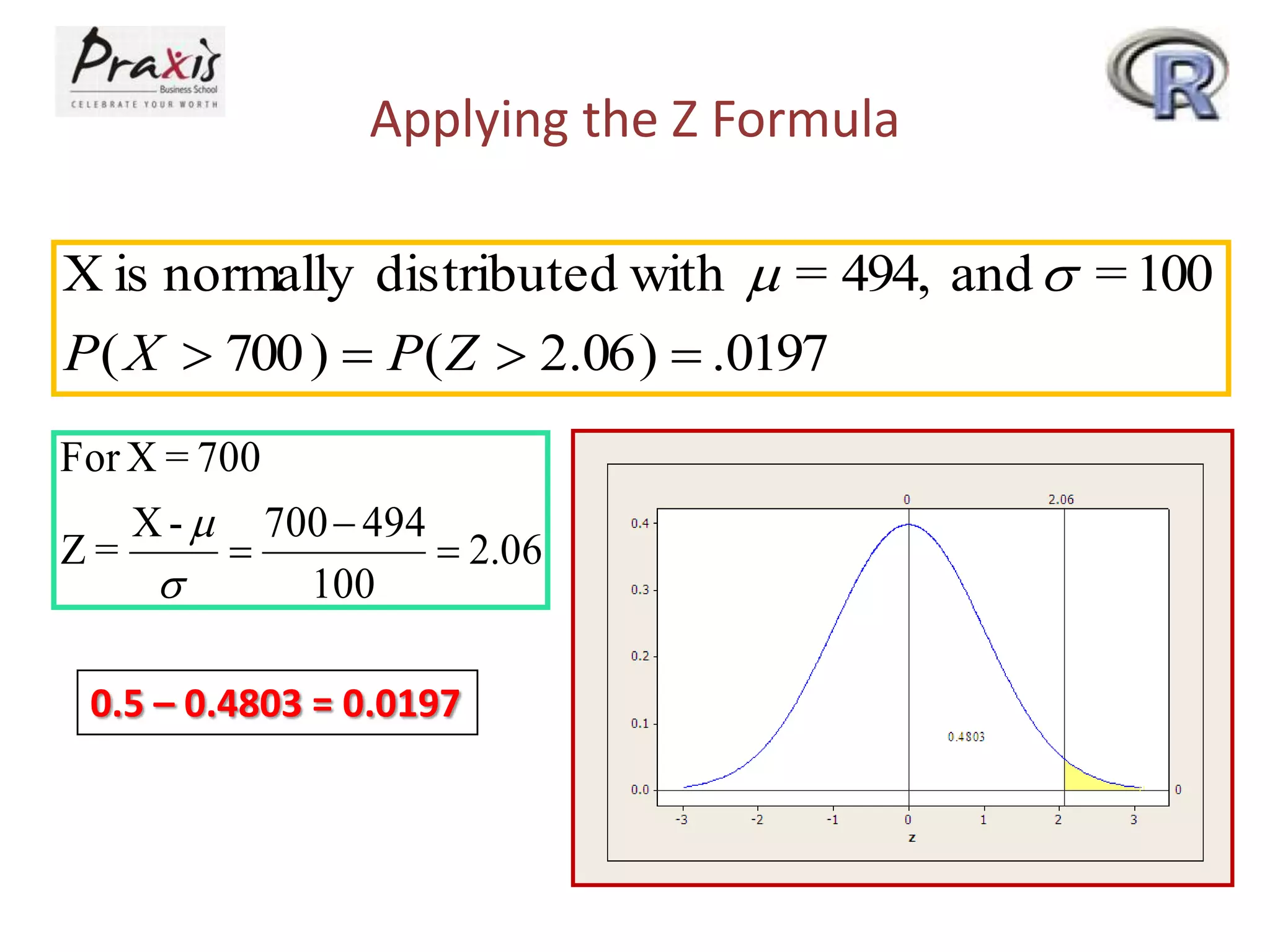
P( X  700 )  P ( Z  2.06 )  .0197
For X = 700
Z=

X - m 700  494

 2.06

100

0.5 – 0.4803 = 0.0197
Applying the Z Formula
X is normally distributed with m = 494, and  = 100
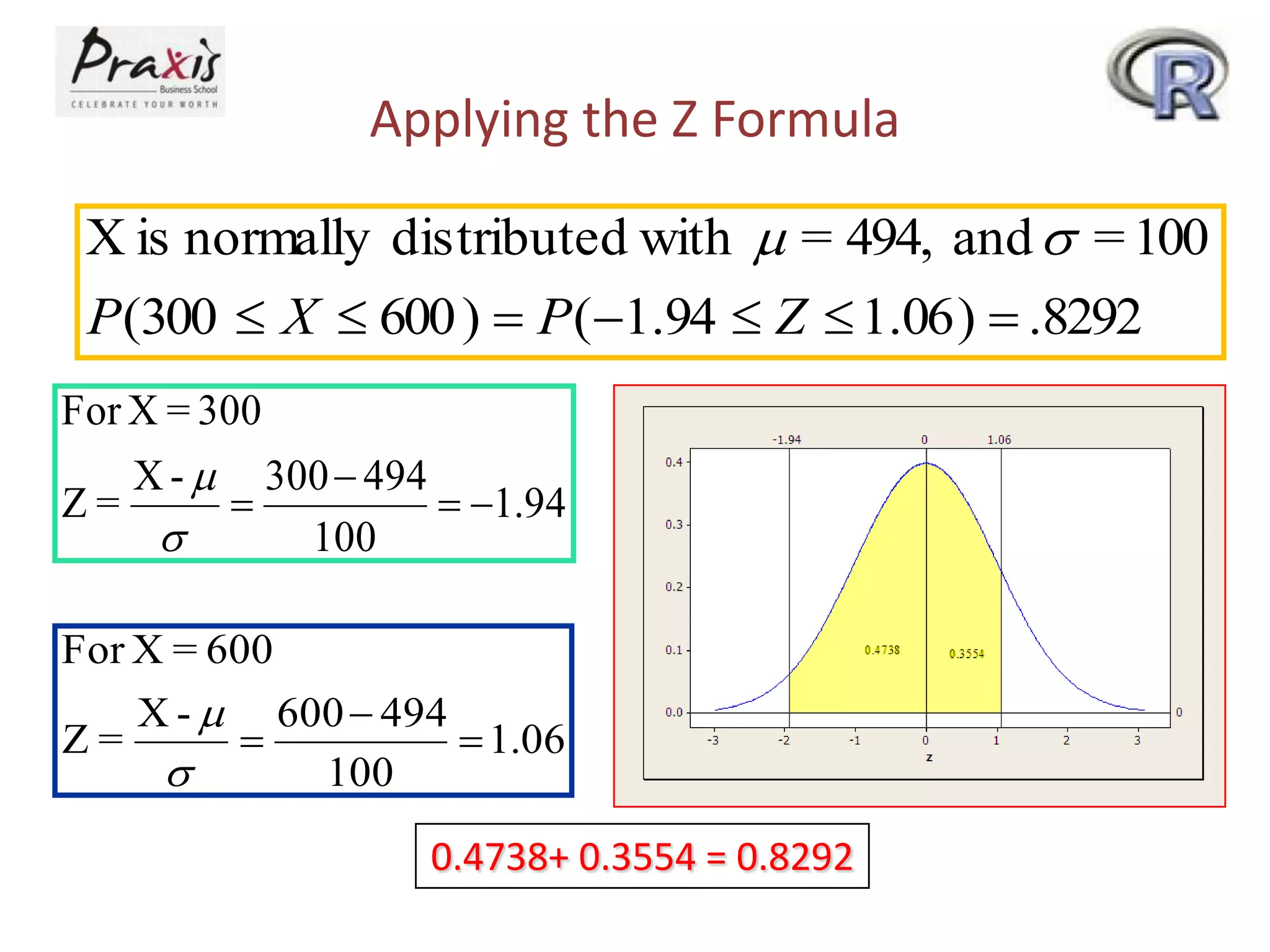
P(300  X  600 )  P (1.94  Z  1.06 )  .8292
For X = 300
Z=

X-m



300  494

 1.94
100

For X = 600
Z=

X-m



600  494

 1.06
100

0.4738+ 0.3554 = 0.8292

Statr sessions 9 to 10

  • 1.
    Discrete Distributions • Whatis a random variable? • Distinguish between discrete random variables and continuous random variables. • Know how to determine the mean and variance of a discrete distribution. • Identify the type of statistical experiments that can be described by the binomial distribution, and know how to calculate probabilities based on the binomial distribution.
  • 2.
    Discrete vs. ContinuousDistributions • Random Variable - a variable which contains the outcomes of a chance experiment • Discrete Random Variable – A random variable that only takes on distinct values ex: Number of heads on 10 flips, Number of defective items in a random sample of 100, Number of times you check your watch during class, etc. • Continuous Random Variable – A random variable that takes on infinite values by increasing precision. For each two values, there always exists a valid value in between them. ex: Time until a bulb goes out, height, etc.
  • 3.
    Describing a Distribution •A distribution can be described by constructing a graph of the distribution • Measures of central tendency and variability can be applied to distributions
  • 4.
    Describing a DiscreteDistribution • Mean of discrete distribution – is the long run average – If the process is repeated long enough, the average of the outcomes will approach the long run average (mean) – Mean of a discrete distribution µ = ∑ (Xi * P(Xi)) where µ is the long run average, Xi = the ith outcome of random variable X, and P(Xi) = probability of X = Xi
  • 5.
    Describing a DiscreteDistribution • Variance of a discrete distribution is obtained in a manner similar to raw data, summing the squared deviations from the mean and weighting them by P(Xi) (rather than dividing by n): Var(Xi) = ∑ (Xi – m)2* P(Xi) • Standard Deviation is computed by taking the square root of the variance
  • 6.
    Discrete Distribution --Example • An executive is considering out-of-town business travel for a given Friday. At least one crisis could occur on the day that the executive is gone. The distribution on the following slide contains the number of crises that could occur during the day the executive is gone and the probability that each number will occur. For example, there is a 0.37 probability that no crisis will occur, a 0.31 probability of one crisis, and so on.
  • 7.
    Discrete Distribution --Example Distribution of Daily Crises Number of Crises ( X ) 0 1 2 3 4 5 Probability P(Xi) 0.37 0.31 0.18 0.09 0.04 0.01 P r o b a b i l i t y P(Xi) 0.5 0.4 0.3 0.2 0.1 0 0 1 2 3 4 Number of Crises ( X ) 5
  • 8.
    Requirements for aDiscrete Probability Function -- Examples • Each probability must be between 0 and 1 • The sum of all probabilities must be equal to 1. X P(X) X P(X) X P(X) -1 0 1 2 3 .1 .2 .4 .2 .1 1.0 -1 0 1 2 3 -.1 .3 .4 .3 .1 1.0 -1 0 1 2 3 .1 .3 .4 .3 .1 1.2 VALID NOT VALID NOT VALID
  • 9.
    Roulette A roulette wheelhas 37 pockets. £1 on a number returns £36 if it comes up (i.e. your £1 back + £35 winnings). Otherwise you lose your £1. What is the expected winnings (in pounds) on a £1 number bet? 1. 2. 3. 4. 5. -1/36 -1/37 -2/37 -1/35 1/36
  • 10.
    Roulette A roulette wheelhas 37 pockets. £1 on a number returns £36 if it comes up (i.e. your £1 back + £35 winnings). Otherwise you lose your £1. What is the expected winnings (in pounds) on a £1 number bet?
  • 11.
    Binomial Distribution • Thebinomial distribution is a discrete distribution where X, the random variable, represents the number of “successes” and the following four conditions are met:     There are n trials The n trials are independent of each other The outcome is dichotomous – only two outcomes are possible The probability of “success” is constant across trials • Example, 10 coin flips, X = # of heads • X = the number of “successes” and we say X follows a Binomial distribution with n trials and P(success in each trial) = p • If the data follow a binomial distribution, then we can summarize P(Xi) for all values of Xi = 1, …, n through the binomial probability distribution formula • n = Sample size
  • 12.
    Situations where a Binomialdistribution might occur 1) Quality control: select n items at random; X = number found to be satisfactory. 2) Survey of n people about products A and B; X = number preferring A. 3) Telecommunications: n messages; X = number with an invalid address. 4) Number of items with some property above a threshold; e.g. X = number with height > A
  • 13.
    Binomial distribution • Probability function •Mean value • Variance and Standard Deviation n! P( X )  p X  qn  X X !n  X ! for 0  X  n, q  1  p m  n p  2  n pq    2  n pq
  • 14.
    Binomial Distribution: Demonstration Problem5.3 According to the U.S. Census Bureau, approximately 6% of all workers in Jackson, Mississippi, are unemployed. In conducting a random telephone survey in Jackson, what is the probability of getting two or fewer unemployed workers in a sample of 20?
  • 15.
    Binomial Distribution: Demonstration Problem5.3 According to the U.S. Census Bureau, approximately 6% of all workers in Jackson, Mississippi, are unemployed. In conducting a random telephone survey in Jackson, what is the probability of getting two or fewer unemployed workers in a sample of 20? • In this example, – 6% are unemployed => p – The sample size is 20 => n – 94% are employed => q – X is the number of successes desired – What is the probability of getting 2 or fewer unemployed workers in the sample of 20? => P(X≤2) – The hard part of this problem is identifying p, n, and x
  • 16.
    Binomial Distribution Table: DemonstrationProblem 5.3 According to the U.S. Census Bureau, approximately 6% of all workers in Jackson, Mississippi, are unemployed. In conducting a random telephone survey in Jackson, what is the probability of getting two or fewer unemployed workers in a sample of 20? n = 20 PROBABILITY X 0.05 0.06 0.07 0 0.3585 0.2901 0.2342 1 0.3774 0.3703 0.3526 2 0.1887 0.2246 0.2521 3 0.0596 0.0860 0.1139 4 0.0133 0.0233 0.0364 5 0.0022 0.0048 0.0088 6 0.0003 0.0008 0.0017 7 0.0000 0.0001 0.0002 8 0.0000 0.0000 0.0000 … … … … 20 0.0000 0.0000 0.0000 n  20 p  .06 q  .94 P( X  2)  P( X  0)  P( X  1)  P( X  2)  .2901 .3703  .2246  .8850
  • 17.
    Poisson Distribution • ThePoisson distribution focuses only on the number of discrete occurrences over some interval or continuum  Poisson does not have a given number of trials (n) as a binomial experiment does  Occurrences are independent of other occurrences  Occurrences occur over an interval
  • 18.
    Poisson Distribution • IfPoisson distribution is studied over a long period of time, a long run average can be determined  The average is denoted by lambda (λ)  Each Poisson distribution contains a lambda value from which the probabilities are determined  A Poisson distribution can be described by λ alone
  • 19.
    Poisson Distribution : ProbabilityFunction P(x)  X e   for X  0,1,2,3,... P( X )  X! where :   longrun average e  2.718282... (the base of natural logarithms) Mean Variance   Standard Deviation 
  • 20.
    Continuous Random Variables •A continuous random variable is a random variable which can take values measured on a continuous scale e.g. weights, strengths, times or lengths. • Probabilities of outcomes occurring between particular two points are determined by calculating the area under the Probability density function curve between these points.
  • 21.
    Properties of NormalDistribution • • • • • Continuous distribution - Line does not break The line does not touch the x-axis Bell-shaped, symmetrical distribution Ranges from -∞ to ∞ Mean = median = mode • • Area under the curve = total probability = 1 68% of data are within one standard deviation of mean, 95% within two standard deviations, and 99.7% within three standard deviations by Empirical rule.
  • 22.
    Probability Density Functionof Normal Distribution There are a number of different normal distributions, they are characterized by the mean and the standard deviation
  • 23.
    Probability Density Functionof Normal Distribution 1 x m  1    2 f ( x)  e     2 where : m  mean of x   standard deviation of x  = 3.14159. . . e  2.71828. . . 2 m
  • 24.
    Normal Distribution – CalculatingProbabilities • Rather than create a different table for every normal distribution (with different mean and standard deviations), we can calculate a standardized normal distribution, called Z-score • A z-score gives the number of standard deviations that a value x is above the mean. • Z distribution is normal distribution with a mean of 0 and a standard deviation of 1
  • 25.
    Standardized Normal Distribution– Calculating Probabilities • Z distribution probability values are given in table A5 of your book or can be calculated using software • Table A5 gives the total area under the Z curve between 0 and any point on the positive Z axis • Since the curve is symmetric, the area under the curve between Z and 0 is the same whether the Z curve is positive or negative
  • 26.
    Standardized Normal Distribution– Calculating Probabilities – z table Second Decimal Place in z z 0.00 0.01 0.02 0.03 0.04 0.05 0.06 0.07 0.08 0.09 0.00 0.10 0.20 0.30 0.0000 0.0398 0.0793 0.1179 0.0040 0.0438 0.0832 0.1217 0.0080 0.0478 0.0871 0.1255 0.0120 0.0517 0.0910 0.1293 0.0160 0.0557 0.0948 0.1331 0.0199 0.0596 0.0987 0.1368 0.0239 0.0636 0.1026 0.1406 0.0279 0.0675 0.1064 0.1443 0.0319 0.0714 0.1103 0.1480 0.0359 0.0753 0.1141 0.1517 0.90 1.00 1.10 1.20 0.3159 0.3413 0.3643 0.3849 0.3186 0.3438 0.3665 0.3869 0.3212 0.3461 0.3686 0.3888 0.3238 0.3485 0.3708 0.3907 0.3264 0.3508 0.3729 0.3925 0.3289 0.3531 0.3749 0.3944 0.3315 0.3554 0.3770 0.3962 0.3340 0.3577 0.3790 0.3980 0.3365 0.3599 0.3810 0.3997 0.3389 0.3621 0.3830 0.4015 2.00 0.4772 0.4778 0.4783 0.4788 0.4793 0.4798 0.4803 0.4808 0.4812 0.4817 3.00 3.40 3.50 0.4987 0.4997 0.4998 0.4987 0.4997 0.4998 0.4987 0.4997 0.4998 0.4988 0.4997 0.4998 0.4988 0.4997 0.4998 0.4989 0.4997 0.4998 0.4989 0.4997 0.4998 0.4989 0.4997 0.4998 0.4990 0.4997 0.4998 0.4990 0.4998 0.4998
  • 27.
    Table Lookup ofa Standardized Normal Probability P(0  Z  1)  0. 3413 Z 0.00 0.01 0.02 0.00 0.10 0.20 1.00 -3 -2 -1 0 1 2 3 0.0000 0.0040 0.0080 0.0398 0.0438 0.0478 0.0793 0.0832 0.0871 0.3413 0.3438 0.3461 1.10 1.20 0.3643 0.3665 0.3686 0.3849 0.3869 0.3888
  • 28.
    Applying the ZFormula X is normally distributed withm = 485, and  = 105 P( 485  X  600)  P( 0  Z  1.10) . 3643 For X = 485, X - m 485  485 Z=  0  105 For X = 600, X - m 600  485 Z=   1.10  105 Z 0.00 0.01 0.02 0.00 0.10 0.0000 0.0040 0.0080 0.0398 0.0438 0.0478 1.00 0.3413 0.3438 0.3461 1.10 0.3643 0.3665 0.3686 1.20 0.3849 0.3869 0.3888
  • 29.
    Applying the ZFormula X is normally distributed with m = 494, and  = 100 P( X  550 )  P( Z  0.56 )  .7123 For X = 550 X - m 550  494 Z=   0.56  100 0.5 + 0.2123 = 0.7123
  • 30.
    Applying the ZFormula X is normally distributed with m = 494, and  = 100 P( X  700 )  P ( Z  2.06 )  .0197 For X = 700 Z= X - m 700  494   2.06  100 0.5 – 0.4803 = 0.0197
  • 31.
    Applying the ZFormula X is normally distributed with m = 494, and  = 100 P(300  X  600 )  P (1.94  Z  1.06 )  .8292 For X = 300 Z= X-m  300  494   1.94 100 For X = 600 Z= X-m  600  494   1.06 100 0.4738+ 0.3554 = 0.8292