Stats for Engineers Lecture 7
Summary From Last Time
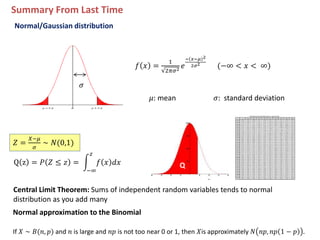
Normal/Gaussian distribution
𝜎
𝑓 𝑥 =
1
2𝜋𝜎2
𝑒
− 𝑥−𝜇 2
2𝜎2
(−∞ < 𝑥 < ∞)
𝜇: mean 𝜎: standard deviation
Q z = 𝑃 𝑍 ≤ 𝑧 =
−∞
𝑧
𝑓 𝑥 𝑑𝑥
𝑍 =
𝑋−𝜇
𝜎
∼ 𝑁(0,1)
Central Limit Theorem: Sums of independent random variables tends to normal
distribution as you add many
Normal approximation to the Binomial
If 𝑋 ∼ 𝐵(𝑛, 𝑝) and 𝑛 is large and 𝑛𝑝 is not too near 0 or 1, then 𝑋is approximately 𝑁 𝑛𝑝, 𝑛𝑝 1 − 𝑝 .
Q
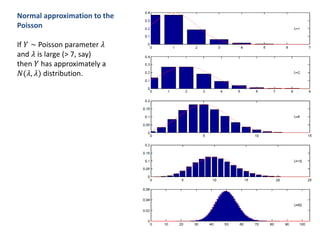
Normal approximation to the
Poisson
If 𝑌 ∼ Poisson parameter 𝜆
and 𝜆 is large (> 7, say)
then 𝑌 has approximately a
𝑁(𝜆, 𝜆) distribution.
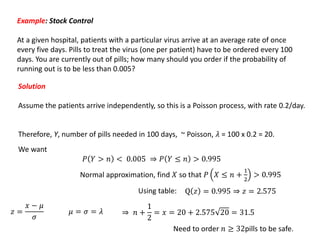
Example: Stock Control
At a given hospital, patients with a particular virus arrive at an average rate of once
every five days. Pills to treat the virus (one per patient) have to be ordered every 100
days. You are currently out of pills; how many should you order if the probability of
running out is to be less than 0.005?
Solution
Assume the patients arrive independently, so this is a Poisson process, with rate 0.2/day.
Therefore, Y, number of pills needed in 100 days, ~ Poisson, 𝜆 = 100 x 0.2 = 20.
We want
𝑃 𝑌 > 𝑛 < 0.005 ⇒ 𝑃 𝑌 ≤ 𝑛 > 0.995
⇒ 𝑛 +
1
2
= 𝑥 = 20 + 2.575 20 = 31.5
Q 𝑧 = 0.995 ⇒ 𝑧 = 2.575Using table:
Normal approximation, find 𝑋 so that 𝑃 𝑋 ≤ 𝑛 +
1
2
> 0.995
𝑧 =
𝑥 − 𝜇
𝜎
Need to order 𝑛 ≥ 32pills to be safe.
𝜇 = 𝜎 = 𝜆
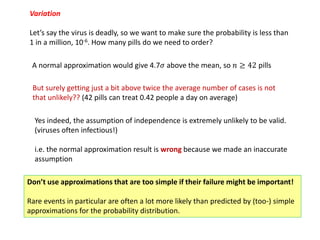
Variation
Let’s say the virus is deadly, so we want to make sure the probability is less than
1 in a million, 10-6. How many pills do we need to order?
A normal approximation would give 4.7𝜎 above the mean, so 𝑛 ≥ 42 pills
But surely getting just a bit above twice the average number of cases is not
that unlikely?? (42 pills can treat 0.42 people a day on average)
Yes indeed, the assumption of independence is extremely unlikely to be valid.
(viruses often infectious!)
i.e. the normal approximation result is wrong because we made an inaccurate
assumption
Don’t use approximations that are too simple if their failure might be important!
Rare events in particular are often a lot more likely than predicted by (too-) simple
approximations for the probability distribution.
Normal distribution summary
Central limit theorem means Normal distribution is ubiquitous
- Sums and averages of random variables tend to a normal distribution for large 𝑛
- Sums of Normal variates also have Normal distributions
- Normal is useful approximation to Binomial and Poisson for large 𝑛
- Calculate integrals using tables of Q standard normal variable 𝑍 =
𝑋 − 𝜇
𝜎
Descriptive Statistics
Types of data
A variate or random variable is a quantity or attribute whose value may vary
There are various types of variate:
• Qualitative or nominal; described by a word or phrase (e.g. blood group, colour)
• Quantitative; described by a number
(e.g. time till cure, number of calls arriving at a telephone exchange in 5 seconds)
• Ordinal; this is an "in-between" case. Observations are not numbers but they can be
ordered (e.g. much improved, improved, same, worse, much worse)
Quantitative data can be:
Discrete: the variate can only take one of a finite or countable number of
values (e.g. a count)
Continuous: the variate is a measurement which can take any value in an
interval of the real line (e.g. a weight).
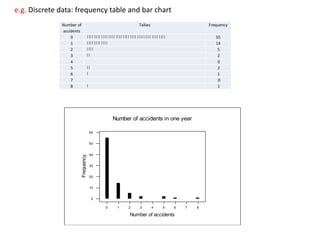
Discrete data: frequency table and bar chart
The frequency of a value is the number of observations taking that value.
A frequency table is a list of possible values and their frequencies.
A bar chart consists of bars corresponding to each of the possible values, whose
heights are equal to the frequencies.
Number of
accidents
Tallies Frequency
0 |||| |||| |||| |||| |||| |||| |||| |||| |||| |||| |||| 55
1 |||| |||| |||| 14
2 |||| 5
3 || 2
4 0
5 || 2
6 | 1
7 0
8 | 1
876543210
60
50
40
30
20
10
0
Number of accidents
Frequency
Number of accidents in one year
e.g. Discrete data: frequency table and bar chart
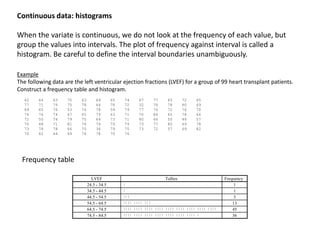
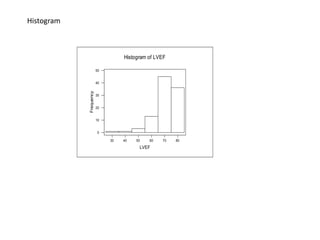
Continuous data: histograms
When the variate is continuous, we do not look at the frequency of each value, but
group the values into intervals. The plot of frequency against interval is called a
histogram. Be careful to define the interval boundaries unambiguously.
LVEF Tallies Frequency
24.5 - 34.5 | 1
34.5 - 44.5 | 1
44.5 - 54.5 ||| 3
54.5 - 64.5 |||| |||| ||| 13
64.5 - 74.5 |||| |||| |||| |||| |||| |||| |||| |||| |||| 45
74.5 - 84.5 |||| |||| |||| |||| |||| |||| |||| | 36
Example
The following data are the left ventricular ejection fractions (LVEF) for a group of 99 heart transplant patients.
Construct a frequency table and histogram.
62 64 63 70 63 69 65 74 67 77 65 72 65
77 71 79 75 78 64 78 72 32 78 78 80 69
69 65 76 53 74 78 59 79 77 76 72 76 70
76 76 74 67 65 79 63 71 70 84 65 78 66
72 55 74 79 75 64 73 71 80 66 50 48 57
70 68 71 81 74 74 79 79 73 77 80 69 78
73 78 78 66 70 36 79 75 73 72 57 69 82
70 62 64 69 74 78 70 76
Frequency table
Histogram
807060504030
50
40
30
20
10
0
LVEF
Frequency
Histogram of LVEF
1401301201101009080706050
40
30
20
10
0
Time till failure (hrs)
Frequency
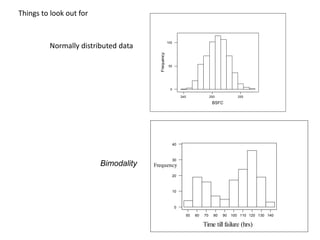
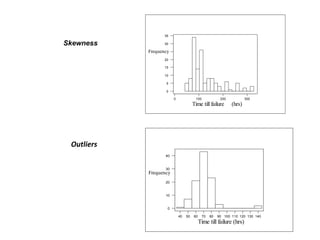
Things to look out for
Bimodality
255250245
100
50
0
BSFC
Frequency
Normally distributed data
140130120110100908070605040
40
30
20
10
0
Time till failure (hrs)
Frequency
Outliers
3002001000
35
30
20
15
10
5
0
Frequency
Time till failure (hrs)
Skewness
Summary Statistics
- Mean and variance, as for the distributions
- BUT – now sample estimates, rather than population estimates
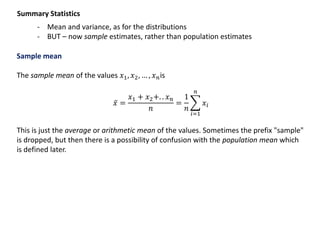
Sample mean
The sample mean of the values 𝑥1, 𝑥2, … , 𝑥 𝑛is
𝑥 =
𝑥1 + 𝑥2+. . 𝑥 𝑛
𝑛
=
1
𝑛
𝑖=1
𝑛
𝑥𝑖
This is just the average or arithmetic mean of the values. Sometimes the prefix "sample"
is dropped, but then there is a possibility of confusion with the population mean which
is defined later.
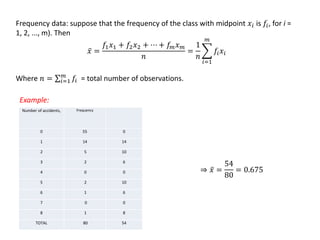
Number of accidents, Frequency
0 55 0
1 14 14
2 5 10
3 2 6
4 0 0
5 2 10
6 1 6
7 0 0
8 1 8
TOTAL 80 54
⇒ 𝑥 =
54
80
= 0.675
Frequency data: suppose that the frequency of the class with midpoint 𝑥𝑖 is 𝑓𝑖, for i =
1, 2, ..., m). Then
𝑥 =
𝑓1 𝑥1 + 𝑓2 𝑥2 + ⋯ + 𝑓𝑚 𝑥 𝑚
𝑛
=
1
𝑛
𝑖=1
𝑚
𝑓𝑖 𝑥𝑖
Where 𝑛 = 𝑖=1
𝑚
𝑓𝑖 = total number of observations.
Example:
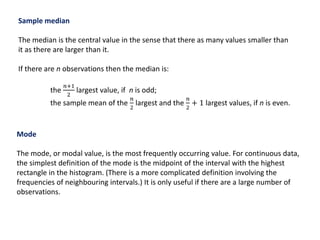
Sample median
The median is the central value in the sense that there as many values smaller than
it as there are larger than it.
If there are n observations then the median is:
the
𝑛+1
2
largest value, if n is odd;
the sample mean of the
𝑛
2
largest and the
𝑛
2
+ 1 largest values, if n is even.
Mode
The mode, or modal value, is the most frequently occurring value. For continuous data,
the simplest definition of the mode is the midpoint of the interval with the highest
rectangle in the histogram. (There is a more complicated definition involving the
frequencies of neighbouring intervals.) It is only useful if there are a large number of
observations.
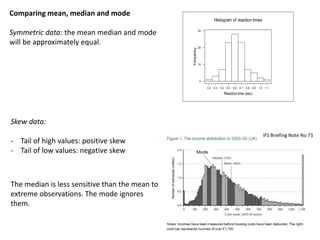
Comparing mean, median and mode
Symmetric data: the mean median and mode
will be approximately equal.
1.11.00.90.80.70.60.50.40.30.2
30
20
10
0
Reaction time (sec)
Frequency
Histogram of reaction times
Skew data:
- Tail of high values: positive skew
- Tail of low values: negative skew
IFS Briefing Note No 73
Mode
The median is less sensitive than the mean to
extreme observations. The mode ignores
them.
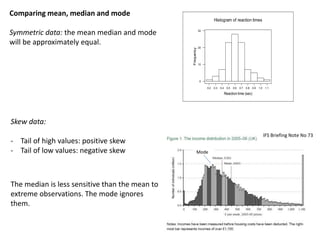
Comparing mean, median and mode
Symmetric data: the mean median and mode
will be approximately equal.
1.11.00.90.80.70.60.50.40.30.2
30
20
10
0
Reaction time (sec)
Frequency
Histogram of reaction times
Skew data:
- Tail of high values: positive skew
- Tail of low values: negative skew
IFS Briefing Note No 73
Mode
The median is less sensitive than the mean to
extreme observations. The mode ignores
them.
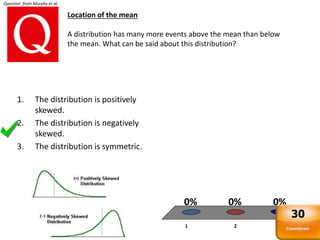
Location of the mean
A distribution has many more events above the mean than below
the mean. What can be said about this distribution?
1 2 3
0% 0%0%
1. The distribution is positively
skewed.
2. The distribution is negatively
skewed.
3. The distribution is symmetric.
Question from Murphy et al.
Countdown
30
Statistical Inference
Probability theory: the probability distribution of the population is known; we
want to derive results about the probability of one or more values ("random
sample") - deduction.
Statistics: the results of the random sample are known; we want to determine
something about the probability distribution of the population - inference.
In order to carry out valid inference, the sample must be representative, and
preferably a random sample.
Random sample: (i) no bias in the selection of the sample;
(ii) different members of the sample chosen independently.
Formal definition of a random sample: 𝑋1, 𝑋2, … 𝑋 𝑛 are a random sample if each
𝑋𝑖 has the same distribution and the 𝑋𝑖's are all independent.
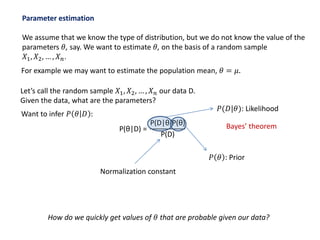
Parameter estimation
We assume that we know the type of distribution, but we do not know the value of the
parameters 𝜃, say. We want to estimate 𝜃, on the basis of a random sample
𝑋1, 𝑋2, … , 𝑋 𝑛.
Want to infer 𝑃 𝜃 𝐷 :
P(θ|D) =
P(D|θ)P(θ)
P(D)
𝑃 𝜃 : Prior
𝑃(𝐷|𝜃): Likelihood
Normalization constant
How do we quickly get values of 𝜃 that are probable given our data?
For example we may want to estimate the population mean, 𝜃 = 𝜇.
Let’s call the random sample 𝑋1, 𝑋2, … , 𝑋 𝑛 our data D.
Given the data, what are the parameters?
Bayes’ theorem
Maximum likelihood estimator: the value of θ that maximizes the likelihood
𝑃(𝐷|𝜃) is called the maximum likelihood estimate: it is the value that makes the
data most likely, and if P(θ) does not depend on parameters (e.g. is a constant) is
also the most probable value of the parameter given the observed data.
Example Random samples 𝑋1, 𝑋2, … 𝑋 𝑛 are drawn from a Normal distribution.
What is the maximum likelihood estimate of the mean μ?
𝜇 = 𝑋 =
1
𝑛
𝑖=1
𝑛
𝑋𝑖Answer: Sample mean:
𝑃(𝜇|𝐷)
𝜇
𝜇
[see notes]
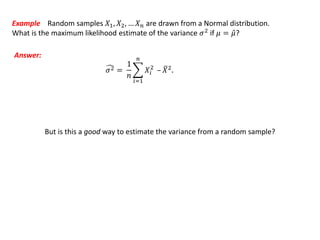
Example Random samples 𝑋1, 𝑋2, … 𝑋 𝑛 are drawn from a Normal distribution.
What is the maximum likelihood estimate of the variance 𝜎2
if 𝜇 = 𝜇?
Answer:
𝜎2 =
1
𝑛
𝑖=1
𝑛
𝑋𝑖
2
– 𝑋2.
But is this a good way to estimate the variance from a random sample?
A good but biased estimator
A poor but unbiased estimator
True mean
Comparing estimators
What are good properties of an estimator?
- Efficient: estimate close to true value with most sets of data random data samples
- Unbiased: on average (over possible data samples) it gives the true value
The estimator 𝜃 is unbiased for 𝜃 if 𝐸 𝜃 = 𝜃 for all values of 𝜃.
𝑃( 𝜃)
[distribution of
Maximum-
likelihood
𝜃 over all possible
random samples]
1 2 3
0% 0%0%
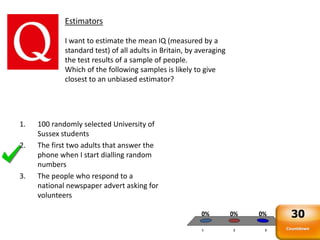
Estimators
I want to estimate the mean IQ (measured by a
standard test) of all adults in Britain, by averaging
the test results of a sample of people.
Which of the following samples is likely to give
closest to an unbiased estimator?
1. 100 randomly selected University of
Sussex students
2. The first two adults that answer the
phone when I start dialling random
numbers
3. The people who respond to a
national newspaper advert asking for
volunteers
Countdown
30
Result: 𝜇 = 𝑋 is an unbiased estimator of 𝜇.
𝑋 =
1
𝑛
𝑋1 + ⋯ + 𝑋 𝑛 = 𝜇
Result: 𝜎2 is a biased estimator of σ2
𝜎2 =
𝑛 − 1
𝑛
𝜎2 [proof in notes]
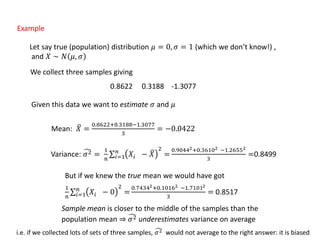
Example
Let say true (population) distribution 𝜇 = 0, 𝜎 = 1 (which we don’t know!) ,
and 𝑋 ∼ 𝑁 𝜇, 𝜎
We collect three samples giving
0.8622 0.3188 -1.3077
Given this data we want to estimate 𝜎 and 𝜇
Mean: 𝑋 =
0.8622+0.3188−1.3077
3
= −0.0422
Variance: 𝜎2 =
1
𝑛 𝑖=1
𝑛
𝑋𝑖 − 𝑋
2
=
0.90442+0.36102 −1.26552
3
=0.8499
But if we knew the true mean we would have got
1
𝑛 𝑖=1
𝑛
𝑋𝑖 − 0
2
=
0.74342+0.10162 −1.71012
3
= 0.8517
Sample mean is closer to the middle of the samples than the
population mean ⇒ 𝜎2 underestimates variance on average
i.e. if we collected lots of sets of three samples, 𝜎2 would not average to the right answer: it is biased
Sample variance
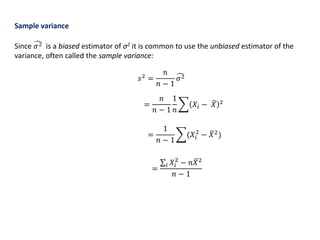
Since 𝜎2 is a biased estimator of σ2 it is common to use the unbiased estimator of the
variance, often called the sample variance:
𝑠2
=
𝑛
𝑛 − 1
𝜎2
=
𝑛
𝑛 − 1
1
𝑛
𝑋𝑖 − 𝑋 2
=
1
𝑛 − 1
(𝑋𝑖
2
− 𝑋2
)
=
𝑖 𝑋𝑖
2
− 𝑛 𝑋2
𝑛 − 1
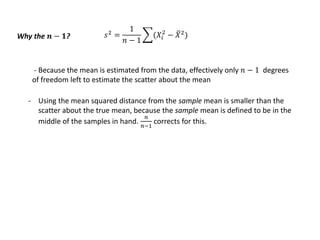
Why the 𝒏 − 𝟏?
- Because the mean is estimated from the data, effectively only 𝑛 − 1 degrees
of freedom left to estimate the scatter about the mean
- Using the mean squared distance from the sample mean is smaller than the
scatter about the true mean, because the sample mean is defined to be in the
middle of the samples in hand.
𝑛
𝑛−1
corrects for this.
𝑠2
=
1
𝑛 − 1
(𝑋𝑖
2
− 𝑋2
)
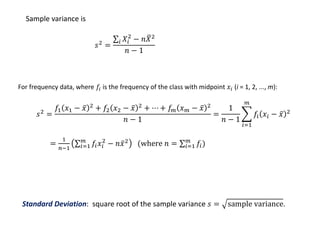
For frequency data, where 𝑓𝑖 is the frequency of the class with midpoint 𝑥𝑖 (i = 1, 2, ..., m):
𝑠2 =
𝑓1 𝑥1 − 𝑥 2
+ 𝑓2 𝑥2 − 𝑥 2
+ ⋯ + 𝑓𝑚 𝑥 𝑚 − 𝑥 2
𝑛 − 1
=
1
𝑛 − 1
𝑖=1
𝑚
𝑓𝑖 𝑥𝑖 − 𝑥 2
=
1
𝑛−1 𝑖=1
𝑚
𝑓𝑖 𝑥𝑖
2
− 𝑛 𝑥2 (where 𝑛 = 𝑖=1
𝑚
𝑓𝑖)
Standard Deviation: square root of the sample variance 𝑠 = sample variance.
𝑠2
=
𝑖 𝑋𝑖
2
− 𝑛 𝑋2
𝑛 − 1
Sample variance is
1 2 3 4 5
0% 0% 0%0%0%
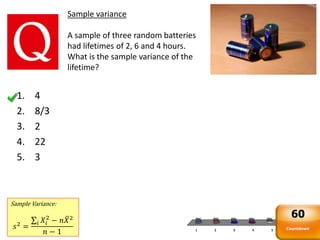
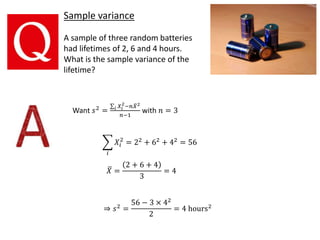
Sample variance
A sample of three random batteries
had lifetimes of 2, 6 and 4 hours.
What is the sample variance of the
lifetime?
Sample Variance:
𝑠2 =
𝑖 𝑋𝑖
2
− 𝑛 𝑋2
𝑛 − 1
1. 4
2. 8/3
3. 2
4. 22
5. 3
Countdown
60
Sample variance
A sample of three random batteries
had lifetimes of 2, 6 and 4 hours.
What is the sample variance of the
lifetime?
Want 𝑠2
= 𝑖 𝑋𝑖
2
−𝑛 𝑋2
𝑛−1
with 𝑛 = 3
𝑖
𝑋𝑖
2
= 22
+ 62
+ 42
= 56
𝑋 =
2 + 6 + 4
3
= 4
⇒ 𝑠2 =
56 − 3 × 42
2
= 4 hours2
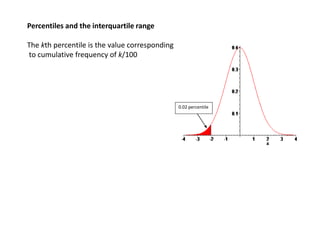
Percentiles and the interquartile range
The kth percentile is the value corresponding
to cumulative frequency of k/100
0.02 percentile
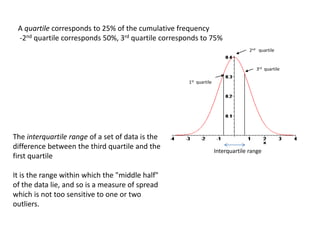
The interquartile range of a set of data is the
difference between the third quartile and the
first quartile
It is the range within which the "middle half"
of the data lie, and so is a measure of spread
which is not too sensitive to one or two
outliers.
A quartile corresponds to 25% of the cumulative frequency
-2nd quartile corresponds 50%, 3rd quartile corresponds to 75%
1st quartile
3rd quartile
2nd quartile
Interquartile range
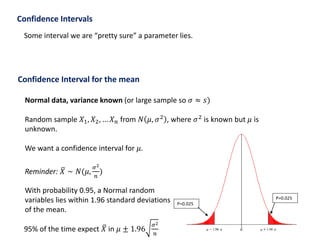
Confidence Intervals
Some interval we are “pretty sure” a parameter lies.
Normal data, variance known (or large sample so 𝜎 ≈ 𝑠)
Random sample 𝑋1, 𝑋2, … 𝑋 𝑛 from 𝑁 𝜇, 𝜎2
, where 𝜎2
is known but 𝜇 is
unknown.
We want a confidence interval for 𝜇.
Reminder: 𝑋 ∼ 𝑁(𝜇,
𝜎2
𝑛
)
P=0.025
P=0.025
With probability 0.95, a Normal random
variables lies within 1.96 standard deviations
of the mean.
Confidence Interval for the mean
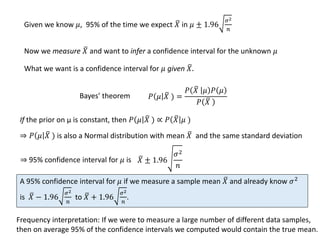
95% of the time expect 𝑋 in 𝜇 ± 1.96
𝜎2
𝑛
What we want is a confidence interval for 𝜇 given 𝑋.
𝑃 𝜇 𝑋 ) =
𝑃 𝑋 𝜇 𝑃 𝜇
𝑃 𝑋
Bayes’ theorem
If the prior on μ is constant, then 𝑃 𝜇 𝑋 ) ∝ 𝑃 𝑋 𝜇 )
A 95% confidence interval for 𝜇 if we measure a sample mean 𝑋 and already know 𝜎2
is 𝑋 − 1.96
𝜎2
𝑛
to 𝑋 + 1.96
𝜎2
𝑛
.
Given we know 𝜇, 95% of the time we expect 𝑋 in 𝜇 ± 1.96
𝜎2
𝑛
Now we measure 𝑋 and want to infer a confidence interval for the unknown 𝜇
⇒ 𝑃 𝜇 𝑋 ) is also a Normal distribution with mean 𝑋 and the same standard deviation
⇒ 95% confidence interval for 𝜇 is 𝑋 ± 1.96
𝜎2
𝑛
Frequency interpretation: If we were to measure a large number of different data samples,
then on average 95% of the confidence intervals we computed would contain the true mean.
1 2 3 4
0% 0%0%0%
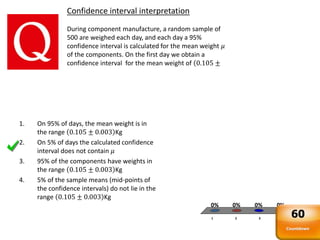
Confidence interval interpretation
During component manufacture, a random sample of
500 are weighed each day, and each day a 95%
confidence interval is calculated for the mean weight 𝜇
of the components. On the first day we obtain a
confidence interval for the mean weight of (0.105 ±
1. On 95% of days, the mean weight is in
the range 0.105 ± 0.003 Kg
2. On 5% of days the calculated confidence
interval does not contain 𝜇
3. 95% of the components have weights in
the range 0.105 ± 0.003 Kg
4. 5% of the sample means (mid-points of
the confidence intervals) do not lie in the
range 0.105 ± 0.003 Kg
Countdown
60
Confidence interval interpretation
During component manufacture, a random sample of
500 are weighed each day, and each day a 95%
confidence interval is calculated for the mean weight 𝜇
of the components. On the first day we obtain a
confidence interval for the mean weight of (0.105 ±
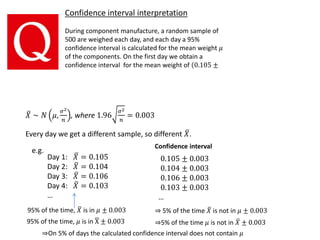
𝑋 ∼ 𝑁 𝜇,
𝜎2
𝑛
, where 1.96
𝜎2
𝑛
= 0.003
Every day we get a different sample, so different 𝑋.
Day 1: 𝑋 = 0.105
Day 2: 𝑋 = 0.104
Day 3: 𝑋 = 0.106
Day 4: 𝑋 = 0.103
…
e.g.
Confidence interval
0.105 ± 0.003
0.104 ± 0.003
0.106 ± 0.003
0.103 ± 0.003
…
95% of the time, 𝑋 is in 𝜇 ± 0.003 ⇒ 5% of the time 𝑋 is not in 𝜇 ± 0.003
⇒5% of the time 𝜇 is not in 𝑋 ± 0.00395% of the time, 𝜇 is in X ± 0.003
⇒On 5% of days the calculated confidence interval does not contain 𝜇
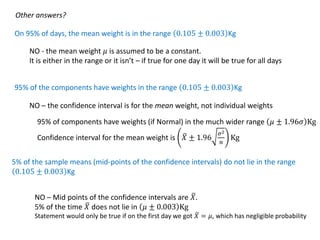
On 95% of days, the mean weight is in the range 0.105 ± 0.003 Kg
5% of the sample means (mid-points of the confidence intervals) do not lie in the range
0.105 ± 0.003 Kg
95% of the components have weights in the range 0.105 ± 0.003 Kg
Other answers?
NO – the confidence interval is for the mean weight, not individual weights
95% of components have weights (if Normal) in the much wider range 𝜇 ± 1.96𝜎 Kg
Confidence interval for the mean weight is 𝑋 ± 1.96
𝜎2
𝑛
Kg
NO – Mid points of the confidence intervals are 𝑋.
5% of the time 𝑋 does not lie in 𝜇 ± 0.003 Kg
Statement would only be true if on the first day we got 𝑋 = 𝜇, which has negligible probability
NO - the mean weight 𝜇 is assumed to be a constant.
It is either in the range or it isn’t – if true for one day it will be true for all days
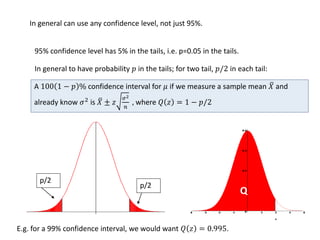
A 100 1 − 𝑝 % confidence interval for 𝜇 if we measure a sample mean 𝑋 and
already know 𝜎2
is 𝑋 ± 𝑧
𝜎2
𝑛
, where 𝑄 𝑧 = 1 − 𝑝/2
In general can use any confidence level, not just 95%.
95% confidence level has 5% in the tails, i.e. p=0.05 in the tails.
In general to have probability 𝑝 in the tails; for two tail, 𝑝/2 in each tail:
p/2
p/2
Q
E.g. for a 99% confidence interval, we would want 𝑄 𝑧 = 0.995.
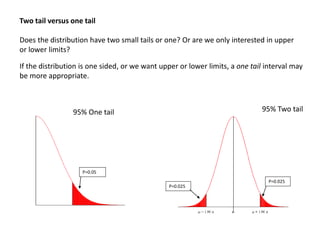
Two tail versus one tail
Does the distribution have two small tails or one? Or are we only interested in upper
or lower limits?
If the distribution is one sided, or we want upper or lower limits, a one tail interval may
be more appropriate.
P=0.05
95% One tail
P=0.025
P=0.025
95% Two tail
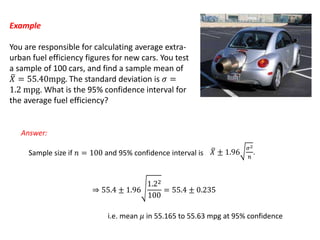
Example
You are responsible for calculating average extra-
urban fuel efficiency figures for new cars. You test
a sample of 100 cars, and find a sample mean of
𝑋 = 55.40mpg. The standard deviation is 𝜎 =
1.2 mpg. What is the 95% confidence interval for
the average fuel efficiency?
Answer:
Sample size if 𝑛 = 100 and 95% confidence interval is 𝑋 ± 1.96
𝜎2
𝑛
.
⇒ 55.4 ± 1.96
1.22
100
= 55.4 ± 0.235
i.e. mean 𝜇 in 55.165 to 55.63 mpg at 95% confidence
1 2
0%0%
Confidence interval
Given the confidence interval just constructed, it is
correct to say that approximately 95% of new cars
will have efficiencies between 55.165 and 55.63
mpg?
Question from Derek Bruff
NO: 𝜎 = 1.2mpg given in the question is the standard
deviation of the individual car efficiencies (i.e. expect
new cars in a range ±1.96𝜎). The confidence interval
we calculated is the range we expect the mean
efficiency to lie in (much smaller range).
1. YES
2. NO
Countdown
30
Example: Polling
A sample of 1000 random voters were polled, with 350 saying they will vote for the
Conservatives and 650 saying another party. What is the 95% confidence interval for
the Conservative share of the vote?
Answer: this is Binomial data, but large 𝑛 = 1000 so can approximate as Normal
𝜎2
= 𝑛𝑝 1 − 𝑝 ≈ 1000 × 0.35 × 1 − 0.35 = 227.5
Random variable 𝑋 is the number voting Conservative, 𝑋 ∼ 𝑁(𝜇, 𝜎2)
Take variance from the Binomial result with 𝑝 ≈
350
1000
= 0.35
⇒ 𝜎 = 227.5 ≈ 15.1
95% confidence interval for the total votes is
350 ± 1.96𝜎 = 350 ± 1.96 × 15.1 = 350 ± 29.6
⇒ 95% confidence interval for the fraction of the votes is
350 ± 29.6
1000
≈ 0.35 ± 0.03 i.e. ±3% confidence interval
Example – variance unknown
A large number of steel plates will be used to
build a ship. A sample of ten are tested and found
to have sample mean 𝑋 = 2.13kg and sample
variance 𝑠2
= 0.25 kg 2
. What is the 95%
confidence interval for the mean weight 𝜇?
Reminder:
Sample Variance: 𝑠2 = 𝑖 𝑋𝑖
2
−𝑛 𝑋2
𝑛−1
Normal data, variance unknown
Random sample 𝑋1, 𝑋2, … 𝑋 𝑛 from 𝑁 𝜇, 𝜎2
, where 𝜎2
and 𝜇 are both unknown.
Want a confidence interval for 𝜇, using observed sample mean and variance.
When we know the variance: use 𝑧 =
𝑋−𝜇
𝜎/ 𝑛
which is normally distributed
But don’t know 𝜎2
, so have to use sample estimate 𝑠2
When we don’t know the variance: use 𝑡 =
𝑋−𝜇
𝑠/ 𝑛
which has a t-distribution
(with 𝑛 − 1 d.o.f)
Sometimes more fully as “Student’s t-distribution”
Wikipedia
Remember: 𝑋 ∼ 𝑁 𝜇,
𝜎2
𝑛
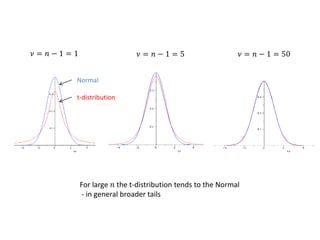
𝜈 = 𝑛 − 1 = 1 𝜈 = 𝑛 − 1 = 5 𝜈 = 𝑛 − 1 = 50
Normal
t-distribution
For large 𝑛 the t-distribution tends to the Normal
- in general broader tails
Confidence Intervals for the mean
If 𝜎2
is known, confidence interval for 𝜇 is 𝑋 − 𝑧
𝜎2
𝑛
to 𝑋 + 𝑧
𝜎2
𝑛
, where 𝑧
is obtained from Normal tables (z=1.96 for two-tailed 95% confidence limit).
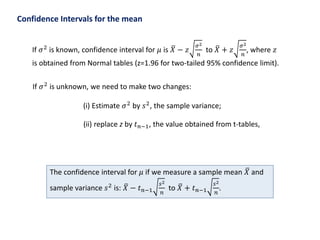
If 𝜎2 is unknown, we need to make two changes:
(i) Estimate 𝜎2
by 𝑠2
, the sample variance;
(ii) replace z by 𝑡 𝑛−1, the value obtained from t-tables,
The confidence interval for 𝜇 if we measure a sample mean 𝑋 and
sample variance 𝑠2
is: 𝑋 − 𝑡 𝑛−1
𝑠2
𝑛
to 𝑋 + 𝑡 𝑛−1
𝑠2
𝑛
.
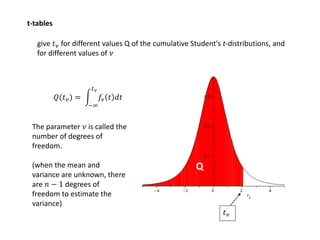
t-tables
give 𝑡 𝜈 for different values Q of the cumulative Student's t-distributions, and
for different values of 𝜈
𝑡 𝜈
Q
𝑄(𝑡 𝜈) =
−∞
𝑡 𝜈
𝑓𝜈 𝑡 𝑑𝑡
The parameter 𝜈 is called the
number of degrees of
freedom.
(when the mean and
variance are unknown, there
are 𝑛 − 1 degrees of
freedom to estimate the
variance)
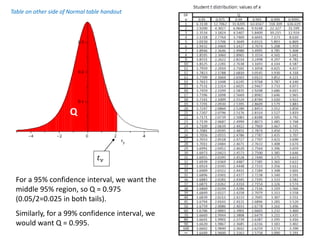
𝑡 𝜈
Q
For a 95% confidence interval, we want the
middle 95% region, so Q = 0.975
(0.05/2=0.025 in both tails).
Similarly, for a 99% confidence interval, we
would want Q = 0.995.
Table on other side of Normal table handout
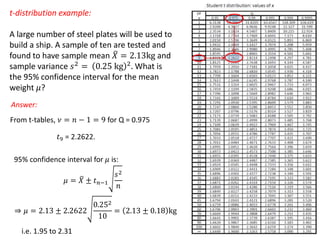
t-distribution example:
A large number of steel plates will be used to
build a ship. A sample of ten are tested and
found to have sample mean 𝑋 = 2.13kg and
sample variance 𝑠2 = 0.25 kg 2. What is
the 95% confidence interval for the mean
weight 𝜇?
From t-tables, 𝜈 = 𝑛 − 1 = 9 for Q = 0.975
Answer:
95% confidence interval for 𝜇 is:
𝜇 = 𝑋 ± 𝑡 𝑛−1
𝑠2
𝑛
i.e. 1.95 to 2.31
𝑡9 = 2.2622.
⇒ 𝜇 = 2.13 ± 2.2622
0.252
10
= 2.13 ± 0.18 kg
1 2 3 4
0% 0%0%0%
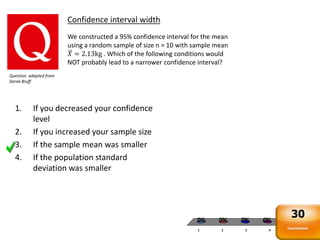
Confidence interval width
We constructed a 95% confidence interval for the mean
using a random sample of size n = 10 with sample mean
𝑋 = 2.13kg . Which of the following conditions would
NOT probably lead to a narrower confidence interval?
Question adapted from
Derek Bruff
1. If you decreased your confidence
level
2. If you increased your sample size
3. If the sample mean was smaller
4. If the population standard
deviation was smaller
Countdown
30
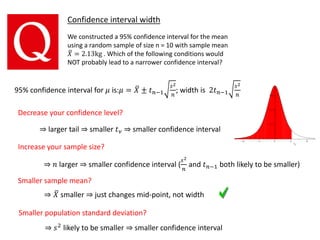
95% confidence interval for 𝜇 is:𝜇 = 𝑋 ± 𝑡 𝑛−1
𝑠2
𝑛
; width is 2𝑡 𝑛−1
𝑠2
𝑛
Confidence interval width
We constructed a 95% confidence interval for the mean
using a random sample of size n = 10 with sample mean
𝑋 = 2.13kg . Which of the following conditions would
NOT probably lead to a narrower confidence interval?
Decrease your confidence level?
⇒ larger tail ⇒ smaller 𝑡 𝜈 ⇒ smaller confidence interval
Increase your sample size?
Smaller sample mean?
Smaller population standard deviation?
⇒ 𝑛 larger ⇒ smaller confidence interval (
𝑠2
𝑛
and 𝑡 𝑛−1 both likely to be smaller)
⇒ 𝑋 smaller ⇒ just changes mid-point, not width
⇒ 𝑠2 likely to be smaller ⇒ smaller confidence interval
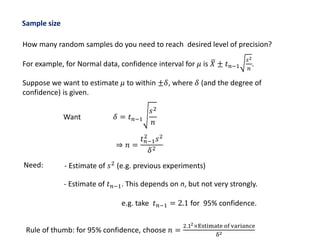
Sample size
How many random samples do you need to reach desired level of precision?
For example, for Normal data, confidence interval for 𝜇 is 𝑋 ± 𝑡 𝑛−1
𝑠2
𝑛
.
Suppose we want to estimate 𝜇 to within ±𝛿, where 𝛿 (and the degree of
confidence) is given.
⇒ 𝑛 =
𝑡 𝑛−1
2
𝑠2
𝛿2
Want 𝛿 = 𝑡 𝑛−1
𝑠2
𝑛
Need: - Estimate of 𝑠2 (e.g. previous experiments)
- Estimate of 𝑡 𝑛−1. This depends on n, but not very strongly.
e.g. take 𝑡 𝑛−1 = 2.1 for 95% confidence.
Rule of thumb: for 95% confidence, choose 𝑛 =
2.12×Estimate of variance
δ2

Statistics78 (2)

  • 1.
  • 2.
    Summary From LastTime Normal/Gaussian distribution 𝜎 𝑓 𝑥 = 1 2𝜋𝜎2 𝑒 − 𝑥−𝜇 2 2𝜎2 (−∞ < 𝑥 < ∞) 𝜇: mean 𝜎: standard deviation Q z = 𝑃 𝑍 ≤ 𝑧 = −∞ 𝑧 𝑓 𝑥 𝑑𝑥 𝑍 = 𝑋−𝜇 𝜎 ∼ 𝑁(0,1) Central Limit Theorem: Sums of independent random variables tends to normal distribution as you add many Normal approximation to the Binomial If 𝑋 ∼ 𝐵(𝑛, 𝑝) and 𝑛 is large and 𝑛𝑝 is not too near 0 or 1, then 𝑋is approximately 𝑁 𝑛𝑝, 𝑛𝑝 1 − 𝑝 . Q
  • 3.
    Normal approximation tothe Poisson If 𝑌 ∼ Poisson parameter 𝜆 and 𝜆 is large (> 7, say) then 𝑌 has approximately a 𝑁(𝜆, 𝜆) distribution.
  • 4.
    Example: Stock Control Ata given hospital, patients with a particular virus arrive at an average rate of once every five days. Pills to treat the virus (one per patient) have to be ordered every 100 days. You are currently out of pills; how many should you order if the probability of running out is to be less than 0.005? Solution Assume the patients arrive independently, so this is a Poisson process, with rate 0.2/day. Therefore, Y, number of pills needed in 100 days, ~ Poisson, 𝜆 = 100 x 0.2 = 20. We want 𝑃 𝑌 > 𝑛 < 0.005 ⇒ 𝑃 𝑌 ≤ 𝑛 > 0.995 ⇒ 𝑛 + 1 2 = 𝑥 = 20 + 2.575 20 = 31.5 Q 𝑧 = 0.995 ⇒ 𝑧 = 2.575Using table: Normal approximation, find 𝑋 so that 𝑃 𝑋 ≤ 𝑛 + 1 2 > 0.995 𝑧 = 𝑥 − 𝜇 𝜎 Need to order 𝑛 ≥ 32pills to be safe. 𝜇 = 𝜎 = 𝜆
  • 5.
    Variation Let’s say thevirus is deadly, so we want to make sure the probability is less than 1 in a million, 10-6. How many pills do we need to order? A normal approximation would give 4.7𝜎 above the mean, so 𝑛 ≥ 42 pills But surely getting just a bit above twice the average number of cases is not that unlikely?? (42 pills can treat 0.42 people a day on average) Yes indeed, the assumption of independence is extremely unlikely to be valid. (viruses often infectious!) i.e. the normal approximation result is wrong because we made an inaccurate assumption Don’t use approximations that are too simple if their failure might be important! Rare events in particular are often a lot more likely than predicted by (too-) simple approximations for the probability distribution.
  • 6.
    Normal distribution summary Centrallimit theorem means Normal distribution is ubiquitous - Sums and averages of random variables tend to a normal distribution for large 𝑛 - Sums of Normal variates also have Normal distributions - Normal is useful approximation to Binomial and Poisson for large 𝑛 - Calculate integrals using tables of Q standard normal variable 𝑍 = 𝑋 − 𝜇 𝜎
  • 7.
    Descriptive Statistics Types ofdata A variate or random variable is a quantity or attribute whose value may vary There are various types of variate: • Qualitative or nominal; described by a word or phrase (e.g. blood group, colour) • Quantitative; described by a number (e.g. time till cure, number of calls arriving at a telephone exchange in 5 seconds) • Ordinal; this is an "in-between" case. Observations are not numbers but they can be ordered (e.g. much improved, improved, same, worse, much worse)
  • 8.
    Quantitative data canbe: Discrete: the variate can only take one of a finite or countable number of values (e.g. a count) Continuous: the variate is a measurement which can take any value in an interval of the real line (e.g. a weight).
  • 9.
    Discrete data: frequencytable and bar chart The frequency of a value is the number of observations taking that value. A frequency table is a list of possible values and their frequencies. A bar chart consists of bars corresponding to each of the possible values, whose heights are equal to the frequencies.
  • 10.
    Number of accidents Tallies Frequency 0|||| |||| |||| |||| |||| |||| |||| |||| |||| |||| |||| 55 1 |||| |||| |||| 14 2 |||| 5 3 || 2 4 0 5 || 2 6 | 1 7 0 8 | 1 876543210 60 50 40 30 20 10 0 Number of accidents Frequency Number of accidents in one year e.g. Discrete data: frequency table and bar chart
  • 11.
    Continuous data: histograms Whenthe variate is continuous, we do not look at the frequency of each value, but group the values into intervals. The plot of frequency against interval is called a histogram. Be careful to define the interval boundaries unambiguously. LVEF Tallies Frequency 24.5 - 34.5 | 1 34.5 - 44.5 | 1 44.5 - 54.5 ||| 3 54.5 - 64.5 |||| |||| ||| 13 64.5 - 74.5 |||| |||| |||| |||| |||| |||| |||| |||| |||| 45 74.5 - 84.5 |||| |||| |||| |||| |||| |||| |||| | 36 Example The following data are the left ventricular ejection fractions (LVEF) for a group of 99 heart transplant patients. Construct a frequency table and histogram. 62 64 63 70 63 69 65 74 67 77 65 72 65 77 71 79 75 78 64 78 72 32 78 78 80 69 69 65 76 53 74 78 59 79 77 76 72 76 70 76 76 74 67 65 79 63 71 70 84 65 78 66 72 55 74 79 75 64 73 71 80 66 50 48 57 70 68 71 81 74 74 79 79 73 77 80 69 78 73 78 78 66 70 36 79 75 73 72 57 69 82 70 62 64 69 74 78 70 76 Frequency table
  • 12.
  • 13.
    1401301201101009080706050 40 30 20 10 0 Time till failure(hrs) Frequency Things to look out for Bimodality 255250245 100 50 0 BSFC Frequency Normally distributed data
  • 14.
    140130120110100908070605040 40 30 20 10 0 Time till failure(hrs) Frequency Outliers 3002001000 35 30 20 15 10 5 0 Frequency Time till failure (hrs) Skewness
  • 15.
    Summary Statistics - Meanand variance, as for the distributions - BUT – now sample estimates, rather than population estimates Sample mean The sample mean of the values 𝑥1, 𝑥2, … , 𝑥 𝑛is 𝑥 = 𝑥1 + 𝑥2+. . 𝑥 𝑛 𝑛 = 1 𝑛 𝑖=1 𝑛 𝑥𝑖 This is just the average or arithmetic mean of the values. Sometimes the prefix "sample" is dropped, but then there is a possibility of confusion with the population mean which is defined later.
  • 16.
    Number of accidents,Frequency 0 55 0 1 14 14 2 5 10 3 2 6 4 0 0 5 2 10 6 1 6 7 0 0 8 1 8 TOTAL 80 54 ⇒ 𝑥 = 54 80 = 0.675 Frequency data: suppose that the frequency of the class with midpoint 𝑥𝑖 is 𝑓𝑖, for i = 1, 2, ..., m). Then 𝑥 = 𝑓1 𝑥1 + 𝑓2 𝑥2 + ⋯ + 𝑓𝑚 𝑥 𝑚 𝑛 = 1 𝑛 𝑖=1 𝑚 𝑓𝑖 𝑥𝑖 Where 𝑛 = 𝑖=1 𝑚 𝑓𝑖 = total number of observations. Example:
  • 17.
    Sample median The medianis the central value in the sense that there as many values smaller than it as there are larger than it. If there are n observations then the median is: the 𝑛+1 2 largest value, if n is odd; the sample mean of the 𝑛 2 largest and the 𝑛 2 + 1 largest values, if n is even. Mode The mode, or modal value, is the most frequently occurring value. For continuous data, the simplest definition of the mode is the midpoint of the interval with the highest rectangle in the histogram. (There is a more complicated definition involving the frequencies of neighbouring intervals.) It is only useful if there are a large number of observations.
  • 18.
    Comparing mean, medianand mode Symmetric data: the mean median and mode will be approximately equal. 1.11.00.90.80.70.60.50.40.30.2 30 20 10 0 Reaction time (sec) Frequency Histogram of reaction times Skew data: - Tail of high values: positive skew - Tail of low values: negative skew IFS Briefing Note No 73 Mode The median is less sensitive than the mean to extreme observations. The mode ignores them.
  • 19.
    Comparing mean, medianand mode Symmetric data: the mean median and mode will be approximately equal. 1.11.00.90.80.70.60.50.40.30.2 30 20 10 0 Reaction time (sec) Frequency Histogram of reaction times Skew data: - Tail of high values: positive skew - Tail of low values: negative skew IFS Briefing Note No 73 Mode The median is less sensitive than the mean to extreme observations. The mode ignores them.
  • 20.
    Location of themean A distribution has many more events above the mean than below the mean. What can be said about this distribution? 1 2 3 0% 0%0% 1. The distribution is positively skewed. 2. The distribution is negatively skewed. 3. The distribution is symmetric. Question from Murphy et al. Countdown 30
  • 21.
    Statistical Inference Probability theory:the probability distribution of the population is known; we want to derive results about the probability of one or more values ("random sample") - deduction. Statistics: the results of the random sample are known; we want to determine something about the probability distribution of the population - inference. In order to carry out valid inference, the sample must be representative, and preferably a random sample. Random sample: (i) no bias in the selection of the sample; (ii) different members of the sample chosen independently. Formal definition of a random sample: 𝑋1, 𝑋2, … 𝑋 𝑛 are a random sample if each 𝑋𝑖 has the same distribution and the 𝑋𝑖's are all independent.
  • 22.
    Parameter estimation We assumethat we know the type of distribution, but we do not know the value of the parameters 𝜃, say. We want to estimate 𝜃, on the basis of a random sample 𝑋1, 𝑋2, … , 𝑋 𝑛. Want to infer 𝑃 𝜃 𝐷 : P(θ|D) = P(D|θ)P(θ) P(D) 𝑃 𝜃 : Prior 𝑃(𝐷|𝜃): Likelihood Normalization constant How do we quickly get values of 𝜃 that are probable given our data? For example we may want to estimate the population mean, 𝜃 = 𝜇. Let’s call the random sample 𝑋1, 𝑋2, … , 𝑋 𝑛 our data D. Given the data, what are the parameters? Bayes’ theorem
  • 23.
    Maximum likelihood estimator:the value of θ that maximizes the likelihood 𝑃(𝐷|𝜃) is called the maximum likelihood estimate: it is the value that makes the data most likely, and if P(θ) does not depend on parameters (e.g. is a constant) is also the most probable value of the parameter given the observed data. Example Random samples 𝑋1, 𝑋2, … 𝑋 𝑛 are drawn from a Normal distribution. What is the maximum likelihood estimate of the mean μ? 𝜇 = 𝑋 = 1 𝑛 𝑖=1 𝑛 𝑋𝑖Answer: Sample mean: 𝑃(𝜇|𝐷) 𝜇 𝜇 [see notes]
  • 24.
    Example Random samples𝑋1, 𝑋2, … 𝑋 𝑛 are drawn from a Normal distribution. What is the maximum likelihood estimate of the variance 𝜎2 if 𝜇 = 𝜇? Answer: 𝜎2 = 1 𝑛 𝑖=1 𝑛 𝑋𝑖 2 – 𝑋2. But is this a good way to estimate the variance from a random sample?
  • 25.
    A good butbiased estimator A poor but unbiased estimator True mean Comparing estimators What are good properties of an estimator? - Efficient: estimate close to true value with most sets of data random data samples - Unbiased: on average (over possible data samples) it gives the true value The estimator 𝜃 is unbiased for 𝜃 if 𝐸 𝜃 = 𝜃 for all values of 𝜃. 𝑃( 𝜃) [distribution of Maximum- likelihood 𝜃 over all possible random samples]
  • 26.
    1 2 3 0%0%0% Estimators I want to estimate the mean IQ (measured by a standard test) of all adults in Britain, by averaging the test results of a sample of people. Which of the following samples is likely to give closest to an unbiased estimator? 1. 100 randomly selected University of Sussex students 2. The first two adults that answer the phone when I start dialling random numbers 3. The people who respond to a national newspaper advert asking for volunteers Countdown 30
  • 27.
    Result: 𝜇 =𝑋 is an unbiased estimator of 𝜇. 𝑋 = 1 𝑛 𝑋1 + ⋯ + 𝑋 𝑛 = 𝜇 Result: 𝜎2 is a biased estimator of σ2 𝜎2 = 𝑛 − 1 𝑛 𝜎2 [proof in notes]
  • 28.
    Example Let say true(population) distribution 𝜇 = 0, 𝜎 = 1 (which we don’t know!) , and 𝑋 ∼ 𝑁 𝜇, 𝜎 We collect three samples giving 0.8622 0.3188 -1.3077 Given this data we want to estimate 𝜎 and 𝜇 Mean: 𝑋 = 0.8622+0.3188−1.3077 3 = −0.0422 Variance: 𝜎2 = 1 𝑛 𝑖=1 𝑛 𝑋𝑖 − 𝑋 2 = 0.90442+0.36102 −1.26552 3 =0.8499 But if we knew the true mean we would have got 1 𝑛 𝑖=1 𝑛 𝑋𝑖 − 0 2 = 0.74342+0.10162 −1.71012 3 = 0.8517 Sample mean is closer to the middle of the samples than the population mean ⇒ 𝜎2 underestimates variance on average i.e. if we collected lots of sets of three samples, 𝜎2 would not average to the right answer: it is biased
  • 29.
    Sample variance Since 𝜎2is a biased estimator of σ2 it is common to use the unbiased estimator of the variance, often called the sample variance: 𝑠2 = 𝑛 𝑛 − 1 𝜎2 = 𝑛 𝑛 − 1 1 𝑛 𝑋𝑖 − 𝑋 2 = 1 𝑛 − 1 (𝑋𝑖 2 − 𝑋2 ) = 𝑖 𝑋𝑖 2 − 𝑛 𝑋2 𝑛 − 1
  • 30.
    Why the 𝒏− 𝟏? - Because the mean is estimated from the data, effectively only 𝑛 − 1 degrees of freedom left to estimate the scatter about the mean - Using the mean squared distance from the sample mean is smaller than the scatter about the true mean, because the sample mean is defined to be in the middle of the samples in hand. 𝑛 𝑛−1 corrects for this. 𝑠2 = 1 𝑛 − 1 (𝑋𝑖 2 − 𝑋2 )
  • 31.
    For frequency data,where 𝑓𝑖 is the frequency of the class with midpoint 𝑥𝑖 (i = 1, 2, ..., m): 𝑠2 = 𝑓1 𝑥1 − 𝑥 2 + 𝑓2 𝑥2 − 𝑥 2 + ⋯ + 𝑓𝑚 𝑥 𝑚 − 𝑥 2 𝑛 − 1 = 1 𝑛 − 1 𝑖=1 𝑚 𝑓𝑖 𝑥𝑖 − 𝑥 2 = 1 𝑛−1 𝑖=1 𝑚 𝑓𝑖 𝑥𝑖 2 − 𝑛 𝑥2 (where 𝑛 = 𝑖=1 𝑚 𝑓𝑖) Standard Deviation: square root of the sample variance 𝑠 = sample variance. 𝑠2 = 𝑖 𝑋𝑖 2 − 𝑛 𝑋2 𝑛 − 1 Sample variance is
  • 32.
    1 2 34 5 0% 0% 0%0%0% Sample variance A sample of three random batteries had lifetimes of 2, 6 and 4 hours. What is the sample variance of the lifetime? Sample Variance: 𝑠2 = 𝑖 𝑋𝑖 2 − 𝑛 𝑋2 𝑛 − 1 1. 4 2. 8/3 3. 2 4. 22 5. 3 Countdown 60
  • 33.
    Sample variance A sampleof three random batteries had lifetimes of 2, 6 and 4 hours. What is the sample variance of the lifetime? Want 𝑠2 = 𝑖 𝑋𝑖 2 −𝑛 𝑋2 𝑛−1 with 𝑛 = 3 𝑖 𝑋𝑖 2 = 22 + 62 + 42 = 56 𝑋 = 2 + 6 + 4 3 = 4 ⇒ 𝑠2 = 56 − 3 × 42 2 = 4 hours2
  • 34.
    Percentiles and theinterquartile range The kth percentile is the value corresponding to cumulative frequency of k/100 0.02 percentile
  • 35.
    The interquartile rangeof a set of data is the difference between the third quartile and the first quartile It is the range within which the "middle half" of the data lie, and so is a measure of spread which is not too sensitive to one or two outliers. A quartile corresponds to 25% of the cumulative frequency -2nd quartile corresponds 50%, 3rd quartile corresponds to 75% 1st quartile 3rd quartile 2nd quartile Interquartile range
  • 36.
    Confidence Intervals Some intervalwe are “pretty sure” a parameter lies. Normal data, variance known (or large sample so 𝜎 ≈ 𝑠) Random sample 𝑋1, 𝑋2, … 𝑋 𝑛 from 𝑁 𝜇, 𝜎2 , where 𝜎2 is known but 𝜇 is unknown. We want a confidence interval for 𝜇. Reminder: 𝑋 ∼ 𝑁(𝜇, 𝜎2 𝑛 ) P=0.025 P=0.025 With probability 0.95, a Normal random variables lies within 1.96 standard deviations of the mean. Confidence Interval for the mean 95% of the time expect 𝑋 in 𝜇 ± 1.96 𝜎2 𝑛
  • 37.
    What we wantis a confidence interval for 𝜇 given 𝑋. 𝑃 𝜇 𝑋 ) = 𝑃 𝑋 𝜇 𝑃 𝜇 𝑃 𝑋 Bayes’ theorem If the prior on μ is constant, then 𝑃 𝜇 𝑋 ) ∝ 𝑃 𝑋 𝜇 ) A 95% confidence interval for 𝜇 if we measure a sample mean 𝑋 and already know 𝜎2 is 𝑋 − 1.96 𝜎2 𝑛 to 𝑋 + 1.96 𝜎2 𝑛 . Given we know 𝜇, 95% of the time we expect 𝑋 in 𝜇 ± 1.96 𝜎2 𝑛 Now we measure 𝑋 and want to infer a confidence interval for the unknown 𝜇 ⇒ 𝑃 𝜇 𝑋 ) is also a Normal distribution with mean 𝑋 and the same standard deviation ⇒ 95% confidence interval for 𝜇 is 𝑋 ± 1.96 𝜎2 𝑛 Frequency interpretation: If we were to measure a large number of different data samples, then on average 95% of the confidence intervals we computed would contain the true mean.
  • 38.
    1 2 34 0% 0%0%0% Confidence interval interpretation During component manufacture, a random sample of 500 are weighed each day, and each day a 95% confidence interval is calculated for the mean weight 𝜇 of the components. On the first day we obtain a confidence interval for the mean weight of (0.105 ± 1. On 95% of days, the mean weight is in the range 0.105 ± 0.003 Kg 2. On 5% of days the calculated confidence interval does not contain 𝜇 3. 95% of the components have weights in the range 0.105 ± 0.003 Kg 4. 5% of the sample means (mid-points of the confidence intervals) do not lie in the range 0.105 ± 0.003 Kg Countdown 60
  • 39.
    Confidence interval interpretation Duringcomponent manufacture, a random sample of 500 are weighed each day, and each day a 95% confidence interval is calculated for the mean weight 𝜇 of the components. On the first day we obtain a confidence interval for the mean weight of (0.105 ± 𝑋 ∼ 𝑁 𝜇, 𝜎2 𝑛 , where 1.96 𝜎2 𝑛 = 0.003 Every day we get a different sample, so different 𝑋. Day 1: 𝑋 = 0.105 Day 2: 𝑋 = 0.104 Day 3: 𝑋 = 0.106 Day 4: 𝑋 = 0.103 … e.g. Confidence interval 0.105 ± 0.003 0.104 ± 0.003 0.106 ± 0.003 0.103 ± 0.003 … 95% of the time, 𝑋 is in 𝜇 ± 0.003 ⇒ 5% of the time 𝑋 is not in 𝜇 ± 0.003 ⇒5% of the time 𝜇 is not in 𝑋 ± 0.00395% of the time, 𝜇 is in X ± 0.003 ⇒On 5% of days the calculated confidence interval does not contain 𝜇
  • 40.
    On 95% ofdays, the mean weight is in the range 0.105 ± 0.003 Kg 5% of the sample means (mid-points of the confidence intervals) do not lie in the range 0.105 ± 0.003 Kg 95% of the components have weights in the range 0.105 ± 0.003 Kg Other answers? NO – the confidence interval is for the mean weight, not individual weights 95% of components have weights (if Normal) in the much wider range 𝜇 ± 1.96𝜎 Kg Confidence interval for the mean weight is 𝑋 ± 1.96 𝜎2 𝑛 Kg NO – Mid points of the confidence intervals are 𝑋. 5% of the time 𝑋 does not lie in 𝜇 ± 0.003 Kg Statement would only be true if on the first day we got 𝑋 = 𝜇, which has negligible probability NO - the mean weight 𝜇 is assumed to be a constant. It is either in the range or it isn’t – if true for one day it will be true for all days
  • 41.
    A 100 1− 𝑝 % confidence interval for 𝜇 if we measure a sample mean 𝑋 and already know 𝜎2 is 𝑋 ± 𝑧 𝜎2 𝑛 , where 𝑄 𝑧 = 1 − 𝑝/2 In general can use any confidence level, not just 95%. 95% confidence level has 5% in the tails, i.e. p=0.05 in the tails. In general to have probability 𝑝 in the tails; for two tail, 𝑝/2 in each tail: p/2 p/2 Q E.g. for a 99% confidence interval, we would want 𝑄 𝑧 = 0.995.
  • 42.
    Two tail versusone tail Does the distribution have two small tails or one? Or are we only interested in upper or lower limits? If the distribution is one sided, or we want upper or lower limits, a one tail interval may be more appropriate. P=0.05 95% One tail P=0.025 P=0.025 95% Two tail
  • 43.
    Example You are responsiblefor calculating average extra- urban fuel efficiency figures for new cars. You test a sample of 100 cars, and find a sample mean of 𝑋 = 55.40mpg. The standard deviation is 𝜎 = 1.2 mpg. What is the 95% confidence interval for the average fuel efficiency? Answer: Sample size if 𝑛 = 100 and 95% confidence interval is 𝑋 ± 1.96 𝜎2 𝑛 . ⇒ 55.4 ± 1.96 1.22 100 = 55.4 ± 0.235 i.e. mean 𝜇 in 55.165 to 55.63 mpg at 95% confidence
  • 44.
    1 2 0%0% Confidence interval Giventhe confidence interval just constructed, it is correct to say that approximately 95% of new cars will have efficiencies between 55.165 and 55.63 mpg? Question from Derek Bruff NO: 𝜎 = 1.2mpg given in the question is the standard deviation of the individual car efficiencies (i.e. expect new cars in a range ±1.96𝜎). The confidence interval we calculated is the range we expect the mean efficiency to lie in (much smaller range). 1. YES 2. NO Countdown 30
  • 45.
    Example: Polling A sampleof 1000 random voters were polled, with 350 saying they will vote for the Conservatives and 650 saying another party. What is the 95% confidence interval for the Conservative share of the vote? Answer: this is Binomial data, but large 𝑛 = 1000 so can approximate as Normal 𝜎2 = 𝑛𝑝 1 − 𝑝 ≈ 1000 × 0.35 × 1 − 0.35 = 227.5 Random variable 𝑋 is the number voting Conservative, 𝑋 ∼ 𝑁(𝜇, 𝜎2) Take variance from the Binomial result with 𝑝 ≈ 350 1000 = 0.35 ⇒ 𝜎 = 227.5 ≈ 15.1 95% confidence interval for the total votes is 350 ± 1.96𝜎 = 350 ± 1.96 × 15.1 = 350 ± 29.6 ⇒ 95% confidence interval for the fraction of the votes is 350 ± 29.6 1000 ≈ 0.35 ± 0.03 i.e. ±3% confidence interval
  • 46.
    Example – varianceunknown A large number of steel plates will be used to build a ship. A sample of ten are tested and found to have sample mean 𝑋 = 2.13kg and sample variance 𝑠2 = 0.25 kg 2 . What is the 95% confidence interval for the mean weight 𝜇? Reminder: Sample Variance: 𝑠2 = 𝑖 𝑋𝑖 2 −𝑛 𝑋2 𝑛−1
  • 47.
    Normal data, varianceunknown Random sample 𝑋1, 𝑋2, … 𝑋 𝑛 from 𝑁 𝜇, 𝜎2 , where 𝜎2 and 𝜇 are both unknown. Want a confidence interval for 𝜇, using observed sample mean and variance. When we know the variance: use 𝑧 = 𝑋−𝜇 𝜎/ 𝑛 which is normally distributed But don’t know 𝜎2 , so have to use sample estimate 𝑠2 When we don’t know the variance: use 𝑡 = 𝑋−𝜇 𝑠/ 𝑛 which has a t-distribution (with 𝑛 − 1 d.o.f) Sometimes more fully as “Student’s t-distribution” Wikipedia Remember: 𝑋 ∼ 𝑁 𝜇, 𝜎2 𝑛
  • 48.
    𝜈 = 𝑛− 1 = 1 𝜈 = 𝑛 − 1 = 5 𝜈 = 𝑛 − 1 = 50 Normal t-distribution For large 𝑛 the t-distribution tends to the Normal - in general broader tails
  • 49.
    Confidence Intervals forthe mean If 𝜎2 is known, confidence interval for 𝜇 is 𝑋 − 𝑧 𝜎2 𝑛 to 𝑋 + 𝑧 𝜎2 𝑛 , where 𝑧 is obtained from Normal tables (z=1.96 for two-tailed 95% confidence limit). If 𝜎2 is unknown, we need to make two changes: (i) Estimate 𝜎2 by 𝑠2 , the sample variance; (ii) replace z by 𝑡 𝑛−1, the value obtained from t-tables, The confidence interval for 𝜇 if we measure a sample mean 𝑋 and sample variance 𝑠2 is: 𝑋 − 𝑡 𝑛−1 𝑠2 𝑛 to 𝑋 + 𝑡 𝑛−1 𝑠2 𝑛 .
  • 50.
    t-tables give 𝑡 𝜈for different values Q of the cumulative Student's t-distributions, and for different values of 𝜈 𝑡 𝜈 Q 𝑄(𝑡 𝜈) = −∞ 𝑡 𝜈 𝑓𝜈 𝑡 𝑑𝑡 The parameter 𝜈 is called the number of degrees of freedom. (when the mean and variance are unknown, there are 𝑛 − 1 degrees of freedom to estimate the variance)
  • 51.
    𝑡 𝜈 Q For a95% confidence interval, we want the middle 95% region, so Q = 0.975 (0.05/2=0.025 in both tails). Similarly, for a 99% confidence interval, we would want Q = 0.995. Table on other side of Normal table handout
  • 52.
    t-distribution example: A largenumber of steel plates will be used to build a ship. A sample of ten are tested and found to have sample mean 𝑋 = 2.13kg and sample variance 𝑠2 = 0.25 kg 2. What is the 95% confidence interval for the mean weight 𝜇? From t-tables, 𝜈 = 𝑛 − 1 = 9 for Q = 0.975 Answer: 95% confidence interval for 𝜇 is: 𝜇 = 𝑋 ± 𝑡 𝑛−1 𝑠2 𝑛 i.e. 1.95 to 2.31 𝑡9 = 2.2622. ⇒ 𝜇 = 2.13 ± 2.2622 0.252 10 = 2.13 ± 0.18 kg
  • 53.
    1 2 34 0% 0%0%0% Confidence interval width We constructed a 95% confidence interval for the mean using a random sample of size n = 10 with sample mean 𝑋 = 2.13kg . Which of the following conditions would NOT probably lead to a narrower confidence interval? Question adapted from Derek Bruff 1. If you decreased your confidence level 2. If you increased your sample size 3. If the sample mean was smaller 4. If the population standard deviation was smaller Countdown 30
  • 54.
    95% confidence intervalfor 𝜇 is:𝜇 = 𝑋 ± 𝑡 𝑛−1 𝑠2 𝑛 ; width is 2𝑡 𝑛−1 𝑠2 𝑛 Confidence interval width We constructed a 95% confidence interval for the mean using a random sample of size n = 10 with sample mean 𝑋 = 2.13kg . Which of the following conditions would NOT probably lead to a narrower confidence interval? Decrease your confidence level? ⇒ larger tail ⇒ smaller 𝑡 𝜈 ⇒ smaller confidence interval Increase your sample size? Smaller sample mean? Smaller population standard deviation? ⇒ 𝑛 larger ⇒ smaller confidence interval ( 𝑠2 𝑛 and 𝑡 𝑛−1 both likely to be smaller) ⇒ 𝑋 smaller ⇒ just changes mid-point, not width ⇒ 𝑠2 likely to be smaller ⇒ smaller confidence interval
  • 55.
    Sample size How manyrandom samples do you need to reach desired level of precision? For example, for Normal data, confidence interval for 𝜇 is 𝑋 ± 𝑡 𝑛−1 𝑠2 𝑛 . Suppose we want to estimate 𝜇 to within ±𝛿, where 𝛿 (and the degree of confidence) is given. ⇒ 𝑛 = 𝑡 𝑛−1 2 𝑠2 𝛿2 Want 𝛿 = 𝑡 𝑛−1 𝑠2 𝑛 Need: - Estimate of 𝑠2 (e.g. previous experiments) - Estimate of 𝑡 𝑛−1. This depends on n, but not very strongly. e.g. take 𝑡 𝑛−1 = 2.1 for 95% confidence. Rule of thumb: for 95% confidence, choose 𝑛 = 2.12×Estimate of variance δ2