Introduction
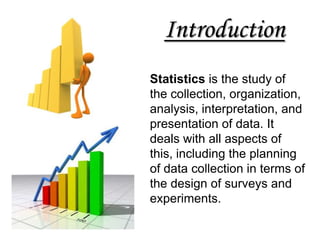
Statistics is the study of
the collection, organization,
analysis, interpretation, and
presentation of data. It
deals with all aspects of
this, including the planning
of data collection in terms of
the design of surveys and
experiments.
History
      The use of statistical
      methods dates back at least
      to the 5th century BC. The
      earliest writing on statistics
      was found in a 9th century
      book entitled: "Manuscript
      on               Deciphering
      Cryptographic     Messages",
      written by Al-Kindi. In his
      book, he gave a detailed
      description of how to use
      statistics and frequency
      analysis      to    decipher
      encrypted messages, this
      was the birth of both
      statistics and cryptanalysis,
      according to the Saudi
      engineer Ibrahim Al-Kadi.
Collection Of Data
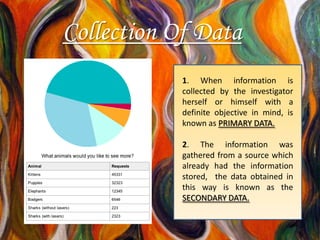
            1. When information is
            collected by the investigator
            herself or himself with a
            definite objective in mind, is
            known as PRIMARY DATA.

            2. The information was
            gathered from a source which
            already had the information
            stored, the data obtained in
            this way is known as the
            SECONDARY DATA.
Presentation of Data

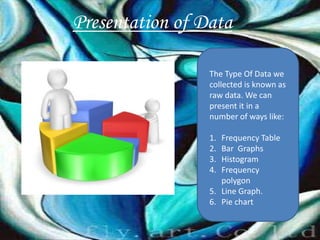
                 The Type Of Data we
                 collected is known as
                 raw data. We can
                 present it in a
                 number of ways like:

                 1. Frequency Table
                 2. Bar Graphs
                 3. Histogram
                 4. Frequency
                    polygon
                 5. Line Graph.
                 6. Pie chart
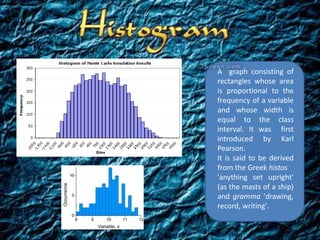
A graph consisting of
rectangles whose area
is proportional to the
frequency of a variable
and whose width is
equal to the class
interval. It was first
introduced by Karl
Pearson.
It is said to be derived
from the Greek histos
'anything set upright'
(as the masts of a ship)
and gramma 'drawing,
record, writing'.
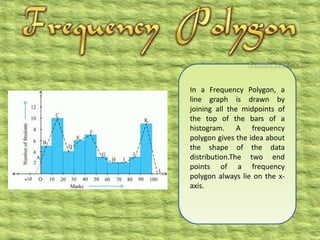
In a Frequency Polygon, a
line graph is drawn by
joining all the midpoints of
the top of the bars of a
histogram. A frequency
polygon gives the idea about
the shape of the data
distribution.The two end
points of a frequency
polygon always lie on the x-
axis.
Statistics

Statistics

  • 2.
    Introduction Statistics is thestudy of the collection, organization, analysis, interpretation, and presentation of data. It deals with all aspects of this, including the planning of data collection in terms of the design of surveys and experiments.
  • 3.
    History The use of statistical methods dates back at least to the 5th century BC. The earliest writing on statistics was found in a 9th century book entitled: "Manuscript on Deciphering Cryptographic Messages", written by Al-Kindi. In his book, he gave a detailed description of how to use statistics and frequency analysis to decipher encrypted messages, this was the birth of both statistics and cryptanalysis, according to the Saudi engineer Ibrahim Al-Kadi.
  • 4.
    Collection Of Data 1. When information is collected by the investigator herself or himself with a definite objective in mind, is known as PRIMARY DATA. 2. The information was gathered from a source which already had the information stored, the data obtained in this way is known as the SECONDARY DATA.
  • 5.
    Presentation of Data The Type Of Data we collected is known as raw data. We can present it in a number of ways like: 1. Frequency Table 2. Bar Graphs 3. Histogram 4. Frequency polygon 5. Line Graph. 6. Pie chart
  • 6.
    A graph consistingof rectangles whose area is proportional to the frequency of a variable and whose width is equal to the class interval. It was first introduced by Karl Pearson. It is said to be derived from the Greek histos 'anything set upright' (as the masts of a ship) and gramma 'drawing, record, writing'.
  • 7.
    In a FrequencyPolygon, a line graph is drawn by joining all the midpoints of the top of the bars of a histogram. A frequency polygon gives the idea about the shape of the data distribution.The two end points of a frequency polygon always lie on the x- axis.