Statistical
Quality
Control
1
What is SQC ?
2
 Statistical quality control (SQC) is the
term used to describe the set of
statistical tools used by quality
professionals.
 The application of statistical techniques to
measure and evaluate the quality of a
product, service, or process.
History
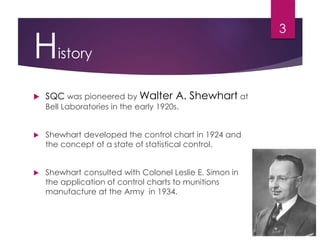
 SQC was pioneered by Walter A. Shewhart at
Bell Laboratories in the early 1920s.
 Shewhart developed the control chart in 1924 and
the concept of a state of statistical control.
 Shewhart consulted with Colonel Leslie E. Simon in
the application of control charts to munitions
manufacture at the Army in 1934.
3
History
 W. Edwards Deming invited Shewhart to speak at the
Graduate School of the U.S. Department of Agriculture, and served
as the editor of Shewhart's book Statistical Method from the
Viewpoint of Quality Control (1939) which was the result of that
lecture.
 Deming was an important architect of the quality control short courses
that trained American industry in the new techniques during WWII.
 Deming traveled to Japan during the Allied Occupation and
met with the Union of Japanese Scientists and Engineers(JUSE)in
an effort to introduce SQC methods to Japanese industry
4
Characteristics of SQC
 It is designed to control the quality standard of goods
produced for marketing.
 It is exercise by the producers during the production process
 It is carried out with the help of certain statistical tools.
 It is designed to determine the variations in quality of the
goods .
 It aims to ascertain whether the production process is in
control or not, and whether the products are of specified
quality.
 It is an economical measure of assessing the quality standard
of goods through statistical experiments without checking
every product in detail.
5
Advantages of SQC
 It provides a means of detecting error at inspection.
 It revels whether the production process is in control or not.
 It leads to more uniform quality of production.
 It improves the relationship with the customer, reduced customer
complaints
 Reduction of Scrap.
 It reduces the number of rejects and saves the cost of material.
 It reduces inspection costs.
 It leads to more uniform quality of product
6
Limitations of SQC
 It cannot be applies indiscriminately as a solution to all the quality
evils
 It leads to a false sense of security in the absence of general
quality awareness.
 It provides only an information service, and it can not reduce the
managers responsibility,
 It cannot be applied mechanically to all production process
without studying their peculiar environments.
 It involves mathematical and statistical problems in the process of
analysis.
7
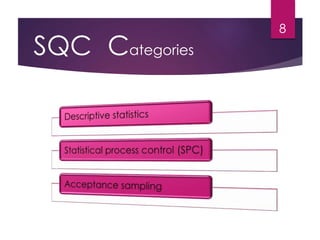
SQC Categories
8
Descriptive Statistics
 Descriptive statistics are used to
describe quality characteristics
and relationships.
9
Descriptive Statistics
 The Mean- measure of central tendency
 The Range- difference between largest/smallest
observations in a set of data
 Standard Deviation measures the amount of
data dispersion around mean
10
Statistical Process Control
 Statistical process control (SPC) involves inspecting a random
sample of the output from a process and deciding whether the
process is producing products with characteristics that fall within
a predetermined range. SPC answers the question of whether
the process is functioning properly or not
 Extend the use of descriptive statistics to monitor the quality of
the product and process
 Statistical process control help to determine the amount of
variation
 To make sure the process is in a state of control
11
Acceptance sampling
 Acceptance sampling is an important field of statistical
quality control that was popularized by Dodge and Romig
and originally applied by the U.S. military to the testing of
bullets during World War II.
 Acceptance sampling is the process of randomly inspecting
a sample of goods and deciding whether to accept the
entire lot based on the results. Acceptance sampling
determines whether a batch of goods should be accepted
or rejected
12
Variation in Quality
 No two items are exactly alike.
 Some sort of variations in the two items is bound to be there. In
fact it is an integral part of any manufacturing process.
 This difference in characteristics known as variation.
 This variation may be due to substandard quality of raw
material, carelessness on the part of operator, fault in
machinery system etc..
13
Types Of Variations
14
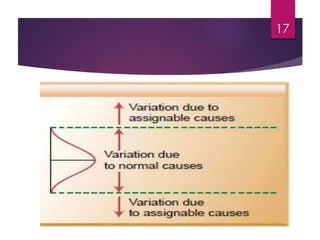
Variation due to chance
causes/common causes
 Variation occurred due to chance.
 This variation is NOT due to defect in machine, Raw
material or any other factors.
 Behave in “random manner”.
 Negligible but Inevitable
 The process is said to be under the state of statistical
control.
15
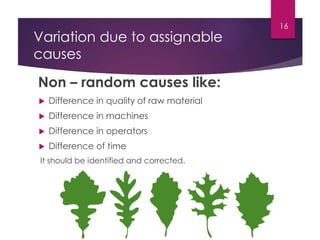
Variation due to assignable
causes
Non – random causes like:
 Difference in quality of raw material
 Difference in machines
 Difference in operators
 Difference of time
It should be identified and corrected.
16
17
Thank You…
18
By ;
Suresh T S
M.Com 314

Statistical quality control

  • 1.
  • 2.
    What is SQC? 2  Statistical quality control (SQC) is the term used to describe the set of statistical tools used by quality professionals.  The application of statistical techniques to measure and evaluate the quality of a product, service, or process.
  • 3.
    History  SQC waspioneered by Walter A. Shewhart at Bell Laboratories in the early 1920s.  Shewhart developed the control chart in 1924 and the concept of a state of statistical control.  Shewhart consulted with Colonel Leslie E. Simon in the application of control charts to munitions manufacture at the Army in 1934. 3
  • 4.
    History  W. EdwardsDeming invited Shewhart to speak at the Graduate School of the U.S. Department of Agriculture, and served as the editor of Shewhart's book Statistical Method from the Viewpoint of Quality Control (1939) which was the result of that lecture.  Deming was an important architect of the quality control short courses that trained American industry in the new techniques during WWII.  Deming traveled to Japan during the Allied Occupation and met with the Union of Japanese Scientists and Engineers(JUSE)in an effort to introduce SQC methods to Japanese industry 4
  • 5.
    Characteristics of SQC It is designed to control the quality standard of goods produced for marketing.  It is exercise by the producers during the production process  It is carried out with the help of certain statistical tools.  It is designed to determine the variations in quality of the goods .  It aims to ascertain whether the production process is in control or not, and whether the products are of specified quality.  It is an economical measure of assessing the quality standard of goods through statistical experiments without checking every product in detail. 5
  • 6.
    Advantages of SQC It provides a means of detecting error at inspection.  It revels whether the production process is in control or not.  It leads to more uniform quality of production.  It improves the relationship with the customer, reduced customer complaints  Reduction of Scrap.  It reduces the number of rejects and saves the cost of material.  It reduces inspection costs.  It leads to more uniform quality of product 6
  • 7.
    Limitations of SQC It cannot be applies indiscriminately as a solution to all the quality evils  It leads to a false sense of security in the absence of general quality awareness.  It provides only an information service, and it can not reduce the managers responsibility,  It cannot be applied mechanically to all production process without studying their peculiar environments.  It involves mathematical and statistical problems in the process of analysis. 7
  • 8.
  • 9.
    Descriptive Statistics  Descriptivestatistics are used to describe quality characteristics and relationships. 9
  • 10.
    Descriptive Statistics  TheMean- measure of central tendency  The Range- difference between largest/smallest observations in a set of data  Standard Deviation measures the amount of data dispersion around mean 10
  • 11.
    Statistical Process Control Statistical process control (SPC) involves inspecting a random sample of the output from a process and deciding whether the process is producing products with characteristics that fall within a predetermined range. SPC answers the question of whether the process is functioning properly or not  Extend the use of descriptive statistics to monitor the quality of the product and process  Statistical process control help to determine the amount of variation  To make sure the process is in a state of control 11
  • 12.
    Acceptance sampling  Acceptancesampling is an important field of statistical quality control that was popularized by Dodge and Romig and originally applied by the U.S. military to the testing of bullets during World War II.  Acceptance sampling is the process of randomly inspecting a sample of goods and deciding whether to accept the entire lot based on the results. Acceptance sampling determines whether a batch of goods should be accepted or rejected 12
  • 13.
    Variation in Quality No two items are exactly alike.  Some sort of variations in the two items is bound to be there. In fact it is an integral part of any manufacturing process.  This difference in characteristics known as variation.  This variation may be due to substandard quality of raw material, carelessness on the part of operator, fault in machinery system etc.. 13
  • 14.
  • 15.
    Variation due tochance causes/common causes  Variation occurred due to chance.  This variation is NOT due to defect in machine, Raw material or any other factors.  Behave in “random manner”.  Negligible but Inevitable  The process is said to be under the state of statistical control. 15
  • 16.
    Variation due toassignable causes Non – random causes like:  Difference in quality of raw material  Difference in machines  Difference in operators  Difference of time It should be identified and corrected. 16
  • 17.
  • 18.