Evaluation:
Statistical
Analysis
Nuno Barreiro
Lecture 10
PC3001, PC4001, PC5001, CS2847
Case study
Barack Obama
homepage 2008
2
Multivariant
test
The originalhomepage was tested against
other designs
A text the button with three variations
• Learn More
• Join Us Now
• Sign Up Now
Five differentmedia in the placeholder
Source
https://blog.optimizely.com/2010/11/29/how-obama-raised-60-million-by-running-a-simple-experiment/
Goal
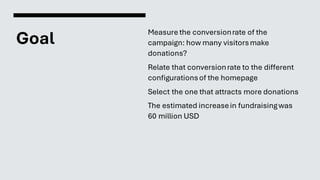
Measure the conversionrate of the
campaign: how many visitorsmake
donations?
Relate that conversionrate to the different
configurationsof the homepage
Select the one that attracts more donations
The estimated increasein fundraisingwas
60 million USD
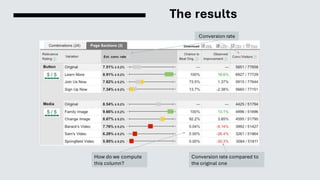
The results
Conversion rate compared to
the original one
Conversion rate
How do we compute
this column?
Should the
"learn more"
button be
used?
All measurements are subject to noise: each
run of the experiment will yield different
results
We need a method to ensurethat those
measurements are meaningful
The method will indicate if the design of the
homepage should be changed
Testing the data
7
Statistical
tests
Test a statistical hypothesis
Done by comparison of the observeddata
with a data set that follows the model that is
to be tested
The comparisonis deemed statistically
significantif the relationship between the
data sets would be an unlikely realisationof
the null hypothesis
The result of the test is expressed as a
probability,the p-value
The null
hypothesis
H0
In a sense, the null hypothesisis the "default"
state of the world
In the case of our multivariate test, the null
hypothesissays that the modifications to the
original design don't have any impact on the
donation rate
The goal of the statistical test is to gather
evidence to reject the null hypothesis
The p–value
The p-value is, in future experiments, the
probability of obtaining results as "extreme"
or more "extreme" given that the null
hypothesisis true
If p = 0.05, the test suggeststhat the observeddata is inconsistentwith
the null hypothesiswith a confidence level of 95% = 1-p, which means that
the null hypothesisis rejected as very unlikely with a confidence level of 95%
Understanding
the p–value
The p-value is NOT the probabilityof the null
hypothesis
The rejection of the null hypothesisdoes not
tell us which of the alternatives might be the
correctone
Further tests are required to get such an
answer, although we can select the best
choice based on the results if its tendency for
improvementis clearly the best
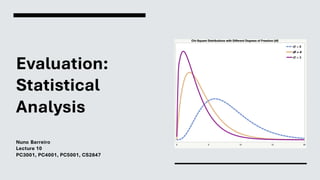
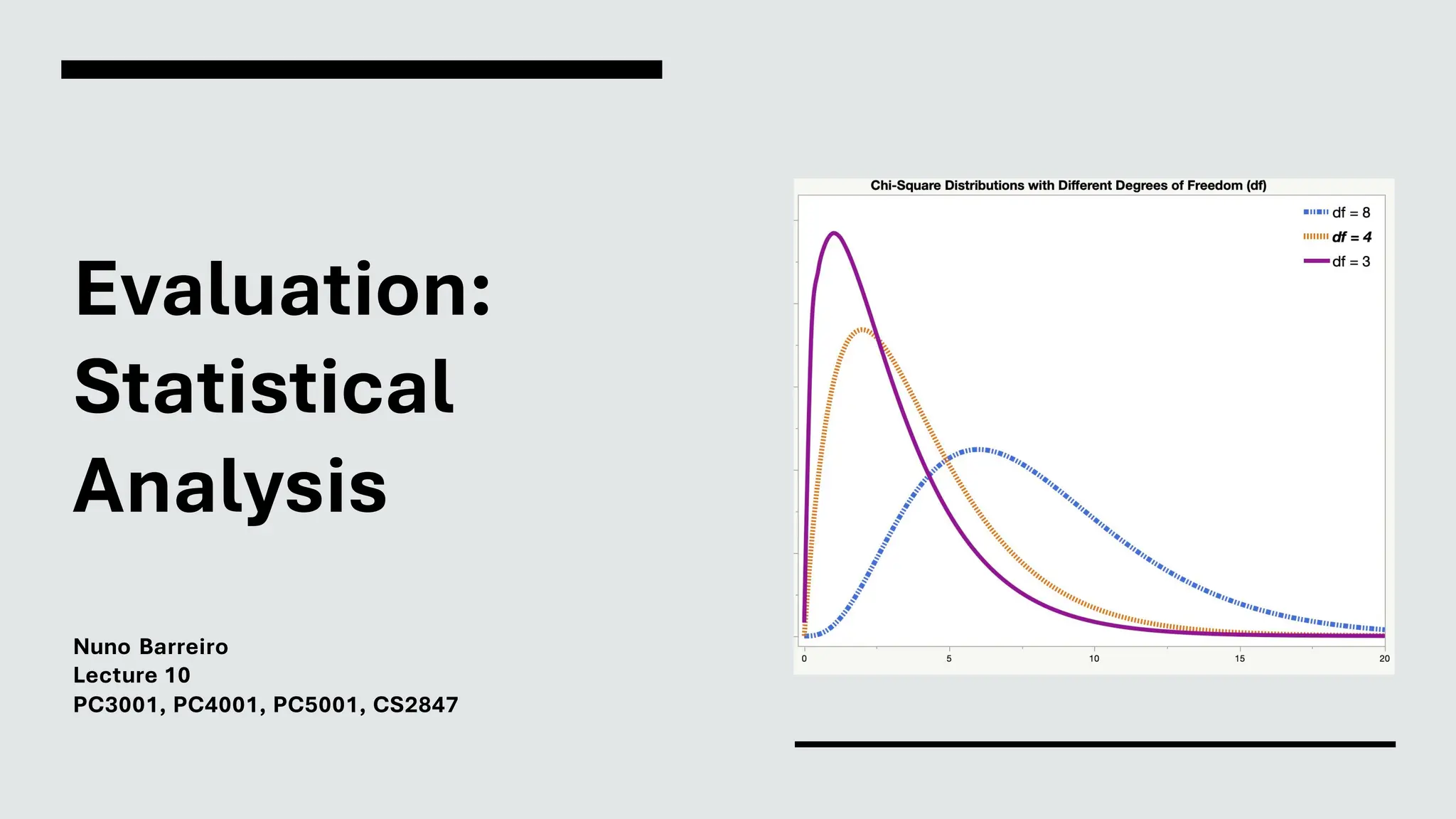
2 test
12
The 2 test
Compares expected values with observed
values and measures the level of variation
The number of values per variable is at least
two
Used for discretedata that follows a normal
distribution (tests of normality can be
applied to the data, but this is usually not
necessary)
We are in the conditions of applicability of the test,
provided that the data follows a normal distribution
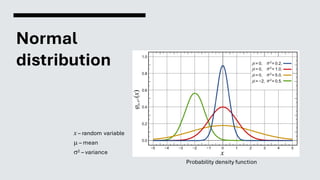
Normal
distribution
 – mean
2 – variance
x – random variable
Probability density function
Binomial
distribution
Discrete probabilitydistribution of the
number of successesin a sequence of n
independentexperiments
Each experiment is asking a yes–no question,
each with its own Boolean-valued outcome
This distribution correspondsto A/B testing
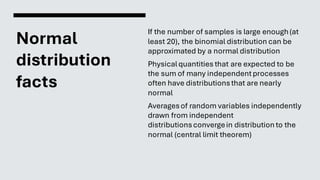
Normal
distribution
facts
If the number of samples is large enough(at
least 20), the binomial distribution can be
approximated by a normal distribution
Physicalquantities that are expected to be
the sum of many independentprocesses
often have distributionsthat are nearly
normal
Averagesof random variables independently
drawn from independent
distributionsconvergein distribution to the
normal (central limit theorem)
Running the 2 test
17
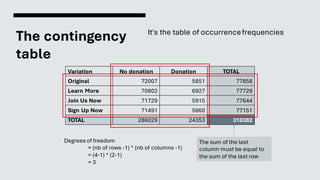
The contingency
table
It's the table of occurrencefrequencies
Variation No donation Donation TOTAL
Original 72007 5851 77858
Learn More 70802 6927 77729
Join Us Now 71729 5915 77644
Sign Up Now 71491 5660 77151
TOTAL 286029 24353 310382
The sum of the last
column must be equal to
the sum of the last row
Degrees of freedom
= (nb of rows -1) * (nb of columns -1)
= (4-1) * (2-1)
= 3
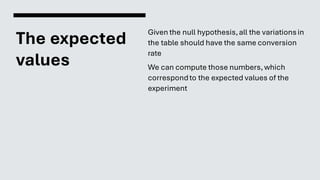
The expected
values
Given the null hypothesis,all the variationsin
the table should have the same conversion
rate
We can compute those numbers, which
correspondto the expected values of the
experiment
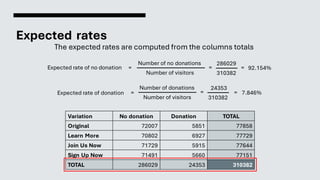
Expected rates
The expected rates are computed from the columns totals
Variation No donation Donation TOTAL
Original 72007 5851 77858
Learn More 70802 6927 77729
Join Us Now 71729 5915 77644
Sign Up Now 71491 5660 77151
TOTAL 286029 24353 310382
Number of no donations
Number of visitors
Expected rate of no donation
286029
310382
=
= 92.154%
=
Number of donations
Number of visitors
Expected rate of donation
24353
310382
=
= 7.846%
=
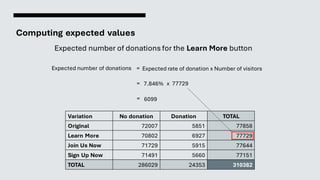
Computing expected values
Expected number of donations for the Learn More button
Variation No donation Donation TOTAL
Original 72007 5851 77858
Learn More 70802 6927 77729
Join Us Now 71729 5915 77644
Sign Up Now 71491 5660 77151
TOTAL 286029 24353 310382
Expected rate of donation x Number of visitors
Expected number of donations
x 77729
=
= 7.846%
= 6099
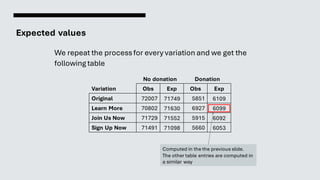
Expected values
We repeat the processfor every variation and we get the
following table
No donation Donation
Variation Obs Exp Obs Exp
Original 72007 71749 5851 6109
Learn More 70802 71630 6927 6099
Join Us Now 71729 71552 5915 6092
Sign Up Now 71491 71098 5660 6053
Computed in the the previous slide.
The other table entries are computed in
a similar way
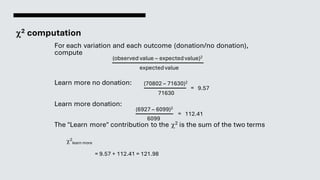
2 computation
For each variation and each outcome (donation/no donation),
compute
Learn more no donation:
Learn more donation:
The "Learn more" contribution to the 2 is the sum of the two terms
2
learn more
(observed value – expectedvalue)2
expectedvalue
(70802 – 71630)2
71630
(6927 – 6099)2
6099
= 9.57 + 112.41 = 121.98
9.57
=
112.41
=
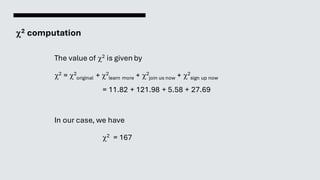
2 computation
The value of 2 is given by
2 = 2
original + 2
learn more + 2
join us now + 2
sign up now
= 11.82 + 121.98 + 5.58 + 27.69
In our case, we have
2 = 167
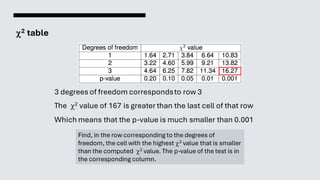
2 table
3 degrees of freedom correspondsto row 3
The 2 value of 167 is greater than the last cell of that row
Which means that the p-value is much smaller than 0.001
Find, in the row corresponding to the degrees of
freedom, the cell with the highest 2 value that is smaller
than the computed 2 value. The p-value of the test is in
the corresponding column.
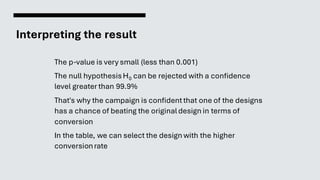
Interpreting the result
The p-value is very small (less than 0.001)
The null hypothesisH0 can be rejected with a confidence
level greater than 99.9%
That's why the campaign is confidentthat one of the designs
has a chance of beating the originaldesign in terms of
conversion
In the table, we can select the design with the higher
conversionrate
The final
homepage
Statistics in
Python
SciPy (pronounced “Sigh Pie”) is a Python-
based ecosystemof open-sourcesoftware
for mathematics, science, and engineering.
It includes the package stats that offers
all the statistical tools that we need.
Import that package with the command:
import scipy.stats as stats
2 test in Python
import scipy.stats as stats
a = [5851, 72007]
b = [6927, 70802]
c = [5915, 71729]
d = [5660, 71491]
obs = [a, b, c, d]
chi2, pValue, dof, expected =
stats.chi2_contingency(obs)
print 'p-value =', pValue
http://docs.scipy.org/doc/scipy/reference/generated/scipy.stats.chi2_contingency.html
Done directly with the contingency table
No donat. Donation
5851 72007
6927 70802
5915 71729
5660 71491
Continuous variables
t test
30
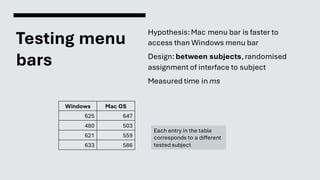
Testing menu
bars
Hypothesis:Mac menu bar is faster to
access than Windows menu bar
Design: between subjects, randomised
assignment of interface to subject
Measured time in ms
Windows Mac OS
625 647
480 503
621 559
633 586
Each entry in the table
corresponds to a different
testedsubject
Hypothesis
testing
The hypothesiswe want to test:
position of menu bar matters
• i.e., mean(Mac times) < mean(Windows times)
The null hypothesisis:
position of menu bar makes no difference
• i.e., mean(Mac times) = mean(Windows times)
t test
This is a test for the null hypothesisthat 2
independentsamples have identical average
(expected) values. This test assumes that the
populations have identical variances by
default.
Compares the means of two samples
A and B
Assumptions
• Samples A and B are independent (between-
subjects, randomised)
• Normal distribution for the underlying probability
distribution of the samples
• Equal variance for both samples
Two versions
of the t test
Two-sided test
• H0: mean(A) = mean(B)
• H1: mean(A) != mean(B)
One-sided test
• H0: mean(A) = mean(B)
• H1: mean(A) < mean(B)
The two-sided test is more conservative,
however, if you are completely certain about
which way the differenceshould go, you can use
the one-sided test
Two-sided t test in
Python
import scipy.stats as stats
a = [625, 480, 621, 633]
b = [647, 503, 559, 586]
tStatistic, pValue = stats.ttest_ind(a,b)
print 'p-value =', pValue
http://docs.scipy.org/doc/scipy/reference/generated/scipy.stats.ttest_ind.html
Windows Mac OS
625 647
480 503
621 559
633 586
Results and
interpretation
The output from the program is
p-value = 0.7468
Can we reject the null hypothesis?
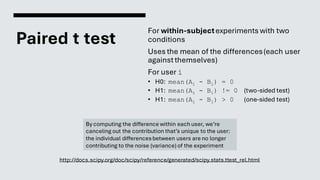
Paired t test
For within-subjectexperiments with two
conditions
Uses the mean of the differences(each user
againstthemselves)
For user i
• H0: mean(Ai - Bi) = 0
• H1: mean(Ai - Bi) != 0 (two-sided test)
• H1: mean(Ai - Bi) > 0 (one-sided test)
By computing the difference within each user, we’re
canceling out the contribution that’s unique to the user:
the individual differencesbetween users are no longer
contributing to the noise (variance) of the experiment
http://docs.scipy.org/doc/scipy/reference/generated/scipy.stats.ttest_rel.html
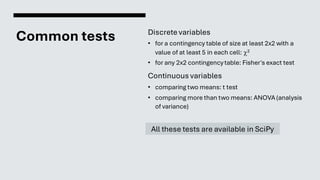
How to select a test
38
Common tests Discrete variables
• for a contingency table of size at least 2x2 with a
value of at least 5 in each cell: 2
• for any 2x2 contingencytable: Fisher's exact test
Continuous variables
• comparing two means: t test
• comparing more than two means: ANOVA (analysis
of variance)
All these tests are available in SciPy

Statistical Analysis

  • 1.
  • 2.
  • 3.
    Multivariant test The originalhomepage wastested against other designs A text the button with three variations • Learn More • Join Us Now • Sign Up Now Five differentmedia in the placeholder Source https://blog.optimizely.com/2010/11/29/how-obama-raised-60-million-by-running-a-simple-experiment/
  • 4.
    Goal Measure the conversionrateof the campaign: how many visitorsmake donations? Relate that conversionrate to the different configurationsof the homepage Select the one that attracts more donations The estimated increasein fundraisingwas 60 million USD
  • 5.
    The results Conversion ratecompared to the original one Conversion rate How do we compute this column?
  • 6.
    Should the "learn more" buttonbe used? All measurements are subject to noise: each run of the experiment will yield different results We need a method to ensurethat those measurements are meaningful The method will indicate if the design of the homepage should be changed
  • 7.
  • 8.
    Statistical tests Test a statisticalhypothesis Done by comparison of the observeddata with a data set that follows the model that is to be tested The comparisonis deemed statistically significantif the relationship between the data sets would be an unlikely realisationof the null hypothesis The result of the test is expressed as a probability,the p-value
  • 9.
    The null hypothesis H0 In asense, the null hypothesisis the "default" state of the world In the case of our multivariate test, the null hypothesissays that the modifications to the original design don't have any impact on the donation rate The goal of the statistical test is to gather evidence to reject the null hypothesis
  • 10.
    The p–value The p-valueis, in future experiments, the probability of obtaining results as "extreme" or more "extreme" given that the null hypothesisis true If p = 0.05, the test suggeststhat the observeddata is inconsistentwith the null hypothesiswith a confidence level of 95% = 1-p, which means that the null hypothesisis rejected as very unlikely with a confidence level of 95%
  • 11.
    Understanding the p–value The p-valueis NOT the probabilityof the null hypothesis The rejection of the null hypothesisdoes not tell us which of the alternatives might be the correctone Further tests are required to get such an answer, although we can select the best choice based on the results if its tendency for improvementis clearly the best
  • 12.
  • 13.
    The 2 test Comparesexpected values with observed values and measures the level of variation The number of values per variable is at least two Used for discretedata that follows a normal distribution (tests of normality can be applied to the data, but this is usually not necessary) We are in the conditions of applicability of the test, provided that the data follows a normal distribution
  • 14.
    Normal distribution  – mean 2– variance x – random variable Probability density function
  • 15.
    Binomial distribution Discrete probabilitydistribution ofthe number of successesin a sequence of n independentexperiments Each experiment is asking a yes–no question, each with its own Boolean-valued outcome This distribution correspondsto A/B testing
  • 16.
    Normal distribution facts If the numberof samples is large enough(at least 20), the binomial distribution can be approximated by a normal distribution Physicalquantities that are expected to be the sum of many independentprocesses often have distributionsthat are nearly normal Averagesof random variables independently drawn from independent distributionsconvergein distribution to the normal (central limit theorem)
  • 17.
  • 18.
    The contingency table It's thetable of occurrencefrequencies Variation No donation Donation TOTAL Original 72007 5851 77858 Learn More 70802 6927 77729 Join Us Now 71729 5915 77644 Sign Up Now 71491 5660 77151 TOTAL 286029 24353 310382 The sum of the last column must be equal to the sum of the last row Degrees of freedom = (nb of rows -1) * (nb of columns -1) = (4-1) * (2-1) = 3
  • 19.
    The expected values Given thenull hypothesis,all the variationsin the table should have the same conversion rate We can compute those numbers, which correspondto the expected values of the experiment
  • 20.
    Expected rates The expectedrates are computed from the columns totals Variation No donation Donation TOTAL Original 72007 5851 77858 Learn More 70802 6927 77729 Join Us Now 71729 5915 77644 Sign Up Now 71491 5660 77151 TOTAL 286029 24353 310382 Number of no donations Number of visitors Expected rate of no donation 286029 310382 = = 92.154% = Number of donations Number of visitors Expected rate of donation 24353 310382 = = 7.846% =
  • 21.
    Computing expected values Expectednumber of donations for the Learn More button Variation No donation Donation TOTAL Original 72007 5851 77858 Learn More 70802 6927 77729 Join Us Now 71729 5915 77644 Sign Up Now 71491 5660 77151 TOTAL 286029 24353 310382 Expected rate of donation x Number of visitors Expected number of donations x 77729 = = 7.846% = 6099
  • 22.
    Expected values We repeatthe processfor every variation and we get the following table No donation Donation Variation Obs Exp Obs Exp Original 72007 71749 5851 6109 Learn More 70802 71630 6927 6099 Join Us Now 71729 71552 5915 6092 Sign Up Now 71491 71098 5660 6053 Computed in the the previous slide. The other table entries are computed in a similar way
  • 23.
    2 computation For eachvariation and each outcome (donation/no donation), compute Learn more no donation: Learn more donation: The "Learn more" contribution to the 2 is the sum of the two terms 2 learn more (observed value – expectedvalue)2 expectedvalue (70802 – 71630)2 71630 (6927 – 6099)2 6099 = 9.57 + 112.41 = 121.98 9.57 = 112.41 =
  • 24.
    2 computation The valueof 2 is given by 2 = 2 original + 2 learn more + 2 join us now + 2 sign up now = 11.82 + 121.98 + 5.58 + 27.69 In our case, we have 2 = 167
  • 25.
    2 table 3 degreesof freedom correspondsto row 3 The 2 value of 167 is greater than the last cell of that row Which means that the p-value is much smaller than 0.001 Find, in the row corresponding to the degrees of freedom, the cell with the highest 2 value that is smaller than the computed 2 value. The p-value of the test is in the corresponding column.
  • 26.
    Interpreting the result Thep-value is very small (less than 0.001) The null hypothesisH0 can be rejected with a confidence level greater than 99.9% That's why the campaign is confidentthat one of the designs has a chance of beating the originaldesign in terms of conversion In the table, we can select the design with the higher conversionrate
  • 27.
  • 28.
    Statistics in Python SciPy (pronounced“Sigh Pie”) is a Python- based ecosystemof open-sourcesoftware for mathematics, science, and engineering. It includes the package stats that offers all the statistical tools that we need. Import that package with the command: import scipy.stats as stats
  • 29.
    2 test inPython import scipy.stats as stats a = [5851, 72007] b = [6927, 70802] c = [5915, 71729] d = [5660, 71491] obs = [a, b, c, d] chi2, pValue, dof, expected = stats.chi2_contingency(obs) print 'p-value =', pValue http://docs.scipy.org/doc/scipy/reference/generated/scipy.stats.chi2_contingency.html Done directly with the contingency table No donat. Donation 5851 72007 6927 70802 5915 71729 5660 71491
  • 30.
  • 31.
    Testing menu bars Hypothesis:Mac menubar is faster to access than Windows menu bar Design: between subjects, randomised assignment of interface to subject Measured time in ms Windows Mac OS 625 647 480 503 621 559 633 586 Each entry in the table corresponds to a different testedsubject
  • 32.
    Hypothesis testing The hypothesiswe wantto test: position of menu bar matters • i.e., mean(Mac times) < mean(Windows times) The null hypothesisis: position of menu bar makes no difference • i.e., mean(Mac times) = mean(Windows times)
  • 33.
    t test This isa test for the null hypothesisthat 2 independentsamples have identical average (expected) values. This test assumes that the populations have identical variances by default. Compares the means of two samples A and B Assumptions • Samples A and B are independent (between- subjects, randomised) • Normal distribution for the underlying probability distribution of the samples • Equal variance for both samples
  • 34.
    Two versions of thet test Two-sided test • H0: mean(A) = mean(B) • H1: mean(A) != mean(B) One-sided test • H0: mean(A) = mean(B) • H1: mean(A) < mean(B) The two-sided test is more conservative, however, if you are completely certain about which way the differenceshould go, you can use the one-sided test
  • 35.
    Two-sided t testin Python import scipy.stats as stats a = [625, 480, 621, 633] b = [647, 503, 559, 586] tStatistic, pValue = stats.ttest_ind(a,b) print 'p-value =', pValue http://docs.scipy.org/doc/scipy/reference/generated/scipy.stats.ttest_ind.html Windows Mac OS 625 647 480 503 621 559 633 586
  • 36.
    Results and interpretation The outputfrom the program is p-value = 0.7468 Can we reject the null hypothesis?
  • 37.
    Paired t test Forwithin-subjectexperiments with two conditions Uses the mean of the differences(each user againstthemselves) For user i • H0: mean(Ai - Bi) = 0 • H1: mean(Ai - Bi) != 0 (two-sided test) • H1: mean(Ai - Bi) > 0 (one-sided test) By computing the difference within each user, we’re canceling out the contribution that’s unique to the user: the individual differencesbetween users are no longer contributing to the noise (variance) of the experiment http://docs.scipy.org/doc/scipy/reference/generated/scipy.stats.ttest_rel.html
  • 38.
    How to selecta test 38
  • 39.
    Common tests Discretevariables • for a contingency table of size at least 2x2 with a value of at least 5 in each cell: 2 • for any 2x2 contingencytable: Fisher's exact test Continuous variables • comparing two means: t test • comparing more than two means: ANOVA (analysis of variance) All these tests are available in SciPy