TEACHER’S
PRESENTATION
BASIC STATISTICS
BASIC STATISTICS
Definition: Science of collection, presentation,
analysis, and reasonable interpretation of data.
Statistics presents a rigorous scientific method for
gaining insight into data.
statistics can give an instant overall picture of data
based on graphical presentation or numerical
summarization irrespective to the number of data
points. Besides data summarization, another
important task of statistics is to make inference and
predict relations of variables.
TYPES OF STATISTICS/ANALYSES
D E S C R I P T I V E
S T AT I S T I C S
Frequencies
Basic measurements
Inferential Statistics
Hypothesis Testing
Correlation
Confidence Intervals
Significance Testing
Prediction
D E S C R I B I N G A
P H E N O M E N A
How many? How much?
BP, HR, BMI, IQ, etc.
Inferences about a phenomena
Proving or disproving theories
Associations between
phenomena
If sample relates to the larger
population
E.g., Diet and health
DESCRIPTIVE STATISTICS
Descriptive statistics can be used to summarize and
describe a single variable
Frequencies (counts) & Percentages
Use with categorical (nominal) data
Levels, types, groupings, yes/no, Drug A vs. Drug B
Means & Standard Deviations
Use with continuous (interval/ratio) data
Height, weight, cholesterol, scores on a test
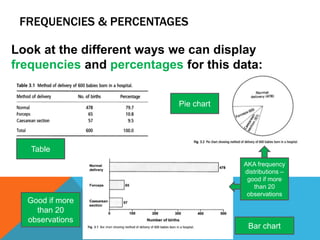
FREQUENCIES & PERCENTAGES
Look at the different ways we can display
frequencies and percentages for this data:
Table
Bar chart
Pie chart
Good if more
than 20
observations
AKA frequency
distributions –
good if more
than 20
observations
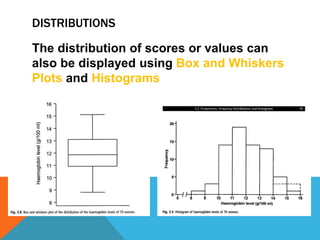
DISTRIBUTIONS
The distribution of scores or values can
also be displayed using Box and Whiskers
Plots and Histograms
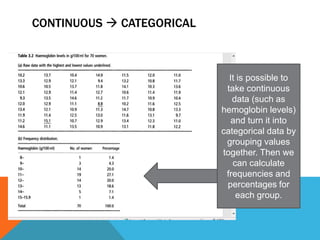
CONTINUOUS  CATEGORICAL
It is possible to
take continuous
data (such as
hemoglobin levels)
and turn it into
categorical data by
grouping values
together. Then we
can calculate
frequencies and
percentages for
each group.
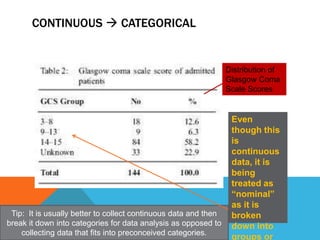
CONTINUOUS  CATEGORICAL
Distribution of
Glasgow Coma
Scale Scores
Even
though this
is
continuous
data, it is
being
treated as
“nominal”
as it is
broken
down into
groups or
Tip: It is usually better to collect continuous data and then
break it down into categories for data analysis as opposed to
collecting data that fits into preconceived categories.
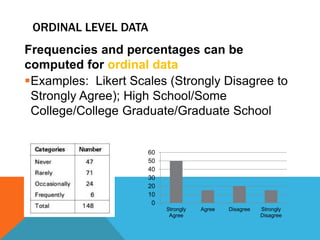
ORDINAL LEVEL DATA
Frequencies and percentages can be
computed for ordinal data
Examples: Likert Scales (Strongly Disagree to
Strongly Agree); High School/Some
College/College Graduate/Graduate School
0
10
20
30
40
50
60
Strongly
Agree
Agree Disagree Strongly
Disagree
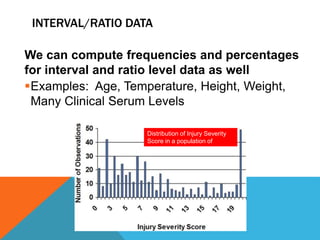
INTERVAL/RATIO DATA
We can compute frequencies and percentages
for interval and ratio level data as well
Examples: Age, Temperature, Height, Weight,
Many Clinical Serum Levels
Distribution of Injury Severity
Score in a population of
patients
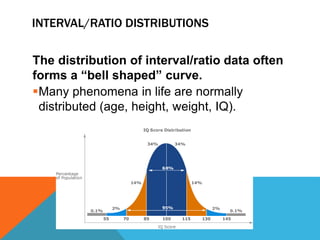
INTERVAL/RATIO DISTRIBUTIONS
The distribution of interval/ratio data often
forms a “bell shaped” curve.
Many phenomena in life are normally
distributed (age, height, weight, IQ).
INTERVAL & RATIO DATA
Measures of central tendency and measures of dispersion are
often computed with interval/ratio data
Measures of Central Tendency (aka, the “Middle Point”)
 Mean, Median, Mode
 If your frequency distribution shows outliers, you might want to use
the median instead of the mean
• Measures of Dispersion (aka, How “spread out” the data are)
― Variance, standard deviation, standard error of the mean
― Describe how “spread out” a distribution of scores is
― High numbers for variance and standard deviation may mean
that scores are “all over the place” and do not necessarily fall
close to the mean
In research, means are usually presented along with standard
deviations or standard errors.
INFERENTIAL STATISTICS
Inferential statistics can be used to prove or disprove
theories, determine associations between variables,
and determine if findings are significant and whether or
not we can generalize from our sample to the entire
population
The types of inferential statistics we will go over:
Correlation
T-tests/ANOVA
Chi-square
Logistic Regression
TYPE OF DATA & ANALYSIS
Analysis of Categorical/Nominal Data
Correlation T-tests
T-tests
Analysis of Continuous Data
Chi-square
Logistic Regression
CORRELATION
When to use it?
 When you want to know about the association or relationship between
two continuous variables
 Ex) food intake and weight; drug dosage and blood pressure; air temperature and
metabolic rate, etc.
What does it tell you?
 If a linear relationship exists between two variables, and how strong that
relationship is
What do the results look like?
 The correlation coefficient = Pearson’s r
 Ranges from -1 to +1
 See next slide for examples of correlation results
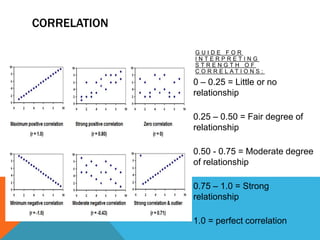
CORRELATION
G U I D E F O R
I N T E R P R E T I N G
S T R E N G T H O F
C O R R E L A T I O N S :
 0 – 0.25 = Little or no
relationship
 0.25 – 0.50 = Fair degree of
relationship
 0.50 - 0.75 = Moderate degree
of relationship
 0.75 – 1.0 = Strong
relationship
 1.0 = perfect correlation
CORRELATION
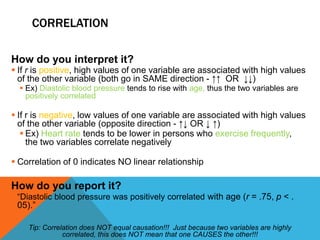
How do you interpret it?
 If r is positive, high values of one variable are associated with high values
of the other variable (both go in SAME direction - ↑↑ OR ↓↓)
 Ex) Diastolic blood pressure tends to rise with age, thus the two variables are
positively correlated
 If r is negative, low values of one variable are associated with high values
of the other variable (opposite direction - ↑↓ OR ↓ ↑)
 Ex) Heart rate tends to be lower in persons who exercise frequently,
the two variables correlate negatively
 Correlation of 0 indicates NO linear relationship
How do you report it?
 “Diastolic blood pressure was positively correlated with age (r = .75, p < .
05).”
Tip: Correlation does NOT equal causation!!! Just because two variables are highly
correlated, this does NOT mean that one CAUSES the other!!!
T-TESTS
When to use them?
 Paired t-tests: When comparing the MEANS of a continuous variable in
two non-independent samples (i.e., measurements on the same people
before and after a treatment)
 Ex) Is diet X effective in lowering serum cholesterol levels in a sample of 12
people?
 Ex) Do patients who receive drug X have lower blood pressure after
treatment then they did before treatment?
 Independent samples t-tests: To compare the MEANS of a
continuous variable in TWO independent samples (i.e., two different
groups of people)
 Ex) Do people with diabetes have the same Systolic Blood Pressure as
people without diabetes?
 Ex) Do patients who receive a new drug treatment have lower blood
pressure than those who receive a placebo?
Tip: if you have > 2 different groups, you use ANOVA, which compares the means of 3 or more groups
T-TESTS
What does a t-test tell you?
If there is a statistically significant difference between the
mean score (or value) of two groups (either the same
group of people before and after or two different groups of
people)
What do the results look like?
Student’s t
How do you interpret it?
By looking at corresponding p-value
If p < .05, means are significantly different from each
other
If p > 0.05, means are not significantly different from
each other
HOW DO YOU REPORT T-TESTS RESULTS?
“As can be seen in Figure 1, specialty candidates had
significantly higher scores on questions dealing with treatment
than residency candidates (t = [insert t-value from stats output],
p < .001).
“As can be seen in Figure 1, children’s mean
reading performance was significantly higher on the
post-tests in all four grades, ( t = [insert from stats
output], p < .05)”
CHI-SQUARE
When to use it?
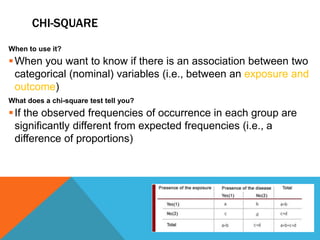
When you want to know if there is an association between two
categorical (nominal) variables (i.e., between an exposure and
outcome)
What does a chi-square test tell you?
If the observed frequencies of occurrence in each group are
significantly different from expected frequencies (i.e., a
difference of proportions)
CHI-SQUARE
What do the results look like?
Chi-square test statistics = X2
How do you interpret it?
Usually, the higher the chi-square statistic, the greater
likelihood the finding is significant, but you must look at
the corresponding p-value to determine significance
Tip: Chi square requires that there be 5 or more in each
cell of a 2x2 table and 5 or more in 80% of cells in
larger tables. No cells can have a zero count.
HOW DO YOU REPORT CHI-SQUARE?
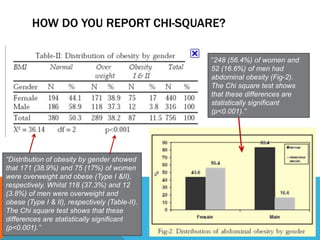
“Distribution of obesity by gender showed
that 171 (38.9%) and 75 (17%) of women
were overweight and obese (Type I &II),
respectively. Whilst 118 (37.3%) and 12
(3.8%) of men were overweight and
obese (Type I & II), respectively (Table-II).
The Chi square test shows that these
differences are statistically significant
(p<0.001).”
“248 (56.4%) of women and
52 (16.6%) of men had
abdominal obesity (Fig-2).
The Chi square test shows
that these differences are
statistically significant
(p<0.001).”
LOGISTIC REGRESSION
When to use it?
 When you want to measure the strength and direction of the
association between two variables, where the dependent or
outcome variable is categorical (e.g., yes/no)
 When you want to predict the likelihood of an outcome while
controlling for confounders
Ex) examine the relationship between health behavior
(smoking, exercise, low-fat diet) and arthritis (arthritis vs. no
arthritis)
Ex) Predict the probability of stroke in relation to gender while
controlling for age or hypertension
What does it tell you?
 The odds of an event occurring The probability of the
outcome event occurring divided by the probability of it not
occurring
LOGISTIC REGRESSION
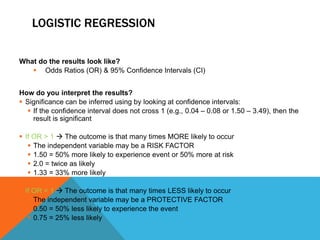
What do the results look like?
 Odds Ratios (OR) & 95% Confidence Intervals (CI)
How do you interpret the results?
 Significance can be inferred using by looking at confidence intervals:
 If the confidence interval does not cross 1 (e.g., 0.04 – 0.08 or 1.50 – 3.49), then the
result is significant
 If OR > 1  The outcome is that many times MORE likely to occur
 The independent variable may be a RISK FACTOR
 1.50 = 50% more likely to experience event or 50% more at risk
 2.0 = twice as likely
 1.33 = 33% more likely
 If OR < 1  The outcome is that many times LESS likely to occur
 The independent variable may be a PROTECTIVE FACTOR
 0.50 = 50% less likely to experience the event
 0.75 = 25% less likely
HOW DO YOU REPORT LOGISTIC REGRESSION?
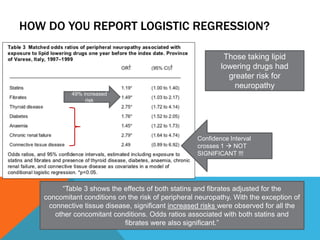
“Table 3 shows the effects of both statins and fibrates adjusted for the
concomitant conditions on the risk of peripheral neuropathy. With the exception of
connective tissue disease, significant increased risks were observed for all the
other concomitant conditions. Odds ratios associated with both statins and
fibrates were also significant.”
Confidence Interval
crosses 1  NOT
SIGNIFICANT !!!
49% increased
risk
Those taking lipid
lowering drugs had
greater risk for
neuropathy
control
variables
SUMMARY OF STATISTICAL TESTS
Statistic Test Type of Data
Needed
Test Statistic Example
Correlation Two continuous
variables
Pearson’s r Are blood pressure and
weight correlated?
T-
tests/ANOVA
Means from a
continuous variable
taken from two or
more groups
Student’s t Do normal weight (group
1) patients have lower
blood pressure than
obese patients (group 2)?
Chi-square Two categorical
variables
Chi-square X2 Are obese individuals
(obese vs. not obese)
significantly more likely to
have a stroke (stroke vs.
no stroke)?
Logistic
Regression
A dichotomous
variable as the
outcome
Odds Ratios
(OR) & 95%
Confidence
Intervals (CI)
Does obesity predict
stroke (stroke vs. no
stroke) when controlling
for other variables?
SUMMARY
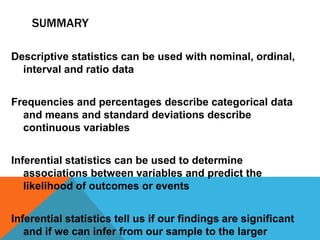
Descriptive statistics can be used with nominal, ordinal,
interval and ratio data
Frequencies and percentages describe categorical data
and means and standard deviations describe
continuous variables
Inferential statistics can be used to determine
associations between variables and predict the
likelihood of outcomes or events
Inferential statistics tell us if our findings are significant
and if we can infer from our sample to the larger

statistic

  • 1.
  • 2.
  • 3.
    BASIC STATISTICS Definition: Scienceof collection, presentation, analysis, and reasonable interpretation of data. Statistics presents a rigorous scientific method for gaining insight into data. statistics can give an instant overall picture of data based on graphical presentation or numerical summarization irrespective to the number of data points. Besides data summarization, another important task of statistics is to make inference and predict relations of variables.
  • 4.
    TYPES OF STATISTICS/ANALYSES DE S C R I P T I V E S T AT I S T I C S Frequencies Basic measurements Inferential Statistics Hypothesis Testing Correlation Confidence Intervals Significance Testing Prediction D E S C R I B I N G A P H E N O M E N A How many? How much? BP, HR, BMI, IQ, etc. Inferences about a phenomena Proving or disproving theories Associations between phenomena If sample relates to the larger population E.g., Diet and health
  • 5.
    DESCRIPTIVE STATISTICS Descriptive statisticscan be used to summarize and describe a single variable Frequencies (counts) & Percentages Use with categorical (nominal) data Levels, types, groupings, yes/no, Drug A vs. Drug B Means & Standard Deviations Use with continuous (interval/ratio) data Height, weight, cholesterol, scores on a test
  • 6.
    FREQUENCIES & PERCENTAGES Lookat the different ways we can display frequencies and percentages for this data: Table Bar chart Pie chart Good if more than 20 observations AKA frequency distributions – good if more than 20 observations
  • 7.
    DISTRIBUTIONS The distribution ofscores or values can also be displayed using Box and Whiskers Plots and Histograms
  • 8.
    CONTINUOUS  CATEGORICAL Itis possible to take continuous data (such as hemoglobin levels) and turn it into categorical data by grouping values together. Then we can calculate frequencies and percentages for each group.
  • 9.
    CONTINUOUS  CATEGORICAL Distributionof Glasgow Coma Scale Scores Even though this is continuous data, it is being treated as “nominal” as it is broken down into groups or Tip: It is usually better to collect continuous data and then break it down into categories for data analysis as opposed to collecting data that fits into preconceived categories.
  • 10.
    ORDINAL LEVEL DATA Frequenciesand percentages can be computed for ordinal data Examples: Likert Scales (Strongly Disagree to Strongly Agree); High School/Some College/College Graduate/Graduate School 0 10 20 30 40 50 60 Strongly Agree Agree Disagree Strongly Disagree
  • 11.
    INTERVAL/RATIO DATA We cancompute frequencies and percentages for interval and ratio level data as well Examples: Age, Temperature, Height, Weight, Many Clinical Serum Levels Distribution of Injury Severity Score in a population of patients
  • 12.
    INTERVAL/RATIO DISTRIBUTIONS The distributionof interval/ratio data often forms a “bell shaped” curve. Many phenomena in life are normally distributed (age, height, weight, IQ).
  • 13.
    INTERVAL & RATIODATA Measures of central tendency and measures of dispersion are often computed with interval/ratio data Measures of Central Tendency (aka, the “Middle Point”)  Mean, Median, Mode  If your frequency distribution shows outliers, you might want to use the median instead of the mean • Measures of Dispersion (aka, How “spread out” the data are) ― Variance, standard deviation, standard error of the mean ― Describe how “spread out” a distribution of scores is ― High numbers for variance and standard deviation may mean that scores are “all over the place” and do not necessarily fall close to the mean In research, means are usually presented along with standard deviations or standard errors.
  • 14.
    INFERENTIAL STATISTICS Inferential statisticscan be used to prove or disprove theories, determine associations between variables, and determine if findings are significant and whether or not we can generalize from our sample to the entire population The types of inferential statistics we will go over: Correlation T-tests/ANOVA Chi-square Logistic Regression
  • 15.
    TYPE OF DATA& ANALYSIS Analysis of Categorical/Nominal Data Correlation T-tests T-tests Analysis of Continuous Data Chi-square Logistic Regression
  • 16.
    CORRELATION When to useit?  When you want to know about the association or relationship between two continuous variables  Ex) food intake and weight; drug dosage and blood pressure; air temperature and metabolic rate, etc. What does it tell you?  If a linear relationship exists between two variables, and how strong that relationship is What do the results look like?  The correlation coefficient = Pearson’s r  Ranges from -1 to +1  See next slide for examples of correlation results
  • 17.
    CORRELATION G U ID E F O R I N T E R P R E T I N G S T R E N G T H O F C O R R E L A T I O N S :  0 – 0.25 = Little or no relationship  0.25 – 0.50 = Fair degree of relationship  0.50 - 0.75 = Moderate degree of relationship  0.75 – 1.0 = Strong relationship  1.0 = perfect correlation
  • 18.
    CORRELATION How do youinterpret it?  If r is positive, high values of one variable are associated with high values of the other variable (both go in SAME direction - ↑↑ OR ↓↓)  Ex) Diastolic blood pressure tends to rise with age, thus the two variables are positively correlated  If r is negative, low values of one variable are associated with high values of the other variable (opposite direction - ↑↓ OR ↓ ↑)  Ex) Heart rate tends to be lower in persons who exercise frequently, the two variables correlate negatively  Correlation of 0 indicates NO linear relationship How do you report it?  “Diastolic blood pressure was positively correlated with age (r = .75, p < . 05).” Tip: Correlation does NOT equal causation!!! Just because two variables are highly correlated, this does NOT mean that one CAUSES the other!!!
  • 19.
    T-TESTS When to usethem?  Paired t-tests: When comparing the MEANS of a continuous variable in two non-independent samples (i.e., measurements on the same people before and after a treatment)  Ex) Is diet X effective in lowering serum cholesterol levels in a sample of 12 people?  Ex) Do patients who receive drug X have lower blood pressure after treatment then they did before treatment?  Independent samples t-tests: To compare the MEANS of a continuous variable in TWO independent samples (i.e., two different groups of people)  Ex) Do people with diabetes have the same Systolic Blood Pressure as people without diabetes?  Ex) Do patients who receive a new drug treatment have lower blood pressure than those who receive a placebo? Tip: if you have > 2 different groups, you use ANOVA, which compares the means of 3 or more groups
  • 20.
    T-TESTS What does at-test tell you? If there is a statistically significant difference between the mean score (or value) of two groups (either the same group of people before and after or two different groups of people) What do the results look like? Student’s t How do you interpret it? By looking at corresponding p-value If p < .05, means are significantly different from each other If p > 0.05, means are not significantly different from each other
  • 21.
    HOW DO YOUREPORT T-TESTS RESULTS? “As can be seen in Figure 1, specialty candidates had significantly higher scores on questions dealing with treatment than residency candidates (t = [insert t-value from stats output], p < .001). “As can be seen in Figure 1, children’s mean reading performance was significantly higher on the post-tests in all four grades, ( t = [insert from stats output], p < .05)”
  • 22.
    CHI-SQUARE When to useit? When you want to know if there is an association between two categorical (nominal) variables (i.e., between an exposure and outcome) What does a chi-square test tell you? If the observed frequencies of occurrence in each group are significantly different from expected frequencies (i.e., a difference of proportions)
  • 23.
    CHI-SQUARE What do theresults look like? Chi-square test statistics = X2 How do you interpret it? Usually, the higher the chi-square statistic, the greater likelihood the finding is significant, but you must look at the corresponding p-value to determine significance Tip: Chi square requires that there be 5 or more in each cell of a 2x2 table and 5 or more in 80% of cells in larger tables. No cells can have a zero count.
  • 24.
    HOW DO YOUREPORT CHI-SQUARE? “Distribution of obesity by gender showed that 171 (38.9%) and 75 (17%) of women were overweight and obese (Type I &II), respectively. Whilst 118 (37.3%) and 12 (3.8%) of men were overweight and obese (Type I & II), respectively (Table-II). The Chi square test shows that these differences are statistically significant (p<0.001).” “248 (56.4%) of women and 52 (16.6%) of men had abdominal obesity (Fig-2). The Chi square test shows that these differences are statistically significant (p<0.001).”
  • 25.
    LOGISTIC REGRESSION When touse it?  When you want to measure the strength and direction of the association between two variables, where the dependent or outcome variable is categorical (e.g., yes/no)  When you want to predict the likelihood of an outcome while controlling for confounders Ex) examine the relationship between health behavior (smoking, exercise, low-fat diet) and arthritis (arthritis vs. no arthritis) Ex) Predict the probability of stroke in relation to gender while controlling for age or hypertension What does it tell you?  The odds of an event occurring The probability of the outcome event occurring divided by the probability of it not occurring
  • 26.
    LOGISTIC REGRESSION What dothe results look like?  Odds Ratios (OR) & 95% Confidence Intervals (CI) How do you interpret the results?  Significance can be inferred using by looking at confidence intervals:  If the confidence interval does not cross 1 (e.g., 0.04 – 0.08 or 1.50 – 3.49), then the result is significant  If OR > 1  The outcome is that many times MORE likely to occur  The independent variable may be a RISK FACTOR  1.50 = 50% more likely to experience event or 50% more at risk  2.0 = twice as likely  1.33 = 33% more likely  If OR < 1  The outcome is that many times LESS likely to occur  The independent variable may be a PROTECTIVE FACTOR  0.50 = 50% less likely to experience the event  0.75 = 25% less likely
  • 27.
    HOW DO YOUREPORT LOGISTIC REGRESSION? “Table 3 shows the effects of both statins and fibrates adjusted for the concomitant conditions on the risk of peripheral neuropathy. With the exception of connective tissue disease, significant increased risks were observed for all the other concomitant conditions. Odds ratios associated with both statins and fibrates were also significant.” Confidence Interval crosses 1  NOT SIGNIFICANT !!! 49% increased risk Those taking lipid lowering drugs had greater risk for neuropathy control variables
  • 28.
    SUMMARY OF STATISTICALTESTS Statistic Test Type of Data Needed Test Statistic Example Correlation Two continuous variables Pearson’s r Are blood pressure and weight correlated? T- tests/ANOVA Means from a continuous variable taken from two or more groups Student’s t Do normal weight (group 1) patients have lower blood pressure than obese patients (group 2)? Chi-square Two categorical variables Chi-square X2 Are obese individuals (obese vs. not obese) significantly more likely to have a stroke (stroke vs. no stroke)? Logistic Regression A dichotomous variable as the outcome Odds Ratios (OR) & 95% Confidence Intervals (CI) Does obesity predict stroke (stroke vs. no stroke) when controlling for other variables?
  • 29.
    SUMMARY Descriptive statistics canbe used with nominal, ordinal, interval and ratio data Frequencies and percentages describe categorical data and means and standard deviations describe continuous variables Inferential statistics can be used to determine associations between variables and predict the likelihood of outcomes or events Inferential statistics tell us if our findings are significant and if we can infer from our sample to the larger