S³

Startup Strategy Stuff
Draft 0.3 – 24.11.2012

                         Jan-Hendrik Adolphs
                         T @twabou
Overview
• This presentation is about frameworks, ideas
  and ideologies about startup and ideation
  strategies.
• It gives a short introduction to:
  – Lean Startup
  – Business Modelling
  – Customer Development
  – Service Design
What is a startup?
• A startup is a human institution that desires
  to create value for customers in an
  environment of high uncertainty and risk.

• Therefore:
  – Test, iterate, try someting
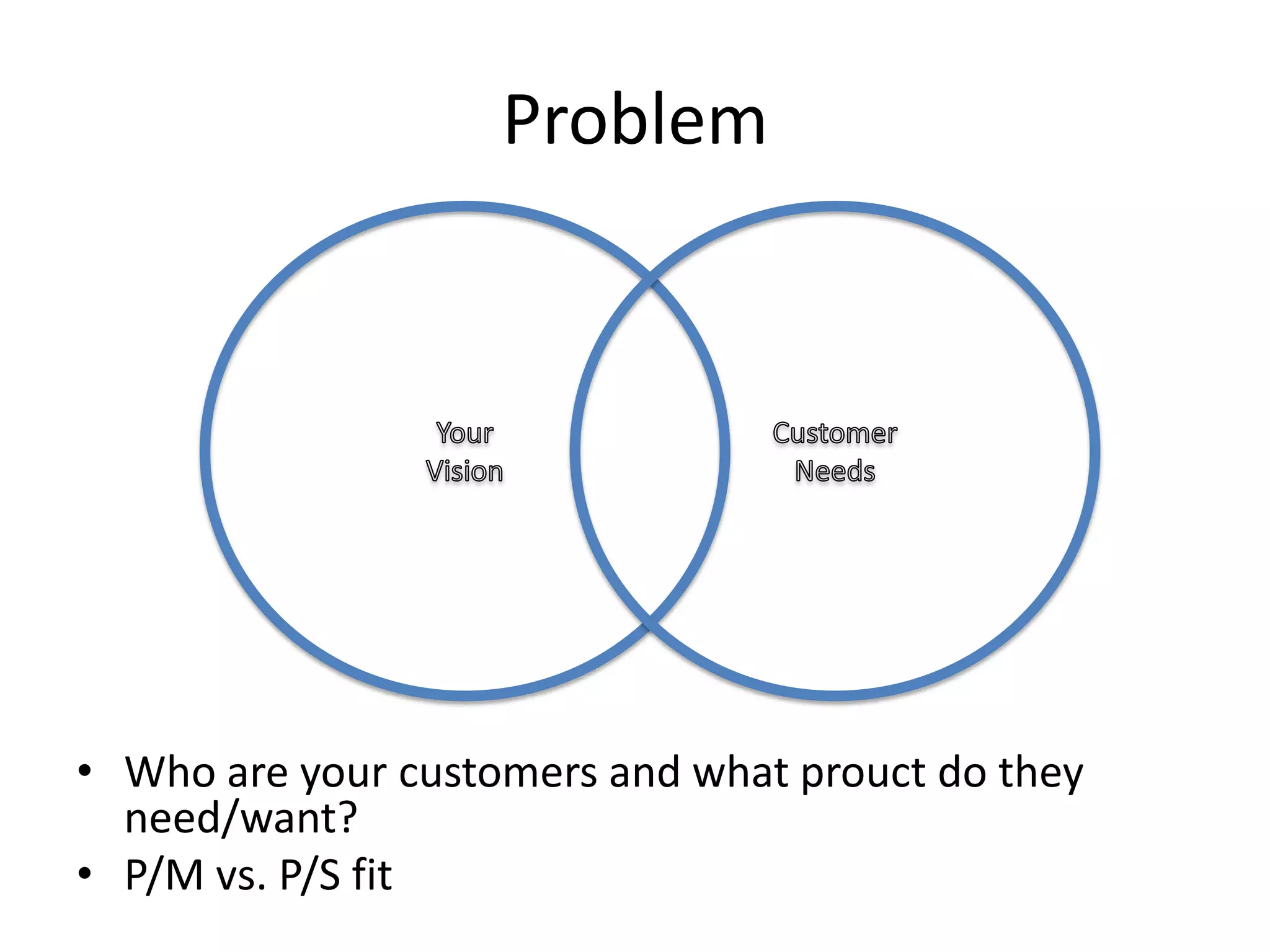
Problem


• Who are your customers and what prouct do they
  need/want?
• P/M vs. P/S fit
So why try it then? And how?
• Because its fun, creative, challenging and
  fulfilling! => And it‘s YOU!

• There are strategies and frameworks that can
  lower the chance of failing and wasting your
  time … but it‘s a lot of work …
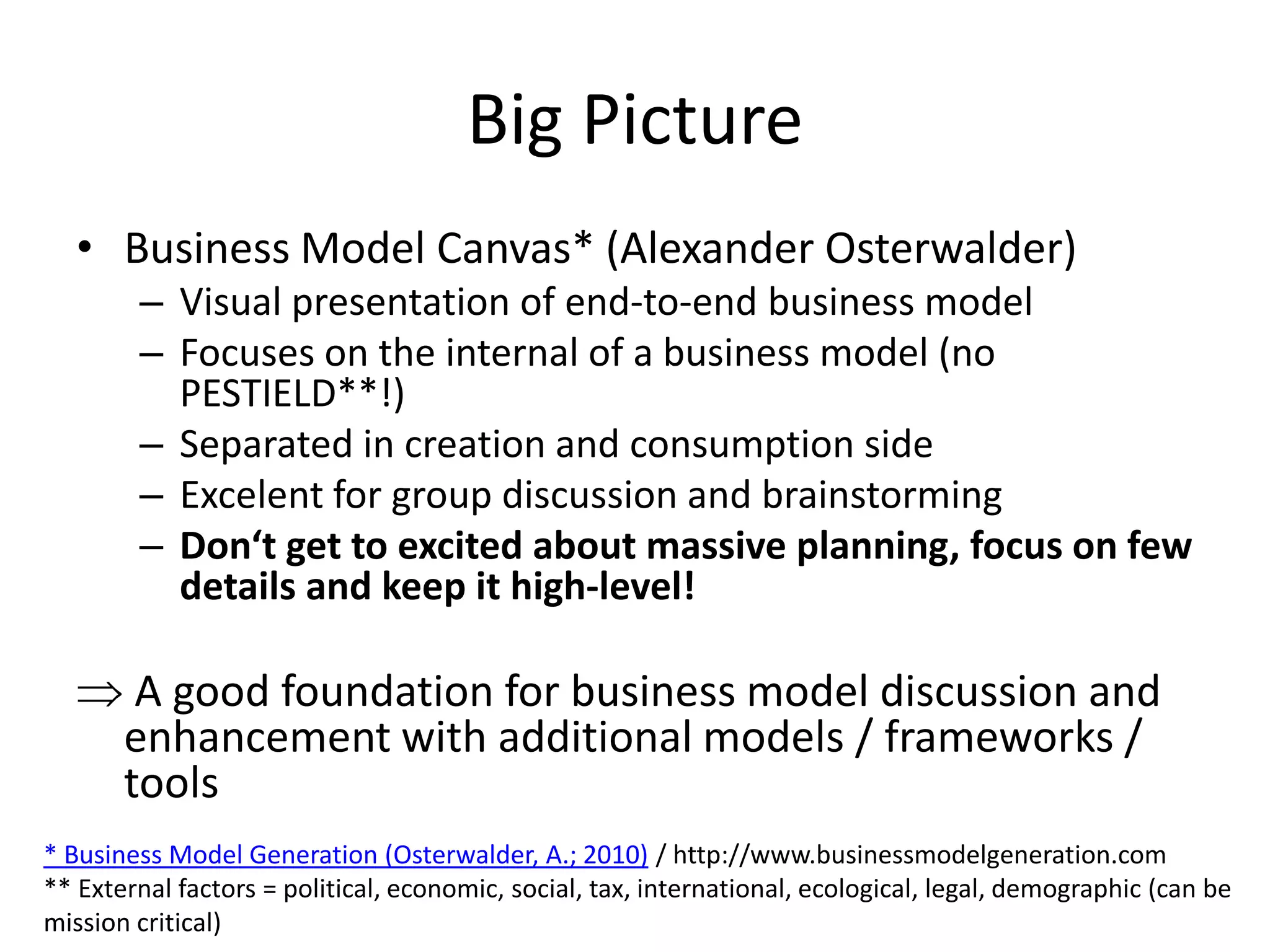
Big Picture
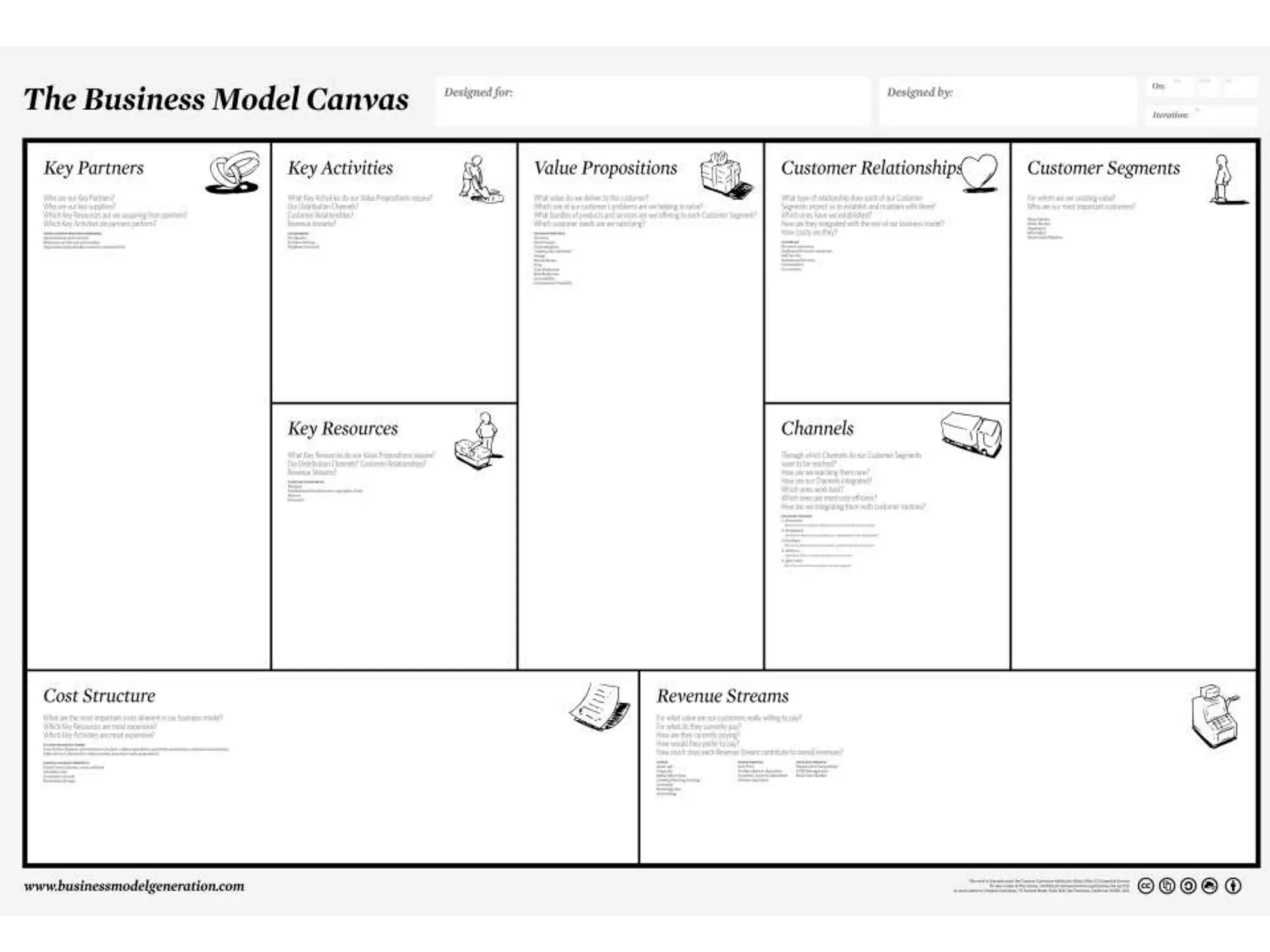
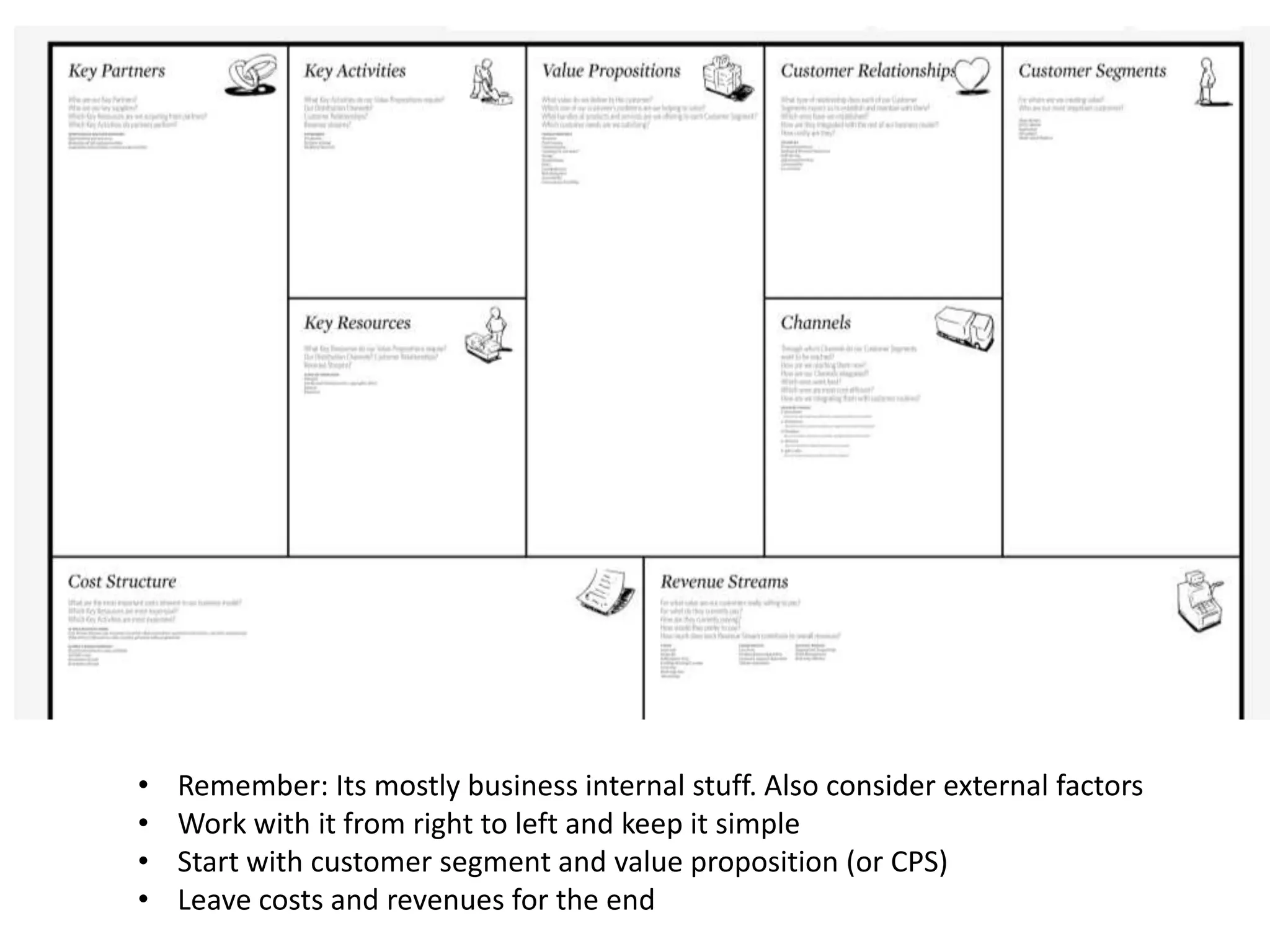
   • Business Model Canvas* (Alexander Osterwalder)
        – Visual presentation of end-to-end business model
        – Focuses on the internal of a business model (no
          PESTIELD**!)
        – Separated in creation and consumption side
        – Excelent for group discussion and brainstorming
        – Don‘t get to excited about massive planning, focus on few
          details and keep it high-level!

        A good foundation for business model discussion and
       enhancement with additional models / frameworks /
       tools
* Business Model Generation (Osterwalder, A.; 2010) / http://www.businessmodelgeneration.com
** External factors = political, economic, social, tax, international, ecological, legal, demographic (can be
mission critical)
Other Frameworks
•   Strategy Diamond
•   Porters 5 Forces
•   Porters Generic Strategies
•   PESTIELD
•   Bowman’s Strategy Clock
•   SWOT/TOWS


• These and more can be found at
  http://www.mindtools.com/pages/main/newMN_STR.htm

(check back-up slides for few examples)
•   Remember: Its mostly business internal stuff. Also consider external factors
•   Work with it from right to left and keep it simple
•   Start with customer segment and value proposition (or CPS)
•   Leave costs and revenues for the end
Focus
• CPS Hypothesis
  – Who? Is there a customer & scalable market?
  – Why? Is there a problem/need/desire that can be
    solved?
  – How will we solve this? With what?


• What you want is a product/service that serves a
  customer as a solution to a problem/need that is
  perceived as a desirable value-creation.
„Create something people love!“*
• Compelling product that people love to use more than
  once and recommend to others
     make it contagious and sticky!
     activation / retention / referral

• Product / market fit
     Right set of features (not more than necessary)
     for identified customer segment

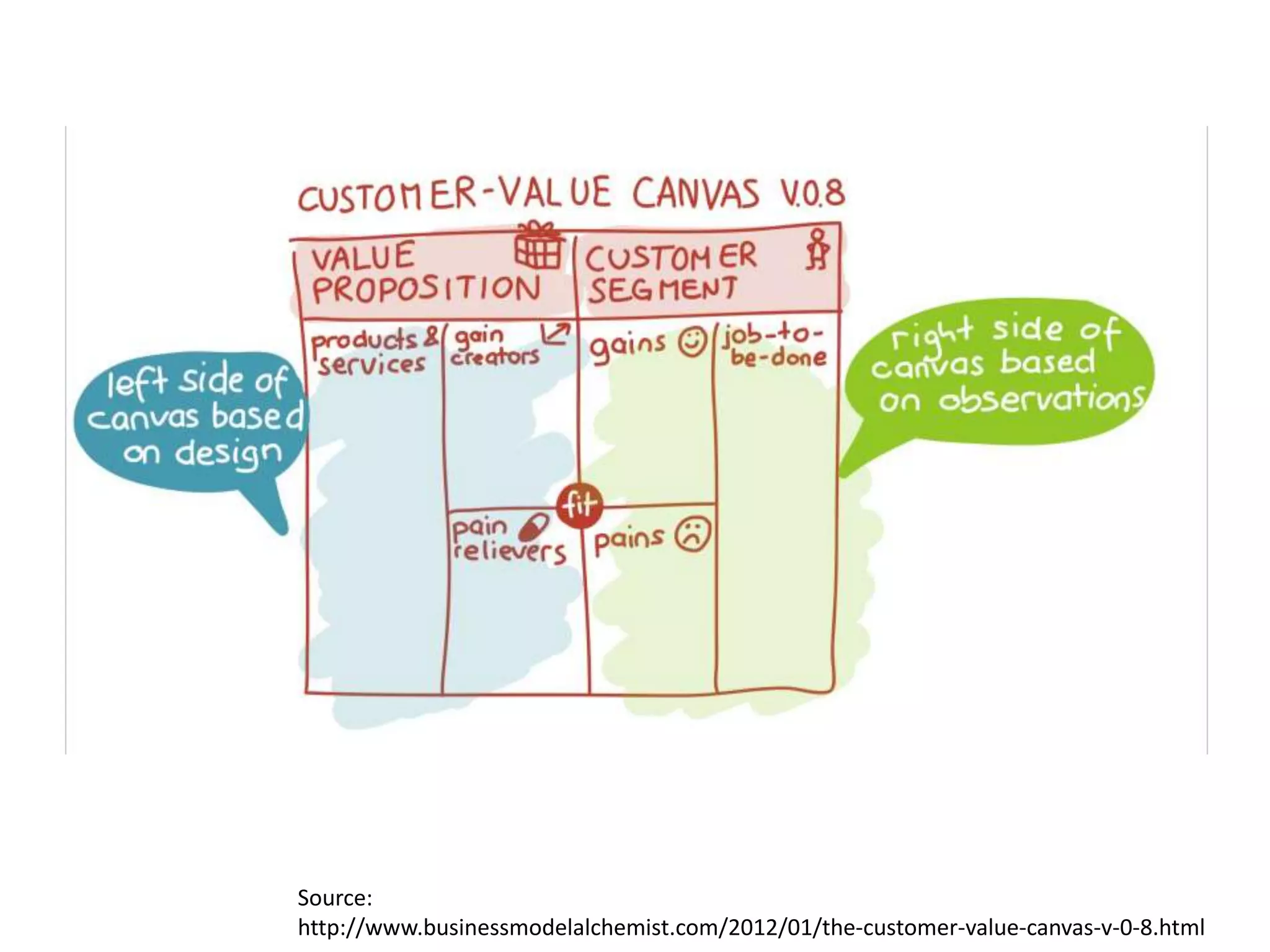
• Customer Value Canvas (Link)
   – Pain => Gain


                                   * Service design and entrepreneurial mantra
Economic Logic
• A happy user..
  – Is willing to pay for your product (revenue)

  – Talks good about your product (referral)

  – Sticks with your product (customer lifetime value
    up)
Source:
http://www.businessmodelalchemist.com/2012/01/the-customer-value-canvas-v-0-8.html
Service Design Thinking
• A multidisciplinary approach to design better
  user-centered services/products
• Service-dominant logic (Stephen Vargo and
  Robert Lusch)*
   => There is no sole product or service, always
   look at product & service as one for better
   user experience! (gives you higher retention
   and refferal)
          Source:
          http://courses.ischool.berkeley.edu/i210/f07/readings/VargoLusch.pdf
Service Design Tools*
• Always ask for the ultimate solution for a
  customer – not the product (there is a
  difference!) Explore it!
  – 5 Why‘s Root Cause Analysis
  – User Journey / User Day Walkthrough
  – Stakeholder Maps / Decision Maker Analysis
  – Customer Lifecylce Map
  – Design Scenarios
    ...

   Source:
   This is Service Design Thinking: Basics, Tools, Cases (Schneider, D.; Stickdorn, M.; 2011)
How (not) to waste time…
• You don’t want to build a product for a market
  that does not exist or is not willing to pay for
  your product.
• Gather feedback from customers as early as
  possible.
• Iterate as often as possible in small
  measurable steps.
• Customer Development vs. Product
  Development
Customer Development vs. Product
           Development
• Why startups fail*: consistent vs. inconsistent
  – Scalation before proven CPS / MVP / business
    modell
  – Waste time on product development instead of
    unterstanding customers


                Source:
                http://visual.ly/why-startups-fail
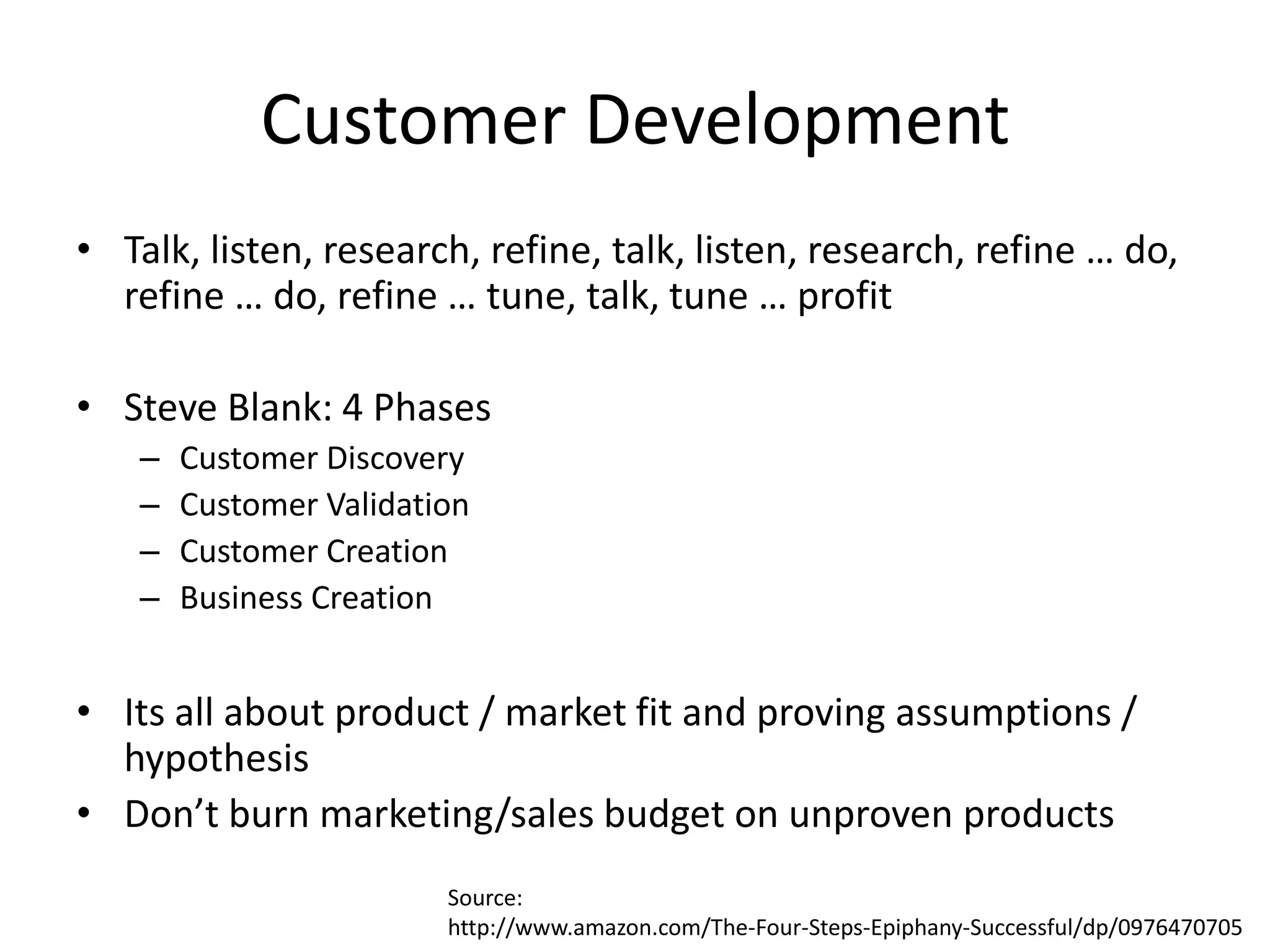
Customer Development
• Talk, listen, research, refine, talk, listen, research, refine … do,
  refine … do, refine … tune, talk, tune … profit

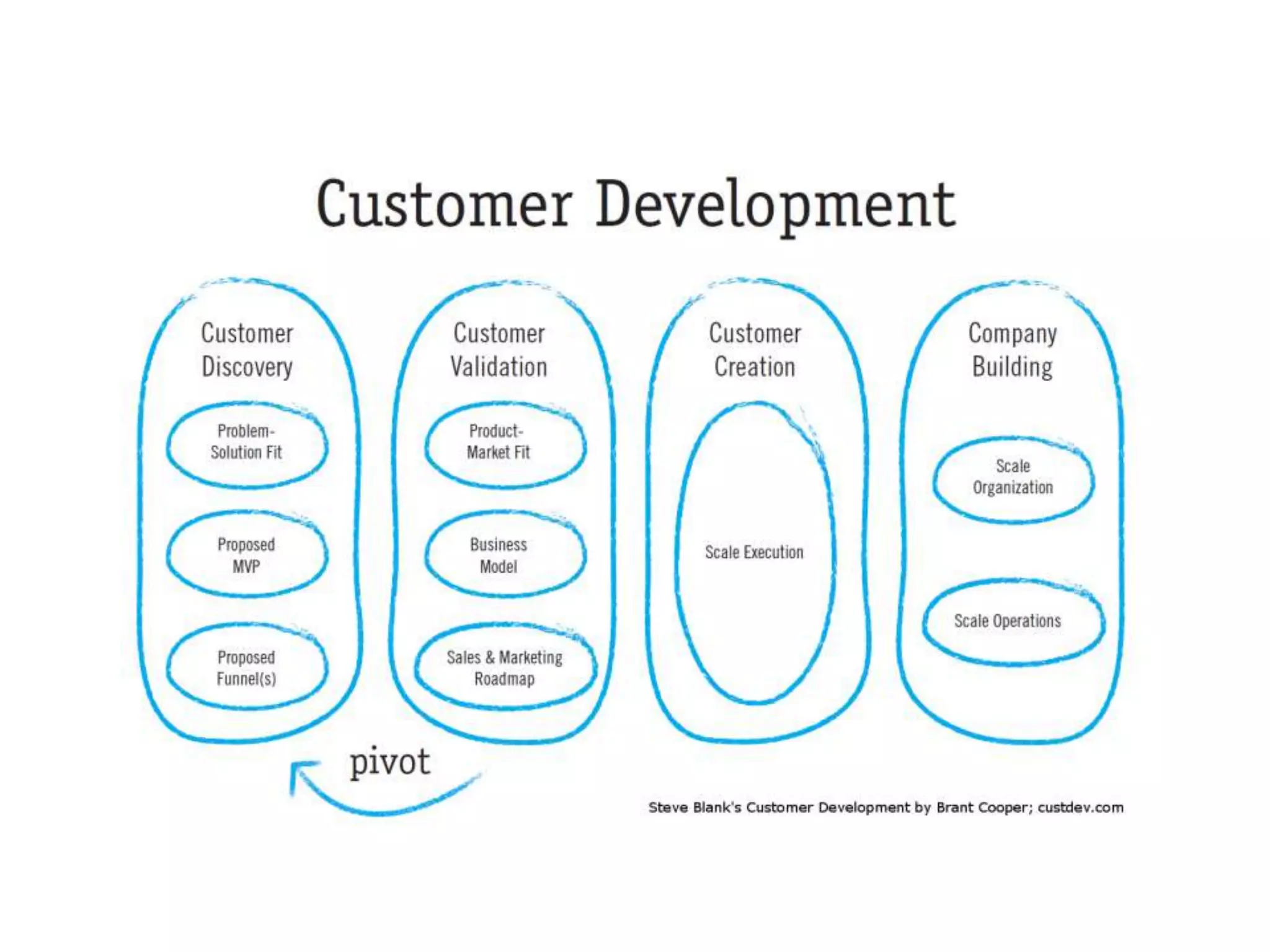
• Steve Blank: 4 Phases
    –   Customer Discovery
    –   Customer Validation
    –   Customer Creation
    –   Business Creation


• Its all about product / market fit and proving assumptions /
  hypothesis
• Don’t burn marketing/sales budget on unproven products
                         Source:
                         http://www.amazon.com/The-Four-Steps-Epiphany-Successful/dp/0976470705
MVP
• Minimum Viable Product = minimum set of
  features of a product or service for that a user
  is willing to pay (best is money, time also good
  for hypothesis validation hint)
• Philosophy: Adress only one specific problem
  that is solved by your solution for províng your
  problem / solution hypothesis
• 80:20 rule -> spent 80% of your time on
  existing features and 20% on new ones
A-B / Split Testing
• Marketing and product development term for
  improving / refining a component
  – Can be color of design element, wording, feature, tag
• Two alternatives run and tested at the same
  time by the same targeted audience
• Whichever shows better results will be used in
  the future
• The other one is abandoned (BUT not forgotten!)
    validated learning
Pivots
• Pivot: A switch from on X to another where X can
  be a market, distribution channel, revenue
  channel, partner, business modell, etc

• Generally a replacment or change of a larger
  business modell component

• Often occurs when a business model doesn‘t
  seem to be working or other option is more
  profitable or customer oriented
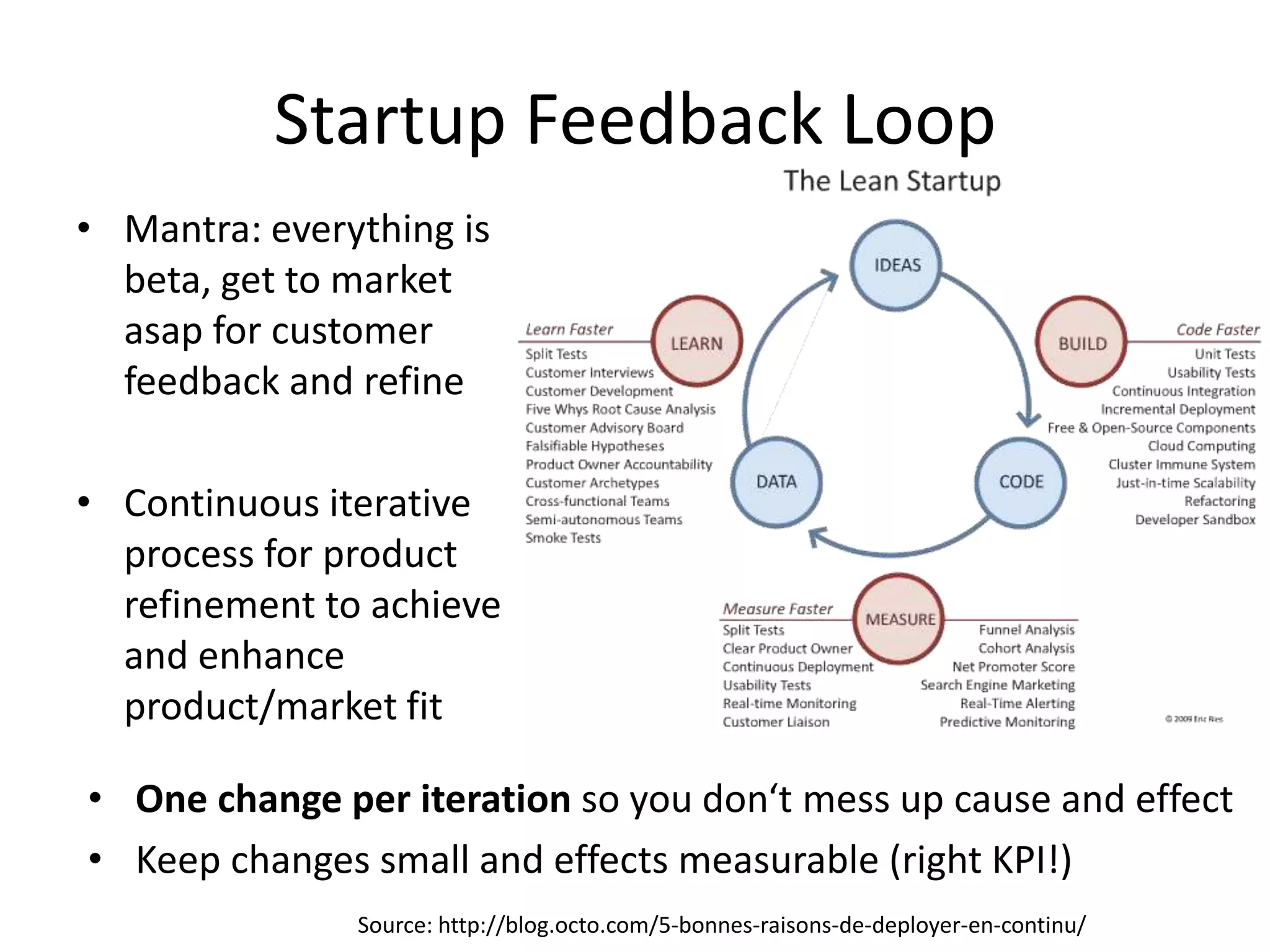
Startup Feedback Loop
• Mantra: everything is
  beta, get to market
  asap for customer
  feedback and refine

• Continuous iterative
  process for product
  refinement to achieve
  and enhance
  product/market fit

• One change per iteration so you don‘t mess up cause and effect
• Keep changes small and effects measurable (right KPI!)
               Source: http://blog.octo.com/5-bonnes-raisons-de-deployer-en-continu/
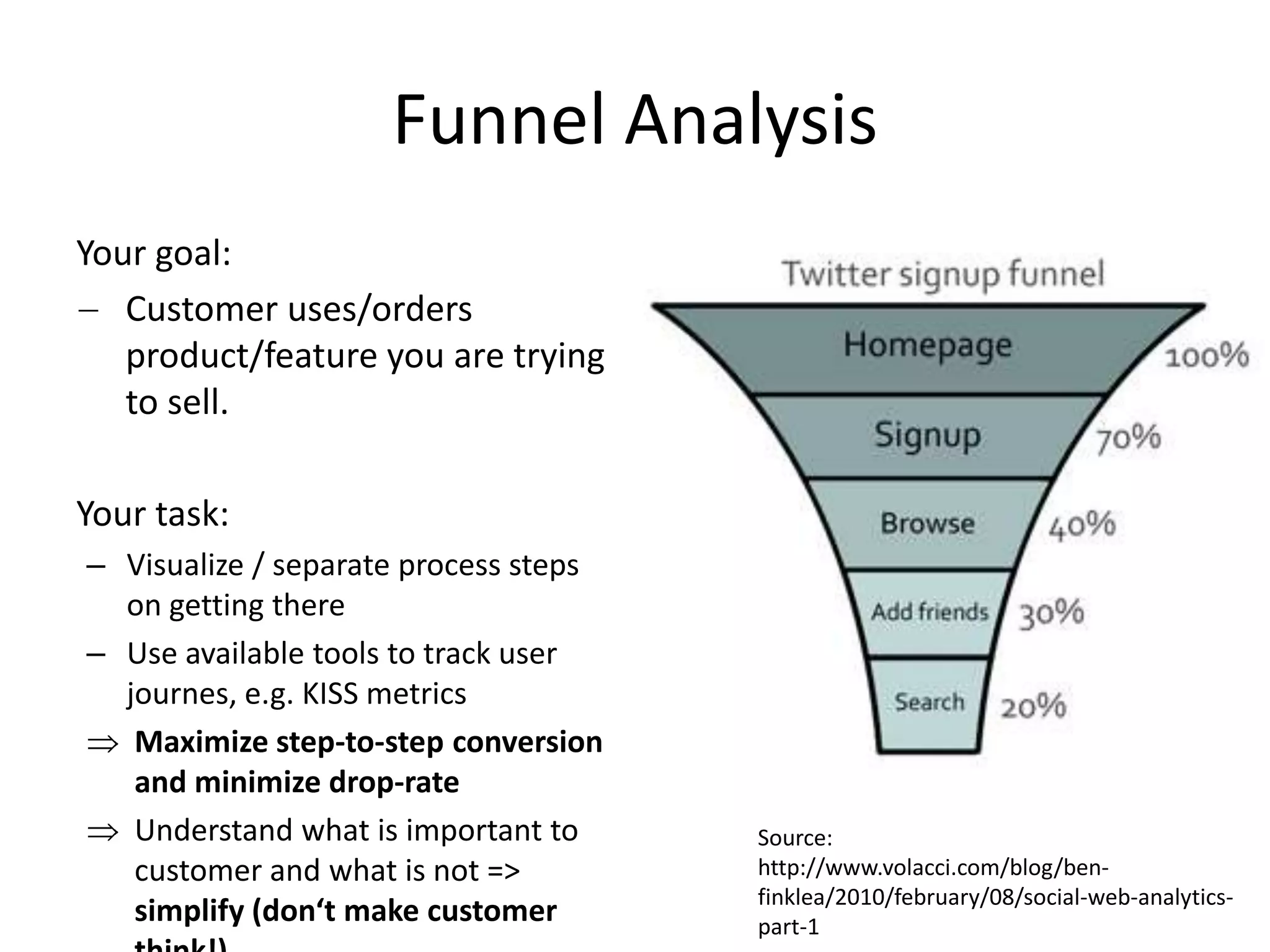
Funnel Analysis
Your goal:
   Customer uses/orders
   product/feature you are trying
   to sell.

Your task:
– Visualize / separate process steps
  on getting there
– Use available tools to track user
  journes, e.g. KISS metrics
   Maximize step-to-step conversion
   and minimize drop-rate
   Understand what is important to     Source:
   customer and what is not =>         http://www.volacci.com/blog/ben-
                                       finklea/2010/february/08/social-web-analytics-
   simplify (don‘t make customer       part-1
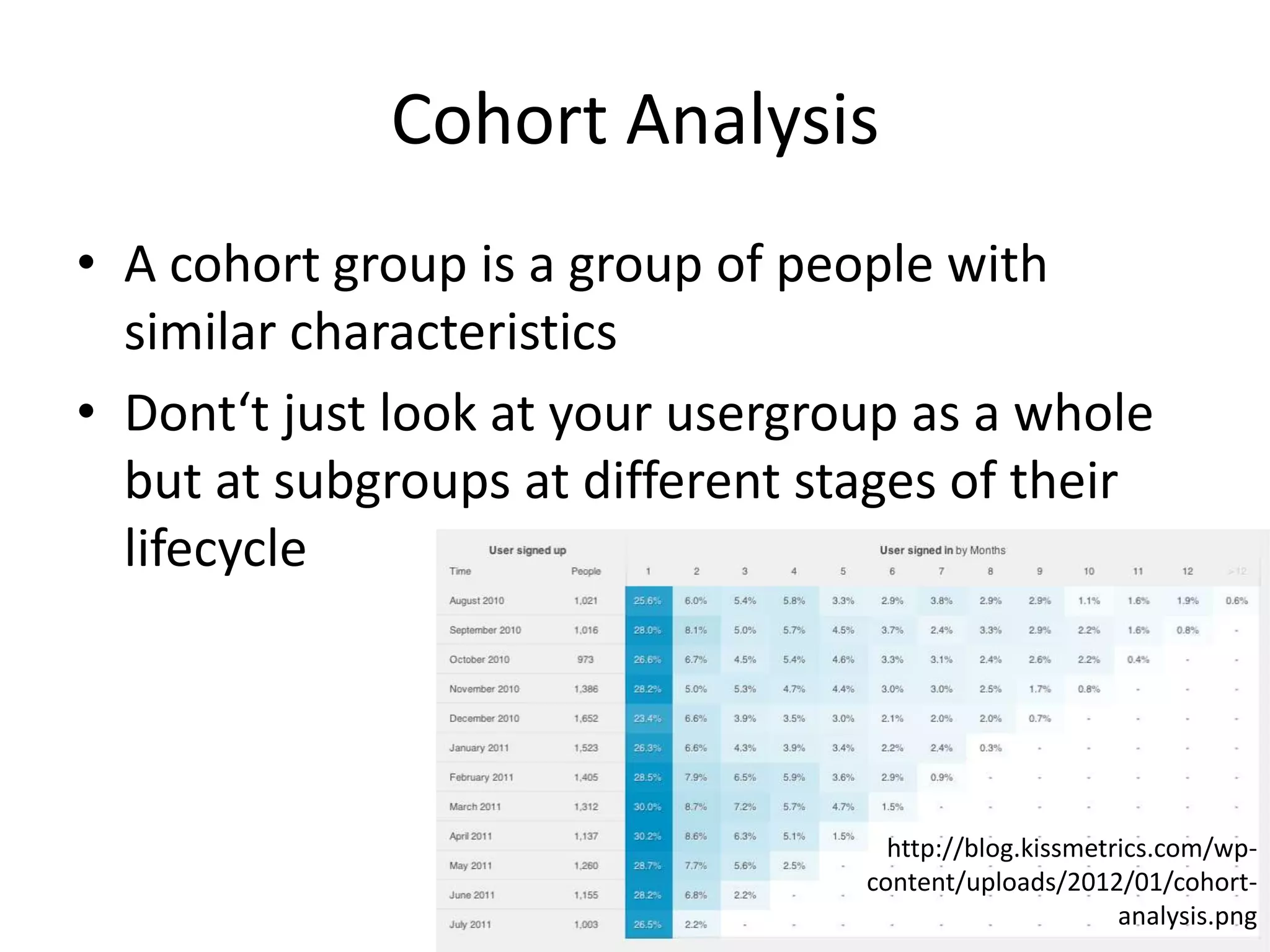
Cohort Analysis
• A cohort group is a group of people with
  similar characteristics
• Dont‘t just look at your usergroup as a whole
  but at subgroups at different stages of their
  lifecycle


                                    http://blog.kissmetrics.com/wp-
                                  content/uploads/2012/01/cohort-
                                                        analysis.png
How can You grow?
1. increase new customers per month (obvious!)
2. decrease churn rate

2nd should be prio 1 because
  – already using your product so no additional COAcq
  – and this seems to be your target market
  – and (once again) you want a compelling/sticky product


=> Once you achieved product/market fit and
   decreased churn rate go back to 1 => SCALE!
Scaling customer considerations
• Different kind of users
  – Visitor, no use of product
  – One-time-user, no retention, no referral
  – X-time-user, low retention, no referral
  – X-time-user, high retention, no referral
  – X*Y-time-user, retention, referral

  => You want the last type for scaling your business
  for exponential growth (viral! = free marketing)
                Source:
                http://www.seedcamp.com/resources/startup-metrics-for-pirates-by-dave-mcclure
Measuring improvement over time
• Look at # of new customers per period
• NOT     # of total customers

Increased # of marginal customers tells you if your
iteration was good for your business

It‘s nice to increase your total # of customers but
you want to find out if a certain product change is
worth keeping or reverting to original.
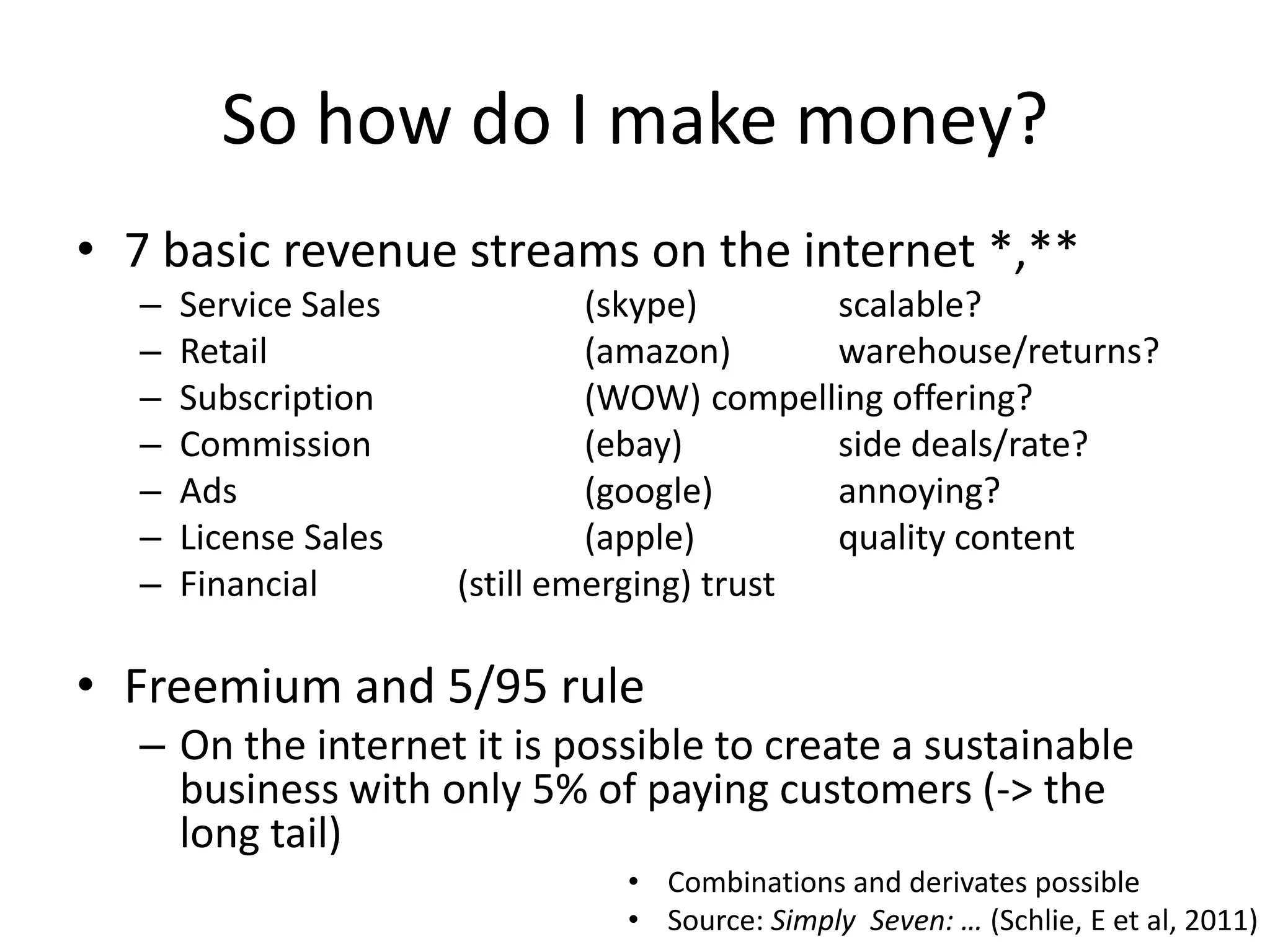
So how do I make money?
• 7 basic revenue streams on the internet *,**
  –   Service Sales            (skype)       scalable?
  –   Retail                   (amazon)      warehouse/returns?
  –   Subscription             (WOW) compelling offering?
  –   Commission               (ebay)        side deals/rate?
  –   Ads                      (google)      annoying?
  –   License Sales            (apple)       quality content
  –   Financial       (still emerging) trust

• Freemium and 5/95 rule
  – On the internet it is possible to create a sustainable
    business with only 5% of paying customers (-> the
    long tail)
                               • Combinations and derivates possible
                               • Source: Simply Seven: … (Schlie, E et al, 2011)
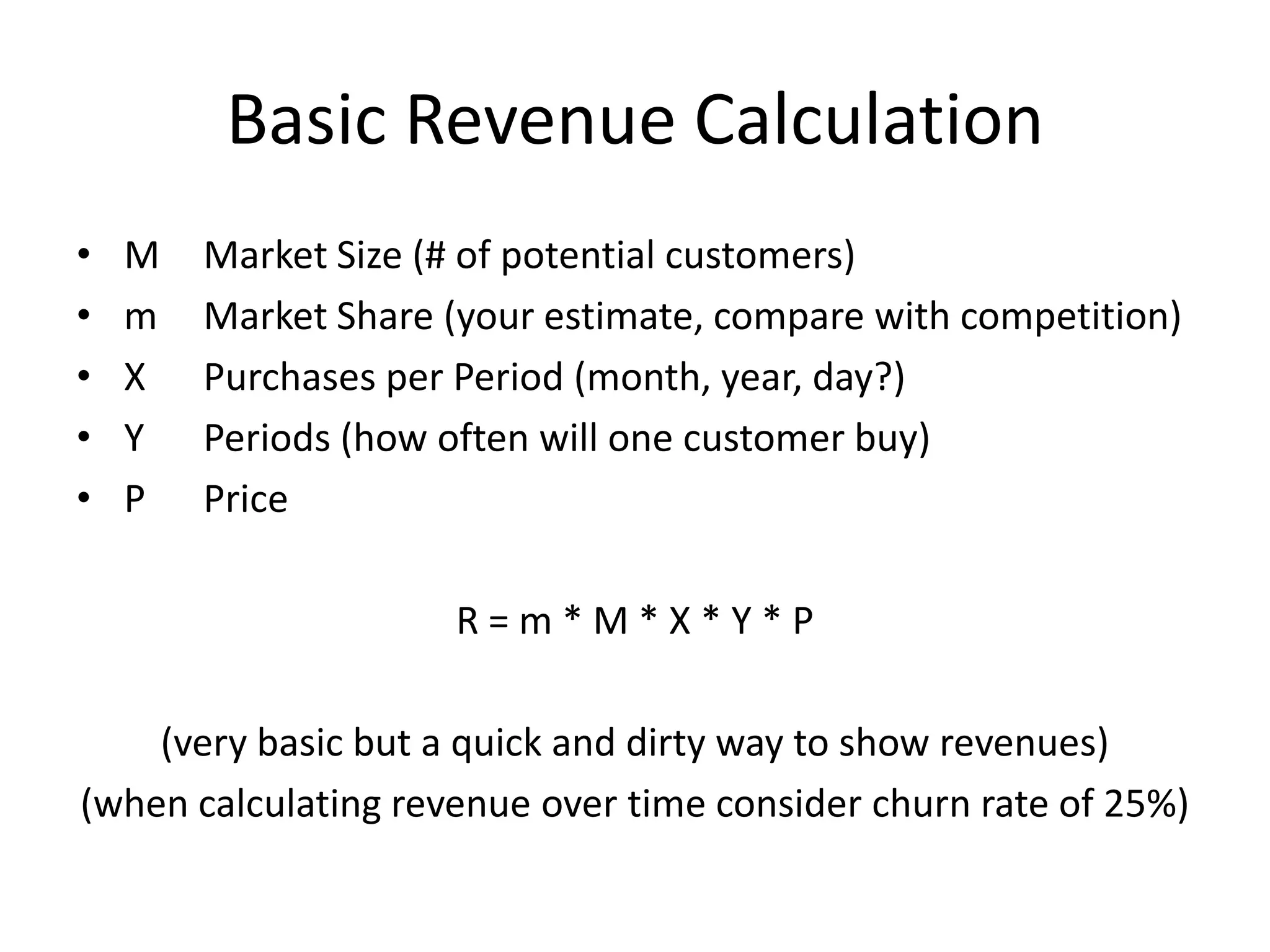
Basic Revenue Calculation
•   M   Market Size (# of potential customers)
•   m   Market Share (your estimate, compare with competition)
•   X   Purchases per Period (month, year, day?)
•   Y   Periods (how often will one customer buy)
•   P   Price

                     R=m*M*X*Y*P

    (very basic but a quick and dirty way to show revenues)
(when calculating revenue over time consider churn rate of 25%)
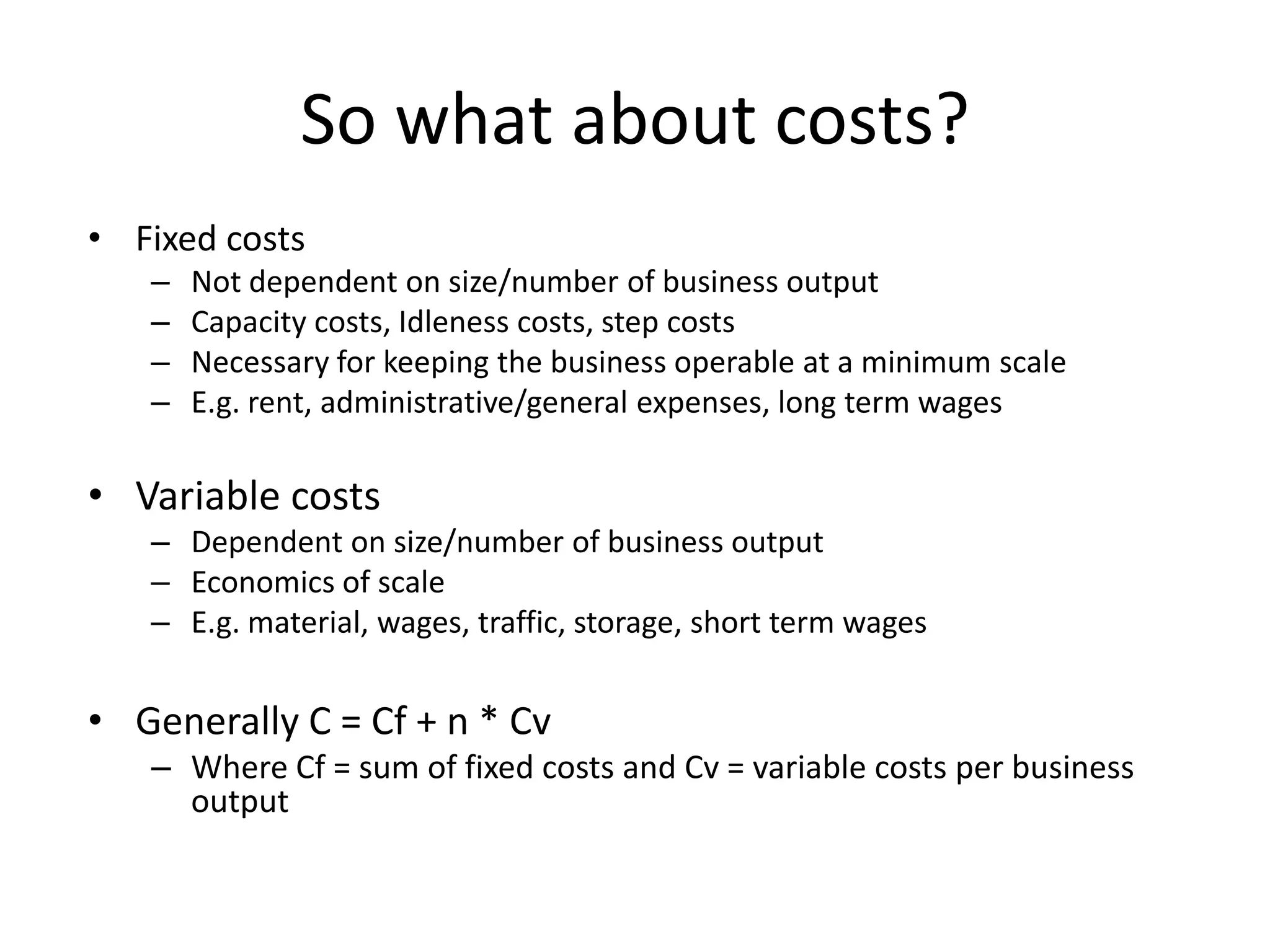
So what about costs?
• Fixed costs
   –   Not dependent on size/number of business output
   –   Capacity costs, Idleness costs, step costs
   –   Necessary for keeping the business operable at a minimum scale
   –   E.g. rent, administrative/general expenses, long term wages

• Variable costs
   – Dependent on size/number of business output
   – Economics of scale
   – E.g. material, wages, traffic, storage, short term wages


• Generally C = Cf + n * Cv
   – Where Cf = sum of fixed costs and Cv = variable costs per business
     output
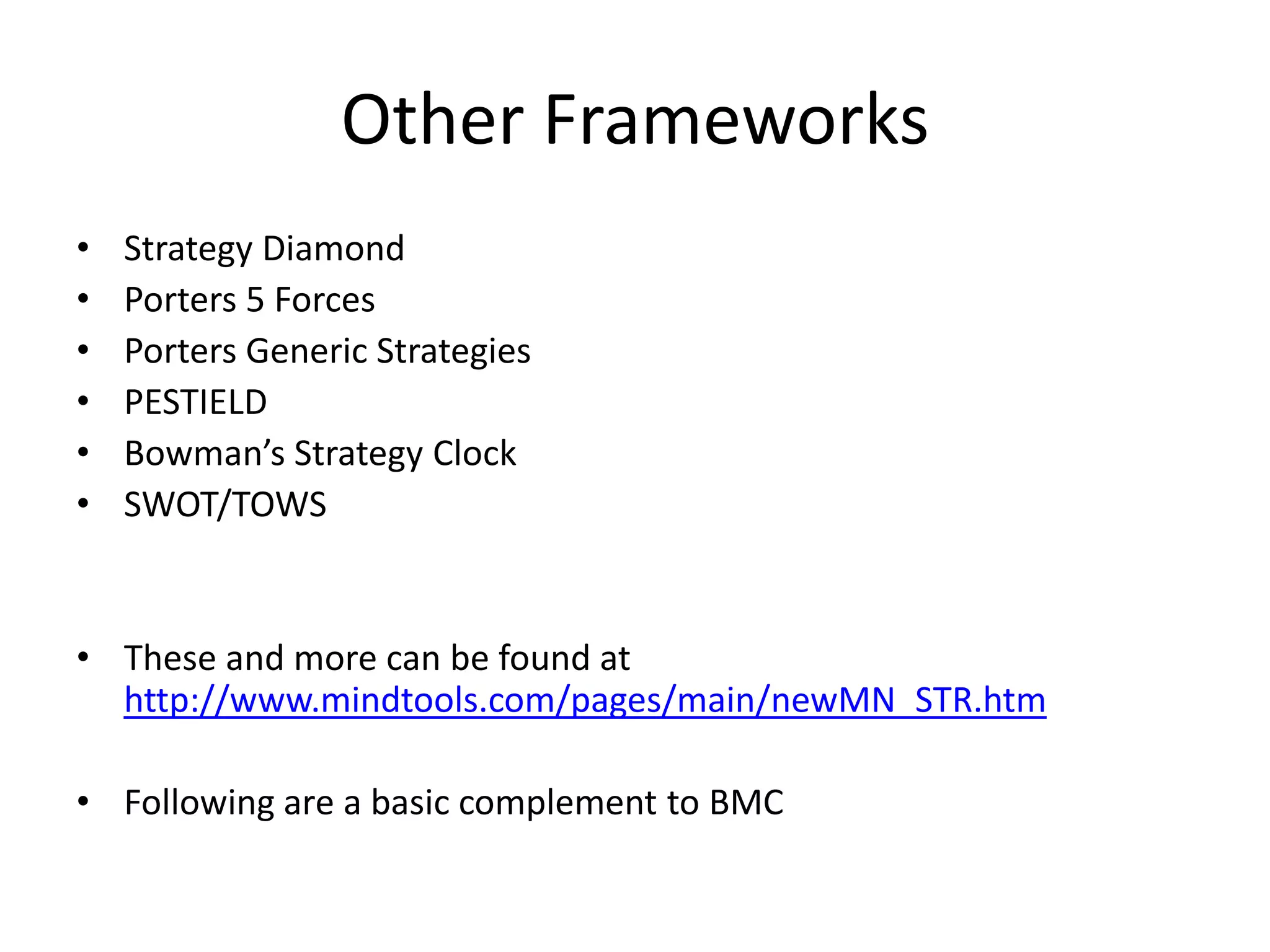
Other Frameworks
•   Strategy Diamond
•   Porters 5 Forces
•   Porters Generic Strategies
•   PESTIELD
•   Bowman’s Strategy Clock
•   SWOT/TOWS


• These and more can be found at
  http://www.mindtools.com/pages/main/newMN_STR.htm

• Following are a basic complement to BMC
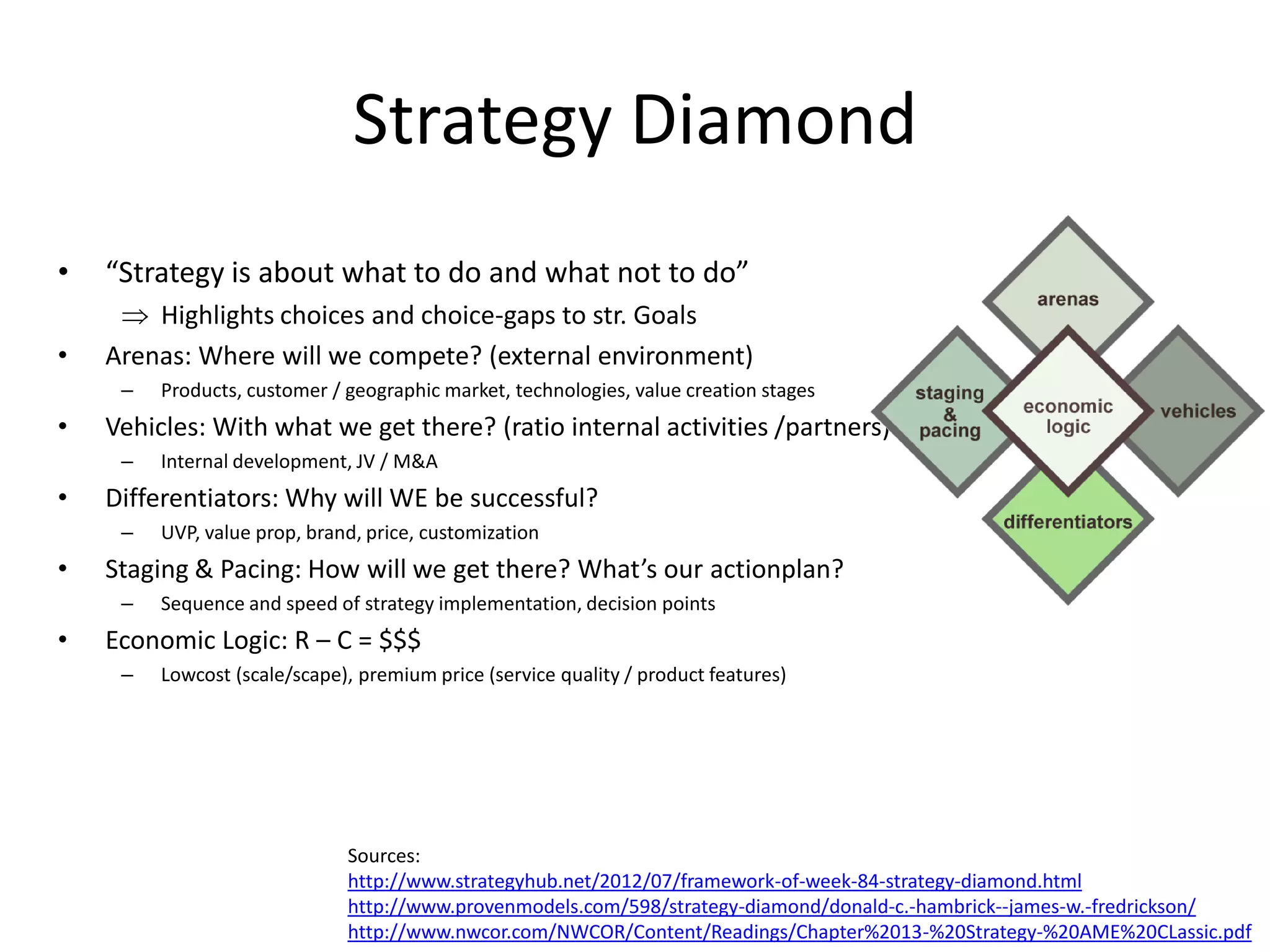
Strategy Diamond
•   “Strategy is about what to do and what not to do”
        Highlights choices and choice-gaps to str. Goals
•   Arenas: Where will we compete? (external environment)
     –   Products, customer / geographic market, technologies, value creation stages
•   Vehicles: With what we get there? (ratio internal activities /partners)
     –   Internal development, JV / M&A
•   Differentiators: Why will WE be successful?
     –   UVP, value prop, brand, price, customization
•   Staging & Pacing: How will we get there? What’s our actionplan?
     –   Sequence and speed of strategy implementation, decision points
•   Economic Logic: R – C = $$$
     –   Lowcost (scale/scape), premium price (service quality / product features)


                              Sources:
                              http://www.strategyhub.net/2012/07/framework-of-week-84-strategy-diamond.html
                              http://www.provenmodels.com/598/strategy-diamond/donald-c.-hambrick--james-w.-fredrickson/
                              http://www.nwcor.com/NWCOR/Content/Readings/Chapter%2013-%20Strategy-%20AME%20CLassic.pdf
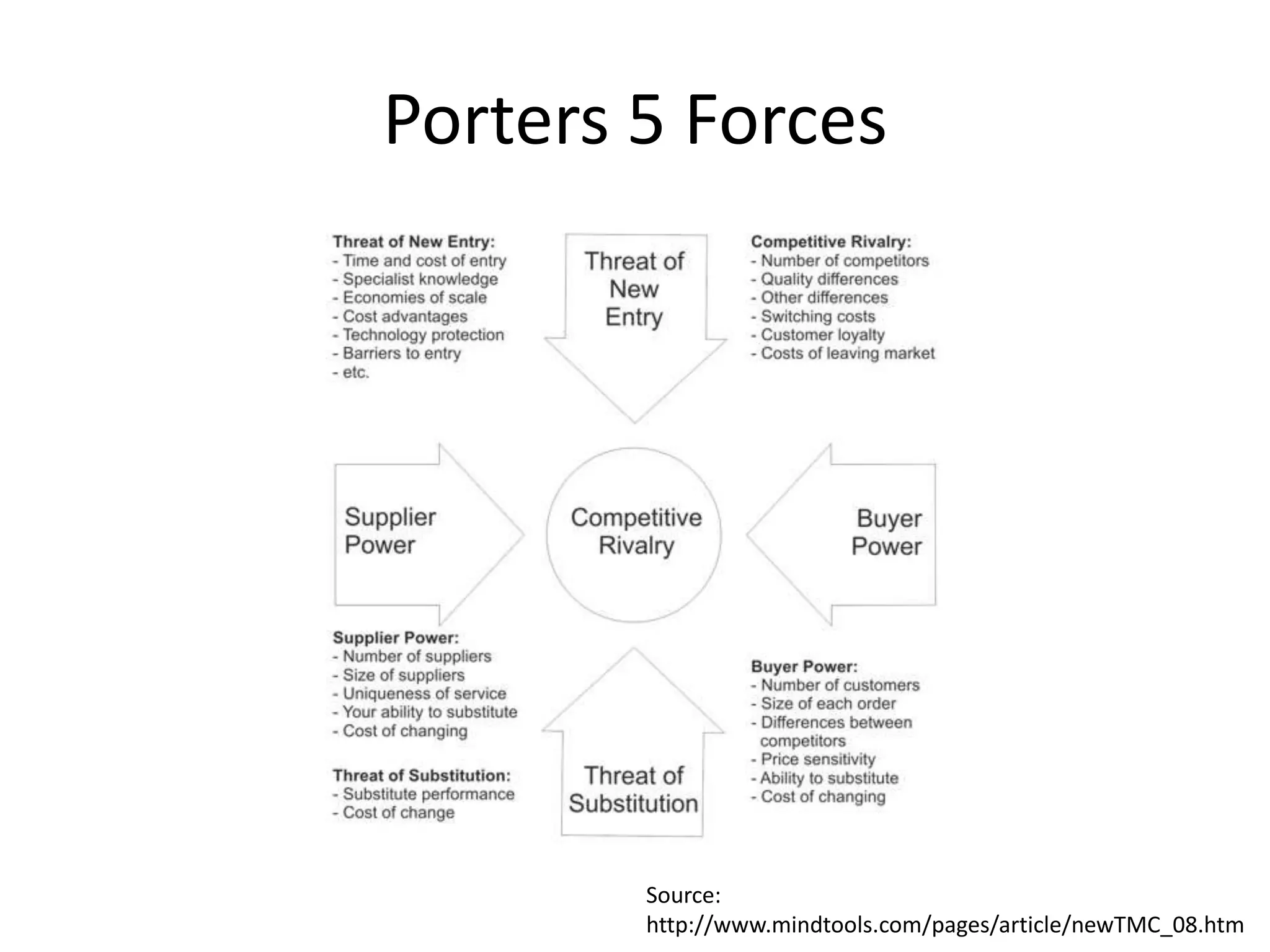
Porters 5 Forces


        Source:
        http://www.mindtools.com/pages/article/newTMC_08.htm
Book Recommendations
•   Business Model Generation
•   The Lean Startup
•   Four Steps to Epiphany
•   The Startup Owner’s Manual
•   The Tipping Point
•   From Good to Great
•   Don’t make me think
•   This is Service Design Thinking
•   Venture Deals: Be smarter than your lawyer and
    VC

Startup strategy1

  • 1.
    S³ Startup Strategy Stuff Draft0.3 – 24.11.2012 Jan-Hendrik Adolphs T @twabou
  • 2.
    Overview • This presentationis about frameworks, ideas and ideologies about startup and ideation strategies. • It gives a short introduction to: – Lean Startup – Business Modelling – Customer Development – Service Design
  • 3.
    What is astartup? • A startup is a human institution that desires to create value for customers in an environment of high uncertainty and risk. • Therefore: – Test, iterate, try someting
  • 4.
    Problem • Who areyour customers and what prouct do they need/want? • P/M vs. P/S fit
  • 5.
    So why tryit then? And how? • Because its fun, creative, challenging and fulfilling! => And it‘s YOU! • There are strategies and frameworks that can lower the chance of failing and wasting your time … but it‘s a lot of work …
  • 6.
    Big Picture • Business Model Canvas* (Alexander Osterwalder) – Visual presentation of end-to-end business model – Focuses on the internal of a business model (no PESTIELD**!) – Separated in creation and consumption side – Excelent for group discussion and brainstorming – Don‘t get to excited about massive planning, focus on few details and keep it high-level! A good foundation for business model discussion and enhancement with additional models / frameworks / tools * Business Model Generation (Osterwalder, A.; 2010) / http://www.businessmodelgeneration.com ** External factors = political, economic, social, tax, international, ecological, legal, demographic (can be mission critical)
  • 8.
    Other Frameworks • Strategy Diamond • Porters 5 Forces • Porters Generic Strategies • PESTIELD • Bowman’s Strategy Clock • SWOT/TOWS • These and more can be found at http://www.mindtools.com/pages/main/newMN_STR.htm (check back-up slides for few examples)
  • 9.
    Remember: Its mostly business internal stuff. Also consider external factors • Work with it from right to left and keep it simple • Start with customer segment and value proposition (or CPS) • Leave costs and revenues for the end
  • 10.
    Focus • CPS Hypothesis – Who? Is there a customer & scalable market? – Why? Is there a problem/need/desire that can be solved? – How will we solve this? With what? • What you want is a product/service that serves a customer as a solution to a problem/need that is perceived as a desirable value-creation.
  • 11.
    „Create something peoplelove!“* • Compelling product that people love to use more than once and recommend to others make it contagious and sticky! activation / retention / referral • Product / market fit Right set of features (not more than necessary) for identified customer segment • Customer Value Canvas (Link) – Pain => Gain * Service design and entrepreneurial mantra
  • 12.
    Economic Logic • Ahappy user.. – Is willing to pay for your product (revenue) – Talks good about your product (referral) – Sticks with your product (customer lifetime value up)
  • 13.
  • 14.
    Service Design Thinking •A multidisciplinary approach to design better user-centered services/products • Service-dominant logic (Stephen Vargo and Robert Lusch)* => There is no sole product or service, always look at product & service as one for better user experience! (gives you higher retention and refferal) Source: http://courses.ischool.berkeley.edu/i210/f07/readings/VargoLusch.pdf
  • 15.
    Service Design Tools* •Always ask for the ultimate solution for a customer – not the product (there is a difference!) Explore it! – 5 Why‘s Root Cause Analysis – User Journey / User Day Walkthrough – Stakeholder Maps / Decision Maker Analysis – Customer Lifecylce Map – Design Scenarios ... Source: This is Service Design Thinking: Basics, Tools, Cases (Schneider, D.; Stickdorn, M.; 2011)
  • 16.
    How (not) towaste time… • You don’t want to build a product for a market that does not exist or is not willing to pay for your product. • Gather feedback from customers as early as possible. • Iterate as often as possible in small measurable steps. • Customer Development vs. Product Development
  • 17.
    Customer Development vs.Product Development • Why startups fail*: consistent vs. inconsistent – Scalation before proven CPS / MVP / business modell – Waste time on product development instead of unterstanding customers Source: http://visual.ly/why-startups-fail
  • 18.
    Customer Development • Talk,listen, research, refine, talk, listen, research, refine … do, refine … do, refine … tune, talk, tune … profit • Steve Blank: 4 Phases – Customer Discovery – Customer Validation – Customer Creation – Business Creation • Its all about product / market fit and proving assumptions / hypothesis • Don’t burn marketing/sales budget on unproven products Source: http://www.amazon.com/The-Four-Steps-Epiphany-Successful/dp/0976470705
  • 20.
    MVP • Minimum ViableProduct = minimum set of features of a product or service for that a user is willing to pay (best is money, time also good for hypothesis validation hint) • Philosophy: Adress only one specific problem that is solved by your solution for províng your problem / solution hypothesis • 80:20 rule -> spent 80% of your time on existing features and 20% on new ones
  • 21.
    A-B / SplitTesting • Marketing and product development term for improving / refining a component – Can be color of design element, wording, feature, tag • Two alternatives run and tested at the same time by the same targeted audience • Whichever shows better results will be used in the future • The other one is abandoned (BUT not forgotten!) validated learning
  • 22.
    Pivots • Pivot: Aswitch from on X to another where X can be a market, distribution channel, revenue channel, partner, business modell, etc • Generally a replacment or change of a larger business modell component • Often occurs when a business model doesn‘t seem to be working or other option is more profitable or customer oriented
  • 23.
    Startup Feedback Loop •Mantra: everything is beta, get to market asap for customer feedback and refine • Continuous iterative process for product refinement to achieve and enhance product/market fit • One change per iteration so you don‘t mess up cause and effect • Keep changes small and effects measurable (right KPI!) Source: http://blog.octo.com/5-bonnes-raisons-de-deployer-en-continu/
  • 24.
    Funnel Analysis Your goal: Customer uses/orders product/feature you are trying to sell. Your task: – Visualize / separate process steps on getting there – Use available tools to track user journes, e.g. KISS metrics Maximize step-to-step conversion and minimize drop-rate Understand what is important to Source: customer and what is not => http://www.volacci.com/blog/ben- finklea/2010/february/08/social-web-analytics- simplify (don‘t make customer part-1
  • 25.
    Cohort Analysis • Acohort group is a group of people with similar characteristics • Dont‘t just look at your usergroup as a whole but at subgroups at different stages of their lifecycle http://blog.kissmetrics.com/wp- content/uploads/2012/01/cohort- analysis.png
  • 26.
    How can Yougrow? 1. increase new customers per month (obvious!) 2. decrease churn rate 2nd should be prio 1 because – already using your product so no additional COAcq – and this seems to be your target market – and (once again) you want a compelling/sticky product => Once you achieved product/market fit and decreased churn rate go back to 1 => SCALE!
  • 27.
    Scaling customer considerations •Different kind of users – Visitor, no use of product – One-time-user, no retention, no referral – X-time-user, low retention, no referral – X-time-user, high retention, no referral – X*Y-time-user, retention, referral => You want the last type for scaling your business for exponential growth (viral! = free marketing) Source: http://www.seedcamp.com/resources/startup-metrics-for-pirates-by-dave-mcclure
  • 28.
    Measuring improvement overtime • Look at # of new customers per period • NOT # of total customers Increased # of marginal customers tells you if your iteration was good for your business It‘s nice to increase your total # of customers but you want to find out if a certain product change is worth keeping or reverting to original.
  • 29.
    So how doI make money? • 7 basic revenue streams on the internet *,** – Service Sales (skype) scalable? – Retail (amazon) warehouse/returns? – Subscription (WOW) compelling offering? – Commission (ebay) side deals/rate? – Ads (google) annoying? – License Sales (apple) quality content – Financial (still emerging) trust • Freemium and 5/95 rule – On the internet it is possible to create a sustainable business with only 5% of paying customers (-> the long tail) • Combinations and derivates possible • Source: Simply Seven: … (Schlie, E et al, 2011)
  • 30.
    Basic Revenue Calculation • M Market Size (# of potential customers) • m Market Share (your estimate, compare with competition) • X Purchases per Period (month, year, day?) • Y Periods (how often will one customer buy) • P Price R=m*M*X*Y*P (very basic but a quick and dirty way to show revenues) (when calculating revenue over time consider churn rate of 25%)
  • 31.
    So what aboutcosts? • Fixed costs – Not dependent on size/number of business output – Capacity costs, Idleness costs, step costs – Necessary for keeping the business operable at a minimum scale – E.g. rent, administrative/general expenses, long term wages • Variable costs – Dependent on size/number of business output – Economics of scale – E.g. material, wages, traffic, storage, short term wages • Generally C = Cf + n * Cv – Where Cf = sum of fixed costs and Cv = variable costs per business output
  • 32.
    Other Frameworks • Strategy Diamond • Porters 5 Forces • Porters Generic Strategies • PESTIELD • Bowman’s Strategy Clock • SWOT/TOWS • These and more can be found at http://www.mindtools.com/pages/main/newMN_STR.htm • Following are a basic complement to BMC
  • 33.
    Strategy Diamond • “Strategy is about what to do and what not to do” Highlights choices and choice-gaps to str. Goals • Arenas: Where will we compete? (external environment) – Products, customer / geographic market, technologies, value creation stages • Vehicles: With what we get there? (ratio internal activities /partners) – Internal development, JV / M&A • Differentiators: Why will WE be successful? – UVP, value prop, brand, price, customization • Staging & Pacing: How will we get there? What’s our actionplan? – Sequence and speed of strategy implementation, decision points • Economic Logic: R – C = $$$ – Lowcost (scale/scape), premium price (service quality / product features) Sources: http://www.strategyhub.net/2012/07/framework-of-week-84-strategy-diamond.html http://www.provenmodels.com/598/strategy-diamond/donald-c.-hambrick--james-w.-fredrickson/ http://www.nwcor.com/NWCOR/Content/Readings/Chapter%2013-%20Strategy-%20AME%20CLassic.pdf
  • 34.
    Porters 5 Forces Source: http://www.mindtools.com/pages/article/newTMC_08.htm
  • 35.
    Book Recommendations • Business Model Generation • The Lean Startup • Four Steps to Epiphany • The Startup Owner’s Manual • The Tipping Point • From Good to Great • Don’t make me think • This is Service Design Thinking • Venture Deals: Be smarter than your lawyer and VC

Editor's Notes

  • #5 P/M = finding the right market for your product visionP/S = finding out what your customers want, especially what is enough for them so that they payMVP = Set of Product features that a customer is willing to pay for