Introduction
• Freelancing allowsyou to earn by offering
your skills and services online.
• Even if you have zero experience, you can start
small, learn fast, and grow.
• This guide helps you take your first steps
toward becoming a successful freelancer.
3.
Step 1: IdentifyYour Skills
• • Start with what you already know — coding,
writing, design, or marketing.
• • Explore trending skills like web
development, video editing, or content
writing.
• • Take free online courses to sharpen your
basic skills (YouTube, Coursera, etc.).
4.
Step 2: Choosea Freelancing
Platform
• • Popular platforms: Fiverr, Upwork,
Freelancer, Toptal, and LinkedIn.
• • Start with one platform and learn how it
works.
• • Study top freelancers’ profiles to understand
what clients look for.
5.
Step 3: Createan Attractive Profile
• • Write a professional bio — short, clear, and
client-focused.
• • Add a smiling, clear profile photo.
• • List your key skills, tools, and services.
• • Include a short portfolio (even with
demo/sample work).
6.
Step 4: Builda Portfolio from
Scratch
• • Create 3–5 sample projects showing your
skills.
• • Use free tools (Canva, GitHub, WordPress) to
make them look professional.
• • Offer free or low-cost work initially to gain
testimonials.
• • Document your process and show results
visually.
7.
Step 5: StartSmall & Deliver
Quality
• • Apply for small gigs or micro-tasks.
• • Overdeliver to build your first 5-star reviews.
• • Communicate clearly with clients —
professionalism matters more than
experience.
• • Ask for feedback and referrals after
completion.
8.
Step 6: LearnPricing & Proposals
• • Start with affordable pricing to attract
clients.
• • Write custom proposals — mention how
you’ll solve their problem.
• • Avoid copy-pasting templates; personalize
every pitch.
• • Gradually increase your rate as your
experience grows.
9.
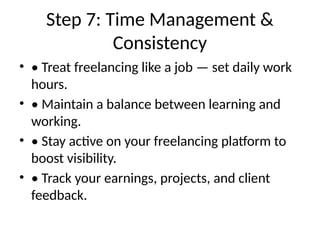
Step 7: TimeManagement &
Consistency
• • Treat freelancing like a job — set daily work
hours.
• • Maintain a balance between learning and
working.
• • Stay active on your freelancing platform to
boost visibility.
• • Track your earnings, projects, and client
feedback.
10.
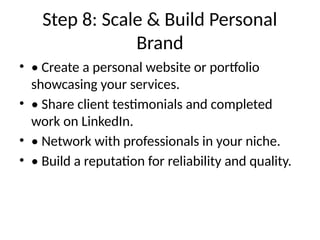
Step 8: Scale& Build Personal
Brand
• • Create a personal website or portfolio
showcasing your services.
• • Share client testimonials and completed
work on LinkedIn.
• • Network with professionals in your niche.
• • Build a reputation for reliability and quality.
11.
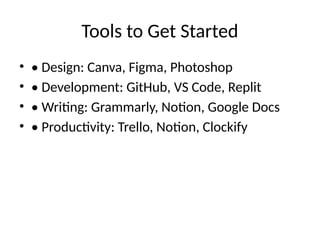
Tools to GetStarted
• • Design: Canva, Figma, Photoshop
• • Development: GitHub, VS Code, Replit
• • Writing: Grammarly, Notion, Google Docs
• • Productivity: Trello, Notion, Clockify
12.
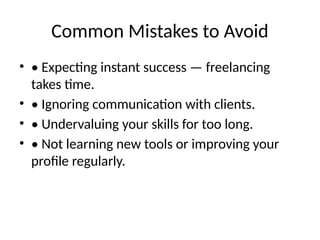
Common Mistakes toAvoid
• • Expecting instant success — freelancing
takes time.
• • Ignoring communication with clients.
• • Undervaluing your skills for too long.
• • Not learning new tools or improving your
profile regularly.
13.
Final Motivation
• Everytop freelancer started with zero
experience.
• Focus on delivering value, learning
continuously, and staying consistent.
• Your skills are your assets — build them, and
success will follow!