Starch Based Polyurethane
Presenter
Muhammad Minhas Azeem
7616
Dept. Applied Chemistry & Biochemistry
Government College University Faisalabad
Polyurethane
Starch
Starch based polyurethane
Advantages
Applications
Drawbacks
References
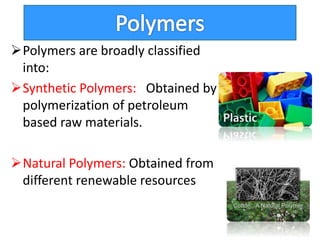
Polymers are broadly classified
into:
Synthetic Polymers: Obtained by
polymerization of petroleum
based raw materials.
Natural Polymers: Obtained from
different renewable resources
 Polyethylene
 Polypropylene
 Polytetrafluoroethylene
(Teflon®)
 Polyvinylchloride
 Polyvinylidenechloride
 Polystyrene
 Polyvinylacetate
 Polymethylmethacrylate
(Plexiglas®)
 Polyacrylonitrile
 Polybutadiene
 Polyisoprene
 Polycarbonate
 Polyester
 Polyamide (nylons)
 Polyurethane
 Polyimide
 Polyureas
 Polysiloxanes
 Polysilanes
 Polyethers
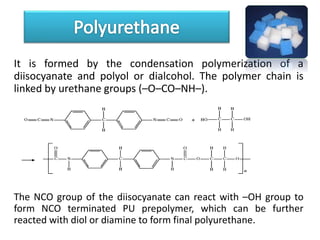
It is formed by the condensation polymerization of a
diisocyanate and polyol or dialcohol. The polymer chain is
linked by urethane groups (–O–CO–NH–).
The NCO group of the diisocyanate can react with –OH group to
form NCO terminated PU prepolymer, which can be further
reacted with diol or diamine to form final polyurethane.
.
Polyurethane foam is used for the thermal
insulation.
If Polyurethane based fine threads combine
with nylon then prepared light weight
stretchable garments.
Polyurethane is used in all parts of the
automobiles for example in seats, doors,
windows and tires.
Polyurethane Soft solid elastomers are used
for gel pads and print rollers
Under the effect of high beam radiations, It
emits toxic fumes, greenhouse gases.
Synthetic PU may cause some health problem
such as allergic reactions, difficulty in breathing.
Most of the PU are biocompatible and some are
not.
PU are not significantly degradable
Polyurethane based products are more
expansive as compared to other materials.
The drawbacks of the polyurethane polymers
can be overcome by the incorporation of
natural polymer into the backbone of synthetic
polymer. The resulting material will have
better mechanical, thermal properties, low
level of toxicity, biodegradable, eco friendly
and biocompatible.
• Polyesters
– Polylactic acid
– Polyhydroxyalkanoates
• Proteins
– Silk
– Soy protein
– Corn protein (zein)
• Polysaccharides
– Xanthan
– Gellan
– Starch
– Chitin
– Chitosan
– Cellulose
– Alginate
• Polyphenols
– Lignin
– Tannin
– Humic acid
• Lipids
– Waxes
– Surfactants
• Specialty polymers
– Shellac
– Natural rubber
– Nylon (from castor oil)
Starch is the principal carbohydrate
storage product of plants
Starch is consists of two types of
molecules.
(i) Linear amylose (20 to 25%)
(ii)Branched amylopectin (75 to80%)
It contain large number of glucose
monomers linked through α (1, 4)
and α (1, 6) glycosidic bonds.
Starch is extracted primarily from corn;
with lesser sources being potatoes, rice,
barley, sorghum, and wheat
Forthcoming slides will give you an overview
about different sources of starch.
.
14
Starch based polyurethane are usually formed by
the copolymerization of thermoplastic starch and
thermoplastic polyurethane.
Poly-addition (a type of condensation
polymerization) reactions are preferred in the
formation of Starch based polyurethane because
no by-products are formed.
The reaction rate of starch urethanization
depends on the nature of the reaction medium,
the kind of isocyanate and the temperature used.
Barikani and Mohammadi (2007) synthesized a
biodegradable polymer. Prepolymer was
prepared by addition of HDI into
polycaprolactone diol. The resultant product is
obtained is NCO terminated prepolymer.
Starch Based Polyurethane
Preparation of polycaprolactone based prepolymer
Preparation of Starch based Polyurethane
FT-IR spectra of prepolymer with Capa225 and HDI a) Capa,
b) prepolymer
FT-IR spectra of (a):Starch,(b): Starch Modified Polyurethane
32
The variation of contact angle with % of grafted prepolymer on starch
contact angle(q)ºPrepolymer on starch
(%)
Sample no.
00Starch
8721
8852
91103
105174
107255
M. Barikani *, M. MohammadiCarbohydrate Polymers, 68 (2007) 773–780
It can be observed that hydrophobicity increases with increasing
amount of prepolymer
(b) (c)
SEM micrographs of (a): Starch, (b): Starch modified urethane ;
( sample no.3), (c): (sample no. 5)
The scanned surface
reveals that starch
granules were
completely covered by
polyurethane.
This criteria confirms
the strong adhesion
between the
polyurethane and
starch granules.
A.L. Da Roz et al(2009) synthesized the cross-linked
starch based PU.
PPO/TDI based PU prepolymer
+ Starch swollen in DMSO,
+DBTDL as catalyst.
 The hydrophilicity of the modified sample was
decreased.
Chemically modified sample has amorphous
structure.
The cross linking produced the change in the
morphology of the starch.
Yongshang Lu et al (2005) synthesized plasticized starch based
waterborne polyurethane.
 First of all rapeseed oil was epoxidized to form epoxidized
rapeseed oil and after some chemical modification rapeseed
oil polyol was prepared.
 The prepared polyol was dispersed with IPDI in the presence
of DMPA and TEA to form water borne PU dispersion. Then
thermoplastic starch which is obtained from wheat was mixed
with the PU dispersion.
Rapeseed oil
CH3 CH2 HC CH CH2 CH CH CH2 CO2 CH2
CH
CH2
CH3 CH2 CH CH CH2 CO2
CH2 CO2CH3 CH2 HC CH
4 7
77
117
CH2 HC CH CH2 CH CH CH2 CO2 CH2
CHCH3 CH2 CH CH CH2 CO2
CH2 CO2
O
CH2 HC CH
O
CH3
CH2CH3
4 7
77
117
HCL
Epoxidized rapeseed oil
CH3 CH2 HC CH CH2 CH CH CH2 CO2 CH2
CH2
CH3 CH2 CH CH CH2 CO2
CH2CH3 CH2 HC CH
Cl
OH
OH
Cl
CH
CO2
4 7
77
117
Rapeseed oil polyol
OUTCOME OF THE STUDY
 Contact angle is increased
 Tensile strength is increased from 2.8 to 4.1 Mpa
 Elongation at break is increased from 84 to 480 %
Toughness is increased from 1.8 to 7.1 MPa
Youngshang Lu et al (2005) modified the TPS with
WPU
Castor oil, IPDI and DMPA based PU prepolymer
Starch, glycerol and water (70:20:10) based TPS
TPS was blended with PU prepolymer to formed
starch based polyurethane
OUTCOME OF THE STUDY
Hydrophobic character is increased
Water absorption and swelling are decreased
Contact angle is increased from 34º to 63º
Young’s modulus is increased from 40 to 75MPa
Yixiang Wang et al (2010) synthesized the WPU composite
reinforced with SN and CW.
 PPG and TDI based WPU matrix
 SN and CW are used as reinforcement
The mechanical properties of the composite increased by
incorporation of the nanofillers such as
 Tensile strength is increased 252%
 Elongation at break is increased 136%
 Young’s modulus is increased 135%
Xiaodong Cao et al (2008) modified the PS with
poly(ε-caprolactone) based WPU.
 PCL, IPDI and DMPA based prepolymer
 Starch, glycerol and water(7:3:90) were used to form PS
OUTCOME OF THE STUDY
 Amorphous character is increased
 Hydrophobicity is increased
 Tensile strength is increased from 2.4 to 3.9 MPa
 Elongation at break is increased from 35% to 886%
Seung-kyu Ha et al(2002) synthesized the
blend of polyurethane and starch granules.
PCL and MDI based prepolymer
+ Starch granules
+ DBTDL catalyst
OUTCOME OF THE STUDY
Tg is increased
Swelling character is decreased
Mechanical properties are also increased
MODIFICATION OF PU BY INCORPORATING
STARCH GRANULES
Guangjun Chen et al (2008) introduced the new
nanocomposites of WPU reinforced with StNs.
 PBA and TDI based PU matrix
 + Starch nanocrystals
OUTCOME OF THE STUDY
Elongation at break is increased 1406%
Tensile strength is increased 28 to 51 MPa
Tg is also increased
 The powdered starch based
polyurethane is used for surgical gloves
as non sticking powder.
 The starch based polyurethane is used
for culture growth of Penicillium
expansum and Aspergillus oryzae.
 Starch-polyurethane blend is
also used in formation of foams.
It is biodegradable and not
harmful for terrestrial and
aquatic life.
The films formed by starch
based polyurethane are used
in the food packaging because
they are colorless, odorless,
tasteless and non toxic.
 It is used in agriculture for
controlled release of fertilizer
and its films are used to cover
the greenhouse.
It is also used in the medical field because is
biocompatible, better mechanical properties
and the products produced after their
degradation are non toxic in nature.
This material provides information about the
formation of biodegradable polymer from the
renewable resources, improves their properties and
the modified polymers are recyclable, biodegradable
and also have large number of applications such as in
medical field and fertilizer industry.
1. Barikani M., Mohammadi M. (2007). Synthesis and characterization of starch
modified polyurethane, Carbohydrate Polymer.68:773-780.
2. Kugler S. (2010). Trend in development of biodegradable starch and
polyurethane materials, Science techniques.64:7-8,531-538.
3. Santayanon R., Wootthikanokkan J. (2003). Modification of cassava starch by
using propionic anhydride and properties of the starch-blended polyester
polyurethane, Carbohydrate Polymer.51:17-24.
4. Lu Y., Tighzert L., Dole P., Erre D. (2005). Preparation and properties of starch
thermoplastics modified by waterborne polyurethane from renewable resources,
Polymer.46:9863-9870.
5. Ha S.K., Broecker H.C. (2002).Characteristics of polyurethane incorporating starch
granules, Polymer.43:5227-5234.
6. Da Roz A L., Curelo A.A.S., Gandini A.(2009). Preparation and characterization of
cross-linked starch polyurethane, Carbohydrate Polymer.77:526-529.
7. Chen G., Wei M., Chen J., Dufresne., Chang P R.(2008). Simultaneous reinforcing
and toughening: New nanocomposites of waterborne polyurethane filled with
low loading level of starch nanocrystals, Polymer.49:1860-1870.
8. Cao X., Chang P R., Huneault M. A.(2008).preparation and properties of plastized
starch modified with poly(ε-caprolactone) based waterborne polyurethane,
CarbohydratenPolymer.91:119-125.
9. Lu Y., Tighzert L.,Berzin F., Rondot S.(2005). Innovative plasticized starch film
modifed with waterborne polyurethane from renewable resources,
Carbohydrate Polymer.61:174-182.
10. Wang Y., Tian H., Zhang L.(2010). Role of starch nanocrystals and cellulose
whiskers in synergistic reinforcement of waterborne polyurethane,
Carbhohydrate Polymer.80:665-671.
11. Zia K M., Barikani M., Bhatti I J., Zuber M.(2008). Synthetic and
thermomechanical characterization of polyurethanen elastomer extended with
α,ω- Alkane diol, Applied Polymer Science.109:1840-1849.
12. Wang Y., Lue A., Zhang L.(2008). Rheological behaviour of waterborne
polyurethane/starch aqeous dispersion during cure, Polymer.50:5474-5481.
13. Spychaj T., Wilpiszewska., Spychaj S.(2007). Starch-urethane polymer
phesicochemical aspects,properties, appliccation, Engineering biopolymer:
Homopolymer blend and composites:155-165.
14. Alfani R., Iannace S., Nicolais L.(1998) Synthesis and characterization of starch-
based polyurethane fomes, Applied polymer Science.68:739-745.
References
.

Starch based polyurethane

  • 1.
    Starch Based Polyurethane Presenter MuhammadMinhas Azeem 7616 Dept. Applied Chemistry & Biochemistry Government College University Faisalabad
  • 2.
  • 3.
    Polymers are broadlyclassified into: Synthetic Polymers: Obtained by polymerization of petroleum based raw materials. Natural Polymers: Obtained from different renewable resources
  • 4.
     Polyethylene  Polypropylene Polytetrafluoroethylene (Teflon®)  Polyvinylchloride  Polyvinylidenechloride  Polystyrene  Polyvinylacetate  Polymethylmethacrylate (Plexiglas®)  Polyacrylonitrile  Polybutadiene  Polyisoprene  Polycarbonate  Polyester  Polyamide (nylons)  Polyurethane  Polyimide  Polyureas  Polysiloxanes  Polysilanes  Polyethers
  • 5.
    It is formedby the condensation polymerization of a diisocyanate and polyol or dialcohol. The polymer chain is linked by urethane groups (–O–CO–NH–). The NCO group of the diisocyanate can react with –OH group to form NCO terminated PU prepolymer, which can be further reacted with diol or diamine to form final polyurethane.
  • 6.
  • 7.
    Polyurethane foam isused for the thermal insulation. If Polyurethane based fine threads combine with nylon then prepared light weight stretchable garments. Polyurethane is used in all parts of the automobiles for example in seats, doors, windows and tires. Polyurethane Soft solid elastomers are used for gel pads and print rollers
  • 8.
    Under the effectof high beam radiations, It emits toxic fumes, greenhouse gases. Synthetic PU may cause some health problem such as allergic reactions, difficulty in breathing. Most of the PU are biocompatible and some are not. PU are not significantly degradable Polyurethane based products are more expansive as compared to other materials.
  • 9.
    The drawbacks ofthe polyurethane polymers can be overcome by the incorporation of natural polymer into the backbone of synthetic polymer. The resulting material will have better mechanical, thermal properties, low level of toxicity, biodegradable, eco friendly and biocompatible.
  • 10.
    • Polyesters – Polylacticacid – Polyhydroxyalkanoates • Proteins – Silk – Soy protein – Corn protein (zein) • Polysaccharides – Xanthan – Gellan – Starch – Chitin – Chitosan – Cellulose – Alginate • Polyphenols – Lignin – Tannin – Humic acid • Lipids – Waxes – Surfactants • Specialty polymers – Shellac – Natural rubber – Nylon (from castor oil)
  • 11.
    Starch is theprincipal carbohydrate storage product of plants Starch is consists of two types of molecules. (i) Linear amylose (20 to 25%) (ii)Branched amylopectin (75 to80%) It contain large number of glucose monomers linked through α (1, 4) and α (1, 6) glycosidic bonds.
  • 12.
    Starch is extractedprimarily from corn; with lesser sources being potatoes, rice, barley, sorghum, and wheat Forthcoming slides will give you an overview about different sources of starch.
  • 13.
  • 14.
  • 18.
    Starch based polyurethaneare usually formed by the copolymerization of thermoplastic starch and thermoplastic polyurethane. Poly-addition (a type of condensation polymerization) reactions are preferred in the formation of Starch based polyurethane because no by-products are formed. The reaction rate of starch urethanization depends on the nature of the reaction medium, the kind of isocyanate and the temperature used.
  • 19.
    Barikani and Mohammadi(2007) synthesized a biodegradable polymer. Prepolymer was prepared by addition of HDI into polycaprolactone diol. The resultant product is obtained is NCO terminated prepolymer. Starch Based Polyurethane
  • 20.
  • 21.
    Preparation of Starchbased Polyurethane
  • 22.
    FT-IR spectra ofprepolymer with Capa225 and HDI a) Capa, b) prepolymer
  • 23.
    FT-IR spectra of(a):Starch,(b): Starch Modified Polyurethane 32
  • 24.
    The variation ofcontact angle with % of grafted prepolymer on starch contact angle(q)ºPrepolymer on starch (%) Sample no. 00Starch 8721 8852 91103 105174 107255 M. Barikani *, M. MohammadiCarbohydrate Polymers, 68 (2007) 773–780 It can be observed that hydrophobicity increases with increasing amount of prepolymer
  • 25.
    (b) (c) SEM micrographsof (a): Starch, (b): Starch modified urethane ; ( sample no.3), (c): (sample no. 5) The scanned surface reveals that starch granules were completely covered by polyurethane. This criteria confirms the strong adhesion between the polyurethane and starch granules.
  • 26.
    A.L. Da Rozet al(2009) synthesized the cross-linked starch based PU. PPO/TDI based PU prepolymer + Starch swollen in DMSO, +DBTDL as catalyst.
  • 27.
     The hydrophilicityof the modified sample was decreased. Chemically modified sample has amorphous structure. The cross linking produced the change in the morphology of the starch.
  • 28.
    Yongshang Lu etal (2005) synthesized plasticized starch based waterborne polyurethane.  First of all rapeseed oil was epoxidized to form epoxidized rapeseed oil and after some chemical modification rapeseed oil polyol was prepared.  The prepared polyol was dispersed with IPDI in the presence of DMPA and TEA to form water borne PU dispersion. Then thermoplastic starch which is obtained from wheat was mixed with the PU dispersion. Rapeseed oil CH3 CH2 HC CH CH2 CH CH CH2 CO2 CH2 CH CH2 CH3 CH2 CH CH CH2 CO2 CH2 CO2CH3 CH2 HC CH 4 7 77 117
  • 29.
    CH2 HC CHCH2 CH CH CH2 CO2 CH2 CHCH3 CH2 CH CH CH2 CO2 CH2 CO2 O CH2 HC CH O CH3 CH2CH3 4 7 77 117 HCL Epoxidized rapeseed oil CH3 CH2 HC CH CH2 CH CH CH2 CO2 CH2 CH2 CH3 CH2 CH CH CH2 CO2 CH2CH3 CH2 HC CH Cl OH OH Cl CH CO2 4 7 77 117 Rapeseed oil polyol
  • 30.
    OUTCOME OF THESTUDY  Contact angle is increased  Tensile strength is increased from 2.8 to 4.1 Mpa  Elongation at break is increased from 84 to 480 % Toughness is increased from 1.8 to 7.1 MPa
  • 31.
    Youngshang Lu etal (2005) modified the TPS with WPU Castor oil, IPDI and DMPA based PU prepolymer Starch, glycerol and water (70:20:10) based TPS TPS was blended with PU prepolymer to formed starch based polyurethane
  • 32.
    OUTCOME OF THESTUDY Hydrophobic character is increased Water absorption and swelling are decreased Contact angle is increased from 34º to 63º Young’s modulus is increased from 40 to 75MPa
  • 33.
    Yixiang Wang etal (2010) synthesized the WPU composite reinforced with SN and CW.  PPG and TDI based WPU matrix  SN and CW are used as reinforcement The mechanical properties of the composite increased by incorporation of the nanofillers such as  Tensile strength is increased 252%  Elongation at break is increased 136%  Young’s modulus is increased 135%
  • 34.
    Xiaodong Cao etal (2008) modified the PS with poly(ε-caprolactone) based WPU.  PCL, IPDI and DMPA based prepolymer  Starch, glycerol and water(7:3:90) were used to form PS OUTCOME OF THE STUDY  Amorphous character is increased  Hydrophobicity is increased  Tensile strength is increased from 2.4 to 3.9 MPa  Elongation at break is increased from 35% to 886%
  • 35.
    Seung-kyu Ha etal(2002) synthesized the blend of polyurethane and starch granules. PCL and MDI based prepolymer + Starch granules + DBTDL catalyst OUTCOME OF THE STUDY Tg is increased Swelling character is decreased Mechanical properties are also increased MODIFICATION OF PU BY INCORPORATING STARCH GRANULES
  • 36.
    Guangjun Chen etal (2008) introduced the new nanocomposites of WPU reinforced with StNs.  PBA and TDI based PU matrix  + Starch nanocrystals OUTCOME OF THE STUDY Elongation at break is increased 1406% Tensile strength is increased 28 to 51 MPa Tg is also increased
  • 38.
     The powderedstarch based polyurethane is used for surgical gloves as non sticking powder.  The starch based polyurethane is used for culture growth of Penicillium expansum and Aspergillus oryzae.
  • 39.
     Starch-polyurethane blendis also used in formation of foams. It is biodegradable and not harmful for terrestrial and aquatic life.
  • 40.
    The films formedby starch based polyurethane are used in the food packaging because they are colorless, odorless, tasteless and non toxic.  It is used in agriculture for controlled release of fertilizer and its films are used to cover the greenhouse.
  • 41.
    It is alsoused in the medical field because is biocompatible, better mechanical properties and the products produced after their degradation are non toxic in nature.
  • 43.
    This material providesinformation about the formation of biodegradable polymer from the renewable resources, improves their properties and the modified polymers are recyclable, biodegradable and also have large number of applications such as in medical field and fertilizer industry.
  • 44.
    1. Barikani M.,Mohammadi M. (2007). Synthesis and characterization of starch modified polyurethane, Carbohydrate Polymer.68:773-780. 2. Kugler S. (2010). Trend in development of biodegradable starch and polyurethane materials, Science techniques.64:7-8,531-538. 3. Santayanon R., Wootthikanokkan J. (2003). Modification of cassava starch by using propionic anhydride and properties of the starch-blended polyester polyurethane, Carbohydrate Polymer.51:17-24. 4. Lu Y., Tighzert L., Dole P., Erre D. (2005). Preparation and properties of starch thermoplastics modified by waterborne polyurethane from renewable resources, Polymer.46:9863-9870. 5. Ha S.K., Broecker H.C. (2002).Characteristics of polyurethane incorporating starch granules, Polymer.43:5227-5234. 6. Da Roz A L., Curelo A.A.S., Gandini A.(2009). Preparation and characterization of cross-linked starch polyurethane, Carbohydrate Polymer.77:526-529. 7. Chen G., Wei M., Chen J., Dufresne., Chang P R.(2008). Simultaneous reinforcing and toughening: New nanocomposites of waterborne polyurethane filled with low loading level of starch nanocrystals, Polymer.49:1860-1870.
  • 45.
    8. Cao X.,Chang P R., Huneault M. A.(2008).preparation and properties of plastized starch modified with poly(ε-caprolactone) based waterborne polyurethane, CarbohydratenPolymer.91:119-125. 9. Lu Y., Tighzert L.,Berzin F., Rondot S.(2005). Innovative plasticized starch film modifed with waterborne polyurethane from renewable resources, Carbohydrate Polymer.61:174-182. 10. Wang Y., Tian H., Zhang L.(2010). Role of starch nanocrystals and cellulose whiskers in synergistic reinforcement of waterborne polyurethane, Carbhohydrate Polymer.80:665-671. 11. Zia K M., Barikani M., Bhatti I J., Zuber M.(2008). Synthetic and thermomechanical characterization of polyurethanen elastomer extended with α,ω- Alkane diol, Applied Polymer Science.109:1840-1849. 12. Wang Y., Lue A., Zhang L.(2008). Rheological behaviour of waterborne polyurethane/starch aqeous dispersion during cure, Polymer.50:5474-5481. 13. Spychaj T., Wilpiszewska., Spychaj S.(2007). Starch-urethane polymer phesicochemical aspects,properties, appliccation, Engineering biopolymer: Homopolymer blend and composites:155-165. 14. Alfani R., Iannace S., Nicolais L.(1998) Synthesis and characterization of starch- based polyurethane fomes, Applied polymer Science.68:739-745. References
  • 46.