Introduction
to
Business
Writing
Lessons
• Lesson 1: Overview
• Lesson 2: What is good business writing?
• Lesson 3: Who are our readers?
• Lesson 4: Using structure effectively
• Lesson 5: Grammar and style
• Lesson 6: Using language effectively
Lesson 1: Overview
Module objectives
• Meet the needs of different types of
readers
• Use structure and language effectively
• Avoid unnecessary risk in writing
• Adhere to corporate’s writing style
Lesson 1 summary
Questions?
Lesson 2: What is good business
writing?
Lesson 2 objectives
• Identify the differences between clear and
unclear writing
• Define the attributes of good business writing
• Explain the importance of good business
writing
Activity 2.1: Which report on
finding do you prefer?
Objective: To explore what good business writing is by comparing different
types of writing
Time: 15 minutes
Directions:
– Read both versions in PM 2.1, Activity 2.1: Which report on findings do you
prefer?
– Determine the version you prefer
– Work with your team to determine why you prefer the version
you selected and not the other
– List your reasons for liking your preference and disliking the other
version on flip chart paper
– Present your reasons to the class
Activity 2.2: Reviewing client feedback
Objective: To explore the impact of our writing on our
clients
Time: 5 minutes
Directions:
– Read PM 2.2, Activity 2.2: Reviewing client feedback —
client feedback letter
– Reflect on what our clients want and expect from us as
writers
Why clear writing is important
• Our writing is one of our key activities and
outputs
• We are more productive if we write efficiently
• When our writing focuses on our reader’s
needs, we strengthen our brand and
reputation
• Clear writing reflects on you personally
Lesson 2 summary
Questions?
Lesson 3: Who are our readers?
Lesson 3 objectives
• Identify the different types of readers
• Describe the needs of different readers
• Explain how to meet the needs of different
readers
Preparing to write
Types of documents you might write
• Reports for clients
• Emails and letters
– Internal
– External
• Internal status reports
• Descriptions of process flows
• Management letters
• Analytics
• Findings
• Recommendations
• Manuals
Your role in writing these documents
might include:
• Requesting, gathering and organizing information
• Preparing arguments
• Drafting sections of reports
• Summarizing information
• Interpreting/making assumptions from data and
writing some narrative about it
• Formatting
• Indexing
• Cross-referencing
• Proofreading
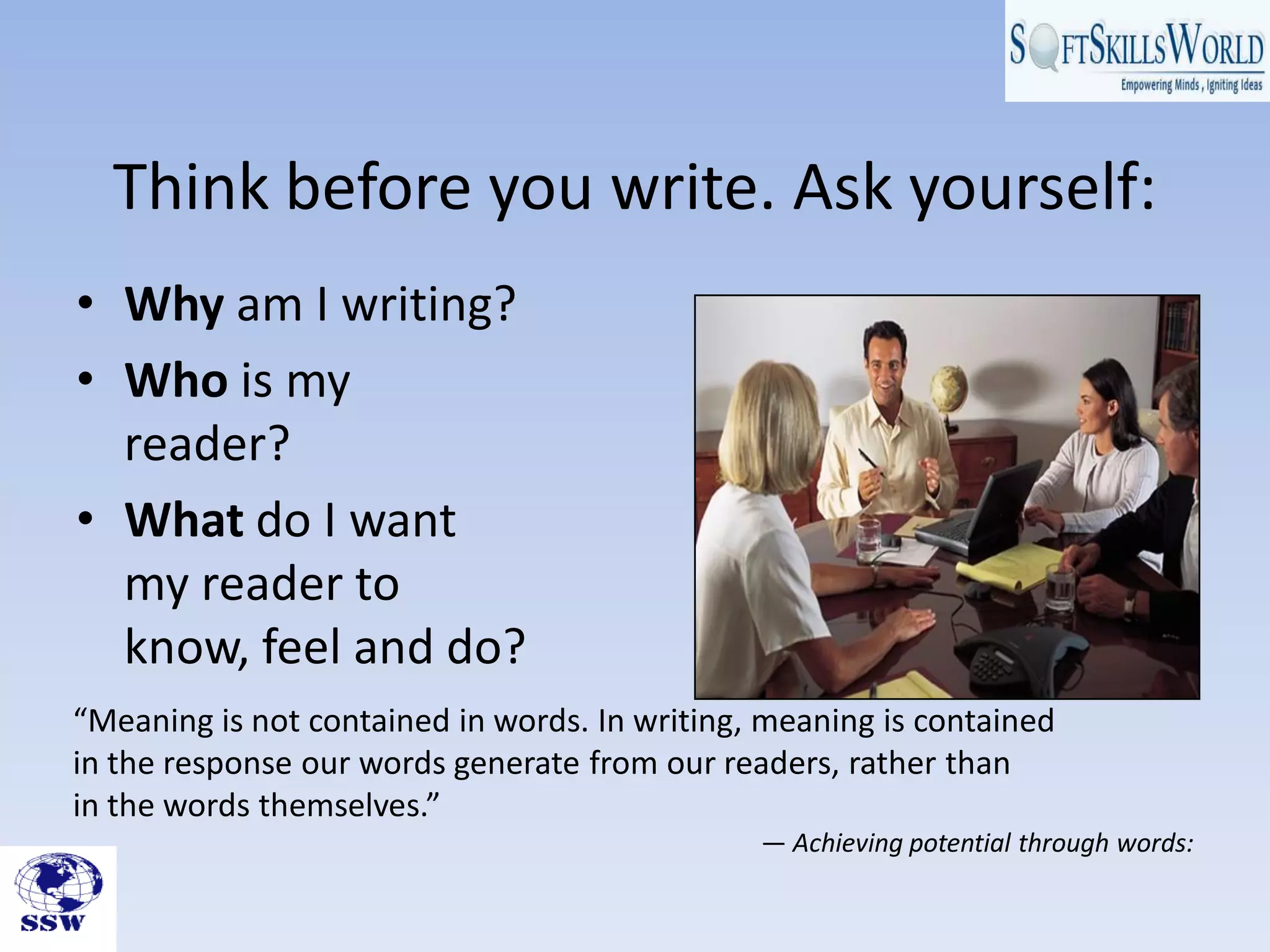
Think before you write. Ask yourself:
• Why am I writing?
• Who is my
reader?
• What do I want
my reader to
know, feel and do?
“Meaning is not contained in words. In writing, meaning is contained
in the response our words generate from our readers, rather than
in the words themselves.”
— Achieving potential through words:
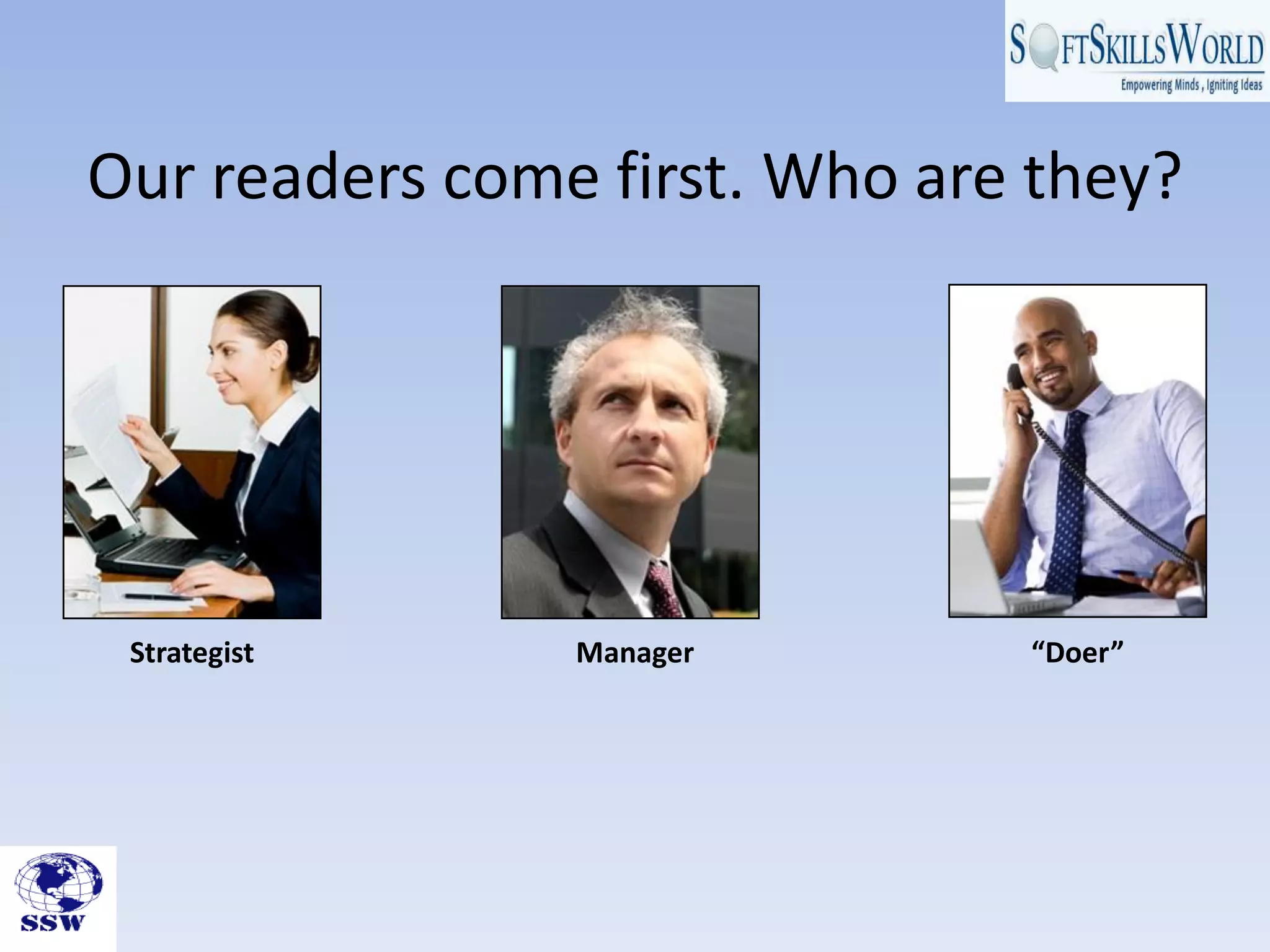
Our readers come first. Who are they?
Strategist Manager “Doer”
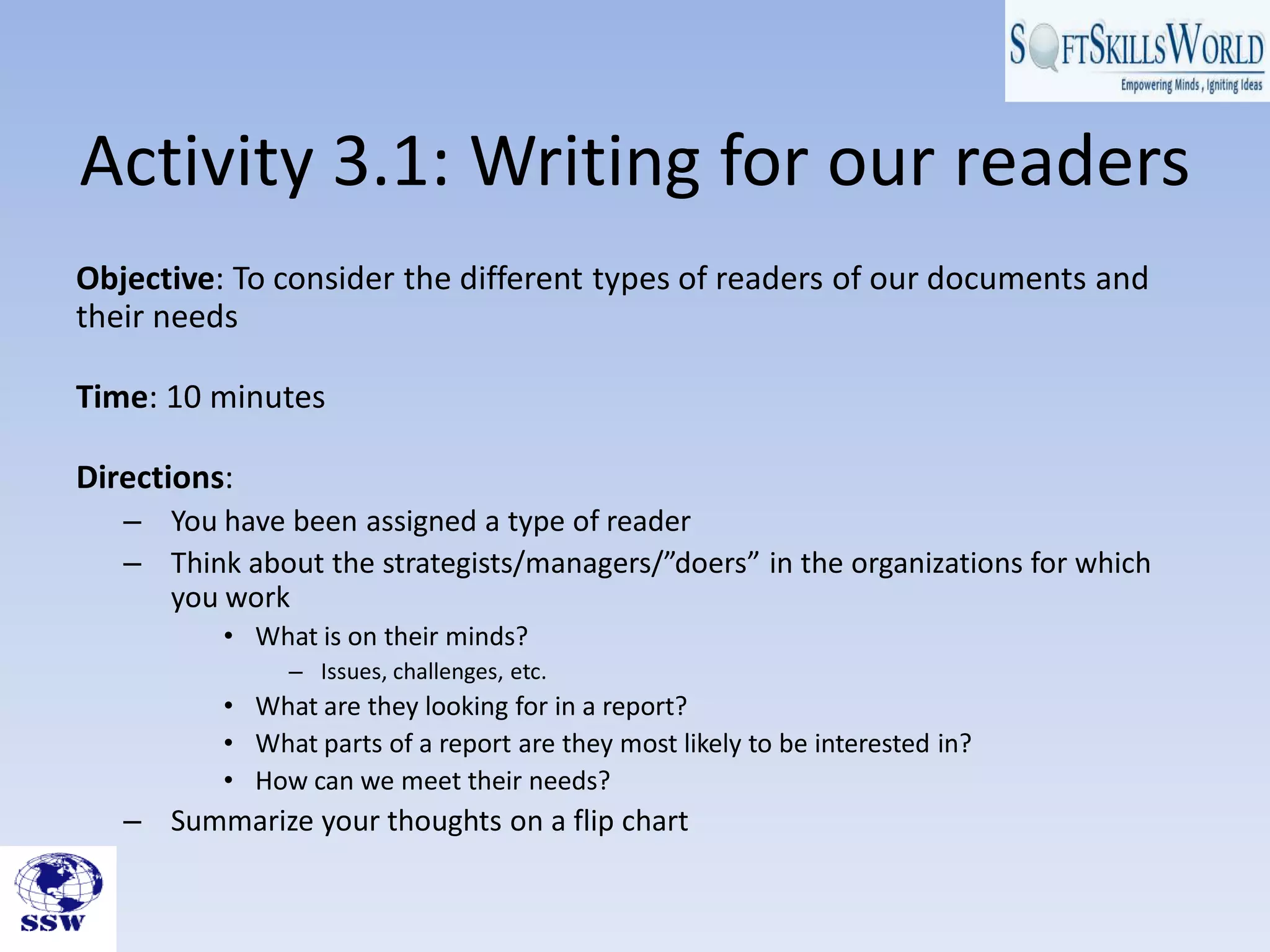
Activity 3.1: Writing for our readers
Objective: To consider the different types of readers of our documents and
their needs
Time: 10 minutes
Directions:
– You have been assigned a type of reader
– Think about the strategists/managers/”doers” in the organizations for which
you work
• What is on their minds?
– Issues, challenges, etc.
• What are they looking for in a report?
• What parts of a report are they most likely to be interested in?
• How can we meet their needs?
– Summarize your thoughts on a flip chart
Lesson 3 summary
Questions?
Lesson 4: Using structure effectively
Lesson 4 objectives
• Explain how effective writing helps strengthen
your corporate’s brand and reputation
• Identify the six elements of effective writing
• Create a well-structured paragraph
Writing to strengthen our brand
The Achieving Potential principles
• Engage proactively
• Make the complex clear
• Integrate diverse perspectives
• Always ask “what is next?”
Clear writing
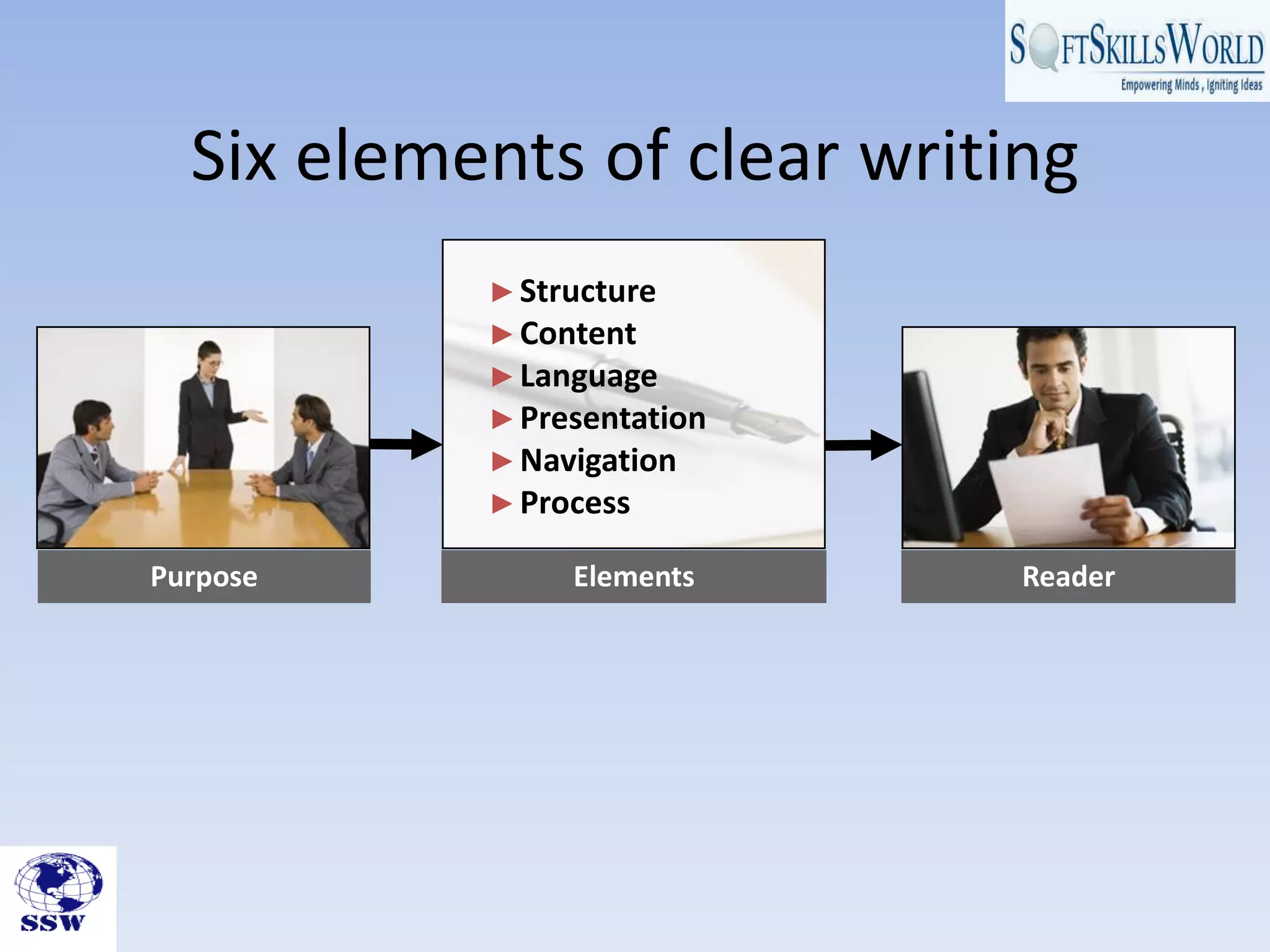
Six elements of clear writing
Elements
►Structure
►Content
►Language
►Presentation
►Navigation
►Process
Purpose Reader
Structure is also important for
clear writing
► What is the purpose of structure?
► Provides a framework
► Gives form to thoughts
► Drives the narrative
Activity 4.1: Structuring paragraphs
Objective: To practice structuring paragraphs
Time: 15 minutes
Directions:
– Work with your team to sort the sentences into two
paragraphs
– Put the sentences in the correct order
– Then put the paragraphs in the correct order
– Tape them to your flip chart
Lesson 4 summary
Questions?
Lesson 5: Grammar and style
• Identify some of the grammatical errors
people frequently make and how to correct
them
• Correct text so it conforms to corporate
global writing style
• Edit writing so it avoids exposing your
corporate to unnecessary risk
Lesson 5 objectives
Activity 5.1: Spot the deliberate
mistake
Objective: To spot and correct common mistakes in
grammar and usage
Time: 15 minutes
Directions:
– Refer to PM 5.1, Activity 5.1: Spot the deliberate mistake
– Work through the items in the document, adding the
correct answers over the items provided, as if editing the
copy
Corporate global writing style
► Presents a consistent image globally
► corporate style guidance:
► Achieving potential through words: corporate global writing and
style guide
► A brief guide to writing for corporate
Activity 5.2: Writing in corporate
global style
Objective: To spot and correct text to meet corporate writing style
Time: 15 minutes
Directions:
– Refer to PM 5.3, Activity 5.2: Writing in corporate global style for detailed directions
– Work through the items in the document, correcting the items, as if editing the copy
– Refer to PM 5.2, A brief guide to writing for corporate
for help
– Be prepared to share the corporate writing style guideline you used to
make the corrections
Avoiding unnecessary risk in our
writing
Our words can expose corporate to
unnecessary risk
• Avoid language that may be difficult to prove in court
• Ask yourself if you can offer substantive evidence of your
claim
• Do not over-promise or lead a client to expect a result that
is greater than, or different from, what we expect to deliver
• Avoid making promises — expressed or implied — of
certain outcomes, results or value
• Avoid implying corporate will either take responsibility for
or implement suggested approaches, or make decisions
that are the responsibility of client management
Activity 5.3: Reducing unnecessary
risk in our writing
Objective: To practice using language in a way that
protects corporate
Time: 20 minutes
Directions:
– Work in pairs
– Read through the statements in PM 5.5, Activity 5.3: Reducing
unnecessary risk in our writing
– Look for any statements that you think would expose corporate to
unnecessary risk
– Rewrite the statements to reduce the risk
Lesson 5 summary
Questions?
Lesson 6: Using language
effectively
Lesson 6 objectives
• Identify ways to use language clearly and
effectively within the context of our work
• Rewrite text so it is easier to read
Writing in clear English
The six rules of writing in clear English
• Write your verbs in the active, not passive, form
• Prefer verbs to nouns
• Use “you” and “we”
• Keep sentences short and simple in structure
• Use everyday words
• Remove redundant words
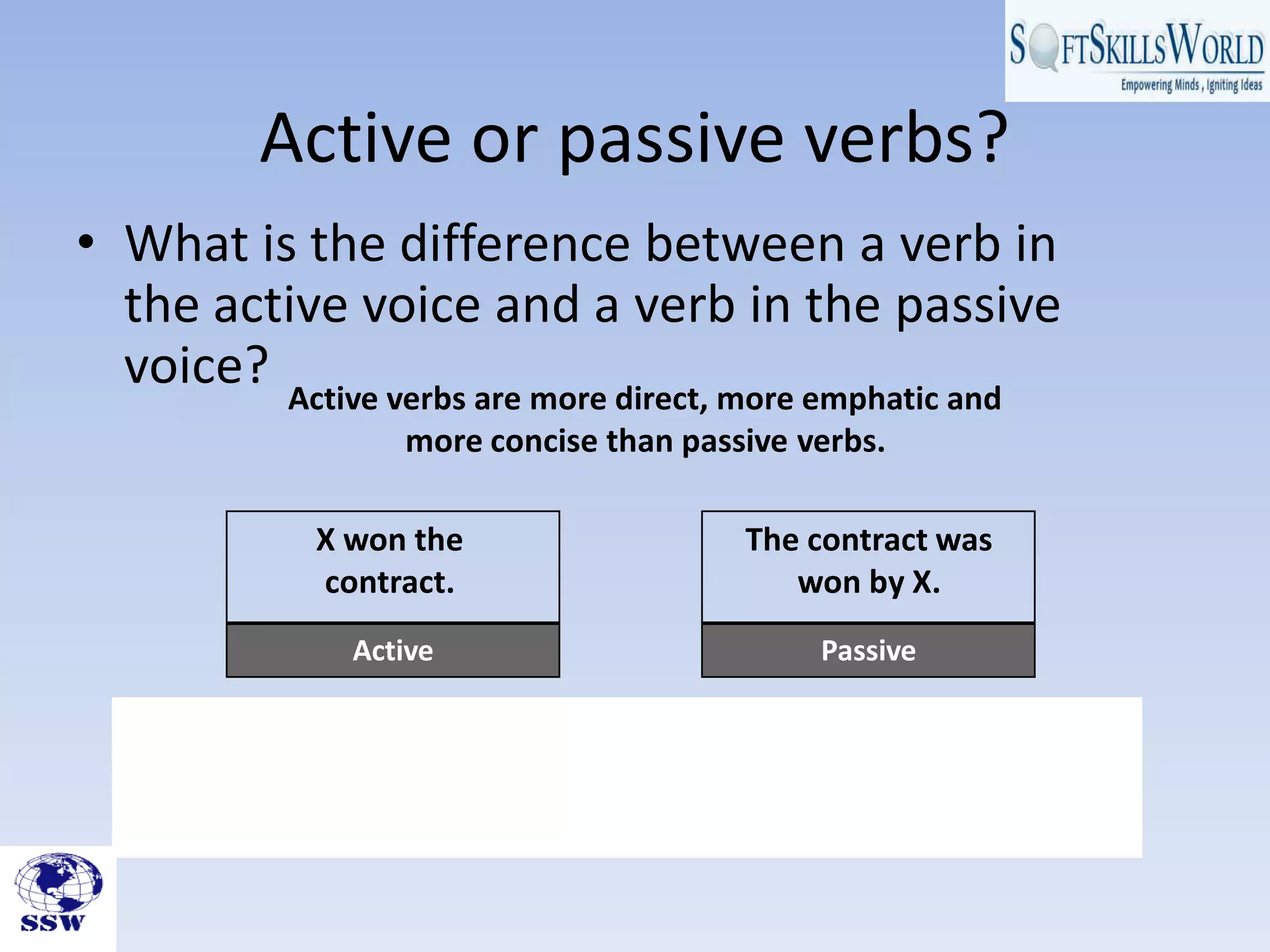
Active or passive verbs?
• What is the difference between a verb in
the active voice and a verb in the passive
voice? Active verbs are more direct, more emphatic and
more concise than passive verbs.
Active Passive
X won the
contract.
The contract was
won by X.
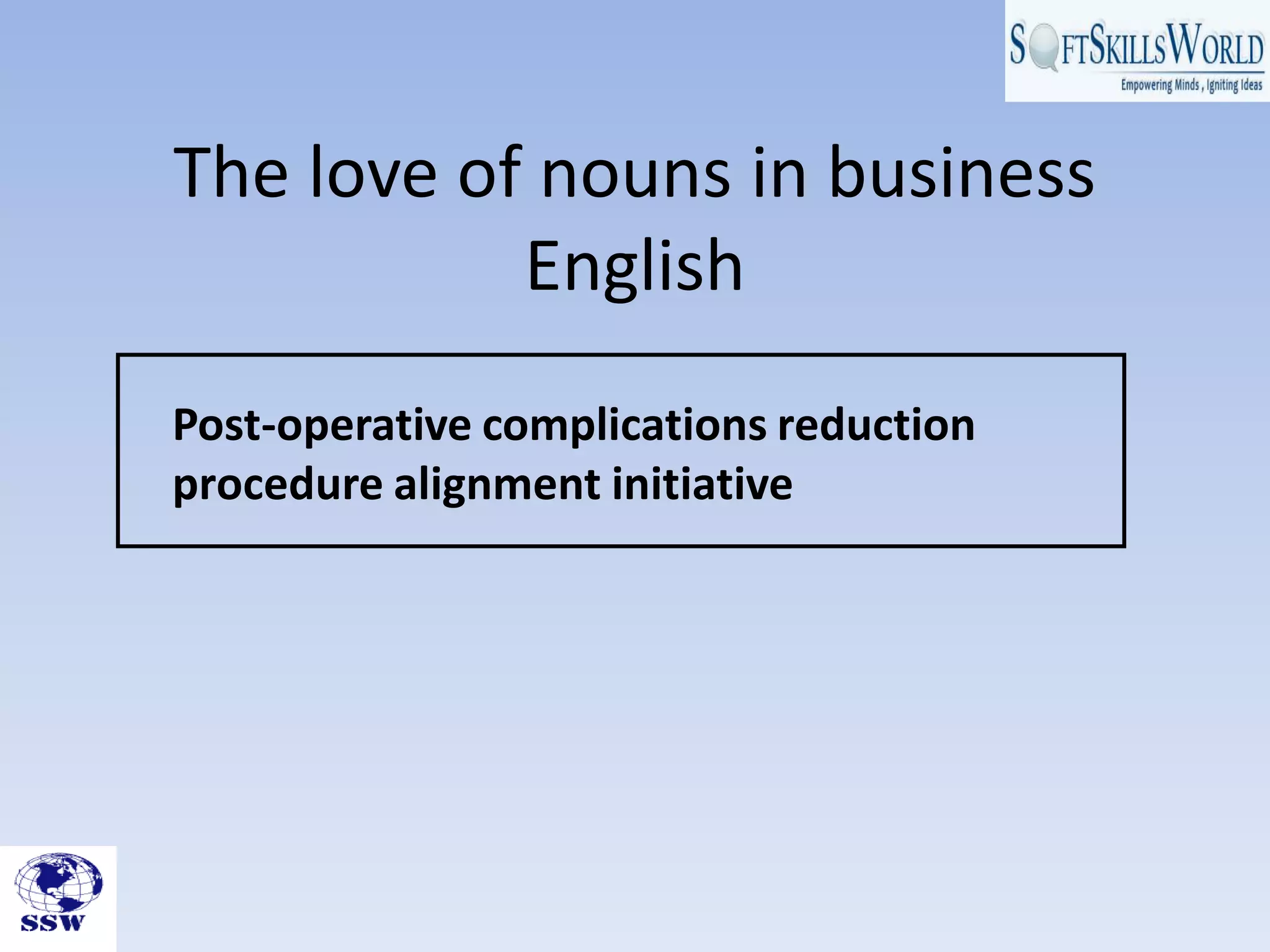
The love of nouns in business
English
Post-operative complications reduction
procedure alignment initiative
Nominalization
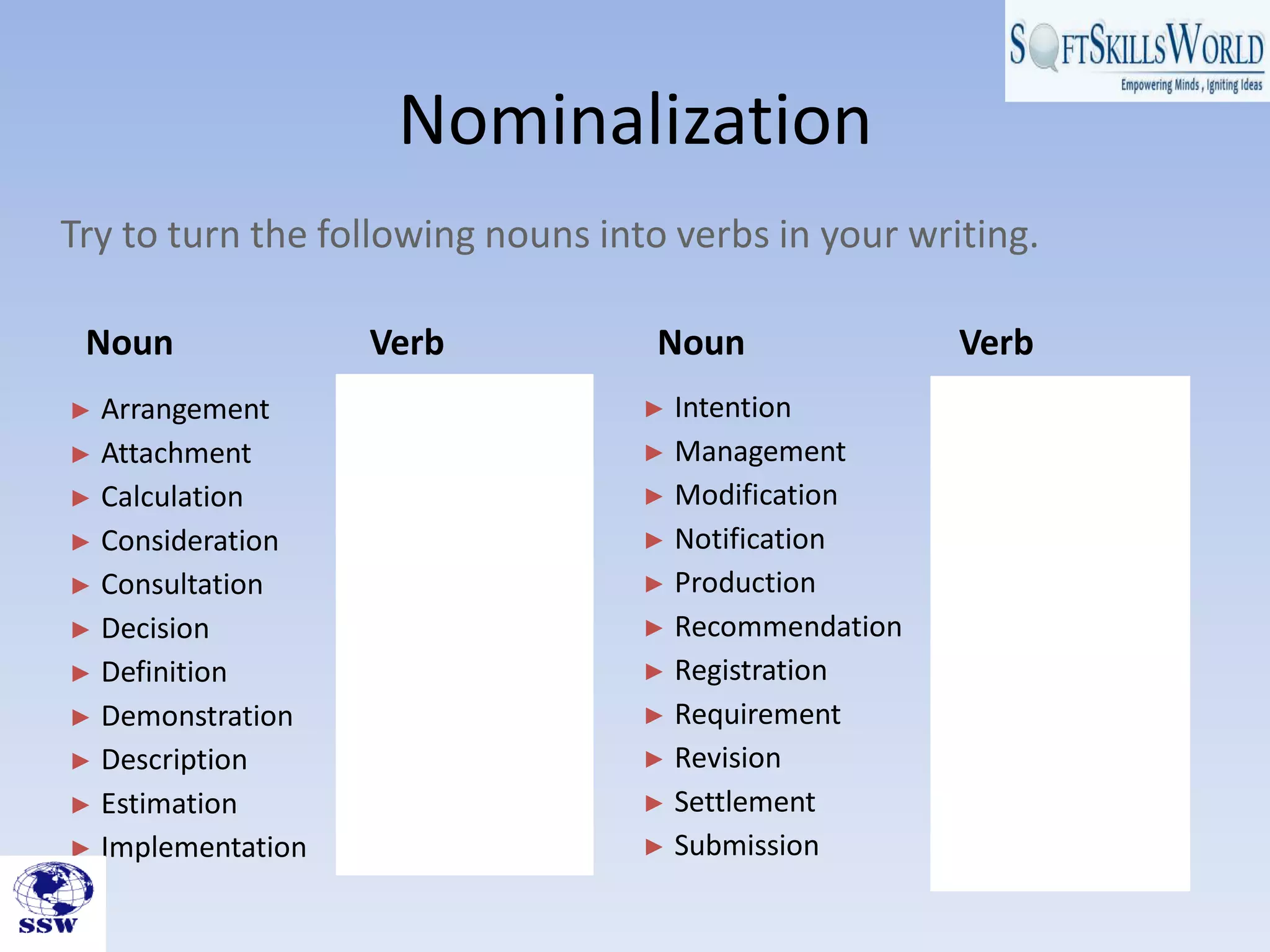
Try to turn the following nouns into verbs in your writing.
► Arrangement
► Attachment
► Calculation
► Consideration
► Consultation
► Decision
► Definition
► Demonstration
► Description
► Estimation
► Implementation
► Arrange
► Attach
► Calculate
► Consider
► Consult
► Decide
► Define
► Demonstrate
► Describe
► Estimate
► Implement
► Intention
► Management
► Modification
► Notification
► Production
► Recommendation
► Registration
► Requirement
► Revision
► Settlement
► Submission
► Intend
► Manage
► Modify
► Notify
► Produce
► Recommend
► Register
► Require
► Revise
► Settle
► Submit
Noun Noun VerbVerb
“You” and “we”
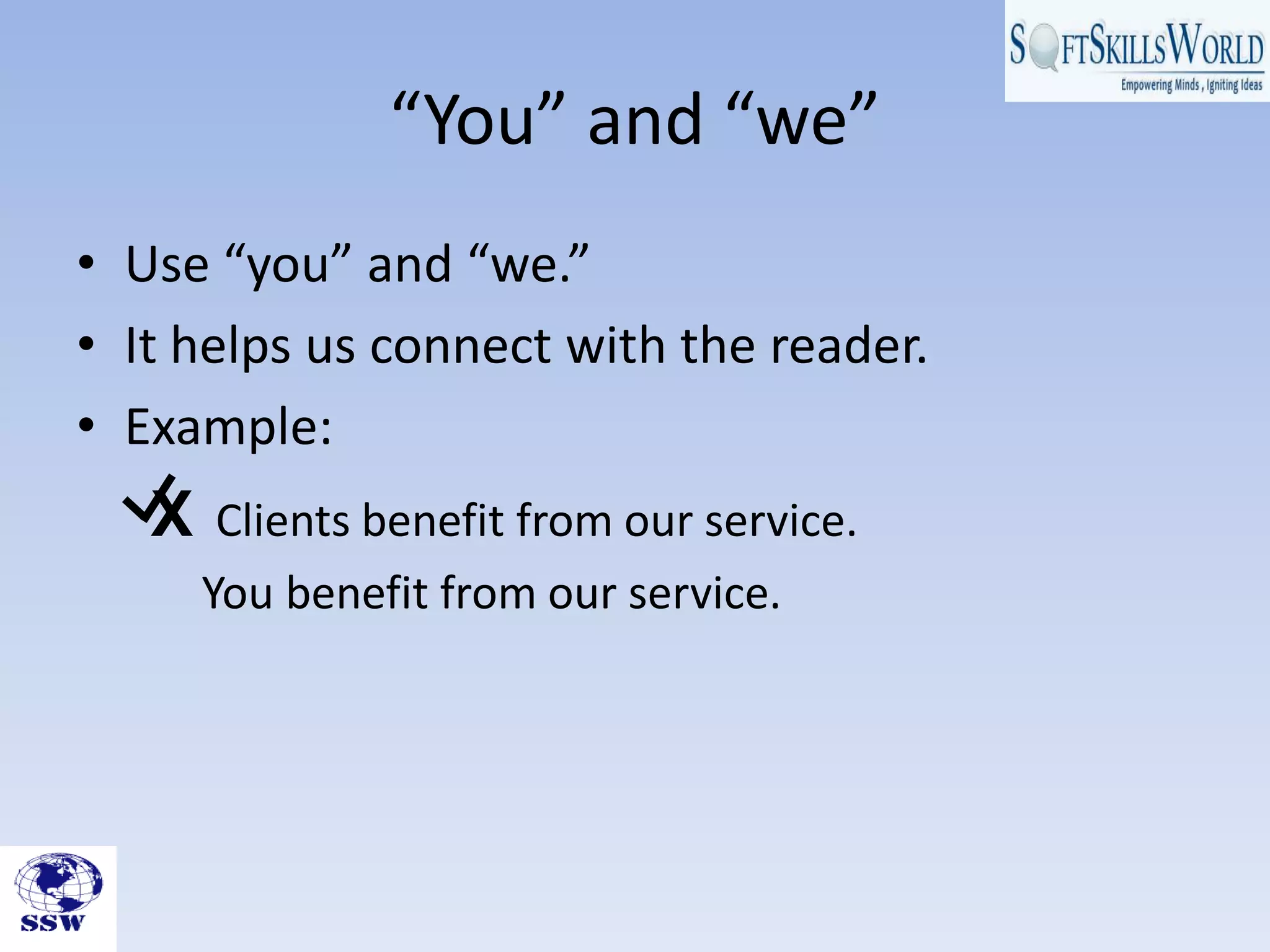
• Use “you” and “we.”
• It helps us connect with the reader.
• Example:
X Clients benefit from our service.
You benefit from our service.
Clear English alternatives
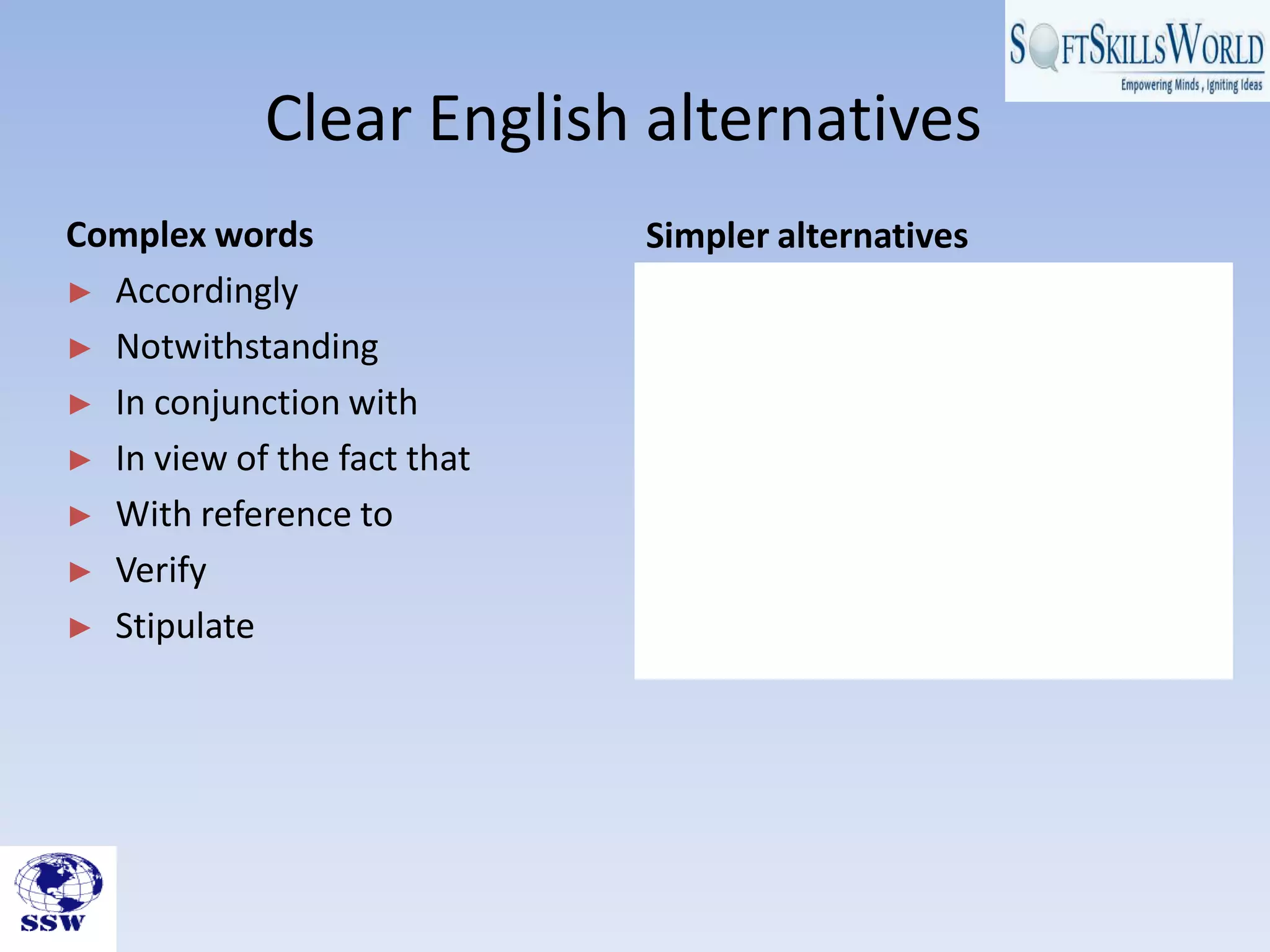
Simpler alternatives
• So
• Even if, despite, still, yet, but
• With
• As, because
• About, concerning
• Check, prove
• State, set, lay down
Complex words
► Accordingly
► Notwithstanding
► In conjunction with
► In view of the fact that
► With reference to
► Verify
► Stipulate
Unnecessary words and phrases
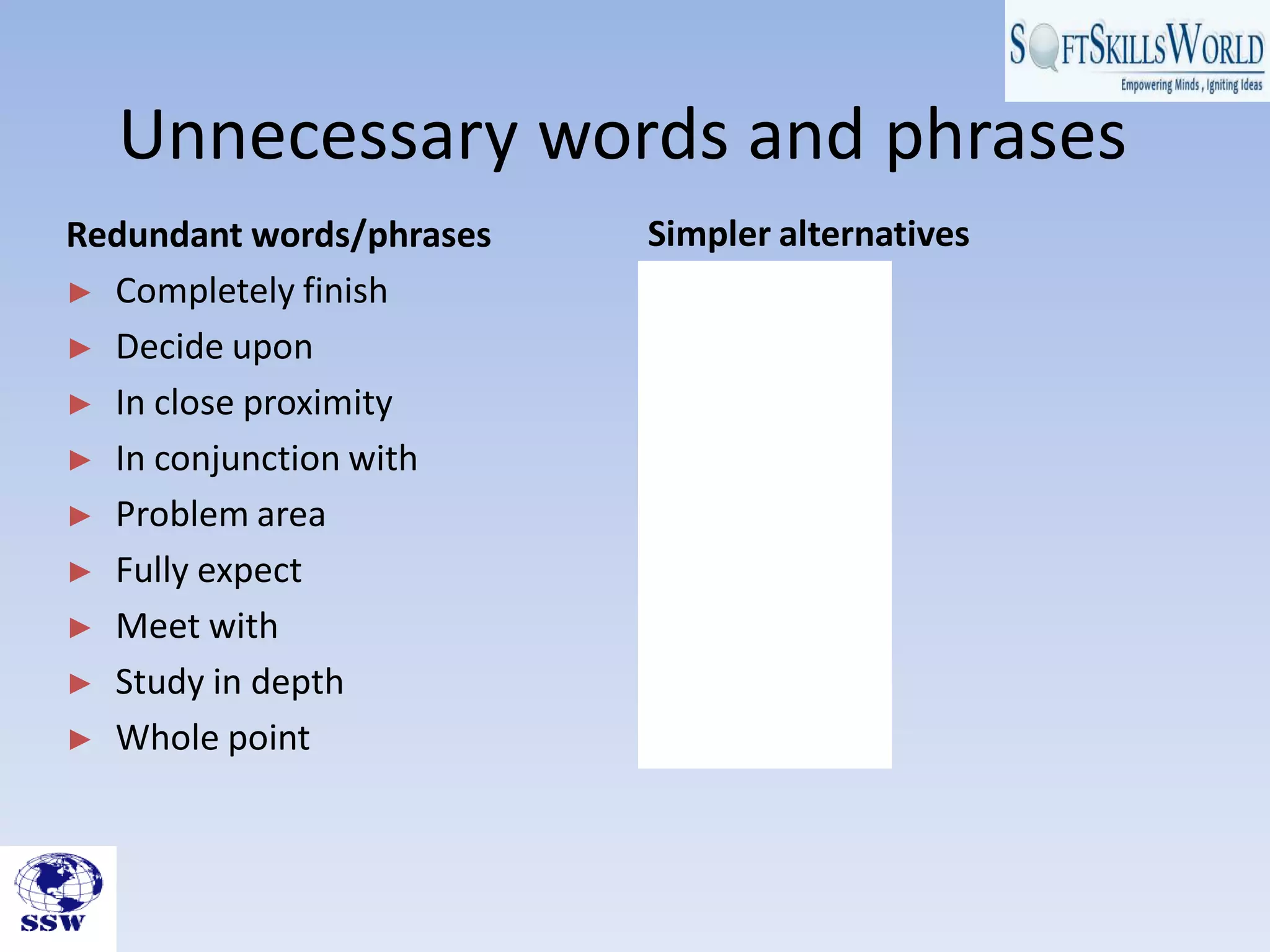
Simpler alternatives
• Finish
• Decide
• Close
• With
• Problem
• Expect
• Meet
• Study
• Point
Redundant words/phrases
► Completely finish
► Decide upon
► In close proximity
► In conjunction with
► Problem area
► Fully expect
► Meet with
► Study in depth
► Whole point
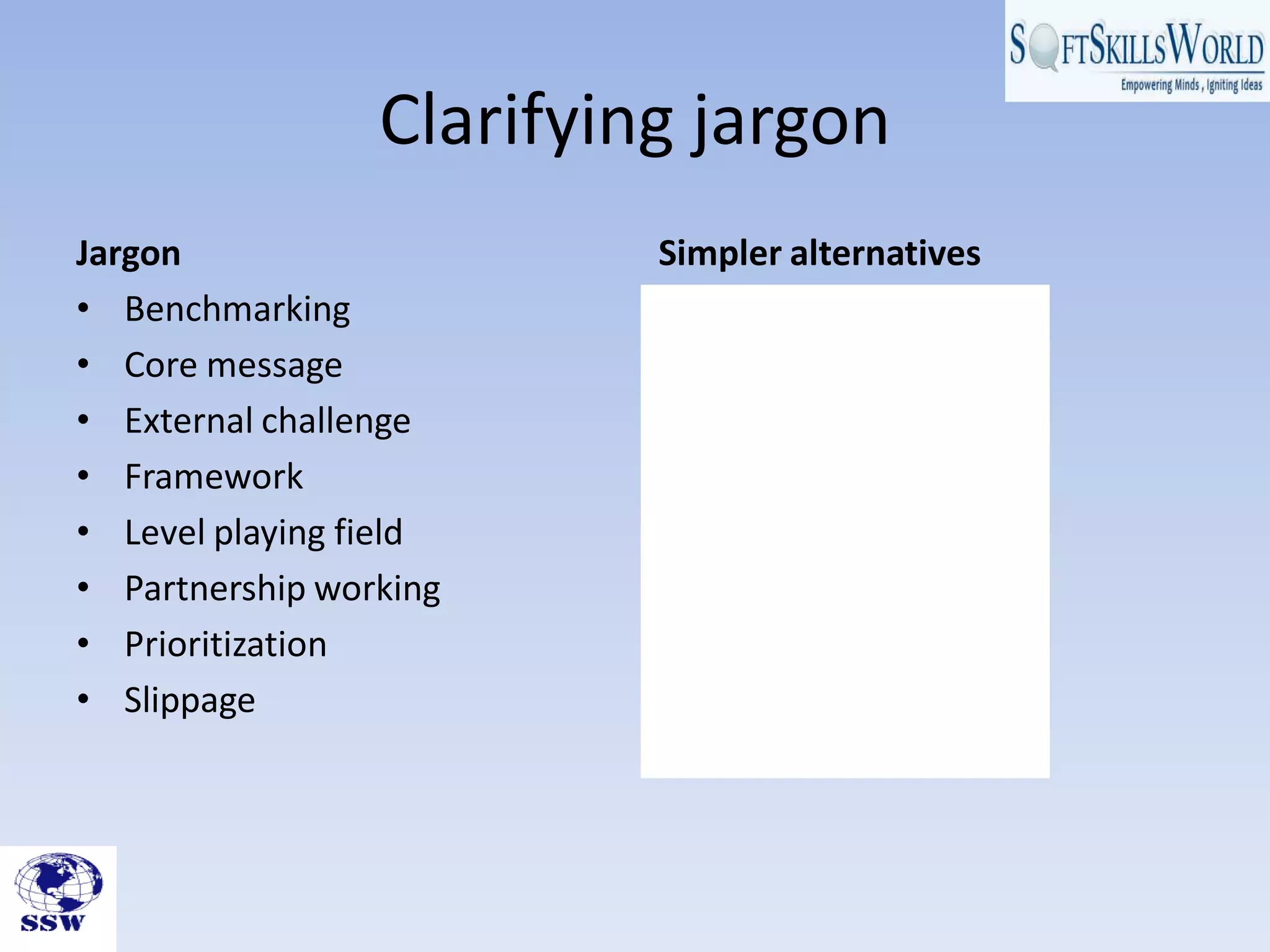
Clarifying jargon
Jargon
• Benchmarking
• Core message
• External challenge
• Framework
• Level playing field
• Partnership working
• Prioritization
• Slippage
Simpler alternatives
• Measuring
• Main point
• Outside pressures
• Guide
• All equal
• Working together
• Most important
• Delay
Activity 6.1: Writing in clear English
Objective: To practice writing in clear English
Time: 25 minutes
Directions:
– Refer to PM 6.1, Activity 6.1: Writing in clear English
– Work in pairs
– Rewrite the sentences using the principles you have
learned.
– Be prepared to share the corrections you make
Activity 6.2: Rewriting text in clear
English
Objective: To practice applying the rules of clear English
Time: 15 minutes
Directions:
– Refer to PM 6.2, Activity 6.2: Rewriting text in clear English
– Read the document
– Rewrite the text on a separate sheet of paper
The six rules of writing in clear English
• Write your verbs in the active, not passive,
form
• Prefer verbs to nouns
• Use “you” and “we”
• Keep sentences short and simple in structure
• Use everyday words
• Remove redundant words
What is expected of writers at
corporate?
What is expected of us as writers at
corporate —a strategic view
• Writing in a way that reflects commercial awareness
and takes into account risk and contractual obligations
• Making complex issues easy to understand
• Managing oneself effectively as a writer
• Using the right tone
• Getting the detail right, so that senior staff — whose
time costs more — can concentrate on taking a
strategic view
What is expected of us as writers at
corporate — getting the detail right
• Clear, unambiguous writing
• Grammatical accuracy and consistency
• Good logical flow
• Helpful headings
• Correct formatting
• Lack of repetition and unnecessary words
Lesson 6 summary
Questions?
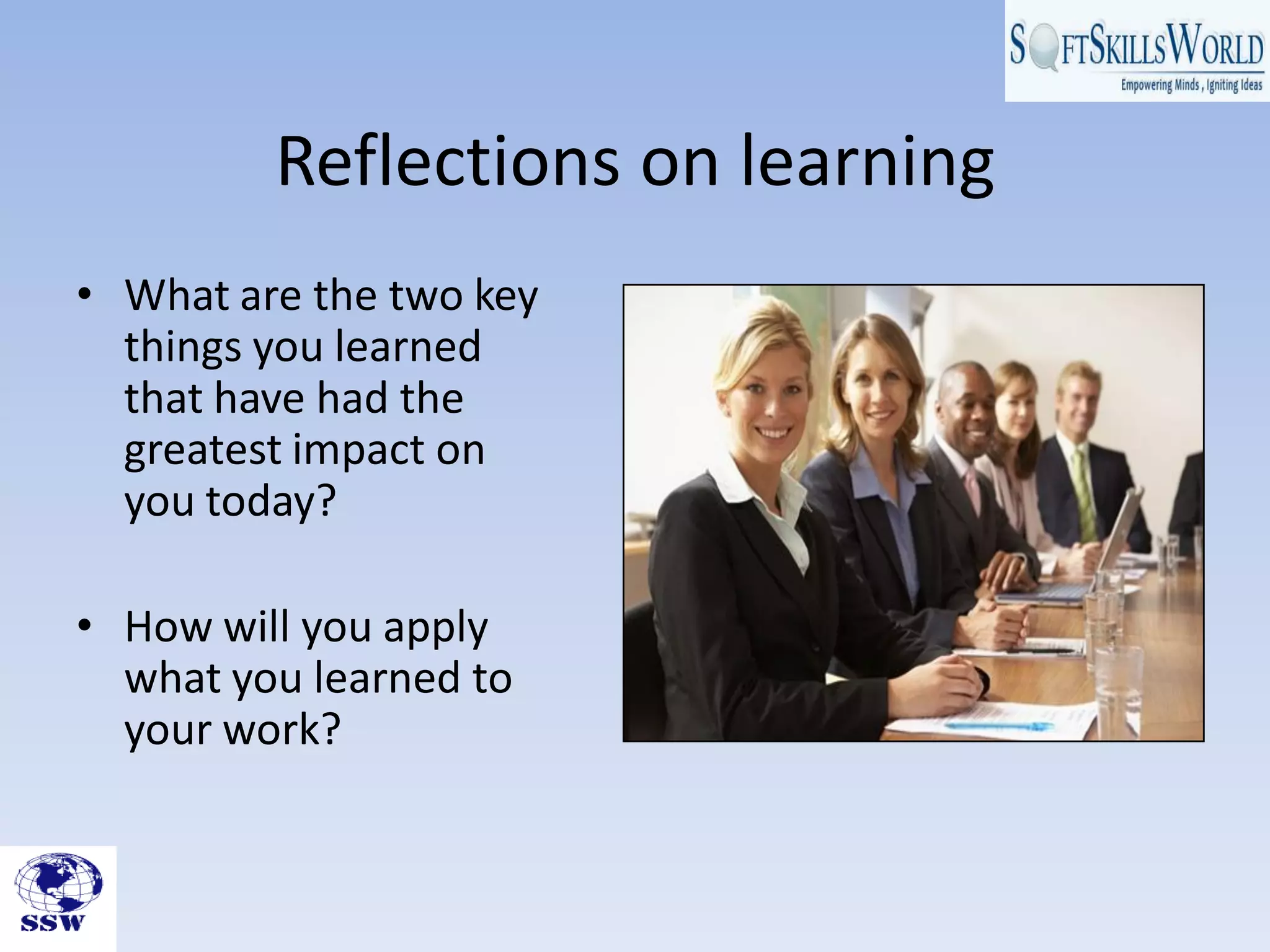
Reflections on learning
• What are the two key
things you learned
that have had the
greatest impact on
you today?
• How will you apply
what you learned to
your work?
Module close

Sswpresentsintroductiontobusinesswritingskillsmodule 120728014403-phpapp01

  • 1.
  • 2.
    Lessons • Lesson 1:Overview • Lesson 2: What is good business writing? • Lesson 3: Who are our readers? • Lesson 4: Using structure effectively • Lesson 5: Grammar and style • Lesson 6: Using language effectively
  • 3.
  • 4.
    Module objectives • Meetthe needs of different types of readers • Use structure and language effectively • Avoid unnecessary risk in writing • Adhere to corporate’s writing style
  • 5.
  • 6.
  • 7.
    Lesson 2: Whatis good business writing?
  • 8.
    Lesson 2 objectives •Identify the differences between clear and unclear writing • Define the attributes of good business writing • Explain the importance of good business writing
  • 9.
    Activity 2.1: Whichreport on finding do you prefer? Objective: To explore what good business writing is by comparing different types of writing Time: 15 minutes Directions: – Read both versions in PM 2.1, Activity 2.1: Which report on findings do you prefer? – Determine the version you prefer – Work with your team to determine why you prefer the version you selected and not the other – List your reasons for liking your preference and disliking the other version on flip chart paper – Present your reasons to the class
  • 10.
    Activity 2.2: Reviewingclient feedback Objective: To explore the impact of our writing on our clients Time: 5 minutes Directions: – Read PM 2.2, Activity 2.2: Reviewing client feedback — client feedback letter – Reflect on what our clients want and expect from us as writers
  • 11.
    Why clear writingis important • Our writing is one of our key activities and outputs • We are more productive if we write efficiently • When our writing focuses on our reader’s needs, we strengthen our brand and reputation • Clear writing reflects on you personally
  • 12.
  • 13.
  • 14.
    Lesson 3: Whoare our readers?
  • 15.
    Lesson 3 objectives •Identify the different types of readers • Describe the needs of different readers • Explain how to meet the needs of different readers
  • 16.
  • 17.
    Types of documentsyou might write • Reports for clients • Emails and letters – Internal – External • Internal status reports • Descriptions of process flows • Management letters • Analytics • Findings • Recommendations • Manuals
  • 18.
    Your role inwriting these documents might include: • Requesting, gathering and organizing information • Preparing arguments • Drafting sections of reports • Summarizing information • Interpreting/making assumptions from data and writing some narrative about it • Formatting • Indexing • Cross-referencing • Proofreading
  • 19.
    Think before youwrite. Ask yourself: • Why am I writing? • Who is my reader? • What do I want my reader to know, feel and do? “Meaning is not contained in words. In writing, meaning is contained in the response our words generate from our readers, rather than in the words themselves.” — Achieving potential through words:
  • 20.
    Our readers comefirst. Who are they? Strategist Manager “Doer”
  • 21.
    Activity 3.1: Writingfor our readers Objective: To consider the different types of readers of our documents and their needs Time: 10 minutes Directions: – You have been assigned a type of reader – Think about the strategists/managers/”doers” in the organizations for which you work • What is on their minds? – Issues, challenges, etc. • What are they looking for in a report? • What parts of a report are they most likely to be interested in? • How can we meet their needs? – Summarize your thoughts on a flip chart
  • 22.
  • 23.
  • 24.
    Lesson 4: Usingstructure effectively
  • 25.
    Lesson 4 objectives •Explain how effective writing helps strengthen your corporate’s brand and reputation • Identify the six elements of effective writing • Create a well-structured paragraph
  • 26.
  • 27.
    The Achieving Potentialprinciples • Engage proactively • Make the complex clear • Integrate diverse perspectives • Always ask “what is next?”
  • 28.
  • 29.
    Six elements ofclear writing Elements ►Structure ►Content ►Language ►Presentation ►Navigation ►Process Purpose Reader
  • 30.
    Structure is alsoimportant for clear writing ► What is the purpose of structure? ► Provides a framework ► Gives form to thoughts ► Drives the narrative
  • 31.
    Activity 4.1: Structuringparagraphs Objective: To practice structuring paragraphs Time: 15 minutes Directions: – Work with your team to sort the sentences into two paragraphs – Put the sentences in the correct order – Then put the paragraphs in the correct order – Tape them to your flip chart
  • 32.
  • 33.
  • 34.
  • 35.
    • Identify someof the grammatical errors people frequently make and how to correct them • Correct text so it conforms to corporate global writing style • Edit writing so it avoids exposing your corporate to unnecessary risk Lesson 5 objectives
  • 36.
    Activity 5.1: Spotthe deliberate mistake Objective: To spot and correct common mistakes in grammar and usage Time: 15 minutes Directions: – Refer to PM 5.1, Activity 5.1: Spot the deliberate mistake – Work through the items in the document, adding the correct answers over the items provided, as if editing the copy
  • 37.
  • 38.
    Corporate global writingstyle ► Presents a consistent image globally ► corporate style guidance: ► Achieving potential through words: corporate global writing and style guide ► A brief guide to writing for corporate
  • 39.
    Activity 5.2: Writingin corporate global style Objective: To spot and correct text to meet corporate writing style Time: 15 minutes Directions: – Refer to PM 5.3, Activity 5.2: Writing in corporate global style for detailed directions – Work through the items in the document, correcting the items, as if editing the copy – Refer to PM 5.2, A brief guide to writing for corporate for help – Be prepared to share the corporate writing style guideline you used to make the corrections
  • 40.
  • 41.
    Our words canexpose corporate to unnecessary risk • Avoid language that may be difficult to prove in court • Ask yourself if you can offer substantive evidence of your claim • Do not over-promise or lead a client to expect a result that is greater than, or different from, what we expect to deliver • Avoid making promises — expressed or implied — of certain outcomes, results or value • Avoid implying corporate will either take responsibility for or implement suggested approaches, or make decisions that are the responsibility of client management
  • 42.
    Activity 5.3: Reducingunnecessary risk in our writing Objective: To practice using language in a way that protects corporate Time: 20 minutes Directions: – Work in pairs – Read through the statements in PM 5.5, Activity 5.3: Reducing unnecessary risk in our writing – Look for any statements that you think would expose corporate to unnecessary risk – Rewrite the statements to reduce the risk
  • 43.
  • 44.
  • 45.
    Lesson 6: Usinglanguage effectively
  • 46.
    Lesson 6 objectives •Identify ways to use language clearly and effectively within the context of our work • Rewrite text so it is easier to read
  • 47.
  • 48.
    The six rulesof writing in clear English • Write your verbs in the active, not passive, form • Prefer verbs to nouns • Use “you” and “we” • Keep sentences short and simple in structure • Use everyday words • Remove redundant words
  • 49.
    Active or passiveverbs? • What is the difference between a verb in the active voice and a verb in the passive voice? Active verbs are more direct, more emphatic and more concise than passive verbs. Active Passive X won the contract. The contract was won by X.
  • 50.
    The love ofnouns in business English Post-operative complications reduction procedure alignment initiative
  • 51.
    Nominalization Try to turnthe following nouns into verbs in your writing. ► Arrangement ► Attachment ► Calculation ► Consideration ► Consultation ► Decision ► Definition ► Demonstration ► Description ► Estimation ► Implementation ► Arrange ► Attach ► Calculate ► Consider ► Consult ► Decide ► Define ► Demonstrate ► Describe ► Estimate ► Implement ► Intention ► Management ► Modification ► Notification ► Production ► Recommendation ► Registration ► Requirement ► Revision ► Settlement ► Submission ► Intend ► Manage ► Modify ► Notify ► Produce ► Recommend ► Register ► Require ► Revise ► Settle ► Submit Noun Noun VerbVerb
  • 52.
    “You” and “we” •Use “you” and “we.” • It helps us connect with the reader. • Example: X Clients benefit from our service. You benefit from our service.
  • 53.
    Clear English alternatives Simpleralternatives • So • Even if, despite, still, yet, but • With • As, because • About, concerning • Check, prove • State, set, lay down Complex words ► Accordingly ► Notwithstanding ► In conjunction with ► In view of the fact that ► With reference to ► Verify ► Stipulate
  • 54.
    Unnecessary words andphrases Simpler alternatives • Finish • Decide • Close • With • Problem • Expect • Meet • Study • Point Redundant words/phrases ► Completely finish ► Decide upon ► In close proximity ► In conjunction with ► Problem area ► Fully expect ► Meet with ► Study in depth ► Whole point
  • 55.
    Clarifying jargon Jargon • Benchmarking •Core message • External challenge • Framework • Level playing field • Partnership working • Prioritization • Slippage Simpler alternatives • Measuring • Main point • Outside pressures • Guide • All equal • Working together • Most important • Delay
  • 56.
    Activity 6.1: Writingin clear English Objective: To practice writing in clear English Time: 25 minutes Directions: – Refer to PM 6.1, Activity 6.1: Writing in clear English – Work in pairs – Rewrite the sentences using the principles you have learned. – Be prepared to share the corrections you make
  • 57.
    Activity 6.2: Rewritingtext in clear English Objective: To practice applying the rules of clear English Time: 15 minutes Directions: – Refer to PM 6.2, Activity 6.2: Rewriting text in clear English – Read the document – Rewrite the text on a separate sheet of paper
  • 58.
    The six rulesof writing in clear English • Write your verbs in the active, not passive, form • Prefer verbs to nouns • Use “you” and “we” • Keep sentences short and simple in structure • Use everyday words • Remove redundant words
  • 59.
    What is expectedof writers at corporate?
  • 60.
    What is expectedof us as writers at corporate —a strategic view • Writing in a way that reflects commercial awareness and takes into account risk and contractual obligations • Making complex issues easy to understand • Managing oneself effectively as a writer • Using the right tone • Getting the detail right, so that senior staff — whose time costs more — can concentrate on taking a strategic view
  • 61.
    What is expectedof us as writers at corporate — getting the detail right • Clear, unambiguous writing • Grammatical accuracy and consistency • Good logical flow • Helpful headings • Correct formatting • Lack of repetition and unnecessary words
  • 62.
  • 63.
  • 64.
  • 65.
    Reflections on learning •What are the two key things you learned that have had the greatest impact on you today? • How will you apply what you learned to your work?
  • 66.