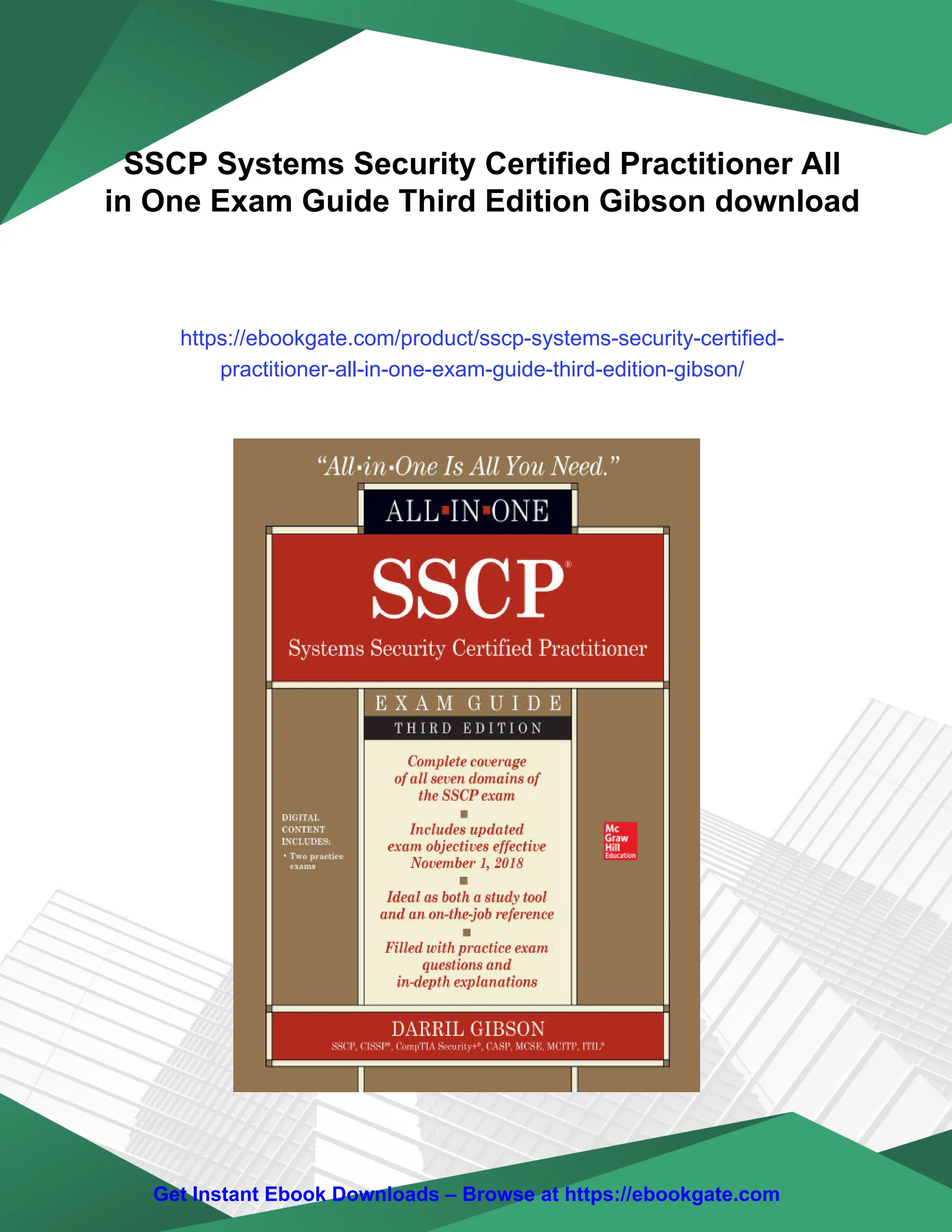
SSCP Systems Security Certified Practitioner All
in One Exam Guide Third Edition Gibson download
https://ebookgate.com/product/sscp-systems-security-certified-
practitioner-all-in-one-exam-guide-third-edition-gibson/
Get Instant Ebook Downloads – Browse at https://ebookgate.com
Get Your Digital Files Instantly: PDF, ePub, MOBI and More
Quick Digital Downloads: PDF, ePub, MOBI and Other Formats
CEH Certified Ethical Hacker all in one exam guide 2nd
edition Edition Horton
https://ebookgate.com/product/ceh-certified-ethical-hacker-all-
in-one-exam-guide-2nd-edition-edition-horton/
CISSP All in One Exam Guide Fifth Edition Shon Harris
https://ebookgate.com/product/cissp-all-in-one-exam-guide-fifth-
edition-shon-harris/
All in one A certification exam guide 3rd ed Edition
Michael Meyers
https://ebookgate.com/product/all-in-one-a-certification-exam-
guide-3rd-ed-edition-michael-meyers/
ISC2 Certified Cloud Security Professional CCSP Exam
Guide First Edition Kim Van Lavieren
https://ebookgate.com/product/isc2-certified-cloud-security-
professional-ccsp-exam-guide-first-edition-kim-van-lavieren/
CISSP Certified Information Systems Security
Professional Study Guide 2nd Edition Ed Tittle
https://ebookgate.com/product/cissp-certified-information-
systems-security-professional-study-guide-2nd-edition-ed-tittle/
Comptia A Certification All In One Exam Guide Exams 220
801 220 802 8th Edition Meyers
https://ebookgate.com/product/comptia-a-certification-all-in-one-
exam-guide-exams-220-801-220-802-8th-edition-meyers/
Wireshark Certified Network Analyst Exam Prep Guide
Second Edition Laura Chappell
https://ebookgate.com/product/wireshark-certified-network-
analyst-exam-prep-guide-second-edition-laura-chappell/
CWSP Certified Wireless Security Professional Official
Study Guide Exam PW0 204 CWNP Official Study Guides 1st
Edition David D. Coleman
https://ebookgate.com/product/cwsp-certified-wireless-security-
professional-official-study-guide-exam-pw0-204-cwnp-official-
study-guides-1st-edition-david-d-coleman/
Eleventh Hour Security Exam SY0 201 Study Guide Ido
Dubrawsky
https://ebookgate.com/product/eleventh-hour-security-exam-
sy0-201-study-guide-ido-dubrawsky/
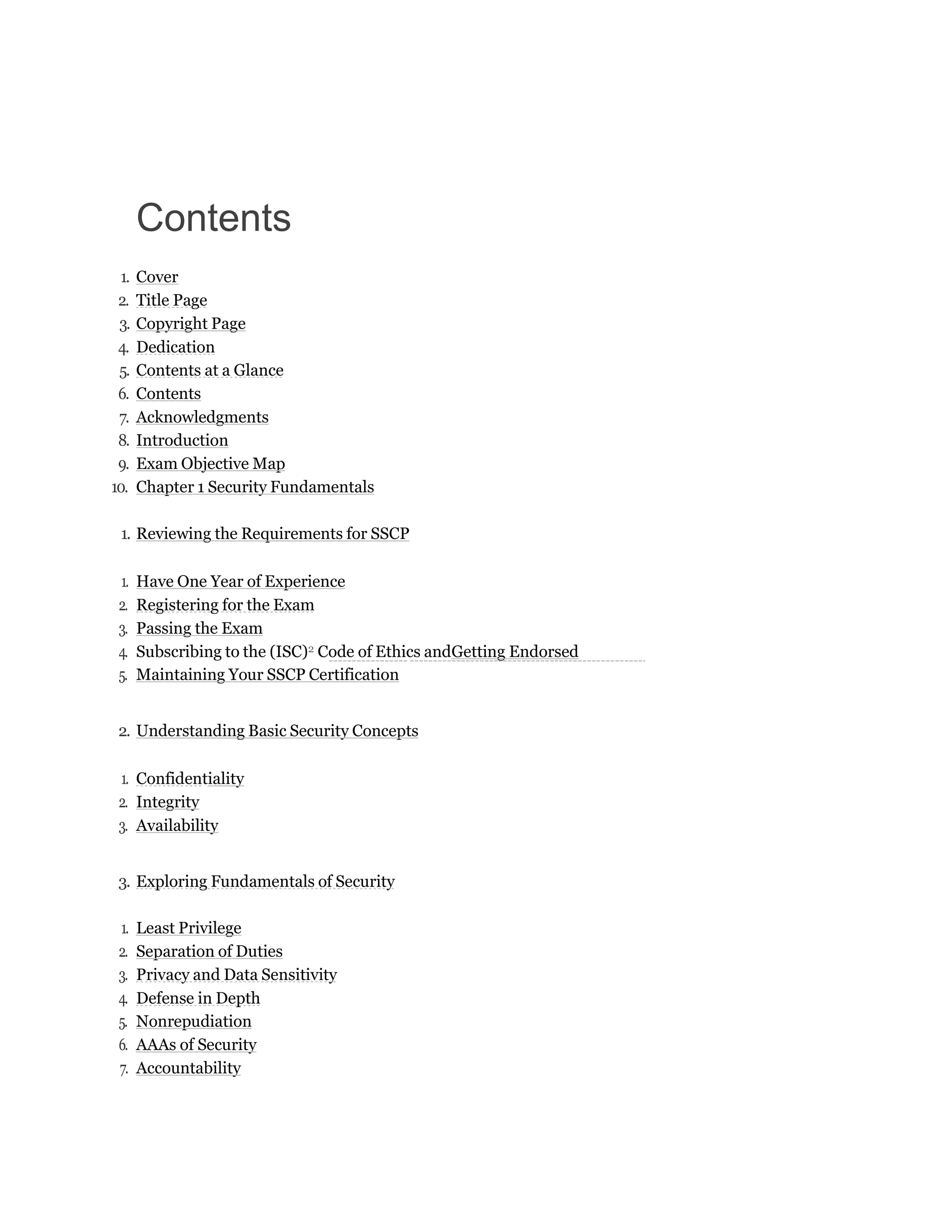
Contents
1. Cover
2. Title Page
3. Copyright Page
4. Dedication
5. Contents at a Glance
6. Contents
7. Acknowledgments
8. Introduction
9. Exam Objective Map
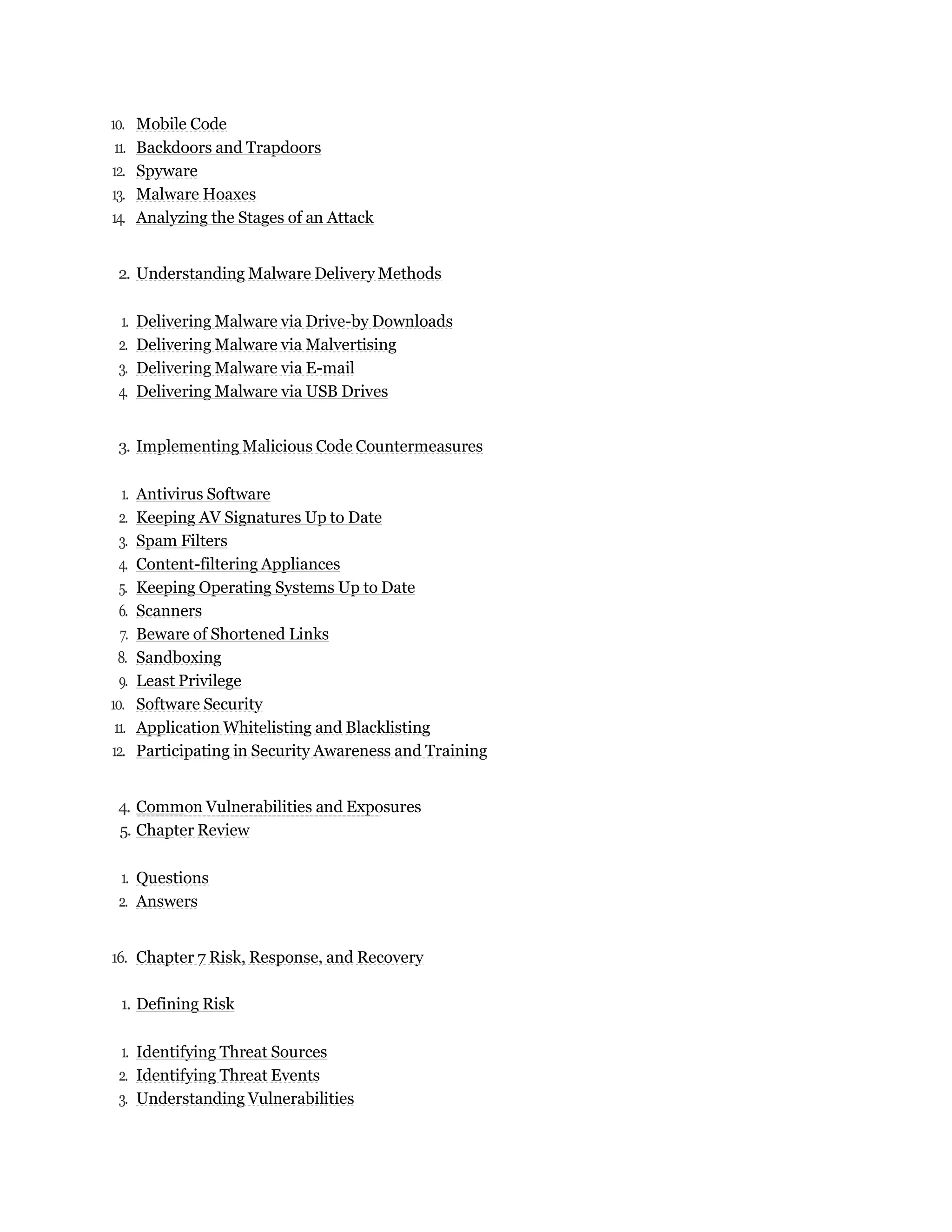
10. Chapter 1 Security Fundamentals
1. Reviewing the Requirements for SSCP
1. Have One Year of Experience
2. Registering for the Exam
3. Passing the Exam
4. Subscribing to the (ISC)2 Code of Ethics andGetting Endorsed
5. Maintaining Your SSCP Certification
2. Understanding Basic Security Concepts
1. Confidentiality
2. Integrity
3. Availability
3. Exploring Fundamentals of Security
1. Least Privilege
2. Separation of Duties
3. Privacy and Data Sensitivity
4. Defense in Depth
5. Nonrepudiation
6. AAAs of Security
7. Accountability
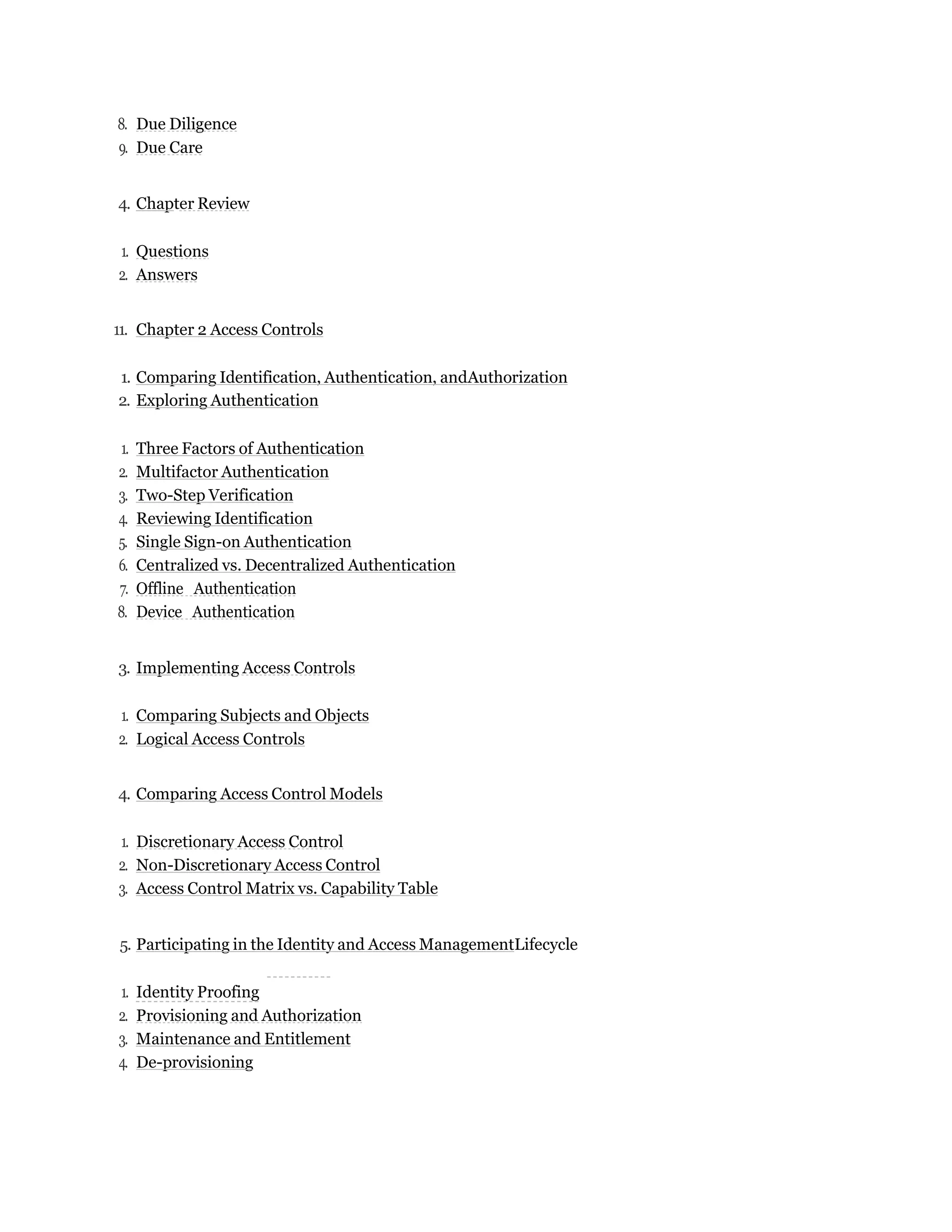
8. Due Diligence
9. Due Care
4. Chapter Review
1. Questions
2. Answers
11. Chapter 2 Access Controls
1. Comparing Identification, Authentication, andAuthorization
2. Exploring Authentication
1. Three Factors of Authentication
2. Multifactor Authentication
3. Two-Step Verification
4. Reviewing Identification
5. Single Sign-on Authentication
6. Centralized vs. Decentralized Authentication
7. Offline Authentication
8. Device Authentication
3. Implementing Access Controls
1. Comparing Subjects and Objects
2. Logical Access Controls
4. Comparing Access Control Models
1. Discretionary Access Control
2. Non-Discretionary Access Control
3. Access Control Matrix vs. Capability Table
5. Participating in the Identity and Access ManagementLifecycle
1. Identity Proofing
2. Provisioning and Authorization
3. Maintenance and Entitlement
4. De-provisioning
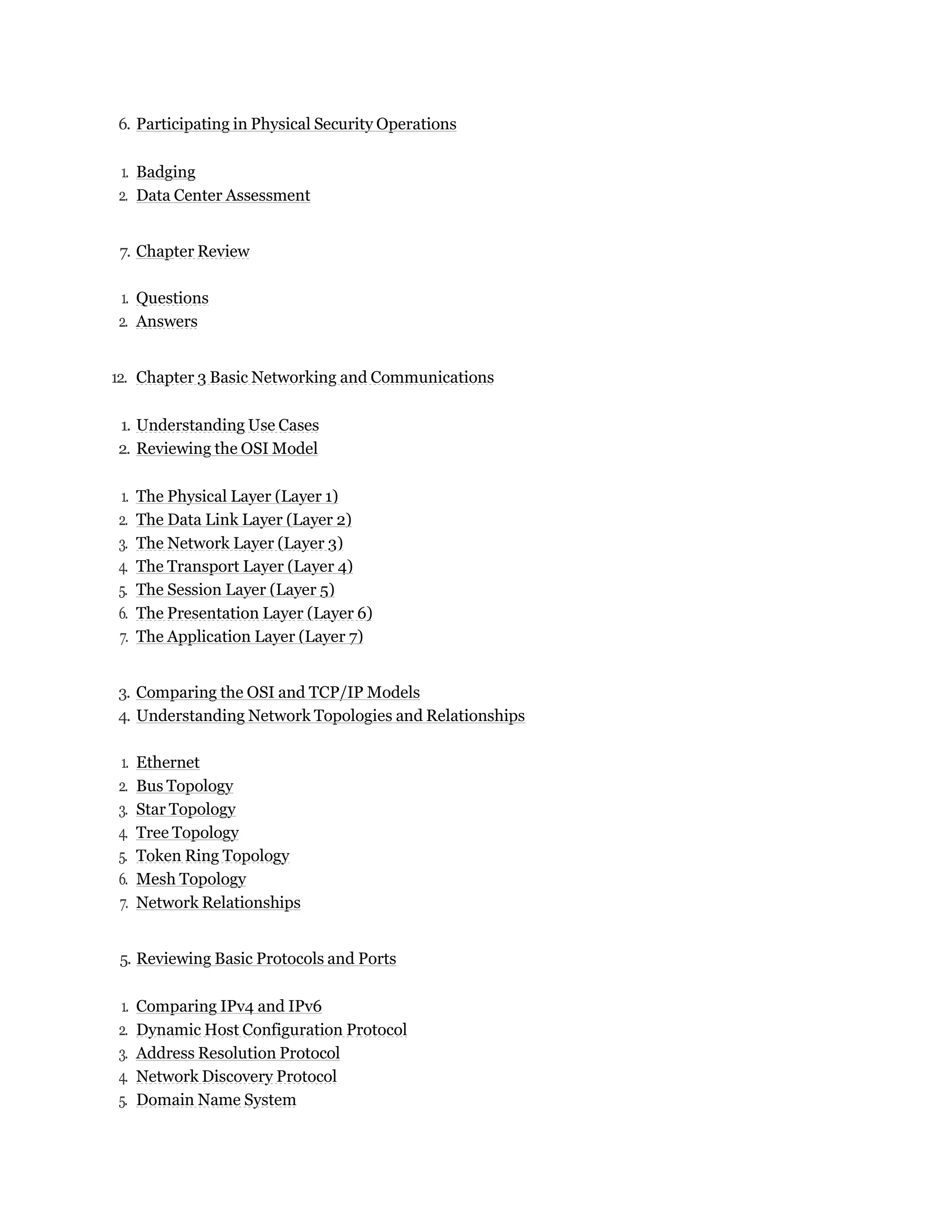
6. Participating in Physical Security Operations
1. Badging
2. Data Center Assessment
7. Chapter Review
1. Questions
2. Answers
12. Chapter 3 Basic Networking and Communications
1. Understanding Use Cases
2. Reviewing the OSI Model
1. The Physical Layer (Layer 1)
2. The Data Link Layer (Layer 2)
3. The Network Layer (Layer 3)
4. The Transport Layer (Layer 4)
5. The Session Layer (Layer 5)
6. The Presentation Layer (Layer 6)
7. The Application Layer (Layer 7)
3. Comparing the OSI and TCP/IP Models
4. Understanding Network Topologies and Relationships
1. Ethernet
2. Bus Topology
3. Star Topology
4. Tree Topology
5. Token Ring Topology
6. Mesh Topology
7. Network Relationships
5. Reviewing Basic Protocols and Ports
1. Comparing IPv4 and IPv6
2. Dynamic Host Configuration Protocol
3. Address Resolution Protocol
4. Network Discovery Protocol
5. Domain Name System
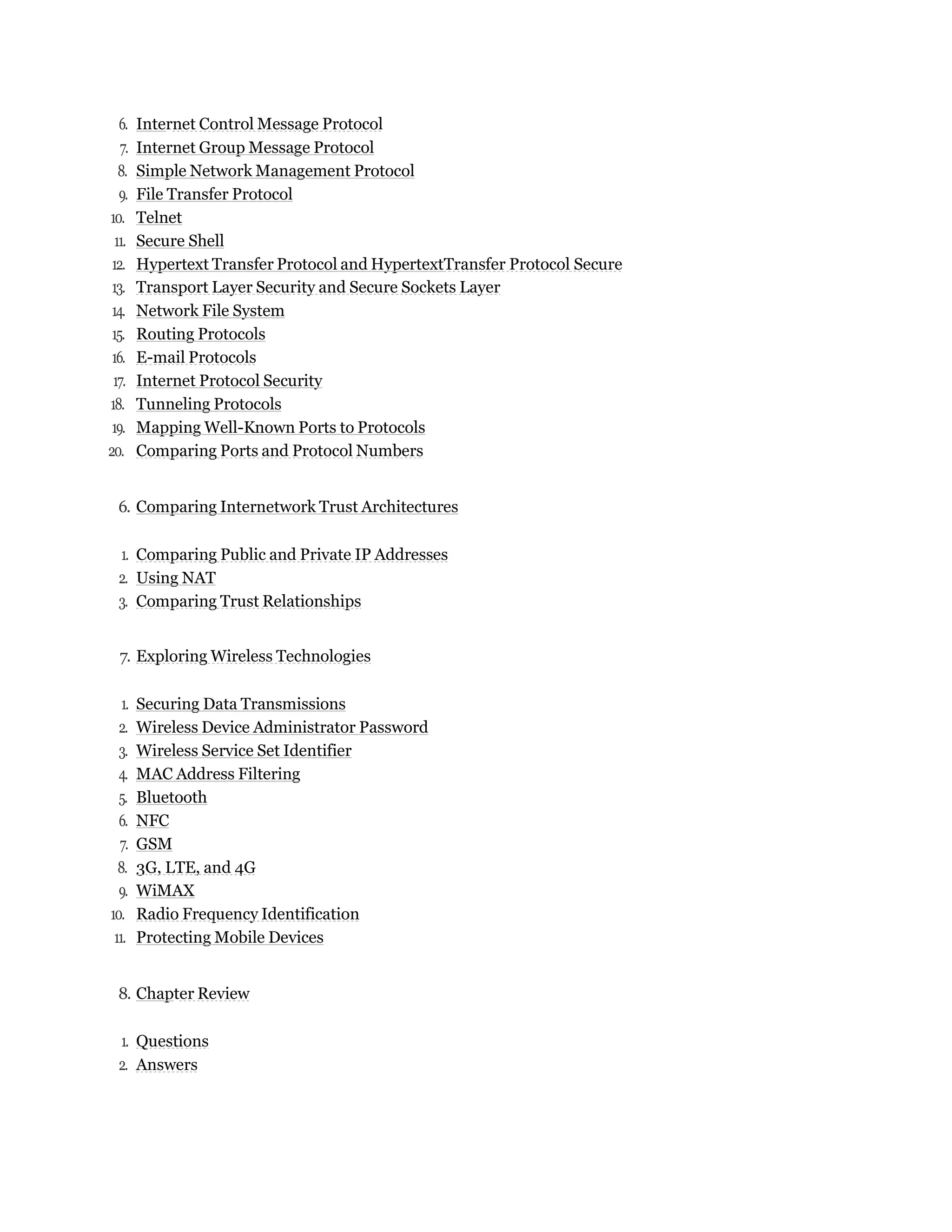
6. Internet Control Message Protocol
7. Internet Group Message Protocol
8. Simple Network Management Protocol
9. File Transfer Protocol
10. Telnet
11. Secure Shell
12. Hypertext Transfer Protocol and HypertextTransfer Protocol Secure
13. Transport Layer Security and Secure Sockets Layer
14. Network File System
15. Routing Protocols
16. E-mail Protocols
17. Internet Protocol Security
18. Tunneling Protocols
19. Mapping Well-Known Ports to Protocols
20. Comparing Ports and Protocol Numbers
6. Comparing Internetwork Trust Architectures
1. Comparing Public and Private IP Addresses
2. Using NAT
3. Comparing Trust Relationships
7. Exploring Wireless Technologies
1. Securing Data Transmissions
2. Wireless Device Administrator Password
3. Wireless Service Set Identifier
4. MAC Address Filtering
5. Bluetooth
6. NFC
7. GSM
8. 3G, LTE, and 4G
9. WiMAX
10. Radio Frequency Identification
11. Protecting Mobile Devices
8. Chapter Review
1. Questions
2. Answers
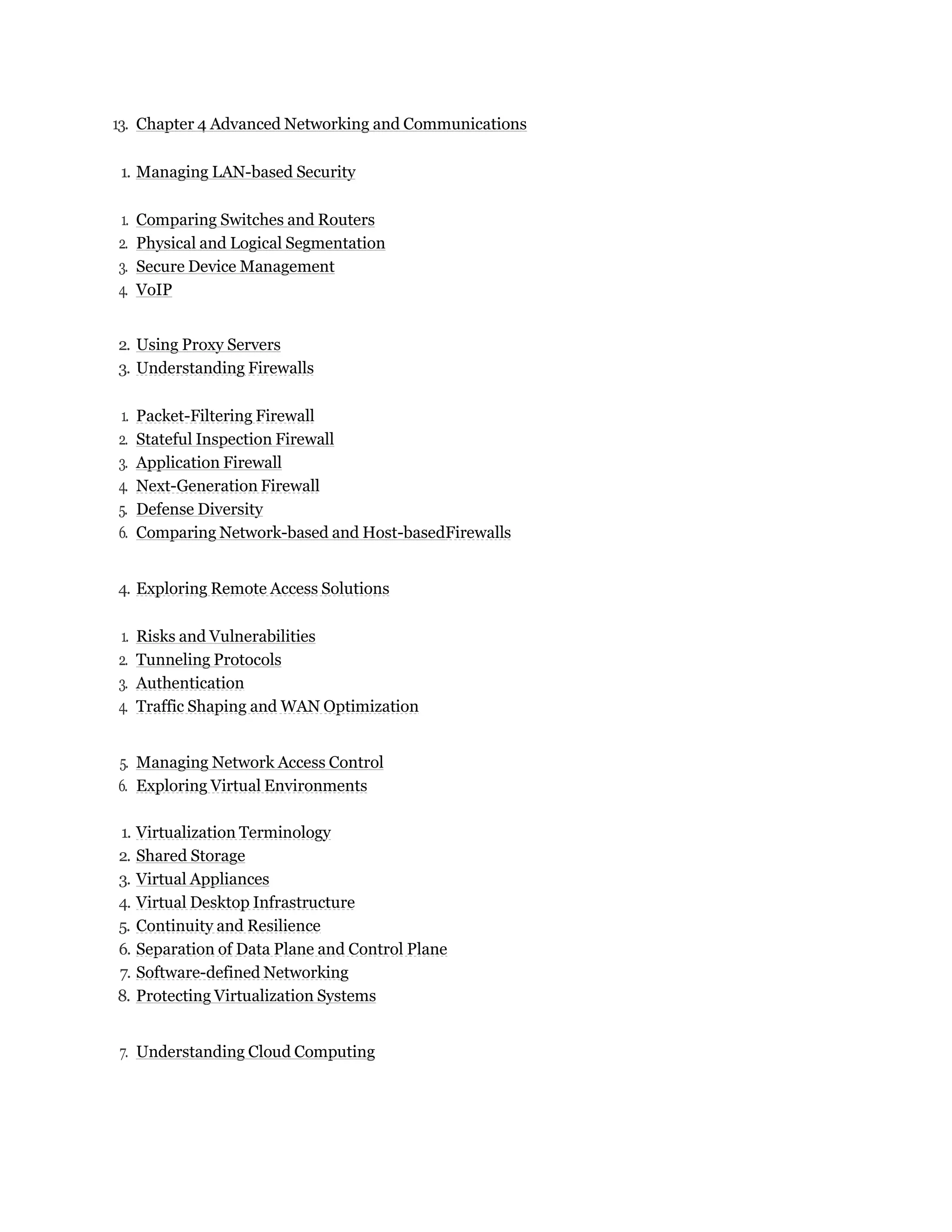
13. Chapter 4 Advanced Networking and Communications
1. Managing LAN-based Security
1. Comparing Switches and Routers
2. Physical and Logical Segmentation
3. Secure Device Management
4. VoIP
2. Using Proxy Servers
3. Understanding Firewalls
1. Packet-Filtering Firewall
2. Stateful Inspection Firewall
3. Application Firewall
4. Next-Generation Firewall
5. Defense Diversity
6. Comparing Network-based and Host-basedFirewalls
4. Exploring Remote Access Solutions
1. Risks and Vulnerabilities
2. Tunneling Protocols
3. Authentication
4. Traffic Shaping and WAN Optimization
5. Managing Network Access Control
6. Exploring Virtual Environments
1. Virtualization Terminology
2. Shared Storage
3. Virtual Appliances
4. Virtual Desktop Infrastructure
5. Continuity and Resilience
6. Separation of Data Plane and Control Plane
7. Software-defined Networking
8. Protecting Virtualization Systems
7. Understanding Cloud Computing
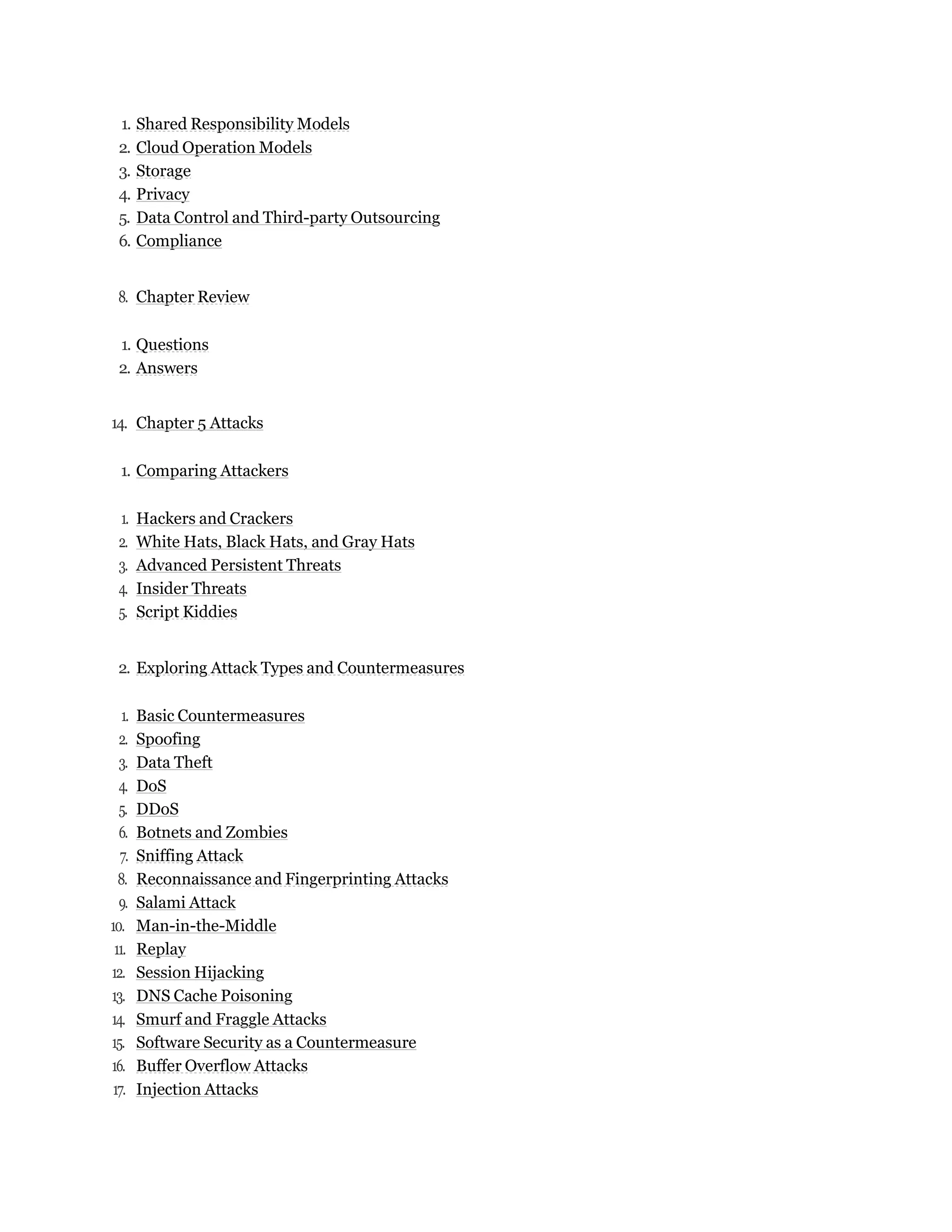
1. Shared Responsibility Models
2. Cloud Operation Models
3. Storage
4. Privacy
5. Data Control and Third-party Outsourcing
6. Compliance
8. Chapter Review
1. Questions
2. Answers
14. Chapter 5 Attacks
1. Comparing Attackers
1. Hackers and Crackers
2. White Hats, Black Hats, and Gray Hats
3. Advanced Persistent Threats
4. Insider Threats
5. Script Kiddies
2. Exploring Attack Types and Countermeasures
1. Basic Countermeasures
2. Spoofing
3. Data Theft
4. DoS
5. DDoS
6. Botnets and Zombies
7. Sniffing Attack
8. Reconnaissance and Fingerprinting Attacks
9. Salami Attack
10. Man-in-the-Middle
11. Replay
12. Session Hijacking
13. DNS Cache Poisoning
14. Smurf and Fraggle Attacks
15. Software Security as a Countermeasure
16. Buffer Overflow Attacks
17. Injection Attacks
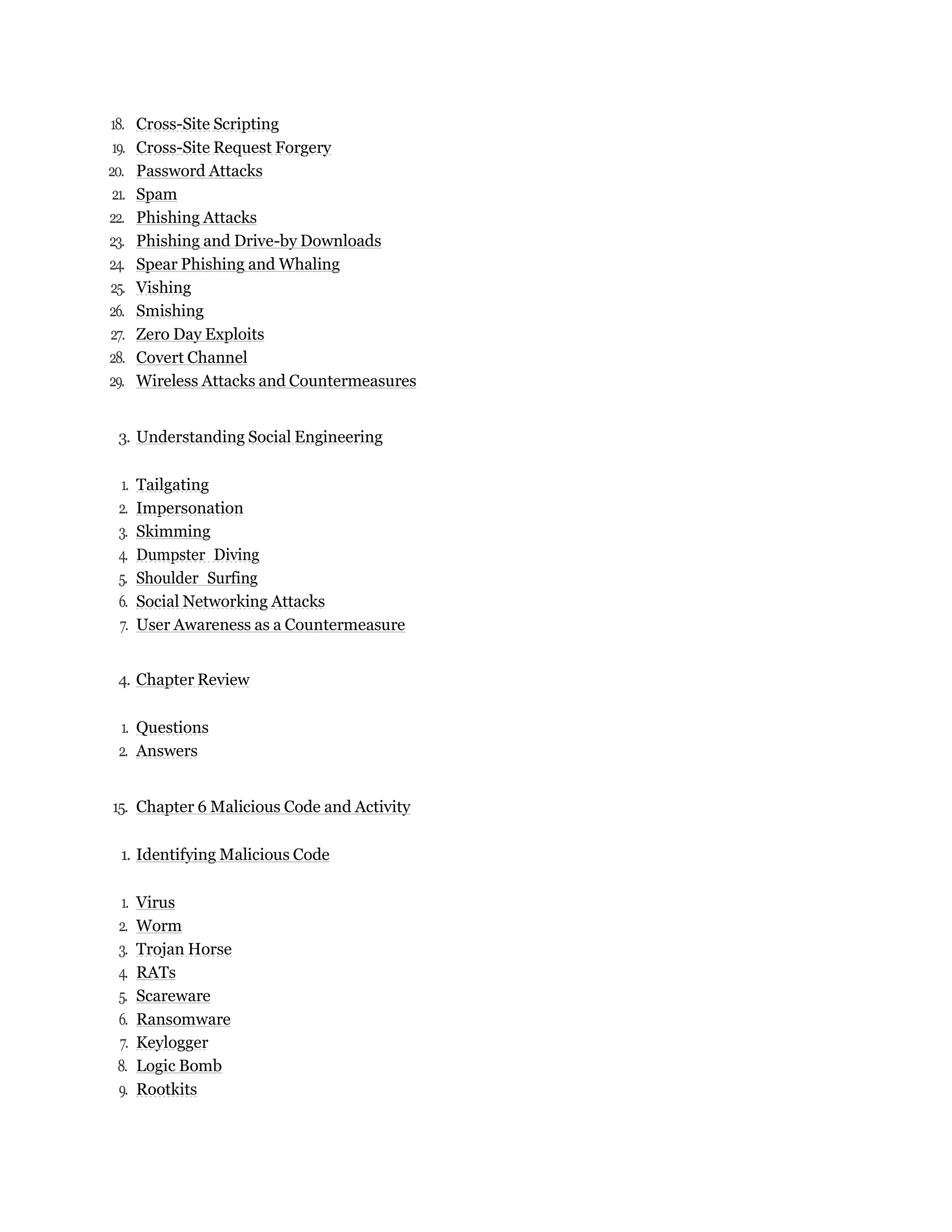
18. Cross-Site Scripting
19. Cross-Site Request Forgery
20. Password Attacks
21. Spam
22. Phishing Attacks
23. Phishing and Drive-by Downloads
24. Spear Phishing and Whaling
25. Vishing
26. Smishing
27. Zero Day Exploits
28. Covert Channel
29. Wireless Attacks and Countermeasures
3. Understanding Social Engineering
1. Tailgating
2. Impersonation
3. Skimming
4. Dumpster Diving
5. Shoulder Surfing
6. Social Networking Attacks
7. User Awareness as a Countermeasure
4. Chapter Review
1. Questions
2. Answers
15. Chapter 6 Malicious Code and Activity
1. Identifying Malicious Code
1. Virus
2. Worm
3. Trojan Horse
4. RATs
5. Scareware
6. Ransomware
7. Keylogger
8. Logic Bomb
9. Rootkits
10. Mobile Code
11. Backdoors and Trapdoors
12. Spyware
13. Malware Hoaxes
14. Analyzing the Stages of an Attack
2. Understanding Malware Delivery Methods
1. Delivering Malware via Drive-by Downloads
2. Delivering Malware via Malvertising
3. Delivering Malware via E-mail
4. Delivering Malware via USB Drives
3. Implementing Malicious Code Countermeasures
1. Antivirus Software
2. Keeping AV Signatures Up to Date
3. Spam Filters
4. Content-filtering Appliances
5. Keeping Operating Systems Up to Date
6. Scanners
7. Beware of Shortened Links
8. Sandboxing
9. Least Privilege
10. Software Security
11. Application Whitelisting and Blacklisting
12. Participating in Security Awareness and Training
4. Common Vulnerabilities and Exposures
5. Chapter Review
1. Questions
2. Answers
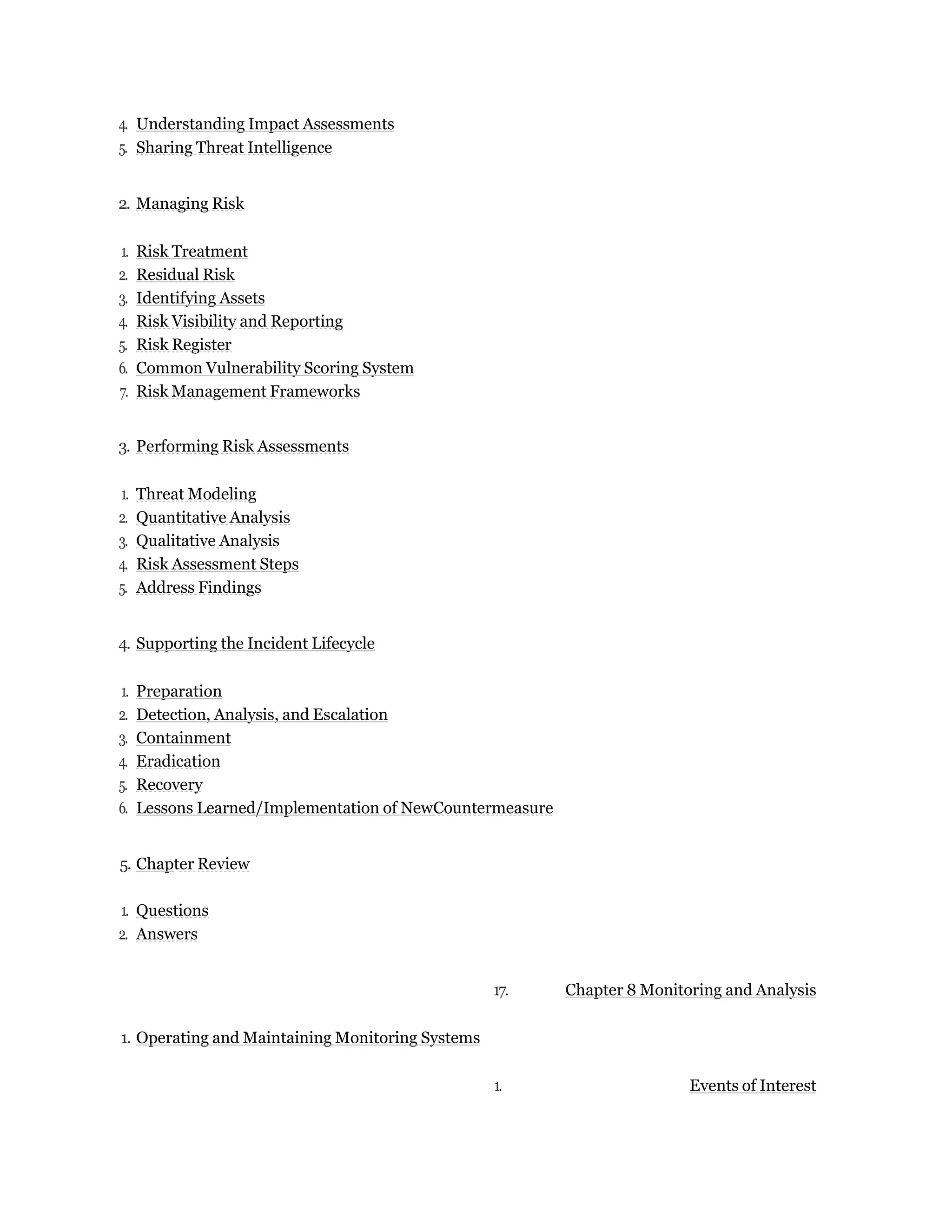
16. Chapter 7 Risk, Response, and Recovery
1. Defining Risk
1. Identifying Threat Sources
2. Identifying Threat Events
3. Understanding Vulnerabilities
4. Understanding Impact Assessments
5. Sharing Threat Intelligence
2. Managing Risk
1. Risk Treatment
2. Residual Risk
3. Identifying Assets
4. Risk Visibility and Reporting
5. Risk Register
6. Common Vulnerability Scoring System
7. Risk Management Frameworks
3. Performing Risk Assessments
1. Threat Modeling
2. Quantitative Analysis
3. Qualitative Analysis
4. Risk Assessment Steps
5. Address Findings
4. Supporting the Incident Lifecycle
1. Preparation
2. Detection, Analysis, and Escalation
3. Containment
4. Eradication
5. Recovery
6. Lessons Learned/Implementation of NewCountermeasure
5. Chapter Review
1. Questions
2. Answers
17. Chapter 8 Monitoring and Analysis
1. Operating and Maintaining Monitoring Systems
1. Events of Interest
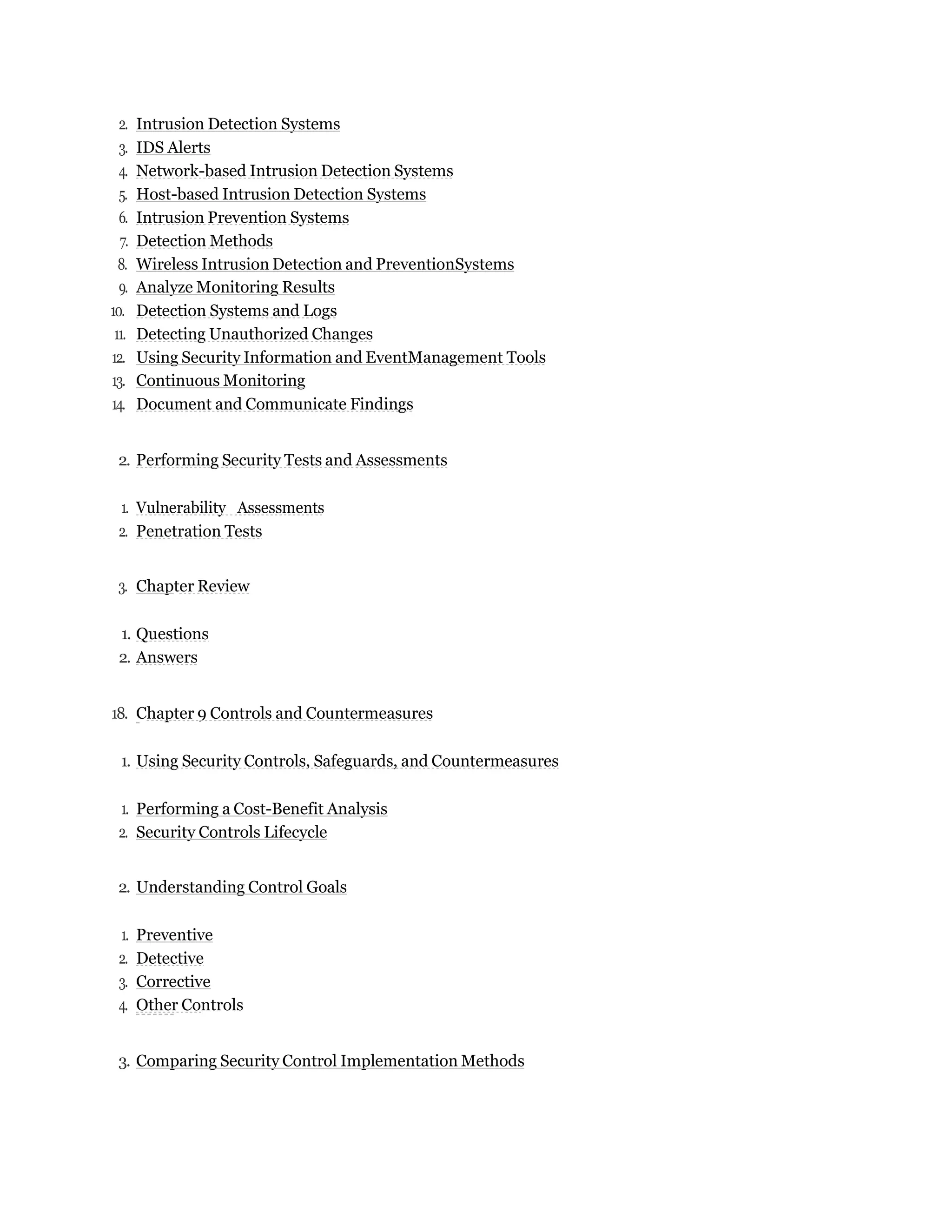
2. Intrusion Detection Systems
3. IDS Alerts
4. Network-based Intrusion Detection Systems
5. Host-based Intrusion Detection Systems
6. Intrusion Prevention Systems
7. Detection Methods
8. Wireless Intrusion Detection and PreventionSystems
9. Analyze Monitoring Results
10. Detection Systems and Logs
11. Detecting Unauthorized Changes
12. Using Security Information and EventManagement Tools
13. Continuous Monitoring
14. Document and Communicate Findings
2. Performing Security Tests and Assessments
1. Vulnerability Assessments
2. Penetration Tests
3. Chapter Review
1. Questions
2. Answers
18. Chapter 9 Controls and Countermeasures
1. Using Security Controls, Safeguards, and Countermeasures
1. Performing a Cost-Benefit Analysis
2. Security Controls Lifecycle
2. Understanding Control Goals
1. Preventive
2. Detective
3. Corrective
4. Other Controls
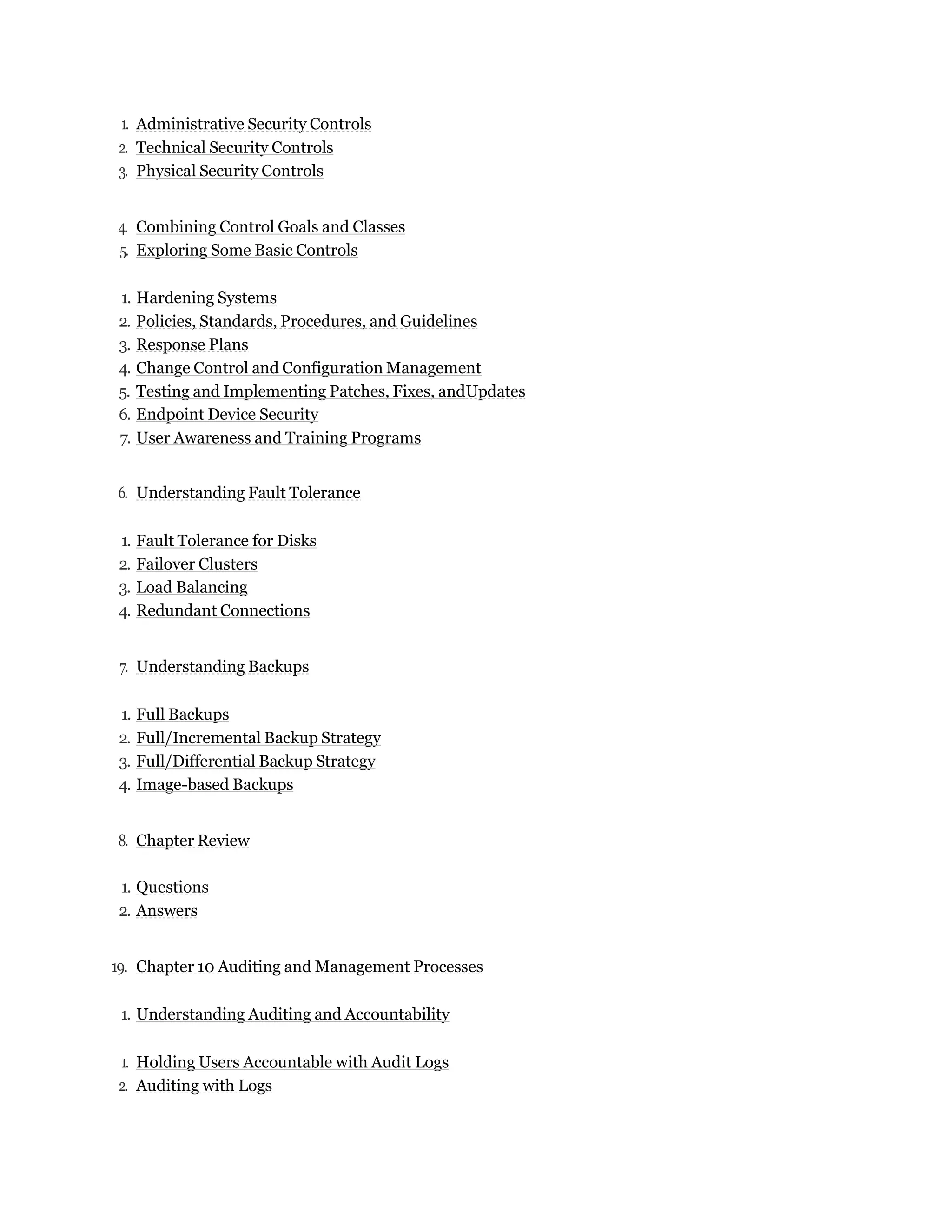
3. Comparing Security Control Implementation Methods
1. Administrative Security Controls
2. Technical Security Controls
3. Physical Security Controls
4. Combining Control Goals and Classes
5. Exploring Some Basic Controls
1. Hardening Systems
2. Policies, Standards, Procedures, and Guidelines
3. Response Plans
4. Change Control and Configuration Management
5. Testing and Implementing Patches, Fixes, andUpdates
6. Endpoint Device Security
7. User Awareness and Training Programs
6. Understanding Fault Tolerance
1. Fault Tolerance for Disks
2. Failover Clusters
3. Load Balancing
4. Redundant Connections
7. Understanding Backups
1. Full Backups
2. Full/Incremental Backup Strategy
3. Full/Differential Backup Strategy
4. Image-based Backups
8. Chapter Review
1. Questions
2. Answers
19. Chapter 10 Auditing and Management Processes
1. Understanding Auditing and Accountability
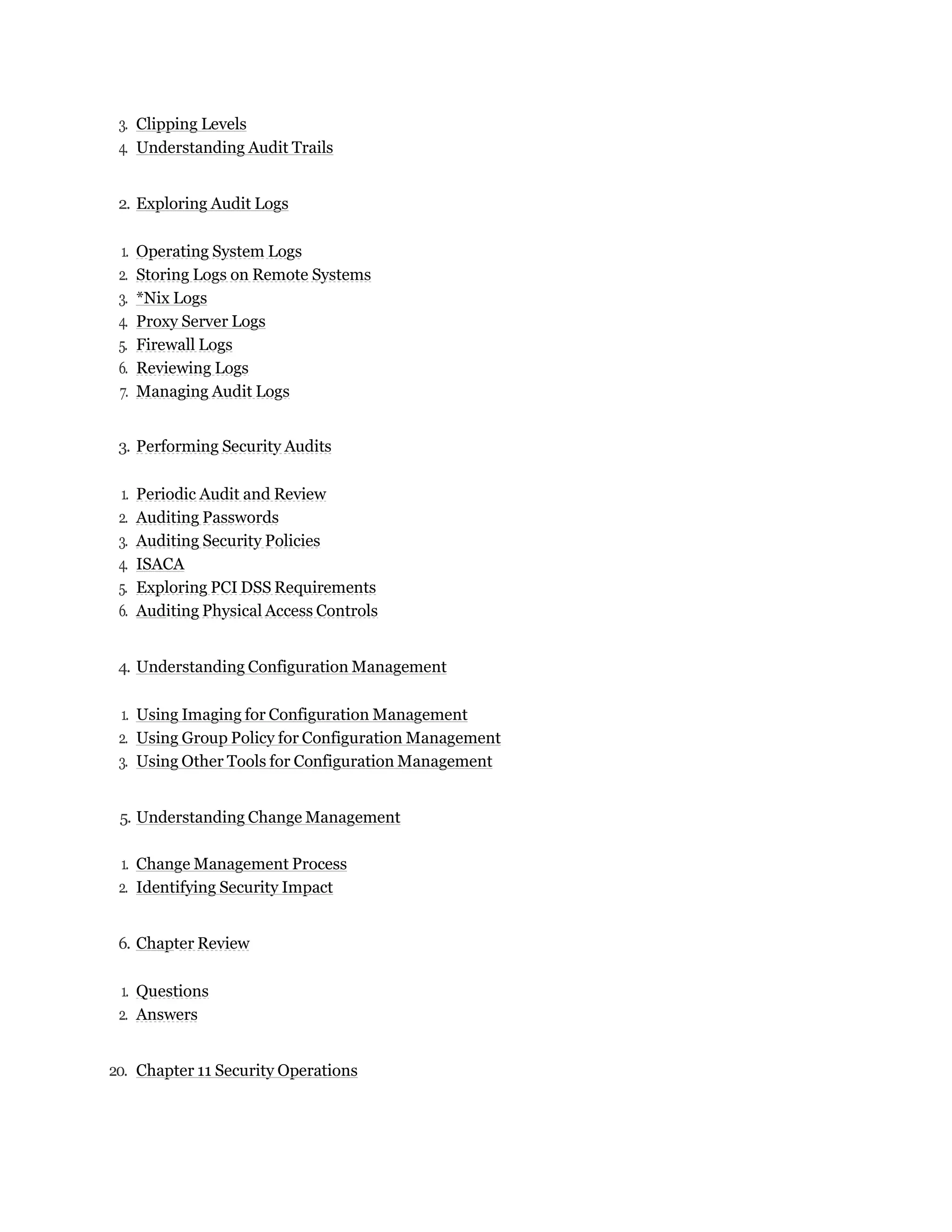
1. Holding Users Accountable with Audit Logs
2. Auditing with Logs
3. Clipping Levels
4. Understanding Audit Trails
2. Exploring Audit Logs
1. Operating System Logs
2. Storing Logs on Remote Systems
3. *Nix Logs
4. Proxy Server Logs
5. Firewall Logs
6. Reviewing Logs
7. Managing Audit Logs
3. Performing Security Audits
1. Periodic Audit and Review
2. Auditing Passwords
3. Auditing Security Policies
4. ISACA
5. Exploring PCI DSS Requirements
6. Auditing Physical Access Controls
4. Understanding Configuration Management
1. Using Imaging for Configuration Management
2. Using Group Policy for Configuration Management
3. Using Other Tools for Configuration Management
5. Understanding Change Management
1. Change Management Process
2. Identifying Security Impact
6. Chapter Review
1. Questions
2. Answers
20. Chapter 11 Security Operations
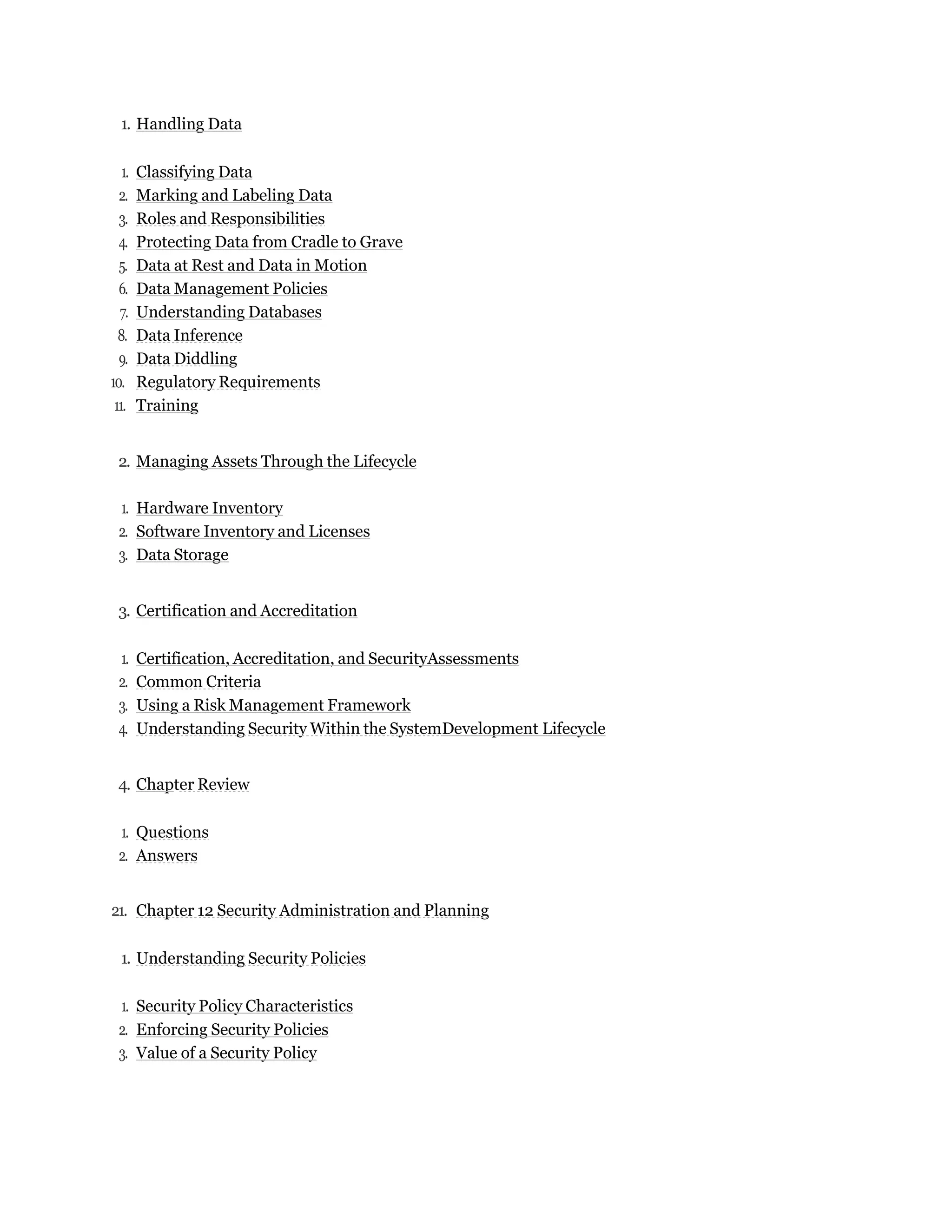
1. Handling Data
1. Classifying Data
2. Marking and Labeling Data
3. Roles and Responsibilities
4. Protecting Data from Cradle to Grave
5. Data at Rest and Data in Motion
6. Data Management Policies
7. Understanding Databases
8. Data Inference
9. Data Diddling
10. Regulatory Requirements
11. Training
2. Managing Assets Through the Lifecycle
1. Hardware Inventory
2. Software Inventory and Licenses
3. Data Storage
3. Certification and Accreditation
1. Certification, Accreditation, and SecurityAssessments
2. Common Criteria
3. Using a Risk Management Framework
4. Understanding Security Within the SystemDevelopment Lifecycle
4. Chapter Review
1. Questions
2. Answers
21. Chapter 12 Security Administration and Planning
1. Understanding Security Policies
1. Security Policy Characteristics
2. Enforcing Security Policies
3. Value of a Security Policy
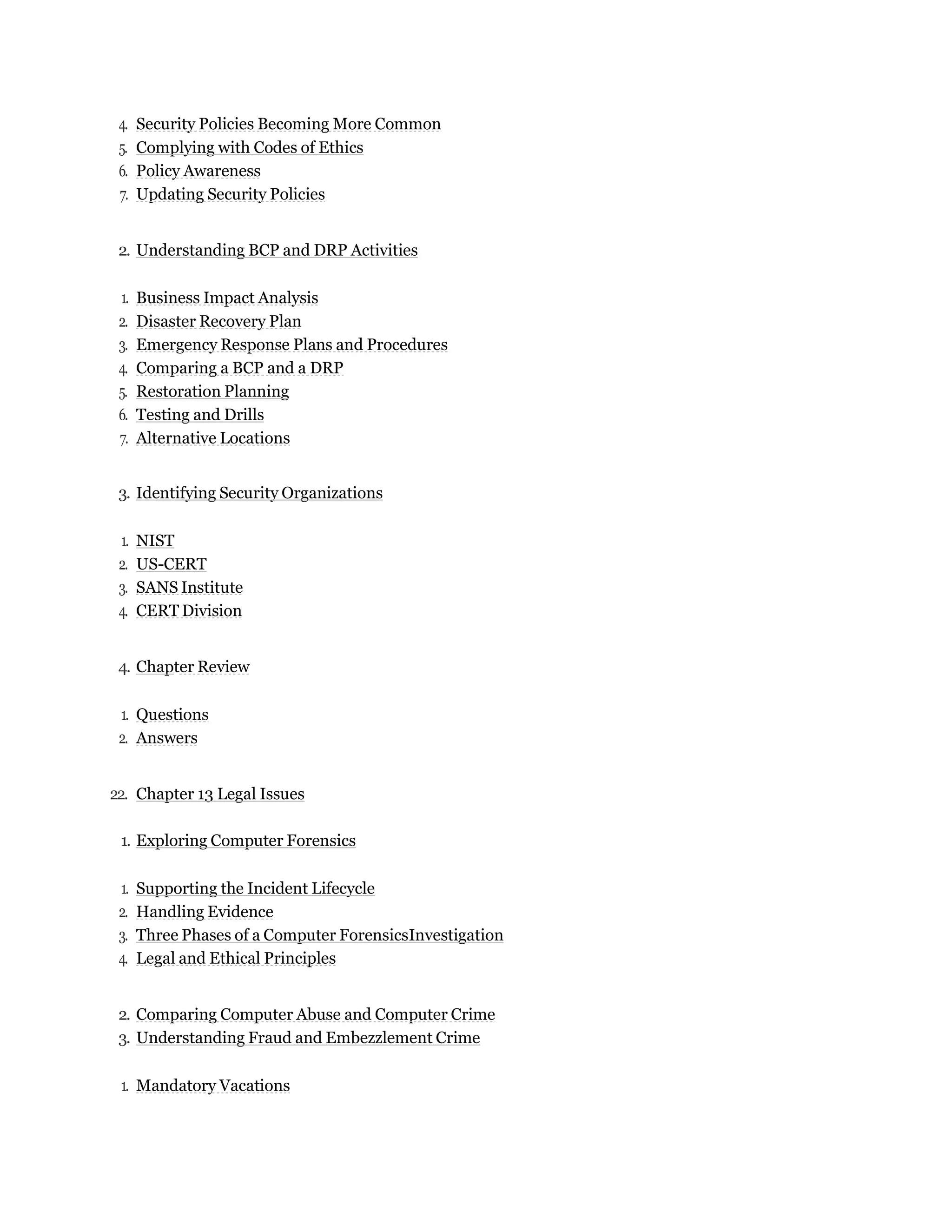
4. Security Policies Becoming More Common
5. Complying with Codes of Ethics
6. Policy Awareness
7. Updating Security Policies
2. Understanding BCP and DRP Activities
1. Business Impact Analysis
2. Disaster Recovery Plan
3. Emergency Response Plans and Procedures
4. Comparing a BCP and a DRP
5. Restoration Planning
6. Testing and Drills
7. Alternative Locations
3. Identifying Security Organizations
1. NIST
2. US-CERT
3. SANS Institute
4. CERT Division
4. Chapter Review
1. Questions
2. Answers
22. Chapter 13 Legal Issues
1. Exploring Computer Forensics
1. Supporting the Incident Lifecycle
2. Handling Evidence
3. Three Phases of a Computer ForensicsInvestigation
4. Legal and Ethical Principles
2. Comparing Computer Abuse and Computer Crime
3. Understanding Fraud and Embezzlement Crime
1. Mandatory Vacations
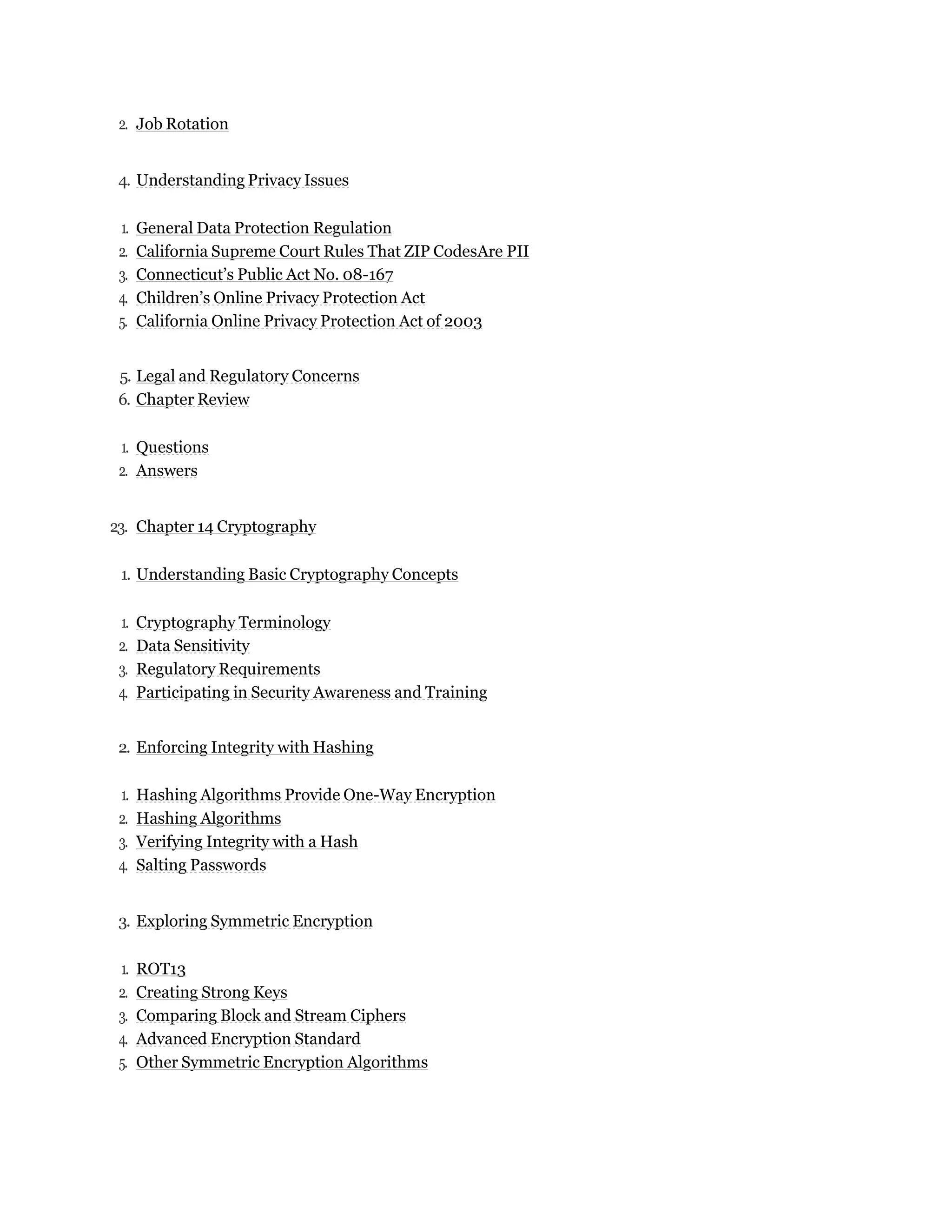
2. Job Rotation
4. Understanding Privacy Issues
1. General Data Protection Regulation
2. California Supreme Court Rules That ZIP CodesAre PII
3. Connecticut’s Public Act No. 08-167
4. Children’s Online Privacy Protection Act
5. California Online Privacy Protection Act of 2003
5. Legal and Regulatory Concerns
6. Chapter Review
1. Questions
2. Answers
23. Chapter 14 Cryptography
1. Understanding Basic Cryptography Concepts
1. Cryptography Terminology
2. Data Sensitivity
3. Regulatory Requirements
4. Participating in Security Awareness and Training
2. Enforcing Integrity with Hashing
1. Hashing Algorithms Provide One-Way Encryption
2. Hashing Algorithms
3. Verifying Integrity with a Hash
4. Salting Passwords
3. Exploring Symmetric Encryption
1. ROT13
2. Creating Strong Keys
3. Comparing Block and Stream Ciphers
4. Advanced Encryption Standard
5. Other Symmetric Encryption Algorithms
4. Exploring Asymmetric Encryption
1. RSA
2. Secure Sockets Layer
3. Transport Layer Security
4. SSL Decryptors
5. Diffie-Hellman
6. Elliptic Curve Cryptography
7. Secure Shell
8. Protecting E-mail with S/MIME
9. Protecting E-mail with DKIM
10. PGP and GPG
5. Other Encryption Schemes
1. Steganography
2. IPsec
6. Understanding Public Key Infrastructure Systems
1. Certificates
2. Certificate Authority
3. Key Escrow
4. Alternative Certificate Trusts
7. Comparing Cryptanalysis Attacks
1. Fundamental Key Management Concepts
2. Known-Plaintext Attack
3. Ciphertext-Only Attack
4. Hashing and Collisions
5. Countermeasures Against Cryptanalysis Attacks
8. Chapter Review
1. Questions
2. Answers
24. Appendix About the Online Content
1. System Requirements
2. Your Total Seminars Training Hub Account
1. Privacy Notice
3. Single User License Terms and Conditions
4. TotalTester Online
5. Technical Support
25. Glossary
26. Index
Guide
1. Cover
2. Title Page
3. SSCP Systems Security Certified Practitioner All-in-One ExamGuide
Page List
1. i
2. ii
3. iii
4. iv
5. v
6. vi
7. vii
8. viii
9. ix
10. x
11. xi
12. xii
13. xiii
14. xiv
15. xv
16. xvi
17. xvii
18. xviii
19. xix
20. xx
21. xxi
22. xxii
23. xxiii
24. xxiv
25. xxv
26. xxvi
27. 1
28. 2
29. 3
30. 4
31. 5
32. 6
33. 7
34. 8
35. 9 36. 1037. 11 38. 1239. 1340. 1441. 15 42. 1643. 17 44. 1845. 1946. 2047. 2148. 2249. 23
50. 2451. 25 52. 2653. 2754. 2855. 2956. 3057. 31 58. 3259. 3360. 34
61. 35
62. 36
63. 37
64. 38
65. 39
66. 40
67. 41
68. 42
69. 43
70. 44
71. 45
72. 46
73. 47
74. 48
75. 49
76. 50
77. 51
78. 52
79. 53
80. 54
81. 55
82. 56
83. 57
84. 58
85. 59
86. 60
87. 61
88. 62
89. 63
90. 64
91. 65
92. 66
93. 67
94. 68
95. 69
96. 70
97. 71
98. 72
99. 73
100. 74
101. 75
102. 76
103. 77
104. 78
105. 79
106. 80
107. 81
108. 82
109. 83
110. 84
111. 85
112. 86
113. 87
114. 88
115. 89
116. 90
117. 91
118. 92
119. 93
120. 94
121. 95
122. 96
123. 97
124. 98
125. 99 126. 100127. 101128. 102129. 103130. 104131. 105 132. 106133. 107134. 108135. 109
136. 110137. 111 138. 112139. 113 140. 114141. 115 142. 116 143. 117 144. 118145. 119 146. 120
147. 121
148. 122
149. 123
150. 124
151. 125
152. 126
153. 127
154. 128
155. 129
156. 130
157. 131
158. 132
159. 133
160. 134
161. 135
162. 136
163. 137
164. 138
165. 139
166. 140
167. 141
168. 142
169. 143
170. 144
171. 145
172. 146
173. 147
174. 148
175. 149
176. 150
177. 151
178. 152
179. 153
180. 154
181. 155
182. 156
183. 157
184. 158
185. 159
186. 160
187. 161
188. 162
189. 163
190. 164
191. 165
192. 166
193. 167
194. 168
195. 169
196. 170
197. 171
198. 172
199. 173
200. 174
201. 175
202. 176
203. 177
204. 178
205. 179
206. 180
207. 181
208. 182
209. 183
210. 184
211. 185
212. 186
213. 187
214. 188
215. 189
216. 190
217. 191
218. 192
219. 193
220. 194
221. 195
222. 196
223. 197
224. 198
225. 199
226. 200
227. 201
228. 202
229. 203
230. 204
231. 205
232. 206
233. 207
234. 208
235. 209
236. 210
237. 211
238. 212
239. 213
240. 214
241. 215
242. 216
243. 217
244. 218
245. 219
246. 220
247. 221
248. 222
249. 223
250. 224
251. 225
252. 226
253. 227
254. 228
255. 229
256. 230
257. 231
258. 232
259. 233
260. 234
261. 235
262. 236
263. 237
264. 238
265. 239
266. 240
267. 241
268. 242
269. 243
270. 244
271. 245
272. 246
273. 247
274. 248
275. 249
276. 250
277. 251
278. 252
279. 253
280. 254
281. 255
282. 256
283. 257
284. 258
285. 259
286. 260
287. 261
288. 262
289. 263
290. 264
291. 265
292. 266
293. 267
294. 268
295. 269
296. 270
297. 271
298. 272
299. 273
300. 274
301. 275
302. 276
303. 277
304. 278
305. 279
306. 280
307. 281
308. 282
309. 283
310. 284
311. 285
312. 286
313. 287
314. 288
315. 289
316. 290
317. 291
318. 292
319. 293
320. 294
321. 295
322. 296
323. 297
324. 298
325. 299
326. 300
327. 301
328. 302
329. 303
330. 304
331. 305
332. 306
333. 307
334. 308
335. 309
336. 310
337. 311
338. 312
339. 313
340. 314
341. 315
342. 316
343. 317
344. 318
345. 319
346. 320
347. 321
348. 322
349. 323
350. 324
351. 325
352. 326
353. 327
354. 328
355. 329
356. 330
357. 331
358. 332
359. 333
360. 334
361. 335
362. 336
363. 337
364. 338
365. 339
366. 340
367. 341
368. 342
369. 343
370. 344
371. 345
372. 346
373. 347
374. 348
375. 349
376. 350
377. 351
378. 352
379. 353
380. 354
381. 355
382. 356
383. 357
384. 358
385. 359
386. 360
387. 361
388. 362
389. 363
390. 364
391. 365
392. 366
393. 367
394. 368
395. 369
396. 370
397. 371
398. 372
399. 373
400. 374
401. 375
402. 376
403. 377
404. 378
405. 379
406. 380
407. 381
408. 382
409. 383
410. 384
411. 385
412. 386
413. 387
414. 388
415. 389
416. 390
417. 391
418. 392
419. 393
420. 394
421. 395
422. 396
423. 397
424. 398
425. 399
426. 400
427. 401
428. 402
429. 403
430. 404
431. 405
432. 406
433. 407
434. 408
435. 409
436. 410
437. 411
438. 412
439. 413
440. 414
441. 415
442. 416
443. 417
444. 418
445. 419
446. 420
447. 421
448. 422
449. 423
450. 424
451. 425
452. 426
453. 427
454. 428
455. 429
456. 430
457. 431
458. 432
459. 433
460. 434
461. 435
462. 436
463. 437
464. 438
465. 439
466. 440
467. 441
468. 442
469. 443
470. 444
471. 445
472. 446
473. 447
474. 448
475. 449
476. 450
477. 451
478. 452
479. 453
480. 454
481. 455
482. 456
483. 457
484. 458
485. 459
486. 460
487. 461
488. 462
489. 463
490. 464
491. 465
492. 466
493. 467
494. 468
495. 469
496. 470
497. 471
498. 472
499. 473
500. 474
501. 475
502. 476
503. 477
504. 478
505. 479
506. 480
507. 481
508. 482
509. 483
510. 484
511. 485
512. 486
513. 487
514. 488
515. 489
516. 490
517. 491
518. 492
519. 493
520. 494
521. 495
522. 496
523. 497
524. 498
525. 499
526. 500
527. 501
528. 502
529. 503
530. 504
531. 505
532. 506
533. 507
534. 508
535. 509
536. 510
537. 511
538. 512
539. 513
540. 514
541. 515
542. 516
543. 517
544. 518
545. 519
546. 520
547. 521
548. 522
549. 523
550. 524
551. 525
552. 526
553. 527
554. 528
555. 529
556. 530
557. 531
558. 532
559. 533
560. 534
561. 535
562. 536
563. 537
564. 538
565. 539
566. 540
567. 541
568. 542
569. 543
570. 544
571. 545
572. 546
573. 547
574. 548
575. 549
576. 550
577. 551
578. 552
579. 553
580. 554
581. 555
582. 556
583. 557
584. 558
585. 559
586. 560
587. 561
588. 562
589. 563
590. 564
591. 565
592. 566
593. 567
594. 568
595. 569
596. 570
597. 571
598. 572
599. 573
600. 574
601. 575
602. 576
603. 577
604. 578
605. 579
606. 580
607. 581
608. 582
609. 583
610. 584
611. 585
612. 586
613. 587
614. 588
615. 589
616. 590
617. 591
618. 592
619. 593
620. 594
621. 595
622. 596
623. 597
624. 598
625. 599
626. 600
627. 601
628. 602
629. 603
630. 604
631. 605
632. 606
633. 607
634. 608
635. 609
636. 610
637. 611
638. 612
639. 613
640. 614
ABOUT THE AUTHOR
Darril Gibson is the CEO of YCDA, LLC (short for You Can DoAnything) and
he has authored or coauthored more than 40 books. Darril regularly writes,
consults, and teaches on a wide variety of technical and security topics and
holds several certifications, including (ISC)2 SSCP and CISSP; CompTIA
Security+ and CASP; Microsoft MCSE and MCITP; and ITIL Foundations. In
response to repeated requests, Darril created the https://gcgapremium.com/
site where he provides additional study materials for several certification
exams. He regularly posts blog articles
(https://blogs.getcertifiedgetahead.com/) about certification topics and uses
that site to help people stay abreast of changes in certification exams. You can
contact him through either of these sites. Darril lives in Virginia Beach with his
wife and two dogs. Whenever possible, they escape to a small cabin in the
country on over 20 acres of land that continues to provide them with peace,
tranquility, and balance.
ABOUT THE TECHNICAL EDITOR
Josh More has more than 18 years of experience in security,IT, development,
and system and network administration.
Currently, he runs Eyra Security, a security and business improvement
consulting firm based in Minneapolis, MN. Josh holds various security and
technical certifications and has served in a leadership position on several
security-focused groups. He writes a blog on security at www.starmind.org,
oftentaking a unique approach to solving security problems by applying lessons
from other disciplines such as agile development, lean manufacturing,
psychology, economics, and
complexity science. He has also written several books on IT,information
security, and career management.
Copyright © 2019 by McGraw-Hill Education. All rights reserved. Except as
permitted under the United States Copyright Act of 1976, no part of this
publication may be reproduced or distributed in any form or by any means, or
stored in a database or retrieval system, without the prior written permission
of the publisher, with the exception that theprogram listings may be entered,
stored, and executed in a computer system, but they may not be reproduced for
publication.
ISBN: 978-1-26-012871-0
MHID: 1-26-012871-7
The material in this eBook also appears in the print version ofthis title: ISBN:
978-1-26-012870-3, MHID: 1-26-012870-9.
eBook conversion by codeMantraVersion 1.0
All trademarks are trademarks of their respective owners. Rather than put a
trademark symbol after every occurrence of a trademarked name, we use
names in an editorial fashion only, and to the benefit of the trademark owner,
with no intention of infringement of the trademark. Where such designations
appearin this book, they have been printed with initial caps.
McGraw-Hill Education eBooks are available at special quantity discounts to
use as premiums and sales promotions or for use in corporate training
programs. To contact a representative, please visit the Contact Us page at
www.mhprofessional.com.
Information has been obtained by McGraw-Hill Education fromsources
believed to be reliable. However, because of the possibility of human or
mechanical error by our sources, McGraw-Hill Education, or others, McGraw-
Hill Education does not guarantee the accuracy, adequacy, or completeness of
any information and is not responsible for any errors oromissions or the results
obtained from the use of such information.
TERMS OF USE
This is a copyrighted work and McGraw-Hill Education and itslicensors reserve
all rights in and to the work. Use of this workis subject to these terms. Except
as permitted under the Copyright Act of 1976 and the right to store and retrieve
one copy of the work, you may not decompile, disassemble, reverseengineer,
reproduce, modify, create derivative works based upon, transmit, distribute,
disseminate, sell, publish or sublicense the work or any part of it without
McGraw-Hill Education’s prior consent. You may use the work for your own
noncommercial and personal use; any other use of the work is strictly
prohibited. Your right to use the work may be terminated if you fail to comply
with these terms.
THE WORK IS PROVIDED “AS IS.” McGRAW-HILL EDUCATION AND ITS
LICENSORS MAKE NO GUARANTEESOR WARRANTIES AS TO THE
ACCURACY, ADEQUACY OR COMPLETENESS OF OR RESULTS TO BE
OBTAINED FROM USING THE WORK, INCLUDING ANY INFORMATION
THATCAN BE ACCESSED THROUGH THE WORK VIA HYPERLINKOR
OTHERWISE, AND EXPRESSLY DISCLAIM ANY WARRANTY, EXPRESS OR
IMPLIED, INCLUDING BUT NOT LIMITED TO IMPLIED WARRANTIES OF
MERCHANTABILITY OR FITNESS FOR A PARTICULAR
PURPOSE. McGraw-Hill Education and its licensors do not warrant or
guarantee that the functions contained in the workwill meet your requirements
or that its operation will be uninterrupted or error free. Neither McGraw-Hill
Education nor its licensors shall be liable to you or anyone else for any
inaccuracy, error or omission, regardless of cause, in the workor for any
damages resulting therefrom. McGraw-Hill
Education has no responsibility for the content of any information accessed
through the work. Under no circumstances shall McGraw-Hill Education
and/or its licensorsbe liable for any indirect, incidental, special, punitive,
consequential or similar damages that result from the use of or inability to use
the work, even if any of them has been advised ofthe possibility of such
damages. This limitation of liability shall apply to any claim or cause
whatsoever whether such claim or cause arises in contract, tort or otherwise.
To my wife Nimfa.Thanks for
sharing your life with me for the past 26 years and
letting me share mine with you.
CONTENTS AT A GLANCE
Chapter 1 Security Fundamentals
Chapter 2 Access Controls
Chapter 3 Basic Networking and Communications Chapter 4 Advanced
Networking and CommunicationsChapter 5 Attacks
Chapter 6 Malicious Code and Activity Chapter 7 Risk, Response, and
Recovery Chapter 8 Monitoring and Analysis Chapter 9 Controls and
Countermeasures
Chapter 10 Auditing and Management Processes
Chapter 11 Security Operations
Chapter 12 Security Administration and Planning
Chapter 13 Legal Issues
Chapter 14 Cryptography Appendix About the Online Content
GlossaryIndex
CONTENTS
AcknowledgmentsIntroduction
Exam Objective Map
Chapter 1 Security Fundamentals
Reviewing the Requirements for SSCPHave One Year of Experience Registering for
the Exam Passing the Exam
Subscribing to the (ISC)2 Code of Ethics andGetting Endorsed
Maintaining Your SSCP CertificationUnderstanding Basic Security
Concepts
Confidentiality
Integrity Availability
Exploring Fundamentals of Security
Least Privilege Separation of Duties
Privacy and Data SensitivityDefense in Depth Nonrepudiation
AAAs of SecurityAccountability Due Diligence Due Care
Chapter Review
QuestionsAnswers
Chapter 2 Access Controls
Comparing Identification, Authentication, andAuthorization
Exploring Authentication
Three Factors of AuthenticationMultifactor Authentication
Two-Step Verification Reviewing Identification Single Sign-on Authentication
Centralized vs. Decentralized AuthenticationOffline Authentication
Device Authentication
Implementing Access Controls Comparing Subjects and ObjectsLogical Access
Controls
Comparing Access Control ModelsDiscretionary Access Control
Non-Discretionary Access Control
Access Control Matrix vs. Capability TableParticipating in the Identity
and Access Management Lifecycle
Identity Proofing
Provisioning and AuthorizationMaintenance and Entitlement De-provisioning
Participating in Physical Security OperationsBadging
Data Center AssessmentChapter Review
Questions
Answers
Chapter 3 Basic Networking and CommunicationsUnderstanding Use Cases
Reviewing the OSI Model
The Physical Layer (Layer 1) The Data Link Layer (Layer 2)The Network Layer
(Layer 3) The Transport Layer (Layer 4)The Session Layer (Layer 5)
The Presentation Layer (Layer 6)The Application Layer (Layer 7)
Comparing the OSI and TCP/IP Models Understanding Network Topologies
andRelationships
Ethernet Bus Topology
Star TopologyTree Topology
Token Ring Topology Mesh Topology Network Relationships
Reviewing Basic Protocols and PortsComparing IPv4 and IPv6
Dynamic Host Configuration ProtocolAddress Resolution Protocol
Network Discovery Protocol
Domain Name System
Internet Control Message Protocol Internet Group Message Protocol Simple
Network Management ProtocolFile Transfer Protocol
Discovering Diverse Content Through
Random Scribd Documents
The Project Gutenberg eBook of History of the
Reformation in Europe in the Time of Calvin,
Vol. 7 (of 8)
This ebook is for the use of anyone anywhere in the United
States and most other parts of the world at no cost and with
almost no restrictions whatsoever. You may copy it, give it away
or re-use it under the terms of the Project Gutenberg License
included with this ebook or online at www.gutenberg.org. If you
are not located in the United States, you will have to check the
laws of the country where you are located before using this
eBook.
Title: History of the Reformation in Europe in the Time of Calvin,
Vol. 7 (of 8)
Author: J. H. Merle d'Aubigné
Translator: William L. R. Cates
Release date: April 24, 2020 [eBook #61913]
Most recently updated: October 17, 2024
Language: English
Credits: Produced by Brian Wilson, David Edwards, Colin Bell,
David
King, and the Online Distributed Proofreading Team at
http://www.pgdp.net. (This file was produced from
images
generously made available by The Internet Archive.)
*** START OF THE PROJECT GUTENBERG EBOOK HISTORY OF THE
REFORMATION IN EUROPE IN THE TIME OF CALVIN, VOL. 7 (OF 8)
***
History of the Reformation in Europe in the Time of
Calvin, Vol. 7 of 8
DR. MERLE D’AUBIGNÉ’S HISTORY.
1.—The History of the Reformation in the SIXTEENTH CENTURY. 5 Vols.
$6.00
2.—The History of the Reformation in the TIME OF CALVIN. 7 Vols.
$14.00
[From a Review by Prof. F. Godet of Neuchâtel.]
What a difference there is between the perusal of a work of this kind
and that of one of the religious novels with which our public is now
satiated. In these latter, notwithstanding all the good-will of the
authors, there is always, or nearly always, something unwholesome.
Imagination, that admirable gift of God, is employed to transport us
into the chiaro-oscuro of fictitious scenes, which communicate a kind
of fascination from which it is difficult to emerge, to return to the
humdrum of every-day life, and to confine ourselves to the narrow
limits of our every-day duties. Here on the contrary we find the full
light of historic truth, imagination restored to its true object—that of
giving life to real facts. The faith of this martyr, it really struggled,
really triumphed—this blood, it really flowed—this pile, its flames
lighted up the surrounding country, but in doing so they really
consumed their victim. When we read these true histories our hearts
do not swell with vain ambition or aspire to an inaccessible ideal. We
do not say: “If I were this one, or that one.” We are obliged to
commune with ourselves, to examine our consciences, to humble
ourselves with the question: What would become of me if I were
called to profess my faith through similar sufferings? Each one of us
is thus called to less self-complacency, to greater humility, but at the
same time to greater contentment with his lot, to greater anxiety to
serve his God with greater faithfulness and greater activity.
We warmly recommend this work to those who are glad to find
wholesome nutriment for the strengthening of their faith, to those
who by contact with a vivifying stream wish to give renewed vigor to
their spiritual life. They will find in its narrations all the energy and
brightness which a living faith communicated to the author, whose
mind retained all its youthful freshness, and at the same time that
wisdom which Christian experience had brought to full maturity.
ROBERT CARTER & BROTHERS.
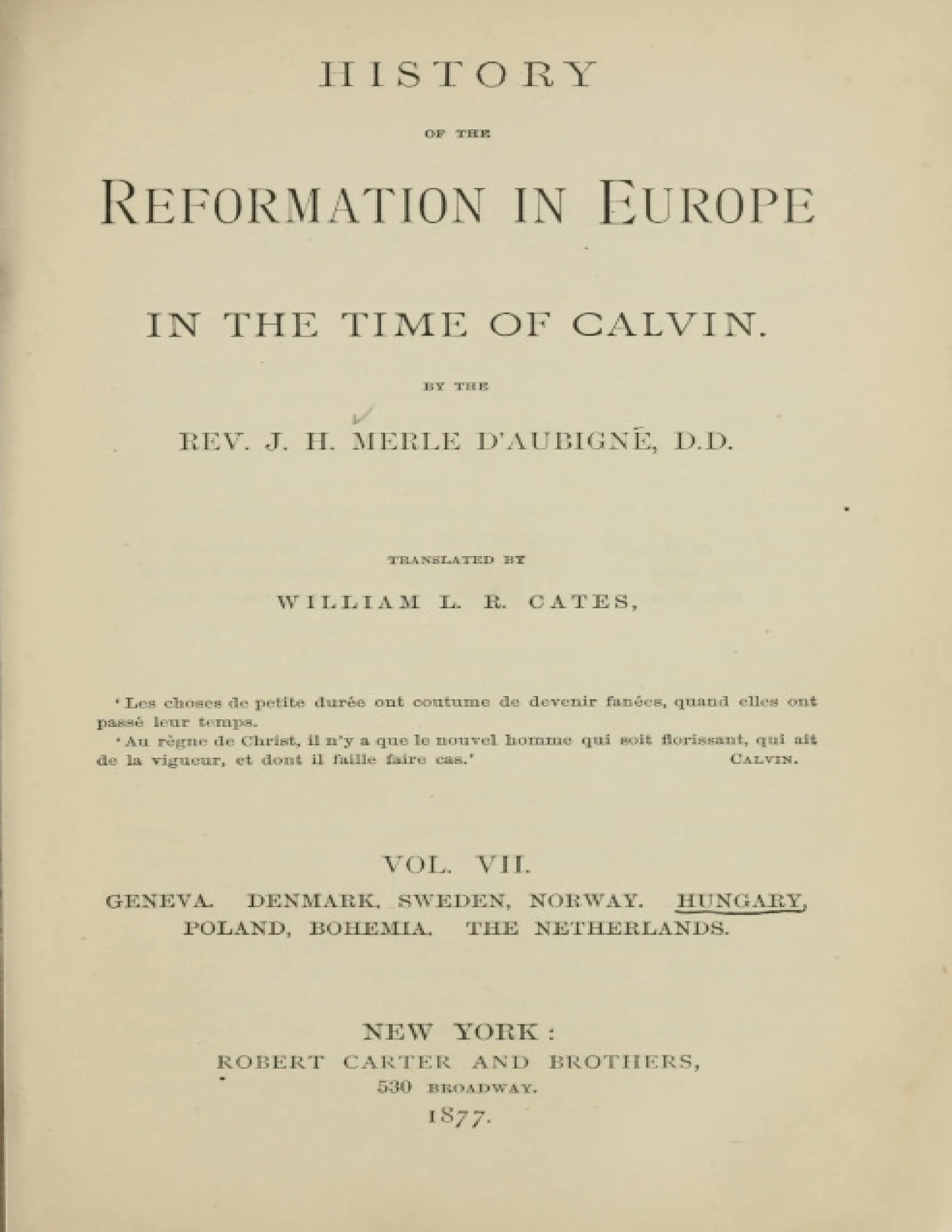
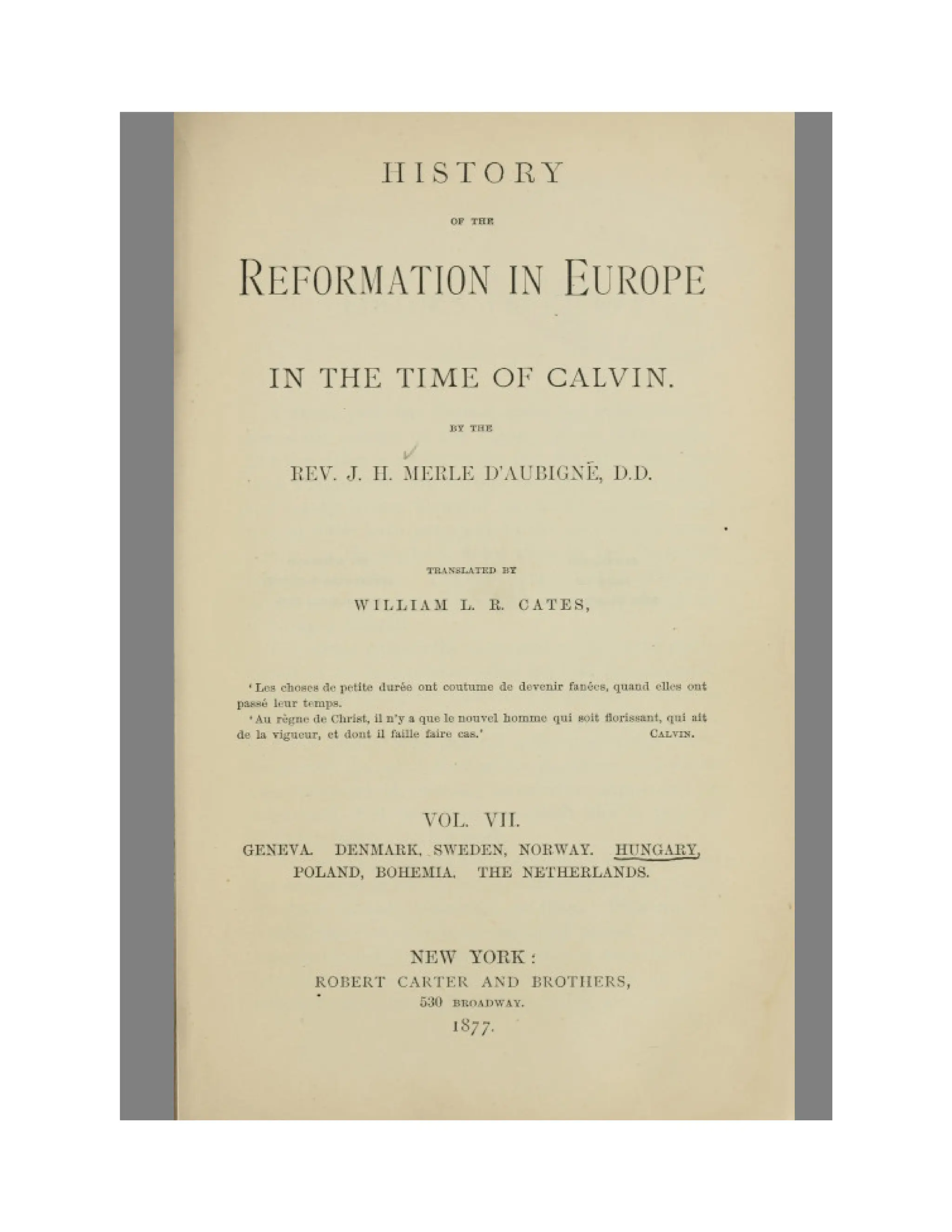
HISTORY OF THE REFORMATION IN
EUROPE IN THE TIME OF CALVIN.
BY THE
REV. J. H. MERLE D’AUBIGNÉ, D.D.,
TRANSLATED BY
WILLIAM L. R. CATES,
‘Les choses de petite durée ont coutume de devenir fanées, quand
elles ont passé
leur temps.
‘Au règne de Christ, il n’y a que le nouvel homme qui soit florissant,
qui ait de
la vigueur, et dont il faille faire cas.’
Calvin.
VOL. VII.
ENGLAND, GENEVA, FRANCE, GERMANY, AND
ITALY.
NEW YORK:
ROBERT CARTER & BROTHERS,
No. 530 BROADWAY.
1877
EDITOR’S PREFACE.
A whole year has elapsed since the publication of the sixth volume of
the History of the Reformation. But this delay is owing to the fact
that the editor has been unable to devote to this undertaking more
than the scanty leisure hours of an active ministry; and not, as some
have supposed, to the necessity of compiling the History from notes
more or less imperfect left by the author. The following narrative,
like that which has preceded it, is wholly written by M. Merle
d’Aubigné himself.
The editor repeats the statement made on the publication of the last
volume—that his task has consisted solely in verifying the numerous
quotations occurring in the text or as foot-notes, and in curtailing, in
two or three places, some general reflections which interfered with
the rapid flow of the narrative, and which the author would certainly
have either suppressed or condensed if it had been permitted him to
put the finishing touches to his work.
We can only express our gratitude to the public for the reception
given to the posthumous volume which we have already presented
to them. Criticism, of course, has everywhere accompanied praise.
The estimates formed by the author of this or that character have
not been accepted by all readers; and the journals have been the
organs of the public sentiment.
One important English review[1]
has censured the author for placing
himself too much at the evangelical point of view. It is
unquestionable that this is indeed the point of view at which M.
Merle d’Aubigné stood. This was not optional with him; he could not
do otherwise. By conviction, by feeling, by nature, by his whole
being, he was evangelical. But was this the point of view best
adapted to afford him a real comprehension of the epoch, the
history of which he intended to relate? This is the true question, and
the answer seems obvious. If we consider the fact that the
theologians of the revival at Geneva have been especially accused of
having been too much in bondage to the theology of the sixteenth
century, we shall acknowledge that this evangelical point of view
was the most favorable to an accurate understanding of the
movement of the Reformation, and to a just expression of its ideas
and tendencies. No one could better render to us the aspect of the
sixteenth century than one of those men who, if we may so speak,
have restored it in the nineteenth.
The criticism most commonly applied to M. Merle d’Aubigné is that
he has displayed a bias in favor of the men of the Reformation, and
especially in favor of Calvin. That the author of the History of the
Reformation feels for Calvin a certain tenderness, and that he is
inclined to excuse, to a certain extent, his errors and even his faults,
may be admitted. But it is no less indisputable that this tendency has
never led him to palliate or to conceal those errors or faults. He
pronounces a judgment: and this is sometimes a justification or an
excuse. But he has in the first place narrated; and this narration has
been perfectly accurate. The kindly feeling, or, as some say, the
partiality of the writer, may have deprived his estimate of the
severity which others would have thought needful; but it has not
falsified his view. His glance has remained keen and clear, and
historical truth comes forth from the author’s narratives with
complete impartiality. These narratives themselves furnish the reader
with the means of arriving at a different conclusion from that which
the author has himself drawn.
May we not add that M. Merle d’Aubigné’s love for his hero,
admitting the indisputable sincerity of the historian, far from being a
ground of suspicion, imparts a special value to his judgments? For
nearly sixty years M. Merle lived in close intimacy with Calvin. He
carefully investigated his least writings, seized upon and assimilated
all his thoughts, and entered, as it were, into personal intercourse
with the great reformer. Calvin committed some faults. Who disputes
this? But he did not commit these faults with deliberate intention. He
must have yielded to motives which he thought good, and, were it
only in the blindness of passion, must have justified his actions to his
own conscience. In the main, it is this self-justification on Calvin’s
part which M. Merle d’Aubigné has succeeded better than any one
else in making known to us. He has depicted for us a living Calvin;
he has revealed to us his inmost thought; and when, in the work
which I am editing, I meet with an approving judgment in which I
can not join without some reservation, I imagine nevertheless that if
Calvin, rising from the tomb, could himself give me his reasons, he
would give me no others than those which I find set forth in these
pages. If this view is correct, and it seems to me difficult to doubt it,
has not the author solved one of the hardest problems of history—to
present the true physiognomy of characters, and to show them as
they were; under the outward aspect of facts to discover and depict
the minds of men?
Moreover, the greater number of these general criticisms are matters
of taste, of tendency, of views and of temperament. There are
others which would be important if they were well-founded. Such
are those which bear upon the accuracy of the work, almost upon
the veracity of the author. Fortunately it is easy to overthrow them
by a rapid examination.
‘M. Merle,’ it has been said,[2]
‘makes use of his vast knowledge of
the works of the reformers to borrow from them passages which he
arbitrarily introduces out of their place and apart from the
circumstances to which they relate. Thus sentences taken from
works of Calvin written during the last periods of his life are
transformed into sentences pronounced by him twenty or twenty-
five years earlier. That which on one occasion was written with his
pen is, in regard to another occasion, put into his lips. We may,
without pedantry, refuse to consider this process in strict conformity
with that branch of truth which is called accuracy.’
It is true that, in Vol. VI., M. Merle d’Aubigné applies to the year
1538 words uttered by Calvin about twenty-five years later, at the
time of his death in 1564:—‘I have lived here engaged in strange
contests. I have been saluted in mockery of an evening before my
own door with fifty or sixty shots of arquebuses. You may imagine
how that must astound a poor scholar, timid as I am, and as I
confess I always was.’ But these words, spoken by Calvin many
years after the event, referred precisely to that year, 1538. The
historian has quoted them at the very date to which they belong;
nor could he have omitted them without a failure in accuracy.
The following is, however, the only proof given of this alleged want
of accuracy:—
‘At the time when Calvin had just succeeded in establishing in
Geneva what he considered to be the essential conditions of a
Christian church, he had published, in the name of his colleagues,
some statement of the success which they had just achieved, and
had given expression to the sentiments of satisfaction and hope
which they felt. Of this statement, to which events almost
immediately gave a cruel contradiction, M. Merle has made use to
depict the personal feelings and disposition of Calvin after the check
which his work had sustained. The conditions are altogether
changed. Instead of triumphing, the reformer is banished; and,
nevertheless, the language which he used in the days of triumph is
employed to characterize his steadfastness and constancy in the
days of exile.’
The document here spoken of is a preface by Calvin to the Latin
edition of his Catechism. In the original edition it bears date March,
1538. It is now before us; we have read and re-read it, and we can
not imagine by what strange illusion there could be seen in it a
statement of the success which Calvin and his colleagues had just
achieved. It does not contain one vestige of satisfaction or of hope,
not a trace of triumph. It is an unaccountable mistake to suppose
that it was written in days of triumph. It was written in March 1538,
in the very stress of the storm which, a few days later, April 23, was
to result in the banishment of the reformer and the momentary
destruction of his work at Geneva. This storm had begun to take
shape on November 25, 1537, at a general council (assembly of the
people), in which the most violent attacks had been directed against
Calvin and against the government of the republic. From this time,
says M. Merle, ‘the days of the party in power were numbered.’[3]
In
fact, the government favorable to Calvin was overthrown February 3,
1538. On that day the most implacable enemies of the reformer
came into power. Thus, in March, Calvin, far from thinking of a
triumph, was thinking of defending himself. The preface which
stands at the head of his catechism is not the statement of success
already seriously impaired, but an apologia for his proceedings and
his faith, a reply to ‘the calumnies aimed against his innocence and
his integrity,’[4]
to ‘the false accusations of which he is a victim.’[5]
The following is the analysis of the preface, given by Professor
Reuss, of Strasburg, in the Prolegomena to Vol. V. of the Opera
Calvini, p. 43:—
‘The occasion for publishing, in Latin, this book was furnished by
Peter Caroli, doctor and prior of the Sorbonne. This doctor, after
having spread abroad iniquitous rumors against Farel, Viret, and
Calvin, broke out passionately in open accusations against these
men, his colleagues, who were equally distinguished by their faith
and their moral character, imputing to them the Arian and Sabellian
heresies and other similar corruptions. At this time there existed no
other public monument of the faith of the Genevese church but the
Confession of Farel and the Catechism of Calvin; and these, as they
were written in French, were almost unknown to the rest of the
Swiss churches. For this reason Calvin translated into Latin his own
Catechism and the Confession of Farel, in order to make known
through this version to all his brethren in Switzerland the doctrine
which he had hitherto professed at Geneva, and to show that the
charge of heresy brought against it was without foundation.’[6]
It must be added that Calvin, in this preface, does not confine
himself to the refutation of the charges of heresy drawn up against
him by Caroli; but he vindicates his own course at Geneva,
particularly in that vexatious affair of the oath which gave rise to the
debate of November 25, 1537, the overthrow of the government on
February 3, 1538, and the expulsion of Calvin and his friends on
April 23 following. This document is, with the letters written by
Calvin at this period, the most precious source of information as to
the reformer’s feelings during this cruel struggle; and in quoting it at
this place the author has made a judicious use of it.
Let us quote further some words from an article in the Athenæum,
of which we have already spoken. In the course of criticisms,
sometimes severe, the writer acknowledges that ‘there are to be
found in this volume, in unimpaired vigor, the qualities we admired
in its predecessors. Few narratives are more moving than the simple
tale of the death of Hamilton, the first of the Scotch martyrs; and
the same may be said of the chapter devoted to Wishart.’ In regard
to Calvin the same writer tells us—‘M. Merle possessed, as we have
already remarked, a knowledge truly marvellous of the writings of
Calvin; and there are few books which enable us to understand so
well as M. Merle’s the mind of the reformer—not perhaps as he was
on every occasion, but such as he would have wished to be.’
Professor F. Godet, of Neuchâtel, expresses the same opinions and
insists on them.[7]
After having spoken of ‘that stroke of a masterly
pencil which was one of the most remarkable gifts of M. Merle
d’Aubigné,’ he adds—‘It is always that simple and dignified style,
calm and yet full of earnestness, majestic as the course of a great
river, we might say—like the whole aspect of the author himself. But
what appears to us above all to distinguish the manner of M. Merle
is his tender and reverential love for his subject. The work which he
describes possesses his full sympathy. He loves it as the work of his
Saviour and his God. Jesus would no longer be what he is for the
faith of the writer if he had not delivered, aided, corrected,
chastened, governed and conquered as he does in this history. St.
John, in the Apocalypse, shows us the Lamb opening the seals of the
book containing the designs of God with respect to his church. M.
Merle, in writing history, appears to see in the events which he
relates so many seals which are broken under the hand of the King
of Kings. In each fact he discerns one of the steps of his coming as
spouse of the church or as judge of the world. And just as the leaves
of the divine roll were written not only without but within, M. Merle
is not satisfied with portraying the outside of events, but endeavors
to penetrate to the divine idea which constitutes their essence, and
to unveil it before the eyes of his reader. Do not therefore require
him to be what is called an objective historian, and to hold himself
coldly aloof from the facts which he recalls to mind. Is not this faith
of the sixteenth century, of which he traces the awakening, the
struggles, defeats and victories, his own faith and the life of his own
soul? Are not these men whom he describes, Calvin, Farel, Viret,
bone of his bone, flesh of his flesh? Are not these churches, whose
birth and first steps in life he relates, his own spiritual family? The
reader himself, to whom his narrative is addressed, is for him an
immortal soul, which he would fain make captive to the faith of the
Reformation. He does not for an instant lay aside, as narrator, his
dignity as a minister of Christ. The office of historian is in his case a
priesthood. Not that he falls into the error of determining at all cost
to glorify his heroes, to palliate their weaknesses, to excuse their
errors, or to present facts in a light different from that objective
truth to which he has been led by the conscientious study of the
documents. The welfare of the church of to-day for which he desires
to labor, may as surely result from the frank avowal and the severe
judgment of faults committed, as from admiration of every thing
which has been done according to the will of God.’
The same judgment was lately pronounced by the author of a great
work on French literature, recently published,[8]
Lieutenant-Colonel
Staaf. It is in the following terms that the author introduces M. Merle
d’Aubigné to the French public:—‘M. de Remusat has said of this
work—“It may have had a success among Protestants (un succès de
secte), but it deserves a much wider one, for it is one of the most
remarkable books in our language.” We might add one of the most
austere, for it is at once the work of a historian and of a minister of
the Gospel. It would be a mistake to suppose that the author has
sacrificed the narrative portion of his history to the exposition and
defence of the doctrines of the Reformation. Without seeking after
effects of coloring, without concerning himself with form apart from
thought, he has succeeded in reproducing the true physiognomy of
the age whose great and fruitful movements he has narrated. All the
Christian communities over which the resistless breath of the
Reformation passed live again in spirit and in act in this grand
drama, the principal episodes of which are furnished by Germany,
France, Switzerland, and England. In order to penetrate so deeply as
he has done into the moral life of the reformers, M. Merle was not
satisfied with merely searching the histories of the sixteenth century;
he has drawn from sources the existence of which was scarcely
suspected before they had been opened to him.’... ‘Now, at whatever
point of view we may take our stand, it is no subject for regret that
for writing the story of the conflicts and too often of the execution of
so many men actuated by the most generous and unalterable
convictions, the pen has been held by a believer rather than by a
sceptic. It was only a descendant and a spiritual heir of the apostles
of the Reformation who could catch and communicate the fire of
their pure enthusiasm, in a book in which their passions have left no
echoes. M. Merle d’Aubigné—and this is one of the peculiar
characteristics of his work—has satisfied with an antique simplicity
the requirements of his twofold mission. It is only when the
conscience of the historian has given all the guarantees of fairness
and impartiality that one had a right to expect from it that the pastor
has indulged in the outpourings of his faith.’
We close with the words of Professor F. Bonifas, of Montauban:[9]
‘In
this volume are to be found the eminent qualities which have earned
for M. Merle d’Aubigné the first place among the French historians of
the Reformation: wealth and authenticity of information, a
picturesque vivacity of narration, breadth and loftiness of view, a
judicious estimate of men and things, and in addition to all these a
deeply religious and Christian inspiration animating every page of
the book. The writer’s faculties remained young in spite of years;
and this fruit of his ripe old age recalls the finest productions of his
youth and manhood.’
A last volume will appear (D.V.) before the end of the present year.
Ad. Duchemin.
Lyons, May, 1876.
CONTENTS OF THE SEVENTH VOLUME.
BOOK XI.—(continuation.)
CALVIN AND THE PRINCIPLES OF HIS REFORM.
CHAPTER XIX.
CALVIN’S RECALL TO GENEVA.
(August 1540 to March 1541.)
The Ministers of Geneva—Departure of Morand and Marcourt from
the Town—Great Famine—Advice of Calvin—His Recall determined
on—The Message taken by Louis Dufour—Calvin’s First Answer—
Journey to Worms—Letter from the Syndics and Council of Geneva—
Calvin’s Anxieties—Consultation of his Friends—His Answer—Its
Conditions—Viret called to Geneva—Viret at Geneva—The Minister
Bernard—His Letter to Calvin—Calvin at Worms—Calvin and
Melanchthon—Their Intimacy—Their Reciprocal Confidence—
Colloquy of Worms—Song of Victory—Triumph of Christ—Calvin’s
Confidence in Viret—Calvin’s Letter to Bernard—Calvin restored to
Geneva by Farel—Trials—Humility and Faith 1
CHAPTER XX.
CALVIN AT RATISBON.
(1541.)
Calvin’s Uneasiness—Concessions of the Lutherans—Calvin’s
Steadfastness—Discourse of Cardinal Farnese—Calvin’s Answer—
Papal Tyranny—The True Concord—Unity and Diversity—The Roman
See not the Apostolic See—Incontinence—Profanation of Religion—A
great Monster—True Ministers—Church Property—The Pope’s Crosier
—Protestants and Turks—Calvin’s part at Ratisbon—Theology of
Rome—Evils to be remedied—Calvin’s Moderation—Reference to the
General Council—Calvin’s Departure from Ratisbon 24
CHAPTER XXI.
CALVIN’S RETURN TO GENEVA.
(July to September, 1541.)
Repeal of the Sentence of Banishment by the General Council—
Letter from the Syndics and Council of Geneva to the Pastors and
Councils of Zurich and Basel—Severity of their Language—Its
Expression of the common Feeling—All Difficulties removed by
Letters from Geneva—Calvin’s Motto—His departure from Strasburg
—His Stay at Neuchâtel—At Berne—Arrival at Geneva—Ostentation
avoided—Calvin’s House—What he had acquired at Strasburg—His
Appearance before the Council—Going forward—Commission of the
Ordinances—Beginning of Calvin’s work—Assistance of Farel and
Viret requested—The Grace of God and the Work of Man—A Day of
Humiliation—The Truth with Charity 42
CHAPTER XXII.
THE ECCLESIASTICAL ORDINANCES.
(September, 1541.)
Project of the Ordinances—Its Presentation to the Councils—Passed
in the General Council—Spirit and Purpose of the Ordinances—
Calvin’s Model the Primitive Church—Geneva an Evangelical
Stronghold—The Christian Life—Remonstrances—The Ministry—
Instruction of the Young—The Poor and the Sick—Prisoners—Election
of Pastors—The Ministers’ Oath—The Doctors—The Elders—The
Consistory—Worship—Common Prayer—Discipline—Manner of
judging of this Discipline—Government of the Church of Geneva—
Theocracy and Democracy—State Omnipotence—Government of the
Church assumed by the State—Calvin not responsible—The Danger
unseen by him 60
CHAPTER XXIII.
CALVIN’S PREACHING.
Preaching Calvin’s Principal Office—Two to Three Thousand Sermons
—His Exposition of Holy Scripture—Quotations—How a young Man
shall cleanse his Way—The Love of Money—A Stranger on the Earth
—Transitory Devotion—Self-love—The lost Lamb—God’s Will that all
should be Saved—His Grace unbounded—How to come to God—The
Blood of Christ—Predestination—Ignorance of it is Learning—No
political Part played by Calvin—His clear Conception of the
Evangelical Ministry 81
CHAPTER XXIV.
CALVIN’S ACTIVITY.
(February, 1542.)
State of Feeling at Geneva—Calvin the Soul of the Consistory—His
Attention to small Matters—Catholicism at Geneva—Believing what
the Church believes—The Virgin and the Church—Politics no Concern
of the Consistory—The Regulation of Morals its Business—
Impartiality—Moderation—Calvin a Peacemaker—Meekness and
Strength—Latent Hostility of the former Ministers—New Ministers—
Ami Porral—His Triumphant Faith—His Christian Death—Living
Christianity—The Work prospering—Development of Religious Life—
Disciplinary Action—Reconciliation—Accomplishment of the
Reformation—Luther’s Part—Calvin’s Part—Luther the Founder of the
Reformation—Calvin its Lawgiver—Calvin a Mediator—Epochs of
Light—Means of National Elevation 96
BOOK XII.
THE REFORMATION AMONG THE SCANDINAVIAN NATIONS—
DENMARK, SWEDEN, NORWAY.
CHAPTER I.
AWAKENING OF DENMARK.
(1515 to 1525.)
John Tausen—His Youth—His Entrance into the Monastery—His
Departure for Germany—His Studies at Louvain and Cologne—At
Wittenberg—Christian II.—His Marriage—Indulgences—Revolt of
Sweden—Royal Vengeance—Martin Reinhard—His foreign Tongue—
Encountered by Ridicule—His Departure from Denmark—Liberal
Laws Promulgated by Christian—Religious Reforms—Carlstadt in
Denmark—His Dismissal—Fresh revolt in Sweden—Flight of the King
—Assistance of his Allies asked for in vain—The Sister of Charles the
Fifth—Her Death in Heresy 120
CHAPTER II.
A REFORMATION ESTABLISHED UNDER THE REIGN OF LIBERTY.
(1524 to 1527.)
Frederick, Duke of Holstein—His Call to the Throne—His Leaning to
Evangelical doctrine—His Impartiality towards Rome and the
Reformation—Promulgation of religious Liberty—The New Testament
in Danish—The Translator’s Preface—Uneasiness of the Clergy—The
King’s Son in Germany—His Adhesion to the Reformation—Growing
Decision of the King—A Sermon of Tausen—Tausen at Viborg—
Continuance in his Work—The Reformation at Copenhagen—
Determination of the Bishops to Persecute—Imprisonment of Tausen
—His preaching through the Air Hole—His Liberation by the King—
Reformation at Malmoe—The Eloquent Tondebinder—The Gospel
embraced by the whole Town of Malmoe—Translation of Luther’s
Hymns into Danish—Increasing Progress in all Parts of the Country—
The Bishops’ Invitation to Eck and Cochlæus—Their Refusal to go to
Denmark—The King’s Discourse to the Bishops—Complete religious
Liberty—Vain Efforts of the Bishops—Royal Ordinance—Apparent
Submission of the Clergy 140
CHAPTER III.
TRIUMPH OF THE REFORMATION UNDER THE REIGN OF
FREDERICK I. THE PEACEFUL.
(1527 to 1533.)
Struggles and Controversies—Tausen’s Writings—A New Bishop—
Various Reforms—Tausen’s Zeal—Diet of Copenhagen—The Bishops
and the Ministers—Increased Number of Sermons by the Ministers—
Silence of the Bishops—Tausen and his Colleagues—Their Confession
of Faith—The Articles—Surprise of the Prelates—Accusations of the
Bishops—Reply of the Evangelicals—Their Demand of a public
Discussion—Refusal of the Bishops—Presentation of a Memorial to
the King by the Ministers—No Answer to it—Triumph of the
Evangelical Cause—Disorders—Frederick’s political Position
strengthened—Intrigues of the ex-King—Invasion of Norway by
Christian II.—A short Struggle—Christian taken Prisoner—His
Demand for a Safe-conduct—His Letter to Frederick—Treated as a
Prisoner of State—Sentenced to Imprisonment for Life—Confined in
a walled-up Keep—Forsaken—Luther’s Intercession for him—Death
of Frederick—His Four Sons 166
CHAPTER IV.
INTERREGNUM. CIVIL AND FOREIGN WAR.
(1533.)
Reviving Hope of the Bishops—Their Efforts—Their Intrigues—
Restriction of religious Freedom—Their Purpose to elect the King’s
fourth Son—Adjournment of the Election—Tausen sentenced to
Death—Rising of the Townsmen—Rescue of Tausen—The Bishops
threatened—Banishment of Tausen—Brigitta Gjoë—Persecution of
Evangelicals—Polemics—Popular Writings—Attack of Lübeck on
Denmark—Rapid Progress of the Invaders—A Diet in Jutland—Long
Debates—Election of Christian III. in spite of the Bishops 194
CHAPTER V.
CHRISTIAN III. PROCLAIMED KING—TRIUMPH OF THE
REFORMATION IN DENMARK, NORWAY, AND ICELAND.
(1533 to 1550.)
Vigorous Prosecution of the War by the new King—The Enemy driven
from the Provinces—Siege of Copenhagen—Extreme Sufferings of
the besieged Town—Entry of Christian into his Capital—His
Determination to crush the temporal Power of the Bishops—Arrest of
the Bishops—General Council of the Nation—Bill of Indictment
against the Bishops—Their Deprivation—Their Liberation—The King’s
Invitation to Pomeranus—Reorganization of the Church by
Pomeranus—New Constitution of the Church—The Reformation in
Norway—In the main a Work of the Government—The Reformation
in Iceland—The two Bishops of Iceland—Oddur’s Translation of the
New Testament—An Evangelical Bishop—His Death—Popish Reaction
—Triumph of the Gospel 211
CHAPTER VI.
THE EARLIEST REFORMERS OF SWEDEN.
(1516 to 1523.)
Various Influences—The Brothers Olaf and Lawrence—Their early
Studies—Their Application to Theology—Olaf at Wittenberg—His
Intimacy with Luther—His Return to Sweden—The two Brothers and
Bishop Mathias—Present at the Massacre of Stockholm—Mathias one
of the Victims—Lawrence Anderson Successor of Mathias—He is
favorable to the Reformation—Olaf and Lawrence at their Father’s
Funeral—Their Refusal of the Services of the Monks—Violent
Opposition—Their Death demanded by Bishop Brask 231
CHAPTER VII.
THE REFORMERS SUPPORTED BY THE LIBERATOR OF SWEDEN.
(1519 to 1524.)
Gustavus Vasa Prisoner in Denmark—His Escape from Confinement—
His Struggle for the Independence of Sweden—His Flight from Place
to Place—News of the Massacre of Stockholm—Concealment in the
Mountains—Farm Labor—Recognition of Him—Betrayal—Pursued like
a wild Beast—His Attempt to rouse the People—Unsuccessful Efforts
—A Rising at last—Speedy Triumph—Gustavus nominated King—His
Leaning to Reform—His Welcome to the Reformers—Anderson
Chancellor of the Kingdom—Olaf Preacher at Stockholm—Partisans
and Adversaries—Conspiracies of the Bishops—Bishop Brask—
Citation of Olaf and Lawrence before the Chapter—Their Attitude—
Anathema 244
CHAPTER VIII.
STRUGGLES.
(1524 to 1527.)
The ‘Illuminated’ at Stockholm—Their Expulsion—Olaf’s Marriage—
His Excommunication by Bishop Brask—His Defence undertaken by
the King—Revenues of the Clergy diminished by the King—
Ostentation of Archbishop Magnus—Feast of St. Erick—The Clergy
humbled by the King—Fears of the Bishops—Public Disputation
proposed by Magnus—Accepted by the King—Olaf and Galle—
Regrets of the Catholics—Tempers heated on both sides—A
Pretender—The Bishops’ Support of Him—Declaration of the King—
His Resolution to complete his Task—Convocation of the States of
the Kingdom—A royal Banquet—Humiliation of the Bishops 265
CHAPTER IX.
VICTORY.
(1527.)
An Episcopal Conspiracy—The Diet of 1527—Complaints of the King
—Exactions of the Clergy—Audacity of Bishop Brask—The King’s
Abdication—Triumph of the Bishops—Excitement of the People—A
Disputation before the Diet ordered—The King entreated to resume
the Sceptre—His long Resistance—His final Consent—Political
Reforms—Religious Reforms—Compact of Westeraas—Disarming of
the Romish Hierarchy—Suppression of the armed Revolt—Coronation
of Gustavus I. 283
CHAPTER X.
‘CESAROPAPIE.’
(1528 to 1546.)
Assembly of Orebro—Authority of the Scriptures—Education of
Pastors—Ecclesiastical Rites—Concessions—Obstacles—Discontent—
Progress—Lawrence Petersen—His Nomination as Archbishop of
Upsala—Marriage of the King—Marriage of the Archbishop—Hostility
of the Monks—Olaf’s Desire for a complete Reformation—The King’s
Desire to put it off—Coolness between the King and the Reformer—
Complaints of Olaf—Irritation of the King—The Mock Suns of 1539—
A Storm raging against Olaf—Brought to Trial with Anderson—Both
condemned to Death—A Ransom accepted by the King—Resignation
and Reinstatement of Olaf—The King Head of the Church—Luther’s
Counsels—Church Order half Episcopalian and half Presbyterian—
Severity of Gustavus—Excuses—Refusal of Gustavus to join the
League of Smalcalde 298
CHAPTER XI.
THE SONS OF GUSTAVUS VASA.
(1560 to 1593.)
The King’s Farewell to the People—His Illness—His Death—Erick the
new King of Sweden—Debates on the Lord’s Supper—Controversies
—Madness of King Erick—Massacres—Death of Burrey—Deposition
of Erick—His harsh Captivity—Catholicism favored by King John—
Catholicism in the ascendent—Arrival of Jesuits—Their Profession of
Evangelical Doctrines—Their Attempt to convert the King—Fratricide
—Death of the ex-King Erick—Conversion of John III. to Popery—
Sudden Change of the King—His Death—The Assembly of Upsala in
1593—Adoption of the Confession of Augsburg 322
BOOK XIII.
HUNGARY, POLAND, BOHEMIA, THE NETHERLANDS.
CHAPTER I.
THE FIRST REFORMERS AND THE FIRST PERSECUTORS IN
HUNGARY.
(1518 to 1526.)
First Gleams—Louis II.—Mary of Hungary—Beginning of the
Reformation—The first Preachers—Their Wish to see Luther—
Threatenings of Persecution—Intolerance of the Catholic Clergy—
Louis II. and Frederick the Wise—The Gospel at Hermannstadt—
Noteworthy Progress—Severe Ordinance against the Reform—First
Act the burning of the Books—Flight of Grynæus—New Efforts—An
Execution at Buda—Another Storm 342
CHAPTER II.
SOLYMAN’S GREAT VICTORY.
(1526.)
Solyman’s Army—Hungary entirely unprepared—Vain Attempts to
raise an Army—The small Troop of King Louis—Battle of Mohacz—
Death of Louis II.—Sorrow of the Queen—Consolation offered by
Luther—A Hymn of Resignation—Two Kings of Hungary—Martyrs at
Liebethen—Edict of Persecution 356
CHAPTER III.
DEVAY AND HIS FELLOW-WORKERS.
(1527 to 1538.)
Mathias Biro Devay—Student at Wittenberg—Various Lords
Protectors of Reform—Slackening of Persecution—Reform at
Hermannstadt—Solyman’s Refusal to oppress the Protestants—
Confession of Augsburg welcomed by Hungarians—Devay’s Return to
Hungary—His Pastorate at Buda—His Fellow-workers—Devay cast
into Prison—His Appearance before the Bishop of Vienna—His
Defence and Acquittal—Imprisoned again—Asylum offered Him by
Count Nadasdy—Controversies with Szegedy—Devay at Wittenberg—
Melanchthon’s Letter to Nadasdy—Devay at Basel—The Printing-
press and Schools—Stephen Szantai—His Enemies the Bishops—
Conference appointed by Ferdinand—Embarrassment of the
Arbitrators—Embarrassment of Ferdinand—Efforts of the Bishops—
Banishment of Szantai 366
CHAPTER IV.
PROGRESS OF EVANGELIZATION AND OF THE SWISS
REFORMATION IN HUNGARY.
(1538 to 1545.)
The Doctrines of Zwinglius in Hungary—Occasion of Trouble to some
Minds—Political Divisions—Fresh Invasion of the Turks—Dispersion of
Evangelical Divines—Abatement of Moslem Violence—Renewed
Courage of the Christians—Progress of the Reformation—Devay in
Switzerland—His Adoption of Calvin’s Doctrines—Luther’s Grief—
Martin de Kalmance—Hostility excited against him—Persecution
instigated by the Priests—Ordinances of Ferdinand—Courage of the
Christians of Leutschau—Stephen Szegedin—His Knowledge and
Eloquence—His Writings—His Acceptance of Calvin’s Doctrines—
Hated by the Papists—His Banishment 388
CHAPTER V.
THE GOSPEL IN HUNGARY UNDER TURKISH RULE.
(1545 to 1548.)
Rome the Persecutor—Islamism tolerant—Council of Trent—The
Union of Christians in Hungary—Confessions of Faith—Szegedin in
the South of Hungary—His second Banishment—Emeric Eszeky—The
Gospel at Tolna—Refusal of the Turks to persecute—Spread of the
Gospel—Rule of the Turks favorable to the Gospel—The Faith
embraced in the whole of Transylvania 406
CHAPTER VI.
BOHEMIA, MORAVIA, AND POLAND.
(1518 to 1521.)
The United Brethren—Relations with Luther—Luther’s Goodwill—
Discussions on the Lord’s Supper—The Calixtines—Poland
evangelized by the Bohemians—First Successes—Luther’s
Reformation in Poland—Jacob Knade at Dantzic—The Gospel well
received—Religious Liberty—A Revolution at Dantzic—Reorganization
of the Church—Appeal of the Catholics to the King—Harshness of
Sigismund—Final Triumph of the Gospel—The Gospel at Cracow—
Embraced by many eminent Persons—Words of Luther—Attempted
Reformation in Russia 417
CHAPTER VII.
THE POLISH REFORMER.
(1524 to 1527.)
Welcome to Our Bookstore - The Ultimate Destination for Book Lovers
Are you passionate about books and eager to explore new worlds of
knowledge? At our website, we offer a vast collection of books that
cater to every interest and age group. From classic literature to
specialized publications, self-help books, and children’s stories, we
have it all! Each book is a gateway to new adventures, helping you
expand your knowledge and nourish your soul
Experience Convenient and Enjoyable Book Shopping Our website is more
than just an online bookstore—it’s a bridge connecting readers to the
timeless values of culture and wisdom. With a sleek and user-friendly
interface and a smart search system, you can find your favorite books
quickly and easily. Enjoy special promotions, fast home delivery, and
a seamless shopping experience that saves you time and enhances your
love for reading.
Let us accompany you on the journey of exploring knowledge and
personal growth!
ebookgate.com

SSCP Systems Security Certified Practitioner All in One Exam Guide Third Edition Gibson
  • 1.
    SSCP Systems SecurityCertified Practitioner All in One Exam Guide Third Edition Gibson download https://ebookgate.com/product/sscp-systems-security-certified- practitioner-all-in-one-exam-guide-third-edition-gibson/ Get Instant Ebook Downloads – Browse at https://ebookgate.com
  • 2.
    Get Your DigitalFiles Instantly: PDF, ePub, MOBI and More Quick Digital Downloads: PDF, ePub, MOBI and Other Formats CEH Certified Ethical Hacker all in one exam guide 2nd edition Edition Horton https://ebookgate.com/product/ceh-certified-ethical-hacker-all- in-one-exam-guide-2nd-edition-edition-horton/ CISSP All in One Exam Guide Fifth Edition Shon Harris https://ebookgate.com/product/cissp-all-in-one-exam-guide-fifth- edition-shon-harris/ All in one A certification exam guide 3rd ed Edition Michael Meyers https://ebookgate.com/product/all-in-one-a-certification-exam- guide-3rd-ed-edition-michael-meyers/ ISC2 Certified Cloud Security Professional CCSP Exam Guide First Edition Kim Van Lavieren https://ebookgate.com/product/isc2-certified-cloud-security- professional-ccsp-exam-guide-first-edition-kim-van-lavieren/
  • 3.
    CISSP Certified InformationSystems Security Professional Study Guide 2nd Edition Ed Tittle https://ebookgate.com/product/cissp-certified-information- systems-security-professional-study-guide-2nd-edition-ed-tittle/ Comptia A Certification All In One Exam Guide Exams 220 801 220 802 8th Edition Meyers https://ebookgate.com/product/comptia-a-certification-all-in-one- exam-guide-exams-220-801-220-802-8th-edition-meyers/ Wireshark Certified Network Analyst Exam Prep Guide Second Edition Laura Chappell https://ebookgate.com/product/wireshark-certified-network- analyst-exam-prep-guide-second-edition-laura-chappell/ CWSP Certified Wireless Security Professional Official Study Guide Exam PW0 204 CWNP Official Study Guides 1st Edition David D. Coleman https://ebookgate.com/product/cwsp-certified-wireless-security- professional-official-study-guide-exam-pw0-204-cwnp-official- study-guides-1st-edition-david-d-coleman/ Eleventh Hour Security Exam SY0 201 Study Guide Ido Dubrawsky https://ebookgate.com/product/eleventh-hour-security-exam- sy0-201-study-guide-ido-dubrawsky/
  • 5.
    Contents 1. Cover 2. TitlePage 3. Copyright Page 4. Dedication 5. Contents at a Glance 6. Contents 7. Acknowledgments 8. Introduction 9. Exam Objective Map 10. Chapter 1 Security Fundamentals 1. Reviewing the Requirements for SSCP 1. Have One Year of Experience 2. Registering for the Exam 3. Passing the Exam 4. Subscribing to the (ISC)2 Code of Ethics andGetting Endorsed 5. Maintaining Your SSCP Certification 2. Understanding Basic Security Concepts 1. Confidentiality 2. Integrity 3. Availability 3. Exploring Fundamentals of Security 1. Least Privilege 2. Separation of Duties 3. Privacy and Data Sensitivity 4. Defense in Depth 5. Nonrepudiation 6. AAAs of Security 7. Accountability
  • 6.
    8. Due Diligence 9.Due Care 4. Chapter Review 1. Questions 2. Answers 11. Chapter 2 Access Controls 1. Comparing Identification, Authentication, andAuthorization 2. Exploring Authentication 1. Three Factors of Authentication 2. Multifactor Authentication 3. Two-Step Verification 4. Reviewing Identification 5. Single Sign-on Authentication 6. Centralized vs. Decentralized Authentication 7. Offline Authentication 8. Device Authentication 3. Implementing Access Controls 1. Comparing Subjects and Objects 2. Logical Access Controls 4. Comparing Access Control Models 1. Discretionary Access Control 2. Non-Discretionary Access Control 3. Access Control Matrix vs. Capability Table 5. Participating in the Identity and Access ManagementLifecycle 1. Identity Proofing 2. Provisioning and Authorization 3. Maintenance and Entitlement 4. De-provisioning
  • 7.
    6. Participating inPhysical Security Operations 1. Badging 2. Data Center Assessment 7. Chapter Review 1. Questions 2. Answers 12. Chapter 3 Basic Networking and Communications 1. Understanding Use Cases 2. Reviewing the OSI Model 1. The Physical Layer (Layer 1) 2. The Data Link Layer (Layer 2) 3. The Network Layer (Layer 3) 4. The Transport Layer (Layer 4) 5. The Session Layer (Layer 5) 6. The Presentation Layer (Layer 6) 7. The Application Layer (Layer 7) 3. Comparing the OSI and TCP/IP Models 4. Understanding Network Topologies and Relationships 1. Ethernet 2. Bus Topology 3. Star Topology 4. Tree Topology 5. Token Ring Topology 6. Mesh Topology 7. Network Relationships 5. Reviewing Basic Protocols and Ports 1. Comparing IPv4 and IPv6 2. Dynamic Host Configuration Protocol 3. Address Resolution Protocol 4. Network Discovery Protocol 5. Domain Name System
  • 8.
    6. Internet ControlMessage Protocol 7. Internet Group Message Protocol 8. Simple Network Management Protocol 9. File Transfer Protocol 10. Telnet 11. Secure Shell 12. Hypertext Transfer Protocol and HypertextTransfer Protocol Secure 13. Transport Layer Security and Secure Sockets Layer 14. Network File System 15. Routing Protocols 16. E-mail Protocols 17. Internet Protocol Security 18. Tunneling Protocols 19. Mapping Well-Known Ports to Protocols 20. Comparing Ports and Protocol Numbers 6. Comparing Internetwork Trust Architectures 1. Comparing Public and Private IP Addresses 2. Using NAT 3. Comparing Trust Relationships 7. Exploring Wireless Technologies 1. Securing Data Transmissions 2. Wireless Device Administrator Password 3. Wireless Service Set Identifier 4. MAC Address Filtering 5. Bluetooth 6. NFC 7. GSM 8. 3G, LTE, and 4G 9. WiMAX 10. Radio Frequency Identification 11. Protecting Mobile Devices 8. Chapter Review 1. Questions 2. Answers
  • 9.
    13. Chapter 4Advanced Networking and Communications 1. Managing LAN-based Security 1. Comparing Switches and Routers 2. Physical and Logical Segmentation 3. Secure Device Management 4. VoIP 2. Using Proxy Servers 3. Understanding Firewalls 1. Packet-Filtering Firewall 2. Stateful Inspection Firewall 3. Application Firewall 4. Next-Generation Firewall 5. Defense Diversity 6. Comparing Network-based and Host-basedFirewalls 4. Exploring Remote Access Solutions 1. Risks and Vulnerabilities 2. Tunneling Protocols 3. Authentication 4. Traffic Shaping and WAN Optimization 5. Managing Network Access Control 6. Exploring Virtual Environments 1. Virtualization Terminology 2. Shared Storage 3. Virtual Appliances 4. Virtual Desktop Infrastructure 5. Continuity and Resilience 6. Separation of Data Plane and Control Plane 7. Software-defined Networking 8. Protecting Virtualization Systems 7. Understanding Cloud Computing
  • 10.
    1. Shared ResponsibilityModels 2. Cloud Operation Models 3. Storage 4. Privacy 5. Data Control and Third-party Outsourcing 6. Compliance 8. Chapter Review 1. Questions 2. Answers 14. Chapter 5 Attacks 1. Comparing Attackers 1. Hackers and Crackers 2. White Hats, Black Hats, and Gray Hats 3. Advanced Persistent Threats 4. Insider Threats 5. Script Kiddies 2. Exploring Attack Types and Countermeasures 1. Basic Countermeasures 2. Spoofing 3. Data Theft 4. DoS 5. DDoS 6. Botnets and Zombies 7. Sniffing Attack 8. Reconnaissance and Fingerprinting Attacks 9. Salami Attack 10. Man-in-the-Middle 11. Replay 12. Session Hijacking 13. DNS Cache Poisoning 14. Smurf and Fraggle Attacks 15. Software Security as a Countermeasure 16. Buffer Overflow Attacks 17. Injection Attacks
  • 11.
    18. Cross-Site Scripting 19.Cross-Site Request Forgery 20. Password Attacks 21. Spam 22. Phishing Attacks 23. Phishing and Drive-by Downloads 24. Spear Phishing and Whaling 25. Vishing 26. Smishing 27. Zero Day Exploits 28. Covert Channel 29. Wireless Attacks and Countermeasures 3. Understanding Social Engineering 1. Tailgating 2. Impersonation 3. Skimming 4. Dumpster Diving 5. Shoulder Surfing 6. Social Networking Attacks 7. User Awareness as a Countermeasure 4. Chapter Review 1. Questions 2. Answers 15. Chapter 6 Malicious Code and Activity 1. Identifying Malicious Code 1. Virus 2. Worm 3. Trojan Horse 4. RATs 5. Scareware 6. Ransomware 7. Keylogger 8. Logic Bomb 9. Rootkits
  • 12.
    10. Mobile Code 11.Backdoors and Trapdoors 12. Spyware 13. Malware Hoaxes 14. Analyzing the Stages of an Attack 2. Understanding Malware Delivery Methods 1. Delivering Malware via Drive-by Downloads 2. Delivering Malware via Malvertising 3. Delivering Malware via E-mail 4. Delivering Malware via USB Drives 3. Implementing Malicious Code Countermeasures 1. Antivirus Software 2. Keeping AV Signatures Up to Date 3. Spam Filters 4. Content-filtering Appliances 5. Keeping Operating Systems Up to Date 6. Scanners 7. Beware of Shortened Links 8. Sandboxing 9. Least Privilege 10. Software Security 11. Application Whitelisting and Blacklisting 12. Participating in Security Awareness and Training 4. Common Vulnerabilities and Exposures 5. Chapter Review 1. Questions 2. Answers 16. Chapter 7 Risk, Response, and Recovery 1. Defining Risk 1. Identifying Threat Sources 2. Identifying Threat Events 3. Understanding Vulnerabilities
  • 13.
    4. Understanding ImpactAssessments 5. Sharing Threat Intelligence 2. Managing Risk 1. Risk Treatment 2. Residual Risk 3. Identifying Assets 4. Risk Visibility and Reporting 5. Risk Register 6. Common Vulnerability Scoring System 7. Risk Management Frameworks 3. Performing Risk Assessments 1. Threat Modeling 2. Quantitative Analysis 3. Qualitative Analysis 4. Risk Assessment Steps 5. Address Findings 4. Supporting the Incident Lifecycle 1. Preparation 2. Detection, Analysis, and Escalation 3. Containment 4. Eradication 5. Recovery 6. Lessons Learned/Implementation of NewCountermeasure 5. Chapter Review 1. Questions 2. Answers 17. Chapter 8 Monitoring and Analysis 1. Operating and Maintaining Monitoring Systems 1. Events of Interest
  • 14.
    2. Intrusion DetectionSystems 3. IDS Alerts 4. Network-based Intrusion Detection Systems 5. Host-based Intrusion Detection Systems 6. Intrusion Prevention Systems 7. Detection Methods 8. Wireless Intrusion Detection and PreventionSystems 9. Analyze Monitoring Results 10. Detection Systems and Logs 11. Detecting Unauthorized Changes 12. Using Security Information and EventManagement Tools 13. Continuous Monitoring 14. Document and Communicate Findings 2. Performing Security Tests and Assessments 1. Vulnerability Assessments 2. Penetration Tests 3. Chapter Review 1. Questions 2. Answers 18. Chapter 9 Controls and Countermeasures 1. Using Security Controls, Safeguards, and Countermeasures 1. Performing a Cost-Benefit Analysis 2. Security Controls Lifecycle 2. Understanding Control Goals 1. Preventive 2. Detective 3. Corrective 4. Other Controls 3. Comparing Security Control Implementation Methods
  • 15.
    1. Administrative SecurityControls 2. Technical Security Controls 3. Physical Security Controls 4. Combining Control Goals and Classes 5. Exploring Some Basic Controls 1. Hardening Systems 2. Policies, Standards, Procedures, and Guidelines 3. Response Plans 4. Change Control and Configuration Management 5. Testing and Implementing Patches, Fixes, andUpdates 6. Endpoint Device Security 7. User Awareness and Training Programs 6. Understanding Fault Tolerance 1. Fault Tolerance for Disks 2. Failover Clusters 3. Load Balancing 4. Redundant Connections 7. Understanding Backups 1. Full Backups 2. Full/Incremental Backup Strategy 3. Full/Differential Backup Strategy 4. Image-based Backups 8. Chapter Review 1. Questions 2. Answers 19. Chapter 10 Auditing and Management Processes 1. Understanding Auditing and Accountability 1. Holding Users Accountable with Audit Logs 2. Auditing with Logs
  • 16.
    3. Clipping Levels 4.Understanding Audit Trails 2. Exploring Audit Logs 1. Operating System Logs 2. Storing Logs on Remote Systems 3. *Nix Logs 4. Proxy Server Logs 5. Firewall Logs 6. Reviewing Logs 7. Managing Audit Logs 3. Performing Security Audits 1. Periodic Audit and Review 2. Auditing Passwords 3. Auditing Security Policies 4. ISACA 5. Exploring PCI DSS Requirements 6. Auditing Physical Access Controls 4. Understanding Configuration Management 1. Using Imaging for Configuration Management 2. Using Group Policy for Configuration Management 3. Using Other Tools for Configuration Management 5. Understanding Change Management 1. Change Management Process 2. Identifying Security Impact 6. Chapter Review 1. Questions 2. Answers 20. Chapter 11 Security Operations
  • 17.
    1. Handling Data 1.Classifying Data 2. Marking and Labeling Data 3. Roles and Responsibilities 4. Protecting Data from Cradle to Grave 5. Data at Rest and Data in Motion 6. Data Management Policies 7. Understanding Databases 8. Data Inference 9. Data Diddling 10. Regulatory Requirements 11. Training 2. Managing Assets Through the Lifecycle 1. Hardware Inventory 2. Software Inventory and Licenses 3. Data Storage 3. Certification and Accreditation 1. Certification, Accreditation, and SecurityAssessments 2. Common Criteria 3. Using a Risk Management Framework 4. Understanding Security Within the SystemDevelopment Lifecycle 4. Chapter Review 1. Questions 2. Answers 21. Chapter 12 Security Administration and Planning 1. Understanding Security Policies 1. Security Policy Characteristics 2. Enforcing Security Policies 3. Value of a Security Policy
  • 18.
    4. Security PoliciesBecoming More Common 5. Complying with Codes of Ethics 6. Policy Awareness 7. Updating Security Policies 2. Understanding BCP and DRP Activities 1. Business Impact Analysis 2. Disaster Recovery Plan 3. Emergency Response Plans and Procedures 4. Comparing a BCP and a DRP 5. Restoration Planning 6. Testing and Drills 7. Alternative Locations 3. Identifying Security Organizations 1. NIST 2. US-CERT 3. SANS Institute 4. CERT Division 4. Chapter Review 1. Questions 2. Answers 22. Chapter 13 Legal Issues 1. Exploring Computer Forensics 1. Supporting the Incident Lifecycle 2. Handling Evidence 3. Three Phases of a Computer ForensicsInvestigation 4. Legal and Ethical Principles 2. Comparing Computer Abuse and Computer Crime 3. Understanding Fraud and Embezzlement Crime 1. Mandatory Vacations
  • 19.
    2. Job Rotation 4.Understanding Privacy Issues 1. General Data Protection Regulation 2. California Supreme Court Rules That ZIP CodesAre PII 3. Connecticut’s Public Act No. 08-167 4. Children’s Online Privacy Protection Act 5. California Online Privacy Protection Act of 2003 5. Legal and Regulatory Concerns 6. Chapter Review 1. Questions 2. Answers 23. Chapter 14 Cryptography 1. Understanding Basic Cryptography Concepts 1. Cryptography Terminology 2. Data Sensitivity 3. Regulatory Requirements 4. Participating in Security Awareness and Training 2. Enforcing Integrity with Hashing 1. Hashing Algorithms Provide One-Way Encryption 2. Hashing Algorithms 3. Verifying Integrity with a Hash 4. Salting Passwords 3. Exploring Symmetric Encryption 1. ROT13 2. Creating Strong Keys 3. Comparing Block and Stream Ciphers 4. Advanced Encryption Standard 5. Other Symmetric Encryption Algorithms
  • 20.
    4. Exploring AsymmetricEncryption 1. RSA 2. Secure Sockets Layer 3. Transport Layer Security 4. SSL Decryptors 5. Diffie-Hellman 6. Elliptic Curve Cryptography 7. Secure Shell 8. Protecting E-mail with S/MIME 9. Protecting E-mail with DKIM 10. PGP and GPG 5. Other Encryption Schemes 1. Steganography 2. IPsec 6. Understanding Public Key Infrastructure Systems 1. Certificates 2. Certificate Authority 3. Key Escrow 4. Alternative Certificate Trusts 7. Comparing Cryptanalysis Attacks 1. Fundamental Key Management Concepts 2. Known-Plaintext Attack 3. Ciphertext-Only Attack 4. Hashing and Collisions 5. Countermeasures Against Cryptanalysis Attacks 8. Chapter Review 1. Questions 2. Answers 24. Appendix About the Online Content 1. System Requirements
  • 21.
    2. Your TotalSeminars Training Hub Account 1. Privacy Notice 3. Single User License Terms and Conditions 4. TotalTester Online 5. Technical Support 25. Glossary 26. Index Guide 1. Cover 2. Title Page 3. SSCP Systems Security Certified Practitioner All-in-One ExamGuide Page List 1. i 2. ii 3. iii 4. iv 5. v 6. vi 7. vii 8. viii 9. ix 10. x 11. xi 12. xii 13. xiii 14. xiv 15. xv 16. xvi 17. xvii
  • 22.
    18. xviii 19. xix 20.xx 21. xxi 22. xxii 23. xxiii 24. xxiv 25. xxv 26. xxvi 27. 1 28. 2 29. 3 30. 4 31. 5 32. 6 33. 7 34. 8 35. 9 36. 1037. 11 38. 1239. 1340. 1441. 15 42. 1643. 17 44. 1845. 1946. 2047. 2148. 2249. 23 50. 2451. 25 52. 2653. 2754. 2855. 2956. 3057. 31 58. 3259. 3360. 34
  • 23.
    61. 35 62. 36 63.37 64. 38 65. 39 66. 40 67. 41 68. 42 69. 43 70. 44 71. 45 72. 46 73. 47 74. 48 75. 49 76. 50 77. 51 78. 52 79. 53 80. 54 81. 55 82. 56 83. 57 84. 58 85. 59 86. 60 87. 61 88. 62 89. 63 90. 64 91. 65 92. 66 93. 67 94. 68 95. 69 96. 70 97. 71 98. 72 99. 73 100. 74 101. 75 102. 76 103. 77
  • 24.
    104. 78 105. 79 106.80 107. 81 108. 82 109. 83 110. 84 111. 85 112. 86 113. 87 114. 88 115. 89 116. 90 117. 91 118. 92 119. 93 120. 94 121. 95 122. 96 123. 97 124. 98 125. 99 126. 100127. 101128. 102129. 103130. 104131. 105 132. 106133. 107134. 108135. 109 136. 110137. 111 138. 112139. 113 140. 114141. 115 142. 116 143. 117 144. 118145. 119 146. 120
  • 25.
    147. 121 148. 122 149.123 150. 124 151. 125 152. 126 153. 127 154. 128 155. 129 156. 130 157. 131 158. 132 159. 133 160. 134 161. 135 162. 136 163. 137 164. 138 165. 139 166. 140 167. 141 168. 142 169. 143 170. 144 171. 145 172. 146 173. 147 174. 148 175. 149 176. 150 177. 151 178. 152 179. 153 180. 154 181. 155 182. 156 183. 157 184. 158 185. 159 186. 160 187. 161 188. 162 189. 163
  • 26.
    190. 164 191. 165 192.166 193. 167 194. 168 195. 169 196. 170 197. 171 198. 172 199. 173 200. 174 201. 175 202. 176 203. 177 204. 178 205. 179 206. 180 207. 181 208. 182 209. 183 210. 184 211. 185 212. 186 213. 187 214. 188 215. 189 216. 190 217. 191 218. 192 219. 193 220. 194 221. 195 222. 196 223. 197 224. 198 225. 199 226. 200 227. 201 228. 202 229. 203 230. 204 231. 205 232. 206
  • 27.
    233. 207 234. 208 235.209 236. 210 237. 211 238. 212 239. 213 240. 214 241. 215 242. 216 243. 217 244. 218 245. 219 246. 220 247. 221 248. 222 249. 223 250. 224 251. 225 252. 226 253. 227 254. 228 255. 229 256. 230 257. 231 258. 232 259. 233 260. 234 261. 235 262. 236 263. 237 264. 238 265. 239 266. 240 267. 241 268. 242 269. 243 270. 244 271. 245 272. 246 273. 247 274. 248 275. 249
  • 28.
    276. 250 277. 251 278.252 279. 253 280. 254 281. 255 282. 256 283. 257 284. 258 285. 259 286. 260 287. 261 288. 262 289. 263 290. 264 291. 265 292. 266 293. 267 294. 268 295. 269 296. 270 297. 271 298. 272 299. 273 300. 274 301. 275 302. 276 303. 277 304. 278 305. 279 306. 280 307. 281 308. 282 309. 283 310. 284 311. 285 312. 286 313. 287 314. 288 315. 289 316. 290 317. 291 318. 292
  • 29.
    319. 293 320. 294 321.295 322. 296 323. 297 324. 298 325. 299 326. 300 327. 301 328. 302 329. 303 330. 304 331. 305 332. 306 333. 307 334. 308 335. 309 336. 310 337. 311 338. 312 339. 313 340. 314 341. 315 342. 316 343. 317 344. 318 345. 319 346. 320 347. 321 348. 322 349. 323 350. 324 351. 325 352. 326 353. 327 354. 328 355. 329 356. 330 357. 331 358. 332 359. 333 360. 334 361. 335
  • 30.
    362. 336 363. 337 364.338 365. 339 366. 340 367. 341 368. 342 369. 343 370. 344 371. 345 372. 346 373. 347 374. 348 375. 349 376. 350 377. 351 378. 352 379. 353 380. 354 381. 355 382. 356 383. 357 384. 358 385. 359 386. 360 387. 361 388. 362 389. 363 390. 364 391. 365 392. 366 393. 367 394. 368 395. 369 396. 370 397. 371 398. 372 399. 373 400. 374 401. 375 402. 376 403. 377 404. 378
  • 31.
    405. 379 406. 380 407.381 408. 382 409. 383 410. 384 411. 385 412. 386 413. 387 414. 388 415. 389 416. 390 417. 391 418. 392 419. 393 420. 394 421. 395 422. 396 423. 397 424. 398 425. 399 426. 400 427. 401 428. 402 429. 403 430. 404 431. 405 432. 406 433. 407 434. 408 435. 409 436. 410 437. 411 438. 412 439. 413 440. 414 441. 415 442. 416 443. 417 444. 418 445. 419 446. 420 447. 421
  • 32.
    448. 422 449. 423 450.424 451. 425 452. 426 453. 427 454. 428 455. 429 456. 430 457. 431 458. 432 459. 433 460. 434 461. 435 462. 436 463. 437 464. 438 465. 439 466. 440 467. 441 468. 442 469. 443 470. 444 471. 445 472. 446 473. 447 474. 448 475. 449 476. 450 477. 451 478. 452 479. 453 480. 454 481. 455 482. 456 483. 457 484. 458 485. 459 486. 460 487. 461 488. 462 489. 463 490. 464
  • 33.
    491. 465 492. 466 493.467 494. 468 495. 469 496. 470 497. 471 498. 472 499. 473 500. 474 501. 475 502. 476 503. 477 504. 478 505. 479 506. 480 507. 481 508. 482 509. 483 510. 484 511. 485 512. 486 513. 487 514. 488 515. 489 516. 490 517. 491 518. 492 519. 493 520. 494 521. 495 522. 496 523. 497 524. 498 525. 499 526. 500 527. 501 528. 502 529. 503 530. 504 531. 505 532. 506 533. 507
  • 34.
    534. 508 535. 509 536.510 537. 511 538. 512 539. 513 540. 514 541. 515 542. 516 543. 517 544. 518 545. 519 546. 520 547. 521 548. 522 549. 523 550. 524 551. 525 552. 526 553. 527 554. 528 555. 529 556. 530 557. 531 558. 532 559. 533 560. 534 561. 535 562. 536 563. 537 564. 538 565. 539 566. 540 567. 541 568. 542 569. 543 570. 544 571. 545 572. 546 573. 547 574. 548 575. 549 576. 550
  • 35.
    577. 551 578. 552 579.553 580. 554 581. 555 582. 556 583. 557 584. 558 585. 559 586. 560 587. 561 588. 562 589. 563 590. 564 591. 565 592. 566 593. 567 594. 568 595. 569 596. 570 597. 571 598. 572 599. 573 600. 574 601. 575 602. 576 603. 577 604. 578 605. 579 606. 580 607. 581 608. 582 609. 583 610. 584 611. 585 612. 586 613. 587 614. 588 615. 589 616. 590 617. 591 618. 592 619. 593
  • 36.
    620. 594 621. 595 622.596 623. 597 624. 598 625. 599 626. 600 627. 601 628. 602 629. 603 630. 604 631. 605 632. 606 633. 607 634. 608 635. 609 636. 610 637. 611 638. 612 639. 613 640. 614
  • 37.
    ABOUT THE AUTHOR DarrilGibson is the CEO of YCDA, LLC (short for You Can DoAnything) and he has authored or coauthored more than 40 books. Darril regularly writes, consults, and teaches on a wide variety of technical and security topics and holds several certifications, including (ISC)2 SSCP and CISSP; CompTIA Security+ and CASP; Microsoft MCSE and MCITP; and ITIL Foundations. In response to repeated requests, Darril created the https://gcgapremium.com/ site where he provides additional study materials for several certification exams. He regularly posts blog articles (https://blogs.getcertifiedgetahead.com/) about certification topics and uses that site to help people stay abreast of changes in certification exams. You can contact him through either of these sites. Darril lives in Virginia Beach with his wife and two dogs. Whenever possible, they escape to a small cabin in the country on over 20 acres of land that continues to provide them with peace, tranquility, and balance. ABOUT THE TECHNICAL EDITOR Josh More has more than 18 years of experience in security,IT, development, and system and network administration. Currently, he runs Eyra Security, a security and business improvement consulting firm based in Minneapolis, MN. Josh holds various security and technical certifications and has served in a leadership position on several security-focused groups. He writes a blog on security at www.starmind.org, oftentaking a unique approach to solving security problems by applying lessons from other disciplines such as agile development, lean manufacturing, psychology, economics, and

  • 38.
    complexity science. Hehas also written several books on IT,information security, and career management.
  • 41.
    Copyright © 2019by McGraw-Hill Education. All rights reserved. Except as permitted under the United States Copyright Act of 1976, no part of this publication may be reproduced or distributed in any form or by any means, or stored in a database or retrieval system, without the prior written permission of the publisher, with the exception that theprogram listings may be entered, stored, and executed in a computer system, but they may not be reproduced for publication. ISBN: 978-1-26-012871-0 MHID: 1-26-012871-7 The material in this eBook also appears in the print version ofthis title: ISBN: 978-1-26-012870-3, MHID: 1-26-012870-9. eBook conversion by codeMantraVersion 1.0 All trademarks are trademarks of their respective owners. Rather than put a trademark symbol after every occurrence of a trademarked name, we use names in an editorial fashion only, and to the benefit of the trademark owner, with no intention of infringement of the trademark. Where such designations appearin this book, they have been printed with initial caps. McGraw-Hill Education eBooks are available at special quantity discounts to use as premiums and sales promotions or for use in corporate training programs. To contact a representative, please visit the Contact Us page at www.mhprofessional.com. Information has been obtained by McGraw-Hill Education fromsources believed to be reliable. However, because of the possibility of human or mechanical error by our sources, McGraw-Hill Education, or others, McGraw- Hill Education does not guarantee the accuracy, adequacy, or completeness of
  • 42.
    any information andis not responsible for any errors oromissions or the results obtained from the use of such information. TERMS OF USE This is a copyrighted work and McGraw-Hill Education and itslicensors reserve all rights in and to the work. Use of this workis subject to these terms. Except as permitted under the Copyright Act of 1976 and the right to store and retrieve one copy of the work, you may not decompile, disassemble, reverseengineer, reproduce, modify, create derivative works based upon, transmit, distribute, disseminate, sell, publish or sublicense the work or any part of it without McGraw-Hill Education’s prior consent. You may use the work for your own noncommercial and personal use; any other use of the work is strictly prohibited. Your right to use the work may be terminated if you fail to comply with these terms. THE WORK IS PROVIDED “AS IS.” McGRAW-HILL EDUCATION AND ITS LICENSORS MAKE NO GUARANTEESOR WARRANTIES AS TO THE ACCURACY, ADEQUACY OR COMPLETENESS OF OR RESULTS TO BE OBTAINED FROM USING THE WORK, INCLUDING ANY INFORMATION THATCAN BE ACCESSED THROUGH THE WORK VIA HYPERLINKOR OTHERWISE, AND EXPRESSLY DISCLAIM ANY WARRANTY, EXPRESS OR IMPLIED, INCLUDING BUT NOT LIMITED TO IMPLIED WARRANTIES OF MERCHANTABILITY OR FITNESS FOR A PARTICULAR PURPOSE. McGraw-Hill Education and its licensors do not warrant or guarantee that the functions contained in the workwill meet your requirements or that its operation will be uninterrupted or error free. Neither McGraw-Hill Education nor its licensors shall be liable to you or anyone else for any inaccuracy, error or omission, regardless of cause, in the workor for any damages resulting therefrom. McGraw-Hill
  • 43.
    Education has noresponsibility for the content of any information accessed through the work. Under no circumstances shall McGraw-Hill Education and/or its licensorsbe liable for any indirect, incidental, special, punitive, consequential or similar damages that result from the use of or inability to use the work, even if any of them has been advised ofthe possibility of such damages. This limitation of liability shall apply to any claim or cause whatsoever whether such claim or cause arises in contract, tort or otherwise.
  • 44.
    To my wifeNimfa.Thanks for sharing your life with me for the past 26 years and letting me share mine with you.
  • 45.
    CONTENTS AT AGLANCE Chapter 1 Security Fundamentals Chapter 2 Access Controls Chapter 3 Basic Networking and Communications Chapter 4 Advanced Networking and CommunicationsChapter 5 Attacks Chapter 6 Malicious Code and Activity Chapter 7 Risk, Response, and Recovery Chapter 8 Monitoring and Analysis Chapter 9 Controls and Countermeasures Chapter 10 Auditing and Management Processes Chapter 11 Security Operations Chapter 12 Security Administration and Planning Chapter 13 Legal Issues Chapter 14 Cryptography Appendix About the Online Content GlossaryIndex
  • 46.
    CONTENTS AcknowledgmentsIntroduction Exam Objective Map Chapter1 Security Fundamentals Reviewing the Requirements for SSCPHave One Year of Experience Registering for the Exam Passing the Exam Subscribing to the (ISC)2 Code of Ethics andGetting Endorsed Maintaining Your SSCP CertificationUnderstanding Basic Security Concepts Confidentiality Integrity Availability Exploring Fundamentals of Security Least Privilege Separation of Duties Privacy and Data SensitivityDefense in Depth Nonrepudiation AAAs of SecurityAccountability Due Diligence Due Care Chapter Review
  • 47.
    QuestionsAnswers Chapter 2 AccessControls Comparing Identification, Authentication, andAuthorization Exploring Authentication Three Factors of AuthenticationMultifactor Authentication Two-Step Verification Reviewing Identification Single Sign-on Authentication Centralized vs. Decentralized AuthenticationOffline Authentication Device Authentication Implementing Access Controls Comparing Subjects and ObjectsLogical Access Controls Comparing Access Control ModelsDiscretionary Access Control Non-Discretionary Access Control Access Control Matrix vs. Capability TableParticipating in the Identity and Access Management Lifecycle Identity Proofing Provisioning and AuthorizationMaintenance and Entitlement De-provisioning Participating in Physical Security OperationsBadging Data Center AssessmentChapter Review Questions
  • 48.
    Answers Chapter 3 BasicNetworking and CommunicationsUnderstanding Use Cases Reviewing the OSI Model The Physical Layer (Layer 1) The Data Link Layer (Layer 2)The Network Layer (Layer 3) The Transport Layer (Layer 4)The Session Layer (Layer 5) The Presentation Layer (Layer 6)The Application Layer (Layer 7) Comparing the OSI and TCP/IP Models Understanding Network Topologies andRelationships Ethernet Bus Topology Star TopologyTree Topology Token Ring Topology Mesh Topology Network Relationships Reviewing Basic Protocols and PortsComparing IPv4 and IPv6 Dynamic Host Configuration ProtocolAddress Resolution Protocol Network Discovery Protocol Domain Name System Internet Control Message Protocol Internet Group Message Protocol Simple Network Management ProtocolFile Transfer Protocol
  • 49.
    Discovering Diverse ContentThrough Random Scribd Documents
  • 53.
    The Project GutenbergeBook of History of the Reformation in Europe in the Time of Calvin, Vol. 7 (of 8)
  • 54.
    This ebook isfor the use of anyone anywhere in the United States and most other parts of the world at no cost and with almost no restrictions whatsoever. You may copy it, give it away or re-use it under the terms of the Project Gutenberg License included with this ebook or online at www.gutenberg.org. If you are not located in the United States, you will have to check the laws of the country where you are located before using this eBook. Title: History of the Reformation in Europe in the Time of Calvin, Vol. 7 (of 8) Author: J. H. Merle d'Aubigné Translator: William L. R. Cates Release date: April 24, 2020 [eBook #61913] Most recently updated: October 17, 2024 Language: English Credits: Produced by Brian Wilson, David Edwards, Colin Bell, David King, and the Online Distributed Proofreading Team at http://www.pgdp.net. (This file was produced from images generously made available by The Internet Archive.) *** START OF THE PROJECT GUTENBERG EBOOK HISTORY OF THE REFORMATION IN EUROPE IN THE TIME OF CALVIN, VOL. 7 (OF 8) ***
  • 57.
    History of theReformation in Europe in the Time of Calvin, Vol. 7 of 8
  • 58.
    DR. MERLE D’AUBIGNÉ’SHISTORY. 1.—The History of the Reformation in the SIXTEENTH CENTURY. 5 Vols. $6.00 2.—The History of the Reformation in the TIME OF CALVIN. 7 Vols. $14.00 [From a Review by Prof. F. Godet of Neuchâtel.] What a difference there is between the perusal of a work of this kind and that of one of the religious novels with which our public is now satiated. In these latter, notwithstanding all the good-will of the authors, there is always, or nearly always, something unwholesome. Imagination, that admirable gift of God, is employed to transport us into the chiaro-oscuro of fictitious scenes, which communicate a kind of fascination from which it is difficult to emerge, to return to the humdrum of every-day life, and to confine ourselves to the narrow limits of our every-day duties. Here on the contrary we find the full light of historic truth, imagination restored to its true object—that of giving life to real facts. The faith of this martyr, it really struggled, really triumphed—this blood, it really flowed—this pile, its flames lighted up the surrounding country, but in doing so they really consumed their victim. When we read these true histories our hearts do not swell with vain ambition or aspire to an inaccessible ideal. We do not say: “If I were this one, or that one.” We are obliged to commune with ourselves, to examine our consciences, to humble ourselves with the question: What would become of me if I were called to profess my faith through similar sufferings? Each one of us is thus called to less self-complacency, to greater humility, but at the
  • 59.
    same time togreater contentment with his lot, to greater anxiety to serve his God with greater faithfulness and greater activity. We warmly recommend this work to those who are glad to find wholesome nutriment for the strengthening of their faith, to those who by contact with a vivifying stream wish to give renewed vigor to their spiritual life. They will find in its narrations all the energy and brightness which a living faith communicated to the author, whose mind retained all its youthful freshness, and at the same time that wisdom which Christian experience had brought to full maturity. ROBERT CARTER & BROTHERS. HISTORY OF THE REFORMATION IN EUROPE IN THE TIME OF CALVIN. BY THE REV. J. H. MERLE D’AUBIGNÉ, D.D., TRANSLATED BY WILLIAM L. R. CATES, ‘Les choses de petite durée ont coutume de devenir fanées, quand elles ont passé leur temps. ‘Au règne de Christ, il n’y a que le nouvel homme qui soit florissant, qui ait de la vigueur, et dont il faille faire cas.’
  • 60.
    Calvin. VOL. VII. ENGLAND, GENEVA,FRANCE, GERMANY, AND ITALY. NEW YORK: ROBERT CARTER & BROTHERS, No. 530 BROADWAY. 1877
  • 61.
    EDITOR’S PREFACE. A wholeyear has elapsed since the publication of the sixth volume of the History of the Reformation. But this delay is owing to the fact that the editor has been unable to devote to this undertaking more than the scanty leisure hours of an active ministry; and not, as some have supposed, to the necessity of compiling the History from notes more or less imperfect left by the author. The following narrative, like that which has preceded it, is wholly written by M. Merle d’Aubigné himself. The editor repeats the statement made on the publication of the last volume—that his task has consisted solely in verifying the numerous quotations occurring in the text or as foot-notes, and in curtailing, in two or three places, some general reflections which interfered with the rapid flow of the narrative, and which the author would certainly have either suppressed or condensed if it had been permitted him to put the finishing touches to his work. We can only express our gratitude to the public for the reception given to the posthumous volume which we have already presented to them. Criticism, of course, has everywhere accompanied praise. The estimates formed by the author of this or that character have not been accepted by all readers; and the journals have been the organs of the public sentiment. One important English review[1] has censured the author for placing himself too much at the evangelical point of view. It is unquestionable that this is indeed the point of view at which M. Merle d’Aubigné stood. This was not optional with him; he could not do otherwise. By conviction, by feeling, by nature, by his whole
  • 62.
    being, he wasevangelical. But was this the point of view best adapted to afford him a real comprehension of the epoch, the history of which he intended to relate? This is the true question, and the answer seems obvious. If we consider the fact that the theologians of the revival at Geneva have been especially accused of having been too much in bondage to the theology of the sixteenth century, we shall acknowledge that this evangelical point of view was the most favorable to an accurate understanding of the movement of the Reformation, and to a just expression of its ideas and tendencies. No one could better render to us the aspect of the sixteenth century than one of those men who, if we may so speak, have restored it in the nineteenth. The criticism most commonly applied to M. Merle d’Aubigné is that he has displayed a bias in favor of the men of the Reformation, and especially in favor of Calvin. That the author of the History of the Reformation feels for Calvin a certain tenderness, and that he is inclined to excuse, to a certain extent, his errors and even his faults, may be admitted. But it is no less indisputable that this tendency has never led him to palliate or to conceal those errors or faults. He pronounces a judgment: and this is sometimes a justification or an excuse. But he has in the first place narrated; and this narration has been perfectly accurate. The kindly feeling, or, as some say, the partiality of the writer, may have deprived his estimate of the severity which others would have thought needful; but it has not falsified his view. His glance has remained keen and clear, and historical truth comes forth from the author’s narratives with complete impartiality. These narratives themselves furnish the reader with the means of arriving at a different conclusion from that which the author has himself drawn. May we not add that M. Merle d’Aubigné’s love for his hero, admitting the indisputable sincerity of the historian, far from being a ground of suspicion, imparts a special value to his judgments? For nearly sixty years M. Merle lived in close intimacy with Calvin. He carefully investigated his least writings, seized upon and assimilated all his thoughts, and entered, as it were, into personal intercourse
  • 63.
    with the greatreformer. Calvin committed some faults. Who disputes this? But he did not commit these faults with deliberate intention. He must have yielded to motives which he thought good, and, were it only in the blindness of passion, must have justified his actions to his own conscience. In the main, it is this self-justification on Calvin’s part which M. Merle d’Aubigné has succeeded better than any one else in making known to us. He has depicted for us a living Calvin; he has revealed to us his inmost thought; and when, in the work which I am editing, I meet with an approving judgment in which I can not join without some reservation, I imagine nevertheless that if Calvin, rising from the tomb, could himself give me his reasons, he would give me no others than those which I find set forth in these pages. If this view is correct, and it seems to me difficult to doubt it, has not the author solved one of the hardest problems of history—to present the true physiognomy of characters, and to show them as they were; under the outward aspect of facts to discover and depict the minds of men? Moreover, the greater number of these general criticisms are matters of taste, of tendency, of views and of temperament. There are others which would be important if they were well-founded. Such are those which bear upon the accuracy of the work, almost upon the veracity of the author. Fortunately it is easy to overthrow them by a rapid examination. ‘M. Merle,’ it has been said,[2] ‘makes use of his vast knowledge of the works of the reformers to borrow from them passages which he arbitrarily introduces out of their place and apart from the circumstances to which they relate. Thus sentences taken from works of Calvin written during the last periods of his life are transformed into sentences pronounced by him twenty or twenty- five years earlier. That which on one occasion was written with his pen is, in regard to another occasion, put into his lips. We may, without pedantry, refuse to consider this process in strict conformity with that branch of truth which is called accuracy.’
  • 64.
    It is truethat, in Vol. VI., M. Merle d’Aubigné applies to the year 1538 words uttered by Calvin about twenty-five years later, at the time of his death in 1564:—‘I have lived here engaged in strange contests. I have been saluted in mockery of an evening before my own door with fifty or sixty shots of arquebuses. You may imagine how that must astound a poor scholar, timid as I am, and as I confess I always was.’ But these words, spoken by Calvin many years after the event, referred precisely to that year, 1538. The historian has quoted them at the very date to which they belong; nor could he have omitted them without a failure in accuracy. The following is, however, the only proof given of this alleged want of accuracy:— ‘At the time when Calvin had just succeeded in establishing in Geneva what he considered to be the essential conditions of a Christian church, he had published, in the name of his colleagues, some statement of the success which they had just achieved, and had given expression to the sentiments of satisfaction and hope which they felt. Of this statement, to which events almost immediately gave a cruel contradiction, M. Merle has made use to depict the personal feelings and disposition of Calvin after the check which his work had sustained. The conditions are altogether changed. Instead of triumphing, the reformer is banished; and, nevertheless, the language which he used in the days of triumph is employed to characterize his steadfastness and constancy in the days of exile.’ The document here spoken of is a preface by Calvin to the Latin edition of his Catechism. In the original edition it bears date March, 1538. It is now before us; we have read and re-read it, and we can not imagine by what strange illusion there could be seen in it a statement of the success which Calvin and his colleagues had just achieved. It does not contain one vestige of satisfaction or of hope, not a trace of triumph. It is an unaccountable mistake to suppose that it was written in days of triumph. It was written in March 1538, in the very stress of the storm which, a few days later, April 23, was
  • 65.
    to result inthe banishment of the reformer and the momentary destruction of his work at Geneva. This storm had begun to take shape on November 25, 1537, at a general council (assembly of the people), in which the most violent attacks had been directed against Calvin and against the government of the republic. From this time, says M. Merle, ‘the days of the party in power were numbered.’[3] In fact, the government favorable to Calvin was overthrown February 3, 1538. On that day the most implacable enemies of the reformer came into power. Thus, in March, Calvin, far from thinking of a triumph, was thinking of defending himself. The preface which stands at the head of his catechism is not the statement of success already seriously impaired, but an apologia for his proceedings and his faith, a reply to ‘the calumnies aimed against his innocence and his integrity,’[4] to ‘the false accusations of which he is a victim.’[5] The following is the analysis of the preface, given by Professor Reuss, of Strasburg, in the Prolegomena to Vol. V. of the Opera Calvini, p. 43:— ‘The occasion for publishing, in Latin, this book was furnished by Peter Caroli, doctor and prior of the Sorbonne. This doctor, after having spread abroad iniquitous rumors against Farel, Viret, and Calvin, broke out passionately in open accusations against these men, his colleagues, who were equally distinguished by their faith and their moral character, imputing to them the Arian and Sabellian heresies and other similar corruptions. At this time there existed no other public monument of the faith of the Genevese church but the Confession of Farel and the Catechism of Calvin; and these, as they were written in French, were almost unknown to the rest of the Swiss churches. For this reason Calvin translated into Latin his own Catechism and the Confession of Farel, in order to make known through this version to all his brethren in Switzerland the doctrine which he had hitherto professed at Geneva, and to show that the charge of heresy brought against it was without foundation.’[6] It must be added that Calvin, in this preface, does not confine himself to the refutation of the charges of heresy drawn up against him by Caroli; but he vindicates his own course at Geneva,

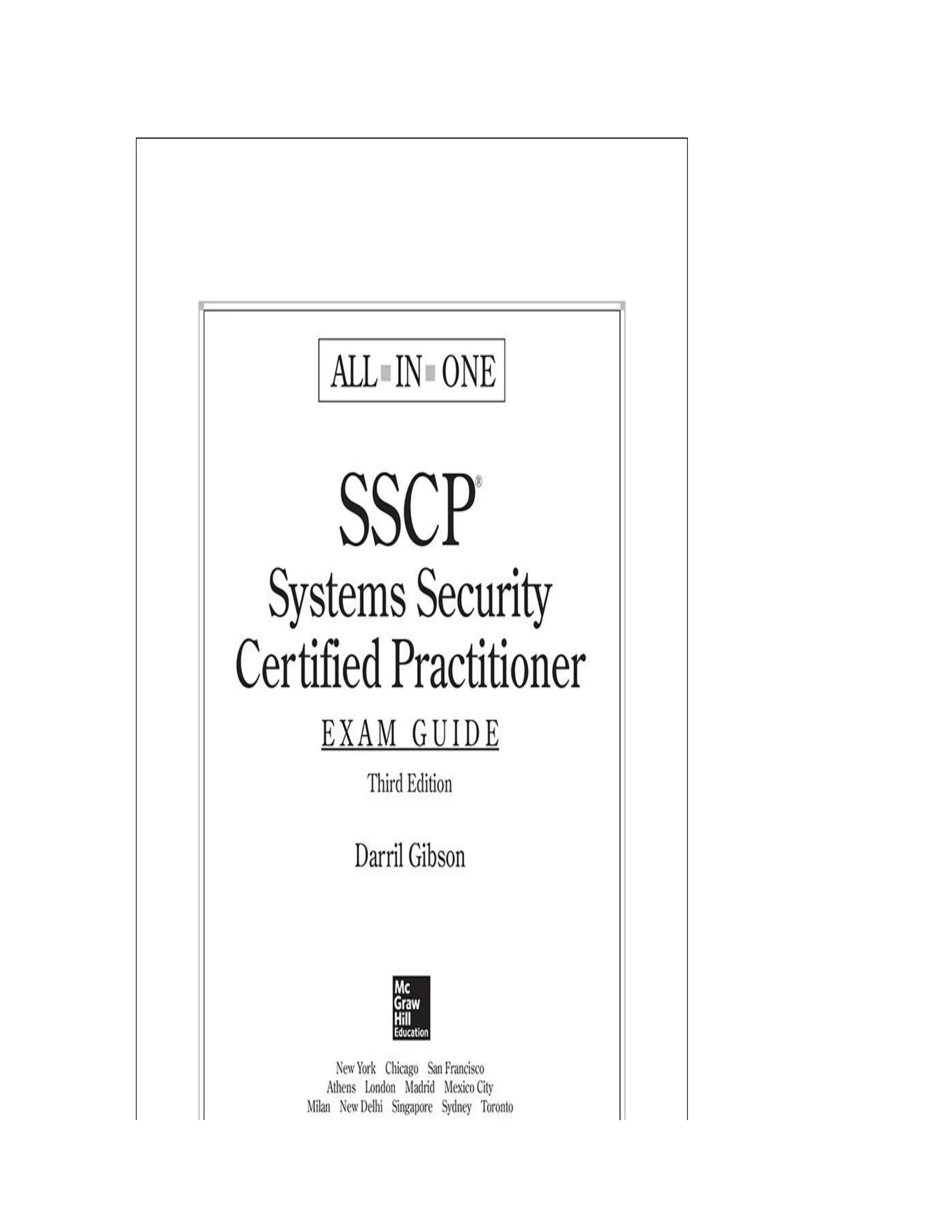
  • 66.
    particularly in thatvexatious affair of the oath which gave rise to the debate of November 25, 1537, the overthrow of the government on February 3, 1538, and the expulsion of Calvin and his friends on April 23 following. This document is, with the letters written by Calvin at this period, the most precious source of information as to the reformer’s feelings during this cruel struggle; and in quoting it at this place the author has made a judicious use of it. Let us quote further some words from an article in the Athenæum, of which we have already spoken. In the course of criticisms, sometimes severe, the writer acknowledges that ‘there are to be found in this volume, in unimpaired vigor, the qualities we admired in its predecessors. Few narratives are more moving than the simple tale of the death of Hamilton, the first of the Scotch martyrs; and the same may be said of the chapter devoted to Wishart.’ In regard to Calvin the same writer tells us—‘M. Merle possessed, as we have already remarked, a knowledge truly marvellous of the writings of Calvin; and there are few books which enable us to understand so well as M. Merle’s the mind of the reformer—not perhaps as he was on every occasion, but such as he would have wished to be.’ Professor F. Godet, of Neuchâtel, expresses the same opinions and insists on them.[7] After having spoken of ‘that stroke of a masterly pencil which was one of the most remarkable gifts of M. Merle d’Aubigné,’ he adds—‘It is always that simple and dignified style, calm and yet full of earnestness, majestic as the course of a great river, we might say—like the whole aspect of the author himself. But what appears to us above all to distinguish the manner of M. Merle is his tender and reverential love for his subject. The work which he describes possesses his full sympathy. He loves it as the work of his Saviour and his God. Jesus would no longer be what he is for the faith of the writer if he had not delivered, aided, corrected, chastened, governed and conquered as he does in this history. St. John, in the Apocalypse, shows us the Lamb opening the seals of the book containing the designs of God with respect to his church. M. Merle, in writing history, appears to see in the events which he relates so many seals which are broken under the hand of the King
  • 67.
    of Kings. Ineach fact he discerns one of the steps of his coming as spouse of the church or as judge of the world. And just as the leaves of the divine roll were written not only without but within, M. Merle is not satisfied with portraying the outside of events, but endeavors to penetrate to the divine idea which constitutes their essence, and to unveil it before the eyes of his reader. Do not therefore require him to be what is called an objective historian, and to hold himself coldly aloof from the facts which he recalls to mind. Is not this faith of the sixteenth century, of which he traces the awakening, the struggles, defeats and victories, his own faith and the life of his own soul? Are not these men whom he describes, Calvin, Farel, Viret, bone of his bone, flesh of his flesh? Are not these churches, whose birth and first steps in life he relates, his own spiritual family? The reader himself, to whom his narrative is addressed, is for him an immortal soul, which he would fain make captive to the faith of the Reformation. He does not for an instant lay aside, as narrator, his dignity as a minister of Christ. The office of historian is in his case a priesthood. Not that he falls into the error of determining at all cost to glorify his heroes, to palliate their weaknesses, to excuse their errors, or to present facts in a light different from that objective truth to which he has been led by the conscientious study of the documents. The welfare of the church of to-day for which he desires to labor, may as surely result from the frank avowal and the severe judgment of faults committed, as from admiration of every thing which has been done according to the will of God.’ The same judgment was lately pronounced by the author of a great work on French literature, recently published,[8] Lieutenant-Colonel Staaf. It is in the following terms that the author introduces M. Merle d’Aubigné to the French public:—‘M. de Remusat has said of this work—“It may have had a success among Protestants (un succès de secte), but it deserves a much wider one, for it is one of the most remarkable books in our language.” We might add one of the most austere, for it is at once the work of a historian and of a minister of the Gospel. It would be a mistake to suppose that the author has sacrificed the narrative portion of his history to the exposition and
  • 68.
    defence of thedoctrines of the Reformation. Without seeking after effects of coloring, without concerning himself with form apart from thought, he has succeeded in reproducing the true physiognomy of the age whose great and fruitful movements he has narrated. All the Christian communities over which the resistless breath of the Reformation passed live again in spirit and in act in this grand drama, the principal episodes of which are furnished by Germany, France, Switzerland, and England. In order to penetrate so deeply as he has done into the moral life of the reformers, M. Merle was not satisfied with merely searching the histories of the sixteenth century; he has drawn from sources the existence of which was scarcely suspected before they had been opened to him.’... ‘Now, at whatever point of view we may take our stand, it is no subject for regret that for writing the story of the conflicts and too often of the execution of so many men actuated by the most generous and unalterable convictions, the pen has been held by a believer rather than by a sceptic. It was only a descendant and a spiritual heir of the apostles of the Reformation who could catch and communicate the fire of their pure enthusiasm, in a book in which their passions have left no echoes. M. Merle d’Aubigné—and this is one of the peculiar characteristics of his work—has satisfied with an antique simplicity the requirements of his twofold mission. It is only when the conscience of the historian has given all the guarantees of fairness and impartiality that one had a right to expect from it that the pastor has indulged in the outpourings of his faith.’ We close with the words of Professor F. Bonifas, of Montauban:[9] ‘In this volume are to be found the eminent qualities which have earned for M. Merle d’Aubigné the first place among the French historians of the Reformation: wealth and authenticity of information, a picturesque vivacity of narration, breadth and loftiness of view, a judicious estimate of men and things, and in addition to all these a deeply religious and Christian inspiration animating every page of the book. The writer’s faculties remained young in spite of years; and this fruit of his ripe old age recalls the finest productions of his youth and manhood.’
  • 69.
    A last volumewill appear (D.V.) before the end of the present year. Ad. Duchemin. Lyons, May, 1876.
  • 70.
    CONTENTS OF THESEVENTH VOLUME. BOOK XI.—(continuation.) CALVIN AND THE PRINCIPLES OF HIS REFORM. CHAPTER XIX. CALVIN’S RECALL TO GENEVA. (August 1540 to March 1541.) The Ministers of Geneva—Departure of Morand and Marcourt from the Town—Great Famine—Advice of Calvin—His Recall determined on—The Message taken by Louis Dufour—Calvin’s First Answer— Journey to Worms—Letter from the Syndics and Council of Geneva— Calvin’s Anxieties—Consultation of his Friends—His Answer—Its Conditions—Viret called to Geneva—Viret at Geneva—The Minister Bernard—His Letter to Calvin—Calvin at Worms—Calvin and Melanchthon—Their Intimacy—Their Reciprocal Confidence— Colloquy of Worms—Song of Victory—Triumph of Christ—Calvin’s Confidence in Viret—Calvin’s Letter to Bernard—Calvin restored to Geneva by Farel—Trials—Humility and Faith 1 CHAPTER XX. CALVIN AT RATISBON. (1541.)
  • 71.
    Calvin’s Uneasiness—Concessions ofthe Lutherans—Calvin’s Steadfastness—Discourse of Cardinal Farnese—Calvin’s Answer— Papal Tyranny—The True Concord—Unity and Diversity—The Roman See not the Apostolic See—Incontinence—Profanation of Religion—A great Monster—True Ministers—Church Property—The Pope’s Crosier —Protestants and Turks—Calvin’s part at Ratisbon—Theology of Rome—Evils to be remedied—Calvin’s Moderation—Reference to the General Council—Calvin’s Departure from Ratisbon 24 CHAPTER XXI. CALVIN’S RETURN TO GENEVA. (July to September, 1541.) Repeal of the Sentence of Banishment by the General Council— Letter from the Syndics and Council of Geneva to the Pastors and Councils of Zurich and Basel—Severity of their Language—Its Expression of the common Feeling—All Difficulties removed by Letters from Geneva—Calvin’s Motto—His departure from Strasburg —His Stay at Neuchâtel—At Berne—Arrival at Geneva—Ostentation avoided—Calvin’s House—What he had acquired at Strasburg—His Appearance before the Council—Going forward—Commission of the Ordinances—Beginning of Calvin’s work—Assistance of Farel and Viret requested—The Grace of God and the Work of Man—A Day of Humiliation—The Truth with Charity 42 CHAPTER XXII. THE ECCLESIASTICAL ORDINANCES. (September, 1541.) Project of the Ordinances—Its Presentation to the Councils—Passed in the General Council—Spirit and Purpose of the Ordinances—
  • 72.
    Calvin’s Model thePrimitive Church—Geneva an Evangelical Stronghold—The Christian Life—Remonstrances—The Ministry— Instruction of the Young—The Poor and the Sick—Prisoners—Election of Pastors—The Ministers’ Oath—The Doctors—The Elders—The Consistory—Worship—Common Prayer—Discipline—Manner of judging of this Discipline—Government of the Church of Geneva— Theocracy and Democracy—State Omnipotence—Government of the Church assumed by the State—Calvin not responsible—The Danger unseen by him 60 CHAPTER XXIII. CALVIN’S PREACHING. Preaching Calvin’s Principal Office—Two to Three Thousand Sermons —His Exposition of Holy Scripture—Quotations—How a young Man shall cleanse his Way—The Love of Money—A Stranger on the Earth —Transitory Devotion—Self-love—The lost Lamb—God’s Will that all should be Saved—His Grace unbounded—How to come to God—The Blood of Christ—Predestination—Ignorance of it is Learning—No political Part played by Calvin—His clear Conception of the Evangelical Ministry 81 CHAPTER XXIV. CALVIN’S ACTIVITY. (February, 1542.) State of Feeling at Geneva—Calvin the Soul of the Consistory—His Attention to small Matters—Catholicism at Geneva—Believing what the Church believes—The Virgin and the Church—Politics no Concern of the Consistory—The Regulation of Morals its Business— Impartiality—Moderation—Calvin a Peacemaker—Meekness and Strength—Latent Hostility of the former Ministers—New Ministers—
  • 73.
    Ami Porral—His TriumphantFaith—His Christian Death—Living Christianity—The Work prospering—Development of Religious Life— Disciplinary Action—Reconciliation—Accomplishment of the Reformation—Luther’s Part—Calvin’s Part—Luther the Founder of the Reformation—Calvin its Lawgiver—Calvin a Mediator—Epochs of Light—Means of National Elevation 96 BOOK XII. THE REFORMATION AMONG THE SCANDINAVIAN NATIONS— DENMARK, SWEDEN, NORWAY. CHAPTER I. AWAKENING OF DENMARK. (1515 to 1525.) John Tausen—His Youth—His Entrance into the Monastery—His Departure for Germany—His Studies at Louvain and Cologne—At Wittenberg—Christian II.—His Marriage—Indulgences—Revolt of Sweden—Royal Vengeance—Martin Reinhard—His foreign Tongue— Encountered by Ridicule—His Departure from Denmark—Liberal Laws Promulgated by Christian—Religious Reforms—Carlstadt in Denmark—His Dismissal—Fresh revolt in Sweden—Flight of the King —Assistance of his Allies asked for in vain—The Sister of Charles the Fifth—Her Death in Heresy 120 CHAPTER II. A REFORMATION ESTABLISHED UNDER THE REIGN OF LIBERTY. (1524 to 1527.)
  • 74.
    Frederick, Duke ofHolstein—His Call to the Throne—His Leaning to Evangelical doctrine—His Impartiality towards Rome and the Reformation—Promulgation of religious Liberty—The New Testament in Danish—The Translator’s Preface—Uneasiness of the Clergy—The King’s Son in Germany—His Adhesion to the Reformation—Growing Decision of the King—A Sermon of Tausen—Tausen at Viborg— Continuance in his Work—The Reformation at Copenhagen— Determination of the Bishops to Persecute—Imprisonment of Tausen —His preaching through the Air Hole—His Liberation by the King— Reformation at Malmoe—The Eloquent Tondebinder—The Gospel embraced by the whole Town of Malmoe—Translation of Luther’s Hymns into Danish—Increasing Progress in all Parts of the Country— The Bishops’ Invitation to Eck and Cochlæus—Their Refusal to go to Denmark—The King’s Discourse to the Bishops—Complete religious Liberty—Vain Efforts of the Bishops—Royal Ordinance—Apparent Submission of the Clergy 140 CHAPTER III. TRIUMPH OF THE REFORMATION UNDER THE REIGN OF FREDERICK I. THE PEACEFUL. (1527 to 1533.) Struggles and Controversies—Tausen’s Writings—A New Bishop— Various Reforms—Tausen’s Zeal—Diet of Copenhagen—The Bishops and the Ministers—Increased Number of Sermons by the Ministers— Silence of the Bishops—Tausen and his Colleagues—Their Confession of Faith—The Articles—Surprise of the Prelates—Accusations of the Bishops—Reply of the Evangelicals—Their Demand of a public Discussion—Refusal of the Bishops—Presentation of a Memorial to the King by the Ministers—No Answer to it—Triumph of the Evangelical Cause—Disorders—Frederick’s political Position strengthened—Intrigues of the ex-King—Invasion of Norway by Christian II.—A short Struggle—Christian taken Prisoner—His
  • 75.
    Demand for aSafe-conduct—His Letter to Frederick—Treated as a Prisoner of State—Sentenced to Imprisonment for Life—Confined in a walled-up Keep—Forsaken—Luther’s Intercession for him—Death of Frederick—His Four Sons 166 CHAPTER IV. INTERREGNUM. CIVIL AND FOREIGN WAR. (1533.) Reviving Hope of the Bishops—Their Efforts—Their Intrigues— Restriction of religious Freedom—Their Purpose to elect the King’s fourth Son—Adjournment of the Election—Tausen sentenced to Death—Rising of the Townsmen—Rescue of Tausen—The Bishops threatened—Banishment of Tausen—Brigitta Gjoë—Persecution of Evangelicals—Polemics—Popular Writings—Attack of Lübeck on Denmark—Rapid Progress of the Invaders—A Diet in Jutland—Long Debates—Election of Christian III. in spite of the Bishops 194 CHAPTER V. CHRISTIAN III. PROCLAIMED KING—TRIUMPH OF THE REFORMATION IN DENMARK, NORWAY, AND ICELAND. (1533 to 1550.) Vigorous Prosecution of the War by the new King—The Enemy driven from the Provinces—Siege of Copenhagen—Extreme Sufferings of the besieged Town—Entry of Christian into his Capital—His Determination to crush the temporal Power of the Bishops—Arrest of the Bishops—General Council of the Nation—Bill of Indictment against the Bishops—Their Deprivation—Their Liberation—The King’s Invitation to Pomeranus—Reorganization of the Church by Pomeranus—New Constitution of the Church—The Reformation in
  • 76.
    Norway—In the maina Work of the Government—The Reformation in Iceland—The two Bishops of Iceland—Oddur’s Translation of the New Testament—An Evangelical Bishop—His Death—Popish Reaction —Triumph of the Gospel 211 CHAPTER VI. THE EARLIEST REFORMERS OF SWEDEN. (1516 to 1523.) Various Influences—The Brothers Olaf and Lawrence—Their early Studies—Their Application to Theology—Olaf at Wittenberg—His Intimacy with Luther—His Return to Sweden—The two Brothers and Bishop Mathias—Present at the Massacre of Stockholm—Mathias one of the Victims—Lawrence Anderson Successor of Mathias—He is favorable to the Reformation—Olaf and Lawrence at their Father’s Funeral—Their Refusal of the Services of the Monks—Violent Opposition—Their Death demanded by Bishop Brask 231 CHAPTER VII. THE REFORMERS SUPPORTED BY THE LIBERATOR OF SWEDEN. (1519 to 1524.) Gustavus Vasa Prisoner in Denmark—His Escape from Confinement— His Struggle for the Independence of Sweden—His Flight from Place to Place—News of the Massacre of Stockholm—Concealment in the Mountains—Farm Labor—Recognition of Him—Betrayal—Pursued like a wild Beast—His Attempt to rouse the People—Unsuccessful Efforts —A Rising at last—Speedy Triumph—Gustavus nominated King—His Leaning to Reform—His Welcome to the Reformers—Anderson Chancellor of the Kingdom—Olaf Preacher at Stockholm—Partisans and Adversaries—Conspiracies of the Bishops—Bishop Brask—
  • 77.
    Citation of Olafand Lawrence before the Chapter—Their Attitude— Anathema 244 CHAPTER VIII. STRUGGLES. (1524 to 1527.) The ‘Illuminated’ at Stockholm—Their Expulsion—Olaf’s Marriage— His Excommunication by Bishop Brask—His Defence undertaken by the King—Revenues of the Clergy diminished by the King— Ostentation of Archbishop Magnus—Feast of St. Erick—The Clergy humbled by the King—Fears of the Bishops—Public Disputation proposed by Magnus—Accepted by the King—Olaf and Galle— Regrets of the Catholics—Tempers heated on both sides—A Pretender—The Bishops’ Support of Him—Declaration of the King— His Resolution to complete his Task—Convocation of the States of the Kingdom—A royal Banquet—Humiliation of the Bishops 265 CHAPTER IX. VICTORY. (1527.) An Episcopal Conspiracy—The Diet of 1527—Complaints of the King —Exactions of the Clergy—Audacity of Bishop Brask—The King’s Abdication—Triumph of the Bishops—Excitement of the People—A Disputation before the Diet ordered—The King entreated to resume the Sceptre—His long Resistance—His final Consent—Political Reforms—Religious Reforms—Compact of Westeraas—Disarming of the Romish Hierarchy—Suppression of the armed Revolt—Coronation of Gustavus I. 283
  • 78.
    CHAPTER X. ‘CESAROPAPIE.’ (1528 to1546.) Assembly of Orebro—Authority of the Scriptures—Education of Pastors—Ecclesiastical Rites—Concessions—Obstacles—Discontent— Progress—Lawrence Petersen—His Nomination as Archbishop of Upsala—Marriage of the King—Marriage of the Archbishop—Hostility of the Monks—Olaf’s Desire for a complete Reformation—The King’s Desire to put it off—Coolness between the King and the Reformer— Complaints of Olaf—Irritation of the King—The Mock Suns of 1539— A Storm raging against Olaf—Brought to Trial with Anderson—Both condemned to Death—A Ransom accepted by the King—Resignation and Reinstatement of Olaf—The King Head of the Church—Luther’s Counsels—Church Order half Episcopalian and half Presbyterian— Severity of Gustavus—Excuses—Refusal of Gustavus to join the League of Smalcalde 298 CHAPTER XI. THE SONS OF GUSTAVUS VASA. (1560 to 1593.) The King’s Farewell to the People—His Illness—His Death—Erick the new King of Sweden—Debates on the Lord’s Supper—Controversies —Madness of King Erick—Massacres—Death of Burrey—Deposition of Erick—His harsh Captivity—Catholicism favored by King John— Catholicism in the ascendent—Arrival of Jesuits—Their Profession of Evangelical Doctrines—Their Attempt to convert the King—Fratricide —Death of the ex-King Erick—Conversion of John III. to Popery— Sudden Change of the King—His Death—The Assembly of Upsala in 1593—Adoption of the Confession of Augsburg 322
  • 79.
    BOOK XIII. HUNGARY, POLAND,BOHEMIA, THE NETHERLANDS. CHAPTER I. THE FIRST REFORMERS AND THE FIRST PERSECUTORS IN HUNGARY. (1518 to 1526.) First Gleams—Louis II.—Mary of Hungary—Beginning of the Reformation—The first Preachers—Their Wish to see Luther— Threatenings of Persecution—Intolerance of the Catholic Clergy— Louis II. and Frederick the Wise—The Gospel at Hermannstadt— Noteworthy Progress—Severe Ordinance against the Reform—First Act the burning of the Books—Flight of Grynæus—New Efforts—An Execution at Buda—Another Storm 342 CHAPTER II. SOLYMAN’S GREAT VICTORY. (1526.) Solyman’s Army—Hungary entirely unprepared—Vain Attempts to raise an Army—The small Troop of King Louis—Battle of Mohacz— Death of Louis II.—Sorrow of the Queen—Consolation offered by Luther—A Hymn of Resignation—Two Kings of Hungary—Martyrs at Liebethen—Edict of Persecution 356 CHAPTER III. DEVAY AND HIS FELLOW-WORKERS.
  • 80.
    (1527 to 1538.) MathiasBiro Devay—Student at Wittenberg—Various Lords Protectors of Reform—Slackening of Persecution—Reform at Hermannstadt—Solyman’s Refusal to oppress the Protestants— Confession of Augsburg welcomed by Hungarians—Devay’s Return to Hungary—His Pastorate at Buda—His Fellow-workers—Devay cast into Prison—His Appearance before the Bishop of Vienna—His Defence and Acquittal—Imprisoned again—Asylum offered Him by Count Nadasdy—Controversies with Szegedy—Devay at Wittenberg— Melanchthon’s Letter to Nadasdy—Devay at Basel—The Printing- press and Schools—Stephen Szantai—His Enemies the Bishops— Conference appointed by Ferdinand—Embarrassment of the Arbitrators—Embarrassment of Ferdinand—Efforts of the Bishops— Banishment of Szantai 366 CHAPTER IV. PROGRESS OF EVANGELIZATION AND OF THE SWISS REFORMATION IN HUNGARY. (1538 to 1545.) The Doctrines of Zwinglius in Hungary—Occasion of Trouble to some Minds—Political Divisions—Fresh Invasion of the Turks—Dispersion of Evangelical Divines—Abatement of Moslem Violence—Renewed Courage of the Christians—Progress of the Reformation—Devay in Switzerland—His Adoption of Calvin’s Doctrines—Luther’s Grief— Martin de Kalmance—Hostility excited against him—Persecution instigated by the Priests—Ordinances of Ferdinand—Courage of the Christians of Leutschau—Stephen Szegedin—His Knowledge and Eloquence—His Writings—His Acceptance of Calvin’s Doctrines— Hated by the Papists—His Banishment 388
  • 81.
    CHAPTER V. THE GOSPELIN HUNGARY UNDER TURKISH RULE. (1545 to 1548.) Rome the Persecutor—Islamism tolerant—Council of Trent—The Union of Christians in Hungary—Confessions of Faith—Szegedin in the South of Hungary—His second Banishment—Emeric Eszeky—The Gospel at Tolna—Refusal of the Turks to persecute—Spread of the Gospel—Rule of the Turks favorable to the Gospel—The Faith embraced in the whole of Transylvania 406 CHAPTER VI. BOHEMIA, MORAVIA, AND POLAND. (1518 to 1521.) The United Brethren—Relations with Luther—Luther’s Goodwill— Discussions on the Lord’s Supper—The Calixtines—Poland evangelized by the Bohemians—First Successes—Luther’s Reformation in Poland—Jacob Knade at Dantzic—The Gospel well received—Religious Liberty—A Revolution at Dantzic—Reorganization of the Church—Appeal of the Catholics to the King—Harshness of Sigismund—Final Triumph of the Gospel—The Gospel at Cracow— Embraced by many eminent Persons—Words of Luther—Attempted Reformation in Russia 417 CHAPTER VII. THE POLISH REFORMER. (1524 to 1527.)
  • 82.
    Welcome to OurBookstore - The Ultimate Destination for Book Lovers Are you passionate about books and eager to explore new worlds of knowledge? At our website, we offer a vast collection of books that cater to every interest and age group. From classic literature to specialized publications, self-help books, and children’s stories, we have it all! Each book is a gateway to new adventures, helping you expand your knowledge and nourish your soul Experience Convenient and Enjoyable Book Shopping Our website is more than just an online bookstore—it’s a bridge connecting readers to the timeless values of culture and wisdom. With a sleek and user-friendly interface and a smart search system, you can find your favorite books quickly and easily. Enjoy special promotions, fast home delivery, and a seamless shopping experience that saves you time and enhances your love for reading. Let us accompany you on the journey of exploring knowledge and personal growth! ebookgate.com