Beyond Basic DatatypesSQL Objects and PL/SQL
Who am I ?Gary MyersOracle developer since 1994 Database Consultant with SMS M&TBlogger since 2004Now at blog.sydoracle.comTwitter at syd_oracleGuest editor at Log Buffer"Oracle" badge at Stackoverflow forums Find me at LinkedIn…
What is PL/SQLPL/SQL is an EXTENSION to SQLPL/SQL is proceduralClosely tied to the databaseRuns under the oracle shadow processMostly in the PGA BEWARE Shared Server (eg APEX)
PL/SQL DatatypesAs an extension, PL/SQL recognizes all SQL datatypes (except LONG)That includes user-defined datatypesUser-defined datatypes includes Oracle supplied ones such as Spatial (MDSYS) and Multimedia (ORDSYS).
PL/SQL specific datatypesBoolean, PLS_INTEGER etcOnly within PL/SQLCannot be used to ‘talk’ to SQL.Avoid as function parametersSome potential for better performance and/or memory consumption
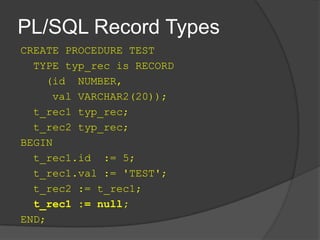
PL/SQL Record TypesCREATE PROCEDURE TEST  TYPE typ_rec is RECORD   (id  NUMBER,val VARCHAR2(20));t_rec1 typ_rec; t_rec2 typ_rec;BEGINt_rec1.id  := 5;t_rec1.val := 'TEST'; t_rec2 := t_rec1;t_rec1 := null;END;
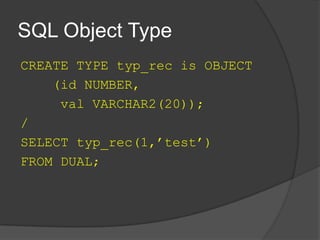
SQL Object TypeCREATE TYPE typ_rec is OBJECT    (id NUMBER,val VARCHAR2(20));/SELECT typ_rec(1,’test’)FROM DUAL;
Constructor MethodsCREATE TYPE holt AS OBJECT 	     (record_type varchar2(1),record_column varchar2(10) ,  CONSTRUCTOR FUNCTION holt ( i_record_type in varchar2 default null,i_record_column in varchar2 default null)    return self as result);
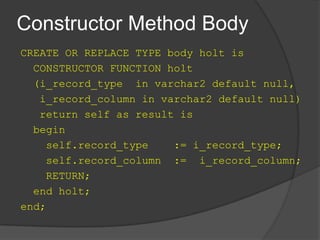
Constructor Method BodyCREATE OR REPLACE TYPE body holt is  CONSTRUCTOR FUNCTION holt  (i_record_type  in varchar2 default null,i_record_column in varchar2 default null)    return self as result is 	  beginself.record_type    := i_record_type;self.record_column  :=  i_record_column;    RETURN;  end holt;end;
PL/SQL using  SQL Typedeclarev_holt   holt;beginv_holt := holt(i_record_type => 'a', i_record_column => 'B');end;/
PL/SQL Collection TypesCREATE PROCEDURE TEST  TYPE typ_coll_vc10 is TABLE   OF VARCHAR2(10) INDEX BY PLS_INTEGER;tc_val typ_coll_vc10;BEGINtc_val(1) := 'TEST';END;
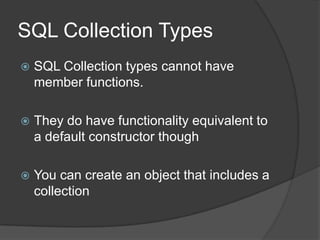
SQL Collection TypesSQL Collection types cannot have member functions.They do have functionality equivalent to a default constructor thoughYou can create an object that includes a collection
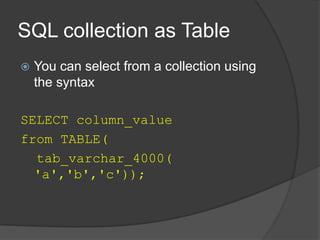
SQL collection as TableYou can select from a collection using the syntaxSELECT column_valuefrom TABLE(  tab_varchar_4000( 'a','b','c'));
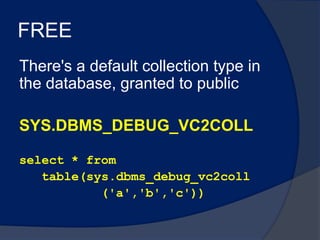
FREE There's a default collection type in the database, granted to publicSYS.DBMS_DEBUG_VC2COLLselect * from  table(sys.dbms_debug_vc2coll            ('a','b','c'))
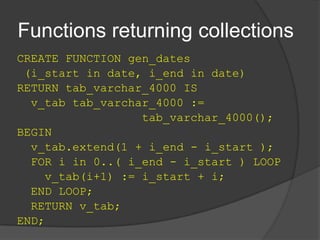
Functions returning collectionsCREATE FUNCTION gen_dates (i_start in date, i_end in date) RETURN tab_varchar_4000 ISv_tab tab_varchar_4000 :=                  tab_varchar_4000();BEGINv_tab.extend(1 + i_end - i_start );FOR i in 0..( i_end - i_start ) LOOPv_tab(i+1) := i_start + i;END LOOP;  RETURN v_tab;END;
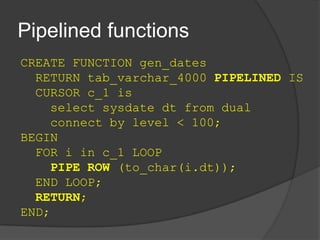
Pipelined functionsCREATE FUNCTION gen_datesRETURNtab_varchar_4000 PIPELINED ISCURSOR c_1 is    select sysdatedt from dual     connect by level < 100;BEGINFORi in c_1 LOOPPIPE ROW(to_char(i.dt));END LOOP;RETURN;END;
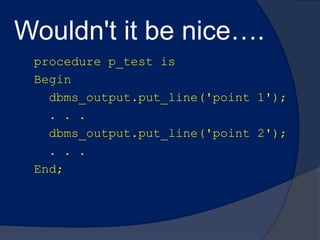
Wouldn't it be nice….procedure p_test isBegindbms_output.put_line('point 1');  . . .dbms_output.put_line('point 2');  . . .End;
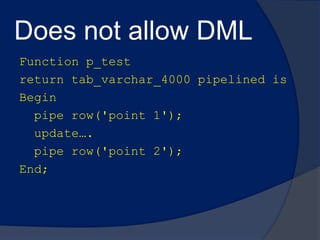
Does not allow DMLFunction p_testreturn tab_varchar_4000 pipelined isBegin  pipe row('point 1');  update….  pipe row('point 2');End;
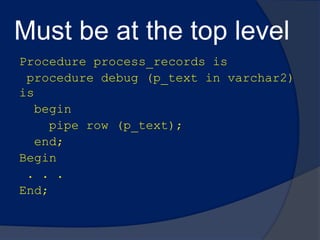
Must be at the top levelProcedure process_records is procedure debug (p_text in varchar2) is  begin    pipe row (p_text);  end;Begin . . .End;
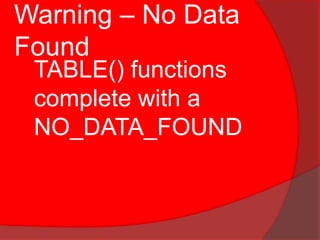
Warning – No Data FoundTABLE() functions complete with a NO_DATA_FOUND
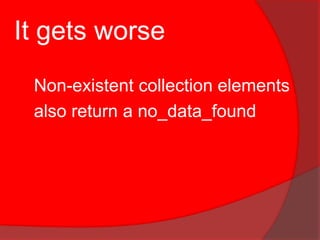
It gets worseNon-existent collection elementsalso return a no_data_found
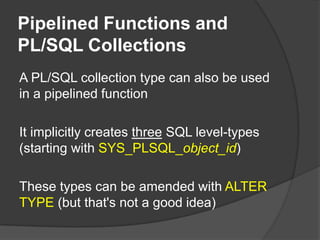
Pipelined Functions and PL/SQL CollectionsA PL/SQL collection type can also be used in a pipelined functionIt implicitly creates three SQL level-types (starting with SYS_PLSQL_object_id)These types can be amended with ALTER TYPE (but that's not a good idea)
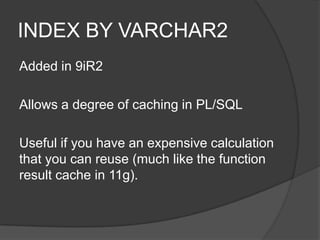
INDEX BY VARCHAR2Added in 9iR2Allows a degree of caching in PL/SQLUseful if you have an expensive calculation that you can reuse (much like the function result cache in 11g).
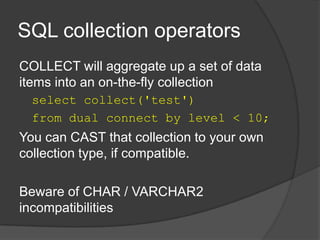
SQL collection operatorsCOLLECT will aggregate up a set of data items into an on-the-fly collectionselect collect('test') from dual connect by level < 10;You can CAST that collection to your own collection type, if compatible. Beware of CHAR / VARCHAR2 incompatibilities
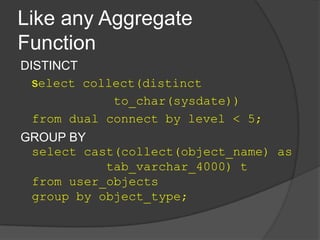
Like any Aggregate FunctionDISTINCTselect collect(distinct to_char(sysdate)) from dual connect by level < 5;GROUP BYselect cast(collect(object_name) as          tab_varchar_4000) t from user_objectsgroup by object_type;
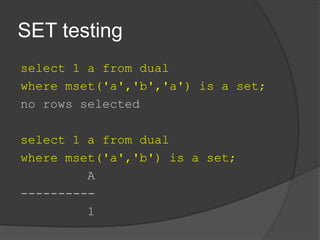
Collections and SetsDefinition :A collection is a set if it doesn't have duplicates
SET testingselect 1 a from dual where mset('a','b','a') is a set;no rows selectedselect 1 a from dual where mset('a','b') is a set;         A----------         1
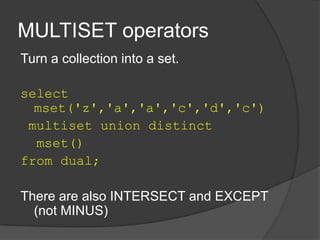
MULTISET operatorsTurn a collection into a set. select mset('z','a','a','c','d','c')multiset union distinctmset() from dual;There are also INTERSECT and EXCEPT (not MINUS)
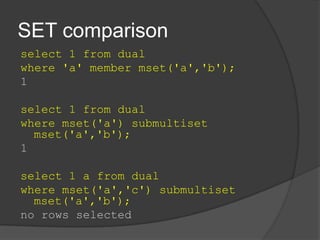
SET comparisonselect 1 from dual where 'a' member mset('a','b');1select 1 from dual where mset('a') submultisetmset('a','b');1select 1 a from dual where mset('a','c') submultisetmset('a','b');no rows selected
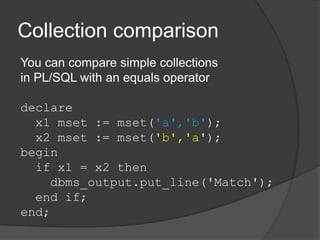
Collection comparisonYou can compare simple collections in PL/SQL with an equals operatordeclare  x1 mset := mset('a','b');  x2 mset := mset('b','a');begin  if x1 = x2 thendbms_output.put_line('Match');  end if;end;
Multiset operators in PL/SQLdeclare  x1 mset := mset('a','b');  x2 mset := mset('b');  x3 mset;begin  x3 := x1 multiset except x2;dbms_output.put_line(x3.count        ||  '.'||x3(1));end;
Final ThoughtFor complex logic SQL*Plus embedded in shell scripts is     NOTa good idea

Sql Objects And PL/SQL

  • 1.
    Beyond Basic DatatypesSQLObjects and PL/SQL
  • 2.
    Who am I?Gary MyersOracle developer since 1994 Database Consultant with SMS M&TBlogger since 2004Now at blog.sydoracle.comTwitter at syd_oracleGuest editor at Log Buffer"Oracle" badge at Stackoverflow forums Find me at LinkedIn…
  • 3.
    What is PL/SQLPL/SQLis an EXTENSION to SQLPL/SQL is proceduralClosely tied to the databaseRuns under the oracle shadow processMostly in the PGA BEWARE Shared Server (eg APEX)
  • 4.
    PL/SQL DatatypesAs anextension, PL/SQL recognizes all SQL datatypes (except LONG)That includes user-defined datatypesUser-defined datatypes includes Oracle supplied ones such as Spatial (MDSYS) and Multimedia (ORDSYS).
  • 5.
    PL/SQL specific datatypesBoolean,PLS_INTEGER etcOnly within PL/SQLCannot be used to ‘talk’ to SQL.Avoid as function parametersSome potential for better performance and/or memory consumption
  • 6.
    PL/SQL Record TypesCREATEPROCEDURE TEST TYPE typ_rec is RECORD (id NUMBER,val VARCHAR2(20));t_rec1 typ_rec; t_rec2 typ_rec;BEGINt_rec1.id := 5;t_rec1.val := 'TEST'; t_rec2 := t_rec1;t_rec1 := null;END;
  • 7.
    SQL Object TypeCREATETYPE typ_rec is OBJECT (id NUMBER,val VARCHAR2(20));/SELECT typ_rec(1,’test’)FROM DUAL;
  • 8.
    Constructor MethodsCREATE TYPEholt AS OBJECT (record_type varchar2(1),record_column varchar2(10) , CONSTRUCTOR FUNCTION holt ( i_record_type in varchar2 default null,i_record_column in varchar2 default null) return self as result);
  • 9.
    Constructor Method BodyCREATEOR REPLACE TYPE body holt is CONSTRUCTOR FUNCTION holt (i_record_type in varchar2 default null,i_record_column in varchar2 default null) return self as result is beginself.record_type := i_record_type;self.record_column := i_record_column; RETURN; end holt;end;
  • 10.
    PL/SQL using SQL Typedeclarev_holt holt;beginv_holt := holt(i_record_type => 'a', i_record_column => 'B');end;/
  • 11.
    PL/SQL Collection TypesCREATEPROCEDURE TEST TYPE typ_coll_vc10 is TABLE OF VARCHAR2(10) INDEX BY PLS_INTEGER;tc_val typ_coll_vc10;BEGINtc_val(1) := 'TEST';END;
  • 12.
    SQL Collection TypesSQLCollection types cannot have member functions.They do have functionality equivalent to a default constructor thoughYou can create an object that includes a collection
  • 13.
    SQL collection asTableYou can select from a collection using the syntaxSELECT column_valuefrom TABLE( tab_varchar_4000( 'a','b','c'));
  • 14.
    FREE There's adefault collection type in the database, granted to publicSYS.DBMS_DEBUG_VC2COLLselect * from table(sys.dbms_debug_vc2coll ('a','b','c'))
  • 15.
    Functions returning collectionsCREATEFUNCTION gen_dates (i_start in date, i_end in date) RETURN tab_varchar_4000 ISv_tab tab_varchar_4000 := tab_varchar_4000();BEGINv_tab.extend(1 + i_end - i_start );FOR i in 0..( i_end - i_start ) LOOPv_tab(i+1) := i_start + i;END LOOP; RETURN v_tab;END;
  • 16.
    Pipelined functionsCREATE FUNCTIONgen_datesRETURNtab_varchar_4000 PIPELINED ISCURSOR c_1 is select sysdatedt from dual connect by level < 100;BEGINFORi in c_1 LOOPPIPE ROW(to_char(i.dt));END LOOP;RETURN;END;
  • 17.
    Wouldn't it benice….procedure p_test isBegindbms_output.put_line('point 1'); . . .dbms_output.put_line('point 2'); . . .End;
  • 18.
    Does not allowDMLFunction p_testreturn tab_varchar_4000 pipelined isBegin pipe row('point 1'); update…. pipe row('point 2');End;
  • 19.
    Must be atthe top levelProcedure process_records is procedure debug (p_text in varchar2) is begin pipe row (p_text); end;Begin . . .End;
  • 20.
    Warning – NoData FoundTABLE() functions complete with a NO_DATA_FOUND
  • 21.
    It gets worseNon-existentcollection elementsalso return a no_data_found
  • 22.
    Pipelined Functions andPL/SQL CollectionsA PL/SQL collection type can also be used in a pipelined functionIt implicitly creates three SQL level-types (starting with SYS_PLSQL_object_id)These types can be amended with ALTER TYPE (but that's not a good idea)
  • 23.
    INDEX BY VARCHAR2Addedin 9iR2Allows a degree of caching in PL/SQLUseful if you have an expensive calculation that you can reuse (much like the function result cache in 11g).
  • 24.
    SQL collection operatorsCOLLECTwill aggregate up a set of data items into an on-the-fly collectionselect collect('test') from dual connect by level < 10;You can CAST that collection to your own collection type, if compatible. Beware of CHAR / VARCHAR2 incompatibilities
  • 25.
    Like any AggregateFunctionDISTINCTselect collect(distinct to_char(sysdate)) from dual connect by level < 5;GROUP BYselect cast(collect(object_name) as tab_varchar_4000) t from user_objectsgroup by object_type;
  • 26.
    Collections and SetsDefinition:A collection is a set if it doesn't have duplicates
  • 27.
    SET testingselect 1a from dual where mset('a','b','a') is a set;no rows selectedselect 1 a from dual where mset('a','b') is a set; A---------- 1
  • 28.
    MULTISET operatorsTurn acollection into a set. select mset('z','a','a','c','d','c')multiset union distinctmset() from dual;There are also INTERSECT and EXCEPT (not MINUS)
  • 29.
    SET comparisonselect 1from dual where 'a' member mset('a','b');1select 1 from dual where mset('a') submultisetmset('a','b');1select 1 a from dual where mset('a','c') submultisetmset('a','b');no rows selected
  • 30.
    Collection comparisonYou cancompare simple collections in PL/SQL with an equals operatordeclare x1 mset := mset('a','b'); x2 mset := mset('b','a');begin if x1 = x2 thendbms_output.put_line('Match'); end if;end;
  • 31.
    Multiset operators inPL/SQLdeclare x1 mset := mset('a','b'); x2 mset := mset('b'); x3 mset;begin x3 := x1 multiset except x2;dbms_output.put_line(x3.count || '.'||x3(1));end;
  • 32.
    Final ThoughtFor complexlogic SQL*Plus embedded in shell scripts is NOTa good idea

Editor's Notes

  • #3 Did a bit of COBOL and IDMS-XThen Ingres for a couple of yearsFound Oracle around the Forms 3 Era, used a lot of Pro*CobolCame to Australia about 12 years ago from England.Forms work in Perth and Adelaide.Arrived in Sydney in ‘99Contracted with the Office of State Revenue, P&amp;O Nedlloyd, MBF Health Insurance…Consultant with DWS for a year, contracted for a bit more.Been consulting with SMS for about 18 monthsCurrently at SiCorp on a very small data warehouse.
  • #4 SQL is very good at set-based operations.When the task isn’t set based, it is worth considering a procedural approach.Processing of large data volumes are more likely to be amenable to set-based solutions. Because PL/SQL runs in the database, and as the same process performing SQL operations, there is a smaller detrimental impact from context switching than you may get from a client language containing SQL (e.g. Perl, Python )In Shared Server, session persistent data is stored in the UGA which is in the SGA, but data that is only required for the duration of the call may still be in the PGA.
  • #5 By not requiring a translation between the SQL types and PL/SQL types, any impedance is reduced.
  • #6 PL/SQL has its own particular datatypes that are geared towards PROCESSING of data, as opposed to STORAGE. Mostly they are beneficial in terms of performance and/or memory consumption.Unless you do heavy processing in PL/SQL, the benefits are likely to be smallPlus they cannot be used in embedded SQL statements, and have to be converted to a standard datatype.
  • #7 You can have type declarations in PL/SQL which are local to the code block.If declared in a package specification, they can be used more widely, but (generally) only within PL/SQL.You can assign variables of the same type to each other. You can assign NULL to a record type.Comparison isn&apos;t as simple (and don&apos;t forget NULLs in record items when you do comparisons).Sometimes worth creating comparison functions.
  • #8 An SQL Object type has attributes (a cross between variables and columns) and optionally member functions/proceduresThese can be used in SQL and PL/SQL
  • #9 Objects come with a default constructor method, where you can create an INSTANCE of the object by stating the object name then, in brackets, values for every one of the attributes. You can create your own constructor functions too. They MUST have the same name as the type, but can differ in their parameters. They can have different numbers of parameters, parameter names, datatypes and default values.I like constructors that have parameters that default to null, so I don&apos;t have to supply them all
  • #10 To implement the method, you need a BODY, in the same way as a package body. Unlike packages, a type body cannot contain functions not declared in the TYPE specification. [But you can declare private functions / procedures in the declaration part of the member functions.CREATE OR REPLACE TYPE body holt is CONSTRUCTOR FUNCTION holt ( i_record_type in varchar2 default null,i_record_column in varchar2 default null) return self as result isv_number number; procedure p_test is beginv_number := 1; end; beginself.record_type := i_record_type;self.record_column := i_record_column; RETURN; end holt;end;
  • #11 You can use user-defined types as easily as the built-in types.
  • #12 A collection type, in PL/SQL, can be of an ARRAY or TABLE. I find tables more useful as I don’t need to consider size when I declare them. A collection is of a single data type. However that datatype may be a simple SQL datatype [such as NUMBER or VARCHAR2(n)], a user-defined SQL datatype (such as a Spatial co-ordinate)) a PL/SQL type such as PLS_INTEGER or a user-defined PL/SQL record type. You can even define collections of collections, though that would get complicated.
  • #13 So you can have a collection like CREATE TYPE tab_varchar_4000 IS TABLE OF VARCHAR2(4000);CREATE TYPE strings_coll IS OBJECT (coll tab_varchar_4000);
  • #14 You are limited to a default constructor if you use the type directly.
  • #15 There&apos;s no public synonym for it, so you need to use the SYS schema declaration
  • #16 You need to initialize the collection.Then extend it to the size necessary.Load up the rows and return it.You can then just select from itselect * from table(gen_dates(sysdate, sysdate+10));
  • #17 Pipelined functions don&apos;t need to assemble the whole dataset into memory before returning it.You MUST have the RETURN at the end, and it returns nothing.
  • #18 You&apos;ve probably seen code like this. Lots of debug statements to report on what the code is doing.Or rather what the code has done, as dbms_output doesn&apos;t get reported until the end.Can we use PIPE ROW to report on debugging during processing ?
  • #19 You don&apos;t want to try wrapping it all up in autonomous transactions and ugly stuff like that
  • #20 You&apos;ve probably seen code like this. Lots of debug statements to report on what the code is doing.Or rather what the code has done, as dbms_output doesn&apos;t get reported until the end.Can we use PIPE ROW to report on debugging during processing ?The PIPE ROW has to be in the top level (ie can&apos;t be delegated to a called subroutine).create function process_records return tab_varchar_4000 pipelined isv_str varchar2(10); procedure put (p_text in varchar2) is begin pipe row (p_text); end;begin for i in 1 .. 10 loop select id into v_str from recs where id = i; put (&apos;update &apos;||i); end loop; return;end;/PLS-00629: PIPE statement cannot be used in non-pipelined functions
  • #21 Warning - NO_DATA_FOUND is a PL/SQL exceptionIt is NOT an SQL error.When you select from a function returning a table, if the PL/SQL encounters an unhandled NO_DATA_FOUND exception, it acts like a RETURN. The function ends, and as far as the SQL is concerned, it completed successfully.create function gen_nums return tab_varchar_4000 pipelinedis cursor c_1 is select rownumrn from dual connect by level &lt; 10;v_num number;begin for i in c_1 loop select 1 into v_num from dual where i.rn &lt; 3; pipe row (i.rn); end loop; return;end;/select * from table(gen_nums);Only returns 2 rows.ALWAYS use a NO_DATA_FOUND exception handler and raise it as a different error.drop function gen_nums;create function gen_nums return tab_varchar_4000 pipelinedis cursor c_1 is select rownumrn from dual connect by level &lt; 10;v_num number;begin for i in c_1 loop select 1 into v_num from dual where i.rn &lt; 3; pipe row (i.rn); end loop; return;exception when no_data_found thenraise_application_error(-20001,&apos;NDF&apos;,false);end;/select * from table(gen_nums);
  • #22 drop function gen_char;create function gen_char return tab_varchar_4000 pipelinedis type tab_val is table of varchar2(10) index by pls_integer;t_valtab_val;begint_val(1) := &apos;test 1&apos;;t_val(10) := &apos;test 10&apos;; pipe row (t_val(10)); pipe row (t_val(5)); pipe row (t_val(1)); return;--exception-- when no_data_found then-- raise_application_error(-20001,&apos;NDF&apos;,false);end;/select * from table(gen_char);
  • #23 create or replace package test_pipe_pkg is type rec_pipe is record (id number, val varchar2(20)); type tab_pipe is table of rec_pipe; function ret_pipe return tab_pipe pipelined;end;/create or replace package body test_pipe_pkg is function ret_pipe return tab_pipe pipelined isv_recrec_pipe; begin v_rec.id := 1; v_rec.val := &apos;test&apos;; pipe row (v_rec); return; end;end;/select * from table(test_pipe_pkg.ret_pipe);select type_name from user_types where type_name like &apos;SYS_PLSQL%&apos;;alter type &quot;GARY&quot;.&quot;SYS_PLSQL_13672_9_1&quot; add attribute gid number;
  • #24 create table t_sub_postcodes (postcode varchar2(4), suburb_name varchar2(20));insert into t_sub_postcodes values (&apos;2000&apos;,&apos;Sydney&apos;);insert into t_sub_postcodes values (&apos;3000&apos;,&apos;Melbourne&apos;);create or replace procedure demo_cache is type tab_postcode is table of varchar2(4) index by varchar2(40);t_postcodetab_postcode; cursor c_1 is select decode(mod(rownum,2),1,&apos;Sydney&apos;,&apos;Melbourne&apos;) sub from dual connect by level &lt;10; function get_postcode (i_suburb in varchar2) return varchar2 isv_postcode varchar2(4); begin if t_postcode.exists (i_suburb) then return t_postcode(i_suburb); elsedbms_output.put_line(&apos;Fetching&apos;); select postcode into v_postcode from t_sub_postcodes where suburb_name = i_suburb;t_postcode(i_suburb) := v_postcode; return t_postcode(i_suburb); end if; end;begin for c_rec in c_1 loopdbms_output.put_line(get_postcode(c_rec.sub)); end loop; end;/show errors procedure demo_cacheexec demo_cache;
  • #25 create table test (val varchar2(10));insert into test select sysdate+level from dual connect by level &lt; 10;select cast(collect(val) as tab_varchar_4000) a from test;
  • #27 create type mset is table of varchar2(4000);/create type mset_mset is table of mset;/
  • #28 create type mset is table of varchar2(4000);/create type mset_mset is table of mset;/
  • #30 First one checks if an ELEMENT is in the setSecond/third ones check if a set is contained within a set
  • #31 set serveroutput on declare x1 tab_varchar_4000; x2 tab_varchar_4000;begin select cast(collect(to_char(sysdate)) as tab_varchar_4000) into x1 from dual connect by level &lt; 10; -- select cast(collect(to_char(sysdate)) as tab_varchar_4000) into x2 from dual connect by level &lt; 5; -- if x1 = x2 thendbms_output.put_line(&apos;Match&apos;); --elsif x1 &lt; x2 then -- dbms_output.put_line(&apos;Less&apos;); elsedbms_output.put_line(&apos;No Match&apos;); end if;end;./
  • #32 Also works with locally defined collectionsdeclare TYPE lset is table of varchar2(30); x1 lset := lset(&apos;a&apos;,&apos;b&apos;); x2 lset := lset(&apos;b&apos;); x3 lset;begin x3 := x1 multiset except x2;dbms_output.put_line(x3.count||&apos;.&apos;||x3(1));end;But not complex ones (SQL or PL/SQL)declare TYPE lrc is record (id number, val varchar2(10)); TYPE lset is table of lrc; x1 lset; x2 lset; x3 lset; function x (p_id in number, p_val in varchar2) return lrc isv_xlrc; begin v_x.id := p_id; v_x.val := p_val; return v_x; end;begin x1 := lset(x(1,&apos;a&apos;), x(2,&apos;b&apos;)); x2 := lset(x(2,&apos;b&apos;)); x3 := x1 multiset except x2;dbms_output.put_line(x3.count);end;
  • #33 SQL*Plus is a poor tool for procedural logic (loops and conditional flows)Embedding calls to sqlplus in a shell script is not a good idea.You generally won’t have a persistent connection, so will be continually logging on and off the database. You can’t maintain transactionsThere is poor error/exception handling as you can really only return a generic error/warning to the shell script.Use Perl (which gets installed with the databases, except XE) or Python or….PL/SQL